



Abstract
This paper proposes a new conceptual approach to the development and utilization of youth-led environmental assessments to inform the planning of youth-enabling environments. Interdisciplinary research has established the influential effects of the physical environment on children and adolescents’ well-being and development, yet there is a gap in our understanding of how to create everyday environments for youth that speak to their needs and interests and provide opportunities for them to flourish. Engaging youth through participatory action research to both develop and conduct environmental assessments can have positive implications for youth empowerment and well-being while also altering research and planning practices to effectively integrate youth voice. The proposed approach integrates elements from affordance theory, the Capability Approach, and positive youth development within a youth participatory action research framework to create a process that encourages capability formation, fosters positive development, and improves our understanding of what constitutes a youth-enabling environment.
The physical environment has been identified as an area in which improvements in policy and practice can positively affect youth in a multitude of ways (Gladstone et al., 2021). However, many public spaces that could, in theory, serve youth interests and support positive development have not prioritized nor capitalized on this potential. As a result, youth often feel as though they don’t belong in or that their goals and needs are not being met by these public environments (Travlou et al., 2008). When environments are planned with youth in mind, designs tend to focus on fulfilling specific developmental needs instead of providing opportunities for youth to realize and exercise their capacities, agency, and identity (Clark & Uzzell, 2006; Ozer, 2017). As well, youth are rarely involved directly in the assessment or design of public spaces (Loebach, 2020). The successful design or transformation of public spaces into welcoming environments with the potential to support positive youth development can be significantly enhanced when researchers, planners, and policy makers employ participatory assessment and planning approaches to directly and genuinely involve youth in the process (Caraballo & Lyiscott, 2020).
Participatory research is a collaborative approach in which community members are engaged as active partners in knowledge generation processes (Anucha et al., 2020; Bertrand et al., 2017). Community-Based Participatory Research (CBPR) is a non-hierarchical and interactive participatory practice that can empower communities themselves to identify issues and generate social change based on their collective experiences and knowledge (Kwan & Walsh, 2018). Youth Participatory Action Research (YPAR), a subset of CBPR, is typically guided by three principles: (1) inquiry is driven by the experiences of youth; (2) research is carried out collaboratively with adults instead of by adults; and (3) the ultimate goal is to improve the lives of youth and their communities through transformative, socially-just action (Rodriguez & Brown, 2009). Applying a YPAR framework to the development of youth-led environmental assessment tools offers the opportunity to not only assess environments in ways which align with the priorities and preferences of youth but champions mechanisms that encourage youth themselves to take actions toward the development of youth-enabling community environments.
YPAR models can be utilized in environmental assessment and planning to directly engage youth in the investigation and improvement of their own community spaces. When applied to planning of public spaces, participatory processes can shift the focus from specific designs and discrete features to the relationship between “people and place” (Rochecouste & Pearson, 2014, p. 44). Existing environmental assessments or audits generally consider physical amenities and esthetic and social characteristics of a setting in relation to how they shape our use of or afford behaviors within a given space. While some audits have been designed to evaluate environments in which youth are considered as a user group, such as parks (Bedimo-Rung et al., 2006; Besenyi et al., 2016, 2018), public activity spaces (G. King et al., 2014; Saelens et al., 2016), and educational settings (Horacek et al., 2014; Lee et al., 2013), they often measure discrete behavioral outcomes for youth, such as physical activity, and/or the presence of resources intended to improve those outcomes (Joseph & Maddock, 2016; Uhm et al., 2011). Such assessments often omit or diminish the importance of contextual factors that influence young people’s utilization of the spaces, such as quality of the environment (Clark & Uzzell, 2006), opportunities for challenge and risk (G. King et al., 2014), the behavior of others (Borghi, 2018), or the degree to which the environment is experienced as welcoming (Manzo, 2005; Travlou et al., 2008).
While there are a few published assessment tools that position youth as primary evaluators (Besenyi et al., 2016, 2018), there has been little to no participatory youth engagement in the development of these evaluation tools. Sincerely engaging youth as experts of their own environments can generate opportunities for youth to critically examine their needs and desires in relation to a space and actively contribute to the enhancement of their communities (Bertrand et al., 2017). Shifting the perspective to assessing spaces according to individuals’ values and aspirations also can lead to more resilient and sustainable community spaces that promote healthy social development and well-being, especially for youth (Derr & Kovács, 2015).
In this paper, we propose an integrated participatory approach to engaging youth in the development and use of environmental assessment tools and processes which are not only contextually sensitive but that honors the capabilities and desires of youth. We begin by illustrating how both the physical environment and participation in research affect youth—specifically adolescent—development. Then drawing on theoretical principles of both the Capability Approach and positive youth development, we describe a conceptual framework for developing youth-engaged environmental assessments. We will then outline how this approach can be operationalized to develop youth-informed and -led environmental assessments that integrate sociocultural influences, physical elements, and participatory principles to specifically and successfully address youth needs. This approach can also advance researchers’ and advocates’ understanding of the factors that can support healthy development and inform the improvement community spaces
Adolescent Development
Adolescence, typically defined as occurring between the ages of 10 and 19 (United Nations, 2013; World Health Organization [WHO], 2015), has been characterized as a mercurial period in the life course (Committee on the Rights of the Child, 2016). Research-based models of adolescence often index development by chronological age or stage (Petersen, 1988), frequently delineated by the onset of puberty, with the premise that each stage must be “completed” before the individual can progress to the next. These theories propose individual physical, social, and psychological attributes as factors that lead adolescents to engage in “risky” behavior and decision-making, positioning youth as passive individuals at the mercy of biological drives, who lack control over their own action and development (Lohmeyer, 2020).
However, research over the past few decades has shown that changes that occur during adolescence are not necessarily correlated with chronological age, and each adolescent’s development is significantly influenced by the physical, social, cultural, and historical context within which they live (Azzopardi et al., 2017). This more contemporary stance has highlighted a need to consider adolescence within a complex, socio-ecological model (Ozer, 2017; Patton et al., 2016), echoing calls from UNICEF and the WHO (2015, 2018) to develop innovative, intersectoral, and multi-component interventions to invest in and improve adolescent health and well-being (Gates, 2016).
Positive Youth Development
The shift away from characterizing adolescence as a developmental disturbance (Freud, 1969) and a time of crisis or conflict (Erikson, 1968) has refocused much adolescent and developmental research toward a more relational approach, called positive youth development (PYD; Roth & Brooks-Gunn, 2003). This strengths-based perspective is rooted in developmental systems theory that recognizes the impact of cultural, ecological, and socio-relational contexts on, and the inherent plasticity of, human development (Lerner, Almerigi, et al., 2005). PYD emphasizes that all youth have the potential for positive, healthy development while acknowledging that, “desired, prosocial developmental outcomes. . . .can occur in parallel with behaviors that may be judged as disruptive or antisocial” (Barbarin et al., 2020, p. 201). These prosocial developmental outcomes include empathy, altruism, belonging, self-worth, and realization of skills and interests (Lerner et al., 2021; Tintiangco-Cubales et al., 2016).
There are a number of frameworks that operationalize contributors to PYD, all of which consider the dynamic relationship between individuals and contexts as integral to the process of thriving (Lerner et al., 2021). The Developmental Assets Profile (Benson, 2006) proposes 40 assets (20 internal and 20 external), such as support, empowerment, and positive identity, as building blocks for healthy development, while the five C’s model (P. E. King et al., 2005; Lerner, Almerigi, et al., 2005) purports that aligning youths’ strengths’ with resources in their community to promote each of the five C’s (i.e., competence, confidence, connection, character, and caring) will lead to thriving and the development of a sixth C: contribution to self, family, and community (Lerner et al., 2021). The USAID & YouthPower Learning PYD framework outlines four domains—assets, agency, contribution, and enabling environment—in which PYD programs, policies, and services must work to, “achieve the vision of healthy, productive and engaged youth” (Hinson et al., 2016, p. 22), and to ensure that youth are thriving (P. E. King et al., 2005, p. 95). Here, the term “environment” is interpreted broadly to include, “social (e.g., relationships with peers and adults), normative (e.g., attitudes, norms, and beliefs), structural (e.g., laws, policies, programs services, and systems), and physical spaces (e.g., safe, supportive spaces)” (Hinson et al., 2016, p. 22). While this is one of the few frameworks to acknowledge the physical environment in any way, it narrowly conceptualizes it as the physical conditions that create safe safes for youth or else as physical access to services and opportunities. However, youth development is influenced by a much broader range of physical environmental conditions that can impact youth in very individualized ways. PYD frameworks should therefore acknowledge that the ways individual youth interact with the esthetic, cultural, or social qualities of their physical spaces can create opportunities or barriers to youth participation, activity engagement, positive experiences, growth, and development (Lentini & Decortis, 2010).
The Impact of Physical Environments on Adolescent Development
Traditional community planning strategies have increasingly designed youth out of most public spaces, providing only token “youth spaces” instead, such as a surveilled skatepark (Owens, 2020). These token spaces are often the only public spaces where youth presence is considered legitimate, but are often not necessarily suited to all youth needs and goals (Travlou et al., 2008). In contrast, environments in which youth feel invited and welcomed create opportunities for healthy development (Ozer, 2017). The practices and relationships that occur within these inclusive environments can help youth create and build upon a sense of self, identity, empowerment, and belonging (Cahill & Dadvand, 2018).
There are several theories that emphasize the importance of the physical environment for healthy development. The person-environment fit (Hunt, 1975) and stage-environment fit (Eccles et al., 1993) theories of behavior suggest that an individual’s behavior is affected both by the person’s characteristics and the properties of their immediate environment (Eccles & Midgley, 1989). According to Eccles and Midgley (1989), “When the needs or goals of the individual are congruent with opportunities afforded by the environment, then favorable affective, cognitive, and behavioral outcomes should result for that individual” (p. 175). The development as action in context theory (Silbereisen & Eyferth, 1986) also prioritizes the fit between an individual and the environmental context for advancing well-being during adolescence (Lerner, Lerner, et al., 2005). This theory proposes that as adolescents develop, they actively leverage opportunities in their environments to achieve certain goals. If there is a discrepancy between their goals and the environmental context, adolescents will attempt to either change the environment or change their own internal conditions, such as their expectations or perspectives. Knöll and Roe’s (2017) model of adolescent health urbanism is another framework that explores how youth respond to, interact with, and ultimately influence their everyday environments (de Certeau, 1984). This model purports that adolescents’ behaviors, opportunities, and motivations can be understood in context via the interactions between adolescents (i.e., individual abilities and aspirations) and place characteristics (i.e. affordances and structures; von Seggern et al., 2009). By considering the environment in terms of adolescents’ fluctuating developmental needs, abilities, and desires, community planners and leaders can provide settings that intentionally support positive youth development and which are more aligned with or amenable to youths’ dynamic goals (Clark & Uzzell, 2006).
Practices for Assessing Youth Environments
Audit tools which have been developed to assess physical or built environments have historically neglected to properly address the uniqueness of adolescence and its complementary environmental needs. Adolescents are often grouped under a general “youth” or “children” category, and this homogenization has contributed to gaps in our understanding of the specific effects of environments on adolescent health and well-being, particularly for 10- to 14-year-olds (Gates, 2016; Patton et al., 2016). A comprehensive review of available environmental assessment tools uncovered just one audit tool designed for adolescents to serve as the auditors—the Electronic Community Park Audit Tool (eCPAT: Besenyi et al., 2018) and only one audit tool that specifically considered adolescents as a user group (BEATS: Built Environment & Active Transport to School, Mandic et al., 2016). However, the BEATS tool was meant to measure neighborhood features that support adolescents’ active transport to school and not specific community environments such as parks or other public spaces.
Audits of youth spaces that are developed and used by adults primarily generate data on adult perspectives of youth environments (G. King et al., 2014). When youth settings are designed and evaluated this way, only adult opinions on the preferred functions and opportunities within an environment are realized (Arlinkasari & Cushing, 2018). Generally, adults analyze and make decisions based on their own knowledge and life experiences (Björklid, 2006). However, changes in social, historical, environmental, and technological contexts mean that the experiences of contemporary youth are vastly different from those of adults, making it difficult for adults to relate back to their own youth experience of the world (Becht et al., 2021). Excluding youth from planning and design processes creates a potential disconnect between adolescents’ preferred affordances, qualities, and experiences and opportunities offered by the environment (Arlinkasari & Cushing, 2018). This can produce under-utilized environments that are ineffective in supporting youths’ goals and desires within their sociocultural contexts, negatively impacting youths’ ability to achieve healthy development (Arlinkasari & Cushing, 2018). Designing environments that are capable of supporting PYD requires not only an understanding of youths’ preferences and needs, but an actual integration and acceptance of the legitimacy of youth ideas and voices within planning and decision-making processes.
Affordances as Developmental Dimensions of Environments
Originally introduced by J. Gibson (1977, 1979), affordances are conceptualized as the possibilities for interaction within an environment that are perceived by a user, such as a weary person regarding a flat, elevated surface as affording an opportunity to sit. Affordances are relational, dynamic place features that are perceived by specific individuals with regards to their unique needs, capabilities, and goals (Lopes et al., 2018). Affordances are also transactional in nature—the individual and environment jointly contribute meaning to an event or action (Clark & Uzzell, 2006). Affordances can be thought of as the bridge between a person’s perception and subsequent actions within an environment (Borghi, 2018).
Affordances have often been characterized by just the physical features of an environment, such as surfaces and structures, which offer possibilities for action or interaction. However, the concept has been broadened by a number of scholars to recognize other contextual factors of an environment, such as social or cultural characteristics or emotional conditions, all of which contribute to individuals’ perception of and actions within an environment (Roe & Aspinall, 2012), as well as their personal and social development (Clark & Uzzell, 2006; see Table 1). For adolescents specifically, the ways in which they engage with their environments are affected by social and geographic contexts (Ozer, 2017) as well as personal and interpersonal dimensions of a place (Lentini & Decortis, 2010). As roles, interests, and preferred activities vary throughout adolescence, the ways in which adolescents perceive and interact with an environment also changes. Affordances, as the mechanisms through which people “make sense of and then act in and upon their world” (Clark & Uzzell, 2006, p. 3), are inextricably linked to adolescents’ experiences in and of physical spaces, which in turn shape their sense of self and world view (Manzo, 2005). This flexible, context-dependent relationship between adolescents and environments has led to the conceptualization of affordances as developmental dimensions of environments (Clark & Uzzell, 2006; Ellis, 2018).
Influences of Perception on Four Types of Affordances.
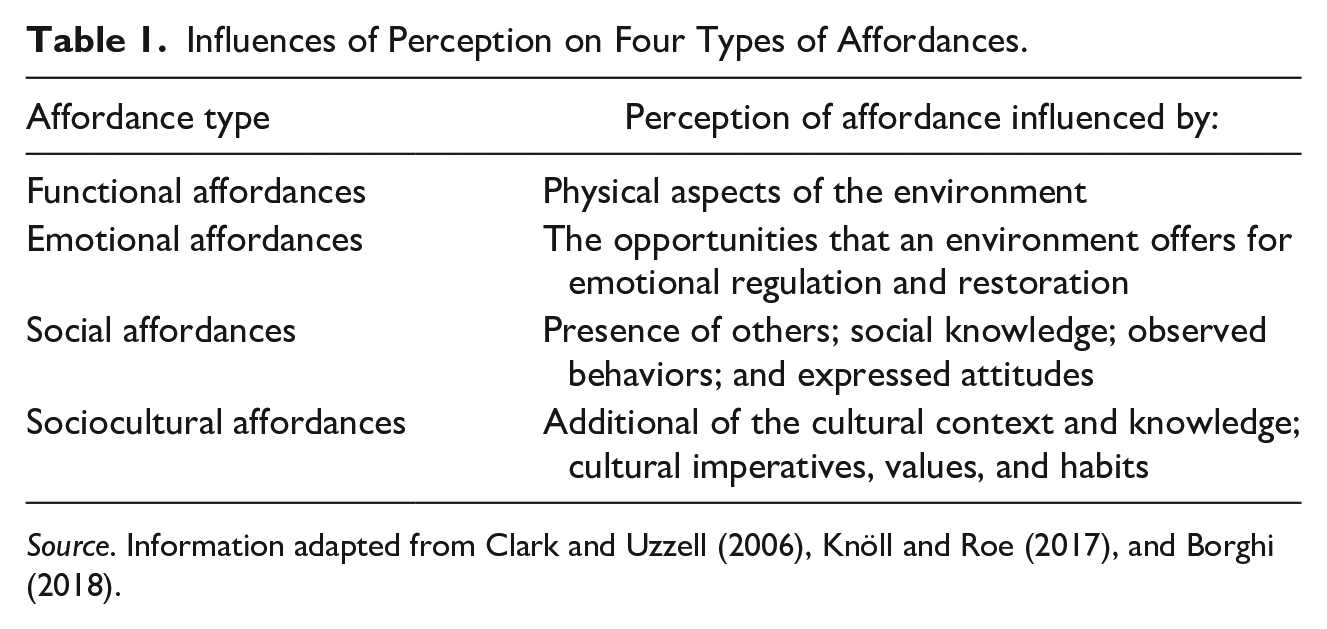
Source. Information adapted from Clark and Uzzell (2006), Knöll and Roe (2017), and Borghi (2018).
Describing environmental opportunities according to adolescents’ developmental needs, such as social interaction or retreat, can shed light on how experience in place creates meaningful space in which youth can explore and reflect on their evolving identities (Clark & Uzzell, 2006; Manzo, 2005). Clark and Uzzell (2006) developed a Socio-Environmental Affordance theory that emphasizes the influence of the interaction of the physical and social context on individual youths’ perceptions and behaviors. Categorizing environments in terms of these socio-environmental and sociocultural affordances can help elucidate how adolescents’ needs, goals, and aspirations interact with their everyday environments to drive behaviors that ultimately affect their health and well-being. The developmental implications of adolescents’ environments emphasizes the importance of considering affordances specifically in the planning, design, and management of environments.
Participatory Processes to Support Positive Youth Development
Youth participation in research is not just a goal, but a human right. The 1989 Convention on the Rights of the Child (UNICEF, 1989) officially declared that young people (10–24 year-olds) have the right to optimal development (Article 3), evolving capacities (Article 5), and participation (Article 12). This fundamental right to participation also takes on additional meaning during adolescence—a critical period during which youth develop unique needs and face distinct challenges (Gates, 2016). It is during this time when youth explore boundaries and emerging opportunities, develop independence from their parents, and test their developing capacities (Knöll & Roe, 2017). Adolescence is also a period of personal expansion. Youth experiment with new identities, embrace larger, more complex social networks, and “engage more actively in the exercise of their rights” (UNICEF, 2018, p. 1). These changes result in a drive for exploration and engagement that can be channeled through participation. However, additional measures must be taken to ensure participation does not become a right for only advantaged youth (UNICEF, 2018). Marginalized youth especially, who are often “rendered invisible” (McIntyre, 2006, p. 630), have been largely denied opportunities to experience empowerment, develop a sense of personal efficacy, and develop a connection to their own peers and communities.
As one of the most prevalent approaches to youth-engaged research, Youth Participatory Action Research (YPAR) is characterized by an iterative process of reflection and action that values building relationships, establishing trust, mutual learning, and active collaboration with peers and adults (Boni et al., 2020). YPAR centers the research process on youth knowledge, nurturing youth themselves through capacity building and participation, and supporting the capacity of youth to advocate for changes to promote health and social justice in their communities (Anucha et al., 2020; Ozer, 2017). This approach acknowledges and values youths’ lived experiences and creates a platform for youth to speak about their current realities as individuals and as part of their larger communities (Tintiangco-Cubales et al., 2016). YPAR helps to honor both how spaces are impacting youth and their right to have their spaces reflect their needs. Linked to Freire’s (1974, 2005) ideas of emancipatory education and critical consciousness, YPAR intentionally embeds youth culture in processes to democratize power and knowledge production in research, breaking down standard assumptions about who has the expertise to produce knowledge about youth (Caraballo & Lyiscott, 2020; Ozer, 2017). Youth are not integrated into adult structures, but rather, “transform that structure so that they can become ‘beings for themselves’” (Freire, 2005, p. 74).
One of the core attributes of participatory research is an emergent, flexible, and interactive process (Kwan & Walsh, 2018). The iterative process allows for shifts in research questions, objectives, and participation due to context, scheduling, or unanticipated conflicts relating to both professional and participant researchers (Ergler, 2017). Such flexibility complies with youths’ changing interests, motivations, and priorities, and allows for a more fluid participatory experience (Arunkumar et al., 2018). By creating spaces in which youth can engage in creative self-expression, critical dialogue, and reflection (Benjamin-Thomas et al., 2019), YPAR projects propose unique opportunities to, “facilitate learning, problem solving, and the use of divergent creative abilities” (Crone & Dahl, 2012, p. 645).
YPAR has also been recognized specifically as supportive of PYD (Lerner, Almerigi, et al., 2005; Ozer, 2017), capitalizing on an important window in which youth can acquire the competencies, strengths, and characteristics needed for healthy development (Ozer, 2017). For youth, participating in YPAR projects has been linked to increases in self-esteem, self-efficacy, and confidence (Sandseter et al., 2022); the promotion of psychological empowerment and strengthened cognitive and social development (Ozer & Piatt, 2017); and enhanced leadership skills and creativity (Batorowicz et al., 2017). Youth also develop social capital and critical consciousness (Bertrand et al., 2017) and orient themselves and their experiences within a broader historical, social, and geographical context (Gutierrez, 2008), which in turn promotes an understanding of their role in the scope of their communities, academia, and research (Anucha et al., 2020). Respecting youths’ perspectives allows them to challenge and re-construct knowledge that shapes their sense of the world and of themselves (Foucault et al., 1991) as they themselves drive the research and generate knowledge about their own environments and environmental needs.
Communities also benefit from YPAR initiatives through increased civic activity and contributions to citizenship (Anucha et al., 2020); enhanced democracy (Head, 2011); promotion of individual and community health (Wong et al., 2010); and social transformation (Benjamin-Thomas et al., 2019). The collaborative nature of YPAR can nurture synergetic relationships between youth and adults (Anucha et al., 2020; McLaughlin, 2020) and increase youths’ feelings of belonging and connection to their communities and peers (Tintiangco-Cubales et al., 2016).
Examining Physical Environments Through Youth Participatory Research
Participatory action research (PAR) projects are often organized across a socioecological model, such as Bronfenbrenner’s (1977) Ecological Systems Theory of human development. This model proposes that a human’s development is influenced by multiple sources at different levels of society. These domains are represented by nested, interrelated systems, including the microsystem (immediate environment of the developing person), the mesosystem (community-based organizations, schools, or other institutions), and the macrosystem (attitudes and ideologies of the culture. Systematic reviews have consistently identified YPAR outcomes across community, organizational, and social spheres (Ataol et al., 2019; Kennedy et al., 2019), recognizing the influence and interactions of some societal systems on youth and youth outcomes. The physical environment, however, has largely been viewed as a subcategory, commonly associated with sustainability or environmental stewardship interventions.
Regardless, YPAR offers unique avenues through which youth can examine and change their physical environments in ways that are meaningful for them (Gardner & Brooks-Gunn, 2009). The centering of the “lived experience” of youth (Lister, 2007, p. 716) within YPAR acknowledges the seminal role that everyday spaces and relationships play in youths’ construction and development of the worlds in which they live (Cahill & Dadvand, 2018). Through YPAR, youth can generate metrics by which to assess and monitor the physical environment according to what they feel constitutes a “successful environment.” The change-oriented action component of YPAR then frames these youth-identified metrics within a larger action agenda to systematically evaluate and improve environmental settings to increase their meaningfulness for youth (Bertrand et al., 2017; Vaughan, 2014).
Barriers to Successful YPAR Implementation
While YPAR, in theory, provides an appropriate framework by which youth could engage in community environmental assessment, there are a number of barriers that can impede the successful implementation of youth participation in research. Historically, youth have been viewed as inherently vulnerable, uninformed, or as adults-in-training (Ergler, 2017). These common misconceptions have limited the inclusion of youth in development research foregoing an opportunity for youth to validate results before conclusions are drawn (Head, 2011; Vaughan, 2014). Presuming youth are inherently vulnerable shapes both the knowledge generated about youth and any resulting actions or policies, producing findings that are more likely to reinforce the idea that youth are at risk or somehow a danger to others (Gillies & Robinson, 2012). Promoting these types of outcomes undermines the value and the right of young people to contribute to research and society at large. Ethical arguments around confidentiality and safety related to youth participants can also impede YPAR efforts, as adult-centric ethics review bodies maintain conservative positions to manage concerns over young peoples’ vulnerability and capacities for research (Lohmeyer, 2020).
The action component of YPAR frameworks has proved especially challenging to successfully operationalize. Although the ultimate goal of YPAR is for youth to realize transformative action in their communities, it is not a guaranteed outcome (Franks, 2011; Sarti et al., 2018). Institution-centric timelines often cannot accommodate a project that is capable of identifying and enacting real, sustainable change. Funding bodies also frequently require pre-defined research goals and methods, limiting opportunities for youth to identify and develop research questions and choose data collection and design methods (Anucha et al., 2020; Ergler, 2017). Instead of research centered on youth participants’ interests, youth are instead integrated into conventional, adult-generated research processes, undercutting the foundational principles of YPAR (Nichols et al., 2013). As most interventions require buy-in from community stakeholders, youth remain dependent on adults to take the necessary steps to implement their ideas. Shorter term or one-off engagements can often translate to limited benefits for youth and their communities and less impactful and sustainable changes (Sarti et al., 2018). This can leave youth feeling less empowered and confident in their ability to affect change than they did prior to the project (Arunkumar et al., 2018; Boni et al., 2020).
Recently, participatory design research has also been critiqued for not addressing actual research design needs (Bødker & Kyng, 2018), instead focusing exclusively on participants’ experiences and, “‘feel good processes’ rather than any long-term, sustained outcome” (Whittle, 2014, p. 121) that is then translation into action. Action plans are not developed for many participatory projects, further emphasizing that the process has become more important than the outcome. When researchers shift to an almost sole focus on the methodologies for inducing participation, embedding action in community systems becomes a supplementary goal (Bødker & Kyng, 2018). Prioritizing process outcomes not only forgoes opportunities to create designs that perpetuate positive effects for youth in their communities, but also creates a disconnect between participatory projects and benefits to the population at large. Without this connection to tangible impacts, community planners and decision makers cannot fully understand the value of including youth or adopting more participatory practices in general (Gomez & Ryan, 2016). By not clearly illustrating why and how participation matters in community research and planning, it is difficult to convince community stakeholders to invest time, money, and energy into dismantling structural barriers that would impede true community participation for youth (Gladstone et al., 2021). These institutional obstacles tend to force researchers into, “a least-effort strategy for researchers with respect to time spent, alliance, and partnerships, technological challenges, and even convincing the research community that the project is meaningful” (Bødker & Kyng, 2018, p. 4:10).
Leveraging the Capability Approach to Support Youth Participatory Research
Evaluating physical environments for the ways in which they contribute to or maximize PYD requires criteria that considers the diversity of adolescents’ individual goals and desires within their sociocultural contexts. Appraising complex, intersectional sociocultural environments can provide a greater, more holistic understanding of the implications of youths’ relationships, sense of self, and physical environments on their well-being and development (Clark & Uzzell, 2006). However, researchers have struggled with how to operationalize the effects of these complex interactions and contexts within which youth are embedded.
One solution for considering the interactions of such complex environmental factors may be provided by the Capability Approach (CA)—a collaborative, socio-ecological framework that considers individual factors alongside social, cultural, and environmental factors to understand human behavior and development (Sen, 1993; Slabbert, 2018). The CA posits that an individual’s well-being is related to the opportunities or barriers present in their social relationships and environments that impact a person’s ability to pursue meaningful achievements and to live a life they have reason to value (Ballet et al., 2018; Campbell & McKendrick, 2017; see Figure 1). The approach augments a conception of human well-being to include what individuals themselves think and feel about their own quality of life. The CA factors in the access individuals have to both opportunities and the resources to capitalize on those opportunities, that is capabilities, to pursue their chosen way of life, referred to as functionings (Slabbert, 2018). This expanded view also reflects the influence of a person’s practice of agency, defined as the ability to pursue objectives that an individual values and to act freely to make changes to achieve those objectives (Sen, 1999).
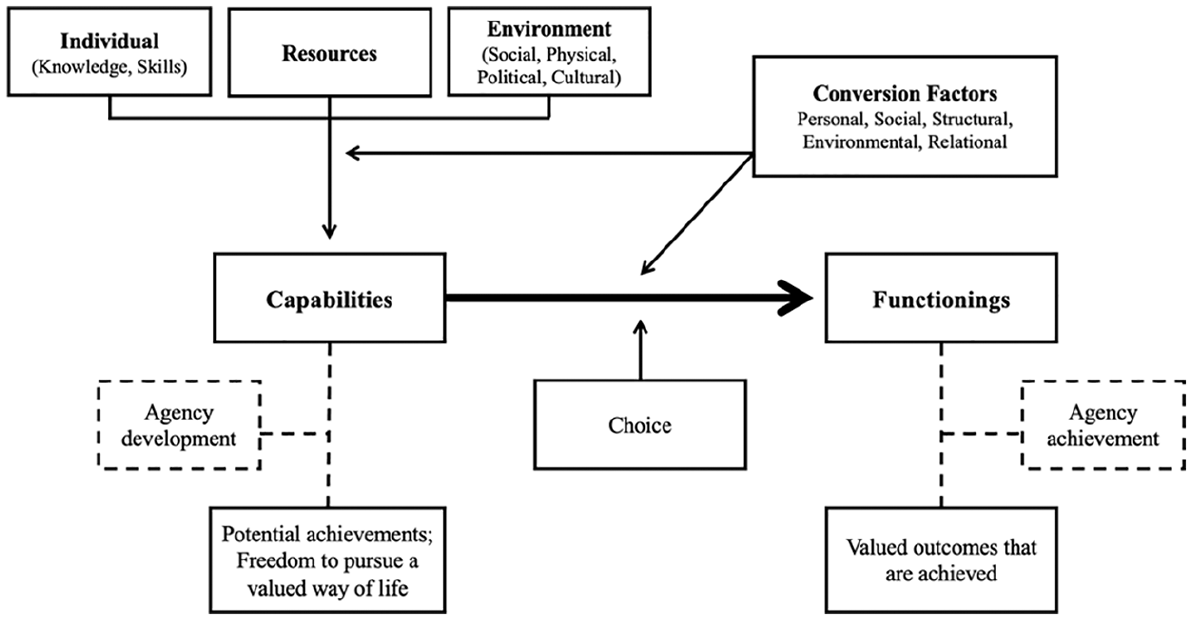
The Capability Approach pathways.
The development of capabilities, and the processes of exercising freedoms to achieve goals, depends on a number of factors representing the interactions between a person’s internal resources and external contexts (Brando, 2020). These personal, social, and structural conditions, called conversion factors, in turn influence an individual’s ability to convert resources into actual opportunities and abilities (Robeyns, 2005). Conversion factors are understood as preconditions that moderate individuals’ abilities to convert resources into preferred opportunities (Hart & Brando, 2018). As facilitators or barriers, conversion factors introduce significant variability in capability development depending on the individual, their experiences, and their interactions with the social and physical environment (Boni et al., 2020).
Prior Operationalizations of the Capability Approach in Youth Research
While the CA has been applied in research about childhood and development, little work has been done to date to apply it to physical environments (Gladstone et al., 2021). To date, the approach has largely been used for social justice research, to reconceive methodologies, or to generate and interpret data (Gladstone et al., 2021). The CA has been proposed as a way to understand development by reorienting our idea of youth experience as embedded in community practice and context (McLaughlin, 2020). This approach provides a more complete picture of how factors within various environments affect youths’ capacity to act, identify values and goals, and to be recognized (Rudy, 1999). Agency development—a goal for both PYD and CA—is contingent upon the interactional dynamics of social context and youths’ immediate and everyday worlds (McLaughlin, 2020). These interactions inform agency development as youth discover their capacities to act and to be recognized through their connections to and relationships with others (Lindemann, 2014). The opportunities and barriers present in everyday, social spaces have a tremendous impact on youths’ understanding of their place in the greater socio-ecological world (Lohmeyer, 2020; McLaughlin, 2020). Embedding the idea of agency development within social engagements gives a richer understanding of the influence of community values and context on individual development and well-being.
Linking the Capability Approach With YPAR
As YPAR provides the basis for why youth should be involved in all stages of the research process, the Capability Approach argues for how we conceptualize that involvement. The CA helps to identify the aggregate factors that constitute both individual and collective flourishing, which can also directly contribute to the main goals of action research (Reason & Bradbury, 2008). Operationalizing the Capability Approach within YPAR can help researchers to better understand goal development in youth, and to rationalize how social arrangements impact aspirations and capability formation (Campbell & McKendrick, 2017). The democratic foundations of both the CA and YPAR also situate well-being within a social justice schema; both frameworks require an understanding of what affects the healthy development of individuals and how to implement capacity building toward the systematic break down of inequalities and power imbalances (Brando, 2020).
By positioning well-being in terms of what youth think and feel about their own lives and freedoms, the CA emphasizes the importance of youth voice throughout the research process (Egdell & Graham, 2017). The CA can help participatory researchers to consider youth choices and norms, social dimensions of well-being, and how data collection, analysis, and dissemination methods can be applied to further foster capability development (Gladstone et al., 2021). By acknowledging the differences in social experiences between youth and adults, the CA supports youths’ active involvement in the development of youth-centered approaches, processes, and methodologies to collaborative action (McLaughlin, 2020). In turn, YPAR can help to inform how we utilize the CA to assess youth needs and desires. Situating youth as leaders of investigations into disparities across their social and physical environments can contribute to more meaningful participation experiences as well as more relevant evaluations (Biggeri et al., 2011).
Integrating the CA can also help address some common critiques of YPAR. The CA can help re-orient how researchers think about and measure youth participation in research by considering them as individuals with their own goals and motivations. Franks (2011) stresses the importance of recognizing that youth are not simply participating in adult projects, but rather that youth may participate in research for reasons that are unrecognized or misunderstood by adults. Instead of expecting full participation across the entire research project, Franks proposed a shift to thinking of the process as a collection of discrete activities in which youth can choose to participate and take ownership of as they’d like. These pockets of participation allow youth the choice to invest more fully in the parts of research that are most compelling to them. Expanding on Franks’ ideas, Lohmeyer (2020) reimagined youth participation outside of the adult research structure. This idea that youth are motivated to engage in parallel projects to adult research agendas helps to shift the perspective from youth as objects of research to seeing youth as capable, active co-creators of knowledge (Gillies & Robinson, 2012). Both pockets of participation and parallel projects are ways to rethink the research process to honor youths’ right to participate according to their values and to promote the capabilities they feel are essential to their well-being.
Integrating the Capability Approach With Environmental Affordance Theory
Articulating the effects of the built environment on youth necessitates an approach that identifies potentials for action within a space while also characterizing the space in terms of how and to what extent it can support positive youth development. Both affordance theory and the Capability Approach provide effective frameworks by which we can evaluate the opportunities and resources in social and physical environments that adolescents can leverage to achieve their goals, leading to capability formation and healthy development. Together, these approaches allow us to specifically address how an adolescents’ physical and social surroundings affect their well-being, desires, and achievement. An Affordance-Capability Approach (ACA) framework acknowledges that different factors in the environment can be perceived and in turn leveraged by adolescents to complement, facilitate, and encourage their healthy development. Positioned within a YPAR framework, an ACA model can also better address how the physical environment supports the goals of PYD while simultaneously encouraging and supporting youth in their healthy development (see Figure 2).
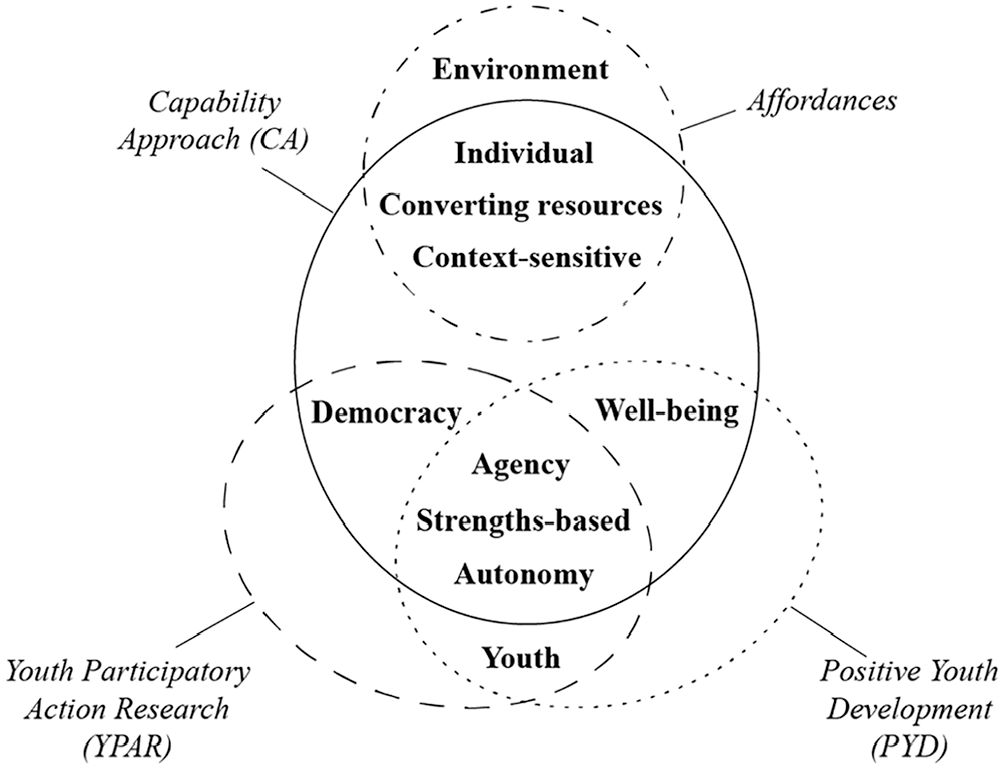
The Affordance-Capability Approach within a YPAR framework.
Advancing an Affordance-Capability Approach to the Development of Youth-Engaged Environmental Assessments
Environments can be designed to support the physical, cognitive, and emotional resources of youth, but only if evaluations of those environments are aimed at enhancing the congruence between the capacities and needs of youth and the ecological assets of their communities (Knöll & Roe, 2017). A YPAR approach to the design and evaluation of the built environment, governed by PYD principles and outcomes, incorporates youth developmental needs for social integration, exploration, and curiosity (Knöll & Roe, 2017); independence and autonomy (Roe & Aspinall, 2012); and also provides a forum in which youth voices are a central part of co-creating a city or space (Head, 2011). Designing youth-enabling spaces that link the physical and social attributes of environments with the desired actions, goals, motivations, and physical and psychological characteristics of the adolescent user (Knöll & Roe, 2017) can lead to more resilient and sustainable environments that are both more valued by and appealing to youth, engendering positive youth outcomes, and enhancing youth well-being (Vaughan, 2014).
Utilizing an Affordance-Capability Approach (ACA) in the development of youth-led environmental assessments can address the critical need for person-environment fit, with the goal of increasing the compatibility between youth and the affordances within an environment. While there has been very little empirical research to date that evaluates how the physical environment supports PYD outcomes specifically, an ACA framework would have the ability to generate key insights around how to provide or alter youth-enabling affordances, that is, opportunities for youth to develop capabilities, agency, and sociocultural competence and to attain PYD outcomes, instead of just thinking about the provision of specific physical amenities. Positioning this ACA framework within YPAR, where youth are legitimately acknowledged as knowledge makers and collaborators, can lead to the integration of more youth-responsive criteria in planning and design. Supporting youth in developing indicators and evaluating their own environments to generate knowledge can be a powerful process that can strengthen research findings and lead to more beneficial and effective local environments for youth (Caraballo & Lyiscott, 2020). Integrating youth-defined criteria and metrics to assess youth-enabling environments specifically can create spaces that are sensitive to the social and cultural nuances of youth and positively contribute to adolescent health and well-being (Rutter et al., 2017; Travlou et al., 2008).
Operationalizing the ACA Within YPAR: The Value of Creative YPAR Methodologies
While there are no specific methods dictated by YPAR, employing a suite of creative, arts-based methodologies can be an effective way to engage youth in research. Multi-method approaches that offer different modalities through which youth may participate afford opportunities for them to exercise agency to choose options they feel are better suited to their needs and interests (Knöll & Roe, 2017; Ozer & Piatt, 2017). When interactive, arts-based methodologies have been previously utilized in YPAR research, it has been reported that they can increase engagement and participation (B. E. Gibson et al., 2014), build stronger connection to the experience and memory of participation (Dean, 2015), enrich discussions (B. E. Gibson et al., 2014), and ensure that youth can participate equitably at the level and through the mediums they prefer (Boni et al., 2020; McLaughlin, 2020). Photographic methods, including photo-elicitation (Böök & Mykkänen, 2014), and photovoice (Darbyshire et al., 2005), have been some of the most prominent techniques in participatory research with children and youth (McLaughlin, 2020). Examples of other arts-based methodologies include drawing, videography, role playing, storytelling, design charettes, and go-along interviews (B. E. Gibson et al., 2014; Lohmeyer, 2020).
Such interactive, creative, and especially visual mediums—that are not dependent on age, verbal, or literacy skills—can facilitate the expression of youth “voice” through whatever mediums are most meaningful to them (Lohmeyer, 2020). UNICEF’s youth participation guidelines identifies “voice” or the “expression of views [that are] facilitated freely in a medium of choice” (O’Kane, 2020, p. 12) as one of the essential features of meaningful participation for adolescents. Centering youth voice acknowledges youths’ ability and right to generate knowledge (Connor et al., 2017) and provides youth “the opportunity for the agentic telling of their story” (Lyon & Carabelli, 2015, p. 13). Presenting youth with an array of methodologies also enables the expression of complex or difficult ideas, experiences, and emotions (Lohmeyer, 2020), as youth feel more in control of the process (Travlou et al., 2008). By providing a point of focus outside of the main research topic, these methods have shown to be effective in facilitating rapport between youth and adults and providing opportunities for adults to practice engaging in active listening (McLaughlin, 2020).
Critical Reflection and Implications
There are a number of challenges to be cognizant of in the operationalization of this proposed participatory ACA model. Typically, the goal in creating an evaluation tool is to standardize concepts so that the tool can be tested across a range of geographic contexts in order to be most widely applicable (Rodiek et al., 2016). However, as affordance-based approaches are inherently subjective, recognizing individuals’ motivations and actions in context (Borghi, 2018), it can be difficult to generate criteria that translates to more systematic, objective evaluations. This will require balancing the personal, individual nature of affordances with developing criteria to support the creation of more widely appropriate youth-enabling environments. Another challenge stems from undertaking this work in an academic context. Ethical and procedural reviews require researchers to pre-determine the research questions, scope, methodologies, making it difficult to honor the democratic principles of participatory research (Ergler, 2017; Lohmeyer, 2020). Working through these types of issues will necessitate retaining as much flexibility and clarity as possible throughout the process, along with fostering a culture of trust and rapport to be able to manage young peoples’ expectations (Caraballo & Lyiscott, 2020; Sarti et al., 2018). Within this academic context, there is also weight placed on “producing rational, scientifically defensible results” (Brown & Fagerholm, 2015, p. 131), while participatory processes may have a number of objectives, such as learning and creating social capital, that are equally, if not more, important.
Rutter et al. (2017) also recently emphasized the need for public health research to consider policy and practice within complex systems, echoing calls for a more relational approach to youth and youth health research (Ergler, 2017). Maintaining this wider socio-ecological context as an overarching frame is essential to conducting effective and just research, especially with regards to youth. Conceptualizing environments through an ACA repositions adolescent health, well-being, and positive development within this complex systems perspective, emphasizing that multiple, interacting domains must be accounted for when considering human development processes and outcomes.
Despite the potential challenges of operationalizing this model, we propose this ACA framework as an effective approach for developing contextually sensitive evaluation tools that honor the capabilities and desires of youth. Engaging youth in developing audit tools and processes through creative, arts-based methodologies can result in environmental assessments that go beyond descriptions of a “resource environment” to those of a “youth-enabling environment.” Through iterative cycles of field work and collaborative workshops, youth can collectively reflect and generate insights on their individual and community needs, essentially ground-truthing existing audits based on youths’ local knowledge and actual experiences (Benjamin-Thomas et al., 2019). Resulting assessments would consider how the transactional and relational nature of affordances, with respect to youth specifically, can be leveraged to improve community spaces—creating youth-enabling environments that truly welcome youth, enhance their well-being, and support positive development.
Footnotes
Declaration of Conflicting Interests
The author(s) declared no potential conflicts of interest with respect to the research, authorship, and/or publication of this article.
Funding
The author(s) received no financial support for the research, authorship, and/or publication of this article.
