



Abstract
Youth-initiated mentoring is an innovative youth care approach in which youth recruit supportive adults from their social networks as a mentor for youth and a partner for parents and professionals. This qualitative interview study documents what youth (n = 15) and parents (n = 13) from multi-problem families look for in a mentor, what mentors (n = 8) believe they have to offer, and whether what mentors believe to offer matches youth’s and parents’ needs. Youth and parents indicated that a strong connection and trust were most important, or even prerequisites, as youth who were unable to find mentors did not have strong relationships of trust. Youth and parents also voiced preferences for an understanding, sensitive mentor who offered youth perspective by providing support and advice and (according to some) setting rules. What mentors believed to offer matched youth’s and parents’ needs, suggesting that most youth successfully recruited suitable mentors.
Keywords
Youth-initiated mentoring (YIM) is an innovative approach in youth mental health care that empowers youth to recruit supportive adults from within their social networks as mentors (van Dam & Verhulst, 2016; van Dam et al., 2019). Mentors are non-parental figures who provide youth with guidance and support. YIM is a hybrid approach combining formal support (i.e., professional care) and informal support (i.e., support from the natural mentor) (van Dam et al., 2021). Including YIM mentors in mental health care for youth seems promising for improving a wide range of outcomes, including wellbeing and academic achievement (Christensen et al., 2020; Raposa et al., 2019; van Dam et al., 2021). Yet, little is known about what youth and parents look for in a YIM mentor. This specifically pertains to multi-problem families, who are faced with a larger number of difficulties that are often chronic and intergenerational (Tausendfreund et al., 2016). Knowledge about their needs can help professionals to guide the mentor selection process, which is especially relevant since not all youth succeed in positioning a mentor (van Dam et al., 2017), suggesting that these youth experience barriers and could benefit from more guidance. To better understand the needs of youth and parents from multi-problem families, this qualitative study assessed what they search for in a mentor, and what mentors believe they can offer.
Contrary to formal mentoring, in which volunteers are matched to youth, YIM provides support for youth to identify and recruit a mentor from their existing social network. In the context of youth mental health care, YIM mentors are confidants and spokespersons for youth, and partners for parents and professionals (Schwartz et al., 2013). It is a client-focused approach, as mentors, youth and parents actively participate in the decision-making process during treatment (van Dam & Schwartz, 2020). Natural and YIM mentoring have been positively associated with various youth outcomes, including mental and physical health, social-emotional skills, and school functioning (van Dam et al., 2018, 2021). These benefits were regardless of youth’s risk status (van Dam et al., 2018), emphasizing the potential of mentoring for vulnerable groups such as youth of multi-problem families.
However, the potential of YIM depends on whether youth can find a mentor. Given the common belief that multi-problem families live in isolation, positioning a mentor may be difficult. Yet, as multi-problem families have (strong) social ties with six people on average (Sousa, 2005), these youth also have the potential to find mentors. In fact, 83% of youth of multi-problem families found a mentor within 33 days (van Dam et al., 2017), confirming that most youth do indeed know adults who they want to involve in their treatment. However, this also shows that 17% of youth were not able to position mentors (van Dam et al., 2017). Positioning mentors is a precondition for involving them in the treatment process, and thus, for making optimal use of YIM. Documenting youth’s experiences on the mentor selection process and information on what youth look for and which factors prevent them from positioning mentors, is important for helping youth who have difficulties finding a mentor. Moreover, it could contribute to better implementing YIM, which is assumed to ultimately result in better outcomes for youth.
Youth’s Needs in the Mentor Selection Process
In studies of formal mentoring, youth who perceive more trusting, mutual, and empathic relationships with their mentors experience greater improvements than youth who perceive lower levels of relationship quality (Garringer et al., 2015). Research on YIM indicates that relationship quality also directs the selection process. Most youth chose mentors with whom they had a strong relationship already before the mentor is positioned, and some referred to their mentor as their “friend,” despite their familial bonds or age difference (Spencer et al., 2016). Moreover, youth chose mentors who they find trusting, empathic, understanding, non-judgmental, and dedicated (Spencer et al., 2016, 2019), which are indicators of high relationship quality.
Parents’ Roles in the YIM Mentor Selection Process
Research on youth mentoring naturally tends to focus on the relationship between mentor and child (Keller, 2005). However, theoretical (Keller, 2005) and empirical (Basualdo-Delmonico & Spencer, 2016; Weiler et al., 2020) literature suggests that parents also contribute to the success or failure of mentoring. That is, parents are the primary gatekeepers of children’s social networks (Kesselring et al., 2012), thus the relationship between a child and mentor may depend on the relationship between the parent and mentor. It is, therefore, expected that the youth’s choice for a mentor is influenced by parents. This may be even more true in the context of YIM, as YIM is embedded within systemic care in which parents are also heavily involved (van Dam et al., 2019). Therefore, the relationship between mentors and parents may also play an important role in the selection process and effectiveness of YIM.
Parents indeed appreciate having a say in selecting mentors (Spencer et al., 2019) and generally prefer mentors who they know and trust so they feel comfortable in letting their child spend time with them (Spencer et al., 2019; Weiler et al., 2020). Yet, parents often accept their children’s choice, although they may have different perspectives on who would be the best mentor (van Dam et al., 2019).
Mentor Expectations
Mentors have another unique perspective on the mentoring selection process, as they can describe their expectations in how to fulfill their mentoring role, which may provide insight in how well the match is between what youth and parents need and what mentors can offer. This match may be especially important to examine, as unfulfilled expectations are an important reason for formal mentors to end their mentoring relationship prematurely (Spencer, 2007). Some mentors enter relationships with preconceived ideas about what youth might need and found that their mentee did not fit their expectations. Many described feeling overwhelmed by the needs of their mentees due to their difficult circumstances (Spencer, 2007). There is sufficient evidence to expect that the needs of youth of multi-problem families are also large (Bodden & Deković, 2016). However, in YIM we might expect a better match between mentors’ expectations and youth’s needs, as the pairs are already acquainted and often consider each other friends or family (Spencer et al., 2021), potentially resulting in a less overwhelming experience for mentors and a better match between the youth’s and parents’ needs and what mentors offer.
Current Study
This study aims to understand the needs of youth and parents of multi-problem families in mentoring relationships during the selection process of a YIM mentor in the context of youth mental health care. More specifically, we aim to document (1) the views of youth, parents and mentors on involving a YIM mentor in treatment; (2) what youth and parents look for in mentors; and (3) what mentors think they can offer and whether that matches youth’s and parents’ needs. To fulfill these aims we conducted semi-structured interviews with youth, parents, and mentors, giving unique insight into different perspectives. To our knowledge, no studies have documented the needs of youth and parents who were unable to find a mentor. By including their perspectives as well, we can gather knowledge on potential barriers of positioning YIM mentors, that could be used to remove these barriers and help youth in finding a mentor. Needs of youth that are often reported could be stressed by professionals. Also, youth’s needs could inform mentors about what youth find important and thereby help mentors to adjust to the needs of youth (Spencer, 2007). Documenting the different perspectives may also provide important insights, which can help professionals guide the mentor selection process.
Methods
Participant Recruitment and Selection
Interviewees were recruited from among the participants in a multi-site quasi-experimental study of the InConnection approach (a YIM program in the Netherlands), called Growth in Personal environment (GRIP) (Koper et al., 2020). Participants are multi-problem families receiving youth and family care and their YIM mentors. Problems that these families encountered include school drop-out, divorce, trauma, antisocial behavior, and/or substance use, among other problems (for more details and inclusion criteria, Koper et al., 2020).
Active informed consent for their own participation in the GRIP study was received from all participants. For youth under the age of 16, active informed consent for their participation was also obtained from one parent or guardian (Koper et al., 2020). For the purpose of the current study, participants were orally asked for permission to participate in the interview at the start of the interview. All interviews were conducted individually between February 2019 and September 2020 after concluding the first treatment phase in which youth search for a mentor. The design of the study was approved by the ethical review board of the Faculty of Social and Behavioral Sciences of Utrecht University (FETC-18-093).
Participant Selection
Interviews were only conducted with families who started treatment following the InConnection approach and, therefore, have sought a mentor. We selected participants based on background characteristics (e.g., age, gender, ethnicity, region) by which we aimed to seek maximum variation in experiences. We invited 19 systems for participation from among the 59 currently participating families receiving InConnection care. Of these, 16 systems agreed to participate (see Table 1 for an overview of systems). Of the three systems that did not participate, two indicated they did not want to, and one initially agreed but did not show up for the appointment after which we were unable to reach them. No significant differences were found between the participating and non-participating systems receiving InConnection care on demographic variables (i.e., age, gender, ethnicity, education level, youth’s type of relationship to the mentor).
List of Participants.
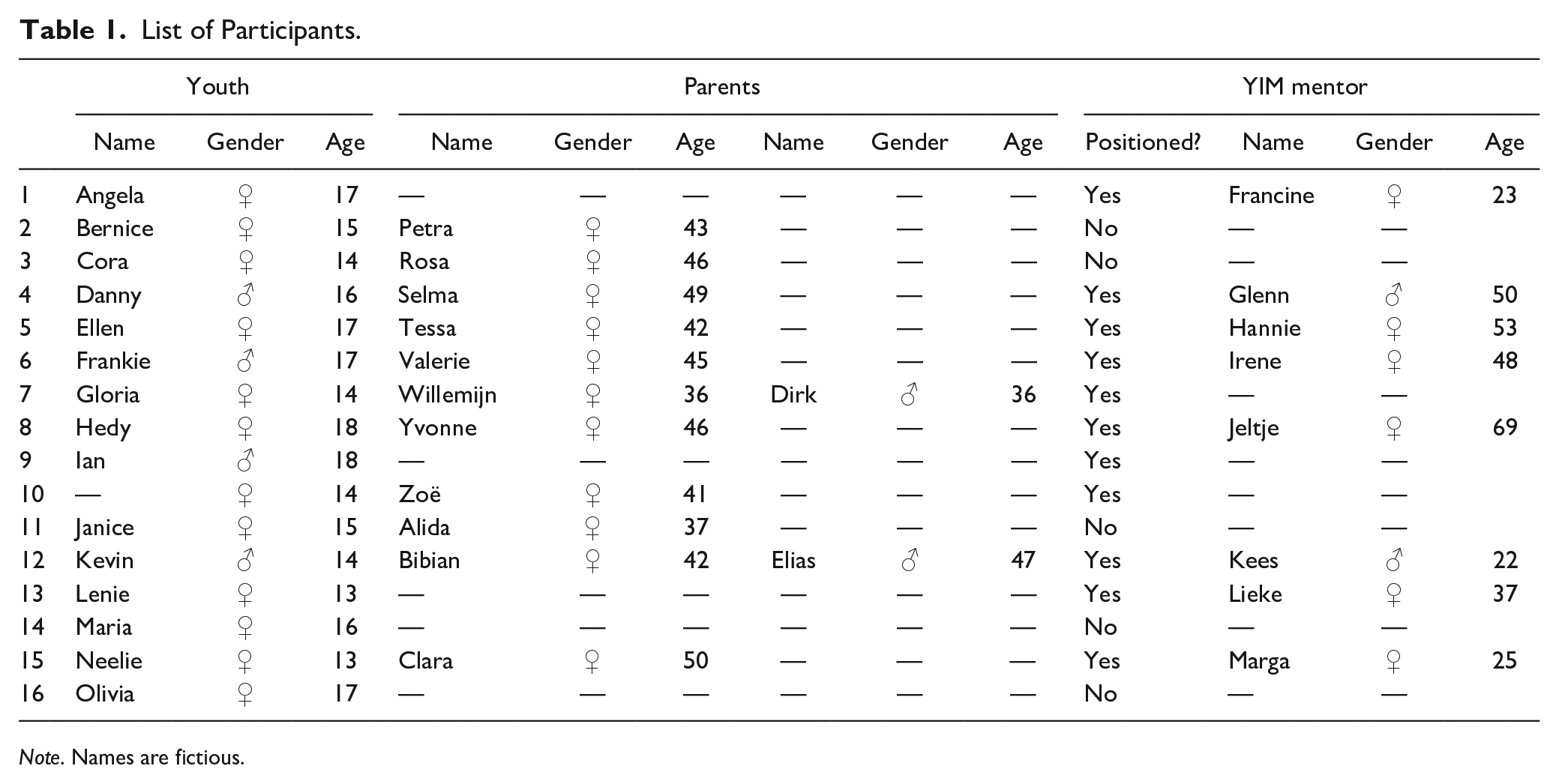
Note. Names are fictious.
Participants
Interviews were conducted with 15 youth, 13 parents, and 8 YIM mentors from 16 systems. In one third of systems (37.6%) we documented the experiences of all potential members and conducted interviews with a youth, one or two parents and a mentor. In two cases (12.5%) two parents participated. In five systems (31.3%) youth had not found a mentor.
From the 15 youth, 11 were girls (73.3%) and the mean age was 15.67 years (SD = 1.70, range = 13–18 years). Most followed preparatory secondary vocational education (66.7%). Eleven youth identified as Dutch (73.3%); the others identified as Belgian, Burundian, Eritrean, and Montenegrin (6.7% each). More than half lived with their parents: eight lived with one of their parents or alternately with either parent (53.3%), and one lived with both parents (6.7%). The others lived out of home: four lived in a residential facility (26.7%), one with friends or family (6.7%), and one in a foster home (6.7%).
Ten of the 13 parents were biological mothers (76.9%); the others were a biological father, a stepfather, and a foster mother (7.7% each). On average parents were 43.76 years old (SD = 4.64, range = 36–50). Nine were divorced or separated (69.2%). Most parents identified as Dutch (92.3%) and one identified as Dutch-Moroccan (7.7%). Most parents finished secondary education (30.8%), vocational education (38.5%), or higher education (23.1%).
Most mentors were female (75.0%) and their mean age was 41.30 years (SD = 17.15, range = 22–69). All mentors identified as Dutch (100%). Two were family members, two were friends of youth or parents, and two were neighbors or acquaintances (25.0% each). The others were an ex-mother-in-law and an ex-stepmother (12.5% each).
InConnection Approach
The InConnection approach is an outpatient alternative to out-of-home care for youth from multi-problem families. Problems that these families encounter include school drop-out, divorce, trauma, antisocial behavior, and/or substance use, among other problems. Treatment is offered by a multidisciplinary team of youth social workers, systemic therapists, psychologists, and psychiatrists in four phases: (1) who, (2) what, (3) how, and (4) adaptivity (van Dam & Verhulst, 2016). In the who phase, caseworkers (social workers) open the conversation on the value of a YIM mentor. Caseworkers explain that mentors are someone who you trust, someone you can go to for support, and/or someone who inspires you to do your best. Youth are asked to think about who could be this person for them, sometimes with help from parents. If necessary, caseworkers provide more support in identifying potential mentors, for example, by making social network maps. Once youth have identified a potential mentor, this person is invited for a meeting with the caseworker, who explains what the positioning as a mentor means. If the mentor accepts the position, all parties meet to discuss issues of confidentiality, privacy, contact frequency, boundaries, and what happens if the parties wish to terminate the cooperation. The mentor is installed when all parties agree to collaborate. In the what phase, all parties give their opinion on what they would like to see changed, which serves as input for the treatment plan which is laid down and enacted upon in the how phase. In the adaptivity phase, all parties discuss how the family will proceed without professional support, after which the treatment is concluded (van Dam & Verhulst, 2016).
Interviews
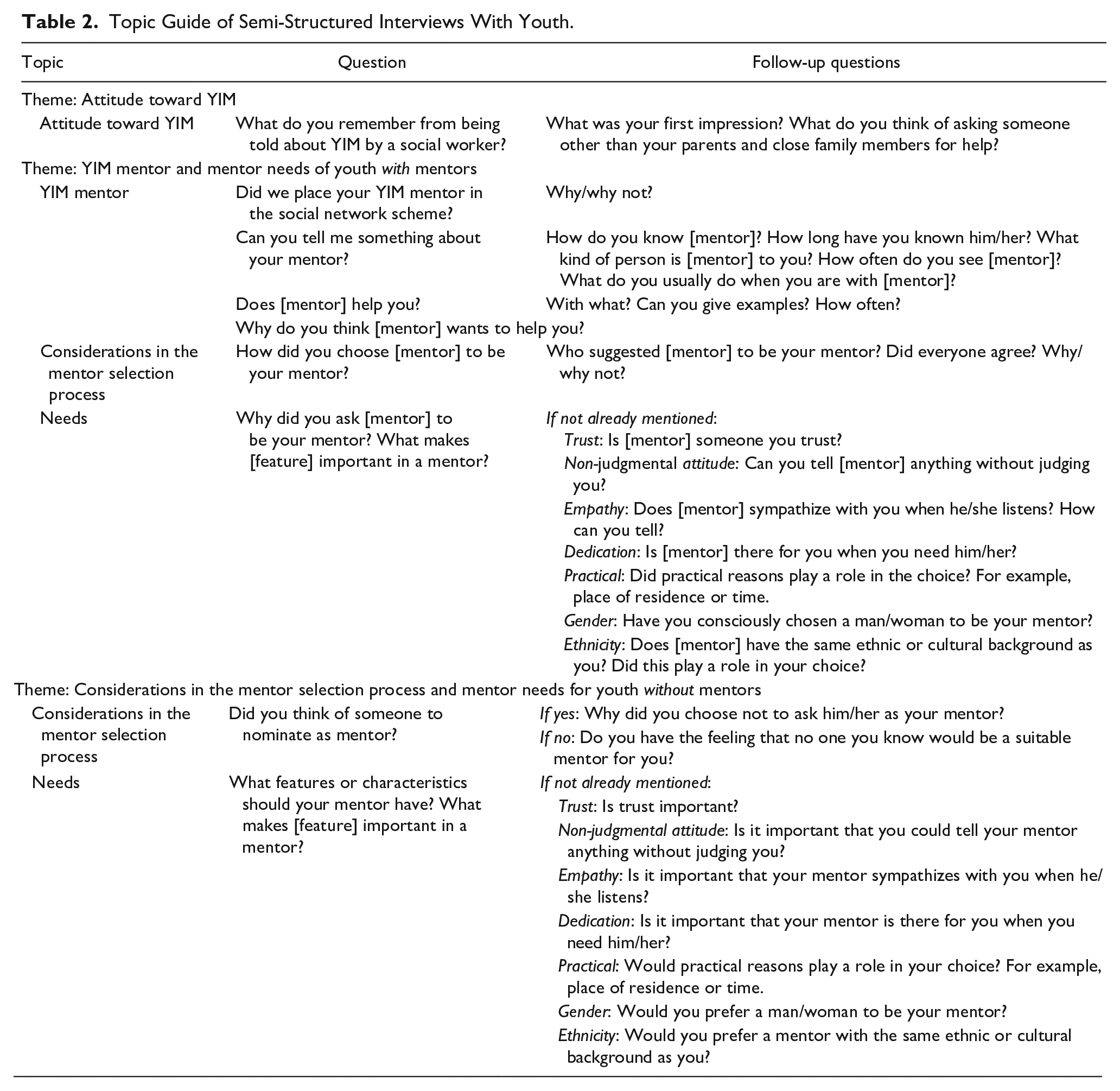
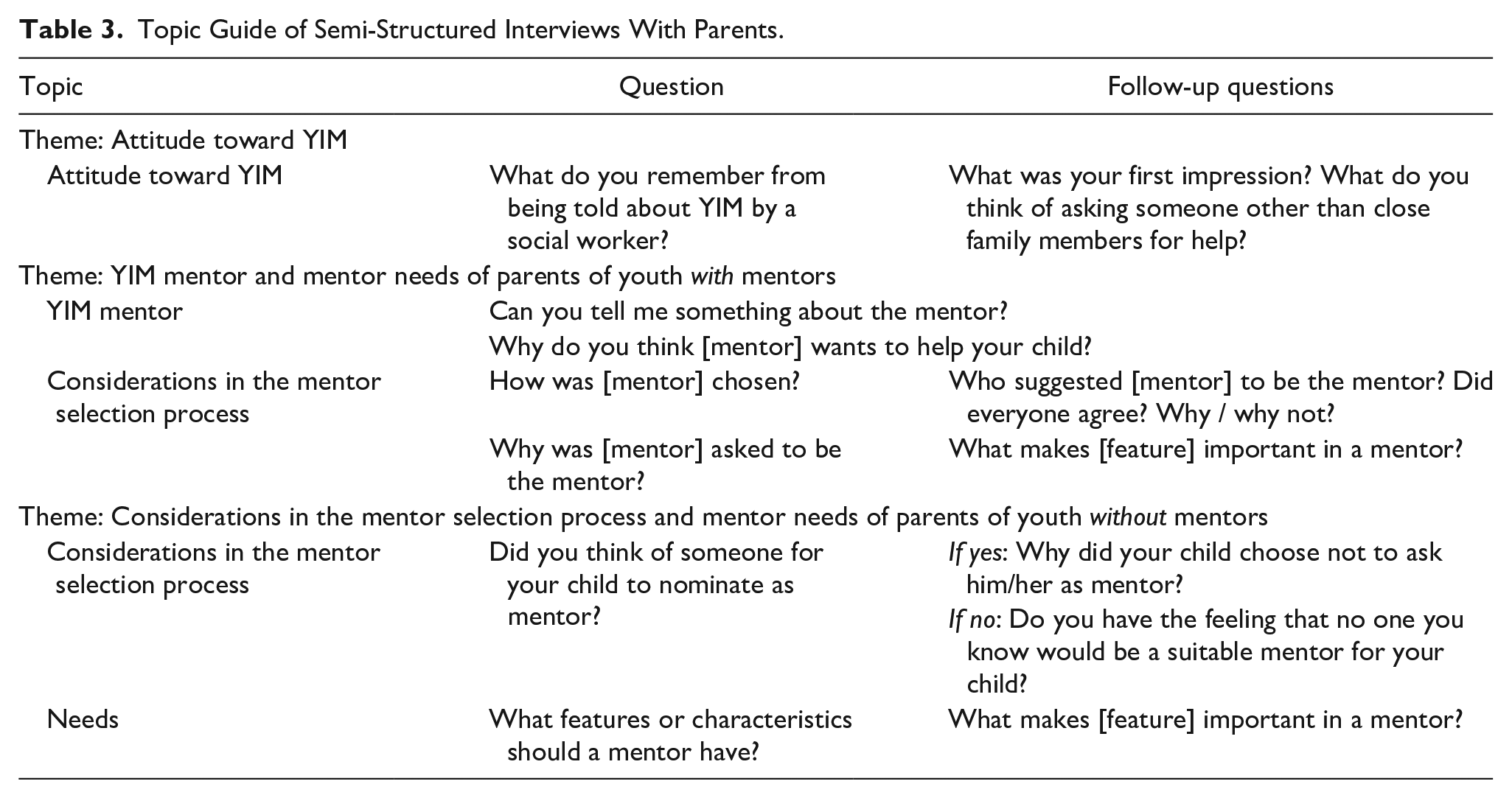
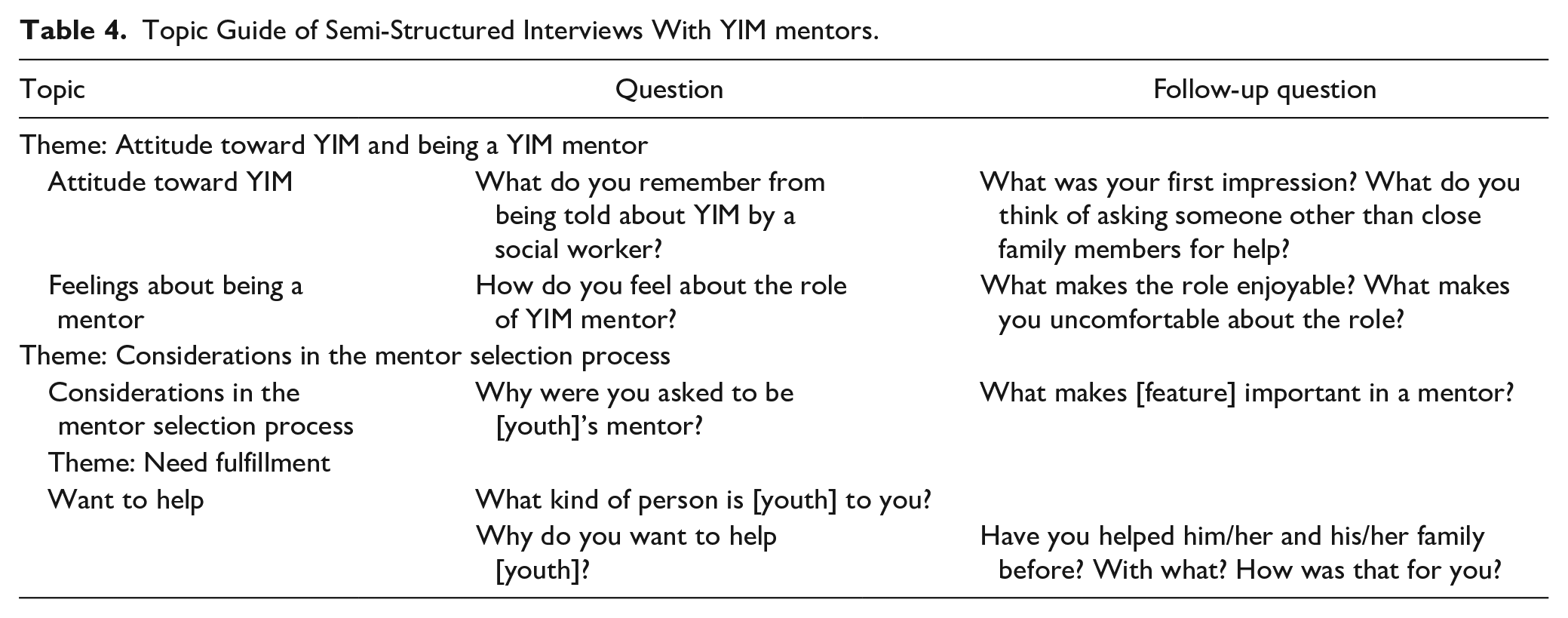
Semi-structured interviews about the mentor selection process were conducted using topic guides developed by the first author based on previous research on YIM. The interview topics are tailored to the experiences of each type of participant (see Tables 2–4 for translations of the topic guides). Youth and parents were asked about what makes a good mentor and the reasons to consider nominating someone as mentor, for example “What qualities should a good mentor have?” (youth and parents); “Can you tell me about how you chose [mentor] to be your YIM mentor?” (youth with mentors). Mentors were asked why they want to help the youth and how they plan to do that, for example “What is the reason that you want to help [youth]?” (mentors). Some youth were not very forthcoming with their needs. If that was the case, open questions were followed by asking youth directly about potential needs identified in the literature search: trust, non-judgmental attitude, empathy, dedication, geographical location, gender, and ethnicity. Interviews lasted between 10 and 45 minutes and were conducted by the first author and seven research assistants after having received training from the first author to maintain consistency across cases. The interviews were conducted face-to-face in the participant’s home until March 2020, after which the interviews were conducted through video calls, due to the outbreak of the coronavirus. Interviews were recorded after permission and transcribed verbatim.
Topic Guide of Semi-Structured Interviews With Youth.
Topic Guide of Semi-Structured Interviews With Parents.
Topic Guide of Semi-Structured Interviews With YIM mentors.
Coding of Interviews
Thematic analysis (Braun & Clarke, 2006) was conducted in NVivo (QSR International, 2012) with interviews with youth, parents, and mentors. First, an initial codebook was developed by the first author using the concepts that emerged from the literature which were part of the topic guide (i.e., sensitizing concepts, such as trust, non-judgmental attitude, and empathy). Second, a small number of interview transcripts was read to familiarize ourselves with the data and develop additional ideas for initial codes. We decided to read and code all available interviews within one system simultaneously to have a holistic view of the systems, leading to better understanding of individual interviews. We found that information from other participants within the system was especially helpful in interpreting the short responses from some youth. Third, the interviews were coded by the first author and a research intern using the initial codes. Additional codes were identified, resulting in continuous evaluation and refinement of the codebook. In this first coding step, the codes were basic and reflected the raw data closely, often using in vivo coding, for example: “mentor gives youth love and hugs.” Fourth, codes were grouped into potential themes, to gather all data relevant to each potential theme. For example, the codes “mentor also didn’t have a strong relationship with parents” and “mentor also moved from place to place” were grouped within the theme “mentor experienced similar situations.” All interviews were reread to check if all relevant data were coded. Fifth, themes were reviewed by rereading the coded data and determining if the data appear to form a coherent pattern matching the description of the theme. If (some of) the data did not fit, these data were moved to another or a new theme or discarded from the analysis. The themes were clustered into overarching themes, which resulted in the final themes.
To assure quality of the data analysis process, coders met weekly to discuss questions and clarify definitions related to coding categories. Codes and final themes were also discussed with all authors. Transcription and data analysis were in Dutch; key quotes were translated into English.
Results
Views on Involving a YIM Mentor in Treatment
All participants, except for two youth, had positive views on YIM. Most youth said it made sense to them to involve a mentor in care. They often described YIM as natural and normal. Youth with positioned mentors mentioned that their mentors already had important roles in their lives before the positioning. The two youth who felt negative about YIM did not position mentors and said that they could not trust others (including mentors), natural mentors do not have sufficient education to help youth, and they did not want to burden others with their problems. All parents indicated that they liked YIM because it is a different approach to care and a type of care they had not yet tried. Mentors were also positive of YIM and being a mentor: They liked having the role of mentor, as it allows them to help the youth. Most mentioned that even before the positioning as mentor, they already mentored the youth. Nevertheless, most mentors were happy to be given the formal position, because it allowed them to become more involved in the treatment and in decision-making.
What Youth and Parents Search for in a YIM Mentor
Youth and parents mentioned several needs for the characteristics of a YIM mentor: strong connection, trust, sensitivity to needs, future perspective, and discipline.
Strong Connection
All youth, including youth without mentors, mentioned the need to have a warm and strong relationship with a mentor. Youth preferred mentors who they feel close to, and with whom they have a stable and (presumably) long-lasting relationship. Feeling safe and comfortable in the presence of mentors was important according to many youth, which is illustrated by Cora (aged 14) who explains why she considered asking the neighbor as her mentor: “Because I’m actually quite comfortable with her.” Some youth also mentioned feeling accepted the way they are and loved unconditionally by their mentors, like illustrated by Hedy (aged 18): “She loves me very much. She can also be very angry with me sometimes, but she always loves me very much.” When asked about the relationship youth have with their positioned mentors, some made comparisons with other relationships, such as friendships or family relationships. Lieke, mentor of Lenie (aged 13), said to consider Lenie as her daughter, even though they are not related: “She is actually my second daughter to me. I always say I have two children. She feels that too and she always likes it very much. . . . It feels like that to me and that is so beautiful.”
Youth, but not parents, indicated that having fun with mentors is another important aspect, so their relationship is not only serious. For example, Hedy (aged 18) said when asked what is important in a mentor: “That you can have fun together and laugh, but also that she strongly urges me to do things.”
Trust
To be able to trust a mentor appeared to be a universal need: Both youth who positioned a mentor and youth who did not, emphasized the importance of trust. Youth trust mentors if they feel they can tell them anything and if they know that information is confidential. In a trusting relationship, youth feel safe and accepted. Bernice (aged 15), who did not position a mentor, explained she feels more comfortable talking to someone she trusts: “It’s just nice to talk to them because I have trusted them for a long time, I have trusted them all my life.”
Youth were more likely to trust a person if they have known them longer and have experienced that they are reliable, for example because they are always there for them. Frankie (aged 17) illustrated this when asked if he trusts his mentor: “Yes, after so many years, I do. I don’t trust people that easily.”
Parents also indicated that trust is important for their children. Willemijn and Dirk, mother and stepfather of Gloria (aged 14), said about why Gloria chose her mentor:
Willemijn: “It’s very confidential, so we don’t get informed about everything. . . . And yes, if there is something really worrying, we will be notified, but usually not.” Dirk: “Gloria can discuss things with her mentor and those things stay with her; that is necessary for Gloria.”
Sensitivity to Needs
Many youth indicated that they searched for a mentor who understands them and recognizes their needs, for example because the mentor has a similar experience. Cora (aged 14), who did not position a mentor, said why she thought her neighbor would make a good mentor: “She also had children with similar problems.” Youth thought this similar experience would make it easier for mentors to help them. Hedy (aged 18) believes this similar experience may be the reason that Jeltje is motivated to help her:
“I think she finds it unfortunate for me, sad for me how it all happens; that she wants to help me with that. And I also think mainly because she has experienced it herself in the past and did not have that support [from someone]. She also moved from one place to another and did not have a good relationship with her parents.”
Youth also voiced their needs for a mentor that is able to listen. If they want to talk about something, such as a problem they encountered, mentors should offer a listening ear. To youth this means that people should listen to them while they are talking, answer their questions and do not mind to keep talking for a long time, even if it is already late. By listening mentors can get a better understanding of youth’s experiences, interests, and needs.
Parents, similarly, indicated their preference for mentors who are empathic, understanding, and able to listen to their children. Tessa, mother of Ellen (aged 17), said the following when asked why Ellen chose Hannie as her mentor: “Because Hannie is someone Ellen can talk to, because she shows a lot of empathy towards her, and a lot of understanding, and Ellen needs that.” Similarly, mother Petra described what she would want for her daughter, who did not position a mentor: “Someone who can understand, someone who can really talk to and support children.”
Future Perspective
Youth found it important that a mentor can help them to achieve a better future. Youth preferred mentors who are an example to them and that they look up to. Angela (aged 17) explained why she chose her mentor: “She really behaves like an adult, she’s thinking about her future and she’s more concerned with school, work and things like that. She can help me towards independence.” In order to achieve this better future, youth asked their mentors for help for a variety of subjects, such as practical help (e.g., for transportation), help with school or work, and advice about relationships (with friends, romantic partners, family members, etc.).
Similarly, parents wanted their children to have mentors who help them, support them and stand up for them to achieve a better future. Willemijn, mother of Gloria (aged 14), said the following about Gloria’s mentor: “She wants to help Gloria, because she just wants Gloria to be okay. That she just becomes a stable, healthy woman, a grown woman. And she wants to do everything she can for that.” Janice (aged 15) does not have a mentor, and according to her mother Alida a mentor would have to help Janice quickly achieving her goals, because otherwise Janice would not take the mentor seriously: “At this moment Janice will only take people seriously if they can arrange things for her . . . [and] not . . . if they just talk to her about dealing with trauma’s and things like that.”
Discipline
Only one youth and a few parents with positioned mentors mentioned that they wanted a mentor who can help by means of discipline. Hedy (aged 18) said about Jeltje, who she chose as her mentor: “Looking back, I sometimes think that it was good that she kicked my ass. Otherwise I would have done things differently and that would have had consequences.”
A few parents indicated that they appreciated it if mentors would help them in the upbringing of their children. Parents acknowledged that their own influence on their children is limited, and they were happy if their children would listen to another adult. In parents’ experience, other adults could usually do or say more to youth (such as teasing or speaking up about negative behavior), while parents got a negative response from the youth with the same behavior. Selma, mother of Danny (aged 15), said: “It also gives me a lot of peace, you know. When Danny doesn’t listen again, I say to his mentor: ‘You know, Glenn, you can go solve it, you are his mentor’.” It, thus, gave parents peace of mind to know that they could ask the mentor for support if their child did not listen to them, thereby reducing their parenting stress.
Mentors’ Perspectives on What They can Offer Youth
Mentors’ perspectives on what they offer corresponded to the aforementioned themes of strong connection, trust, future perspective, sensitivity to needs, and discipline. Therefore, these themes are detailed below.
Strong Connection
Many mentors indicated that they knew the youth for a long time (often years and sometimes since the youth was born) and already had a strong connection with them before being positioned as mentor. Mentor Glenn described his relationship to Danny (aged 15): “He is very dear to me. . . . Well, I think we have a good relationship. . . . The bond is simply good.” Mentors also said they can laugh and joke with the youth. Sometimes they engaged in fun activities together, such as walking the dog, shopping, eating out and going to the cinema. They enjoyed participating in these activities.
Trust
Mentors acknowledged that trust is an important factor because trust makes youth want to talk to them. They conveyed to do their best to gain youth’s trust. Glenn, mentor of Danny (aged 15), said: “Due to the trust they also come to you and they are honest and sincere. If they do not trust you, they become closed off and you will not know what is going on.” Despite that youth said they trust their mentors, youth did not always disclose to their mentors. Therefore, mentors often take initiative in contacting youth, offering help and creating situations in which youth are more forthcoming. For example, Kees, mentor of Kevin (aged 14), said:
“When I was talking to him for a while, it actually came to light that things weren’t going well. I said to him ‘If you need help, you know I live next door, you have my phone number. Just send me a message, and it will all be fine’.”
Sensitivity to Needs
Mentors indicated that they are understanding toward youth. In some cases, mentors said they go beyond understanding: They recognize youth’s needs and empathize with their pain and burden. According to Jeltje, mentor of Hedy (aged 18), she felt Hedy’s pain because she has experienced a similar situation: “I used to be in the same situation. So yes, I feel her. I understand her feelings and sometimes I feel it, too. I can’t let her down because I’ve been there myself.” This reflects that mentors are aware of the vulnerability and needs of youth.
As youth do not always disclose to their mentors, mentors found it important that they can sense if there is something wrong. Irene described a situation where she felt that Frankie (aged 17) needed to talk:
“Last week, when Frankie was like ‘I’m going outside for a cigarette’, I just noticed. I said ‘I’ll go outside, too,’ to just have a chat. . . . At such moments he is a bit more open . . . than when he’s sitting at the table with a group of people. Then he’s brave enough to tell me things.”
Future Perspective
Most mentors indicated they wanted to achieve something with the youth, for example to go back to school with the end goal that the youth can grow into a healthy adult. When Hedy (aged 18) was not doing well at school, her mentor Jeltje said to her: “Now you’re just playing with your future. I think it’s just stupid if you don’t continue school, you can learn, so don’t just do nothing!”
Some mentors said they were motivated to help youth because they experienced similar problems. In turn, sharing these experiences with youth served as a motivation for youth to listen to their mentors. Glenn explained how he used his own experience to motivate Danny (aged 15):
“I try to direct him every now and then, of course, because I have made many mistakes myself. I had to make these mistakes right, and I have received advice through it because you actually learn more in practice for yourself, which I would like to pass onto Danny. . . . if I explain something, I also try to explain my motivation. Because then I just know that I can reach him better.”
Discipline
Most mentors indicated they wanted to help the youth by applying control or discipline: Mentors set and enforced boundaries by, for example, drawing up rules for smartphone use and for bedtime and wake-up time. They also encouraged youth to go to school and do their best. Glenn said he collaborated with Danny’s mother Selma in the upbringing of Danny (aged 15) by dividing responsibilities:
“It’s not that she saddles me with responsibilities. It’s more that I want to tackle that issue, in my opinion. . . . we try to do it well by doing it together. And then I try to do what I think should be done.”
Discussion
Previous research examined the effects of natural mentoring relationships on youth development (e.g., van Dam et al., 2018) and explored the potential of YIM in treatment for vulnerable youth (Schwartz et al., 2013; van Dam et al., 2021). However, previous studies have not addressed the needs of youth and parents in YIM mentors, and if these needs match to what mentors offer. This interview study indicated that youth and parents from multi-problem families unanimously voiced their needs for a strong connection and trust in mentoring relationships. This study was unique by including the perspectives of families who had not positioned mentors, which showed that these youth and parents reported (almost) the same needs. Youth and parents preferred mentors that were sensitive to youth’s needs and helped them obtain a better future. Whereas only one youth and some parents with mentors mentioned the importance for mentors to provide discipline, rules and structure, mentors said to offer disciplining more often. Regarding the other themes, the needs of youth and parents and what mentors said to offer matched well.
Participants were fairly uniform in voicing favorable views on YIM, in line with our expectation, given that all had voluntarily enrolled in a treatment program including YIM. Yet, two youth without mentors indicated they did not want mentors to be involved, because they could not trust others and did not want to burden others, and because mentors are not as knowledgeable as professionals. Three more families indicated they wanted to position mentors, but that there was no suitable person, because youth had no strong relationships with trusting adults. Although the current study does not give insight in the number of youth with feelings of mistrust in the population of multi-problem families, it can be expected that many of them have experienced maltreatment and other adverse childhood experiences (Bodden & Deković, 2016), which can hinder the healthy development of trust (Geenen & Powers, 2007; Zegers et al., 2006). Nevertheless, the current and previous (van Dam et al., 2017) studies showed that most youth were capable of positioning mentors with the current support, suggesting that YIM may indeed be a promising tool in mental health care for youth of multi-problem families.
All youth and parents indicated that a strong connection and trust were the most important factors in mentoring relationships. Both factors were connected to the relationship duration prior to positioning the mentor, which was especially important for youth who did not trust others easily. This emphasizes the importance of trust in order to ask for support. These needs of youth and parents were met by the positioned mentors, as all mentors perceived the relationships with youth as trusting, warm, and strong. Thus, most youth were able to position mentors who fulfill their most important needs of trust and warmth. The findings are in line with the program theory of YIM, which assumes that trust and strong connection are key factors explaining the effectiveness of YIM (van Dam & Schwartz, 2020).
Most youth and parents indicated they want mentors who are sensitive to youths’ needs, understanding and empathic. In the interviews, mentors demonstrated their ability to sense that something is wrong, even if youth have not said anything, suggesting that mentors are indeed sensitive to youth’s needs. Several youth, parents and mentors believed mentors to be more understanding if they had previous experiences with situations involving family conflict, mental health care, or judicial or civil law. The similar experience allowed mentors to not just understand youth’s situations, but also acknowledge them. This is in line with research suggesting that similar experiences increase the perception of empathy (Eklund et al., 2009; Hodges et al., 2010), and research indicating that empathy predicts relationship quality (Boele et al., 2019). Based on our and previous findings it seems desirable that mentors have similar experiences. Future research may demonstrate if mentor’s sensitivity and empathy are working mechanisms of YIM.
Some mentors indicated that they offered structure, control or discipline, often by collaborating with parents. Yet, while only a few parents and just one youth voiced this need for discipline, they did not indicate that mentors used discipline too often. In the interviews, discipline, and strong connection or warmth often occurred together, reflecting authoritative parenting, one of the core parenting dimensions (Baumrind, 1967) which is considered most optimal in Western societies (Alicia, 2018; Steinberg et al., 1992). This combination of discipline and warmth illustrates that mentors do not simply want to exercise power, but rather use their authority to help and guide youth. Perhaps, this is why youth were not bothered by mentors’ discipline, even though they did not indicate this need. However, mentors should be cautious with offering unsolicited discipline, as it could be a potential source of tension and dissatisfaction, and should discuss their inclination in the what phase. The youth and parents who voiced the need for discipline were from families with a positioned mentor, perhaps suggesting that their need was based on the experience with their own specific mentor before positioning or during the mentoring. It is not unexpected that youth do not voice the need for discipline when thinking about a hypothetical mentor, as adolescents are increasingly autonomous (Zimmer-Gembeck & Collins, 2008).
Youth and parents wanted mentors who can help youth obtain a better future and grow into healthy adults through advice and support. Similarly, mentors said to want to help youth to achieve goals, such as going to school, suggesting that positioned mentors match youth’s and parents’ needs. Mentors’ focus on achieving goals is promising, as a meta-analysis on formal mentoring demonstrated that friendship models, which encourage mentors to provide general friendship aimed at broad developmental goals, were less effective than targeted models of mentoring, in which mentors offer support to mentees to achieve a specific, predetermined goal (Christensen et al., 2020). Therefore, goal-oriented mentoring relationships seem most desirable.
Limitations
There are several limitations to this study that are important to note. First, the interviews were conducted once when the phase in which mentors are positioned had only just ended. Therefore, we could only examine what youth and parents would like and what mentors believed they could offer after positioning the mentor, and not what actually happened. Thus, whether mentors really fulfilled the needs of youth and parents, is unknown. Second, only families who chose to receive care with YIM were included, and families who rejected YIM have not been interviewed. However, this was the first study to also include families without successful mentoring matches, thus gaining unique insight in the barriers experienced by families who are open to YIM, but have not positioned mentors. Thus, while our findings reflect the potential of YIM to meet the needs of youth and parents from multi-problem families, more knowledge is needed on how to engage families in YIM who preferred more traditional forms of youth mental health care.
Implications for Practice
Our findings demonstrated that most youth of multi-problem families are successful at positioning mentors to involve in their treatment with the current level of support from professionals and parents, despite their increased risk for trust issues (Bodden & Deković, 2016; Geenen & Powers, 2007; Zegers et al., 2006), and the common belief that their families have weak social ties (Sousa, 2005). Yet, some youth were unable to find mentors, because they did not trust others and they did not want to seek or accept help. For these youth, care involving a YIM mentor may not have been the best approach, due to their unwillingness or the impossibility to position a mentor. In these cases, mental health professionals could first target the factors that hinder the search for a mentor and the use of informal support sources in general, such as creating trust and being able to seek and accept help. Although trust in other people is complex and depends on multiple factors (Sztompka, 1998), trust can be improved in children by means of attachment-based interventions, such as Basic Trust (Colonnesi et al., 2012; Zeegers et al., 2020). Likewise, youth who have trouble seeking help may benefit from gaining positive social support experiences and receiving encouragement from others (Gulliver et al., 2010).
Youth and parents preferred mentors with a similar experience, because such mentors would better understand the youth. Therefore, it seems advisable that YIM programs should not introduce screening of prospective mentors, as is recommended in formal mentoring (Garringer et al., 2015) by doing a comprehensive background check with the result that, for example, mentors with criminal records are excluded (Garringer et al., 2015). Thus, the selection criteria for formal mentoring cannot be transferred directly to the context of YIM, as the responsibility of mentor selection lies with different parties. In formal mentoring, the mentoring programs are responsible for the match between mentors and mentees and they, therefore, have a great responsibility in making a suitable and, most of all, safe match. In contrast, in YIM the relationships already exist before enrollment, and involving mentors from the social network of the youth is an important strength of the approach.
Footnotes
Acknowledgements
We would like to thank the youth mental health care organizations and their employees for their full cooperation: Enver, Jeugdformaat, Foundation Juzt, and Levvel. We are grateful for the collaboration with Utrecht University, University of Amsterdam and the YIM Foundation. We also want to thank our students and research assistants who contributed to data collection. Special thanks to research assistant Kelly, who helped in the coding process.
Author Contributions
Levi van Dam obtained funding for the study. All authors contributed to the design of the study. Natasha Koper coordinated the recruitment of participants and data collection during the study. Hanneke E. Creemers and Levi van Dam supervised the process. Natasha Koper wrote the manuscript in close collaboration with all other authors. All authors read and approved the final manuscript.
Availability of Data and Material
The dataset is accessible by all authors. Access is granted to students or research assistants who assist in data collection for the duration of their research project membership, after signing a confidentiality agreement.
Declaration of Conflicting Interests
The author(s) declared the following potential conflicts of interest with respect to the research, authorship, and/or publication of this article: Natasha Koper and Levi van Dam are employed by the YIM Foundation to conduct this research project. Levi van Dam is involved in the development of the InConnection approach. Hanneke E. Creemers, Geert Jan J. M. Stams, and Susan Branje declare that they have no competing interests.
Funding
The author(s) disclosed receipt of the following financial support for the research, authorship, and/or publication of this article: The work described in this article was supported by funding from five youth mental health care organizations in the Netherlands, that is Enver, Jeugdformaat, Foundation Juzt, GGz Breburg and Levvel. The funders had no role in the design and conduct of the study; collection, management, analysis, and interpretation of the data; preparation, review, or approval of the manuscript; and the decision to submit the manuscript for publication.
Ethics Approval and Consent to Participate
Ethical approval for this study has been obtained from the faculty ethical review board of the Faculty of Social and Behavioral Sciences of Utrecht University (FETC18-093). The study is registered at the Netherlands Trial Register (NL7565). All participants have given written informed consent for participation in this study. Written informed consent was obtained from a parent or guardian for participants under 16 years old.
Consent for Publication
All authors read and approved the final manuscript.
Dissemination Policy
Results are communicated to a scientific audience through this paper. Results are also communicated to participating youth, mentors, parents, and caseworkers by sending the published paper and a Dutch-language summary by email. This paper and the summary are also disseminated through the website of the GRIP study ( ) and therefore accessible to the general public and other relevant groups.