




Abstract
Self-report questionnaires on alcohol use are commonly used in both research and in clinical work with adolescents, but little is known about how adolescent responders perceive and interpret them. This study explores how adolescents think while responding to two alcohol-related questionnaires. It also investigates whether the instruments can initiate self-reflective processes on alcohol use. Data were collected among adolescents visiting a center for young people with substance use problems in Sweden. The participants found the questionnaires easy to complete and widely relevant, and the questionnaires commonly initiated a process of self-reflection. Results support the use in clinical settings.
Introduction and Aims
Self-report questionnaires on alcohol or other substance use are commonly used in both research and in clinical work with adolescents. Questionnaires are used to categorize study participants on the individual or group level, and for screening, diagnosis, and treatment purposes. Furthermore, alcohol-related questionnaires can be used in the clinical setting, to initiate and stimulate respondents’ own reflections on their alcohol use, or to introduce the topic of alcohol use for further exploration.
When exploring the suitability of a questionnaire for a particular group, statistical methods are normally used. Self-report questionnaires on alcohol drinking behavior in adolescents have traditionally been tested with mathematically based validation methods (e.g., factor analysis (Fernandes-Jesus et al., 2016; Knight et al., 2003; Kuntsche & Kuntsche, 2009; Patton et al., 2014; Santis et al., 2009)). However, to evaluate the performance of a questionnaire in a thorough manner, direct study of the question-and answer process with cognitive methods is recommended (Collins, 2003; Streiner & Norman, 2008). Results from such studies in adults indicate that, although well validated with standard psychometric methods, questionnaires are not always perceived as intended: responders may interpret questions in unexpected ways, and have difficulty understanding their content (Hauge et al., 2015; Murtagh et al., 2007; van Oort et al., 2011). Despite the extensive use of self-report alcohol questionnaires, little is known about how responders, and particularly adolescent responders, perceive, and interpret them. Only a small number of studies have reported how adolescent responders interpret items and the thought processes involved (Chung & Martin, 2005; Joffer et al., 2016; Koskey, 2016).
Two self-report instruments commonly used to capture features of adolescent alcohol use are the Drinking Motives Questionnaire-Revised Short Form (DMQ-R SF) and the Alcohol Use Disorders Identification Test (AUDIT) (Kuntsche & Kuntsche, 2009; Saunders et al., 1993). Research on drinking motives has flourished during the past decade, especially in drinking motives among adolescents and college students. Motives for drinking alcohol have been identified as the most proximal pathway to alcohol use (Cooper, 1994; Cox & Klinger, 1988), and extensive empirical research has confirmed the association between specific drinking motives and drinking patterns (Hammarberg et al., 2017; Kuntsche et al., 2005, 2008). The DMQ-R SF was developed from the DMQ-Revised (DMQ-R): both instruments assess the relative frequency of four separate motives for drinking (Cooper, 1994). The DMQ in its different versions has become the most used measure of drinking motives. Indeed, the original study by Cooper has been cited over 1,300 times (Scopus, June 2020). A Swedish version of the DMQ-R (and DMQ-R SF) has been elaborated (Oster et al., 2017).
The four-factor structure of the DMQ-R and the DMQ-R SF has been confirmed in studies performed in adults seeking psychiatric care, in adults seeking treatment for alcohol problems and in college students (Hammarberg et al., 2017; Nehlin et al., 2018; Oster et al., 2017). In those, as well as previous studies (Kuntsche & Kuntsche, 2009; Mazzardis et al., 2010), the short version (SF) was found to have good psychometric properties.
Both the DMQ-R and the DMQ-R SF have mainly been used in epidemiological studies of alcohol use in adolescents, and only a few studies have reported using motives as a treatment component (Banes et al., 2014; Blevins & Stephens, 2016). However, in a qualitative study with persons with mood and anxiety disorders, participants found the DMQ-R not only to be non-confrontational and exhaustive; the questionnaire also made them reflect on their drinking habits (Nehlin et al., 2018). Previous assessment research has pointed out that the assessment per se may have an impact on subsequent drinking behavior by creating awareness in the assessed person (Clifford & Maisto, 2000; Epstein et al., 2005; Ogborne & Annis, 1988).
The AUDIT was originally developed to screen for hazardous alcohol use in adults seeking primary care, but has since come to use in diverse settings, and not only for screening. The most appropriate application of the AUDIT in adolescents (e.g., age group, cut-off limits, and wording of items) is currently under debate, and so far there is no consensus on how the instrument should best be applied to capture signs of problematic drinking in this population (Clark & Moss, 2010; Knight et al., 2003; Patton et al., 2014). Nevertheless, the AUDIT is widely used today in adolescent populations.
As part of a project investigating the usability and utility of self-report alcohol questionnaires in new settings, the general aim of this study was to establish new, qualitative knowledge of adolescents’ thoughts when responding to the DMQ-R SF and AUDIT. A specific aim was to explore whether the instruments could induce adolescents to self-reflect on their alcohol use.
Design and Methods
Data were collected among adolescents visiting a center for young people with substance use problems. The center is run by the social services in the municipality of a medium-sized (200,000 inhabitants) university town in Sweden. The center specializes in treatment for substance use in adolescents aged 13 to 20 years. The adolescents are offered individual counseling, as well as treatment programs such as the Community Reinforcement Approach (CRA), or Motivational Enhancement Therapy (MET), and family-based programs (e.g., Functional Family Therapy, FFT). Screening and monitoring of substance use are performed with urine tests, in conjunction with questionnaires (e.g., the AUDIT). In Sweden, treatment for adolescent substance use is normally delivered by the social services, and in those settings diagnoses are not determined.
Inclusion criteria were visiting the center, having consumed alcohol in the past 12 months, and the ability to read and speak in Swedish fluently. There were no specific exclusion criteria. Eligible participants were approached in the center’s waiting room by a researcher familiar with the setting, but previously unknown to the participants (KC). The researcher was not employed by, and did not report interview data to the center. The adolescents were offered oral and written information about the study, and those who chose to participate met with the researcher in a quiet room after their appointment at the center. Most of those who were approached agreed to take part, with only four declining: one was occupied with other matters, and three did not drink alcohol. At the interview session, participants were thoroughly informed about the study, and then read and signed a consent form. No compensation was offered. The project was approved by the Ethical Review Board of Uppsala University (Reg. no. 2015/434).
In all, 26 interviews were conducted: 10 included the DMQ-R SF only, and 16 both the DMQ-R SF and AUDIT. There were 26 participants (14 were boys). Their ages ranged from 15 to 20 years (mean 16.9, ±SD 1.7, median 17). For three of the participants, Swedish was not their first language. The first nine interviews, which included the DMQ-R SF only, lasted between 2:35 and 8:40 min with a median length of 6:19 min. The following 16 interviews, which included both the DMQ-R SF and AUDIT, lasted from 4:56 to 13:19 min, with a median length of 8:36 min. All interviews were included in the analyses.
The Drinking Motives Questionnaire-Revised Short Form
The DMQ-R SF (Kuntsche & Kuntsche, 2009) measures four types of drinking motives: enhancement, coping, conformity, and social. Drinking to increase positive mood reflects an internal, positive-reinforcement Enhancement motive for alcohol consumption (e.g., drinking to feel high). Drinking to reduce negative affect reflects an internal, negative-reinforcement Coping motive (e.g., drinking to forget problems). Alcohol consumption to avoid negative social consequences reflects an external, negative-reinforcement Conformity motive (e.g., drinking to fit in with others). Drinking to obtain social rewards reflects an external, positive-reinforcement Social motive (e.g., drinking to celebrate with friends).
The DMQ-R SF consists of 12 items, three per motive. The responders rate the frequency of drinking for each item on an ordinal scale with six response categories (1 = never, 2 = almost never, 3 = some of the time, 4 = about half of the time, 5 = most of the time, 6 = almost always). Subscale scores are created by summing the three items on each of the four subscales.
The Alcohol Use Disorders Identification Test
The AUDIT (Saunders et al., 1993) is a 10-item self-report questionnaire covering different domains of alcohol consumption, drinking patterns, and alcohol-related problems during the past 12 months. Each item is scored on a scale from 0 to 4 (maximum score is 40). In adults, the non-hazardous drinking levels are 0 to 5 points for females, and 0 to 7 for males (Berman et al., 2012). Scores between 6 and 12 for females, and 8 and 14 for males, indicate hazardous alcohol use. Scores from 13 to 18 in females, and 15 to 18 in males, indicate harmful use, and scores 19 or more indicate probable alcohol dependence. So far, there is no consensus on scoring limits for adolescents.
Data Collection
In this study, the think-aloud method was used to collect data. The method, also known as protocol analysis, was introduced within the field of psychology in the 1980s as a way to understand elementary cognitive processes as they unfold over time (Collins, 2003; Van Someren et al., 1994). To provide information about their thought processes, respondents are asked to “think aloud” while completing a task. The researcher assumes a non-active position in the room, and only interferes to encourage respondents to keep thinking aloud. The think-aloud method has been used to investigate self-report questionnaires, and is also recommended for cognitive pre-testing of survey questions (Collins, 2003; Hauge et al., 2015; Murtagh et al., 2007; Streiner & Norman, 2008; van Oort et al., 2011; Westerman et al., 2008). Findings can be used to refine measures, or highlight areas for consideration when applying the measures in practice.
The participants were told that the study focused on their thoughts while answering a questionnaire, rather than on the actual results. They were instructed to think aloud by saying whatever came to mind while responding to the questionnaire. In addition, they were told that they could be reminded to keep talking aloud, and that the researcher would not answer questions about the questionnaire items. If the participants remained silent for 5 to 7 s when completing the questionnaires, they were asked what they were thinking about. If verbalized thoughts were unclear, the participants were asked to explain more explicitly. At the end of the session, the respondents were asked their opinion of filling out the questionnaire, and to describe its pros and cons. They were also asked whether they thought the questionnaire lacked items addressing important issues. All sessions were recorded (with MP3-players) and transcribed verbatim.
Shortly after the start of the study, staff at the center suggested that the AUDIT should also be investigated, in that the instrument is often used in their programs. The AUDIT was added, and thus the first 10 interviews included the DMQ-R SF only, while the remaining 16 included both the DMQ-R SF and AUDIT.
Data Analysis
To analyze the think-aloud data, qualitative content analysis focusing on manifest content was conducted (Graneheim & Lundman, 2004). Themes were identified and analyzed inductively, that is, themes were strictly formed from data, rather than from predetermined areas of interest.
The interview transcripts were read several times by two of the authors (CN and KC) separately. Meaning units (words and sentences of interest for the aims of the study) were coded. After a joint discussion, codes were sorted into themes, which were then divided into subthemes based on dissimilarities within the themes. To increase the rigor of the analysis, the material was re-read by the same two authors (CN and KC), and the analysis continued until all themes were clearly defined and distinct from one another. Finally, all authors discussed the coding of the data until consensus was reached and the themes were perceived as describing the content in a distinct and concise way. In addition to being researchers, all authors have extensive experience in the field of psychiatric care, adolescent substance use treatment, or both.
Results
The identified themes and subthemes are presented separately in text below, except for the last theme, which includes results from both questionnaires. In Table 1, the themes and subthemes are presented along with verbatim quotes to illustrate the findings.
Themes, Subthemes, and Verbatim Quotes.
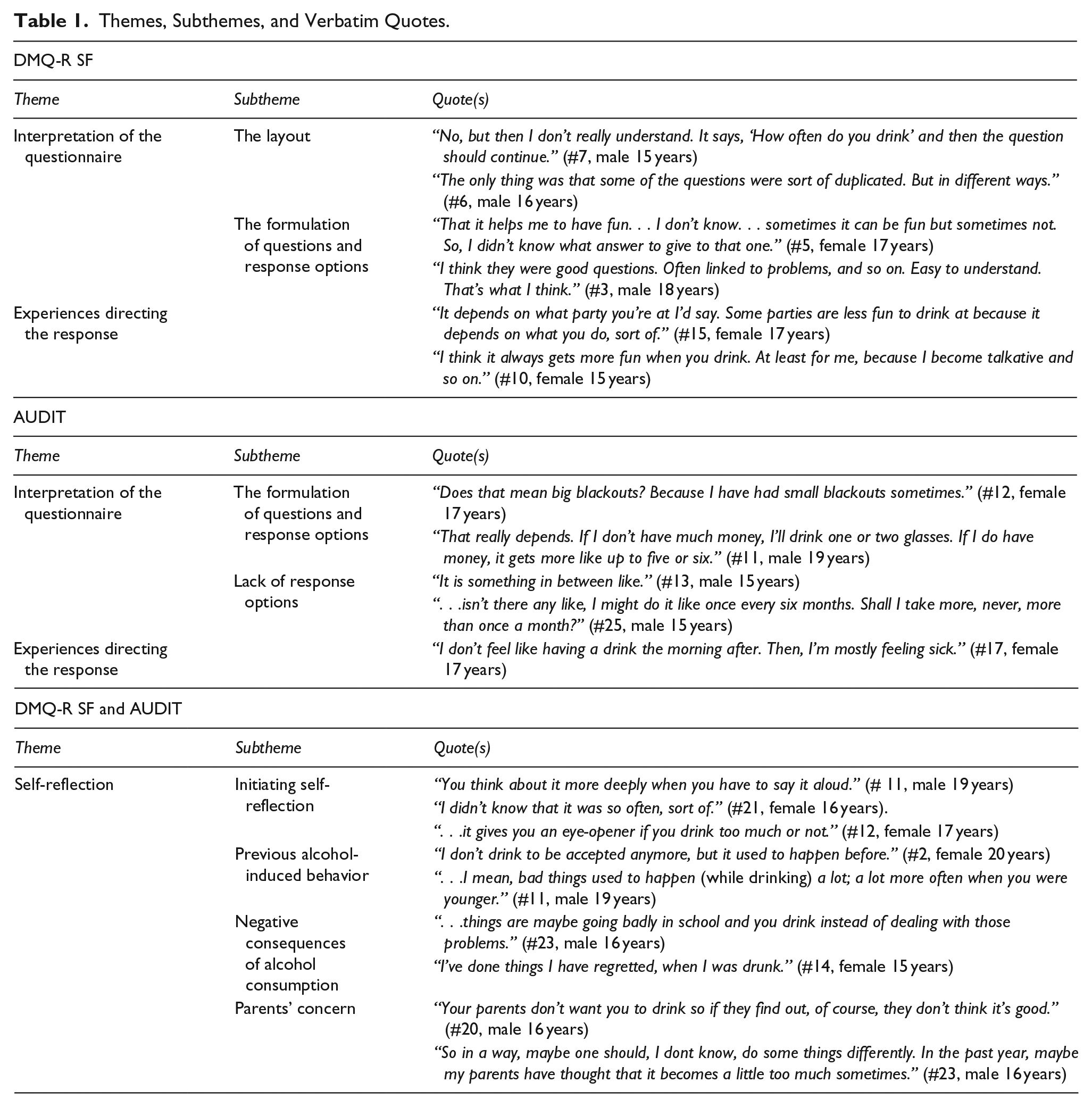
The DMQ-R SF
In all, 26 individuals responded to and commented on the DMQ-R SF.
Theme: Interpretation of the Questionnaire
A large portion of the participants’ comments pertained to the questionnaire itself: the layout, the formulation of questions and, to some extent, the lack of suitable response options. Many of the comments about the questionnaire occurred in the initial phase of the interview. Most of the respondents’ interpretation problems of the questionnaire items were resolved after some careful thought.
Subtheme: The layout
Some of the participants found the graphic design of the questionnaire initially confusing and had difficulties finding out how to respond. Furthermore, that the questions appeared repeatedly in similar forms was noted, although this did not create confusion.
Subtheme: The formulation of questions and response options
It was common for the participants to comment on how to interpret the wording or the situation described in the questionnaire. A few participants had difficulty determining a suitable response option and instead chose a rough estimate. One item in the DMQ-R SF repeatedly raised comments, suggesting it was difficult to understand: “To get high” (In Swedish “få ett rus,” DMQ-R SF item 5).
Theme: Experiences Directing the Response
When the participants pondered over the questions, they often referred to their own personal experiences of using alcohol. Those experiences—rather than the motive for drinking—seemed to direct the response.
The AUDIT
Sixteen participants responded to and commented on the AUDIT.
Theme: Interpretation of the Questionnaire
The participants expressed few comments on the layout of the questionnaire. Moreover, it appeared that the items of the AUDIT did not require as much in-depth/lengthy consideration as those of the DMQ-R SF.
Subtheme: The formulation of questions and response options
At times, the participants had difficulty interpreting the wording or the situation described in the questionnaire. Some had difficulties understanding the concept of quantifying a “drink” (“glas” in Swedish).
Subtheme: Lack of suitable response options
Sometimes the participants indicated difficulty when determining an acceptable response option and instead chose a rough estimate. The graphic design of the questionnaire, however, seemed easy to follow. Only one participant had problems understanding the layout, expressing insecurity over how to value response alternatives.
Theme: Experiences Directing the Response
Similar to the DMQ-R SF, many participants referred to situations they had previously encountered, often highlighting their practical experiences. Those experiences seemed to direct the respondent’s response.
Theme: Self-Reflection
This theme was identified based on thoughts about both DMQ-R SF and AUDIT. A commonly expressed view of the participants pertained to their personal alcohol use.
Subtheme: Initiating self-reflection
To be asked to think aloud and to say whatever came to mind while responding to the questionnaires triggered the participants to think about why and how much they were drinking. Some noted that answering the questionnaires constituted a rare opportunity to carefully examine why and how often they drank. The adolescents reported that either one or both of the questionnaires provided a clearer picture and gave them some control over their personal alcohol consumption. The DMQ-R SF helped the participants to reflect over their motives. The AUDIT differed from the DMQ-R SF in that it initiated thoughts about quantity of drinking. Furthermore, the participants felt that the questionnaires could be useful also to their peers. They also noted that some may be a little embarrassed to talk about alcohol use.
Subtheme: Previous alcohol-induced behavior
When replying to the three questions about conformity motives, the participants reflected over how peer attitudes had played an important role in their younger years. Several participants in the upper ages stressed that they can now manage the peer pressure to drink alcohol. A recurrent theme was that the adolescents took little notice of the opinions of others, and that their peers did not care about how others drink.
Subtheme: Negative consequences of alcohol consumption
The coping motive (using alcohol to forget problems) was either endorsed or rejected by the participants. Those participants who rejected this motive were forceful in their expressions (e.g., they would use the word never). They commented that it was never a satisfactory solution and gave examples of negative consequences of using alcohol for this purpose. Others reported negative consequences of excessive alcohol use such as aggressive behavior, physical, and verbal confrontation and initiating a pattern of heavier drug use.
Subtheme: Parents’ concern
Some participants contemplated over their parents’ concern, even though parents were not directly referred to in the questionnaires.
Discussion and Conclusion
This is the first study, to our knowledge, to report qualitative data of how adolescents think when responding to self-report questionnaires on alcohol drinking behavior. Information collected using the think-aloud method would have been difficult to collect with fixed response options, or by asking participants retrospective questions. The adolescents who were approached were motivated to participate, and accepted the task of answering the questionnaires in an efficient and cooperative manner. Although they did not express their views in a voluble fashion, the interviews did likely capture the essence of their impressions.
Both questionnaires were reasonably comprehended by the adolescents. Although many of the participants expressed some concern on how to go along with the responding, they appeared to resolve these uncertainties with relative ease. Many of the participants expressed some difficulty while determining suitable response options, but eventually, most did find acceptable options. A small number of the participants were unable to find an adequate response option, choosing instead the alternative “sometimes,” or an option positioned in the middle of the scale. Only a few problems related to understandability were noted, and those were in some cases associated with the participant’s limited Swedish vocabulary. There were also some wordings (e.g., to get high, få ett rus in Swedish) that are not commonly used in this age group. In forthcoming revisions, attention should be paid to those wordings when using the questionnaires in adolescents.
Both questionnaires were well accepted by the interviewed adolescents. The participants’ final, evaluating comments on both questionnaires were mainly positive while few comments were neutral and none negative. None of the participants had any complaint about responding to the questionnaires. The participants’ positive attitude may be related to their willingness to participate in the project. Accordingly, acceptability might have been lower in a situation where they would have felt greater stress or where they feared results would lead to negative consequences. Taken together, acceptability and suitability was good for both the DMQ-R SF and AUDIT in this adolescent group.
In addition, the results indicate that the questionnaires could initiate processes of self-reflection on drinking habits. In many cases, the participants ruminated over situations they had encountered rather than recalling their motives for drinking. In cognitive psychological theory the frequently cited “Question-and answer model” (e.g., Collins, 2003) suggests that to answer a question respondents must complete four actions: comprehend the question, retrieve the necessary information from long-term storage, make a judgment about the information needed to answer the question and respond to the question. Thus, the thought process that leads to an answer includes invoking earlier experiences.
Most of the participants spontaneously verbalized such thoughts by starting to think about how much they were drinking and why. It is likely that such self-reflection processes have an impact on their drinking habits. In a systematic review, McCambridge and Kypri (2011) found that people tend to reduce their alcohol consumption simply after having been asked questions on their use of alcohol. In future studies, the impact of questionnaire-induced attentiveness to drinking habits on drinking amounts in adolescents will be investigated.
With the think-aloud method, a new type of data could be collected to gain a better understanding of how adolescents think while completing self-report alcohol-related questionnaires. In this study, the performance of the two questionnaires was in focus of interest. If the main interest is the adolescents’ thoughts about alcohol use, more traditional in-depth qualitative interview methods would be preferable.
Limitations
One potential weakness of the study is the interview setting. Having a researcher present in the room may have created bias. Given that the questionnaires are about alcohol use, social desirability may have played a role. On the other hand, some researchers advocate that the think-aloud method provides less distraction or social desirability bias compared to other cognitive interviewing techniques (Willis, 2005).
A social desirability measure was not used in this study. Because the results of the questionnaires as such were not of interest, but rather the thinking processes when responding, such measures were superfluous. But in studies with a broader aim, it would be of interest to include measures of social desirability.
The number of participants was relatively small; however, qualitative research is often based on small sample sizes in which understanding of experiences and perceptions is prioritized. The participants, adolescent boys and girls aged 15 to 20 years age, were selected to best inform the research questions and contributed to variations in the understanding. Nonetheless, a larger sample could have enhanced the findings.
The qualitative study design does not aim for generalization of the results in a quantitative manner. Rather, describing the context, the process of analysis and the appropriate quotations enhance the readers’ understandings of transferability (Graneheim & Lundman, 2004). As with all research using qualitative analysis, measures must be taken to strengthen the neutrality of the coder. In this study a sound data analysis process was applied with alternative coding and discussion of the data.
Conclusion
The results of this study support the use of the DMQ-R SF and AUDIT in adolescent treatment populations for research and mapping. The participants found the questionnaires easy to complete and widely relevant. The results also support the use of the DMQ-R SF and AUDIT for clinical use as a component within the treatment plan in the sense that both could generate processes of self-reflection on alcohol use.
Footnotes
Declaration of Conflicting Interests
The author(s) declared no potential conflicts of interest with respect to the research, authorship, and/or publication of this article.
Funding
The author(s) received no financial support for the research, authorship, and/or publication of this article.
