



Abstract
Cities face interconnected challenges for health equity, including structural racism, inadequate housing, and climate change. Due to past failures to achieve positive development outcomes for low-income and marginalized communities, many U.S. cities now emphasize equitable planning and community engagement. However, practitioners often lack the tools to implement just, equitable, and health-promoting policies effectively. Through semi-structured interviews with 23 professionals in sectors like community development, planning, transportation, and housing—primarily in local government and nonprofits—we observed a shift toward more equitable practices, explicitly naming the role of racism in urban planning and the adoption of new strategies and frameworks for equitable planning that support health. We document approaches used to overcome opposition to healthy, equitable, and sustainable development, including building trust and employing strategic communication framing. Community-led initiatives emerged as powerful drivers of equity and sustainability, though greater public sector support for these potentially transformational efforts is needed. Further progress could benefit from a deeper understanding of cultural mindsets that hinder equitable transformation.
Introduction
Urban leaders increasingly recognize that equity and sustainability are core and interconnected goas in U.S. cities, driven by factors including extreme weather events, structural racism, and the housing affordability crisis. Given historic failures to garner positive development outcomes for low-income and marginalized groups, government-led infrastructure and policy initiatives face resistance and require city officials to work in new ways (Fainstein and Forester, 2023; Knapp et al., 2022). Community-based organizations (CBOs) are demanding more from city hall and private developers. They are negotiating benefits from new developments while working to mitigate harmful impacts, such as displacement and environmental injustices (Bates, 2018; Rosen, 2023), or to garner support for their own programs, such as community land trusts and faith-based initiatives (Berney, 2022; Born et al., 2021). Simultaneously, there is a growing understanding in urban development research and practice about the importance of integrating sustainability, equity, and inclusion to promote health and wellbeing (Pineo, 2020), yet these concepts are often treated separately.
From a social determinants of health lens, equitable and sustainable development are critical for urban health. Inequities across age, race, socioeconomic status, and other factors contribute to adverse health and wellbeing trends in the United States. Despite having the world’s largest economy (IMF, 2024), the United States ranks lower in life expectancy (WHO, 2023) and happiness (Helliwell et al., 2024) compared to other high-income countries, 1 respectively ranking 40th and 23rd. Life expectancy stagnated in 2010 and then began declining from 2014 (NASEM, 2021). Residential segregation, shaped by policies like redlining, has led to disproportionate health burdens for low-income and racially minoritized populations, including increased exposure to overheating via the urban heat island effect and air pollution (Steil and Arcaya, 2023).
This article explores two possibilities for promoting health through sustainable and equitable urban development in the United States. First, action on equitable development is increasing (Jackson et al., 2023), including its integration with environmental sustainability (Chu and Cannon, 2021), yet both of these could be more clearly integrated with local public health agendas to have greater impact. Further progress on equitable and sustainable urban development is needed, particularly in the current political context. As such, practitioners of urban development (e.g. affordable housing providers, urban planners, nonprofit groups) require strategies to counteract social and political opposition. Second, using narratives and framing strategies to advocate for progressive policy change may help planners, CBOs, and other urban development actors to shift mindsets, and ultimately, to implement sustainable and equitable development. Using qualitative data from interviews with senior professionals across various sectors, and insights from the scholarly literature, this research explores these two possibilities in a range of U.S. cities. Our findings document the strategies that have underpinned a continued shift toward greater integration of equity across multiple urban dimensions, such as community-led programs and strategic communication, of which the latter is an underexplored opportunity for healthy urban planning.
As this article traces activities in multiple U.S. regions and cities, we reference multiple “communities,” and we use this term in a relational sense, as a contingent group shaped by shared practices, power relations, and exclusions (Mohr Carney et al., 2022). The following sections elaborate on the two possibilities outlined above, providing theoretical grounding and definitions. We then describe our methods and the findings of our semi-structured interviews, interpreted through scholarly literature. In the discussion, we consider the study’s implications for practice and further research.
Integrating sustainable, equitable, and healthy urban development
Sustainability, equity, and health are often theorized and practiced separately in urban planning and development literature, despite their interconnected nature (Pineo, 2020). Below, we theoretically ground this article in frameworks that integrate these dimensions, seeking to promote health through addressing inequities in resource distribution, adopting inclusive processes, and considering both local and global impacts of urban development. We present the social determinants of health framework as justification for our broad interpretation of the factors affecting health in cities, including housing, parks, and mobility infrastructure. We then contextualize our study in literature describing how U.S. urban development practices integrate sustainability, equity, and health.
Promoting health through urban planning is fundamentally a political endeavor, where power in decision making explains differential environmental exposures (Corburn, 2017; Pineo, 2022). Such inequities are not naturally occurring, rather they stem from urban policy that affords greater opportunity based on race, class, and other characteristics, creating disparities in factors such as homeownership rates (Sander et al., 2018) and life expectancy (Huang and Sehgal, 2022). From a social determinants of health lens (Commission on Social Determinants of Health, 2007), health inequities result from an unfair distribution of health-promoting resources, such as clean air. The social determinants of health framework moves beyond individual characteristics to focus on how the environments in which we live, work, and study can impact health and wellbeing. Although this perspective is crucial to depart from the reductionism of the biomedical model, it is critiqued as failing to clarify the historical and structural causes of inequities (Borde and Hernández, 2019). The same critique can be applied to many healthy urban planning approaches, which have been strongly influenced by public health’s epistemological and ontological orientations, reducing structural barriers to “lifestyle choices” (Corburn, 2017; Pineo, 2020, 2022).
Addressing environmental pollution and poverty has been core to healthy urban planning and engineering approaches since their modern inception in the 19th century, but explicit inclusion of equity principles came later; notably through the concept of health promotion in the 1980s. The World Health Organization’s Healthy Cities Movement promoted equity, and scholars such as Corburn (2009, 2013) brought equity and justice firmly into theories of healthy urban planning, advocating for attention to the social and political components of this field, which are often overshadowed by rational and technical health paradigms. Pineo (2020) argued that sustainability, equity, and inclusion were not fully integrated into conceptualizations of healthy urban development. She advocated for increased attention to the distributed health impacts of environmental harms, drawing on Agyeman’s “just sustainabilities,” a holistic treatment of sustainability, justice, and equity (Agyeman, 2013; Agyeman et al., 2003), which we adopt here.
Recognizing the varying interpretations of sustainability and sustainable development, Agyeman, Bullard, and Evans adopted the term “just sustainabilities,” which they linked explicitly with equity and justice. They defined this as “The need to ensure a better quality of life for all, now and into the future, in a just and equitable manner, whilst living within the limits of supporting ecosystems” (Agyeman et al., 2003: 5). This understanding combined the widely used Brundtland definition (World Commission on Environment and Development, 1987) of sustainability with multiple dimensions of justice and equity informed by Sen (2009) and Schlosberg (1999, 2004, 2007), including distribution, recognition, capabilities, and participation. Agyeman tied this all to quality of life and wellbeing, stating that “without a clean environment and fair share of the earth’s resources, our capabilities to flourish are constrained” (Agyeman, 2013: 43). Pineo’s (2020: 983–984) concept of healthy urbanism extends the perspectives of Corburn and Agyeman, advocating for development that is: (1) inclusive—participatory processes and design that “enables all members of society to conveniently participate in daily activities without feeling that they are disadvantaged by their personal characteristics or needs”; (2) equitable—provides “access to health-promoting environments to all residents and specifically considers and seeks to remove barriers to access”; (3) and sustainable— “supportive of the needs of the current (and immediately local) population without compromising the needs of future (or spatially distant) populations.”
Frameworks have been produced to operationalize the constituent components of justice in urban development practice (McDermott et al., 2013; See and Wilmsen, 2022). Berney (2022) argues that just design and development must repair inequity and discrimination in urban development, including how collective resources and services are distributed. This requires the transformation of positionalities and power relationships through broad invitations to participate in the processes and benefits of development. Following Lefebvre (1996) and Harvey (2008), it also requires a re-imagination of the principles guiding design and development to embrace the rights of all people to participate in the construction of the city and meet their needs, but especially those with marginalized identities. Just urban design and development support the ability of people to be safe, happy, and free in their daily pursuits with a high quality of life and the ability to thrive in place. This is a redistributive justice approach to build efficiency, equity, and legitimacy in development.
Research centering justice and equity in the United States has outpaced equitable urban development practices by public agencies. Although justice has been influential in multiple schools of planning theory (Dadashpoor and Alvandipour, 2020), North American urban planning has been overly focused on the distributive and procedural components (Agyeman, 2013; Meerow et al., 2019; Milroy, 2004), with similar findings internationally (Castán Broto and Westman, 2017). Equity has received lower prioritization in urban plans and programs compared to economic and environmental goals (Anguelovski et al., 2016; Loh and Kim, 2021; Manaugh et al., 2015). Even though equity was incentivized in the federal Sustainable Community Regional Planning Grants (SCRPGs) program, an analysis of 10 SCRPG plans found that equity was not articulated, while sustainability and quality of life were prioritized (Zapata and Bates, 2017). Looking at Baltimore’s SCRPG activities, Finio et al. (2021) found that equity discussions, analysis, and planning were conducted, yet significant changes on the ground did not occur. An international synthesis of healthy urban development case studies (six out of 15 were in the United States) found that equity and inclusion objectives were less frequently achieved than sustainability (Pineo et al., 2025).
Equitable development practices had been expanding in the United States, although national policy changes under the Trump administration will likely disrupt this trajectory, such as major reductions to the U.S. Department of Housing and Urban Development’s (HUD) housing assistance programs (Treskon and Levy, 2025). Jackson et al. (2023: 412) state that urban planners are “increasingly proactive in promoting equity and centering racial justice,” noting that there is still “much work to be done.” Analyses document these shifts, such as Portland incorporating equity into planning and development (Bates, 2018), 17 cases of equitable park and recreation systems (Beck et al., 2024), and community-academic-policy partnerships that are advancing equitable development through a mobility justice lens (Baquero et al., 2024). Chu and Cannon’s (2021: 91) analysis of criteria for climate adaptation decision making found “more participatory action, inclusive decision-making, and progressive, redistributive politics.”
Framing, narrative, and equity
This section describes how narratives, storytelling, and framing strategies have been characterized in urban planning theory as powerful motivators of change, constituting our urban future and tools for conflict resolution (Sandercock, 2003; Throgmorton, 1996; Van Hulst, 2012). Stories align with communicative planning theories by helping us understand another person’s perspective in urban debates (Innes, 2004). As contemporary scholars have moved away from the communicative turn in planning, storytelling and narrative have been reinvigorated in decolonial and counterhegemonic planning theories to highlight marginalized urban experiences (Ortiz, 2022; Redden et al., 2022). Here we present some limitations of the literature on storytelling in planning and position other fields’ interpretation of these phenomena as valuable and underexplored for healthy urban planning.
Storytelling and narrative are advocated as multi-purpose strategies for contested societal issues, yet their value and adoption have been underexplored in healthy urban planning literatures. Such approaches can be used to find a path forward to overcome conflict (Cobb, 2013; Sandercock, 2003). Cobb explains that “conflict disables a community’s capacity to deliberate, to engage in conversations that enable learning, and to support the evolution of the narrative landscape” (Cobb, 2013: 7). Simplified narratives are used to justify marginalization. Thus, Cobb argues that public officials should engage in “narrative braiding” through dialogue to bring together diverse narrative strands that parties agree are the legitimate causes of a problem. The result of this effort is to “disrupt and destabilize the broader cultural narratives that anchor and exacerbate the conflicts between identity groups,” through policies and decisions that account for diverse positions on a problem (Cobb, 2013: 19, emphasis in original). In planning, this possibility for story and narrative has focused on finding commonalities across different groups’ perspectives in the context of deliberative participation exercises (Forester, 2000; Goldstein et al., 2015; Sandercock, 2003; Van Hulst, 2012). Ortiz’s (2022) work on storytelling in planning offers an alternative to these Western sources based on Latin American decolonial thinking, reframing storytelling for epistemological justice and healing.
Theoretical and methodological diversity in the study of storytelling in planning could be obscuring its role in urban debates and change. Literature that positions storytelling in planning as persuasive (Sandercock, 2003; Throgmorton, 1996, 2003), what Van Hulst (2012) calls “storytelling for planning,” does not typically detail the mechanisms between communication and changed opinions/behaviors, such as analyses in the psychology, cultural anthropology, and linguistics literatures (see Flusberg et al., 2024). Major critiques of this planning literature are that it undervalues the role of power in urban issues (see Throgmorton, 2003) and that it focuses more on representation than on reality (Mager and Matthey, 2015). The lack of distinction between core terms is a further challenge with storytelling in planning literature. For instance, story and narrative are often used interchangeably (e.g. Van Hulst, 2012), removing the potential to distinguish and analyze bigger-picture patterns in dialogue (narrative) in contrast with specific accounts including a setting, plot, characters, etc. (story). Recent work by Van Hulst et al. (2025) addresses some of these challenges by outlining how discourse, framing, and narrative analysis methods can be used and combined for interpretive policy analysis, yet there remains the potential to further clarify how these diverse approaches can be applied to study urban change, particularly in the field of healthy urban planning.
Research on the role of narratives, framing, and cultural mindsets in policy debates has been more active outside of the urban planning field. The study of policy narratives, or stories “told to sway opinion,” by public policy scholars (McBeth et al., 2022) aligns with contemporary work on narratives in planning (Rigolon et al., 2022), but could be further applied to analyze framing effects on residents’ cultural mindsets and behaviors regarding urban issues. Flusberg et al. (2024) analyze linguistics and cognitive psychology literatures and categorize the effects of framing strategies as: attention and perception; beliefs; attitudes; reasoning, judgment and decision making, and behavior. 2 For instance, perceptions of the urgency of a social or political issue can increase when war metaphors are used (Flusberg et al., 2024). The FrameWorks Institute (2020, 2021) has researched the role of narratives in changing mindsets, which in turn can lead to social change (e.g. Kendall-Taylor et al., 2023). Building on their work, this article uses “narrative” to reference patterns in discourse, while “cultural mindset” refers to patterns in thinking. We use “framing” to describe how a message is designed to cue a specific causal assumption for the audience (Flusberg et al., 2024). Given the contested political nature of promoting health, equity, and sustainability through planning, there would be value in further analysis of the role for narratives, storytelling, and framing.
Interview recruitment and analysis
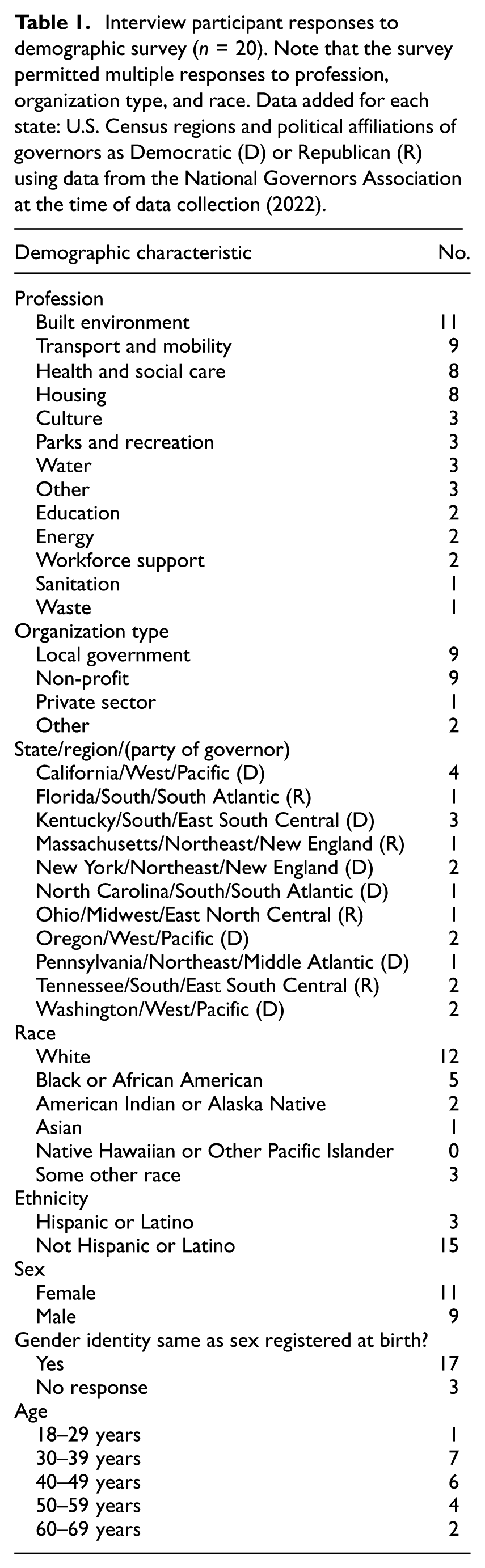
We conducted semi-structured interviews with 23 primarily senior professionals working on sustainable and equitable urban development projects in the United States between August and September 2022. We invited 49 participants via purposive (n = 28) and snowball (n = 21) sampling, targeting people with significant experience (based on job titles that included terms such as director and manager) in different sectors, geographies, and organization types. We used our professional networks and grantees of the Robert Wood Johnson Foundation for purposive sampling, including the Reinvestment Fund, the backbone organization for the Invest Health initiative, the Building Healthy Places Network, and the National Recreation and Parks Association. Recruitment occurred through email, as did requests for participant recommendations via our professional networks. Of the 23 participants, 11 were recruited via purposive sampling and 12 via snowball sampling. Participants were informed and consented (following research ethics approval), and interviews were audio-recorded and transcribed. Table 1 displays demographic data for participants, who were roughly split between nonprofit and local government organizations and located in all four major U.S. Census regions, with three to four states in each, apart from the Midwest (with one state represented). The political affiliations for governors of these states (at the time of interviews) were primarily Democratic, with five participants in states with Republican-affiliated governors. Multiple participants described working in cities where the political leadership was not aligned with the state governor.
Interview participant responses to demographic survey (n = 20). Note that the survey permitted multiple responses to profession, organization type, and race. Data added for each state: U.S. Census regions and political affiliations of governors as Democratic (D) or Republican (R) using data from the National Governors Association at the time of data collection (2022).
The lead author analyzed transcripts in NVivo qualitative data analysis software using reflexive thematic analysis (Braun and Clarke, 2022). A separate deductive content analysis was used to identify specific approaches for operationalizing equity and sustainability in practice. A preliminary version of our interview findings informed a global study on sustainable and equitable development (specifically the selection of international case study cities), as reported in our study protocol (Pineo et al., 2024). Here, we elaborate on those findings, providing additional data and new interpretation.
Findings: Possibilities for change in U.S. cities
The results of our reflexive thematic analysis are grouped into four themes below, described in context with existing literature.
Distrust undermines dialogue and collaboration to change mindsets
Historical urban development practices, defined by segregation and government-led initiatives, undermined the needed relationships and trust for advancing health-promoting equitable and sustainable development policies and programs. The context for distrust was described by multiple participants as cities being exclusive and segregated by design, consistent with scholarship on urban segregation (Massey and Denton, 1993; Trounstine, 2018). Participants from different U.S. regions described their cities as “segregated,” with “an intentionality behind that” (participant 8, chamber of commerce official), based on racism and classism that shaped historical and present policies. For example, participant 7 (urban planner) said that data analysis made it “very obvious” that the problem of racial disparities in homeownership “stems from redlining.” One account demonstrated that recent urban policies had reinforced historical separations, albeit unintentionally: “our down-zoning … perpetuated that redlining … we didn’t realize it” (participant 14, urban planner). The same planner described their job as working to “undo the harms that were created,” such as unaffordable housing and lack of access to green space. This sentiment was echoed by other public sector participants.
Distrust was present among supporters and opposers of equitable and sustainable development initiatives. Among supporters, distrust has been created through historical harms, undelivered promises, and a deficit of recognition from government. Participants described being and feeling “overlooked for many years” (participant 12, program manager in a health foundation). Opposers were described as being distrustful of people and organizations progressing initiatives to promote equity and sustainability. Participant 9, an affordable housing developer, described this distrust and how it can be addressed: [people] have all kinds of terrible made-up ideas about what we do, how we cheat, how we lie (…) what you need to do to counter that is to talk to people and build a relationship … they might still disagree with the project that you’re proposing … for whatever underlying reasons or stated reasons that they have, but they start seeing you as a human being that they can talk to.
Overcoming distrust through open dialogue was described as a key strategy for changing mindsets. Participant 19, a planning consultant, explained the need for conversations between city staff and elected officials with low-income and racially minoritized residents “that disproportionately face barriers to good health” to improve trust. They said that for this dialogue “to move the dial” both trust and time were needed, indicating the reciprocal relationship between communication and trust. Participants held multiple conversations to “[lay] the groundwork” (participant 22, urban planner) for progressive policy solutions, particularly those working with conservative communities. Participant 22 described using data on homeownership disparities and redlining to remove a sense of ideology or bias, explained as: “We’re showing you data. It’s a fact; we’re not trying to have an opinion around it.” Having these conversations in places where people were already gathered (“the church, “the realtors’ association”) was a way to encourage meaningful engagement, especially for controversial topics.
“Words matter” to counter opposition to development
As described above, participants identified narratives, values, and cultures that resist equity in urban development, requiring targeted communication strategies. Key strategies included framing proposals to gain support, using narratives to shift perspectives, and encouraging community storytelling to influence decision makers. Strategies to change mindsets were deliberate, described by participants with statements such as, “there’s a lot of perspective that has to be transformed” (participant 8, chamber of commerce official), “[dispel] some of the harmful prevailing narratives” (participant 18, program manager in a health foundation), and “we really want to change the narrative” (participant 16, public health official). At times, these strategies were about educating local residents. For instance, a communication campaign aimed at countering NIMBYism sought to normalize apartment living, tackling misconceptions that “affordable housing is just Section 8 housing,” and explaining that “just because you live in an apartment doesn’t mean you are low income” (participant 7, urban planner). Personal stories were also seen as persuasive (“those stories can make a difference”), such as “heartbreaking stories” from tenants who shared how affordable housing “changed their lives” (participant 9, affordable housing developer). A senior employee in a chamber of commerce (participant 8) gave a long account of their strategy for communicating with local politicians about the need for health-promoting equity initiatives that highlights multiple uses of story, narrative, and framing.
First, the participant’s (8) story recounts the city’s history as a framing choice that justifies future equity-related policies by including reference to historical racist policies and their impact on wealth generation. He began by situating the story’s purpose: “I’m just going to tell you a bit of a story about where we come from in [this city] and where we’re going.” He describes the city’s former industrial power status followed by decline and outward migration in the mid 20th century. He noted the lack of mortgage loans to veterans of color that reduced their ability to move to the suburbs: “many of the minority populations who actually served in the war did not experience that type of financial opportunity.” Noting economic and environmental challenges in the late 20th century, he then described more recent opportunities for reinvestment in the urban core. As earlier quotes showed (such as participant 22 on housing data), other interviewees noted the importance of highlighting the impacts of past and ongoing segregation for advancing reparative policies and practices.
Next, the participant described the narratives that the city plan adopts in its vision, linking the future direction to the past. The plan’s narratives are about “creating choices for people” and a “vibrant urban community that’s low stress.” Health and equity were embedded in his account of how the city should change: “we were often known for the [city’s healthcare facilities], but our focus around social determinants of health really changed the narrative to focus on the root causes of negative health outcomes in communities.” He describes this shift as being about “access to resources … for all residents, not for some”; and supporting competitiveness, as he explains: “creating these mixed-use communities that are diverse, that are equitable, that are walkable … is extremely critical for creating competitive urban places.” This example shows an explicit focus on changing the city’s narrative regarding health, from healthcare to social determinants.
A final strategy used by this participant relates to framing by using analogy and deliberate word choices to convey the need for equitable investments. He describes using a weightlifting analogy that describes a targeted universalism approach: “[if] your upper body is really strong … but your legs look like twigs, you are going to spend more time on a leg press, right. Balance.” He noted that he “had to sell the idea” to politicians by reassuring them: “we’re not saying you have to give anything, we’re talking about access to opportunity. It’s not a welfare and charity model. It’s an opportunity model.” This participant has developed multiple communication strategies to advocate for equitable, healthy, and sustainable development, such as stories that highlight marginalized experiences and framing through terms that his audience will accept (e.g. “balance” and “opportunity”).
Ecosystems of support to overcome obstacles
Working against the status quo to advance equity was described as conflictual and complex, often requiring practitioners to work across silos and confront political and organizational challenges. To support this work, participants benefited from training, networks, and collaborative projects.
Participants used terms like “battle,” “fighting,” and “adversary” to highlight the combative nature of this work. For example, two planning colleagues described the city’s work to invest in areas following “years of disinvestment and generational wealth gaps” created by redlining. One described it as “an uphill battle, but we are fighting the battle, trying to … shore up those people” to avoid displacement (participant 7). Her colleague explained further: “there are people warming up to argue zoning changes” related to changing allowable land uses from single-family to mixed-use residential (participant 22). She described their “biggest adversary” as the home builders’ association because “they want changes that only benefit them individually, as opposed to … [the whole] community.” In another example, a planner working in public health explained how rural residents outside of a wealthy city were “fighting” for bus shelters to provide shade (participant 20).
The emotional toll of this conflictual work was high, with participants feeling “very fresh and raw” (participant 9, affordable housing developer) after public meetings or enduring “five extra hours in a day … to get to the same point” (participant 6, public health official). Trauma was a recurring theme, stemming from violence, disasters, and COVID-19, which created “frustration” when action was delayed or denied (participants 4, 12, 20, 21).
People came together in networks, steering groups, and other bodies, some of which were project specific and time limited, while others were ongoing and broad in nature. These convenings supported participants to have conversations to prioritize activities, resolve challenges, and collaborate in mutually beneficial ways that filled gaps in a single organization’s capacity. For example, in one tactical urbanism project for safe mobility infrastructure, the steering committee was described as “one of the most important parts” (participant 1, urban designer in nonprofit), promoting “collective responsibility” among agencies (participant 23, transportation planner).
Bottom-up efforts are transforming equitable and sustainable development
A range of initiatives led by CBOs were described as transforming possibilities for sustainable and equitable development, moving beyond procedural justice to a more fundamental power shift. Such activities spanned residents’ efforts to “fight” for recognition and funding, through to CBO and government partnerships. Although community-led development occurs in the United States (Agyeman, 2013), government support has been absent or counterproductive in the past (Green and Haines, 2012), and relying on nonprofits and CBOs for development is critiqued as legitimating state neglect and obscuring disinvestment as part of neoliberalization (Purcell, 2009). Thus, participants’ discussion of CBOs leading equitable development merits attention.
Although public sector organizations also led sustainable and equitable development initiatives, CBO-led examples were viewed as uniquely promising to upend existing problematic practices. Such activities were described as filling gaps in what the government had the capacity or will to support. In one project, state funding supported a tactical urbanism group to work with young people to re-design mobility infrastructure on a road with high pedestrian fatalities, first through a small grant and then through a significant funding commitment to improve the street. A participant explained that “this would not have happened” without the youth-led project, which “sort of elevated it for [the state agency]” and “showed what was possible” (participant 16, public health official).
CBOs sometimes had to work very hard to garner local government support for transformational solutions. Although partnership work was common, there was an impression that city processes and regulations were stacked against sustainable and equitable development solutions. For instance, when a nonprofit that spearheaded a park rehabilitation project learned that nearby property values might increase by 5%–20%, they committed to initiatives to avoid displacement, including support for new homeowners and a community land trust that created hundreds of affordable housing units. Participant 10, a senior leader on this work, was unprepared for how long it took to convince city leaders to support the community land trust, saying it felt like “Groundhog Day” to repeatedly explain its purpose and value. The participant was surprised that he needed to do this explanatory work with city leaders, saying: I mean, we knew that there was going to be a significant education push for the community who might not know how a community land trust works. I don’t think I was prepared for how much time it took to talk to city leaders.
Ultimately, the mayor allocated budget for the community land trust. In another example, a senior leader of a mobility advocacy group (participant 5) described a “very tense relationship” between her organization and city staff, partly because of the former’s “very publicly embarrassing campaign to fight” a city infrastructure proposal. When a new mayor was elected after adopting the advocacy group’s policy recommendation as “one of his key positions,” they were able to “completely reverse” the relationship with city staff and “actually do things that are collaborative.”
Frameworks and approaches
This section reports specific approaches for operationalizing equitable, sustainable, and healthy development.
Centering equity in multi-sector collaboratives
Equity was pursued as a galvanizing force in internal and external collaboration, especially across sectors. In a public health department, an equity infrastructure team functioned to facilitate internal collaboration, identify strategic cross-departmental projects, and change organizational culture and practices. Separately, the California Accountable Communities for Health Initiative, a US$17 million investment in 13 places from 2017 to 2022, supported diverse organizational partners and residents to align interventions and promote upstream solutions (Angus et al., 2024).
Equitable development frameworks
Multiple frameworks were described for advancing equity in urban development. For example, a public health department was using an equity framework consisting of three components: (1) “normalize,” to facilitate shared language, analysis, and priorities; (2) “organize,” to proactively target and shift systems to undo past and ongoing structural racism through tools, training, and other resources; and (3) “operationalize,” to implement and iteratively improve the tools. A nonprofit used asset maps of nonprofits working in related issue areas to inform their equitable development plan, to avoid duplicating efforts, and to promote collaboration.
Power building
Several interviewees discussed the importance of power building as a strategy for equitable development through supporting civic engagement and holding leaders accountable for creating change. A Californian program called the Building Healthy Communities initiative, which invested in 14 communities over 10 years, aimed to build and sustain power among residents and enable them to advocate for improved health outcomes and racial equity. The resulting Flower Power framework conceptualizes how base building, civic engagement, narrative change, policy advocacy, and healing work together to build community power and advance health and racial equity (Barsoum and Farrow, 2020).
Anti-displacement
Participants used a range of anti-displacement strategies to ensure that neighborhood improvements, such as affordable housing and green spaces, did not result in displacement. Strategies included homeowner-occupied unit rehabilitation and eviction prevention, zoning changes that allow for housing diversity (i.e. not only single-family residential), and rent subsidies. Participants also described opportunities for wealth building, for land banks to acquire and repurpose vacant or foreclosed properties to stabilize neighborhoods, and for community land trusts to maintain long-term housing affordability by owning land collectively and leasing it to residents.
Discussion and conclusions
Viewing our qualitative data in the context of existing scholarship, we observe and document a shift across multiple stakeholders in liberal and conservative geographies toward more equitable and sustainable development practices that support the social determinants of health. A key finding from our study is that resistance to such initiatives has led to new ways of working, often spearheaded by the demands of residents and CBOs adopting more radical stances on resource distribution. Participants spoke of how bottom-up initiatives offered the greatest potential for disrupting the status quo to achieve transformative results. Specific framing and communication strategies were adopted to counteract opposition to equitable and sustainable development, a finding that we discuss in more detail below. Policy changes initiated by the Trump administration in 2025, such as housing program assistance cuts (Treskon and Levy, 2025) and rolling back of environmental regulations (Rashes et al., 2025), will likely significantly impact the work described by our participants; however, many of the practices identified here remain feasible despite federal changes.
This study has contributed new evidence of the storytelling, narrative, and framing strategies used to shift common mindsets that disregard structural barriers to health. Inequitable access to healthcare and healthy living environments are reinforced in society by cultural mindsets that blame low-income groups for their circumstances. Mindsets about individualism, capitalism, and stereotypes about marginalized groups often obstruct progressive change, particularly related to race and spatial justice (FrameWorks Institute, 2020; Volmert et al., 2023). Racist and classist motives have been found to underpin opposition to urban planning policies and decisions related to affordable housing and inclusionary zoning, highlighting the limits to current planning models in the context of power differentials (Scally and Tighe, 2015; Tighe, 2012). In addition, opposition is also motivated by perceptions that crime will increase, and property values will decrease, although numerous analyses have demonstrated the opposite (Albright et al., 2013; Voith et al., 2022; Wang et al., 2025). Recent empirical research builds on established theories of how framing and narrative can shift mindsets, leading to changes in public opinion and policy, including in relation to equitable green space policy (Kendall-Taylor et al., 2023; McBeth et al., 2022; Rigolon et al., 2022). However, there is a knowledge gap about the cultural mindsets underpinning opposition to equitable and sustainable development.
Our findings demonstrate how practitioners are using communication strategies to shift mindsets. For instance, the story excerpt from the chamber of commerce participant (8) evokes the “bootstraps narrative.” This well-known narrative is about an underdog who succeeds through sheer will and determination, promoting the myth of unfettered social mobility in the United States, rather than acknowledging that opportunities for success are severely constrained by race and class (FrameWorks Institute, 2021). The chamber of commerce participant’s communicative choices pushed back against this thinking by outlining the historical conditions that led to racial wealth disparities and then demonstrating the logic of providing “balance” and “opportunity” through targeted investment, “not welfare.” This is a counter-narrative to the idea that an individual from disadvantaged circumstances should create their own success. Most public health narratives in the United States do little to change this individualistic thinking by focusing on individual agency and behavior change. The myth of the bootstraps narrative is linked to opposition to equitable development, and further research should explore the specific mindsets opposing sustainable and equitable development progress in specific places, alongside advocacy narratives that could shift those mindsets.
This article highlights both the challenges and opportunities for advancing health through sustainable and equitable urban development in the United States. While bottom-up initiatives show transformative potential, participants highlighted the need for state support, a strategy more aligned to urban co-production (Castán Broto et al., 2022). The current political climate presents significant obstacles to progressive policy change, with cultural mindsets and resistance threatening progress at all levels of government. Cities remain critical arenas for change, where local governments, community groups, and coalitions can come together to make their communities inclusive and livable. While new scholarship in reparative planning shows a path forward (Williams, 2020; Williams and Steil, 2023), our findings show that practitioners are often still at the stage of making the case for change. In this context, further progress could be supported through peer-to-peer learning across places (in the United States and internationally) that have successfully adopted policies and approaches that support health, wellbeing, equity, and sustainability in an integrated way, even in the face of policy resistance. This moment calls for bold leadership and collaboration to overcome barriers and reimagine urban spaces as inclusive, equitable, and sustainable environments for future generations.
Footnotes
Acknowledgements
We would like to thank the Change Stories Advisory Group members and research participants for their contributions to this study.

Funding
The authors disclosed receipt of the following financial support for the research, authorship, and/or publication of this article: Support for this research was provided by the Robert Wood Johnson Foundation (via the Global Ideas Fund at CAF America and Grant ID 80984). The views expressed here do not necessarily reflect the views of the Foundation.
Declaration of conflicting interests
The authors declared no potential conflicts of interest with respect to the research, authorship, and/or publication of this article.
Data availability statement
Dryad: Semi-structured interviews about sustainable and equitable development in the United States. https://doi.org/10.5061/dryad.prr4xgxts (Pineo, 2024). Data are available under the terms of the Creative Commons Zero “No rights reserved” data waiver (CC0 1.0 Public domain dedication).