




Abstract
Capital is deeply embedded in the production of urban space. Many have written on capital and increasing financialization’s impact in the physical spaces and social constructions of the city writ large. To make visible housing financialization’s effect on the production of urban sociality at the micro scale, this research examines the financial underpinning and resultant urban streetscapes for three housing developments built in Zurich from 2009 to 2012. I interrogate the impact of each project’s relationship to financialization on the materiality and detail of the architectural and street siting choices, by researching the funding model for each development and how it affects the project’s siting, massing, and material decisions. I question how and whether these material decisions enable the street to serve as social infrastructure, and find that while the streetscape created by each project differs, in all three the street is not a lively place of interaction but rather a place of sterility or at least partial exclusion created to serve financial markets’ commodified interests.
Introduction
In her edited book Architecture and Capitalism: 1845 to the Present, Peggy Deamer notes the necessary embeddedness of capital in architecture and calls out the relative lack of architecture scholarship acknowledging this relationship (Deamer, 2014). Driven by architects’ persistent attempts to claim autonomy (Imrie and Street, 2014), as well as historians’ frequent focus on architects’ authorship, architecture history often excludes the forces external to design agency that shape spatial relationships in the built environment (Cramer-Greenbaum, 2023).
Meanwhile, global hunger for asset-backed capital has driven increasing financialization of building and construction markets, and global institutional investors have become increasingly involved in the production of commercial and more recently residential spaces (Büdenbender and Aalbers, 2019). The impact of finance on the production of urban environments is substantial, and well documented on the macro scale of skylines, speculative urban redevelopments, public housing allocation, and transportation infrastructure around the world (Halbert and Attulyer, 2016; Stevens, 2020; Yazici et al., 2025).
To make visible the effect of housing’s financialization not only on large iconic spaces but also on the production of urban streetscapes at the micro scale, this research examines the financing model, construction, design process, and resultant urban streetscapes for three housing developments in Zurich. Public–private partnership (PPP) Maaghof City West in Escher-Wyss, pension-fund property K.I.S.S. in Altstetten, and private asset Im Forster in Fluntern each create a distinct mode of urban living and model of street engagement or disengagement, co-created through distinct finance models and design choices beholden to the clients’ agenda. The manifestation of financial intent impacts how the architecture contributes to the social potential of the neighborhood street, producing modes of urban living with wider effects than their immediate location.
I interrogate the impact of each project’s relationship to financialization on the materiality of the architecture and street siting choices by researching each funding model and examining its relationship to the project’s siting, massing, and material decisions. In turn, I question how or whether these material decisions enable the street to serve as social infrastructure (Latham and Layton, 2019), and whether a social street should always be seen as a normative good.
I find that the streetscape created by each project differs. In all cases the street is not a lively place of interaction but rather a place of sterility or partial exclusion created to serve financial commodified interests, although not all residents desired broad social interaction in their living environments. The spaces we inhabit shape who we are, at the scale of skylines and cities, and at the scale of cladding, entryways, and sightlines. Less attention has been focused on the micro-empirical ways finance has affected the streetscape and human experience of the city (Halbert and Attulyer, 2016). The embeddedness of financialization at these micro scales shapes our social capacity, and so I look to disclose its pervasive impact on the spaces through which we move and within which we inhabit the city.
Housing financialization and street sociality
Many have written on the impact of financialization embedded in the physical spaces and social constructions of the city writ large. From the shaping of skylines to hollowing underground territories, many urban spaces have become vacant storage for global capital (Soules, 2021; Willis, 1995), rather than interwoven fabrics of human life. In many examples of financialization impacting large-scale urban spaces, a uniting theme emerges: when financial markets produce the physical spaces of the city, its sociality may be lost. In investigating the micro scale of financial production in producing neighborhood streetscapes, I detail theories of financialization as they apply to housing markets and construction funding models, and social infrastructure as it applies to housing and streets. I then elaborate on how micro-materiality in housing construction impacts street-level sociality.
Financialization in housing
Financialization has long been important in shaping commercial spaces around the world (Aalbers, 2016, 2017; Aalbers and Haila, 2018). More recently, as global markets have hungered for high-quality asset-backed capital, housing markets have filled this need, as traditional investors such as pension or investment funds have increased their presence in housing markets (Aalbers, 2016; Tulumello and Dagkouli-Kyriakoglou, 2024). Initially present primarily in owner-occupied homes through financing instruments and mortgage debt securities, recent literature documents the increasing presence of global financing in rental housing as well, as private equity and other investor classes have developed rental housing portfolios (Aalbers, 2017; Fields and Uffer, 2014).
The flow of global finance into rental housing markets affects them in several ways. Housing prices go up due to abundant supply of housing finance, rather than demand for housing outstripping supply (Aalbers and Haila, 2018). Another strong effect is the transformation of housing construction from social necessity to financial asset, undertaken to keep financial markets solvent rather than to shelter people (Aalbers, 2017; Tulumello and Dagkouli-Kyriakoglou, 2024). Financialization impacts housing consumption as well, as real estate becomes value storage for investment funds and private owners alike, and individual asset-based wealth increases (Aalbers and Haila, 2018; Smith, 2008). As the flow of finance into housing drives prices up, private wealth increases for those who already own houses or land on which to build (Aalbers and Haila, 2018), and private landowners become more committed to protecting and increasing their asset-based wealth (Cook and Ruming, 2020).
Financing in housing markets creates significant spatial displacement of localized landlords, with housing often owned and operated through global companies managing asset portfolios (Aalbers, 2017; Fields, 2017; Nethercote, 2020). This displacement is one part of a broader financialization effect: the uncoupling of real estate from its landed locale and setting it adrift as a tradeable global commodity (Aalbers, 2017). This uncoupling has a substantial impact on tenant experience in rental housing, from neglected maintenance and deteriorating living conditions to complete absenteeism and lack of accountability on the part of the landlord, to social breakdown and disruption of longstanding tenant communities (Fields, 2017; Fields and Uffer, 2014; Nethercote, 2020).
The entrance of financing into local housing markets impacts housing construction processes as well. The PPP model of construction has emerged in the past decades as an important tool in advancing urban development. PPPs allow cash-strapped urban governments to build beyond their financial capacity in exchange for ceding land rights, zoning requirements, or other benefits to private developers. The model is often deployed in housing construction. While not explicitly privatizing public land or assets, PPPs often rely on private finance, construction, and delivery, and have remained controversial (Valverde and Moore, 2018). Financing has generally been theorized to increase municipal risk in urban development (Weber, 2010). Sagalyn (1997) argues that PPPs caused cities to take on significant financial risk in developments they could not have pursued alone, and that these financial risks might impact zoning prerogatives such as density requirements. In Zurich, PPPs are often criticized for building at an overly high density, beyond zoning allowances, and thereby “reducing qualities of the immediate living environment and serving to cross-finance large-scale projects” (Herdt and Jonkman, 2023: 9).
PPPs have additionally been theorized as the city ceding too much agency to private financial interest and commercializing the urban built environment; as city government “becoming an agency which manages the urban edifice as a commercial market product” (Nijkamp et al., 2002: 1867). PPPs today are often buoyed by private housing finance supply (Valverde and Moore, 2018), and entangle the public partner, most often the city government, in needing to placate the investment desires of global financial markets.
Street sociality: Infrastructure, materiality, and the design process
This article examines how the financialization described above impacts the design of urban streetscapes, and how that design in turn impacts the sociality of the street. I focus on three facets of the street’s sociality: as social infrastructure, in materiality and design choices that support the social, and within the social process through which urban designs are created.
The deep urban geography literature on social infrastructure such as parks, schools, libraries, markets, and other public spaces has expanded in recent years to include less self-evident spaces, such as housing estates and streets (Jing 2022; Pile et al., 2026; Prytherch, 2022). Spaces of social infrastructure are theorized as spaces that increase social capital, spaces that “are open to the public and facilitate activities to build connections between people” (Jing, 2022: 511), or “spaces where people can socialize and connect with others” (Latham and Layton, 2019: 9). Acknowledging that these connections may include micro-conflicts and the many negotiations of daily life interactions (Pile et al, 2023, 2026; Widmer, 2023), this article initially takes increased social connection and capital, in all its forms, as valuable in strengthening societal resilience and the capacity for living together. The spaces that “create affordances for people to be out amongst other people” (Latham and Layton, 2019: 9) offer opportunities for creating strong and weak ties (Jing, 2022) and the neutral conviviality (Widmer, 2023) critical to living together in cities.
In theorizing the street as social infrastructure, an immediate challenge and opportunity emerges. The street, unlike other social infrastructure spaces, is at the same time a thoroughfare, intended for flow through it (Prytherch, 2022). Public access is a key piece of the social as described above, and the street, even amidst gentrifying homes and shops along it, remains an unrestricted public place for the flow of people through the city (Mehta, 2019). The design challenge comes from understanding how the street and its adjacent architecture might handle throughflow and simultaneously encourage conviviality at its edges.
Social infrastructure definitions often rest on place type. Within urban design literature, design and materiality choices in urban spaces that are less dependent on typology have also been theorized to enhance social capital, create a richer public life, and even allow for increased social-economic integration (Carmona, 2019; Jing, 2022; Mehta, 2019). The street edge design carries these opportunities along with the challenge of being an interface between internal dwelling (housing) and external flow (transit infrastructure). In theorizing the socio-spatial parameters of urban street edges, Thwaites et al. (2020) aim to categorize the spatial structures that specifically support street edge vitality. They conclude that three main factors contribute to the social enabling capacity of the street edge. First, they find that a coherence along the edge that avoids “extremes of rigid uniformity and random variations,” and instead balances the two with “overall coherence but localized variety” (Thwaites et al., 2020: 298–299) optimizes potential sociality. Second, they find that gradual transitions through the edge, between the public and private realms, create a richer diversity of experience and more personal agency in traveling between the two. And third, they contend that within the edge, “the capacity to hold and encourage stationary activity” via “displays, set-backs, protrusions and other features of façade articulation and use” engages people and encourages lingering (Thwaites et al., 2020: 299).
This article next analyzes the sociality of three housing projects in Zurich through these capacities, and assesses the impact of each project’s financing in their materiality and street engagement. I also examine the motivations of the stakeholders taking part in the design process. Architecture is a fundamentally social act, too often heralded as a design strategy divorced from context, practice, politics, and economics (Jones, 2009), with agency over-ascribed to the architect amidst complex urban, historic, social, and geographic concatenations (Cramer-Greenbaum, 2023). Jones (2009) posits that it is the social engagement between architects and economic and political urban agendas that leads to the production of iconic architecture in the service of promoting place, selling cities as a form of improvable and appreciating commodity (Jones, 2009). Participatory processes may play an important part in designing social infrastructures (Jing, 2022; Pile et al., 2026), while new forms of housing construction such as PPPs involve intense social entanglements across diverse stakeholders throughout the process (Houghton, 2013).
The everyday impact of financialized materiality on the street has high stakes. Antoine Picon writes that the built environment can afford “the creation of situations that can either reinforce or disrupt the usual dividing lines in society” (Picon, 2020: 148). This high-stakes social capacity of architecture, embedded in the material choices evinced in the components of the street edge (Thwaites et al., 2020), which in turn are embedded in the process of its creation (Jones, 2009), asks us to carefully consider how these material choices are made, and in this article’s case, to interrogate the impact of financial intent on these material agencies. To do so, this article now turns to three empirical case studies of recent housing developments in Zurich, Switzerland.
Background and methods
Zurich is a small but global city of about 420,000 people, in a greater urban region of roughly 1.2 million. For the past two decades the Zurich agglomeration has been growing, with a net-positive rate of both Swiss and foreign in-migration. Facing a housing crisis comparable to many cities around the world, a pressing concern for Zurich is housing supply shortage. The city and regional vacancy rates have been stubbornly low for decades. In the city’s 2021 population survey, 37% of residents surveyed expressed concern about the availability of affordable housing (Stadtentwicklung Zuärich and Stadt Zuärich Statistik, 2021).
To address low vacancy rates and ensure housing supply for expected future growth, the city has been executing an ambitious building plan, through public and privately funded channels, to increase overall housing stock and the percentage of affordable housing over the last two decades. While supported in public referenda, the agenda for increased housing stock and affordable housing continues to be a highly politized debate (Cramer-Greenbaum, 2024; Debrunner et al., 2020; Kälin et al., 2021). The politics of where and how to build new housing, and its subsequent effects on urban life, extend around the world. While local idiosyncrasies play a crucial role in these debates, Zurich’s agenda to build new housing, combined with planning incentives for multiple development funding models, creates an opportunity to study the relationship between financing new development, the form it takes, and its impact on the everyday spaces of the city.
Selection of case studies
I compare three new housing developments, large-scale for Zurich and built during a housing construction boom from 2009 to 2012, in three different neighborhoods: Maaghof City West (MCW) in the neighborhood of Escher-Wyss; K.I.S.S. in Altstetten; and Im Forster in Fluntern. All three depart from a more traditional, staid, and smaller-scale Zurich housing block.
The cases were chosen to represent three distinct neighborhood socio-economic contexts, three distinct approaches to density allowances, and three distinct financing models. MCW was a PPP, K.I.S.S. belongs to a pension fund real estate portfolio, and Im Forster was developed for private asset management. Over the past 20 years, Escher–Wyss has undergone rapid transformation, from declining industrial area to booming almost entirely new-build residential. Altstetten has undergone less change recently but is poised for transformation with an influx of interest from the city and private developers in the last 10 years. It retains much of its old building stock. Fluntern has seen measured but steady additions of predominantly high-end housing over the last 50 years, without undergoing major characteristic changes (Figure 1).
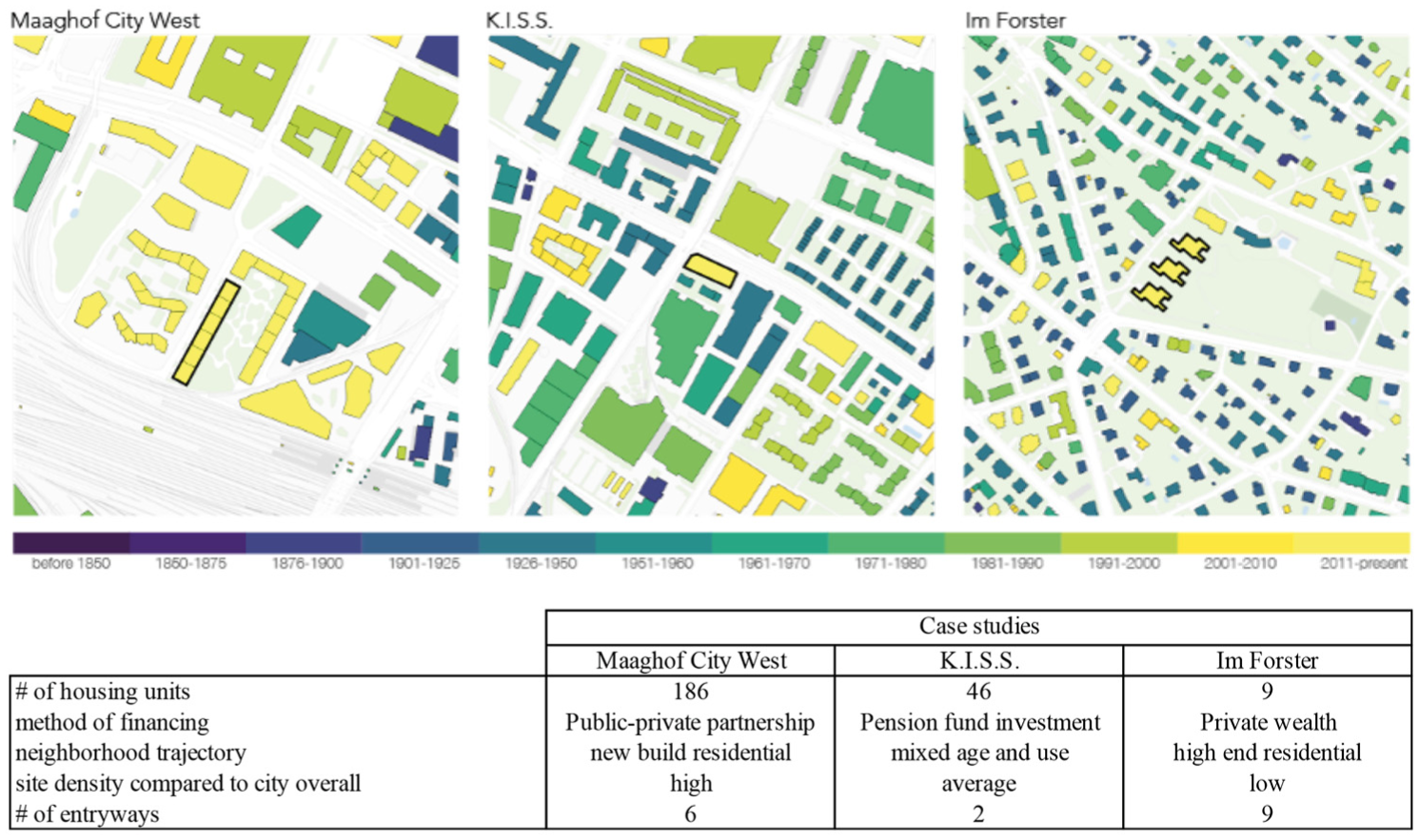
Case building comparison.
Methods
This research integrates the financial context of each case with site observations, interviews, diagrammatic analysis of building siting, structure, and materiality, and a survey of residents in the case study and surrounding buildings. The site observations took place several times a week at each site throughout 2019–2021, with repeated visits at day and at night, in the working week and on weekends, and in different seasons, noting how many people passed through or lingered in the sites, whether they interacted with each other, and what type of interactions occurred. The diagramming analysis examines the interface between the building and the street through plans, sections, and building massing, comparatively coding different orientations, material features, and relationships between spaces.
The work included semi-structured interviews with one project architect and one client or client representative from each site. Where interviewees chose not to be cited, I have relied on Swiss media documents and confirmation from the other interviews. The questions focused on the process interplay between the clients’ agendas and the architects’ responses. Lastly, I conducted a mailed paper survey of households, including an addressed stamped return envelope, in and within 100 m of the case buildings by paper survey in German and English in July 2021. The survey was offered to 831 people and received 149 mailed responses (17/97 in Fluntern, 23/129 in Altstetten, and 109/605 in Escher–Wyss), for an average 18% response rate. The survey asked questions about why residents chose their current location, whether they felt their neighborhood is changing, whether they felt like they belonged in their neighborhood, and why. In addition to quantitative analysis of question answers, I examined the survey responses for references to social interactions and sense of community in each case. Both the interviews and survey were approved by the ETH Zurich Ethics Commission, reference number EK 2021-N-74, on May 26, 2021.
Findings and discussion
For all three case studies, the developers intended to gain significant return on investment, by increasing the land value through construction of new housing. The financing model manifests differently in each case study, and consequently shapes three different social infrastructures for the street.
Maaghof City West, Escher–Wyss
Development of the entire Maaghof Areal site began in 2000, steered by a PPP between multiple city offices and large national companies. The project developers’ aim was two-fold; to create real property and investment value on underutilized land very close to central Zurich, and to add high-density housing units to an extremely tight housing market.
Completed in 2012 as part of a larger residential development, the MCW building sits in a new neighborhood built on former industrial land adjacent to the train tracks. MCW, on Turbinenstrasse, comprises one long structure with six separate entryways. The building, designed by Diener and Diener Architects, is 10 stories above ground, with 186 residential rental units. The neighborhood is almost entirely new-build (Figure 1). The scale of MCW’s construction is consistent in the neighborhood but exceptionally large for Zurich, with much higher residential density than elsewhere in the city.
The development of the entire site began in 2000 with a different development model than previous projects in Zurich. The development group included Maag Holding AG, Coop, Welti–Furrer, the Zurich Office of Construction and Office of Development and Urban Planning, and the Maag–Areal Plus, a joint venture of private landowners, real estate asset management corporations, and the City of Zurich in PPP. The project required special building permission to build the proposed level of density, approval for which was required from the City Office of Building Direction, the Cantonal (regional) Council, and the City Council. Permission was granted in 2008; however, project planning collapsed due to higher-than-average construction costs, and difficulty attracting market-rate buyers to residential flats on ground floors. The addition of a high-rise residential tower with upscale prices addressed the economic feasibility concerns and resurrected the plan (interview, I Halene, Maaghof City West architect, August 11, 2021). Architects Diener and Diener developed the initial framework for the site development, stipulating that each parcel would be developed by individual developers, with favorable terms (low rate 99-year leases) for land use from the city, and following a set of organizing design guidelines applied to the entire site.
MCW is shown in the photos and diagrams in Figure 2, with the main street-facing facade on the left, and the facade facing Maaghof Park on the right, seen from the train running directly adjacent to the lot.
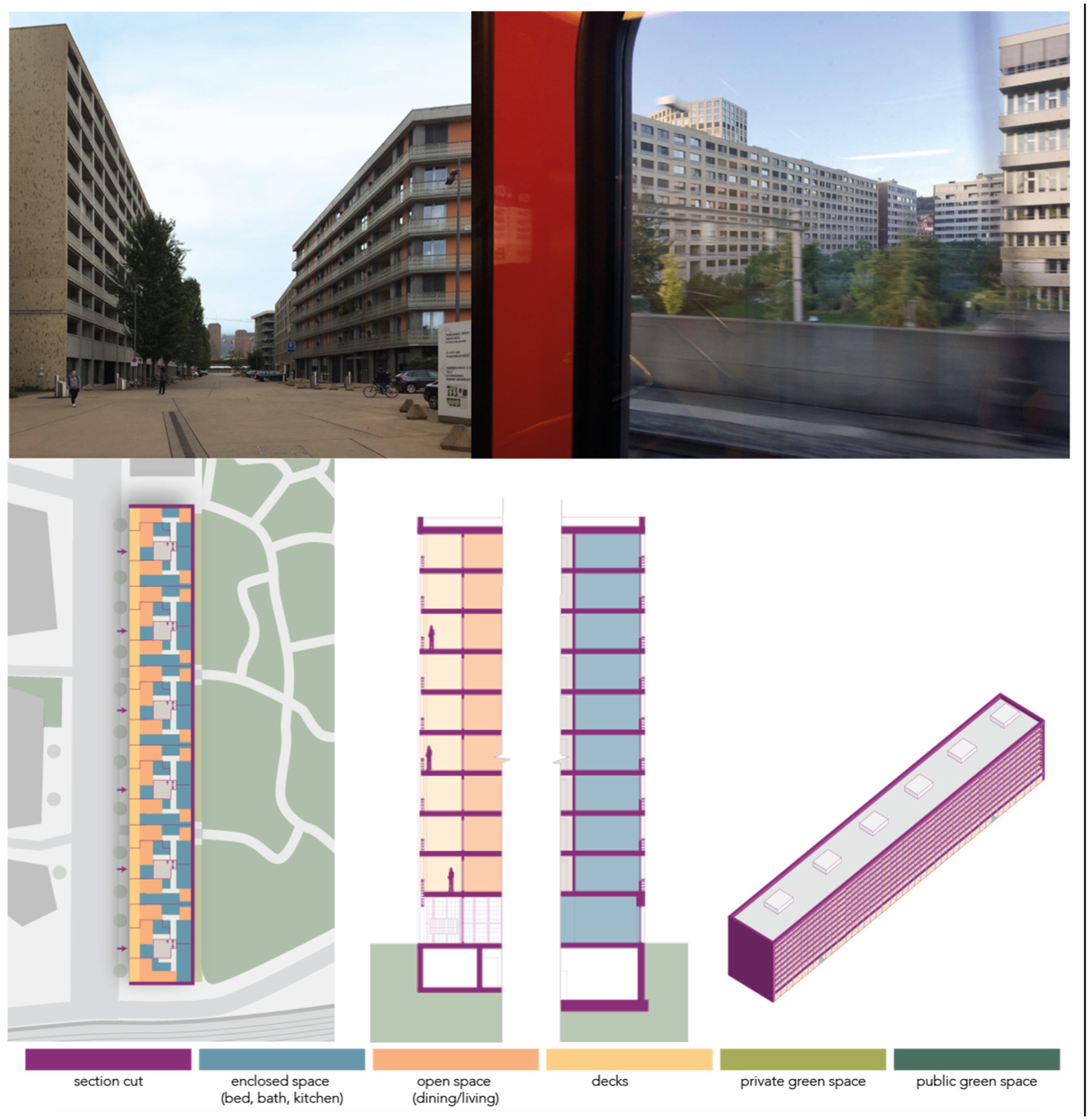
Maaghof City West.
The designers of Maag Areal intended to provide the site with a new identity based on the neighborhood’s industrial past (interview, I Halene, Maaghof City West architect, August 11, 2021). The MCW architects were generally pleased with the outcome of the project, although they expressed some disappointment with the “hard” face of the landscape design, and its effect on the atmosphere of the development (interview, I Halene, Maaghof City West architect, August 11, 2021).
Each of the three case study buildings has one porous facade open to the surroundings and context, and one thicker, barrier-like facade creating interior privacy. At MCW, the building opens onto Turbinenstrasse, with the common entryways, decks, and open interior living spaces facing the street. While the decks are open to the street, they are still recessed into the mass of the building, appearing dark and cavernous. They were intended to contribute life to the streetscape (interview, I Halene, Maaghof City West architect, August 11, 2021) but maintain an air of impenetrability, reinforced by the sparse planting and hard surfaces of the surrounding landscape. The delicate hierarchy of the columns, railings, and floor slabs does little to break up the uniform length of the facade. While ensuring privacy, the recess of the balconies and their separation by concrete dividers also ensures very little casual interaction with one’s neighbors. Two ground-level tunnels, hard to see from the main approach (Figure 2), allow the public to pass through the building into the park.
The facade facing Maaghof Park is closed off with recessed windows, behind which are private bedrooms spaces. The subtle recess of the windows on the park side of the building allows the facade to remain monolithic, with only very lightly patterned tilework. The monolithic shell facing the park, the mediated porosity of the street-edge balconies, and the minimized visibility of the tunnels to the park can be seen in section and massing diagrams (Figure 2).
On both weekdays and weekends the site is quiet, with little observable human presence except for residents entering and exiting the building at both day and night. The ground-floor tenants rarely use their dedicated outdoor space in the park, nor their balconies on the street-facing facade. In the survey, residents termed the building and neighborhood “anonymous,” with very little contact or interaction between neighbors beyond a polite elevator greeting. Some residents enjoyed this aspect of life in MCW, others disliked it, and some didn’t mind much either way, citing MCW as simply the place they could find an available apartment. Thirty-six percent of survey respondents from MCW cited “convenient to work” as an important factor in deciding to move to MCW, with another 8% listing good transit connections and proximity to the main train station.
K.I.S.S. building, Altstetten
The goal of the K.I.S.S. building’s owner, insurance and pension fund company Swiss Life, was to raise property values beyond current use for its pension fund portfolio. Swiss Life aimed to overcome perceived site undesirability with effective marketing to middle or higher social status residents. The location, on Badenerstrasse, is a very busy intersection, with high traffic, noise, and exhaust emissions, and little nearby green space. The client undertook extensive feasibility studies on the requirements, profile, and desires of potential tenants, to better understand what might attract them, and then created a housing amenity that compensated for the disadvantages. The goal was to ensure successful renting to full occupancy promptly after the building’s completion. Figure 3 shows the street facade on Badenerstrasse on the left, and the back facade facing a service alley and overlooking a small park on the right.
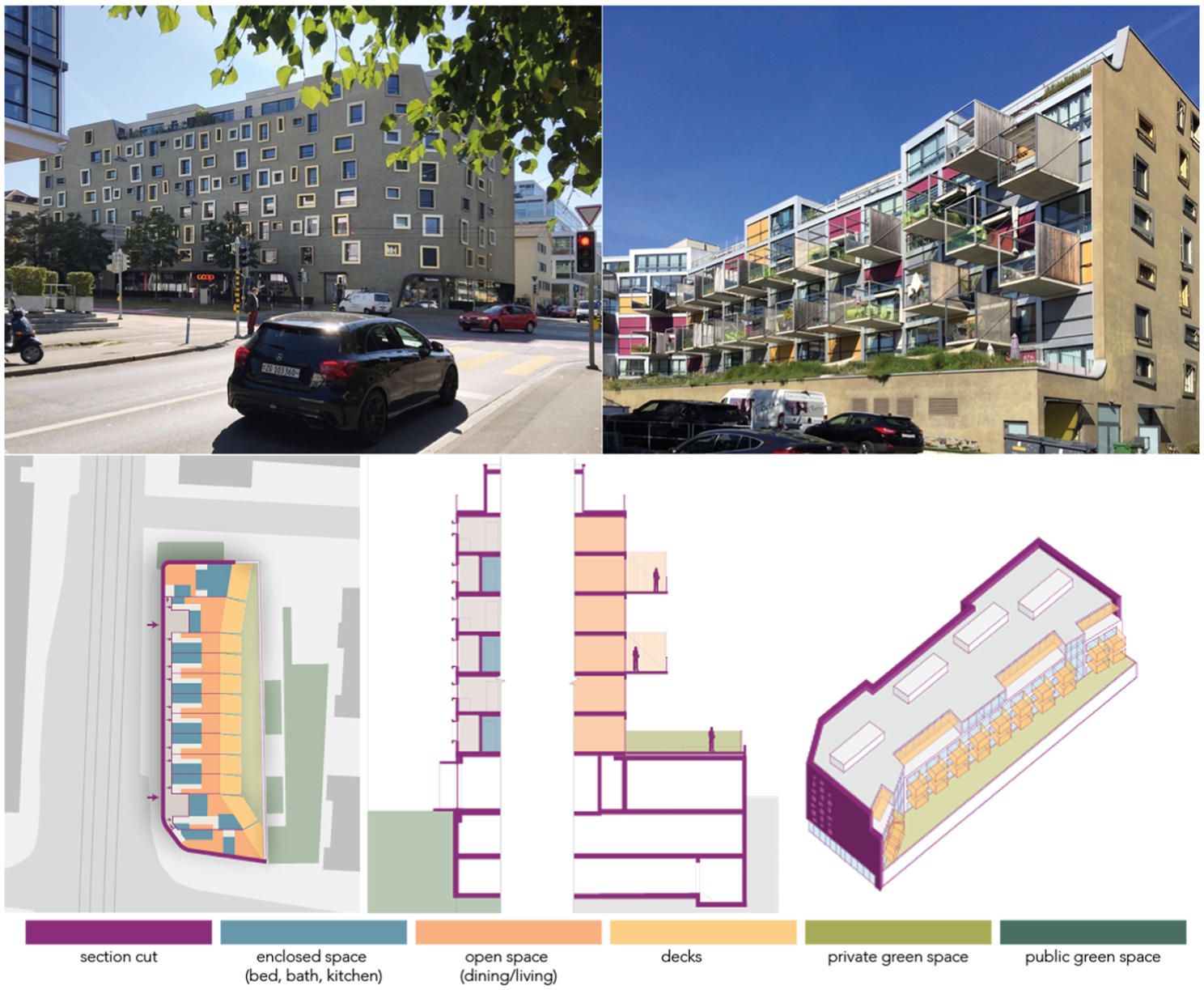
K.I.S.S. in Altstetten.
Swiss Life has owned the property since 1946. It neglected maintenance on the building previously onsite, and a feasibility study conducted by Evolution Design in 2006 determined that the building systems did not meet current standards, could not be easily upgraded, and should be demolished (interview, S Carmenzind, K.I.S.S. architect, July 20, 2021). Swiss Life funded the new construction as part of their pension fund’s real estate portfolio and rebuilt the site as new housing with a commercial ground floor.
The architects identified multiple target groups as potential tenants for the building, based on extensive sociological research incorporating the Sinus-Milieu model, in which people are categorized along the two axes of social status and core values (Figure 4).
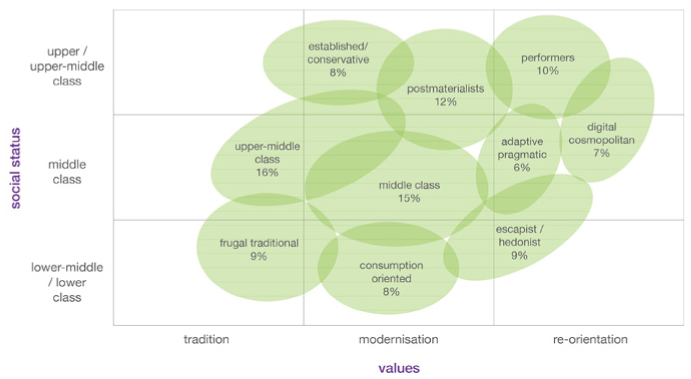
Breakdown of Sinus–Milieus model social categories for Switzerland from 2015.
The identified target groups were the “Established,” the “Performers,” the “Post-Materialists,” the “Middle Class,” and the “Escapists” (Barth et al., 2018; interview, S Carmenzind, K.I.S.S. architect, July 20, 2021), mostly higher and middle social status groupings. From these groupings the architecture firm, Carmenzind Evolution, designed three apartment types to cater specifically to these groups. The project achieved full occupancy through social media advertising, without paying for conventional apartment listings (interview, S Carmenzind, K.I.S.S. architect, July 20, 2021). How much this was due to the extremely tight rental market in Zurich versus the targeted design and marketing is hard to assess.
In contrast to MCW, the K.I.S.S. design has a thick barrier facade facing the public street, lightly punctuated by service corridor windows (Figure 4). The open living space and projecting decks face private green space, a service alley, and a small park behind the building. Zurich building regulations do not allow bedrooms or living rooms on the front street facade due to noise, traffic, and emission exhaust. The irregular window pattern and tilted framing facing the street, designed to enliven the facade (interview, S Carmenzind, K.I.S.S. architect, July 20, 2021), does little to reduce the fortress-like appearance.
The back facade is livelier, with cantilevered decks offering some privacy to residents but also creating sightlines along which unintended casual interactions with neighbors may take place. While imposing on the street, the building exposes itself openly amongst residents to the somewhat quieter back area. The building blocks out the busy street, while creating a secluded community amongst the private decks and small park behind. Here residents can be observed using the decks and interacting with each other, helping adjust awnings for neighbors and trading gardening advice. Survey respondents from K.I.S.S. cited the large back decks as a primary draw for the site.
Im Forster buildings, Fluntern
The families who privately own the Im Forster site wanted to add real property value while maintaining the private character and luxury of the large park and adjacent historic villa (Marti, 2005). They therefore chose to add only moderate levels of housing, instead of the full densification the site footprint would have allowed, preserving the park for residents’ private use (Baudirektion Kanton Zürich, 2007). They also chose to build rental units and not condominiums, explicitly to preserve the land in one parcel to be passed on to future generations. The development contains three buildings with nine apartments and one workshop each.
The site is 45,000 m2, the largest privately owned unbuilt plot in City Zurich. It houses an historic chalet from 1890 and a villa built in 1931. In part due to rising maintenance costs for the site, the two families who have owned the land for generations decided to invest in new housing to offset the costs and increase income (Marti, 2005). They hired a Swiss real estate consultancy company Wuest and Partners to assess the site and determine the relative value of possible building plots. They also decided to utilize one third of the site’s buildable potential, designating two additional sites to be built on in the future. The owners worked with the city to place the whole site under municipal monument protection, to ensure its preservation over time (Marti, 2005). As with K.I.S.S., the owners generated a list of target clientele they specified in the design competition brief: DINKS, well-educated people aged 30+ years old, and post-family people aged 50+ years old. Although the stated intent was to create a mixed area for multiple social classes, the unit pricing was developed in accordance with the extremely high-end location on Zuriberg (Marti, 2005).
Jakob Steib Architekten won the design competition to develop the three sites along Mittelbergsteig. Although some neighbors and the Zurich Heritage Trust objected to the scale of the buildings, the construction went forward with minimal alterations, and the project was completed in 2011. The photos and diagrams in Figure 5 show the front entrance on Mittelbergsteig on the left, and the back terraces of the buildings facing the private park.
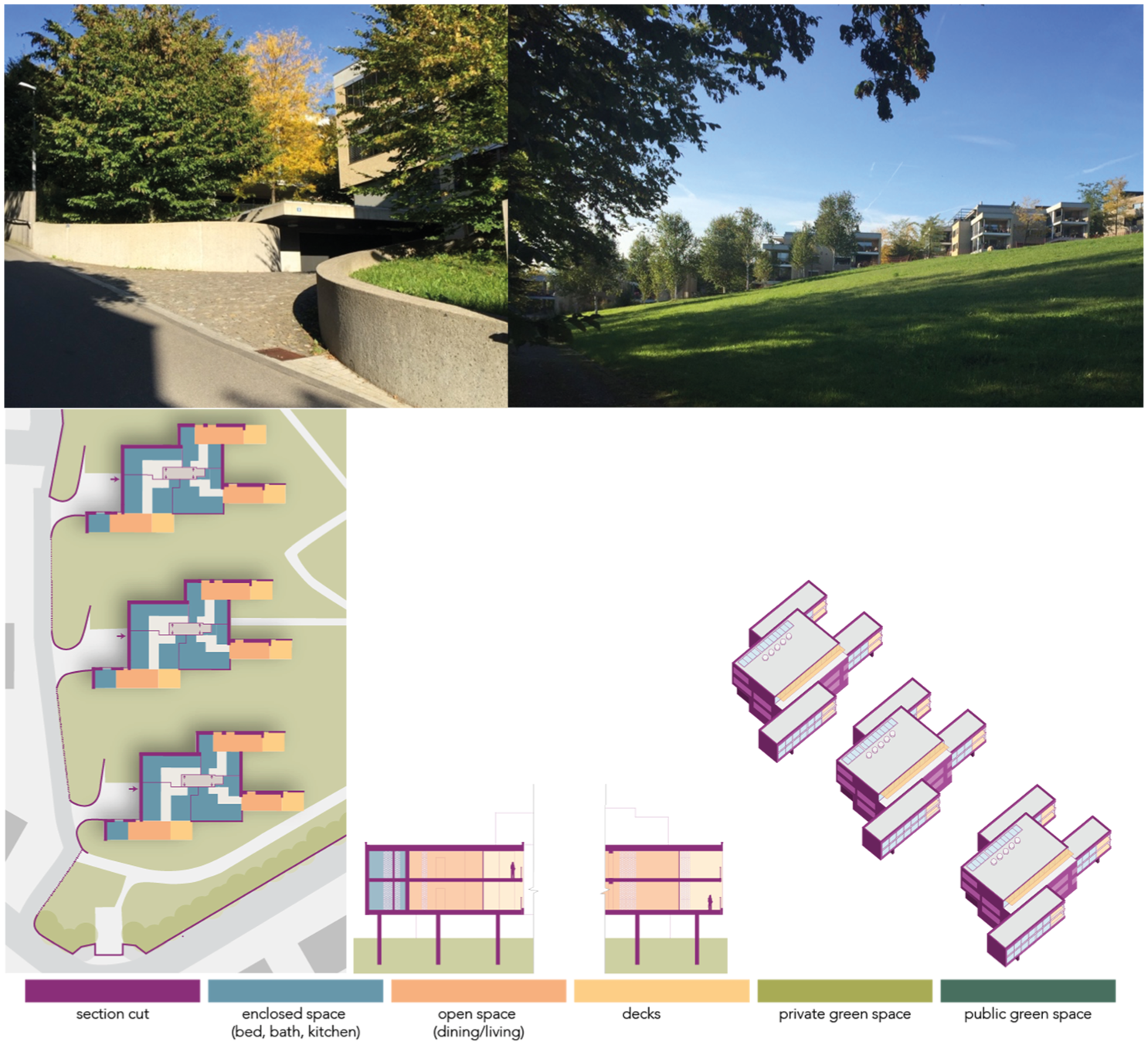
Im Forster, Fluntern.
The main design intent of Im Forster was to preserve the open expanse of meadow while creating housing, accomplished by aligning the three building blocks along the western perimeter of the site. This strategy preserved the meadow’s expansiveness, further amplified by lifting the housing floors on columns to float above the ground plane. The meadow then extends under parts of the new structure, punctuated by only a few support piers (Steib Gmuär Geschwentner Kyburz, 2011). While purportedly not a gated community (Marti, 2005), the street facade design intentionally makes clear that the lawn is not for public use, although grazing sheep are allowed.
Im Forster’s thicker, less open facade faces uphill to neighboring buildings, while the lighter transparent facade faces downhill, giving open living spaces with precious views out over Lake Zurich. The decks float above the private lawn at the building’s rear. Im Forster is set back from the street and recessed into the hill, with low concrete retaining walls and opaque fences communicating clearly that there is no public access.
Im Forster offers a solid clinker brick wall to the street, with a few penetrations for light and little to no visibility. Visibility is reserved for the fingers of living space extending out over the private lawn, encouraging and allowing interactions between neighbors while discouraging broader public presence. The effect is fortress-like, effectively preserving the private nature of the grounds surrounding the development.
On all days and at all times of day, Im Forster’s neighborhood is extremely quiet, with very little foot traffic or visible human presence. This is reinforced by residents arriving in cars, entering the underground parking, and taking the elevator to their residences from inside the building. From the private back lawn, residents may be seen on their decks, and they quickly note the intrusion of an unknown researcher amidst the sheep. In the survey, Im Forster residents almost uniformly declined to comment on their perceptions of the neighborhood and any feelings of belonging within it. Sixty-four percent of respondents pointed to the private park as a principal reason for choosing the site.
Partial publics and internal community
The cases all built housing to serve distinct financial markets, reflected in the attitude and provision for divergently inclusive publics, and the social experience of the street edge that these buildings create. MCW operates in an entirely public context, providing if not encouraging access from the street to the public Maaghof Park with two passageways directly through the building. K.I.S.S. invites a partial public into the elevated back decks, creating a community internal to the building, but otherwise turns its back to the street. Im Forster is entirely private, creating a bunker-like atmosphere of seclusion that protects and increases the value of an inheritable land-based asset. The below analysis of the design choices along, across, and within the street edges (Thwaite et al., 2020) demonstrates what kind of streetscape social the architecture enables.
MCW exemplifies PPPs taking on significant financial risk beyond the city’s capacity, which in this case nearly derailed the project. The risk led to a much higher density allowance increase than was proposed in the original project, matching concerns about public–private financing in other Zurich projects (Herdt and Jonkman, 2023). The building’s architectural expression is beholden to these financial aims. Its monolithic facade works to accommodate the locally unprecedented density but fails to provide the meaningful street-edge variation that would encourage lingering. Neither does the building provide a gradual transition from public to private space. The building acts like a wall, making the public garden behind feel isolated and unclearly public, while the private ground-floor gardens on the garden edge feel too exposed and not properly private. The only edge capacity to hold stationary activity is in the private upper-floor balconies, recessed and invisible to the street. The building’s architectural inability to provide a socially enabling street edge, in large part due to the financing model’s required density, is reflected in the residents’ perception of the site. The survey found that residents see the site not as a place to be but instead as a place that is good for getting elsewhere; the appeal was the transit connections and connectivity. MCW might serves an important purpose for those seeking anonymity in the city, as many MCW residents describe themselves. For others, any sociality or lack thereof was inconsequential compared to the basic need that the building fulfilled—providing housing in a city where this is in extremely tight supply.
K.I.S.S. is a classic example of the “renoviction” displacement and social exclusion common to Swiss cities as a strategy for upgrading rental values (Debrunner et al., 2022). It is housing built in the service of supporting financial markets through robust pension fund returns, rather than investment primarily to create housing. Financial markets enact this agenda through absentee landlordism contributing to negative effects of rental housing financialization (Fields, 2017; Fields and Uffer, 2014; Nethercote, 2020), and through precise targeting of higher-end clientele than surrounding residents. The architecture explicitly supports attracting this clientele. While it provides some variety along the street edge, it still presents as a fortress. There is no transition from public to private space, but instead an elevated exclusion of building residents from the public spaces of the park and street. Provision for stationary activity is provided only by the open back decks, which creates a partial public visible to the street but internal to the building’s residents. The decks, often cited as the best building feature by the residents, create a strong feeling of community within the building’s residents, inclusive of those wealthy enough to meet the rent requirements dictated by a pension fund real estate portfolio.
Im Forster exemplifies the increasing value of investing private wealth in land and housing development, as abundant financing supply drives up its value. It also demonstrates how financialization makes real estate more important as value storage, in this case specifically as consolidated inheritable wealth. The facade offers coherent variation and rich detailing on the street, however with no gradation of public to private. Rather, the facade detailing clearly signals a line not to cross for those who do not belong to the estate. There is nowhere to sit or stay, and no intention to provide for this type of increased social potential through engagement with neighbors outside the building. This is especially typified in the private entrances, where residents can be screened from public view even coming and going.
For better or worse? Streetscape sociality in financialized housing models
The three cases demonstrate a varied impact of how housing market financialization impacts construction agendas, which in turn impact building designs. In two cases, streetscape social infrastructure was clearly weakened by exclusive internal communities. In K.I.S.S., this was partly by choice and partly unavoidable due to zoning restrictions on a busy street, whereas at Im Forster this was intentional and desirable for residents. At MCW, the streetscape social was weakened by the architectural challenges of fitting the high number of required units onto the site. The two fully private case studies reinforce socio-economic dividing lines, creating strong internal communities desirable to residents and exclusive of broader and different socio-economic publics. While MCW offers theoretically public space, the high-density-accommodating design discourages the space from serving as social infrastructure.
Numerous studies point to myriad value in increasing casual or neutral social contact (Jing, 2022; Layton and Latham, 2022; Latham and Layton, 2019; Widmer, 2023), among them the value of disrupting societal dividing lines, as Picon (2020) suggests. Yet this sociality is complicated—on an aggregate level beneficial for societal cohesion, on an individual level at times undesirable. Some residents in MCW and K.I.S.S. named anonymity and privacy as the reasons they chose to live there, or said that they did not mind the lack of community, while residents in K.I.S.S. and Im Forster cited the private lawn and back decks. If privacy, anonymity, or exclusivity are desirable to some, should enabling socialization be a planning priority? If urban design choices can truly disrupt societal dividing lines instead of reinforcing them, they do so through enabling robust social engagement at the level of the street. When architectural design works in the service of clients feeding global financial markets, this enabling does not materialize—architects serve their clients, who serve financial markets, giving architects very little agency in determining the social infrastructure that their work may or may not create. Whether a more social streetscape incentivized by stricter planning policies that curtail global financial intention should be a planning aim is an important question for further study, but there is little possibility of this while housing construction remains under the primary direction of global finance. The agency and credit that scholarship often awards the architect should be tempered with full understanding of how financial motives underpin how architects make decisions in shaping space. We ignore the micro-impacts of finance at our peril, since finance remains the driving force behind the production of our homes and our streets.
Footnotes

Ethical considerations
The household survey and interviews cited in this article were approved by the ETH Zurich Ethics Commission, reference number EK 2021-N-74, on May 26, 2021.
Consent to participate
The household survey included a participant information sheet and a signed form, returned with the survey, confirming informed consent to participate and for data to be published in anonymous format. The interview request included a participant information sheet and consent form, returned at the time of interview.
Funding
The author received no financial support for the research, authorship, and/or publication of this article.
Declaration of conflicting interests
The author declared no potential conflicts of interest with respect to the research, authorship, and/or publication of this article.
Data availability statement
The data for this study is held by the author and can be made available in an anonymized format upon request.