



Abstract
As neurotechnology, artificial intelligence, and cognitive science increasingly shape urban imaginaries, new visions of the ‘cognitive city’ are emerging. This commentary identifies and critically reflects on three distinct modes through which urban life is being cognitively enabled: (1) neurourbanism, where cities are redesigned to promote brain health and emotional well-being; (2) consultancy-led cognitive urbanism, which advances a post-smart city paradigm of reflexive, learning cities underpinned by AI and data analytics; and (3) neurotechnical governance, where infrastructures of thought and emotion are being operationalised through state-led experimentation, exemplified by recent developments in Chinese cities. Rather than treating these as empirical categories, we interpret them as competing socio-technical imaginaries that project different futures of urban governance, subjectivity, and intervention. Across all three, the figure of the citizen as a cognitive subject becomes central, being measured, modulated, and responsibilised through new forms of expertise and infrastructure. We examine who is shaping these imaginaries, what claims they make, and how they differently reconfigure urban life. The commentary concludes by proposing a critical research agenda for urban studies that takes cognition seriously without succumbing to neurohype and that focuses on power, ethics, and the right to mental sovereignty in the future city.
Introduction
Urban governance is increasingly extending inward to target cognition, emotion, and mental states (Rose and Fitzgerald, 2022). From AI-managed cities that ‘learn’ and adapt to brain-computer interfaces in healthcare and education, urban technologies now reach past conventional infrastructure. They form what we call cognitive infrastructures, systems designed to register, interpret, and modulate how people think, feel, and respond (Rose and Abi-Rached, 2013). This marks a shift in the spatial and political imaginaries of urban life. Where smart cities promised behavioural optimisation through sensors and data, cognitively enabled cities seek to pre-empt action by shaping the conditions of thought and affect (Halpern and Mitchell, 2023). Cognitive urbanism, we argue, needs to be understood as a contested terrain of competing visions of how the mind meets the city.
In this commentary, we identify three emergent and interrelated visions of the cognitively enabled city. We treat these as comparable socio-technical imaginaries constituted through collective, future-oriented narratives that organise perception and action around what cities are and should become (Jasanoff, 2015). Each embodies distinct ways of seeing, imagining, and organising urban futures through the lens of cognition, and articulates different assumptions about urban life, governance, and the role of technological mediation in shaping subjectivity:
Neurourbanism: an interdisciplinary effort to reconfigure cities around mental health and emotional well-being, rooted in neuroscience, psychiatry, and therapeutic design. Advocates promote evidence-based planning to reduce stress, anxiety, and social isolation through built environment interventions (Adli et al., 2017; Pykett et al., 2020).
Consultancy-led cognitive urbanism: a post-smart city narrative led by technology firms and urban consultants (Sadowski, 2020). Here, the ‘cognitive’ city is metaphorical, envisioning AI- and data-driven systems that ‘learn’ and ‘think’, promising self-optimisation and improved service delivery.
Neurotechnical governance: an emerging assemblage of brain-machine interfaces, emotion-sensing devices, and algorithmic infrastructures integrated into urban systems, most clearly illustrated by recent developments in China (Ienca and Andorno, 2017; Yuste, 2023). This mode literalises cognition as a governable domain and embeds neurotechnology into the urban fabric.
What unites these visions is the centralisation of the urban cognitive subject, in which citizens can and should be sensed, shaped, and governed at the levels of thought, emotion, and neural responsiveness. Across all three, cognition becomes infrastructural as it is not only observed but actively produced and managed (Rose and Abi-Rached, 2013).
This commentary proceeds in three parts. First, we examine each vision by (i) tracing the key social interests of planners, consultants, researchers, and states, (ii) unpacking the imaginaries that animate them, framing cognition as a target of urban intervention, whether for well-being, optimisation, or geopolitical competition, and (iii) reflecting on how these visions intend to reshape urban life, subjectivity, and the politics of experience. Second, we look across these visions. Our aim is not to adjudicate between them or empirically validate their outcomes, but to open up a space for critical urban reflection. If urban studies is to take the cognitive turn seriously, it must move beyond both technological optimism and disciplinary caution as the brain, like the body, has become a site of urban governance (Foucault, 2007 [1978]). Third, we propose a research agenda for critical cognitive urbanism that foregrounds mental sovereignty, interrogates techno-political infrastructures, and resists reducing urban life to circuits of optimisation, stress management, and cognitive compliance. Cognition may be the next frontier of urban governance, but it is also a terrain of struggle, resistance, and collective imagination. We close by identifying the contribution of this paper, and the implications for urban studies of ignoring cognitive governance.
Visions of cognitively enabled urbanism
The cognitive turn in urban governance is not unfolding through a single, unified model but through overlapping imaginaries that redefine how cities think and feel. Three influential visions illustrate this shift. Neurourbanism seeks to design cities that nurture mental health by linking neuroscience to planning (Adli et al., 2017). Consultancy-led cognitive urbanism extends smart cities' logic into an AI-driven phase of reflexivity, promising systems that sense, learn, and adapt. Neurotechnical governance, most visible in China, integrates brain–machine technologies and emotional analytics into state infrastructures, fusing cognition with control. We aim to map these visions and their claims but not to rank their prevalence. Together, they position cognition as both an object and an instrument of urban governance, reshaping how cities are planned and managed, and how citizenship itself is conceived and enacted.
Neurourbanism – Neuroscience-driven mental health design
Neurourbanism sits at the intersection of neuroscience and urban design. Emerging from collaborations among neuroscientists, planners, and public health advocates, it reimagines cities as therapeutic environments that support mental well-being (Adli et al., 2017). The core assumption is that urban form affects brain function, as stress, isolation, and cognitive overload are spatially produced and can be spatially mitigated (Lederbogen et al., 2011). Translating neural data into design principles, neurourbanism treats parks, façades, and lighting schemes as instruments for regulating affect and emotion (Ellard, 2015; Nieuwenhuijsen and Khreis, 2016). This section traces the rise of the movement, its evidentiary claims, and the ethical tensions that follow when mental health becomes a domain of spatial governance.
The field is being shaped by interdisciplinary teams of neuroscientists, planners, architects, and public health advocates who are responding to the mental health impacts of urban living. Research centres and NGOs (e.g., the Centre for Urban Design and Mental Health and Neuro Landscape) partner with European projects and city agencies to fuse brain science with planning (Centre for Urban Design and Mental Health, n.d.). As urbanisation correlates with higher rates of stress, anxiety, and psychiatric symptoms, the argument is that cities should be intentionally designed for well-being (Sharp-Newton, 2025). Hence, the appeal of ‘facts’ such as urbanisation is a key driver of mental health burden, which justifies data-driven interventions. EU-funded initiatives (e.g., GreenME, GreenInCities) use wearable EEG and physiological sensors to study how parks, lighting, noise, and crowding affect the brain. Planners and health officials are drawn to the prospect of quantifying the ‘dose’ of nature or design features that promote calm, creativity, and social connection. Neuroscience labs, ‘neuro-architecture’ practices, and municipalities (often with philanthropic backing) thus form a coalition whose goal is to translate emerging evidence into design guidelines that enhance urban mental health, thus treating cities, in effect, as extensions of the nervous system (Ancora et al., 2022). In practice, translation occurs through standards, pilot procurement, and planning guidance, embedding neuro-metrics into municipal decision-making (e.g. park refurbishment criteria, lighting tenders) often ahead of robust public deliberation.
Proponents contend that neurourbanism can produce environments that actively support cognitive and emotional needs. Brain-friendly parks, noise buffers, biophilic façades, and restful lighting are cited as ways to reduce stress and improve well-being. Systematic reviews of urban planning and wellbeing suggest that thoughtful urban design, including green spaces and walkable areas, can mitigate adverse cognitive and emotional effects of dense cities (Mouratidis, 2021). Proposed tools, such as mental health digital twins and neuro-urban assessment techniques, apply machine learning to neuro-data to predict mental health impacts of design changes (Ancora et al., 2022). Anticipated benefits include reduced anxiety and depression, higher productivity, lower healthcare costs, and, through healthier communities, greater social equity.
If realised, neurourbanism would recast the city as an active agent working on its inhabitants’ minds. Public spaces become open-air laboratories where planners and algorithms evaluate how benches, trees, or façade colours influence neural activity. But this optimisation logic risks medicalising and datafying subjectivity. Whilst advocates envision more nurturing environments, the approach can resemble biopolitical governance extended into psychology, as decision-makers rely on neuroscientific metrics to justify interventions (Foucault, 2003 [1976]; Pykett et al., 2020). Experts, rather than communities, may end up defining mental health norms of public life, with daily experiences such as commuting, working, and socialising, framed as inputs and outputs of a city-wide ‘brain’. Citizens are being positioned as cognitive patients of urban design rather than co-designers of what counts as healthy cognition. Yet claims that urban form can measurably ‘rewire’ the brain remain highly speculative and ethically contested. In focusing on well-being, neurourbanism entwines planning with a technology of subjectivity. The ‘everyday’ becomes a site of psychosocial intervention, and governance reaches into thought and emotion by providing care while institutionalising thresholds of acceptable arousal and focus. This raises pressing questions about agency, justice, and who decides what a healthy city should feel like.
Consultancy-led cognitive urbanism – AI, data, and ‘thinking cities’
Where neurourbanism speaks the language of science, consultancy-led cognitive urbanism speaks that of markets and metrics. Here the ‘cognitive’ city is a metaphor for urban systems that learn, predict, and self-optimise through AI and big data. Promoted by global technology firms and consultancies, this post-smart-city discourse locates cognition not in human brains but in digital infrastructures (Sadowski, 2020). Urban intelligence becomes a purchasable service promising frictionless efficiency and personalised experiences. This section examines how corporate imaginaries replace political judgement with algorithmic reasoning and recast citizens as data-producing inputs to a continuously learning urban platform (Bloomberg, 2023; Kuhn, 2025; Mahmoud, 2023).
The cognitive urbanism label now spans a growing private-sector ecosystem. PwC Middle East codifies ‘cognitive cities’ as AI-first, anticipatory systems and packages the idea across cities, buildings, and heritage (PwC Middle East, 2023). TONOMUS. NEOM operationalises the brand at city scale via a data-and-AI backbone that will ‘think, learn, and evolve’, explicitly contrasting cognitive models with legacy smart-city approaches (NEOM, 2023). Siemens Advanta’s ‘The Rise in Cognitive Cities, Buildings and Infrastructure’ ties the term to an implementable stack (IoT/edge, data platforms, AI) from advisory through delivery (Elbracht, 2023). AECOM (Digital) deploys the concept in strategy work embedded early in capital programmes (Walter and Lee, 2023). Detecon (Deutsche Telekom Group) outlines a consulting pathway to the cognitive city in a 2025 white paper centred on data/AI operating models (Kuhn, 2025). Collectively, these actors standardise a techno-managerial template comprising platformised data, IoT/digital twins, machine learning orchestration, and operating-model change, giving the ‘cognitive city’ a visible multinational footprint. Market imperatives propel the agenda as consultants seek new revenue by turning urban planning into a technology- and data-driven business. Governments and developers, drawn by prestige and the promise of efficiency, embrace pitches that AI can proactively solve urban problems. Unlike neurourbanism’s research-led coalition, this vision is spearheaded by corporate–state partnerships and narrated through glossy reports, conferences, and policy roadmaps.
Consultancy narratives claim multiple benefits including hyper-efficient services that optimise energy, transport, and safety in real time; sustainability gains through smarter resource use; and even new forms of civic engagement. The core promise is predictive resilience enabled through systems that ‘learn from data’ to pre-empt congestion or pollution, approximating ‘sentient’ infrastructures (Halpern and Mitchell, 2023). This often includes an ‘utopian vision’ about better customer service for citizens (Marvin et al., 2015) via personalised apps or chatbots (e.g., inferred preference profiles from platform logs translated into service tiers) and about stimulating innovation ecosystems. Smart efficiency is reframed as human-centric progress. Communications emphasise adaptivity to changing needs and a quality-of-life utopia where automation frees people for creative tasks.
If realised, consultancy-led cognitive urbanism would recast urban life as an unfolding digital ecosystem. Citizens become continuous data providers and platform users, their movements, transactions, and even inferred preferences feeding machine-learning models and personal devices and smart infrastructure serve as the city’s sensory organs (Barns, 2018; Mattern, 2021). Subjectivity shifts as people are imagined as nodes with profile pages rather than voters or neighbours (Zuboff, 2015). Governance is explicitly algorithmic as traffic, utilities, and even policing are routed through centralised ‘brain’ platforms (e.g., Alibaba’s City Brain) that synthesise multiple data streams (Caprotti and Liu, 2022). In this logic, prediction displaces messy human judgment and political choices are technicised into questions of sensors, datasets, and model optimisation. While platform urbanism can streamline delivery and surface system patterns, it also entrenches technocracy, so governance is done for people by engineers, not with people through dialogue (Cardullo and Kitchin, 2019; Sadowski and Bendor, 2019). In short, consultancy-driven cognitive cities amplify state-corporate rationalities. The city becomes an object to be managed by digital apparatus and the cognitive subject is one whose identity and needs are continuously inferred by machines. Everyday life may be more efficient, but it is ever more mediated by surveillance technologies and corporate data agendas.
Neurotechnical governance and China’s cognitive infrastructure
The third vision moves from metaphor to material control. Neurotechnical governance embeds brain–computer interfaces (BCIs), biometric sensors, and AI analytics into urban systems, turning cognition, emotion, and behaviour into administrable layers. In China, this trajectory is most pronounced as neural, affective, and behavioural registers are reconceived as variables to optimise, modulate, and surveil (Chen, 2024; Poo et al., 2016). However, the agenda is neither uniform nor uncontested. Institutional limits, local discretion, emerging regulation, and public resistance mediate implementation, producing uneven geographies of uptake across cities and sectors (Huld, 2025). China’s cognitive infrastructure fuses national ambition with experimental surveillance – what we might term ‘cognitive state urbanism – while generating cracks, hesitations, and governance dilemmas.
China’s ambitions are anchored in national strategies and large-scale science initiatives. The China Brain Project (launched in 2016) positions brain science as central to AI, cognitive enhancement, and neuro-inspired technologies (Jiaying, 2025; Poo et al., 2016). More recently, multi-ministry roadmaps set near-term milestones for BCI translation and commercialisation, signalling an explicit push to integrate neuroscientific capacities with urban development and industrial policy (Chan, 2025). At the city scale, City Brain initiatives – exemplified by Hangzhou – deploy AI to coordinate traffic, public safety, health, and service logistics through continuous sensing and action (Caprotti and Liu, 2022; Weber, 2023). Read through anticipatory governance, these platforms, for instance, the AI system piloted in Beijing’s Haidian district, are designed to forecast and detect incidents and trigger pre-emptive interventions (Xu et al., 2025). Steered by municipal/state agencies and co-produced by major technology firms, they offer limited avenues for citizen oversight or accountability (Zhang et al., 2022). Beyond these ambitions, however, regulatory and ethical constraints are emerging. In early 2024, the State Council Information Office issued Guidelines for Research Ethics in Brain–Computer Interface (China SCIO, 2024), requiring avoidance of harm, informed consent, and non-interference with human autonomy (Center for Security and Emerging Technology (CSET), 2024). Complementary guidelines from the Psychiatric Society of China aligns practice with the Declaration of Helsinki (Zhang et al., 2025). These moves signal growing sensitivity to invasive neural monitoring even as experimentation proceeds.
On the ground, neurotechnical urbanism encounters friction and diverse local responses. Trials of BCIs in schools and workplaces have reportedly been slowed or suspended following concerns from parents, teachers, and ethics committees (Standaert, 2019). Public commentary emphasises ‘right to mental integrity’ and warns against covert neural surveillance (Blumenthal-Barby and Ubel, 2024; Bublitz, 2024; Chan, 2018). National direction is in tension with municipal pragmatics (Wu and Zhang, 2022), so local governments interpret mandates differently, resist certain elements, or adopt them selectively. The result is not a monolithic neuro-authoritarian model but a variegated landscape of infrastructure, experimentation, regulation, and contestation.
In sum, China’s cognitive infrastructure blends state ambition, corporate partnerships, scientific experimentation, and emergent regulation. To label it uniformly, neuro-authoritarian overstates coherence and understates contradiction. Instead, it is a contested, evolving assemblage under pressure from ethics, resistance, and political judgement. Analytically, China illustrates how neurotechnical ambitions are operationalised (or resisted) through concrete governance devices of pilots, platforms, contracts, and committees (Ienca and Andorno, 2017). It offers both a cautionary example and a comparative anchor for thinking critically about how any state might govern cognition in the age of neurotechnology. Comparable initiatives from UNESCO ethics frameworks and US defence research illustrate that cognitive governance is a global concern, not unique to China.
Taken together, these three visions show the rapid diversification of cognitive urban imaginaries, from therapeutic design and corporate optimisation to neurotechnical control. Each promises well-being or efficiency, yet each carries distinct risks of reductionism and domination. The next section brings these trajectories into conversation, comparing their logics, governance models, and ethical implications, and asks what kinds of urban life cognitive infrastructures make possible, permissible, or impossible.
Critical comparison of visions
The three visions represent distinct yet overlapping trajectories in the cognitive reimagination of urban life. Each reframes the city as a site for managing thought, affect, and behaviour, but they diverge in their epistemologies, actors, and political stakes. This section critically compares their underlying rationalities, specifically how they define cognition as a governable object, how they distribute authority between experts, corporations, and states, and what forms of citizenship they imply. The goal is not to rank these approaches but to reveal the shared infrastructures of power and imagination that underpin them and to show how cognition is being enrolled in broader transformations of urban governance.
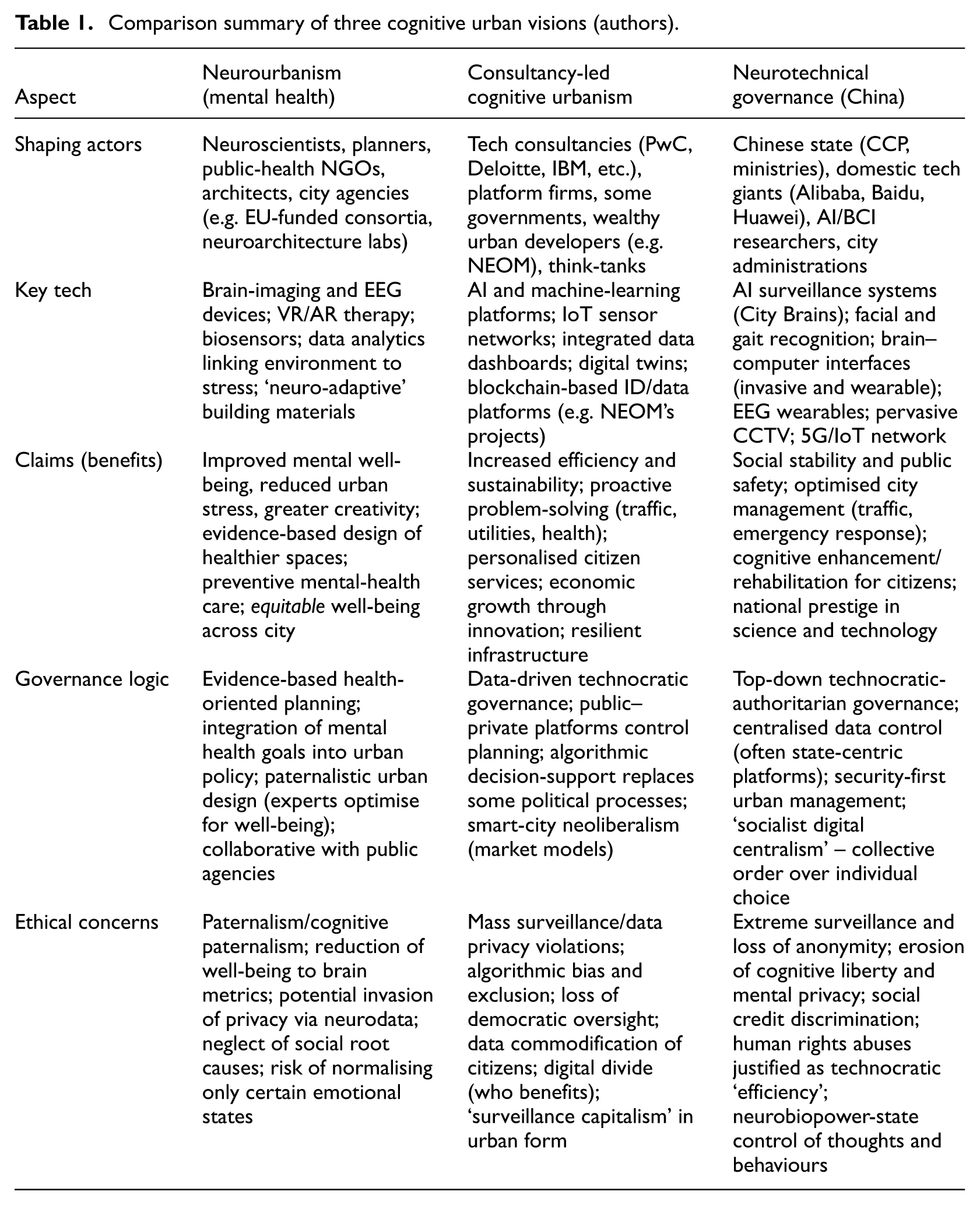
To clarify the distinct logics and overlapping ambitions of these three cognitive urbanisms, Table 1 summarises the core features of their key actors, technologies, claims, governance models, and ethical concerns. It is an analytical device to show how different coalitions of expertise, markets, and states mobilise cognition as a new domain of urban intervention. Reading across the visions reveals convergence around the belief that mental and affective processes can be measured and managed, alongside sharp contrasts in how and by whom this should occur. These contrasts frame the discussion that follows, examining political, ethical, and spatial implications.
Comparison summary of three cognitive urban visions (authors).
Neurourbanism’s transformative claims have prompted critical counterpoints. Social theorists warn that a brain-centric lens risks reductionism and paternalism. Work on ‘urban stress’ cautions against narratives that downplay the sociopolitical determinants of health (Rose and Fitzgerald, 2022). As Pykett et al. (2020) caution, a focus on psychophysiological markers can obscure structural drivers of distress also a concern echoed by Manning’s (2019) call to explain how urban life gets ‘under the skin’ without collapsing experience into neural correlates (p. 1). Critics of workplace and consumer neurotechnology similarly argue that EEG-based optimisation systems risk objectifying people as sources of brain data and thereby eroding autonomy and cognitive liberty (Ienca and Andorno, 2017; Whitehead et al., 2017). Who decides the ideal mental state? If urban authorities increasingly steer environments using aggregate brain metrics, this can slide into a form of social management, a modern technocratic utopia that prescribes happiness from above. Moreover, continuous monitoring via wearables and sensors raises acute privacy issues, blurring the distinction between public space and personal experience. Neurourbanism thus intersects debates on cognitive liberty, especially rights to mental privacy and autonomy (Ienca and Andorno, 2017). Will citizens freely choose their own emotional stimuli, or will city systems nudge moods through ambient design? Once parks, streets, or transit hubs double as sites of neuro-sensing, public space is implicitly medicalised and subject to parametric adjustment. In short, neurourbanism reworks classic public-health paternalism in neurological terms, prompting concerns about social control and the ethics of ‘engineering’ mental states.
The risks of consultancy-produced techno-optimism are stark. Critics link the cognitive city to Zuboff’s (2015) surveillance capitalism, wherein continuous data-gathering enables privacy intrusions and entrenches unequal power. The very streams that fuel ‘learning’ systems can become tools of control and a systematic review warns that pervasive data use ‘opens the door to … over-surveillance, power imbalance, and manipulation’ (Machin et al., 2021: 3). Spatial impacts are mediated by routing, zoning, and policing models whose false positives/negatives fall unevenly across neighbourhoods. There are concerns about algorithmic bias in determining which populations benefit from predictive policing or credit scoring, and about a persistent data divide. A relentless turn to data-driven governance also risks sidelining democratic processes. Suppose problems are framed as cognitive-data issues, solvable by tech, the political challenges of inequality, housing rights, and cultural life, are cast as outside algorithmic expertise (Calvillo, 2018). In this register, cognitive urbanism services neoliberal agendas, privileging efficiency and public–private partnerships over public deliberation. Observers note that consultancy narratives rarely foreground citizens’ rights or socio-spatial justice, favouring market-friendly services and workforce upskilling. In practice, ‘cognitive city’ claims can mask the expansion of surveillance and the commercial enclosure of public space.
China’s neurotechnical project exemplifies one of the most assertive articulations of cognitive urbanism, suggesting the attempt to extend technocratic governance into thought, emotion, and attention. However, its significance lies as much in its contradictions as in its ambitions. While the state promotes BCIs, AI analytics, and brain-science programmes as foundations for national rejuvenation, these same technologies expose tensions between innovation, control, and autonomy. Neurotechnical governance aspires to make cognition measurable and optimisable, yet in practice, it encounters regulatory, ethical, and social frictions that complicate this vision. Experiments in schools and workplaces have sparked debate over ‘mental privacy’ and human dignity, prompting gradual recalibration of policy and ethics oversight (Ienca and Andorno, 2017). Rather than a coherent model of what we might term ‘neuro-authoritarianism’, that seamlessly projects state authority into cognitive and affective life, China’s emerging infrastructure is uneven, variegated, and contested. National ambition meets local discretion, commercial experimentation, pockets of resistance, and growing regulatory reflexivity (Wu and Zhang, 2022). Municipalities selectively interpret central directives, companies seek profit and prestige and ethicists within China increasingly call for safeguards against cognitive intrusion. This mix of acceleration and hesitation shows neurotechnical governance as an unsettled formation, marked by a struggle over how cognition is rendered governable. For critical urban studies, the case illuminates how mind and mood are becoming infrastructural, being folded into platforms, surveillance architectures, and optimisation systems, whilst also warning against technological determinism. Neurotechnical urbanism is contingent, negotiated, and globally uneven. The challenge for scholars is situating these developments within the broader politics of planetary urbanisation and asking what forms of cognitive sovereignty, ethical design, and democratic oversight can resist normalising neural control.
Across these visions, a new figure of the urban cognitive subject takes shape. In neurourbanism, this subject is medicalised as a neurobiological organism whose stress and well-being can be spatially modulated through evidence-based design. In consultancy-led cognitive urbanism, it becomes datafied as a user or sensor, with preferences and behaviours continuously harvested and optimised within algorithmic city systems. In neurotechnical governance, it is securitised and folded into state infrastructures that read thought and emotion as potential risks to social order. Each mode reconfigures the relationship between citizen and city, relocating governance from managing territory to calibrating minds. Together, they reveal how cognition is being positioned as a frontier of urban governmentality, where the right to think and feel freely becomes a political question as critical as mobility, housing, or climate justice. However, this comparative analysis also exposes gaps in our theoretical and empirical understanding of how these systems operate, whom they serve, and what forms of resistance or democratic oversight are possible. These gaps define the need to construct a critical research agenda capable of engaging cognitive urbanism as a contested socio-political project demanding rigorous, reflexive inquiry.
Future research agenda
We have demonstrated that cognition is a new frontier of urban governance; the challenge then for urban studies is to articulate an equally ambitious research response. This section sketches a critical agenda for understanding and contesting cognitive urbanism as a socio-technical project. It calls for interdisciplinary inquiry linking neuroscience with political economy, ethics, and spatial justice, examining how cognitive infrastructures reshape subjectivity, democracy, and everyday urban experience. Rather than accept the cognitive turn as inevitable, urban scholars should interrogate its assumptions, track its institutional networks, and propose alternative, more democratic ways of designing and governing the mind-city relation.
First, scholars should interrogate the assumptions underlying cognitive urbanism. How valid is the idea that brain data can translate into actionable design guidelines? As Pykett et al. (2020), emphasise, we need socio-technical analyses that bridge neural data with place-based inequalities in race, gender, and class. Urban research must thus combine ethnography and neuroscience, for instance undertaking comparative studies of neuro-urban interventions across diverse neighbourhoods can reveal who benefits. Similarly, researchers should examine what counts as a healthy brain state in context by engaging with ethics and local communities rather than letting technocrats dictate norms (Ienca and Andorno, 2017).
Second, the political economy of cognitive infrastructures deserves scrutiny. Critical urbanists should map the networks of consultants, vendors, governments and NGOs that promote these visions, and analyse how they shape urban policies. How do profit motives or geopolitical competition influence which projects proceed? Comparative studies of cognitive-city pilots in Global North cities would illuminate how digitally-colonialist or surveillance-capitalist rationalities operate in practice. This agenda also includes evaluating outcomes such as whether cognitive city projects actually deliver on efficiency or equity, or exacerbate social divides? Given concerns about algorithmic bias, researchers should analyse who is marginalised by ‘smart’ decisions in policing or mobility alike and advocate safeguards.
Third, legal and normative frameworks for cognitive governance are imperative. As Ienca and Andorno (2017) argue, we may need new rights of cognitive liberty, mental privacy, and psychological continuity to protect individuals. Urban scholars can explore how international human rights norms apply to public space and city data, comparing governance models in the EU, China, and elsewhere, for regulating neural data. For example, can existing privacy or health laws cover brain imaging in public? Studies should propose regulations for new scenarios, e.g. consent frameworks for population brain data. Weber’s (2023) call is apt for developing a roadmap for governing highly personal types of data collected by neurotechnologies. An immediate research goal is thus to design such roadmaps, informed by multidisciplinary input, for urban neurotech (Ienca and Andorno, 2017; Ligthart et al., 2023).
Fourth, the transformation of urban subjectivity and democracy under cognitive infrastructures must be examined. How do citizens perceive and negotiate such environments? Participatory research, such as surveys and workshops, is needed to gauge public awareness and consent regarding EEG surveillance, health-nudging apps, and related practices. Scholars should also study alternative imaginaries, for instance, ‘neuro-urban commons’ where communities co-own brain-computing tools. Investigating pilot projects, such as community-designed green corridors or data cooperatives, can help articulate more democratic pathways.
Finally, interdisciplinary collaboration is essential. Urban studies must partner with neuroscientists, ethicists and data scientists to ensure research is empirically grounded and technically informed. Methodologically, this could mean mixed-method projects combining urban field experiments with brain imaging (Ancora et al., 2022). It also means critiquing techno-fetishism, where urban scholars should question whether ‘more data’ genuinely leads to better cities, or whether the missing ingredient is political will and social justice. Ultimately, a critical agenda for cognitive urbanism should balance innovation with rights and efficiency with equity. By focusing on the human dimensions such as citizenship, empowerment, and diversity alongside technology, future work can help ensure that the ‘cognitively enabled city’ serves democratic, not just technocratic, ends.
Conclusion
This paper has identified and critically compared three emerging visions of the cognitively-enabled city. This shift carries serious risks. By reducing citizens to brain states and behaviours, these visions can flatten human complexity into algorithms or neural metrics. Scholars caution that such cognitively enhanced city models risk organising urban life as a web of brains and devices oriented to efficiency and control (Ienca et al., 2022; Yuste et al., 2017). The danger is a surveillance regime of mental data where privacy and human rights are at stake. Safeguarding mental sovereignty must now stand alongside housing, mobility, and climate justice as a core concern of democratic urban life. Already, critics warn that opaque AI governance can ‘marginalise’ citizens by sidelining human judgment in favour of automated prediction. In short, unchecked cognitive urbanism risks technocratic, neoliberal or even authoritarian governance of minds.
Cognitive urbanism thus extends long-standing urban studies’ concerns with governance, infrastructure, and spatial justice into the mental and affective domains, calling for renewed critical attention. If urban studies ignores this cognitive turn, then technology firms and consultants will define urban futures as marketable ‘cognitive city’ products. At the same time, authoritarian states may exploit neuro-surveillance to cement control. We may also drift toward a medicalised planning logic that treats city-dwellers as subjects of ‘mental hygiene’ interventions. The stakes are clear because to safeguard democratic life, urbanists must go beyond existing smart cities paradigms and take cognition, mental autonomy and neuro-infrastructure seriously. This requires a sustained, interdisciplinary response that draws on urban studies, STS, medical sociology, neuroscience, and ethics, ensuring that power, rights, and participation remain central. This way, we can ensure that future cities be governed by people and democratic values, not by invisible algorithm or vested interests.
Footnotes
Acknowledgements
Earlier versions of this commentary benefited from discussions with colleagues working at the intersections of urban studies, neuroscience, and science and technology studies. We are grateful for these exchanges. We also thank the two anonymous reviewers for their insightful and constructive comments, which substantially improved the paper. Any remaining errors or omissions are our own.

Funding
The authors received no financial support for the research, authorship, and/or publication of this article.
Declaration of conflicting interests
The authors declared no potential conflicts of interest with respect to the research, authorship, and/or publication of this article.