




Abstract
Scholarly debates about a right to the city in the Global North have largely neglected the potential role of housing type and tenure in shaping displacement risk and socio-demographic disparities therein. Yet, past scholarship demonstrates that mobile home residents face a heighted risk of dispossession relative to residents of other dwelling types. Leveraging microdata from Canada’s 2021 Census of Population, I elucidate who would lose their right to the city if urban mobile home residents were displaced. First, I use latent class analysis to identify two distinct clusters of urban mobile home residents, each containing approximately 50% of Canada’s urban mobile home population, but whose socio-demographic characteristics differ along key dimensions of social vulnerability. Next, I conduct a series of logistic regression models to simulate between-cluster variation in the likelihood of displacement if mobile home dispossession were to occur. Results demonstrate significant variation in the likelihood of displacement across clusters, suggesting that the urban mobile home residents at the greatest risk of displacement are lower-income, white, older adults who are not in the labor force and who live alone. By bringing scholarly debates about a right to the city into conversation with the literature on mobile homes, I underscore the key role of dwelling type and tenure in shaping urban citizenship in Canada.
Introduction
Over the past 50 years, a right to the city has served as a rallying cry for urban activists and an object of inquiry for urban scholars (Harvey, 2008; Lefebvre, 1968). Developed as a corrective to the perceived shortcomings of growth machine-led urban development, a right to the city is an ideological framework that facilitates advocacy for bottom-up, equity-oriented urban development. Moreover, it is a conceptual framework that can be leveraged to structure empirical analyses of patterns and trends in the (in)equitable distribution of an expansive catalogue of rights that, together, constitute an overarching right to the city (Attoh, 2011; Brown, 2013; Purcell, 2013).
I focus here on one such right: the right to inhabit the city. Prior research demonstrates that, across cities globally, particular socio-demographic groups face a heightened risk of displacement, including poor and lower-income residents (Balzarini and Shlay, 2016; Hubbard and Lees, 2018), Indigenous peoples (Njoh, 2015), and refugees (Tsavdaroglou, 2020). Scholars working in the Global South have also elucidated the processes through which housing characteristics—including factors like dwelling type and tenure—intertwine with socio-demographic vulnerabilities to shape displacement risk (Brown, 2013; Davy and Pellissery, 2013; Dugard and Ngwenya, 2018; Samara et al., 2013). Yet, research in the Global North is comparatively silent regarding the role of housing characteristics in shaping a right to the city. This gap is surprising given a rapidly growing literature demonstrating that residents of mobile homes across North America face a heighted risk of dispossession relative to residents of other dwelling types (Rumbach et al., 2020; Sullivan, 2018). 1 Informed by the literature on mobile homes, this article is among the first to explore the potential role of housing type and tenure in structuring socio-demographic disparities in a right to the city throughout the Global North. Specifically, using the case of urban mobile home residents in Canada, I ask: If urban mobile home residents were displaced by the various dispossession pressures that they face, who would lose their right to the city?
The remainder of the article proceeds as follows: I first describe key characteristics of mobile homes as a dwelling type, elucidating how they provide a tenuous right to the city for their residents; then I review the current state of knowledge regarding the socio-demographic composition of mobile home residents; and situate mobile homes within the urban housing landscape in Canada, reflecting upon the dispossessory pressures that residents face. 2 Then, leveraging restricted-use microdata from the 2021 Census of Population, I use latent class analysis to develop a typology of mobile home residents. Using logistic regression, I employ this typology to simulate mobile home residents’ capacity to retain their right to the city should dispossession occur. Finally, I reflect upon how my findings inform scholarly debates about a right to the city in the Global North, highlighting directions for future research.
Mobile homes: Affordable but precarious
According to Statistics Canada, mobile homes are [a] single dwelling designed and constructed to be transported on its own chassis and capable of being moved to a new location on short notice. It may be placed temporarily on a foundation such as blocks, posts or a prepared pad and may be covered by a skirt. (Statistics Canada, 2022b)
3
Mobile homes constitute a key source of unsubsidized affordable housing across both Canada and the United States (Canada Mortgage and Housing Corporation, 2018; Sullivan, 2023). The up-front cost of purchasing a mobile home is substantially lower than the cost of entering homeownership. The Manufactured Housing Institute (2020a) reports that the average price of a new mobile home in the United States is around US$70,000, in contrast to an average price of US$286,000 for a new single-family home. For those choosing between leasing land to place a mobile home versus renting a different type of dwelling, monthly rental costs are similarly lower. Analyzing the city of Calgary, Alberta, Canada, Lund (2021) found that leasing land in one mobile home community cost between CA$300 and CA$600 per month, as compared to an average rate of CA$1216 for a two-bedroom apartment.
Largely due to the fact that mobile homes tend to be substantially less expensive than other dwelling types, their residents exhibit comparatively lower rates of being cost burdened. Statistics Canada calculates cost burden using the shelter-cost-to-income ratio, or “the proportion of an average total income of [a] household which is spent on shelter costs” (Statistics Canada, 2023d), wherein shelter costs comprehensively encompass “all shelter expenses paid by households” (Statistics Canada, 2023e). Households paying from 30% to 49% of their monthly income on shelter costs are considered moderately cost burdened, while households paying 50% or more of their monthly income on shelter costs are considered extremely cost burdened. In supplementary analyses (see Table S1 in the Online Supplemental Material), I find that mobile home residents are roughly three times less likely to be moderately cost burdened and roughly five times less likely to be extremely cost burdened compared to residents of nearly all other dwelling types. In fact, only residents of “other movable dwellings” exhibit lower cost burden than mobile home residents, and this is only true regarding the percentage of residents who are extremely cost burdened.
Despite the affordability of mobile homes, a constellation of intersecting factors render mobile home residence uniquely precarious. Prior research finds that most mobile home residents occupy a relatively atypical tenure arrangement; namely, owning their home but leasing the land that it sits upon (Durst and Sullivan, 2019; Lund, 2021; Sullivan, 2018). Consequently, mobile home residents face some of the same displacement pressures that traditional renters face, including unaffordable rent increases and redevelopment (Hormel, 2023). Distinct from traditional renters, however, mobile home residents facing displacement must navigate what to do with a dwelling they own, which is also being displaced. While a straightforward solution would be to move the mobile home to a new location, most mobile homes are, counterintuitively, functionally immobile. In the uncommon case that relocating a mobile home is possible, the cost of doing so is often prohibitively expensive (Rumbach et al., 2020). Alternately, displaced mobile home residents can opt to sell their home. However, at least in the United States, mobile homes are classified as personal property rather than real estate, resulting in the value of mobile homes depreciating over time (Kear et al., 2023). As a result, displaced mobile home residents frequently also experience dispossession and, in the process, are largely unable to leverage the full value of their past homeownership investment to secure new housing.
Beyond mobile home residents’ atypical tenure arrangement, the physical location of mobile homes also fosters increased housing precarity for this group. Due, in part, to the high degree of social stigma associated with mobile homes (Hormel, 2023; Lamb et al., 2022b), local governments tend to site mobile homes in less desirable locations, and these locations are often characterized by a heightened risk of exposure to extreme weather events (Lamb et al., 2022a; Phillips et al., 2021; Rumbach et al., 2020). Consequently, mobile home residents face a relatively greater risk of dispossession through destruction compared to residents of other dwelling types. This is particularly true for mobile home residents living in homes built prior to 1976, when the National Mobile Home Construction and Safety Standards Act of 1974 (1974) was implemented in the United States, establishing more rigorous construction standards.
Thus, mobile homes offer a right to the city to residents who would, otherwise, likely be unable to afford urban citizenship—even if the nature of that citizenship is unequal across dimensions like tenure arrangement, social stigmatization, and access to desirable and non-hazardous locations within the city. Due to these inequities, residents of mobile homes face a heightened risk of dispossession relative to residents of other dwelling types, rendering their right to the city uniquely tenuous.
Mobile home residents
Generating knowledge regarding who would lose their right to the city if urban mobile home residents were displaced requires, first, understanding who comprises this population. Based on administrative data, industry reports, and quantitative and qualitative data collection across Canada and the United States, the “average” mobile home resident is disproportionately likely to be low-income compared to residents of other dwelling types (Apgar et al., 2002; Hormel, 2023; Kremarik and Williams, 2001; Manufactured Housing Institute, 2020a; Mimura et al., 2009). This makes good sense given the relative affordability of mobile homes (Durst and Sullivan, 2019; Lund, 2021; Manufactured Housing Institute, 2020b; Sullivan, 2023), underscoring that mobile homes offer a right to the city for households that may otherwise be excluded. Research in the Canadian context also finds that mobile home residents have lower average levels of educational attainment compared to residents of single-family dwellings (Kremarik and Williams, 2001). Further, in both Canada and the United States, mobile home residents tend to be either young adults or older adults (Apgar et al., 2002; Hormel, 2023; Mimura et al., 2009). Finally, in the United States context, a majority of mobile home residents are white (Apgar et al, 2002; Kear et al., 2025; Mimura et al., 2009).
While informative, these summary statistics necessarily mask heterogeneity within the population of mobile home residents—a shortcoming some scholars have sought to remedy through their research. For instance, studying a mobile home community located in Syringa, Idaho, United States, Hormel (2023) notes that one longtime resident was a well-remunerated, middle-aged college professor. Studying a mobile home community located on Vancouver Island, British Columbia, Canada, Russell (2006: 80) similarly notes that “the majority of [interviewees] would be considered middle to upper middle-class … professionals.” Further, although most mobile home residents in the United States are white, racial and ethnic diversity has been growing over time, such that non-white individuals now comprise a sizable minority of mobile home residents (Apgar et al, 2002; Kusenbach, 2017; Mimura et al., 2009). While adding important nuance to knowledge regarding who lives in mobile homes, these characterizations are often unable to illuminate whether observed diversity constitutes distinct subpopulations of mobile home residents versus outliers.
Thus, knowledge about who lives in mobile homes tends to be either highly generalized or markedly specific. One notable exception is a recent article by Kear et al. (2025), who leverage microdata to assess heterogeneity among mobile home residents in Tucson, Arizona, United States, by statistically identifying socio-demographic clusters of residents without the use of a priori assumptions regarding group membership. In doing so, the authors identify four distinct profiles of mobile home residents: non-citizen, Hispanic households with children; extremely low-income female-headed households; low income, older homes, female-headed households; and fixed-income older adults. I build on the work of Kear et al. (2025) by using similar techniques to identify unique socio-demographic clusters of mobile home residents living in Canadian cities. By developing profiles of urban mobile home residents that depict the diversity of this group in a generalizable manner, I improve upon past conceptualizations of urban mobile home residents, enabling me to more accurately assess who would lose their right to the city if mobile home residents were displaced by the dispossessory pressures that they face.
Mobile homes in Canada
Given my focus on urban mobile home residents in Canada, this section situates mobile homes within the Canadian urban housing landscape and reflects upon the dispossessory pressures that Canadian mobile home residents face. Roughly half of mobile home residents live in cities (Kremarik and Williams, 2001); however, mobile homes are unevenly distributed across the urban landscape. Across Canada, mobile homes constitute a larger percentage of the housing stock in smaller cities (census agglomerations) relative to larger cities (census metropolitan areas). 4 The prevalence of mobile homes also varies across Canadian regions, with mobile homes comprising over 8% of the urban housing stock in the Territories but less than 1% in the Central region, with other regions falling in the middle (see Table S2 in the Online Supplemental Material for more detail). 5
Canadian urban mobile home residents currently face at least two dispossessory pressures: eviction and extreme weather events. Eviction is of particular concern for mobile home residents who lease their home and/or land, especially those who reside in land lease communities (colloquially referred to as “mobile home parks,” “trailer parks,” or “manufactured housing communities”). Although neither the Census of Population nor the Canadian Housing Survey collects data on land tenure by dwelling type, Lund (2021) notes that land lease communities for mobile homes exist in all Canadian provinces and territories and, in each of these locations, it is legal for land owners to initiate a mass eviction in order to redevelop the land.6,7 A wide range of motivations may lead landowners to redevelop land lease properties, including financial gain. In the Canadian context, every province and territory limits the frequency with which landowners can raise rent on existing residents, and half of the provinces and one territory have instituted formal rent control measures (Vermes, 2023). Considering landowners’ inability to substantially raise rents alongside the high demand for urban land associated with Canada’s affordable housing crisis, owners of land lease communities may reasonably view redevelopment as a key mechanism for increasing profit (Government of Canada, 2024). While no known database tracks mass evictions associated with the redevelopment of land lease communities in Canada, a comprehensive search of news media outlets conducted by Lund (2021) uncovered 45 proposed closures of land lease communities over a 12-year period, which would affect an estimated 4500 residents.
Urban mobile home residents in Canada also face dispossession pressures due to extreme weather events—the frequency, duration, and severity of which are increasing due to ongoing climate change (IPCC, 2023). The most common natural disasters in Canada are water-related, including floods, storms, and hurricanes (McGillivray, 2024). Additionally, wildfires constitute the third-largest category of natural disasters affecting Canada (see Figure S1 in the Online Supplemental Material for more detail). Once a predominantly rural phenomenon, wildfires are increasingly affecting Canadian cities. In 2023, for instance, nearly half of Canadians displaced by wildfires lived in urban areas (United Nations Office for Disaster Risk Reduction, 2024). With these dispossessory pressures in mind, I now turn to answering my research question: If urban mobile home residents were displaced by the various dispossessory pressures that they face, who would lose their right to the city?
Data and methods
I answer my research question by leveraging restricted-use microdata from the 2021 Census of Population, which I accessed through the Research Data Centre at Western University. The raw data comprise the population of Canada as of May 2021 (Statistics Canada, 2025). Following Kear et al. (2025), the unit of analysis is the household. The raw data are, first, restricted to households residing in cities. After obtaining descriptive statistics for the population of urban households in Canada, data are then further restricted to mobile home households. 8 Thus, the final data set represents the population of mobile home households located in Canadian cities. Per Statistics Canada’s standards for ensuring the maintenance of confidentiality, I apply standard weights to the raw census data and round all underlying counts to the nearest five.
The analysis proceeds in three steps. First, I descriptively compare urban mobile home households to the population of urban households using Chi-square goodness of fit tests for statistical inference. Second, I use latent class analysis to statistically identify clusters of urban mobile home households. Latent class analysis is similar to other finite mixture modeling techniques, such as k-means clustering, with the key distinction that latent class analysis is designed to be used with categorical indicators, including indicators that are multinomial (Goodman, 2002; Sinha et al., 2021). I determine the ideal number of clusters by plotting the BIC values associated with increasing (n + 1) clusters and identifying a point of inflection (Sinha et al., 2021).
Third, I conduct a series of bivariate logistic regressions to simulate between-cluster variation in urban mobile home households’ capacity to retain their right to the city should dispossession occur. Within these models, the independent variable is cluster and the dependent variables are moderately cost burdened and extremely cost burdened. 9 To construct the dependent variables, I calculate the median shelter cost of each dwelling type enumerated by Statistics Canada, with the exception of mobile home and other movable dwellings. Then, I use urban mobile home households’ monthly income to calculate the shelter-cost-to-income ratio that these households would experience if they moved into a different dwelling type within a Canadian city. To account for variation in the cost of living across Canadian cities, I then repeat this process by disaggregating Canadian cities in various ways, enabling me to calculate geography-specific shelter-cost-to-income ratios. As a result, moderately cost burdened is a binary indicator of whether an urban mobile home household would spend 30–49% of their monthly income on shelter costs if they moved into any other dwelling type within a given urban geographic unit (no = reference). Similarly, extremely cost burdened is a binary indicator of whether an urban mobile home household would spend 50% or more of their monthly income on shelter costs if they moved into any other dwelling type within a given urban geographic unit (no = reference).
A wide range of measures are included in the latent class analysis that informs the development of the independent variable. To account for the possibility that individual characteristics may interact with structural factors in shaping vulnerability (Phillips et al., 2021), variables consist of socio-demographic characteristics commonly included in social vulnerability indices (Cutter et al., 2003; Flanagan et al., 2011), in addition to housing characteristics associated with a heightened risk of dispossession (Durst and Sullivan, 2019; Lamb et al., 2022a, 2022b; Sullivan, 2018). The first six socio-demographic variables capture various dimensions of households’ social class location. Household income is a binary indicator of whether a household’s income is within the bottom quartile of all urban households. Low-income captures whether a household is classified as poor based on Canada’s official poverty measure, which is an absolute measure that defines a series of income thresholds that vary based on family size and geographic differences in the cost of living (Statistics Canada, 2023c). Thresholds are not calculated, however, for households living in Canadian territories or on Indigenous reserves, making the associated variable multinomial (not low income, low income, or not applicable). In labor force is a binary indicator of whether any member of the household is currently working for pay. Education represents the highest level of educational attainment achieved by the household head, coded as: less than high school; high school or some college, including postsecondary trade programs and educational programs lasting less than 4 years; or Bachelor’s degree or greater. Finally, shelter cost burdened is calculated as previously described, yielding a three-category indicator of not cost burdened, moderately cost burdened, and extremely cost burdened.
The next six socio-demographic variables capture various dimensions of households’ composition and demographic features. Presence of children indicates whether a household contains one or more members under the age of 18. Following prior research suggesting that households with children face heightened precarity and that, among all households with children, those headed by lone female parents face distinctly acute social vulnerabilities (Desmond 2016), presence of children is constructed as a multinomial indicator (no; yes, female-headed household; yes, other household structure). Other variables are binary indicators. Presence of adult 65+ indicates whether a household contains one or more members aged 65 or older. Living alone indicates whether the household head is the only member of the household, while overcrowded indicates whether a housing unit is considered suitable, defined as having “enough bedrooms for the size and composition of resident households according to the National Occupancy Standard (NOS)” (Statistics Canada, 2023a). Finally, visible minority is an indicator of whether the household head is a visible minority, while Indigenous is an indicator of whether the household head self-identifies as Indigenous. 10
The remaining four variables capture housing characteristics associated with a heightened risk of dispossession. Home built pre-1980 is a binary indicator of whether a dwelling was built prior to 1980. This cutoff was selected to approximate the period when more rigorous construction standards for mobile homes were implemented; however, it is reasonable to expect that other dwelling types constructed prior to 1980 may lack some of the weatherization features common in newer buildings. Needs major repairs is a binary indicator of whether a housing unit is in need of major repairs versus regular maintenance or minor repairs, where major repairs include such issues as “defective plumbing or electrical wiring and dwellings needing structural repairs to walls, floors or ceilings” (Statistics Canada, 2023b). Tenure: home is a multinomial indicator of whether a household owns their home, rents their home, or has a home provided by their government or tribe. Finally, tenure: land is a binary indicator of whether a home is located on land characterized by condominium tenure, meaning held in joint ownership with others.
Results
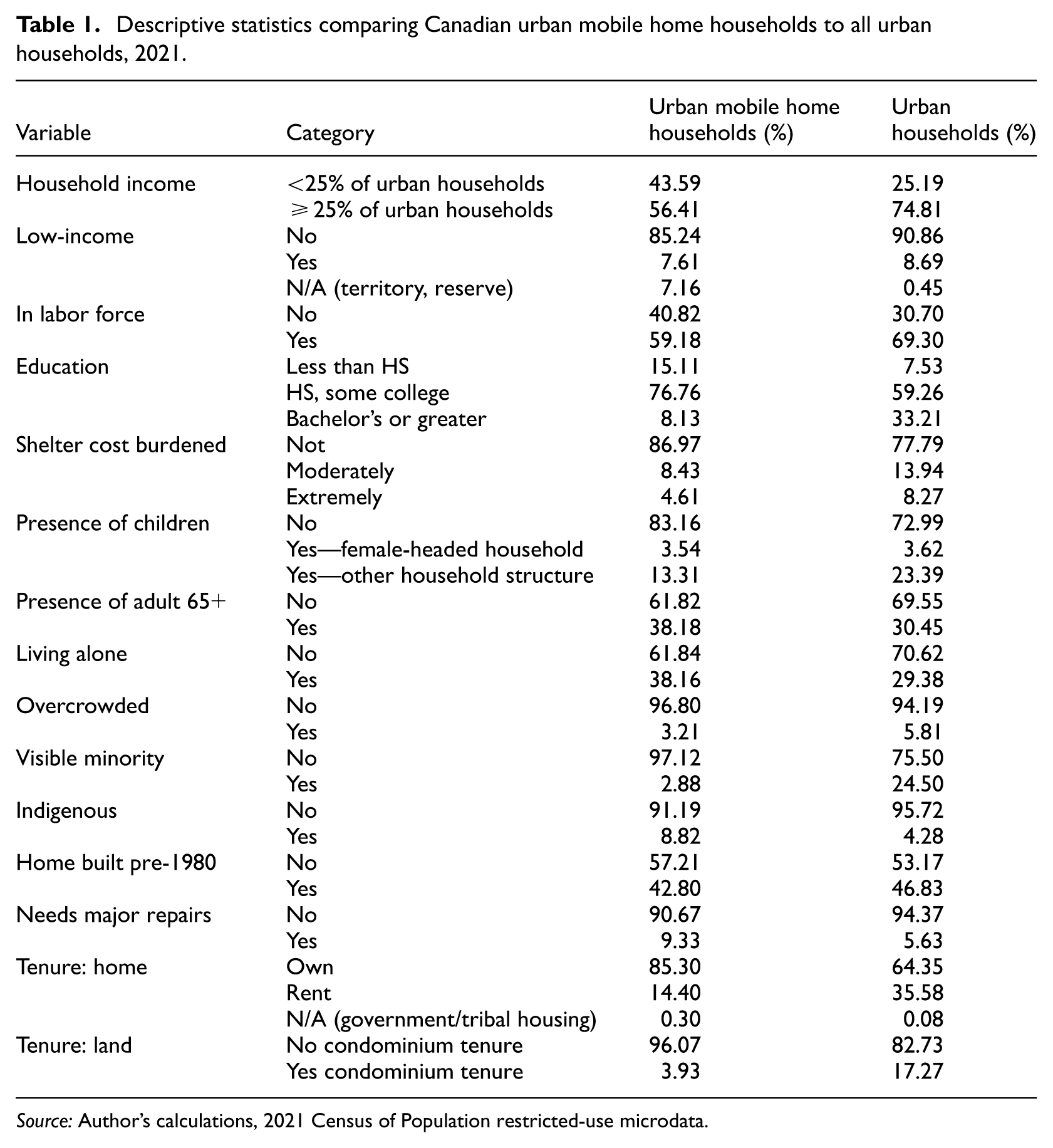
Table 1 presents descriptive statistics comparing urban mobile home households to the population of urban households. Regarding socio-demographic characteristics, urban mobile home households are significantly more likely to be in the lowest quartile of income compared to all urban households (p<0.001), though urban mobile home households are, simultaneously, significantly less likely to be shelter cost burdened (p<0.05). Urban mobile home households have significantly lower labor force participation compared to urban households (p<0.05) and their household heads also have significantly lower educational attainment (p<0.001). Additionally, urban mobile home households differ significantly from urban households along the dimension of low-income status (p<0.001); however, this pattern largely reflects the greater percentage of urban mobile home households residing in a territory or on an Indigenous reserve. Relatedly, urban mobile home household heads are significantly more likely to identify as Indigenous relative to all urban household heads (p<0.05), and they are also significantly less likely to identify as a visible minority (p<0.001). Urban mobile home households are significantly less likely to have children in the home relative to urban households (p<0.05), although the likelihood of a household with children being female-headed is not significantly different across populations. Finally, urban mobile home household heads are significantly more likely to live alone relative to urban household heads (p<0.05). The socio-demographic composition of urban mobile home households mirrors that of urban households regarding the presence of household members aged 65 or older and the likelihood of being overcrowded.
Descriptive statistics comparing Canadian urban mobile home households to all urban households, 2021.
Source: Author's calculations, 2021 Census of Population restricted-use microdata.
Regarding housing characteristics, urban mobile home households are significantly more likely to own their home compared to all urban households (p<0.001); however, they are less likely to live on land characterized by a condominium tenure (p<0.001). The housing characteristics of urban mobile home households mirror those of urban households regarding the likelihood of a home being built prior to 1980, as well as the likelihood of a home needing major repairs. Taken together, these descriptive findings about the “average” urban mobile home household living in Canada align with prior research in Canada and the United States, which finds that mobile home residents tend to possess relatively lower levels of income and education compared to residents of other dwelling types, and that mobile home residents are disproportionately likely to be white. These findings additionally elucidate that mobile homes, not only, offer urban citizenship to those who may otherwise be excluded but, also, offer access to homeownership that may otherwise be unattainable, consistent with prior research (Apgar et al., 2002; Mimura et al., 2009).
As noted previously, however, these summary statistics may mask heterogeneity within the mobile home population—a possibility that I statistically assess using latent class analysis. Initially, I fit one to four latent classes. Comparing BIC values for one to four latent classes, a clear inflection point emerges between the second and third class; thus, two is the optimal number of latent classes to describe urban mobile home households in Canada. I term these latent classes “Cluster A” and “Cluster B.” Post-estimation statistics indicate that Cluster A represents 48.3% of urban mobile home households, while Cluster B represents 51.7% of urban mobile home households.
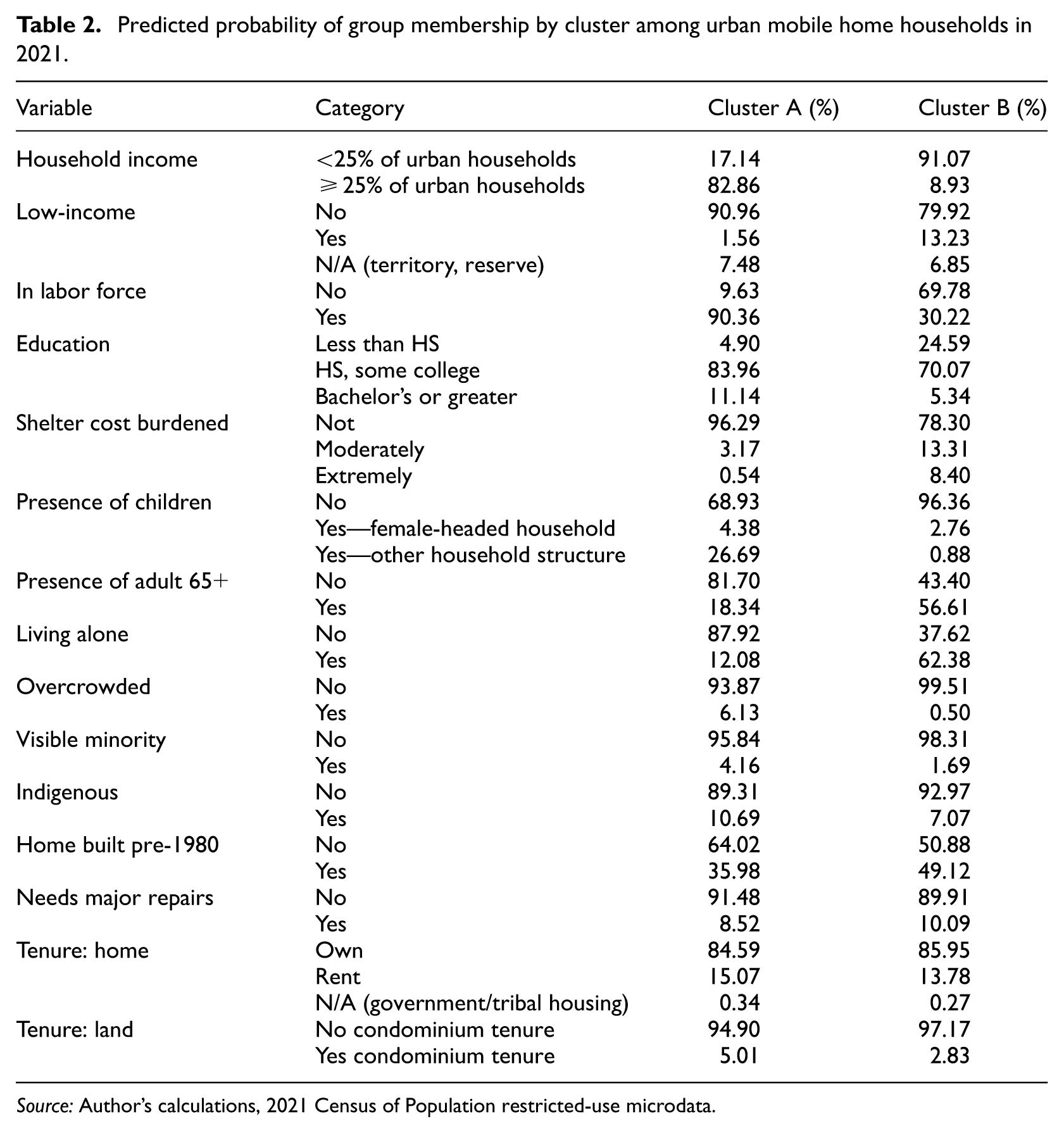
Table 2 presents the predicted probability of membership in each of the two clusters across the study variables. Members of Cluster A can be characterized as urban mobile home households with one or more household members in the labor force, a household income above the lowest quartile of urban residents, and a household income above the cut-off to be considered low-income. Perhaps unsurprisingly, then, members of Cluster A are not shelter cost burdened. Members of this cluster have a high school diploma or greater. The urban mobile home residents who comprise Cluster A live with other people in a home appropriate for the number of occupants, often with children present but rarely with a household member aged 65 or older. Demographically, members of Cluster A are white, non-Indigenous Canadians. Finally, in terms of housing characteristics, members of Cluster A own mobile homes built predominantly after 1980 that are not in need of major repairs and are not located on land characterized by condominium tenure.
Predicted probability of group membership by cluster among urban mobile home households in 2021.
Source: Author’s calculations, 2021 Census of Population restricted-use microdata.
In contrast, members of Cluster B can be characterized as urban mobile home households without a household member in the labor force and with a household income in the lowest quartile of urban residents, but above the cut-off to be considered low-income. Members of Cluster B are not shelter cost burdened and, in terms of educational attainment, they have a high school diploma or greater. The urban mobile home residents who comprise Cluster B are adults aged 65 and older who live alone and, as such, children are not present in the household and residents are not overcrowded. Demographically, members of Cluster B are white, non-Indigenous Canadians. Finally, in terms of housing characteristics, members of Cluster B own mobile homes equally likely to be built before or after 1980 that are not in need of major repairs and are not located on land characterized by condominium tenure.
Based on visual inspection informed by social vulnerability indices and prior research (Cutter et al., 2003; Flanagan et al., 2011; Kear et al., 2025; Phillips et al., 2021), members of Cluster A are not particularly socially vulnerable. On the other hand, members of Cluster B exhibit some characteristics associated with heightened social vulnerability, including lower income and living alone as an older adult. These observations are statistically confirmed by a series of supplementary regression models that use cluster membership to predict social vulnerability (see Table S3 in the Online Supplemental Material). These models demonstrate that members of Cluster B are significantly more likely to be socially vulnerable across nearly every study variable compared to members of Cluster A, with the exception of a lower likelihood of having children present or being overcrowded (although the buffering effect of these characteristics may be offset by a significantly higher likelihood of living alone), a lower likelihood of being a visible minority or Indigenous, and a lower likelihood of renting as opposed to owning a mobile home.
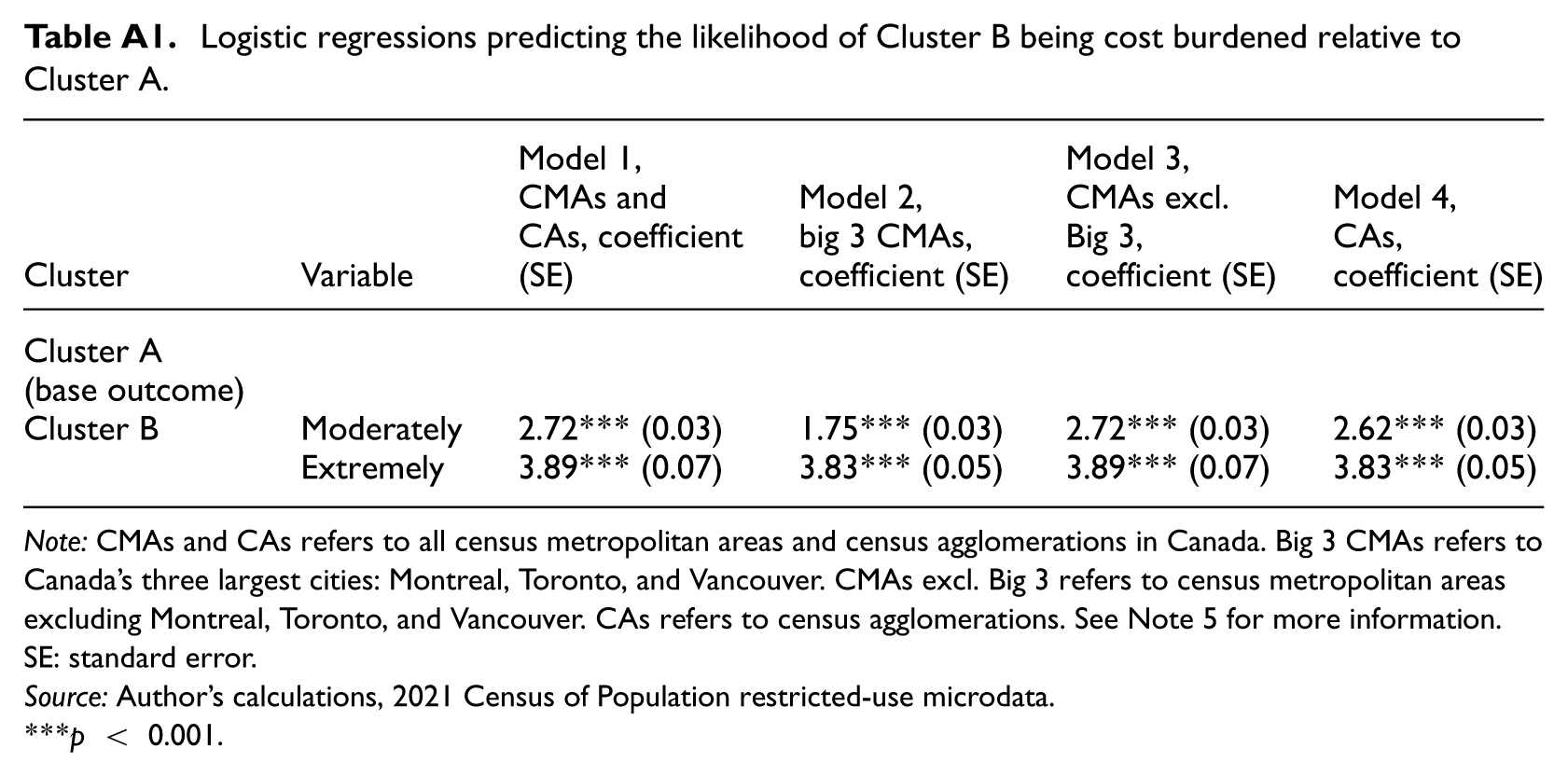
If theory holds true, Cluster B’s higher social vulnerability should be associated with a higher risk of losing a right to the city after dispossession relative to Cluster A. I test this hypothesis using a series of logistic regression models simulating whether members of Cluster A versus Cluster B would be able to comfortably afford moving into any other dwelling type within a given urban geographic unit should the dispossession pressures discussed previously force them from their mobile home. Model 1 tests between-cluster differences in the ability of urban mobile home residents to move to a different dwelling type within any Canadian city. To partially account for differences in the cost of living across cities, Models 2–4 run the same test across various subsets of Canadian cities. Specifically, Model 2 tests between-cluster differences in the ability of urban mobile home residents to move to a different dwelling type in one of Canada’s three largest cities (Montreal, Toronto, and Vancouver), while Model 3 explores census metropolitan areas excluding Canada’s three largest cities, and Model 4 investigates census agglomerations. Results of these regression models (available in Appendix Table A1) are all statistically significant at the p<0.001 level, and the direction of effect is consistent with my hypothesis that Cluster B faces a greater risk for displacement than Cluster A.
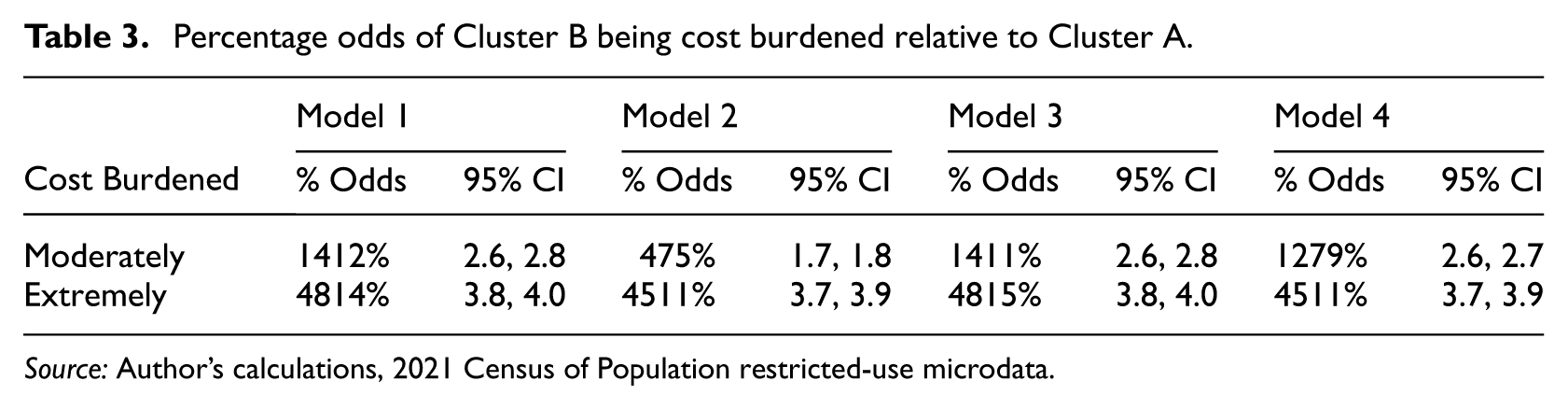
Table 3 quantifies Cluster B’s greater risk for displacement by presenting the percent odds of Cluster B being moderately and extremely shelter cost burdened relative to Cluster A across each model specification. Results are fairly consistent across geographic units and degree of shelter cost burden, with urban mobile home residents comprising Cluster B approximately 1250–1400% more likely to be moderately cost burdened by moving into a different dwelling type and over 4500% more likely to be extremely cost burdened by moving into a different dwelling type relative to Cluster A. The sole exception is between-cluster differences in the likelihood of being moderately cost burdened by moving into a different dwelling type in one of Canada’s three largest cities. While urban mobile home residents in Cluster B are still more likely to be shelter cost burdened in this scenario, the percentage odds are approximately three times lower than other moderate cost burden scenarios. This likely reflects a higher availability of low-cost housing options in Canada’s three largest cities.
Percentage odds of Cluster B being cost burdened relative to Cluster A.
Source: Author’s calculations, 2021 Census of Population restricted-use microdata.
Discussion and conclusion
This research elucidates who would lose their right to the city if urban mobile home residents in Canada were displaced by the various dispossession pressures that they face. First, using latent class analysis, I identified two distinct socio-demographic profiles of urban mobile home residents, referred to as Clusters A and B. The residents who comprise Cluster A tend to be higher-income, working, white adults with children in the home. On the other hand, the residents who comprise Cluster B tend to be lower-income, white, older adults who are not in the labor force and who live alone.
Based on these profiles, I hypothesized that the urban mobile home residents who comprise Cluster B exhibit greater social vulnerability than those who comprise Cluster A and, consequently, that members of Cluster B face a higher risk of displacement after dispossession. To test this hypothesis, I conducted a series of logistic regression models simulating between-cluster differences in ability to move to a different urban dwelling type without becoming moderately or extremely cost burdened. Confirming my hypothesis, I find that the urban mobile home residents who comprise Cluster B are approximately 1250–1400% more likely to be moderately shelter cost burdened and over 4500% more likely to be extremely shelter cost burdened if forced to move to a different dwelling type after experiencing dispossession. These findings are robust across multiple urban geographies in Canada. Thus, I conclude that the urban mobile home residents in Canada who are most likely to lose their right to the city via displacement are lower-income, white, older adults who are not in the labor force and who live alone.
By bringing debates regarding a right to the city into conversation with the literature on mobile homes, I hope to inspire future scholarship bridging these domains. In particular, research focused on the Global South often acknowledges the role of dwelling type and tenure in shaping an individual’s right to the city (Brown, 2013; Davy and Pellissery, 2013; Dugard and Ngwenya, 2018; Samara et al., 2013); however, the findings herein draw necessary attention to the reality that dwelling type and tenure continue to hold important implications for urban citizenship in the Global North. Future research could explore other dwelling types and tenures, as well as mobile home residents beyond the Canadian context.
To this end, one key limitation of the current study is the relative lack of data on mobile home residents’ land tenure arrangements. Replicating these analyses with detailed land tenure data would add crucial nuance to the findings presented herein. Additionally, the finding that low-income older adults are among the urban mobile home residents at greatest risk of displacement dovetails with increasing rates of homelessness among older adults across Canada and the United States (Crane and Joly, 2014; Culhane et al., 2013; Murphy and Eghaneyan, 2018), representing a potentially fruitful path forward for scholars of a right to the city. Finally, while latent class analysis and other, similar statistical techniques are capable of capturing some of the diversity within populations that may be masked by summary statistics, it is worth noting that the process of assigning clusters, itself, masks some degree of heterogeneity. For one, statistical requirements regarding minimum cell counts demand that small sub-populations be either collapsed into larger categories or omitted entirely, thereby rendering them invisible (e.g., here, the decision to group urban mobile home household heads with bachelor’s, master’s, doctorate, and professional degrees). Additionally, characterizing clusters based upon the sub-populations with the highest predicted probability of cluster membership inherently blurs within-cluster diversity (e.g., here, nearly ten percent of urban mobile home households in Cluster A are predicted to be out of the labor force). Thus, scholars studying urban mobile home residents and other marginalized urban groups are encouraged to acknowledge and, to the extent possible, incorporate within-group heterogeneity into analyses. By doing so, scholars will help to safeguard an inclusive right to the city.
Supplemental Material
sj-docx-1-usj-10.1177_00420980251408379 – Supplemental material for Mobile home residents’ tenuous right to the city: Uniform or varied?
Supplemental material, sj-docx-1-usj-10.1177_00420980251408379 for Mobile home residents’ tenuous right to the city: Uniform or varied? by Lora A. Phillips in Urban Studies
Supplemental Material
sj-docx-2-usj-10.1177_00420980251408379 – Supplemental material for Mobile home residents’ tenuous right to the city: Uniform or varied?
Supplemental material, sj-docx-2-usj-10.1177_00420980251408379 for Mobile home residents’ tenuous right to the city: Uniform or varied? by Lora A. Phillips in Urban Studies
Footnotes
Appendix
Logistic regressions predicting the likelihood of Cluster B being cost burdened relative to Cluster A.
| Cluster | Variable | Model 1,CMAs andCAs, coefficient(SE) | Model 2,big 3 CMAs,coefficient (SE) | Model 3,CMAs excl.Big 3,coefficient (SE) | Model 4,CAs,coefficient (SE) |
|---|---|---|---|---|---|
| Cluster A(base outcome) | |||||
| Cluster B | Moderately | 2.72*** (0.03) | 1.75*** (0.03) | 2.72*** (0.03) | 2.62*** (0.03) |
| Extremely | 3.89*** (0.07) | 3.83*** (0.05) | 3.89*** (0.07) | 3.83*** (0.05) |
Note: CMAs and CAs refers to all census metropolitan areas and census agglomerations in Canada. Big 3 CMAs refers to Canada’s three largest cities: Montreal, Toronto, and Vancouver. CMAs excl. Big 3 refers to census metropolitan areas excluding Montreal, Toronto, and Vancouver. CAs refers to census agglomerations. See Note 5 for more information.
SE: standard error.
Source: Author’s calculations, 2021 Census of Population restricted-use microdata.
p < 0.001.
Acknowledgements
Thank you to the editors and anonymous reviewers for their insightful and constructive feedback. Earlier versions of this research were presented at the 2024 annual meeting of the American Sociological Association and the 2025 annual meeting of the International Conference on Urban Affairs, where session organizers and attendees also provided valuable feedback.

Funding
The author received no financial support for the research, authorship, and/or publication of this article.
Declaration of conflicting interests
The author declared no potential conflicts of interest with respect to the research, authorship, and/or publication of this article.
Supplemental material
Supplemental material for this article is available online.
Notes
References
Supplementary Material
Please find the following supplemental material available below.
For Open Access articles published under a Creative Commons License, all supplemental material carries the same license as the article it is associated with.
For non-Open Access articles published, all supplemental material carries a non-exclusive license, and permission requests for re-use of supplemental material or any part of supplemental material shall be sent directly to the copyright owner as specified in the copyright notice associated with the article.
