




Abstract
One of the difficulties in implementing densification objectives is that planners often do not have sufficient coercive power to restrict property rights, which means that landowners can resist the implementation of land use plans. As a result, planning increasingly takes place on the project level, allowing planning authorities and developers to renegotiate the terms and conditions of densification. While project-level negotiations have been researched, these studies do not focus on individual landowners but rather on developers. This article examines how developers and public authorities manage the property rights of individual landowners to prevent delays or blockages in project implementation. Drawing on a comparative case study of Thun (Switzerland) and Utrecht (Netherlands), we show how project-based planning takes different forms depending on legal frameworks and planning norms. In Thun, strategies focus on consensus building and input legitimacy; in Utrecht, more coercive instruments such as expropriation are used and legitimized based on their output. The findings suggest that project-based planning tends to exclude individual landowners from negotiation, framing their objections as obstructions to be managed. While individual owners’ interests are often sidelined, the private economic interests of developers and large landowners often appeal to collective goals such as climate change mitigation or housing supply. This raises broader questions about which interests are recognized, or dismissed, in the construction of social sustainability in urban densification.
Introduction
Densification, which refers to the redevelopment of the existing built environment to achieve a higher building, use, or population density, has become an important policy objective in many countries (Broitman and Koomen, 2020; Dembski et al., 2020). Yet, its implementation is difficult because of the complicated web of established rights and interests in which densification occurs (Dovey et al., 2017). To overcome potential conflicts, planners engage with institutional landowners or developers in project negotiations through, for instance, negotiated land use plans and private law contracts (Lehrer and Pantalone, 2018). This more discretionary approach to planning, also called project-based planning, allows planning authorities and developers to negotiate interests and overcome conflicts (Bouwmeester et al., 2024).
A critical aspect overlooked in the literature is the role of individual landowners in such negotiations. In this article, we define individual landowners as private individuals who own a plot of land within or adjacent to a redevelopment area. Understanding the role of such individual landowners in decision making in densification projects not only is relevant in understanding efficient implementation of densification objectives but also speaks to broader social sustainability concerns about who benefits from densification and how value is distributed across different types of actors (Charmes and Keil, 2015). This makes the question of the social sustainability of densification not only one of substantive goals but also about how these outcomes are produced (Boström et al., 2015).
Given the complexity of densification, there is a high chance that a spatial intervention negatively impacts the interests of individual landowners (Bröchner et al., 2021). In response, these actors can mobilize or protest, seeking to renegotiate densification outcomes (Verloo and Davis, 2021). In most countries, individual landowners can create spaces of negotiation through their property rights, which allow owners to veto implementation, or through procedural rights, such as the right to be heard, to appeal, or to receive compensation (Needham et al., 2019). These rights form an important part of democratic politics, as public decisions must be seen as legitimate by those affected by them and the general public (Mäntysalo et al., 2011). However, the planning literature highlights that such rights are viewed by authorities and developers as bureaucratic obstacles to efficient implementation, leading to efforts to streamline planning procedures in countries (Buitelaar et al., 2013).
Despite studies touching upon the role of property rights of institutional landowners in densification projects (Biggar and Friendly, 2023; Debrunner et al., 2020), there is a gap in the literature specifically examining how the rights of individual landowners influence the implementation of densification projects. Scholars have, for instance, addressed neighborhood resistance in urban renewal projects (Matthews et al., 2015; Scally and Tighe, 2015), how different planning instruments or approaches can improve acceptance of planning interventions (Pleger, 2017; Wicki et al., 2022), or the legal frameworks that define rights of appeal (Taylor, 2014). However, there is a gap in the literature addressing how the legal framework protecting the rights of individual landowners is negotiated, interpreted, and implemented at the project level under densification.
This contribution aims to understand how municipalities and developers strategically respond to the rights of (neighboring) individual landowners who threaten to block or delay the implementation of densification objectives. Specifically, this contribution studies the following questions: (1) how does the institutional context influence the strategies that developers and local planning authorities use; and (2) how do considerations of the trade-off between legitimacy and efficiency influence the selection of these strategies? The analysis builds on a neo-institutional approach, emphasizing how formal and informal rules frame actor strategies in planning negotiations (Gerber et al., 2009). The analysis draws on two densification projects in Thun (Switzerland) and Utrecht (the Netherlands).
An institutional approach to project-based planning
Trade-offs of densification
Densification is widely promoted as a key planning strategy to achieve sustainable urban development. It is associated with goals like reducing urban sprawl, promoting low-carbon living, increasing housing affordability, and limiting land take. However, empirical evidence shows that in many cities undergoing densification, social inequality, housing inaccessibility, and ecological degradation persist or even intensify (Kjærås, 2024; Moos, 2016). Instead of prioritizing long-term public and environmental benefits, densification is often used as a vehicle for private value extraction, enabling developers and investors to profit from intensified land use while displacing lower-income residents or excluding them from the benefits of redevelopment (Livingstone et al., 2021). This dynamic, referred to as “the business of densification,” underscores a core trade-off: densification policies frequently enable economic returns at the expense of social sustainability (Debrunner et al., 2020).
In the literature, this duality is reflected in the terminological distinction between densification and upzoning. While the term densification is typically used in planning debates to frame intensified land use as a societal good, upzoning is more commonly used to highlight the following redistribution of development rights and impacts on land values, which may or may not impact housing supply and affordability (Freemark, 2023; Murray and Limb, 2023). These contrasting framings highlight that densification is simultaneously promoted as a public interest and contested for its uneven distributional consequences, raising questions about how collective and individual interests are mediated in practice.
Much of the research on densification has approached social sustainability in terms of outcomes, such as affordability, housing accessibility, or neighborhood diversity (Debrunner, 2024; Götze et al., 2024a; Moos, 2016). Processes of densification are well studied, but less often linked to questions of social sustainability, for example whose interests are recognized and which trade-offs are legitimized in planning. Yet conflicts often stem not only from material outcomes but also from perceptions of procedural exclusion. This helps explain why local implementation remains contested: acceptance by residents is important (Touati-Morel, 2015), and individual landowners can significantly delay or block projects if they refuse to cooperate (Meijer and Jonkman, 2020). These “small plots” carry “big stakes” in urban redevelopment, as there are considerable financial risks associated with delays.
The Institutional Resource Regime to understand the governance of densification
To understand how these tensions between collective and individual interests are managed in practice, this contribution uses the Institutional Resource Regime framework, which conceptualizes how local planning authorities and developers strategically respond to property rights used by (neighboring) individual landowners. The framework relies on the premise that institutions, or the rules of the game, serve as a framework influencing actors’ behavior, constraining and enabling their specific uses of the resource land (Vatn, 2005). Simultaneously, local stakeholders may strategically seek to renegotiate their access and use rights to resources through local-level negotiations (Debrunner et al., 2020). These two components of the Institutional Resource Regime framework will now be discussed.
The Institutional Regime: The rules of the game
We understand that two main sets of rules govern urban land: public policies and property rights. Property rights safeguard individual interests, granting legal rights to resource users. On the other hand, policy instruments are used by the state to regulate the behavior of actors to solve politically defined public problems and subsequently protect the public interest (Knoepfel et al., 2007). These two sets of rules together shape the Institutional Regime, which governs, in the case of densification, the resource land. Together, they shape what Buitelaar (2003: 322) refers to as a user rights regime, that is, the specific constellation of site-specific rules that define, limit, or reasign the user rights in land. In the context of densification, this regime governs who has the right to make decisions about land use and under what conditions. However, when public policy cannot effectively constrain property rights, as is often the case in spatial planning, incoherences emerge within the IR (Gerber et al., 2009). In such situations, local actors may resort to negotiation to determine land use outcomes, leading to project-specific arrangements that reinterpret the existing legal framework (Gerber, 2016).
Localized Regulatory Arrangements: The play of the game
At the project level, these negotiation processes result in the formation of self-organized management structures called Localized Regulatory Arrangements (LRAs). These arrangements correspond to what Williamson (2000) describes as the “governance” level of institutional analysis: they are not purely informal nor entirely defined by law, but emerge within the leeway afforded by formal institutional frameworks. Within these LRAs, stakeholders make deliberate choices, deciding whether to implement all or only specific policy objectives, address regulatory gaps through context-specific agreements, or prioritize property rights over public policies (Viallon et al., 2019: 78). At the LRA level, planning authorities, sometimes in collaboration with developers, strategically select policy instruments to influence the behavior of landowners, who may delay or obstruct the realization of densification projects. Following Gerber et al. (2018), we distinguish four main types of instruments:
The first type of instrument is public policy instruments without an impact on use or disposal rights, such as strategies that rely on economic incentives and information, and communication-based instruments.
The second type of instrument impacts the scope and content of use or disposal rights, for example changing the boundaries of a project-level land use plan.
A legal reconfiguration of property rights is a third type of instrument, including introducing new legislation impacting use or disposal rights, for example by reducing appeal possibilities.
The fourth type of instrument is one that redistributes property rights, including, for example, expropriations or the targeted purchase of land.
The strategic use of these instruments not only affects project implementation but also influences who is included or excluded from the negotiation process. For instance, modifying project boundaries may remove oppositional landowners from the LRA.
Explaining the selection of policy instruments: Balancing output efficiency and input legitimacy
While institutional context determines the formal availability of policy instruments, the actual choice of strategy is also shaped by informal norms and political culture, which Williamson (2000) describes as social embeddedness. The selection of policy instruments embodies distinct interpretations of public problems, the role of public and private actors in urban development, and what constitutes “good planning” (Landry and Varone, 2005). A central trade-off in this context is between input legitimacy and output efficiency. Following Scharpf (1997), legitimacy can be derived from the input, i.e. the opportunities individuals have to participate in decision making either directly or through representatives, or from the output, meaning the efficient achievement policy outcomes. These different understandings of legitimacy can conflict with each other. The strategic use of different instruments embodies different understandings of legitimacy: some emphasize consensus building and input legitimacy, while others prioritize speed and output efficiency.
Project-based planning is often justified based on output legitimacy: it enables speedy implementation by negotiating solutions at the project level (Gerber, 2016). However, scholars have also criticized this approach for diminishing input legitimacy by limiting citizens’ participation and reducing public accountability (Raco, 2013; Shih and Shieh, 2020). Inclusive decision-making processes can improve input legitimacy but are viewed by market actors as time-consuming (Mäntysalo et al., 2015). Recognizing this trade-off is crucial for understanding why actors in LRAs prioritize certain strategies over others.
Research design and methods
Case selection and justification
The study used an in-depth qualitative case study approach to examine complex negotiation processes in their institutional context (Opoku et al., 2016). To capture a wide range of strategies, two countries with distinct Institutional Regimes were selected: the Netherlands and Switzerland. In both countries, municipalities are the primary public entities responsible for land use planning (Janssen-Jansen and Woltjer, 2010; Schönig, 2020). Municipal planning administrations act on behalf of the city council (executive level) and the city parliament (legislative level) and play a crucial role in formulating and implementing land use plans and granting building permits for new developments. Both countries can be classified as comprehensive-integrated planning systems (Nadin et al., 2024), yet there are key differences between their institutional frameworks. Switzerland has a semi-direct democratic planning system, where planning decisions such as the implementation of a new land use plan involve public referenda. Additionally, property rights are strongly protected and limited intervention in them is possible (Gerber, 2016; Lawson, 2009). The Netherlands follows a consensus-driven model, in which planning decisions are shaped through negotiations among stakeholders. Simultaneously, stronger state interventions in property rights are possible (Hartmann and Spit, 2015).
Two secondary cities facing similar densification pressures were selected. Although Utrecht is significantly larger than Thun (their population sizes are 374,000 and 44,000, respectively), both cities function as regional hubs and are projected to grow by approximately 11% in population size by 2030 (Gemeente Utrecht, 2019; Stadt Thun, 2016). Three criteria were defined for selecting case studies at the municipal level: (1) use of a negotiated land use plan; (2) the actor constellation in the LRA involving individual landowners; and (3) construction recently finished or about to begin. Subsequently, two case studies were selected: Hoffmatte (Thun) and Nieuwe Defensie (Utrecht).
Data collection and analysis
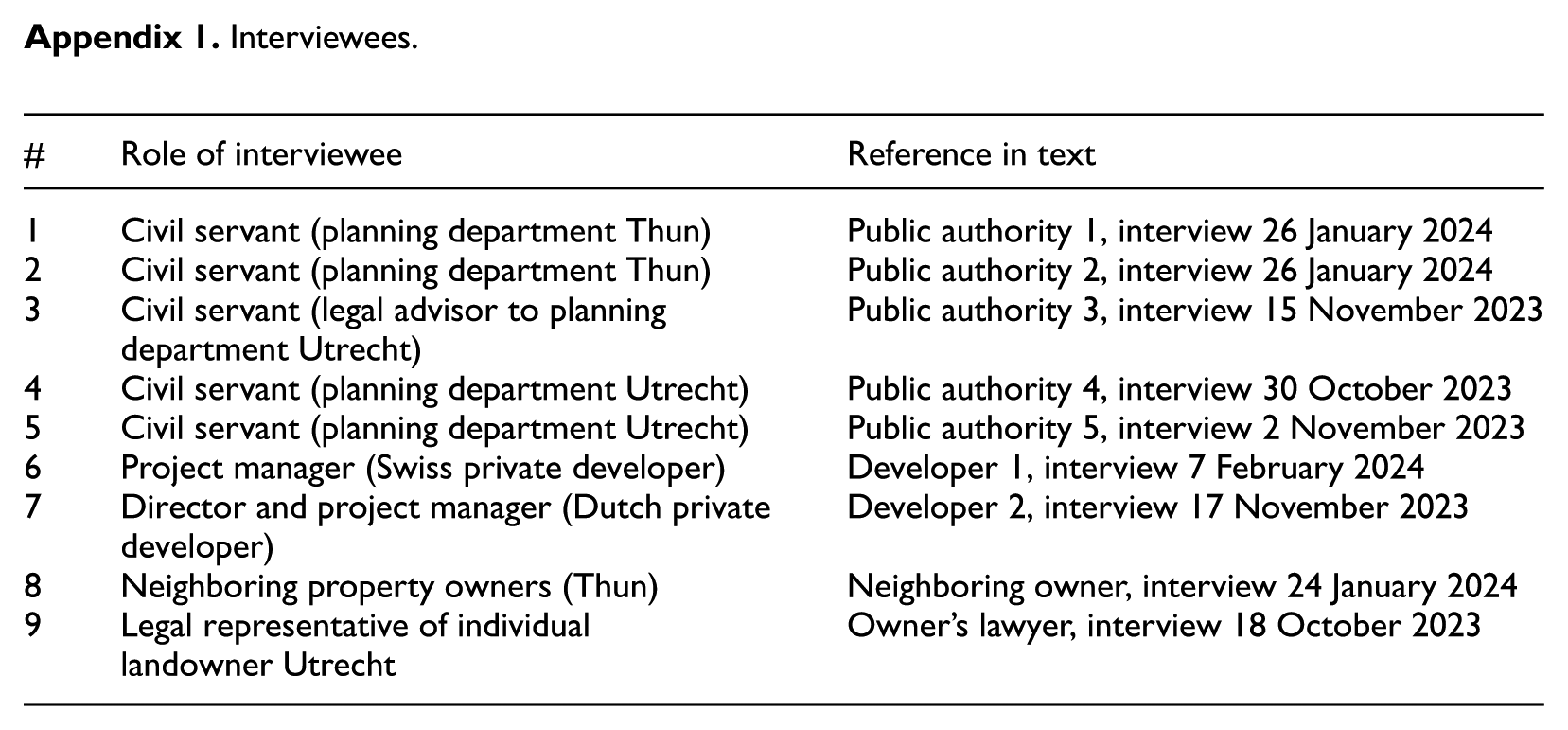
Formal institutions governing densification and land use policy, property rights, and rights of appeal at the national, cantonal/provincial, and municipal levels were analyzed through an extensive document analysis. This included legally binding documents such as laws, land use plans, and strategic visions. Data on the negotiation processes of the two cases were collected in nine in-depth interviews with local planning authorities, private actors such as developers, and landowners involved in the cases (see Appendix 1). Furthermore, written communication, including newspaper articles, municipal responses to objections, and municipal meeting minutes, provided more insights into negotiations and was used to triangulate the data.
All data were analyzed in MaxQDA using qualitative content analysis. The coding process began with a deductive approach, applying the predefined categories as defined in the theoretical framework, but remained flexible to allow for the identification of emerging themes and patterns through open coding (Sheydayi and Dadashpoor, 2023). In addition to coding explicit content, attention was paid to how actors justified their positions and decisions to better understand their strategic behavior within the institutional context. After coding the entire data set, it was rechecked to ensure consistency.
Planning for densification in the face of neighborhood resistance: Hoffmatte (Thun)
The Hoffmatte project is constructed on an unused plot next to a production site owned by the company Hoffmann Neopac. Plans for the area include the construction of 180 apartments, a nursing home with around 100 places, and 55 retirement apartments. The plans were developed in collaboration between the planning authority, private developer Frutiger, and the Wohnen Im Alter (WIA) foundation, a foundation focusing on the creation and operation of residential and care facilities for the elderly and people in need of care. The following sections will discuss the legal frameworks, the planning process, and how resistance by neighboring landowners affected the project implementation.
Legal frameworks in Switzerland (the rules of the game)
The 2012 reform of the Swiss Spatial Planning Act (Swiss Federal Authorities, 1979) made densification a legally binding objective (Art. 1 Abs. 2). Swiss municipalities have encountered difficulties implementing densification objectives, especially as, compared to other countries, the rights of private landowners are strongly protected and can only be restricted if an overriding narrowly defined public interest exists (Debrunner and Hartmann, 2020). As a result, there are limited planning instruments available that allow planning authorities to compel unwilling landowners to densify. To promote densification, municipalities use special land use plans (Sondernutzungsplanen) to adjust zoning regulations for specific projects. These project-level plans allow for negotiations and can contain special stipulations concerning, for example, density, urban design, infrastructure, and green spaces (Götze et al., 2024b).
If parties disagree with decisions made by the municipality, such as the adoption of a special land use plan, the Building Act of the Canton of Bern (BauG-BE) (Kanton Bern, 1985) regulates the appeal process. While Switzerland is known for broad public participation in political decision making, the legal appeal process is relatively restrictive. Only individuals who can demonstrate direct proximity and actual material harm are entitled to appeal, and only if they submitted a formal objection during the initial review phase (BauG-BE, Art. 35 Abs. 2, Art. 35c Abs. 1 and Art. 61a Abs. 2). Objections can be raised during the approval process before the responsible authority decides. If no resolution is found during a municipal hearing, the case may proceed to the Department of Municipalities and Spatial Planning, with further appeal options to the Cantonal Directorate of Home Affairs and Justice, and ultimately the Federal Court.
The negotiation process of Hoffmatte: The play of the game
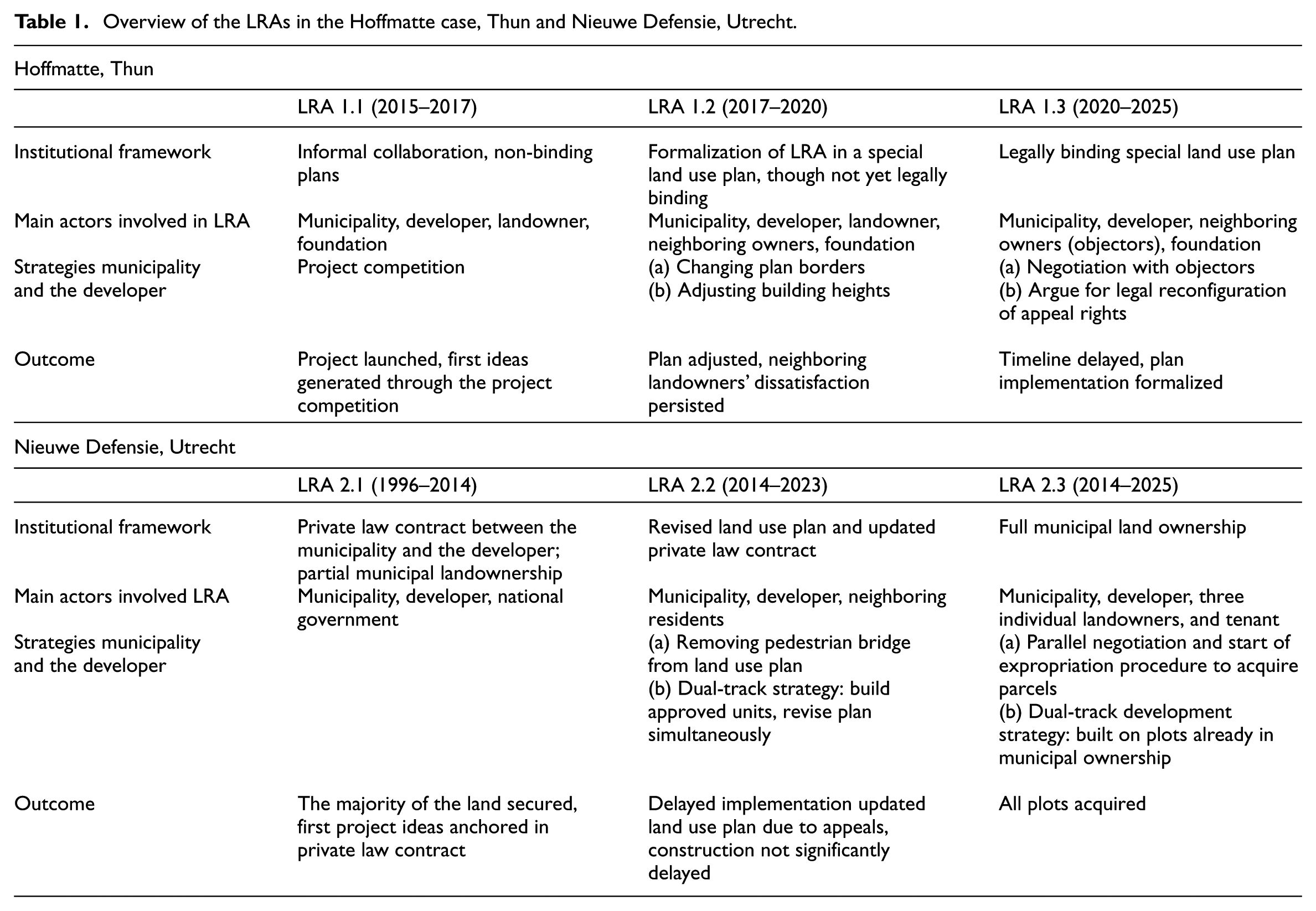
The planning process of Hoffmatte in Thun consists of three distinct phases, each representing a different LRA. Over time, both the actor constellation and the project boundaries evolved. Figure 1 illustrates the initial site boundaries and land ownership, and how these changed throughout the process. Below, we analyze the project’s progression, highlighting the key actors, their roles and objectives, and the strategies employed in each LRA. A summary of these LRAs is provided in Table 1.
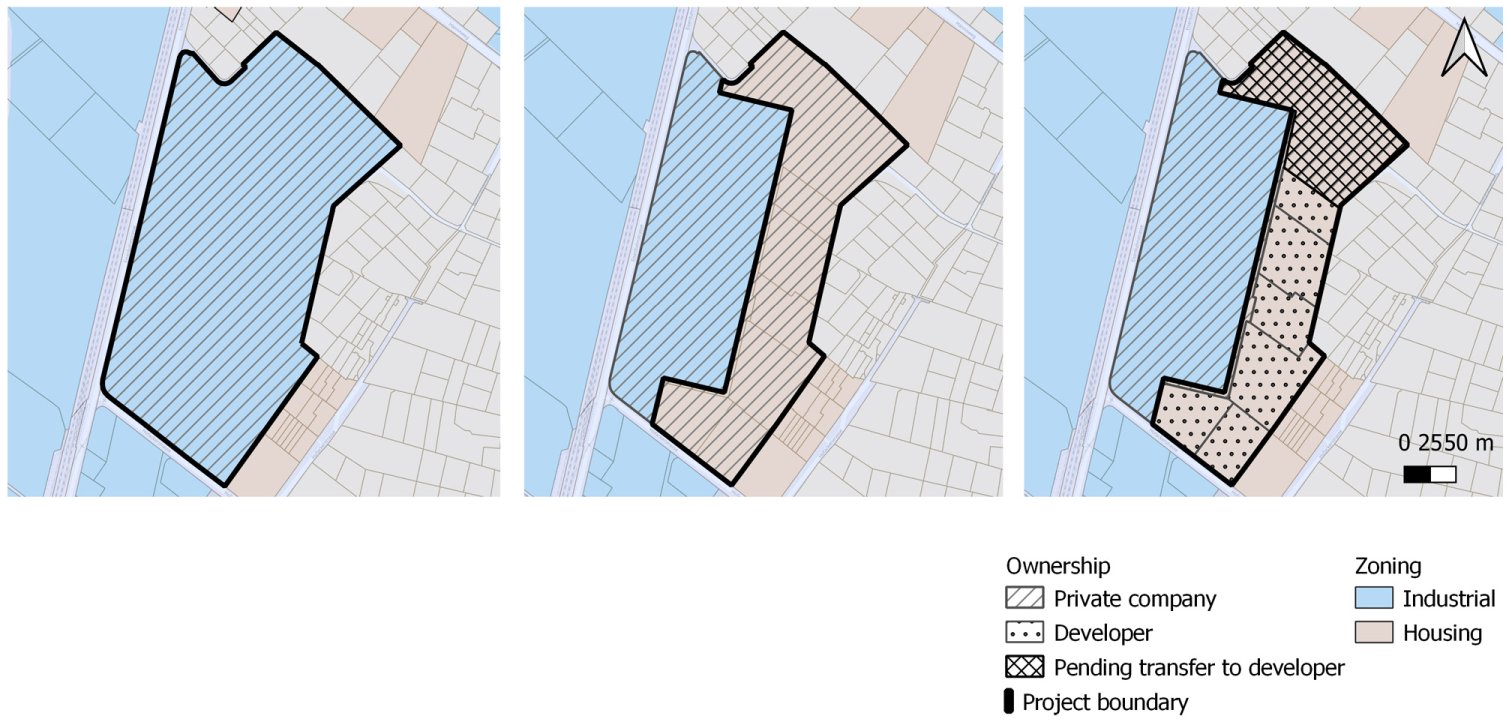
Evolution of project boundaries, ownership, and zoning in the Hoffmatte project, Thun (Switzerland). These maps illustrate the changing ownership and zoning regulations during the three phases of the Localized Regulatory Arrangement (LRA 1.1–1.3). Data source: GRUDIS; Geoportal der Stadt Bern.
Overview of the LRAs in the Hoffmatte case, Thun and Nieuwe Defensie, Utrecht.
LRA 1.1: Initiation of the project (2015–2017)
As a smaller municipality with limited steering capacity, Thun depends on landowners’ initiatives to make densification happen (Public authority 2, interview 26 January 2024). In this case, developer Frutiger AG initiated the project after coming to an agreement with landowner Hoffmann Neopac about the future transfer of property rights (Figure 1).
In 2016, the developer issued a project competition, following the guidelines proposed by the Swiss Society of Engineers and Architects (Schweizerischer Ingenieur- und Architektenverein, 2020). The municipality requested a design competition to generate a structural plan that would legitimize the rezoning of the plot through a special land use plan, which would allow the planning authorities to include project-specific conditions (Public authority 1, interview 26 January 2024). The jury was made up of “recognized experts from the field” (Stadt Thun, 2019: 1), along with representatives of the municipality of Thun, the landowner, and the developer. The competition was intended to pre-emptively build consensus and increase the input legitimacy of the project by guaranteeing a high-quality development: “Planning this area was challenging as you need to deal with […] the fragmented, single-family home ownership in the neighborhood. The project competition is a good instrument to guarantee high-quality living space and increase acceptance” (Public authority 1, interview 26 January 2024).
The project competition served as a communication-based strategy to inform neighboring residents about the development. However, neighboring landowners, primarily residents of detached single-family homes, were not directly involved at this stage (Neighboring owner, interview 24 January 2024).
LRA 1.2: Adjusting the project boundaries and formalizing plans (2017–2020)
As the planning process transitioned into formalizing ideas into the special land use plan, the municipality and developer adjusted the project boundaries (see Figure 1). Whereas the project competition initially included the entire site, the landowner maintained that it had no immediate plans to relocate its industrial operations. The redrawing of the project boundaries allowed the municipality and developer to proceed with the plan without interfering with ongoing economic activities (Public authority 1, interview 26 January 2024).
In 2017, the municipality and developer initiated the special land use plan procedure. A draft plan was made available for public consultation. During this phase, neighboring property owners first became involved in the LRA, voicing objections, citing the building height and visual intrusion, traffic increases, and loss of neighborhood character (Stadt Thun, 2017; Neighboring owner, interview 24 January 2024). In response to these concerns, the municipality and developer agreed to revise the proposed building heights: it appears that high-rise buildings (total height over 30.0 m) at this location and at this time would probably be met with great resistance. For this reason, the city and the developer decided to forego high-rise buildings […] and set the maximum overall height at 29.9 m. (Stadt Thun, 2017: 3)
This adjustment aimed to demonstrate responsiveness to concerns by neighboring owners, increasing input legitimacy, while preserving project financial feasibility (Public authority 2, interview 26 January 2024). However, neighbors remained dissatisfied, stating they felt the height adjustment was insufficient: “[T]hey acted like lowering a few meters is enough. It’s still too much for this area” (Neighboring owner, interview 24 January 2024). In this phase, formal opportunities for participation were used by individual landowners to influence the agreements made between the municipality and the developer in LRA 1.1.
LRA 1.3: Overcoming appeals by neighboring landowners (2020–2025)
Following a successful referendum on the special land use plan in 2020, formal objections were submitted by 13 neighboring landowners. These objections included allegations of violation of the municipal building law, incompatibility with the cantonal structure plan, traffic overload, and noise (Public authority 1, interview 26 January 2024). Three objections could be resolved by talking with the objectors and clearing misunderstandings (Public authority 2, interview 26 January 2024). The canton rejected the other objections, after which three parties contested the decision at the Administrative Court of the Canton of Bern (Verwaltungsgericht des Kantons Bern, 2022). One complaint proceeded to the Federal Court. Both courts upheld the municipality’s decision, stating that it had reasonably balanced the public interest in densification with the private interests of the appellants (p. 15), and that the participatory procedures contributed to the plan’s legitimacy (pp. 12–14), thus supporting both input legitimacy through formal procedures and output legitimacy by serving broader public objectives. The Federal Court rejected the final complaint in early 2023, rendering the special land use plan legally binding. Reflecting on the long appeal process, the public authorities stated: “People simply try to prevent the project and often succeed in doing so, at least in terms of time. Many people also do it for money, too, it has to be said. The hurdle [to appeal] is too small” (Public authority 2, interview 26 January 2024). This final phase demonstrates how, despite Switzerland’s relatively restrictive legal standing for appeals, neighboring owners used their property rights to significantly delay the project. The framing of their objections as selfish or financially motivated in the quote above points to a deeper tension: individual landowners exercising legal rights are seen as undermining collective goals.
Individual landowners giving way for high-density redevelopment: Nieuwe Defensie (Utrecht)
The Nieuwe Defensie project is a high-density redevelopment of former halls of the Ministry of Defense near the center of Utrecht, with plans for the construction of 950 apartments. Once owned by the national government, the site was acquired by the municipality and is being redeveloped in cooperation with BPD, one of the Netherlands’ largest developers. However, as shown in Figure 2, four smaller plots remained in individual ownership throughout much of the planning process.
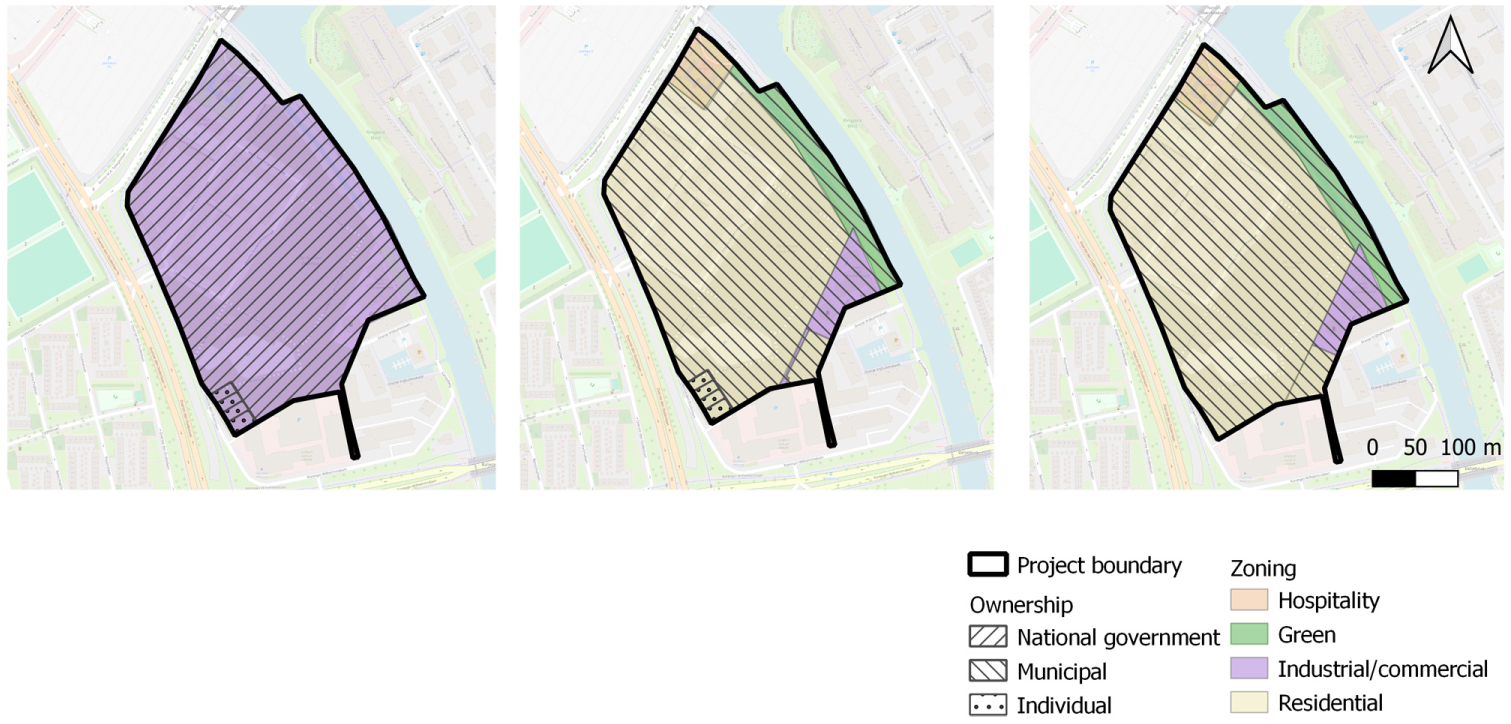
Evolution of project boundaries, ownership, and zoning in the Nieuwe Defensie project, Utrecht (Netherlands). These maps show the development of the Nieuwe Defensie site over the course of three LRAs (LRA 2.1–2.3). Data source: Ruimtelijkeplannen.nl.
Legal frameworks in the Netherlands (the rules of the game)
To secure land for densification projects, municipalities in the Netherlands can rely on a broad mix of collaborative and coercive instruments. Municipalities frequently use private law contracts and project-level land use plans to negotiate with developers (van Den Hurk and Tasan-Kok, 2020). However, when such cooperation is insufficient, municipalities can also draw on more forceful instruments like pre-emption rights and expropriation. Expropriation is legally permitted for a wide range of public interests, including for private land uses with an indirect public interest. In practice, most procedures end with a “voluntary” purchase, with the threat of expropriation providing pressure (Holtslag-Broekhof et al., 2018).
Planning decisions are subject to legal safeguards to protect the rights of affected parties. The General Administrative Act (Awb) (Overheid, 2024) and the Spatial Planning Act (Omgevingswet, 2024) define procedures for objections and appeals. Everyone has the right to express opinions (zienswijzen) on a proposed intervention. Only those who are directly affected by the decision can file an objection (bezwaar) within six weeks. If unresolved, the objector can submit an appeal (beroep) to the administrative court. To reduce delays in planning procedures, the relativity principle (relativiteitsbeginsel, Article 8:69a Awb) was introduced in 2013, meaning that an appeal can only succeed if the violated rule was specifically intended to protect the interest of the appellant (Buitelaar et al., 2013).
The play of the game in the Nieuwe Defensie Case
The planning and negotiation process unfolded in three distinct LRAs, each involving shifting actor constellations, instruments, and strategies (see Table 1). Figure 2 shows the evolution of land ownership, land use plans, and development boundaries.
LRA 2.1: Initial development agreement and land acquisition (1996–2014)
The project’s origins lie in a 1996 agreement between the municipality and the developer BPD. At this time, the national government instructed the municipality to develop the large expansion area of Leidsche Rijn. Utrecht lacked the financial means to purchase all the necessary land. In exchange for acquiring land on the municipality’s behalf, BPD received development rights for approximately 6600 housing units, including 400 units earmarked for the Defensieterrein site (Public authority 4, interview 30 October 2023).
The Defensieterrein plot was largely owned by the Ministry of Defense (see Figure 2). The site was zoned for industrial use, but the national government no longer used the plot for storage of defense materials, making it an ideal plot for new residential developments (Public authority 5, interview 2 November 2023). After negotiations with the state, by 2014 the municipality had acquired most of the land and signed a development agreement with BPD to construct 600 dwellings, including 120 social rental units. The municipality also committed to acquiring the remaining four plots from three private landowners and one long-term tenant (renting from the Ministry of Defense), either through expropriation or through voluntary purchase. This early phase was marked by a shared goal between the municipality and the developer to implement densification on underutilized land.
LRA 2.2: Expanding development ambitions and navigating objections (2014–2023)
The municipality and BPD developed a land use plan based on the 2014 agreement. The plan was adopted by the municipal council in 2018. Only minor adjustments were made based on neighborhood input, such as the removal of a pedestrian bridge (Public authority 5, interview 2 November 2023). In 2019, the municipality and developer revised their development ambitions for the site. The number of units would be increased to 950, primarily by including smaller and more affordable apartments. The revised housing program included an additional 100 social rent, 100 mid-sector rent, and 150 affordable owner-occupied units.
To enable the development, the municipality had to amend the land use plan. An appeal was lodged by a neighboring shopping center against the revised land use plan, which argued that the increased density would result in more people using their parking lot. The case delayed the implementation of the updated land use plan until December 2023, when the Council of State ruled the appeal to be inadmissible. However, construction on the first 600 units began in 2020 based on the original land use plan, which was already in effect on the site. This dual-track strategy, namely to move forward with construction for the units already permitted while pursuing a land use plan revision for the rest, allowed development to proceed efficiently despite the uncertainty caused by the appeal (Developer 2, interview 17 November 2023).
LRA 2.3: Acquiring the remaining plots (2014–2025)
Parallel to the land use planning process, the municipality engaged in prolonged negotiations with the owners of four privately held plots located within the project boundaries but not yet in municipal ownership (see Figure 2). These included three private landowners and one long-term tenant, with whom the municipality needed to negotiate compensation to terminate the rental contract. Simultaneously with these negotiations, an expropriation procedure was started for all four plots to prevent delays (Public authority 5, interview 2 November 2023).
Negotiations were complicated by disagreements over land value. The individual landowners and tenants were long-time residents who had lived on the plots for decades. Their resistance was not merely financial but rooted in concerns about displacement. According to them, the compensation offered was not enough for them to secure comparable housing elsewhere in such a central location (Owner’s lawyer, interview 18 October 2023). While the landowners expected compensation based on future development potential, municipal regulations restricted compensation to the current use value of the property. As one public official explained: “We cannot spend 1 million on the property, but it is no problem if we spend 1 million on procedures. While [the owners] thought they were sitting on a pot of gold” (Public authority 5, interview 2 November 2023). When negotiations took longer than expected, the developer proposed to approach the landowners directly to offer a higher purchase price than the municipality was legally allowed to provide. However, this strategy was ultimately not used: the municipality preferred to stick to the set strategy, and the developer agreed, partly because social housing was planned for these plots, making the plot less financially interesting for the developer (Developer 2, interview 17 November 2023). Additionally, construction could already begin on the remainder of the site, unaffected by the ownership disputes. This ensured the overall project timeline was not stalled by the delays surrounding the small parcels.
Negotiations with one of the owners proved to be especially difficult. The owner appealed the land use plan to the Council of State, but this was rejected based on the argument that the individual interest of a few owners was secondary to the development of the neighborhood. Specifically, it was stated that it is in the public interest to densify. The developer stated the importance of having expropriation as an instrument available: “We expropriate … well, formally, as a developer, of course, we cannot expropriate, but we have the agreement with the municipality … We only expropriate the most difficult people” (Developer 2, interview 17 November 2023). This phase demonstrates the use of instruments redistributing property rights, ensuring that land acquisition challenges did not hinder the efficient implementation of the overall project (Public authority 4, interview 30 October 2023). The selection of this instrument thus reflects a focus on output legitimacy. In the end, all four plots were acquired by the municipality following extended negotiations.
Now that the municipality has acquired all four remaining plots, it will retain land ownership until construction is completed (expected in 2027). In line with the private law agreement, the municipality will transfer ownership of the land to BPD after completion, except for the plots allocated to social and mid-rent housing. These will be provided to the developer via a long-term ground lease at a discounted rate.
Discussion: Negotiating densification in the face of property rights
This contribution looked at the role of individual landowners in project-based negotiations between public authorities and developers, and the strategies used to prevent them from stalling or blocking project implementation. Through a comparative analysis of Thun (Switzerland) and Utrecht (Netherlands), we explored how these strategies (play of the game) are shaped by legal frameworks (rules of the game) and the social embeddedness of institutions. Previous research has shown that project-based planning reshapes the balance of power between public actors and private, mostly institutionalized landowners (Bouwmeester et al., 2024). This article builds on this by looking at individual landowners who own land within or adjacent to project areas. It shows that their inclusion in project-based planning is shaped not only by formal rules and what instruments are available but also by informal norms that define legitimate decision making.
In both cases, four types of strategies were identified for managing opposition by individual landowners: (1) through compromise, for example changing the land use plan based on objections; (2) by redrawing project boundaries, for example in the special land use plan; (3) by weakening property rights, for example legal changes restricting the right to appeal; and (4) by eliminating contesting voices, for example expropriating landowners within the project perimeter. The selection of certain strategies is dependent on the instruments that are available in a given institutional context but also provides insights into informal norms or social embeddedness of formal institutions. In this contribution, we used the distinction between input legitimacy and output efficiency to show this. Compromise is most closely tied to input legitimacy, especially when objections result in changes to the plan. Redrawing boundaries can also be seen as relating more closely to input legitimacy. Legal reforms to restrict appeals and expropriation are mainly justified based on output efficiency. While these strategies are shaped by the legal instruments available in each context, our findings also show that the way these instruments are implemented is deeply shaped by informal norms. In Thun, where property rights are strongly protected and planning is embedded in a system of semi-direct democracy, authorities favored consensus-based strategies like compromise and project boundary adjustments. In contrast, in Utrecht, planning authorities more readily employed instruments like expropriation, reflecting a focus on output efficiency.
These strategies were not used in isolation: their timing played an important role. In Utrecht, development proceeded on plots already in municipal ownership while the land acquisition of the four smaller plots was still ongoing, diminishing the influence of resisting owners and managing financial risks. As Hutter and Wiechmann (2022) emphasize, temporality is not just a backdrop to planning decisions. Our cases illustrate how timing is used as a strategy to mitigate the impacts resulting from the resistance by individual landowners. Additionally, in our case studies, individual landowners use different strategies that slow down urban densification, creating legal and opportunity costs for developers. These strategies, like appealing, create a delay but do not fundamentally change the outcomes of densification projects. This process reflects the temporal politics of planning, where the capacity to negotiate the terms, the power to delay the implementation, and the slowing down of the planning process constitute waiting as a mode of governance (Ay and Penpecioglu, 2024).
A core finding of our results is the prioritization of collective goods over individual rights in the name of social sustainability. While densification is promoted as a public good, it also generates conflicts over whose interests count. Our findings show that planning authorities often frame objections by individual landowners as obstacles to be managed, especially when such objections are perceived as contrary to the broader societal goals of densification. As Charmes and Keil (2015) note, because densification is linked to such collective goals like climate change mitigation and housing supply, individual opposition is often dismissed as “anti-growth” or “anti-affordability.” However, this obscures the fact that the recognition of such individual interests is also central to social sustainability.
More fundamentally, in project-based planning, the interests of institutionalized actors such as developers, who stand to gain from the increased land values and development opportunities enabled by upzoning, are often aligned with collective goals. Simultaneously, individual expressions of social sustainability, such as place attachment, procedural inclusion, or social exclusion, are deprioritized. Our findings suggest that densification, as practiced under project-based planning, does not simply undermine social sustainability but reframes it, prioritizing certain outcomes over such individual interests, and legitimizing that trade-off in the process. This article thus underscores the ongoing need to interrogate not just how densification is implemented but who it is for, and which trade-offs are normalized in its name.
Conclusion
This study examined two densification projects in Switzerland (Thun) and the Netherlands (Utrecht) to analyze how municipalities and developers manage the rights of individual landowners under project-based planning. The comparison highlights how institutional contexts shape strategies: in the Netherlands, the broader interpretation of public interest enables coercive instruments such as expropriation, while in Switzerland, strong property rights and direct democracy require more consensus-oriented approaches.
While our evidence supports these conclusions, we also acknowledge its limitations. We recognize that different combinations of formal institutions and governance norms in other contexts may produce different strategies for managing individual landowner rights. More case-study research could therefore further explore the role of individual landowners, assessing different actor constellations and to what extent they influence the efficient implementation of densification strategies in other institutional contexts. Further research should also unpack the broader concept of social embeddedness by investigating how political culture and planning norms shape the implementation of specific planning instruments.
The contribution of this study to the neo-institutional literature lies in highlighting the role of individual landowners in project-based planning. While initial research has shown how project-based planning has led to a new balance of power between public authorities and landowners (Bouwmeester et al., 2024), the findings of this contribution show that this does not affect different types of private landowners equally. A negotiated approach to planning can sideline the interests of individual landowners, revealing a pattern in which the procedures of project-based planning tend to prioritize collective goals, which are often aligned with the interests of more powerful actors. It shows the paradox of property rights in project-based planning: that is, while strengthening the position of some institutionalized landowners, it weakens those of others. By examining the strategies employed to manage individual landowners’ rights in densification projects, we can better understand not only how densification is implemented through project-based planning but also who benefits from it and who is left out.
Footnotes
Appendix
Interviewees.
| # | Role of interviewee | Reference in text |
|---|---|---|
| 1 | Civil servant (planning department Thun) | Public authority 1, interview 26 January 2024 |
| 2 | Civil servant (planning department Thun) | Public authority 2, interview 26 January 2024 |
| 3 | Civil servant (legal advisor to planning department Utrecht) | Public authority 3, interview 15 November 2023 |
| 4 | Civil servant (planning department Utrecht) | Public authority 4, interview 30 October 2023 |
| 5 | Civil servant (planning department Utrecht) | Public authority 5, interview 2 November 2023 |
| 6 | Project manager (Swiss private developer) | Developer 1, interview 7 February 2024 |
| 7 | Director and project manager (Dutch private developer) | Developer 2, interview 17 November 2023 |
| 8 | Neighboring property owners (Thun) | Neighboring owner, interview 24 January 2024 |
| 9 | Legal representative of individual landowner Utrecht | Owner’s lawyer, interview 18 October 2023 |

Funding
The authors disclosed receipt of the following financial support for the research, authorship, and/or publication of this article: This research was funded by the Swiss National Science Foundation, Switzerland. Grant ID: 188939.
Declaration of conflicting interests
The authors declared no potential conflicts of interest with respect to the research, authorship, and/or publication of this article.