




Abstract
Debates on the relationship between urban spaces and creative industries have traversed multiple dimensions and spatialities. Yet, with some notable exceptions, analytical focus rarely lands on domestic space. This article engages with the domestic geographies of creative work in the city to explore the growing centrality of home both as a locus for this work and as material–affective infrastructure sustaining creative production. Drawing on longitudinal research with musicians in Sydney, Australia, we use the lens of creative practitioners’ experience through COVID-19 – wherein home and neighbourhood were necessarily centred – to unpack the intensification of home’s importance to creative work. The article explores how home, understood relationally as encompassing home–neighbourhood, plays a pivotal role as an informal, low-risk and supportive creative production space. Relational spaces of home – enrolling kitchens, bedrooms, home studios and gardens, as well as nearby local venues and scenes in the self-reinforcing affects of creative collaboration and performance – provide vital material–affective infrastructure for the process of collaborative creativity. Participants revealed the geographies of ‘creative homes in creative neighbourhoods’ fashioned via the self-intensifying affects of levity, appreciation and sociality, enabling and supporting ongoing creation. Home–neighbourhoods were central to worlds of creative work, intensified by COVID-19’s tempering effect alongside digitalisation, assetification and financialisation. Foregrounding the intertwining of neoliberal urbanism, housing (in)security and creative work, we conceptualise home–neighbourhood in relation to the emerging geographies of hybrid and home-supported work, with key implications for urban cultural and housing policy.
Introduction: Home–neighbourhood and creative work in the city
Boundaries between home and work have always been malleable. In recent decades, a series of socio-technical and economic forces aligned with (inter alia) digitalisation, the knowledge economy and the assetification and financialisaton of property has amplified a long-term drift towards working from home (Reuschke and Ekinsmyth, 2021). More recently, COVID-19 accelerated and intensified this shift. It reconfigured home/work boundaries and produced new configurations of both home and work: kitchens became waged workspaces; bedrooms, spare rooms, verandas and garden sheds were digitally connected and refashioned – transiently – into online classrooms, office spaces, studios and more (Orman et al., 2024). While the pandemic intensified the roles of homes and neighbourhoods as infrastructure for work (Maginn and Mortimer, 2020), gentrification and financialisation have corroded housing affordability and security, and commodified neighbourhood spaces, with significant geographical implications.
In this article, we engage specifically with the growing centrality of home as a locus for creative work and as material–affective infrastructure that sustains creative production and creative cities. Debates on the relation between urban spaces and creative industries have traversed multiple dimensions and spatialities ranging from localised ‘scenes’ (Connell and Gibson, 2002) to dispersed spatialities (Gibson and Brennan-Horley, 2006; Gibson et al., 2023). Yet, with notable exceptions (e.g. Bain, 2004), analytical focus has rarely landed on domestic space or traversed the doorstep of the home. We use the lens of creative practitioners’ experience through COVID-19, wherein home and neighbourhood were necessarily centred, to unpack the intensification of the importance of home to creative work and we unpack how work is unevenly shaped, supported and sustained in those domestic and neighbourhood spaces, which we conceptualise as ‘home–neighbourhood’.
Our approach to creative cities is topological: acknowledging creative workplaces as relational spaces at the interstices of home, neighbourhood and formal creative/art venues (Brennan-Horley et al., 2025). Such approaches challenge topographical approaches that centre site-specific ‘measures’ of creativity, tying creative work to singular ‘discrete’ workplaces. Topological approaches unsettle binaries between centre/periphery and work/home, and recognise the diverse (sometimes peripheral suburban) spaces necessary for creative work (Brennan-Horley, 2010; Gibson and Brennan-Horley, 2006). Throughout, we understand the term ‘creative city’ as multi-dimensional, referring to (i) the imaginary of the creative city, where arts and cultural events and practices are seen to define cities as vibrant and dynamic; (ii) urban policy frameworks that leverage creative cities as unique and marketable places in the competition for inward investment, residents and tourists; and (iii) the actually existing geographies of creative cities that recognise the ‘backstage’ of cultural and arts production (including semi-industrial workspaces, networked workplaces embedded in labour and urban processes; Homan et al., 2021; Pasquinelli and Sjöholm, 2015; Strom, 2020). Beyond bounded geographies of city/suburb, public/private and home/work we foreground the domestic, material and affective geographies that sustain creative work and industries, revealing the entanglement of the creative city with matters of housing security, the availability of low-cost venues and the self-reinforcing affects of creative collaboration, currently marginalised in existing conceptual and policy frameworks.
Below, we report on research that engages with creative industry workers 1 in Sydney, Australia, focusing on musicians playing original live music. Through qualitative interviews, we engage with musicians’ work–life geographies pre, during and post COVID-19, to explore how home–neighbourhood plays a pivotal role as an informal, low-risk creative production space. We conceptualise home–neighbourhood as a material–affective infrastructure that enrols kitchens, bedrooms, home studios and gardens, as well as local venues and scenes, into the self-reinforcing affects of creative collaboration and performance. Our findings provide prescient insight relevant to the wider centrality of home–neighbourhoods to worlds of work, intensified by COVID-19’s tempering effect alongside other social–technical forces. They also illuminate the informal and social dimensions of work marginalised in neoliberalist conceptions of labour (Hewitt and Cook, in press), including creative labour (see Hesmondhalgh and Baker, 2011; O’Connor, 2016). Moreover, the findings reveal the divergent experiences of home-owners and renters, highlighting the need for reforms to support residential tenure security, flexible zoning and the preservation of community spaces for creative cities. Diverse working arrangements that emerged in pandemic times fuelled speculation about their democratising potential (Reuschke and Ekinsmyth, 2021: 2178). Our research suggests that home–neighbourhood spatialities are intertwined with expressions of neoliberal urbanism that unevenly shape the capacities of home–neighbourhood to support work. We suggest that cultural policy must expand – beyond Central Business District activation and the insertion of ‘affordable housing’ into hyper-commodified inner-city markets (Strom, 2020; Teresa and Zitcer, 2022) – towards topologically informed housing and planning policies equipped to support ‘creative homes in creative neighbourhoods’.
Home–neighbourhood as material–affective infrastructure for creative work
To engage with the importance of home–neighbourhood in creative work, we adopt a relational understanding of home as constituted in and through spaces and processes at neighbourhood, suburb, city and global scales (Blunt and Dowling, 2022). The hybridity, relationality and porosity of home is embraced by housing research that urges greater consideration of city and home as unbounded processes and spatialities (see Atkinson et al., 2009; Cook et al., 2016). Blunt and Sheringham’s (2019) conceptualisation of ‘home-city’ for example brings the urban and the domestic within the same register. They highlight the practices of home-making that configure homes as vital spaces mediating unequal and precarious labour markets in globalised, neoliberal cities (Ghosh, 2014) that while dependent on marginalised workers, simultaneously undermine their employment, tenure and housing security.
The intertwining of homes and neoliberal cities resonates with the predicament of creative workers. Creative workers generate cultural capital and cachet that attract money and people into cities, yet neoliberal policy settings simultaneously erode housing and neighbourhood infrastructures that support creative work. The financialised logics that underpin fiscal and urban policy funnel investment into housing, fuelling gentrification and residential up-zoning (Grodach et al., 2017) which threatens affordable housing and small and medium-sized creative workspaces. The ‘race for space’ unleashed by low interest rates, pent-up demand and COVID-19-induced government stimulus has further fuelled house price appreciation (Pawson et al., 2022: 16). The regulation of creative spaces (e.g. via sound-proofing requirements and limited trading hours) also increases the costs of creative-based businesses and premises, heightening vulnerability to speculative housing redevelopment or acquisition by financialised entertainment conglomerates (Ballico and Carter, 2018). Embedded in local networks and constrained by precarious economic circumstances (i.e. casualised, freelance, gig-economy work), creative workers nonetheless depend on home for creative practice. At the nexus of labour, home, and the domestic, we are attentive to insights from feminist geography (Strauss 2018), and understand precarity as co-constituted and differently navigated via matters of social reproduction, employment conditions, and the urban built environment.
Home for many creative workers comprises improvised studios – spaces within rooms, attics, garages or basements – that provide flexibility in balancing work with domestic responsibilities (Bain, 2003, 2004). While combining domestic and creative work can be challenging (Bain, 2004), the relaxation of regulated work times may enhance ‘the freedom of open-ended possibility’ crucial to creative practice (Bain, 2003: 313), potentially deepened by social and familial networks (Farrell, 2001). Domestic, social and familial dimensions are marginalised in creative city policies that privilege high-end performance spaces and the marketability and commodification of creative work (Brennan-Horley et al., 2024). For creative working lives, formal arts infrastructures are often less significant than ‘low-income working-class neighbourhoods’ where, as Bain (2003: 313) notes, ‘the boundaries between different social groups and different land-use activities remain relatively porous’. The significance of informal home spaces has intensified via technological advances in home computing, recording, editing and consumption (Taylor, 2017, 2021), further deepened by COVID-19 lockdowns.
Within ‘home-city’ literatures, the boundaries of home are also understood to extend beyond the dwelling to encompass practices that ‘domesticate’ neighbourhoods and cities. Public spaces used for social gatherings by workers, for instance, can provisionally transform cities into ‘oases of conviviality’ tempering hostile urban environments and exclusionary processes (Blunt and Sheringham, 2019: 824). The idea of the ‘city as home’ comprises neighbourhood material spaces (e.g. parks, squares, community gardens) and affects of belonging and attachment that surface via home-making practices in public spaces, such as eating, gardening and socialising (Blunt and Sheringham, 2019). Berlant (2016: 394) characterises such practices as ‘survival ethics’ through which workers negotiate gaps in ‘resource distribution, social relation and affective continuity’ (see also Sanchez, 2023). Neighbourhoods and shared or public spaces are refashioned through embodied practices and encounters as infrastructures of care (Williams et al., 2025), with resonant parallels for creative workers requiring spaces and venues where the reputational and financial costs of experimentation are low (Taylor, 2017), and where performing live music generates positive affects enabling social and economic participation (Brennan-Horley et al., 2024; Cohen and McManus, 1991; Hesmondhalgh, 2013; Wood and Smith, 2004).
In this article, we bring the relational geographies of home-city into dialogue with the experiences of creative workers to consider the material–affective infrastructures of home–neighbourhood that support creative work. We augment the emphasis on material infrastructures that dominates literatures on creative cities and earlier iterations of co-working (Merkel, 2019) – that is, which focuses on venues – to also consider the affects that condition creative work. We are guided by the idea of ‘affective infrastructures’ that, for Bosworth (2023: 54), ‘gesture towards emotionality’ as one element of the ‘complex conditions for other processes, events and relations’ (Anderson, 2014: 105). Rather than ‘pertaining to the individual’, affects are understood as collective dispositions shaping experiences and subjectivities in conjunction with economic and political structures (Soaita, 2025: 9). This is not a retreat to the general or abstract: affects register relationally through embodied interactions, encounters and experiences (Williams et al., 2025). Through interviews with creative workers, we illustrate how homes and neighbourhoods encompass low-risk facilitative spaces for creative work, facilitating interactions between performers and audiences to constitute a material–affective infrastructure that provisionally transforms place and sustains creativity (cf. Cohen and McManus, 1991; Wood and Smith, 2004). Rather than separating the ‘material’ and the ‘affective’, we draw out how securely owned or rented homes, low-risk neighbourhood venues and live music collaboration and performance (and their associated affects of levity, appreciation and sociality) are entanglements that intensify and support creative practice, transforming home–neighbourhoods into creative workspaces (cf. Anderson, 2016; Williams et al., 2025). In so doing, we extend the nascent affects of belonging and attachment in Blunt and Sheringham’s (2019) original conceptualisation of home-city, to centre the material–affective infrastructure of home–neighbourhood supporting creative cities.
Accordingly, we conceptualise home–neighbourhood as the relational, material and affective articulation of home and neighbourhood, revealing the importance of the relational embeddedness of home-based creative work in wider spatialities. As Bain (2003: 315) observed, the ‘neighbourhood is a spatial framework that seems to become meaningful for many artists when it is connected in some way to their artistic practice’. We reveal how material–affective networks operate as supportive functional infrastructures, enfolding many of the dispersed material places, practices and capacities for feeling that are crucial to how work develops (Bissell, 2022). Equally, these material–affective networks are key to creating a ‘scene’ (wherein a critical mass of aesthetic labour and social relationships converge) or a ‘vibe’ (a material–affective infrastructure that supports the survival and flourishing of creative work) (Działek and Murzyn-Kupisz, 2023; Schiermer, 2021). These hybrid networks and spaces not only unsettle boundaries between cities and suburbs but reframe the location, meaning and conditions of work and home. The articulation of affective infrastructures with porous home-city boundaries offers important insights into processes and factors that are crucial to creative work in metropolitan cities yet still lie largely outside the attention of contemporary policy settings that often associate ‘creative cities’ with city centres, place marketing and inter-city competition for major events, exhibitions and tourist visitation.
Method
This article draws on in-depth qualitative interviews from a multi-year, federally funded project on post-pandemic geographies of creative work. Within the overall sample of 21 interviewees spanning diverse creative sectors were nine professional and semi-professional musicians involved in the production and performance of original live music (alternative rock, country, opera and jazz). The article documents the significance of home–neighbourhood to their creative process, and the uneven geographies of access to the supportive infrastructures discussed above. The intensification of home-based work via COVID-19 and the timing of our research in COVID-19 recovery times (November 2022 to November 2024) cast the importance of home–neighbourhood to creative work into sharp relief. Focusing on a single sector (music) further enables clarity of focus on the heightening importance of the home–neighbourhood nexus, already critical in creative work, while the affective capacities of live music to condition social and economic life (Brennan-Horley et al., 2024; Wood and Smith, 2004) provide a valuable lens through which to explore material–affective infrastructures.
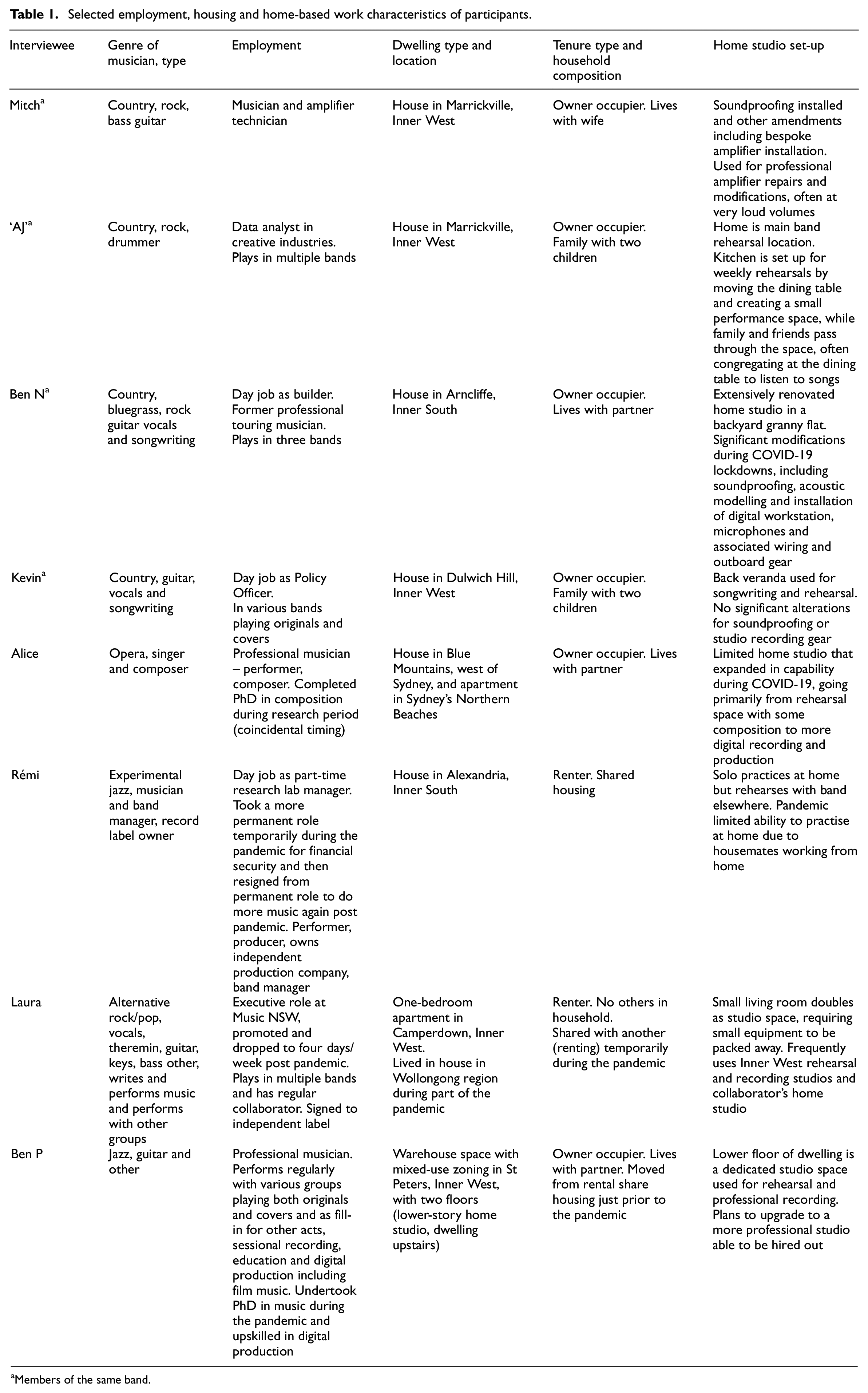
Participants were recruited via snowballing, building on the research team’s existing contacts with professional musicians in Sydney, Australia. To illuminate the affective dimensions underpinning creative collaboration, our sample included four participants who, while involved in diverse creative (and non-creative) employment, also played and rehearsed together in the same band. This ‘ensemble’ approach affords rich interpersonal data and insights into the emotional dynamics of creative work (Zhukov et al., 2024). Recognising that tenure security shapes the supportive capacities of housing infrastructure (Power and Mee, 2020), we also sought participants living in both owner-occupied and private rental housing (Table 1). Reflecting the wider gender dynamics within the music industry, 2 seven out of nine musician participants were male. Other than Alice (who requested a pseudonym), participants are referred to by their names. We also included professional and semi-professional musicians, recognising the difficulties of making a living through creative work and the marginalisation of semi-professional workers in formal employment statistics. The limitations of this method are the sample size, so that our findings, while strongly suggestive of the importance of home–neighbourhood, are not representative of all the sector’s trends.
Selected employment, housing and home-based work characteristics of participants.
Members of the same band.
Most participants were based in Sydney’s Inner West (Figure 1), an area with a legacy of live music infrastructures and creative industry policies (Brennan-Horley et al., 2025; Gibson and Homan, 2004). Sydney’s Inner West is also a gentrification frontier with house price appreciation and land values pressuring lower-value venues, studios and rehearsal spaces. While the Inner West local government is known for supporting creative work, the locality has been targeted for large-scale apartment development and state-led gentrification, intrinsic to neoliberal urbanism. As Table 1 indicates, participants were differently placed within this housing and property market – some purchasing homes ‘early’ in formerly affordable creative neighbourhoods, cementing social relationships, housing security and creative career opportunities (Valli, 2022). Others struggle for housing security, affordability and space. Difference positionings within unequal housing markets, as we show below, shape the capacities of home–neighbourhood to support creative work.
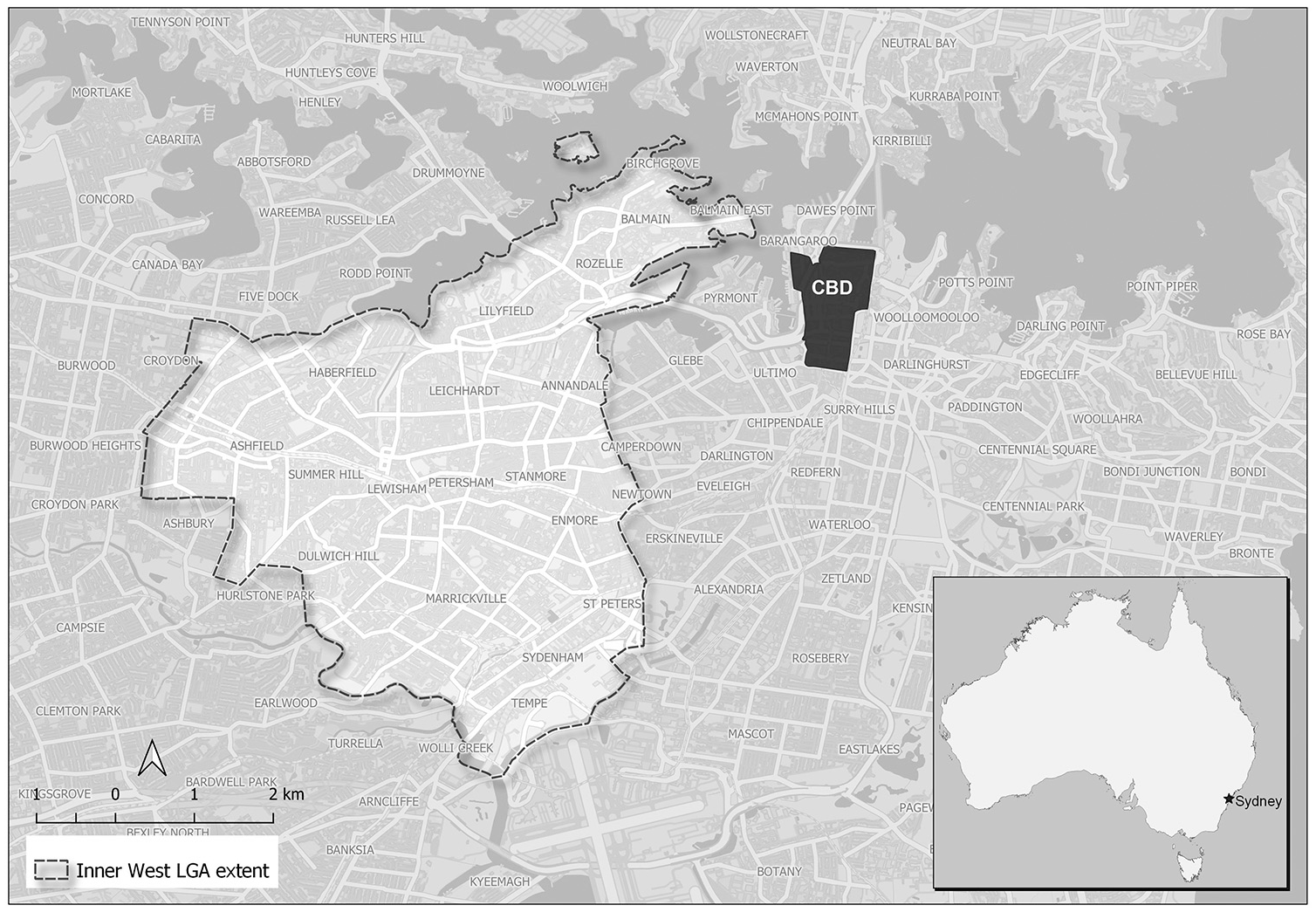
Sydney’s Inner West and Central Business District.
To better understand how home–neighbourhood contributes to creative work, the research comprised in-depth qualitative interviews (c. one hour) conducted in musicians’ homes. An initial qualitative mapping exercise (see Brennan-Horley et al., 2024) asked participants to record their everyday spaces of creative work and activity. Participants were then invited to reflect on the importance of each of these places to different phases of their creative practice, for example composition, production, rehearsal, recording and performance. To pin-point the everyday spatialities of affective infrastructures, the interview schedule incorporated prompts evoking the affects of performance and practice in relation to participants’ workspaces and housing circumstances. The infrastructural value of home–neighbourhood surfaced as these systems were disrupted through a string of pandemic-related lockdowns, powerfully illuminating its importance in sustaining work and everyday lives (cf. Brennan-Horley et al., 2024). Detailed below, participants’ reflections on the material–affective dimensions of creative work reveal taken-for-granted infrastructural qualities furnished by home–neighbourhood made legible through the lens of COVID-19 times.
At home with the creative city
Homes are crucial to the work of creativity, including the work of musicians. While the place of home in creative practice changed for all participants during COVID-19, homes already featured as key sites for practising, songwriting and rehearsing prior to the pandemic. This was captured by Kevin, a semi-professional musician in Sydney who noted that ‘ninety-nine per cent of my song writing happens here at home’. Performing in three bands, Kevin was a guitar player and singer-songwriter who performed at local pub venues. Yet his creative practice began at home: ‘Sometimes I’ll be in the bedroom with the door closed. Just me and my guitar … or in the back room with the door closed or in the actual backyard. They’re all equally as productive’. These everyday home spaces comprise for Kevin a ‘creative zone’: ‘They’re places where you go into … a creative zone, and it’s very mindful for me. The ideas generally flow quite quickly in those locations. Sometimes they’re just an idea, like a melody or a lyric or a chordal progression’.
Kevin was not alone in locating the building blocks of live music production in the home. Opera singer and composer Alice emphasised that the privacy afforded by her home was ‘monumentally valuable’ for composition, as a low-pressure environment where she could compose ‘in my pyjamas’ and as a space to recover from highly adrenalised performance runs. The informality of these everyday spaces enabled low-risk experimentation and recuperation – crucial aspects of creative work weakened by the neoliberalisation of creative labour (Hesmondhalgh and Baker, 2011). These everyday home spaces were adaptable and had other uses (beyond creative work) so that, as Taylor (2021: 1) argued, there are ‘no terrible repercussions if everything does not work out perfectly’.
In addition to opportunities for experimentation, flexible home spaces enabled collaboration. Music creation was, for Kevin, like all participants, facilitated through rehearsal in each other’s houses. The granny flats, kitchens and dining rooms of bandmates all comprised domestic sites of creative work, where collaborative songwriting and live music development took place. These spaces not only comprised the physical and technical materials required to support the creative process but, via practices of songwriting and performing, produced the affective conditions that enabled ongoing music production. Participants’ accounts of jamming and songwriting revealed the material–affective infrastructural qualities of home in underpinning creative work.
Mitch, for instance, a 62-year-old bass player and amp technician, with a long-term multi-dimensional involvement in live music, reflected on the material dimensions of rehearsal in his band member’s kitchen: At AJ’s place, we sit in … a kitchen area, and we plug into a little mixing desk … and we go into one amp, and everything plays through the one amp. So, we’ve got … two acoustic guitars, one steel guitar, one bass guitar and two vocals. We’ve got a little mixing desk, that goes in one little amplifier, and that’s nice and quiet. That enables us to rehearse at pretty good volume, and everyone would be able to hear what’s going on.
Furnished with instruments and basic technologies (amps and mixers), AJ’s kitchen comprises an informal rehearsal space for live music development. Yet the process of jamming and playing together at home also generated a mood of levity and lightness – described by Mitch as having ‘fun’ and ‘a couple of laughs’ – that enriched the conditions and motivation to create. As Mitch continued: For me, AJ’s place has been a fantastic experience … As much as I like playing, I really prefer playing amongst friends. I like the jamming, I like the writing … I find that creative side of it fun and having a couple of laughs, and it’s not too serious. If you make a mistake, it doesn’t mean anything, you know, and you’re learning from that, and you can play the song again. So, AJ’s place … I find that really relaxing … It’s a beauty.
The material affordances of AJ’s kitchen as a space to rehearse supported a familiar and comfortable sociality that bubbled over in laughter and a feeling of joy. Following Anderson (2016), joy is not simply an emotional state experienced individually but an affect that conditions ongoing relationships and capacities to act, in this case ongoing participation in creative practice, or in Mitch’s words to ‘play the song again’. The informality of jamming in a low-pressure environment allowed songwriting and wellbeing to flourish in a self-reinforcing circuit (Schiermer, 2021). This was further elaborated by Alice, who similarly centred the ‘ease’ of collaboration at home that ‘enhanced being able to make work together’. Home is thus enlisted in affective dimensions that sustain creative work.
Home also becomes a proto-performance space through the co-presence of family members and friends, blurring the boundary between home and stage and private and public, where the contours of players and audiences emerge. For Ben N, the band’s lead guitarist, the presence of AJ’s family and friends contributed to a ‘casual feel’ enriching the affective atmosphere of playing together: It’s a much more casual feel. We’ve got the family coming in and out of the room, they can make comments, they’re listening to the music as we’re rehearsing so they get to know the songs, and they have favourite songs. It’s just more interesting being part of a living household rather than locked in a studio while you rehearse.
Within these narratives, home plays a vital role in live music development: it provides the closed doors of experimentation (without the pressures of being ‘on the clock’ in a commercial rehearsal space) and the quasi-public space of collaboration and nascent performance (cf. Bain, 2003, 2004). Moreover, our study shows how these practices enhance and gain momentum via an affective atmosphere of levity and appreciation that is conducive to creative work. Illustrating the meaningful social relationships underpinning creative work, Kevin concludes: ‘it just feels like a special … sacred place when we’re all there hanging out. But we’re actually making great music too’. These combined material–affective elements surface in positive atmospheres – experienced as conviviality, enjoyment, recouperation and safety, drawing people back to music creation beyond the market economy (cf. Gibson and Gordon, 2018). While cultivating these spaces is uneven and, as we set out presently, embedded in employment and housing market access and comparative affluence, participants’ experiences locate the conditions for songwriting and rehearsal within the everyday spaces of home.
Shifting attention to homes as material infrastructures for creative work, the rise of home recording and online distribution and marketing technologies (Hracs, 2012; Leyshon, 2014) also meant that homes were provisionally, and sometimes permanently following COVID-19, configured with home studios for recording and rehearsal. Comprising collections of instruments, amps, software, hardware and assorted electrical and acoustic technologies, studios ranged from temporarily assembled living rooms in which recordings took place with smart phones, to state-of-the-art home-recording spaces.
The living room of Rémi’s band’s keyboard player, for instance, was periodically turned into a rehearsal and recording studio for their experimental jazz band. Equipment for Rémi’s ‘tiny desk set-up’ was sourced across band members, and assembled for use in a transient home studio to make music video content, and then dispersed. In contrast, Ben P, an experienced musician, producer and audio engineer, converted the ground floor of his two-storey apartment into a professional rehearsal and recording studio. COVID-19 accelerated Ben P’s reconfiguration of home as a workspace, encompassing a change in tenure, housing style and expansion of digital and audio technologies. Initially living in a community-housing co-operative, Ben P and his partner moved into their owner-occupied dwelling during COVID-19. Their new home comprised a residential conversion of a semi-industrial building with a large downstairs space, backing onto a loading dock enabling the easy transportation of equipment. Supported by a large, secure, adaptable private home, Ben expanded his capacity for home-based work to encompass full album production, less reliance on external rehearsal and recording spaces and future income as he ‘rents the space out to other people’. This account reveals the increasing importance of home as material infrastructure for creative work.
Yet, as Blunt and Sheringham (2019: 825) point out, homes and neighbourhoods are not sealed off from the city but are ‘integrated and overlapping spheres’. The capacity to work creatively from home is thus also entwined with housing market dynamics and positionalities. Home band rehearsals were not possible for Laura, for example, a multi-instrumentalist, songwriter and singer, who lived solo in a one-bedroom rented apartment in Sydney’s Inner West. The intensification of home-based work via pandemic lockdowns (2020/2021) meant that Laura’s ‘day job’ transitioned to her home space, leaving ‘no distinction between work and creative work’ and making it impossible to ‘switch off’, creating a ‘depressing’ environment that inhibited creative practice. Like many others at the time, Laura moved to a relatively affordable regional housing market south of Sydney, into a shared two-bedroom house. However, this move failed to support her creative practice, due to a significant commute (3.5 hours roundtrip) and associated loss of creative time and her Sydney-based networks. Laura returned to her previous apartment in Sydney ‘exhausted’, conceding that ‘I would have gotten a two bedroom, but there’s no way that I could afford that’. Meanwhile, high rental costs, strict tenure controls, poor insulation and the risk of investment-led eviction meant that Laura’s apartment was poorly positioned to support creative work. While carefully organising her creative and living space to continue writing music and recording demos, Laura ultimately described her apartment as ‘not functional’ in terms of music production. Laura’s experience highlights the uneven capacities of housing to support creative work and the impacts of housing financialisation on experiences of inclusion and exclusion already embedded in home-based work (Merkel, 2019; Reuschke and Ekinsmyth, 2021). The limitations of some homes’ material and social affordances – for example, tenure status and security, sound proofing, capacities for reconfiguration – are conditioned by neoliberal urban policies that favour landlords over tenants, and owner occupation over private (and other) rental (Power and Mee, 2020). These tensions lead us to the importance, next, of local neighbourhoods as crucial sources of rehearsal and recording venues, and as sources of live music infrastructure and constituents of creative neighbourhoods.
Creative homes in creative neighbourhoods: Rethinking scenes
The infrastructural affordances that neighbourhoods offer to creative work beyond the physical boundaries of the home emerge from proximity and convenience. Proximate, low-cost and convenient spaces enable musicians both to rehearse (absorbing sounds and noise often unsuited to shared housing, rental or high-density living) and to access the required space to accommodate instruments, people and technologies assembled in music rehearsal, recording and production. Such spaces are supportive of musical collaboration and its associated affects of appreciation, levity and sociality, underpinned by a need to develop a local audience through live performance.
Compared to the band where four members owned their homes and two had dedicated home studios, Laura’s bands mainly relied on a network of neighbourhood rehearsal spaces ranging from commercial studios to ‘tiny little rooms upstairs and in back streets’ concentrated in Sydney’s Inner West suburb of Marrickville. Many of these spaces were run by artists where: the people that have set them up share them but they just keep popping up … it’s almost like the Airbnb space. Like, you only have to plug in the code and there’s like two rehearsal rooms in there and you can just go in and it’s got a bit of backline [supplied drums and amplifiers] in there.
Without these spaces, Laura concluded, her bands ‘couldn’t rehearse’. Similarly, Rémi’s shared-house living meant that his five-piece experimental jazz band could rarely rehearse at home, or at his bandmates’ inner-city homes: ‘We practise weekly, generally late evenings because of the other occupations of the other members. If it’s 9 pm to 12, you can’t really do it at someone’s house’. For Rémi and Laura, the specific neighbourhood ecologies of Sydney’s Inner Western suburbs furnish valuable rehearsal infrastructures in which studios and residential homes are interspersed: a product of an uneven legacy of live music concentration (Taylor, 2017), semi-industrial land zoning, place-based creative industry policies and ongoing demand (Gibson and Homan, 2004). Wresting creative music production from privatised home ownership and traditional living arrangements, these ‘rehearsal-ready’ streets and suburbs afford Rémi a shared house close to a rehearsal studio with an alternative space, accessible by public transport and subsidised by the neighbouring local council. The availability of a network of accessible neighbourhood rehearsal spaces was crucial.
The importance of proximate neighbourhood opportunities for rehearsing carried through into all participants’ discussions of performance venues: not only as physical space but for developing and nurturing affective atmospheres of positive social connectivity (cf. Hesmondhalgh, 2013). For Ben B, the self-reinforcing circuit between live music performance and the collective affect of appreciation was understood as a socio-creative activity where live music performance unleashed powerful connectivity between performers and audiences so that: when you’re playing original music, you’re doing something collectively that you believe in … There’s something powerful in that. When you can do that in a place where you connect with the audience and they appreciate it, then that’s – music is a social activity. We do it as a species to be social. I think there’s something inherently kind of great about that.
For Schiermer (2021: 437), the circulation of collective affects between the producers and consumers contributes to the ‘intensity and immediacy’ of creative outputs. As Ben P notes (above), these affective circuits cohere in place, further illustrated by Rémi’s reflection on particular neighbourhoods and venues: Some music venues have a very good regular crowd that goes there and don’t necessarily come in because they know a band. That’s the venues that I cherish because … there’s an atmosphere around the encouragement of arts … people want to see a gig and they rock up almost regardless of what’s there [and] they like the venue and they know that the venue also have a program that’s good.
Ben P noted the importance of small to medium-sized, locally orientated venues such as the Newtown Social Club, that ‘allowed bands to put nights on and charge five or ten bucks at the door’, an experience shared by Alice who emphasised the value of ‘low-stakes’ venues (e.g. galleries) as part of developing larger works. Such venues enable independent bands to develop material and local fan bases in ways ‘conducive to people feeling the licence to be creative’. As Ben P saw it, these locally orientated venues differed from overtly profit-orientated venues, where: Making money, having poker machines, selling heaps of booze, having sport on the TV and fitting more people into a room, putting a DJ in a corner or a cover musician with a loop pedal – it’s always about making immediate money.
Thinking infrastructurally, smaller neighbourhood venues offered a ‘creative vision’ enabling bands to develop the material and audiences to eventually perform in larger venues (cf. Bennett, 1997; Hesmondhalgh, 2013; Homan, 2000). They were ‘a bridging venue between bands ending up being successful and playing at [larger venues]’, and for Ben P they were crucial to live music creation: The venues … that do well … generally it’s the licensee having a creative vision that’s about more than that week’s profit margins … As soon as they can see they’re building a community – and maybe they break even that week or don’t break even – but they’ve done something really good that people are going to tell their friends about. Those things often do really well.
The confluence of small, local venues, close to suburbs with relatively affordable housing where performers and audiences also live, was seen as generative of an everyday, neighbourhood-based music scene, itself a nurturing medium for creative practice (cf. Hracs, 2009; Taylor, 2017). For Laura, the affordability of housing determined where she played. Countering the city-centre focus of much creative city policy, the live music scene for Laura is ‘more about where people are living; because of that, more activity will happen’.
It is unsurprising that parts of Sydney have maintained residential enclaves of musicians alongside an ecology of performance venues, such as Sydney’s Inner West. In such neighbourhoods, creative artists’ homes were embedded in local networks of accessible rehearsal and performance venues that helped constitute an ‘everyday’ scene as supportive infrastructure for creative work, rather than a celebrated scene of global significance (cf. Hracs, 2009). Participants’ perspectives echo Taylor’s (2021: 1) insistence that live music flourishes where expectations and financial costs are low, in ‘pub rooms, speakeasies and hole-in-the-wall cafes’ (see also Bennett, 1997; Homan, 2000). These are flexible, multi-purpose spaces where nothing much is lost ‘in the way of money or reputation’ (Taylor, 2021: 1). Such neighbourhood scenes embrace the experimental sociality of creative practice and its affective circuits as a valued part of the neighbourhood ‘vibe’ that supports ongoing creativity. This ecology of low-cost venues and spaces in proximity to where people live is what creates the ‘licence’ to create and play live music. Enfolding homes and nearby venues, the performance itself becomes a ‘self-intensifying circuit’ (Schiermer, 2021: 435) intensified via performers’ and audiences’ capacities for levity, appreciation and sociality. This ecology is not only at risk via the threat of gentrification and assetification to housing options. The rapid loss of independent, neighbourhood-scale venues poses an equal threat, as they are priced out of operation by global corporate control of venues, ticket pricing and distribution (e.g. by US-based Live Nation). Since 2020, nationwide, 1300 live music venues (25% of the total) have closed, including 551 in New South Wales (Darling, 2024). This underscores the urgency of attending to the availability of creative homes in creative neighbourhoods, a point with policy resonance, with which we conclude.
Conclusion: Creative homes in creative neighbourhoods
In this article, we have demonstrated how home–neighbourhood – understood as a relational process – is crucial to creative practice in the city. Home–neighbourhood operates as material–affective infrastructure that sustains the creative work of music composition, rehearsal and performance. As an analytical category, home–neighbourhood locates creative work in the informal domestic and neighbourhood spaces conducive to collaboration, performance and experimentation. Unsettling the relationship between creative work and commodification, home–neighbourhood foregrounds the affects of levity, appreciation and sociality that surface in a self-reinforcing circuit sustaining creative practice. Through the co-articulation of spaces, materials and affects, home–neighbourhood builds on existing understandings of the creative city (Działek and Murzyn-Kupisz, 2023; Homan et al., 2021) while also offering a new conceptualisation of the spatialities of work in post-COVID-19 cities.
Focusing first on our contribution to creative city research, home–neighbourhood centres the informal spaces of working from home and neighbourhood that are essential to creative work. Entering beyond the ‘front door’ of creative workers’ homes, our research revealed the experimental, everyday spaces of DIY studios, temporarily adapted kitchens, living rooms and bedrooms where production takes place (cf. Bain, 2003). Such spaces transcend the boundaries of work/home, core/periphery and public/private (Gibson and Brennan-Horley, 2006), reinforcing topological approaches to the creative city (Brennan-Horley, 2010). They also denote the qualities of informality and adaptability that nourish creative work. Generating collective dispositions of levity, appreciation and sociality that are entangled with musical performance and collaboration, as well as informal, low-risk, low-cost home space and neighbourhood venues (Taylor, 2017, 2021), we conceptualise home–neighbourhood as material–affective infrastructure. A key contribution of this article is to reveal that the collective dispositions of creative collaboration and performance not only counter social inclusion and isolation (Brennan-Horley et al., 2024; Cohen and McManus, 1991) but are fundamental to the labour of creative work (cf. Hesmondhalgh and Baker, 2011; Wolifson et al., 2024). Foregrounding the social, familial and affective dimensions of work, home–neighbourhood moves beyond neoliberalised conceptions of labour, to foreground meaningful engagement in local cultural practice (cf. Gibson and Gordon, 2018). Home–neighbourhood thus challenges mainstream approaches to creative cities that privilege a single, formal, bounded workspace beyond the home.
Second, home–neighbourhood also centres housing security and undercapitalised neighbourhood venues squarely within creative city imaginaries. As a material–affective infrastructure, home–neighbourhood enrols secure, affordable housing and low-risk, low-cost venues in the collective dispositions that are supportive of creative work. Home–neighbourhood thus counters the tendency in creative city research and policy to privilege formal arts infrastructures and city-marketing strategies over affordable homes and neighbourhoods (Bain, 2003). It also challenges the assumption that creative ‘scenes’ or ‘vibes’ are located in hallowed (generally inner-city) venues and precincts disconnected from home and domestic spaces. Home–neighbourhood further confounds public policy initiatives that locate affordable housing in highly commodified downtown neighbourhoods beyond the supportive infrastructures of neighbourhood and community-focused venues (see Gibson et al., 2023).
Home–neighbourhood is third, a spatial imaginary attuned to the post-COVID-19 geographies of informal, hybrid and home-supported work challenging the traditional dominance of city centres (Maginn and Mortimer, 2020; Orman et al., 2024). However, rather than a retreat to the intimate and the domestic (though see Brennan-Horley et al., 2024), our research reveals the porosity of home–neighbourhood, a relational space at the nexus of neoliberal urbanisation (including gentrification and financialised property markets) and the increasingly networked, dispersed character of work. Workers are positioned unevenly within such networks: some have limited access to supportive infrastructures which curtailed their capacities for creative work, while others, with secure tenure, modify and expand their capacities to work from home. The capacity of housing to care is shaped by tenure, governance and material affordances (Power and Mee, 2020), and thus home–neighbourhood is an uneven, contingent process open to housing market inequalities. Rather than separating housing concerns from the matter of work, the significance of these inequalities places housing more centrally as a locus of work, industry and labour in post-COVID-19 cities, including and beyond creative industries.
Following from this conceptualisation are two observations about public policies in support of creative work. In Sydney, post-COVID-19 cultural policy initially focused on promoting creative activities in the central city and earmarked ‘entertainment precincts’ with favourable by-laws for live music and performance (Gibson et al., 2023). The ‘back spaces’ of creative production, especially creative homes in their neighbourhood context, were neglected. Redressing this requires a widening of policy attention to home–neighbourhood in contexts where the worlds of work and home are ever-more deeply infused. More critically, it will require deeper and more nuanced attention to housing affordability and security of tenure and to policy domains and politics not yet adequately addressed in mainstream ‘creative cities’ policies. This includes tenant rights movements; planning policy reform capable of moving beyond sticky binaries of home/work, production/consumption, public/private and home/neighbourhood; as well as wider dynamics of housing financialisation and gentrification that pose significant threats to the creative industries. While the resulting policy ‘solutions’ might prove challenging to conceive, the impetus is to imagine ‘creative spaces’ as much more than either venues or low-cost production space (e.g. in industrial areas) but as a topological network of spaces that encompass home in its neighbourhood context. The integration of housing and financial concerns with creative cities policies, our work suggests, is integral to protecting an essential material–affective infrastructure of creative homes in creative neighbourhoods, ensuring that creative workers have somewhere to live and, crucially, places to work.
Footnotes
Acknowledgements
This article has significantly benefited from feedback on earlier presentations of this work at the workshop Foundations for Home-Based Work: A Comparative Perspective hosted by the Cultural Research Centre and the Asia Research Initiative at The National University of Singapore (2023), convened by Lilian Chee, Jane M. Jacobs, Audrey Yue, Natalie Pang, Liyana Doneva and Ruella Che; along with sessions convened by Naama Blatman, David Kelly, Alistair Sisson, Emma Power and Ellen van Holstein at The Institute of Australian Geographers’ Conference (2024 and 2025). Our thanks to the convenors, colleagues and participants for their generous feedback in these fora. We are also grateful for the time and generosity of participants in this study in sharing their experiences and practices. Our special thanks to three referees and the journal editors, whose feedback helped to frame and streamline this article.
Declaration of conflicting interests
The authors declared no potential conflicts of interest with respect to the research, authorship, and/or publication of this article.
Funding
The authors disclosed receipt of the following financial support for the research, authorship, and/or publication of this article: Australian Research Council DP220100756 Reassembling the pandemic city: Shifting geographies of creative work.
