




Abstract
This article posits that the unnoticed and unseen (invisible) aspects of street waste-picker mobilities are an intimate part of the regime of human/waste mobilities and the maintenance of critical urban operations. Street waste-pickers are commonly known to make a living from accumulating and selling recyclable material (waste) and operate on the streets of the urban as a visible and common phenomenon. However, through their everyday management of waste and spatial movements within the urban, street waste-pickers contend with urban displacements, poverty and general social exclusion within everyday urban spaces, dimensions which are often rendered invisible in the context of street waste-picker mobilities. Highlighting the invisible dimensions of street waste-picker mobilities shows how the body functions as a form of infrastructure in distributed form and suffers attritional decay through its entanglement with poverty in the urban. This article builds on and contributes to the conceptual development of the notion of ‘infrastructural violence’ and builds on more recent work on bodies as infrastructures to highlight aspects of ‘slow infrastructural violence’. It contributes to this body of knowledge by positing the ‘following’ method as a mechanism that reveals the invisible and backgrounded socio-material networks that entangle marginalised bodies as intimate parts of urban infrastructure. The article demonstrates this through ‘following’ street waste-pickers and revealing their everyday relations with movement, spatial organisation and everyday exclusion.
In South Africa, street waste-picker presence on the streets of the urban has produced a stark image of inequality – one where you can find modern vehicles revving their engines next to a street waste-picker on foot dragging a trolley filled with recyclable waste. Upon initial observation, the phenomenon of street waste-pickers appears through constant and everyday movements along the streets of the city, where they are often dragging a trolley/cart, trafficking recyclable waste for distances unimaginable to the privileged urban dweller. My observations of street waste-pickers came from my commutes on a Rea Vaya bus, from which I would regularly see street waste-pickers among the everyday infrastructure(s) – navigating their trolleys on the pavements and roads. Their trolley wheels echoed a clanky vibration that meagrely competed against the roars of the diesel engine trucks and general vehicles that are known to bring life to the dull and lacklustre buildings of the Johannesburg city centre. My day-to-day bus commutes to Braamfontein always indulged me with various sightings of street waste-pickers early in the morning and late in the afternoon – they were almost as permanent as the rustic mine dunes visible far into the distance, symbolic remnants of the gold rush that birthed Johannesburg and its infamous status. My initial idealisations of street waste-pickers were fuelled with strong imagery of peripatetic nomads, on a mission of scouring out waste to create a livelihood for themselves. Their trolleys and the waste therein symbolised a mine tram with gold ore and their bodies embodied the labour of miners – a metaphor for a new ‘gold rush’ whose value is now latent in the decaying residues of the city once prided for its illustrious moniker: Egoli.
1
Nothing could be further from this. In reality, and in humbling honesty, my observations lacked the lustre and brilliance of the metaphor I had thought up, which was rudely interrupted by the mundanity of the everyday mobilities of being a street waste-picker. In stark contrast, my seamless mobility was rudely interrupted by a punctuated screech of the Rea Vaya bus, indicating my stop. And there I was, back on the street, back to reality. Being brought back to earth – quite literally – had me reflecting that perhaps this is where I should start with my inquiry into street waste-pickers – a common ground as mundane as the street.
Introduction: Moving within Johannesburg
The street is often perceived as a neutral backdrop – an unremarkable conduit that enables the mobilities of urban life – yet it reveals residents’ social, cultural and economic capital (Czyński, 2021). From the vantage point of a bus passenger like me, its presence fades into the background, absorbed into the smoothness of transit and the rhythm of routine. The street does not call attention to itself; it is rendered invisible by the very infrastructures that mediate my movement through the city. I travel with ease along Empire Road towards Braamfontein, momentarily transfixed by the distant presence of the Sentech tower, but hardly conscious of the street beneath me. The bus, the route, the destination – all of these obscure the materiality of the street that makes the journey possible. Yet for others, the street is not a passive backdrop but an active terrain. For street waste-pickers, the street is felt viscerally – its gradients, seams, potholes and inclines are not aesthetic features of the urban landscape but lived variables that structure the body’s labour. Here, Star and Ruhleder’s (1996: 5) assertion that ‘infrastructure becomes visible only upon breakdown’ is inverted: for the urban marginalised, infrastructure is never invisible. It is a site of friction, fatigue, navigation and negotiation. Infrastructure does not recede into the background because it is constantly present as resistance and resource.
This distinction illuminates how the phenomenology of infrastructure unfolds unevenly across urban lives. For street waste-pickers, the street is not simply a means of access or mobility; it is a site of embodiment – where work happens, where bodies endure and where survival strategies are enacted. In this sense, the bodies of street waste-pickers become infrastructural themselves – they mediate between waste and space, collecting, transporting and redistributing materials across the city. Their trolleys trace routes that are often illegible to formal systems but are essential to the city’s urban (ecological and economic) metabolism. Thus, if, as Star (1999) suggests, infrastructure is both a substrate and a system, then street waste-pickers inhabit both roles simultaneously. They are embedded within the substrates of urban function, while also being systemically excluded from formal recognition. Their infrastructural role is emergent rather than planned, precarious rather than protected. And yet, their daily practices materially sustain the urban environment, revealing the paradox at the heart of slow infrastructural violence: the gradual, often unnoticed harm that accumulates over time as a result of the neglect, withdrawal or uneven provision of infrastructure, disproportionately burdening marginalised communities and reinforcing structural inequalities.
This article builds on and contributes to critical urban studies which interrelate with scholarship of relational infrastructures and ethnography (Star, 1999; Star and Ruhleder, 1996), and also builds on a growing theme within political urban geography that situates the ‘body’ as infrastructure to reveal the social and material forms of resources and their everyday politics. Critical urban studies emphasise ‘the politically and ideologically mediated, socially contested and therefore malleable character of urban space – that is, its continual (re)construction as a site, medium and outcome of historically specific relations of social power’ (Brenner, 2009: 198). Situated within this orientation, this article builds on a developing strand of debates of rethinking infrastructure(s) from an urban perspective that has its foundations in Nixon’s (2011)‘slow violence’, Rodgers and O’Neill’s (2012)‘infrastructural violence’, as well as Truelove and Ruszczyk’s (2022) notion of ‘slow infrastructural violence’.
To contribute to this strand of scholarship, this article breaks from the idea that infrastructure should be thought of in only physical terms in the form of pipes, wires, cables and systems of highways; it also breaks from macroeconomic ideas of infrastructure that interlinks infrastructure economies, large-scale infrastructural projects and financialisation to the state and other mediating institutions (Furlong, 2020). Instead, the article adopts a critical urban perspective and aligns with scholarly approaches that foreground the heterogeneous nature of infrastructural networks within cities (Lawhon et al., 2018; McFarlane et al., 2017). It draws on an understanding of infrastructure as hybrid systems – bundles of humans and machines interconnected through complex infrastructural networks (Larkin, 2013). It also engages with the notion of infrastructure as incremental, where infrastructures emerge, solidify and scale through material configurations that test and prefigure new forms of infrastructure and associated resource flows (Silver, 2014). Furthermore, this perspective recognises infrastructures – both visible and invisible – as deeply implicated in the making and un-making of individual lives (Amin, 2014). Finally, it takes seriously the concept of ‘people as infrastructure’, which highlights the forms of economic collaboration and collective capacity among urban residents who are often marginalised or excluded from formal urban economies (Simone, 2004). I choose to specifically build on Truelove and Ruszczyk (2022), as they shift from an understanding that focuses on the absence of infrastructure (e.g. water pipes, electrical lines, information technology) and instead emphasise the everyday ‘making of infrastructure’ through their conceptualisation of bodies as active infrastructure. This framing is relevant for the purpose of understanding street waste-pickers in the urban in view that ‘conceptualising bodies as infrastructure reveals important and intimate dimensions of the everyday politics and social and material forms that enable critical resources to flow, and integral networks be built in cities’ (Truelove and Ruszczyk, 2022: 1). This article contributes by broadening our understanding(s) of waste infrastructure in the urban as distributed networks of human bodies and technologies that vacillate between visibility and invisibility through the everyday construction and deconstruction of embodied socio-material infrastructural relations.
Moreover, while critical urban geography and the intertwinement of the body and infrastructure emphasise ‘infrastructural violence’ as well as the absences and the making of infrastructure in everyday urban life, there has been a lack of engagement with the embodied infrastructure(s) within the spatial imagination of mobilities. The article argues that understanding the movements of the body within multiple and contradictory spaces of the urban generates more composite and prosaic understandings of street waste-pickers and waste as they traverse different social landscapes of the urban. Incorporating a spatial imagination of mobilities thus enables a recognition not only of urban actors’ movements but also of how forms of ‘slow infrastructural violence’ are nuanced and modulated through space and time. Given this orientation, this article seeks to shed light on the backstage or otherwise invisible aspects of street waste-picker mobilities – a crucial element that reveals the mechanisms of ‘slow infrastructural violence’ as it plays out within the everyday dynamics of urban Johannesburg.
This article is structured as follows. It first explores critical urban approaches of ‘infrastructural violence’ (Rodgers and O’Neill, 2012), as well as the trajectory of this line of scholarship that frames infrastructure in complex and unique ways. It goes on to situate street waste-pickers within the debate of ‘infrastructural violence’ and introduces its relation to the ‘new mobilities paradigm’. It then explores ‘following’ as a method that contributes to generating a spatial imagination of mobilities within articulations of ‘slow infrastructural violence’. The article then examines the empirics related to following street waste-pickers to reveal the visibilities and invisibilities of their mobilities and contributions to the critical urban waste networks of Johannesburg. It ends with reflections on how incorporating a spatial imagination of mobilities enhances understandings of nuanced forms of infrastructural violence that can only be grasped through traversing the multiple spaces and trajectories of street waste-pickers’ everyday practices.
Infrastructure: Its forms, limitations and ‘mobile’ possibilities
Thinking of infrastructure relationally conjures up the idea of an ephemeral construction site of the divergent social realities that are made and re-made and that make up the deeper, emergent and open-ended qualities of urban infrastructure(s) and the realities of everyday urban life. Following Graham and Marvin (2022), I too seek to demonstrate the complex ways in which reconfigurations of infrastructure are intimately bound up with broader transformations in the geographies of cities and the experiences of urban life. Graham and Marvin (2022) position this orientation within the ‘relational’ and ‘infrastructural’ turns in geography. Infrastructural systems are conventionally understood as the ‘material networks facilitating flows of people, goods, energy, water, waste and information and how these systems are leveraged by the proponents of neo-liberal restructuring as adaptive spatial fixes and often become contested political objects’ (Addie, 2021: 10). Meanwhile, the relational turn in social and urban theory encompasses the ways in which multiple, networked connections are continually enrolled and invoked in the dynamic processes and metabolisms that sustain modern cities (Graham and Marvin, 2022). Through foregrounding infrastructure as a material, social and political field of power, critical urban geography has become an interdisciplinary body of work that has evolved to show the indelible relation between bodies, infrastructure and urban forms. This trajectory has permeated urban political ecology approaches that have highlighted the materiality of infrastructures and bodies as a shared, mutually constitutive ontology of the city and urban life. However, the framing of the ‘body’ as a ‘phenomenological reality’ and an ‘analytic frame’ has been largely unexplored, despite the emphasis on the function of ‘people’ that was key to understanding cities and their infrastructures (e.g. Simone, 2004). Recent scholarship has emphasised the multiple entanglements between the body and infrastructure, with particular attention to forms of ‘violence’. Having its foundations within the ambit of critical feminist scholarship, this line of enquiry touches on the disconnection to, lack of access to and absence of infrastructure (Datta and Ahmed, 2020), on an everyday embodied perspective on the intersectionality of urban citizenship (Sultana, 2020) and on how the social and material work of the body helps to build, develop and maintain cities (Truelove and Ruszczyk, 2022). Moreover, scholars have ontologically framed the ‘body’ as infrastructure, affirming that the body is infrastructure as ‘they lift and carry, become technologies of circulation, function as accumulation strategies and enable socio-ecological fixes’ (Andueza et al., 2021: 812). Assessing the scope of the trajectory of critical urban scholarship on the body and its intertwinement with infrastructure, Lesutis and Kaika (2024) argue that bodies are not themselves ontologically infrastructure but, instead, can become infrastructure – that is, they can become infrastructured. They argue that this process of infrastructuring occurs through the violence of colonial and capitalist modernity that subjects human bodies and their capacity to labour to surplus value extraction. Ultimately, however, this trajectory positions the ‘body’ as intertwined with infrastructure to navigate the lived experience of the body as a subjective, intimately lived geography of infrastructure (Lesutis and Kaika, 2024).
To explore the ethnographically invisible aspects of street waste-pickers in the urban, I take my cue from Truelove and Ruszczyk (2022) in their framing of the body as infrastructure and how the social and material work of bodies helps build, develop and maintain through mundane and intimate mobilities of the everyday. Truelove and Ruszczyk (2022) build their analysis on the bedrock of feminist theory and feminist political geography where feminist, queer, poststructuralist and postcolonial scholars as well as critical race theorists have centred the body as subject and object of analysis through which to understand how power acts spatially in the world to control, regulate, confine, produce, construct and delimit the body (Mountz, 2018). Moreover, in relation to the city, infrastructure can be found on multiple scales, and defining infrastructure is a political act that focuses attention on certain aspects of infrastructure while ignoring others. A case in point is how Truelove and Ruszczyk (2022: 7) describe the slow infrastructural violence among women in Delhi: In the unplanned bastis (small informal settlements) of Delhi such as Rampur Camp, slow violence constitutes a particular quality and outcome of the invisible and intimate infrastructures that make water flow. Slow infrastructural violence appears in the social orderings by which particular bodies experience chronic and accruing harms from a systematic exclusion from the public water network, the social reproduction and care that structure gendered water practices, the hazards of finding, negotiating and transporting water, and lost income, life opportunities, and even potentially life years due to the experience of mitigating a contaminated, insufficient, and irregular water supply.
While street waste-pickers do not necessarily replace the ‘infrastructure’ of waste management in the city of Johannesburg, it is important to understand how they instead augment infrastructural relations through the making (and extending) of waste urban infrastructure via embodied and mobile means – further complicated by negotiating the city’s material, symbolic and systemic dynamics. My argument runs congruent with Truelove and Ruszczyk’s (2022) analysis to the extent that they state that it is precisely because bodies are not conventionally understood to comprise infrastructure that the role of the body in critical urban networks is often made invisible and often overlooked. Thus, the urban metabolisms that are maintained through the body’s social, affective and material practices disclose important dimensions of how infrastructures are made in the everyday, how networks across the city work and how the city (and patterns of belonging, exclusion and violence) is unevenly experienced. In this respect, feminist geographical thought has positioned the body as intimately connected with the structural and as constituting a sphere of life and everyday practice by which wider political, economic and social relations are experienced and lived (Truelove and Ruszczyk, 2022).
This framework provides much utility for framing street waste-pickers in urban settings, as their bodies not only are used for recycling in cities but also act as a vital infrastructure (Fredericks, 2018) of the urban through the movement, management and monetisation of recyclable waste. Street waste-picker bodies can be conceptualised as infrastructure, since infrastructure is commonly envisioned as a system of substrates (e.g. railroad lines, pipes and plumbing, electrical power plants and wires), invisible and part of the background of other kinds of work (Star, 1999). The embodied and corporeal nature of framing street waste-picker bodies as infrastructure sets up multiple layers of invisible dimensions, as there are larger forces at work in cities beyond individuals and their random interaction (Rodgers and O’Neill, 2012). Tracing street waste-picker mobilities sets up embodied infrastructure as an ‘ethnographically graspable manifestation’ and reveals how broader processes of marginalisation, abjection and disconnection become operational and sustainable in contemporary cities through infrastructure (Rodgers and O’Neill, 2012). This becomes more pronounced in the context of street waste-pickers in the urban, as suffering tends to impact the poor and marginalised groups adversely because of the uneven distribution of material, social and symbolic capital (Benson et al., 2008). Among marginalised actors, street waste-pickers in the urban are far more susceptible to reoccurring forms of harm, thus affirming and going beyond Miller’s (2005) notion of materiality to show how structural forms of violence often flow through material – and embodied – infrastructural forms. Accordingly, this article is primarily concerned with the mobilities of street waste-pickers within the city’s material networks – focussing on how they navigate the physical pathways through which people and objects circulate, and how these pathways both shape and are shaped by their movements.
What is violent about infrastructure? Situating the mobilities of street waste-pickers within the debate
Acknowledging the multiple forms of harm that marginalised actors in the urban are susceptible to, I draw from Truelove and Ruszczyk’s (2022) theoretical underpinnings to their notion of ‘slow infrastructural violence’. However, the notion of ‘slow infrastructural violence’ finds its foundations through Nixon’s (2011: 2) important work on the concept ‘slow violence’: ‘a violence that occurs gradually and out of sight, a violence of delayed destruction that is dispersed across time and space, an attritional violence that is typically not viewed as violence at all’. Written from the perspective of violence wrought by climate change, toxic drift, deforestation, oil spills and the environmental aftermath of war, Nixon (2011) provides a substructure to think through how violence is articulated via indirect means, an almost overlooked and frivolous situation or what can otherwise be thought of as invisible. Moreover, Nixon’s definition brings forth important dimensions of ‘slow violence’ that I believe are relevant to street waste-pickers, and valorises how the body as infrastructure is positioned within the urban setting. Just as the environmental aftermath and its residues are articulated by Nixon (2011) as attritional lethality of environmental crises disproportionately affecting the poor and marginalised, so do the residues (waste) of cities burden street waste-pickers as poor and marginalised bodies in urban settings. A violence of delayed destruction that is dispersed across time and space describes how the bodies of street waste-pickers are distributed across the urban setting. Nixon (2011) goes on to explain that violence is usually conceived of as an event or action that is immediate, spectacular or sensational. He posits that we need to engage a different kind of violence: a violence that is neither spectacular nor instantaneous, but rather incremental and accretive, its calamitous repercussions playing out across a range of temporal scales. In so doing, we also need to engage the representational, narrative, and strategic challenges posed by the relative invisibility of slow violence. (Nixon, 2011: 2)
Taken further, Truelove and Ruszczyk (2022) productively draw from Nixon (2011) to show how the concept of ‘slow violence’ can gain further nuance within the context of cities through conceptualisations of ‘infrastructural violence’ (Rodgers and O’Neill, 2012). Infrastructure then, according to Rodgers and O’Neill (2012), can be the material embodiment of structural violence, revealing how networks of water, waste and energy operate through political economic structures that exclude working-class urbanites from equitable access. Thus, building on Nixon’s (2011) and Rodgers and O’Neill’s (2012) notions of ‘slow violence’ and ‘infrastructural violence’ respectively, Truelove and Ruszczyk (2022) position a new notion termed ‘slow infrastructural violence’ to bring a gendered and embodied lens to understanding how bodies provide invisible forms of infrastructure in daily practice. Truelove and Ruszczyk (2022: 4) define ‘slow infrastructural violence’ as ‘a violence of gendered (and intersectional) social orders that organizes urban landscapes, helps distribute and circulate resources, and that often leads to recurring forms of harm for particular gendered/classed/casted/racialized bodies in the city’. Noting the embodied as well as the urban contextualisation of ‘infrastructural violence’, Truelove and Ruszczyk’s (2022) conceptualisation of ‘slow infrastructural violence’ is relevant for understanding the mobilities and organisation of street waste-pickers within the urban, as they help ‘distribute and circulate’ waste, which also leads to recurring forms of harm for street waste-picker bodies within the context of the urban. While my own orientation towards Truelove and Ruszczyk’s (2022) framing of ‘slow infrastructural violence’ does not take an explicitly gendered lens, it does, however, take a feminist political geographical approach to situating the body of the street waste-picker as an infrastructural actor. Slow infrastructural violence seeks to show how bodies are rendered invisible and how violence accretes over time as an unrecognised and unseen aspect of everyday intimate infrastructures. Given that these embodied infrastructures do not leave easily visible traces on the ground for researchers to follow, nor data algorithms for engineers to produce, the invisibility of infrastructure’s power to keep things the same is entrenched (Truelove and Ruszczyk, 2022). This article posits that ‘slow infrastructural violence’ is revealed in the mobilities of street waste-pickers through the incremental, everyday ways in which urban systems constrain, exploit and erode their ability to move with dignity, security and recognition. This form of violence is not explosive or spectacular but insidiously embedded in the built environment, bureaucratic exclusions and social attitudes that shape the street waste-pickers’ daily routes and routines. However, revealing this requires a situated spatial imagination of mobilities – one that involves ‘following’ the bodies of street waste-pickers (as infrastructure) as they move through and engage with the material, symbolic and systemic dynamics that entangle urban life.
Capturing the spatial imagination of mobilities through ‘following’ street waste-pickers
Following the mobilities turn, scholars embedded in the new mobilities paradigm (Sheller and Urry, 2006) have sought to widen the frame used when examining the kinetic features of social relations. The notion of mobility is defined by Cresswell (2010: 18) as ‘a fragile entanglement of physical movement, representations and practices’. For Cresswell (2011), mobility is multidimensional and is constituted through intersections between how entities move as well as how that movement is understood and experienced, and the social conventions that develop through and around it. ‘Following’ is one such method that makes the ‘mobilities turn’ practical.
‘Following’ involves research that follows people and is usually conducted in more than one location, with the overall aim of generating ‘composite understandings of people as they traverse different social landscapes’ (Breines et al., 2021: 922). Thus, this method also enables a recognition not only of participants’ movements but also of how their practices vary across different socio-political spaces. Hui (2012) demonstrates that the following of things inevitably shifts between mobility and immobility and that these temporal flows interact with each other. In relation to this, ‘following the thing’ is a social science method that traces the journey of a given product or object. This method surfaces often-overlooked processes, dynamics and connections between people, services and infrastructures. In doing so, ‘follow the thing’ is used to understand interconnections and to explore and expose complexities, vulnerabilities and injustices (Sodero et al., 2021).
The ‘following’ method which is embedded within a multi-sited research approach implicates globalisation as a process that has led to cultural geographers inevitably engaging with multi-sited fieldwork. Hulme (2017: 159) asserts that: The call to follow-the-thing created by the combination of Harvey, Marcus, and Appadurai in that earlier era of globalisation, could now in the era of high globalisation, perhaps be usefully added to by a call to better know the unfollowable thing – the gaps, the mechanisms of the chain.
She refers to the gaps as ‘the bits where the subaltern mostly resides’ which can bring the subaltern explicitly back into the methodology of ‘following’. Thus, the awareness of ‘gaps’ in an object’s trajectory exposes the system at play and, more importantly, in real terms, the precarious livelihoods created by it. Conversely, she found that the emphasis on studying commodity chains and the objects they produced rendered them somehow mutable and disposable. As one of the concerns of Marcus is that multi-sited approaches may lose sight of the subaltern, Hulme (2017) is interested in positioning the ‘subaltern’ back into the methodology of following-the-thing.
This article builds on this call from Hulme (2017), Breines et al. (2021) and Hui (2012) and positions itself within the earlier discussion around the notion of ‘slow infrastructural violence’ that orientates the body as both a material and social form of infrastructure that ‘helps distribute and circulate resources and that often leads to recurring forms of harm for particular gendered/classed/casted/racialized bodies in the city’ (Truelove and Ruszczyk, 2022: 4) and further exposes the collateral damage of capitalistic commodity chains (Hulme, 2017) through following the ‘body’. Tracing the movements of street waste-pickers seeks to cultivate more layered understandings of individuals as they navigate diverse social terrains. This mode of following not only highlights their mobility but also reveals how their practices materialise forms of slow infrastructural violence across various socio-political urban spaces. From this perspective, the article foregrounds the often-overlooked or invisible dimensions of street waste-picker mobilities – as forms of moving infrastructure – that shift across spatial and temporal contexts in the city.
Introducing James: Methods and confidentiality
Johannesburg is located in the Gauteng province of South Africa; it is the largest city in terms of population in the country, and is considered a megacity. The city generates about 1.4 million tonnes of domestic waste alone, with landfill sites brimming over with excess recyclable waste. Moreover, given the inequality, poverty and vast unemployment within the city, street waste-pickers make a living from collecting recyclable waste within the urban. They operate a make-shift trolley and are intimately involved in the circulation and distribution of resources that keeps waste out of sight and contributes to the city’s solid waste management through informal means.
James is used as a pseudonym and a singular embodied representation of a number of street waste-pickers interacted with during the course of data collection. James is framed as a key informant in this study but also as a representative for the street waste-pickers observed and interacted with. This approach is adopted to protect the confidentiality of the research participants as well as to frame this article as an ethnographic story and journey to display the complex followings and realities that street waste-pickers face at an everyday level. These interactions took place intermittently over eight months of fieldwork in Johannesburg. To gather the data, I spent days walking and ‘following’ street waste-pickers within and around the more affluent areas of Johannesburg. This choice was motivated by researcher safety as well as by the unique manifestations of visible urban inequality related to critical urban processes.
The methodological framework is strongly informed by street phenomenology (Kusenbach, 2003), which seeks to understand lived experience as it unfolds within and through the urban environment. A central method employed was the go-along – a hybrid of participant observation and interviewing (in motion) – through which I accompanied individual street waste-pickers during their daily routines. This approach enabled access to the experiential dimensions of urban life that are often rendered invisible by more static or representational methods. The go-along, complemented by periods of sustained observation and informal conversation, made it possible to grasp the situated, affective and infrastructural contours of street waste-pickers’ everyday urban life.
Into the streets of Johannesburg: The visibilities of street waste-pickers in the urban
James is one of those street waste-pickers who contends with the everyday toil of pushing a trolley filled with recyclable waste within the city. I met James through what I call intentional coincidence as I noticed him religiously sorting recyclable waste on the corner of a street that I frequented. Being aware that he was a waste-picker (and a potential research participant), I made a point of passing by him every Monday to create familiarity with him and eventually strike up a conversation. James would have several bags with assorted colours of hard plastic, aluminium cans and cardboard boxes, all scattered across the street (see Figure 1).
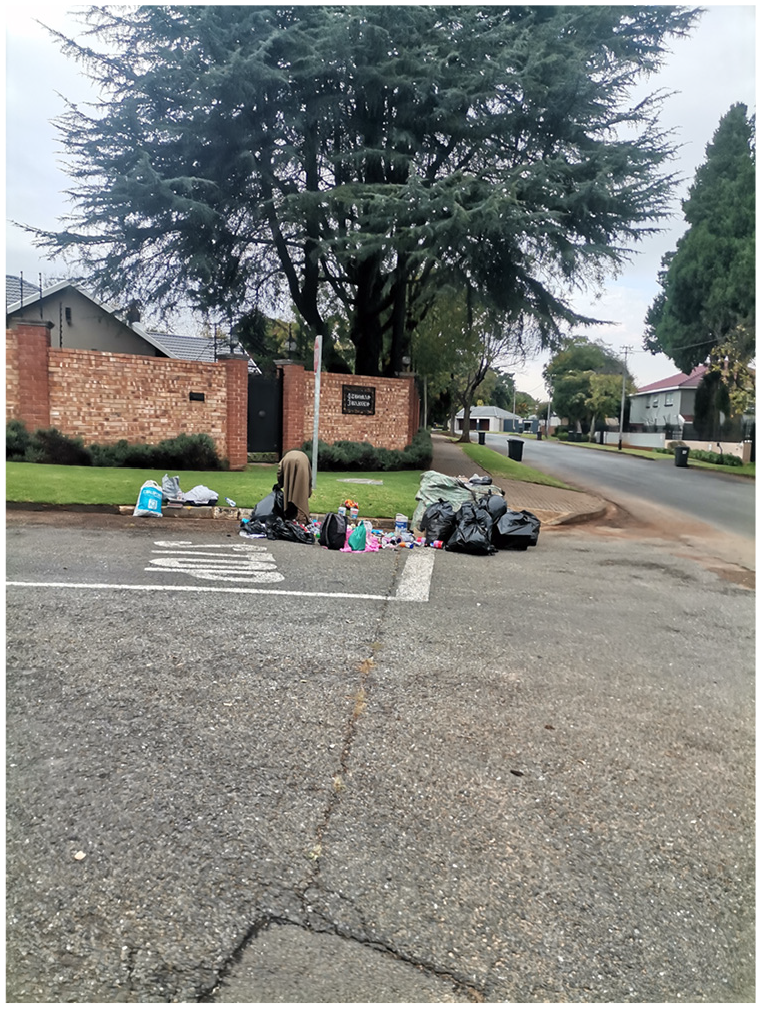
Street waste-picker sorting recyclable waste on the corner of a street.
My observation was not novel, as this is a common scene in Johannesburg throughout the week. Monday, in my case, just meant that the area where I encountered James was being serviced by the municipality which meant that municipal bins were available for the street waste-pickers to access. As such, at first sight, street waste-picker activities become an extension of the city’s infrastructure, as a way of managing the waste and contributing to the movement of waste from suburban areas. This is the common understanding of street waste-picker activities in the urban. Scholarship on waste-pickers captures their role in similar ways. For example, the South African Waste-Pickers Association (SAWPA) defines waste-pickers as ‘someone who collects reusable and recyclable materials from residential and commercial waste bins, landfill sites and open spaces in order to revalue them and generate an income’ (SAWPA, n.d.). For most residents, this understanding of waste-pickers is where it ends. As Breines et al. (2021: 922) mention, the act of ‘following’ allows for more ‘composite understandings of people as they traverse different social landscapes’. Following James beyond the moment of immobility alongside the street where he sorted waste implicates his body further into unseen and unacknowledged infrastructural networks and how infrastructure is built at the scale of the body and at the level of the everyday. As Berlant (2016: 393) expands, ‘Infrastructure is not identical to system or structure, as we currently see them, because infrastructure is defined by the movement or patterning of social form. It is the living mediation of what organizes life: the lifeworld of structure’. The movement of James extends beyond the moment of sorting on the corner of the street, and infrastructure becomes more than just one moment of activity stuck in place; as such, infrastructure is an extension of relations beyond fixity, which implicates the mobilities and movement of James in the creation of infrastructural waste networks in the city. James’ hands, legs, feet, back, arms and all the interconnected muscle fibres are drawn into how the infrastructural network moves, operates and evolves. Being-in-motion in the street brings, once again, more nuanced dynamics that street waste-pickers need to navigate and grapple with compared to previous instances of being stationary on the corner of the street, within green areas and public parks where the use of those spaces is relatively neutral and does not necessarily pose as many threats compared to being mobile in the street.
Figure 2 reveals a stark illustration of street waste-pickers engaging their bodies to push and pull trolleys filled with recyclable waste up a steep slope, implicating the body as a form of infrastructure that circulates waste. As seen in Figure 2, street waste-pickers exert effort to pull the weight of the compacted recyclable waste on the trolleys. They also need to exert pulling effort that angles the trolley relative to the ground to overcome gravitational force induced by the slope of the street. And they have to exert upward effort to resist the frictional force of the rough asphalt road that clings to the miniscule wheels compounded by the downward gravitational depression created by the weight of the compacted recyclable material.
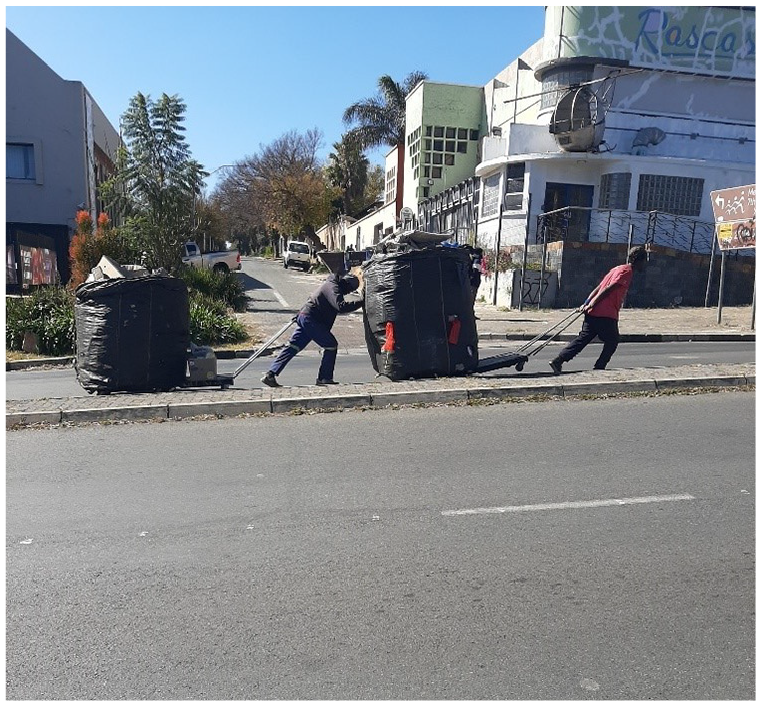
Street waste-pickers dragging trolleys filled with recyclable waste in a street in Mellville, Johannesburg.
As further drawn from Figure 2, the effort that goes into pushing, dragging and pulling trolleys filled with recyclable waste is burdened by several physical forces that objectively slow movement down. While James’ movements are ephemeral, they nevertheless point towards the everyday making (and unmaking) of infrastructures that enable life to take place (Truelove and Ruszczyk, 2022). The making and unmaking of infrastructure are an everyday practice – and are fleeting in relation to common-held understandings of infrastructure as bounded, fixed and stable (Castree and Christophers, 2015). Dragging the trolley implicates the body in infrastructure through the body’s social, affective and material practices which bring to light important dimensions of how infrastructure is made in the everyday, how waste networks across the city work and how the city, through patterns of inclusion and exclusion, is unevenly experienced. The organisation, the everyday sorting of recyclable material and the movement of both waste-picker and waste form part of the ‘making of infrastructure’ where the body becomes the central mediator.
Following waste-pickers beyond the visible: Into the geographies of exclusion
Out of sight, out of mind
James’ journey does not only involve moving and collecting waste in and across the city; the trolley also intimately forms part of his everyday life. While waste may constantly be part of the logistical movement from point A to point B, the trolley remains a constant extension of James even when he is not actively and visibly ‘making infrastructure’. Yet, the question is never asked, what happens after street waste-pickers have sold their recyclable material and the day’s ‘work’ comes to an end? ‘Following’ James a bit further reveals ‘composite understandings of people as they traverse different social landscapes’ (Breines et al., 2021: 922). Moreover, the method of ‘following’ can enable recognition not only of participants’ movements but also of how their practices vary across different socio-political spaces (Breines et al., 2021). As street waste-pickers navigate the streets of urban Johannesburg, their mobilities are not only uneven but also precarious, vulnerable and unsafe, as they are exposed not only to material threats that can physically slow down and harm the body but also to symbolic structures that determine or even coerce inclusion and exclusion. While dragging the trolley in the streets of urban Johannesburg implicates the bodies of street waste-pickers as embodied forms of infrastructure through the body’s social, affective and material senses, these movements are also mediated by symbolic structures that expose street waste-pickers to material and stigma-related forms of harm through exclusion.
I followed James on his daily operations within and across the city, but also beyond what would be considered the activities of waste-picking which revealed complex layers of social and urban exclusion from the perspective of James. I came to find out that James was homeless and used the public infrastructure of a bus stop as a means of shelter for the evening. In fact, James would locate himself in different bus stops within the city which would invite an array of other contending forces that he would have to deal with on a daily basis. The street waste-picker’s intersection with urban homelessness brings a dimension of urban stigma, which Baumann and Yacobi (2022: 475) posit ‘is not merely a symbolic force but has significant material effects … urban dwellers often experience it in deeply embodied ways, including through impacts on their physical health’. Figure 3 vividly illustrates one of the bus stops where James positions himself, bringing this dynamic into clear focus.
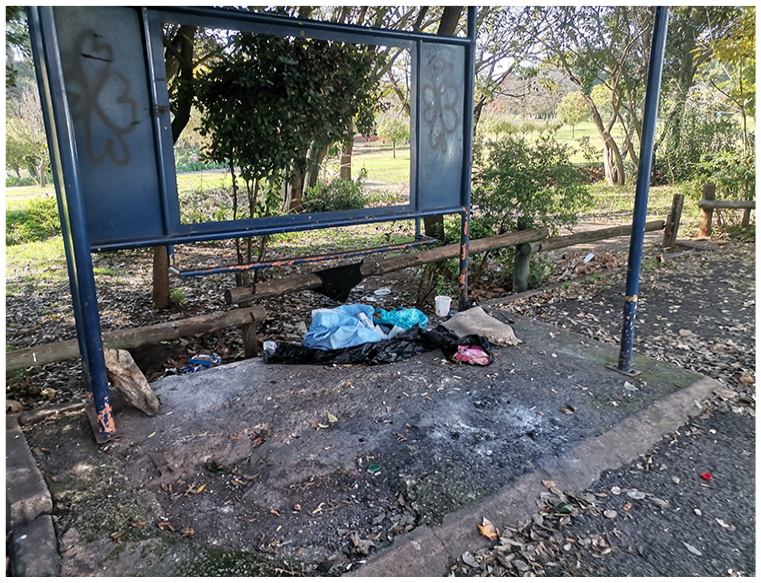
Bus stop showing a temporary settlement of a street waste-picker.
During the day, James had to vacate the bus stop that he had located himself for the night. This was a coping strategy to contend with negative perceptions around vagrants in affluent areas of Johannesburg. Usually, during the day, waste-pickers must contend with private security companies or Johannesburg metro police, as residents and/or business owners issue complaints about waste-pickers in and around public spaces. Street waste-pickers like James must constantly be on the move, not only to collect waste from municipal bins in the city during the day but also to navigate their urban surroundings in the evening. This makes them a vulnerable group in cities like Johannesburg. They are constantly confronted by what Rodgers and O’Neill (2012: 403) call ‘infrastructural violence’, as: [i]nfrastructure shapes how people relate to the city and to each other, affecting where and how people and things move across time and space. At the same time, infrastructure is also completely caught up within the workings of social, cultural, economic and political arrangements, structures and technologies.
Taking this to the full extent, James’ precarity is reflected not only through the meagre amounts of money collected through collecting and selling recyclable material but also through his constant and everyday mobilities and navigation within and around the urban setting.
Surveillance and targeting
Street waste-pickers are continually subjected to surveillance and targeting. Figure 4 illustrates how their experiences intersect with homelessness and urban stigma, revealing how vulnerable populations are singled out and subjected to processes of ‘sanitisation’. It shows one of the bus stops where James sometimes finds shelter. However, as depicted in the figure, wood-plank benches have been systematically removed to discourage mainly the homeless and thereby also street waste-pickers from using the site. During the evening, when it is dark and most of the businesses are closed and urban residents have gone home, this bus stop becomes populated with urban dwellers looking for shelter. However, during the day, private security companies disperse whoever may be in the area to create a perception of order, or an image of the ‘urban’ which affirms what Baumann and Yacobi (2022: 476) explain: ‘stigma attached to spaces – especially those lacking certain public services – is often used to further legitimise and reproduce infrastructural exclusion by demarcating symbolic boundaries, imaginations of Otherness or lack of deservingness of certain populations’.
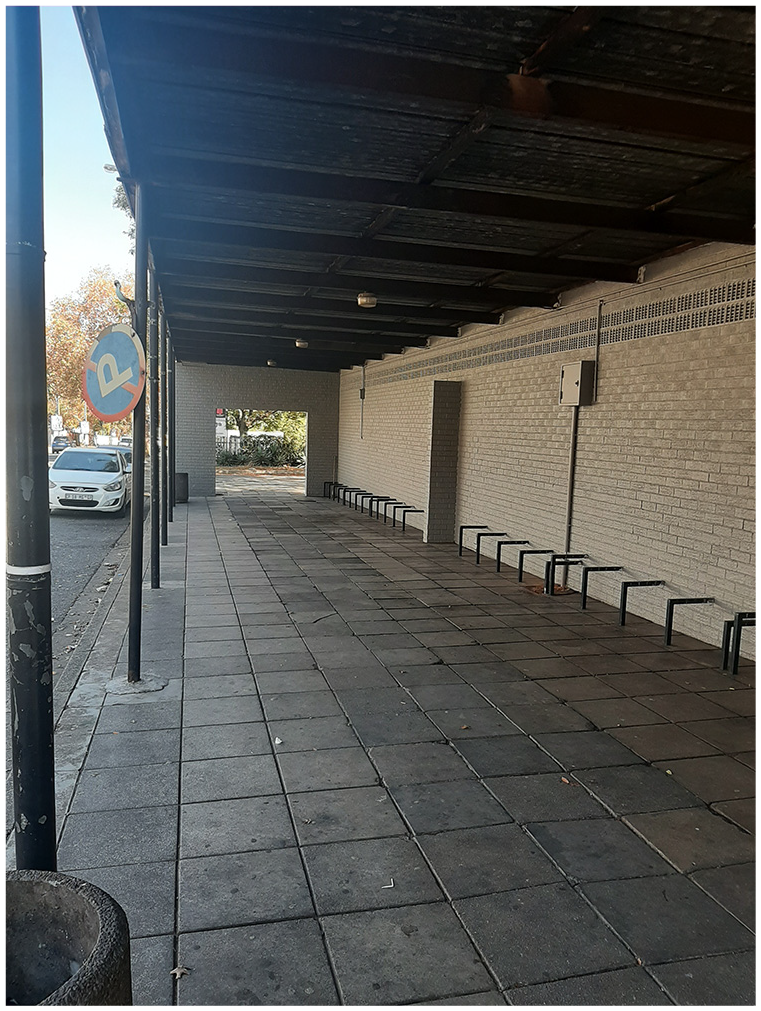
Bus stop where benches have been removed in Rosebank, Johannesburg.
The precarious nature of James’ mobilities leads him to several places in the city, while managing his make-shift trolley and scouring for waste in the urban. The constant surveillance leads to further marginalisation in the urban of street waste-pickers, which forces the manufacturing of the invisibility of street waste-pickers and thereby also their role in the making of urban infrastructure through their bodies. The critical networks as well as the circulation and distribution of recyclable waste are made invisible and intentionally made to be overlooked in urban spaces like Johannesburg. I was further interested in where James – and other waste-pickers – would go to if they were constantly removed from urban spaces like the bus stop(s).
Hiding in plain sight
James showed me how and where several waste-pickers organise in the urban, where they are momentarily free from harassment and surveillance and have a space for organising their recyclable waste. Figure 5 depicts a site along the banks of a river where street waste-pickers have organised themselves, but at the same time it shows the entrenched invisibility not only of themselves but also of the critical urban function of solid waste management.
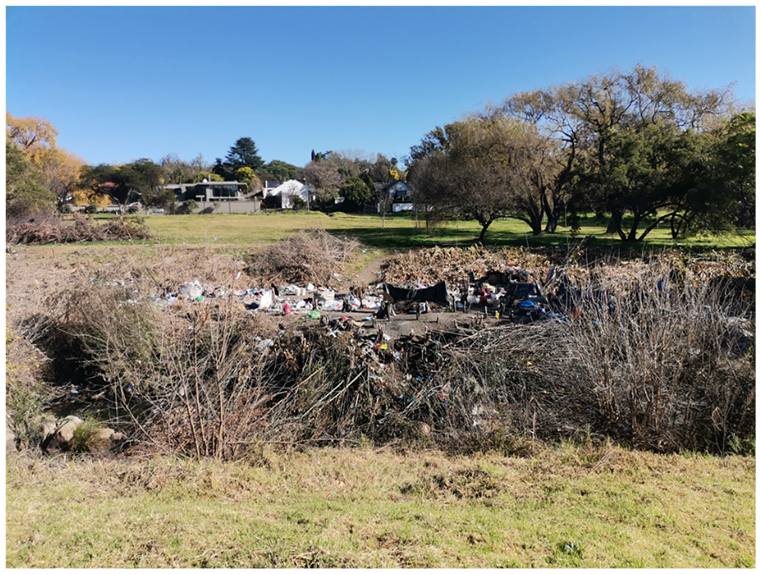
Street waste-picker settlement on the banks of the river in an affluent area of Johannesburg.
As depicted in Figure 5, street waste-picking thus does not become an activity in and of itself, but rather a feature of generalised urban poverty and coping strategies therein. Baumann and Yacobi (2022: 485) remind us that the ‘stigma of infrastructural disconnect is often framed as self-inflicted or linked to an inherent attribute of a given community, thus blaming the victims of urban exclusion for their own situation’. However, this is not the case for waste-pickers, as there is a produced nature of stigma and violence that is an outcome and effect of disconnect and exclusion from the urban. I find this stigma to be connected not only to street waste-pickers working with waste but also to street waste-pickers’ interconnection with the urban displaced and generalised urban poverty. The infrastructural origin of stigma and exclusion faced by street waste-pickers like James must be connected to the structural causes of urban inequality (Baumann and Yacobi, 2022). Thus, following James beyond what is conventionally understood to be street waste-picker activities reveals what Breines et al. (2021: 922) describe as ‘important insights into the complex chains, networks, industries and legal frameworks that enable or hinder the mobilities of people and objects’. More importantly, a much more composite understanding of the street waste-picker is produced through investigating multiple sites and their relations to the urban environment. It also suggests that street waste-picking and the management of recyclable waste by marginalised communities involve more than just the mobilities on the streets but also contending with urban stigma linked to their relations with urban displacement and urban dwelling, thereby reproducing complex layers of vulnerabilities beyond the day-to-day operations of recycling waste. Thus, in the context of identifying ‘slow infrastructural violence’, ‘following’ becomes ‘a tool that can help explore how mobilities of different temporal-spatial stretches are entangled’ (Breines et al., 2021: 930) and that furthermore fosters an understanding of how the embodied cannot be disconnected from the structural. This affirms Truelove and Ruszczyk’s (2022: 3) assertion that the intimate constitutes ‘a sphere of life and everyday practice by which wider political, economic, and social relations are experienced and lived’.
Concluding reflections on the spatial imagination of mobilities and creating composite understandings of street waste-pickers in the urban
Returning to Truelove and Ruszczyk’s (2022: 4) definition of ‘slow infrastructural violence’ as a ‘violence of gendered (and intersectional) social orders that organises urban landscapes, helps distribute and circulate resources and that often leads to recurring forms of harm for particular gendered/classed/casted/racialized bodies in the city’, we can position the mobilities of street waste-pickers within this framework, not only to show the daily conventional practices of waste-picking in cities but also to add layers to their vulnerabilities through the ‘slow infrastructural violence’ produced through their intimate interconnection with urban displacements and urban stigma. Moreover, this article aimed to demonstrate how existing approaches to understanding the body’s entanglement with infrastructure have fallen short in capturing the spatial imagination of mobilities, and in producing nuanced, grounded understandings of bodies in the urban context that can effectively articulate the complexities and intricate dynamics of ‘slow infrastructural violence’. Adding the spatial imagination of mobilities to the analysis of ‘slow infrastructural violence’ reveals that intricacies of violence are not only manifest in material (and immovable) terms where forms of structural violence flow through material infrastructural forms (Miller, 2005). Instead, the aim is to develop a grounded and multifaceted understanding of street waste-pickers in the urban environment by conceptualising ‘infrastructure’ as a mobile body that encounters and negotiates subtle forms of violence through movement.
In this way, this article also sought to provide a paradigmatic contribution by positioning the method of ‘following’ as a way to explore the ways in which urban landscapes are organised as well as how actors help distribute and circulate resources, but at the same time being sensitive to multiple forms of harm for the bodies that facilitate these infrastructural moments and infrastructural makings. Furthermore, the method of ‘following’ contributes to exposing moments and accretions of infrastructural invisibility of the body, as it centres the body through multiple socio-spatial moments and interactions which expose moments of ‘slow infrastructural violence’ as well as how urban stigma, as a form of urban vulnerability, coalesces into infrastructural configurations that modulate urban vulnerabilities which are constantly reproduced and renegotiated (Baumann and Yacobi, 2022). Thus, as demonstrated in this article, ‘following’ offers a powerful way of augmenting the conceptualisation of infrastructure as ‘bodies’ to the extent that it can provide a paradigmatic lens that centres the body as well as overcoming ‘mobile’ difficulties that this type of infrastructure poses, as it does not leave easily visible traces on the ground for researchers to follow (Elyachar, 2010).
Following involves more than the physical process of following people, objects and knowledge, expected from conventional ethnographic research; it also requires ‘theoretical openness to be guided by what happens in the field and take up the leads that may take the researcher in new directions’ (Breines et al., 2021: 931). A key consideration in the context of ‘slow infrastructural violence’ is that following be connected to the everyday intimate practices of particular bodies in the making of infrastructure by disposed and marginalised actors in the urban. Moreover, it also provides content to understand common notions of ‘infrastructural violence’ by generating a concrete and practical means to make embodied infrastructure an ‘ethnographically graspable manifestation’ (Rodgers and O’Neill, 2012: 403).
Footnotes
Acknowledgements
A special word of thank you goes to the participants of the ‘Governing for urban inclusion’ academic writing workshop, who saw the first drafts and provided helpful comments towards strengthening this article.
Ethical approval and informed consent statement
Ethical approval was granted by the Humanities and Social Science Research Ethics Committee (HSSREC) of the University of the Western Cape, with HSSREC Reference Number: HS22/6/62. Informed consent has been obtained from research participants.
Declaration of conflicting interests
The author declared no potential conflicts of interest with respect to the research, authorship, and/or publication of this article.
Funding
The author disclosed receipt of the following financial support for the research, authorship, and/or publication of this article: This study is based on PhD fieldwork, made possible through funding by the National Research Foundation in collaboration with the SARChI Chair in Waste and Society.

Data availability statement
The underlying research materials related to this paper, including qualitative data, are available upon reasonable request. Researchers interested in accessing these materials may contact the author via email.