




Abstract
This article examines how disabled people become part of public transport infrastructure through embodied and interactional practices. Drawing on ethnographic fieldwork and video analysis of journeys in Santiago de Chile, it explores how disabled users co-produce the system’s functioning—anchoring themselves in carriages, navigating ticketing processes, or coordinating alighting from buses. Challenging dominant framings of accessibility as material provision or personal independence, the article emphasizes the relational and distributed nature of disability and mobility. It draws on critical infrastructure studies, disability studies, and ethnomethodology to conceptualize public transport as a “coming-together” of bodies and materialities. Rather than merely revealing breakdowns or failure, the analysis foregrounds the everyday labor of care, coordination, and adjustment through which infrastructure is sustained. Disabled people’s embodied practices are shown to be infrastructural in themselves—constitutive of what allows the system to function. This perspective calls for a shift in how urban mobility is conceptualized and designed: not as a neutral system serving passive users but as an interdependent accomplishment involving human bodies, materials, and social relations. The article argues for recognition of this labor, and for planning approaches that value, rather than seek to eliminate, embodied interdependence as part of more just, inclusive urban transport.
Introduction
Within urban studies, infrastructures have been examined as both providers of essential services and reproducers of inequality (Graham and McFarlane, 2014). This ambivalence becomes especially salient in the case of disabled people. How does urban transport infrastructure serve disabled people, and to what extent does it depend on their resilience and adaptation? What is at stake for disabled bodies as they engage with it?
Infrastructure is at the center of ongoing debates around accessibility, transport provision, and mobility justice for disabled people (Gaete-Reyes, 2015; Imrie, 2012, 2013), with a growing attention to barriers existing in public transport (Muñoz, 2025; Mwaka et al., 2024; Navas et al., 2023; Velho, 2021). These forms of exclusion and marginalization articulated through materialities (see Rodgers and O’Neill, 2012, on “infrastructural violence”; see also Parker et al., 2023) need to be examined with attention to how disabled people and their embodied practices (be)come together with infrastructure.
In this article, I explore the interaction between disabled people, non-disabled people, and urban infrastructure. My aim is to contribute to an ongoing discussion around “people as infrastructure” (Simone, 2004) by emphasizing how the local organization of routine, embodied interactions between passengers, transport workers, and materialities are essential to the emergence of a public transport system that is useable and navigable by disabled people. In the context of urban studies and geography scholars analyzing infrastructure as “peopled” (Simone, 2021), I trace how transport infrastructure and the bodies of its users are embedded in a relation of mutual configuration, causing each other to exist in particular ways.
Framed by Truelove and Ruszczyk’s (2022) call for theorizing the socio-materiality of infrastructure and the body, this article draws on Doherty’s (2021) framing of everyday practices as constitutive of infrastructure. Inspired by work on the entanglement of macro and micro mobilities (Bissell, 2016; Joseph and Gopakumar, 2023), I explore how disabled bodies relate ambivalently to transport systems. Following Dokumaci’s (2020) critique of individualism and independence, I frame public transport as a complex, shifting infrastructure that not only transports bodies but is constituted and propped up by them.
The article explores the case of Santiago de Chile’s public transport system (RED) in relation to disabled and/or reduced mobility passengers—a wheelchair user, an older couple, and a family whose mother is visually impaired. While disabled public transport users are typically imagined as passive beneficiaries of support and infrastructural accessibility, there is evidence suggesting that disabled people are proficient in actively producing accessibility around them through everyday interactions (Muñoz, 2021, 2023a). This article continues that thread by analyzing the sociality of achieving a more-or-less-accessible public transport through embodied practices and material entanglements. I show that disabled users’ embodied practices—especially their interactions with other setting members—are embedded in the emergence of a “properly functioning” system, allowing us to describe these practices as crucial components of the infrastructure itself.
By focusing on the case of disabled public transport users, I carefully examine how exactly this happens in everyday life. This is the first of two emphases guiding this article: analyzing the concrete methods through which bodies and infrastructure come together. In recognizing that “people do not travel in the abstract” (Doherty, 2021: 771), I draw on Ethnomethodology and Conversation Analysis (EMCA) to focus on the observable, sequential aspects of encounters between (disabled and non-disabled) people and materialities, as they assemble infrastructures that sustain the mobilities of disability. The article’s second emphasis—on relationality and interaction—follows Simone’s (2021) invitation to rethink urban collective life beyond individuals or institutions. I focus on what is routinely achieved through ordinary interaction, nuancing the relationship between disability, independence, and individualism (Dokumaci, 2020).
In so doing, this article situates itself within “relational geographies of disability” (Hall and Wilton, 2017) which recognize disability as emerging in the interplay of individuals’ impairments, structural conditions, social interactions, and embodied practices. Rather than conceptualizing people and infrastructure as separate, this approach allows me to analyze in detail how the two (be)come together. This underscores the role of non-hegemonic bodies (such as disabled people, women, children, older people, etc.) in holding together public transport systems—the very systems that systematically exclude them (Mansilla et al., 2024; Park and Chowdhury, 2022; Stock, 2023).
In exploring how everyday embodied, interactional practices of disabled people constitute urban transport infrastructure, this article traces the concrete, observable ways in which “infrastructures are peopled and people become infrastructural” (Doherty, 2021: 759). Whether infrastructure breaks down (making people’s doings apparent) or not (leaving their efforts unseen or unrecognized), I argue that infrastructure is an interaction-led coming together of bodies, materialities, design principles, and political agendas.
The following two sections examine relevant literature to, first, understand different ways in which infrastructures and bodies have been put in relation, and second, to conceptualize infrastructure as a “coming-together” of bodies and materialities. Next, the methods used for data collection and analysis are described. The empirical sections examine three instances of embodied practices deployed to achieve different aspects of transport infrastructure: a stable space in the carriage; topped-up cards; and a “get-off-able” bus. The article concludes by conceptualizing embodied public transport as a relational, co-produced accomplishment sustained through interdependent practices. It argues that infrastructure must be accountable to the bodies that sustain it, recognizing their labor not as a stopgap but as central to more just and inclusive urban mobilities.
Infrastructure becoming embodied
Among many relevant contributions, critical infrastructure studies have explored the association between infrastructure and a “modernist ideal” (Lawhon et al., 2023; Mwaura and Lawhon, 2025) which “aligns infrastructure projects with an objective of universal, networked, centralized provision” (CIC, 2022: 125). While modernist thinking envisions infrastructure as having inherent properties, inscribed into them at the design stage, critical infrastructure studies have framed this from an anti-essentialist perspective.
Infrastructure would be, in that sense, the result of unfolding processes and circumstances that cannot be taken for granted (CIC, 2022), and that in fact may affect people differently. Infrastructure may serve the needs of some, while being violent and unfair to others (Rodgers and O’Neill, 2012). One of such forms of violence is described by Andueza et al. (2021) as the abstraction and differentiation of bodies according to capitalist needs. Disability scholars have analyzed this tendency with an emphasis on infrastructures as barriers that sort and segregate bodies (Mansilla et al., 2024; Muñoz, 2025).
Recognized as relational, distributed, and always in formation (Mwaura and Lawhon, 2025), there is ample opportunity to explore infrastructures as entangled with human practices, “emphasizing the role of dams, pipes, roads, and tunnels in reproducing particular social formations, as well as emphasizing the flows (of finance, resources, labor, care, and repair) needed to sustain these lively materialities” (Andueza et al., 2021: 800). From this standpoint, critical infrastructure studies have emphasized the question of how infrastructures come into our lives and routines (CIC, 2022).
“Peopled” infrastructures
Arguably, one of AbdouMaliq Simone’s (2004, 2021) greatest contributions has been to conceptualize “people as infrastructure,” acknowledging “the tyranny of imposing frozen, uni-dimensional categories on messy, evolving social life and social relations that assimilate countless processes, and inheritances” (Simone, 2021: 1342). Simone responds to modernist essentialism and opens the discussion to consider infrastructures as “peopled,” thus acknowledging the role of communities in holding these together. Other researchers (e.g. Silver, 2014; Truelove and Ruszczyk, 2022) have built upon these ideas to explore how people’s mobilities, local organization, and care labor interact with, and constitute, infrastructure. Indeed, “there is a recognition that these kinds of infrastructures often require huge amounts of informal work to extend provision and maintain it” (Latham and Layton, 2022: 663).
Such recognition has contributed to an emphasis on how people come together to “make up for” (or “patch together,” or “subsidize,” see Truelove and Ruszczyk, 2022) failing infrastructure. Other research traces instances of breakdown, glitches (Berlant, 2016; CIC, 2022), failure (Dokumaci, 2020), and improvisation in response to neglected infrastructure (Simone, 2004, 2021). For example, Dokumaci (2020: 105) describes people becoming affordances for one another, “especially in circumstances where there are not readily available affordances or convenient tools, objects and infrastructures to respond to their pain, ill health, and bodily particularities.”
However, re-examining this notion with attention to the urban mobilities of disabled people allows us to specify some of these aspects. First, it should be considered that the mobilities of disabled people and their families almost always assume destabilization and disruption, as they face the routine problem of navigating spaces not designed for them. Thus, it is not only “failing” infrastructure but also “functioning-as-intended” infrastructure that may disrupt the mobilities of disabled people.
Second, this rationale may imply that people become involved in the functioning of infrastructures only when these “fail,” and conversely, that “fully functioning” transport infrastructures would not need users to adapt or put their bodies on the line at all. In the case of disability, this further reinforces an imagination of accessibility as provision, as well as an ontological distinction between people (as recipients of a service) and infrastructure (as the material manifestation of such a service). However, it has been argued that even “properly” designed and implemented infrastructures require the routine involvement of (disabled and non-disabled) users to enact these as accessible (Muñoz, 2023a). Thus, the entanglement between infrastructure and disabled bodies may require further exploration.
Infrastructure as a coming-together of bodies and materialities
What does it mean to conceptualize and analyze infrastructures as embodied? The terms “embodied infrastructure” or “people as infrastructure” have been used to reference the building of “informal social networks” (Johnson, 2015, see also Latham and Layton, 2019; McFarlane and Silver, 2017). While such approaches align with the idea that people come together to respond to absent or failing infrastructure, they are less clear in describing how exactly bodies and infrastructural materialities assemble and achieve various things under “ordinary” conditions. Recognizing infrastructure as embodied—that is, always sustained by and made up of embodied practices—is further specified by considering the practices of disabled public transport users.
Critical infrastructure studies position bodies and infrastructure as embedded in an ambivalent relationship: bodies are governed into becoming facilitators for (capitalist) infrastructure to emerge (Andueza et al., 2021), while also resisting and subverting such domination. Moreover, following Truelove and Ruszczyk (2022: 2), “[i]f we broaden the understanding of infrastructure to the social and material practices of bodies, then people as infrastructure do more than prevent the city from failure. They can actually help the city to develop.”
Conceptualizing infrastructure as embodied has two implications. First, it recognizes that infrastructure cannot exist without people’s bodies—raising questions about what is at stake for bodies engaging with infrastructure, as well as the inequalities reproduced in the process (Andueza et al., 2021). Second, it focuses on the relational and interactional aspects of achieving various socio-material arrangements. Dokumaci’s (2020: 100) concept of “people as affordances” is crucial here, as it “[brings] into focus the sociality involved in their making, through improvised relationalities between the world and one’s own body as well as between multiple bodies.” For example, the embodied ways in which (disabled and non-disabled) people support each other’s mobilities result from ordinary interactions, which may involve the materialities of the city. The distributed nature of affordances, as “[t]hey reside neither in the environment nor in the body but in the inherent coupling of the two” (Dokumaci, 2020: 99), frames infrastructure as a “coming-together” of bodies and materialities. This illustrates how transport systems govern and sort bodies, but also how they are shaped and routinely sustained by embodied practices.
Conceptualizing transport infrastructure as a “coming-together” of bodies and materialities may also enrich contemporary understandings of (non-)accessible urban spaces. Valentine (2020) critiques accommodationist approaches to accessibility, which tend to focus on the inclusion of disabled individuals through an emphasis on independence rather than interdependence. In line with Valentine’s reflection that “[i]f we begin from our inherent interdependence (instead of from aspirational independence) and acknowledge world-making as a collective human practice, a different set of demands for access are raised” (Valentine, 2020: 81), other research has documented accessible transport infrastructure as an interactional achievement (Muñoz, 2023a). This research examines collaborative embodied interaction between disabled and non-disabled people to overcome barriers and enable their journeys.
An emphasis on interdependence and interactional achievements resonates with research that conceptualizes embodied practices of care as infrastructure (Jirón et al., 2022; Joelsson et al., 2025; Johnson, 2015), which analyzes how “reproductive work, care in particular, becomes a form of infrastructure that sustains urban life” (Doherty, 2021: 761). However, it remains unclear how, specifically, embodied practices of care and urban infrastructural materiality may come together and support one another.
Responding to Valentine’s critique and following Dokumaci’s emphasis on the sociality of affordances, I aim to examine how everyday encounters, ordinary interactions, and interdependent embodied practices of (non-)disabled people enable the emergence of more accessible public transport infrastructures. This aim coalesces into two sets of questions. First, in what observable ways do bodies (be)come together with infrastructure? And how does disability specify this process? Second, what (unrecognized) costs are assumed by those engaging in embodied practices that, in various ways, contribute to the “holding-together” of transport infrastructure?
Research methods
The article draws on a combination of ethnographic field notes and video data collected across two research projects (one was conducted from 2016 to 2020; the other, ongoing since 2023). Both projects adopt a qualitative approach to studying the everyday mobility practices of disabled people, with particular attention to the role of other setting members (transport workers, relatives, strangers, etc.) in supporting or hindering the disabled person’s journeys, as well as the impact of transport infrastructure on these interactions.
Participant recruitment followed a principle of diversity to capture a wide range of experiences related to public transport usage. The aim was not statistical representativeness but theoretical generalization, to capture the variety of perspectives and conditions shaping these practices. In total, 21 participants took part in the two studies. These included adults with visual impairments, adults with mobility impairments, two non-disabled relatives/caregivers, and one guide dog trainer. 1 To contextualize their positions along the phenomenon of interest, participants varied in age, sex, preferred travel mode (bus or metro), and whether they usually travelled alone or accompanied.
Across the project, 38 semi-structured interviews were conducted. These involved the disabled participants and their relatives as well as additional stakeholders such as transport workers, planners, and representatives of disability organizations. The video data used in this article comes from 15 go-along journeys (Kusenbach, 2003) conducted with disabled participants.
Scholars have discussed how go-alongs with disabled people call for critical reflection on the risks of taking mobility for granted or underestimating the socio-spatial politics shaping mobile methods (Edwards and Maxwell, 2023; Parent, 2016). Likewise, the ethnographic immersion that go-alongs can provide (Stiegler, 2021) offers an opportunity to explore bodily difference and the everyday practical challenges of accomplishing things together (Muñoz, 2023b).
Go-alongs were video-recorded using GoPro cameras attached to the participant’s body (or mobility aid), the researcher’s body, or both. The collected video material—totaling more than 18 hours of recordings—was compiled and substantively reviewed to identify sequences where participants were observably interacting with material or programmatic elements of the public transport infrastructure. The sequences were analyzed following the principles of EMCA (Garfinkel, 1967; Sacks, 1992) as applied to video (Heath et al., 2010) to examine participants’ everyday reasoning and practical actions. The cases presented below draw on a combination of sequential analysis of video (presented in sections “Flo, daughters, and guide dog: Achieving topped-up cards” and “Alba and Mario: Achieving a get-off-able bus” as graphic transcripts (see Laurier, 2014) and ethnographic insights emerging from immersive go-alongs. These are representative instances of a repeatedly observed, more general, phenomenon—namely, how disabled people actively produce relevant elements of the public transport infrastructure through situated action. They were selected for their analytical clarity and the breadth of contextual elements represented (type of disability, transport mode, and companionship).
One central idea in EMCA is that social actions and order are produced in and through interaction, rather than existing “outside” or “prior to” it. Seemingly self-evident tasks such as overtaking while driving (Depperman et al., 2018), opening a phone conversation (Schegloff, 1986), or even “being ordinary” (Sacks, 1992) are analyzable as interactional achievements. Focusing on embodied practices as interactional achievements highlights the labor routinely involved in accomplishing things, which is especially relevant in the case of disabled people, whose efforts often address physical and attitudinal barriers. Emphasizing the embodied dimension of ordinary practices reflects how disabled participants put their bodies at stake when accomplishing various things through gesturing, holding each other, or queuing. The following sections examine how participants, through interaction, become part of the infrastructure by achieving key elements of the transport system itself.
Incorporating ourselves into the infrastructure
This section illustrates three cases of disabled people as public transport users. The participants interact with others and with materialities as they become members of the broader infrastructure that is Santiago de Chile’s public transport system.
Natalia: Achieving a stable space in the carriage
Is an appropriate sitting space in a bus or train something we find, or something we produce? Research with disabled people in Santiago de Chile (Muñoz, 2021) has explored how a seemingly menial task, such as boarding and sitting in a public transport vehicle, results from material affordances, assistance from other passengers, and substantial labor by the disabled users themselves. This section analyses the idiosyncratic way in which a wheelchair user accomplishes producing a stable space for herself and her mobility aid.
Natalia is a young mental health professional born with spinal muscular atrophy type 2 (SMA2) and has used an electric wheelchair for as long as she can remember. She is experienced as both a bus and metro passenger, though she prefers the latter as a more predictable, reliable option. In the go-along journeys I conducted with Natalia, it became apparent that she routinely puts significant effort into becoming a metro passenger.
Entering the Tobalaba metro station, I saw how Natalia recruited the assistance of metro staff to tap her card at the gates. Down on the platform, she patiently navigated the crowded space with her electric wheelchair, with me following closely behind. Finally, Natalia and I were safely positioned at the very end of the platform.
The train has finally arrived. Since we are at the first station on this line, the train is fresh and empty. As soon as the doors open, passengers crowd around them and quickly find spots to sit or stand inside the carriage. Natalia enters and approaches the grab pole in the middle. I follow her closely. A couple carrying bags and a pushchair is standing by the grab pole. As Natalia moves closer, she addresses them.
“Permiso” [Excuse me/make way], she says in a polite yet firm manner, without stopping. The couple look at her and move further into the carriage, freeing up the space by the pole.
Earlier, Natalia had explained to me that instead of looking for a spot by the other seats, she preferred to stay by the grab pole and use it as a source of stability. I now see what she meant. She moves closer to it and skillfully catches it between the seat and the armrest of her wheelchair, effectively “anchoring” both it and herself to the grab pole. This way, the swaying motion of the train is mitigated, and Natalia feels it less. As her body is quite small compared to her wheelchair, a steadier arrangement is more comfortable for her.
Wheelchair users are generally expected to use the designated space inside the carriage, typically located near the other passenger seats. When such space is unavailable, people in wheelchairs or with pushchairs often position themselves near the main seating area, away from the doors and passenger flow. As a wheelchair user, Natalia does not need to find a seat but to ensure her wheelchair fits inside the carriage in a comfortable way, preventing the train’s swaying motion from causing her to feel unstable in her own assistive device.
To ease her discomfort, she has developed a technique: wedging the carriage’s central pole between her armrest and seat—neither of which were intended for this use. In just a few moments, she locates the pole, navigates around fellow passengers, and produces the “anchoring.” Rather than adhering to the standard expectations built into the carriage’s accessibility design, she crafts an ad-hoc adjustment that fits her specific bodily needs. This is not an act of defiance but a nuanced, skillful way of becoming a passenger on her own embodied terms. As she interacts with the pole, she transforms it—temporarily and purposefully—into a point of support that the original design did not anticipate. “This way I don’t shake,” she explains after the maneuver, adding that it is when the train brakes that the sensation of instability becomes especially uncomfortable.
The importance of Natalia’s interaction with other passengers should also be noted. Her utterance of “permiso” makes her presence known while also clearing space around the grab pole. Beyond being a mobility aid, the wheelchair is also a resource that makes her disability visually available to others, enabling ordinary interactions oriented to the fact that her own needs, capacities, and agenda may differ from mainstream ones.
Natalia’s technique creates a literal attachment between her extended corporeality (Winance, 2006) and the train’s materiality, producing a stable space for her in the carriage. Gibson (1979, cited in Dokumaci, 2020) describes objects being “graspable” as a property emerging from the relation between an object’s characteristics and the user’s hand. Similarly, affordances (Dokumaci, 2020) emerge as a combination of a thing’s properties and the needs and actions of an organism. Here, Natalia’s embodied action, combined with the material properties of the wheelchair and the pole, shape the latter as “anchor-able.”
In a manner reminiscent of Bissell’s (2010) account of vibrations in railway travel, the connection between Natalia’s body and the surrounding infrastructure was problematic and thus central to her course of action. Made to feel uncomfortable in her own wheelchair by the train’s motion, Natalia’s maneuver reconfigures how her body and the infrastructure fit together. In doing so, Natalia’s body, the wheelchair, and the train become more stably connected—now part of a differently assembled collective.
Flo, daughters, and guide dog: Achieving topped-up cards
Becoming a public transport passenger is the result of several elements coming together. In Santiago’s RED, one such element is having a contactless card (locally known as a “Bip Card”) with enough credit to pass through the gates and integrate into the transit flows of the system. In 2007, Transantiago (as Santiago’s modernized public transport system was known when it first launched) introduced contactless card technology to streamline fare payment. The Bip Card is, simultaneously, a part of the public transport infrastructure (Ureta, 2015) and a membership device that categorizes topped-up card holders as passengers.
For a family living with disability, however, topping up cards can pose a significant challenge. The following sequence depicts an instance where Flo (a visually impaired mother), her two daughters María and Laura, and Otto the guide dog interact as a group with RED’s topping-up system at a metro station. I joined the family on this journey and observed from a distance how this sequence unfolded (Figure 1).
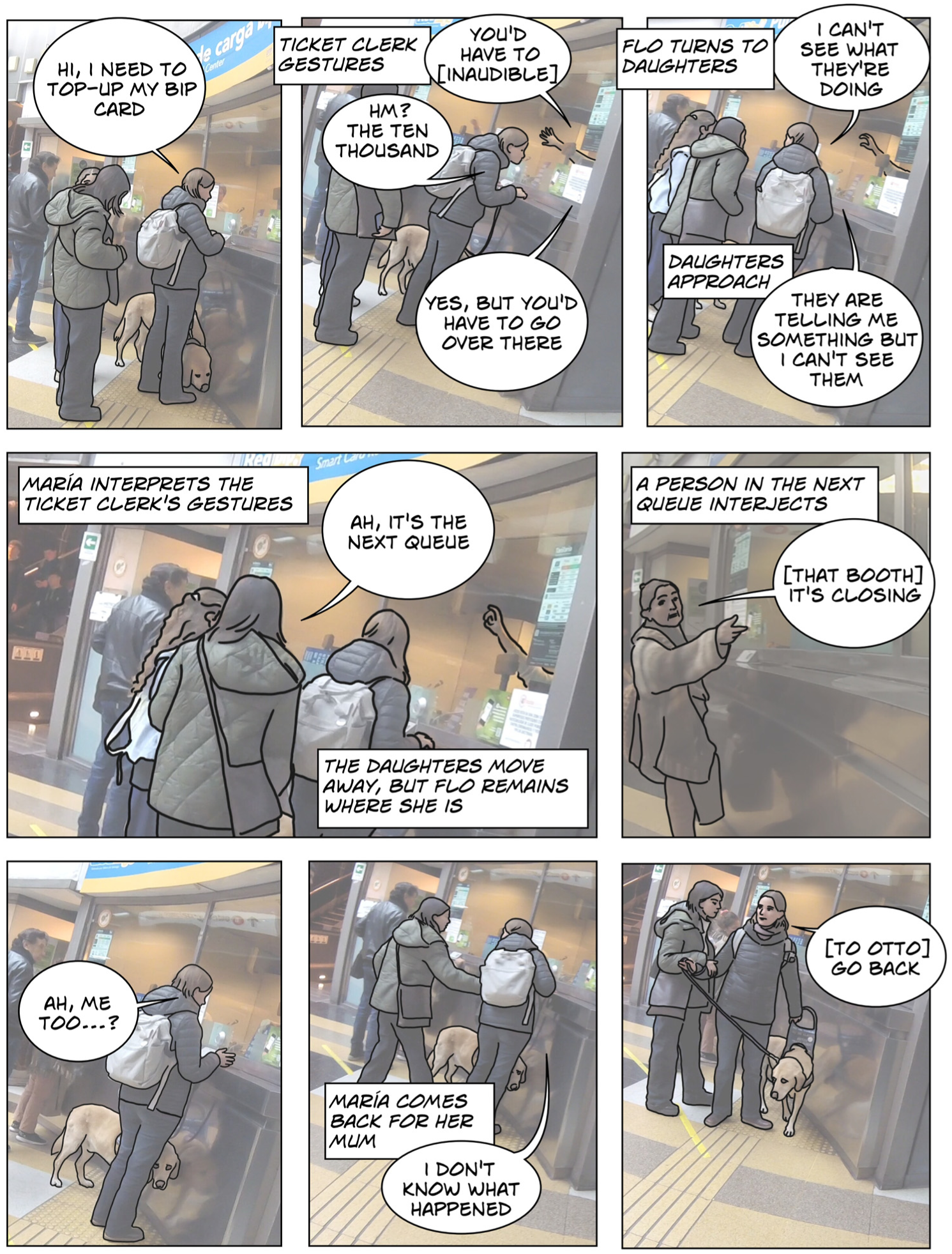
Flo switches queues.
Flo is at the ticket booth and passes her Bip Card to the clerk (panel 1). The clerk makes gestures with her hand, but Flo cannot see these nor clearly hear what is being said through the security glass. Detecting that the clerk is speaking, she responds to the most common question within the ordinary procedure of topping up the card: how much are you putting on? She explains that she would like the full 10,000 pesos she gave to be loaded onto the card (panel 2). As the clerk keeps trying to tell her something, Flo turns to her daughters and says “I can’t see what they’re doing,” prompting them to approach the booth (panel 3). Flo’s utterance is significant as it displays her awareness of missing visual cues that would clarify what is wrong, while also indicating to María and Laura how they might help bridge the communicational gap. María interprets the clerk’s gestures and says “Ah, it’s the next queue” as she and her sister move away (panel 4). Flo, however, remains where she is. Another person—a member of the next queue—looks at Flo and points to the first till, explaining that it is closing (panel 5). This prompts Flo to produce a question with no specific recipient, which could potentially be answered by any of those involved (her daughters, the clerk, or even the stranger). In this context, the question “Ah, me too?” expresses Flo’s uncertainty about whether the instruction to move applied to her (panel 6). María returns and grabs Flo’s arm as Flo turns to her to express, with a “I don’t know what happened,” that she has become lost in the sequence (panel 7). Flo instructs Otto to “go back” as she turns. María adjusts her grip to hold Flo’s right arm as they move away (panel 8).
This first sequence shows the barriers faced by the group and the resources they use to address them. The interactional environment of the ticket office poses challenges for both Flo and the ticket clerk in recognizing and understanding one another. First, the security glass prevents Flo from clearly hearing the clerk, complicating the delivery of instructions when the ordinary sequence of topping up cards will not be met in the expected order (i.e., Flo must switch queues first). Second, the physical layout of the booth renders Otto non-visible to the clerk, possibly preventing her from recognizing Flo as visually impaired. Similar to the white cane, which can serve as a visual cue for identifying someone as visually impaired (Due and Bierring Lange, 2018), a guide dog 2 usually accomplishes the same effect. Not seeing Flo as visually impaired may explain the clerk’s insistence in communicating through hand gestures.
María’s interpretation of the gestures, along with the stranger’s interjection, redefines the next queue as the “right” one. However, while the daughters move away—effectively disassembling their original queue—Flo stays put. Her uncertainty about whether she should change queues too is consistent with her being mid-way through the topping-up sequence—her money and Bip Card are still with the ticket clerk. Still unsure, Flo seeks support from her daughters. In this context, María’s grabbing of her mother’s arm helps disambiguate the situation while physically directing Flo to the next queue. María’s shepherding (Cekaite, 2010) is sustained both by María’s haptic signaling and Flo’s verbal directives to Otto (“go back”).
Crucially, the seemingly simple task of changing queues relies on the assumption of sight. As Brown (2004: 11) notes, queuing “is as much about being able to show one’s actions as it is being able to see the actions of others.” Within this ocularcentric participation framework (Due, 2024), the stranger’s interjection correctly interprets the situation as stemming from a lack of information suitable to visually impaired participants. Similarly, María comes in as an affordance (Dokumaci, 2020) to bridge and compensate for this miscommunication.
The sequence continues in Figure 2. After moving to the next queue, Flo protests about having to queue again. María assuages Flo’s concern by stating that skipping the queue would be possible (panel 1). Gesturing again, the clerk beckons María. She announces that Flo’s card is being returned, and Flo responds by noting that her money is also missing (panel 2). María passes her card to her mother. Note how the passing is supported by a hearable announcement (“Here’s your card”), reducing the usual reliance on sight when handing things over (Due and Trærup, 2018). María’s utterance, which only announces the card being passed, prompts Flo to ask again about the missing money (panel 3). María returns to the booth, presumably to ask the clerk about the money (the conversation is inaudible in the recording). Her inquiry is supported by Flo’s claim that she gave 10,000 Chilean pesos to the ticket clerk (panel 4). María turns to Flo and explains that the clerk has already topped up the card. Since this seems to contradict the original instruction to move to the next queue, Flo seeks confirmation from María (panel 5). Finally, Flo leaves the queue, chuckling (panel 6).
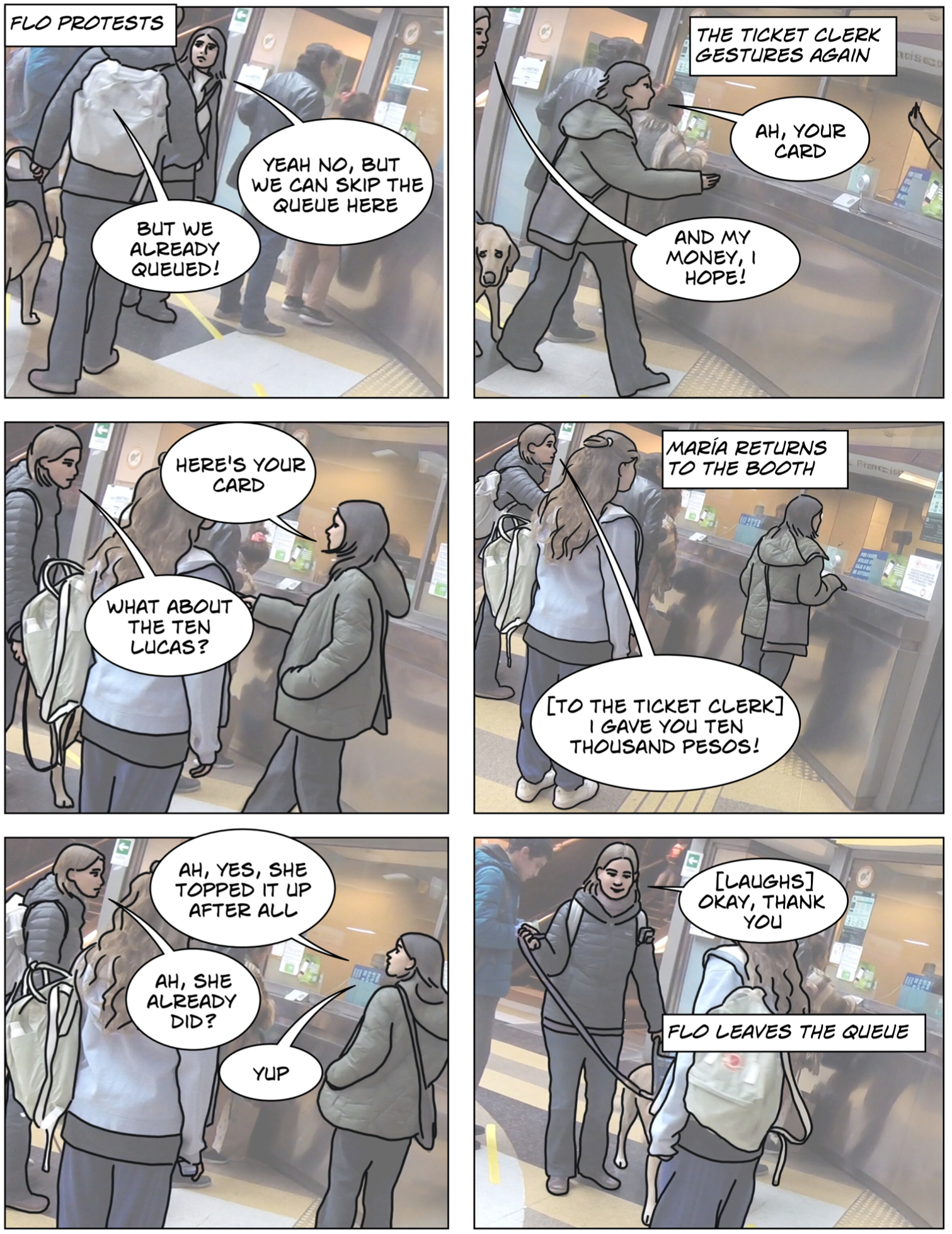
Flo gets her card back.
Flo’s humorous response may reflect the mismatch between the laborious process of adjusting to the clerk’s instructions and the fact that she ultimately obtained what she was asking for in the first place. However, although the clerk’s actions seem oriented toward repairing the initial sequence (i.e. returning a topped-up card), the family still has to collaborate to interpret information conveyed in a way not accessible to Flo.
Topped-up cards—a crucial condition for Santiago’s public transport system to function properly—are the result of various embodied practices. In the case of a family living with visual impairment, significant additional work needs to be done—from coordinating queue shifting in an ocularcentric environment to reassembling intelligible conditions of payment and card handling. This sequence shows that extra work is needed not to compensate for a lack of sight but to account for ableist assumptions embedded in the interaction.
Thus, Flo’s access to the ticket office—and ultimately to the system—is built upon an assemblage of embodied practices and abilities that serve both her family and the transport infrastructure. This labor is distributed among family members as part of the ongoing task of “doing mobility together” (Laurier et al., 2015) while dealing with disability. Together, they embody a device that, against all odds, does achieve topped-up cards.
Alba and Mario: Achieving a get-off-able bus
“People see me as super healthy, but I have many things [ailments],” says Alba, a 65-year-old woman, as we ride the bus with her husband Mario. She gestures with one hand to signify “many things,” while using the other to hold her crutch.
Both of them live with long-term injuries that limit their mobility. As Alba explains, these injuries are mostly non-visible. Due to her hip injury, she must travel sitting. Mario stands nearby, as there are no more free seats. He grabs the handrail at waist level because his shoulder injury prevents him from raising his arm to the overhead handles.
Alba and Mario’s respective injuries make the bus space a particular one. Seats are an absolute necessity, not an occasional comfort. Some handles are simply out of reach. Their moving as a “together” (McIlvenny et al., 2014) provides them with practical resources for navigating the public transport in ways impossible for them individually. A seemingly simple act, such as getting off the bus, results from skillful embodied coordination shaped by their orientation to each other’s needs—framed, in this case, by their injuries.
Figure 3 shows how Alba and Mario alight from the bus together. As the bus stops, Alba stands up and Mario slowly shuffles toward the doors, along with the other passengers (panel 1). The doors open, allowing Alba to assess the step down from the bus. She describes the distance between the bus and the pavement as “so far.” Turning to Mario, she instructs him to “go first.” Her directive is paired with a step back, clearing the way for her husband (panel 2). As Mario steps off, Alba formulates her request more explicitly: she will need help “there.” The indexical use of “there” is framed by her initial topicalization of the problem (the bus-to-pavement gap) and by the moment she utters it (as Mario steps off the bus, panel 3). Once on the pavement, Mario turns around and extends his hand to Alba. His gaze is directed down, either at her feet or at the gap (panel 4). Alba steps off the bus, taking Mario’s hand with her right hand. Her crutch is on her left (out of frame) for additional support (panel 5). As Alba progresses across the gap, Mario’s gaze remains fixed on her footing (panel 6).
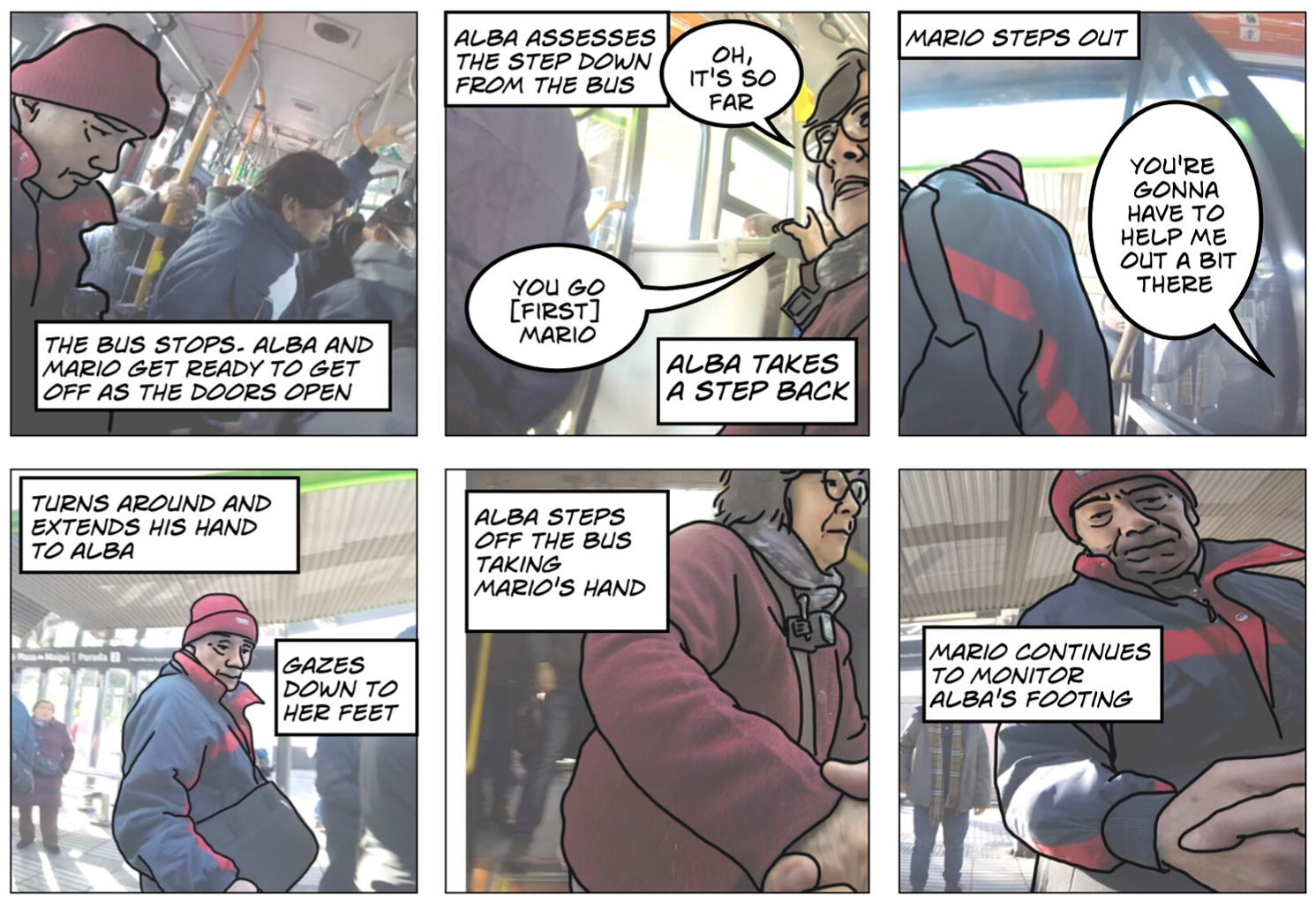
Alba and Mario step off the bus.
Alba and Mario deploy embodied resources to coordinate and step off the bus as a “together.” The first step in their alighting sequence, performed by Alba, is to assess just “how far” the bus is from the pavement. In Santiago, this distance is not a given; it varies with unequal infrastructure (in richer or poorer areas of the city) and local conditions (such as traffic that may prevent a bus from stopping right by the pavement). Crucially, one main reason a bus may leave a larger gap is the assumed ability of passengers to traverse it.
After identifying the gap, the couple uses a combination of gaze and hand holding—an intertwining of bodies (Goodwin, 2017) that serves as a form of scaffolding to support Alba. While the embodied practice of scaffolding has mainly been studied in family interactions where controlling a child’s actions is relevant (Cekaite, 2010), here it serves to bridge a gap in infrastructure. 3 This is accomplished by simultaneously preserving, and drawing upon, the couple’s “togetherness.”
Thus, the participants’ actions achieve a temporary, ad-hoc bus-close-to-pavement arrangement in the clear absence of one. Here, I draw on Dokumaci’s (2020: 102) analysis of a husband becoming used to twisting off a bottle cap before handing it to his wife with arthritis: Thus, for instance, Patrick participates “as if” anticipating the pain in Valerie’s swollen fingers as his own, and he obviates it by becoming her affordance, cracking the seal on a water bottle before handing it to her. Just as with Ahmet’s case and the walk-on-ability of his road, we cannot understand the twist-off-ability of the cap separately from the properties of a cap in relation to Valerie’s swollen fingers—and the pain she feels as Patrick relates to it.
Alba and Mario’s embodied joint activity reflect this idea well. The “get-off-ability” of the bus is assessed and reshaped in relation to Alba’s condition as well as Mario’s availability and orientation to her needs. They achieve getting off the bus together by orienting to one another’s conditions, treating these as shared concerns of moving together.
Conclusion: Achieving an embodied public transport through care and responsibility
In mainstream discussions of accessibility, independence is often framed as the alternative to dependence (Valentine, 2020). Mobility researchers have critically examined the hegemonic liberal notion of independent mobility as functional to capitalist flows (Middleton and Byles, 2019; Schwanen et al., 2012), while arguing that interdependent mobilities are key to enabling the mobilities of all people—not only those living with disability.
This article has examined in detail how disabled public transport users manage to become part of urban transport infrastructure, effectively incorporating themselves into its functioning through various embodied practices and social interactions. The data analyzed resonate with Mingus’s (2011) notion of access intimacy, which “is about shifting our values to emphasize freedom through connection and collective, rather than individual, responsibility for access” (Valentine, 2020: 92). I have shown how the ongoing, ever-unfolding labor of supporting each other’s access is achieved through familiarity and a shared orientation to each other’s needs and capacities. This challenges notions of accessible public transport as benefitting individuals rather than collectives, and highlights practices of mutual care and interactionally achieving viable paths.
The empirical cases show how crucial infrastructural properties—such as stable spaces within a carriage, topped-up fare cards, and “get-off-able” buses—are not given but accomplished through embodied practices. Natalia’s anchoring technique turns a metro pole into a stabilizing element. Flo’s family collectively navigates an ocularcentric ticketing system to produce functional access. Alba and Mario’s coordinated movement reconfigures a discontinuous street-level alignment into an exit route. In each case, both public transport infrastructure and disabled passengers emerge through the participants’ bodily implication with each other and the environment. This supports an understanding of disability as distributed across bodies—Mario and Alba’s joint actions show how they both account for her injured hip. Flo, her daughters, and Otto share the visual impairment as a practical concern, especially in bridging the gaps left by a system seemingly uninterested in assuming the same responsibility. These are not merely moments of improvisation or patching-up failure; they are the everyday, often invisible practices through which infrastructure materializes and persists. As users engage in embodied practices that enable the system to function, it should be acknowledged that this benefits and obligates the system in various ways.
By the same token, in recognizing that public transport infrastructure cannot exist without people’s bodies, it is imperative to ask what is at stake for bodies as they become engaged in assembling infrastructure. The data presented exemplify how disabled people bear the cost of adapting their embodied practices to ableist expectations embedded in the system’s functioning—expectations of sightedness and the ability to jump from bus to pavement. Crucially, this labor often goes unacknowledged, echoing what Truelove and Ruszczyk (2022) call “slow infrastructural violence”: the persistent erasure of the bodily work required to make systems accessible, particularly by those already marginalized by them. Recognizing this, there is an opportunity for planners to collaborate with users to design systems that reduce friction while supporting adaptive practices.
Access is not just a condition to be met but a relation to be sustained—one built on embodied trust and shared responsibility. This aligns with Tronto’s (2013) notion of “caring with,” which involves collective commitment. Recognizing this reframes accessibility not as accommodation but as a collective and ongoing accomplishment that may—and should—involve the system itself.
This article puts forward the notion of embodied public transport as a relational achievement. This framing invites careful attention to who becomes involved in such accomplishment. Drawing on the analyzed cases, I argue that embodied public transport is never accomplished alone, but through social interactions. Likewise, essential infrastructure properties—such as buses we can get off of, topped-up cards, and generally accessible spaces—are never delivered in a one-way manner but are relationally produced by the system and its users. Public transport is not merely a network of buses, tracks, and machines; it is a network of bodies-in-relation, continuously sustaining the system in ways that infrastructure alone cannot.
Embodied infrastructure is ongoing labor that traditional approaches to design and planning cannot replace. Rather than aiming to render practices of mutual, care-full orientation (Williams, 2017) unnecessary, transport systems may instead engage with them—supporting bodies coming together as part of the infrastructure. This recognition has normative implications: if infrastructure is co-produced by its users, then systems must be accountable to those bodies. Embodied practices should not be seen as temporary stopgaps before “better” design arrives but as valid, durable, and structuring elements of mobility. Design and planning that draw inspiration from these practices and explore opportunities of co-design with both disabled and non-disabled users will enable more just, inclusive, and interdependently grounded urban mobilities.
Footnotes

Ethical considerations
The research supporting this article was granted ethical approval by the University of Edinburgh’s Research Ethics and Integrity Committee (School of Geosciences), and the Comité de Evaluación Ético y Científico of the Facultad de Arquitectura y Urbanismo, Universidad de Chile. Informed consent to participate and for publication was obtained in written form by all research participants.
Funding
The author disclosed receipt of the following financial support for the research, authorship, and/or publication of this article: This work was supported by the Chilean National Commission for Science and Technology (Conicyt), PFCHA/DOCTORADO BECAS CHILE/2015 (72160153) and the National Agency of Research and Development of Chile (ANID), Fondecyt de Postdoctorado (3230574), Millenium Science Initiative Program (ICS2019_024 and NCS2022_039).
Declaration of conflicting interests
The author declared no potential conflicts of interest with respect to the research, authorship, and/or publication of this article.