



Abstract
Exposure to environmental burdens, such as air and noise pollution or a lack of green space, is linked to various adverse outcomes. Prior research shows that poor residents and foreign minorities in European cities often face disproportionate exposure to environmental burdens, yet substantial regional differences within countries remain poorly understood. We address this gap using fine-grained 1 km-by-1 km neighbourhood grid data on air and noise pollution and green space availability, combined with administrative information on poverty rates and the share of foreign minorities for all German cities with at least 100,000 inhabitants in 2017. We examine whether poor residents and foreign minorities experience higher environmental burdens, how patterns of environmental inequality vary across cities, and which contextual factors contribute to account for these differences. Our results indicate that foreign minorities are consistently more exposed to single and multiple environmental burdens, whereas poor residents generally are not. However, the magnitude of environmental inequality varies markedly across cities. The most important factor explaining this variation is the extent to which disadvantaged groups reside in central neighbourhoods, rather than levels of segregation or the overall supply of “clean and healthy” neighbourhoods. Finally, we consider how ongoing inner-city gentrification may shape environmental inequality. We find little to no environmental inequality in more gentrified cities—measured by a higher share of academics in the local labour force—while environmental disadvantages for foreign minorities remain substantial in less gentrified cities.
Introduction
Exposure to environmental burdens such as air pollution, noise from traffic and industry, and limited access to green and recreational spaces has been associated with a range of adverse outcomes. Poor environmental quality negatively affects both physical and mental health (Currie et al., 2014; Engemann et al., 2019). In 2019, air pollution was linked to an estimated 379,000 premature deaths, and noise pollution to at least 12,000 premature deaths, across EU member states (European Environment Agency, 2020a, 2020b). Beyond health, environmental burdens also impair cognitive development and educational outcomes in children (e.g., Aguilar-Gomez et al., 2022; Bernardi and Conte Keivabu, 2024; Heissel et al., 2022), labour market outcomes (Isen et al., 2017), and social mobility (O’Brien et al., 2018).
People of lower socio-economic status (SES) (Bell and Ebisu, 2012; Casey et al., 2017) and racial or ethnic minorities (König, 2024; Laurian and Funderburg, 2014; Neier, 2021; Padilla et al., 2014; Rüttenauer, 2018b) in both the US and Europe are disproportionately exposed to poorer environmental conditions near their homes. Much of the existing research has concentrated on unequal exposure to air pollution from industrial and other sources (Ard, 2015; Colmer et al., 2020; Crowder and Downey, 2010; Downey, 2007; Padilla et al., 2014; Pais et al., 2014; Rüttenauer, 2018b; Samoli et al., 2019). Emerging studies point to similar disparities in exposure to noise and lack of access to green spaces (Casey et al., 2017; Diekmann et al., 2023; Jünger, 2022; König, 2024). However, only a few have considered multiple dimensions of neighbourhood environmental quality simultaneously, let alone cumulative exposures (Honold et al., 2012; Shrestha et al., 2016; Su et al., 2009; Zhou et al., 2006).
This study contributes to research on environmental inequality by (1) examining social disparities in neighbourhood environmental quality using objectively measured, nationwide sociodemographic and environmental data, and by jointly assessing exposure to multiple environmental burdens. Earlier studies from Germany often relied on subjective perceptions of environmental quality (Best and Rüttenauer, 2018; Kohlhuber et al., 2006) or were limited to specific cities or regions (Flacke et al., 2016; Raddatz and Mennis, 2013). However, perceived and actual environmental quality may differ due to varying mitigation measures, time spent in neighbourhoods, or differing standards of what constitutes good environmental conditions.
We use fine-grained, objectively measured data on air pollution, noise, and green space availability, combined with administrative 1 km-by-1 km grid data on neighbourhood shares of poor residents and foreign minorities for all German cities with at least 100,000 inhabitants in 2017. This allows us to provide comprehensive national estimates of environmental inequality. In doing so, we expand the still limited number of nationwide studies based on objective environmental data (Ehler et al., 2023; Jünger, 2022; König, 2024; Rüttenauer, 2018b), while also advancing this work by jointly analysing different environmental dimensions and using administrative social security data to capture socio-economic composition. We extend the existing literature by examining whether disadvantaged urban neighbourhoods in Germany are disproportionately exposed to noise and multiple environmental burdens.
What often remains unclear from nationwide studies is whether national-level findings accurately reflect inequality patterns in individual cities or regions. With a few exceptions from the US (e.g., Ard, 2016; Downey, 2007) and Germany (Rüttenauer, 2019), little attention was paid to regional variation in environmental inequality. Looking into explanatory factors such as residential segregation (Ard, 2016; Downey, 2007; Rüttenauer, 2019) and (racial) income inequality (Downey, 2007; Downey et al., 2008; Rüttenauer, 2019) has yielded mixed results. For instance, segregation helps explain exposure of migrants to industrial toxins in the US (Ard, 2016) but not in Germany (Rüttenauer, 2019). We contribute to this literature by employing segregation measures to explain the different levels of exposure of poor residents across German cities.
Here, beyond providing nationwide estimates of environmental inequalities, we also (2) contribute to understanding regional or between-city variation in neighbourhood disadvantages faced by poor residents and foreign minorities by analysing environmental inequality patterns for all large cities separately. We furthermore (3) examine whether city-level contextual factors account for differences in environmental disadvantages faced by poor and foreign minority residents across cities. We find that, across cities, neither socio-economic nor ethnic residential segregation consistently explains variation in environmental inequalities, and evidence on the scarcity of “clean and green” neighbourhoods is mixed. Instead, the most reliable predictor is the extent to which disadvantaged groups reside in densely populated, typically central neighbourhoods, which strongly shapes their environmental disadvantages. In light of these findings, we (4) explore a potential levelling effect of gentrification: poor and foreign residents are more likely to live in densely populated central areas in cities where gentrification is weaker and knowledge-intensive service economies are less developed. Because gentrification tends to draw highly educated residents into city centres, we use the correlation between population density and the local share of academics as a city-level indicator to explore how these processes relate to environmental inequality.
Theoretical background and previous findings
Neighbourhood environmental inequality
There is strong evidence that individuals of lower socio-economic status (SES) and racial minorities in the US are disproportionately affected by environmental hazards such as air and noise pollution, industrial risks, limited green and recreational space, and unsafe traffic infrastructure (e.g., Ash et al., 2013; Crowder and Downey, 2010; Kodros et al., 2022; Mohai and Saha, 2015; Pais et al., 2014). In contrast, research on environmental inequality in Europe is more recent. Reviews by Hajat et al. (2015) and Fairburn et al. (2019) conclude that SES-based environmental inequality varies widely across and within European countries, and depends on the spatial unit of analysis. However, evidence for environmental inequality by ethnic minority status, whether measured by nationality, migration background, or similar, is more consistent, showing that minorities are disproportionately exposed to air and noise pollution (e.g., Diekmann et al., 2023; Glatter-Götz et al., 2019; Neier, 2021).
For Germany, two ecological studies showed that foreign minorities face higher exposure to industrial air pollution and have less access to urban green space (König, 2024; Rüttenauer, 2018b). Two further studies using geo-referenced data from the German General Social Survey examined neighbourhood-level exposure to pollutants (NO2, ozone, particulate matter) and land use (soil sealing, green space) (Ehler et al., 2023; Jünger, 2022). Both found persistent environmental disadvantages for ethnic minorities, which were not significantly reduced after adjusting for SES. Similarly, König (2024) found no association between neighbourhood income and environmental quality once the share of non-nationals was accounted for. To date, few studies have taken a comprehensive approach to multiple environmental burdens. A case study of Dortmund found substantial spatial overlap of different environmental stressors (Honold et al., 2012) indicating that environmental inequality should be assessed using multidimensional indices to be fully captured.
Explanations of residential environmental inequality
Two main mechanisms have been proposed to explain environmental inequality: selective siting and selective migration. Selective siting refers to the placement of environmental burdens, such as industrial facilities, landfills, or major roads, in disadvantaged neighbourhoods. This may result from low land prices, discriminatory decisions by authorities (top-down), or limited political power among residents to resist such developments (bottom-up). However, evidence on selective siting remains limited and mixed, partly due to challenges in gathering suitable longitudinal data (Mohai and Saha, 2015; Rüttenauer and Best, 2021).
Selective migration describes neighbourhood sorting, where disadvantaged groups tend to concentrate in environmentally burdened areas, while others move to neighbourhoods with better conditions (e.g., Crowder and Downey, 2010). This has been attributed primarily to affordability. Air and noise pollution, and green space availability, significantly influence housing prices (e.g., Chay and Greenstone, 2005; Kamtziridis et al., 2023). Discrimination by landlords and real estate agents can further restrict housing access for certain groups, especially ethnic minorities in Germany and elsewhere (e.g., Auspurg et al., 2017; Christensen et al., 2022).
In addition, residential preferences may shape environmental inequality. Despite lower environmental quality, inner-city areas attract residents due to cultural offerings, job proximity, and infrastructure. The “new” middle class—people with higher education or income and a taste for culture and environmental values (Neckel et al., 2018)—often prefers such neighbourhoods (De Vos et al., 2016; Florida, 2019; Reckwitz, 2019). Immigrants may choose inner-city neighbourhoods with large co-ethnic populations, which offer ethnic networks and infrastructure that enhance well-being (Wiedner et al., 2022; Winke, 2018).
Given the cross-sectional data used in this study, we cannot distinguish between the dynamic processes of selective siting and sorting. Analysing selective siting requires long-term data due to the extended timelines of hazardous facility placement. However, selective sorting remains relevant here, as it reflects individual-level mechanisms that likely influence key aspects of urban structure, such as residential segregation and centrality.
Hypotheses on environmental inequality within German cities
In the light of previous studies, we expect that neighbourhoods with higher poverty rates (H1a) and higher shares of foreign minorities (H1b) exhibit higher levels of air and noise pollution, more limited access to green spaces, and higher exposure to multiple environmental burdens.
Differences in environmental inequality between cities
Segregation
A US study found that most measures of residential segregation could predict African Americans’ exposure to industrial toxins across cities (Ard, 2016). Earlier research showed mixed results, linking segregation to both higher and lower exposure to industrial air pollution (Downey et al., 2008). These findings underscore the role of historical developments and path dependency in shaping segregation and environmental inequality (Cesaroni et al., 2010; Downey, 2007). In (West) Germany, major demographic shifts occurred in the late 1960s. At that time, many unrenovated, substandard buildings in city centres offered affordable housing to newly arrived low-income immigrants and low-income natives (Reinecke, 2012), while the middle class moved to the suburbs—a trend also seen in many US cities. These dynamics increased residential segregation and exposed poorer and immigrant populations to lower environmental quality in inner cities. Higher levels of social or ethnic segregation may therefore be linked to greater environmental inequalities (Woo et al., 2019). Yet empirical evidence for this link in German cities is limited. Rüttenauer (2019), for instance, found no significant relationship between segregation and foreign minorities’ exposure to industrial pollution.
Scarcity
The level of segregation in a city is influenced by housing supply and demand. Winke (2018) has shown that higher levels of housing supply are associated with self-segregation of natives, whereas high levels of housing demand are linked to an increase in migrant segregation, presumably due to barriers in access to housing in predominantly native neighbourhoods faced by migrants. Similarly, the supply of quiet neighbourhoods near green and recreational spaces with clean air should affect the likelihood of disadvantaged social groups gaining access to these “goods”. Limited availability of housing in “clean and green” neighbourhoods within a given city implies higher competition. Utilising a quasi-experimental design, Gruhl et al. (2025) have demonstrated that the implementation of low-emission zones in German cities has resulted in an increase in average apartment rents in the affected neighbourhoods by approximately 2 percent. Besides higher housing prices, discrimination may also negatively impact the accessibility of these neighbourhoods for disadvantaged social groups. However, if the environmental quality of most neighbourhoods in a city is high, these amenities are unlikely to affect rent and housing prices to the same extent.
Centrality
In urban areas, population density correlates with environmental burdens. While per capita emissions may be lower in dense neighbourhoods, overall pollution levels tend to be higher (Castells-Quintana et al., 2021). Urban pollution is greater in monocentric cities—a settlement pattern common for German cities (Castells-Quintana et al., 2021). Rüttenauer (2019) found that foreign minorities in German cities with centrally located polluting facilities face higher industrial pollution than minorities in other cities. Similarly, Cesaroni et al. (2010) showed that residents of central neighbourhoods in Rome are more exposed to air pollution due to heavy traffic. These patterns reflect historical urban development: in the 1960s and 1970s, inner-city neighbourhoods in both Rome and Germany offered more affordable housing. In Rome, this led to a concentration of older residents today; in Germany, it resulted in a high share of immigrants and economically disadvantaged residents in central areas (Reinecke, 2012). Similar trends have been noted in British (Bailey and Minton, 2018; Verbeek and Hincks, 2022) and some French cities (Padilla et al., 2014). Since higher population density in German cities is also linked to higher poverty rates (Helbig, 2023b), central, disadvantaged neighbourhoods may face greater exposure to environmental burdens.
Hypotheses on environmental inequality between cities
We expect that the extent of neighbourhood disadvantages experienced by foreign minorities and poor residents varies substantially across cities (H2). Three potential explanations are proposed: Higher residential segregation of these groups is linked to greater exposure to environmental burdens (H3a). Environmental inequality is more pronounced where high-quality neighbourhoods (those with fewer environmental bads and more environmental goods) are scarcer (H3b). The more centrally poor or foreign residents live, the higher their exposure to environmental burdens (H3c). This means that stronger correlations between neighbourhood population density and poverty or foreign minority shares correspond to a stronger link between these shares and environmental burdens.
Data and methods
To test our hypotheses, we combine demographic and socio-economic data at a 1 km-by-1 km grid with spatial environmental data on air pollution, noise exposure and urban green space. Information on the socio-economic composition of all 1 km-by-1 km grid cells in Germany comes from the German Federal Employment Agency (Helbig, 2023b). Data on the share of foreign minorities was requested from the same Agency via a special inquiry. Further population data (overall population, residents aged under 65) was commercially obtained from the GfK Geomarketing GmbH. Information on different dimensions of environmental quality comes from various sources: from the German Federal Environment Agency, we obtain data on air pollution at a 2 km-by-2 km grid 1 (Schneider et al., 2016) and spatial polygon data on noise pollution caused by airports, road traffic, and railway traffic (Umweltbundesamt, 2024, accessible via European Environment Agency’s Central Data Repository). 2 High resolution data on green space based on satellite imagery comes from the European Environment Agency’s (2020c) Urban Atlas.
Our spatial unit of analysis is the 1 km-by-1 km grid. Since the spatial data on the different dimensions of environmental quality are not readily available at that scale, we generally assign environmental conditions to grid cells via a spatial overlap approach that involves: (1) intersecting grid cells with the spatial units at which the environmental data is obtained, (2) grouping and combining the resulting spatial fragments per grid cell, and (3) processing that information into grid-level measures of environmental quality. See Section B of the Online Supplemental Material for a more detailed description of the spatial data processing. The codes used for data preparation and analyses are available from the corresponding author’s GitHub. 3
While demographic, socio-economic, and air pollution data are available for all of Germany, green space data are limited to cities and their commuting zones located within the 96 so-called Functional Urban Areas as defined by the OECD (Dijkstra et al., 2019). Among all German cities located within Functional Urban Areas, we restrict our analytical sample to grid cells located within the 69 cities that fall under the German Federal Environment Agency’s definition of agglomeration centres (Umweltbundesamt, 2024) for two reasons: First, these are the largest and most densely populated cities in Germany that are home to around 30 million people (36 percent of the overall population) and are the most relevant in terms of environmental inequalities. Densely populated urban areas exhibit higher levels of air pollutants emitted by households, traffic, and industry, while narrow streets and multistore buildings reduce ventilation and slow down pollution dispersal. Lack of green space is closely linked to the scarcity of space typical to larger cities. In addition, cities exhibit more diverse populations of residents compared to rural areas, fostering socio-spatial inequalities. Second, information on noise exposure is most readily available for these cities.
Measures
Neighbourhood social composition (grid-level)
We use two grid-level dependent variables: the share of foreign minorities and the share of poor residents.
The Federal Employment Agency provided absolute figures of different social groups at the grid-level. This is administrative data routinely collected as part of the employment statistics and probably the most reliable source of information on the small-scale spatial distribution of foreign populations and poor residents in Germany. The total number of residents per grid as well as the number of residents in different age categories as of 2017 was commercially obtained from GfK Geomarketing. 4 This data serves as the denominator when calculating grid-level variables in percentage terms and is used for population weighting of regression models.
To measure the share of poor residents, we calculate the proportion of individuals receiving social assistance for the unemployed or for low-income workers, as a percentage of all residents under age 65 for each grid in 2017. Eligibility for this type of assistance is generally restricted to individuals who have been unemployed for more than one year and low-income workers whose income is below the minimum subsistence level and who cannot cover living expenses from their own resources. Like previous studies, our index includes the working poor (e.g., Macintyre et al., 2008) but unlike others we exclude those that are “comfortable” between jobs.
To measure the share of foreign minorities, we calculate the grid-level share of residents belonging to the labour force without German citizenship in 2017. The labour force is defined as the group of employable people generally entitled to social assistance for the unemployed or for low-income workers—that is, including individuals that are employed subject to social security contributions or unemployed, but excluding those that are non-employed (outside the labour force). 5
Neighbourhood environmental quality (grid-level)
Our index of air pollution exposure is calculated as the toxicity-weighted sum of the 2017 annual mean concentrations of nitrogen dioxide (NO2), fine particulate matter (PM2.5), and sulphur dioxide (SO2). It is based on emissions from various sources (e.g., traffic, industry, households) and estimated with the REM-CALRGRID chemical transport model that accounts for geographic and meteorological conditions (provided by the German Federal Environment Agency; see Endnote 1). Air pollution estimates are calibrated at around 400 air pollution monitors (Schneider et al., 2016). To collapse pollutant-specific annual means into one measure of air pollution, we use toxicity weights calculated by the Federal Environment Agency based on pollutant-specific health damage estimates (Matthey and Bünger, 2020). Since the air pollution data going into this index is originally obtained at a 2 km-by-2 km grid, the air pollution index measures urban background air conditions. It cannot capture small-scale variation in air conditions due to road traffic or a lack of natural spaces.
We base our index of noise pollution on the annual mean level of exposure to noise from airports, railway lines, and roads in 2017, provided by the German Federal Environment Agency (Umweltbundesamt, 2024; see Endnote 2). We use source-specific noise maps to calculate the fraction of grid-level residential areas affected by harmful night-time noise of above 50 dB from either of the three sources. We then summed these source-specific traffic noise indices to obtain a single index of noise pollution. Residential areas are areas of residential use as recorded in the 2018 OpenStreetMap land use data for Germany (Geofabrik, 2025).
We measure residential green space availability as a grid cell’s surface share covered by green space and other natural environments (in percentage). The measure is based on small-scale polygons of the following greenspace-related land use categories from the 2018 Urban Atlas: “green urban areas”, “sports and leisure facilities”, and “forests”. Other types (e.g., arable land, permanent crops) are excluded since their desirability is ambiguous. 6 We further construct a lack of green space measure equal to 100 minus the green space value to be used for the index of multiple environmental burdens.
Finally, to construct an index of exposure to multiple environmental burdens, we created standardised variants (mean = 0, SD = 1) of the indices for air pollution, noise pollution, and lack of green spaces (using grid population as weight when calculating means and standard deviations) and summed them up to obtain our composite index of environmental burdens. A grid cell characterised by average levels of air pollution, noise exposure, and (lack of) green space would, thus, result in an index value of 0. Using the example of Berlin, Figure 1 visualises the three components separately (top) and when collapsed into one index (bottom).
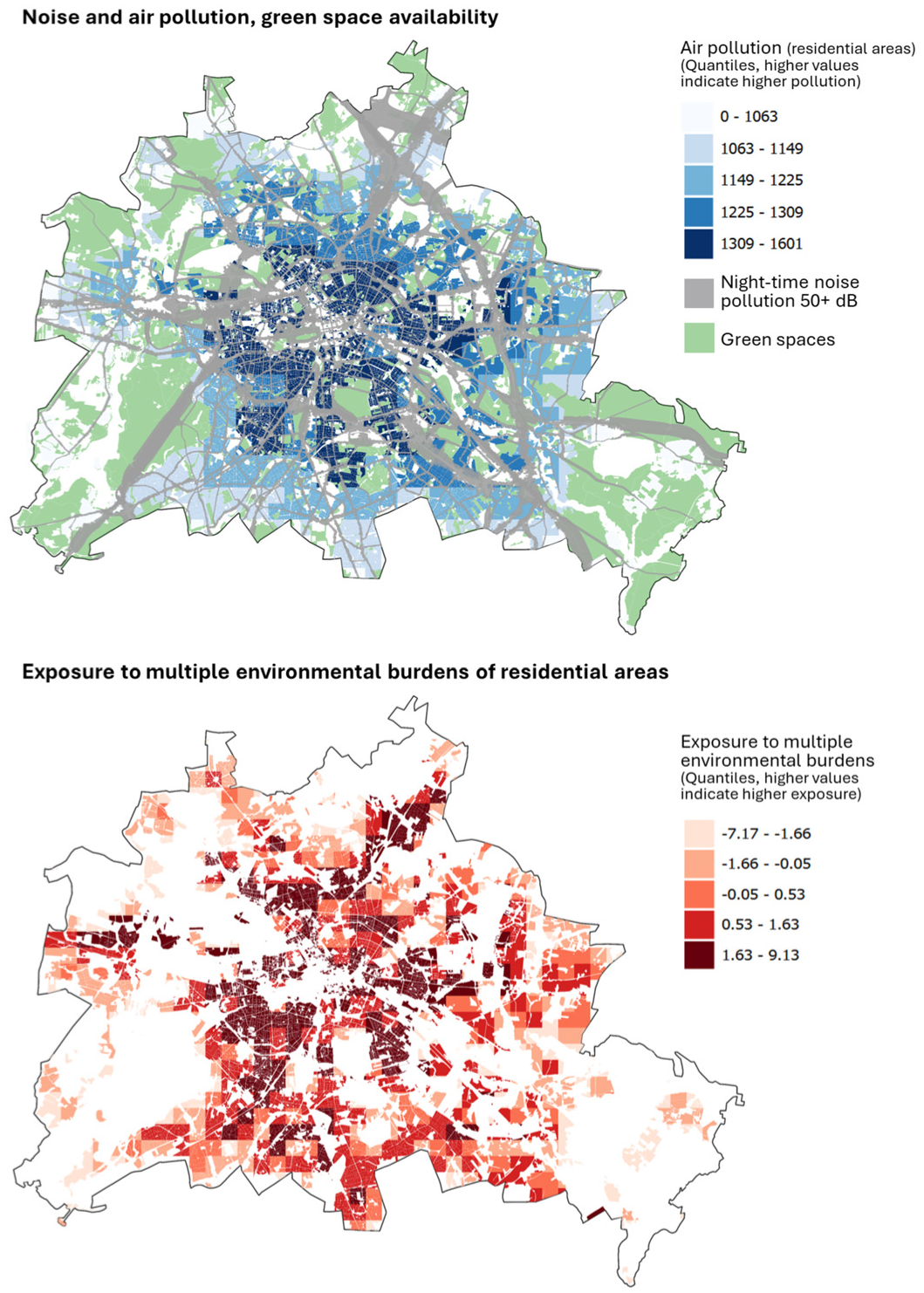
Environmental quality indicators mapped across Berlin.
City context (city-level)
To investigate the role of local contexts in shaping neighbourhood environmental inequalities, we enrich the grid-level data with a number of city-level context factors. In order to capture cities’ extent of ethnic and socio-economic residential segregation, we calculated the index of dissimilarity (Massey and Denton, 1988), defined as:

Where ai is the population of natives in a neighbourhood i, A the city-wide native population, bi the foreign minority population in a neighbourhood i, and B the city-wide foreign minority population. Index d is a value between 0 and 100 that indicates the proportion of the city’s population that must relocate in order to achieve an equal spatial distribution of foreign minorities and poor residents across a given city.
To measure residential centrality of foreign minority and poor residents, we use the city-wide correlation between the share of foreign minorities/poor residents and the grid population size. We thereby assume that grid population density is a reliable indicator of its centrality within a given city (Louf and Barthelemy, 2016). The scarcity of desirable neighbourhoods with low or non-existent environmental burdens is approximated using aggregated city-level measures of the various neighbourhood environmental quality indicators.
As macro-level control variables, we further include a city’s total population and population density and the city-level shares of poor and foreign minority residents when investigating the role of city-level contextual factors (see Section “Statistical approach”). Weighted descriptive statistics for all indicators at the grid and city level are found in Table S1 of the Online Supplemental Material.
Statistical approach
Spatial dependence, that is, the tendency that nearby units exhibit similar characteristics, tends to be a more serious methodological challenge with small-scale spatial data, like 1 km-by-1 km grid data, because an increasing number of spatial units for a given area may result in many observations clustered around local means. OLS regression models, assuming independence of observations, yield biased and inconsistent estimates when applied to spatially clustered data (LeSage and Pace, 2009). A common approach is to explicitly model spatial dependence by the inclusion of “spatial lags” (Anselin and Bera, 1998; LeSage and Pace, 2009).
To account for spatial dependence we employ Spatially Lagged X Models (SLX, Vega and Elhorst, 2015), which are defined as follows:
where
We study the link between residential environmental quality and sociodemographic neighbourhood composition. We treat the sociodemographic neighbourhood composition as dependent variables and environmental quality as independent variables for two reasons: theoretically, this follows a selective migration logic, whereas reversing the roles would imply a selective siting logic, which seems less plausible since many hazards (e.g., railways and roads) were established decades ago, if not longer, making neighbourhood sorting a likely explanation of contemporary environmental inequalities, despite the limitations of cross-sectional data. Practically, SLX models only adjust for spatial dependence from covariate spillovers—thus accounting for clustered environmental quality (i.e., air and noise pollution and footprints of green spaces not confined to single grids), but not for spatial autocorrelation in neighbourhood composition (e.g., caused by ethnic enclaves). Calculating the index of spatial autocorrelation (Moran’s I) for neighbourhood composition and environmental variables indicates that adjusting for spatial autocorrelation in environmental quality is particularly pressing—the air pollution and multiple environmental burdens indices are strongly autocorrelated (Moran’s I equal to 0.95 and 0.54, respectively), while other environmental quality and neighbourhood composition measures exhibit moderate degrees of spatial autocorrelation (see Figure S1 in the Online Supplemental Material).
Alternative spatial regression methods exist, some of which allow to incorporate different sources of spatial dependence (see Rüttenauer, 2023 for a recent overview), but SLX models offer three practical advantages: First, they are straightforward to estimate and can flexibly integrate standard procedures to clustering standard errors, weighting, and including city fixed effects. Second, SLX coefficients are interpretable like standard OLS coefficients, unlike those from Spatial Autoregressive (SAR) and Spatial Error Models (SEM). Third, SAR-like models require dropping non-missing grid cells surrounded by non-inhabited cells, because one cannot construct the spatial lag (contiguity criterion)—such “islands” are, however, substantively important (e.g., grid cells surrounded by large parks or lakes or located in predominantly industrial or commercial areas). SLX models allow us to retain these by calculating spatial lags for environmental quality based on all grids (including non-inhabited ones) before restricting the sample to inhabited grids (see Subsection C.2 of the Online Supplemental Material for more detail).
The analyses have three parts: First, we examine if disadvantaged social groups face lower neighbourhood environmental quality by running a series of SLX regressions pooling 1 km-by-1 km grid cells across cities, regressing the two dependent variables (share of foreign minorities, poverty rate) on each environmental quality measure (and its spatial lag) separately. To test if neighbourhood inequalities persist when restricting to within-city variation, we run SLX models including city fixed effects for each treatment-outcome pair. SLX regressions are weighted by total grid population. We estimate fully standardised coefficients with standard errors clustered at city level. To assess sensitivity to the spatial regression method, we additionally estimate a simpler model (no clustered SEs, no weights) for various spatial regression approaches (see Subsection C.3 of the Online Supplemental Material).
Second, we create city-specific grid cell subsamples and re-run the same SLX regressions to examine between-city differences in the extent of neighbourhood environmental inequality. Third, we assess whether these differences are explained by city-level contextual factors by regressing the city-specific environmental quality main coefficients from the SLX models on factors like city-level residential segregation, scarcity of clean/healthy neighbourhoods, and residential centrality via OLS. 7 Each type of city-level environmental inequality estimates (e.g., foreign minorities’ disproportionate noise exposure) is modelled separately, controlling for city size (log), city population density, and the poverty/foreign minority shares at the city level. Following King (1997), to account for uncertainty of first-stage (SLX) estimates, the second-stage OLS regressions are weighted by the inverse of the squared standard errors of the first-stage SLX estimates, giving greater weight to more precise estimates of city-level environmental inequalities.
Results
Social disparities in neighbourhood environmental quality
Neighbourhoods with higher poverty rates (
Results for H1a and H1b are based on data pooled across all German cities with at least 100,000 inhabitants. Figure 2 shows estimates of environmental inequality by neighbourhood poverty rates and foreign minority shares. As evident from the left column of Figure 2, we find no support for H1a. High-poverty neighbourhoods are not affected by poorer environmental quality. The estimated coefficients are small in magnitude and fail to reach statistical significance across all dimensions of environmental quality, with or without city fixed effects.
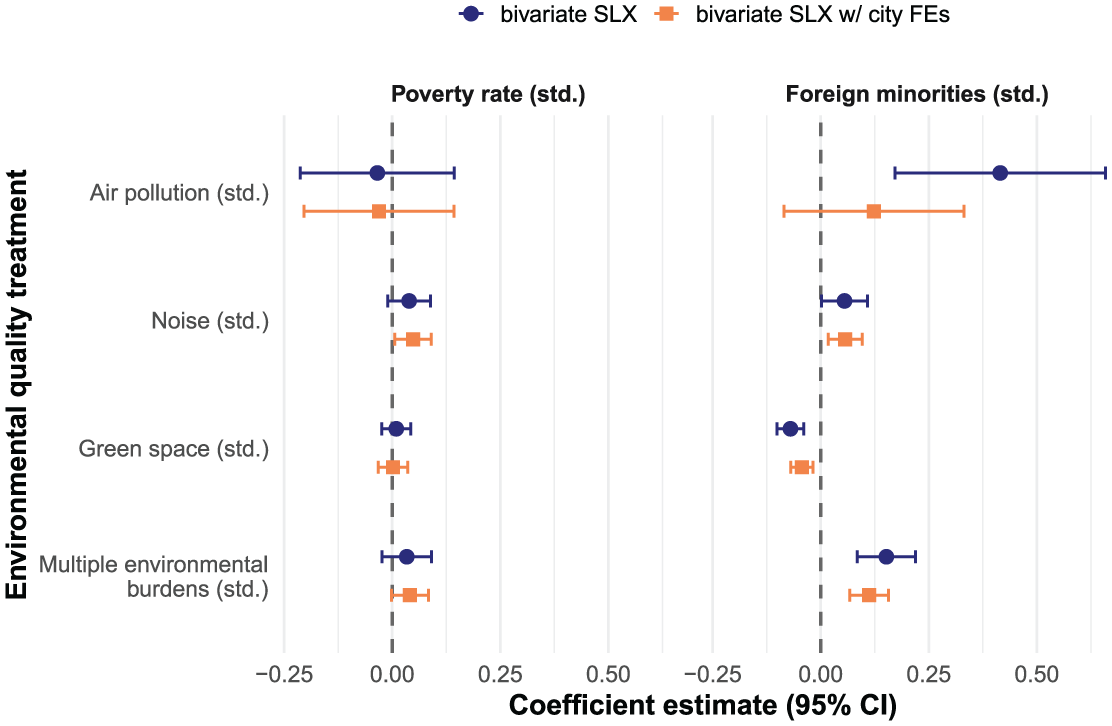
Link between indicators of environmental quality and grid-level shares of poor and foreign residents.
The right column presents results for foreign minorities. We do find a clear and consistent pattern of environmental neighbourhood disadvantage, supporting H1b. Based on the bivariate SLX model (without city-fixed effects), a one standard deviation increase in exposure to air pollution is linked to an increase in the share of foreign residents by 0.42 standard deviations (4.4 percentage points). Results in terms of noise exposure, green space availability, and exposure to multiple environmental burdens are more moderate in size but consistently indicate that foreign residents in German cities face poorer environmental conditions around their homes relative to the German majority population. The SLX main coefficient estimates indicate that a one standard deviation increase in exposure to noise, access to green space, and exposure to multiple environmental burdens are associated with a change in the foreign resident share by 0.02, −0.07, and 0.13 standard deviations respectively. This implies, for instance, that a one standard deviation increase in the index of environmental burdens is associated with an increase in the share of foreign minority residents by around 1.4 percentage points. Importantly, these disadvantages persist within cities, except for the air pollution estimate. The air pollution point estimate remains considerable in size when including city fixed effects but is no longer statistically significant. Due to the pretty coarse spatial scale of the original air pollution data, this should not be taken as evidence against within-city inequalities in air pollution exposure. Instead, the air pollution coefficients likely suffer from aggregation bias—smaller to mid-sized German cities often contain a relatively small number of these large grid cells that conceal small-scale inequalities.
The additional analyses with regard to the choice of SLX compared to other spatial regression models can be found in Figure S2 in the Online Supplemental Material. The key insight is that, overall, the coefficients of environmental quality in the focal unit are qualitatively similar, adding to the robustness of our results.
Differences in environmental inequality between cities
The extent of neighbourhood disadvantages experienced by foreign minorities and poor residents varies substantially across cities (
For the second part of the analyses examining between-city variation in environmental quality based on city-specific subsamples, we focus on the results for the index of multiple environmental burdens. The same set of results regarding social inequalities in exposure to air pollution and noise and green space availability are shown in Figures S3 to S8 in the Online Supplemental Material.
Figure 3(a) shows and maps the standardised, city-specific association between exposure to multiple environmental burdens and the poverty rate at the grid level (SLX main coefficient estimate). 8 Positive coefficient estimates (coloured in shades of red) indicate that neighbourhood grids with high poverty rates are disproportionately exposed to multiple environmental burdens in a given city. Negative coefficient estimates (coloured in shades of green) imply that poor residents tend to live in less exposed neighbourhoods.
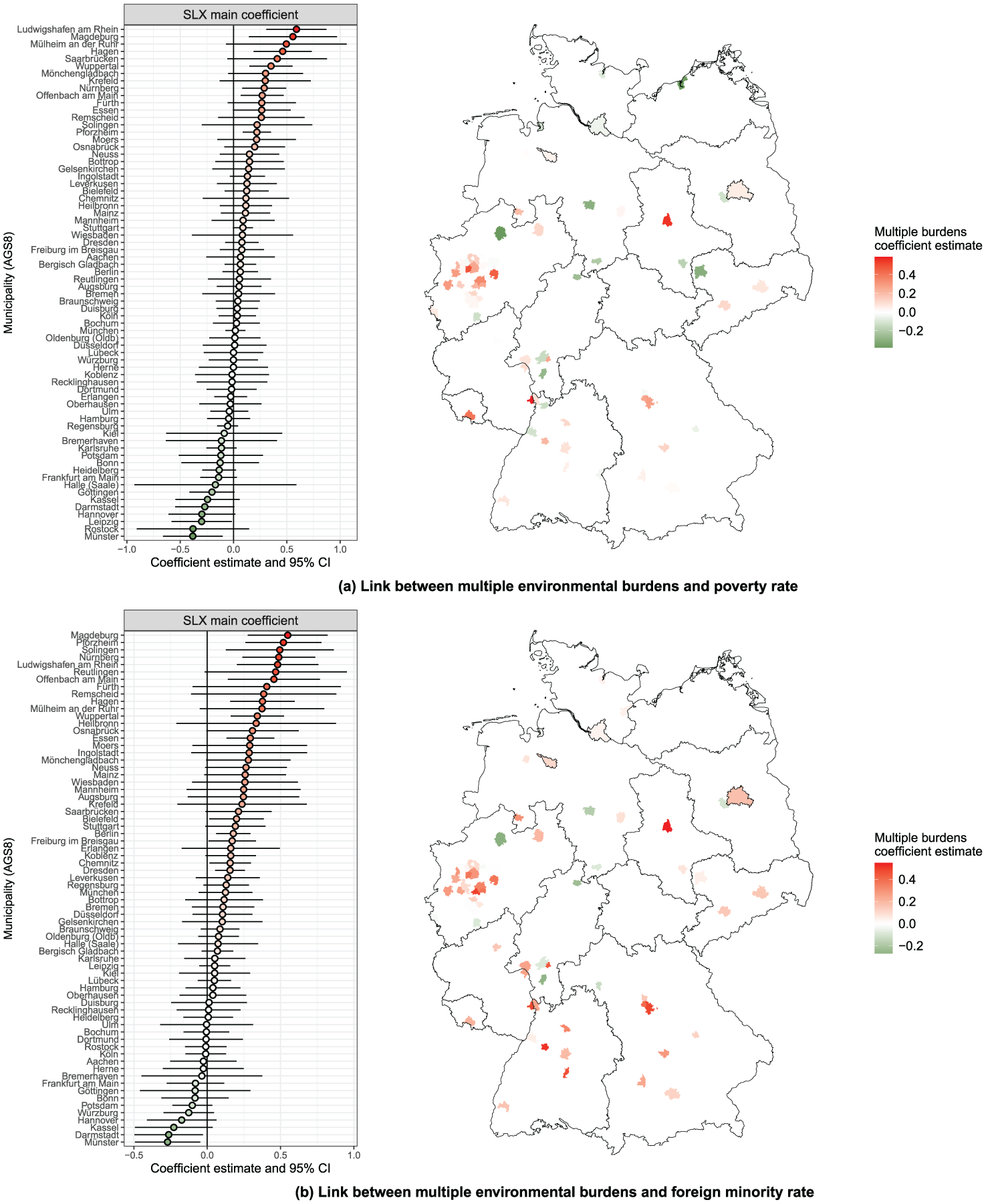
Link between exposure to multiple environmental burdens and neighbourhood poverty rates (a) and foreign minority rates (b) by city.
For the majority of cities, the estimate of environmental inequality in relation to poverty rates is close to zero or even negative. A few cities, mainly located in the west and south of Germany, are the exception and show pronounced positive associations between a grid’s exposure to multiple environmental burdens and the share of poor residents.
Figure 3(b) shows the same set of results for the share of foreign minorities. The extent of environmental inequality by minority status varies substantially between cities but shows a clear pattern overall: most German cities are characterised by environmental inequality to the detriment of foreign minorities, whereas there are only few cities in which minorities tend to live in neighbourhoods with equal or even better environmental quality.
These city subsample analyses reveal two key points: (i) supporting H2, neighbourhood (dis-)advantages for foreign minorities and poor residents vary greatly between cities, and (ii) consistent with results based on pooled data (Section “Social disparities in neighbourhood environmental quality”), environmental inequality is stronger and more consistent by citizenship than by economic resources. This variation in estimates of spatial inequalities offers a valuable examine how local contextual factors shape patterns of environmental inequality.
City-level contexts of environmental inequalities
Higher residential segregation of these groups is linked to greater exposure to environmental burdens (
We regressed the city-specific environmental inequality estimates from Section “Differences in environmental inequality between cities” (first stage) on city-level contextual variables to assess how they relate to environmental inequalities (Figure 4). We find that residential segregation, overall, does not seem to play a major role in the extent of urban environmental inequalities. Higher levels of residential segregation of poor residents are not associated with (more pronounced) neighbourhood environmental disadvantages of any kind. If anything, poor residents tend to reside in greener neighbourhoods in highly segregated cities (β = 0.03, p-value = 0.06). For foreign minorities, residential segregation is linked to particularly pronounced disadvantages in terms of noise exposure but unrelated to neighbourhood disparities in terms of air pollution exposure and green space availability.
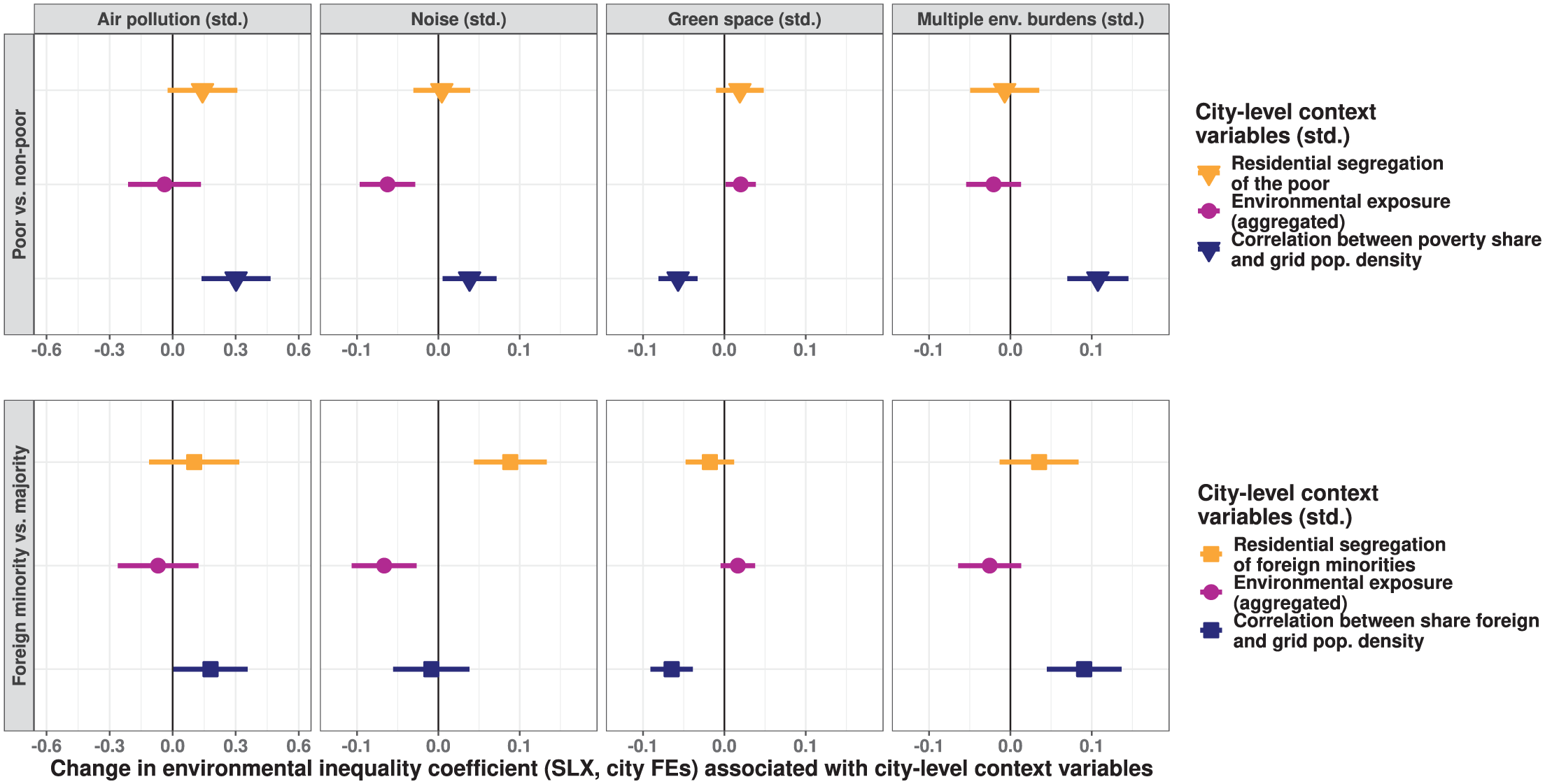
Link between SLX estimates of within-city environmental inequality and city-level contextual factors.
Environmental quality measures aggregated to the city level approximate a city’s scarcity of environmentally desirable neighbourhoods. As noted in Section “Differences in environmental inequality between cities”, positive coefficients for environmental bads indicate environmental disadvantages for marginalised groups, while in case of environmental goods such disadvantages are indicated by negative coefficients.
If scarcity of “clean” neighbourhoods increased environmental inequality, higher city-level exposure to environmental bads would, thus, correlate positively with inequality estimates. With regard to social disparities in noise exposure, the opposite is observed: the disproportionate exposure to noise for both poor and foreign minority residents tends to be lower in cities where noise exposure is a relatively common feature. We find no association between city-level air pollution and environmental inequality.
If scarcity of “green” neighbourhoods within a city was linked to more pronounced environmental inequality, increases in the city-level availability of green space (representing the opposite of scarcity) would again need to be positively linked to the city-level estimate of disparities in green space availability—the corresponding coefficient estimates in Figure 4 actually point in this direction, the one for foreign minorities fails to reach statistical significance though. All things considered, we find only partial support for H3b.
Finally, we examined if a group’s tendency to live in the city centre explains varying degrees of environmental inequality. Supporting H3c, we find strong evidence that residential centrality is linked to poorer residential environmental quality. It consistently predicts greater disadvantages for poor and foreign residents regarding air pollution, green space, and multiple environmental burdens—for poor residents it is also linked to higher disadvantages in noise exposure. Compared to residential segregation and the scarcity of “clean and green” neighbourhoods, a group’s residential centrality is a much stronger predictor of environmental disadvantages. Notably, densely populated areas tend to exhibit higher pollution levels simply because they are densely populated irrespective of their centrality. 9 To account for this, we replicated the analysis underlying Figure 4 using the distance from each neighbourhood’s centroid to the local city hall as an alternative centrality measure (see C.5 in the Online Supplemental Material). While this measure confirms our findings for green space and for multiple environmental burdens, it is not statistically significantly related to higher air pollution.
A levelling effect of gentrification on environmental inequality?
The preliminary conclusion on city contexts is that, in contrast to prior work from the US (e.g., Woo et al., 2019), socio-economic and ethnic residential segregation does not persistently explain variation in environmental inequalities across cities. Results on the scarcity of “clean and green” neighbourhoods are mixed: While green space disparities, if anything, tend to be slightly larger in cities with few green areas, scarcity of neighbourhoods not affected by noise correlates with lower levels of environmental inequality. The latter may be due to two factors: Either because a large city-level proportion of neighbourhoods affected by noise implies affectedness for a larger and more diverse group of residents; or because in competitive housing markets, it is not necessarily neighbourhoods with good environmental quality that are the most sought-after. Net of differences in the level of residential segregation, we found a group’s tendency to live in densely populated grids, usually located in the city centre, to be a strong and consistent city-level predictor of a group’s environmental neighbourhood disadvantages.
In what kind of cities, then, are poor and foreign residents mainly found in densely populated areas in the city centre? We believe that examining the processes of suburbanisation and gentrification that have historically and continue to influence neighbourhood inequality could prove an effective approach to this question. Poor environmental quality in city centres have prompted the development of post-war suburbanisation in numerous US metropolitan areas, with affluent and predominantly white populations relocating to suburban areas offering more living space and a buffer to industrial zones. While suburbanisation was less pronounced in European countries, the expansion of the knowledge-intensive service economy in many European cities including Germany in the 1990s has led to an increase in the number of highly educated individuals relocating to city centres (Tammaru et al., 2021; Viguié et al., 2023). This process of gentrification has since become a mass phenomenon in many high-income countries (Holm, 2014). The rate of gentrification likely varies depending on the presence of a knowledge-intensive service economy. Similarly, in competitive housing markets, there is a greater likelihood of social groups being displaced from city centres. Helbig (2023a) found that highly educated and high-income groups in Germany tend to cluster in the centres of university cities and large cities with populations of 500,000 or more.
Given the lower environmental quality of inner-city areas, we anticipate that the level of gentrification may be inversely related to environmental inequalities. To evaluate these exploratory claims, we calculated a measure of city-level gentrification. For each city, we calculated the grid-level correlation between the share of academics among the labour force population and population density, reflecting academics’ propensity to locate in central (densely populated) rather than peripheral grids within a city—a typical outcome of recent gentrification processes.
Figure 5 plots city-level disparities in the exposure to multiple environmental burdens by foreign minority shares against the gentrification levels. We observe mild or negligible environmental inequality in more gentrified German cities, whereas environmental disadvantages for foreign minorities are substantial in less gentrified cities, supporting an inverse relationship between dynamic processes of gentrification and environmental inequalities. Figure S8 in the Online Supplemental Material shows a very similar pattern with regard to poverty rates.
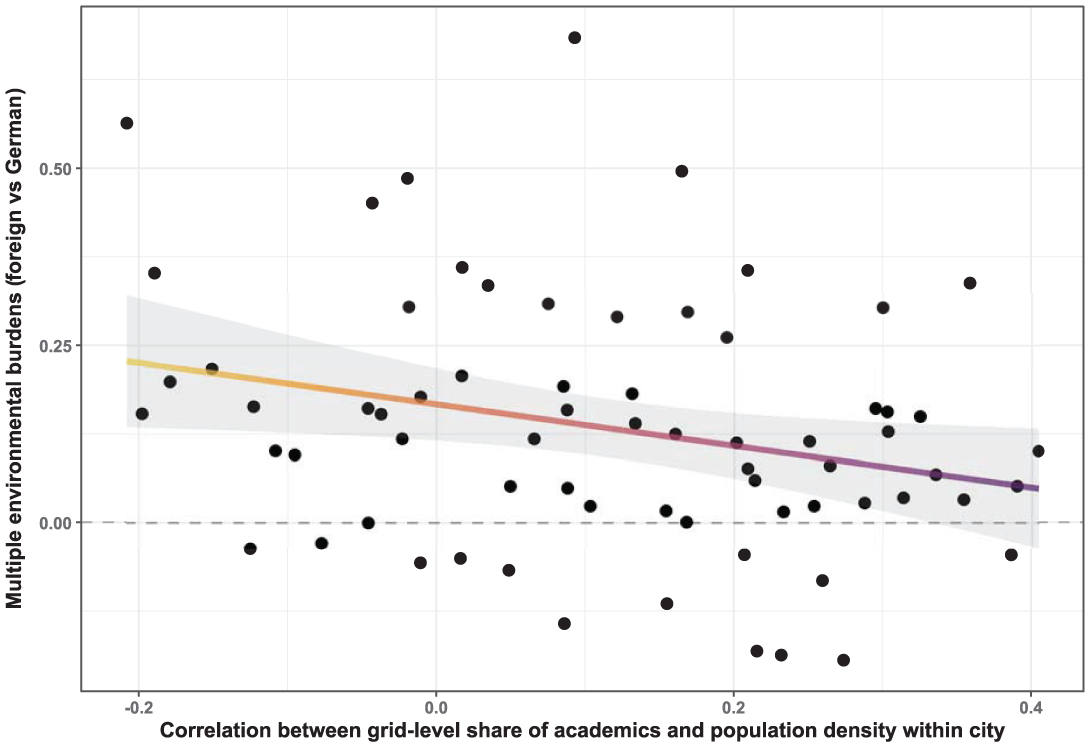
Association between environmental inequality by citizenship and gentrification at the city level.
Limitations
Estimates of spatial inequalities depend on the spatial scale of the underlying data, a challenge known as the Modifiable Areal Unit Problem. This can lead to ecological fallacies or aggregation bias. Using more fine-grained spatial data can reduce ecological bias by minimizing within-unit and increasing between-unit variation in exposures, confounders, and outcomes (Dark and Bram, 2007). In our study, this suggests that the detailed spatial units better capture actual neighbourhood conditions and group together more homogeneous resident groups. Still, ecological bias cannot be fully ruled out.
Discrimination may partly explain associations between neighbourhood shares of foreign minorities and environmental burdens. Ideally, data would also include naturalised citizens, as they may face housing market discrimination based on ethnicity. However, consistent data on migration background across cities was not available from the federal data provider. It remains unclear whether migrants’ environmental disadvantages align with those of non-German citizens.
Lastly, Federal Employment Agency data does not include information on poverty levels or foreigner shares at the grid level for residents over age 65. As environmental inequality among older adults may differ from that of younger groups, our findings should be interpreted with caution for this population.
Discussion and conclusion
This study examined environmental inequality in German cities by analysing whether poor residents and foreign minorities are more exposed to air and noise pollution, limited access to green space, and multiple environmental burdens (1). We also assessed variation in these exposures across cities (2) and investigated whether city-specific contextual factors—residential segregation, scarcity of desirable neighbourhoods, and residential centrality—account for regional differences in environmental inequalities (3). Finally, in light of our findings, we examined a potential equalizing effect of inner-city gentrification (4).
(1) Consistent with our hypothesis, we find that neighbourhoods with higher shares of foreign minorities are more exposed to air and noise pollution, have poorer access to green space, and face greater overall environmental burdens. However, we find no clear link between neighbourhood poverty rates and environmental burdens across the 69 German cities analysed.
(2) Estimating city-specific inequalities reveals considerable variation. Foreign minorities are more exposed to multiple environmental burdens in most cities, while poor residents face significant disadvantages only in a few cities, primarily in western and southern Germany.
(3) We hypothesised that residential segregation, limited availability of “clean and green” neighbourhoods, and neighbourhood centrality contribute to these differences between cities. We find that high levels of ethnic residential segregation increase the likelihood of minorities being disproportionately exposed to noise—extending earlier findings that showed no such link for industrial pollution (Rüttenauer, 2019). This points to potentially distinct mechanisms for different environmental stressors. Contrary to our hypothesis, we found no clear evidence that a scarcity of neighbourhoods with good environmental quality is generally associated with greater environmental inequalities. In fact, in the case of noise exposure, the opposite seems to be the case. Finally, neighbourhood centrality (whether measured via population density or proximity to the city hall) is linked to considerably greater disadvantages for both poor and foreign residents regarding green space access and overall environmental burdens, while higher population density is furthermore associated with higher air pollution.
A key finding of Rüttenauer’s (2019) multi-level analyses is that foreign minorities in cities with centrally located factories are particularly affected by industrial pollution, emphasizing the role of centrally located factories in environmental inequalities (implying that foreign minorities more often live in these areas). We, on the other hand, emphasise the role of minorities’ residential centrality (assuming generally lower environmental quality in these areas). The interpretations of the respective static results seem different at first, not least because of the use of environmental quality as a dependent or independent variable—but they show likely two sides of the same coin.
(4) Given the strong role of centrality in explaining environmental inequality across cities, we examined this relationship more closely, linking it to dynamic processes of gentrification. In cities with highly competitive housing markets, where well-educated residents are especially drawn to central neighbourhoods, the environmental quality of neighbourhoods inhabited by poor and foreign residents does not differ significantly from that of the majority population. This suggests that social and environmental inequalities may be temporary and shaped by stages of urban development. During the German Kaiserreich, many working-class districts were built near manufacturing plants—typically in the eastern parts of cities due to wind direction—while western areas saw the rise of bourgeois and villa neighbourhoods (Harlander and Kuhn, 2012; Heblich et al., 2021 for England). In the late 1960s and early 1970s, many West German cities experienced major demographic shifts, leading to the formation of immigrant neighbourhoods in inner-city areas with high concentrations of economically disadvantaged residents (Reinecke, 2012). Today, with the rise of a knowledge-based service economy, cities with large academic workforces are undergoing renewed transformation. This new wave of gentrification involves academics moving into central neighbourhoods, displacing earlier, less affluent residents.
Unlike early gentrification research (Glass, 1964), gentrification in inner-city neighbourhoods today is no longer limited to isolated areas but has become a widespread phenomenon in Germany and beyond (Holm, 2014). Rather than “islands of renewal in seas of decay”, many large cities now resemble “islands of decay in seas of renewal” (Holm, 2014: 277f). These differing rates of urban change across cities lead not only to varied patterns of social segregation and gentrification but also to differences in environmental inequality.
While the current wave of gentrification may help reduce environmental inequality, disadvantaged groups can still face negative consequences. Evidence from European cities shows that inner-city gentrification can reduce access to public transportation for low-income populations (e.g., Buettner et al., 2013; Sterzer, 2017; Viguié et al., 2023). In addition, affluent, well-educated newcomers may use their influence to improve local environmental quality—by shaping urban planning, promoting green initiatives, or supporting low-traffic zones (Aldred et al., 2021)—which may have unintended negative impacts on nearby neighbourhoods. The finding that gentrification might temporarily reduce environmental inequality and even support residential integration could be short-lived. If disadvantaged groups that were once concentrated in the centre are pushed to peripheral areas, this may increase future residential segregation and lead to new forms of selective siting in marginalised neighbourhoods.
Supplemental Material
sj-docx-1-usj-10.1177_00420980251412793 – Supplemental material for Understanding variation in neighbourhood environmental inequalities: The influence of residential segregation, gentrification, and other city-level factors
Supplemental material, sj-docx-1-usj-10.1177_00420980251412793 for Understanding variation in neighbourhood environmental inequalities: The influence of residential segregation, gentrification, and other city-level factors by Christian König, Katja Salomo and Marcel Helbig in Urban Studies
Footnotes
Acknowledgements
We thank Matthias Hintzsche and Stefan Feigenspan (Umweltbundesamt, UBA) for assistance in accessing UBA’s noise and air pollution data. Parts of this article were presented at a workshop on environmental inequalities at RPTU Kaiserslautern—we thank the attendees for their feedback. We are grateful to Urban Studies editor Scott Orford and to two anonymous reviewers for detailed, constructive feedback and for the timely handling of the manuscript.

Funding
The authors disclosed receipt of the following financial support for the research, authorship, and/or publication of this article: The open access publication was funded by the WZB Berlin Social Science Center.
Declaration of conflicting interests
The authors declared no potential conflicts of interest with respect to the research, authorship, and/or publication of this article.
Supplemental material
Supplemental material for this article is available online.
Notes
References
Supplementary Material
Please find the following supplemental material available below.
For Open Access articles published under a Creative Commons License, all supplemental material carries the same license as the article it is associated with.
For non-Open Access articles published, all supplemental material carries a non-exclusive license, and permission requests for re-use of supplemental material or any part of supplemental material shall be sent directly to the copyright owner as specified in the copyright notice associated with the article.
