




Abstract
Pressurised by commitments to climate targets and the volatility of fossil fuel prices, cities need to decarbonise their heating systems. However, promoting new ways of generating, recovering, storing and distributing heat from unconventional sources is a complex urban governance task that overarches several infrastructure domains. This article explores the governance challenges of transitioning urban heating towards increasingly hybrid systems built on other infrastructure domains and in which networks at different temperatures and scales are combined with off-grid solutions. Building on critiques of techno-solutionism and its promise of seamless fixes for sustainability issues, we focus on the governance frameworks designed to support technological solutions. We argue that urban governance innovations such as the devolution of key responsibilities, multi-infrastructure coordination or urban experimentation follow similar logics of solutionist thinking that underestimate their socioeconomic, political and spatial dimensions. Empirically, we investigate Amsterdam’s transition towards a new generation of heating infrastructures based on nexuses with urban data, electricity, water, wastewater and waste infrastructures. These purported multi-infrastructural solutions have been promoted through collaborative planning efforts, local heat visions and experiments. However, we expose key limitations of current urban governance approaches: these partially overlook conflicts of interest, local resistance and the ambivalent spatial and socioeconomic impacts of heating transitions. Equally problematic are the weak European and national regulation and limited institutionalisation of district heating, with local stakeholders relying primarily on experimentation and voluntary collaboration.
Introduction
Driven by climate policy pressures and geopolitical energy crises, European cities are increasingly called to lead the heating transition and to implement local heating and cooling plans. Increasingly, new heating solutions – the envisaged ‘next generation of district heating’ (Lund et al., 2018: 614) – have become attractive to urban energy and climate policy decision-makers and consultants. These new heating systems are based on heterogeneous technological solutions tailored to the spatially differentiated energy demands of individual neighbourhoods and buildings and locally available heat sources (Lund et al., 2018; Werner, 2017). Integral to this new generation of heating systems are multi-infrastructural ‘heat nexuses’: sociotechnical interfaces between heating and other infrastructure domains that could mobilise the potential of waste, electricity, data and water infrastructures to generate, recover, store and distribute heat in novel ways (Lygnerud et al., 2022; Nielsen et al., 2020). Multiple studies and policy and planning discourses have hailed them as win–win solutions exploiting synergies between various infrastructures. They could help phase out fossil fuels and pluralise heating solutions to deliver various co-benefits, such as a ‘least-cost transformation’ (Lund et al., 2018: 614) or more user-centred, collective infrastructures (Juwet, 2020).
The promotion of new multi-infrastructural heating systems often reflects techno-optimist or even ‘techno-solutionist’ approaches using more functional, efficient or sustainable technologies to fix complex environmental problems (see Morozov, 2013); this has leveraged experimentation in cities across Europe. However, moving beyond a mere ‘techno-solutionist’ mindset, there is growing consensus about the critical role of governance innovation in disseminating technological solutions and transforming infrastructures. These include a strong belief in the transformative governance capacity of cities, which can effectively manage sociotechnical transitions through nexus thinking and cross-sectoral policy coordination, strategic planning and urban experimentation.
The Netherlands is a prime example of this approach, as the decentralisation of key responsibilities in policymaking to municipalities and newly formed regions has intensified over the last 15 years (Denters, 2021; Groenleer and Hendriks, 2020). Dutch municipalities are expected not only to deliver public heating services and establish public heating companies but also to take responsibility for innovating heating systems through local experimentation, developing local heat visions and programmes, organising collaboration and consensus-building among multiple private and public stakeholders and neighbouring municipalities and managing and enforcing the shift from natural gas to net-zero systems (Devenish and Lockwood, 2024). The case of Amsterdam is particularly interesting because the municipality has adopted one of the country’s most ambitious heating visions, building on diverse nexuses with other infrastructure domains and on a multi-scalar approach tailored to sociospatial contexts and heating sources. However, a letter signed by over 800 municipal employees in 2022 pointed to severe implementation gaps in climate policy in one of the world’s most vulnerable metropolitan regions (Wagemakers and Hielkema, 2022).
Below, we elucidate the transition towards more distributed, multi-infrastructural heating systems in Amsterdam, highlighting the urban governance challenges accompanying the introduction of a new generation of heating infrastructures, which existing studies (e.g. Devenish and Lockwood, 2024; Fontaine and Rocher, 2021, 2024; Juwet, 2020) have largely overlooked. We ask: What are the urban governance approaches in promoting allegedly sustainable urban and infrastructural solutions and aligning stakeholders from multiple infrastructure domains? What frictions and conflicts arise when implementing this new generation of heating infrastructures? And what are the emerging geographies of the increasingly heterogeneous and localised heating systems? Our case study demonstrates that decision-makers have moved beyond mere techno-solutionism. However, heat governance suffers from what we call ‘urban governance solutionism’, whereby technological solutions are underpinned by governance innovations that underplay critical challenges, such as controversial alignments and power dynamics across sectors, redistributional impacts of heating transitions, unequal spatial impacts and structural limitations in the city’s capacity to lead the heating transition.
Data for this study were collected between 2020 and 2023 by analysing local and national policy documents and legislation, advisory reports, newspaper and online articles and secondary empirical literature. Additionally, we conducted 16 semi-structured expert interviews with heating transition decision-makers and consultants. Focusing on multi-infrastructural nexuses, we collected the data in three steps: firstly, we investigated local experiments, urban pilot projects or living labs at the interface of different infrastructure domains to understand the sociotechnical design and institutional and spatial contexts within which they are developed. This included interviewing project managers, advisors and spokespersons to gain insights into the heat nexuses and their governance challenges. Secondly, we analysed policy documents, legislative proposals, websites and position papers to better understand the multi-level governance context of urban heating transitions. Finally, we conducted semi-structured interviews with heating, electricity, waste and water companies, operators of data centres, municipal and provincial planners, policymakers and consultants to ascertain the relations between different infrastructure domains and the challenges of cross-sectoral governance. We selected interviewees with significant expertise and/or decision-making authority in developing infrastructural nexuses, who would reflect our proposed multi-infrastructural perspective on heating transitions. This perspective differs from that in more traditional studies of the governance of energy transition based on policy or institutional analyses (e.g. Devenish and Lockwood, 2024). Instead, we take a grounded theory approach guided by an understanding of how these emerging multi-infrastructure solutions work and their cross-sectoral challenges. The interviews, coding strategy and analysis considered the following: (1) materiality and technical design of the proposed nexuses; (2) spatial configurations of heating networks; (3) collaborative approaches across infrastructure domains; and (4) governance, institutional and regulatory contexts within which these nexuses should operate.
Below, we introduce current debates on re-engineering urban heating towards more distributed systems and multi-infrastructural solutions before discussing scholarship on the governance innovations in urban infrastructure transformations. In the empirical sections, we first present the decentralised arrangements of heating governance in the Netherlands and then focus on Amsterdam’s multi-sited approach to transforming its district heating system. Next, we present four heat nexuses (waste and wastewater to heat, power to heat, aquathermal energy and residual heat from data centres) and underpinning governance approaches promoted as heating solutions. In our discussion and conclusion, we highlight the governance challenges of the envisaged heating transition. We emphasise that the success of these solutions depends on overcoming a form of ‘urban governance solutionism’ that threatens to undermine the effective decarbonisation of heating systems.
Re-engineering urban heating systems and the rise of multi-infrastructural solutions
Although long overshadowed by debates on electricity systems, decarbonising the heating sector has recently become a primary concern in European and national energy policy and research. Heating and cooling accounted for half the total energy consumption in the EU in 2020 (European Environmental Agency (EEA), 2023) and renewables powered only 25% of heating and cooling in Europe in 2022 (Eurostat, 2024). As greenhouse gas (GHG) emissions from heating and cooling in private households and industry have decreased only moderately in recent decades, greater policy efforts are needed to achieve national and European climate commitments. Meanwhile, the European boycott of Russian gas imports since Russia’s invasion of Ukraine in 2022 has caused gas prices to soar and stoked a cost-of-living and inflation crisis, thereby increasing the urgency of finding alternatives to fossil fuels.
In discourses on the decarbonisation of heating systems, cities are increasingly considered critical drivers of sustainability solutions. Multiple studies have pointed to cities’ innovation capacity and their locational advantages in developing district heating networks and other collective solutions due to higher spatial densities of heat demand and residual heat sources (e.g. Hawkey et al., 2015). Decarbonising heating systems requires much greater direct involvement and political consent of local stakeholders and spatial coordination than electricity transitions (Devenish and Lockwood, 2024). The reason is that heating transitions must be tailored to various local factors, including the energy efficiency of the building stock, building density, the availability of local heat sources, physical conditions of storing and transporting thermal energy, institutional conditions and local energy network configurations (Hawkey et al., 2015; Wade et al., 2022). In line with this, the amended European Energy Efficiency Directive sees cities as ‘centres of economic activity, knowledge generation, innovation and new technologies’ and mandates cities with over 45,000 inhabitants to adopt local heating and cooling plans (Energy Efficiency Directive (EED), 2023: 9).
Despite this emphasis on cities’ role in innovating heating systems, heating transitions have only recently attracted more attention from urban scholars. Previous research (Hawkey et al., 2015; Summerton, 1994) improved understanding of how urban heating systems are spatially constituted and governed and demonstrated the need for spatially differentiated policy and planning approaches to thermal energy demand and provision (Devenish and Lockwood, 2024; Fontaine and Rocher, 2021, 2024; Herreras Martínez et al., 2022; Wade et al., 2022). However, those studies focused primarily on the rollout of high-temperature district heating networks, largely neglecting ideas of a ‘new generation of urban heating systems’ discussed in recent engineering literature and urban policy agendas.
The vision is to equip cities with heating and cooling networks that integrate renewable energy and residual heat from multiple sources and combine heat and power generation (see also EED, 2023). Together with tapping new energy resources, this requires new storage facilities and reducing the heating/cooling demand (EED, 2023; Lund et al., 2018; Werner, 2017). It is proposed to develop medium- and low-temperature networks tailored to the specific heating/cooling demands, built environments and available heat sources within each district. The role of low-temperature networks has been particularly emphasised, based on two assumptions: firstly, the demand for space heating will decrease in response to considerable investment in energy retrofitting and net-zero buildings; secondly, various low-temperature heat sources will feed into future heating networks. Complementarily, micro-grids and individual building installations (‘off-grid solutions’) such as solar thermal systems or heat pumps, new storage sources and the industrial use of hydrogen are projected either to complement heating networks or to replace them in specific localities (Lund et al., 2018; Lygnerud et al., 2019). Overall, heating systems are expected to become more composite in their technological design and tailored to spatial contexts.
Mobilising other infrastructure domains has thus been promoted as crucial for new ways of generating, recovering, distributing and storing heat (e.g. Lygnerud et al., 2022). The aspiration is a future heating system that ‘transcends technical systems’, enabling a ‘shift in paradigms away from single-sector thinking to a coherent energy systems understanding of how to benefit from the integration of all sectors and infrastructures’ (Lund et al., 2018: 614). These multi-infrastructural heat nexuses between heating systems and other infrastructure domains, such as waste incineration, electric heating, heat recovery from data centres and water systems and biogas production from wastewater, have been presented as win–win solutions for urban heating transitions (e.g. Lygnerud et al., 2022; Nielsen et al., 2020). Documenting their technical feasibility, environmental and economic advantages (Nielsen et al., 2020) and potential to close material and energy loops, these studies call for ‘integrated coordination’ across siloed infrastructure systems (Lund et al., 2018: 614).
Optimistic views on cities’ transformative potential have coevolved with enthusiasm for distributed, hybrid, multi-infrastructural heating systems. Imaginaries of these new-generation systems have been widely embraced by public and private actors and leveraged for extensive urban experimentation and piloting. As discussed below, the implementation and success of these techno-solutions often hinge on faith in governance innovations that can effectively promote a new generation of urban heating systems.
Innovating urban infrastructure governance for techno-solutions
Recent debates on the next generation of urban heating infrastructures reflect a techno-optimist conviction that the climate crisis and fossil fuel dependency can be effectively mitigated by promoting technological innovation and re-engineering infrastructures. Not only does this conviction reflect faith in new technology but debates actively pursue a ‘techno-solutionist’ agenda in which cities are to be (re)organised to make them amenable to the proposed technological solutions (Morozov, 2013; Sætra, 2023). Engineers, developers, consultancies and policymakers thus present and (re)define extremely complex and contentious infrastructure challenges as ‘solvable’ with advanced technology (Sætra, 2023).
While innovative technologies, such as those of new-generation heating infrastructures, might have promise, new technological solutions tend to introduce novel challenges. Critics argue that ‘techno-solutionist’ approaches often fail to address unintended sociospatial consequences of technological innovation and oversimplify infrastructural change, overlooking the ecological, institutional, spatial and political complexities inherent in sociotechnical change (Jaffe and Pilo, 2023; Monstadt and Coutard, 2019; Pilo, 2021; Sætra, 2023).
Mirroring such criticism, debates on sociotechnical transitions have broadened their focus from technological to governance innovations. Inspired by governance scholarship, the idea is that the successful transformation of infrastructures does not solely or even primarily rely on innovative technologies, but that their proliferation requires governance innovations through the adoption of novel institutional forms, approaches and techniques (Hölscher, 2019; McGuirk et al., 2022; Monstadt et al., 2022). Such governance innovation, McGuirk et al. (2022) argue, can entail purposefully unlocking new paradigms in institutions, laws, policies and financing and governance structures, enabling system change. Recent debates have highlighted four key ‘governance innovations’ that are believed to support the transformation of urban infrastructures and effectively sustain techno-solutions.
First, recent debates on sociotechnical transitions reflect a strong belief in the transformative power of cities and local governments (e.g. Luque-Ayala et al., 2018; Sareen and Waagsaether, 2023). Building on concerns that higher tiers of government are too slow or unresponsive to enact thorough change (McGuirk et al., 2022), cities have been positioned as strategic sites for developing transformative and prefigurative infrastructure governance (Russell, 2019; Rutherford, 2020). However, rather than seeing cities as inherently progressive or democratic, there is growing emphasis on innovating urban governance, enabling cities to shift from passive recipients of national policies into active participants and innovators who create, foster and implement sustainable infrastructure solutions (cf. Russell, 2019; Sareen and Waagsaether, 2023).
Second, ‘nexus thinking’ has emerged as a critique of ‘infrastructural siloism’, advocating stronger coordination across infrastructure domains to exploit synergies and manage or reduce trade-offs and conflicts (Artioli et al., 2017). This approach recognises the diverse ecological, technological, financial, operational and institutional interconnections and interdependencies between infrastructure domains, often overlooked in segmented, sector-orientated infrastructure governance (Monstadt and Coutard, 2019). Recent scholarship has thus emphasised the need for collaborative governance and inter-policy coordination to mobilise win–win solutions (for an overview: Monstadt and Coutard, 2019; Williams et al., 2019). However, as exploiting synergies between infrastructure domains can be at odds with bounded rationalities, conflicting interests and siloed institutional structures and policy frameworks, strategic boundary work and inter-policy coordination between across infrastructure have been discussed (Monstadt and Coutard, 2019). Furthermore, scholars stress that the transformative governance capacity of cities also hinges on their effective collaboration with neighbouring municipalities and regional stakeholders (e.g. Moss and Hüesker, 2019) and support from and interaction with national and supranational levels of government (Fontaine and Rocher, 2021).
Third, the ambition of introducing radical changes to address urgent sustainability challenges is often tempered by more incremental transformations that are poorly aligned with long-term visions and by the uncoordinated actions of multiple sectors and stakeholders. Sociotechnical imaginaries and guiding visions and strategic plans surrounding desired long-term infrastructural futures have thus become a key focus in studies on infrastructure change (Envall and Rohracher, 2023; Monstadt et al., 2022). By collectively opening up political conversations about infrastructural change through the collective design, visualisation and performance of ‘alternative’ urban futures, the idea is to mobilise urban actors and coordinate the dispersed agency of infrastructural change (Envall and Rohracher, 2023).
Fourth, urban experimentation in urban living labs, pilot projects or sociotechnical niches has gained interest as a way to test new technologies and collaborative governance models in real-world settings, stage purposive infrastructure interventions and learn what works in practice (Torrens and von Wirth, 2021). The idea is that collaborative experimental sites bring multi-sector actors together in catalytic spaces to trigger wider transitions beyond their immediate domain and induce transitions across urban infrastructure systems (McGuirk et al., 2022: 1396). Experimentation thus promises to facilitate complex infrastructural change by fostering learning and addressing uncertainties in multi-infrastructural transformations, helping to overcome path dependencies in established practices, institutional arrangements and vested interests within existing sociotechnical systems (Monstadt et al., 2022).
Overall, the assumption is that complex infrastructural challenges like fossil fuel dependency and climate crises can be effectively addressed through more sustainable technologies, whose promotion requires the deployment of innovative urban interventions, institutional reforms and robust urban policy frameworks. As we illustrate in our study on Amsterdam’s heating transition, techno-optimistic visions of future heating infrastructures are increasingly underpinned by a strong belief in specific governance solutions designed to support them.
Governing heating transitions in the Netherlands: Municipalisation, spatial planning and local experimentation
Since the 1990s, stagnating national climate policy regimes and policy shifts to voluntary agreements have resulted in the Netherlands falling behind in international climate policy (Zuidema and de Roo, 2015). A 2019 ruling by the Dutch Supreme Court thus forced the government to intensify and accelerate its climate action to meet international agreements. To achieve the climate targets, decarbonising the heating sector is crucial but is a major challenge for Dutch climate policy, as in 2019, 92% of households relied on natural gas for heating (Centraal Bureau voor de Statistiek (CBS), 2021), and the proportion relying on renewable energy for heating (7%) was the second lowest in the EU (Eurostat, 2024). Furthermore, the Dutch government wants 1 million new homes to be built by 2031, whose additional carbon footprint will have to be compensated for. Meanwhile, the decision to terminate domestic gas extraction in Groningen province to mitigate extraction-induced earthquakes has increased dependence on costly gas imports. This precarious reliance on natural gas has been exacerbated since the 2022 invasion of Ukraine: the Dutch government’s energy price cap to protect residents and the economy from soaring prices due to the boycott of Russian gas was expected to cost around €23.5 billion for 2022 and 2023 (Rijksoverheid, 2022). Although heating markets, other than electricity or gas markets, are not harmonised by EU law, recent regulatory initiatives have intensified the pressure to decarbonise national heating systems. For example, the European Directives on Energy Efficiency and on the Energy Performance of Buildings set stricter energy efficiency targets for buildings, requirements for energy retrofitting and mandatory local heating and cooling plans for cities with over 45,000 inhabitants.
To achieve the binding GHG emission reduction targets of European Effort Sharing Regulations, the Dutch government has ramped up its efforts to decarbonise the heating sector. The Climate Law of 2019 aims to reduce national GHG emissions by 49% by 2030 and by 95% by 2050, compared to 1990 levels, while seismic activity causing extensive damage to buildings led to legislation to permanently shut the Groningen gas field in October 2024 and to completely phase out natural gas by 2050 (Ministerie van Economische Zaken en Klimaat (EZK), 2019). To operationalise the decarbonisation targets, a National Climate Agreement (Klimaatakkoord) has been co-developed with multiple stakeholders. Among others, it formulates pathways towards replacing natural gas: from 2025 onwards, an annual average of at least 80,000 homes should be connected to collective heat networks fed by sustainable heating sources, including geothermal and aquathermal heat, residual heat from industries and data centres, green electricity and new storage facilities (Ministerie van Economische Zaken en Klimaat (EZK), 2019: 37f.). Moreover, 1.5 million residential units are to be retrofitted by 2030 (Ministerie van Economische Zaken en Klimaat (EZK), 2020: 32) and zero-energy new builds will be promoted. Since 2018, new buildings must not be connected to the gas grid. The primary responsibilities for planning and implementing the heating transition have been devolved to the municipalities operating at multiple scales.
To facilitate and support the municipal governance of heating transitions, the national government has set up two national platforms: in the Heating Expertise Center (Expertise Centrum Warmte), multiple stakeholders (representatives of national ministries, provinces, municipalities and energy and building companies) collaborate to develop guidelines for municipal heat planning. A Natural-Gas-Free Neighbourhoods Programme (Programma Aardgasvrije Wijken) supports the experimentation and exchange of best practices and knowledge. It builds on 64 selected pilot neighbourhoods used as living labs for experimenting with various technologies and strategies towards alternative heating solutions. An associated knowledge and learning programme gathers and disseminates valuable information on best practices. This learning-by-doing approach is intended to support municipalities in building new knowledge, expertise and competencies and to identify the most effective approaches for decarbonisation. Both platforms are supported by national funding programmes for local living labs, for buying external expertise or internal hiring and for energy retrofitting in gas-free neighbourhoods (Devenish and Lockwood, 2024).
The national government has designated 30 energy regions as a new spatial/policy scale for collaboration between neighbouring municipalities, waterboards, provincial governments and private and civil society actors. Between 2019 and 2020, each region had to develop a regional energy strategy, a policy instrument translating national objectives into regional action and guiding inter-municipal energy policies. Among others, regional actors had to identify sustainable heat sources, map heat demand and supply in the region and explore opportunities for heat infrastructures spanning several municipalities (van Dijk et al., 2022). The regional cooperation functions primarily as a platform for agenda setting; critical responsibilities for changing heating systems rest with individual municipalities.
Complementarily, all municipalities had to develop heating transition visions (Transitievisies Warmte) before 2022 that specify how and in which timeframe they plan to decarbonise heat supply and insulate buildings in each neighbourhood for the least cost. These visions build on neighbourhood implementation plans (Wijkuitvoeringsplannen) formulating district-based strategies for phasing out natural gas. These plans are co-developed by municipalities, local homeowners and tenants, network operators, heat companies and other stakeholders and provide a framework for investment decisions.
After years of heated debate, the House of Representatives passed the Municipal Heat Transition Instruments Act (Wet Gemeentelijke Instrumenten Warmtetransitie– WGIW) in June 2024, which is expected to enter into force in July 2025 after the Senate’s approval. The WGIW requires municipalities to develop heating programmes by 2026 and update them every five years. Through rules in their environmental plan (Omgevingsplan), municipalities ultimately determine when and how individual districts will be disconnected from natural gas and which sustainable alternative will replace it. Building owners can choose from various sustainable alternatives. The complementary Collective Heat Act (Wet Collectieve Warmte– WCW) is at an advanced stage in parliamentary consultations. It is expected to strengthen municipal control over the heating transition and requires municipalities to demarcate ‘heat plots’ (warmtekavel) in which most users must be connected to a collective heating system. Except in certain cases, designated heating companies must be in majority public ownership. Based on concrete agreements between municipalities and heat providers, 20–30-year concessions will be awarded, assigning integral responsibility for the construction, management and maintenance of the collective heat transport and distribution to the public concessionaire. 1
However, the mandatory public ownership has raised considerable criticism, and the adoption of the WCW is uncertain – not least because of the shift towards a far-right populist government in July 2024. Energie-Nederland (2023), the association of the Dutch energy industry, argues that the municipalisation interferes with their property rights, restricts the mobilisation of private capital urgently needed for investments in outdated infrastructures and increases prices, and it considers municipalities lack the knowledge needed to operate high-tech infrastructures (see also PricewaterhouseCoopers International, 2022). While such resistance is not surprising, uncertainty about the legal framework guiding future heating markets continues to retard the heating transition: public utilities have not yet been established, and commercial energy companies have suspended their investments (Interviews 15 and 16).
Overall, the expected legal reforms will consolidate decentralised heating transition governance tailored to neighbourhoods’ spatial contexts. As with other policy domains (Denters, 2021), the national government facilitates inter-municipal knowledge exchange, experimentation and learning by doing and stimulating urban policy innovations by providing guidelines and funding. Furthermore, it aims to enhance local planning power through public ownership of heat companies. Thus, the heating transition depends on municipalities’ governance capacity, following Dutch traditions of cooperative policymaking, consensus-building and ‘polder politics’ as a ‘deliberative process of give and take’ (Groenleer and Hendriks, 2020: 200).
Below, we examine Amsterdam’s approach to municipal heating transition governance, focusing on cross-domain technological solutions.
The search for sustainable heat sources: Nexusing heating infrastructures in Amsterdam
Amsterdam municipality can be considered a frontrunner in experimenting with increasingly heterogeneous heating systems and new nexuses between the heating system and other infrastructure domains. It has adopted a more ambitious timeframe than instructed by the central government – aiming to decarbonise its heating systems by 2040 rather than 2050 – and was the first Dutch municipality to have completed its ‘heat transition vision’ (Gemeente Amsterdam, 2020a). Its strategy is to increase the coverage of collective heating systems through heterogeneous options, as it considers that there are ‘no one-size-fits-all solutions’ (Gemeente Amsterdam, n.d.).
The plan is to expand and complement existing district heating networks through new decentralised networks by dividing the municipality into network areas, for which concessions with one or several public providers must be granted (Gemeente Amsterdam, 2020a). Fourteen per cent of the total heat demand (c. 110,000 residential units) is planned to switch to all-electric heating systems. Another 113,000 units will eventually be supplied with green gas or hydrogen via the former natural gas grid. About 102,000 units are already connected to one of the two existing high-temperature heating networks, which are currently fed by a Combined Heat and Power (CHP) waste incineration plant and a gas power plant that is to switch to renewable fuel sources. A further 248,000 units (31%) are to be connected to a high-temperature network. Low-temperature networks based on different local sources will be built in urban development and transformation areas for 85,000 residential units (10%). Finally, 18% of the residents (152,000 units) will be served by more decentralised networks that source local resources and use off-grid solutions within individual buildings (Gemeente Amsterdam, 2020a; see Figure 1).
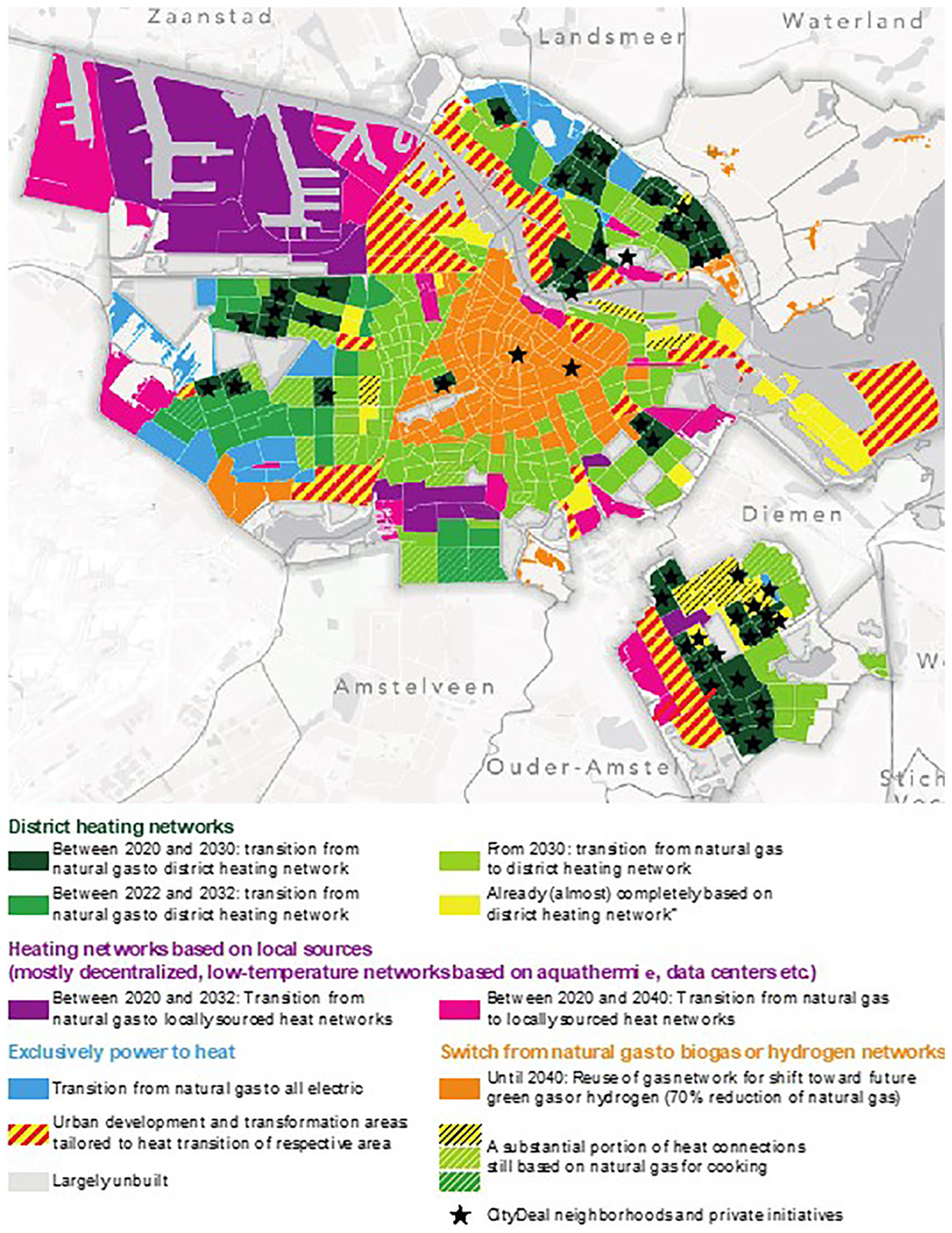
The Amsterdam heat transition map (own figure based on Gemeente Amsterdam, 2020a: 7).
Whereas the municipality formulates its preferences regarding the heating system and potential heat sources within each heat district and can emphasise these in its negotiations on concession contracts, the respective public heating concessionaires are responsible for defining the heat sources, building and operating networks, etc. However, the national and municipal governments use different instruments to encourage heating companies to adopt sustainable heat sources. Thus, Amsterdam municipal council has made it mandatory for newly constructed neighbourhoods to be connected to low-temperature networks, as they are more suitable to be supplied from unconventional sources (Gemeente Amsterdam, 2020c). Apart from developing district heating networks at different scales and temperatures, one of the key challenges remains the search for sustainable heat sources to replace natural gas. As discussed below, multi-infrastructural solutions are being explored at different scales to replace natural gas as the dominant heating source.
Waste and wastewater to heat
Most of the 102,000 households connected to high-temperature heat networks are supplied by Vattenfall’s gas-fired CHP plant in Diemen (see below) but 30,000 are supplied by waste incineration (Niemantsverdriet, 2019) via the heating company Westpoort Warmte. The incineration of municipal waste in Amsterdam has been controversial for many decades due to concerns about air pollution, the undermining of waste recycling and prevention goals, mismanagement and the financial debacle of the municipally owned waste energy company AEB (Niemantsverdriet, 2019; Savini, 2021). Built to become one of the most efficient waste incinerators in the world and a goldmine for the municipality, the AEB’s incinerators process Amsterdam’s and the region’s combustible residual and industrial waste and sludge from Amsterdam’s sewage treatment plant. However, they rely on solid waste imports from abroad to utilise the plants to capacity and operate cost-efficiently (Savini, 2021). Since its expansion in 2006, an adjoining new sewage treatment plant serving 1 million inhabitants has also been generating biogas from sewage sludge digestion. More recently, Waternet Amsterdam has installed a biogas upgrade at the wastewater treatment plant, which converts biogas into biomethane. Initially, biomethane was to replace natural gas for residential heating, but it now fuels vehicles and garbage trucks. Finally, Vattenfall plans to build a large 100 MWth biomass plant fuelled by wood-processing waste. However, Vattenfall has shelved its plans because of controversy about the plant’s sustainability.
As the most common heat nexus, waste-to-energy has long been promoted as a sustainability fix: it supplies stable power and heat 24/7 and is a reliable base load for electricity and heat grids. Concomitantly, it delivers ‘renewable’ high-temperature heat cheaply and is thus envisaged to supply inner-city areas, whose buildings’ energy efficiency is low. Since advanced end-of-pipe technology averts the uncontrolled emission of toxic pollutants, it is also regarded as a safe method of waste treatment. However, Amsterdam municipality’s major investments in waste incineration are also undermining Amsterdam’s circularity strategy (Gemeente Amsterdam, 2020b; Savini, 2021), as they disincentivise the promotion of waste prevention, reuse and recycling but stimulate long-distance waste imports that generate GHG emissions.
Given the limited success of recycling and prevention campaigns and technical restrictions, local utility companies foresee no feasible and short-term alternative to waste incineration (Interviews 3 and 9). However, combustible waste volumes are expected to shrink in the longer term, which puts incineration companies at financial risk and limits their future potential for low-carbon heating (Gemeente Amsterdam, 2020b; Savini, 2021).
AEB’s severe financial and managerial crises and its envisaged sale to Rotterdam’s waste company raise questions about its future role in Amsterdam’s heating transition. In 2019, after fires at the plant caused by inadequate maintenance, the regulatory authorities shut down four of the six incinerators, reducing AEB’s processing capacity by 70%. As a result, the 11 other Dutch waste incineration plants had to treat Amsterdam’s waste, and the municipality had to cover the substantial costs for the AEB. Since 30,000 residents depended on ‘renewable’ district heating, the AEB had to install emergency diesel generators as the least sustainable heating option (Niemantsverdriet, 2019).
Electric heating options
Amsterdam’s plans to decarbonise heating infrastructures will significantly affect the electricity grid. Urban electricity demands are rocketing, not only because of the transition from natural gas to electric heating but also in response to the simultaneous shift to electric mobility, the growth of data centres and the burgeoning installation of air conditioning systems. This translates into major challenges for Amsterdam’s distribution grid operator Liander, whose grid capacity is already strained (Liander, 2020). It also pressures power producers to overcome the country’s huge backlog in renewable electricity generation despite the considerable locational conflicts in extending renewable energy capacity in this densely populated country. Significant grid capacity challenges arise, particularly in areas where heating systems are planned to become all-electric. While the emergence of new heat sources (residual heat, aquathermal energy, etc.) could mitigate electricity demands and reduce the challenges for Amsterdam’s strained distribution grid (Interviews 1 and 7), electricity-fed heat pumps will be required for low-temperature networks.
Despite this, the distribution grid operator Liander has no legal mandate in the heating domain, yet heating choices heavily impact future distribution grids and potentially compete with the electrification of mobility. Heating companies are responsible for choosing the heat source for their network, and Liander must align its grid capacity accordingly. However, upgrading Lander’s grid capacity is not merely a question of making considerable investments; there are also severe challenges to overcome: the available subterranean space for network expansion and land for substations are scarce, and grid extensions depend on the municipality, which permits and controls new installations (Interviews 1 and 9). Planning and approval procedures for network extensions often take several years, partly because they must also be coordinated with district heating and other network operators to avoid recurrent construction works. Albeit heavily affected, Liander’s ability to shape the heating transition pathway and cushion undesirable impacts on electricity grids largely depends on providing relevant data on grid capacity to decision-makers in other utility companies, the municipality, housing corporations, etc., and on coordinating with and advising them (Interview 7).
Load management presents additional challenges because electricity and heat demand have similar load curves (with demand peaks in the mornings/evenings and winter), and the availability of renewable electricity fluctuates. As a proposed solution, Vattenfall initially planned to build a 100 MWth ‘electric boiler’ in Diemen that stores heat and is fuelled by renewable electricity in periods of surplus solar and wind electricity and low prices. However, although the plant is almost constructed, its operation has become highly uncertain. In June 2024, Vattenfall announced that the skyrocketing fees of the transmission grid operator have made the boiler uneconomical, and further investments have been put on hold (Van de Weijer, 2024).
Aquathermal energy
Aquathermal energy is considered a sustainable source for future heating and cooling systems, as water sources are abundant in the Netherlands. Technologically, surface water, wastewater and drinking water can be used to extract thermal energy with a heat exchanger. A heat pump converts this heat to the desired temperature for heating and hot tap water. Often, aquathermal energy is combined with seasonal storage. Although the first Dutch business cases were developed in the late 2000s, aquathermal energy has only recently attracted interest from heating companies, as low-temperature heating networks have become more important. In 2019, a national ‘green deal on aquathermal energy use’ was signed by several national ministries, water associations, research partners and heating and water utilities (Netwerk Aquathermie, 2019). The resulting Network Aquathermal Energy (Netwerk Aquathermie) is intended to spur its innovation and market development and accelerate the heating transition. Aquathermal systems have since been recognised as viable heat sources in the National Climate Agreement and benefit from national subsidies.
In Amsterdam, Waternet, the local water utility, anticipates that aquathermal networks could service 60% of residential units with heat (Waternet, 2023) and so has engaged in creating national awareness of and political support for the development of aquathermal energy. Currently, five small-scale aquathermal networks are operational in different residential and commercial districts, and various business cases are being developed (Waternet, 2023). However, Waternet, heating companies and housing corporations are still experimenting to gain experience and scale up aquathermal energy for broader dissemination (Interview 5). There are considerable governance challenges to overcome. Firstly, Waternet does not have the mandate to diversify into the heating market. Changing mandates would need approval from the municipality and the regional water boards (responsible for managing surface water), as well as national legislation. This also applies to the tariffs, where cross-subsidisation across domains is not allowed: One of the challenges we are confronted with is how finances are regulated as a water company. The drinking water tariff we can only spend on drinking water. The sewage tax we can only spend on sewage. So, in fact, we have no financial means to develop this [aquathermal energy]. (Interview 8)
Secondly, Waternet lacks designated funds to build and operate heating networks (Interviews 8, 10 and 11). Building aquathermal networks requires major initial investments, which are difficult to recover in markets where aquathermal energy competes with amortised gas infrastructures: Technology is often not the issue. The challenge is the governance. How to organize it? Who is responsible? It also very strongly relates to affordability—natural gas is, in fact, a relatively cheap way of heating and a system that already exists in housing. So, implementing a sustainable alternative is, by definition, more expensive. The idea is that a sustainable alternative should have a return on investment, but the question is what timeframe is acceptable. (Interview 11)
Thirdly, as this heat source is still experimental, the institutional and legal frameworks to support aquathermal energy and define the frameworks for viable business cases are as-yet inadequate (Buijze et al., 2023). Fourthly, aquathermal energy’s applicability is mostly limited to neighbourhoods with low-energy buildings and low-temperature networks, but these are not widespread. Finally, its sustainability depends on a sufficient supply of renewable electricity and grid capacity to fuel complementary heat pumps.
Residual heat from data centres
The Internet and ‘cloud services’ are supported by massive material data infrastructures (Furlong, 2021). In Amsterdam, data centres powering the digital economy and multiple tech services have long benefitted from ‘smart city’ initiatives and have operated below the radar of local energy and land-use policies. However, their expanding spatial and environmental footprint has become controversial in Amsterdam’s energy transition (Monstadt and Saltzman, 2025). The metropolitan region aspires to become the ‘digital gateway to Europe’ through major internet exchange nodes and its more than 100 data centres. With expected annual growth rates of 6.5% (Dutch Data Center Association (DDA), 2021a), investment in digital infrastructure has become a significant economic factor for the Netherlands. But data centres’ electricity consumption is huge: in 2021, the electricity demand in Noord-Holland province was equivalent to that of approximately 630,000 households and is expected to increase considerably (Alliander, 2021).
Although the distribution grids in the urban region have reached capacity, for a long time data centre operators could not be refused a building permit in business zones if they met building regulations. The city of Amsterdam, alongside grid operators Liander and Tennet, raised concerns that data centres’ demands on power grid capacity and their land requirements have been spiralling out of control (Monstadt and Saltzman, 2025). A one-year moratorium was imposed in 2019 and made permanent in 2023, defining more restrictive data centre policies (Gemeente Amsterdam, 2020d).
As data centre growth cannot be adequately controlled via zoning regulations, the municipality has adopted new policies. New centres must recover residual heat and feed it into decentralised low-temperature heating networks for use in nearby households, offices and other facilities. Agreements on using residual heat must be stipulated in contracts between operators of data centres and heat network operators. In recent years, there have been collaborative pilot projects, for example to heat 1300 student homes or a swimming pool (DDA, 2021b). Data centres are framed as sustainable heat sources because they provide non-fluctuating heat and many rely on renewable electricity. However, there are many restrictions. Their residual heat tends to be 30–40°C, which is too low for conventional applications (Wahlroos et al., 2018: 1754). Heat pumps can be used to raise these temperatures, but this requires electricity from the already strained power grids and is expensive. Although the moratorium requires new data centres to be connected to a residual heat network, the required subterranean low-temperature network has not yet been built, and its construction faces challenges because accessible underground space is scarce (Interview 14). Furthermore, low-temperature heat networks are only suitable for low-energy neighbourhoods, which must be near the data centre to mitigate energy losses. The question is, thus, how to spatially plan data centres so that they align with the limited capacity of power grids and are sited close to neighbourhoods suitable for low-temperature heating. Moreover, it remains unclear who will be responsible for building such a network and taking on the associated risks (Interviews 11 and 12): [The municipality] can allow it [the network], but then the question arises who should pay for a network fed with residual heat, so, if you let it be built by a third party, that party must have some assurances that it can make a feasible business case. (Interview 12)
From techno- to urban governance solutionism?
Amsterdam can be considered a pioneer in experimenting with new multi-infrastructural solutions, shifting from single-sector thinking to a ‘system of systems’ approach. Going beyond a techno-solutionist approach, heat governance builds on significant collaborative efforts from various infrastructure providers, municipal authorities and – at least at the neighbourhood level – users to test each sociotechnical configuration’s technical feasibility and economic marketability. However, the promotion of this new heating system is based on what we call ‘urban governance solutionism’, characterised by two interrelated tendencies: firstly, it aims to tackle complex societal challenges through technological fixes, by advancing new ways of generating, recovering, storing and distributing heat from unconventional sources; secondly, it is shaped by the assumption that municipalities can effectively promote those technological solutions by deploying a set of innovative planning interventions, institutional reforms and robust policy frameworks that facilitate heat governance. However, as shown below, this approach fails to address key governance challenges resulting from redistributive socioeconomic and spatial impacts of heating transitions, the political contestation of the proposed solutions and the increasing heterogeneity of urban energy landscapes.
Although supposed to guide the heating transition, municipalities have limited resources to convince or enforce local actors to invest in heat transformations, confirming recent concerns about the limited regulatory efforts by national and European policies and an overreliance on the transformative power of cities and local governments (Groenleer and Hendriks, 2020; Herreras Martínez et al., 2022; Martens et al., 2024). Major uncertainties remain about whether pending national heat legislation to incentivise larger investments into heating networks will close significant regulatory gaps. For instance, heat providers and municipalities are left in the dark about future ownership regulations, so commercial infrastructure providers have withdrawn or shelved investment plans. Meanwhile, no municipal or national heat network operators with the institutional capacity, knowledge and financial resources to build and operate heterogeneous heating systems have yet been established – this may take years and further delay the heating transition.
Limitations to municipal heat governance also arise from the inability to mandate connections to district heating (Gemeente Amsterdam, 2020c; Herreras Martínez et al., 2022), creating uncertainty about cost recovery for heat (co-)providers. While the expected Municipal Heat Transition Instruments Act will empower municipalities to terminate gas supply in designated neighbourhoods, their political power to enforce district heating remains questionable, especially as rising tariffs have led housing associations in Amsterdam and other Dutch cities to withdraw from the system. Hence, public acceptance of the heating transition is low due to high costs (particularly for low-income households), uncertainties about future pricing and cost disparities between districts – challenges requiring greater financial and regulatory support from national and European policies (Martens et al., 2024).
The municipality also has limited influence over the investment decisions of building owners on energy retrofitting which should reduce Amsterdam’s gas consumption by a fifth (Gemeente Amsterdam, 2020c: 25). Large-scale retrofitting is labour intensive, is expensive, takes a lot of time and grapples with cost increases in insulation material and a shortage of qualified labour (Herreras Martínez et al., 2022). Thus, it may be difficult to convince owners of low-energy houses to connect to district heating since heat pumps provide a cheaper solution (Späth and Rohracher, 2015). The envisaged rollout of district heating networks – as the precondition for using heat from data centres, aquathermal energy or waste incineration – can thus come with trade-offs with energy retrofit investments.
Adopting a nexus approach to heating transitions raises important governance challenges. Stakeholders in other infrastructure domains operate under contradictory legal frameworks and policy directions that create uncertainties about whether, how and under what conditions these domains should prioritise the envisaged heating transition. What seems like a functional and frictionless technical solution requires infrastructure companies to make eminently political choices. For example, should data centres operators take account of the capacities of electricity systems and build their infrastructure near renewable energy plants far from the urban centres, as proposed by spatial planning policies for data centres (Ministerie van Binnenlandse Zaken en Koninkrijksrelaties (BZK), 2019), or should residual heat be recovered, for use in low-temperature district heating? Should waste be used to create ‘renewable’ heat, or instead be prevented, prepared for reuse or recycled to comply with the priorities of EU waste legislation? Should electricity supply prioritise powering heat systems, data centres or mobility? Should water and sewage companies be legally mandated to co-provide heat and operate small-scale networks, or should they focus on their core business?
Other infrastructure providers and their regulators are new to the heating sector, and their diverse interests mean that integrated, cross-sectoral heating governance is highly politicised. Each infrastructure domain has its intrinsic institutional logic, specialised knowledge, conflicting regulatory frameworks and economic interests, and operates at different scales (see also Monstadt and Coutard, 2019). Some of these actors’ interests converge towards a multi-infrastructural heating vision: Waternet may aspire to enter new markets, or AEB promotes incineration to dispose of its waste cost-efficiently, generate additional income and market itself as a producer of ‘renewable energy’. Although such ‘win–win solutions’ are mobilised in collaborative heat governance approaches and governmental decision-making at various levels, the envisaged heating transition comes with considerable losses for powerful natural gas providers in traditional markets and with trade-offs for infrastructure providers: for example, data centre operators must invest in residual heat recovery, Liander is under pressure to quickly upgrade its grid to avert capacity shortfalls and national and local governments must provide substantial subsidies and institutional support because no effective business models or regulatory frameworks for low-carbon heating markets have yet been developed. Consequently, low-income users might not be able to afford alternatives to natural gas unless assisted.
This cross-sectoral nature of heat governance also multiplies the involvement of various national ministries, local and regional governments, private companies and civil society organisations beyond the heating sector. Hence, Dutch heat governance implements a multi-scalar collaborative planning approach: municipalities collaborate nationally to exchange experience and ‘best practices’ about their pilot programmes on gas-free neighbourhoods, neighbouring municipalities collaborate with various stakeholders to formulate regional energy strategies and municipalities adopt resource-intensive participatory processes with energy users and various stakeholders at the neighbourhood level. However, the multi-scalar planning approach, which relies primarily on the voluntary collaboration of multiple stakeholders, is constrained if policies come with redistributive impacts for participating parties and if non-collaboration or non-compliance with strategic plans can hardly be sanctioned (Scharpf, 1988). While potential economic beneficiaries, for example energy consultancies (Herreras Martínez et al., 2022) or waste or water companies, might champion progressive heating policies, the envisaged national and local reforms entail economic losses for gas utilities, stranded investments of private energy companies and high costs for data centre operators, housing associations and decentralised energy users. These stakeholders might resist cooperation and voluntary agreements. While collaboration across sectoral and territorial jurisdictions is needed, local governments are considered ‘toothless tigers’ with limited powers to enforce compliance with heat policies (Devenish and Lockwood, 2024: 5).
Faced with the politics of progressive heat policies, which necessarily involve a conflictual reallocation of resources, Amsterdam’s heating transition strongly relies on experimental approaches with novel heat sources, often benefitting from public funding. A patchwork of pilot projects has yielded new multi-infrastructural solutions that stakeholders tinker with, generating knowledge about implementability and scalability. However, the viability of hybrid heating systems has hardly been tested on a larger scale (see also Lund et al., 2018), and precise technological standards and regulatory frameworks that could ‘scale up’ the implementation of novel heat solutions across different domains are largely missing. A risk of this strong reliance on living labs and innovative pilots is that while stakeholders use them to demonstrate their environmental innovativeness, their long-term performance and capacity to introduce structural (and necessarily costly) reforms across different infrastructures remain uncertain.
Finally, our study demonstrates that the envisaged next generation of heating infrastructures produces complex urban geographies of future heating systems that raise important governance questions. Clearly, the spatial and temporal availability and viability of different heating sources and storage technologies vary greatly across Amsterdam, as does the heating demand of buildings or neighbourhoods. In line with national requirements, Amsterdam has demarcated several heat districts with highly localised solutions representing a radical shift towards spatially, technologically and institutionally highly heterogeneous heating landscapes. The question is how a spatially and temporally universal and equitable delivery of heating services can be governed in systems involving a heterogeneous patchwork of service (co-)providers and different heating costs in each district and requiring different degrees of user engagement. The challenge is not solely that the transaction costs of governing such heterogeneous and decentralised systems are high if not reaggregated through novel financial models, management strategies, ownership arrangements, digital platforms and market instruments. A major risk is also that heat tariffs will differ considerably within and between municipal jurisdictions, further fuelling local residents’ dissatisfaction (Martens et al., 2024) and undermining urban cohesion goals.
To conclude, the Netherlands, and Amsterdam more specifically, has contributed significantly to innovating heat governance and promoting local heat solutions. Similarly to many other European countries, Dutch national and urban governments have made localism and municipalising public responsibilities central to their political narrative of the heating transition. Municipalities are framed as privileged sites to drive, facilitate and lead the heat transition through certain governance solutions to complex, costly and contentious transition tasks. Here, the invocation of local and regional transition visions, strategic plans, nexus thinking and experimentation shows that the city of Amsterdam has moved beyond mere technological solutionism. Instead, the envisioned infrastructural solutions are underpinned by what we term ‘urban governance solutionism’, that is, the presumption that implementing a generic set of governance innovations has the capacity to solve complex sociotechnical problems.
Faced with the urgency of decarbonising heating systems within tight timeframes, we have observed that the simplistic adoption of seemingly benign and highly functional governance innovations can easily obscure the underlying politics of the heating transition. This approach tends to downplay conflict and inequality, rely on implicit assumptions of consensus and place unrealistic expectations on voluntary stakeholder participation and commitment. Our study points to critical governance issues such as contested realignments and power dynamics across sectors, the redistributive effects and high costs of heating transitions, the unequal spatial impacts of such transitions and increasing heterogeneity of urban energy landscapes and the structural limitations in municipalities’ capacity to coordinate diverse stakeholders with competing interests and to encourage their financial engagement despite uncertain return on investments.
Rather than relying on the transformative governance capacity of municipalities, greater centralisation of powers to accomplish redistributive policies (cf. Scharpf, 1988) and to introduce market rules and more effective planning instruments with greater legally binding effect are thus needed. Although municipalities should have a major role in governing heating transitions, our study shows clear limitations of the local state. To achieve truly transformative change and unlock the full potential for decarbonised heating systems, it is essential to reconsider and strengthen regulatory and market reforms in national and European policy – not only in the heating sector but also across other infrastructure domains that have to contribute to the heating transition.
Conclusion
Focusing on Amsterdam’s heating transition strategies, we have investigated the challenges and opportunities of experimenting with a new generation of heating systems based on hybrid networks and heat nexuses. Here, multi-infrastructural heating solutions are promoted as win–win solutions to the heating crisis, building on a strong belief in governance innovations – inter-policy and regional coordination, nexus thinking, collaborative development of guiding visions and plans, as well as experimentation – and their capacity to unlock novel technological solutions and enable systems change. However, this assumption overlooks the politics and ambivalent impacts of heating transitions and overestimates the city’s governance capacity. Our analysis reveals that sociotechnical change entails conflicts, diverging visions and interests and highly contested institutional change. Promoting localised and hybrid systems and relying increasingly on multi-infrastructural nexuses, we argue, will translate into wicked governance challenges for municipalities unless more guidance is provided by national and European regulations. While aligning with critiques of techno-solutionist approaches, this study advanced these debates uncovering a complementary form of solutionism: urban governance solutionism. By shifting the focus to partially simplistic, technology-driven and generic urban governance solutions, we show that governance practices can perpetuate simplistic notions of sociotechnical change, thereby shaping the outcomes of infrastructure transitions in unintended ways. Embedding this understanding within the specific case of Amsterdam’s heating transition further contributed to bridging studies on the role of municipalities in driving sustainable transformations with the growing body of research on heating transitions, an area that remains in its nascent stages.
Amsterdam’s experimentation with new heat governance approaches yields important lessons about new responses to pressing sustainability challenges and should not be abandoned. However, we believe that current techno-optimist approaches to heat governance risk underestimating crucial requirements of infrastructural solutions, such as institution building (creating clear national and European market rules, standards, tariff models, etc.), business and ownership models and local governance capacities to plan for and guide increasingly heterogeneous energy landscapes. Concomitantly, previous governance approaches tend to divert attention from non-technical solutions for tackling a root cause of the climate crisis: the energy demands of growth-based economies.
Interviews
Alliander, director of corporate strategies, 14 October 2020.
Dutch Datacenter Association, energy and sustainability spokesperson, 12 December 2020.
OverMorgen, policy consultant for Amsterdam’s heat transition strategy, 8 January 2021.
Equinix Benelux, principal engineer, 11 January 2021.
Firan, senior business developer, 14 January 2021.
Municipality of Amsterdam, policy officer, spatial planning and sustainability, 19 January 2021.
Liander, lead regional manager for the Amsterdam region, 21 January 2021.
Waternet, researcher, 29 January 2021.
Vattenfall, project manager, 2 February 2021.
Waternet, programme manager, 3 February 2021.
Waternet, adviser, sustainable energy and projects, 11 February 2021.
Province of Noord-Holland, economic policy advisor, 14 December 2021
Municipality of Amsterdam, economic policy advisor, 10 March 2022.
Interxion, programme manager, 24 March 2022.
Energie-Nederland, strategic programme manager, 8 August 2024.
Netherlands Enterprise Agency (RVO), senior advisor sustainable heating, 12 August 2024.
Footnotes
Acknowledgements
The authors sincerely thank all interview partners for their valuable insights and support. We are also grateful for the constructive feedback received on an earlier version of this article during the roundtable workshop ‘Infrastructures as Urban Solutions? Critical Perspectives on Transformative Socio-Technical Change’ in Limburg, The Netherlands. Additionally, we benefitted greatly from workshops and critical discussions with multiple European city partners as part of the Horizon 2020 project ‘Decarb City Pipes 2050’. Finally, we appreciate the thoughtful critiques provided by three anonymous reviewers, the guidance of Phil Hubbard and Ruth Harkin and the professional language editing by Joy Burrough.
Declaration of conflicting interests
The author(s) declared no potential conflicts of interest with respect to the research, authorship, and/or publication of this article.
Funding
The author(s) disclosed receipt of the following financial support for the research, authorship, and/or publication of this article: The authors received financial support from Utrecht University’s Research Hub ‘Transforming Infrastructures for Sustainable Cities’ for the empirical research. Furthermore, the article benefitted from funding from the project ‘Decarb City Pipes 2050’, funded under the EU’s Horizon 2020 research and innovation programme under grant agreement no. 893509.
