



Abstract
While grassroots initiatives often involve extensive community engagement in response to external (un)desired development, there are also several ‘top-down’ initiatives where municipalities or external organisations strive to improve neighbourhood engagement. This article focuses on the latter, an externally initiated neighbourhood street festival in Trondheim, Norway. During this festival, temporary interventions and activities are implemented in public spaces to engage citizens in conversations on local urban development and enhance their sense of belonging to the area. Based on street interviews with neighbours and visitors at the festival and in-depth interviews with involved actors, we investigate what these actions contribute locally. We ask: How do neighbourhood-based festivals influence community engagement? How can we understand the organisation of such initiatives more conceptually? Our analysis suggests that the festival finds itself in a delicate balancing act between simulating a local initiative that does not exist and awakening a latent initiative locally by stimulating action. Based on this tension, we suggest a conceptual framework for neighbourhood initiatives relevant to research and practice in urban development and planning.
Introduction
Today, neighbourhood festivals are common features in urban planning and development (Mair and Duffy, 2015), representing innovative forms of interaction between public authorities and local actors (Nyseth et al., 2019). These events – often described as urban festivals – can function as an urban strategy (Smith et al., 2022) to activate public spaces (McGillivray et al., 2023) and trigger constructive local enthusiasm (Tjora, 2016) through moments of celebration (Waitt, 2008). Urban festivals have the potential to enhance community empowerment and building (Foster, 2022), create new channels for social engagement (Stevens and Shin, 2014) and momentarily suspend everyday life (Koefoed et al., 2022: 706). Offering temporary programming of public spaces (Foster, 2022), urban festivals are now ‘go-to’ options for municipal authorities (Smith et al., 2022) aiming to involve citizens in development processes (Nyseth et al., 2019; Schreiber et al., 2023). Various private–public partnerships – often described as ‘entrepreneurial urbanism’ (Lunneblad and Sernhede, 2022) – have emerged to develop social infrastructure and community building in areas of transformation (Hanssen and Habberstad, 2023) through, for instance, urban festivals. For these partnerships to be stable, co-financing and coordination are central to building bridges between – and commitment among – the private, public and civic spheres (Ansell and Gash, 2008; Hanssen and Habberstad, 2023). Yet, the neighbourhood itself can initiate events like urban festivals as a response to problems that are overlooked by local government (Bryson et al., 2023), for instance in the form of grassroots, do-it-yourself (DIY) or tactical urbanism (Lydon and Garcia, 2015; Talen, 2015).
There is usually established community engagement in locally originated initiatives, which often aim to maintain a strong ‘we’ in the face of external influences such as undesirable development. While serving vital purposes, citizens’ initiatives can be counterproductive (Vakkayil, 2022), socially inequitable (Stevens and Dovey, 2023) and empower and favour individual actors (Swyngedouw, 2005). In top-down approaches, residents are encouraged to engage in more tightly managed (Johansson and Kociatkiewicz, 2011) events but often lack decision-making power. Therefore, these events are ‘managed for and sometimes with them rather than by them’ (Stevenson, 2021: 1782). Moreover, if poorly done, neighbourhood initiatives may burden already challenged communities and lead to tokenism, where certain community members feel excluded from the processes (Rong et al., 2023).
The relationship between neighbourhood festivals and urban development needs to be better understood (Smith et al., 2022). There is also a demand for more research on neighbourhood festivals to enable citizens to feel included and contribute to their success (Rogers and Anastasiadou, 2011). This article explores engagement experiences within the local community through a neighbourhood street festival in Trondheim, Norway. We use a broad definition of engagement, referring to (1) residents’ participation and involvement in the festival and (2) its connection to local planning and development initiatives. Applying a constructivist-interactionist position, where reality is created in social contexts and with a strong emphasis on action and negotiation (Tjora and Scambler, 2020), we ask: How do neighbourhood-based festivals influence community engagement? How can we understand the organisation of such initiatives more conceptually? Through street interviews with neighbours and visitors and in-depth interviews with various actors, we explore the contributions of such short-term actions at the local scale and their effects on neighbourhood engagement. Our analysis suggests that the festival navigates a delicate balance between simulating a local initiative that does not exist and awakening a latent initiative locally. This tension informs a conceptual framework for neighbourhood initiatives relevant to research and practice in urban development and planning.
The neighbourhood festival as an interaction scene
We theoretically explore the central role of interpersonal relations and ‘face to face contacts’ (Goffman, 1983: 8) in shaping urban neighbourhoods’ social dynamics. However, we not only look at the neighbourhood from a micro-sociological approach but extend to a meso-analytical level where it represents a tiny public (Fine, 2010, 2012). The tiny public is a local lens to understand how features of group life trigger action and civic commitment (Fine, 2010). We apply Goffman’s analytical premise to explore situations rather than individuals: ‘Not then, men and their moments. Rather moments and their men’ (Goffman, 1967: 3). From this departure point, engagement in the neighbourhood is a process achieved through ongoing interactions and shared experiences in vibrant public spheres (Fine, 2010). Neighbourhood festivals may facilitate a vibrant public sphere: ‘In a world in which spontaneous neighbourhood groups have diminished in salience’ (Fine, 2010: 363). A festival can also seek to be a recurring third place– a location fostering encounters outside the home and workplace (Oldenburg, 1991) and, therefore, reinforcing the importance of communal spaces, contributing to social infrastructure (Klinenberg, 2019).
What attracts people most is other people (Whyte, 1980: 19). A festival can be a local interaction scene (Fine, 2012), gathering people from the neighbourhood who do not know each other. Such temporary actions can produce spaces of wispy communities: brief communities through times for events and gatherings (Fine, 2012: 107). Although temporary, these brief communities could still contribute to participants’ commitment through short periodic breaks from mundane routines. Arenas of local action are often powerful during activation but may vanish when participants depart (Fine, 2012: 13). We can understand a festival (in activation) as a celebrative social occasion (Goffman, 1983) – a joint appreciated circumstance that occurs in a physical space and contributes to the reproduction and stability of the interaction order. In that way, festivals are temporary, optional, social activities (Gehl, 2001) that, from an urban design perspective, are central to creating attractive neighbourhoods where citizens interact.
Festivals as a celebrative social occasion (Goffman, 1983) are a reality in which participants will have different experiences. This is described as the highest level in Goffman’s vision of an occasion-based model, with potential to embed a variety of smaller activities within (Wynn, 2016). However, while participants’ experiences may differ, the lived festival also requires coordinated participation and ‘a sense of official proceedings’ (Goffman, 1983: 6–7), forming the basis for a ritual production of collective consciousness (Durkheim, [1893] 1997). Goffman (1983) proposes that the social self is constantly interacting with others through two types of social situations: gatherings (incidents where individuals are present but not necessarily interact) and encounters (social events with temporary and spatial borders, where interactions are more likely to occur; Henriksen and Tjora, 2014: 2113).
Both gatherings and encounters can occur at festivals, and we understand the festival and the neighbourhood as consisting of people who act and interact with each other in one or more joint acts (Blumer, 1969). These interpersonal interactions channel emotional energy (Collins, 2005) as social products within the individual from interaction ritual chains. This emotional energy contributes to an understanding of how those not involved in the festival, for various reasons, may experience being left out of this celebrative occasion and the festival community (Tjora, 2016). Yet, individuals participating in successful interaction rituals may experience strong group feelings through collective effervescence (Durkheim, [1912] 2001), where the importance of the self dissolves in favour of intensive solidarity, trust and group commitment. Thus, festivals’ disruptive effect moves participants beyond everyday life’s roles and expectations into anti-structural communitas gatherings (Turner, 1969), enabling ritualistic feelings of being part of ‘something larger than yourself’. Furthermore, festivals can function as an interaction pretext (Henriksen and Tjora, 2014: 2119) or triangulation (Whyte, 1980: 94), an external stimulus legitimising conversations or encounters between neighbours.
Social identification with the local community connects to neighbours’ shared history. Shared pasts generate memories and commitment, demonstrating that citizens belong together in meaningful micro-communities (Fine, 2010, 2012). A shared history can involve ‘staging’ the surroundings with symbols to give a particular expression (Skaar et al., 2019) that, in turn, contributes to collective place identity (Blokland, 2009). Shared stories can work as catalysts for change by shaping a new imagining of future alternatives (Sandercock, 2003: 26). Goffman’s (1971) dramaturgical metaphor emphasises how individuals stage their surroundings to highlight the place’s character and to impress others (Skaar et al., 2019: 153). Additionally, shared pasts and memories can recall fun situations, contributing to the reproduction and stability of the interactional order (Goffman, 1974, in Fine and Corte, 2017: 66). Based on retrospective narratives (Fine and Corte, 2017), participants attending the festival in previous years may have collective memories that contribute to fun stories, strengthening neighbourhood engagement.
An externally initiated festival as a point of departure
This study’s starting point is the Abels Street festival in the Elgeseter area of the Norwegian city of Trondheim (population approximately 200,000). Elgeseter district, situated in the east of the city, is known as the ‘knowledge axis’ and ‘Techno City’ (Trondheim Municipality, 2021), housing St Olavs Hospital and the Norwegian University of Science and Technology (NTNU), alongside technology companies and private development firms. Significant development projects are underway along Elgeseter Street, which also functions as a critical transport axis in and out of Trondheim. The street has been the subject of much debate 1 due to noise, traffic issues and the absence of vibrant street life due to the lack of first-floor businesses and difficulties crossing the street on foot. In addition to extensive commercial activities, Elgeseter comprises residential housing, predominantly apartments. A short distance from the university and city centre, the area houses a high proportion of students, leading to increased population turnover, as students have more temporary housing situations. With a scarcity of large dwellings and primary schools, few families with children live there long term.
The first festival (2021) was initiated by Pådriv (translated: ‘driving force’), a nationwide network aiming to enable individuals, companies and municipalities to collaborate for inclusive, green and profitable development. This form of public–private–civic partnership is increasingly prevalent in Norwegian planning (SoCentral, 2023). The weekend-long festival aims to temporarily transform Abels Street into what organisers call ‘a vibrant city street’, with street experiments sparking dialogue on ongoing urban development and providing new opportunities for social interactions within the neighbourhood (see Figure 1 for pictures from the festival). With Abels Street, positioned as a cross street to Elgeseter Street, the festival also addresses spatial challenges with this transport axis. While the Mobility Lab Stor-Trondheim 2 (MoST) – interested in improving and researching transport-related issues in the area – took charge of the 2023 festival, the involvement of the municipality, Pådriv and the local social arena and neighbourhood house, Bøker og Bylab (CityLab), has been consistent throughout all festival years.
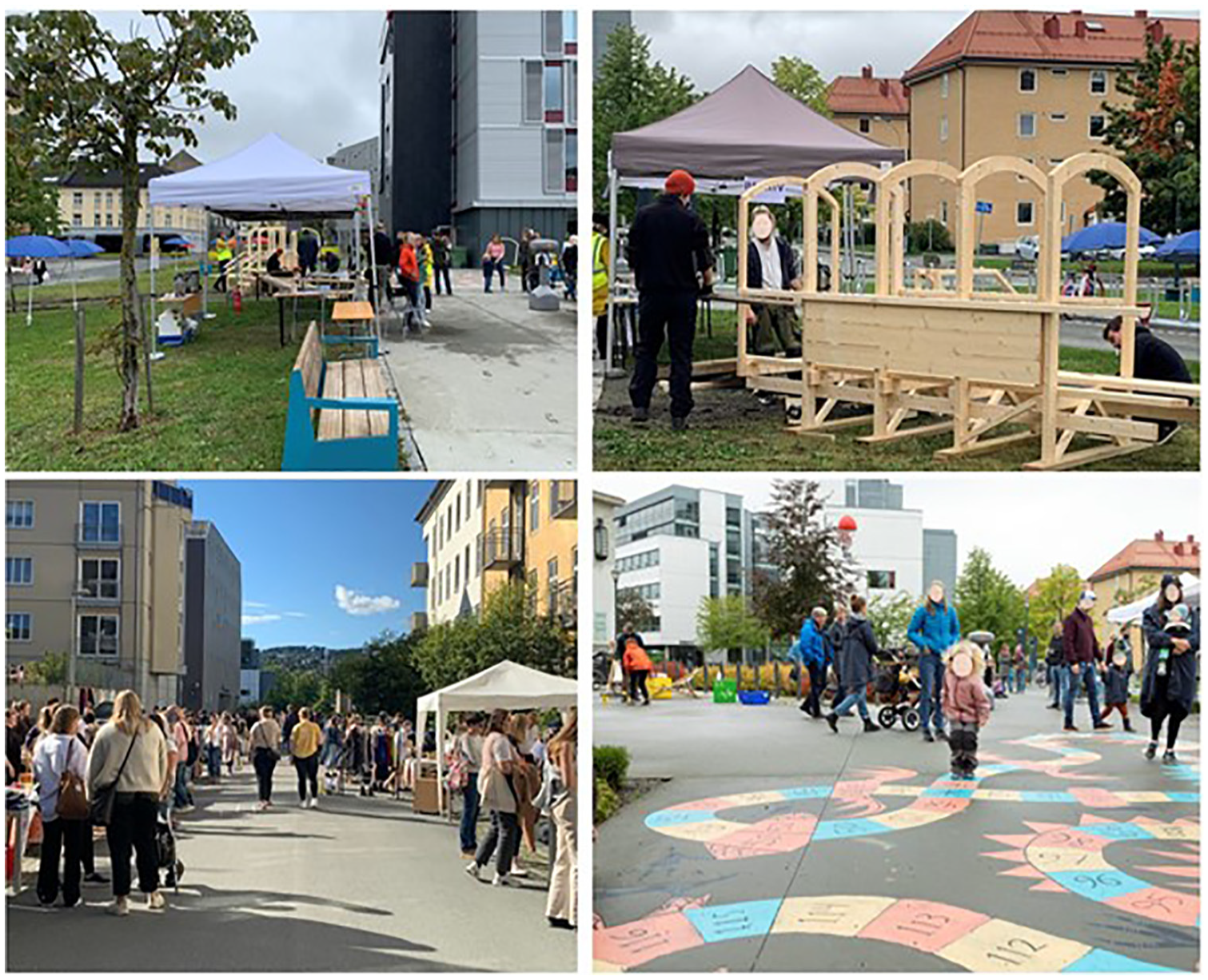
Activities at Abels Street Festival.
Pådriv’s work is based on the 17.17 community development framework (SoCentral, 2023), aligned with the UN’s 17 Sustainable Development Goals (SDGs). This framework enables collaboration across sectors for sustainable place development and aims to improve cooperation between municipalities, private actors and citizens (SoCentral, 2023). As today’s cities often have ambitious aims and strategies to meet SDGs on climate transition, social justice and cohesion (Nilssen and Hanssen, 2022), invitations to the co-creation of events like this are often welcomed by local governments. In the societal part of Trondheim’s municipal plan (Trondheim Municipality, 2022), examples of co-creation goals are how Trondheim is described as ‘a city of culture and volunteering’ where ‘private actors and urban developers can contribute to strengthening the social infrastructure through supporting local initiatives’ (aim 2.4).
Pådriv’s webpage and social-media channels extend an invitation to potential volunteers in the neighbourhood: ‘Do you want to help carry out activities and contribute to a festival that will strengthen the sense of belonging to Elgeseter and facilitate a better neighbourhood?’ (Pådriv Trondheim, 2022). The festival features a variety of low-threshold activities, and local planning authorities use it to communicate with the neighbourhood about planned development, through both one-on-one dialogue at stands and public debates. In its first three years, the festival has offered activities such as a flea market, free bicycle repairs, street experiments like graffiti art, temporary street furniture, building of a play tram for children, complementary neighbourhood breakfasts, private businesses advertising their local services, debates on local urban development and information on related research projects.
This street festival is not well known among the public. It is one of many similar events (yearly neighbourhood festivals, flea markets and cultural activities organised by the municipality) happening in Trondheim, both during the same weekend and throughout the year. The high number of similar events, and a lack of festival originality (Finkel and Platt, 2020: 5), make it challenging for the organisers to reach both the general public and potential volunteers, even with the use of social media and flyers left in mailboxes. Nevertheless, the festival’s features are similar to those of other city events, making this study relevant beyond the local context.
Research methods
This article consists of a longitudinal three-year qualitative study of the festival, including 71 on-site street interviews with visitors and neighbours and 12 in-depth interviews with involved actors. We understand individuals’ experiences of the festival in line with a phenomenological starting point where we, as researchers, want informants to express their understanding of reality in a world created and understood through interaction with others (Tjora, 2019: 11).
Our street interviews took place at the festivals in 2021–2023. These ‘spontaneous’ street interviews were not pre-arranged, and recruitment and interviews took place in the moment (Henriksen and Tøndel, 2017). Seventy-one street interviews were conducted in total (29 in 2021, 28 in 2022 and 14 in 2023), of which most lasted around five minutes. We applied a semi-structured interview guide that allowed informants to speak relatively freely about their experiences. Questions included informants’ perception of the festival, whether they have had conversations with someone they do not know, what they believe is the festival’s aim and how it will affect the neighbourhood. In addition, we asked whether informants had participated before and whether the festival had increased their contact with other residents. Street interviews allow researchers to study participants’ situation as it unfolds (Henriksen and Tøndel, 2017). Getting respondents to participate and reflect on their involvement may be easier than in surveys, where participation is less binding and experiences may be forgotten if answered later.
We applied theoretical sampling (Glaser and Strauss, 1967), where preliminary results from the street interviews informed questions for discussion in our in-depth interviews. For example, the street interviews indicated low neighbourhood involvement in the festival’s organisation; therefore, we wanted to investigate this further in the in-depth interviews. However, the last round of street interviews (2023) occurred after our in-depth interviews were conducted. For these street interviews, the main point was to investigate potential festival returnees’ experiences during the three years it had been organised. Referring to the street interviews in the analysis chapter, through direct quotes, is a supplement to the in-depth interviews and helps to illustrate key aspects. Street interview informants are referred to as, for example, Street 11, 2022 (Street interview number 11 in 2022).
We conducted in-depth interviews with 12 actors having local involvement. Based on our presence in the first two years of the festival and our insight from the street interviews, we contacted potential informants (neighbours, volunteers, private developers, municipal staff and county municipal staff). Interviews lasted around 60 minutes and took place in the informant’s workplace or another setting the informant chose. We wanted to gain insight into local actors’ experiences and thoughts about the festival and other local initiatives, as well as these initiatives’ connection to the neighbourhood and local planning processes. Therefore, we applied a relatively broad and open interview guide. For informants’ anonymity, we hide their specific roles and give them pseudonyms categorised as ‘external’ or ‘local’ participants. External participants (municipal employees and local business actors) have pseudonyms starting with the letter E, while local participants’ (residents) start with L. By this, we aim to ensure confidentiality and transparency throughout our study.
Overview of informants:
External participants: Pseudonyms starting with E.
Local participants: Pseudonyms starting with L.
On-site street interview participants: Street [number], [year].
Our analysis builds on a stepwise-deductive inductive (SDI) research design (Tjora, 2019). We conducted an empirical and inductive coding of the in-depth interviews based on three overarching goals (Tjora, 2019: 28): (1) to extract the essence of the empirical material; (2) to reduce the volume of the material; and (3) to facilitate idea generation based on details in the material. We generated detailed empirical codes in the analysis software HyperRESEARCH (448 codes), an inductive grouping of codes (45 code groups) and, finally, a theory-driven (abductive) merging of code groups resulting in two main themes – and four sub-themes – which form the basis of our analysis. Our empirical study relates to established data protection rules and is approved by SIKT – Norwegian Agency for Shared Services in Education and Research (ref. no. 100932).
Analysis: Festival stimulating or simulating engagement?
The empirical findings presented in this article suggest that the festival is delicately balanced between (1) simulating a local initiative that does not really exist– with a potentially adverse effect on neighbourhood engagement and (2) awakening a latent initiative locally by stimulating action– with a potentially positive effect on neighbourhood engagement. These two broad analytical themes – and tensions between stimulating and simulating – are structured by four sub-themes that emerged in our analysis:
Festival stimulating engagement: A temporary arena for sparking local initiatives
According to the organisers, street festivals can be a temporary arena for stimulating neighbourhood engagement. Emma thinks the most important outcome of the street festival is to illustrate ‘how it turned out when it [the area] was alive for a few days’ and, in that sense, how the festival as short-term action can trigger new, local initiatives, as another informant states: ‘The important thing was that something happened. It’s good to talk about this or that, but we need those temporary things to see: can it be helpful or not?’ (Erin). Eric sees the festival as a possibility to foster new initiatives: The way I see it is to […] try to create a commitment […], other initiatives […] creating things linked to a place; I feel Abels Street Festival was about that: getting people to meet, and, again, things happen based on that.
Festival organisers explain that, while some residents in the area were initially sceptical of the festival, other neighbours became involved when it first started: People here are used to keeping to themselves because there are few activities. […] In the first year – at the flea market – there was an elderly lady who was sceptical about the whole thing [festival]. Then she came outside her door, saw the flea market and said, ‘But I also have a lot of things that I can sell’. So, she went up and got them so that she could join in. That’s an example of an activity that helps create more engagement and action, right? Some [people] need to be wakened up a bit. (Edwin)
Even if the festival stimulates more engagement, informants are determining whether it will have long-term effects: Lisa mentions that the festival ‘is a very positive thing in the moment’ with a ‘kind of “now” effect’, but she is unsure whether it will have long-term effects: ‘No one has come afterwards and said, “I want to be part of it, it was fun, we have to make sure it happens again”’. One festival visitor emphasises that ‘If this keeps happening every two weeks or every month, then yes. Then it will affect the neighbourhood’ (Street 4, 2021). Emily has a more positive attitude and says, ‘There is already an expectation that there will be a [new] festival’. Informants explain that the ambition of the festival is to create ‘interest from other actors’ (Edward) to ‘take ownership of it, so it becomes self-driven’ (Edwin).
There was a desire to engage local residents in organising the festival and at the same time to make ‘a better relationship between people in the neighbourhood’ (Erin). In our street interviews, residents pointed to a problematic relationship between a more stable group of residents and students living in the area temporarily. Emily says it is essential to ‘create something that allows us to meet’ and, as Eric voices, to facilitate ‘meetings across life situations’.
Since the festival was open to all citizens of Trondheim, exclusive neighbourhood interactions would occur mainly through the organisation of the festival. Lisa explains that few neighbours participated in the organisation: Everyone thinks it’s great fun to come to an event, but no one [neighbours] signed up to help organise it […] we were not able to engage [residents]. […] Getting people to like or join Facebook groups is easy, but getting someone to attend a meeting and make an effort is an uphill battle.
Edwin says they were able to reach a ‘core group’ of resourceful residents: ‘[There] is a small proportion who will get actively involved in what we do. It is like VIPs, very important people who can achieve a lot’. From the street interviews, it was clear that residents had mixed experiences. The first year, an older resident stated, ‘For some, this has probably been a small icebreaker. We’ve got to know our neighbours better’ (Street 1, 2021), whilst two students said, ‘Our shared flat [students living together] went down to get breakfast’ and ‘no, we didn’t really talk to anyone’ (Street 5, 2021). For others, the motivation to attend the festival is not to interact with neighbours. Examples of this are both the student’s honest recognition of the festival’s ‘first come, first served’ breakfast deal for the first 200 participants as a motivation for attending, and other practical reasons for participating: ‘No, I haven’t talked with anyone, I’m a bit hungover, so it’s really just to come and exchange clothes [at the flea market]’ (Street 26, 2022).
Festival stimulating engagement: Activities leading to place identity
A recurring theme in our interviews is how the festival can contribute to local place identity and be an identity marker for the area. One informant explains that he ‘hope[s] it helps to give a bit of – that kind of – local identity. That it, in a way, creates a bit of pride’ (Edward). Discussing the festival’s contribution to an area under rapid urban development, Eva explains: But that mix of old and new, strange, and something with soul and identity. […] It is so important to preserve what you have of place identity while adding new things, because then you get a cool mix of things.
One example of how the festival organisers see this mix of old and new as important for place identity is the focus on using temporary street interventions to address the area’s history. The history of trams is visible through the area’s historical to-be-preserved tramshed. As Laura says, ‘Trams are a very important part of the history here’. Lisa refers to how a ‘play’ tram was built during the 2021 festival and created a physical result that could contribute to place identity: It [the festival] has had […] some physical results. Because that tram was built […] It is visited by children. So, for quite a few young children, it’s probably like ‘ah yes we’re going to the tram!’ It has certainly created an identity that wasn’t there before.
Elena emphasises the importance of ‘taking care of the history and bringing it in with the new [development]’. From our analysis, it emerges that this is felt to be particularly important in the area –‘a somewhat problematic district’ (Eva) – that struggles with creating pride and belonging among residents, due to, among other things, a high share of student housing and the lack of primary schools, resulting in families leaving the area when their children reach school age. These challenges – according to our informants – give involved actors an important mediating task to ‘build identity’ and ‘bring out the history of the area’ (Laura). We find similar answers in our street interviews, when asking visitors about the intention of the festival: ‘To make sense of community’ (Street 5, 2021) and ‘To create increased interest in a beautiful neighbourhood that traditionally is associated with noisy, polluting traffic’ (Street 18, 2021).
Festival simulating engagement: External initiative lacking local embeddedness
In the official information about Abels Street Festival, MoST (2023) seeks volunteers that ‘would like to take part in carrying out activities […] to strengthen the sense of belonging to Elgeseter’. Lisa describes how, while clearly inviting interested parties into the organisation, the initiative still was ‘[A] bit of a “top-down” thing, even though they wanted it to be a “bottom-up” thing’. She elaborates on what she understands as a problematic top-down approach: [When] funding was granted, it was because it came from above, but based on that you want to achieve something from below. I’m a bit critical of it because no real initiative was taken to involve any local forces because it was thought that ‘they don’t have time’. I was a bit like ‘this isn’t right’. You’re supposed to organise a city event, and you’re not supposed to include anyone who lives here? (Lisa)
Lucas is critical of the festival’s purpose and questions whether it would be better if the initiative came from below, starting within the neighbourhood’s wishes and needs.
I’m a bit unsure what it actually contributes to. I think it would be better if it came from below […] Do something crazy. Because then neighbours would have to cooperate on things, which they don’t do today. The only contribution is that the neighbours show up and sell trash and shit. (Lucas)
While certain informants think it would be better if the initiative came from the residents themselves, others point to a lack of citizens with permanent residence in the area, which makes it challenging to gather local forces in the organisation of the festival: ‘I don’t think there are enough locals living permanently at Elgeseter to be able to own it [the festival]. We’re not that kind of neighbourhood. You need a primary school. You need things that cover several generations’ (Laura). Despite existing for three years, the festival lacks local embeddedness. However, the goal of the festival could be to trigger and achieve this in a more long-term perspective, as Laura explains: ‘This opened in 2019, right? And it’s been organised twice, so I think that people are aware that we exist […] I think we’re a step closer to something’.
Festival simulating engagement: Participation fatigue through co-creation
The municipal project, the CityLab, is an example of a physical measure aiming for participation and transparency in the area’s ongoing urban planning and development processes. Managed as a social meeting place centred around free discarded books from the public library, the CityLab and the street festival symbolise municipal efforts for increased citizen participation. Situated next to Abels Street, the CityLab functions as the festival’s headquarters. When asked about experiences of such participatory measures, an ambivalence between increased contribution to local planning processes and frustration with the lack of follow-up afterwards is reflected, as explained by Emma: ‘If you don’t get results, I think the enthusiastic neighbours might become more frustrated than they were before you started’.
The frustration that neighbours experience if they don’t see results after providing input to a planning process can lead to participation fatigue, according to Lisa: There are many places in the process where you can contribute or you’re asked ‘What do you think?’. You’re given the opportunity to give input in public meetings, send an email, answer a survey and such. Then it becomes a form of ‘participation fatigue’, especially if you feel that you’re not getting through or not being heard.
Nevertheless, one of the overarching aims of both the festival and the CityLab is to create ‘an equal arena’ (Edwin), where residents, the municipality and private developers meet in a ‘completely different type of conversation than in the usual involvement or participation meetings’ (Edwin). While the aim is to create an equal arena, residents and private developers do not have the same power and opportunity to influence the process. In addition, participation procedures themselves may create a false expectation that residents’ voices will be heard in the process: It’s fascinating […] why things go so wrong in terms of neighbours feeling that they are not being heard, and, on the other side, you have those doing everything correctly according to the [Norwegian] Planning and Building Act.
3
It is two completely different worlds. […] I think it’s very difficult for neighbours to understand what this really is […] There is the eternal question of what’s the difference between being heard and having it your way, if you know what I mean? (Eva)
Some informants understand participation meetings as ‘symbolic acts’ that outwardly legitimise or enable agreement on urban development projects in the area. In addition, citizens’ opportunity to have a say on the development plans – regulated by the Norwegian Planning and Building Act – appears late in the process, limiting the opportunities to influence the plans: By the time the project reaches the stage where it is to be submitted for public hearing, it has been worked on for so many years […] so much has been discussed in the professional channels. When the ‘little man in the street’ comes to have his say, there’s so little room to change things that it’s almost all pro forma. (Lisa)
One neighbour visiting the 2023 festival expresses frustration that the festival is an arena to get input on residents’ needs and desires without addressing the challenges they care about: I think it has zero opportunity to influence the neighbourhood. […] it has nothing to do with it. It has something to do with lots of other things. […] But it’s still completely impossible to get across the [Elgeseter] road. If you can’t do anything about the minimum … it’s a bit provocative to say ‘Any suggestions to improve the following?’ And then it’s like ‘Don’t mess with me, don’t make me suggest things that no one addresses or does anything about’. (Street 7, 2023)
The lack of a clear connection between local needs and the organisers’ approach – as described above – can signify that involvement ‘ends up being cosmetic’, as Laura explains, or ‘a bit simulated’, as Lucas suggests: The municipality or Pådriv cannot adopt a commitment if it does not exist. […] It becomes a bit simulated. […] There’s a kind of lack of municipal understanding of the power relationships in things. You talk very beautifully about co-creation, but you don’t give people completely free rein. […] I think it’s a bit of a naive concept – the way municipal bureaucrats want the world to be.
Eva mentions ‘maturation of the neighbourhood’ as a goal for temporary projects. The festival may also stage situations and interactions to achieve such neighbourhood maturation – and thus increase external (economic) interest in the area: ‘[…] I feel that these temporary projects are part of an “area maturation”. […] things are going to take a long time to develop, so you must create some reasons that make people start going there’ (Eva). Another argument is that the festival can create situations that provide photographs that can be used in advertising – and perhaps contribute to such ‘area maturation’: I feel that Abels Street [Festival] will be a ‘photo-op’ [photo opportunity]
4
for Trondheim municipality. You can show really nice pictures […] what you’ve achieved. There’s a complacency about it that I don’t think reflects the actual outcome. But it’s unfair to hold it against them too. The fact that something happens is a good thing! (Lucas)
Lucas adds to his scepticism by saying that the festival tries to simulate bottom-up neighbourhood initiatives, but that it starts from the wrong (top-down) end: The most beautiful thing I know is the [Eat the Rich] festival at Svartlamon.
5
[…] concerts, people selling old scrap, drinking in the backyard. It’s really great. That’s what Abels Street [Festival] is trying to simulate. Only […] it starts with a municipal organisation, or municipal money […] at the wrong end. It’s that kind of bureaucrat involvement. […] it’s so governmental and sad.
Discussion and conclusion
From the tension between stimulating and simulating engagement presented in our analysis, informants’ experiences and reflections emphasise that the festival can (over time) stimulate local engagement, contribute to place identity and create a collective feeling of togetherness. At the same time, the festival’s limitations can lead to the opposite and thus limit, and in the worst case be harmful to, local engagement. For example, by simulating local participation through what our informants call symbolic or cosmetic co-creative actions, a consequence can be local frustration or passivity in the form of ‘participation fatigue’.
A typology for neighbourhood events
In the following, we use the presented tension to discuss the organisation of neighbourhood events more conceptually and point to insights it provides that may be relevant beyond the local context. Based on our empirical analysis, we propose a typology for neighbourhood events (Table 1) that can give a better understanding of what leads to local neighbourhood engagement.
A conceptual framework for neighbourhood events.

The type of initiative in Table 1 varies along the vertical axis, while the span – and tension – between simulating and stimulating varies along the horizontal axis. The span indicates a potential for moving in a positive direction from simulating to stimulating. We will address the suggested four types of neighbourhood-based events in the following discussion.
Stimulating engagement?
A neighbourhood street festival is a temporary social situation where gatherings and encounters (Goffman, 1983) occur between neighbours that can spark or awaken latent initiatives. For some informants, the festival may be a celebratory social occasion (Goffman, 1983) of shared experiences (Stevens and Shin, 2014), that can spark local initiatives and engagement (analysis topic 1). The sceptical neighbour who became involved in the flea market illustrates that the festival can function as a local stage (Fine, 2010: 362) stimulating engagement through the presence of other people (Whyte, 1980: 19). These stimulating experiences align with what we term sparking events: externally initiated events that can inspire or trigger engagement – or create local ownership, as pointed out by an informant – even if not originating locally.
Festivals’ effect on community engagement depends on their scale, time frame and recurrence. We are uncertain about the long-term, ‘sparking’ effects of once-a-year festivals. Therefore, we understand the festival community as a wispy community that allows diverse groups to encounter one another (Stevenson, 2021) through events and gatherings (Fine, 2012). Thus, the festival is not a sustainable interaction scene, since it does not facilitate individuals regularly gathering with their expectations intact (Fine, 2010, 2012). Instead, festivals can be a temporary arena for fleeting gatherings (Goffman, 1983). As arenas of local action, festivals can be powerful during activation, but this seems to vanish when participants depart (Fine, 2012). Although not a third place (Oldenburg, 1991), due to its short duration, the festival’s physical interventions – such as the play tram – can transform the physical reality (Stevens and Shin, 2014) and contribute to future meeting places and social infrastructure (Gehl, 2001; Klinenberg, 2019). Moreover, with their temporary experiments, festivals can be an interaction pretext (Henriksen and Tjora, 2014), legitimising contact between neighbours (Tjora and Scambler, 2020). However, even if the festival contributes to short-term experiences of togetherness, it is far from being the ideal-typical – and partly romanticising – idea of what we call a community event: a bottom-up, citizen-driven initiative that embraces a large number of neighbours combined with strong local roots. Instead, the festival shares characteristics also found in what we term enthusiast events: initiatives originating locally, engaging enthusiastic and resourceful neighbours. However, enthusiast events might only involve an exclusive core circle of temporary ‘insiders’ (Rust, 2022: 221), as explained by one informant. Engaging a broad base of residents is usually challenging due to, for instance, residents living in the area temporarily, such as the students attending the festival solely to get free breakfast or buy second-hand clothes. Enthusiast events do not necessarily have a broad base in the neighbourhood but can be outwardly presented and perceived as such.
Simulating engagement?
Our analysis also demonstrates that the festival actively draws on local history through activities and temporary street interventions. Naming the event ‘a festival’ and staging the surroundings with symbols creates atmospheric scenery backdrops that contribute to a shared narrative or atmosphere (Skaar et al., 2019), which, in line with Goffman’s theatre metaphor (Goffman, 1971), outwardly gives a good impression of the place and can contribute to place promotion. A visualisation of the community identity, an identity marker can, if successful, contribute to a collective place identity (analysis topic 2; Blokland, 2009) and a sense of community. Nevertheless, our analysis cannot say whether the festival has strengthened a sense of community after three years. Frustration expressed by, mostly, local informants provides a basis for again pointing to a tension in our results: between those who feel the festival can have a positive effect, at least in the long term, and those who perceive it as an externally imposed initiative without connection to local wishes and needs. In this case, we can talk about a ‘failed ritual’ and the production of negative emotional energy (Collins, 1988, 2005) among those who do not engage, those who engage with scepticism or those who go ‘all in’ but end up with less faith in the community than before attending the festival. Collins’ (2005: 108) theoretical programme for understanding the social stratification of situations describes how chains of interaction rituals over time have the potential to generate enduring social feelings within individuals belonging to a group. However, these feelings do not have to be empowering for a community. Our analysis suggests that, instead of creating positive social feelings, simulating events without collective effervescence can be a source of not only drained but negative emotional energy (Collins, 2005: xii), as explained by informants experiencing ‘participation fatigue’. In contrast to the effervescent ritual chains Collins describes, we suggest a reconceptualised understanding of the chains as downward spirals of emotional energy, gradually lacking more and more of the Durkheimian solidarity and group commitment that successful rituals contribute to as they descend the vortex. Consequently, the festival does not necessarily contribute to collective consciousness (Durkheim, [1893] 1997) but might, rather, risk leading participants towards discharged beliefs of the neighbourhood community. Our interpretation offers a new alternative way of seeing the consequences of such external initiatives, contrasting with the mainstream attitude of ‘the more, the better’, demonstrating how ‘the more’ is not always the better.
In line with Stevenson (2021), the festival is managed for, and partly by, a few engaged neighbourhood people and has limited local embeddedness (analysis topic 3). Due to its challenges of involving a broad base of residents – and what informants call a problematic relationship between a more stable group of residents and students living in the area temporarily – the festival might struggle to achieve the ritual togetherness of communitas, which describes a state of something more than just community by physical proximity (Turner, 1969: 96). Instead, influential enthusiastic neighbours, or the area’s energy stars, using Collins’ (2005: 132) terminology, who already embody elevated levels of emotional energy, reinforce their importance to the neighbourhood and further the structural organisation of the festival. We see a link between external organisations organising the festival with limited knowledge of neighbours’ needs and some informants’ experience of the festival as ‘symbolic participation’ through simulated co-creation (analysis topic 4). For instance, organisers state that they want to create arenas for participation in the local development debate, but, in reality, they face the same challenges as in more traditional participation processes, namely a lack of proper channels for citizens to be heard (Fung, 2015; Røsnes, 2005) and to influence the processes in the early stages (Hanssen and Falleth, 2014). This can create false hope of influencing uninfluenceable processes – a known problem in planning processes where expectations are unclear. Furthermore, this false hope is illustrated in local informants’ experience of the festival simulating co-creation, for instance through photo opportunities that showcase citizens’ involvement in the Elgeseter area. As a result, the festival could risk becoming what we term a cosmetic event: an externally driven effort that simulates a local initiative that does not really exist and where the organisers might lack an understanding of or interest in local needs and desires and are more focused on the event’s potential impact beyond the neighbourhood, as described by one informant. When events lack local embeddedness and end up being cosmetic, participants have few opportunities to have fun together (Fine and Corte, 2017). The festival risks losing its fundamental festive elements of ‘show’ and is ultimately arranged ‘just for show’.
Despite limited resources, the organisers seek to increase local engagement through more creative and innovative forms of citizen participation. In the best-case scenario, this inspires and awakens citizen engagement and stimulates local initiatives. At worst, it simulates neighbourhood events without local embeddedness, having limited effect. This could lead to false hope and to citizens abstaining from engaging, a persistent challenge in participatory planning processes. Neighbourhood engagement may develop over time, as this festival has only been organised for three years. Coupled with adjacent events and participatory activities organised locally more frequently than the annual street festival, the potential for community engagement in local urban planning processes in the neighbourhood increases.
Footnotes
Acknowledgements
We thank Aksel Tjora and Helge Hillnhütter for their constructive comments and suggestions on this article’s earlier drafts and Ugo Corte and Steffen Wellinger for their support and inspiration. We also wish to acknowledge the members of the Sociology Clinic, especially Aleksander Haukø Haugen, Savana Mohenad, Serafima Andreeva, Eivind Johansson, Marie Lyngstad and Magnus Robertsen Mostad, who helped us conduct and transcribe the street interviews. We also thank the editors and anonymous referees for their helpful and precise feedback.
Declaration of conflicting interests
The author(s) declared no potential conflicts of interest with respect to the research, authorship, and/or publication of this article.
Funding
The authors disclosed receipt of the following financial support for the research, authorship, and/or publication of this article: This research received funding from NTNU Health, Norwegian University of Science and Technology (grant no. 992021149) and MoST (grant no. 987440100).
