




Abstract
In urban neighbourhoods, there is an enduring problem with inequality in participation. Middle-aged, higher educated, white men are often overrepresented. Research indicates that front-line workers can play an important role to reach and activate underrepresented groups, but there is little evidence on how they manage (or fail) to do so. In this article, we focus on front-line workers’ strategies to combat inequality in citizens’ initiatives in the deprived neighbourhoods of Amsterdam, the Netherlands. To analyse these strategies, we construct the ACLR-framework. We find that front-line workers manage to activate a more diverse group of citizens by paying special attention to those who are not already active, by supporting citizens in developing and exercising civic skills, by connecting them with others, and by making sure that citizens experience the system as responsive. However, this professional support is often not recognised because of what we call the civic support paradox: the better that front-line workers do their work, the more invisible it is, and the more difficult it is to pinpoint the factors that make it effective.
Introduction
Research on civic engagement consistently shows that citizens active in urban neighbourhoods are not representative of the citizenry as a whole. Middle-aged, higher educated, white men are often overrepresented (Docherty et al., 2001; Foley and Martin, 2000; Ghose and Pettygrove, 2014; Hurenkamp et al., 2006; Imrie and Raco, 2003; Jones, 2003). This also leads to different participatory levels between neighbourhoods, as white, higher educated people are concentrated in more well-to-do neighbourhoods (Maloutas and Fujita, 2012).
Earlier studies indicate that inequality is an issue in different types of civic engagement. This goes for ‘citizen participation’ (Edelenbos and van Meerkerk, 2016; Fung, 2004), which is top-down government-induced engagement, where governments invite citizens to take part in participatory projects, as well as for bottom-up ‘civic action’, where citizens organise in self-coordinated action to enhance common life (Lichterman and Eliasoph, 2015; Norris 2002). However, since marginal groups have a strong presence in social movements, overall inequality is probably less persistent in bottom-up civic action.
In this article we analyse how front-line workers combat inequality in specific forms of civic engagement, which we call citizens’ initiatives. To situate citizens’ initiatives within various forms of civic engagement, we suggest placing them on a continuum that runs from bottom-up civic action to top-down induced citizen participation (see Figure 1). By placing them on a continuum we suggest there are no solid boundaries between the three varieties of civic engagement. Moreover, practices of civic engagement can move on this continuum over time, or spread themselves on this continuum. Both happened with the women’s movement, which started out as civic action focused on self-help, developed into blended forms of action when governments started listening and responding to their claims, and was later invited to government-induced forms of citizen participation (Banaszak, 2010).

Continuum of civic engagement.
All varieties of engagement on the continuum can be political or social. Policitally oriented civic action can be found in social movements, which criticise current policies or practices and independently fight for social change (Jasper, 1997), or in community action that focuses on empowering citizens to politically fight for community interests (Boyte, 2004). Socially oriented civic action is about self-organising for social aims such as having a shared good time in sports or leisure (Van den Berg et al., 2011). At the other pole of the continuum, political citizen participation involves citizens in government-induced political processes of deliberation and decision-making (Fung, 2004), while social citizen participation concerns welfare-state-induced forms of activation such as volunteering in exchange for a welfare payment (Kampen et al., 2013).
In the middle of the continuum we locate citizens’ initiatives, which we define as ‘collective, informal, social or political activities by citizens as volunteers that aim to deal pragmatically with public issues in their communities’ (Bakker et al., 2012; De Wilde et al., 2014; Van Dam et al., 2014). As forms of collective action, citizens’ initiatives differ from individual voluntary activities such as buying groceries for a sick neighbour or writing a protest letter to the alderman. As informal practices they differ from formalised and sustained civic associations such as Scouting (Putnam, 2000) and from vested, large-scale social movements such as the womens movement (Jasper, 1997). Citizens’ initiatives can promote social aims such as forging connections between different cultural groups, or developing community gardens, or political aims, such as promoting ethnic diversity in schools or combating gentrification (Tonkens and Verhoeven, 2012).
Situated in the middle of the continuum between top-down and bottom-up, citizens’ initiatives are forms of ‘blended action’ in which civic engagement and governmental support coincide (Bakker et al., 2012: 396; Bartels et al., 2013: 340; Lichterman and Eliasoph, 2015: 806). In this blend, government can be civic enabler of ‘productive engagement and collaborative problem solving among ordinary citizens’ (Sirianni, 2009: 1; compare Bakker et al., 2012). Professional involvement of so called ‘front-line workers’ 1 sets citizens’ initiatives apart from self-organised bottom-up civic action, while the enabling role of front-line workers distinguishes citizens’ initiatives from government-induced citizen participation. Because of this front-line workers support, citizens’ initiatives will usually be found in more developed welfare states (Tonkens and Verhoeven, 2012).
In this article we will focus on citizens’ initiatives as blended forms of action. More specifically, we will analyse what front-line workers as civic enablers do to fight inequality in citizens’ initiatives. Little is known about the role of front-line workers in combating unequal citizen engagement. Bloemraad and Terriquez (2016: 219) convincingly showed that community based organisations (CBOs) ‘can empower individuals and develop their skills’ (2016: 217) and ‘develop and sustain cultures of engagement (…) by building social networks, fostering solidarity and collective efficacy, and by promoting a shared commitment to collective well-being’. However, Bloemraad and Terriquez say nothing about the role of front-line workers in this process. Other studies indicate that front-line workers can build civic capacity that supports citizens in taking up everyday public work (Bartels, 2017; Lowndes and Sullivan, 2008; Sirianni, 2009). Front-line workers can also effectively support politically oriented initiatives, such as community organising for better social services (Postle and Beresford, 2005) or mobilising underrepresented citizens in deprived neighbourhoods for political activities (De Graaf et al., 2015: 13). However, we know little about what professionals exactly do to promote more equal citizen engagement. To be sure, we can only explore front-line workers’ activities as a plausible stimulating factor, since we cannot establish causal relationships between front-line workers’ activities and (un)equal engagement in citizens’ initiatives.
We chose to study the activities of front-line workers in Amsterdam’s deprived neighbourhoods. Deprived neighbourhoods provide a critical case (Flyvbjerg, 2006) for inclusiveness in citizens’ initiatives, since civic engagement is much harder to achieve owing to the hyperdiversity of the population (De Graaf et al., 2015; Denters and Klok, 2010; Fung, 2004: 99–131). Moreover, during the period of study, front-line workers in Amsterdam were in a unique position to combat inequality in citizens’ initiatives, as they were involved in a policy experiment to regenerate the social fabric of deprived neighbourhoods, as we will clarify further below.
To better understand the role of professional support our main question is: how do front-line workers combat inequality in citizens’ initiatives in Amsterdam’s deprived urban neighbourhoods? Our answers build on a case-study in 24 deprived neighbourhoods in the city of Amsterdam. In the next section, we first discuss what is known about inequality in civic engagement. Then we introduce our framework for the analysis of front-line workers’ support, followed by an explanation of our case study and methods, the analysis of our findings, and conclusions.
Inequality in civic engagement
What do we know about inequality in civic engagement? Research repeatedly indicates that active citizens in urban neighbourhoods are not representative of the citizenry as a whole. White, older, higher educated and male citizens are usually overrepresented (De Wilde et al., 2014; Docherty et al., 2001; Foley and Martin, 2000; Ghose and Pettygrove, 2014; Imrie and Raco, 2003; Jones, 2003; Tonkens and Verhoeven, 2012; Uitermark, 2015). Conversely, ethnic minorities, younger and lower educated people, and to a lesser degree women, are often excluded. Dealing with this problem is particularly urgent in deprived neighbourhoods, which have more serious social problems combined with lower engagement rates (Uitermark, 2015).
Unequal citizen engagement on the neighbourhood level mirrors national trends in citizen participation. Educational level, gender, ethnicity and age determine who politically participates (Brady et al., 1995; Michon and Vermeulen, 2013; Norris, 2002; Pattie et al., 2004; Verba et al., 1995). Income can influence political participation as well, but its effect is mostly dependent on education (Brady et al., 1995). The same pattern of inequality is found in client participation in public service organisations such as healthcare organisations (Brooks, 2006; Contandriopoulos, 2004) or community housing (Paddison et al., 2008; Tunstall, 2001). However, this pattern is less persistent in forms of civic action such as social movements. Norris (2002: 201–202) found that across the world there is a small gender gap (men protest a little more than women), an educational gap (higher and medium educated people protest more), and an age imbalance (people between 25 and 65 years of age protest most). These imbalances vary by topic. In environmental protest, there is an educational gap but no gender or age gap (Norris, 2002: 205). In recent Spanish anti-austerity demonstrations, (mostly better educated) women and younger people predominated (Van Stekelenburg, 2012).
Little is known about initiators of citizens’ initiatives in this respect. Research in the Dutch city of Enschede indicates most initiators are college educated and aged between 30 and 50 (Bakker et al., 2011). Other Dutch research suggests that higher educated people dominate citizens’ initiatives (Hurenkamp et al., 2006) and that migrants tend to take initiatives within their own ethnic groups (Tonkens and De Wilde, 2013).
We also know little about what happens if front-line workers get involved as civic enabler. As argued in the introduction, research indicates that professional support plays an important role in combating inequality, but gives few clues on what professionals exactly do to promote participation of underrepresented groups. Durose (2011) found two front-line workers’ strategies for inclusion: reaching and enabling. Reaching concerns identifying marginalised and excluded groups, integrating them in the wider community, and connecting them to service providers. Lowndes and Thorp (2011: 514) found that appreciation of the diversity of people’s backgrounds and creation of similar opportunities for people with different backgrounds contributed to reaching a ‘cohesive community’. Enabling concerns engaging with marginalised groups to build transferable skills, in order to develop ‘their capacity to engage in the wider community and interact with service providers’ (Durose, 2011: 13, compare De Graaf et al., 2015: 7).
To analyse how front-line workers combat inequality in citizens’ initiatives, we draw on the CLEAR framework that was developed as ‘a diagnostic tool for assessing official schemes to encourage participation and discusses remedial measures that might be taken to tackle problems’ (Lowndes et al., 2006: 281). Lowndes et al. argue that citizen participation works best if citizens ‘have the resources and knowledge to participate’ (Can), ‘have a sense of attachment that reinforces participation’ (Like), ‘are provided with the opportunity for participation’ (Enabled), ‘are mobilised by official bodies or voluntary groups’ (Asked), and ‘see evidence that their views have been considered’ (Responded to) (Lowndes et al., 2006: 286). These qualities are summarised in the acronym CLEAR: Can, Like, Enabled, Asked and Responded to.
We argue that an adapted version of this framework can serve as a lens to analyse how front-line workers deal with inequalities in citizens’ initiatives. To translate this diagnostic tool to our analytical purposes, we adapted CLEAR to the acronym ACLR: asked, can, linked, responsive. 2 The most crucial factor in enabling citizens’ initiatives is being asked. Particularly in deprived neighbourhoods, the mobilisation of non-active citizens requires an intense approach in which people’s aspirations and perspectives are deemed valuable. Moreover, front-line workers need to convince citizens that engagement can help to make their hopes and ideas for the neighbourhood come true (Fung, 2004).
Second, can refers to front-line workers strengthening the resources, skills and knowledge of citizens who are interested in developing an initiative. In deprived neighbourhoods this seems to be of vital importance, since differences in skills and resources are known as important factors in explaining inequality in civic engagement (Foster-Fishman et al., 2013; Ghose and Pettygrove, 2014).
Third, in the CLEAR model, enabled is about opportunities for participation. How-ever, to analyse how front-line workers operate to enlarge such opportunities, we think that the focus should be on how they connect initiators to other citizens, organisations, institutions and networks. For this purpose we replaced enabled by linked, as in linking social capital (Szreter, 2002).
Fourth, if your opinion is asked, you also need to see evidence that your views are considered. However, for citizens’ initiatives, responsiveness matters more than being responded to (the R of CLEAR). Research indicates that citizens, when engaging in citizens’ initiatives, face bureaucratic barriers such as rules and forms to fill in, which are often experienced as incomprehensible or discouraging (Tonkens and De Wilde, 2013). They then need responsiveness: front-line workers who support them in navigating red tape.
Case study and methods
Overall, citizens are pretty active in the Netherlands, the context of our Amsterdam case study. Voting during national elections has circulated between 75% and 80% since the 1980s (Van Houwelingen and Dekker, 2015: 220). Over the last decade, 27% of the population have participated in volunteering. Lower educated people tend to volunteer less (19% in 2010), mid-level educated are close to the Dutch average (28% in 2010) and higher educated are substantially more active (37% in 2010). In general, about 8% of the Dutch population are actively working to keep up public facilities such as public libraries or to enhance their neighbourhood. Of these people, 49% are women, 70% have lower or mid-level education, 64% are younger than 55 and 21% belong to migrant groups (Van Houwelingen et al., 2014: 50–51). These findings suggest that educational level and age are less selective when it comes to engagement in the neighbourhood. These indicators are not an exact measure of citizens’ initiatives, but come rather close to the type of activities involved in them. All forms of civic engagement are less intense in large Dutch cities compared with small municipalities (Van Houwelingen and Dekker, 2015: 228–230).
In 2007, the Dutch government invested 95 million euros in ‘district budgets’, meant to stimulate citizens’ initiatives in the 40 most deprived city districts spread over 18 Dutch cities (Tonkens and Verhoeven, 2012). The city of Amsterdam was on top of the list with five districts, which included 24 neighbourhoods. Amsterdam received 17.1 million euros to invest in these neighbourhoods of which 12.1 million was directly available for stimulating and supporting citizens’ initiatives (Tonkens and Verhoeven, 2012). The large investment of resources in a high number of neighbourhoods make Amsterdam a suitable case to study how intensive front-line workers’ guidance affects inequality in citizens’ initiatives.
Amsterdam hosts almost 800,000 residents of which 230,000 are foreign born and 180,000 are second-generation immigrants (De Graauw and Vermeulen, 2016: 996). In 2010, 27% of the inhabitants belonged to a sports organisation, 21% to an NGO, and 15% to a labour union or employers’ organisation (Gemeente Amsterdam, 2011a: 111). Of the population 51% voted during local elections, with lower participation of Turkish (46%), Morrocan (39%) and Surinamese Dutch (26%) (De Graauw and Vermeulen, 2016: 998). Twenty-eight per cent volunteered and 48% provided informal care (Gemeente Amsterdam, 2011a: 123). Participatory conditions have deteriorated for citizens with a migrant background, particularly Muslims, since the attacks of 9/11 and the murder of Theo van Gogh in 2004 (Vermeulen et al., 2012: 339–340).
The 2008–2011 municipal policy aimed at engaging more citzens with more diverse backgrounds in a higher quality engagement (Gemeente Amsterdam, 2008: 11). The city wanted to enable as many citizens as possible to take citizens’ initiatives. Their credo was: ‘let a thousand flowers bloom’ (Gemeente Amsterdam, 2008: 11). Citizens’ initiatives were seen as a means to contribute to a better quality of life in the neighbourhood and to the development of social capital (Gemeente Amsterdam, 2009: 6). To reach these goals, the city appointed front-line workers (which they dubbed ‘participation brokers’): civil servants who wanted to work with citizens’ initiatives, and social workers who were already active in deprived neighbourhoods (Tonkens and Verhoeven, 2012: 31). These participation brokers assisted citizens in generating ideas for initiatives. They reached out for them in supermarkets, schools, elderly homes and community centres. They also organised festive gatherings, where initiatives were presented and information on budgets was provided. They also approached welfare-organisations, housing corporations and neighbourhood associations to spread the word to citizens. They supported citizens with an idea for an initiative, to apply for a budget and, if desired, with execution of the initiative (Tonkens and Verhoeven, 2012: 54).
In order to find out what professionals did to support citizens’ initiatives and how citizens experienced this, we interviewed both groups. A total of 745 citizens received financial support from a district budget system between September 2008 and June 2010 for a total of 1211 initiatives. We contacted all 745 respondents through various rounds of stratified random sampling per eligible city district. After three rounds of calling at their doors and trying to contact them by telephone, we reached 472 potential respondents. A total of 183 did not want to participate in the research, leaving us with 289 respondents: a response ratio of 61%. We did not find any indications of selective non-response. 3 Therefore we consider all quantitative findings as representative for the group of citizens that applied for district budgets during the period of our research. In addition to this survey we held semi-structured interviews with 49 of these 289. The selection was based on a spread of neighbourhoods and personal background in terms of gender, age, ethnicity and educational level. These interviews lasted 1 to 1.5 hours. We asked these 49 citizens for names of front-line workers who had been helpful to their initiatives. We selected the 15 who were mentioned most often to hear their side of the story. They were all willing to participate. For all interview data we first performed open coding, followed by axial coding, both with ATLAS.ti. In addition to these interview data, we analysed policy-documents and political speeches to grasp how politicians and policy makers viewed citizens’ initiatives and professional support.
Who are the initiators?
We will now turn to our findings. First we will describe the initiators and the types of initiatives they undertook, followed by an analysis of what front-line workers did to combat inequality in citizens’ initiatives.
Considering their personal characteristics, we find a rather diverse group of people taking citizens’ initiatives (see Table 1). The initiators were more often women (61%), lower or mid-level educated (50%) and younger than 50 years (48%). Moreover, 40% were first- or second-generation migrants and 32% had a low income. These numbers go against the grain of the general selectivity biases found in the literature. Particularly the high percentages of women and migrants stand out, while higher educated citizens do not form a majority. The high number of migrants is even more striking considering the less favourable participatory conditions in Amsterdam, especially for Muslims. Nevertheless, the low number of Turkish migrants stands out. This may be caused by their higher degree of self-organisation which may make them less interested in taking citizens’ initiatives (Michon and Vermeulen, 2013).
Personal characteristics in percentages (N = 289).
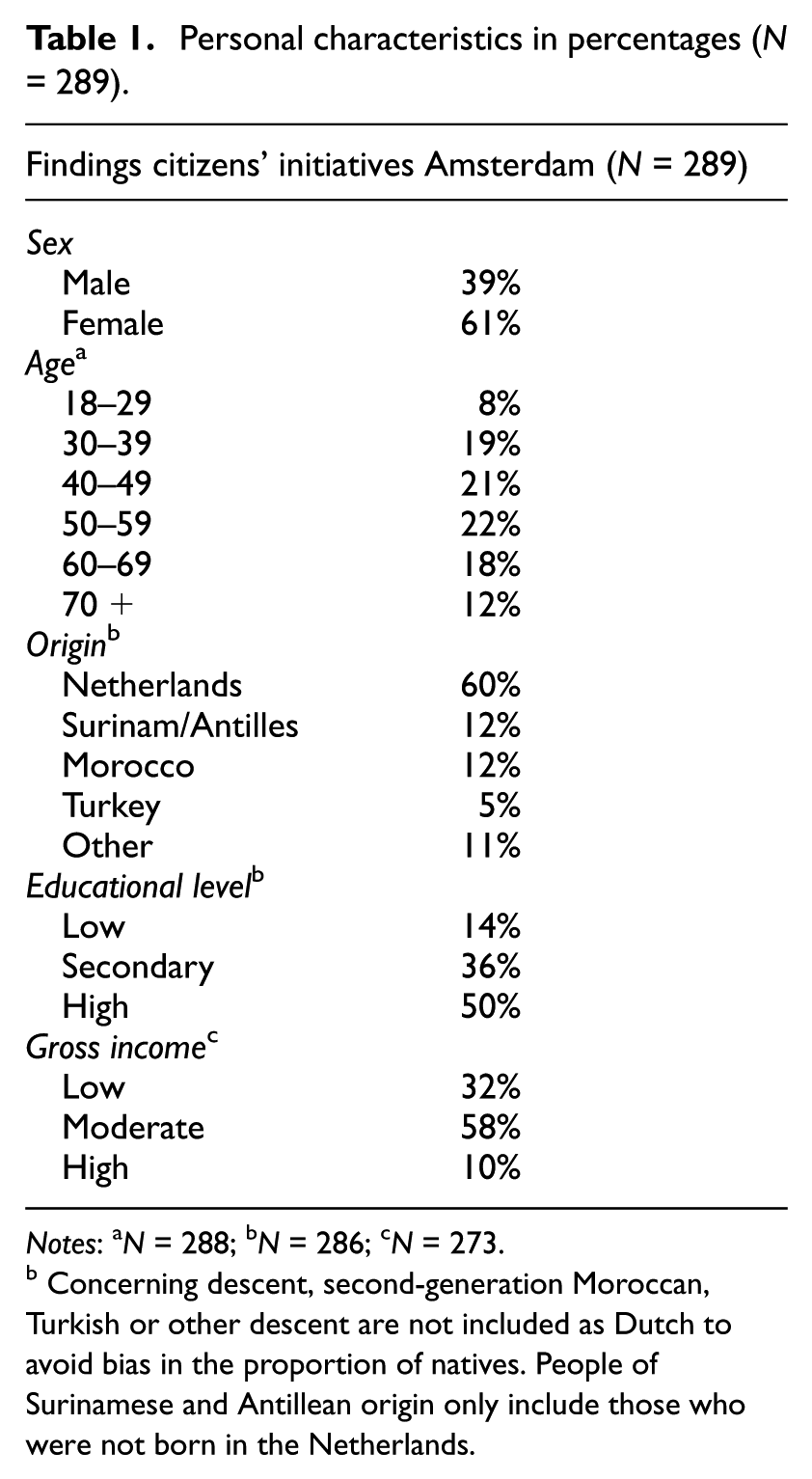
Notes: a N = 288; b N = 286; c N = 273.
Concerning descent, second-generation Moroccan, Turkish or other descent are not included as Dutch to avoid bias in the proportion of natives. People of Surinamese and Antillean origin only include those who were not born in the Netherlands.
We find that almost all initiators vote (93%), many volunteer at an organisation (79%), go to district meetings about the neighbourhood (76%), engage in an initiative by other residents (73%), try to teach other people something on a voluntary basis (70%), as a top five of their activities. Out of a total of 11 activities the average per respondent is 7.3 and almost 80% of the initiators at least combine 6 or 7 (see Table 2). These numbers are much higher compared with the whole population of Amsterdam (see above) and also higher than found in research on political participation, which suggests that the majority of citizens on average undertake more than two political actions such as voting or engaging in political discussions (Pattie et al., 2004: 79). In general, the initiators are hyperactive citizens. This is striking, particularly considering that deprived neighbourhoods show less civic engagement than the city average.
Activities, memberships and duration of residence (N = 289).
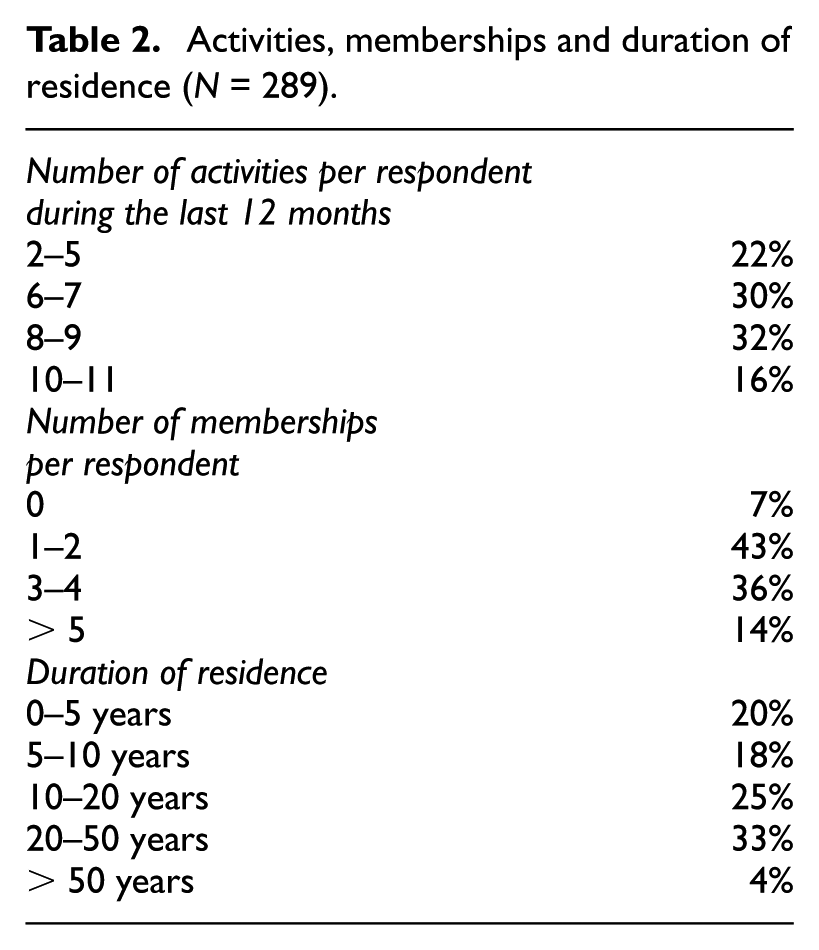
This image of hyperactivity is confirmed when considering organisational memberships. Fifty-three per cent are a member of a neighbourhood organisation or local action group, 52% of a leisure organisation (sports, hobbies), 43% of an advocacy group (trade union, etc.), 41% of a NGO (Amnesty International, Greenpeace, etc.) and 34% of a child or youth organisation (PTA, child care, etc.). Thirty per cent are a member of a church or religious organisation and 20% of an organisation focused on health or social welfare. Only 7% of the initiators are not a member of any organisation, while 50% belong to three or more organisations (see Table 2), with an average of 2.7 memberships for all initiators. Again these numbers are much higher than indicated above for the whole population of Amsterdam.
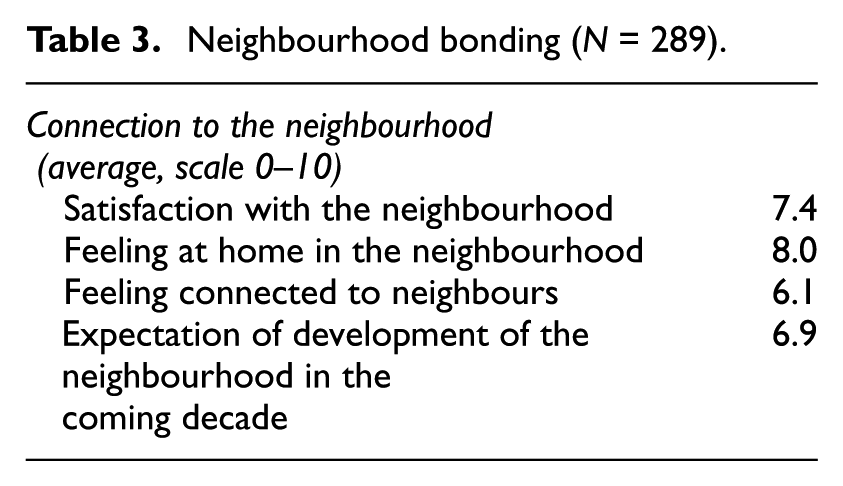
The hyperactivity of the people taking citizens’ initiatives in Amsterdam needs to be understood against their duration of residence and connection to the neighbourhood. The majority of the initiators has been living for more than ten years in the neighbourhood, with 25% between 10 and 20 years and 33% between 20 and 50 years (see Table 2). In comparison, the average length of residence in the city is 8.1 years in a situation with substantial population turnover (Onderzoek en Statistiek Amsterdam, 2011). Initiatiors are attached and commited to their neighbourhood: they are quite satisfied with the neighbourhood, feel very much at home, expect the area to develop in a positive direction and perceive the involvement of other residents as just adequate (see Table 3). Fifty-seven per cent want to continue living at their current address forever. Only 6% expect to move within a year. By contrast, 56% of the whole population of Amsterdam say they may move within two years (Gemeente Amsterdam, 2011b: 12). These numbers are almost the same as the averages of the whole population of Amsterdam, which, again, is striking for deprived neighbourhoods (Gemeente Amsterdam, 2011c: 15–23).
Neighbourhood bonding (N = 289).
In sum, we see a more diverse group of citizens taking initatives; most of them are accustomed to participation and have extensive networks which may help them to find professionals for support, and help professionals to find them.
A closer look at the initiatives
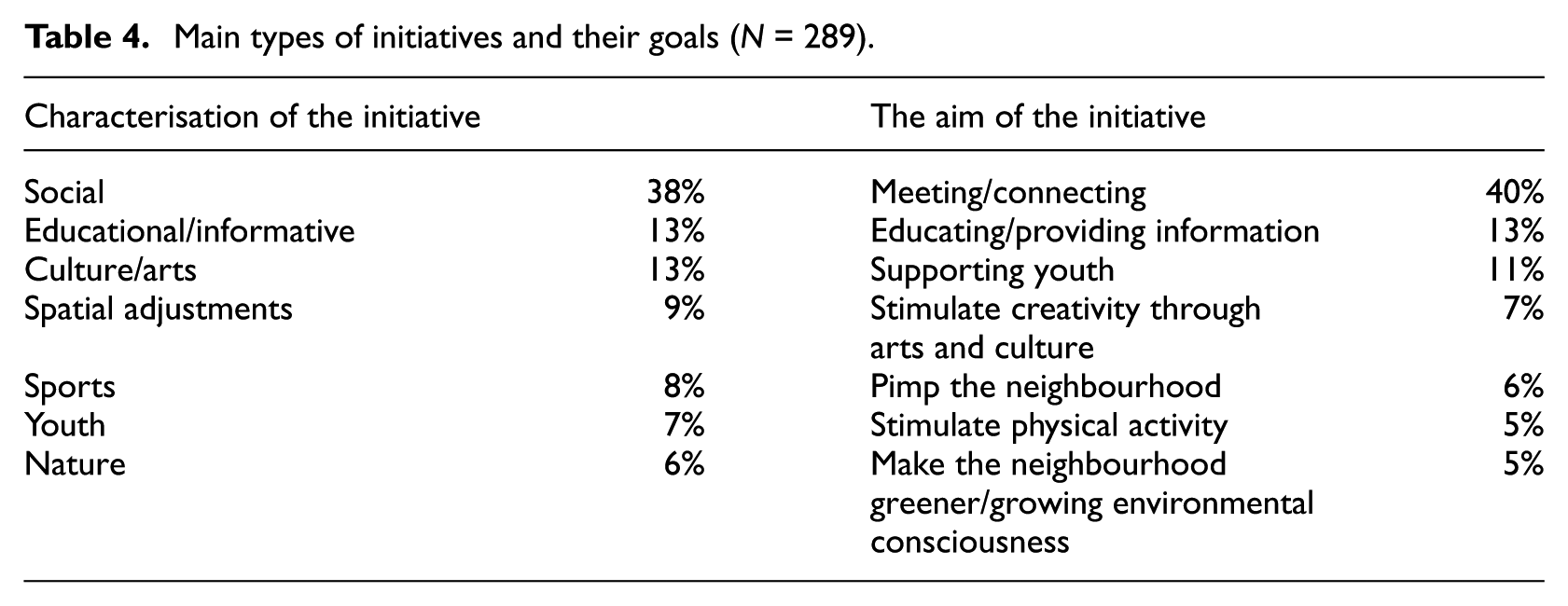
The list of citizens’ initiatives is long and diverse, ranging from Turkish women gathering others to talk about their daily problems, parents reconstructing a playground, to a woman from Moroccan descent starting a homework class for children with language problems. We mostly found socially oriented activities such as setting up meeting places and organising neighbourhood parties (38%), educational activities (13%), and culture and arts activities (13%) (see Table 4). In terms of aims, we see that meeting and connecting scores highest (40%). Other high ranking aims are providing education or information and supporting young people (see Table 4). Both the type of initiatives and the goals of initiators reflect a strong orientation toward social problems in the neighbourhood such as anonymity, isolation and nuisance.
Main types of initiatives and their goals (N = 289).
Most of these initiatives are small scale in various ways. The vast majority is initiated by one or two persons (respectively, 43% and 23%). The number of participants is also low with most initiatives performed by one to ten participants (reaching many more people, as we will see below). The small scale is also reflected in the budgets requested: 69% of the requests are below 5000 euros. The same goes for the allocated budgets: 71% below 5000 euros. Finally, the duration of the initiatives was also limited: 64% lasted less than six months, and half of the initiatives only happened once (Tonkens and Verhoeven, 2012: 41–42). Possible explanations for this small scale are that the initiatives reflect a broader trend toward individualisation of voluntarism in which people become active in ways that connect to personal possibilities, limitations, needs and interests (Hustinx, 2009: 217), or that they reflect the support structure created by the municipality, which aimed at including as many citizens as possible.
Front-line workers dealing with unequal engagement
Although we do not claim that we can prove a direct causal effect between the professional support provided and the diversity found among the initiators of citizens’ initiatives, we do think it is interesting to reflect on how support by front-line workers may have been helpful in combating inequality. For the analysis of our interview data we now turn to our ACLR model: focusing on the factors Asked, Can, Linked and Responsive (see the theory section).
Asked
The first theme where inequality creeps in is: who is stepping forward to engage in citizens’ initiatives? People with lower education, young people and people with a migrant background, and particularly the women among these groups, are less inclined to do so (Fung, 2004). In our case study, front-line workers invited people to engage, aiming at citizens of all feathers: Actually, the dominant opinion was: people send in a proposal, and then we hear nothing from them anymore. But … they might need more activation. … So we organized … two evenings to engage in conversation with the inhabitants. Very nice ideas arose out of those meetings. We found out that residents do want to do something. So we want to make visits in the whole district in this manner, every time with a small group of people in a small area. (P7)
In asking, front-line workers pay special attention to those who are not part of the already active crowd.
Well that fixed group … we did of course approach them, but not only them, because then you will be with the same people again. So for example, we approached a person who was very active in the mosque nearby, a young boy, but who also spoke Dutch … He could explain it all evocatively in Turkish in the mosque, telling them there is now money for the neighbourhood. And those are … also active people, but they did not take part in regular neighbourhood meetings. … The young people, we made extra efforts to reach them, through youth work. … And anyone who wants to do something for his neighbourhood, we will try to push a little: ‘dude, make an effort to activate young people too’. (P3)
When there is an already active group in a neighbourhood, this group unintendedly deters others. So another thing front-line workers did was to try to open up the space for engagement by ‘outsiders’: There is a pretty close-knit group that lives there since the eighties and running. We try to open it up and to include younger people … This really demands an investment … to have people with other ideas, that you have invested in. Just by regularly looking for them and have a chat with them and thus establish a relationship so that they feel empowered and expand their group, seek others who can join and thus can have a voice. (P8)
Some front-line workers recounted that they had to break through the invisible walls of the civil society, in order to really include newcomers: I have experienced so many times that as a first step, I had to reorganize the civil society … There is this one powerful person, whose position is actually given to him by the institutions because the institutions do not have time, … so they always come to him, … and he gets subsidies and opportunities. To straighten that will cost you … at least one and a half or two years if you are very clever and sharp … and if you do that then you see the neighbourhood blossoming, finally. (P11) You need to put more energy into those people who are less independent … You try as much as possible to address a mixture of people. It is harder to reach and engage people who do not speak Dutch well. You just need to insert more energy and there are also colleagues … who speak Turkish or Moroccan, and they can come along and talk to people who cannot speak Dutch. (P1)
Front-line workers also invested time and energy to find out what the not (yet) active people wanted, by in depth conversation: You should really take some time for the person making the request. … Because most of them are no project writers. … They are not able to. What they want to do … is sometimes expressed in two sentences. So you really have to talk to that person. What is it that you really want to do? (P2)
Can
Once citizens are seduced to become active, the next common hurdle is to also have the skills and resources to transform vague ideas into concrete plans, to organise meetings, write letters, make publicity, and handle conflicts in the group or with outsiders. Lack of organisational skills seriously limits access of already disadvantaged groups, while abundance of such skills favours already well-to-do groups (Ghose and Pettygrove, 2014). Front-line workers tried to support citizens in developing and exercising those skills, again particularly focusing on those with limited education and/or language problems. First, they helped them to develop a plan: We help them get clear idea and then you have two types; people who do not come up with an idea, but with a problem. And then we help them to be translated into a concrete plan. Or they have a vague idea, someone says there is very little for the children and I want to do something for my children (…). Someone complains about rubbish. Then I say ‘fine, … let’s see’. And then we go the the place they complain about and I pick up the cans and I say: ‘who do you think has thrown that can here?’ ‘Kids.’ (…) ‘And what age do you think they are?’ ‘Well, group seven or eight.’ ‘Fine.’ ‘How many schools are here?’ ‘Two.’ Well, we now go to a primary school to set up an environmental club for the children. (P11) Sometimes I had the impression that they could not even read and write so then you have more work to do to guide people into making a proposal. (P10)
Once the plan is made, front-line workers support citizens who lack the necessary skills to make the plan come true: And then we also make the next step together. So organizing a homework guidance class implies that you should have a space, you have to think what frequency, what age groups you want to cater for. And you need to find someone who can deliver quality. So we go and look for professional homework guidance, let them send in tender, engage in conversation with these people. We do all that together. (P6) You often see that people get quite far on their own, unless they have to make a budget or find a location. Especially if they do not do these things very often, they can use additional assistance. (P10)
Organisational and bureaucratic skills are crucial for success and need to be developed: I say to the inhabitant: ‘come sit next to me. This is the digital form. We’re going to fill it in. (…) This notification is not enough, you still have to apply for a permit. We are going to submit. And I’m going to make a call to the license-department. We make an appointment and we go there to talk, to explain what we do, and everything will be fine.’ (…) Then of course my intention is that the person sees: it’s not that hard, you just have to go through the list of questions … (P6) They are just not familiar with the policy frameworks. … Also, the regulations and subsidy rules they do not know. (…) then give your tips and formulate … and you put it on paper. (P9)
Linked
Another hurdle is to connect to other groups and organisations, and to cooperate with them. Groups with limited contacts usually have limited success with their plans. Their isolation is usually not chosen but happened to them (De Wilde et al., 2014). In our case study, front-line workers support citizens to reach out and connect with others, and to build an infrastructure of networks and organisations: What they cannot properly do themselves (…) is linking with other initiatives (…). You first need someone who says ‘go’ and who sits around the table with this or that person. I will make sure that you come together, you do not have to organize that. For that trajectory you need someone (…) to start such an initiative together with an open attitude. (P15) Immediately when I hear about [an initiative] … I invite them for an interview. … I offer my facilities, which is in any case, my network, and my (…) knowledge. … So, if someone wants to take a sports initiative I always invite our sports department to also have a look at it with their expertise. … And often they too have interesting networks. (P13)
Responsive
The last common hurdle concerns dealing with bureaucratic obstacles along the way, such as not being able to reach a crucial person who has decision power about some aspect of the plan, not getting a response after having sent in a request for a permit, receiving bureaucratic letters that you do not understand (Tonkens and De Wilde, 2013). Front-line workers try to make sure that citizens – again particularly those with limited education – experience the system as responsive, despite rules and regulations and hard to reach contacts, that are often part and parcel of government bureaucracies they have to deal with: With licenses, I really help them. To see where the form is, see how it goes. Therefore, the permits-department, I visit them and tell them, ‘hey, this is coming’ and I briefly explain how it works. (P15) I am the person to talk to for residents who run into the district, who have long been trying to get something done and did not succeed. (P8) It can happen that I say to the official in charge: arrange that license, please. Fill in the forms. (P6)
Conclusions and discussion
Since literature indicates that educational level, gender, ethnicity and age cause an imbalance in civic engagement, a major issue is how this imbalance can be corrected. We analysed a case study of citizens’ initiatives in deprived neighbourhoods in Amsterdam with abundant professional support. We found more diversity than expected, with more women, people with lower or mid-level education, more variation in ethnic background, and more people younger than 50.
Although we cannot causally connect these findings to the front-line workers’ support, our interviews indicate ways in which they tried to create more inclusiveness in citizens’ initiatives. Front-line workers paid special attention to those who were not part of the already active crowd by asking them to consider a citizens’ initiative (Ask). In addition front-line workers tried to support citizens in developing and exercising civic skills, again particularly focusing on those with limited education and/or language problems (Can). Next, they supported citizens to reach out and connect with others, and to build an infrastructure of networks and organisations (Linked). Last, front-line workers tried to make sure that particularly lower educated citizens experienced the system as responsive, despite rules and regulations and hard to reach contacts (Responsive).
Our ACLR model proved to be helpful to analyse what it is that front-line workers do to combat inequality in citizens’ initiatives. We think that our ACLR model is not only relevant for analysing support of citizens’ initiatives but also for the analysis of government’s taking up the role of civic enabler in social work, or in the activation of citizens as volunteers in activating welfare states. Our ACLR model does not apply to citizen participation, since governments play a rather dominant role in such top-down processes, instead of enabling engagement that develops bottom up. For the analysis of citizen participation CLEAR remains a useful framework.
The important role of front-line workers in combating inequality in citizens’ initiatives is hardly heroic. They try to remain in the background and not appear ‘on stage’ themselves. As a consequence, their position is fragile, particularly in a context of New Public Management where public policies face constant demands to prove their worth. A recent study on front-line workers in Amsterdam (Bartels, 2017) shows that they are highly effective in mobilising citizens and stimulating social innovation, but they are ‘constantly forced to justify’ their subtle interventions in terms of measurable targets and results. However, front-line workers cannot justify their ‘dynamic (informal, improvised and situated) practices (…) in static conventional planning and evaluation mechanisms’ (Bartels, 2017: 10). This points to a problem of front-line workers successfully combating inequality in citizens’ initiatives: when done well, it is invisible (De Wilde et al., 2014). We call this problem the civic support paradox: the better it is done, the more invisible it is, and the more difficult it is to pinpoint the factors that make it effective.
Even though we think that our ACLR model helps to grasp front-line workers’ efforts more systematically, we also hope that policy makers and evaluators will take this civic support paradox into account, and appreciate front-line workers’ efforts as (at least possible) indicators of success. This is important, because the inclusion of otherwise underrepresented groups happened against the background of Dutch society in which economic inequality is rising (wetenschappelijke Raad voor het Regeringsbeleid (WRR), 2014). Without recognition of front-line workers’ efforts, it seems rather ironic that governments expect equal participation while society becomes less equal.
Our study pointed to what front-line workers themselves report doing when supporting citizens’ initiatives. Future studies should shed more light on what they do in practice, by using ethnographic methods such as shadowing (Gill et al., 2014; Quinlan, 2008). Such approaches can deepen our understanding of their actions but, just like our study, they cannot prove a causal connection between professional support and the presence of a more diverse active citizenry. One would need a laboratory setting to prove such a connection. Disregarding the ethical problems that this would imply, urban areas are too lively and dynamic to be used or constructed as a laboratory setting. In urban studies we usually have to live with plausible stories about probable connections in unique settings. We hope to have provided such a story in the uniques setting of deprived neighbourhoods in Amsterdam.
Footnotes
Acknowledgements
We thank Dr Floris Vermeulen for his very helpful comments on two previous versions of this article. We are also grateful to the editors of this journal as well as two anonymous reviewers for their critical comments on earlier versions of this article. Additionally, we want to thank our former colleagues Anne Brouwers, Marjolijn Heerings, Gerben Kroese, Gerben Moerman and Suzanne Roggeveen of the Department of Sociology of the University of Amsterdam for their cooperation and support, as well as sociology students who supported us with the data collection.
Declaration of conflicting interests
The author(s) declared no potential conflicts of interest with respect to the research, authorship, and/or publication of this article.
Funding
The author(s) disclosed receipt of the following financial support for the research, authorship, and/or publication of this article: This research was supported by the Directorate for Housings, Neighbourhoods and Integration of the Dutch Ministry of the Interior and Kingdom Relations, and by the Program Bureau for The Amsterdam Neighbourhood Approach of the Municipality of Amsterdam.