




Abstract
Theoretical foundations that frame gentrification often focus heavily on the material and political economy perspective. While this perspective addresses the material impacts of gentrification – cost of housing, changes in demographics, development of new housing structures – it does not address the way gentrification is experienced by long-time residents of gentrifying communities. One of the often-overlooked dimensions of gentrification is how residents’ perceptions of their continued belonging in the neighbourhood can lead to experiences of alienation. While underexplored in gentrification research, hauntology offers a theoretical framework that allows for a ‘more than material’ understanding of the relationship between personhood, place and property in neighbourhoods undergoing gentrification. Using a case study of a gentrifying neighbourhood in New England, this article describes the utility of the hauntological framework in understanding ‘more than material’ impacts of gentrification. Drawing on extensive ethnographic research, alongside photovoice and walking interviews with long-time residents, this article describes how participants and residents are often haunted by the sense of individual and communal loss of their community’s future place in the neighbourhood. These ‘lost futures’ are often represented by the material changes, such as new buildings, and demographic changes, witnessed through the displacement of their neighbours, occurring in their neighbourhood. This article argues that by engaging with the framework of hauntology, researchers can better interrogate how residents in gentrifying neighbourhoods experience loss through these demographic and material changes.
Introduction
In the 1987 short film by John Smith, The Black Tower, the protagonist is haunted by a mysterious tower that shows up seemingly overnight. At first, we see this tower in the distance among the bustling sound of traffic and construction – the everyday sounds of life in the city. Each subsequent day, the tower seems to grow bigger and change locations – appearing right outside his window one morning while simultaneously appearing deep in the distance of his neighbourhood later in the day. The tower itself is completely blacked out, its image creating at once a new physical presence in the city while also appearing as a void – its presence in structure is also an absence in form.
There are, of course, many ways to understand what John Smith was attempting to communicate with this film. Considering his later film, 1996’s Blight, a film about a low-income housing development and its inhabitants that was demolished to make room for a new road, it appears that urban renewal was on his mind. The image of a newly constructed building appearing almost overnight and looming over us is one that may feel all too familiar to individuals living in a gentrifying community. Much like Smith’s narrator, the stories told in social science research on gentrification describe residents of gentrifying communities as experiencing an overwhelming sensation that the gentrifying neighbourhood is changing in ways that are outside of their control and happening quickly. And, much like Smith’s black tower, this new construction may feel like a looming figure, in both its presence and its absence, haunting their daily routines.
The intrusion of the black tower into the urban environment is itself a helpful depiction of what Derrida terms ‘hauntology’. For Derrida, the ideological crisis that followed the fall of the Soviet Union and the subsequent restructuring of social, technological and media landscapes created the need for a theoretical foundation that represented what was ‘neither living nor dead, present nor absent’ (Derrida, 1994[2006]: 63). Derrida’s introduction of an ontological framework that places itself between presence and absence opens the door for us to view a new relationship to space and time – to the structures that surround us and what they represent historically and emotionally. For urban researchers, this presents a further opportunity to interrogate the shifting urban landscape brought on by gentrification: what are the spectres created by the ‘lost futures’ of displacement and the change in urban landscapes?
The goal of this article is to adopt a hauntological lens in our understanding of gentrification. As such, the article is guided by two questions. First, how do the hauntings of ‘lost futures’ appear in neighbourhoods undergoing gentrification in the eyes of their residents? And second, what is the role of hauntology in understanding the relationship between personhood, place and property in neighbourhoods undergoing gentrification? I begin by defining gentrification and discussing why a ‘more than material’ analysis of gentrification is necessary to fully grasp its impact. I then further define hauntology and discuss how previous scholars have attempted to bring the hauntological lens into urban studies. Finally, I provide a case study of a research project conducted in a rapidly gentrifying neighbourhood in a highly populated city in the Northeast United States as an example of the practical applications of engaging with hauntology as a valid theoretical framework in gentrification studies.
Literature review
Gentrification and neoliberal capitalism
While popular theoretical positions used to explore the impacts of gentrification on communities, such as political economy, often emphasise economic stressors and the need for affordable housing, this singular focus may ignore the psychological impact on neighbourhood residents (Thurber et al., 2019). This predominant understanding of gentrification relies on the lens of the political-economy, where gentrification is the predictable result of neoliberal capitalist modes of production that places the ideology of the free market into public life (Abramovitz, 2012; Harvey, 2019; Lees et al., 2013; Thurber et al., 2019). The neoliberal conceptualisation of property organises social relationships away from what Harvey (2019) calls the ‘right to the city’, instead commodifying housing into a space that enforces and reproduces extractive value from residents (Best and Ramírez, 2021; Blomley, 2004). This process of commodity extraction thus cuts beyond the standard material analysis of gentrification, calling for a deeper understanding of the impacts.
In conceptualising the definition of gentrification, Davidson and Lees (2005) argue that previous understandings of gentrification do not make room for a modern, post-recession urban landscape. These definitions largely followed Glass’ (1964) definition that distinguished between rehabilitated housing and new-builds/redevelopment (Davidson and Lees, 2005). By creating this distinction, however, the definition does not account for the displacement that is often a result of new-builds and redevelopment. Therefore, in this study I use the definition of gentrification presented by Davidson and Lees (2005) as a baseline. This definition consists of four parts: (1) capital reinvestment; (2) increase in high-income demographics; (3) landscape change; and (4) indirect and direct displacement of low-income groups. In order to expand this definition to include the ‘more than material’ impacts, I will also engage with the literature that explores the relationships between gentrification, well-being and neighbourhood social dynamics.
Gentrification’s ‘more than material’ impacts
While the political-economy lens helps us to identify who benefits from and who is harmed by the processes of gentrification, its singular focus often ignores the lived experiences of community members witnessing and undergoing the processes of gentrification and subsequent displacement (Thurber et al., 2019). Alternatively, interdisciplinary fields of gentrification scholarship have been raising the impacts of gentrification beyond the material, instructing us to point towards its consequences on social, cultural and political displacement (Brown-Saracino, 2011; Chernoff, 1980; Martin, 2007). Bars, coffee shops, boutiques and restaurants, among other commercial institutions, can often act as social, cultural and political signifiers to the ‘more than material’ displacements (Brown-Saracino, 2011; Ocejo, 2014; Zukin, 1982, 2010). Gentrification can thus act as a ‘cultural market’ where creative and real estate industries become attracted to culinary and artistic ‘revitalisation’ of the neighbourhood (Hernandez, 2021; Zukin, 1982). In this way, the ‘cultural marketplace’ of gentrification reflects the attempts to claim a ‘right to the city’ through the replacement of cultural signifiers and the disruption of social ties (Banerjee, 2001; Harvey, 2019; Lefebvre, 1991).
Beyond the social displacements of gentrification, we can also understand the traumatic psychological impact of residents experiencing and witnessing these physical and social displacements. Fullilove’s (2004) diagnostic conceptualisation of ‘root shock’ describes how individuals who have been displaced from their neighbourhoods due to the forces of gentrification experience symptoms of traumatic stress. Similarly, Till (2012) describes chronic urban trauma as a mechanism that is both individual and social, where the experience of gentrification affects the communal relations that have built up over time (Till, 2012). The environmental and demographic changes that occur as a result of gentrification create a duality in long-time residents: remembrance and longing for past belonging, and current feelings of alienation from friends and family (Koelsch et al., 2017).
For these researchers, trauma extends beyond a singular moment and instead reoccurs repeatedly, often rooted in a particular place (Pain, 2019; Till, 2012). In his book Slow and Sudden Violence, Hyra (2024) outlines how these reoccurring traumas of displacement can eventually become untenable and can develop into ‘uprisings’, such as those seen in the Black Lives Matter revolts in the summer of 2020. This expansion of the concept of trauma to research on gentrification, although not new, offers up a unique opportunity for urban researchers to ‘broaden the study of gentrification beyond locating its structural causes to understanding possibilities for – and lending our hands to – local resistance’ (Thurber et al., 2019:17).
Gentrification scholarship that focuses, in large part, on displacement may inadvertently pathologise historically marginalised communities (i.e. poor, working class, Black, immigrant) (Thurber et al., 2019). While the ‘more than material’ framework addresses the gap between the material impact of gentrification and its impact on residents’ well-being, what I see as missing in this relationship is a conceptualisation of how the structural and environmental change in their neighbourhoods affects residents’ understanding of their place in the future of the city. What is more, these analyses do not often discuss how these changes impact the loss of a vision of a shared political and social future. Next, I will discuss the theoretical framework of hauntology as an attempt to address this gap.
Hauntology
Rooted firmly in phenomenology, hauntology was first expressed in full by French philosopher Derrida (1994[2006]) in his book Specters of Marx. Derrida’s portmanteau of ‘haunt’ and ‘ontology’ is used to explain how the social and cultural elements of our past persistently return to the present (Derrida, 1994[2006]; Fisher, 2012). Whereas ontology is the study of understanding being and existence, hauntology is a way of understanding the present as an intrusion of the past that gestures towards a potential future (Davis, 2005; Derrida, 1994[2006]). To that end, hauntology sees the present as unstable on its own. As Fisher (2014: 8) describes: Let’s put it this way: it’s easy to say, ‘Oh, things were great in the 70s, let’s go back to the 70s,’ but I think the real issue is ‘What kind of future did we expect from the 70s?’ I mean, there was a trajectory, and this trajectory was interrupted. And now we find ourselves haunted by this future that we vaguely expected at the time, and that was terminated somewhere …
Fisher (2009, 2014) significantly expanded Derrida’s formulation of hauntology in his works Capitalist Realism and Ghosts of My Life. Fisher (2012) was particularly interested in the bidirectional temporality of Derrida’s concept: it represents both that which is no longer present and that which has not yet happened but is already affecting the present. For Fisher (2009), this understanding led to his belief in the ‘slow cancelation of the future’, that the capitalist mode of production created an image of the future that was quickly becoming non-existent; our cultural forcers were no longer forward-thinking but gripped by the nostalgia of an idealised past. Invoking this idea of nostalgia, Fisher (2012) describes this difference between nostalgia and hauntology as hauntology representing a nostalgia of the future. This looking backwards meant that the haunting was no longer purely from the past but from a ‘lost future’ that a more hopeful past pointed towards (Fisher, 2009). It is important here to acknowledge the difference between hauntological ‘lost futures’ and nostalgia. Where nostalgia is a longing for a past, Fisher describes hauntology as a nostalgia of the future (Fisher, 2012). For both Derrida and Fisher, the seeming abandonment of Marxism by the Soviet Union and the rise of neoliberalism in global economics meant that a future once-promised by the Left 1 appeared no longer to be a given. And it was in this realisation that we are haunted by these ‘lost futures’.
Fisher’s application of hauntology was primarily aimed at pop culture (e.g. music, television, films). Not only was this a departure from Derrida’s purely political exploration of the concept but it also expanded the relevant application of hauntology to domains outside of political philosophy. It is here that I see the utility of hauntology’s theoretical underpinnings for understanding the ‘more than material’ effects of gentrification.
Spectres of gentrification
Sociologist Gordon (2008: 8) describes social hauntings as ‘how that which appears to be not there is often a seething presence’. Hauntings are the absence of a community through the presence of the things that caused that absence: brand new luxury apartment buildings, rehabilitated housing structures, trendy new cafes and restaurants, new park systems and bike paths. Hauntings are also present in the signifiers of a community’s absence: changes in demographics, increased police presence, lower neighbourhood involvement in the day-to-day tasks of maintaining neighbourhood cleanliness and order. Hauntings are present in both the structures themselves and the absence of former centres of community. As Bell (1997: 813) notes, ‘The scenes we pass through each day are inhabited, possessed, by spirits we cannot see but whose presence we nevertheless experience’.
This present absence brought on through gentrification is the representation of a ‘lost future’ through the visuals of what is left behind and no longer. That is, social hauntings in a changing neighbourhood can be witnessed in empty storefronts, rehabbed multifamily housing units or the personal belongings left behind on the pavement after a no-fault eviction. Each of these signifiers represent a lost future – the remnants of what is left behind are a symbol of a community’s absence and the lost hope of a future in the neighbourhood that they were included in.
Capturing the hauntological urban is an area that research has not been fully engaged with. Best and Ramírez (2021) approach the racial hauntings of urban displacement through interrelated performance art pieces and art installations in two US cities. Using hauntology and Gordon’s (2008) conceptualisation of urban hauntings as a framework, they draw on how these art installations showcased the absence of Black bodies and Black history as brought out through the displacement inherent to gentrification (Best and Ramírez, 2021). Similarly, Kindynis (2019) uses graffiti as their focus of inquiry when engaging with the urban hauntological. For Kindynis, graffiti is a representation of how hauntings signify places that are ‘stained by time’ (Fisher, 2012: 19). Kindynis views layers of graffiti as the spectral presence of the urban environment representing a counter-history to ‘conventional sites of historical and cultural importance’ (Kindynis, 2019: 37). It is our job, as they see it, to excavate these spectres by retracing and reengaging with these spaces and those that once inhabited them (Kindynis, 2019).
These examples can be represented by what many urban scholars have pointed towards as gentrification’s impacts on the collective memory of residents. Gans (1962), in his ethnography of Boston’s West End neighbourhood before its demolition, shows us how culture can be embedded into a particular space and as such creates conditions for deep social ties which are often (intentionally) overlooked or ignored by urban developers. These disruptions, and the collective traumas they create, also create collective memories of what once was, embedded into space (Armstrong and Crage, 2006; Bell, 1997; Brown-Saracino, 2011; Olick, 1999). Similarly, Bell (1997: 815) relates these shared memories as signifiers of the ‘ghosts of place’ or the present absences of social ties that imbue an ‘aliveness to a place’.
The city itself is a place of constant change, particularly in those areas undergoing large capital reinvestment where the landscape and environment of the neighbourhoods are undergoing rapid adjustment. Where root shock and chronic urban trauma help us to understand the impact of gentrification on individual well-being, hauntology allows us to conceptualise a communal sense of loss of a future ideal. What differentiates these conceptualisations of ghostly demarcations of place and the hauntological is nostalgia: a nostalgia for a more desirable, if not overly simplified, past versus a nostalgia for a shared equitable future that the past represents. When social ties and identities are disrupted by the forces of gentrification, so is a shared vision of the future of the neighbourhood (Brown-Saracino, 2011; Fisher, 2014; Ocejo, 2014). From the standpoint of gentrification and urban studies, hauntology has much to add in our understanding of how demolition and construction warp our sense of space and time and affect how residents begin to relate to a neighbourhood’s past and changing future.
In order to show how a hauntological framework can be used in gentrification research, I present a case study of my own ethnographic research on a gentrifying neighbourhood in a highly populated city in the East Coast of the United States.
Case study site: East Boston
In the early summer of 2022, I began research that aimed to understand how long-term residents made meaning of gentrification through their experiences. The East Boston neighbourhood of Boston is a site of substantial recent capital reinvestment and has been a focus of gentrification-related activism and policy attention (Miller, 2019; Tiernan, 2020). Historically, the neighbourhood was predominantly an Italian-American neighbourhood (Mahato, 2018). As immigrants from Central and South America began to move into the neighbourhood, the White, ethnically Italian residents began to move out of the neighbourhood to the surrounding suburbs while some stayed (Mahato, 2018). As of the 2020 census, the neighbourhood is more than 50% Hispanic, and around 36% non-Hispanic White (BPDA, 2021). The White population in East Boston, however, has grown around 5% over the past 20 years, greater than any other racial and ethnic group in the neighbourhood (BPDA, 2021). East Boston is a largely renter-occupied neighbourhood, with rental units making up around 72% of the total housing stock (BPDA, 2021). Average rent has more than tripled in the neighbourhood since 2000, rising from US$875/month to around US$2600/month for a one-bedroom apartment (Tiernan, 2020). What is more, the majority of developments are for studio and one-bedroom apartments while the average family size is between two and three people (2.66) (Miller, 2019).
Methods
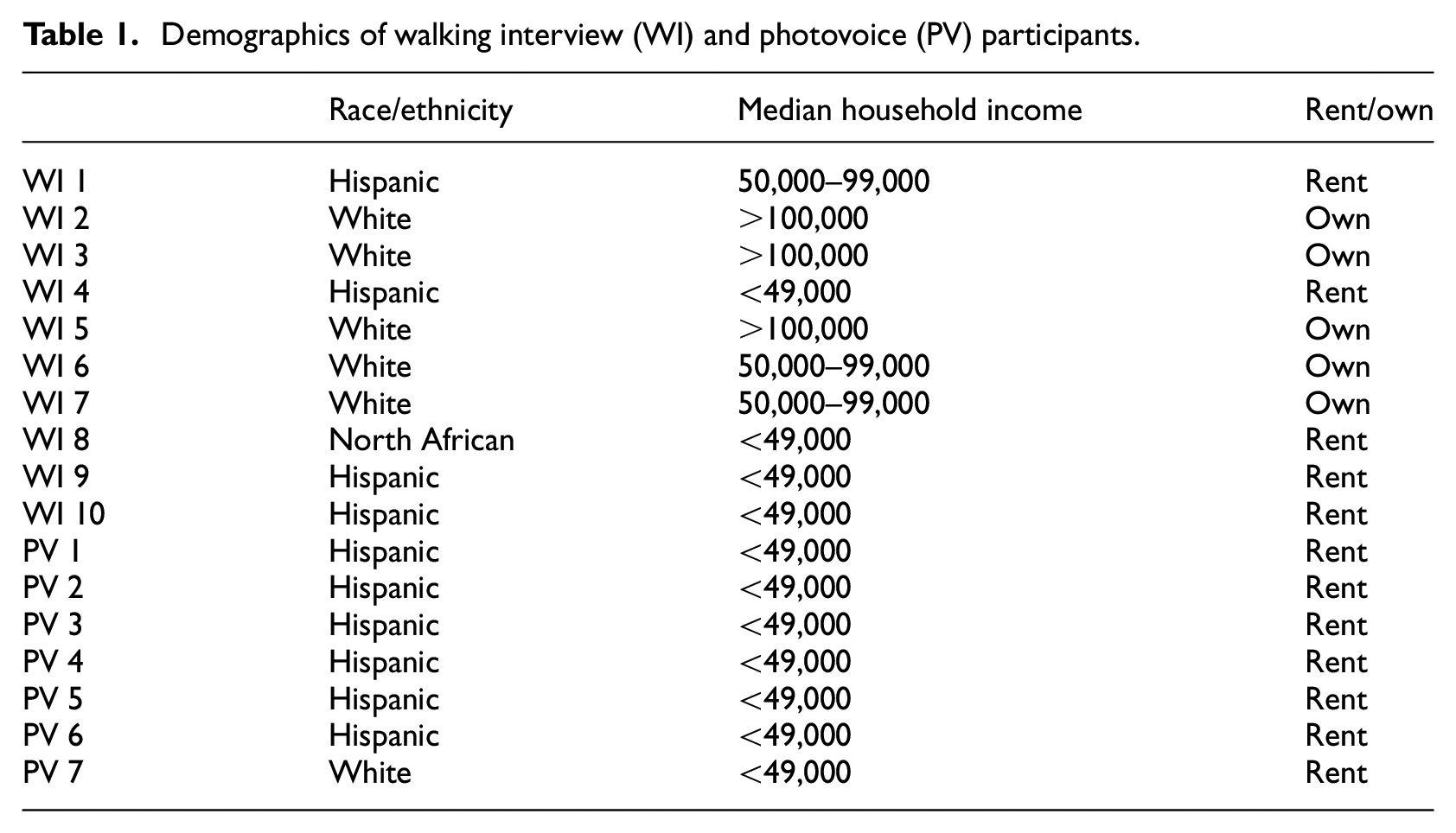
As visual changes are often the most immediate and visceral experience of gentrification, I used methods focused on creating and collecting visual data including photographs and maps for analysis. In order to do this, I used multiple methods of inquiry and analysis to fully unearth the experience of gentrification for those living in a gentrifying neighbourhood. The methods include: (1) an ethnography of more than 1435 hours over the course of one year of dedicated field work in East Boston; (2) walking interviews (n = 10 residents); (3) photovoice (n = 7 residents); and (4) geospatial analysis that situated the ethnography, walking interviews and photovoice findings within more standard indicators of neighbourhood change. The demographic breakdown of the participants from both the photovoice and walking interviews is shown in Table 1.
Demographics of walking interview (WI) and photovoice (PV) participants.
Key data from these sources included mapped walking routes that I tracked using the MapMyRun app and geolocated participant photos that were both uploaded into ArcGIS for analysis. I then analysed these data in tandem with additional spatial data layers reflecting Census tract-level demographic data and parcel-level data on changes in property values after development. I assessed demographic data over a 10-year period (2010–2020) using census data from the Decennial Census. Changes in property value over the same 10-year period were analysed using city data on the building permit process used by developers from Boston’s online data hub.
The triangulation of these various data sources allowed me to create a full, well-rounded image of the impact of gentrification as defined and identified by both administrative data and on-the-ground resident experiences. The ethnographic approach allowed me to capture the mundaneness of the day-to-day experiences within a gentrifying neighbourhood (Yi’En, 2014). Whereas the walking interviews and photovoice exposed the hauntological through the experiences of residents, capturing the mundane, everydayness of urban existence through walking up and down every street and alleyway and attending various gatherings, protests and community meetings offered opportunities to grasp the hauntological in its everyday form.
East Boston’s spectres
Gentrification-related hauntings come in many forms in East Boston: an empty hole in the ground with excavators sitting by where a multifamily home once stood, a busy auto shop on Condor St surrounded by brand new luxury apartments, a pavement crowded with the leftover belongings of a family who could no longer afford rent, the comments between neighbours describing how there is no longer any good Italian food in the neighbourhood. The intrusion of an unrepresented future in these spaces is both material and emotional – it is in both the physical structures themselves and what they represent.
The combination of neighbourhood stories, spatial data and visual data allowed me to capture the ways in which the hauntological was represented in various forms, experiences and relationships to the neighbourhood. Below, I will describe the forms in which the hauntological was made manifest throughout these different modalities.
Spectral objects
One of the more striking images that is representative of the landscape changes occurring in East Boston is the Eddy, a 17-story luxury apartment building located on the waterfront. Much like Smith’s Black Tower, the Eddy stands above all other buildings in a neighbourhood largely composed of three-story multi-family households. As such, its structure feels as though it is visible from almost every corner of the neighbourhood. Aside from bordering the waterfront, the Eddy is immediately adjacent to a HOPE VI public-housing-turned-mixed-income residential neighbourhood, and its presence represents a stark contrast to the two forms of housing. During large parts of the day, the structure of the Eddy casts a shadow over much of the adjoining neighbourhood where there used to be unobstructed views of the sun and the waterfront.
The encompassing presence of the Eddy was captured by Arial, 2 a participant in the photovoice project (Figure 1). Arial is an immigrant from El Salvador who attended the groups with her husband; she spoke to me via an interpreter as neither her nor her husband spoke English and my Spanish is quite limited. When describing why she took this photograph, she described how the building ‘just towered over everything. Everyone in there must be so rich, and they look like they are looking down on all of us’.
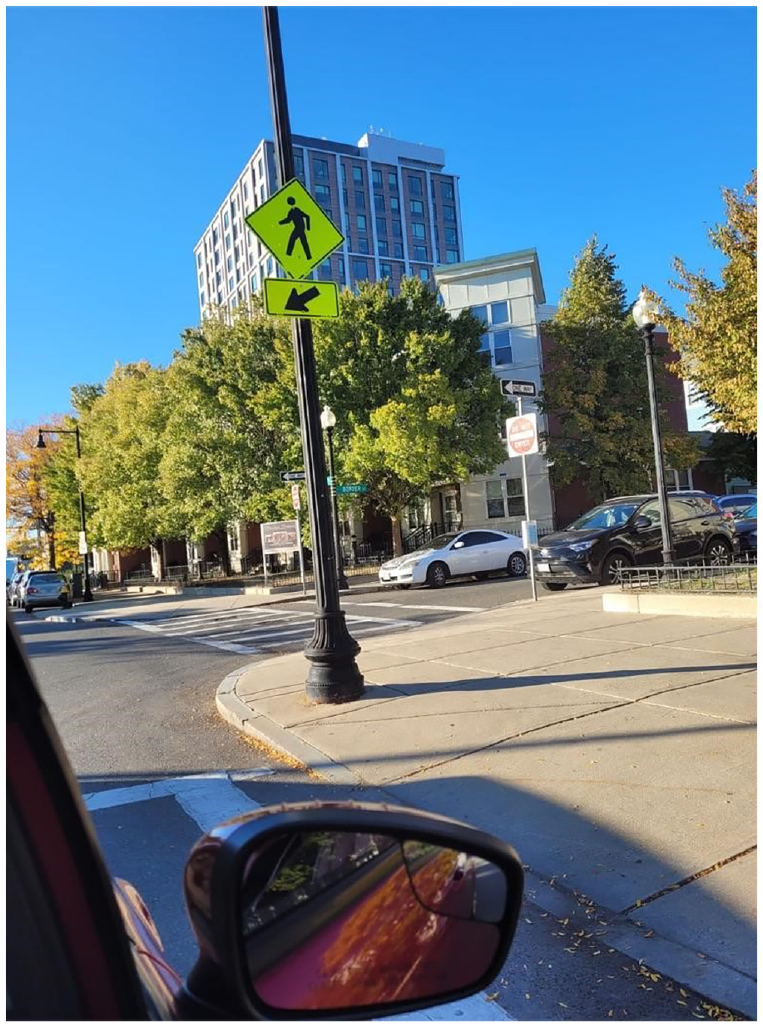
The Eddy as seen from Arial.
In a similar vein, a separate participant, Sandy, a Hispanic-identifying female who has lived in the neighbourhood for nearly 30 years, took a photograph of her commute that brought her down towards the waterfront of the neighbourhood (Figure 2). Here, she wanted to capture what she feels was lost by the new luxury apartment buildings along the waterfront. In her description to the group, she stated: ‘I remember when we used to be able to see the city. It was beautiful … Now all we can see are these new ugly buildings’. The presence of these new, ‘ugly’ buildings themselves also signifies what is absent: the view of the harbour and the city.
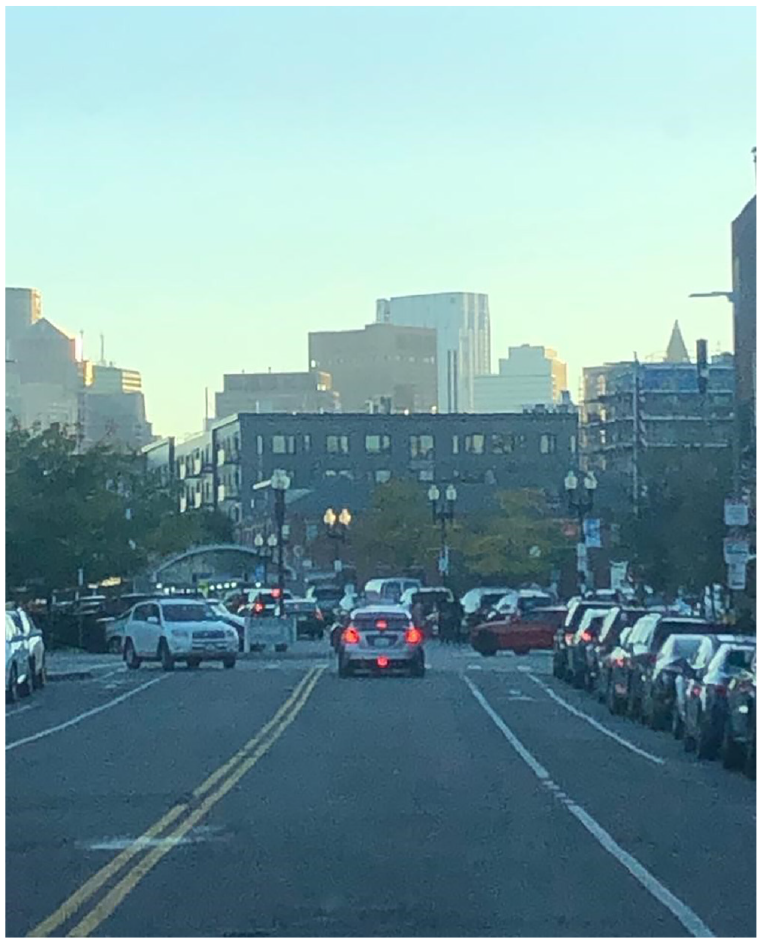
The ‘lost’ view of the harbour.
Embedded within these statements is the idea that these new buildings do not belong in the neighbourhood – in their style and in their location. And yet, their existence in the neighbourhood calls into question who belongs in the neighbourhood after all – the neighbourhood that felt like home for many residents is changing in such a way that they no longer feel included. These hauntings are of the ‘lost future’ that Fisher (2012) speaks of. It is the lost future of belonging.
In both of these instances, the hauntological is manifest in the presence of something that was not formerly there – buildings whose presence also signifies the absence of what once was. In the second image, the absence is not only in the lost view of the harbour and the downtown but also in what the lost view and the new buildings represent. In this image, the absence is the sunlight that is now obstructed for residents in the immediately surrounding blocks. Their presence is obstructive for most of the neighbourhood residents, and their existence represents an area that residents no longer feel is for them. The view of the harbour and the city itself, the sunlight, is no longer for them.
Throughout the photovoice process, participants worked together to build collective meaning from the photographs that everyone had taken and to find a creative way to present their experiences. For Sandy, this meant collecting the photographs that signified ‘loss’ in all its forms, as seen in Figure 3.
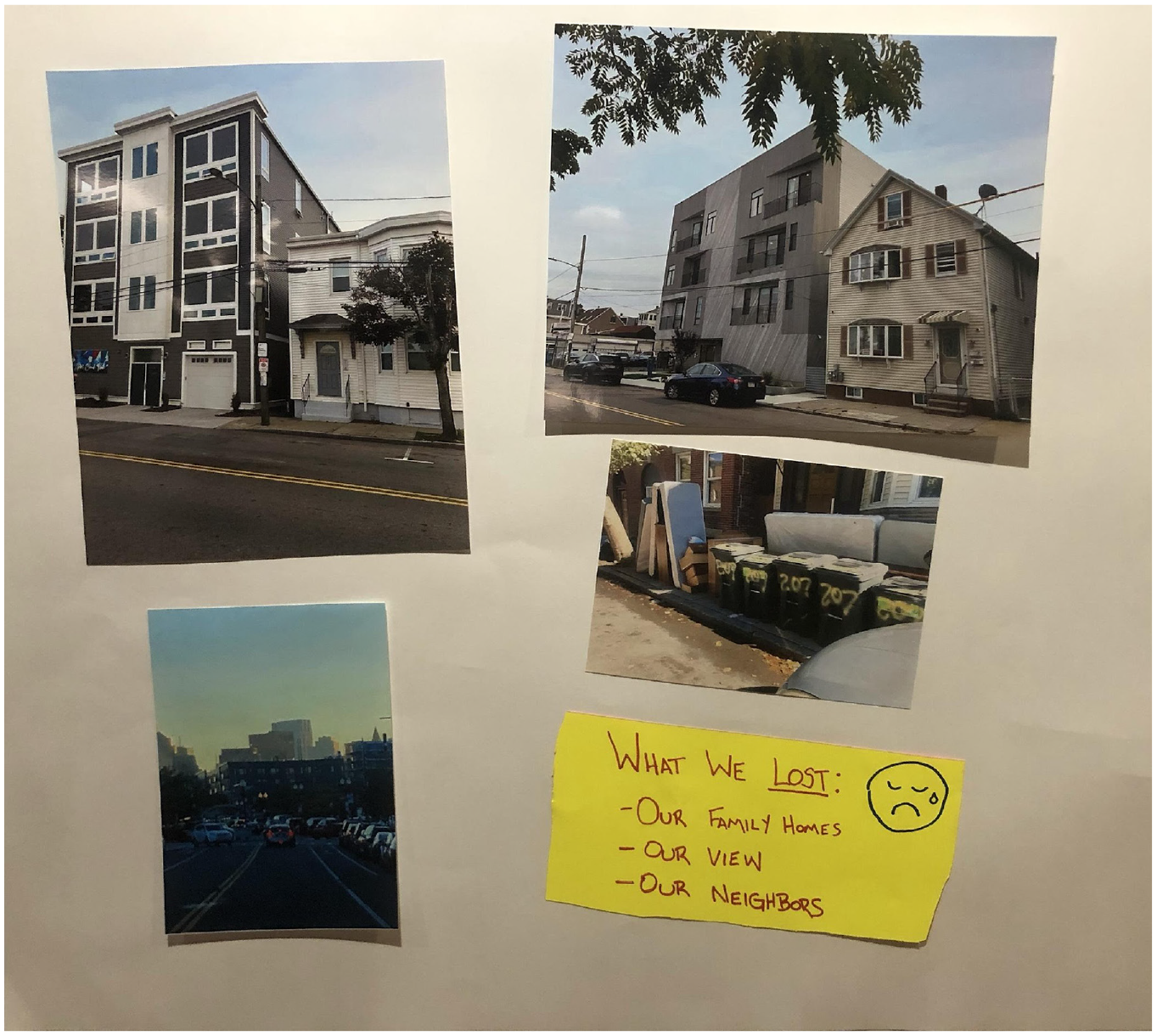
Photovoice poster.
The hauntological represented as a loss is shown in both the photographs themselves and their description. We can see how the top photographs show the dichotomy between the styles of buildings – single-family homes being towered over by four-story luxury condos and apartments whose aesthetic expression does not match what was before. The description by the participant is simple, but it conveys that loss is both structural and emotional – it is embedded in the aesthetics of our space and the emotional attachment that this space has.
Although the hauntings of the physical structures and spaces were the most visible and easily recognisable, the spectre of each renovated building and large luxury building is also a manifestation of absence. Each of the hauntings of absences was the spectre not only of nostalgia but also of the lost futures of a largely working-class and immigrant community that no longer sees itself in the future of the neighbourhood. My research suggests that these experiences of loss were felt deeply by those who are closest to the epicentre of the changes occurring in the neighbourhood.
The present absence
Sometimes the spectres of gentrification are actual community members – friends, families and neighbours whose absence is a presence. The displaced community makes up the present absence of the neighbourhood – their absence is marked across all aspects of the city, like the manifest shadows of humans and objects left behind after a nuclear blast. These present absences of the community members themselves represent another hauntological terrain of gentrification: ‘lost futures’ presented through the loss of long-time community members and the grief experienced by current residents.
This sense of grief at the loss of community hovers over every aspect of conversations surrounding residents’ relationships to gentrification within the walking interviews and photovoice groups. When talking to Evelyn during our walking interview, she remarked about this sense of loss: Yeah. I don’t really know anyone. It’s a lot of new people coming in now [and] it’s weird to run into, it’s like [people will say] ‘yeah I just couldn’t fight in Eastie. I couldn’t buy my children’s home, I couldn’t live with my parents’. Like it’s wonderful to live here in East Boston. You’re so close to downtown, you have all these wonderful things that have been happening. You can walk to everything. But people couldn’t stay. Everyone has had to leave … It’s just like dude we did everything right what more could we do? … We wanted to give back to the community and like where’s my community? It’s not even here.
Evelyn is a Hispanic-identifying female resident who was born and raised in the neighbourhood. For her, this loss itself is beyond an individual loss. It is a communal grief over the losing of one’s culture through the changing of the neighbourhood. When loss is mentioned across interviews and photovoice participants, it is rarely in the individualist meaning of the word. That is to say, loss is often experienced and expressed communally. We can see an example of this expressed in Evelyn’s quote above when she remarks ‘where’s my community? It’s not even here’. This same sense of communal loss was shared at the housing event where a young woman, who appeared to be a Hispanic teenager, nervously asked to speak. She shared with the crowd how she and her mother were evicted from their home in East Boston in 2020 and currently live in Revere, an adjoining city to the north: ‘No tiene las personas que amo. No tiene la gente que yo amo. No tiene mis favoritas restaurantes. Y no tiene la comunidad que yo amo’ (‘It doesn’t have the people I love. I don’t have the people I love. I don’t have my favourite restaurants. And I don’t have the community I love’).
This sense of individual and communal loss is represented in the photograph taken by Sandy. It is an image of what was left behind after a family eviction across the street from where she lives (Figure 4). She describes knowing the family, and her sadness at seeing them forced out of the neighbourhood. She recalled talking to her landlord and asking him ‘Am I next? When am I going to be kicked out?’ Again, we see Fisher’s (2012)‘lost future’ present in these descriptions. The images and voices of residents living through these changes are themselves the hauntings of what should have been – a strong community, family homes, a sense of belonging. As things change and increasing pressures are placed on the community, these futures no longer feel possible. What is left behind are the spectres of what once was and what could have been.
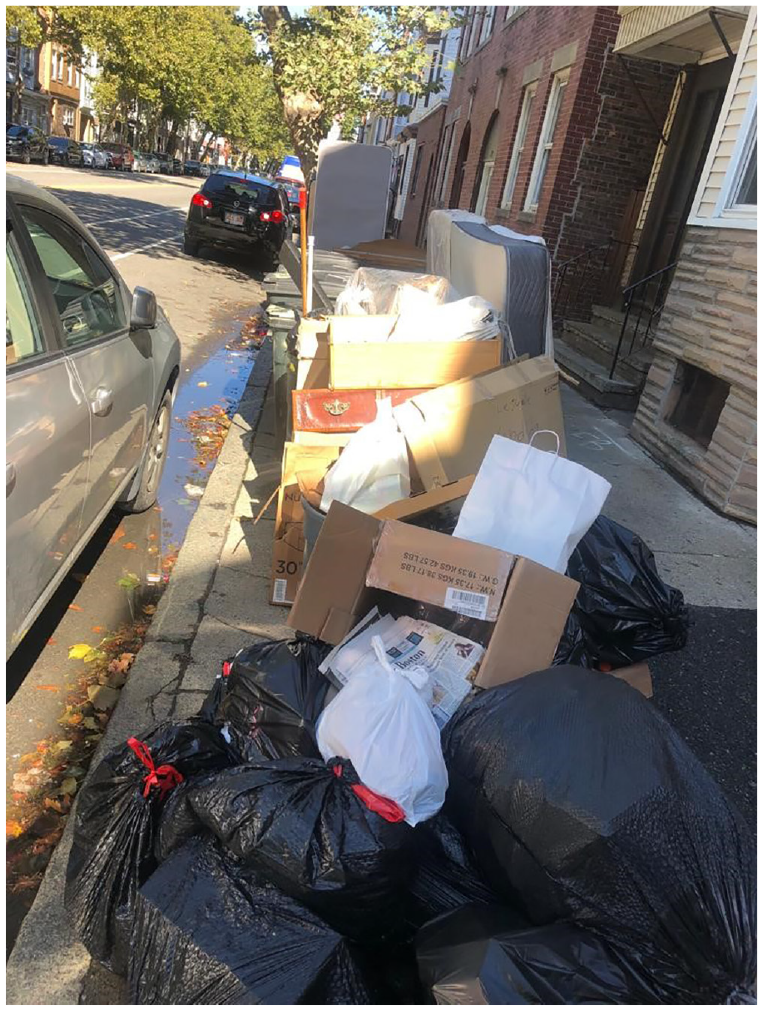
Image of what remained after a family’s eviction, as captured by Sandy.
The spectres of present absences can also be represented in how businesses have changed. During the photovoice portion of my research, a community member shared a picture they had taken of a new business that markets high-end groceries and merchandise. The resident who took the picture described how this new business was marketing itself to the new residents coming into the neighbourhood – the merchandise and products themselves creating a vision of East Boston that was not representative of the previous Italian-American heritage or the majority Hispanic population. Throughout this discussion, another resident mentioned how this location used to be a Brazilian fútbol store – a small business that once represented a staple in the majority Hispanic population. Elliot recounted his experiences there: ‘I would go in often and just talk about fútbol and listen to stories of his life in Brazil. I think he ended up moving Revere when the rent got too high’.
These accounts showcase a duality in the hauntological gentrifying urban landscape: an attempted creation of a new future for the neighbourhood, and representations of what was once believed to be the future of the neighbourhood. What is left behind are the spectres of present absences– a nostalgia for a future where families are still living among us, not displaced and forced to leave their belongings behind. Their ghosts do not solely point towards a remembered past but towards a disappearing future where they once belonged in the minds of long-time residents.
Alienation from the future
At the heart of the hauntological inquiries into gentrification is the lost sense of belonging in the future of the neighbourhood. For many residents that I engaged with through walking interviews and photovoice, the sense of alienation from the future of the neighbourhood was also representative in the expansion of new public spaces in the neighbourhood. While this may appear initially as a contradictory premise, this contradiction is explained by how long-term residents explained their relationship to these newly created spaces. New waterfront parks were voiced to be ‘not for us’, as one participant told me while walking me around some of the new open spaces on the waterfront: And so then I was just like ‘ohhhh’ you didn’t redo the park and the station for us … you did it to bring in people. Ohhh you didn’t give us a beautiful park … it’s like ‘oh, this wasn’t for us’, it’s for, it’s because there was this grand master plan, this update, urban renewal type of situation where it’s just like ‘ohhh that’s why the BPDA is doing this’, not for the people who are already here but for the people they want to come here.
For Evelyn, this is all intimately obvious: these changes were to attract new residents into the neighbourhood. They would not have upgraded the parks, created new parks and created new public spaces if this wasn’t going to bring new people into the neighbourhood.
Residents’ sentiments about the purposes for the changes in the neighbourhood were also reflected in their memories of what the neighbourhood was like prior to development. In a group discussion in a photovoice session, Lily was listening intently as the group shared their photographs. While the group was collectively making meaning from a set of photographs from another participant, she made the remark: ‘I miss the old days when Eastie was violent because at least then we didn’t have all of these developers. It feels like we’re either fighting ourselves or fighting the system’.
Lily’s comments reflect the message that ‘they didn’t do this for us’. They reflect the sentiment from most people I talked to – that development is kicking people who are already here out so they can bring in wealthier newcomers. Embedded in this statement is also the belief that community violence is better than development, because with community violence developers will stay away and the neighbourhood will keep more of its residents. There is an inherent pessimism here: you can’t have both things; you can’t have a safe community without displacement; you can’t have renewal without displacing those who already live here. These collective feelings often spread beyond ‘they didn’t do this for us’ into a feeling that ‘they’re trying to get rid of us’.
We can trace in these responses an extension of what Fisher (2012: 16) describes as the ‘slow cancellation of the future’, wherein the loss of a collective vision of the future means the ‘deterioration of a whole mode of social imagination’. Lily’s apparent nostalgia for this past objective violence is indicative of loss of social imagination – the objective violence of the past still held within it a collective vision of a future without this violence, different from the current future vision where Lily and her community no longer belong.
Implications
Brown-Saracino (2011) offers up a construction of collective memory that is positioned in the formation of collective social ties. Our collective memory of the past that has been disrupted can, in turn, function to create an inclusive present-day social identity (Brown-Saracino, 2011). Hauntology provides a useful intervention here, where the intrusion of gentrification’s collective threat on the social and political signifiers of a neighbourhood creates a collective identity rooted beyond a shared memory of the past, but also a shared memory of how that past envisioned our future. That is to say, our collective memories embedded into a ‘lost future’ function to define our collective identity in a new potential future. Throughout my research, participants never used the words ‘ghosts’ or ‘spectres’ or ‘hauntings’ in their descriptions of gentrification. But when viewing their responses through the hauntological framework, often what they were describing and showing was just that: hauntings, ghosts and spectres. This was manifested most clearly in the experiences of community members whose shared images and interviews acted as representations of their own feelings that the neighbourhood was losing something – its culture, its identity, its people and so on.
Hauntology provides a theoretical framework that allows us to explore the spaces that occupy the material and more-than-material impacts of gentrification on communities. Hauntology allows for space to be more than just a collection of material objects, but a collective of embodied emotions. Fullilove’s (2004) and Pain’s (2019) theoretical frameworks, along with the art installations explored by Best and Ramírez (2021) and the graffiti excavated by Kindynis (2019), show how space is embedded with trauma. The application of the hauntological allows us to reframe how the embeddedness of urban trauma exists in the everydayness of urban existence.
The application of ‘lost futures’ allows us to understand what has been lost beyond the material. The radical potential of hauntology is in its ability to navigate the relationship between material structures and the more-than-material implications of root shock and trauma. Where root shock and chronic urban trauma help us to understand the impact of displacement and the changing environment in a trauma-informed capacity, hauntology allows us to engage in the physical structure itself as the traumatic signifier. That is, in its relation to root shock, hauntology is represented in those who are left behind and the structures that have taken their place, in the ways in which the new buildings alongside the remnants of those who have been displaced encapsulate the ways in which the discourses of urban renewal often whitewash the trauma of displacement. This helps us pull at the threads of the material to reveal the more-than-material hidden in plain view, allowing us to look at space in a new, unnerving way.
The ‘lost futures’ described in the hauntological framework also allow us to see the class-based narratives embedded into the gentrifying urban landscape: whose futures are being lost, and in what way? That is to say, the poor, working-class, often Black, indigenous or people of colour residents who are being displaced are themselves losing a future that, at one time, represented a hope for social mobility. During the process of gentrification, it is both the racial and ethnic dynamics that change, as well as the class dynamics. The loss of a particular view is not just an inconvenience but the realisation that the future you had hoped to build in the community has been replaced by the capitalist drive to extract value in ways that you are excluded from.
Here, we can see the utility of a hauntological critique of gentrification in its capturing of the shared vision of a future that has been lost. The spectres of gentrification are the stunted progressive movements towards more democratised and pluralistic political futures that can function from outgrowths of strong, enriched social ties; i.e. in the vision of Fisher (2014) and Derrida (1994[2006]), the creation of a society beyond capitalism. In the case of urban studies, this can be understood as a society beyond the commodification of housing. These disruptions in social ties can work to prevent community organising towards this more democratised future, embedding a cynicism into the community wherein the only hope is to prevent displacement in some cases. Alternatively, we can also understand the collective rejection of these ‘lost futures’ in Hyra’s (2024) conceptualisation of urban uprisings as being a consequence of the slow violence of state policy and the sudden violence of police interventions. Uprisings as rejections of these ‘lost futures’ present the possibility that a shared, democratised future is not wholly lost but instead is waiting to be grasped.
Hauntology asks urban researchers to first view the democratised future embedded in how residents construct the past, thus allowing us to more fully grasp what is at stake for gentrifying communities. In a way, a hauntological lens focused on the urban environment asks us to interrogate the question: How do we explain the present absence of a community? That is to say, how do we grapple with what is left behind – structurally, culturally, emotionally, spiritually – as a community is forced out? In the language of hauntology: what ghosts linger in these contested spaces? It is my hope that we have only begun to understand the implications and applications of engaging in hauntology as a legitimate urban theoretical framework. As prior authors have indicated, there is room for this theoretical foundation to grow and advance in the field of urban research, and in doing so to explore new relationships to urban environments and their residents. It is our duty, then, to excavate these spectres that lie in between the material and more-than-material within the gentrifying urban landscape, and to drag them into the sunlight and interrogate them. And in doing so, we must contend with the troubling histories and realities they present us with.
Footnotes
Acknowledgements
I would like to thank the community members of East Boston for welcoming me into their neighbourhood, and for the members of East Boston Mutual Aid for trusting me with their community and helping me put this project together.
Declaration of conflicting interests
The author(s) declared no potential conflicts of interest with respect to the research, authorship, and/or publication of this article.
Funding
The author(s) disclosed receipt of the following financial support for the research, authorship, and/or publication of this article: This project was partially funded by the Society for the Psychological Studies of Social Issues and the Boston College School of Social Work.
