




Abstract
In light of the calls to relax restrictive density regulations, this paper examines how increasing residential development capacity, i.e. upzoning, may change the demographic, socio-economic and housing characteristics of the affected neighbourhoods. We examine the neighbourhood-level upzonings of New York City to answer this question. We find that upzoning is positively associated with signs of gentrification – upzoned neighbourhoods became whiter, more educated and more affluent in the long run. Upzoning is also associated with increases in housing production, but housing prices also increased. Most importantly, we find that these effects varied significantly by the intensity of upzoning and the pre-upzoning local contexts. Neighbourhoods affected by intense upzonings experienced gentrification more intensely, along with greater housing production, rent growth and housing price appreciation. Black-majority and low-income neighbourhoods experienced gentrification to the greatest extent, while neighbourhoods with high demand for housing saw the greatest increases in housing supply. We discuss different mechanisms of gentrification likely at play for the different types of neighbourhoods.
Introduction
In recent years, calls to relax restrictive land use regulations have dominated national, state and local policy debates in many countries, particularly in places where housing prices have been rapidly rising. Such calls have garnered nationwide support in the US as a way to boost housing supply and bring down the cost of housing (Manville et al., 2022; Quigley and Raphael, 2004) and to further housing equity by removing zoning regulations with exclusionary effects (Kim, 2024; Manville et al., 2020; Pendall, 2000; Whittemore, 2021). One of the most common zoning reforms for housing production has been to increase the allowable residential density on a given lot, a practice often referred to as ‘upzoning’.
Advocates of upzoning argue that removing restrictive density regulations will lead to more housing production and alleviate housing cost burdens (Glaeser and Gyourko, 2002). However, empirical research presents mixed evidence when it comes to the link between upzoning, housing production and affordability (Asquith et al., 2023; Been et al., 2023; Freemark, 2023; Greenaway-McGrevy and Phillips, 2023; Greenaway-McGrevy et al., 2021). Moreover, sceptics of upzoning have raised concerns over the effects of upzoning on incumbent residents. They fear that upzoning will result in new developments that cater to high-income households, leading to gentrification and displacement of existing low-income residents (Rodríguez-Pose and Storper, 2020).
Although empirical research on upzoning’s effects is growing rapidly (Freemark, 2023), there are gaps to be filled. First, examining the long-term effects of upzoning has been challenging given that many upzoning initiatives are of recent vintage. Moreover, most of the quantitative studies on upzonings have focused on housing supply and property values, but less on the changes in neighbourhood characteristics. Studies of neighbourhood change have mostly been qualitative accounts based on a select few cases, limiting the generalisability of the findings. Lastly, existing studies have yet to identify whether varying intensities of upzoning and variations in pre-upzoning neighbourhood conditions matter for its effect.
Through an in-depth investigation of the experience of New York City (NYC), we aim to make the following contributions to the existing literature on upzoning: (1) identifying the long-term, at minimum 10 years, effects of upzoning on a comprehensive set of neighbourhood characteristics associated with gentrification, housing production and affordability and (2) teasing out how the effects of upzoning differ by the intensity of upzoning and (3) by pre-upzoning local conditions. We compare the changes in the characteristics of upzoned neighbourhoods with those that were similar prior to upzoning but were not upzoned. We construct the comparison group using a matching method.
Building on previous literature (Finio, 2022; Lee and Perkins, 2023), we identify gentrification as: increases in non-Hispanic whites and relative decreases in other racial and ethnic groups; increases in population with a bachelor’s degree or higher and high-status occupation; and increases in median household income. Given that housing characteristics have a circular relationship with gentrification, we consider them as part of the mechanisms of gentrification rather than simply as outcomes.
NYC offers a particularly rich setting for achieving our goals. First, neighbourhood-level rezoning has long been the primary growth management strategy of the city, which allows for sufficient sample size and for examining the long-term effects of upzoning. Second, NYC has neighbourhoods that are extremely diverse, serving as a context for examining how neighbourhoods with varying characteristics are affected by upzoning. There are several existing studies on NYC’s upzoning (e.g. Davis, 2021; Furman Center, 2010; Liao, 2023; Peng, 2023) but none have explored how upzoning’s impact may vary by the pre-upzoning neighbourhood characteristics and the intensity of upzoning.
Defining upzoning
There is no definitive definition of what constitutes an upzoning. We understand upzoning to be any zoning change that increases the density and intensity of allowable development capacity but focus on increases in residential use for the purpose of this paper. In practice, upzoning can refer to vastly different types and scales of zoning changes. For instance, an example of a project-level upzoning is the practice of upzoning on a project-by-project basis for large-scale development projects (Kim, 2020); a neighbourhood/area-wide upzoning may increase the allowable densities around transit stations (Freemark, 2020; Manville et al., 2023); a citywide upzoning can allow for additional units in zoning districts that previously only allowed one single-family, detached housing per lot (Kuhlmann, 2021); and a state-wide upzoning can increase development capacities statewide, such as the Senate Bill 9, passed in 2021 in California, which allows property owners in single-family zoning districts to build up to four units on each lot.
The intensity of upzoning can also vary. At the low end of the intensity spectrum, allowing accessory dwelling units to be built by right in single-family zoning districts, can be identified as upzoning. At the higher end of the intensity spectrum, an over 10-fold increase in development capacity can be found in certain parts of NYC, such as the Hudson Yards neighbourhood. Most upzoning cases lie somewhere in between.
Given the various types and scales of upzoning, we wanted to understand how upzoning’s impact may vary by its design and target communities. Although empirical research examining the impacts of upzoning is at its nascent stage, there is increasing evidence that the effects will vary by geography and policy design.
Upzoning, housing affordability and gentrification
Effects of upzoning on housing market
Existing studies on the upzoning’s effect on (1) housing production and (2) price and cost of housing offer mixed results (Freemark, 2023). One of the most cited papers on upzoning is Freemark’s (2020) paper on upzoning parcels near transit stops in Chicago, which sparked heated debate among urban scholars (Manville et al., 2022; Rodríguez-Pose and Storper, 2020). The author finds that upzoning did not lead to immediate increases in new housing construction when compared with the nearby areas that have not been upzoned. By contrast, many others have reported that upzoning does lead to an increase in housing supply (Cheung et al., 2024; Dong, 2024; Greenaway-McGrevy and Phillips, 2023; Peng, 2023; Stacy et al., 2023).
A closer reading of the existing literature suggests that the variations in the design of upzoning initiatives may explain the diverse degree and direction of the effects. For example, the effects of upzoning will vary depending on the geographic extent and the intensity of upzoning. Studies of mass upzoning of all land that previously only allowed for single-family detached homes have found positive effects on housing production (Cheung et al., 2024; Dong, 2024; Greenaway-McGrevy and Phillips, 2023). A couple of studies that examined neighbourhood-level upzonings, by contrast, did not find increased housing production, although the evidence is far from conclusive (Freemark, 2020; Murray and Limb, 2023). The experience from Washington, DC suggests that hyper-targeted upzonings associated with broader redevelopment plans can lead to a substantial number of new houses (Brooks and Schuetz, 2023).
With regard to property values, many studies have found that upzonings have led to value appreciation. For example, Kuhlmann’s (2021) study of Minneapolis revealed that homes on parcels that were upzoned from single-family housing to allow for up to three units experienced increases in housing sales prices compared to the homes nearby on non-upzoned lots. Greenaway-McGrevy et al. (2021) found that upzoning about three-quarters of land in Auckland, New Zealand also led to notable increases in property values for lightly developed parcels on which redevelopment potential was large. By contrast, property values of intensively developed parcels declined compared to properties in similar, yet non-upzoned parcels, due to higher demolition costs and foregone rental incomes.
Property value appreciation has a mixed relationship with gentrification depending on neighbourhood context. If appreciation occurs in high-homeownership neighbourhoods, existing homeowners are poised to benefit. If it occurs in renter-heavy neighbourhoods, appreciation poses a direct displacement risk to the incumbent residents. Freemark’s (2020) study of Chicago’s neighbourhood-level upzoning around transit stations found significant increases in the transaction prices of properties across all types. Juxtaposing this finding with the non-effect on housing construction, the author raises concerns about the impact of upzoning on gentrification and displacement.
Few studies have shed light on the heterogeneity of upzoning’s effects depending on the demographic, socio-economic and land use characteristics of neighbourhoods prior to upzoning. Atkinson-Palombo (2010) examined the effects of new transit stations and permissible zoning in the Phoenix metropolitan area and found that homes and condos in amenity-rich, mixed-use neighbourhoods saw significant price appreciation, whereas residential neighbourhoods experienced no appreciation effect. Cheung et al. (2024) examined the experience of Auckland, New Zealand and found that property value appreciation was the largest in middle-income neighbourhoods and the lowest in high-income neighbourhoods. Kuhlmann (2021), in the case of Minneapolis’ citywide upzoning, showed that housing value appreciated more in neighbourhoods where median assessed values were lower than the city median. These studies collectively suggest that upzoning’s effect will vary by the pre-upzoning conditions of the affected neighbourhoods.
How upzoning changes neighbourhood characteristics
Compared to the body of research on housing outcomes, there is relatively limited quantitative research on how upzoning changes neighbourhood characteristics. Studies that exist are mostly based on NYC. For example, Davis (2021) finds that the upzoning was associated with increases in the white population share between 2000 and 2010. Liao (2023) examines the effects of 22 upzoning initiatives in NYC that occurred between 2004 and 2013 on residential mobility, showing higher mobility rates among incumbent residents in the upzoned neighbourhood. Moreover, the author finds that renters and Black households were even more likely to move out. In-migrants, by contrast, were more likely to move from higher-income neighbourhoods. Based on these findings, Freemark (2023) suggests that upzoning, in the short term, ‘provides an outlet for gentrification’ (p. 557).
Peng (2023) offers the most comprehensive quantitative analysis to date that sheds light on the long-term effects of upzoning on neighbourhood characteristics. Examining upzonings that occurred in NYC between 2002 and 2013, the author finds that upzoning led to greater housing supply and price appreciation in the long run and that these effects grew over time. The author further finds that both high-skilled and low-skilled workers increased in the upzoned areas compared to the non-upzoned areas, but that the high-skilled workers increased more than the low-skilled workers, confirming Freemark’s prediction that upzoned areas have become outlets for gentrification.
Qualitative studies of the upzoned neighbourhoods in NYC collectively suggest that upzoning has led to or accelerated the pace and intensity of gentrification (Busa, 2014; Curran, 2007; Stabrowski, 2015). For example, in the case of Greenpoint/Williamsburg in Brooklyn, Curran (2007) argues that the 2005 rezoning led to the residential displacement of the Polish immigrant community (see also Stabrowski, 2015). Freeman’s (2005) classic study of gentrification in historic black communities, such as Harlem and Clinton Hill, finds that upzoning these neighbourhoods in the 2000s accelerated the pace of gentrification (Busa, 2014).
Our review of both quantitative and qualitative studies suggests that upzoning will likely lead to gentrification. Given that areas targeted for upzoning are oftentimes communities of colour, with lower income and rates of homeownership (Furman Center, 2010; Lo and Freemark, 2022), the association between upzoning and gentrification deserves greater scholarly attention. Such communities are likely to feel gentrification pressure more intensely than wealthy white neighbourhoods.
Research design
Analytical approach
This paper aims to answer the following questions: How are neighbourhood-level upzonings associated with changes in long-term neighbourhood characteristics? How do the effects vary by pre-upzoning conditions? We answer these questions by comparing the characteristics of census block groups that were upzoned in NYC between 2001 and 2013 with those that were not upzoned, using Decennial Census, American Community Survey (ACS) and Primary Land Use Tax Lot Output (PLUTO) data. 1 Given that zoning changes are disproportionately more concentrated in neighbourhoods with less political resistance (Been et al., 2014; Gabbe, 2018, 2019), we match the upzoned neighbourhoods with non-upzoned ones with similar pre-treatment characteristics through Coarsened Exact Matching (CEM) and compare their neighbourhood characteristics in 2020. 2
To construct our sample, we first compiled a complete list of all rezoning initiatives after consultation with the Director of Zoning at the NYC Department of City Planning (DCP). The focus was on the rezonings that took place under the Bloomberg administration, as this period saw the most aggressive and comprehensive upzoning initiatives. Between 2001 and 2013, we identified 122 rezoning initiatives that changed dimensional and density regulations. We then classified them into four groups following an internal classification system developed by the DCP in 2009: (1) 30 initiatives that primarily increased residential development capacity; (2) 23 initiatives that combined upzoning with downzoning or other zoning amendments; (3) 66 initiatives that either primarily downzoned or locked in existing density restrictions; and (4) two initiatives that did not change residential development capacity. Among these categories, we focus on the first two categories, which involved some form of upzoning, totalling 53 initiatives (Figure 1). 3 We then identified the boundaries of all upzoning initiatives from a GIS shapefile, NYC Zoning Map Amendments (NYZMA), maintained by DCP.
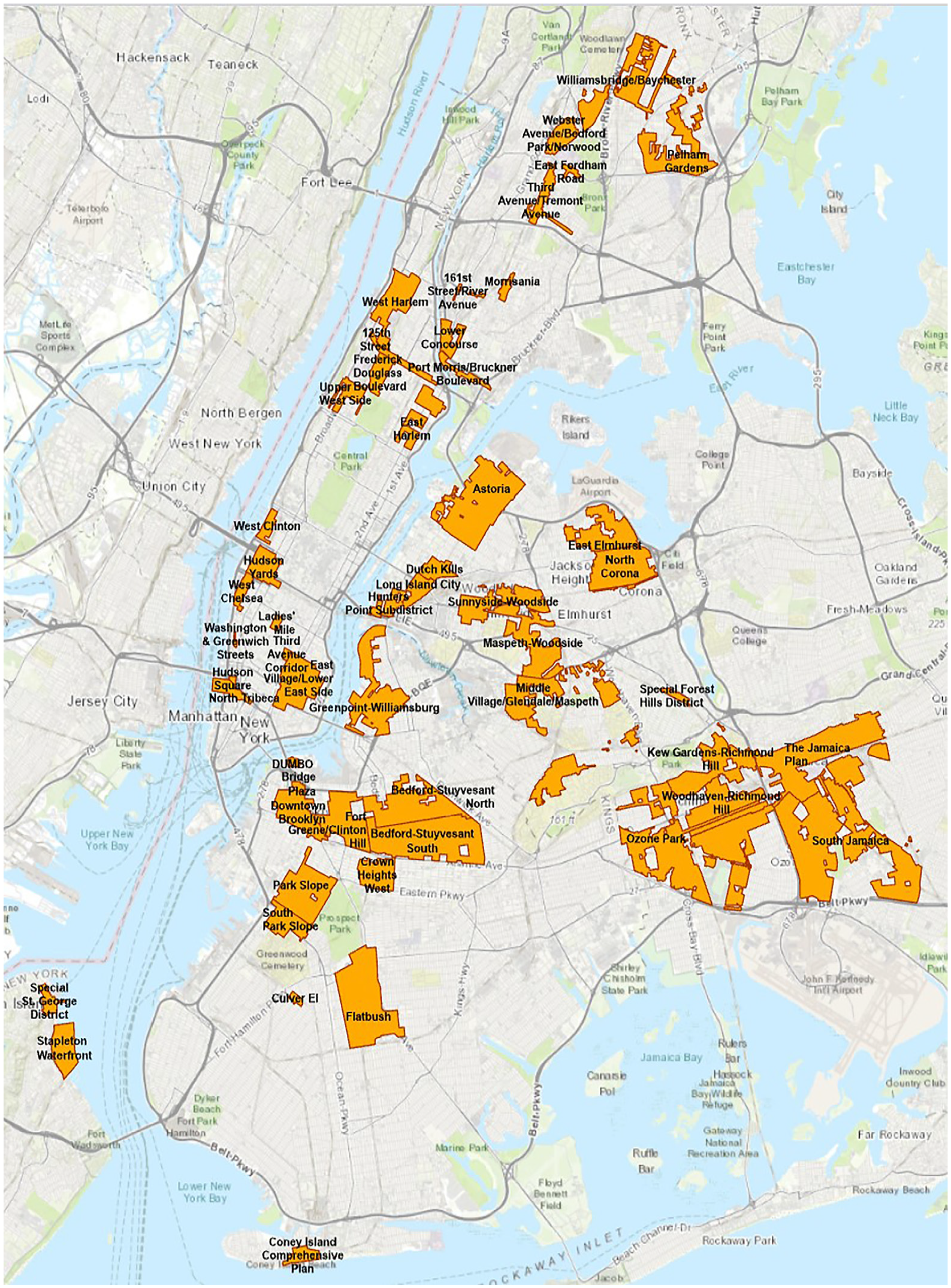
Map of 53 upzoning initiatives in New York City.
Once we identified 53 initiatives that increased residential development capacity, we calculated the difference between the maximum allowable residential floor area ratio (FAR) in 2001 and 2013 for each initiative. We used the 2002 and 2014 PLUTO, a database containing tax lot-level land use and tax data maintained by DCP, to calculate the changes in development capacities. 4 However, one of the most significant limitations of the pre-2012 PLUTO database, which has not been resolved by previous researchers, is that the database does not specify the use category of its maximum development capacity entry (e.g. residential, commercial). This presents a considerable challenge to scholars interested in how upzoning affects housing supply because the changes in the actual residential development capacity are unknown.
Methodologically, what sets our study apart from previous studies of NYC’s upzoning is that we found a way to identify the exact changes in residential development capacities by carefully reviewing the details of each rezoning initiative (explained in further detail in Online Supplemental Appendix C). As a result, we were able to examine how increasing residential development capacity, specifically, is associated with changes in neighbourhood and housing characteristics.
Following previous literature (Been et al. 2014; Dong, 2024; Gabbe, 2018, 2019), we use census block groups as our unit of analysis. We first identified the upzoned block groups that fell completely within the upzoning initiative boundaries. For those block groups that were partially included, we considered a block group as upzoned if more than 80% of the block group’s total lot area was affected. 5 As a result, 785 block groups were identified as upzoned.
The second to fourth columns of Table 1 present neighbourhood characteristics of all upzoned and non-upzoned block groups in New York City in 2000, prior to matching. Consistent with previous studies, upzoned block groups had statistically significantly different characteristics compared to non-upzoned neighbourhoods (Been et al., 2014; Gabbe, 2018, 2019). The upzoned area were more likely to have lower shares of non-Hispanic whites and college graduates, lower median incomes, rents and property values. These differences suggest that there might be observable and unobservable differences between the two groups.
Neighbourhood characteristics in 2000 among upzoned and control neighbourhoods.
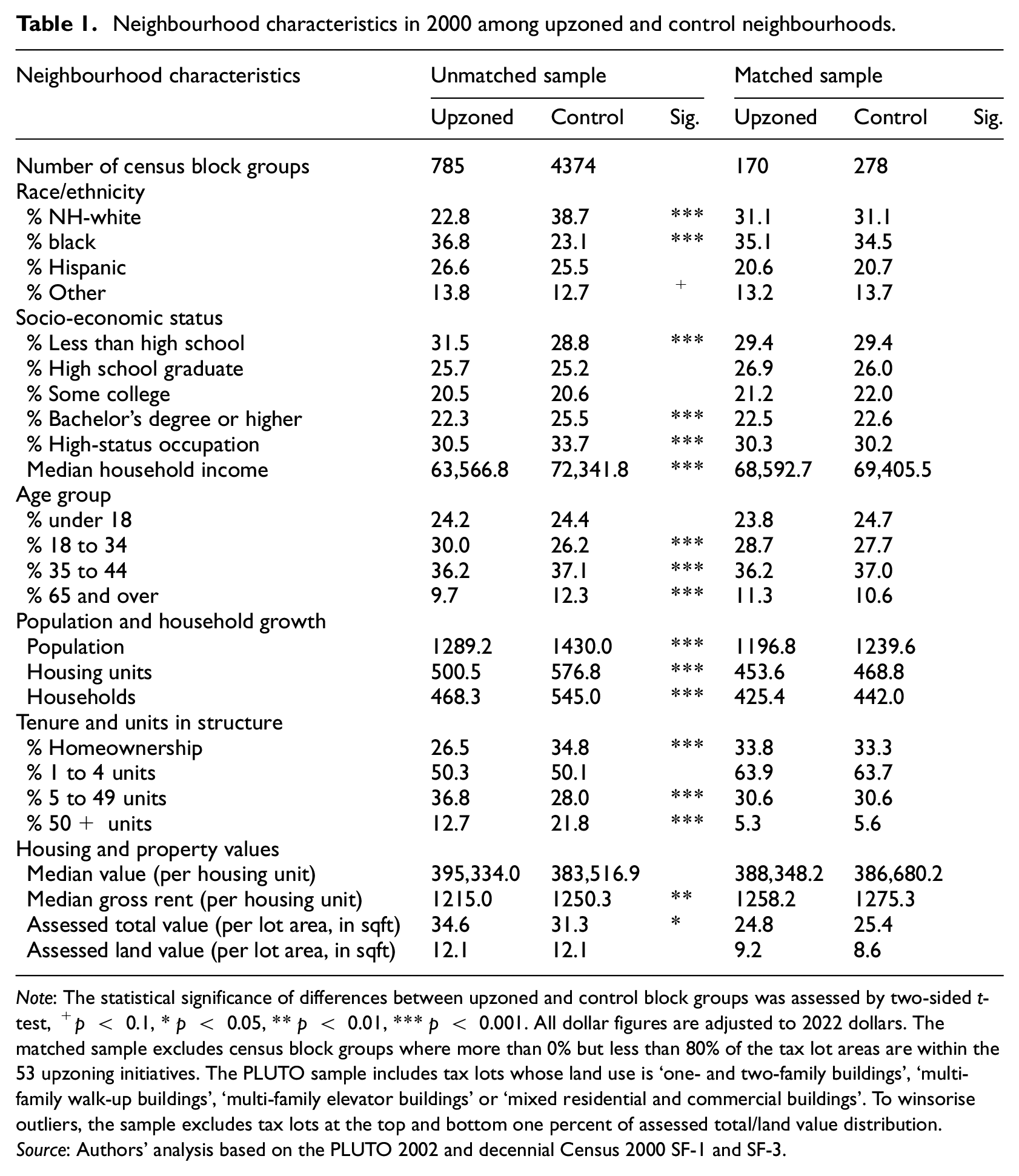
Note: The statistical significance of differences between upzoned and control block groups was assessed by two-sided t-test, +p < 0.1, *p < 0.05, **p < 0.01, ***p < 0.001. All dollar figures are adjusted to 2022 dollars. The matched sample excludes census block groups where more than 0% but less than 80% of the tax lot areas are within the 53 upzoning initiatives. The PLUTO sample includes tax lots whose land use is ‘one- and two-family buildings’, ‘multi-family walk-up buildings’, ‘multi-family elevator buildings’ or ‘mixed residential and commercial buildings’. To winsorise outliers, the sample excludes tax lots at the top and bottom one percent of assessed total/land value distribution.
Source: Authors’ analysis based on the PLUTO 2002 and decennial Census 2000 SF-1 and SF-3.
We use CEM to match upzoned block groups with non-upzoned block groups with similar characteristics prior to upzoning. Drawing on the previous literature, we use neighbourhood characteristics that are the likely predictors of upzoning for matching. As CEM prunes observations that have no close matches and outliers, the number of matched upzoned block groups in our treatment sample was reduced to 170, and our control group consisted of 278 matched block groups. While our matching method does not fully mitigate the selection bias issue, the results of balancing tests indicate that the differences between our matched treatment and control groups were not statistically significant (Table 1).
We examine the effects of upzoning on various neighbourhood characteristics by estimating the following equation:

where Y i, 2020 is a neighbourhood characteristic of census block group i in 2020; upzoned i is a dummy variable that takes a value of 1 if the block group has been upzoned between 2001 and 2013 and 0 for non-upzoned, but similar block groups; and Yi, 2000 is the neighbourhood attribute of interest in 2000. 6 Our dependent variables include population and household growth variables, age, race/ethnicity, household income, educational attainment, units in structure, and housing and property values. Variables used for housing and property values include median per-unit housing value and gross rent, which are self-reported values in census surveys, and average assessed property and land values, which are professionally appraised values.
In our base model, we use a categorical variable for upzoning in our main analysis although our data also allows for the use of a continuous variable that can represent the magnitude of change in the maximum allowable residential FAR. This is because, as we will demonstrate later, we find that upzoning does not have a continuous, linear relationship with changes in neighbourhood characteristics. Given that upzoning’s effect may vary depending on how much additional development capacity is created (Greenaway-McGrevy et al., 2021), we supplement our analysis by dividing our sample into two subgroups, intense (more than 1.0 FAR) and moderate upzoning (less than 1.0 FAR), to test if intense upzonings are more strongly associated with signs of gentrification, housing production and appreciation of housing prices. 7 To maintain consistency over time, block group boundaries are standardised to 2000 geographic definitions using the NHGIS geographic crosswalks, and all dollar figures are adjusted to 2022 dollars.
Conditions that may mediate the effects of upzoning
Through a review of existing literature, conversation with practitioners and preliminary analyses of descriptive statistics of our sample, we identified three pre-upzoning conditions that may mediate the effects of upzoning: (1) racial composition, (2) median income and (3) demand for housing. 8 For each of these conditions, we created subgroups that reflect the different pre-upzoning conditions and ran separate regression analyses to explore the heterogeneous effects of upzoning.
The first condition we consider is the racial composition of the upzoned neighbourhoods. Ample evidence exists as to how communities of colour, most prominently black, experience gentrification differently than white or multi-racial neighbourhoods. Studies have found that black-majority neighbourhoods are least likely to gentrify, potentially due to perceptions of disorder and poverty, whereas racially diverse neighbourhoods with Asian and Hispanic immigrants were most likely to gentrify (Hwang, 2015; Hwang and Sampson, 2014). Moreover, black neighbourhoods are known to experience gentrification by middle-class black households, rather than non-Hispanic whites (Freeman, 2005; Hyra, 2008). Therefore, we examine upzoning’s effects on four neighbourhood types: (1) majority-white, (2) majority-black and (3) majority-Hispanic or (4) integrated neighbourhoods where no racial/ethnic group accounted for 50% or more.
As reviewed earlier, Cheung et al. (2024) and Kuhlmann (2021) found that upzoning’s effect on property values varied by neighbourhood income. We thus divide our sample into three categories: high-income (median income greater than $81,200 in 2022 dollars), middle-income ($53,300 to 81,199) and low-income (less than $53,300). The thresholds were the cutoffs defining income tertiles among block groups in NYC in 2000.
Lastly, scholars have hinted that the strength of housing demand may also determine the effects of upzoning (Cheung et al., 2024). We used rent growth from 1990 to 2000 as a proxy of housing demand. 9 If the submarket’s growth rate is lower than the citywide rate, it is considered a low-demand market, and otherwise a high-demand market.
Findings
Aggregate results
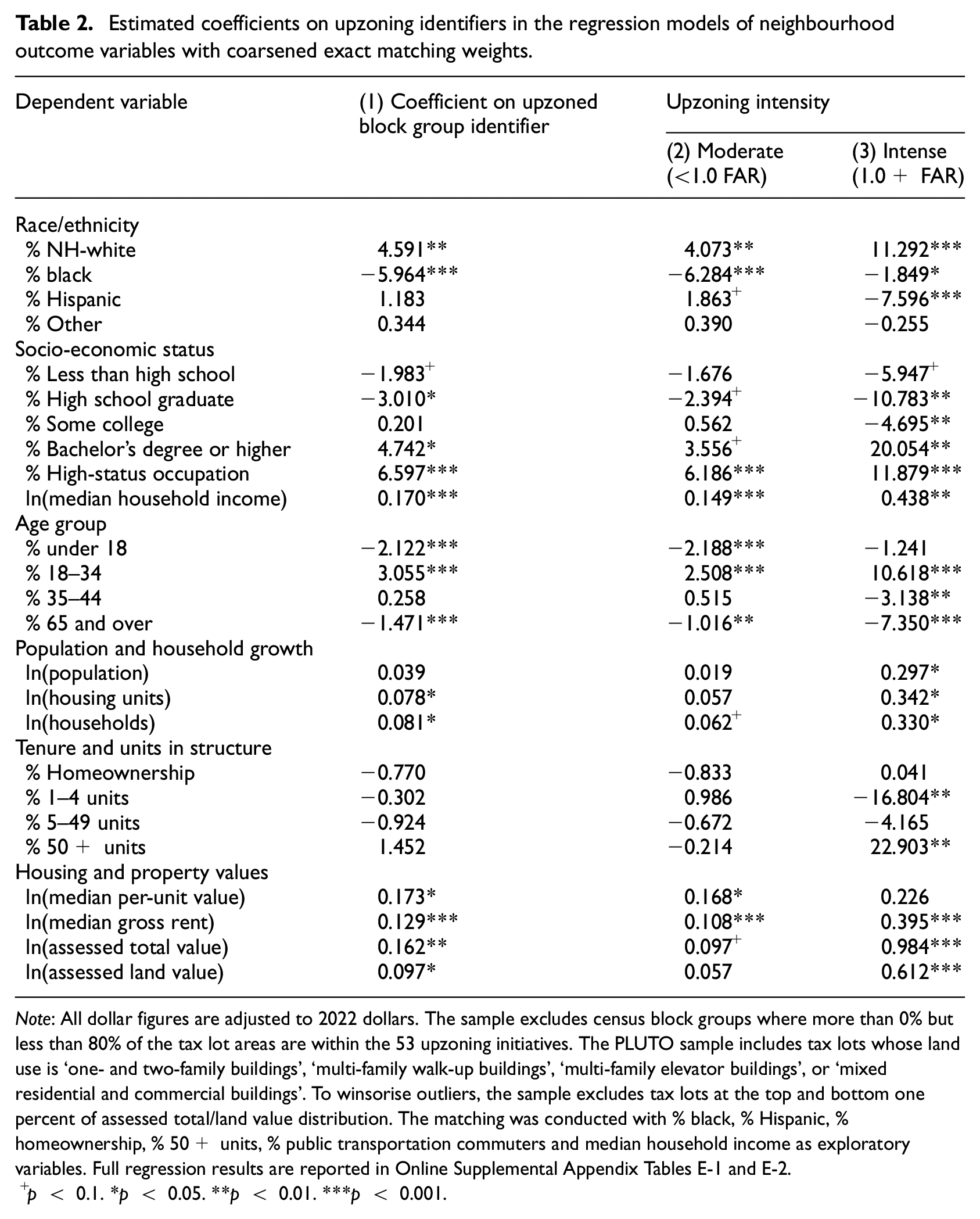
When we compare all upzoned block groups with the matched control group, we find that upzoning is positively associated with demographic and socio-economic changes indicating gentrification (column (1) in Table 2). We find that block groups affected by upzoning were likely to have a greater share of non-Hispanic whites (4.6 percentage points, hereafter pp.) and a lower share of black population (−6.0 pp.) in 2020 compared to the non-upzoned block groups that had similar characteristics in 2000. In terms of socio-economic status, the upzoned block groups had greater shares of college graduates (4.7 pp.) and workers with a high occupational status (6.6 pp.) and higher median household income (17.0%). 10
Estimated coefficients on upzoning identifiers in the regression models of neighbourhood outcome variables with coarsened exact matching weights.
Note: All dollar figures are adjusted to 2022 dollars. The sample excludes census block groups where more than 0% but less than 80% of the tax lot areas are within the 53 upzoning initiatives. The PLUTO sample includes tax lots whose land use is ‘one- and two-family buildings’, ‘multi-family walk-up buildings’, ‘multi-family elevator buildings’, or ‘mixed residential and commercial buildings’. To winsorise outliers, the sample excludes tax lots at the top and bottom one percent of assessed total/land value distribution. The matching was conducted with % black, % Hispanic, % homeownership, % 50+ units, % public transportation commuters and median household income as exploratory variables. Full regression results are reported in Online Supplemental Appendix Tables E-1 and E-2.
p < 0.1. *p < 0.05. **p < 0.01. ***p < 0.001.
On housing characteristics, we find positive associations with housing supply. In the upzoned block groups, the number of housing units increased 7.8% more than those in the non-upzoned counterparts. Relatedly, while we find that the number of households increased (8.1%), we do not find a statistically significant increase in population, indicating that the newer households were smaller. We further observe that upzoned block groups had higher per-unit housing values (17.3%), gross rents (12.9%) and property values (16.2%) compared to the non-upzoned, previously similar block groups. Our findings largely confirm the long-term positive effects of upzoning on housing supply and price appreciation found by Peng (2023).
However, when we divided our upzoned sample into two subgroups, intense and moderate upzoning, we found that intense upzoning is associated with much more pronounced signs of gentrification (columns (2) and (3) in Table 2). When compared to the aggregate results, the growth of non-Hispanic whites was significantly greater in the intense upzoning (11.3 pp.) than in the non-upzoned block groups. We also observed a statistically significant difference in the loss of the Hispanic population (−7.6 pp.).
Similarly, differences in educational attainment and household income levels between the upzoned and non-upzoned block groups are much more pronounced in the case of intense upzoning. The only indicator of gentrification that did not follow this pattern was the loss of the black population, which was more pronounced in the moderately upzoned initiatives (−6.3 pp) compared to the intensely upzoned initiatives (−1.8 pp). The larger percentage point difference we find in moderate upzoning is likely because many black-majority communities, such as Bedford-Stuyvesant, are included in the moderately upzoned group, resulting in a larger initial share of the black population.
We observe appreciation in median gross rent and assessed property and land values in intense upzoning initiatives but find no effect on owner-reported median per-unit value. We believe this is an indication that the housing price appreciation is driven mostly by the construction of new high-end rental properties with large property values. This is consistent with the effect we see on housing structures. We found that intense upzoning is associated with about 23.0 percentage points greater share of housing units in large multifamily buildings (50 or more units), whereas we do not find such an effect in either the aggregate analysis or for the moderately upzoned neighbourhoods. These neighbourhoods also experienced greater growth in population, housing and household (29.7%, 34.2% and 33.0% respectively).
The block groups within moderately upzoned initiatives saw an increase in median gross rent (10.8%), albeit to a lesser magnitude than the effects of intense upzoning, and an increase in median per-unit housing value (16.8%). However, we did not observe a statistically significant association in the assessed values. We believe the less-pronounced effect on assessed values is likely due to low levels of new constructions, which contrasts with what we find in intense upzoning. New constructions are most likely to push up assessed values as their per-unit construction costs are much higher than existing structures.
Heterogeneity of upzoning’s impacts: Pre-upzoning racial and ethnic composition
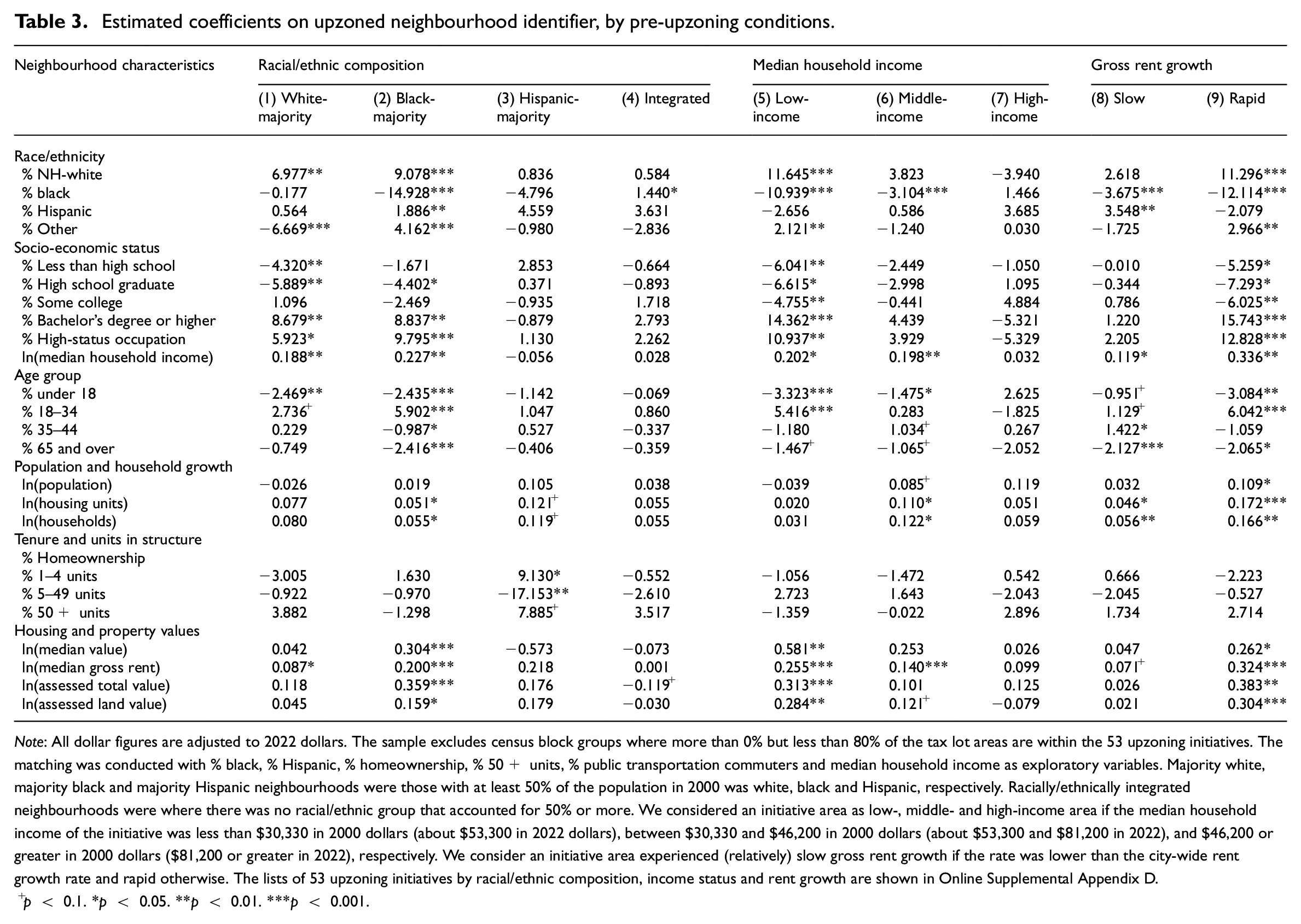
Now that we have examined the associations between upzoning and neighbourhood changes using all upzoned block groups as our sample, we now turn to how upzonings may be differentially associated with neighbourhood changes depending on the pre-upzoning neighbourhood characteristics. We first examined the variations in the upzoning’s effects by the pre-upzoning racial and ethnic composition (columns (1)–(4) in Table 3). In general, we find that many of the post-upzoning neighbourhood changes found in the aggregate sample are driven by the changes in the white- and black-majority neighbourhoods.
Estimated coefficients on upzoned neighbourhood identifier, by pre-upzoning conditions.
Note: All dollar figures are adjusted to 2022 dollars. The sample excludes census block groups where more than 0% but less than 80% of the tax lot areas are within the 53 upzoning initiatives. The matching was conducted with % black, % Hispanic, % homeownership, % 50+ units, % public transportation commuters and median household income as exploratory variables. Majority white, majority black and majority Hispanic neighbourhoods were those with at least 50% of the population in 2000 was white, black and Hispanic, respectively. Racially/ethnically integrated neighbourhoods were where there was no racial/ethnic group that accounted for 50% or more. We considered an initiative area as low-, middle- and high-income area if the median household income of the initiative was less than $30,330 in 2000 dollars (about $53,300 in 2022 dollars), between $30,330 and $46,200 in 2000 dollars (about $53,300 and $81,200 in 2022), and $46,200 or greater in 2000 dollars ($81,200 or greater in 2022), respectively. We consider an initiative area experienced (relatively) slow gross rent growth if the rate was lower than the city-wide rent growth rate and rapid otherwise. The lists of 53 upzoning initiatives by racial/ethnic composition, income status and rent growth are shown in Online Supplemental Appendix D.
+p < 0.1. *p < 0.05. **p < 0.01. ***p < 0.001.
Upzoned block groups in black-majority neighbourhoods seemed to have experienced gentrification most intensely. We find that these block groups were likely to have a 14.9 percentage points lower share of blacks than the non-upzoned black-majority block groups. This is notably greater than the 6.0 percentage-point difference identified in the aggregated analysis. In 2020, the white share was 9.1 percentage points higher in the upzoned block groups in black-majority neighbourhoods than in the non-upzoned ones. In the white-majority neighbourhoods, upzoning resulted in greater white population share (7.0 pp.), at the expense of ‘other’ racial/ethnic groups.
Socio-economic indicators of gentrification were observable in both white- and black-majority neighbourhoods. Census block groups in these neighbourhoods had greater shares of college graduates and decreases in less educated populations when compared to the non-upzoned block groups. The share of workers in management and professional occupations and the median household income also increased more than in non-upzoned, white- and black-majority block groups.
Although we also observe a greater number of housing units (5.1%) and households (5.5%) in the upzoned black neighbourhoods, this was accompanied by an increase in housing prices. These block groups were likely to have a greater median per-unit housing value (30.4%), median gross rent (20.0%) and assessed property value (34.6%) compared to those in the non-upzoned counterparts. Housing price indices of white-majority, Hispanic-majority and racially integrated neighbourhoods were not statistically significantly different from those in their non-upzoned counterparts, except for the median gross rent of upzoned white-majority neighbourhoods, which was 8.7% greater than that of the non-upzoned ones.
Heterogeneity of upzoning’s impacts: Pre-upzoning income levels
We next divided our sample into three income groups, low-, middle- and high-income, to examine whether upzoning affected these groups differently. We find a notable and consistent trend towards gentrification most starkly in low-income neighbourhoods (columns (5)–(7) in Table 3). The upzoned block groups in low-income neighbourhoods had a substantially greater white population share (11.6 pp.) and a lower black share (−10.9 pp.) compared to their non-upzoned low-income counterparts. While we observe a similar pattern among middle-income neighbourhoods, the magnitude and significance of the differences were much smaller. The differences in racial and ethnic composition were not statistically significant between the upzoned and non-upzoned high-income neighbourhoods.
Changes in the socio-economic status among residents also indicate a trend towards gentrification most strongly in low-income neighbourhoods. The upzoned block groups in low-income neighbourhoods had greater shares of college graduates (14.4 pp.), and high-status occupation workers (10.9 pp.). Census block groups in the upzoned middle- and high-income neighbourhoods did not experience similar neighbourhood changes.
Most surprisingly, we observe substantial increases in the housing and property values in the upzoned census blocks in previously low-income neighbourhoods. Median per-unit housing value and gross rent were about 58.1% and 25.5% greater in the upzoned low-income neighbourhoods compared to the non-upzoned counterparts, respectively. The assessed value at the property level was also 31.3% greater.
In contrast to the dramatic changes in housing prices, we do not observe statistically meaningful differences in population, household and housing unit growth in low-income neighbourhoods. By contrast, housing unit density and household density increased in the upzoned middle-income neighbourhoods, by 11.0% and 12.2% respectively. We discuss the implications of these observations for mechanisms of gentrification in the Discussion section.
Heterogeneity of upzoning’s impacts: Pre-upzoning market condition
Lastly, we divided the upzoned neighbourhoods by the strength of the housing market prior to upzoning (columns (8) and (9) in Table 3). Confirming commonsense knowledge and existing research, we observe significant changes in characteristics in neighbourhoods with strong housing demand. Upzoned block groups located in high-demand neighbourhoods had an 11.3 percentage points greater share of whites and a 12.1 percentage points less share of blacks than non-upzoned neighbourhoods with similarly high housing demand. They also had a 33.6% higher median household income. The share of college graduates was likely to be much higher (15.7 pp.) as well. In contrast to these effects, we only find relatively minor neighbourhood changes in upzoned, low-demand neighbourhoods such as lower shares of blacks and older adults.
These strong signs of gentrification in high-demand neighbourhoods were accompanied by significant increases in housing price indices. The upzoned block groups in high-demand markets had higher median per-unit housing value (26.2%) and gross rent (32.4%) as well as assessed value at the property-level (38.3%). Such effects on housing prices were muted in the upzoned, low-demand neighbourhoods.
When we look at population, housing units and household growth, we see greater increases in the upzoned block groups in high-demand markets compared to the non-upzoned, high-demand markets. Such increases are less observable and statistically less significant in low-demand markets. These results suggest that housing production was greater in upzoned, high-demand neighbourhoods compared to similarly high-demand neighbourhoods that had not been upzoned, but that this growth was not sufficient to keep housing prices at bay.
Discussion
Our analysis of the upzoning initiatives that occurred between 2001 and 2013 in NYC suggests that there is a strong association between upzonings and gentrification. This association is stronger with more intense upzonings and when black-majority, low-income and high-housing-demand neighbourhoods are upzoned. Given these findings, we now discuss possible mechanisms of gentrification. According to the conceptual framework proposed by Freemark (2023, Figure 1), there are two possible mechanisms of gentrification associated with upzonings. First, upzonings can lead to speculative investment without increases in housing supply, which in turn results in higher property values and rents. The other scenario suggests that upzonings, particularly intense upzonings, likely lead to increased housing construction that has amenity effects in the nearby neighbourhood, also resulting in higher housing prices.
We are likely seeing a variation of the first mechanism at play in the moderately upzoned neighbourhoods. In these neighbourhoods, we do not observe statistically significant differences in the population and household growth and assessed property values, whereas we do find that the owner-reported housing values and median gross rent appreciated more than the non-upzoned control group. This suggests that homebuyers were willing to pay more for homes in these neighbourhoods but this increase in demand was not offset by an increase in housing supply. The new residents were whiter, more educated and wealthier.
Intensely upzoned neighbourhoods saw a much larger appreciation in median gross rent and assessed property value compared to the non-upzoned, matching block groups. In contrast to the moderately upzoned ones, we observe meaningful growth in population and housing units and that this change was largely driven by the construction of high-end rental properties. Such introductions of new buildings likely had amenity effects, attracting a population with demographic profiles different than incumbent residents.
We also find that black neighbourhoods experienced the most dramatic gentrification and greatest increases in housing prices. Considering the fact that these block groups saw modest increases in households and housing units, it seems that both mechanisms of gentrification were at play in black-majority neighbourhoods. These block groups likely saw some increase in housing production, but not sufficient to suppress housing price appreciation, thus leading to gentrification.
Our findings about gentrification in black neighbourhoods contradict prior studies on gentrification. Black neighbourhoods are known to be the least likely to gentrify (Hwang, 2015; Hwang and Sampson, 2014) and their primary gentrifiers are going to be black middle-class households (Freeman, 2005; Hyra, 2008). However, our finding is consistent with that of Sutton (2020) who also found that black neighbourhoods in NYC initially experienced gentrification by black households between 1970 and 2000 but experienced non-black gentrification between 2000 and 2010. Given that Sutton’s (2020) study was inconclusive about why the gentrification of black neighbourhoods in NYC compared to other cities differs, we carefully posit that upzoning may explain part of this divergent trajectory.
The magnitude and mechanisms of gentrification also varied by the pre-upzoning income levels. In low-income neighbourhoods, gentrification occurred most intensely and housing became more expensive without meaningful increases in the housing stock. By contrast, we found that middle-income neighbourhoods saw larger increases in population, household and housing unit densities, whereas property values did not appreciate more than the non-upzoned, middle-income neighbourhoods. This finding differs from that of Cheung et al. (2024) in which the authors find the largest value appreciation in middle-income neighbourhoods. This may be due to the different scales and scope of upzoning. Cheung et al. (2024) analysed a city-wide upzoning of all single-family districts, whereas we analysed neighbourhood-level upzoning.
We found no effects of upzoning on neighbourhood characteristics for high-income neighbourhoods, which raises the question of whether increases in residential development capacities were sufficient to incentivise speculative investments and actual housing production. However, when we examined the increases in maximum FAR in all three income groups, we found few discernible differences between the groups. In fact, FAR increases in high-income neighbourhoods were slightly greater than the other income groups. This suggests that the non-effects of upzoning in high-income neighbourhoods are not because of the intensity of upzoning.
In terms of pre-upzoning housing demand, we observed clear and intense signs of gentrification in neighbourhoods that had a high-demand for housing prior to upzoning. We also found appreciation in housing prices despite the increases in housing units and the share of large multifamily apartment buildings. This is likely because although meaningful housing production occurred in the upzoned areas, the pace and scale of housing production were insufficient to keep housing prices at bay.
Conclusion
Upzoning, a policy intervention that amends existing zoning ordinances to increase allowable development densities, has emerged globally as a solution to addressing housing shortages and affordability challenges. Nevertheless, existing research on upzoning has reported mixed evidence regarding its impact on housing production and affordability. Moreover, scholars have raised concerns about the upzoning’s impact on gentrification and displacement of incumbent residents. We analysed the effects of upzoning on a broad set of neighbourhood characteristics in NYC. Our research reveals that upzoning is associated with gentrification but that this effect will be felt most intensely in majority-black, low-income and high-housing-demand neighbourhoods. While NYC is a unique market, we believe the variations that we find across different types of neighbourhoods in the city bolster the generalisability of our findings.
We would like to clearly acknowledge that our findings should not be interpreted as definitive causal effects of upzoning. Due to data limitations and the objective of this research, we did not use research design and methodsthat would allow us to make stronger causal claims, such as difference-in-differences or instrumental variables. To mitigate this limitation, we use matching methods to help us better control for unobserved factors. Moreover, the consistency of the directions and magnitude of the associations we find, as well as the mechanisms of gentrification identified by examining the mediating pre-upzoning conditions, allow us to posit that upzoning likely leads to gentrification and that this effect will vary by the intensities of upzoning and the pre-upzoning conditions of the upzoned neighbourhoods.
We conclude the paper by offering implications for planning practice and research. First, it is crucial that upzoning initiatives are adapted to the specific local context in which they will apply. For example, our findings suggest that upzoning low-income neighbourhoods was not associated with meaningful housing production, but strongly associated with neighbourhood changes indicating gentrification. Such a finding suggests that planners and policymakers should think twice when considering upzoning low-income neighbourhoods.
In black neighbourhoods, we observe enhanced levels of housing production, but also the most intense signs of gentrification. This means that upzoning black neighbourhoods must be accompanied by strong anti-gentrification and anti-displacement measures. Examples include adding income-restricted units; offering support for local community organisations; facilitating a positive and trusted relationship between existing business owners and property owners; providing financial literacy education and legal counselling services; just cause eviction laws; and tenant-based rental assistance programmes.
To increase housing supply, neighbourhoods where demand for housing is strong seem to be the ripe targets for upzoning. This may mostly yield high-end multifamily complexes, and the introduction of such properties will likely accelerate gentrification given the profiles of their residents and their amenity effects. However, urban infill developments are expensive and thus alternative housing products, such as small-scale multifamily structures or more modest apartment complexes will likely not be feasible nor are they the best use of the high-demand land. Moreover, although these neighbourhoods may become outlets for gentrification, other neighbourhoods may be relieved of gentrification pressure as a result. We need further research to understand the regional effects of upzoning.
Lastly, future research should aim to identify whether upzoning leads to displacement. Liao (2023) and Peng (2023) present contrasting results regarding upzoning-induced displacement. Moreover, this residential mobility will likely vary by metro- and neighbourhood-level characteristics (Lee and Perkins, 2023). Qualitative case studies can also fill this gap by exposing the dynamics of neighbourhood change on the ground. How has upzoning affected incumbent residents and businesses? How do these neighbourhoods differ from their non-upzoned counterparts? Finding answers to these questions will add a profound dimension to our understanding of the relationships between upzoning, gentrification and displacement.
Supplemental Material
sj-docx-1-usj-10.1177_00420980241298199 – Supplemental material for Upzoning and gentrification: Heterogeneous impacts of neighbourhood-level upzoning in New York City
Supplemental material, sj-docx-1-usj-10.1177_00420980241298199 for Upzoning and gentrification: Heterogeneous impacts of neighbourhood-level upzoning in New York City by Minjee Kim and Hyojung Lee in Urban Studies
Footnotes
Acknowledgements
We would like to thank the three anonymous reviewers for providing insightful comments and suggestions. We would also like to thank Professor Rolf Pendall and the participants of the 2023 ACSP paper session on zoning reform for providing helpful feedback on the earlier version of the manuscript. Finally, we would like to thank Frank Ruchala, Director of Zoning at the NYC Department of City Planning, for offering the on-the-ground expert knowledge on NYC’s upzoning initiatives. This work was partially supported by the New Faculty Startup Fund from Seoul National University.
Declaration of conflicting interests
The author(s) declared no potential conflicts of interest with respect to the research, authorship, and/or publication of this article.
Funding
The author(s) received no financial support for the research, authorship, and/or publication of this article.

Supplemental material
Supplemental material for this article is available online.
Notes
References
Supplementary Material
Please find the following supplemental material available below.
For Open Access articles published under a Creative Commons License, all supplemental material carries the same license as the article it is associated with.
For non-Open Access articles published, all supplemental material carries a non-exclusive license, and permission requests for re-use of supplemental material or any part of supplemental material shall be sent directly to the copyright owner as specified in the copyright notice associated with the article.
