




Abstract
Digital neighbourhood platforms (DNPs) – also called online neighbourhood networks or neighbourhood social networks – are still a relatively novel phenomenon, and little is known about their actual reach among citizens and about neighbourhood conditions which foster or impede their spread. We consider DNPs as a digital extension of conventional neighbourhood social capital and analyse their spread in comparison with the latter using a recent community survey in two large German cities with a probability sample of 2900 respondents in 139 neighbourhoods. The analysis is guided by the scholarly discussion on the potential of DNPs to reduce current inequalities in the distribution of social capital. The results showed that 18% of respondents in Cologne and 12% of respondents in Essen have used DNPs. Multilevel analyses revealed a strong negative association of neighbourhood ethnic diversity with user rates, in parallel to the same negative effect on conventional neighbourhood social capital. It is therefore reasonable to assume that pre-existing inequalities in social capital are replicated by DNPs. On the individual level, the use of DNPs was less dependent on strong social bonds than on conventional social capital. Comparing respondents who use DNPs to those who do not, the former group proves to be socially more connected, more trusting and more satisfied with their neighbourhoods.
Introduction
Digital neighbourhood platforms (DNPs) or online neighbourhood networks such as nextdoor.com, nebenan.de (in Germany) or hoplr.com (in Flanders and the Netherlands) and privately organised neighbourhood groups on WhatsApp or similar social media have emerged as a novel, digital form of communication, exchange and support in many local communities and have drawn the attention of scholars interested in the effects of the pervasive digitalisation of daily life on cities and communities (e.g. O’Brien, 2018; Rainie and Wellman, 2012). Yet, research on DNPs still remains fragmentary in most countries, and little is known about their actual reach among citizens and their effects on the social fabric of neighbourhoods (De Meulenaere et al., 2023). Recent research on DNPs seems to have focused on two perspectives which are both closely linked to the concept of social capital as a collective phenomenon of (mainly urban) neighbourhoods: do DNPs strengthen or attenuate the social capital of neighbourhoods and residents, and do they replicate, reduce or even exacerbate inequalities in social capital (Heinze et al., 2020; Ognyanova and Jung, 2018)? These questions tap into a long tradition of neighbourhood research in rapidly changing societies, and in particular increasingly diverse societies. It is therefore necessary to look to the extensive research on social capital and to contextualise the new phenomenon in the existing landscape of hypotheses and research approaches. This article contributes to a nascent research field by looking at the prevalence of the use of DNPs and its socio-demographic predictors both on individual and neighbourhood levels, and comparing the findings with conventional forms of neighbourhood social capital. We use a representative population survey conducted in 2021 in 139 neighbourhoods in two German cities. The study design with a sufficiently large number of small urban areas is particularly well suited to investigate neighbourhood-level differences and influences. Before presenting the empirical results, we briefly discuss aspects of the research on neighbourhood social capital which are relevant in this context, and previous research on digitalisation and its effect on social exchange in neighbourhoods.
Social capital and neighbouring
Urban neighbourhoods cater – more or less successfully – for their residents’ basic human needs such as housing, traffic, childcare and shopping, and are supposed to provide public goods such as security and opportunities for contact, recreation and support between neighbours. Social life in urban neighbourhoods and its transformations through history have attracted scholarly interest since the 19th century and continue to stimulate research and debates evolving around the broad concept of social capital. Social capital can be seen as a multidimensional term for collective goods that ‘exist[s] in the relations among persons’ (Coleman, 1988: 100) and that includes trust, shared values and social networks which can potentially be activated to the advantage of its members (Völker, 2021). Applied to neighbourhoods, the social practice of ‘neighbouring’ as one facet of social capital denotes actual contacts and social interactions between residents who live nearby that may include small talk on the pavement, reciprocal favours during holiday absences or more intensive forms of reciprocal support and common activities (Ruonavaara, 2022). Contrary to pessimistic notions that have accompanied the development of cities through history, urban neighbourhoods continue to play an important and positive role in many people’s lives, although social networks have become geographically more dispersed and fragmented over time and neighbourhoods are not the main source of social connections (if they ever were; Hampton, 2016; Völker et al., 2007).
Studies on social networks in (and out of) neighbourhoods have fundamentally been influenced by Granovetter’s (1983) distinction between strong and weak ties and by Putnam’s (2000) related distinction between bonding and bridging capital. Social relations in neighbourhoods are often assumed to be of a rather limited and superficial nature, focused on instances of casual support (Völker and Flap, 2007). A recent survey on helping behaviour in neighbourhoods revealed that the most frequent occasions were taking parcel deliveries and borrowing small food items (Fromm and Rosenkranz, 2019). Yet, neighbours may become close friends, or people may self-select into neighbourhoods based on pre-existing friendship ties or family relations (Dekker and Bolt, 2005; Ruonavaara, 2022). In the survey sample used for our analyses, slightly less than a quarter of respondents said that at least half of their close friends lived in their own neighbourhood.
Research on social capital in urban neighbourhoods has been invigorated in the last two decades by Putnam’s (2007) controversial hypothesis that increasing ethnic diversity has diminished neighbourhood social capital in modern societies, referring to conflict and group threat theories according to which ethnic minorities can be perceived as a threat to majority residents, as well as the homophily principle which assumes that people prefer contact with similar others (van der Meer and Tolsma, 2014; Vertovec, 2022). Classic anomie and social disorganisation theories which emphasise perceived powerlessness and uncertainty about shared norms have been employed to explain why concentrated poverty attenuates social capital (Ross et al., 2001; Sampson et al., 1997; van der Meer and Tolsma, 2014). Recently, De Courson and Nettle (2021) used microsimulations to show that trust and cooperation are likely to break down in environments where many people close to the desperation threshold turn to selfish and antisocial behaviours.
A massive research effort in several countries has since sought to validate or disprove Putnam’s proposition, so that we know today much more about the conditions of neighbourhood social capital (Dinesen et al., 2020; Völker, 2021). While most studies have supported the idea of a negative impact of diversity on social capital, scholars have maintained that this effect depends on individual perceptions and attitudes (Laurence et al., 2019; Van Assche et al., 2023; Wickes et al., 2022), the lack of interethnic contact (Gundelach and Freitag, 2014; Wallman Lundåsen and Wollebæk, 2013) and urban segregation patterns (Laurence, 2017), and that it applies to ‘Whites’ and non-migrant residents only (Abascal and Baldassarri, 2015; Demireva and Heath, 2014). Some studies from the USA and UK particularly have shown that neighbourhood poverty and concentrated disadvantage have a stronger detrimental effect on neighbourhood social capital than does ethnic diversity (Demireva and Heath, 2014; Marcus et al., 2015; Otero et al., 2022; Sturgis et al., 2011). Yet, ethnic and social segregation are so strongly intertwined in large cities in many countries that a separation of effects becomes difficult (Tammaru et al., 2020). Also, many studies have looked specifically at neighbourhood trust, while actual neighbouring – contact and social interactions between neighbours – has less frequently been investigated (Campbell et al., 2022; Völker and Flap, 2007; Williams and Hipp, 2019). However, these studies tend to corroborate these findings about the detrimental effects of ethnic diversity and/or poverty: individually, residents who are poorer, less educated, renters and from ethnic minorities have fewer social ties with neighbours, and collectively, neighbourhood disadvantage and ethnic heterogeneity is associated with less social exchange between residents (Campbell et al., 2022; Guest et al., 2006; Paik and Sanchagrin, 2013). The question that follows from these findings on conventional neighbourhood social capital is whether and to what extent these patterns are mirrored in the spatial distribution of online social capital.
Online communication and digital neighbourhood platforms
The pervasive use of digital information technologies and the digitalisation of daily life have added a new chapter to the ever-ongoing transformation of urban neighbourhoods. This process of digitalisation has entered a new stage with the advent of the smartphone and constant mobile internet access just a few years ago (Rainie and Wellman, 2012). Communication and social interactions are being partly transferred from traditional channels (including the telephone) to internet-based social media, and people now live in a new hybrid world where analogue and digital spheres are increasingly interwoven. Discussions on how internet communication affects social relations in local communities started quite early, often with the pessimistic expectation that it dealt another blow to community life, like the TV was assumed to (Campbell et al., 2022; Hooghe and Oser, 2015; Kavanaugh and Patterson, 2001; Putnam, 2000). If communication channels with friends and neighbours were provided online, it was thought that people might cease to visit meeting places such as cafes and parks (Hampton and Wellman, 2003). Such initial reservations about online communication have quickly receded and made way for much more optimistic assessments. Based on an experimental suburban property development in Canada which was fully equipped with fixed broadband internet access and provided residents with a neighbourhood email list, Barry Wellman and Keith Hampton draw an optimistic picture of enhanced neighbourhood communication and participation due to the possibilities of online connectivity (Hampton and Wellman, 2003; Wellman et al., 2001). They found that the internet increased ‘the overall volume of contact by providing new ways to communicate with existing social ties’ and ‘intensified the volume and range of neighbourly relations’ both online and offline (Hampton and Wellman, 2003: 283, 305). Hampton (2016) developed a bold concept of hybrid communities and networks organised around multiple foci – not only but including the neighbourhood – which potentially increase people’s social capital. In a similar experiment in a small town in Virginia (USA) during the 1990s, a ‘critical mass’ of local computer network users induced more residents to use the internet for ‘social-capital-building activities’ (Kavanaugh and Patterson, 2001). Yet, community involvement and attachment did not increase overall, and individual social capital was found to be a ‘prerequisite for, rather than a consequence of, effective computer-mediated communication’ (Kavanaugh and Patterson, 2001: 506). An in-depth study in selected Los Angeles neighbourhoods entitled ‘Metamorphosis’ looked at the residents’ use of online communication as part of a transformed ‘communication action context’ (Zhang et al., 2018). The researchers posited that online communication about local issues (‘local storytelling networks’) fosters feelings of belonging, perceived collective efficacy and civic engagement among residents (Ognyanova and Jung, 2018). In a separate survey study conducted in a town in Los Angeles County, Ognyanova et al. (2013) found positive associations between (offline) social interactions, interethnic contact and online communication. Overall, Hampton and Wellman’s (2003) early finding that individuals who used online communication also had more offline social interactions has since been replicated and broadly confirmed (De Meulenaere et al., 2021; Hampton et al., 2011; Hooghe and Oser, 2015; Liu et al., 2016; Steinsbekk et al., 2024; but see Kearns and Whitley, 2019; Twenge and Spitzberg, 2020, for mixed findings). Much of the still-limited research on DNPs was conducted in the USA, and even less is known about the spread and impact of DNPs in European countries, and particularly Germany, the place of the current study. According to a Belgian study, 10% of the population in Flanders were active users of Hoplr, a large designated DNP for the Dutch-speaking countries (Robaeyst et al., 2022). A population survey in the Belgian city of Ghent in 2018 yielded a share of 36% who were members of a DNP (30.5% with Hoplr or Facebook, and 5.5% with WhatsApp; De Meulenaere et al., 2023). In a postal neighbourhood survey conducted in 2017 in the city of Nuremberg (Germany) using the same question as in the survey used for this article, 7% of respondents said that they used DNPs, and an additional 24% knew about them (Fromm and Rosenkranz, 2019: 62). Qualitative studies in Germany found that DNPs located on social media platforms such as WhatsApp and Facebook were much more frequently used than designated proprietary services as nebenan.de or nextdoor.de (Rees et al., 2022: 423; Tappert et al., 2022). Nebenan.de was reported to have 1.6 million users in Germany in 2020 (Schreiber, 2020). The most frequent purpose of using DNPs is the exchange of mutual help and second-hand goods. A minority of users are interested in making new contacts, exchanging information or joining local groups (Becker and Schnur, 2020; Tappert et al., 2022; Üblacker, 2020). The same picture emerged from a Norwegian study where a large DNP defined itself as a promoter of the sharing economy (Akin et al., 2021). It appears that DNPs are more suitable for building weak rather than strong ties.
As the large majority of studies were based on cross-sectional designs, their results cannot be taken as evidence for causal effects of the use of DNP or other forms of online communication on social capital on the individual or even on the neighbourhood level. Still, scholars continue to be interested in the bigger questions about the potentially beneficial effects of DNPs on neighbourhood social capital. Broadly speaking, a guiding question of current research is whether DNPs can contribute to building more inclusive and fairer communities or whether they replicate or intensify urban inequalities. Ognyanova and Jung (2018: 154) theorised that the online communication infrastructure may ‘catalyse civic engagement among those who have not been active before’, and thus help to reduce existing social and ethnic inequalities in social capital. Yet, they reported findings from the Metamorphosis project that the positive association between online communication and offline social capital did not extend to segregated Latino and Asian neighbourhoods in Los Angeles. Similarly, De Meulenaere et al. (2023: 48) asked whether imbalances in the use of DNPs may curtail their assumed individual and collective benefits, thereby ‘confirming and even increasing existing social inequalities’. Kurtenbach (2020), analysing the spatial distribution of registered users of nebenan.de in Cologne (Germany), found strong negative correlations of user rates with socio-demographic indicators of concentrated disadvantage, that is, welfare dependency and foreign citizenship, and concluded that DNPs continue or may even aggravate the strong social divides that characterise segregated cities.
Aims of the present study
The current study aims to contribute to the discussion about DNPs and social capital by analysing the spread of DNPs in urban neighbourhoods and comparing levels of online and offline social exchange, with a focus on social and ethnic inequalities both on individual and neighbourhood levels. Based on a cross-sectional, neighbourhood-based probability survey of the urban population (the main focus of which was not on DNPs but on social capital more generally), we attempt to gauge the prevalence of the use of DNPs in two German cities in 2021, and by identifying the socio-demographic profiles of DNP users and of the neighbourhoods they reside in, to shed light on the social selectivity of DNPs. In contrast to parts of extant research in Germany, our definition of DNPs extends beyond designated (commercial) web services such as nebenan.de to self-organised DNPs on social media such as WhatsApp. Reflecting the dearth of previous research in the European context and very similar to the recent Belgian study by De Meulenaere et al. (2023), our analyses are rather exploratory and do not strictly test a theoretical model. However, by comparing the socio-demographic correlates of the use of DNP to conventional social exchange, they can contribute to answering the bigger question of whether DNPs have the potential to reduce social inequalities in social capital or rather to perpetuate them. Specifically, if individual and neighbourhood socio-demographic predictors show lower levels of selectivity in online compared to offline social capital, then DNPs could be seen to have the potential to reduce social inequalities and broaden access to social capital, without claiming causality. In the absence of longitudinal or experimental data, we cannot judge whether or in which direction online and offline social capital are causally linked.
Based on previous research mainly done in the USA on conventional social capital from many countries and on DNPs, we can formulate tentative hypotheses about the expected outcomes. As previous studies did not produce strong evidence that DNPs do in fact attenuate inequalities in social capital, we assume that DNPs show similar patterns of socio-demographic inequalities as conventional social capital (H1 and H2). Yet, as with previous studies, we expect to find a positive association between conventional capital and the use of DNPs (H3).
H1: The use of DNPs, like conventional social exchange with neighbours, is less likely for residents who have a lower educational and occupational status, are less wealthy and have a migration background.
H2: Neighbourhood ethnic diversity and concentrated disadvantage are associated with lower levels of conventional social exchange as well as DNP usage, controlling for individual-level socio-demographic predictors.
H3: Residents who use DNPs also have higher levels of conventional social capital.
Data and methods
The data are mainly from the second wave – because the focal question was not included in the first wave – of a two-wave panel survey in urban neighbourhoods in Cologne and Essen, two large cities in North Rhine-Westphalia (Germany). A few time-stable variables such as migration background were taken from the first wave because some questions were only asked in the first wave. The main focus of this survey was not on DNPs but on social capital, crime and security perceptions and interethnic relations. In a two-stage cluster design, 139 neighbourhoods were randomly drawn (out of 283 in Cologne and 311 in Essen) with an oversampling by a factor of 2 of the 30% most disadvantaged areas in both cities. Neighbourhoods are small administrative units with a mean area size of 0.56 km2 (SD = 0.55) and a mean population of 2900 (SD = 2100). Within these areas, residents aged between 18 and 89 years were randomly drawn from the official population register. The sampling design was optimised for multilevel analyses of neighbourhood social processes and contextual effects on individuals rather than for city-wide estimates. The first wave (T1) was conducted in autumn 2020 and the second wave (T2) which was used for this analysis was conducted 12 months later in autumn 2021, using a mail survey design following Dillman et al.’s (2014) Taylored Design Method with three invitation letters and applying a web-first sequential mixed mode (paper/web) approach. Both modes were used relatively evenly (web mode 47%, paper mode 53%). T2 participants received an unconditional cash incentive (€5) with the first invitation letter, while there had been no previous incentives in T1.
The sample size in T1 was 4990 (response rate 35.6%). Complying with data protection rules, participants were asked for permission to store their names and addresses for inviting them to the second wave 12 months later; 23.5% of T1 participants declined, leaving a potential number of 3817 respondents for T2 (net of ineligible persons). Of those, 3112 took part in T2 (response rate 81.5%, or 62.6% of all T1 participants, or 22.3% of the invited sample at T1). In self-administered panel surveys, it is possible that different persons from the same household completed the questionnaire in T2 than in T1 (despite addressing participants personally). We checked for the identity of respondents based on sex and year of birth and found 118 divergent cases which we excluded from the analysis. Sixteen respondents with missing values on the main outcome variable were also excluded, leaving a sample of 2858 respondents. The average number of respondents per neighbourhood was 20.6 (standard deviation 6.4), and about 9% of neighbourhoods had fewer than 12 respondents which can be seen as a desirable minimum number of cases for multilevel analyses (Oberwittler and Wikström, 2009).
Comparing our T2 sample to the original T1 sample, we found signs of selective attrition. The final sample included fewer first-generation migrants (T2: 12.4% versus T1: 19.2%), fewer respondents under 35 years (T2: 21.0% versus T1: 24.8%), fewer respondents with low educational degrees (T2: 18.5% versus T1: 21.6%), fewer welfare recipients (T2: 11.1% versus T1: 15.1%) and fewer respondents with very low generalised trust (T2: 13.5% versus T1: 16.6%), although the prepaid cash incentive helped considerably to reduce the selectivity of panel attrition (Natter, 2023). Overall, also considering the pre-existing bias due to selective participation in T1, the results of our analysis must be interpreted with caution, as lower-status and minority residents are underrepresented in the sample. More generally, it can be assumed that individuals who were more socially minded and may have therefore been more ready to use DNPs were also selectively more likely to take part in surveys, probably resulting in an upward bias of prevalence rates of the use of DNPs.
City contexts
Cologne is Germany’s fourth-largest city, with just over 1 million inhabitants; Essen is Germany’s 10th-largest city, with 580,000 inhabitants. Essen is situated in the middle of the Ruhr area, which is Europe’s fifth-largest metropolitan region, characterised by a history of coal and steel industries and subsequent de-industrialisation, resulting in a shrinking and ageing population and above-average unemployment. Cologne is situated on the river Rhine, about 70 km south of Essen, and is a more dynamic metropolis. While the economy of both cities is today dominated by the service sector, with more than 80% of the workforce, Cologne’s economic base as well as the socio-demographic composition of its population is more diverse. Cologne has a slightly larger share of young adults aged 18–30 years than Essen (16.8% versus 14.6%), a larger share of the workforce holds university degrees (30.4% versus 20.4%) and works in the creative and knowledge industries (15.0% versus 7.5%) and a larger share of the population has a migration background (37.5% versus 31.7%). 1
Social and ethnic segregation are defining features of Cologne and Essen, like of any large European city. Segregation indices are difficult to compare nationally and internationally, but German cities are said to have moderate levels of segregation (Rüttenauer, 2022). Ethnic segregation is slightly lower in Cologne (and was declining between 2002 and 2014) than in Essen, where it increased during the same period (Helbig and Jähnen, 2018). Social segregation in both cities is higher than ethnic segregation, in particular in Cologne, and the intercorrelation between concentrated disadvantage and ethnic diversity index is very strong in Cologne (r = 0.73) and even stronger in Essen (r = 0.90). Large migrant populations in combination with moderate segregation levels translate into high levels of ethnic diversity in many neighbourhoods. The mean ethnic diversity (Hirschman–Herfindahl) index in Cologne neighbourhoods is 0.57 and it is 0.48 in Essen neighbourhoods.
Dependent variables
The questionnaire of the second wave of the neighbourhood survey included a short question on the knowledge and use of DNPs adopted from Fromm and Rosenkranz (2019). The question wording was: ‘There are internet platforms for neighbourhoods, such as nebenan.de or nextdoor.de, and local neighbourhood groups on Facebook or WhatsApp. Do you know or use any of these?’, with the answer categories ‘No, I don’t know them’, ‘Yes, I know them but haven’t used them yet’ and ‘Yes, I know them and have used them’. The rudimentary character of this survey question does not allow for more detailed information about the frequency and purposes of the use of DNPs, nor the users’ experiences. We also cannot separate respondents who are still using DNPs from those who have used them in the past but have ceased to do so. Except in Figures 1 and 2 which include knowledge of DNPs, we will concentrate on the use of DNPs for the main analyses.
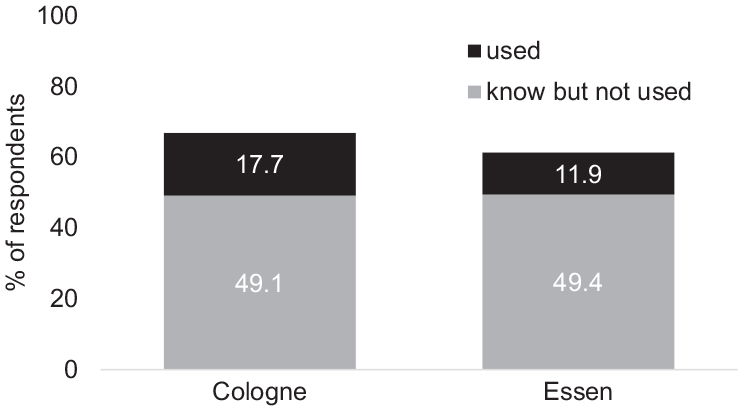
Prevalence of knowledge and use of digital neighbourhood platforms.
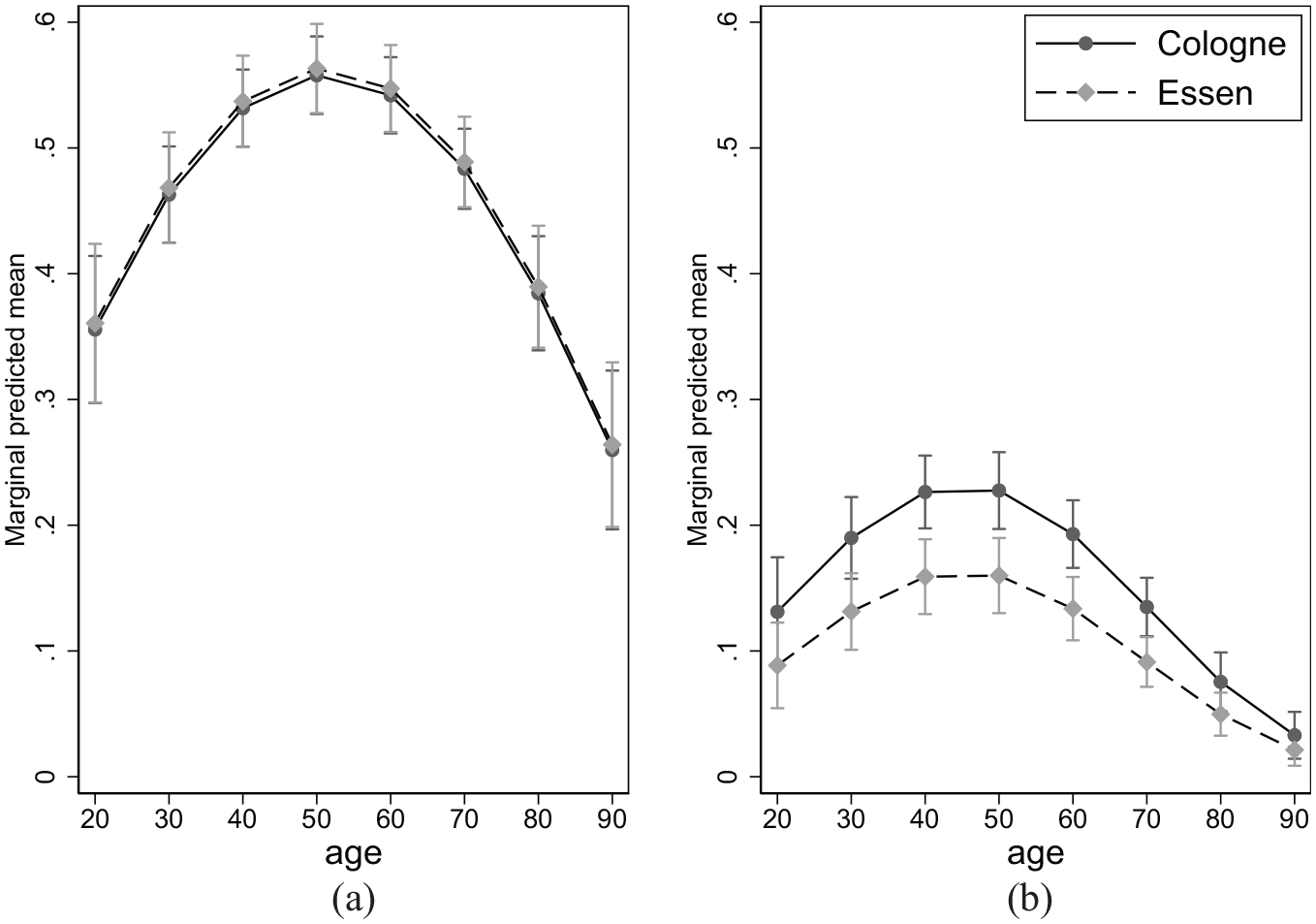
Knowledge and use of DNPs by age: (a) know but not used and (b) used.
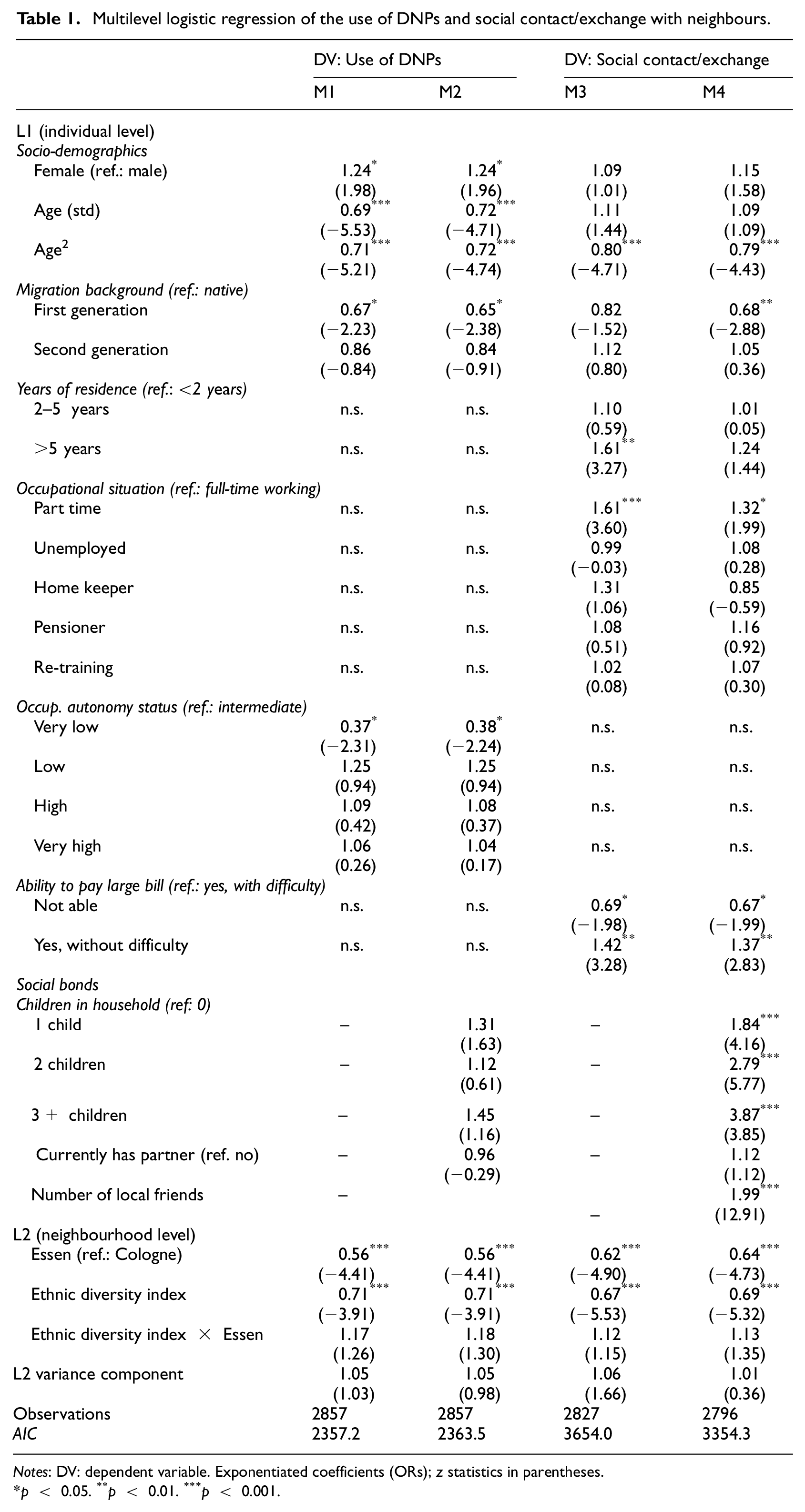
Multilevel logistic regression of the use of DNPs and social contact/exchange with neighbours.
Notes: DV: dependent variable. Exponentiated coefficients (ORs); z statistics in parentheses.
p < 0.05. ** p < 0.01. *** p < 0.001.
Conventional or offline social capital was measured using the scale ‘contact/exchange with neighbours’, consisting of five items on respondents’ activities ranging from drinking tea or coffee and leisure activities to doing favours, borrowing/lending things and checking on neighbours in need of support (Cronbach’s Alpha 0.76). Respondents were asked whether they had done this never or once or more than once with people from their neighbourhood during the past six months.
Independent variables
The survey contains a set of standard socio-demographic questions. Next to age, sex, migration background, educational status and current occupational situation, there are questions on the length of residency in the neighbourhood, on the presence of children in the respondents’ households and whether respondents had a partner. The respondents’ social status was measured by a ranking of the occupational autonomy status ranging from ‘very low’ for unskilled workers to ‘very high’ for senior managers derived from a question about respondents’ occupational status (Hoffmeyer-Zlotnik, 1993), and by three questions on subjective income levels, on the ability to pay a large bill and on receiving welfare payments.
The presence of local friends was measured by asking respondents about the number of ‘good friends’ and the follow-up question how many of those are from the respondents’ neighbourhoods. The following scales and items are not used as predictors in regression models but are employed to compare the levels of conventional social capital of respondents with and without experience of DNPs. The scale social cohesion/trust, which was adopted from the collective efficacy scale by Sampson et al. (1997), measured perceived trust and shared norms among neighbours using four items such as ‘People in this neighbourhood can be trusted’ (Cronbach’s Alpha 0.78). Neighbourhood satisfaction is a scale based on three items asking how satisfied respondents are with their neighbourhood, how much they feel ‘at home’ and whether they would feel sorry if they had to leave their neighbourhood (Cronbach’s Alpha 0.82). Generalised trust was based on the single question ‘Generally speaking, would you say that most people can be trusted?’, using a 0–10 scale. Some of the variables (educational status, occupational autonomy status, migration background, children in household) were measured at T1 only and considered as time stable.
Neighbourhood socio-demographic makeup is measured using register-based statistics provided by the statistical offices of Cologne and Essen. These include data on age groups, marital status, household size, length of residence, migration background and citizenship by countries of origin and the number of welfare recipients. The latter was used as a proxy measure for concentrated disadvantage, as official statistics on income and educational and occupational status are not available on small geographic levels in Germany. Neighbourhood ethnic diversity was measured by computing the Hirschman – Herfindahl diversity (or fractionalisation) index of eight different migration backgrounds based on countries of origin, which includes parents’ country of birth in the case of second-generation immigrants (Schaeffer, 2013). The more diverse a neighbourhood is in terms of the ethnic mix of various groups, the higher the diversity index, while neighbourhoods with very large, homogenous ethnic minority groups would score lower on this index. As it turned out, the Hirschman–Herfindahl diversity index did not yield stronger effects than the simple percentage of residents with a migration background, reflecting the fact that neighbourhoods with higher shares of migrant residents but lower levels of ethnic diversity – ethnic enclaves – hardly exist in cities in Germany as in most other European contexts (Dinesen et al., 2020; Schaeffer, 2013). Thus, we cannot claim that specific residential patterns of ethnic minorities as opposed to the sheer volume of non-native residents were responsible for our model results. Generally speaking, neighbourhoods with larger shares of migrant residents are also more ethnically diverse in almost every case, as no single ethnic group dominates individual neighbourhoods in the two cities of our study.
Analytical strategy
Considering the exploratory character of the study, we started with a descriptive analysis of the knowledge and use of DNPs. We then ran a series of nonlinear multilevel models to investigate the socio-demographic predictors of using DNPs simultaneously on the individual and on the neighbourhood level. Considering the geographically nested structure of the sample, it is important to avoid the misspecification of effects both on individual (L1) and on neighbourhood (L2) levels. Controlling for neighbourhood conditions helps to avoid the ‘individualistic fallacy’ of attributing social phenomena exclusively to individual-level influences (Sampson and Wilson, 1995), and reversely, individual-level predictors act as controls for socio-demographic composition in multilevel regression models so that the effects of neighbourhood-level predictors may be interpreted as potential contextual effects of collective neighbourhood conditions over and above individual influences. Yet unmeasured properties of respondents which may be associated with the (self-)selection of residents into neighbourhoods guard against a simple interpretation of effects as causal (Galster and Sharkey, 2017). Using cross-sectional survey only, we interpret the findings as associations without any claims for causality.
As the main outcome variable (use of DNPs) is binary, we applied logistic multilevel regression. In order to facilitate the comparison of model results with contacts with neighbours, we transformed the continuous scale ‘contact/exchange with neighbours’ (which was based on five items) into a binary variable applied at the mid-point of the scale. Model coefficients represent odds ratios or were transformed into likelihoods in prediction plots.
Results
Prevalence and socio-demographic correlates
Starting with descriptive results, Figure 1 shows that slightly more than 60% of respondents reported that they either knew or used DNPs. While slightly less than 50% of respondents in both cities reported that they knew DNPs but had not used one, about 18% in Cologne and 12% in Essen reported that they had used DNPs. These numbers should be taken with a grain of salt considering sampling issues. The knowledge of DNPs is much more widespread than their active use. Compared with previous German studies, these figures are considerably higher, while compared to a similar recent survey in Ghent (Belgium; De Meulenaere et al., 2023), they are considerably lower. In particular, the rate of registered users at one DNP (nebenan.de) in Cologne was just 2.9% in 2017 (Üblacker, 2020: 151). Apart from a sample selection bias, the higher prevalence may also be accounted for by the fact that studies have shown many more residents to use DNPs on WhatsApp or Facebook than on proprietary websites such as nebenan.de or nextdoor.de. In addition, it seems plausible that the COVID-19 pandemic has pushed the spread of DNPs enormously, but we lack the information to show this (Den Broeder et al., 2022; Schreiber, 2020).
Which socio-demographic predictors were associated with the prevalence of the use of DNPs? The following results are based on multilevel logistic regression models so that the reported effects are net of all other significant individual- and neighbourhood-level predictors in the model and thus offer a more realistic picture compared to simple bivariate associations. In particular, individual-level effects are adjusted for neighbourhood-level effects and vice versa, reducing the strength of some socio-demographic predictors. While the complete model results are reported in Table 1 (models M1 and M2), we highlight some of the findings in prediction plots based on these models. Looking first at age (Figure 2), we found a strongly curvilinear-shaped relationship with both the knowledge and the use of DNPs, with an increasing trend between the ages of 20 and 40 years (for use) or 50 years (for knowledge, respectively), and a declining trend in older age. The peak age of using DNPs was around 40–50 years, with a likelihood of slightly over 20% in Cologne and about 15% in Essen, roughly doubled from lower likelihoods at the age of 20. Respondents were predicted to be as likely to use DNPs at the age of 70 years as in early adulthood. The relatively advanced age structure of DNP users comes as a surprise but may reflect not only the high degree of digital literacy among middle-aged groups but also a lack of interest in DNPs among the younger age groups. Studies have shown that neighbourhood attachment is often higher in older age groups (Wahl and Oswald, 2010), and the need for local support may also increase with age. However, our result contrasts with Kurtenbach’s (2020) analysis of registered users of nebenan.de in Cologne, finding a very strong correlation with the share of 21–34-year-old residents on the neighbourhood level. For the remainder parts of this article, we will concentrate on the use of DNPs and ignore the knowledge of DNPs as explanandum.
Figure 2 also confirms the initial descriptive finding that respondents in Essen showed the same level of knowledge of DNPs but a significantly lower level of use of them. The odds of using DNPs were reduced by 46% in Essen compared to Cologne, controlling for individual- and neighbourhood-level influences (see Table 1, model M1). Females had 24% higher odds of using DNPs than males, and the odds were reduced by about a third for first-generation migrants, while second-generation migrants did not differ significantly from native respondents (see Figure 3). These findings on sex and migration status mirror the survey results from Ghent (De Meulenaere et al., 2023). While most social status indicators such as educational status, subjective income level and receiving welfare payments were unrelated to the odds of using DNPs, respondents with a very low occupational autonomy status were much less inclined to use DNPs: for them, the odds were reduced by around 60%. Figure 3(a) plots the predicted likelihoods for all autonomy status groups and reveals that these were roughly even for all status groups, at slightly below 20% in Cologne and between 10 and 15% in Essen, except for the lowest category which represents the group of unskilled workers. The likelihood dropped sharply to only around 5% for this group. Probably reflecting a sharp digital divide in German society, access to digital communication is widely common across the social strata except in the lowest status group.
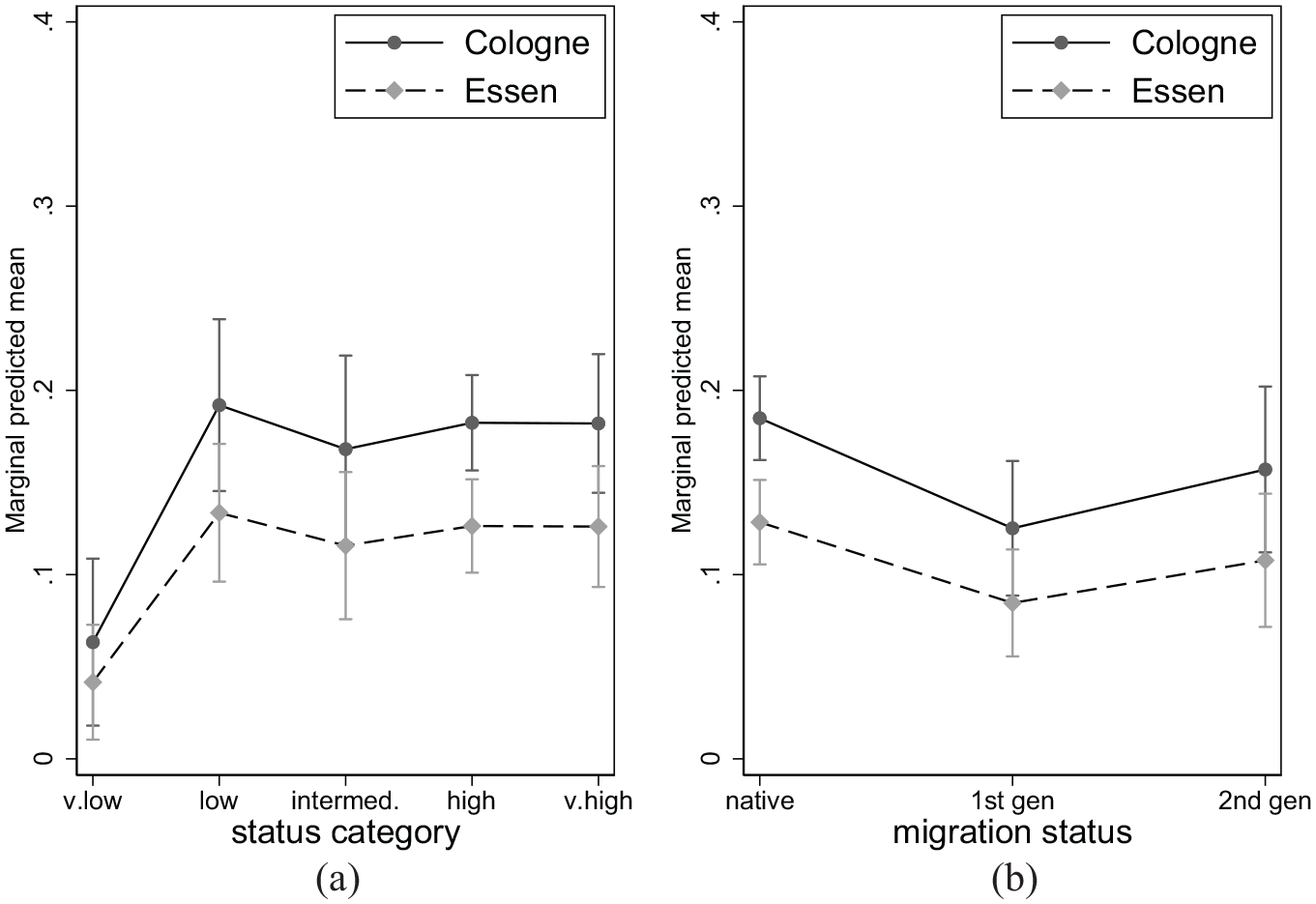
Use of DNPs by occupational autonomy status and migration status.
Neighbourhood-level correlates
We were particularly interested whether collective characteristics of neighbourhoods were relevant as social contexts for the spread of DNPs, independent of the individual influences of residents which we just discussed. Looking at the conditional model which controls for socio-demographic composition, the intraclass correlation coefficient (ICC) reveals that only 2.2% of the total variance was attributable to the neighbourhood level in Cologne, and in Essen the share was zero (see Supplemental Table S1, Essen not reported). For this computation of variance components and ICCs only, we switched to linear multilevel regression because these parameters are not available in logistic regression. Very small ICCs are not unusual for behavioural outcomes (as opposed to perceptions such as collective efficacy or perceived disorder), though, and do not preclude substantive neighbourhood differences and contextual influences on individual behaviour (Duncan and Raudenbush, 1999). The lack of any significant neighbourhood-level variance in Essen is likely due the considerably lower prevalence rates of using DNP and may be exacerbated by the lower number of neighbourhoods than in Cologne, both hampering the statistical power of potential effects. The only other study with a very similar research design to compare this finding to was conducted in Ghent (Belgium), where no significant ICC for membership in a DNP and subsequently no effects of neighbourhood characteristics were found (De Meulenaere et al., 2023).
Based on exploratory analyses of zero-order correlations between various neighbourhood socio-demographic variables and the neighbourhood-mean share of DNP users (see Supplemental Table S2), we chose ethnic diversity as a neighbourhood-level predictor in multilevel models because it had the strongest zero-order correlation with the use of DNPs – clearly stronger than the indicator of poverty. Even though Essen lacked a significant neighbourhood variance component, we still found a negative zero-order correlation between ethnic diversity and the mean share of DNP users of r = −0.38 in Essen, close to r = −0.44 in Cologne. In Cologne, neighbourhood ethnic diversity explained about 30% of the variation in the use of DNPs between neighbourhoods in the multilevel model controlling for all relevant individual influences (see Supplemental Table S1). An alternative model replacing the ethnic diversity index by the simple percentage of ethnic minority residents yielded an almost identical explanatory power. The association is illustrated in the prediction plot (see Figure 4, based on Table 1, model M1). In Cologne, the predicted likelihood of using DNPs halves from around 27% in the least diverse neighbourhoods down to slightly less than 15% in the most diverse neighbourhoods, thus a very sizable effect. The plot shows that this association was much weaker in Essen where the prevalence of the use of DNPs was also lower, as already mentioned. 2 Except one, no other socio-demographic indicator added significantly to the explanation of neighbourhood differences in the use of DNPs. As the list of zero-order correlations (see Supplemental Table S2) reveals, none of the variables reflecting a young and urban population potentially attracted to DNPs (shares of young adult, unmarried and single households, higher residential fluctuation) showed strong correlations with the share of DPN users or significant effects in the multilevel models controlling for ethnic diversity. Even the share of welfare recipients as a proxy measurement of concentrated disadvantage which had a moderate negative correlation (r = −0.36 in Cologne) did not yield a significant effect controlling for ethnic diversity. The only exception in Cologne was the share of pre-Second World War housing which could be regarded as a proxy indicator of gentrified neighbourhoods: this predictor added about 15% to the explanation of neighbourhood variance and together with ethnic diversity raised the total explained neighbourhood variance to 46% (see Supplemental Table S1).
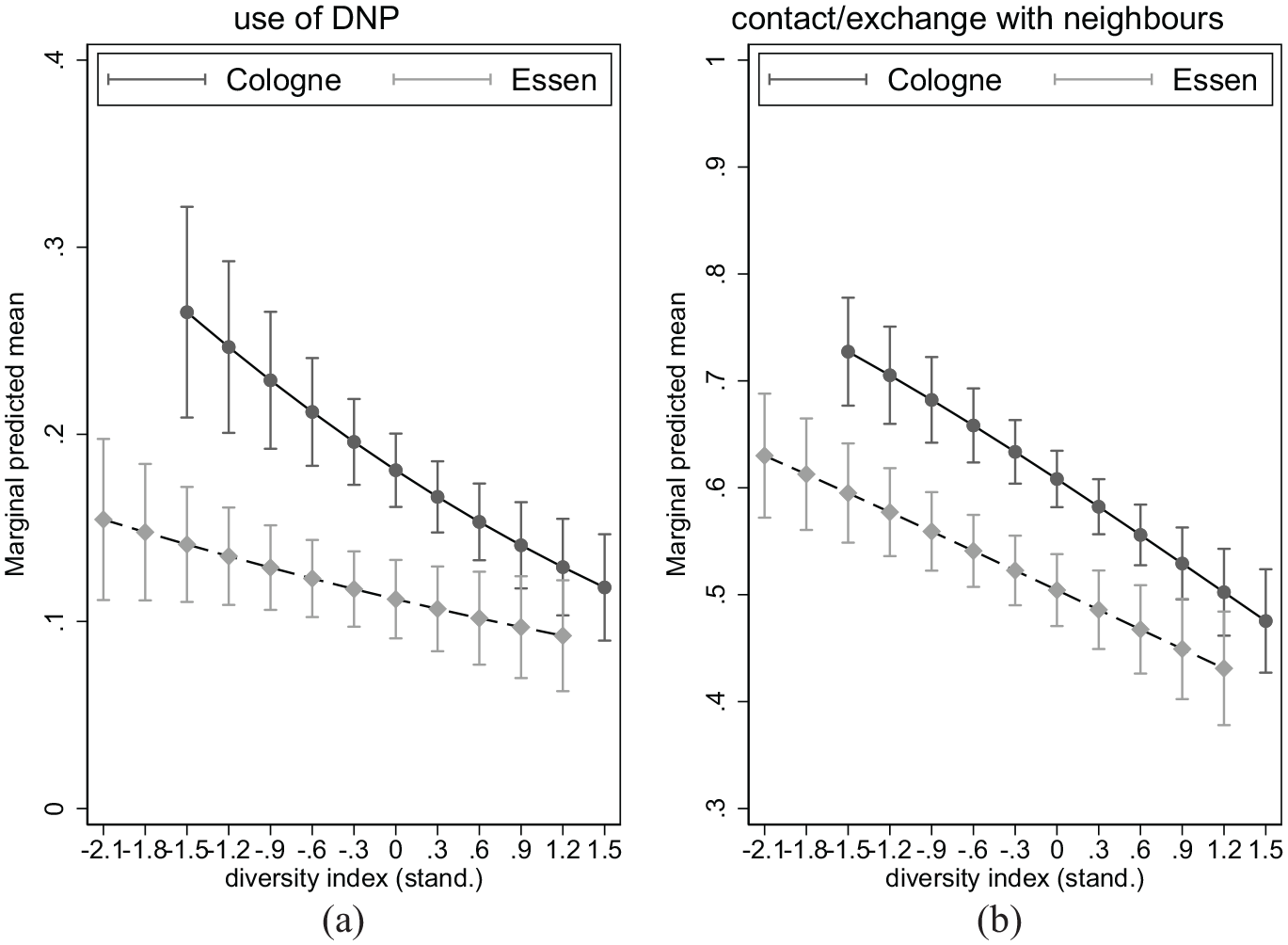
Neighbourhood-level association of the use of DNPs and social contact/exchange with neighbours with ethnic diversity.
We added the survey-based scale ‘neighbourhood social cohesion/trust’ (measured at T1) to the list of neighbourhood-level, zero-order correlates (see Supplemental Table S2). This scale shows a strong correlation (r = 0.45 in Cologne) with the rate of DNP users, while the correlation with the share of respondents who have frequent contacts with neighbours is even stronger (r = 0.67 in Cologne, r = 0.78 in Essen). These correlations support the interpretation that DNPs are much more successful in neighbourhoods already high on social capital and suggests that DNPs currently do not help to counteract spatial inequalities in social capital. However, it is important to remember that these correlations cannot be interpreted causally.
Comparison of the use of DNP to that of conventional social exchange with neighbours
How do individual residents who use DNPs compare to residents who have frequent conventional social exchange with neighbours, and how do neighbourhoods where the use of DNPs is more widespread compare to neighbourhoods where conventional social contact and exchange between neighbours is more frequent? These questions relate to the broader question of whether DNPs replicate or even aggravate pre-existing urban inequalities in social capital or can be seen as a potential force to compensate for such inequalities.
To shed light on this issue, we come back to Table 1 in order to compare multilevel models explaining the use of DNPs (models M1 and M2) with those explaining frequent conventional contacts and exchange with neighbours (models M3 and M4). While some socio-demographic variables share similar effects on both types of neighbouring, more variables had distinct influences on either the conventional or the digital variant. To start with the similarities, age also showed a reversed u-shaped relationship with conventional social contacts and exchange but peaked later in life. The predicted likelihood of having frequent exchange with neighbours increased from 40% in Cologne and 30% in Essen in early adulthood to slightly more than 60% in Cologne and around 55% in Essen at the peak age of 60, and declined in older age but was still much higher at the age of 80 than at the age of 20, contrary to the likelihood of using DNPs. First-generation migrants were also less likely to have frequent social contact with neighbours, yet this effect became stronger and significant only when additionally controlling for individual local bonds (see Table 1, model M4). We found distinct effects of variables representing social status and local embeddedness on the likelihood of frequent contact and exchange with neighbours. Individuals who had been residing in the neighbourhood for more than five years and those who were working part time (compared to full time) both had 60% higher odds of frequent social contact with neighbours. Apparently, being a long-time resident and having more free time both increase the chances of developing social ties with neighbours. Respondents who said they could not pay a large bill had 31% lower odds, and those who said they could pay a large bill without difficulty had 42% higher odds, of frequent social contact with neighbours, both compared to a middle answer category. We interpret the latter finding as a detrimental effect of income deprivation on social contact with neighbours. Poor residents may lack the financial means and/or may feel ashamed to socialise with neighbours, even if they might be more in need of neighbourly exchange and support than wealthier residents.
As a second step, we added three variables representing strong social bonds both within their immediate family as well as in the local vicinity (see Table 1, models M2 and M4). Respondents who lived with children had a hugely increased likelihood of frequent contact with neighbours: one child translated into a 1.8 times higher odds, two children into a 2.8 times higher odds and three children or more into a threefold increased odds of frequent contact. Also, a one standard deviation higher number of close friends in one’s neighbourhood was connected with doubled odds of having frequent social contact. While the latter effects could be seen as partly tautological (if close friends live nearby, one will meet them from time to time), the effects of children can be interpreted as the ‘social glue’ of neighbourhoods as they lead to contacts with other families in the vicinity, especially if they attend local schools (Weller and Bruegel, 2009). It is noteworthy that these social bonds did not increase the odds of using DNPs, or, to put it differently, the use of DNPs was equally likely for residents who lacked strong personal bonds in their neighbourhoods. Üblacker (2020) assumed that strong local bonds would actually diminish the interest in DNPs because of the availability of conventional neighbourhood ties. However, we did not see a significant negative effect either of having children or of having been resident for longer periods on the odds of using DNPs. It seems that residents who have strong neighbourhood bonds use digital channels of communication in addition to conventional channels (Kearns and Whitley, 2019).
On the neighbourhood level, conventional social exchange with neighbours shows the same negative association with ethnic diversity (see Figure 4, right-hand side): in neighbourhoods with very low levels of ethnic diversity (which means an overwhelmingly native German population), over 70% of respondents in Cologne and over 60% in Essen are predicted to have frequent contact with neighbours, and this share decreases to 50% in Cologne and 45% in Essen in the ethnically most heterogeneous neighbourhoods. The diversity index accounts for 50% of the variance between neighbourhoods in the frequency of social contact/exchange with neighbours (see Supplemental Table S1). And as with the use of DNPs, Essen shows consistently lower levels of social capital also of the conventional kind.
As an additional way of relating DNPs to different facets of (neighbourhood) social capital, we computed mean comparisons of several indicators of social capital for the three groups of respondents who used DNPs, knew but did not use them and those who neither used nor knew DNPs, all controlling for individual socio-demographic variables. A graphical representation of these mean differences can be found in the supplementary material (see Supplemental Figure S1). These comparisons show that residents who used DNPs also had more conventional contact with neighbours, perceived higher levels of neighbourhood cohesion/trust, felt more satisfied in their neighbourhood and had higher levels of generalised trust, as assumed in Hypothesis H3. Using DNPs was connected to larger mean differences in these variables than just knowing DNPs. These positive associations with different measurements of individual and neighbourhood social capital support the interpretation that DNPs spread among residents who are socially more connected and more trusting than other residents, and are in line with previous studies on social media usage (De Meulenaere et al., 2021; Hampton et al., 2011; Ognyanova et al., 2013). Kearns and Whitley (2019) found positive associations with social contact but not with perceptions of neighbourhood trust and cohesion, yet they looked at internet use at large and not specifically at the use of DNP. It is tempting to assume that DNPs can help residents to improve their neighbourhood social capital and satisfaction (which has been maintained in qualitative studies, see Becker and Schnur, 2020) but this conclusion cannot be drawn from cross-sectional data.
Summary and discussion
Based on a population survey in 139 neighbourhoods in two German cities in 2021, we investigated the spread and individual- and neighbourhood-level socio-demographic correlates of the use of DNPs, and related the use of DNPs to conventional forms of neighbourhood social capital. The analyses were informed by recent discussions on social inequalities in access to both online and offline forms of neighbourhood communication and exchange and the potential of DNPs to reduce these (De Meulenaere et al., 2021; Ognyanova and Jung, 2018). About half of the respondents in Cologne and Essen said they knew DNPs existed, and 18% in Cologne and 12% in Essen said they currently used (or had used) DNPs. These rates were higher than in previous studies from Germany but lower than in a similar recent survey from Belgium (De Meulenaere et al., 2023). Making sense of the considerable differences in the prevalence rates of using DNPs between the two German cities (which persisted after controlling for socio-demographic factors such as age and educational and occupational status), it seems likely that Cologne is the more socially innovative city than Essen, and better matches the profile of a ‘creative city’ (Friedrichs, 1995).
Turning to the socio-demographic variables that predict the use of DNPs, we assumed on the basis of extant research that online social capital is socially selective in similar ways to offline social capital. The results of multilevel models only partially supported our hypotheses. On the individual level of residents (and net of neighbourhood-level influences), most status-related indicators were not associated with the likelihood of using DNPs: educational status, financial situation, receiving welfare benefits and being a second-generation migrant all did not affect whether somebody used DNPs or not, refuting hypothesis H1. In contrast, a strained financial situation had a very strong impact on conventional social exchange with neighbours, which we interpreted as an aspect of poverty-driven social (self-)exclusion. On the other hand, a low occupational status was associated with lower online but not offline social capital, and being a first-generation migrant was linked to both lower online and offline social capital. We found a very marked non-linear effect of occupational status that only affected the group of unskilled workers, whose odds of using DNPs were reduced by 60%, probably reflecting a sharp digital fault line at the lowest end of the social strata (Lengsfeld, 2011).
Not only was the use of DNPs less dependent than offline social capital on some facets of social status but the analyses revealed that it was also less associated with strong social bonds in the form of children and close local friends, and independent of the length of residence. Whereas these bonds not surprisingly increased conventional forms of social exchange with neighbours, respondents who lacked these bonds were just as likely to use DNPs. One could conclude that DNPs are less demanding and selective with respect to some aspects of social status and as well as local embeddedness of their users and may thus be more readily accessible for groups of residents who lack offline social connections. This finding could be seen as a confirmation that online communication is more apt in providing weak rather than strong ties (Kavanaugh et al., 2003). Yet, our analyses also showed that residents who used DNPs had more offline social capital, too, and were more trusting and satisfied with their neighbourhoods than other residents. Again, due to the cross-sectional design we cannot tell to what extent this reflects selection effects or actual consequences of using DNPs, but these group differences may nevertheless be encouraging signs that DNPs have in fact a potential to increase individual residents’ social capital overall.
The results were different and less positive on the collective level of neighbourhoods. Social inequality of both types of social capital was more pronounced and consistent at the collective level of neighbourhoods – as assumed in hypothesis H2 – in the form of strong negative associations between neighbourhood ethnic diversity and the likelihood of using DNPs and having frequent contact and exchange with neighbours. Although the multilevel models yielded significant neighbourhood-level variance components and predictions only for Cologne, bivariate correlations hinted at similar associations also in Essen. Respondents in the most diverse neighbourhoods in Cologne were almost half as likely to use DNPs than respondents in the least diverse neighbourhoods, controlling for individual migration status and other socio-demographic predictors. We tested this indicator against a host of other socio-demographic characteristics but ethnic diversity – or simply the share of non-native residents which performed equally strongly – remained the only significant predictor in almost all models. While ethnic diversity is very strongly connected to concentrated social disadvantage in German cities, making it difficult to disentangle both effects, model comparisons leave little doubt that ethnic diversity had a stronger predictive power than concentrated disadvantage.
This finding aligns with a plethora of studies on conventional social capital summarised in Dinesen et al. (2020). Contextual neighbourhood influences on individual behaviours are notoriously difficult to interpret causally – particularly in cross-sectional and non-experimental studies – considering the processes of self-selection of individuals into neighbourhoods and the sorting mechanism of housing markets (Galster and Sharkey, 2017). Unobserved properties of individual residents in disadvantaged and ethnically diverse neighbourhoods surely account for some of these apparent ‘neighbourhood effects’. In addition, studies, including the current study, rarely measure the social mechanisms which translate structural neighbourhood conditions into perceptions and actions of individual residents (Sharkey and Faber, 2014). Yet, the relative strength of ethnic diversity compared to other structural indicators suggests that it does signal specific detrimental effects on social capital in urban neighbourhoods. In their meta-analysis, Dinesen et al. (2020: 454) found relatively little support for the assumption that interethnic contact attenuates the negative association between neighbourhood ethnic diversity and social capital. This is relevant, as many policy approaches are based on the contact hypothesis which assumes that interethnic prejudice recedes and trust can be built through personal contacts (Paluck et al., 2019). From this perspective, residential patterns of multi-ethnic, highly diverse neighbourhoods are seen by some as advantageous for building up interethnic communication, including an online communication infrastructure, as opposed to ethnic enclaves with fewer opportunities for interethnic contact (Zhang et al., 2018). The limited evidence presented here could rather speak for the homophily thesis, which assumes that the visible dissimilarity of residents from various ethnic backgrounds decreases social contact and exchange because residents have more trust in and prefer to communicate with people who are like them (Dinesen et al., 2020: 444; Putnam, 2007). Yet, the current study is not in a position to contribute empirically to the analysis of theoretical explanations, which according to Dinesen et al. (2020: 458) remains underdeveloped.
Irrespective of causal mechanisms, the fact that residents have considerably less online as well as offline social capital in more diverse neighbourhoods highlights the challenges for urban social policies. Our findings suggest that DNPs currently do not overcome the barriers of social inequality in urban neighbourhoods, as the negative association of neighbourhood ethnic diversity with online social capital is equally strong as with offline social capital. This appears to dampen Ognyanova and Jung’s (2018: 155) hope that local online communication infrastructure could have a ‘catalysing role [for] civic engagement among those who have not been active before’ and could ‘facilitate inter-ethnic conversations and collaborations towards shared community goals’. Taking empirical studies such as the current one as a starting point, more in-depth research into the intentions, experiences and communication patterns of users of DNPs as well as those residents who do not use them is necessary to develop strategies to reduce the existing social inequalities. More attention also needs to be paid to specific characteristics of migrants’ social networks which may be less neighbourhood-centred and spatially more scattered than those of non-migrants (Ryan et al., 2008). If that were true, we might underestimate the social capital of many residents in ethnically diverse urban neighbourhoods.
Supplemental Material
sj-docx-1-usj-10.1177_00420980241286266 – Supplemental material for The unequal spread of digital neighbourhood platforms in urban neighbourhoods: A multilevel analysis of socio-demographic predictors and their relation to neighbourhood social capital
Supplemental material, sj-docx-1-usj-10.1177_00420980241286266 for The unequal spread of digital neighbourhood platforms in urban neighbourhoods: A multilevel analysis of socio-demographic predictors and their relation to neighbourhood social capital by Dietrich Oberwittler and Lisa Natter in Urban Studies
Footnotes
Acknowledgements
We would like to thank the editors of the special issue and the anonymous reviewers for their useful comments which have improved the article.
Declaration of conflicting interests
The author(s) declared no potential conflicts of interest with respect to the research, authorship, and/or publication of this article.
Funding
The author(s) received no financial support for the research, authorship, and/or publication of this article.

Supplemental material
Supplemental material for this article is available online.
Notes
References
Supplementary Material
Please find the following supplemental material available below.
For Open Access articles published under a Creative Commons License, all supplemental material carries the same license as the article it is associated with.
For non-Open Access articles published, all supplemental material carries a non-exclusive license, and permission requests for re-use of supplemental material or any part of supplemental material shall be sent directly to the copyright owner as specified in the copyright notice associated with the article.
