




Abstract
Cities often deploy infrastructure-based solutions to tackle problems such as congestion caused by increasing motorisation rates. Such solutions include the introduction of complete streets or improved public transit systems. However, these solutions are often viewed as ‘quick fixes’ that are expected to resolve issues with ease. This article examines this phenomenon, which we call infrastructure solutionism, through two case studies in Bengaluru, India – re-shaping public transportation to attract car users through demand management, and redesigning major streets to accommodate varied users through parcelling. Through these case studies, it becomes evident that infrastructure solutions did not address the problems caused due to motorisation. Building upon the literature on technological solutionism in Science and Technology Studies, this article unpacks rationalities of infrastructure solutionism by examining material, valuational and expectational commitments mobilised through each case, and suggests that such solutions appear to be concerned with city image building, rather than addressing the chokehold of automobilisation.
Introduction
Globally, the production of motor vehicles continues unabated, despite rising concerns about climate change. Data obtained by the United States Bureau of Transportation Statistics shows that 76 million motor vehicles were produced in 2021 alone. China and India’s share in the annual production of motor vehicles rose from 3% in 1991 to 40% in 2021 (United States Department of Transportation and Bureau of Transportation Statistics, 2021). The increase in motor vehicles in Southern cities is balanced by a narrative of hope, guided by the belief that private vehicle ownership trends will mimic those of the Global North, first growing rapidly, then saturating and eventually declining (Metz, 2013; Newman and Kenworthy, 2011).
Negative externalities because of growing motorisation such as congestion, pollution, traffic accidents and the climate crisis have led to various cities in the South looking to reduce the number of private vehicles in cities through planning and development programmes (Cervero, 2014). Such programmes could be broadly classified under two themes. The first concerns the building of large public transit projects such as metro, light rail or bus rapid transit (Suzuki et al., 2013). These are underpinned by the belief that private vehicle users will switch to these options, reducing the number of vehicles on the road. The second concerns improving conditions for cyclists and pedestrians (Pucher and Buehler, 2012) as a means to attract others (especially private vehicles users) to these modes. Both of these solutions could be understood as infrastructure based, which we will refer to as belonging to ‘infrastructure solutionism’. In this article, we critically examine two such infrastructure-based solutions implemented in the early 2010s in Bengaluru, India using a case-study approach (Creswell and Poth, 2016). The first is an integrated public transit project of park-and-ride facilities and air-conditioned buses provided along specific routes meant to lure automobile users through the solution of demand management, and the second is a street redesign project aimed at improving traffic flows for non-motorised and motorised users through the solution of corridorisation. The timeline of the case studies is of particular note here, considering that these cases pre-date the evolution of the debates on urban solutionism and the UN Sustainable Development Goals within which we seek to place our work.
Both these projects were implemented in Bengaluru, a burgeoning metropolis in south-central India, with an estimated population of 14 million as of 2021. It is home to some of the largest tech companies in India. Bengaluru attracts many middle-class youths from all parts of India, fuelled by the growth of its large IT industry, and other commercial and business ventures that benefited from this growth (Upadhya, 2009). A key index of the nature of population growth is the upsurge in private automobile ownership. Automotive ownership expanded from 1.6 million in 2005 to 8.7 million in 2020, with a vehicle ownership rate of 640 vehicles per 1000 inhabitants in 2021. The resultant traffic congestion is considered an impediment to Bengaluru’s image as a city of seamless global flows (Gopakumar, 2015b, 2020a). Efforts to manage congestion initially were mobilised around the idea that a modern road is an uncongested one (Anand, 2006), and gave rise to projects like elevated highways and junction-free corridors. By 2010, however, this popular discourse had shifted to one of controlling the growing vehicle population. Accompanying this discursive shift were infrastructure solutions such as a metro system, park-and-ride facilities, air-conditioned low-floor buses, remodelled streets that demarcate pedestrian spaces and non-motorised movers (Gopakumar, 2020b).
We locate our two case studies within this discourse about controlling automobile growth. Our analysis of the projects is based on fieldwork conducted in Bengaluru between 2013 and 2018, comprising observations, and interviews with urban planners, designers and civil society groups. These solutions, we argue, were driven by material, valuational and expectational logics that together sought to create a world-class vision of Bengaluru, promoted by both public and private actors. We further demonstrate that these projects failed to realise their stated goal of fixing motorisation and exacerbated the differences between various socio-economic groups in the city. In the next section, we review the literature related to urban infrastructure solutionism and how it is guided by certain rationalities. While the literature cited below is broad in geographical focus, our focus is on Southern cities, and the ideas we develop are meant to be applied to our case in Bengaluru specifically.
Rationalities and logics of infrastructure solutionism
Over the years, arising from the infrastructural turn, insights from Science and Technology Studies, human geography and other disciplines have shown how infrastructures and infrastructure-based solutions should not be considered neutral, static or as a fix. Rather, they are imbued with rationalities and logics that configure cities to function in specific ways. This argument hinges upon two facets. First, infrastructures are both products of and manifest modalities of (state) power, meaning that they are quintessential sites for enacting modernity and progress and concomitantly building the nation-state (Larkin, 2013; Mitchell, 2002; Swyngedouw, 2015). Their solid, unyielding form composed of durable materials becomes the conduit for the smooth unobstructed movement of a range of humans/materials. By fostering this mode of circulation and the socioeconomic change it drives, infrastructures are key to installing particular social orders. The production and maintenance of these orders through infrastructure endow it with political rationalities to achieve certain ends (Anand et al., 2018; Hetherington and Campbell, 2014; von Schnitzler, 2015). Second, and related to the above, infrastructures have a splintered presence (Coutard, 2008) along pervasive societal fault lines. This means that without explicit steering, new technologies would accrete within existing technological orders and reinforce extant inequities (Winner, 1977). It has been seen for instance that within cities, infrastructures are deeply entangled in the sociopolitical, such as how processes spurred by globalising neoliberalisation fragment the constitution of infrastructures (Goldman, 2011; Graham and Marvin, 2001) and how social power relations determine infrastructural provision (Desai et al., 2015; Ranganathan, 2015). Seen through this perspective, infrastructures acquire specific logics that operationalise their uneven spatial imprint in the city.
Given the political rationale and consequence of infrastructure solutionism, we question infrastructure-based solutions advanced in the transport sector. For instance, in their study of sustainable transportation experiments in Greater Manchester, Hodson et al. (2018) posit that priorities of place-based urban governance shape how infrastructure interventions become embedded within the local context. Such material embeddedness indicates an institutional lock-in of techno-managerial actors with no electoral authority but extensive political patronage in addressing urban challenges (see also Banister et al., 2011). In Southern cities too, the manifestation of power and rationality in governing transportation infrastructures emerges in Cirolia and Harber’s (2022) work on African cities. Conceptualised as urban statecraft, they look at the contingent and plural processes of governing practised through a complex web of intergovernmental relations spanning national, regional and urban scales. Similarly, Guma et al. (2023) discuss the implementation of an expressway in Nairobi, which they believe exemplifies the idea of a ‘plug-in urbanism’, assuming projects often conceptualised and implemented in the North to be seamlessly transferable to Southern cities.
While these diverse literatures and examples advance various ideas about infrastructure-based solutions, they do not offer a comprehensive definition or terminology, using various terms such as fix(es), solution(s), intervention(s) or infrastructure-led development. We therefore advance the idea of ‘infrastructure solutionism’ as located within the broader literature on technological solutionism (and the allied concept of technological fix) in Science and Technology Studies and related scholarship of the history and philosophy of technology. While technological solutionism as a mode of technology-mediated interventions has become prevalent with the deployment of digital technologies (social media, apps, algorithms and smart sensors) to address urgent social and policy goals (Mann et al., 2022; Morozov, 2013; Taffel, 2018), technological fixes, on the other hand, have been employed in the context of large-scale interventions to address climate change (Levidow, 2023; Luke, 2010; Markusson et al., 2017). Common to both these concepts is the all-encompassing reliance on technology to solve intractable societal problems (Johnston, 2020; Rosner, 2004). Based on this, we see infrastructure solutionism as a tendency to ‘fix’ complex societal challenges through infrastructural installations.
Notably, and particularly in the case of Southern cities, these solutions tend to be guided by techno-managerial approaches, implying that they are envisioned within institutionalised spaces by technical experts identifying and labelling particular problems, and then using infrastructure to solve these problems. This tends to treat problems in isolation and neglects the socio-material nature of infrastructures. Unravelling these concepts is therefore key to lucidly demonstrating the departure from the well-ordered techno-managerial project (Banister et al., 2011). Furthermore, we believe that identifying the rationalities underpinning infrastructure solutionism, applied to urban transportation projects in this article, is critical to understanding how projects are chosen and implemented and how they actually work. 1
Sean Johnston (2020) in his study of the history of technology fixes and their proponents, describes several logics that characterise how the concept was deployed in practice. Three are notable – a problem framing that embeds particular values (valuational logic), a future-orientated intervention (expectational logic) and a material solution tailored to address the problem (material logic) (see also Selinger, 2013). 2 Following Johnston (2020), we propose that infrastructure-based solutions are guided by three component logics of these rationalities – valuational, expectational and material:
(1) Valuational logic attends to extrinsic final values that are embodied in the technologies with selective consequences (van de Poel and Kroes, 2014).
(2) Expectational logic focuses on how a narrative of promise accompanies the roll-out of the intervention (Borup et al., 2006).
(3) Material logic relies on a post-phenomenological reading into human–technology relations with a view to describing the quality of the mediation in these solutions (Rosenberger and Verbeek, 2015; Verbeek, 2011).
We identify how these three logics are prevalent in the projects we analyse in Bengaluru. In the following section, we discuss the methods used for data collection.
Methodology
We rely on qualitative analysis to develop insights about how infrastructure solutionism is being deployed in Bengaluru to address street congestion. To achieve this objective, we enlist a case study methodology (Creswell and Poth, 2016) as the most appropriate. We examine two cases of infrastructure solutionism deployed in the city of Bengaluru – re-shaping transit infrastructures and re-designing street infrastructures. The choice of multiple cases from the same site is to confirm the operation of broadly comparable logics of infrastructure solutionism at work in both these cases. The fact that the first case examines the efforts of the provider of public transportation while the second reveals actions of a private entity proposed by corporate elites indicates that these are ‘critical cases’ (Flyvbjerg, 2006) and demonstrates a ‘purposeful maximal sampling’ approach (Creswell, 2012).
We conducted data collection during the period 2013–2018, following Creswell and Poth (2016), and relied on multiple sources including documents, semi-structured interviews, observation and audiovisual materials. Documentary sources included newspaper articles and policy and design documents. We organised 20 semi-structured interviews of government officials, researchers, designers, urban observers, transport activists, commuters and citizen groups. Direct observation happened on the streets of Bengaluru, when we visited bus stations, travelled on buses and walked along the roads. These visits became moments to gather audiovisual material.
After data collection, we translated and transcribed the interview material and newspaper articles whenever they were not in English. We then performed a thematic analysis, coding recurring words in the interviews and our other text-based sources mentioned above. From these, and guided by our theoretical framework, we derived our main theme – an on-the-ground manifestation of infrastructure-orientated solutionism and its underlying logics. This material was further supplemented by our observational audiovisual data. The case studies discussed here analyse the solutionistic appeal in implementing mobility infrastructures like public transit to lure wealthier citizens into the public transport network, and street redesign measures to enable active mobility in the commercial core of Bengaluru. We study the type of project, its location, the actors involved, the intentions and the implementation.
Re-imagining Bengaluru through infrastructure
Bengaluru has had a long history as a city of promise going back to pre-colonial times (Nair, 2005). The layering of the multiple historical promises with societal fractures and fault lines has shaped the terrain within which the most recent promise of a globalising Bengaluru as India’s Silicon Valley is embedded.
A key aspect of the contemporary embedding of Bengaluru’s promise is the exalted position that urban infrastructures, especially road infrastructures, have enjoyed. Infrastructures offer the means for reducing and eliminating blockages in flows (be they economic, human or information). Flows are key to the constitution of a global network society (Castells, 2009), and blockages that disrupt flows could be considered the antithesis of a smooth globalised world with seamless circulations. Seen through this logic, Bengaluru’s pervasive road and traffic congestions have been portrayed as blockages that can potentially disrupt vital economic and information flows necessary for a globalising city (Gopakumar, 2020a, 2020b, 2015b). Different discourses have sought to address the problem of traffic congestion in Bengaluru. Prior to 2010, the predominant discourse in the city was one of infrastructure inadequacy. Policy documents and plans developed by the state and city government stated that the city faced serious deficiencies in road infrastructure and that these were to blame for the inability to serve the growing traffic in the city. Developing mega-infrastructure projects such as elevated highways and flyovers and road redesign efforts to create junction-free corridors and wider carriageways were some of the preferred means to address these deficiencies. By assuring more road space for automobiles, congestion on the roads could be reduced, thereby smoothening the vital circulations necessary for the city to globalise.
However, by 2010, with the unabated rise in automobile numbers on the road, the popular discourse on traffic and road congestion had shifted to one of controlling the growing vehicle population. Accompanying this discursive shift was a shift in the infrastructure solutions proposed to address congestion. Since 2010, solutions proposed in policy and planning documents have included metrorail systems, park-and-ride facilities integrated with redesigned intra-city bus terminals, air-conditioned low-floor buses, remodelled streets that demarcate spaces for pedestrians and non-motorised movers, bus rapid transit systems and monorail. A key objective of this approach was to provide alternative options for commuting that would attract motorists to public and active transport, thereby reducing the presence of vehicles on the road.
Re-shaping transit infrastructure
Much of the movement within Bengaluru depends on bus-based public transit, provided by the Bangalore Metropolitan Transport Corporation (BMTC). Although BMTC is constituted as a public body, it is managed as an independent corporation institutionally separate from the municipal government. This corporate status grants BMTC autonomy from governmental and political interference but also means that it receives little budgetary support from the local/state government in its day-to-day operations. BMTC is therefore highly dependent on ticket sales for managing its operational expenses, as is evident in the account statements in its annual report (BMTC, 2020).
Since 2006, there has been a noticeable shift in the orientation of public transportation in Bengaluru. In response to the growing experience of vehicular congestion on city roads, BMTC sought to re-organise public transportation with the explicit aim of persuading motorists to abandon their private vehicles in favour of public transit for intra-city travel, through a process of demand management (Table 1). Demand management is the key solutionism here, achieved through a multi-pronged infrastructure approach that re-invented the rolling stock of buses, embedded passenger information systems within buses and developed dedicated park-and-ride facilities (referred to locally as Traffic and Transit Management Centres (TTMCs)). 3 The changes in the rolling stock of buses saw the introduction of air-conditioned buses manufactured by Volvo. According to a transport planner (TP1) for BMTC, ‘They [BMTC] have stratified their bus services to make money out of these expensive buses’. With regards to park-and-ride facilities, TP1 mentioned that ‘the TTMCs were created to integrate multiple modes of transport efficiently. And from a transport demand perspective they are expected to attract commuters by having passenger conveniences and park-and-ride facilities’.
Rationalities of infrastructure solutionism.

As of 2019–2020, BMTC has operated about 6700 buses along 5600 routes. Of the 6700 buses, 860 are air-conditioned and there are differences in their fare structures. Altogether, buses carry about 3.5 million passengers every day (BMTC, 2020). These consist of various kinds of bus services – air-conditioned services for intra-city travel as well as dedicated services to the airport, ordinary non-air-conditioned buses that carry the lion’s share of urban bus travel and dedicated non-air-conditioned buses with subsidised fares that (purportedly) serve the urban poor. About 860 (12%) of the 6700 buses that BMTC operates are air-conditioned buses, serving more than 700 city routes. In contrast, reduced-fare buses dedicated to the urban poor account for only 13 bus routes (BMTC, 2020). This despite the urban poor comprising 16–20% of Bengaluru’s population (Roychowdhury, 2021).
The incorporation of the air-conditioned buses was considered a major achievement by BMTC, as stated in the BMTC annual report of 2020 which proclaimed that the ‘pioneering introduction of world-acclaimed Air-conditioned Volvo buses in the city context, opened new vistas in public transport’ (BMTC, 2020). In the Indian context, these buses offer greater comfort but also greater accessibility due to their low floor heights and more inclusive design. However, BMTC’s main aim in acquiring and operating these buses seems to be to attract elite automobile users, especially those from the IT industry, seen in the routes chosen for plying these buses: BMTC (2020) mentions in its annual report that air-conditioned buses were a ‘first of its kind in the country and meet the sophisticated demands of the IT community in the city’. The choice of this niche clientele is confirmed by senior administrators of BMTC, who suggest that ‘air-conditioned buses were a major draw for people travelling in their own cars, who then started shifting to these buses’ (interview with managing director, BMTC). Such reasoning is evident in BMTC’s choice to integrate TTMCs across the city with branded supermarket stores (Figure 1a).
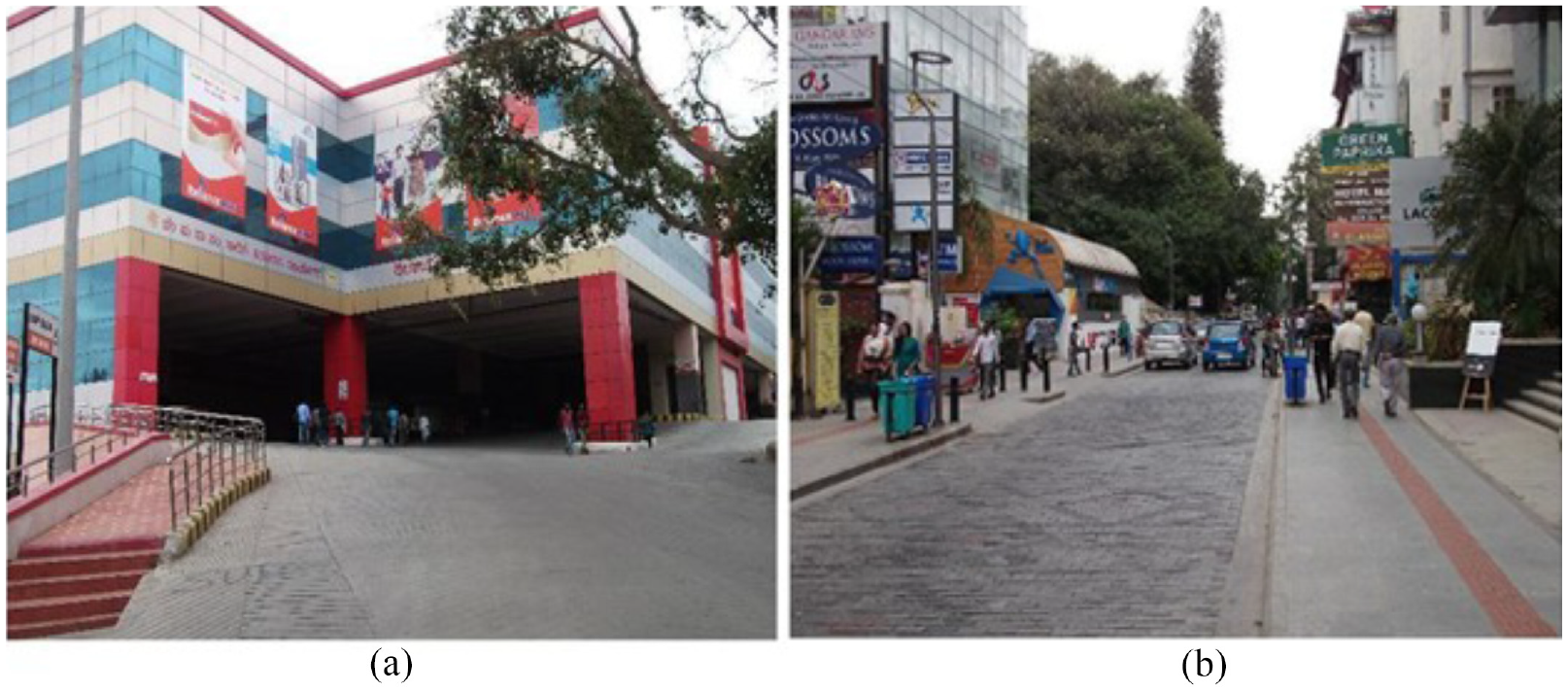
(a) TTMC in Bengaluru; (b) Tender SURE redesign on Church Road.
However, the buses and the TTMCs have failed to attract their intended users. As an interview with a parking attendant at a TTMC revealed, ‘it is only on weekends that the parking spaces are used by people who park there to do their shopping in the neighbourhood. The rest of the week the garage remains practically empty’. Similarly, since the parking spaces are free for anyone to use irrespective of whether they use a bus or not, it is debatable whether TTMCs are being used as parking as opposed to park and ride. In interviews, civil society groups also criticised these investments for not improving existing bus services. The ridership of the air-conditioned buses has in practice been much lower than of the ordinary buses where overcrowding, especially during peak times, is the norm. In fact, the air-conditioned buses have worsened the situation for marginalised groups of bus users, as BMTC lowered the frequency of ordinary buses on routes with air-conditioned buses. One practice that commuters speak of is the clumping of air-conditioned buses at peak times so that most buses on a route are air conditioned: ‘From 7:30 to 9:30 am, a majority of the buses are air-conditioned buses. Before that there are ordinary buses’ (interview, commuter, W3). Such conditions force the economically vulnerable users to either change their commutes or give up work altogether. For those with capital reserves, such commutes become the catalyst for a shift to a personal vehicle with its safety bubble that insulates from everyday acts of harassment: ‘People travel in ordinary buses packed like cattle. Women have to travel dangerously by travelling in the footboard of buses … They drop their work or if possible buy a two-wheeler’ (interview, coordinator, Slum People’s Forum). This shift to a personal vehicle reinforces automobilisation, the opposite of the outcome that the introduction of air-conditioned buses was expected to have.
Given that the proposed changes to the transit infrastructure did not attract existing automobile users, and that they further encouraged even existing bus users to acquire personal vehicles, it becomes necessary to question why these measures were adopted in the first place. Part of the reason seems to be BMTC’s overarching efficiency obligation – to reduce its everyday costs while enhancing revenue from ticketing (BMTC, 2020). Additionally, we believe that a major driver was BMTC’s need to develop its image as a purveyor of world-class public transport that showcases the latest transit infrastructure. This was suggested in interviews with civil society actors: ‘BMTC is worried about their image, so the Volvo buses are there. Then there are the TTMCs that are swanky with glass facades’ (interview, secretary, Bus Commuter Forum). Such statements point towards a material sensibility of ‘swankiness’ and ‘world-class transport’ that attends BMTC’s infrastructure interventions. A representative of BMTC’s labour union stated: ‘Why should you go for [Volvo]-class transport? They say we are making profit … but that is a bankrupt concept … it is becoming commercialised’ (interview, BTMC union representative). Moreover, investments in air-conditioned buses and park-and-ride facilities also trap the organisation within particular kinds of cycles. For one, all maintenance and repair is locked into branded and expensive spare-parts whereas previously buses received in-house repair and maintenance. As the union representative pointed out, ‘A small part may be only 200 rupees but they [Volvo] will charge 10,000 rupees. You have to buy brand name. You cannot buy from cheaper manufacturers. You have no choice’ (interview, BMTC union representative). Such lock-ins associated with branded infrastructure inject a commercial logic into the operation of public transport. The infusion of commercial logic and the exclusion of poorer commuters to organise a Volvo-class transport have accordingly coloured BMTC’s value orientations.
To sum up, the constituents of reshaping public transportation mobilise infrastructure solutionism through demand management. The introduction of air-conditioned buses and the development of ‘swanky’ TTMCs was envisioned as a practice expected to lure affluent automobile users to public transit, thereby reducing congestion on the streets by lowering the demand for automobiles. It was this explicit expectation of attracting the affluent that spurred a particular branding of transit infrastructures. We diagnose that this branding is expressed through a material logic of swankiness. These strategic actions inflect particular valuational and expectational logics within public transportation in the city. As we have seen, the focus on attracting car users has prompted a public transit that disregards the travel needs of poor commuters while privileging the affluent.
Street redesign in the commercial heart of Bengaluru
Streets in Bengaluru like in other Indian cities are fluid, with multiple uses competing for a foothold (Anjaria, 2012; Appadurai, 1987) and a lack of clear demarcations (Jain and Moraglio, 2014). Recently, with the growing numbers of automobiles, streets are being reordered as arteries dedicated for automobiles, with other uses being pushed to the margins (Gopakumar, 2020a, 2020b). Tender SURE (Specifications for Urban Road Execution), an experimental initiative proposed by the Bangalore City Connect Foundation (BCCF), seeks to correct the predominance of vehicles on the street by redesigning street infrastructure to demarcate spaces for multiple modalities of movement. Tender SURE proposes a design solution to accomplish an essential goal – corridorising the road surface into clear, standardised and aesthetic segments for pedestrian, cycling and vehicular uses with design elements that prioritise accessibility and prevent one segment from usurping space at the cost of others (Sadoway and Gopakumar, 2017). Corridorising is the key solutionism mobilised through this infrastructure intervention (Table 1). The rationale is that re-designing streets with more spaces for walking and cycling and limited lanes for automobiles would alter the dynamics of movement and tilt the balance towards low-carbon modes. Several components of street infrastructure, such as dedicated cycle tracks, pedestrian walkways, street vegetation and carriageways, are separated by level differences, concrete bollards or varied floor tiling to emphasise the creation of hermetic partitions between uses. This is supposed to grant ‘protected corridors’, thereby nurturing the coexistence of multiple modes on the street (interview, design entrepreneur).
Tender SURE was conceived by BCCF and executed by the private non-profit organisation Jana Urban Space Foundation (JUSF) as an urban experiment. BCCF and JUSF are centrally positioned within a wider network of civic intermediaries that have acquired traction since the 2000s to experiment in reshaping Bengaluru’s street-level fabric and in the roll-out of nation-wide urban renewal efforts (Sadoway et al., 2018). These efforts and their legacy of collaborating with governments at multiple levels to re-fashion the city have successfully laid the organisational groundwork for a particular form of civic action to take hold. BCCF was proposed as an integrator of citizen and corporate involvement to improve the quality of living in Bengaluru (BCCF, n.d.). Nurtured by different political leaders at the state level since the early 2000s (Kamath, 2013), civic action groups such as BCCF and JUSF are products of the initiative of policy entrepreneurs and techno-evangelists. Such groups, with their robust connections to elites in information and biotechnology sectors, mobilise a particular urban politics through their initiatives that some suggest indicates the elite capture of urban governance (Baindur, 2017).
The Tender SURE redesign was piloted initially on the Vittal Mallya Road, a road in central Bengaluru that serves an affluent neighbourhood. The test project was financed entirely by private corporations – United Breweries and the Prestige Construction groups, whose high-end retail and commercial spaces line the road. The implementation of the pilot project resulted an increase in value of these properties, which perhaps served as a strong motivator for where the project was chosen to be implemented, and the actors who conceptualised and financed the project. Later, select iconic roads in central Bengaluru that had considerable commercial or real-estate significance were chosen for implementing the subsequent phases of the project, and it was executed entirely by JUSF with public funds despite the high cost per kilometre.
The involvement of private actors, the selection of where to implement and the use of public funds for this rather expensive project beg the question of whether the roll-out had any significant benefits for the city’s inhabitants. A key observation, that is also evident from Figure 1b, is the largely unimpeded access that automobiles have retained on the re-designed streetscape. The organic jostling for space and access, which is the norm on Indian streets, is curtailed through the design of the street infrastructure, but not necessarily to the benefit of pedestrians and cyclists. Bollards and level differences seek to limit pedestrians and cyclists to clearly demarcated parts of the roadway. Whereas in the past, automobiles might have had to negotiate past pedestrians spilling over onto the roadway while gathered around a roadside vendor, the re-designed streets have sought to moderate the self-organised nature of the street. Design elements seek to maintain the spaces allocated to different modes. At the same time, a key concern voiced by motorists at the launch of this initiative was that standardising lane configurations would reduce the width of the carriageway available for automobiles (Bharadwaj and Ramani, 2014). Indeed, intensive pushback from motorists in popular and social media instigated a mid-stream redesign to reduce pedestrian space (Bangalore Mirror Bureau, 2014). Possibly mindful of the opposition from motorists, a design entrepreneur defended the effort: ‘the [automotive] traffic throughflow now after Tender SURE … is better now … and anecdotally when you talk to police officers on the beat, they accept that this [re-design] has improved the traffic through-flow’ (interview, design entrepreneur).
On the other hand, the allocation of space for pedestrians on the re-designed road appears arbitrary and not borne out by ‘scientific analysis of pedestrian traffic on the road, with wide pavements formed in some locations when there was no need’ (interview, urban engineer, UE1). Furthermore, the image of the pedestrian is not one that reflects the reality of Bengaluru’s streets – such as someone who transacts on the roadside for a cup of tea from a vendor, for their shoe to be repaired by a cobbler or to buy produce. Attention, instead, appears fixed on a particular pedestrian, one who consumes street aesthetics while transient; a point that is reinforced by the way in which the project was implemented – first evicting street vendors from their trading spaces and then designating a few spaces for them (interview with urban researcher, U2; see also Chatterjee, 2020). Similarly, the cycling tracks that were developed as part of the redesign effort appear not to be required by those who need them. As a matter of fact, ‘there is a large movement of wage earners around the periphery of the city along the ring roads. This is where pedestrian and cycling infrastructure needs to be developed’ (interview, urban researcher, U1). Cycling tracks in central Bengaluru, despite their impressive design elements, remain largely unpatronised or used by a few privileged cyclists. This combination of factors would suggest that Tender SURE was primarily an image-building exercise that ‘advanced the real-estate significance of high-end commercial properties adjoining the roadway’ (interview, urban researcher, U2).
In summary, riding upon its vaunted goals of reducing the imprint of motorisation on city roads, the redesign of street infrastructure demonstrates infrastructure solutionism of corridorising through a high-design aesthetic that matches contemporary design practice around the world. This is revealed in the standardisation of road parcels, accessibility ramps and bollards. In its actual practice, though, the project furthered a particular branding of city roads. The decision to implement Tender SURE on particular streets in the heart of Bengaluru, as well as to not consider the actual needs of pedestrians and cyclists, demonstrates a particular valuational logic. Aestheticising high-profile streets, smoothening traffic flows for private vehicle owners and evicting the socioeconomically vulnerable from these areas lead to reserving streets for a particular road user who would be attracted to and consume this superficial street aesthetic and its commercial attractions.
Discussion
These cases highlight the necessity of viewing mobility interventions to de-automobilise within their wider infrastructure solutionism context. While existing theoretical frameworks suggest the conception of infrastructure as a ‘magic bullet’ from plug-and-play models (Guma et al., 2023), we propose the examination of rationalities of infrastructure solutionism to discern the particular mode of addressing urban problems, through the cases of tackling vehicular congestion in this article. By depending on modern infrastructure to ‘solve’ the problem, public and private actors seem to be attempting to paper over tensions and issues that require fundamental rethinking of urban challenges and governance strategies.
In this discussion, we articulate the rationalities of infrastructure solutionism to shed light on the valuational, expectational and material logics associated with decontextualised techno-managerialism. Central to these logics is the embedding of a particular constellation of infrastructure (Monstadt and Schramm, 2013) in the landscape of the city by public and private actors.
In the case studies, solutions were projected to solve urban mobility issues in the city, but the design, materiality, aesthetics and packaging of these solutions were largely aimed at achieving a decontextualised techno-managerial practice (see Table 1).
In the case of re-shaping public transportation, BMTC introduced TTMCs and air-conditioned buses as strategies of demand management with the expectation that comfortable transit would motivate motorists to switch from private vehicles. The implementation of the demand management strategy within the context of high dependence of the corporation on ticketing revenues has infused a commercial value orientation that excludes those dependent on affordable buses and instead targets those capable of paying the higher fares charged on comfortable buses. Swanky TTMCs and air-conditioned Volvo buses are the infrastructures that mediate the ride quality experienced by the user. The glass-facade TTMCs with high-end commercial retail, low-floor buses, electronic sign boards and the cool and quiet comfort on board grant a ‘swanky’ experience.
In the case of re-designing central city roads through corridorising – with the intention of designing segments with uniform width and aesthetics for pedestrians, cyclists and vehicles – the key objective was to prevent automobiles from usurping space for other users. Here too, the solution of corridorising within the context of limited control on automotive through-flow and the commercial and real-estate significance of the exercise on the chosen roads imbues them with a well-crafted design materiality that enhances the tactile experience of the street and thereby the commercial attractions that abut the street. The underlying expectation is that the enhanced tactile sensibility on the street will be the motivation for users to prefer shedding their automobiles and adopting pedestrian or cycling modes to better consume the street experience. However, the commerce-orientated street experience embeds values orientated towards particular active users of the road who will consume not only the street but also the commercial attractions beside it. Transport planning in India is largely a techno-managerial activity, where planners attempt to ‘solve the problem’ of moving in the city (Badami, 2009). Decontextualised and viewed through a techno-managerial lens (Short and Pinet-Peralta, 2010), urban mobility challenges are reduced to traffic or congestion problems, thereby missing the larger holistic picture of the ‘urban transport problem’ (Dimitriou, 2011). However, there has been a gradual change in mobility policy discourse in Indian cities, where promoting public transit, reclaiming streets for pedestrians and cyclists and restricting street space for automobiles have become focus points.
The shift in transport planning in Bengaluru is evident in more recent times in efforts to herald a greener mobility transition in the city. The shift has been orchestrated through the creation of laboratory-like experimental venues (Evans et al., 2016) that provide a platform for a range of actors to engage with technocratic entities that manage the city’s mobility infrastructure. Convened by the Rocky Mountain Institute (an American non-profit, think-and-do tank organisation) and Micelio (an innovation enabler for the electric vehicle industry), with the support of the Government of India’s Niti Aayog and Government of Karnataka’s Directorate of Urban Land Transport in 2020, the Bengaluru Urban Mobility Lab sought to identify infrastructural solutions and support implementation for the identified solutions (Rocky Mountain Institute et al., 2020). The solutions workshop held in February 2020 brought together representatives from BMTC, the Bangalore Metro Rail Corporation (BMRCL) and the Bangalore Electricity Supply Company (BESCOM) with mobility experts, consultants, companies that aggregate mobility data and members of middle-class organisations such as the Bangalore Political Action Committee. The Bengaluru Urban Mobility Lab proposed a range of infrastructure solutions, including enhancing public transport through developing an open data platform and service benchmarks; promoting first- and last-mile connectivity through identification of high-density corridors, data gathering and sharing with stakeholders; creating a framework whereby public agencies share data for data-based solutions; and developing infrastructure for battery charging and swapping and protocols for management of charging data.
The solutions identified by the Bangalore Urban Mobility Lab have become the basis for the solution themes underlying the roadmap presented in the report Roadmap for Transformation of Bengaluru to a Global EV Lighthouse City authored by global consultant PricewaterhouseCoopers Pvt Ltd and Cenex UK (2022). The report, arising from a joint partnership between the Foreign, Commonwealth and Development Office of the UK Government, the Government of India’s NITI Aayog and the Government of Karnataka, outlines strategic actions in the near and long term in Bengaluru as well as best practices undertaken in London that could support Bengaluru’s efforts. Such initiatives highlight the multi-stakeholder nature of these decision-making processes and point towards a certain elite capture in planning, which stands in contrast to a more grassroots, participatory process whereby the challenges facing Bengaluru and the possible solutions to them may be discussed in the community and initiatives to implement such solutions may be built in a more ground-up fashion. The departure from such engaging methods to favour a multi-agency, high-level stakeholder, multilateral institution-led effort must not be mistaken for true stakeholder engagement and needs to be investigated along the lines of critique advanced by Montero (2017), Whitney (2022) and Bok (2020), examining the elite capture and role of ‘trendy urbanists’ in implementing the projects of a ‘Solutions Bank’. 4
The case studies in this article fall into these emerging discourses where the techno-managerial apparatus is not an exclusive domain of planning authorities and engineers but is porous to civil society organisations and policy advisors/entrepreneurs (Krishnan, 2017). However, there remains the precedence of using a single solution/policy to solve a multi-faceted problem like urban transport. In many cases, these solutions are rooted in ‘techno’, ‘fix’ modes of thinking, devoid of social contexts. It is decontextualised solutionism that leads the low-income bus commuter in Bengaluru to be wedged into automobilised commutes, which leads to increase in city traffic volumes, or to designed and demarcated rights of way for different users, rendering better automobile access while simultaneously sidelining the everyday cyclist, pedestrian and vendor.
Conclusion
This article sheds light on the constitution of infrastructure solutionism within the rapidly automobilising megacities of the Global South. While locating the phenomenon within wider solutionism at play in cities, this article charts how decontextualised techno-managerialism mobilised via infrastructure solutionism is used to address automobilisation. The crossovers of urban solutionism with the New Urban Agenda and the urban emphasis on the Sustainable Development Goals, as well as the expanding influence of international financial institutions and policy entrepreneurs in the Global South, engage with the debates in the discipline (Angelo and Wachsmuth, 2020; Bulkeley, 2022). The many shapes and forms that these engagements take (Bunnel and Das, 2010; Montero, 2017; Whitney, 2022) are temporally and locationally distributed across Global South contexts, with our case study illustrating early developments in the Indian urban context from 2013 to 2018, where independent, limited measures were adopted to address the perils of automobility through expanding pedestrian and public transport infrastructure. Relying on two cases from Bengaluru, we zero in on the strategies (demand management and corridorising) and the associated solutionistic rationalities of valuational, expectational and material logics. These rationalities underlie a particular techno-managerial orientation that divorces the social context from infrastructure solutions.
Given infrastructural obduracy, infrastructure solutionism has the power to shape persistent images of cities. This is a potential direction of research that our articulation of the rationalities underlying infrastructure solutionism can contribute to. City branding, in this sense, refers to the promotion of a particular image of a city to attract investments and tourism, and includes an increasing role played by private actors in envisioning and realising this image (Bonakdar and Audirac, 2020; see also Lang, 2011). Import of strategies prevalent within product branding and marketing is now commonplace within exercises to build city image (Kavaratzis and Ashworth, 2005), especially as green and sustainable (Braiterman, 2011; Chan et al., 2018). Various cities in the Global South are also engaged in such branding exercises expressed in various forms, such as through publicising and planning mega-projects, hosting spectacle events or making smart cities (Das, 2015; Watson, 2015).
The case studies also show that the attractive solutions proposed speak to a wider, shared, global goal of addressing climate change; therefore ‘sustainability fixes’ (Mahmoudi et al., 2020) like revamping public transit or making streets more pedestrian friendly have great purchase. The prompt for these infrastructural corrections was the congestion experienced in Bengaluru, which was seen as a contrast with the aspiration to be the ‘Silicon Valley of India’. These connections between city branding and infrastructure solutionism therefore could be seen as something to be leveraged, where labels such as green or sustainable might elicit a better realisation of sustainability goals.
Footnotes
Declaration of conflicting interests
The author(s) declared no potential conflicts of interest with respect to the research, authorship, and/or publication of this article.
Funding
The author(s) received no financial support for the research, authorship, and/or publication of this article.
