




Abstract
This article examines the production, representations and reactions to the #LondonIsOpen campaign to ask how urban imaginaries are produced and what they entail for understanding the city. The analysis considers how the idea of a cosmopolitan, diverse and multicultural city is framed, what it includes and excludes and the distinct geographies of the city it produces. It draws on three data sources: documentary analysis of videos used in the campaign; social media analysis of tweets using #LondonIsOpen; and semi-structured interviews with key figures in the campaign team. The main arguments are that the appeal to openness contributes to the versatility of the campaign and the range of responses to it, making it highly adaptable and flexible to respond to current affairs; and that open London is geographically selective and imagined as business focused, trendy and cosmopolitan. In turn, the reactions to the idea of open London range from seeking a borderless world to anti-migrant rhetoric. Although the campaign represents London as welcoming and inclusive, such welcoming is partial and subject to contestation. The article concludes that over time, the openness of #LondonIsOpen has come to serve multiple political functions and act as a brand for the city.
Introduction
The ways a city is described, conceived of and represented are formed in a multitudinous and scalar range of feelings, ideas and relationalities, crisscrossing space and time, both sedimented and porous. The urban imaginaries of a city such as London can therefore be regarded as infinite and ongoing productions of culture and economy, defined by their diversity and multiplex range of associations. For Huyssen, an urban imaginary is ‘the cognitive and somatic image which we carry within us of the places where we live, work and play. It is an embodied material fact’ (Huyssen, 2008: 3). This idea broadly matches understandings and uses of urban imaginaries, which recognise cities as multiple, fluid and emergent (Hall, 2012) and as continually (re)produced and sustained through orienting acts of the imagination (Çınar and Bender, 2007), and this article examines and develops the analysis of urban imaginaries through a particular campaign, often known as #LondonIsOpen. If collective urban imaginaries can be constitutive of communities, solidarities and space over time (Çınar and Bender, 2007), then we must ask how urban imaginaries are produced, for whom they are produced and what they mean as a way of understanding place.
The #LondonIsOpen campaign was initiated by the Mayor of London following the outcome of the Brexit referendum in 2016. It consisted of a range of poster images, videos and social media posts that drew on the idea that the city is ‘open’. In unpacking how London is represented as an open city, we explore the ways it is (re)imagined and reacted to in various phases of this campaign. We link representations and reactions to a wider question of how the image of a cosmopolitan, diverse and multicultural city is conceived, what it includes and excludes and the distinct geographies of the city it produces. If London is open, what or whom is it open to, and what practices of welcoming are suggested in the campaign? In other words, is open London a selective and restrictive city of so-called ‘poor doors’ or one that can be accessed and enjoyed by all? We find that the celebratory approach of #LondonIsOpen successfully conveys an imaginary of London’s cosmopolitanism, appealing to the city’s diversity and inclusivity and to its centrality in global finance, but in a way that masks or obscures other social and spatial relations within the city, and a partial approach to welcoming. Thus, while the political impetus of the campaign has an explicitly political function by appearing to position the city against the nation and in extending welcome and care for the Other, it has unexpected and uneven consequences.
Contextualising #LondonIsOpen
Initiated in 2016 ostensibly to position London’s urban cosmopolitanism against the outcome of the Brexit referendum (Georgiou, 2017), #LondonIsOpen has over time also become a recurring brand of and for the city: a means to promote London as a tourist destination; as a city of film, sport, art and fashion; and as a site for global investment. The flexibility and multivalences of the idea of openness show the different ways the city is represented and reflected. As a hashtag-based campaign, it squarely placed the production of urban imaginaries in digital space, making it an excellent case study for understanding how cities are imagined and contested in both online and offline worlds. As an agile trope, the open city theme was revived in response to terror attacks in 2017; to mobilise against online hate speech in 2018; to provide practical and discursive support to EU Londoners from 2016 to 2019; and to encourage visitors back to London’s independent businesses following the easing of lockdown restrictions in the summer of 2020. #LondonIsOpen has become a brand, having been used extensively on the international stage – at events with EU ambassadors, at sporting events and to encourage investment in the city. It was also evident when the London mayor, Sadiq Khan, crossed the India–Pakistan land border in 2017. In May 2021, following Khan’s re-election as mayor, #LondonIsOpen was replaced by the ‘Let’s Do London’ campaign which aimed to promote London as a tourist destination (GLA, 2021). Despite its official end, #LondonIsOpen was still being revived in September 2021 following the NATO withdrawal from Afghanistan to welcome refugees to the city.
The campaign has drawn on different media, including social media; collaboration with Art on the Underground, with #LondonIsOpen artwork featuring across Transport for London (TfL) services; merchandise; its own website; branded takeovers of iconic London landmarks like Piccadilly Circus; and direct engagement work with EU Londoners in the run-up to Brexit. As Georgiou (2017) observes, there are different narratives of openness evident in each of the different media domains used by the campaign. Whereas artwork by artist David Shrigley replaced the ‘Os’ in ‘LONDON’ with globes and bore the text ‘LONDON, EVERYONE WELCOME’, the campaign’s website linked out to London and Partners, the city’s promotional and business growth agency, with the heading ‘London is open for business’.
The first year of the campaign has been analysed by Georgiou (2017, 2018), through a focus on the mediation of cosmopolitanism in two campaign videos, by analysing Facebook comments for the videos and Londoners’ online and offline reactions to them, and through conducting focus groups with young people to capture how the city is seen as a cosmopolitan, open and diverse place. We add to that analysis by going beyond 2018, and drawing on the full length of the campaign, while also using mapping and elite interviews that enable us to explore how the city is (re)imagined at different sites and scales. Georgiou finds that the cosmopolitan values of the campaign represent a familiar starting point for many privileged, middle-class Londoners. For working-class young Londoners, however, the campaign videos inform a realisation that the openness of the city does not extend to them, and that the city is not as open as its images suggest.
As Georgiou argues, openness in #LondonIsOpen powerfully captures both the possibility of the celebration of difference and a city that has surrendered itself to inequality of access. For privileged Londoners, #LondonIsOpen reflects an engagement with the aesthetic and commodified landscape of the city where encounters with diversity are selective and usually through consumption. For those who are bitterly aware of the city’s inequalities, an imaginary constituted through experiences of discrimination and inequalities emerges. In finding a post-cosmopolitan imaginary that supports a sense of resentment among those who lack the symbolic power to enjoy the lifestyles represented in #LondonIsOpen, Georgiou exposes the social divisions of the city in ways that suggest it is not the antithesis to ‘Brexitland’ (Sobolewska and Ford, 2020) as portrayed in media discussion of the north/south divide. This resentment towards the capital city is also something that comes out of the analysis of tweets we undertook and allows us to explore how and by whom the city is (re)imagined online. Before doing so, however, we situate our work in the context of urban imaginaries and their relationship to city branding.
‘The city is a world within itself, the city is my home’: Imagining the city
Urban imaginaries are social constructions that may lead to the formation of collectives and change in, as well as contestations and struggles over, the city. Imaginaries about cities are constituted in a diverse range of ways, from media representations to lived practices (Bridge and Watson, 2011). For Taylor (2004), they are an ensemble of ideas, narratives, myths and images with both material and discursive implications. If urban imaginaries reflect the full gamut of intersecting images, stories, ideas and interests (Prakash and Kruse, 2008), then, as Raban (2017 [1974]) argues, the city is the interplay between its spaces and imaginations which are thus constitutive of the city itself (Frisby, 2001). City imaginaries are produced and sustained, according to Çınar and Bender (2007), through the daily travels, transactions and interactions of city dwellers that shape collective life. These daily practices provide a basis for city-branding initiatives to be contested and challenged (Tsavdaroglou and Kaika, 2022). The everyday life of city dwellers together with representations of the city in popular media and the arts can allow us to explore the means through which the city is produced. This is echoed by Bridge and Watson (2011), who argue that to study the city, we need to ask at whose imagination certain representations of the city such as posters or statues are directed. Likewise for Donald (2011), we must consider the real consequences of representations because the way we live in and experience cities is shaped by the immaterial city of word, image and myth.
City branding is deeply linked to the production and reproduction of urban imaginaries. In #LondonIsOpen, the city is branded through narratives and images, enabling us to consider how it is imagined by policy makers and (re)contested and (re)imagined by residents and non-residents alike. As Bonakdar and Audirac (2020: 149) argue, city branding is the active production of realities because it seeks to ‘penetrate the mind and internalise a way of thinking by projection’. City branding produces new urban imaginaries with a view to promoting, developing or envisioning a new future for a city (Zenker, 2018). Whereas many city-branding exercises seek to advance a cultural or economic imaginary of cities through development and tourism (Tate, 2012) or promote urban entrepreneurialism and policy change (Jokela, 2020), what makes #LondonIsOpen distinct is the projection of a political future for the city that often appears to diverge from the nation. This city/state divergence is at odds with the idea of imaginaries as depoliticising (Wells and Lamb, 2022), and instead suggests the need to question what it means to imagine London as an open city and what the consequences of that (re)presentation are. As we discuss below, the different ways that the brand has been used have enabled it to play an economic and political role where multiple imaginaries have been (re)produced in different ways at different points in time, creating a brand that is open-ended in its aims and outcomes. This is because of the centrality of the play with the idea of openness which we suggest has a different valence from related terms such as welcoming or inclusive. The #LondonIsOpen brand and the imaginaries that it produces are a way in which the open and inclusive city is brought about.
The idea that the city is open is at once self-evident and relatable while at the same time ambivalent and indefinable. The ‘open’ as a normative good spans disciplines such as architecture and urban planning, sociology and geography (Lorne, 2020). Likewise, everyday uses of the term range from an attitude of welcoming and hospitality to access and availability through inclusion and equality of opportunity. In architecture and urban planning, the open city has been theorised as somewhere that can accommodate difference, is adaptable and can incorporate the unpredictable (Porqueddu, 2018). The open city is thus one that can facilitate and foster cultural change and exchange (Ipsen, 2005). Sennett (2018) argues that an open city is characterised by porousness, incompleteness, ambiguity and non-linearity. Porousness facilitates contact between groups. Incompleteness lends itself to people re-imagining space in the city over time. Ambiguity allows for the creation of liminal spaces. A city that embraces non-linearity is one that reflects the changing needs and desires of the people who live there (Sennett, 2018). In the empirical sections, we will explore how #LondonIsOpen produces imaginaries that draw on different visions of the city; how it serves as a brand; and how it utilises the language and appeal of openness. First, we outline the methods used for data collection and analysis.
Methods
To research #LondonIsOpen, and to move beyond the work of Georgiou (2018), we employed three methods. First, content analysis is used to consider the campaign videos. This considers what it means to project particular visions and imaginaries of the city and maps which parts of the city are represented as being part of open London. Second, by analysing over 79,000 unique tweets with #LondonIsOpen, we consider how the campaign has been reimagined and reacted to online and ask how welcoming is framed and understood. Finally, data from semi-structured interviews with two campaign leads are used to explore what drove the campaign’s design, development and creative focus; this data complements the other methods.
All #LondonIsOpen videos available on the ‘Mayor’s Office London’ and ‘London and Partners’ YouTube channels were analysed and grouped by theme, with a record of their release dates, number of views and number of comments. Using ethnographic content analysis (Altheide, 1987), we identified videos of particular interest for understanding representations of the city. We then narrowed our focus by choosing three videos to spatialise our analysis. The three ‘doors’ videos which feature businesses’ doors opening are among the most viewed, share the same visual register and are seen as ‘iconic’ (interview, creative lead). Conducting a count of each of the businesses and mapping them based on location led to the creation of digital maps of London that plotted video release dates and filming locations. The use of mapping allowed for analysis of the types of businesses featured, their locations and their classed and raced markers. We contrasted this with the locations chosen for the #LondonIsOpen tour bus which travelled around the city providing free immigration advice to EU Londoners for four days in 2019.
Using social media analysis, we explored how London is (re)imagined and how #LondonIsOpen is (re)contested online by downloading every tweet made using #LondonIsOpen via the Twitter Application Programming Interface (API) between the campaign launch in June 2016 and its official end in April 2021, to analyse the full dataset of 79,255 original tweets excluding those not in English. Using a distant-reading approach (Moretti and Piazza, 2005), we identified word frequencies for each year and for the full data set to analyse topics most associated with the hashtag as well as trends and changes in usage over time. We considered prevailing sentiments across the data set. This gave us insight into the scope of engagement with #LondonIsOpen and guided our subsequent close reading. We qualitatively coded a random sample of 100 tweets for each year since the campaign was launched (with a stratified sample for 2021) for greater granularity. As tweets are in the public domain, we did not seek permission from individual users.
We conducted two elite semi-structured interviews with the public relations consultants who developed the campaign working for the Mayor of London. One was the former Director of External and International Affairs at the Greater London Authority (GLA) who led the campaign from its inception up to May 2021; the other was the founder and creative director of Cavalier and former creative adviser at Freuds (the marketing agencies involved in the campaign), who developed the video content for the campaign from 2016 to 2020. The interviews focused on creative content, stakeholders and core aims. We used open coding in NVivo to generate themes and sub-themes which we cross-referenced with thematic analysis of tweets and videos. Both interviewees consented to having their job titles and organisations’ names used in study publications. We refer to the first interviewee as ‘campaign lead’ and the second as ‘creative lead’.
‘No matter who you are or where you are from, London’s the city!’: Visions of the city
#LondonIsOpen’s campaign materials present various descriptions of the city, ranging from epithets that evoke national stereotypes through chimney-sweeping Victoriana (‘on the rooftops of London, coo what a sight’, Mayor’s Office London, 2016a), to descriptions of London’s diverse food cultures (‘all the curry, all the currywurst’, Mayor’s Office London, 2018b). Likewise, the ways that the city is represented in different forms of media and in the minds of residents and non-residents differ widely. Whereas one might imagine a city embodied by East End pubs home to soap-operatic familial strife, another might imagine a city that can learn to embrace bears fond of marmalade. Panayi (2020) in his history of the city, for example, presents London as being built on multiple migrations going back millennia. For Panayi, migration has been fundamental to London’s economic, social, political and cultural development. In another example, Judah’s (2016) journalistic study of the city presents London as a megacity of global migrants with a declining white population where extremes of wealth and poverty have led to the invisibilisation of some parts of the city and the creation of ethnic enclaves. Indeed, there is no singular narrative or experience of the city, and, as Çınar and Bender (2007) argue, it is impossible for the city to be experienced in its totality because one person’s experience of a city is limited to their fragment of it and their unique perspective of that fragment. It is in this way that images and ideas of the city are as different as its individual residents. To consider these multiple Londons, and to guide our analysis about which Londons are visible and made to count, we first consider dominant imaginaries in the campaign’s video output.
The analysis of the campaign videos identified three dominant narratives or imaginaries of the city. These are representations of London as a city that is: diverse and inclusive; entrepreneurial and pro-business; and global in its outlook. London as a welcoming, liberal and inclusive city is evident in the quote in this section’s heading, taken from a poem in a 2016 #LondonIsOpen video narrated by the children’s author David Walliams. Who is seen as being in and part of the city in these videos is, however, a rather selective diversity. Despite the appeal to inclusivity, these early videos do not include the city’s more recent diasporas, tending to feature members of London’s more established ethnic minorities, thus making ethnic diversity the spectacle (Georgiou, 2017: 646). The visual register of the campaign does, however, shift over time.
The campaign video ‘What is London to you?’ (Mayor’s Office London, 2018a, 2018b) makes multiple statements on what London is by drawing on the city’s religious and gender diversity; sports and culture; and strength in business and technology. It uses rhyming couplets to bring together seemingly incongruous visions of the city. A notable example is ‘London is avocado on toast, London is Sunday roast’, which contrasts the imagined figure of the brunch-going hipster whose consumption habits preclude property purchase, with the idea of traditional British cuisine. In addition, it highlights London’s multiple identities, stating that ‘London is [each of the six major world religions]’ before underlining the city’s Europeanness, focusing on its French and Irish populations with a succession of images, from a French patisserie and the Eurostar to St Patrick’s Day celebrations. It also draws on queer and activist imaginaries (Skeggs et al., 2004). These represent London as a place of safety in which people can express their gender and sexual identity, and as a city of progressive defiance. Images of Pride in London and of the statue of suffragist Millicent Fawcett in Parliament Square are used to present the city as ‘loud’, ‘proud’, ‘courageous’ and ‘outrageous’. These images celebrate London’s oppositional politics – albeit politics of a kind that are sanctioned by the state or are non-violent in approach. The video concludes with the statement ‘London is anyone, London is everyone’, emphasising and celebrating diversity and inclusivity.
How diversity is represented visually is an issue in more than one part of the campaign. In the video ‘#LondonIsOpen – not just for Christmas’ (Mayor’s Office London, 2016c), animals replace humans and are used to stand in for London’s diversity. The video features animals filmed at London Zoo, two city farms and a cat café that has been associated with anti-gentrification protests (BBC, 2015). They replace the spectacle of ethnic diversity with a simulacrum of the diversity they seek to promote. Analysing such uses in children’s books, Chetty (2017) argues that replacing human faces with animals as a way of educating readers about race and diversity perpetuates whiteness by providing narratives that are seemingly about racism but remove its temporal and spatial realities. In this video, which is narrated by David Walliams, animals, who as the campaign’s creative lead argued, ‘all come from different places, migrate, and are quite similar to humans in lots of ways’ (interview, creative lead), are used as a stand-in for London’s ethnic and cultural diversity. This abstracts the spatial and temporal realities of inequality in London whilst aiming to capture ‘the idea that London has a diverse wildlife, and the wildlife gets along and we’re a diverse city and we all get along’ (interview, creative lead). The invisibilisation of human faces combined with the relationality of pet-owner, of captive animals in zoos or of animals in need of protection suggests that London’s diversity requires management, responsibility or care. While stating that London is a ‘place to find a home’, the video projects an idea of managed welcome that both abstracts race and acts on behalf of the Other.
Georgiou (2018) argues that as the campaign developed in its first phase, it shifted from being an ethical response to Brexit through discursive narrations of tolerance and openness towards a city-branding exercise. ‘What is London to you?’, however, suggests that the campaign functions to project an urban imaginary that is diverse and multiple (Bonakdar and Audirac, 2020) and envisions a new future for the city (Zenker, 2018) that diverges from national imaginaries that may project homogeneity, at a time when the UK government was open about its ‘hostile environment’ policy towards migrants (Webber, 2019). The wide range of images in this video appears to capture the incompleteness of the city, suggesting that the city can mean different things to different people (Sennett, 2018). It thus appears to recognise that the city trenches are the ‘trenches of the imagination’ (Bridge and Watson, 2011: 9), and seeks to unlock the imagination by building identifications across and between different city dwellers, and an open and porous order that facilitates exchange. However, the use of diversity to market the city may not have meaning or relevance for those who live there. Analysing a similar branding exercise for the city of Leicester, with the tagline ‘Leicester, a world of difference’, Hassen and Giovanardi (2018) argue that appealing to difference had the effect of eroding the meaningfulness of diversity for local people.
Other campaign videos are more business orientated, offering a different angle on cultural and ethnic diversity. Videos produced in collaboration with London and Partners represent the city as pro-business and pro-investment, with diversity as a driver for financial growth. One such video, ‘#LondonIsOpen for business’ (London and Partners, 2016), which is made up of images of doors opening and quotes from CEOs of multinational companies and London politicians, describes the city as follows: ‘230 languages are spoken here in London; it’s the most diverse talent pool that you can get’. London’s financial heritage is also emphasised as a key counterpoint to the anticipated impact of Brexit. London is described as a financial hub: ‘it’s very easy for me to scale my business from this one hub right in the centre’. This uses Britain’s positioning on the Mercator map projection to imagine London as being the centre of the world. Likewise, the CEO of business banking at Barclays states: ‘Barclays has been here for 326 years, it will be here for another 326 years’. This uses London’s imperial history and role in the development of global capitalism to attract ‘global talent’. London’s financial heritage is thus used to attract investment into London despite the threat of Brexit and its implications for migration, tax, trade and global businesses.
The role of diversity in this video is consequently focused on the role that ‘interesting people from across the world’ can play in fostering financial growth. This imagines a London that is built neither on centuries of migration (Panayi, 2020) nor on inequality (Judah, 2016) but is a city that is at the heart of global power and speaks to the imagination of global financiers. London is thus represented as a magnet for a kind of diversity where the act of welcoming is selective and financialised. The #LondonIsOpen campaign imagines the city to be diverse, entrepreneurial and global. Its audience is imagined to be simultaneously capital rich, fearful about the impact of Brexit and aware of the need for protection and care for the Other. Video output for #LondonIsOpen also sees the city as multiple and joyous even if its multiplicity is selective or abstracted. To discover how such imaginaries of the city are reacted to and reimagined, however, necessitates an engagement with popular responses to the campaign. The way that #LondonIsOpen has been debated on social media provides an insight into how urban imaginaries are (re)produced and thus how collectives in, and contestations and struggles over, the city are formed.
#LondonIsOpen: Social media reactions
As the campaign is built on a hashtag, we added Twitter to this analysis. Twitter as a site for open exchange can show how #LondonIsOpen has ‘spilt out onto the city’s digital streets on social media’ (Georgiou, 2018: 189). If urban imaginaries are constituted as much by media representations as by lived practices (Bridge and Watson, 2011), then social media provides a unique insight into the interplay between the chosen representations of the city by policy makers and how they are debated online. We explore online responses to the #LondonIsOpen campaign to examine the everyday interactions and transactions of city dwellers (Çınar and Bender, 2007) that shape the contestations and struggles over how the city is imagined (Davoudi et al., 2018) and how the (re)production of urban imaginaries consequently influences change in the city (Bridge and Watson, 2011). Viewing social media as part of the reappropriation of public space (Gerbaudo, 2012) makes social media an important site for the study of urban imaginaries. Although Twitter users in Britain tend to skew younger, male and middle class (Sloan, 2017), London is a Twitter hotspot and has the third largest number of tweets posted of cities worldwide (Hofer et al., 2015). This makes tweets about London and, specifically, the #LondonIsOpen campaign worthy of analysis. This is evident in the number of tweets featuring the hashtag as well as the reach of engagement with #LondonIsOpen, with over 1000 tweets in 28 languages other than English.
The campaign aimed to ‘leave a sense of pride, inclusivity and defiance amongst fellow British, European and Global Londoners’ (Cavalier, n.d.). It sought to ‘make sure that the world knew what we are as a city’ (interview, creative lead) and to demonstrate ‘to EU Londoners that they are welcome’ (interview, campaign lead) in the aftermath of a politically fraught and divisive referendum campaign. Likewise, for the Mayor of London, the campaign sought to ‘prove beyond any doubt that London remains welcoming, united, outward looking and open’ (Khan, in London and Partners, 2017) in the face of Brexit, and projects an imaginary for the city’s future as one where ‘we don’t simply tolerate our differences in London, we celebrate them’ (Khan, in Mayor’s Office London, 2016d). It is unsurprising therefore that of the five most-used terms in tweets using #LondonIsOpen from 2016 to 2021, Brexit was the most used.
Reactions to the campaign online have not consistently shared the view of the campaign leads or of the mayor. The following tweet, for example, critiques the perceived politicisation of London’s New Year’s Eve fireworks, using the hashtag: ‘@SadiqKhan I’ve been to the NYE fireworks twice. Once under @BorisJohnson, once under yourself. There was no political messages in 2013. Today, #LondonIsOpen to the world, not just an elite group in Brussels. #Brexit #londonfireworks’ (@BrettParnell463, 2021). Here, the campaign hashtag is viewed primarily through the lens of the Brexit referendum but shifts the meaning of openness to chime with government messages about an ‘open Britain’ able to trade with the rest of the world and freed from ‘Brussels elites’. In this way, the tweet subverts the narrative of a global London evident in the campaign videos. In contrast to this view, the campaign lead described the hashtag as apolitical: ‘didn’t feel political in any way so stakeholders felt comfortable using it’. However, even though it was intended to be an ‘open and inclusive campaign, the election of Trump and the rise of nativist populism meant that the campaign did evolve to become slightly more confrontational than it was in its initial phase’ (interview, campaign lead). The tweet above not only captures the ambivalences of openness by playing with the question of to whom London is open, it also reflects the status of the hashtag as a political tool and brand for the city. This is evident in the struggles over the narratives that the hashtag has been used for.
In 2017, hashtags such as #WeStandTogether and #NotAllMuslims frequently appeared alongside #LondonIsOpen following terror attacks in Westminster and London Bridge. Such tweets often expressed welcome, pride in London or appeals to diversity, as well as opposition to the actions of the UK Independence Party (UKIP) or the English Defence League (EDL), thus reproducing the imaginary of the campaign’s video outputs of London as a city that is diverse and inclusive. Also in 2017, #LondonIsOpen was widely used to express anger at President Donald Trump’s state visit; his imposition of the travel ban (sometimes called the Muslim ban); and his criticisms of Sadiq Khan at the time of the London Bridge terror attack. In such tweets, the hashtag is used to close or protect London from what is perceived to be fascist politics: ‘How. Fucking. DARE you? Keep your fascist nose the hell out of London’s business. We do not want your input #LondonIsOpen’ (@TVPaulD, 2017). Reactions to #LondonIsOpen on Twitter highlighted London’s diversity, with an emphasis on an attitude of welcome. This was particularly evident following the hashtag’s use to welcome Afghan refugees to London and by various refugee third-sector organisations.
Other tweets imagine London as a porous city that can foster cultural exchange, and suggest that the hashtag can be reimagined or reappropriated to represent a city that embraces diasporas old and new, and a future of open or no borders, thus extending a politics of welcome to all: ‘… Bulgarian at Wood Green; Cypriot at Bounds Green; French at Gloucester Road; Greek at Kentish Town; Irish at Kilburn; Lithuanian at Canning Town; Polish at Perivale; Romanian at Edgware Road; &; Spanish at Lancaster Gate #LondonIsOpen’ (@London_CDO, 2018); ‘#LondonIsOpen, #Diversity is our greatest strength and our open borders make us safer’ (@tarquinbludclot, 2020). Such tweets build on the representation of London as diverse and inclusive in the campaign’s other outputs but do so in a way that reinterprets the openness. As the campaign lead noted, ‘the scope of openness is so wide, we could use it for lots of different things’. In the second of the two tweets above, the poster, a London-based journalist with 730 followers, uses the ambiguity of openness to imagine a city that is both porous and anti-border. We can thus see elements of Sennett’s (2018) appeal to porosity and non-linearity in a way that creates space for the discussion of systemic change in digital space.
Across the full dataset, we found that tweets using #LondonIsOpen were mostly positive. Around 30% were negative. Many of these used the idea of openness to criticise the GLA’s divergences from central government with respect to immigration policy: ‘@MayorofLondon #LondonIsOpen for every criminal from any part of the world who wishes to exploit our politically correct stupidity’ (@getbehindbrexit, 2017). They also linked London’s ethnic and racial diversity to crime in the city. This suggests that the ambivalences of the open in #LondonIsOpen constitute an assemblage of representations of the city that bring together different and sometimes conflicting symbolic narratives (Bonakdar and Audirac, 2020).
The multiple imaginaries inherent in the political contestations over #LondonIsOpen are also clear in how the hashtag has been taken up as a brand for the city on Twitter. City branding is often used to secure a greater share of growth in the world economy while at the same time constructing new urban imaginaries (Bonakdar and Audirac, 2020). This is evident in the following: ‘Oh #London we are very proud! Our #city has overtaken #NewYork as the #global #fintech investment crown! #LondonIsOpen’ (@IconRelocation, 2019); ‘#LondonIsOpen Stress Free Landlording’ (@LondonNetworker, 2016). In these tweets, the hashtag represents how city branding becomes a co-productive exercise through the interplay between urban policies and residents’ collective actions (Vallaster et al., 2018). As the campaign lead described, ‘we used the #LondonIsOpen brand for most things’. Both tweets above reflect the entrepreneurial and pro-business outlook evident in campaign videos and show that the GLA’s use of the brand has been adopted by businesses. Whereas the first tweet expresses pride in London’s global role in financial technology by emphasising its financial openness, the second promotes London’s property market. Both appear to have captured the imaginations of global finance and both imagine the city as one of easy economic growth. In these tweets, #LondonIsOpen projects the city as desirable for those wishing to invest. London as seen by policy makers and by those with an interest in the city on Twitter is multiple and shifting. While the campaign promotes growth and investment alongside the celebration of an abstracted difference, reactions to the campaign see a city that presents a progressive alternative, that wears a financial crown and that is too welcoming of the Other. In this way, #LondonIsOpen tweets confirm, subvert and challenge the way London is imagined by policy makers. Although we only conducted qualitative analysis of a random sample of 100 tweets for each year, it is of note that most users quoted here either work in digital and print media or represent businesses. The majority are male. This not only reflects the demographic profile of British Twitter users (Sloan, 2017) but provides insight into whose imagination representations of the city in the campaign are directed to and whose they capture (Bridge and Watson, 2011). It appears that in line with Georgiou (2017) the campaign represents a familiar starting point for privileged middle-class Londoners accustomed to engaging in policy debates. We have so far considered the drivers of the campaign and reactions to it in digital space. The following section adds a physical spatial dimension to our discussion. In doing so, it considers where is imagined to be London and who is excluded from what is represented by #LondonIsOpen.
Where is London open? Mapping the city
To draw together and spatialise the representations of and reactions to #LondonIsOpen, we mapped where is imagined as being London in the three ‘doors’ videos (Mayor’s Office London, 2016b, 2018a, 2020). We chose a narrow focus in the second stage of analysis for these videos because they feature specific places in London and are among the most viewed #LondonIsOpen video outputs, with 40,075, 25,255 and 1498 views respectively. Their locations are mapped, analysed and contrasted with physical, face-to-face aspects of the campaign. The location of the businesses featured indicates the ways a particular imaginary of London is produced, making it ‘open’ in some places but not in many others. As the creative lead for the campaign explained, the film crew sought a variety of doors for visual diversity for the 2016 video; as many European businesses as possible in 2018; and types of business that were most impacted by the pandemic in 2020.
The doors used to represent London changed as the campaign evolved and reacted to current affairs. While the diversity sought in the original doors video was purely aesthetic, cultural and economic diversity was sought in the latter two videos. Although the visual register remained the same, how the campaign imagined and represented London changed over time. In the 2016 video, most of the businesses are fashion retailers, including designer brands and a boutique hatter. The food and drink retailers featured include a luxury patisserie and a fine-dining restaurant. In contrast, neither the 2018 nor the 2020 videos feature fashion retailers and there are a greater number of smaller, independent food and drink retailers. Many of these businesses appeal to the so-called hipster aesthetic, such as ‘real coffee’ shops or bars serving microbrews (Hubbard, 2016).
Figure 1 shows the filming locations for each of the three doors videos. The businesses and locations featured in the 2016 video are denoted by the black labels. Most filming locations for this video are in affluent central London. The dark grey and light grey labels respectively denote the locations for the 2018 and 2020 videos. The two later videos feature locations from a wider range of areas except for the western half of the city. The three areas that feature most in the 2018 and 2020 videos are Brixton, Hackney and Walthamstow. These are areas that are historically associated with deprivation and racialised minority settlement and that today are associated with gentrification (Duman, 2012; Paccoud and Mace, 2018). The urban displacement project which uses machine learning and spatial analysis to identify levels of gentrification in London finds that parts of Brixton are experiencing ‘super-gentrification’ and parts of Hackney and Walthamstow are experiencing ‘marginal gentrification’ (Urban Displacement Project, 2021). Although it is not possible to provide street-level granularity in Figure 1, the clusters of businesses featured particularly in Brixton, Hackney and Walthamstow map onto streets or clusters of streets that the Urban Displacement Project (2021) identifies as experiencing gentrification and as often bordering ‘descending neighbourhoods’ with growing levels of deprivation.
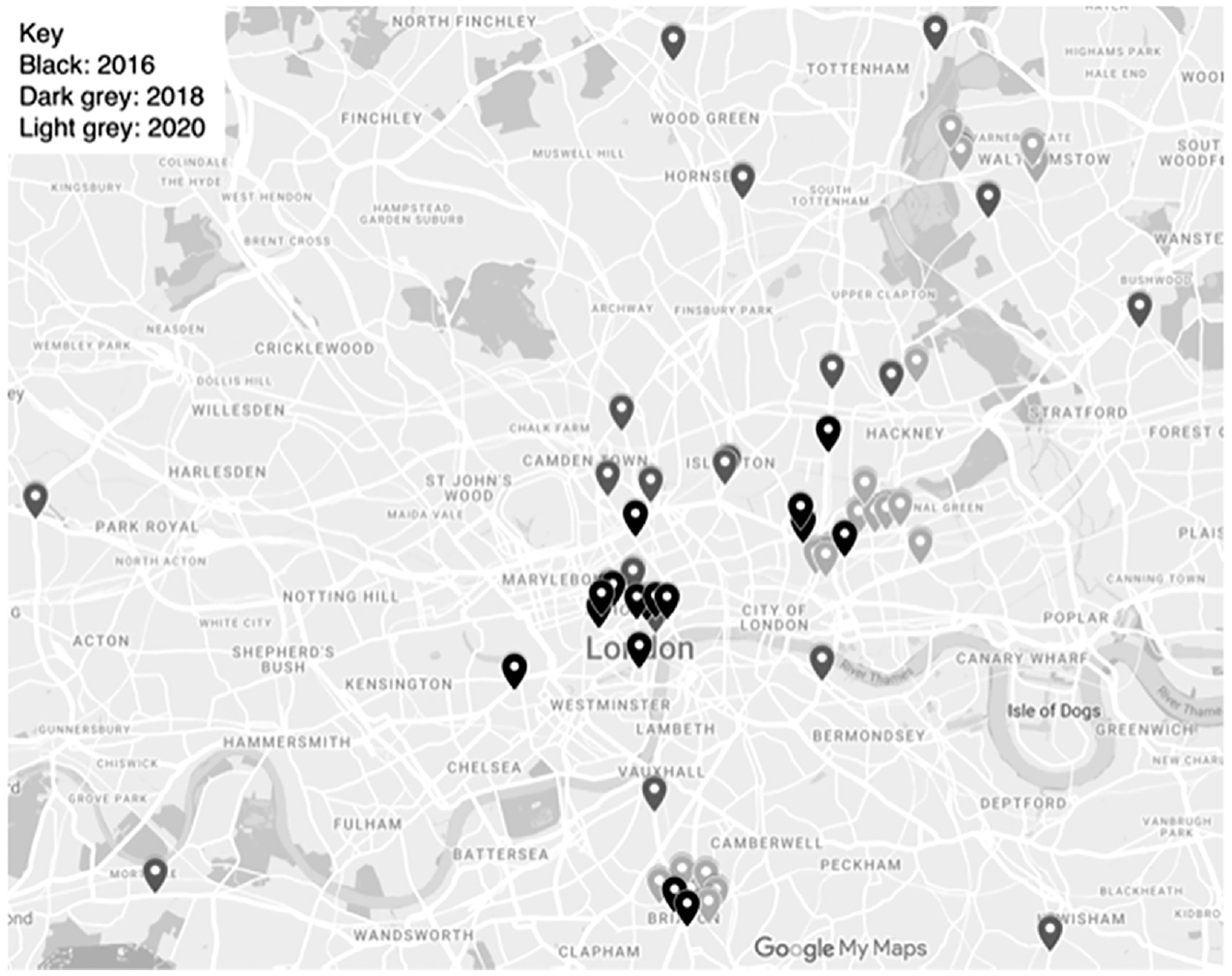
Map of doors filming locations.
Although the cultural and national backgrounds represented in the videos changed over time, they do not necessarily represent the economic, social or racial diversity of the areas they feature, thus abstracting the dominant imaginaries of diversity, business and globality across the campaign videos. Except for a French patisserie and a haberdasher called ‘African Queen Fabrics’, the 2016 video features no businesses that are visually identifiable as ‘ethnic enterprises’ and only five ‘ethnic enterprises’ are identifiable in the 2020 video. In contrast, the 2018 video which was produced in response to the publication of the Brexit withdrawal agreement features businesses that explicitly display their national or cultural origin. These include a German delicatessen, a Dutch cycle shop and a Polish supermarket. However, most identifiable European businesses depicted are from a longitude west of Berlin. In addition to a selective and curated ethnic diversity in the doors videos, there is a clear correlation between businesses that appeal to the so-called ‘hipster aesthetic’ and the areas chosen. The carefully selected diversity in the visual language of the videos thus forms an urban imaginary of London that signals the kind of spaces that represent London, and which social groups belong there. This combined with the focus on so-called hipster outlets suggests that the doors videos reinvent and reimagine the urban community and, in doing so, much like Zukin’s (2010: 17) discussion of gentrification in New York, ‘construct a new habitus latte by latte’.
Whereas the widely viewed doors videos represent the ‘cool’, ‘trendy’, ‘hipster’ London of boutique eateries and coffee shops, the less visible aspects of the campaign, those which were predominantly physical, took #LondonIsOpen to areas not often associated with the hip, cool or trendy. In 2019, a double-decker bus wrapped in #LondonIsOpen branding, with the words ‘we are all Londoners’ in different EU languages, travelled on a four-day tour of the city to provide free immigration advice to EU Londoners. As the campaign lead noted, the areas chosen were ‘where communities were’, and they ‘went to where there was a concentration of EU communities and particularly those who would find it more difficult to access services’. Materials were shared in a ‘culturally appropriate way’ and the campaign lead viewed it as ‘reaching thousands’ and ‘having more substance than just a slogan’. Figure 2 shows the #LondonIsOpen tour bus locations.
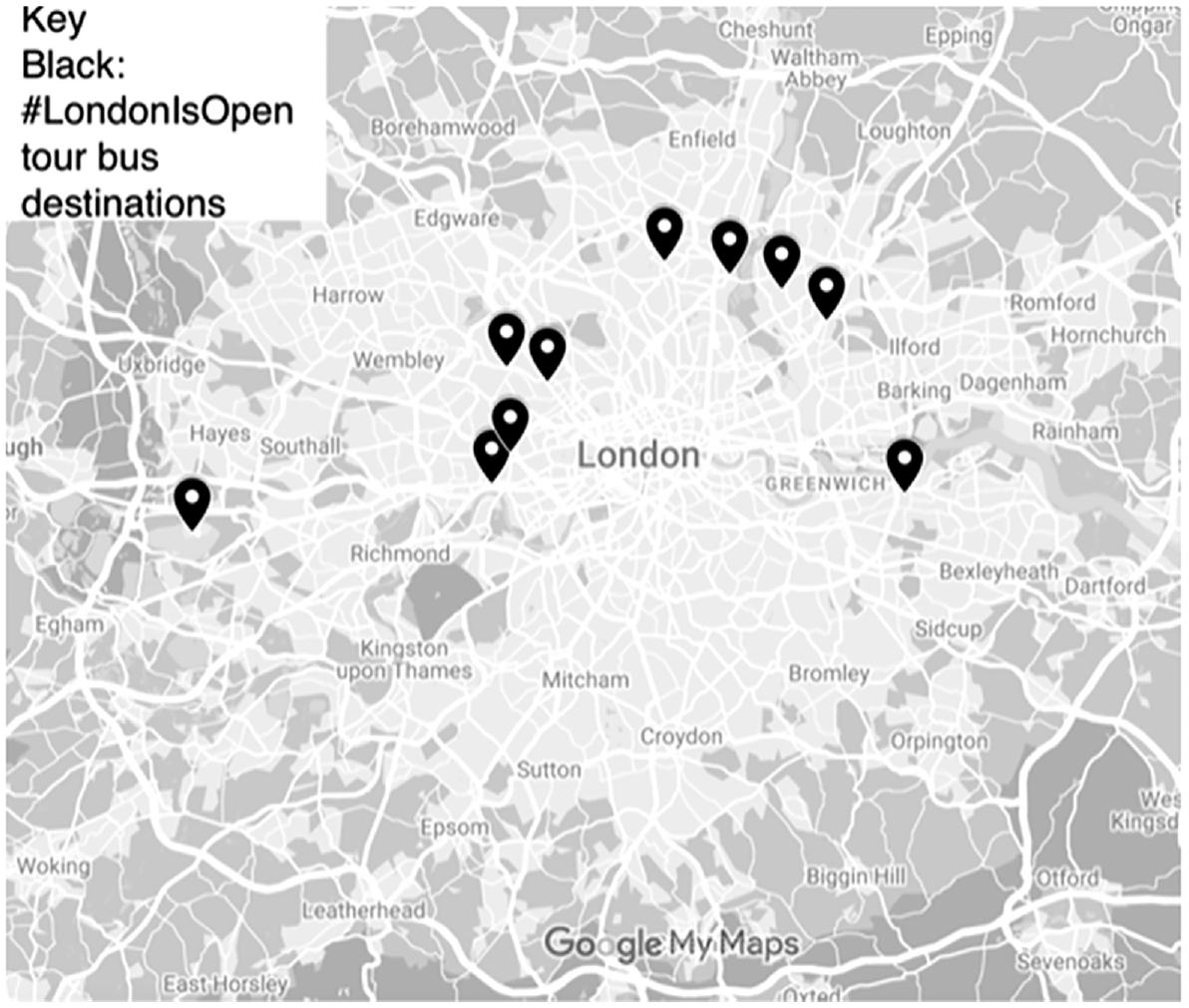
#LondonIsOpen tour bus destinations.
The places represented in the #LondonIsOpen doors videos are highly visible and relatively affluent. Face-to-face aspects of the campaign, however, took place in relatively peripheral, middle-ring parts of London that are more marginal culturally and economically. Two of the boroughs where the tour bus was taken are in London’s top five most impoverished (Trust for London, 2021). Each of the locations chosen are highly visible within their locality and have high footfall. The borough of Haringey in north London provides a good example, with some very affluent and some very deprived localities. The borough includes two #LondonIsOpen tour bus destinations – Wood Green and Tottenham Hale – both of which rank highly in the indices of deprived areas in England (DCLG, 2019). The face-to-face aspects of the campaign which took #LondonIsOpen to more marginal parts of the city are also the least visible. The parts of the city that are imagined to be London and chosen to represent it are highly selective. Just as the earlier campaign videos abstracted the city’s ethnic diversity by replacing human faces with animals, large swathes of the city are excluded and invisibilised from campaign materials – replacing Wood Green with Walthamstow.
What this points to is a city that is imagined to be diverse enough to ‘attract interesting people’ and ‘global talent’ but one that has been cleansed of poverty, inequality and racialised minorities lacking in talent. It is only in less visible aspects of the campaign that London’s social and economic diversity is recognised. This reflects Georgiou’s (2017) argument that the openness of the city does not always extend to those who need it and that hospitality in #LondonIsOpen applies selectively to certain voices and experiences. When it does extend to those who need it, the campaign does so quietly. In this way, a city that is described as ‘loud’ and having ‘fearless outrageous courageous’ (Mayor’s Office London, 2018b) only appears to embody these characteristics in areas that may be celebrated by ‘diverse talent’ (London and Partners, 2016).
Conclusion
This article has examined the active production and contestation of urban imaginaries around the idea of London as an open city. Our analysis has shown that the city is imagined as multiple and shifting and its (re)presentations are contested and partial in ways that may undermine or even contradict the stated aims of #LondonIsOpen. The idea of openness contributes to the versatility of the campaign and its range of responses; while that made it highly adaptable and flexible to respond to current affairs to project an imaginary of London, it is also selective and arguably misleading. In assessing the different sites and scales of the campaign, we can see that at one level the open city is imagined as business focused, while culturally it is depicted as trendy, desirable and cosmopolitan. Both picture the city as welcoming and inclusive. However, these practices of welcoming are focused either on EU migrants who are highly economically productive or on migrants who need care and protection. Thus, the campaign’s audience is imagined to be capital rich, fearful about the impact of Brexit and aware of the need for protection and care for the Other. Moreover, the localities that are imagined to be London are highly selective, producing geographies of the city that are partial and, in some ways, unrepresentative of London, when its scale and diversity are considered. In line with Georgiou (2017), therefore, it appears that who speaks and who benefits from acts of welcome in the open city are those who wield financial power and those who are seen as deserving of welcome.
The appeal to an idea of openness is the other key thread in this article. In a seemingly post-Covid moment in May 2021 as some restrictions were lifted, we noted more play with this word in adverts – mainly on London transport and in collaboration with TfL. For instance, IKEA’s advert proclaimed, ‘Hooray! London’s open again’. Similarly, in July 2021, Coca-Cola launched an advert with the slogan ‘Let’s open up, London’; this began with a takeover of the renowned advertising site of Piccadilly Circus. While the ‘open’ is clearly a response to the Covid lockdowns, we think its adoption by two large multinational businesses indicates the appeal of the urban imaginaries produced by #LondonIsOpen, albeit reflecting more the entrepreneurial and pro-business elements of it.
The multivalent meanings of the open embedded in the seemingly simple slogan #LondonIsOpen thus enable diverse forms of city branding, enterprise, welcoming – and some reactions that re-work the meaning of the open in different directions. Yet proclaiming that a city is open is, paradoxically, also a way of showing the ways its openness is partial. It is this partiality that allows us to engage with what #LondonIsOpen as both a branding initiative and political campaign means for how we understand place. The ambivalences and ambiguities of the open produce multiple and often conflicting imaginaries of the city. Who participates in the production and consumption of these imaginaries, as we have seen, however, appears to be restricted to those ‘trendy’ and ‘cool’ Londoners or those who work in policy and the media. In contrast, where the hashtag has been used to practise a politics of welcoming, this has been done both quietly and in often unseen parts of London that are not associated with what makes it iconic. In this way, #LondonIsOpen reveals who is seen and heard in the production of visible imaginaries of the city and how the multiple city can be fragmentary. This raises the question of how alternative imaginaries could lead to the formation of new struggles in the city and whether the partialities of the open hold potential for new ways of imagining the city.
Footnotes
Acknowledgements
We are grateful to the Editor and two anonymous reviewers for their helpful and constructive feedback that have helped us to improve this article.
Declaration of conflicting interests
The author(s) declared no potential conflicts of interest with respect to the research, authorship, and/or publication of this article.
Funding
The author(s) disclosed receipt of the following financial support for the research, authorship, and/or publication of this article: The research for this article was funded by the Economic and Social Research Council (grant reference ES/T009454/1).
