




Abstract
This paper focuses on multi-actor partnerships within city food networks geared towards food system transformation. While an emergent body of research uncovered collective tactics in the context of urban food strategies, more research is needed to understand how tactics mobilised by multiple state, civil society, and market actors change based on different engagements and connections – namely their relational aspects. We conducted a systematic literature review of interdisciplinary research on Fair Trade Towns, one of the most globally widespread examples of multi-actor city food networks, to observe tactics from a relational perspective, analysed through the Deleuzian theoretical device of ‘lines of flight’. Findings show what tactics are employed by different state, civil society, and market actors in city food networks, and how these different partnerships act along ‘lines of flight’, activated relationally depending on the connections and the power dynamics in different assemblages. We conclude by identifying new avenues for future research to understand the relational, unfolding, and complex character of food system transformation.
Introduction
In global food policy discourses, cities are being increasingly called to take the lead in addressing the socio-environmental challenges of ‘feeding the planet’ (Cardoso et al., 2022). In this paper, we are interested in ‘city food networks’ as a way in which cities are taking action to bring about positive changes in food systems. City food networks can be defined as multi-actor and cross-sector partnerships based on the collaboration among state, market, and civil society actors and their competing agendas. These networks are characterised by complex patterns of knowledge exchanges, collective learning, and capacity building, as well as distributed governance (Moragues-Faus, 2021; Moragues-Faus and Sonnino, 2019; Sonnino and Coulson, 2021). Examples include Food Policy Councils 1 (Clayton et al., 2015), community-led governance (Turcu and Rotolo, 2022), the Sustainable Food City Network (Moragues-Faus and Sonnino, 2019), and Fair Trade Towns, which are the empirical focus of this paper. In particular, we are interested in understanding the relational dynamics of city food networks geared towards food system transformation, defined as a ‘process of radical change in the structural, functional, and relational aspects of the food system that leads to more just socio-ecological relationships, patterns of interactions and outcomes’ (Sonnino and Milbourne, 2022: 915). In other words, city food networks, with their place-based initiatives and progressive food policies, have the potential to transform food systems to provide safe, healthy, and equitable food for all (Sonnino and Milbourne, 2022).
Recognising that city food networks are complex partnerships entailing a multiplicity of competing priorities, emergent research is engaging with their on-the-ground dynamics, analysing the interactions among different actors, as well as the power relations among them (Lever and Sonnino, 2022; Manganelli et al., 2020; Ng, 2020). We build on this scholarship by deepening our understanding of relational and dynamic aspects of multi-actor city food networks. In Particularly, we want to expand existing knowledge on the tactics adopted by different state, market, and civil society actors with a more nuanced understanding of how these tactics overlap, compete, and interact based on different configurations of actors. Accordingly, the questions driving this paper are: what tactics do multiple state, market, and civil society actors mobilise within city food networks? How do such tactics change based on multiple engagements and connections and what are the consequences for the actors involved?
To enact the relational premise of the paper, we mobilised the concept of ‘lines of flight’, a lesser-known aspect of Deleuze and Guattari’s ‘assemblage theory’ 2 . In Deleuze and Guattari (1988), assemblages (agencements) are formations of heterogeneous elements, combinations of functions bringing different elements together and defined by the relationships they establish with other assemblages (Deleuze and Guattari, 1988). Elaborated in the Anti-Oedipus (2004) and further developed in A Thousand Plateaus (1988) to conceptualise change, lines of flight (ligne de fuite) are connections that escape (fuite) the boundaries of an individual assemblage and link it to another assemblage – hence they are also called rupture lines. In this study, we argue, this theoretical approach enables us to visualise ruptures, connections, and mutations in multi-actor partnerships and thus offer a dynamic and relational understanding of constellations of tactics among different actors.
The contribution of this paper is as follows. First, while previous studies examined the co-production of food policies from a multi-actor perspective (Clayton et al., 2015; Giambartolomei et al., 2021; Vara-Sánchez et al., 2021), here we stress the need to observe them from a dynamic and relational perspective – namely how different actors perform different tactics depending on the partnership they are relating to and engaging with. Departing from scholarship emphasising the relational nature of urban food governance (Berti and Rossi, 2022; Moragues-Faus et al., 2020), and employing the theoretical device of ‘lines of flight’, we stress how the diversification of roles in city food networks depends on multiple connections among overlapping agencies, giving even more flesh to the complex character of these partnerships. A relational lens to study city food networks is especially timely as pervasive social and environmental problems need the collaboration of multiple actors, including businesses, consumers, governments, and NGOs (Grzymala-Kazlowska and O’Farrell, 2023). Additionally, by analysing and extending past research on Fair Trade Towns, we identify literature gaps and provide new avenues for future research to advance our understanding of multi-actor city food networks.
Research design
To answer our questions we focussed on Fair Trade Towns, one of the most widespread city food networks aiming at social justice, climate adaptation, and fair economic exchanges within global food systems. The Fair Trade Towns movement (FTT) began in 2001 in Garstang (UK) when the local community started to lobby local businesses and the public sector to supply and consume more Fair Trade products and has since expanded significantly, with over 2000 municipalities globally (International Fair Trade Towns, 2022). FTT represents a promising vantage point to advance our understanding of multi-actor partnerships in city food networks for several reasons.
First, FTT is inherently a multi-actor network: the accreditation is built on different criteria, which require the active participation of state, market, and civil society groups (Fairtrade Foundation, 2011). Specifically, local councils are required to pass a resolution supporting Fair Trade certifications (FT) and to expand the public procurement of FT certified products; retailers and local businesses are required to make a range of FT products available in the area’s retail and catering outlets; and civil society groups (i.e. community organisations, schools, universities) are required to support FT with initiatives and events, while local media are expected to raise awareness of FT across the community (Fairtrade Foundation, 2011).
Second, the FTT movement is centred on local authorities, which lead the initiative through funding, resources, allocated staff, and support to FTT grassroots initiatives. From this perspective, FTT represents a cross-sectoral space of deliberation, characterised by multi-scalar interdependencies, similar to food policy councils (Moragues-Faus and Battersby, 2021). Third, FTT is geared towards food system transformation, as the initiative aims to expand uptake and awareness of FT as a proxy to foster more equitable food supply chain relationships; in practical terms, this translates into fostering transformative food initiatives through FT public procurement, support to local FT businesses, and advocacy around FT food.
Despite these promising characteristics, FTT have remained virtually absent from urban studies scholarship and research is scattered among different disciplines. We thus conducted a systematic review to integrate existing interdisciplinary knowledge on FTT, a critical approach helpful in identifying literature gaps and setting future research agendas (Vrontis and Christofi, 2021). Following a five-step approach (Denyer and Tranfield, 2009), we reviewed 55 papers and analysed the multiple tactics and connections among state, market, and civil society actors in FTT. We now outline the theoretical coordinates of the paper, before offering a detailed overview of methods and findings.
A relational and assemblage-informed approach to city food networks
Our theoretical coordinates revolve around two pillars: city food networks as (i) relational infrastructures embedded within power dynamics and (ii) place-based multi-actor partnerships.
City food networks as relational infrastructures
We adopt a relational sensitivity to urban food governance (Moragues-Faus and Battersby, 2021), focussing on urban spaces not only as spatial and governance structures but also as relational infrastructures. This theoretical orientation stresses the need to complement the analysis of material infrastructures with the study of social infrastructures, that is, the social relations that inform local action (Berti and Rossi, 2022; Moragues-Faus et al., 2020). Despite the centrality of localisation and urban relations in debates on food system transformation, it is important to be mindful of the ‘local trap’, a romanticised and uncritical view of the ‘local’ as automatically more sustainable, democratic, and participative (Born and Purcell, 2006). Studies have stressed the need to move beyond an optimistic and naïve view of urban food governance and analyse the materialities of local micropolitics, with a focus on contention and the configurations of power embedded in local food partnerships (Lever and Sonnino, 2022). Place-based governance is not automatically more transparent or participative but is shaped, case by case, by locally distinctive entanglements of relations and geographies (Lever et al., 2019), with different outcomes in terms of power relationships (Sonnino and Coulson, 2021).
City food networks as place-based multi-actor partnerships
We draw upon the literature on the co-production of food policies from a multi-actor perspective, focusing on state and non-state actors (Clayton et al., 2015; Vara-Sánchez et al., 2021). Understanding relations among different actors is fundamental in participative food governance, as this entails actors with competing priorities and agendas (Clayton et al., 2015). Within these debates, great attention has been paid to community actors, such as grassroots groups and social movements. While the importance of grassroots actors in urban strategies cannot be overstated, recent studies have been calling for transdisciplinary approaches to understand the multi-actor reality of food systems transformations, taking into account the collaboration between the public and private sectors, and civil society (López Cifuentes et al., 2021; Sonnino and Milbourne, 2022). Given the strongly participative and collaborative processes characterising city food networks, in this study we want to emphasise the relational and multi-actor dimensions of urban food policy.
In particular, we depart from Giambartolomei et al.’s (2021) call to study the cross-sector tactics of multiple stakeholders in city food networks. They analysed the tactics that ‘food policy entrepreneurs’ develop collaboratively, including not only local municipalities, but also NGOs, academics, and grassroots groups. We take this approach one step further and seek to understand the specific tactics of multiple state, market, and civil society actors, and whether and how these tactics change based on the cross-sectoral collaboration they are grounded in. In other words, we want to understand how state, market, and civil society actors involved in city food networks interact with each other, whether they display different tactics based on the actors they collaborate with, and with what consequences for all the actors involved. To be able to visualise these relational patterns, we employ the concept of ‘lines of flight’.
Visualising relationality along ‘lines of flight’
The concept of assemblage has been widely used in urban studies research as it offers the potential to analyse overlapping agencies (Moragues-Faus and Sonnino, 2019). In Deleuze and Guattari (1988, 2004) assemblages (agencement) are defined as ‘a collection of lines’, namely the aggregation of singular parts and their connections: connections that sustain its structure (molar lines), connections that allow the assemblage to reproduce itself (molecular lines), and connections that link different assemblages together (lines of flight).
Lines of flight are ‘transformational multiplicities’ (Deleuze and Guattari, 1988: 12) that cross through assemblages and work through unexpected conjunctions and unpredictable mutations; therefore, they have both a disruptive and creative force (Deleuze and Guattari, 1988). Lines of flight are mobilised through practices of disruption, discontinuity, and fractures, and operate through ‘deterritorialisation’ and ‘reterritorialisation’, namely movements by which something escapes from a given territory, freeing up fixed relations to liberate creative potential (Parr, 2010).
We here employ this aspect of assemblage theory for its potential to visualise multiple connections and their transformative outcomes on its elements, which, we argue, is central to understanding the relational and dynamic dimensions of city food networks. The theoretical device of lines of flight was used extensively by Deleuze and Guattari to analyse transformations, change, and becoming in socio-political assemblages (Thornton, 2020). We propose ‘lines of flight’ as a programmatic analytical prism to understand change and transformation in partnerships among different actors, but also change in those very actors. We here enlist ‘lines of flight’ as a tool to reveal paths of ‘mutation precipitated through the actualisation of connections among bodies that were previously only implicit that releases new powers in the capacities of those bodies to act and respond’ (Parr, 2010: 147). We argue that analysing lines of flight across different socio-political assemblages can produce unexpected outcomes and reveal whether and how tactics change depending on the partnerships in which they are being deployed.
Methodology
We adopted a systematic review process as it is particularly strategic for interdisciplinary research, enabling us to critically assess and integrate complementary perspectives originating in different academic fields (Burgers et al., 2019). To increase the validity of the review and facilitate its replicability, we employed a five-step review process: formulating research questions; locating studies; study selection; analysis; and reporting (Denyer and Tranfield, 2009).
Locating studies
We searched the databases EBSCO, Scopus, Web of Science, and Scholar using the keywords ‘Fair Trade Town*’ and ‘Fairtrade Town*’ in the title, abstract, and keywords. The search was restricted to peer-reviewed articles, books, and academic conference proceedings. Acknowledging the importance of grey literature, we followed Adams et al.’s (2017) theorisation of grey literature’s quality, thus including tier 1 grey literature (books and book chapters written by experts and practitioners), and tier 2 literature (i.e. NGO reports), while leaving out tier 3 data (i.e. blogs, social media posts). Grey literature was sourced by hand-searching and cross-referencing (Domenico et al., 2021).
Study selection
We selected articles published in English, Spanish, and French, spanning from January 2001 (FTT launch) until December 2023. The first collection amounted to 153 articles. We eliminated duplicated results and screened the remaining articles by reading the titles and abstracts; the collection of articles was reviewed and discussed by the authors to ensure robust guidelines in the selection process (Kumar et al., 2020). We assessed the articles following a set of agreed inclusion and exclusion criteria guided by the research questions and purpose of the study. These criteria revolve around the type of certification and the focus of the papers. First, we selected articles delving into the FT certification, excluding sources analysing other social justice certifications. Whilst cities and communities around the world may decide to adopt different multi-stakeholder initiatives to certify the sustainability of their food activities, we decided to focus on FTT as it is one of the largest initiatives of this type and has attracted many scholars’ and practitioners’ attention. 3 Second, we included sources with a focus on Fair Trade Towns and excluded articles focussing on FT consumption or production in general. Although we acknowledge the importance of exploring consumer behaviour and companies’ strategies regarding FT products, we were interested in delving into FTT as a city food network. Based on these criteria, 55 sources were included in the final review (Appendix 1).
Analysis
We performed descriptive coding based on disciplinary field, theoretical approach, methodology, and geographical context, to provide an overview of the literature (see Appendix 2). We then performed a thematic analysis building on Giambartolomei et al.’s (2021) approach to tactics, as well as on the conceptualisation of stakeholder involvement in FT as a bi-directional engagement and mutual participation in decision-making (Pearcy and Dobrzykowski, 2012). We thus coded papers with a focus on (1) the tactics of (i) civil society actors, (ii) state actors and (iii) market actors, and (2) bi-directional engagement between each of these actors through the analytical lens of ‘lines of flight’.
Overview of the field
Disciplinary field and theoretical approaches
The analysis shows a highly fragmented body of research. Major contributions come from geography (24%), focussing on the spatial dimension of FTT. These papers draw from Massey’s relational approach to space (e.g. Malpass et al., 2007) and research on place-based activism, retail geographies, and place branding (e.g. Peattie and Samuel, 2021). Other major contributors come from marketing (22%), adopting a macro-marketing perspective stressing the relational nature of production and consumption (Samuel et al., 2018a), or adopting theory on market-based activism (e.g. Discetti and Anderson, 2023). Other academic fields represented are management (17%), sociology and political science (15%), and food studies (7%). Here the field is scattered across different theoretical approaches, such as servant leadership theory (Samuel et al., 2018a), Gibson Graham’s diverse economies framework (Lyon, 2014), and practice theory (Wheeler, 2012c). The high interdisciplinarity and the variety of theoretical backgrounds are emblematic of the multi-faceted and multi-stakeholder nature of this field.
Methodological approaches
Research on FTT mainly adopts qualitative methods (62%), especially from interviews with steering groups and local activists, in some cases accompanied by ethnographic observations (e.g. Malpass et al., 2007; Peattie and Samuel, 2018). In studies in the Global South, research focuses on the grassroots drivers of the campaign, namely small businesses in India (Carimentrand and Ballet, 2018) and producers’ associations in Latin America (Coscione, 2015). Methodological choices rarely encompass interviews or ethnography with NGOs or businesses, with few exceptions (Discetti, 2021; Vasileva and Reynaud, 2021).
Geographical contexts
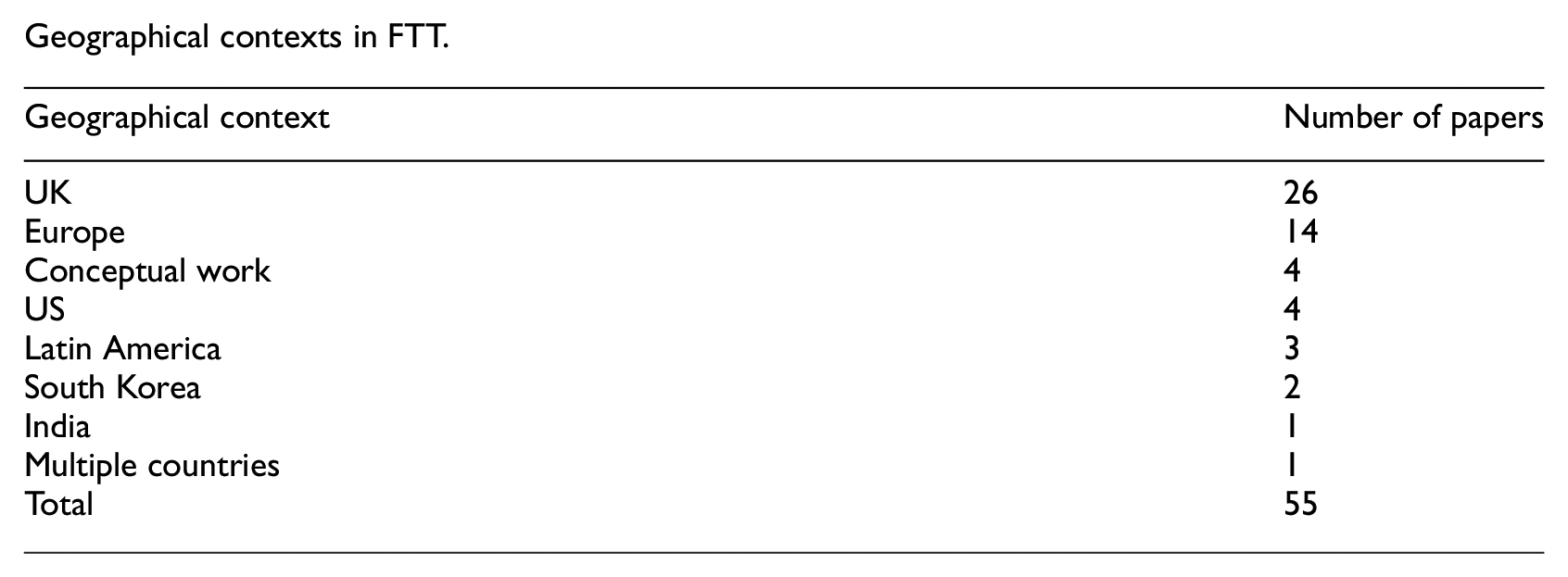
Most papers on FTT are focussed on the UK, which is the country where the movement started, and are based on a single case study (49%). Studies on new developments of the campaign, such as in India and Latin America, are highly underrepresented. A detailed breakdown of each of these categories is outlined in Appendix 2.
Lines of flight in Fair Trade Towns
Our analysis uncovered different tactics employed by civil society, state, and market actors, and their bi-directional engagement along different ‘lines of flight’ (Figure 1).
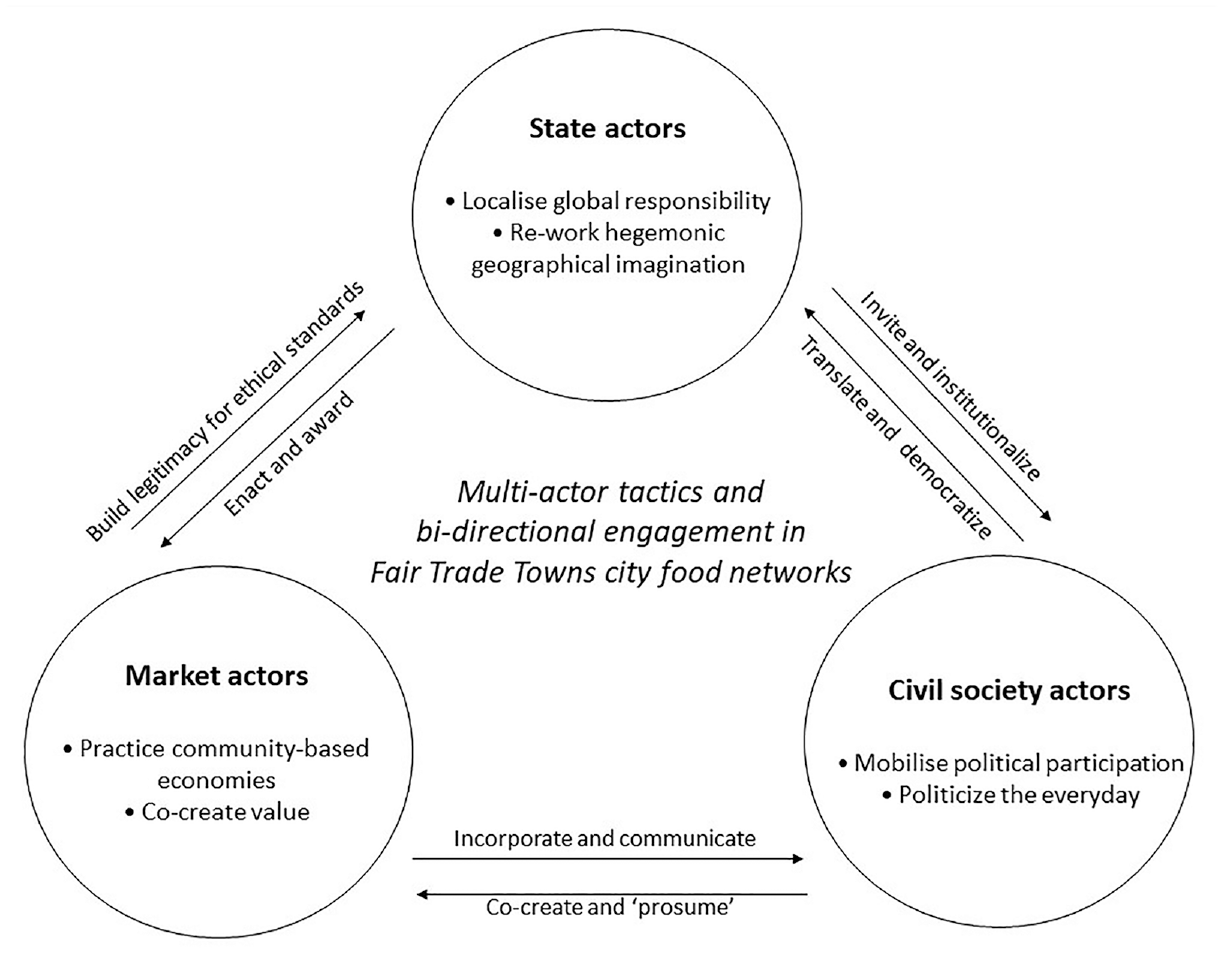
Multi-actor tactics and bi-directional engagement in FTT.
State actors
The two FTT state actors’ tactics identified are localising global responsibility and re-working hegemonic geographical imaginations. First, state actors localise global responsibility by negotiating the local and the global as ‘mutually constitutive’: local authorities play a central role in producing and re-producing FTTs as ‘ethical spaces’, acting as intermediaries between mobilised civil society, market actors driving innovation through sustainable business models, and global concerns (Malpass et al., 2007). The ‘city’ becomes the key actor promoting FT and inscribing FT policies into a sustainable public agenda, which includes ethical consumption, sustainable production, and food sovereignty (Rolland, 2016). It can be argued that, in this way, FTT enacts a politics of ‘re-location’ of global issues: Common fair trade narratives are rooted in geographies of difference, and conceptualize place solely in relation to producer communities and identities located in specific spaces and represented through photographs and sound-bites. In contrast, the Towns campaign attempts to embed fair trade consumption in local places – a critical turn in the fair trade movement which opens up a politics of possibility for the promotion of alternative economic practices. (Lyon, 2014: 149)
This politics of re-location re-imagines not only local food policies but also local identity. In Deleuze and Guattari (1988), lines of flight organise and lead different modes of becoming, which in turn open the possibility of different modes of subjectivity; by observing how different tactics ‘escape’ their original socio-spatial formation (assemblage) to interact with different actors and their related assemblages, we observe changes not only in the interactions among civil society, state, and market actors but also within their very subjectivities. In the case of Bristol FT city presented by Malpass et al. (2007), the local authority used the ‘politics of re-location’ of FTT to reshape the city identity from a key player in the history of the slave trade to a new identity centred around fairness in trade –‘from Slave Trade to Fair Trade’: ‘the Fairtrade City becomes not only a place that is known to promote fairtrade but also a place characterised by fairness’ (Malpass et al., 2007: 638). In this way, the politics of re-location of global responsibility affects not only local public policies around food, but also the identity of the local municipality and, by extension, the city. Similarly, Rolland (2016) and the International Trade Centre (ITC, 2021) discussed the case of Lyon, using the FTT accreditation to redefine its identity through the label ‘Lyon Ville Équitable et Durable’.
Second, state actors involved in FTT re-work hegemonic geographical imaginations. The FTT movement escapes from hegemonic spatial paradigms that articulate spaces, organisations, actors, and their collective functioning around the virtual oppositions of North/South, urban/rural, consumer/producer – assemblages grounded in the ‘North’ and the ‘South’ as homogenous entities (Rolland, 2019b). FTT reconfigures these paradigms, especially through domestic FT initiatives. In Belgium and France, for example, the FTT accreditation includes the promotion of local food alongside FT products – for example local ‘fair trade’ milk – thus recognising Northern producers as key FT actors (Rolland, 2016, 2019b). Similarly, domestic FTT initiatives in Latin America (Coscione, 2015) and India (Carimentrand and Ballet, 2018) are promoting the consumption of locally produced FT products, recognising the potential of Southern economies. Through a process of deterritorialisation and reterritorialisation, FTT can be considered as ‘redrawing’ and ‘decoupaging’ (Deleuze and Guattari, 1988) the ‘territoriality of actors, namely the relational dimension of territories intended as interaction of actors, interests, and contradictions’ (Rolland, 2015: 2). FTT disrupts hegemonic geographical associations of ‘North-urban-consumer’ and ‘South-rural-producer’ along lines of flight, ‘re-coding’ (Deleuze and Guattari, 1988) these previously associated elements into new configurations of actors and spaces, a North ‘Fair Trade’ producer, and a South ‘Fair Trade’ consumer.
How do lines of flight escaping the ‘State-actor assemblage’ interact with civil society groups? State actors involved in FTT invite civil society groups into public decision-making and institutionalise ethical practices. Analysed from the perspective of spaces of power, local authorities invite civil society groups to participate in local decision-making, for example through involvement in public procurement consultations, where grassroots voices about social and environmental concerns can be heard (Discetti et al., 2020). A key example is the city of Saarbrücken (Germany), which launched a participatory process to embed ethical trade in all its operations, working with universities, the chamber of commerce, the chamber of workers, local NGOs, cooperatives, and administrations to adopt a participatory approach to public procurement and urban food policies (ITC, 2021).
Through the involvement of civil society groups in democratic decision-making, local councils in FTT institutionalize civil society’s FT practices into public policies. In some cases, national governments lead the way in institutionalising grassroots efforts, as in the case of Ecuador, which included the promotion of FT in its constitution, or France, which integrated the concept of FT into law (Vasileva and Reynaud, 2021). However, it is important to recognise that changes along lines of flight are contingent – they are not always emancipatory and do not necessarily lead to transformation; in some cases, they produce only temporary change, which can fall back on less emancipatory outcomes (Thornton, 2020). Although re-framing towns and cities as ‘Fair Trade’ can lead to more democratic municipalities, where grassroots voices can be connected to inclusive urban food policies, it is important to not fall into the ‘local trap’, as FTT municipalities can also exert forms of hidden power. For example, FTT municipalities have been reported to implement austerity measures by cutting funding for FTT grassroots groups, or institutionalising FTT grassroots groups into static spaces, with thick boundaries and no spaces for dynamic discussions (Discetti et al., 2020).
Lastly, we found that FTT state actors interact with market actors in two main ways: FTT local councils enact sustainable agendas through engagement with market actors and award ethical economic practices, especially through procurement policies. FTT recognises procurement as a powerful tool to advance ethical agendas, as authorities spend significant resources on public purchases (ITC, 2019). The EU’s legislative framework on public procurement (European Commission, 2018) explicitly allows public authorities to request ethical criteria when awarding procurement contracts, favouring FT certifications. The Italian government has included FT criteria as a mandatory, rather than voluntary, requirement in all public tenders for some food products (Vasileva and Reynaud, 2021). This legal framework allows municipalities to favour businesses with ethical credentials and award market actors with preferential contracts and tenders. For example, the FTT city of Bruges (Belgium), with a strong tradition of chocolate production, has committed to stimulating FT chocolate supply chains through a local FT Chocolate Board, a ‘fair trade chocolate consultation platform bringing together city officials, technical colleges, civil society organizations, and chocolate businesses’ (ITC, 2021: 23). In so doing, the city is taking the lead in forming alliances with FT market actors to improve ethical standards in the local chocolate industry. 4 We can make sense of these examples through lines of flight’s potential for ‘disruption’ and ‘discontinuity’, but also transformation (Deleuze and Guattari, 1988). The inclusion of FT as a preferential or even mandatory criterion for businesses to participate in urban food policies disrupts mainstream public policy around food procurement, representing a discontinuity with policies favouring the most cost-effective options for purely economic measures of value. FTT therefore transforms public procurement criteria by including fairness as an essential requirement for decision-making and creating preferential relationships with businesses upholding these values.
Civil society actors
We observed two main tactics employed by FTT civil society actors: mobilising political participation and politicising the everyday. Civil society actors mobilise political participation through several sub-tactics, including pressuring the commercial sector, influencing retailers, and gathering community support (Peattie and Samuel, 2018), but also blending online and offline activism, partnering with NGOs, and building a collective identity (Discetti, 2021; Shawki and Schnyder, 2023). Civil society groups in FTT bridge several sectors of the local community, often weaving together heterogeneous networks, for example secular and religious groups (Dawson, 2022).
Second, civil society groups in FTT politicise the everyday by highlighting the political aspects of everyday consumption. FTT campaigners use consumption as a strategy to involve ordinary people in more committed forms of activism, such as lobbying, campaigning, and volunteering (Barnett et al., 2010). In this sense, FTT is more significant in political terms than in purely economic ones, as it provides ordinary people with avenues for political participation (Wheeler, 2012b). However, it is important to consider power asymmetries reproduced by FTT community actors. Deleuze and Guattari (1988) stress that it is not possible to know whether two lines of flight will be compatible nor whether they will produce transformation: lines of flight are historically contingent, and the only way to ascertain whether transformation is possible is through experimentation (Thornton, 2020). While FTT networks mostly exert ‘power with’, that is, solidarity-based action, they also exert forms of ‘power over’, that is, coercive power, and some lines of flight in FTT civil society groups do not escape conventional market dynamics, reproducing the very power dynamics they were designed to transform. Studies (Discetti et al., 2020; Lyon, 2014; Partzsch et al., 2022) report the discomfort of FTT activists who have to rely on big corporations to gain FTT accreditation: While FTT visibly turns against existing trade practices, the network needs conventional corporations in order to be successful. […] A public representative told us that ‘especially the Worldshops, some of which have higher standards, do not like the fact that we work together with Lidl and other big companies. And they argue sometimes this makes everything untrustworthy’. (Partzsch et al., 2022: 1269)
Civil society groups interact with state actors by translating global discourses into local narratives and democratising spaces for participation at the local level. Activist groups involved in FTT re-articulate global ‘sustainability’ discourses into locally relevant narratives, as in the case of Café Chicago (Shawki, 2015). Café Chicago is a non-profit organisation run by the Latino Union as an immigrant worker cooperative that roasts, packages, and sells FT coffee in Chicago. The organisation was founded to create revenues for the Union’s social justice work for immigrants: ‘Café’ Chicago illustrates how a local social agency can rearticulate and recontextualise the ideas of a global movement to adapt it to the circumstances of specific local communities. […] Participating in the local Fair Trade movement is a way to address some of the socio-economic challenges that poor immigrant communities face and to demonstrate international solidarity with the poor community from which the coffee is sourced. […] The Fair Trade movement is a predominantly white middle and upper class movement, but this example shows how it expanded to include poor and marginalised groups through the process of reinterpretation. (Shawki, 2015: 420)
Rather than employing contentious and oppositional politics targeting the state, civil society groups such as Café Chicago democratise spaces for participation, developing capacities at the local level and enabling participatory politics and civic engagement for disadvantaged members of the community through the FT proxy. Again, through movements of ‘deterritorialisation’ and ‘destratification’ (Deleuze and Guattari, 1988) lines of flight connect different discrete communities: the immigrant workers in Chicago; the small producer from which they source the FT coffee in Latin America; the local Union workers; the consumers committed to social justice and fair labour. Through these lines of unexpected connectivity, FTT civil society groups open new pathways for political participation – several other examples are available (Human and Crowther, 2011; ITC, 2021; Wheeler, 2012b).
Lastly, FTT civil society groups engage with market actors by co-creating and ‘prosuming’ ethical brands. Steering groups of activists co-create the FT brand and reframe consumption of FT products as a ‘prosumer’ activity: [the] prosumer is central to the development and accreditation of FTT through the work of its steering group who share a passion for FT, and collectively invest time, effort, and social capital in promoting it. […] one important perceived role for steering groups was to protect and uphold Fairtrade brand value and community standards. (Samuel et al., 2018a: 766)
This process of co-creation and negotiation of FT brands is activated through emotional engagement between consumers and brands (Peattie and Samuel, 2021). Again, here we witness lines of flight at work through unexpected conjunctions, where grassroots FTT activists and market actors co-create FT companies through ‘prosumer’ partnerships.
Market actors
FTT market actors include a broad business ecosystem of manufacturers, retailers, workers’ cooperatives, social enterprises in the World Fair Trade Organization (WFTO) network, larger organisations certified by Fairtrade International, socially engaged supermarkets, and Fair Trade World Shops. All these actors are involved to different extents and varying degrees in FTT, grounded in contingent social and geographical contexts. Our analysis shows that FTT market actors deploy tactics of (i) practicing community-based economies and (ii) co-creating value.
Through marketing research on the notion of brand community, FTTs can be considered as brand communities promoting the FT brand (Samuel et al., 2018a), namely co-produced by market and community actors through three core elements: a collective identity; shared traditions; and a sense of moral responsibility to others. FTTs as brand communities intertwine everyday consumption with an emotional attachment to the FT brand (Samuel et al., 2018a), thus co-creating value through a collaboration of market and community actors. Here we can observe a further process of ‘deterritorialisation’ that ‘disrupts’ the notion of value from an attribute inherent to the product and its quality to a complex construct accounting for its very condition of production: it is evident that a moral and ethical message is at the core of the [Fairtrade] brand, but further elements have been developed through subsequent communications campaigns. Most important of these is the concept of quality, framed in its broadest sense to include not only the nature of the consumer’s experience of the product, but also their contribution to the quality of the producer’s life and their environment through that purchase choice. (Nicholls and Opal, 2005: 158)
Here FTT market actors collaborate with community actors to ‘de-code’ the notions of value and quality, and ‘re-territorialise’ them into new assemblages, made up of relations among production conditions, livelihoods of workers, fair wages, and ethical consumption.
How do processes of co-creation take place in FTT? FTT market actors incorporate ethical concerns voiced by community FTT groups into their operations and communicate their efforts to the broader audience of supporters and consumers through the main device of ethical labels, such as ‘Fairtrade’ or ‘WFTO Guaranteed’. The emphasis on certifications, particularly the Fairtrade label, however, is not without challenges. In the case of FTT campaigns strongly centred around the promotion of the Fairtrade label, scholars (Discetti et al., 2020; Smith, 2015) have highlighted the power dynamics and tensions generated by a licencing organisation (i.e. the Fairtrade Foundation) both accrediting FT places and licencing businesses with the FT label: The [Fairtrade] Foundation places itself in a difficult position by both setting the standards for fair trade places and standing to gain from the activities generated by these. For example, the organisation inevitably finds complexities in promoting Fair Trade Organisations’ products over and above others, as this is readily perceived by other licensees as a contradiction to their interests and investments. (Smith, 2015: 198)
In A Thousand Plateaus processes of deterritorialisation are always coupled with related processes of reterritorialisation; however, Deleuze and Guattari (1988) warn against imagining these processes as symmetrical and always transformative, as re-territorialisation can also re-combine elements in more power entrenched relations – as shown by the tensions generated by an excessive emphasis on labels rather than on the movement’s values.
Lastly, as regards the interaction between market and state actors, FTT market actors cooperate with state actors to build legitimacy and advance acceptance of ethical standards. Several grey literature examples of public procurement partnerships show how FT companies are advancing the social and environmental agendas in public spending (ITC, 2021). For example, the case of Espoo municipality (Finland) showed that FT suppliers seek these partnerships at the city level as an opportunity to expand their political legitimacy, expand their economic growth, and advance the positive impacts on the producers (Tikkanen and Varkoi, 2011). Additionally, FT World Shops have historically functioned as hubs of knowledge and education on FT, which further advance societal acceptance and demand for ethical standards. For example, in South Korea, the FT Worldshop ‘Jigoomaeul’ played a significant role in making FT known to consumers and the general public, which ultimately contributed to making Seoul a FT City in 2018 (Hwang et al., 2019). However, here again, Thornton’s (2020) caveat that lines of flight do not always have emancipatory outcomes remains valid: in fact, FTT market actors are often still centred around consumption as the main pathway to societal change: ‘the exclusive focus on consumption arguably constructs fair trade places as accepting of a neoliberal model, against which wider and original fair trade activism was attempting to fight’ (Smith, 2015: 197). While the connections that FTT establishes between ethical business and communities have transformative potential, it is important to evaluate whether this potential is actualised case by case.
Conclusions and directions for future research
The paper expands existing knowledge of city food networks through a novel application of a lesser-known aspect of assemblage theory, the concept of lines of flight. This theoretical device enabled us to cast new light on the relational and dynamic dimensions of multi-actor tactics in city food networks, which, in turn, enhances our understanding of these networks’ ability to contribute towards food systems transformation. We draw upon these contributions to offer potential directions to move the literature on city food networks forward.
The relational dimensions of multi-actor tactics
Previous literature examined the co-production of food policies from a multi-actor perspective (Clayton et al., 2015; Giambartolomei et al., 2021; Vara-Sánchez et al., 2021) and through assemblage-theory lenses (Moragues-Faus and Battersby, 2021; Sonnino and Coulson, 2021). However, the concept of lines of flight remained virtually absent from literature on the topic. Deleuze and Guattari’s emphasis in developing ‘lines of flight’ is on how things connect rather than how they ‘are’– a relational view of things and entities, which gives visibility and priority to creative mutations rather than fixed realities. Deleuze and Guattari invite a shift in focus from static entities to an unfolding of forces, assemblages, or multiplicities, with the power to affect and be affected. Employing this theoretical sensitivity, we argued that actors in city food networks act along different ‘lines of flight’ depending on the connections and the power dynamics being activated relationally with other actors. Since a line of flight ‘can evolve into creative metamorphoses of the assemblage and the assemblages it affects’ (Parr, 2010: 147), different mutations of tactics and roles in city food networks can be interpreted as depending on the governance assemblage being activated by multiple and ever-changing configurations of actors. We highlighted the creative potential of lines of flight: we observed how FTT municipalities localise global responsibility through local policies, thus positively shaping the city’s identity, as in the cases of Bristol and Lyon. We discussed how community actors transform relationships with state and market actors towards co-creation rather than contention; we also showed how market actors incorporate community concerns to build legitimacy for ethical standards. Thus, we ask: how can these different actors harness the creative potential of collaboration and co-creation along lines of flight to advance progressive food policies? What spaces and connections are more conducive to co-creation being negotiated relationally? And what types of collective leadership are needed to facilitate these transitions? However, we tempered these creative accounts with more controversial and disruptive network dynamics – we argued it is important to look at lines of flight from a dynamic perspective too.
The dynamic dimensions of multi-actor tactics
The theoretical focus of lines of flight constitutes a lens through which to better comprehend the complexity and overlap of roles, agencies, and power relations in city food networks and their changes in different configurations of actors – their dynamic nature. We discussed in our findings how connections are not necessarily transformative and productive, as lines of flight can also lead to regressive transformations: we showed this in the networks’ overreliance on powerful supply chain actors, such as big retailers and manufacturers, to secure FTT accreditation (Partzsch et al., 2022); in the domination of the Fairtrade label over more radical and transformative FT approaches (Discetti et al., 2020; Smith, 2015); in the reproduction of privilege in consumer subjectivities, whose social, cultural, and economic capital is necessary to support FT through consumption (Wheeler, 2012b). These insights are instrumental to a pragmatic understanding of city food networks’ ability to transform food systems. We encourage future studies to observe city food networks from dynamic and power-informed perspectives, to investigate connections not only in their productive power but also in their disruptive potential. This leads to our last point.
To what extent do city food networks bring about food system transformation?
While optimistic views about cities leading transformative action exist (Turcu and Rotolo, 2022; Vasileva and Reynaud, 2021), we argue that city food networks’ potential to bring about real change needs to be tempered with more research adopting an on-the-ground and case-by-case approach in local and national settings (see, e.g. Coulson and Sonnino, 2019). We need to remember that urban systems do not exist in isolation, and precarity and inequalities undermine social processes of urban resilience and democratic governance (Adger et al., 2020). We also need to consider that governance institutions are only one of the pillars of achieving sustainable urban outcomes, together with democratic responsiveness, organisational capacity, and environmental conditions (Swann and Deslatte, 2019). We thus need to evaluate city networks’ ability to generate positive change case by case, to avoid falling not only into the ‘local trap’, but also into an uncritical acceptance of translocal, distributed, collective governance as automatically transformative of food systems. While city food networks do develop critiques of neoliberal state and conventional markets, they often fail to include the most vulnerable and marginalised members of society, thus downplaying their role of inclusive spaces of deliberation (Discetti et al., 2020; Partzsch et al., 2022). From this perspective, a theoretical sensitivity towards ‘lines of flight’, leading to connection and mutations which can be creative and participative or destructive and regressive, can inform future analysis of the case-by-case transformative potential of city food networks. More research is needed to understand how city food networks’ spaces and partnerships fail to include the most disadvantaged and vulnerable members of society and how these networks can address power asymmetries in different connections and mutations of actors’ configurations over time.
To conclude, this paper identified different configurations of tactics among state, market, and civil society actors in city food networks, highlighting the need to study city networks’ ability to generate food system transformation from a relational and dynamic perspective. We offered ‘lines of flight’ as an overlooked theoretical tool with an untapped potential to advance urban studies research. In particular, we envision lines of flight’s future potential for urban scholars in their ability to visualise ‘deterritorialisation’ and ‘reterritorialisation’ dynamics in multi-actor collaboration, namely how different actors ‘disrupt’ and ‘recode’ existing assemblages to produce transformative urban policies. We believe lines of flight offer theoretical grounding to understand how multi-actor partnerships, beyond food systems, can have both emancipatory and regressive outcomes, with important consequences to further our understanding of how urban actors can co-produce policies towards more sustainable outcomes.
Footnotes
Appendix
Geographical contexts in FTT.
| Geographical context | Number of papers |
|---|---|
| UK | 26 |
| Europe | 14 |
| Conceptual work | 4 |
| US | 4 |
| Latin America | 3 |
| South Korea | 2 |
| India | 1 |
| Multiple countries | 1 |
| Total | 55 |
Declaration of conflicting interests
The author(s) declared no potential conflicts of interest with respect to the research, authorship, and/or publication of this article.
Funding
The author(s) received no financial support for the research, authorship, and/or publication of this article.
