




Abstract
Cities are so complex that we constantly build models to represent them, understand them and attempt to plan them. Models represent a middle ground between the singular configurations of cities and universal theories. This is what makes them valuable and prone to circulate (between places, institutions and languages) and evolve to adapt to new ideas, local conditions and/or other models. When it comes to analytical urban models (i.e. analytical representations of cities developed to study or simulate part of their structure or dynamics), there is a lack of academic understanding regarding how context and circulation affect their content, use and interpretation. What happens to analytical urban models and their reception during their circulation across geographical and disciplinary boundaries? How have different academic disciplines interacted with, contributed to and been influenced by analytical urban models? What are the consequences of urban models’ mobility for our understanding of cities? In this article, we employ the policy mobilities framework to analyse the circulation of analytical urban models. We use six canonical models as case studies to determine how their assumptions came about and how these models have circulated across different domains of policy and application by using biographical information and model analysis. The first contribution of the article is to demonstrate by example that our hypothesis regarding the influence of context is consistent. We also show that highly transferable/mobile models share common characteristics relating to contingent factors such as their creators’ biographies, institutional context and the traditional markers of power relations.
Introduction
Cities are complex human organisations composed of ‘bodies and bricks’ (Fox and Wolf, 2022) as well as multiple networks linking individuals, institutions and the built environment. To help us grasp how such organisations function, how they evolve with time and what cities could look like in the future, simplified representations in the form of urban models have been developed over the last 50 years or more (Pumain, 1998). These models are either generalised from specific exemplar cities or deductively devised from urban theories. Either way, models represent a middle ground and a mediator between the singular configurations of cities inscribed in a unique/contingent spatiotemporal frame on the one hand, and universal theories removed from a ‘messy’ urban reality on the other hand. ‘Models are separate constructions, moving between, translating, arbitrating, and interceding in differences between the two worlds, and in so doing, making sense of them’ (Barnes, 2008: 6). This is what makes urban models valuable. Generality makes their application possible and fruitful across many types of geographical space and organisation: from research departments to policy departments (and back again). During this circulation, the content and reception of urban models tend to change and adapt to local, epistemic and social conditions. Thus, urban models serve a dual bottom-up as well as top-down purpose. First, they contribute a significant and highly visible share of the current scientific approaches to cities (i.e. the ‘new science of cities’, see Batty, 2013), thereby allowing us to examine urbanism as a self-organised phenomenon with its own evolutionary trajectories and development. Second, they can enable testable policy interventions that allow us to examine urbanism as a process of engineering, invention and planning.
Although urban models can have multiple forms, functions and meanings, in this article we focus on the models that can be called analytical. Compared to more theoretical or normative urban models, analytical urban models aim to better understand and explain the processes behind certain urban features (i.e. centrality, urban form, population distributions, etc.) using a scientific and usually formal approach (e.g. equations, diagrams, statistics, simulations, etc.). Such models are described as analytical in that they proceed to decompose and simplify a complex matter to better understand it, in the tradition of spatial analysis. Unlike normative urban models (i.e. models of cities as blueprints of a desired future), the circulation of which is described and explained by the literature on (urban) policy transfer (Dolowitz and Marsh, 2000) and (urban) policy mobilities (McCann and Ward, 2012; Peck and Theodore, 2010), we lack a more detailed understanding of how individual analytical urban models travel and circulate in time and (social) space, and how this circulation can affect their content, use and interpretation, to build on the existing literature devoted to the role and history of analytical models in general science (see Dahan, 2010) and in geography (e.g. Barnes, 2004; Barnes and Abrahamsson, 2017; Orain, 2022).
What happens to analytical urban models and their reception during their circulation across geographical and disciplinary boundaries? How have different academic disciplines (e.g. economics, geography, physics and mathematics) interacted with, contributed to and been influenced by analytical urban models? What are the consequences of urban models’ mobility on our understanding of cities? We ask all these questions to understand (1) the importance of contingent elements of context versus simplifications chosen on scientific grounds in the design and circulation of analytical urban models and (2) the impacts that analytical urban model design has had both on urban studies and policymaking in the long run. We hypothesise that models, like ideas, are produced by actors embedded in contingent context settings that ultimately affect their circulation (Secord, 2004). We relied on reflexive methods from the fields of policy mobilities studies, the history of science and the sociology of knowledge production to study them. We selected six canonical analytical urban models as illustrative case studies to determine how and why their assumptions came about and how these models have circulated across different domains of policy and application by using biographical and model analysis. In particular, we show how some assumptions can become problematic once these models become appropriated by users who do not – or cannot – grasp the meaning and consequences of such assumptions for uses beyond their original purpose, such as forecasting and policy making. It was not our intention to specify the properties of these known models in relation to those of all existing or possible models in an exhaustive review, nor was it our aim to investigate the reasons for their success. Instead, we aimed to analyse how the ways in which analytical urban models circulate are comparable depending on the diversity of their objectives, the circumstances in which they were produced and the economic or political interests expressed by their users. Therefore, the first contribution of the article is to demonstrate by example that our hypothesis regarding the influence of context is corroborated. We also show that although highly transferable models share common characteristics relating to their content, a significant number of reasons for their trajectories seem to relate to contingent factors such as their designer’s biography, the institutional context and the traditional markers of power relations (e.g. language, locus, gender, discipline and social capital). This information is key to future uses and adaptations that are aware of the contingency of their content and the limitations of their scope. It also corroborates previous findings in the sociology of knowledge (e.g. Collins and Evans, 2007; Secord, 2004) by highlighting how tacit knowledge and referred expertise facilitate the circulation of urban models from one discipline to the next, and from scientific institutions to policy spheres.
The first section of this article reviews the findings on urban model circulation gathered from the policy mobilities literature and discusses their value in studying analytical urban models. The second section presents the methodological strategy used to investigate the consequences of urban models’ circulation on our understanding of cities. The third section presents descriptive results of the six analytical urban models’ circulation and the fourth section discusses them comparatively to disentangle the factors of circulation into structural and contextual types (i.e. linked to the model components or its contingent position in a particular context). We conclude the article with a reflection on the contribution of this analysis to the future of urban modelling and simulation.
Adapting the policy mobilities framework to study analytical urban models
The circulation of normative planning practices or policies has recently become a topic of research (Peck and Theodore, 2015; Roy and Ong, 2011; Shore et al., 2011) and debate (Temenos and Baker, 2015) among geographers. The policy mobilities field of research emerged from critical policy studies to challenge: depictions of the smooth diffusion and adoption of best practices […] that have been selected from a global marketplace of policy solution [… by being] attentive both to the constitutive role sociospatial context plays in the development and authorisation of ‘successful’ policy solutions (as well as those policies that are deemed to have failed) and to the relationality of policymaking sites (whether as sites of emulation, implementation, or contestation). […] through the study of these aspects of policymaking, the policy mobilities approach seeks to be attentive to how decision-making is laden with power relations. (Theodore, 2019: 1)
This approach responded to certain policy-related questions (How can we slow down fast policies? How can we contest hegemonic policies?) as well as scientific-geographical questions (How can we explain the spread of some policy models? What are the social and political practices facilitating policy mobilities?). This represents a departure from the political science literature on policy transfer, represented by authors such as Dolowitz and Marsh (2000: 8), who focus on the international diffusion process of policies, and addresses questions such as ‘What is transferred? What restricts or facilitates the policy transfer process? How is the process of policy transfer related to policy “success” or policy “failure”?’. In contrast, the policy mobilities literature is concerned with understanding the following areas: (1) the production of urban policies as socio-material assemblages rather than well-defined packages; (2) the production of cities through the global circulation of local urban policies; and (3) the role of political-economic institutions (particularly neoliberal ones) in shaping policy development and im/mobility (Baker and Temenos, 2015; McCann, 2011; McCann and Ward, 2012; Peck and Theodore, 2010; Prince, 2012). In particular, this literature argues for a ‘peopling of urban policy mobilities research’ (Temenos and Baker, 2015: 843), which involves the development of a focus and methods to identify the actors involved in policy development and circulation, their role and their socio-institutional embeddedness (Larner and Laurie, 2010; McCann, 2011; Prince, 2012).
We argue that the literature on urban policy mobilities – despite being focused on different types of urban models (i.e. normative practice and public policies) – is relevant to the analysis of analytical urban model circulation for at least three reasons.
First, it acknowledges the fact that model circulation reflects the embeddedness of actors in power relations rather than rational choices. Even though analytical urban models are developed rationally by scientists and received critically by urban scholars and practitioners, ‘science’, much like policy, is part of the social production of knowledge. For instance, Peck and Theodore (2010: 170) asked the following questions: Which policies rise to the status of ‘models’, or objects of emulation? Do they simply rise to the top in some competitive marketplace for policies, or are they, instead, creatures of dominant interests, travelling from centres of authority along politically constructed and ideologically lubricated channels?
Their position was that urban models travel not only because of the quality of the ‘supply side’ but also because of their affinity with problems and needs for solutions of the demand side’.
1
This process can be partly explained by the actors’ constraints: “Solutions-starved” actors, often under pressure to “deliver” successfully, quickly, and at low cost, “scan” globally looking for pretested policy models that have been anointed as “best” in one way or another, with the idea of “importing” them’ (McCann and Ward, 2012: 45).
Here, a parallel exists with analytical urban models, where canonical models such as the gravity model or the monocentric city model are used as building blocks in larger models to represent typical urban patterns (e.g. migration flows distribution and the centre–periphery organisation of urban activities respectively). Their availability as ‘off-the-shelf’ solutions presents the risk of reinforcing the dominance of these models outside of their application domain (e.g. the continued application of monocentric city models to real cities that have greatly diverged from that structure, or the continued application of Western models of cities to cities of the Global South). By contrast, some urban models have not been ‘anointed’ or have not reached the status of ‘canons’ despite the high quality of their content (e.g. the scholarship pertaining to ordinary cities; Robinson, 2006). This derives in part from the unequal access to sources of interactional expertise (in the sense of Collins and Evans; for instance, having direct access to policymakers and thus being able to learn the language of their needs to design a model that addresses them), communication resources (publishing in open-access journals or taking part in conferences, see Barnes and Roche, 2022) and mainstream academic legitimacy (positions in prestigious university and/or dominant disciplines). This is central to the policy mobilities literature: Not all policies, even ones that are locally successful, are mobilised or designated as best practices. Similarly, not all cities feature in the mental maps of policymakers or international institutions when they identify exemplars of best practice. […] Access to resources such as time, travel budgets, the media, translation services, and cultural capital would presumably make it easier for certain policy boosters to articulate their knowledge widely, and uneven access to those same resources would condition which urban actors are able to learn from global conversations about good policy. (McCann, 2011: 121–122)
Recognising this fact suggests a critical discussion of canonical urban models and their ‘metadata’ (i.e. the information about their creation, development and circulation). Indeed, by operating a selection of urban features, actors and scales to represent given aspects of cities, urban modellers create analytical urban models that can have a tremendous (but partly unjustified) influence on how cities are viewed and addressed by policymakers, depending on how their models circulate and are adopted and understood across time, space, languages and disciplines. Understanding the content of analytical urban models – as well as their hidden assumptions, purposes and contingent design choices – is thus crucial to guide the appropriate use of such models to avoid misleading conclusions and ultimately create better urban models that adapt to particular contexts. Additionally, this situation should entice urban modellers to broaden their search for urban model ‘building blocks’ beyond canonical urban models (through systematic literature reviews for instance; see Achter et al., 2024).
Second, the policy mobilities literature acknowledges the fact that representations of cities are situated and directly linked to particular contexts and individual agents. In the same manner, analytical urban models emerge from the work of individuals situated in space, time and social context, and circulate due to disciplinary translators and intermediaries. This similarity suggests that the recommended use of ethnographic techniques to analyse their significance and the importance of context in urban policy mobilities (see Peck and Theodore, 2010; Prince, 2012) could also be suited to the case of analytical urban studies. Who would be the equivalent of ‘travelling technocrats’ (Larner and Laurie, 2010) in analytical urban model circulations? We can think of other academic actors (those who read about new models, those who use models and adapt them, those who participate in the promotion of models through peer review or invited lectures, those who teach, those who oppose, those who summarise through overviews and literature reviews) but also semi- or non-academic actors, such as consultants, researchers working for policymakers, as well as friends and romantic partners who bridge different scientific communities. 2 To be able to identify some of them, one must follow people and models around and analyse the historical situations in which they are embedded (McCann and Ward, 2012) – an ‘externalist’ approach being revived in contemporary geography and urban studies (Barnes, 2008; Ferretti, 2021; Rybski and Ciccone, 2023). We believe that researching the biography of analytical urban models’ designers, intermediaries and translators can help us to better understand the significance and limitations of urban models’ content and their potential for future use as building blocks of larger models. It is also an exercise of reflexivity because as urban modellers, academics and educators, we ourselves serve roles in the development, circulation and promotion of analytical urban models.
Third, the policy mobilities literature considers the materiality of urban policies as ‘assemblages’, which are not single fixed documents constantly delivering the essence of a policy applicable in the same way everywhere, but rather elements of discourse found in ‘books, reports, documentaries, websites, blogs, press releases, newspaper reports, etc’ (Prince, 2012: 193) assembled and interpreted in various ways by policymakers, consultants, politicians and academics, depending on the context. 3 In the case of analytical urban models, considering them as assemblages means distinguishing, for a given model, the set of equations described in the seminal publication making the model known to the modelling community from other versions of the model published in the past or subsequent documents, including simplified versions of the model in educational textbooks and the different implementations of the model in computer simulations (with all the hidden choices associated with the operationalisation of theories and concepts into analytical models; see Muelder and Filatova, 2018). The example of Thomas Shelling’s models of segregation is representative in that respect. This example is referred to as either Schelling (1969) or Schelling (1971), although the model in the 1969 paper considers – only by implication – a one-dimensional space, while the 1971 model considers a two-dimensional space with very different resulting dynamics. Additionally, the default NetLogo implementation of Schelling’s model differs from the original description of the model. Therefore, referring to the Schelling model of segregation is misleading and prone to misunderstanding since there are several variants implemented, which makes direct comparisons difficult to unravel. This is true of most models where more than a single application has been developed.
For all these reasons, we hypothesise that contingent elements of context (including social networks and power relations in which the modeller is involved, as well as the materiality of the model) can affect the content and circulation of urban models. We also hypothesise that ethnographic methods from policy mobilities studies (e.g. following actors and models and analysing the situations in which they are embedded) can help us to uncover these elements of context and their influence.
Methodological strategy to investigate urban models’ circulation
We selected six important analytical urban models to demonstrate, by example, the role of contextual contingency on models’ content and trajectories. Each model was analysed independently by a dedicated author following a common framework. 4
The selection of the models and authors followed four principles:
1. The final set of models should reflect the diversity of urban modelling. This means that they should focus on different aspects of cities (and not just transportation, for instance) and different urban scales (from the neighbourhood to the system of cities).
2. The final set of models should reflect a certain diversity of modelling formalisms (within algebraic thinking) and not be restricted to a single approach. This should ensure the presence of a plurality of paradigms and epistemologies, from methodological individualism to structuralism.
3. The models should have acquired a canonical status by having a strong influence on the discipline (rather than a measurable number of uses). This is acknowledged by the presence of said models being used in most urban studies and urban modelling curricula. 5
4. The authors chosen to analyse the models should have a certain academic legitimacy in doing so. This implies a level of interactional expertise that can stem from more than one source. For example, they may have published books or articles discussing the model or taught the model (i.e. interactional expertise; contributing to its diffusion), or they may have contributed to its development by adapting it, extending it or applying it to new cases (contributory expertise). In distinguishing interactional from contributory expertise, we used Collins and Evans’ (2007) conceptualisation of specialist expertise and its reliance on language.
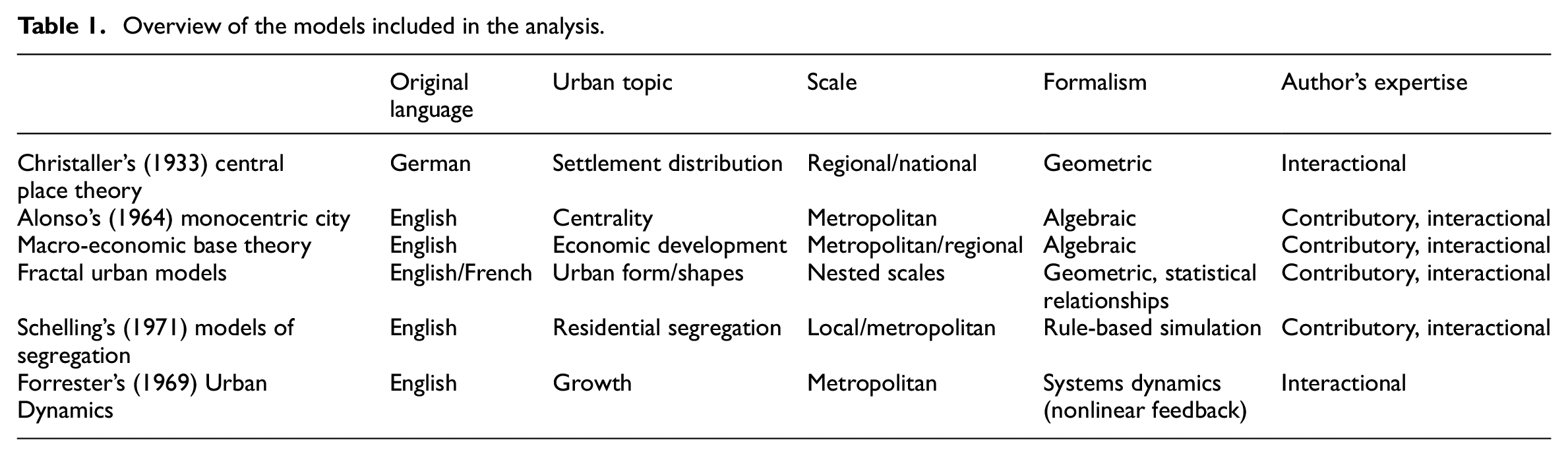
As shown in Table 1, our final selection covers a diversity of urban dimensions: from urban morphology to economic activity and from spatial allocation to urban growth and dynamics. Models range from the local to the national scale, with the special case of fractal models that cover multiple scales simultaneously by definition. Although many models are algebraic, geometric and rule-based formalisms are also represented.
Overview of the models included in the analysis.
We analysed these models along four lines:
1. The model overview, including its aim, components and mechanisms.
2. The biography of the model creator(s), intermediaries and the model itself, following the trail of the model’s circulation across languages and disciplinary boundaries as much as possible.
3. The influence it has had on urban studies (i.e. on academic works, through replication, development of the model, adaptation/hybridisation, critique, results’ discussion, etc.).
4. The influence it has had on urban policy (i.e. its application to existing cities, whether implicit or explicit).
For each of these four lines, we provide a table comparing the results for all models. Then, we provide our analysis of one or two models in further detail. For more details, we refer interested readers to the full presentation of each model in the recorded seminars 6 and edited podcasts. 7
Analytical urban model circulation, some results
Model overviews
The model presentations correspond to the models’ components and their main contributions to urban scholarship. Table 2 presents a comparative overview of the diversity of issues/aims addressed by the models selected, along with a description of the main actors and urban features modelled, as well as the main findings from the models. Some models work to answer a clear scientific question (e.g. Can segregation occur in a relatively tolerant society (Schelling)? What is the geographical impact of transportation cost on population density in monocentric cities (Alonso)?); therefore, their findings are easy to relate to the model’s aim. In other cases, the model has the ambition of explaining the larger structural or morphological organisation of urban areas under a descriptive representational framework (e.g. Christaller’s aim of explaining the size, number and spatial distribution of cities) or a looser but more comprehensive focus (e.g. Forrester’s Urban Dynamics model or fractal urban models). Interestingly, this sharpness of focus is not necessarily associated with the level of precision of the actors and urban features modelled. For example, Christaller’s central place theory has a broad aim and a multiscale span with a small number of details on urban actors. Schelling’s models of segregation have a focused aim and also a small number of features, whereas Forrester’s Urban Dynamics is a large, entangled model of urban stocks and flows with a looser aim of simulating an entire city system, similar to fractal urban models, despite the simplicity of their generating principles.
Model presentations.
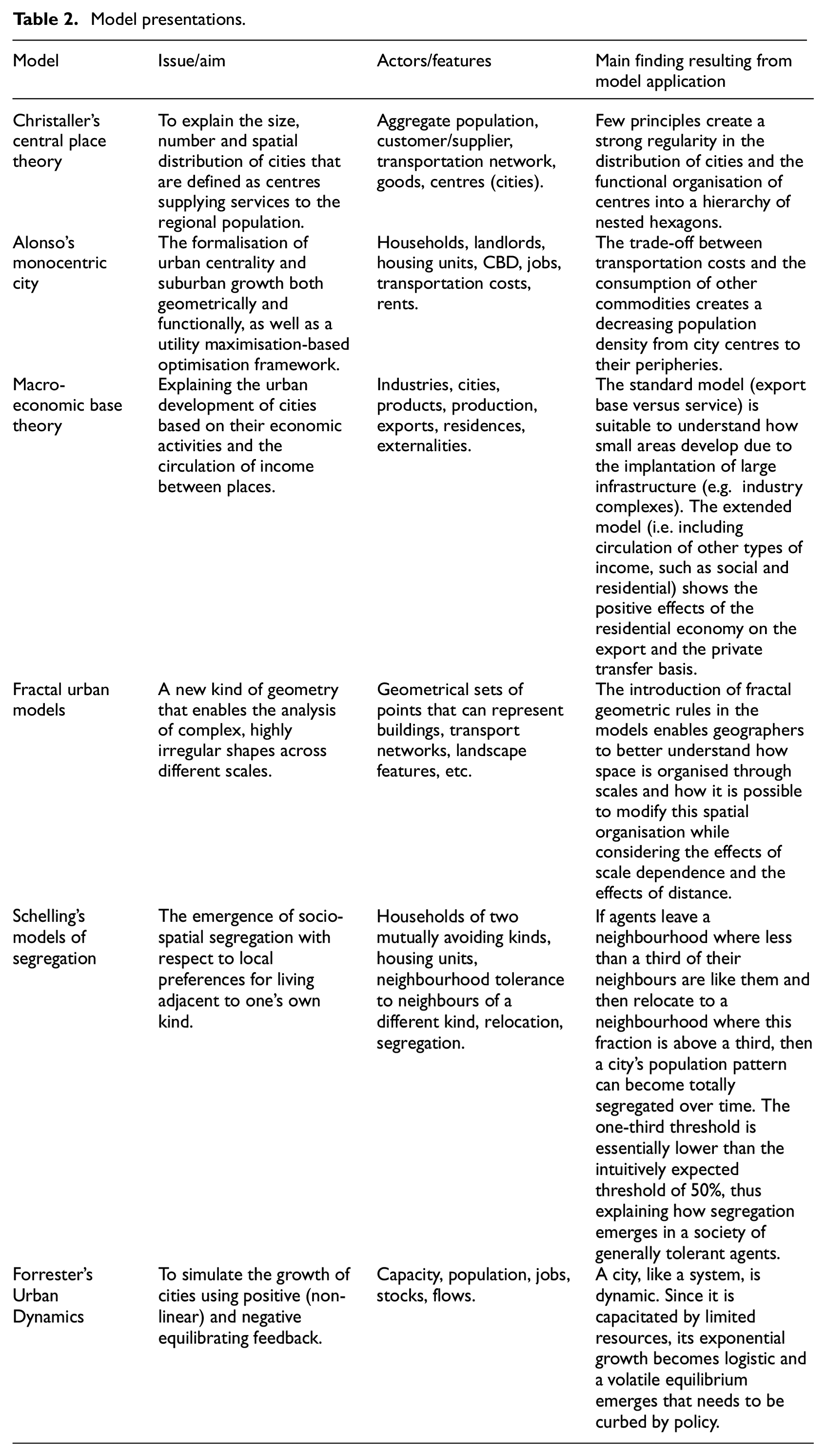
An interesting aspect of model comparison here is the way the models can be summarised. For instance, the monocentric city model of Alonso works in a somewhat deductive manner. There are 13 assumptions on which the model relies (e.g. assumptions about the urban setting, the choices and behaviours of landowners and households, the fixation of rents, the bidding process for housing allocation, etc.). Understanding all the assumptions is central to the understanding of the model but also to assessing its contributions and limitations. Indeed, the main finding of the model (i.e. the concentric gradient of decreasing population density around the central business district) directly derives from framing the trade-off between location and movement as a formal utility maximisation optimisation problem. Solving the equilibrium of this set of assumptions is limited by the context created by these assumptions. In particular, the morphological centrality (the distribution of population density) is derived from the model, whereas the functional centrality (the fact that everyone works in the CBD) is assumed. Thus, the model is limited when it comes to explaining polycentric urban forms. Another crucial remark about this model is that when used for simulating the evolution of the social differences inside a city, it automatically locates the poorest income group close to the urban centre and the well-off populations in the suburban periphery, which is a typical configuration of north-American cities (Lemoy et al., 2010). As such, even a purely mathematical analytical model may be clearly dependent in its formulation on the geographic context of its elaboration (in this case, the United States).
In contrast, each fractal urban model can be summarised very simply by the reference fractal shape(s) or the fractal construction rules used for its development. These reference shapes or geometrical rules are used to assess how urban forms (which are not strictly self-similar but statistically self-similar) relate to these geometrical figures in order to analyse their self-similar properties – particularly their fractal dimensions – or generate fractal urban patterns (typically using randomness).
These different types of presentations reflect the highly heterogeneous nature of the models and their materiality (i.e. the set of documents that compose them). In the first case, the model corresponds to a mathematical deduction from a precise set of assumptions detailed in a unique document (Alonso’s, 1964 book, adapted from his PhD dissertation), but is also part of a much wider set of ideas from urban economics that seek explain the monocentric city. In the second case, the model is an assemblage of ideas about geometry, protocols for measuring mathematical dimensions, generative processes, etc. The other models can be situated in between these two extremes. Furthermore, in the first case, the model is based on explaining behaviour in a system when structure is given, whereas in the second case, explaining structure is the primary aim.
Biographies
The model biographies allow us to track the models back to their origin (whether unique or multiple), provide an account of the geographical, historical and institutional context of their creation and derive some hypotheses regarding the effects of this context on its reception and further circulation. Beyond the difference in contexts and immediate reception (see Table 3), a striking common element in these biographies is the position of the known model creators at the intersection of different disciplinary fields or between the academic and policy worlds. In a way, most of these canonical urban models were achieved using outside-the-box resources and referred expertise. 8 This is evident in the case of Forrester, who started his career as an electrical engineer and ended it by advising the Club of Rome on population sustainability. Schelling’s fame as a political strategist during the Cold War also contrasts with the model for which he is remembered in sociology, geography and complexity science. 9 Moreover, Alonso was trained as an architect, not an economist.
Model biographies.
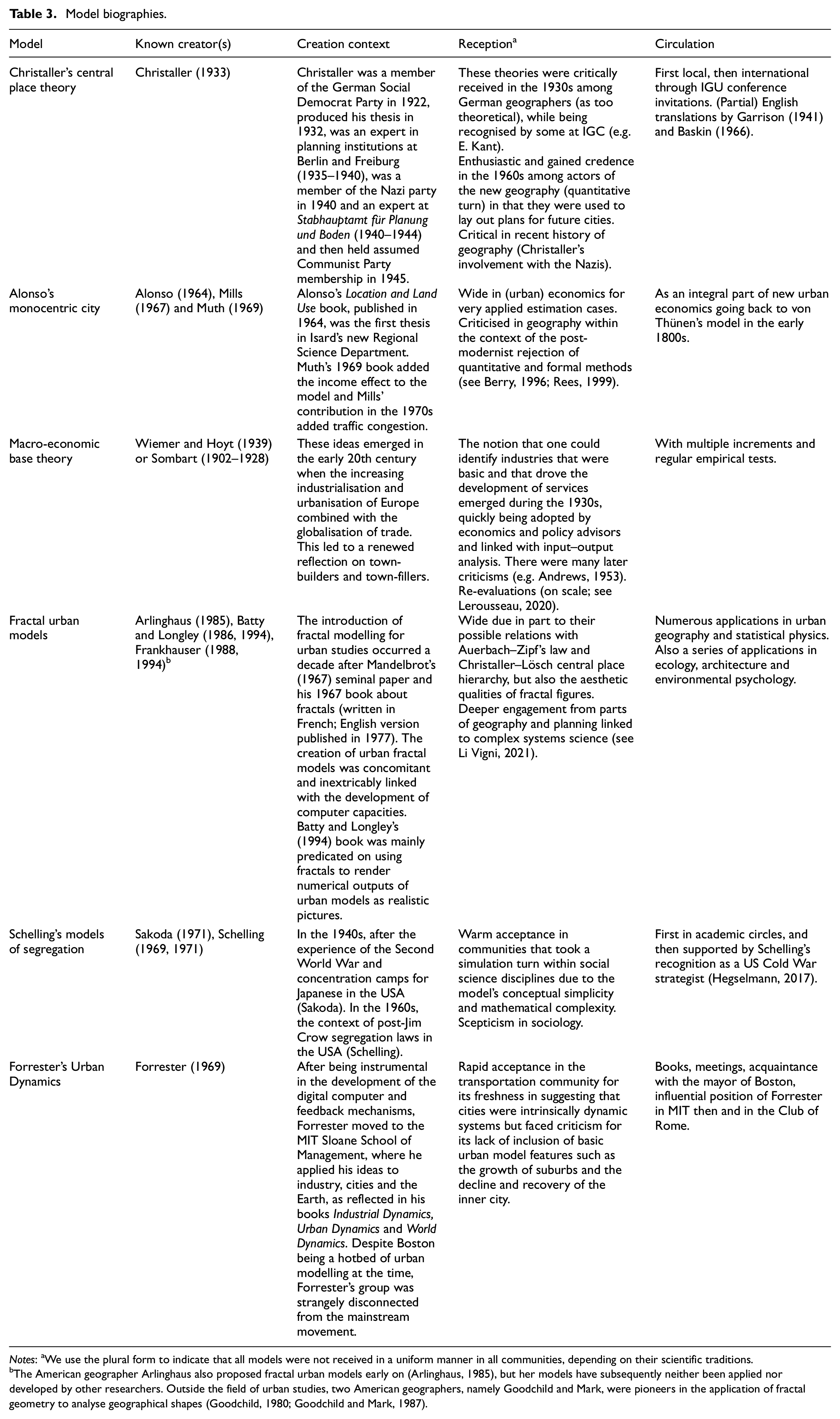
Notes: aWe use the plural form to indicate that all models were not received in a uniform manner in all communities, depending on their scientific traditions.
The American geographer Arlinghaus also proposed fractal urban models early on (Arlinghaus, 1985), but her models have subsequently neither been applied nor developed by other researchers. Outside the field of urban studies, two American geographers, namely Goodchild and Mark, were pioneers in the application of fractal geometry to analyse geographical shapes (Goodchild, 1980; Goodchild and Mark, 1987).
Two models exhibit a particularly interesting biography and circulation history: Christaller’s central place theory and Forrester’s Urban Dynamics.
The history of Christaller’s central place theory is embedded within the larger geopolitical context of the Second World War, denoting the importance of its reception for the potential adoption or rejection of the model by ideologically motivated scholars. Christaller’s model reflects his own fascination with the issue of territorial division and his concern to rationalise spatial planning (Robic, 2001). This was also part of a ‘new utopia of rational planning for social development’ that had emerged in Germany at the end of the 19th century and was enshrined in Weimar legislation and then in that of the Third Reich, which was reflected in the constitutional law of the Federal Republic of Germany, with the continuity of institutions and careers on both sides of the Second World War (Rösslør, 1989). The model was effectively applied for the planning of territories conquered by the Nazis in Europe from 1939 to 1945 and also inspired the settlement locations of the IJsselmeerpolders in the Netherlands (Bosma, 1993, cited by Renes and Piastra, 2011; Sugiura, 2006). Additionally, it inspired the planning of the territories annexed by Israel after 1967 (Tilly, 2005). On the academic side, even if it needs to be contextualised and completed, central place theory is still a reference for describing settlement patterns anywhere or guiding archaeological explorations (Lapin, 2001), despite the political context of its first applications. Indeed, a former member of the Social Democrat Party, Christaller joined the Nazi party in 1940 to work as an expert at the Office for Planning – funded by Himmler – on the spatial structure of the Reich population, before moving on to the Communist Party in 1945 and back to the Social Democrats in 1959 (Hottes, 1981; Hottes et al., 1983; Rössler, 1987; Rösslør, 1989). This aspect of his personal and professional life did not motivate the earlier rejections of his model (which were rather based on his strong theoretical stance against nomothetism in geography), nor its later acceptance by the new generation of theoretical and quantitative geographers in the 1960s (e.g. Berry, 1967), 10 whose influential position in the new quantitative geography field at the time (i.e. on the transatlantic arc of quantitative geographers’ migrations; see Johnston and Sidaway, 2004) provided a platform for Christaller (invited to give the opening plenary of the Lund IGU Symposium in 1960) and his model to diffuse (through the translation of Christaller’s book by Baskin in 1966 or its summary by Ullman in 1941; see Barnes and Roche, 2022).
Similarly, the history and mobility of the Urban Dynamics model are framed by the early years of urban development models in the USA (1965–1972) and by Forrester’s own professional career. Knowledge of the urban development modelling context (in particular Lowry’s land use transportation model and the later family of activity allocation models that build on the Lowry model, particularly in Britain; see Batty, 1976) reveals the extent to which Forrester did not make use of these at all, did not search academic connections with them and did not review, read or even absorb their work. Instead, Forrester produced a completely new model of urban growth 11 based on his background as an electrical engineer, his previous experience of computing during the war (see Barnes, 2008), his implementation of systems dynamics applied to industrial activity (Forrester, 1961) and, more anecdotally, his discussions about cities and urban problems with his acquaintance John F Collins, the mayor of Boston, MA, from 1960 to 1968 (who wrote the foreword to Urban Dynamics). Thus, the development of this model shows how external events (Forrester’s position in the MIT Sloane School of Management in 1956 and his involvement with the influential Club of Rome in the 1970s) shaped the content, formalism and circulation of a model of cities removed from its contemporary counterparts in urban studies, which became the source of its appeal but also the cause for its insufficiency and subsequent abandonment.
Following these models, their creators and some intermediaries thus produced a deeper understanding of the choices behind certain elements of each model under consideration (e.g. the engineering formalism of Urban Dynamics), as well as the contingency of some of their later trajectories of success and controversy (see Central Place Theory).
Influence on urban studies
We can summarise the influence of the models on urban studies in terms of how they made urban scholars evolve in their treatment of the urban features modelled, how they contributed to improving the model or how they changed its use (see Table 4). 12 In doing so, we have categorised the trajectory and influence of the models in urban studies into two options borrowed from the policy transfer and policy mobilities literature:
A ‘transfer’ characterises the trajectory of a model used for replication across other case studies without being significantly transformed during the process. This seems to be the fate of Forrester’s short-lived Urban Dynamics model in urban studies. The model was applied and calibrated to particular case studies, revealing some empirical invalidation (Gray et al., 1972); however, these did not produce hybrid forms of a model incorporating Forrester’s initial formalism into land use transportation interaction (LUTI) models, for instance. 13 Instead, the main influence of Forrester on urban studies seems to have been his focus on the role of time and dynamics more generally in thinking about human systems. Most of the applications – particularly those associated with world dynamics – were based on plausible ‘thought experiments’ rather than focused empirical testing.
In contrast, ‘mobility’ represents back-and-forth trajectories of influence, hybridisation and incremental development. This seems characteristic of the influence of the model(s) behind economic base theory, or of Schelling’s models of segregation, with their multiple implementations and developments. These last two models provide a very interesting story of mobility in urban studies, which we focus on in the following paragraphs.
Model trajectories in urban studies.
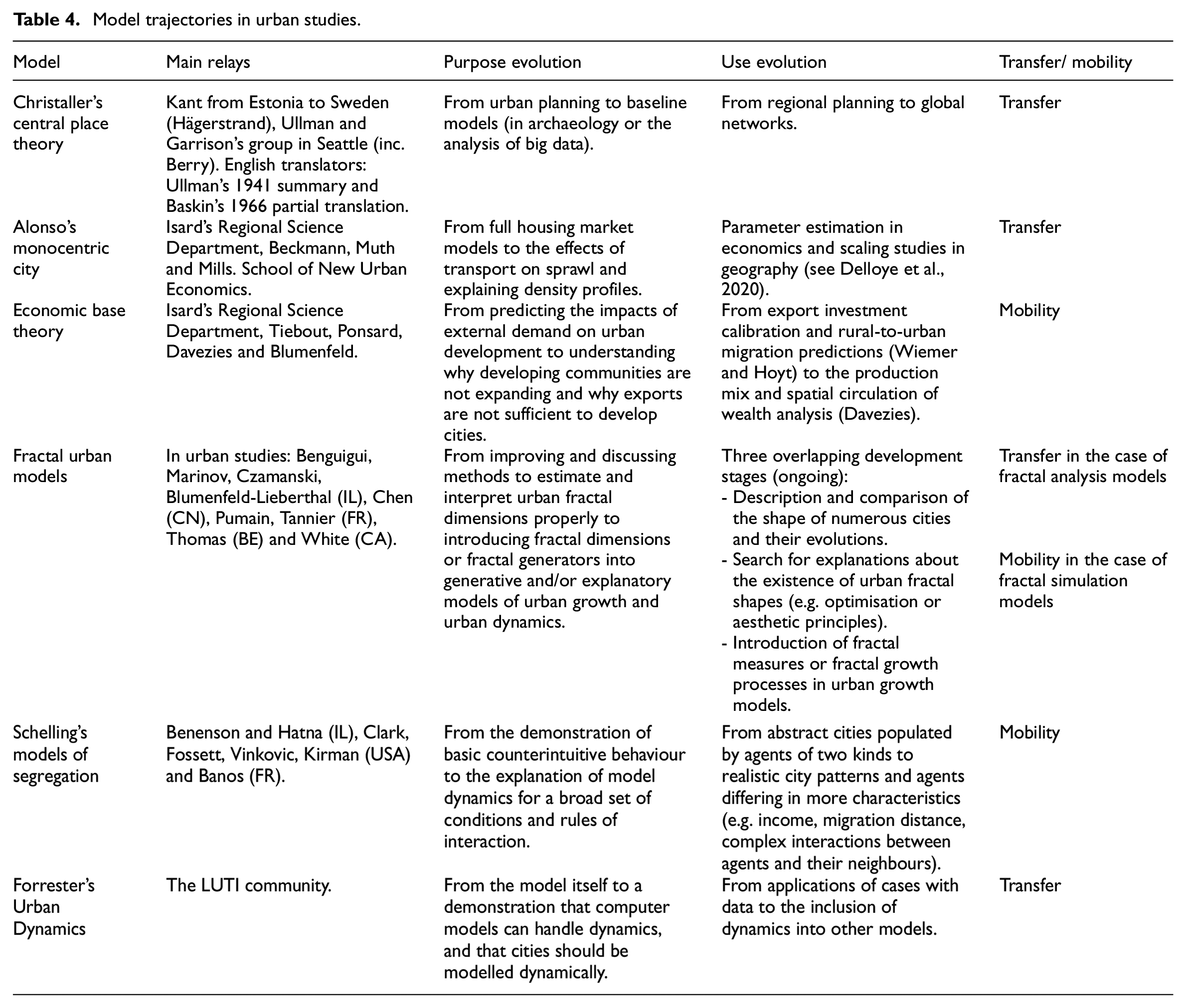
Economic base theory has an unknown origin (with influences traced back to Wiemer and Hoyt, Sombart and Perroux’s growth poles as well as to Tiebout) but has well-documented trajectories of incremental developments that led the model from initially focusing on the impact of external demand on local development to explaining the maintenance and growth of residential local economies without an export base. This included the notable roles of Isard in changing the scale of analysis from one city to a regional focus including inter-city flows, Ponsard in measuring urban export activities at different spatial scales, Tiebout and Davezies in incorporating multiple income flows besides the export base (typically social incomes, national public expenditure and private transfers) and Blumenfeld in identifying the quality of relations between residential supply and export companies.
Schelling’s models of residential segregation were influential in several theoretical and applied aspects. Unexpected self-organising minority–majority dynamics are observed in populations consisting of several groups of unequal size (Benenson and Hatna, 2011), with the further assumption that the agents’ tolerance to strangers within the neighbouring community may be heterogeneous (Hatna and Benenson, 2012, 2015). Clark (2002) introduced a multi-ethnic setting and Benenson et al. (2009) and Spielman and Harrison (2014) introduced an economic component. With all these adaptations, the basic qualitative phenomenon remains the same: a mild level of individual intolerance is sufficient for the emergence of a strong spatially segregated residential pattern. Benenson et al. (2003) applied the Schelling model in the Israeli context, including Jewish–Arab residential segregation in Jaffa, Tel Aviv, while Flint et al. (2012) applied it to residential segregation in the ultraorthodox residential areas of Jerusalem. Grauwin et al. (2009) took up Schelling’s spatial segregation model again and explicitly introduced a variable representing individuals’ allowance for a collective reference. In the case of ‘altruistic’ individuals, the final spatial pattern maximises individuals’ global utility. In the case of ‘selfish’ individuals (no consideration of a collective reference), space takes on a segregated spatial pattern in which individuals, for want of coordination, fail to maximise their utility.
In conclusion, the two aforementioned models have had a double influence on urban studies: they have imprinted scholars’ qualitative intuition about urban dynamics and also generated a versatile quantitative tool to explore a broad variety of real-world scenarios. This material assemblage of theories and actionable tools most likely enhanced their academic circulation.
Influence on urban policy
We can summarise the influence of urban models on urban policy by looking at which policy recommendations can be drawn from the model, whether the model or these recommendations were ever implemented and, if so, whether the experiment directly credited the analytical urban model and how it was evaluated (Table 5).
Model trajectories in urban policy.
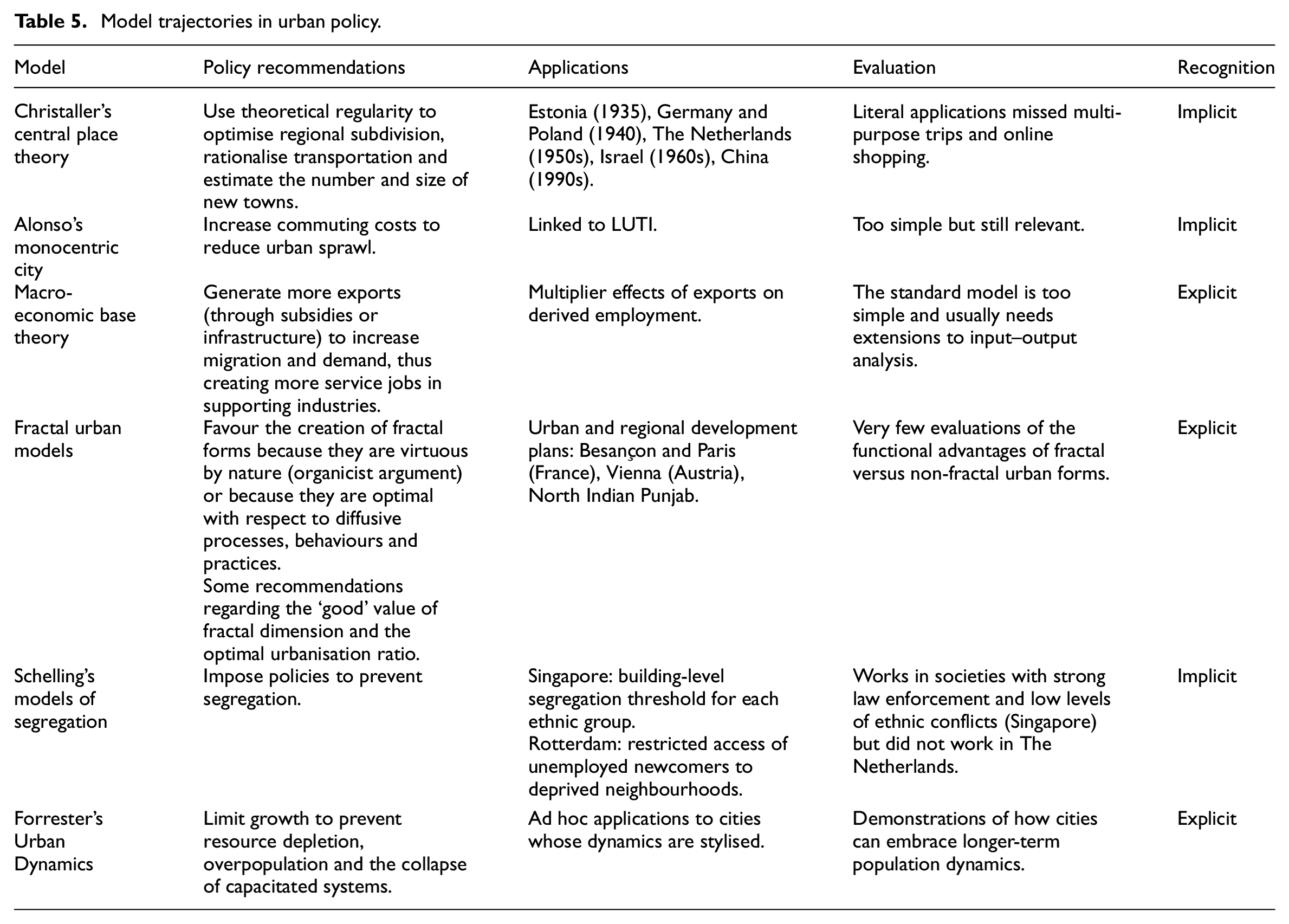
For most models analysed in this article, the recognition of their role in policy is implicit, which means that the original model is not credited per se. Rather, the model informs the theoretical framework of the implemented policy (as in the case of central place theory) or is part of a more applied model (such as Alonso’s model, which is nested or embedded into LUTI and spatial interaction models).
Macroeconomic base theory is an exception here. Derived from policy initiatives and often geared towards applications, it was first applied in the post-war years very explicitly by US city planners – to the extent that as early as 1953, RB Andrews expressed the following warning: It seems fitting to point out that, in the case of urban base theory, we have operated far too long on a set of ideas which appear valid but which, despite substantial conceptual omissions and difficulties of application, seem to be accepted all too blithely as gospel by many researchers and active city planners. (Andrews, 1953: 167)
Fractal urban models are also used explicitly to derive planning principles and design recommendations. Although fractals have provided important (yet dispersed) theoretical insights in the field of planning, an obstacle to their policy application is the fact that notwithstanding what might appear to be top-down designs, fractal principles argue against urban designs and planning interventions that impose pre-defined and large-scale blueprints of forms on city morphologies (Jahanmiri and Parker, 2022). Thus, fractal principles contradict typical urban design practices based on zoning and favouring regular and smooth shapes (Tannier, forthcoming). Moreover, using measures of fractal dimensions, along with measures of density, is not common among urban planners and designers. 14
In general, the influence of the economics-based models analysed on general urban policy is limited, and the more direct the applications of their recommendations, the less favourably their implementations tend to be evaluated. Although there are some very specific applications of models in domains such as urban transport planning, the general experience with such models in applied policymaking is mixed and the impact of simulations on the creation of new policy has been largely negative (Boyce and Williams, 2015).
Structural and contextual factors of circulation
Based on the above descriptive and biographical elements, we can distinguish between two sets of factors favouring the circulation of analytical urban models that have now become ‘canons’. The first set of factors relates to the temporal/spatial/geopolitical context of model production and the personal attributes of the model creator(s) and intermediaries. This reflects the fact that academia, much like the sphere of policy, is a site of power struggles between individuals with various endowments. Having removed these factors, we can highlight a second set of factors facilitating the circulation of analytical urban models, which relate more directly to the form and content of the models themselves.
In terms of contextual factors, the main facilitator (or inhibitor) of model circulation in the models we have analysed seems to be that they originate from English-speaking places and times which were central to the development of the Anglo-American tradition of quantitative urban studies (see Table 1). In short, if the model is described in the English language and comes from scholars employed in American and Western European institutions (e.g. MIT, Harvard, U Penn), it has a better chance of spreading internationally. Analytical urban models presented in other languages will face important barriers to their circulation and adoption, even when they are translated. The case of central place theory is telling in that respect. Being originally written in German, it was initially discussed mostly by German-speaking geographers in Germany, Estonia and later France and the USA. Its international recognition followed Christaller’s presentation at the 1960 Symposium of Urban Geography organised by the IGU Commission in Lund, and its eventual translation into English by Baskin (Christaller and Baskin, 1966), thus producing a delay of three decades between the initial production and full reception of the model. Besides this temporal delay, the translation to English was only partial, leading to unjustified attacks from later readers. For instance, the third part of his thesis, where he discussed its limitations and offers predictions, was omitted in Baskin’s translation, which means it barely existed for English readers (Robic, 2001). Similarly, the translation of Christaller’s thesis into other languages has led to misconceptions, confusion in interpretation and appropriations by scientific and political currents. In French, for instance, Djament and Covindassamy (2005) describe a series of choices behind the translation of Christaller’s main concepts, from his three location principles (Versorgungsprinzip, Verkehrsprinzip and Absonderungsprinzip) to distances (Abstand and Entfernung and). They were transparent and explicit about the options on offer to translate them: direct translations, the reuse of previously translated terms by other authors and conceptual equivalents in contemporary scientific language. In contrast, the 1998 translation to Chinese seems to have involved less transparency and a larger share of ideological interpretation of Christaller’s theory, including a long preface by Zhang Dawei, who was not involved in the translation but situated the work of Christaller in the Chinese planning context (Radeff, 2019).
Another factor influencing the circulation of analytical urban models is the disciplines they originate from. Indeed, analytical models coming from ‘hard’ sciences and disciplines favouring formalisation (e.g. economics, physics, engineering) have higher chances of reaching a large audience and being granted legitimacy in bridging disciplines (e.g. urban geography) than models coming from social sciences (even from urban studies themselves). However, we also found that polymaths are particularly successful in creating and circulating such models, in part because they can play on different sources of legitimacy and expertise. They might also understand better the common problems faced by various disciplines. 15 All of the known/recognised creators of the models presented are male, which reflects the gender imbalance of academic power of the past decades (and sometimes also the appropriation of women’s work by prominent male figures). Finally, although the policy mobilities research has shown the importance of institutional labelling/anointment in urban policy success (Béal et al., 2015; Peck and Theodore, 2010), its equivalent for analytical models is less obvious. Indeed, although the scientific practice of urban modelling is less dependent on institutional labels (however, it can be boosted by a creator or intermediaries affiliated with prestigious universities and inclusion in disciplinary textbooks), it may be more subject to data availability and path dependency in the way some urban features are modelled. For example, how Forrester’s Urban Dynamics has circulated amongst different domains is primarily due to his novel way of considering time and evolution in urban development models at a time when most urban modellers were still using equilibrium static models out of habit and data restriction rather than out of holding the scientific conviction that it was the most suitable approach. Finally, we must acknowledge that the models that have found an audience in urban studies and the policy sphere reflect, match with and contribute to the geopolitical zeitgeist of their time, which is exemplified by the capitalist assumptions and cost-benefit optimisation rationale of monocentric city models. 16
In addition to these contextual elements, we have identified a series of circulation-enhancing factors more directly linked to the model’s content. The first one is the model’s simplicity and a clear focus on the basic phenomena. For instance, Schelling’s models of segregation focus on the spatial clustering of similar individuals as a result of a simple mechanism of intolerance-induced moves. The simplicity and generality of the model thus derive from its limited representation of the process modelled in pursuit of a clear goal: showing that the simple individual-level mechanism (micro-motives) is sufficient to generate the population-level outcome of spatial segregation (macro-behaviour) (Schelling, 1978). A second factor increasing the mobility of analytical urban models is the transparency of the hypothesis modelled. Unlike urban policy and its material forms of political discourse and programmatic documents, the models we have presented most often include a mathematical or diagrammatic representation of the hypothesis (e.g. Alonso’s monocentric city model) that is detailed and justified in the text to reduce ambiguity. This facilitates the process of scientific legitimation, replication and inclusion of such models as building blocks of subsequent larger models. A third favouring factor linked to the first two is that of transportability, which relates to their relevance and applicability to other case studies, sites, issues or disciplines from the original one, – this inter-disciplinary mobility being part of the circulation idea (see Temenos and Baker, 2015). Transportability can come from a common ‘need’ of modellers in various urban fields (i.e. explaining specialisation, centrality or polarisation), which can be adapted to transportation, economic planning or urbanisation models. In that case, being a polymath modeller is useful. Transportability can also come from the form in which the model is circulated. The beautiful aesthetics of fractals have played no small role in the scientific fascination surrounding them (Tannier, 2018). The presence of maps and graphics might also be the difference between the success of central place theory and its lesser known prior formulation by Reynaud in the 19th century, using text only (Robic, 1993). In the case of models represented in mathematical form, the formal language can work both ways: it can soothe differences and facilitate circulation among academic circles, but it can also create barriers in less mathematically literate worlds, such as the urban policy and planning spheres. Thus, the presentation of the model can hinder its adoption and circulation if its mathematics is beyond those who would be the key recipients of its practice, while too simple a presentation might suggest that the model is naïve.
Conclusion
In this article, we have addressed a gap in the literature on urban models’ circulation by questioning the specificity of analytical urban models compared to urban policy models, using the theoretical framework and methodological tools of the policy mobilities debate. Starting from the hypothesis that contextual elements serve roles in the production and circulation of analytical urban models as they do in normative urban models, we have shown by example that such contingent elements of context can be identified (e.g. their institutional origin, geopolitical context, language, etc.) and distinguished from factors relating to models’ content in their influence on the design and circulation of analytical urban models by following the models, their creators and intermediaries. We were able to uncover factors of unequal circulation common to urban policy’s unequal mobility, such as power relations in the institutional context of their assemblage and aspects of their materiality (the presence of graphics, equations, etc.), or the importance of travelling actors for knowledge in transit (Secord, 2004). In contrast, institutional anointment of the model itself seems less important to their circulation than path dependency and transportability for analytical urban models (although the institutional affiliation of its authors and intermediaries matter). We can thus conclude that the theoretical framework of the policy mobilities research is fruitful in analysing this type of urban model, with some modifications to account for differences in the nature, goals and behaviours of the actors involved in the circulation.
The circulation of (canonical) urban models remains ongoing. Most of the models presented are used as parts of other models (LUTI, ABMs, etc.), transformed and adapted to new uses. Notably, they have become incremental parts of the wider toolbox of urban modelling (Cottineau et al., 2019). To be useful and meaningful in the future, the canonical analytical urban models should remain transparent about where they come from and why they include a particular set of hypotheses, actors and features. Keeping this information attached to the models (as metadata) is crucial, and this work has attempted to contribute in this manner. This is especially important for canonical models because they tend to be chosen and used out of habit, ease and past dependency, even when new models, representations and ideas are needed (e.g. for urban policies; see McCann, 2011).
Footnotes
Acknowledgements
The authors wish to thank Ali Sobhani for his contribution to the early days of the Unforeseen Influence seminar series. They are grateful to all those who attended and contributed to the Unforeseen Influence seminars, where individual model circulations were presented, as well as the participants of external seminars, where earlier versions of this work were presented (CASA-UCL, LISER). They thank Nicolas Szende and two anonymous reviewers for their critical discussions and suggestions on the manuscript.
Declaration of conflicting interests
The author(s) declared no potential conflicts of interest with respect to the research, authorship, and/or publication of this article.
Funding
The author(s) disclosed receipt of the following financial support for the research, authorship, and/or publication of this article: Clémentine Cottineau and Rūta Ubarevičienė are grateful to the Department of Urbanism at TU Delft for its funding of the seminar series and podcast production costs. Clémentine Cottineau acknowledges funding by the ERC Starting Grant 101039455 SEGUE.
