




Abstract
Populism is multilayered and involves two main dimensions – ideology and strategy – which are employed within and beyond political parties. These dimensions can result in sometimes overlapping but generally divergent backlashes, targeting specific climate and sustainability interventions in cities. This critical commentary presents episodic populist backlashes against urban climate actions by exploring how they create their own political landscapes across the political spectrum in cities against progressive urban climate agendas. Specifically, the article examines how episodic populist backlashes manifest on an urban scale and highlights the need for urban scholars to pay more attention to the phenomenon. The article proposes two complementary explanations for why populism precedes urban climate actions in episodic and thematic ways. These explanations include policy backlashes against diffused global climate norms in cities, and counter-movements and rhetoric against climate justice and what it entails, such as inclusion in decision-making and intersectionality. The article then concludes by offering a research agenda on the episodic populist backlashes against urban climate actions, which highlights the need for a better understanding of how episodic populist movements might emerge into global climate policy diffusion, and climate justice coupled with intersectionality in cities of the Global North and Global South.
Introduction
Cities must adapt to address the dynamic challenges posed by climate change. Many of them have already demonstrated proactive leadership by pledging their commitment, specifically to the Paris Agreement, to adapt critical urban sectors to achieve 1.5°C pathways. Certain progressive cities are now engaging in decarbonisation efforts to modestly reduce emissions in their operations, facilitated by strategic investments in ICT-led smart city infrastructure systems, which include mass transit, electric vehicles and energy-efficient and sustainable buildings. Many cities in the Global North have undertaken rapid climate measures, ranging from the prohibition of diesel cars within the city centres to tackling extreme heat emergencies (Otteni and Weisskircher, 2022; Yazar, 2023).
At the same time, there are concerns about the growing opposition to these climate and sustainability initiatives and policies, called the backlash. Backlashes have been explained as escalating negative feedback (Patashnik, 2019) or contentious politics (Alter and Zürn, 2020) affecting political dynamics and policy outcomes (Patterson, 2023; Yazar et al., 2023). Some backlashes are embodied, especially within wind infrastructures, and include Indigenous communities and their pursuit of procedural justice in green energy decision-making, pushing policymakers to respect democratic values and supporting local participation (Scheidel et al., 2020). While backlashes are still early in development and fragmented (Patterson, 2023), the scant empirical work documenting such developments in the cities of the Global North indicates that political oppositions to the local climate actions are rising over time (Fainstein and Novy, 2023; Förtner et al., 2021; Mullis, 2021). Opposition to urban climate actions may manifest as populist ideology backlashes, either stemming from populist political parties and their actors who advocate climate change denial and oppose related measures, or as a populist strategy employed within the framework of a single-issue local party structure.
Such backlash politics heavily derive from the traditional and long-standing far-right parties in Europe, using populist ideology to generate anti-climate rhetoric. An example of a far-right populist party backlash is evident in the case of the Alternative for Germany (AfD). The party advocates for the greater use of diesel cars and linking the core populist ideology (e.g. diesel bans are elitist projects against the people) by organising or affiliating with local protest movements opposing diesel ban in the city centres of Cologne, Düsseldorf and Aachen (Eichenauer et al., 2018; Otteni and Weisskircher, 2022; Weisskircher, 2020). One-issue parties or episodic populist political movements are also increasingly fuelling populism strategically to advance their own power and interests against local climate and sustainability measures in the cities of the Global North. The People’s Party (FNB) – a single-issue local party in Norway known as the People’s Action – No to More Road Tolls, serves as a notable example illustrating populism as a strategic approach. Ongoing political tensions revolve around the Light Rail Project and the road tolls designed to fund public transportation and alleviate traffic in Bergen, Norway. The FNB employs a slogan ‘a city for all of us’ and emphasises a dedication to social inclusion within its party programme while advocating for the abolishment of road tolls (Remme et al., 2022). However, despite this form of populism as a political strategy that seemingly supports social inclusivity, it becomes evident that the policies advanced by the party favour affluent households and suburban car drivers.
Furthermore, the occurrence of episodic populist backlashes against local climate actions is also particularly relevant not only because of local climate and sustainability measures, but also due to cities’ historical significance as sites for safeguarding liberal values through social movements. Climate activism, as a political act, has been carried out to advocate recognition of vulnerable groups and communities seeking procedural justice in local climate action decision-making by embracing epistemological pluralism (Mikulewicz et al., 2023; York and Yazar, 2022). Consequently, there has been a notable rise in the potency of populist backlashes, targeting these social oppositions demanding recognition and justice. The activists’ calls for climate emergency in the cities of Arizona, for instance, are being actively thwarted by an increasingly radicalised Republican Party, neglecting Latino and African American community organisations in public hearings and decision making both at local and state levels (Yazar, 2023). Such downsides highlight that the practice of democracy at the local levels is under threat and climate change policy is one of the most important victims of this situation – along with other issues such as tax policy, gun control and abortion.
Considering these two populist phenomena, namely populism as ideology and populism as political strategy, embodied against urban climate policies and measures, as well as democratic participation, this critical commentary contributes to the literature on populism and backlash politics by introducing a comprehensive framework, which aims to enhance our understanding of the escalating episodic populist backlashes observed in urban contexts, thereby offering avenues for further investigation and analyses in the cities, globally.
Populism: Straddling ideology and political strategy amid urban climate measures
Climate change is a valence issue, meaning it is widely recognised as a societal issue, even when there is a conflict on the most suitable measures and actions how to tackle it (Fraune and Knodt, 2018). The alignment to achieve the Paris Agreement, from fossil phase out in energy production to urban climate measures, escalates populist parties and movements to develop anti-climate rhetoric. Populism is both an ideology and a political strategy and is used by myriad political parties ranging from the far right to the radical left. Its advocates perceive populism as a simplistic ideology that sets politicians and experts (i.e. elites) against ordinary people (Ivarsflaten et al., 2020; Mudde, 2010, Mudde and Kaltwasser, 2018), many of whom construct narratives around the perceived loss of control or values (Decker and Lewandowsky, 2017) and assert that popular sovereignty cannot be violated (Mudde and Rovira Kaltwasser, 2018; Rancière, 2016).
Ideology-based populism is an integral aspect found within both far-right and radical-left political ideologies, particularly concerning environmental resource extraction, and co-opt emancipatory concepts such as sustainability and anti-extractivism to further strengthen marginalisation, oppression and authoritarian rule from national to urban levels (for the intersection between political ecology and populism, see Atkins and Menga, 2022; McCarthy, 2019; Menga, 2022; Scoones et al., 2018). The ideology-based populism against climate change is embodied as post-truth politics in populist political party agendas (Selk and Sonnicksen, 2017). Post-truth politics sparks backlash by questioning science and expertise surrounding climate change debates and related policy measures and actions, employing emotional appeals to influence public opinion and policy outcomes (Fischer, 2019). Such post-truth politics is embodied within ideology-based populism, positioning climate change as a ‘value issue’ against a ‘valence issue’ (Lockwood, 2018). Hence, ideology-based populism takes place as meaning-making through value-based rhetoric, navigating shifts in climate change from the realm of rational scientific debate to the domain of ethno-nationalist ideology and myths (Forchtner, 2019). Thus, a key element of populist ideology reinterprets policy measures and actions related to climate change, incorporating it into core populist narratives.
The populist ideology tactics, targeting European regions undergoing energy transitions, aim to divert attention from climate measures by associating them with issues other than the climate change. These tactics employ rhetoric suggesting real threats from specific ethno-racial groups due to immigration, and progressive EU social policies (e.g. same-sex marriage). They claim that such threats seek to dismantle family values and strangle national sovereignty (Yazar and Haarstad, 2023). Urban scholars have also examined far-right populism in cities and the potential effects of its electoral geographies on urban policies (van Gent et al., 2014) and planning (Fainstein and Novy, 2023); and they raised concerns about oversimplifying the political landscape by relying on a simplistic rural–urban dichotomy (Fainstein and Novy, 2023; Förtner et al., 2021; Mullis, 2021). The rise of the Alternative for Germany (AfD) and its increasing support, particularly in the East German cities following the local elections in 2023, reveals its populist ideology rhetoric against clean energy and immigration is among the primary reasons for the party’s high voter turnout there (Hans-Böckler-Stiftung, 2023).
Populism is also a political strategy which can be defined as a way of doing politics (Canovan, 1999; Knight, 1998) entailing a discursive approach to certain thematic issues. Many studies have documented how neo-populism has interconnected social and identity movements amid a wave of global sentiment (Hoover, 2021) claiming that the changes introduced from outside (e.g. the European Green Deal and the Paris Agreement) have resulted in the sacrifice of livelihoods. Against this backdrop, populist backlashes emerge not only from the traditional and long-standing populist far right and radical left, but also from populist movements somewhere between these two ends of the political landscape as exemplified by the Yellow Vest Movement in France, the Farmer-Citizen Movement in the Netherlands, and the People’s Action – No to More Road Tolls in Norway. These are just a few instances of the newly emerging actors orchestrating contention against specific climate measures (e.g. demand-side policy) within a given national, regional or urban context.
Furthermore, these episodic populist movements acknowledge climate change but employ populism as a political strategy. Unlike the scope of value issues employed in populist ideology, such as targeting specific ethno-racial or gender groups or denying the reality of climate change, populism as a political strategy generates rhetoric against specific climate measures. The manifestation of such populist claims in urban contexts is evident in the critique of a green or sustainable city. These episodic populist movements highlight the contrast between sustainable models focusing on the urban lifestyles within environmentally conscious city-centres and the dispersed suburban populations heavily reliant on cars, as seen in the cities of Norway (Haarstad et al., 2023; Remme et al., 2022). Populist reactions akin to those seen in the US are evident even in liberal cities and among Democrat party voters who perceive neglect in the implementation of light-rail projects extending into their affluent neighbourhoods. This sentiment arises from concerns about mainstream sustainability and climate-oriented urban policies that potentially jeopardise private properties (Einstein et al., 2020; Fainstein and Novy, 2023).
Such episodic populist strategies may resonate with their local supporters and create a sense of unity and urgency around their cause against local climate measures, but they also juxtapose with social movements demanding progressive climate measures. These measures span from infrastructural adaptation (e.g. access to affordable mobility) to including diverse voices and preferences in urban governance structures and decision-making processes. Activists and community organisations advocate for climate justice through the inclusion and recognition of various perspectives and knowledge from local communities and stakeholders to better understand and manage urban systems (Bulkeley, 2021; Long and Rice, 2019; Robin and Broto, 2021). Consequently, the strategic use of populism through fuelling populist narratives against specific urban climate measures is in limbo with groups advocating for climate justice and related initiatives like Fridays for Future.
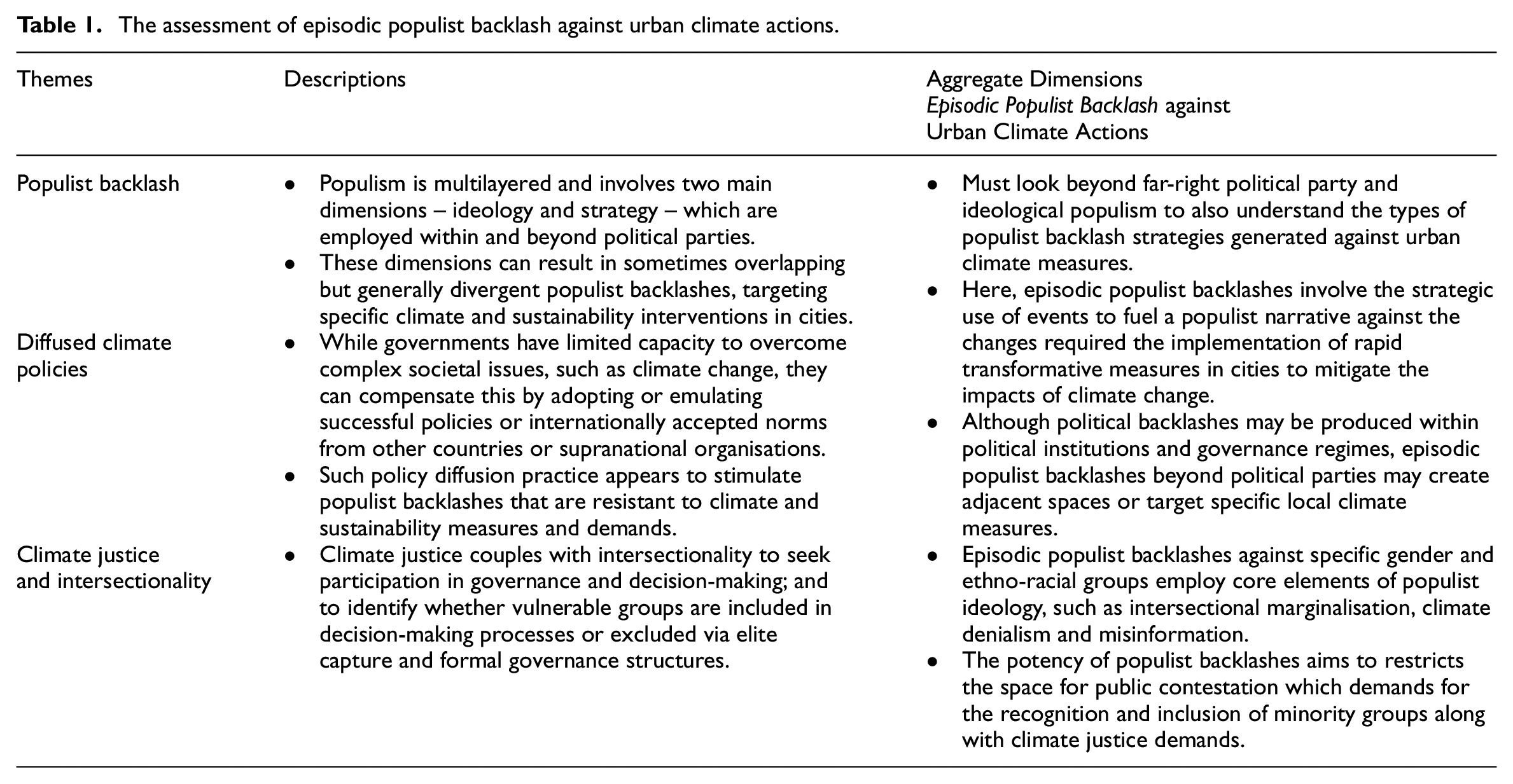
Specifically, the two dimensions of populism, ideology and political strategy, can result in sometimes overlapping but generally divergent backlash and rhetoric, targeting specific climate and sustainability interventions in cities. Hence, the next two sections will focus on two emerging backlashes, embodied within either populist ideology or political strategy, against urban climate actions. The first pertains to backlashes against diffused climate and sustainability policies in which local governments mobilise and adopt these norms in their local context. The second is backlashes against climate justice movements and what it entails (e.g. inclusion in decision-making and intersectionality) (see Table 1 for the assessment of episodic populist backlash against urban climate actions). These two phenomena warrant further attention, leading to the proposal that urban scholars explore further the underlying reasons behind why and how episodic and thematic populist backlashes against urban climate actions take place.
The assessment of episodic populist backlash against urban climate actions.
Populist backlashes against diffused climate policies in cities
Climate and sustainability policies and actions emerge as results of negotiations and commitments, having taken place on local and international levels. While governments have limited capacity to overcome complex societal issues, such as climate change, they can compensate this by adopting or emulating successful policies or internationally accepted norms from other countries or supranational organisations, a practice known as ‘policy diffusion’ (Simon Rosenthal et al., 2015). Policy diffusion is not a straightforward process and carries with it political strains. For instance, there was an increase in climate policy adoption after Donald Trump’s election, especially in the Democratic states across the US (Bromley-Trujillo and Holman, 2020). In addition, local governments in Turkey also took up climate actions to fill the void left by the national government with respect to domesticating internationally accepted climate norms (Yazar et al., 2023).
Human geographers have shown how some urban sustainability policies, either set at the international level or seen as successful in a particular local context, are mobilised by political elites, and supported by corporate interests operating within networks spanning and surpassing the territorial borders of states (McCann and Ward, 2012; Peck and Theodore, 2012). This body of work in the policy mobility literature underlines that policy diffusion is inherently a political process (Temenos and McCann, 2013: 346). Although the scholarly attention on the political tensions stirred up by global climate policy diffusion in the adopted national or local contexts has been limited, Patterson (2023) argues that the changes introduced by such diffusion can lead to ‘policy backlashes’ when embracing these climate norms entails changing the policy status quo and sizable protests and elite-led countermobilisations ensue.
The populist narratives against climate measures among European countries, for instance, is commonly attributed to phasing out fossil fuel in energy production, following the European Union’s climate neutral agenda by 2050 – an economy with net-zero greenhouse gas emissions. The ambitious commitment requires significant transformations of energy systems and large expansion of renewable energy sources, but also increases the valid concerns, such as unemployment, depopulation and economic loss, of many locals living in these regions. All these concerns are already being materialised in far-right populist parties’ agendas, especially in Germany, Estonia and Poland. Far-right populist parties in these countries have intensified their backlash politics as a form of contention to delay regional decarbonisation actions by positioning energy transition as an attack on historical traditions, regional identity and above all, the traditional family (Yazar and Haarstad, 2023).
Such thematic and episodic backlashes against local climate measures are not only embodied within well-established right-wing parties (using populism as ideology) as illustrated in Europe. Rather, there are also newly emerging single-issue thematic movements against these globally inspired climate and sustainability-related urban initiatives. The Net Zero Scrutiny Group, for instance, comprising conservative members of the UK parliament, stands in opposition to several of the government’s net-zero policies. The Group largely stands against the Ultra-Low Emission Zone (ULEZ) across the cities of the UK, claiming that ban on diesel cars in the city centres, and requiring energy efficiency regulations in buildings adversely affects the most vulnerable, and contributes to the current cost-of-living crisis (DeSmog, 2023). This position is reinforced by its argument that the current infrastructure of the city predominantly caters to elites, specifically locals residing in the city centre. Locals in the liberal cities of Branford (California) and Cambridge (Massachusetts) have reacted with similar ire against mixed urban development and light-rail projects, with many turning to populist grassroots movements that cite concerns over environmental initiatives and intervention in private property rights (Einstein et al., 2020). Fainstein and Novy (2023) argue that these populist uprisings across the US political spectrum share the perspective that planners are elites and do not represent the people.
Populist backlashes against climate justice and intersectionality in cities
Scholars raise concerns by stating that intersectionality (e.g. indigeneity, between genders and specific ethno-racial groups) must be at the core of urban climate justice and critical urban studies. They call for more empirical work to be done in the cities, globally (McArdle, 2021; Robin and Broto, 2021). Intersectional decolonial environmental justice, including socio-ecological and climate justice, expands environmental justice scholarship. It delves into radical imaginaries that focus on social movements for environmental justice that are relational, connected to place and space and challenge local-to-global power asymmetries (Álvarez and Coolsaet, 2020; York and Yazar, 2022). Consequently, the integration of intersectionality within climate justice movements recognises the reproduction of injustices and the potential co-option within governance decision-making, especially concerning historically marginalised communities and identities. Activists, in response, advocate for prompt measures from their national and local governments to contribute to the climate mitigation and adaptation efforts globally.
Grassroots organisations in Greater Los Angeles present a vivid example of how climate justice activism significantly influences environmental agenda setting and policy actions, especially for vulnerable Latino and Black communities in city planning and waste management, through civic epistemologies (Méndez, 2020). Another recent example is Klimakleber, an activist group from the Letzte Generation (Last Generation) which has gained attention for their unique protest tactic of glueing themselves to streets in various German cities. Their protests deliberately take place on busy roads, causing major traffic disruptions to raise awareness and exert public pressure on governments to strengthen their policies addressing climate change (Hummer, 2023). The mayors of progressive German cities including Hannover, Tübingen, Marburg and Greifswald supported the activists’ incentives and wrote a letter to the parliamentary group demanding the establishment of a society council ‘Bürgerinnenrat’, and more vigorous efforts with regard to climate change policies to fulfil the promises made by the German government under the Paris Climate Agreement in 2015 (Pascal, 2023; Scharlodde, 2023).
The occurrence of episodic populist backlashes against progressive urban climate policy and actions is particularly emerging against the social oppositions illustrated above, spanning from civic epistemologies derived from Latino and Black community organisations to other groups advocating for climate justice and related initiatives like Fridays for Future. Consequently, there has been a notable rise in the potency of populist backlashes’ aim to restrict the space for public contestation which demands the recognition and inclusion of minority groups along with climate justice demands. These populist backlashes, manifesting as episodic and thematic, serve as counter movements, reflect a genuine rejection of cosmopolitan and egalitarian values, using populist ideology to generate anti-climate rhetoric targeting minority rights. Supra-local networks also play a pivotal role in orchestrating local energy transition planning processes by praising specific gender and racial groups. These networks either advance certain industry objectives, such as the support of ‘petro-masculinities’ (to understand better how fossil fuels are associated with authoritarian practices involving male-dominated sectors, see Daggett, 2018), or thwart urban governance regimes from being more inclusive and just.
The Tea Party, for instance, which is a loosely affiliated cohort of ideologically motivated Republican Party activists, is engaged in various urban planning activities heavily backlashing against the smart city concept and urban sustainability, among other trends (Flint, 2011). The movement, which was supported by both social conservatives and libertarians (Skocpol and Williamson, 2016), labelled the UN Sustainable Agenda 21 as ‘totalitarian’. In addition, researchers argue that following the party’s support for Trump, the former US president invoked concerns about ‘forced suburban integration and its threat to white home-owners, indicating his support for local exclusionary measures’ (Fainstein and Novy, 2023: 11). These examples illustrate how populist ideology shapes a political landscape with flexible and blurred boundaries between political parties and movements, giving rise to nativist and patriarchal perspectives (e.g. protecting a specific racial or gender groups) through specific urban sustainability and climate agendas.
Social oppositions embodied in climate justice activism have also incited backlashes led and fostered by episodic populist movements. These populist movements span from organising protests to spreading misinformation – in response to collective actions inspired by climate justice movements in urban contexts. For example, discursive tactics like media campaigns and anti-clean energy protests (Fraune and Knodt, 2018; Sovacool et al., 2022; van Berlo and Natorski, 2020) have been used by populist parties across the political spectrum to influence climate policy and energy transition processes, actions and decisions. The anti-offshore wind group, Green Oceans, a citizens group located in Rhode Island (US), constructs its claims using misinformation tactics, including fake experts, conspiracy theories and climate denialism, all in order to delay offshore wind investment decisions and action processes (The Climate and Development Lab, 2023), a method commonly referred to as ‘obstruction’ (Edwards et al., 2023; Ekberg et al., 2022).
Diffused climate policies and climate justice movements coupled with inclusivity and recognition of certain intersectionality in decision-making appear to stimulate a populist political landscapes that is resistant to climate and sustainability measures and demands. Although the diverse roles played by far-right political parties at national levels is known, this critical commentary offers avenues for further investigation and analysis, as detailed below, to enhance our understanding of episodic and thematic populist backlashes against climate-change-related measures observed in cities.
Research agenda on the episodic populist backlashes against urban climate actions
Based on the two dimensions of populism, namely its manifestation as an ideology and as a political strategy (see Figure 1 below) and focusing on how they are embodied within climate policy backlashes and climate justice including what it entails, several avenues for future research are proposed.
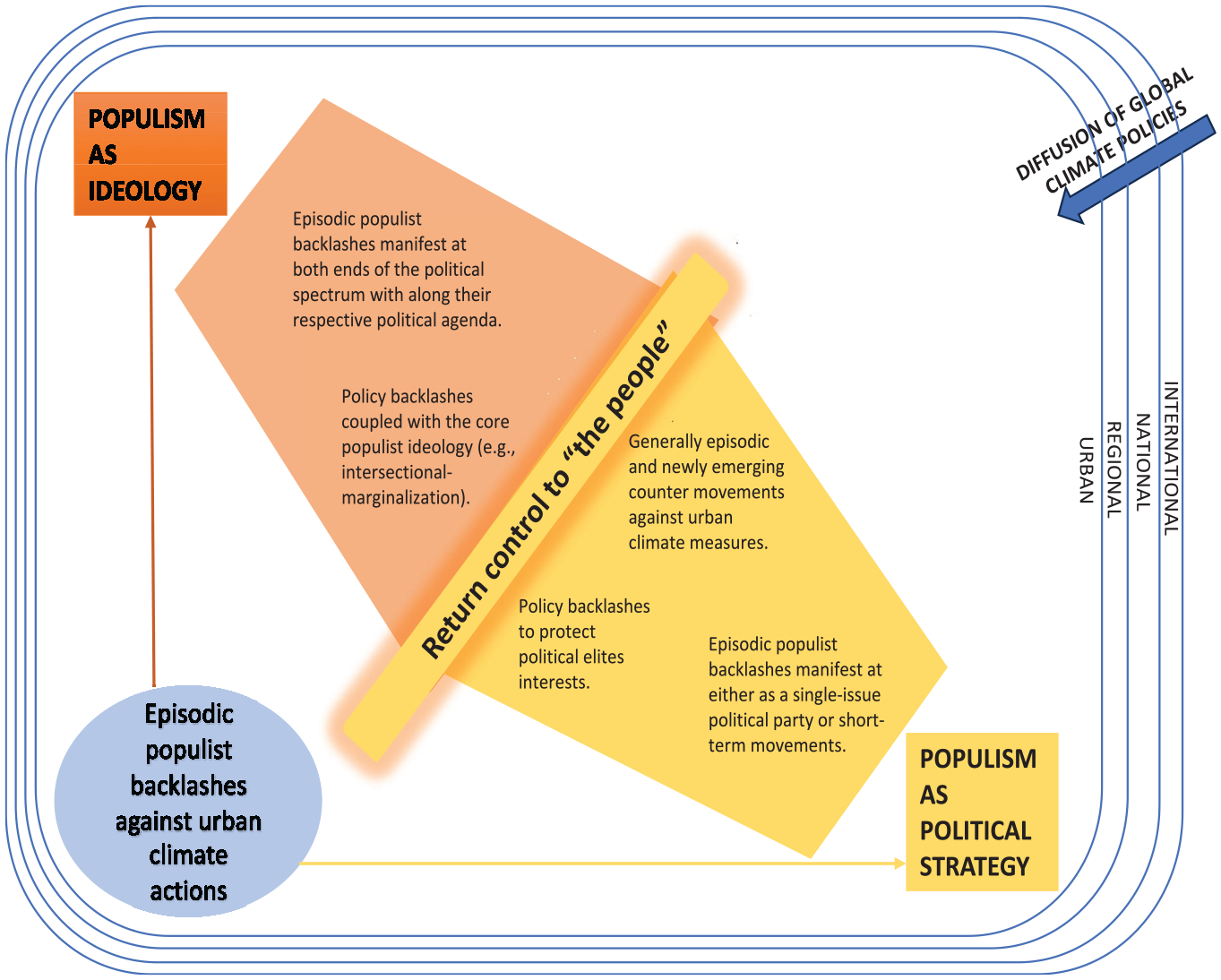
Episodic populist backlashes against urban climate actions.
What are the differences and commonalities of populist rhetoric as ideology and as political strategy?
While there is growing research on populism and climate change, less focus is afforded to what extent populism as ideology differs from populism as political strategy when it comes to generating rhetoric against local climate actions to gain public support. As illustrated in Figure 1, the core of the ‘the people’ versus ‘the elites’ argument (or a supposed return of control to the people) is being used both by episodic populist movements and/or single-issue parties, as well as by the populist parties that originate from the opposite ends of the political spectrum. On the other hand, episodic populist backlashes against urban climate measures that manifest across the political landscape employ core elements of populist ideology (e.g. intersectional marginalisation, climate denialism and misinformation), by claiming that progressive European social policies are the most significant threat to society, and not climate change. Populism, which can be used as a political strategy by a single-issue party (such as in the road toll case in Norwegian cities) or as counter-movements (such as anti-light-rail projects in wealthy neighbourhoods in liberal US cities) does not use the same rhetoric in every case. Future research must identify what specific rhetoric can be instrumentalised for episodic populist backlashes that manifest either as a single-issue party or short-term movements against climate actions in the cities, globally. Such exploration is critical to specifying the similarities (or differences) among populist movements that underpin the backlashes against specific climate and sustainability interventions in cities.
Which policy backlashes towards specific climate policies receive support from certain networks and actors?
Episodic populist backlashes may navigate institutional complexities, either by collaborating with counterinstitutions outside of formal governments, or specific political actors and elites within formal governments, to amplify their influence over local climate and sustainability initiatives. This involves favouring individual and corporate interests, and imposing limitations (e.g. obstruction) on particular innovative climate policies and actions that are either diffused from global networks or generated courtesy of local knowledge. By identifying (e.g. through quantitative social network analyses) the specific policies rejected vehemently by populists, supported by local elites or counterinstitutions, it may be possible to reveal what types of networks and which specific actors are clustered around and dominate urban governance structures. Furthermore, this could help us identify climate policies that are excluded from formal governance channels because they require changes in the current formal institutional structure.
How are episodic populist backlashes against local climate actions aligned with anti-climate movements?
Several of the empirical cases analysed in this study demonstrate that some far-right populist parties are visible in the anti-diesel car ban movements in German cities, either by directly organising or by being involved in protests (such as anti-offshore wind power in cities across the US) targeting governments’ progressive local climate agendas and policies. More research is needed in both the cities of the Global North and the Global South to better understand how activists’ demands on climate change are being actively countered by episodic and populist anti-climate movements. Such research can also highlight the extent to which the practice of democracy in cities is under threat, with the climate among the most important issues. In addition, other intersectionality-related issues such as the rights of certain gender and racial groups are emphasised.
How influential are the episodic populist backlashes against local climate actions when it comes to creating new political terrains and gaining broader public support in related countries?
The empirical cases highlighted in this study also show that certain climate and sustainability measures (e.g. sustainable urban planning and low-carbon actions such as diesel car bans in city centres, and light-rail investments) can steer the general public towards populist movements. Although these populist movements are episodic and tend to target certain thematic issues related to urban climate measures, they may create a new political terrain, assisted by both conventional and social media channels, to influence the most well-established political parties from across the political spectrum to manifest these locally embedded thematic backlashes to national levels in order to attract voters. Hence, more temporal analyses are needed to reveal the multi-level interactions among multiple jurisdictional levels (from local to national) when it comes to populist backlashes based on climate and sustainability interventions.
Conclusion
As scholars point out, there is a clear risk of local climate measures becoming complex and technocratic, and the climate issue being depoliticised. This means that local governments are less likely to develop climate policy and actions on the basis of public interest and negotiation and are more likely to serve economic interests and growth (Kenis and Mathijs, 2014; Swyngedouw, 2022). Entrepreneurial city approaches (Harvey, 1989) – considering the link between business-driven urban development technology and the changing role and function of urban governance, comprising local political elites, business and corporate actors and interests, as well as international networks – have long been co-opting diverse interests and knowledge inclusion in formal governance decision-making processes. Nevertheless, there is a growing public demand emerging through social opposition and activism, alongside a call for change from political entrepreneurs within formal institutions. This rising demand calls for both practical and transformative measures to mitigate the impacts of climate change. Moreover, these collective actions and demands for transformative changes amid climate change may paradoxically create populist political terrains that allow globally accepted climate agendas and norms to emerge, as well as climate activism favouring both populist political agendas and powerful political elites and decision-makers.
Against this backdrop, this critical commentary contributes to the discourse on populist backlashes against local climate actions in several ways. First, populism is multilayered and involves two main dimensions – ideology and strategy – which are employed within and beyond political parties. These dimensions can result in sometimes overlapping but generally divergent backlash and rhetoric, targeting specific climate and sustainability interventions in cities. Secondly, its summarised empirical evidence informed this commentary’s proposal of potential avenues for future research. These suggested directions are based on the examination of policy backlashes and counter movements employed as institutional and discursive tactics by populist political parties and movements. Admittedly, without including additional empirical research from cities in the Global South, the learning here is derived solely from the Global North as to what populist backlash politics with respect to urban climate measures entail. With that in mind, savvy scholarly efforts focusing on the Global South are much needed to better harness these insights into the contemporary populist backlashes against local climate actions globally.
Footnotes
Declaration of conflicting interests
The author declared no potential conflicts of interest with respect to the research, authorship, and/or publication of this article.
Funding
The author disclosed receipt of the following financial support for the research, authorship, and/or publication of this article: This study received accelerator grant from the Centre for Climate and Energy Transformation, University of Bergen, Norway.
