




Abstract
Rapid urbanisation in sub-Saharan Africa occurs with little land registration, and government-led regularisation schemes often find limited uptake of title deeds by residents. In theory, there could be private and public benefits from land titling in cities. However, little is known about how landholders value the various dimensions of formal property rights in comparison to informal tenure. We address these questions by unbundling property rights into multiple functions of tenure security and by adopting an innovative combination of methods, including an incentivised willingness-to-pay exercise, a survey, and in-depth interviews conducted in Dar es Salaam, Tanzania. Examining how landholders perceive dimensions of tenure advances our understanding of limited land formalisation in urban Africa and provides evidence for alternative policy approaches to address local demand for tenure security more effectively.
Introduction
In much of sub-Saharan Africa, urban land is predominantly held under informal (non-statutory) property rights. Whilst formalisation policies are controversial and complex to implement (Boone, 2019), there are potentially both private and public benefits to land registration in cities (Collier et al., 2017; Henderson et al., 2021). For example, cadastral records enable revenue collection enhancing capacity for public goods provision (Panman and Lozano Gracia, 2022). Thus, since the 1990s, many sub-Saharan governments have aimed to plan, survey and title urban land with private property rights (McAuslan, 2013), often favouring this approach over alternative policies to secure land rights (e.g. Hendriks et al., 2019; Urban LandMark, 2010). However, regularisation processes impose financial costs and red tape that limit land title acquisition (Hendriks et al., 2019). Additionally, recent research has underscored the stalling of formalisation when informal institutions are legitimate and functional, and the formal apparatus is (or is perceived as) relatively ineffective. These studies frame the demand for title deeds as a choice between alternative institutional systems (Abubakari et al., 2020; Collin, 2020; Gochberg, 2021; Honig, 2017, 2022; Monkkonen, 2016; Panman, 2021).
To further understand the reasons of limited title acquisition, we unbundle concepts of property rights and tenure security. Which rights and functions of tenure are most critical to landholders? How do landholders compare the informal and formal systems along these dimensions? How do these considerations affect demand for land titles? We answer these questions in the context of a pilot regularisation scheme, offering 66-year leaseholds to de-facto landholders in Dar es Salaam, Tanzania. Three years into the programme, the rate of title acquisition remained low (13%), reflecting the trend of other government projects (Kusiluka and Chiwambo, 2018) and subsequent community-led schemes. Following preliminary information sessions on the aims and methodology of the study, we surveyed landholders eligible for this programme on their experiences and perceptions of informal tenure, expectations and valuations of title deeds. This questionnaire and follow-up in-depth interviews explicitly asked respondents to distinguish between multiple rights of the property bundle and functions of tenure security. Furthermore, we deployed an incentivised willingness-to-pay exercise to quantify demand for land titles, providing a rich body of qualitative and quantitative evidence to address our research questions.
The study finds that informal tenure produces anxieties regarding conflict with the government, third parties and family members, which decrease significantly during the regularisation programme. Notably, processes of town planning and land demarcation (surveying) are effective in reducing perceived risks of imminent government expropriation and boundary conflict. Additionally, landholders believe that the title deed will further strengthen inheritance and compensation rights and generate public goods – all benefits expected in the distant future. These valuations drive substantial demand for land titles, so that average willingness-to-pay is equivalent to the typical household monthly income in our sample, or 10 months of household expenditure for drinking water in Dar es Salaam (World Bank, n.d). However, landholders are not willing to pay large up-front fees for benefits accruing in the long-term. In a context of constrained savings and credit, a mismatch in the timing of the costs and benefits of land titles motivates landholders to postpone the acquisition of land titles. These results suggest that unbundling property rights is vital to appreciate strengths and weaknesses of informal tenure, understand local demands for institutional change and design appropriate policies which do not necessarily reform the property rights regime via land titles.
This study advances research on land formalisation, tenure security and land conflict in urbanising cities. Our approach to understanding the demand for land titles reconciles a novel focus on the substitutability of alternative tenure regimes with a more established argument on the cost-barriers of regularisation. Compared to prior studies adopting survey and interview data (Magina et al., 2020; Wankogere and Alananga, 2020; Zakayo et al., 2019), theoretical and hedonic models (Dowall and Leaf, 1991; Monkkonen, 2012; Panman and Lozano Gracia, 2022), or stated and incentivised willingness-to-pay elicitation (Ali et al., 2016; Bezu and Holden, 2014), our mixed-method approach presents more complete insight into complex valuations of formalisation. We contribute to literature exploring how landholders experience urban land conflict (Lombard and Rakodi, 2016) and make claims on land (van der Haar et al., 2020) through revealing how different stages of regularisation address specific concerns and aspirations to tenure security. Finally, our study adds to burgeoning work on land and peri-urban urbanisation, wealth accumulation, middle-class formation and reproduction 1 in African cities (Andreasen et al., 2020; Briggs and Mwamfupe, 2000; Mercer, 2021) by demonstrating how landholders value the inheritance component of the property rights bundle, as well as the investment and credit opportunities of land formalisation.
In the remainder of the paper, we first present our analytic framework and study background. We then discuss our methodology and results and conclude by summarising findings and their policy implications.
Unbundling property rights
Property rights are bundles of rights defining how land may be controlled and used, transferred and disposed by different actors – each of these activities is regulated by specific rights that can be seen as ‘sticks in the bundle’ (Lombard, 2012: 14 quoting FAO, 2002: 9). Land rights provide tenure security by regulating social relations (and mutual expectations) between individuals, households, communities and the granting authority (Payne and Durand-Lasserve, 2013). However, treating property rights as a bundle makes the concept of tenure security particularly complex (Sjaastad and Bromley, 2000). For example, individuals may have secure rights of ownership (e.g. from eviction), but restricted rights to use, develop or sell land (Payne and Durand-Lasserve, 2013). Diverse individuals may have overlapping interests in the same land (e.g. usufructuary or use rights) (Meinzen-Dick and Mwangi, 2009). Furthermore, tenure security is negotiated across diverse arenas: expropriation from state, encroachment by third parties, and inheritance within families generate multiple experiences and expectations of tenure security or insecurity. Thus, a comprehensive approach to tenure security should consider specific dimensions of the property bundle and diverse arenas of negotiation (e.g. Doss and Meinzen-Dick, 2020).
The academic literature further defeats binary and unidimensional conceptualisations of tenure security by proposing that this is experienced along a ‘continuum’ of rights accrued incrementally (Payne, 2002) and through multiple dimensions of ‘de-jure’, ‘de-facto’ and ‘perceived’ rights (van Gelder, 2010; also, Lahoti, 2022; Valkonen, 2021; Zhang, 2022). However, a specific lens of tenure security as protection from forced displacement remains predominant (see definitions in Lombard, 2012: 4; Payne and Durand-Lasserve, 2013: 8; van Gelder, 2010: 449). Similarly, literature on urban land conflict disproportionately focuses on government eviction, market dispossession and intra-community conflict (for a review see Dadashpoor and Ahani, 2019), paying less attention to broader power relations, rival claims and gender inequalities ordinarily experienced within communities and households (Barry et al., 2007; McMichael, 2016; Patel, 2013). Instead, these authority relations and social dynamics have profound effects on tenure security (Valkonen, 2021; Zhang, 2022), generating various forms of claim-making (van der Haar et al., 2020) and demands for rights.
Given these complexities, reforming property rights to enhance tenure insecurity is not straightforward. As title deeds can only provide ‘thin rights’ instead of ‘thick claims’ (Goodfellow and Owen, 2020), private leaseholds are neither necessary nor sufficient to increase key dimensions of tenure security, and achieving the latter requires a great deal of socially embedded practices (Goodfellow and Owen, 2020; also Manara and Pani, 2023a). In some contexts, property formalisation even ‘harbours’ conflict (Lombard, 2012, 2016), programmatic state dispossession (Ghertner, 2014; Gillespie, 2016) or institutional grey areas (Horn, 2022; van Overbeek and Tamás, 2020) generating further insecurity. In fact, alternative approaches may be more effective to increase tenure security, for example through the social tenure domain model, pro-poor and fit-for-purpose systems proposed by the Global Land Tool Network instead or ahead of conventional titling programmes (Global Land Tool Network (GLTN), 2022). However, even if community-led enumeration, registration of partial or communal interests (e.g. Christensen, 2017, on Namibia) or administrative recognition of settlement boundaries (e.g. Urban LandMark, 2010, on South Africa) may meet local needs of tenure security at lower costs (Hendriks et al., 2019), conventional titling programmes remain high on the policy agenda of many African governments.
Drawing on these debates, we propose that unpacking multiple dimensions of tenure security and functions of the property rights bundle is analytically and methodologically useful to understand demand for land titles (or the lack thereof) and inform policies that promote tailored improvements of tenure security instead of ‘blueprint’ solutions (see also Valkonen, 2021). Research finds that in some contexts landholders are keen to obtain land titles even when they already feel relatively secure from government eviction, for example, due to administrative recognition and interim documents (Patel, 2013; Van Gelder, 2013; Varley, 2017). This is at odds with a narrow approach to tenure security focussing on forced displacement only. What other perceptions and expectations drive this demand for land titles? For example, Varley (2017: 395) suggests that residents of Mexico City worried about greater threats coming ‘from rather closer to home’, as temporary guests or tenants could make undue claims to land ownership. Similarly, Patel (2013) argues that landholders of Durban, South Africa sought individual land titles to protect themselves from rival claims within the community.
Despite such evidence, few papers explicitly disentangle the property rights bundle to understand how landholders compare informal and formal tenure in African cities. For instance, Panman (2021) suggests that ownership and transfer rights are on a par in the formal and informal systems of Dar es Salaam, Tanzania, since both systems rely on unregistered middlemen and local leaders. This would limit formalisation, even if informal institutions are not effective in coordinating land use rights and public goods provision. Instead, Abubakari et al. (2020) explain that informal inheritance rights are increasingly contested in urban Ghana because of high land values, land development and community fragmentation. However, registration remains limited because the formal system does not easily accommodate micro-schemes of space sharing, secondary or usufructuary rights. In the same spirit, Ege (2017) discusses the tenure (in)security effects of land certification in rural Ethiopia, distinguishing between rights of possession, rental and latent rights to argue that the first improved while inheritance rights became increasingly uncertain and contested. Building on these foundations, our study will explicitly unbundle property rights to understand demand for land titles in relation to multiple dimensions of tenure security.
Tenure security and regularisation in urban Tanzania
Dar es Salaam is the largest city of Tanzania and the most populous city in East Africa. With a population of 7 million, it is projected to reach over 10 million by the early 2030s (World Population Review, 2022). As in many sub-Saharan cities, inadequate supply of formal land produced proliferating unplanned settlements, which comprise heterogeneous income levels, housing and infrastructure conditions (Kironde, 1994). Since the 1990s, the rural hinterland has been gradually transformed into a ‘desirable suburban landscape’ (Mercer, 2021: 6; also, Briggs and Mwamfupe, 2000) where the middle class have made substantial investments, using land as ‘a reserve of wealth, which can be passed on to children and mobilised in times of economic hardship’ (Andreasen et al., 2020: 101). Compared to other assets and investment strategies, land does not depreciate as easily and is less subject to inflation. In fact, it typically accrues value over time and enables other income streams (Andreasen et al., 2020; also, Badarinza et al., 2019). Thus, the rising middle class of Tanzania developed peri-urban land to secure intragenerational means of wealth accumulation (Andreasen et al., 2020; Mercer, 2017, 2021).
Various de facto and de jure tenure options coexist in Dar es Salaam, including customary rights in peri-urban areas and interim land titles offering administrative recognition. In the early 2000s, the government initially promoted land registration through low-cost and short-term documents (Residential Licence), which found limited uptake by residents and progressively lost policy appeal in favour of longer-term leaseholds presented below (Manara and Pani, 2023b). As government campaigns emphasise, in theory, there are private and public benefits to these titles, which can be collateralised with banks and enforced within state courts. However, the formal system can be insecure, characterised by ineffectiveness and lack of confidence in formal processes (Panman and Lozano Gracia, 2022), while the informal system provides relatively high levels of tenure security (Kironde, 2000; Kombe and Kreibich, 2000; Panman, 2021). Notably, the government has extensive powers of expropriation for formal and informal property alike and compensation should be paid to both by law (Kombe, 2010). This may explain why the Measuring Living Standards in Cities survey (MLSC) finds similar tenure security and property values across formal and informal households (Panman and Lozano Gracia, 2022).
In the 1970s, the government switched from a repressive approach to recognising urban unplanned settlements (Kironde, 1994). Yet, informal tenure remains essentially ‘a gamble’ (Mercer, 2021: 16). Twenty percent of households worry that their land may be taken away from them, especially through government expropriation (Panman and Lozano Gracia, 2022: 7). Land acquisitions generate conflict because of inadequate and delayed compensation (Kombe, 2010). About 10% of informal plots were under boundary disputes in 2005 and 2018 (e.g. Manara and Pani, 2023b: 9), with infamous episodes of double sale (Wolff et al., 2018). Conflicts in rental housing undermine the tenure security of renters (Cadstedt, 2010) and women are under-represented in cadastral records (Ali et al., 2016). These sources of tenure insecurity may drive demand for formal property, even if the expected gains from land titles are minimal or inexistent in practice.
According to the national land reform of the 1990s (McAuslan, 2013), land regularisation requires that a plot is planned, surveyed with beacons and registered in the cadastre before the final issuance of a title deed or Certificate of Right of Occupancy: a 66-year leasehold by the Ministry of Lands. However, it was only in 2016 that the government initiated neighbourhood-level regularisation schemes, coordinating and subsidising the stages of planning and surveying in seven municipalities (MLHHSD, 2018). At the time of our research, these programmes provided a unique opportunity to study the demand for land titles, and we selected the pilot of Dar es Salaam as our case-study (see next section). Later, many communities took initiative to engage in regularisation schemes across the city, but similarly registered limited uptake of land titles (Manara and Pani, 2023b; Nuhu and Kombe, 2021).
In the context of government-led regularisation programmes, after the phases of planning and surveying, landholders are typically invoiced to acquire land titles, but this step represents a bottleneck (Kusiluka and Chiwambo, 2018). A burgeoning literature suggests that landholders have positive expectations of private and public benefits from land titles (Magina et al., 2020; Manara and Pani, 2023b; Wankogere and Alananga, 2020; Zakayo et al., 2019), but prices remain unaffordable for many low- to middle-income earners (see also Ali et al., 2016; Kironde, 2019; Kusiluka and Chiwambo, 2018; Omar, 2017). In fact, we know little about the actual demand for land titles (Panman and Lozano Gracia, 2022): how landholders value formal property rights vis-á-vis informal tenure, and their motivations, which we explore by unpacking the property rights bundle through an innovative combination of methods.
Methodology
Case-study
As illustrated in Online Appendix A (‘Brief history of the case-study area’), our study is based on Kilungule A and B, two sub-wards of the Kimara Ward of Dar es Salaam, where the government started one of its pilot regularisation schemes in 2016 (Kusiluka and Chiwambo, 2018; Omar, 2017; World Bank, 2019a, 2019b). This area is located 12 km from the CBD, along the Morogoro Road (Online Appendix Figure A1|). In the 1970s, the first residents unknowingly purchased land that was already owned by a British company. However, the urbanisation of Kilungule only began in the 2000s when most residents informally purchased farm and forest land in search of the ‘rural idyll’ and investment opportunities, as typical of the Tanzanian ‘interstitial classes’ (Mercer, 2017, 2021). These landholders have made substantial property investments, converting the local landscape into a residential neighbourhood, which is representative of several expanding suburbs of Dar es Salaam undergoing regularisation schemes since 2016. Online Appendix A discusses some events that may have contributed to selecting Kilugule for the government-led pilot scheme including past land contestation and recent connectivity upgrade.
Data collection and sample descriptives
We conducted our study three years into the programme, when 1482 plots were planned, surveyed and invoiced for the acquisition of land titles. However, only 13% had already paid their titling fees. For our study, we sampled 184 plots using mechanical randomisation during public meetings in the presence of the local community. Our sample is necessarily restricted to de-facto landholders (identified as such by community members in conjunction with government representatives) named on land title invoices. We could not sample usufructuaries, tenants, or self-identified landholders not named on invoices, who cannot acquire land titles by law. Additionally, we could not sample de-facto landholders who had yet to be invoiced, because this would preclude the willingness-to-pay elicitation method used in this study (details on method and ethics are provided in Online Appendix B). Furthermore, interviewing landholders who faced actual choices of title acquisition provided unique insights into their demand for land titles.
Several weeks before data collection, we held information sessions to present the research aims and methodologies to our respondents. We explained that the study comprised a willingness-to-pay elicitation exercise that would give participants a chance to win discounts on the price of the title deed. To minimise the risk that only those interested in acquiring land titles would take part in the study, we stressed that everyone should attend to provide their views on the programme, since they could state a null willingness-to-pay and explain their motivations during interviews. While these efforts may be insufficient to eliminate all selection bias, in fact, we had two respondents attending and declaring a null willingness-to-pay. Furthermore, we clarified that taking part in this exercise would not change landholders’ capacity to acquire the title deed at the invoiced price any time during or after the research. These sessions explained the willingness-to-pay elicitation procedure through examples and Q&A. Importantly, we did not provide any information on the legal functions of private leaseholds and the acquisition process to avoid influencing respondents’ understanding and demand for land titles. However, they were encouraged to think critically and pragmatically about how they value land titles ahead of the research sessions, providing exceptional background for in-depth interviews on this topic.
The research sessions were attended by 146 respondents. First, we conducted the willingness-to-pay elicitation exercise using the Becker–deGroot–Marschak (BDM) method described in Online Appendix B. Then, we administered a quiz testing knowledge on the land title and the acquisition process. Finally, we surveyed respondents on their past experiences and current perceptions of tenure security, broader land interests (e.g. past or intended investment), expected benefits and costs of title acquisition. A random sub-sample of 42 respondents also undertook semi-structured interviews that picked up from the closed survey questions, lasting between one and two hours. Both questionnaires explicitly encouraged respondents to distinguish between multiple rights of the property bundle and functions of tenure security, and how these affected demand for land titles. In-depth interviews also allowed respondents to bring up further topics, such as critiques to the regularisation programme and proposals for alternative policy approaches, but – to our surprise – they largely shared views in favour of private property and statutory registration. This research also comprised a separate lab-in-the-field experiment testing whether local leaders could predict demand for land titles ex-ante and identify low and high willingness-to-pay plot owners in their neighbourhoods (Manara and Regan, 2022).
As shown in the sample descriptives (Online Appendix Table C1), male ownership is predominant, but about one quarter of plots are held jointly, and another quarter are owned by women only. Most landholders have at least one child, while 18% have over four children. The majority are between 40 and 60 years old (59%) and received education beyond primary level (58%). Reflecting the profile of a recently urbanised neighbourhood, over half of the plots were acquired in the 2000s (66%), primarily by purchase (86%). There are many absentee landlords (26%) and landholders with at least one other plot in Tanzania (50%). The typical household monthly income is 200,000 TSh or 85 US$ (just under the city average monthly wages reported by MLSC survey, World Bank, n.d), which also corresponds to the mean willingness-to-pay for land titles in our sample. In the last five years, most respondents made housing investment (57%) and a staggering 25% attempted or managed to access credit, as we show in Online Appendix Table C2 and further elaborate in Online Appendix D.
Comparing multiple functions of tenure security
To discuss how landholders value land titles by comparing formal and informal property rights, we focus on three distinctive functions of tenure security that have the largest qualitative impact on demand for title deeds. As summarised in Online Table C2, a third of respondents indicated that protection from government expropriation was the main benefit considered in deciding their willingness-to-pay (34%), followed by protection from third parties (30%) and protection of inheritance rights (16%). With regards to past experiences (including beyond the study area), a staggering 42.5% had disputes with third parties, while about 14% experienced government expropriation and the same amount experienced inheritance conflicts. At present, about 24% anticipate that their heirs may incur inheritance disputes (18.5% responded yes and 5.5% were unsure), while 18.5% perceive government expropriation as either possible (7%) or unpredictable (11.5%). These functions of tenure security also contribute to demand for land titles quantitatively. Under hypothetical scenarios where the title deed provided only one function of the bundle, protection from conflict with third parties, government and inheritance disputes increased average willingness-to-pay by 28, 20 and 20% respectively.
Three further considerations are due. First, demand for land titles does not differ significantly for plot owners with specific experiences, perceptions or expectations of tenure security (Online Appendix Table C3). That is, these variables do not explain variation in willingness-to-pay within communities. Instead, only household income matters at statistically significant levels: the poorest category (income under 100,000 TSh) would pay from 80,000 to 100,000 TSh less than the richer categories. Furthermore, willingness-to-pay is higher for those who intend to invest in property and lower for those who intend to sell their property (in the next five years). Finally, perceived risks of tenure security do not correlate with most plot owner characteristics (Online Table C4). There are only two exceptions: the risk of third-party conflict is higher for those with few children (0 or 1), while the risk of inheritance conflict is higher for those who acquired their plot in the last five years. 2
Second, our respondents expect further benefits and costs of land title acquisition that are beyond the functions of tenure security discussed in this paper. For example, they value the possibility of using land titles to access credit and increase land values. They also foresee substantial costs of time, effort and potential side-payments. However, these considerations were less determinant of demand for land titles and are briefly discussed in Online Appendix D.
Finally, some may worry that our price elicitation method (BDM) led respondents to overstate willingness-to-pay, for example, if they gathered extra funds to take advantage of the discount opportunity expiring in 10 days from the win. Interviews revealed that the study nudged respondents towards ‘focussing funds’ on land title acquisition, providing important evidence that they procrastinate this payment, due to limited savings, uncertain cashflows and competing expenses (see section ‘Why the low uptake?’). Regardless, for any landholder the best strategy was to state exactly what they were willing and capable to pay within 10 days. As our training sessions explained well, overstating willingness-to-pay would increase chances to win small discounts, which they could not redeem (because they could not meet the remaining payment by the deadline). Overall, 30% of respondents indicated that they would have bid more if they had 90 days to pay (+52% on average). Therefore, on balance, our implementation of the BDM procedure cannot be the cause of a systematic upward bias of willingness-to-pay.
Conflict with government
According to our respondents, risks of imminent expropriation have diminished significantly for all planned and surveyed plots that were designated for residential use, demarcated with beacons, and invoiced for the acquisition of the land title. The town plan has allocated roads and infrastructural reserves enabling landholders to localise risk. Thus, only a minority who live near planned extensions of electrical and gas-pipe lines still perceive the risk of imminent expropriation. For the remainder, beacons are ‘the first stage of government recognition’ (33EF) 3 and help ‘dissipate fears of eviction’ (09PG) even if future risks of expropriation remain significant. For example, Julia (28EJ) reflected that the Tanzanian government owns the land: its plans are ‘unpredictable and expropriation may happen more or less anytime’. Some noted that recent episodes occurred in the study area for road construction activities. Others made mention of cases in Kigamboni Municipality, on the other side of the city. ‘The society around you encounters this problem’ concluded Farid (38EF), a man in his forties who owns a plot with his wife and raises five kids on a modest income. ‘So, you want to take precautions before the conflict arrives to you personally’.
In this context of persisting risk, respondents were adamant that a title deed can provide a ‘state of mental peace’ (01CM) and ‘freedom from worries’ (10EH) in the longer term. Respondents know that the government has full power to expropriate formal land and are cognisant that a title deed cannot eliminate all risk. However, landholders expect that title deeds establish a new social contract where the government acknowledges and legitimises their ownership, allowing them to make claims to the state and secure fair treatment and adequate compensation should eviction occur. Jonathan (07CJ) has a bachelor degree and stated one of the highest values of willingness-to-pay for a land title. He believes that plots without documents would be subjected to discretionary management by officers in negotiation processes, who ‘can just remove you and give you whatever they want. Beacons without title deed are nothing. You just see the stones, but you don’t have any documents to prove ownership’. However, ‘if you have a title deed, you can sit down and discuss’.
Furthermore, the title deed is the first step to make broader claims on the state. All respondents see a need for settlement upgrade and believe that the promising regularisation programme will improve accessibility and infrastructure. They expect that financial contributions from title fees and land rents will ‘bring development and positive changes making the mtaa [neighbourhood] a good place to live in’ (02RA). Specifically, many anticipated improvements in the road network and water supply. Hamis (29CH), a man over sixty mentioned that ‘if a person is sick, a car can take the patient … in case of fire accidents a person can call fire brigades to put fire off’. Additionally, Lucia (34EL), a mother of three, believed that improvements from earth to tarmac roads will ease travel for students during rainy seasons. Such promises have not fully materialised and some respondents still complain about the lack of water supply, the inaccessibility of secondary road networks and insufficient streetlighting even along the main roads. Yet, respondents continue to think that the ownership document entitles them to both private land and public infrastructure. ‘The city will come to us’ commented Thomas (12RT), a low-income father of five, ‘so we took the regularisation process with both hands’.
Conflict with third parties
Respondents were extremely concerned with protecting ownership rights from third party encroachment. Over 42% of our sample experienced land disputes like encroachment by neighbours, unauthorised development in the absence of landholders, and cases of double-selling. These situations become even more problematic when there is an acute lack of witnesses, if the seller or informal middleman has moved away or passed on. Rafael (21CR) is a man in his thirties who, after returning from work in Congo, found a man building a house on his property. As quarrels ensued, the encroacher eventually attempted to buy over the land from Rafael, who instead demanded that the man ‘demolish everything’. Whilst larger landholders like Rafael yield considerable power, smaller landholders face ‘minor’ encroachments by neighbours who attempt to cut down banana tree markers, allow animals to roam, or infringe by a metre onto another’s plot. While minor conflicts may bring further complications, many individuals grudgingly accept encroachment to de-escalate the situation, or to simply keep the peace of the area. Therefore, it is no surprise that this dimension of tenure security was a priority for our respondents: ‘there cannot be another benefit if you don’t live well with your neighbours’ said Omary (13PO), a poorly educated and low-income man in his sixties, who was among the first settlers squatting on the land without making any payment. For him, protection from local conflict is ‘the main benefit’ of the regularisation project.
The process of land demarcation was completed in the study area before our research started. This certainly raised some discontentment for individuals like Omary, who had to surrender land to his adjacent neighbour for surveyors to place beacons in a straight line. He felt obligated to submit to the authority of surveyors. Sometimes the survey occurred in the presence of only one party, which increased power imbalances amongst neighbours. Therefore, the survey had uncovered and exacerbated latent tension, potentially triggering new discontentment. However, beacons pin down plot boundaries, substantially enhancing tenure security for most people. Alpheus (26PB) is a retired man who works as a part-time auditor while receiving extra income as a local leader. In 1999, the seller double-sold part of Alpheus’ plot before leaving Dar es Salaam. Alpheus compromised with his new neighbour who had ‘family, kids’, but the latter had ‘tried to encroach on (his) land almost every day until the formalisation project … now everything is solved after putting the beacons … they are fighting for me’.
Just like Alpheus, most respondents think that beacons mark the end of local conflict and increase tenure security: in Asha’s words, ‘it is all over’ (30FA). There are hopes and expectations that beacons can be effective in preventing and arbitrating future disputes, potentially reducing the need for land titles. First, some noted that beacons are ‘trusted and respected’ (07CJ) because they were often established in the presence of neighbours, local leaders, and surveyors representing the state. Second, unlike trees, wires, or poles, these new markers are ‘permanent physical signs’ (23FJ) that can improve the informal negotiation of disputes. Thus, people are confident that the community will abide by these boundaries, and state intervention will not be necessary. Hence, plot owners are unlikely to acquire title deeds specifically to handle land disputes via formal claims, state courts, and the rule-of-law. Beacons alone may suffice to ensure tenure security from local conflict.
Conflict of inheritance
As noted above, our respondents belong to the ‘interstitial’ classes (Mercer, 2021) who view land as a family asset to pass down to their children (Andreasen et al., 2020). About 14% of respondents have experienced inheritance conflict before. Rehema (37CR) is a woman in her fifties with one child. As a local leader, she ‘knows much’ and has seen widows ‘robbed of everything and stripped out of ownership by relatives from the husband’s side’. Furthermore, inheritance conflict is especially charged in polygamous families. The late Gadia had ‘eight children with different mothers … when he passed away, one of the wives laid claim to all four of her husband’s properties’. Hamis (29CH) a man with four children mentioned that his eldest brother mistreated him and his siblings whilst attempting to claim their father’s land and properties. Thus, young parents are already strategizing to allocate land as inheritance for their children, possibly by purchasing one plot per child: ‘if you have kids, it is better to make it very clear about what you are leaving behind before you go, especially land’ says Aneka (02RA), a young woman with a postgraduate degree.
For some respondents, the regularisation project has been an opportunity to implement this strategy and manage inheritance ahead of time. Town planning standards required that large pieces of land be divided into smaller plots during the survey process. Therefore, elders with large plots and grown-up children used the planning requirement as an opportunity to subdivide their land into smaller units and designate their heirs as legitimate owners. For instance, Gislar (32CG) took this chance to subdivide his large land into 11 plots:
I have three sons. Each of them is occupying a piece of land and has built a building of their own and here I have granddaughters and grandsons. I also have daughters who will be married but it will be better if they have their own land. So, I have allocated land to them legally, since it’s surveyed and they are recorded by the government.
His heirs are now eligible to acquire a title deed, which is a massive step to secure their inheritance rights, even if they do not possess the title deed yet.
However, this option was not available to all respondents and a significant share believe that there is a risk of future inheritance conflict (24%). 4 This is the highest reported risk in the study area compared to conflict with government and third parties. Jamila (16FJ), a well-educated woman in her thirties was concerned that her brothers would attempt to claim the plot allocated to her by their father. Ally (20PA), a male in his forties believes that ‘inheritance is a basic right’ and wanted to ensure equitable inheritance between his two wives and six children. Jonas (23FJ) felt it was important to protect his wife and children from distant relatives. Similarly, Thomas (12RT) was worried that ‘if I die, [my relatives] can come and tell my wife: this is not yours, get out! But if she has title deed, they cannot interfere. That is very important’ Respondents observed that the title deed will enable their heirs to claim their rights through the state and the rule-of-law, while the earlier stages of regularisation are not effective in preventing inheritance conflict.
Why the low uptake?
The evidence presented above suggests that landholders expect substantial private and public returns from land titles, in relation to multiple functions of tenure security. These include protection of inheritance and compensation rights (in case of expropriation) and provision of public goods. So, why is the uptake of title deeds persistently low? We propose that expectations of long-term benefits do not justify the relatively large short-term costs of title acquisition, causing many landowners to often delay or postpone the uptake of land titles. As Jonathan (07CJ) typified: ‘the issue is you commit to pay a lot of money, but what immediate benefit are you going to get?’ Regularisation has already provided important short-term benefits through planning and surveying processes, for example, by securing plots from boundary conflict. However, additional benefits from land titles are expected only in the distant future. Respondents do not expect to engage with expropriation, inheritance, or trade anytime soon. Accessing formal credit is the only private benefit that the title deed can deliver in the short-term (see Online Appendix D). Yet, as many complained, paradoxically much money is needed to acquire the title deed in the first instance.
In summary, demand does not meet current fees. This is demonstrated by quantitative evidence from our willingness-to-pay elicitation exercise. In Figure 1 (below), aggregate willingness-to-pay shows substantial demand for title deeds. Over 40% of our respondents are willing to pay about 200,000 TSh or 85 US$, which corresponds to the typical household monthly income in our sample, or 10 months of household expenditure for drinking water in Dar es Salaam (World Bank, n.d). A full 90% are willing to pay at least 100,000 TSh, and only two respondents were not willing to acquire a land title at any price (equivalent to a bid of 0). However, while there is demand for land titles, the average willingness-to-pay in our sample is less than half the median invoice price of 538,000 TSh or 230 US$. At this price, less than 10% of respondents are willing to acquire a land title. Even if all plots were charged 170,000 TSh (the minimum invoice value observed in our sample), roughly 50% of plot owners would not purchase a title deed.
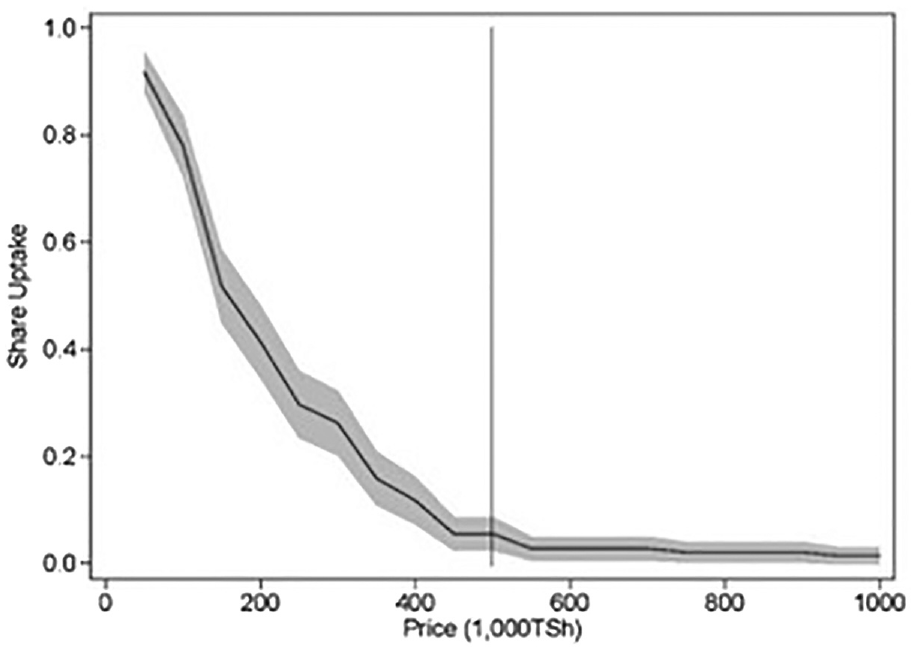
BDM elicited demand for title deeds representing the share of respondents with a BDM bid greater than or equal to the indicated price, with 90% confidence bands. Vertical line represents median invoice price in our sample. The sample is 146 plots.
Given the long-term benefits of land titles and some related uncertainties (for instance, risks of expropriation and inheritance may change over time), the acquisition of land titles does not warrant large up-front monetary costs. All respondents agree with Jackson (03PJ) that ‘the price is a huge burden’ considering budget and liquidity constraints, uncertain incomes from informal jobs, and savings invested in land and housing. For example, Orida (35FO) is a single parent with two of her four kids in university. She pays all school fees from her salary, ‘I had planned to save for the title deed’ she said, ‘but I failed year after year’. Like Orida, many have chosen to prioritise education and healthcare, expressing a determination to acquire the title deed in the future. After all, reflected Justin (42RJ), ‘there is no difference, whether you pay today or later on. The title deed will be there waiting for the right time’.
Conclusion
Unbundling property rights and functions of tenure security, our findings underscored the complexity of landholders’ choices when new tenure options become available to them. We studied a government-led programme offering 66-year leaseholds to individuals recognised as de-facto landholders. Despite limited acquisition, we found substantial demand for land titles and expectations of tenure security gains. Respondents deemed land titles essential to strengthen inheritance and compensation rights but were less interested in other functions: for example, they already felt reassured against encroachment because of the intermediary steps of regularisation and did not value the market transferability of land. Crucially, however, landholders considered the up-front price of land titles too high for benefits that would mostly accrue in the distant future, particularly inheritance and compensation rights. Therefore, title acquisition was limited since landholders prefer to postpone until there is an imminent need for their title deed. In sum, our analytic approach revealed nuanced valuations of land regularisation, which are not adequately understood by policy discourses. Primarily, respondents valued regularisation to solidify the social embeddedness of property, enhancing social relations with neighbours and between heirs. They also valued land titles to recast the social contract with the state, providing entitlements to state compensation (in case of eviction) and public goods (urban infrastructure). Instead, limited interest in market transactions may explain why a market premium for titled property is not observed in Dar es Salaam (Panman and Lozano Gracia, 2022). 5 Additionally, our results support widespread evidence that people value land titles even when they do not face imminent threats of state eviction (Patel, 2013; Van Gelder, 2013; Varley, 2017).
These findings inform two sets of policy recommendations. First, it appears clear that adequate pricing policies are needed to improve current regularisation programmes in this case-study and similar contexts where landholders value land titles but are unable or unwilling to pay large upfront fees. As conventional regularisation schemes require costly processes of planning and surveying, waiving fees may not be viable. However, different policies could raise title uptake despite the time inconsistency of costs and benefits. For example, amortising costs through instalments would allow acquisition by those who are unable to pay large upfront fees. However, this approach might not suffice if the key issue is that landholders are unwilling to pay until benefits are imminent. Instead, enforcing a payment deadline (e.g. through financial penalties) may work better for such individuals. Determining which policies are most effective at overcoming this timing issue requires further research.
Second, our evidence underscored that strengthening tenure security as a bundle requires diversified policy approaches. For instance, in our case-study, the posing of physical markers significantly reduced perceived risk of encroachment and boundary conflicts ahead of issuing titles. This suggests that cheaper interventions of community-led plot demarcation (instead of planning and surveying) may work well to reduce internal land conflicts. In other scenarios where communities worry about government eviction, registering group or communal rights (instead of individual rights) may better respond to local demands for tenure security. More generally, this paper’s findings contributed to demonstrating that issuing land titles is not a panacea for increasing all dimensions of tenure security (Hendriks et al., 2019; Urban LandMark, 2010). Instead, unbundling informal property is key to identify weak rights and local demands for tenure security, informing fit-for-purpose (and potentially cheaper) interventions.
In conclusion, this paper studied demand for land titles by interrogating landholders’ perceptions and expectations on selected functions of tenure security under formal and informal property rights. However, this approach was necessarily limited. First, it overlooked other rights (e.g. tenancy rights) that also deserve attention. Second, while respondents’ perceptions and expectations of formalisation matter to choices of title acquisition, whether they will translate in actual benefits remains to be seen and should be the subject of further research. Moreover, our empirical findings cannot easily be generalised to contexts characterised by diverse socio-economic profiles, informal governance, and local politics. Our respondents are representative of a rising middle-class that invests in peri-urban land to live and accumulate wealth for their children’s inheritance (Andreasen et al., 2020; Mercer, 2021). In central neighbourhoods with higher market pressures, landholders may foresee imminent eviction or opportunity for sale, and be prepared to pay higher upfront fees. In other central locations, unscrupulous profit-seeking landlords may favour unregistered and ambiguous rights to extract informal rents (see Ouma et al., 2022 on Nairobi). Furthermore, in neighbourhoods of Dar es Salaam with a high concentration of indigenous residents (so called ‘coastal tribes’) and cities where customary rights retain great legitimacy, such as Accra or Kampala, ideas of state-sanctioned private property, regulation and taxation could be met by political opposition. Differently from our case-study, residents may not be keen to gain visibility or may seek alternative forms of government recognition instead of individual land titles. In fact, this paper’s main contributions are analytical and methodological: we suggest unbundling property rights to gain nuanced understandings of tenure security in diverse contexts and design ad-hoc policies that address local needs.
Supplemental Material
sj-pdf-1-usj-10.1177_00420980241235157 – Supplemental material for Unbundling tenure security and demand for property rights: Evidence from urban Tanzania
Supplemental material, sj-pdf-1-usj-10.1177_00420980241235157 for Unbundling tenure security and demand for property rights: Evidence from urban Tanzania by Martina Manara and Tanner Regan in Urban Studies
Footnotes
Acknowledgements
The project was approved by the Tanzanian Commission for Science and Technology (COSTECH) [REC ref. 2019-135-NA- 2019-37]. It has passed review by the LSE Research Ethics Committee [REC ref. 000770]. We thank Mr Palmon and Mr Temu at the Ubungo Municipal Office, our team of enumerators and research assistants, particularly Prosper Kaigarula and Emilia Mlolere for supporting the coding of interviews. Neeshaa Cheong provided excellent research assistance during the final stage of writing. We thank participants at the LSE workshops Writing the World (May 2022) and the Politics of Urban and Rural Land in Tanzania (November 2022), in particular Cathy Boone, Joseph Kironde, Faustin Maganga and Colin Marx for their generous feedback. Xaxa Panman’s comments have been extremely useful to sharpen the contributions of this paper. We are especially grateful for discussions with Vernon Henderson, Melanie Lombard, Claire Mercer, and Erica Pani. Finally, we thank the editor and two anonymous reviewers for their encouraging and constructing feedback. We are fully responsible for any errors or omissions.
Declaration of conflicting interests
The author(s) declared no potential conflicts of interest with respect to the research, authorship, and/or publication of this article.
Funding
The author(s) disclosed receipt of the following financial support for the research, authorship, and/or publication of this article: This work was supported by the International Growth Centre [grant number TZA- 89473]. Martina Manara also acknowledges support by the ESRC-Postdoctoral Fellowship [grant number ES/W005719/1]; and the Leverhulme Early Career Fellowship [grant number ECF-2022-193].

Supplemental Material
Supplemental material for this article is available online.
Notes
References
Supplementary Material
Please find the following supplemental material available below.
For Open Access articles published under a Creative Commons License, all supplemental material carries the same license as the article it is associated with.
For non-Open Access articles published, all supplemental material carries a non-exclusive license, and permission requests for re-use of supplemental material or any part of supplemental material shall be sent directly to the copyright owner as specified in the copyright notice associated with the article.
