




Abstract
Of the build out of humanity predicted up to the end of the century, a substantial portion will occur within informal urban settlements – areas characterised by poor access to infrastructure and services. There is a pressing need to better understand how and with what implications the growing proliferation of Internet of Things (IoT) technologies, as a component of smart urbanism, are being applied to address the challenges of these areas. The following paper addresses this research gap, showing how IoT technology is reconfiguring trust within water and energy infrastructures in Nairobi. We apply work on informal urban infrastructures and smart urbanism to three case studies, producing novel insights into how IoT technologies reconfigure connections between users, providers and infrastructures. This reconfiguration of trust smooths chronic infrastructural uncertainties and generates reliability within informal settlements and, in doing so, leads to increased personal economies. We conclude by considering how these examples provide insights into the implications of IoT for everyday urbanisms in informal settlements and how these insights relate to global smart city debates more widely.
IoT and informal urbanism: Gaps and potentialities
The infrastructures that permeate and service urban areas are increasingly controlled by advanced digital devices. Sensors, actuators and thermostats, connected via internet infrastructure, form networks of devices that are able to seamlessly and ubiquitously transmit data between them. This notion of a connective network in which physical objects are brought together ‘online’ through the internet has been summarised in the term the ‘Internet of Things’ (IoT). IoT envisions a new paradigm of digital communication whereby everyday objects are equipped to communicate with one another and with users (Zanella et al., 2014). Examples of IoT technologies include health monitoring systems, domestic thermal controls and energy meters. Discourses of IoT, and smart cities more generally, conjure a hyper-modern world where millions of connected devices are able to communicate with each other to create efficiencies, enhance sustainability and improve human life (CISCO, 2015). In light of these supposed benefits, governments and municipalities around the world have been eager to engage with this paradigm, inserting IoT within both national and urban strategies (Li et al., 2015).
Despite a global deployment of IoT technologies, the predominant focus of research and policy discourse has been towards application of these technologies within the more developed urban areas of the Global North (Erfanmanesh and Abrizah, 2018). As Wamba et al. (2017: 7) state, ‘very few studies (around IoT) were conducted on cities in underdeveloped countries, which face huge challenges including waste management, electricity and water supply … and these issues should be included into future research’. Miazi et al. (2016) identify aspects particular to developing countries that this ‘novel paradigm’ of IoT can benefit, including precision agriculture, road safety and environmental modelling, as well as a range of technical, device and financial challenges this paradigm may face. Graham and Haarstad (2014) identify that IoT has potential within low-income and informal settlements where infrastructural access is minimal but, as Roy et al. (2016) note, social acceptance of IoT may also be low in these areas. This paper builds on these examinations and addresses the overarching gap, exploring IoT’s implications for the informal urban areas and infrastructures in which it is deployed.
In Africa, Coetzee and Eksteen (2011) suggest IoT may be most beneficial to food security, natural disaster management and water monitoring. Other work by Atayero et al. (2016) has examined the readiness of African countries to adopt IoT technologies, noting the political and economic hurdles that can inhibit adoption. In addition, Stewart (2019) suggests adoption is hugely dependent on the power and infrastructural capacities available to allow communication between devices. Both Saint and Garba (2016) and Onyeji-Nwogu et al. (2017) have also identified how the demand for IoT technologies in African cities will significantly differ between regions, commenting that in these cities automation devices may not be of much use, whereas smart metering technologies could make a significant impact. In addition, there has been an abundant level of research around the political-economies of smart metering in the Global South and particularly within Africa (Pegels, 2010).
Despite a low percentage of machine-to-machine connections within Africa (1% of global connections) (Ndubuaku and Okereafor, 2015) current IoT interventions have shown potential, including Airtel Congo’s fleet-tracking devices, Sweetsense smart water meters in Rwanda, MTN in Rwanda providing PoS terminals and Sequoia Technology using M2M GPRS printers to speed HIV diagnosis. Bekele (2017) notes that whilst many African countries were too late to shape previous digital revolutions, the nascent stage of IoT at present means that Africa could play a significant role in shaping its development.
The rapid deployment of IoT technologies has meant that research into their implications for cities has lagged behind, especially in relation to informal urban settlements – areas home to 1 billion people (World Health Organisation, 2010). Despite a handful of critical studies examining IoT deployments within informal settlements, including Luqman and Van Belle (2017) on IoT fire-detection technology within Cape Town and Devraj’s (2018) work on solar-powered Water ‘ATM’ dispensers in India, these efforts are few and far between. Despite the aforementioned IoT examples operating in Africa and within informal settlements, reliable figures concerning the exact number of IoT initiatives and critical examinations of IoT deployment within informal urban settings are rare. This is a major research gap.
Globally, the number of urban dwellers will have increased from less than 1 billion in 1950 to 9 billion people in 2100, with cities of the Global South being major areas of population growth. In Africa, over 60% of the urban population lives in informal settlements (UN Habitat, 2015), and five of the world’s seven largest cities in 2100 are predicted to be in Africa (Hoornweg and Pope, 2017). The global challenge of developing the world’s poorer population while limiting carbon emissions will be won or lost in cities characterised by informal urban development (UN Habitat, 2015) and it is here that IoT can play a crucial role. Growing penetration of IoT technologies into the lives of urban residents has created a pressing need to better understand how these technologies operate across all urban profiles, including informal settlements and their associated infrastructure.
This paper addresses this research gap, showing how IoT technology is deployed in informal urban settings in Nairobi, Kenya, to enhance the reliability of water and energy infrastructures. The following section argues that IoT’s ability to reconfigure trust within the highly fragmented infrastructures of informal settlements is of significant value to local communities and notably differs from the deployment of these devices within more formal infrastructures. The paper then describes how these arguments are developed through three case studies of IoT-enabled infrastructures within informal settlements in Nairobi, outlining the research approach, methods and data collection. The paper draws on key work around smart urbanism in the Global South to justify and frame our use of grounded accounts of IoT in practice (Datta, 2018; Guma, 2019; Guma et al., 2019). The substantive results are organised into two sections. The first presents the paper’s central finding that IoT reconfigures trust within the infrastructures of informal settlements, while the second outlines the key implications of this for people’s lives, namely that of managing infrastructural uncertainty. The conclusion reflects upon the transferability of the results and considers these insights in relation to theoretical framings of infrastructures of informal areas and within global understandings of the Smart City and IoT.
IoT, informal infrastructures and everyday urbanism
Within cities of the Global North, IoT technologies promise a ‘plug-in’ approach, whereby devices are seamlessly integrated within pre-existing and operating infrastructures, such as the smart metering of electricity in UK homes (Darby, 2010). For many cities in the Global North, IoT is a key component in urban visions for creating smarter cities and within smart urbanism (Zanella et al., 2014). A classic criticism of smart city initiatives in the Global North, however, concerns the lack of grassroots engagement with these technologies, thereby resulting in the majority of the benefits accruing to those with greater power and, consequently, the greatest influence on how devices are deployed (Kitchin, 2014). Echoing the concerns of smart city critics more broadly, Graham and Haarstad (2014; referencing Lianos and Douglas, 2000) suggest that so far the IoT has been predominantly ‘driven by the needs of large corporations that stand to benefit greatly from the foresight and predictability afforded’ (Graham and Haarstad, 2014: 6).
Furthermore, Hollands (2008) notes, a ‘key element of the smart city is the utilization of networked infrastructures undergirded by ICT’s’. This focus on network infrastructures is at the heart of smart city visions for developed cities and is increasingly part of broader visions of modernity for cities in the South (Graham and Marvin, 2002).
The smartening of cities in the Global South, whether through greenfield projects such as Konza Tech City in Kenya and Eko Atlantic in Nigeria, or through smart urbanism in existing cities such as Nairobi (Guma, 2019), is enabling these urban areas to become nodes within worldwide circulations of data, information and capital (Easterling, 2014). Work by Odendaal (2015) on South Africa, Watson (2015) on Africa and India, and Backhouse on East Africa (2015) has examined how smart city visions are taking shape within these areas. Further work on India by Datta (2018, 2019) has looked at the 100 Smart Cities project and explores how this focus reframes discussions around citizenship. In Malaysia, Bunnell (2015) identifies that, by enabling smart city projects, the Malaysian government and investors may create unexpected and potentially unwanted opportunities for reconfiguring citizenship. Despite these various efforts towards understanding the smart city and smart urbanism in the Global South, however, conditions of informality have yet to be examined in depth. Most notably, there has been little consideration of how key components of the smart city, such as IoT, are embedded within infrastructures of informal urban settlements.
Many of the aforementioned smart city plans in Africa reinforce the desirability of connected, homogenous infrastructures in order for cities to compete in the global economy (Harvey, 1989). This ICT-enabled ‘modern infrastructural ideal’ (Graham and Marvin, 2002), however, has little resonance with the infrastructural conditions of informal urban areas of the Global South. For these areas, infrastructural configurations can be splintered, fragmented, underfunded and suffer from legacies of inadequate colonial decision-making and planning (Silver, 2015). Significant populations of these areas rely on self-provisioned infrastructures that are separate from those provided by either state or corporate actors. These infrastructures often comprise various arrangements of multiple formal and informal services (Lawhon et al., 2018). The lack of engagement of dominant smart city visions with the infrastructural conditions associated with urban informal settlements replicates an unhelpful bias against informality. In understanding the everyday conditions of informal settlements, recent efforts have placed front and centre the human component and everyday lives that both shape and are shaped by the city (Myers, 2011). Examining everyday processes of informal urban areas and their associated infrastructure allows greater understanding around how informality shapes lives (Lawhon et al., 2014). This focus on everyday urbanism informs the use of case studies to capture the deployment and implications of IoT in practice and is outlined in the next section.
IoT in Nairobi
This paper has two aims: (1) to investigate how IoT technologies are being inserted within the infrastructures of informal urban settlements; and (2) to understand the implications of these applications for people’s lived existence. This section briefly describes and justifies how these aims were translated into research design.
With the introduction of fibre optic cabling, supportive government policy, the emergence of M-Pesa as a mobile payment service and attractive financial markets, Kenya has become a leading site for ICT development in recent years (Graham and Mann, 2013). In addition, innovation hubs such as iHub have become key sites fostering local and international start-ups and businesses in the country (Friederici, 2016). This amalgamation of factors has resulted in Nairobi becoming an attractive site for capital investment in relation to the smart city, whether related to Konza Tech City being built 64 km south of Nairobi or within the smartening of Nairobi itself (Mwaniki, 2017). Recent work by Guma (2019) and Guma et al. (2019) has further explored how ICT-led urbanism in the city is reflective of market-led efforts to connect the urban poor to financial circulations and, in the case of a low-income neighbourhood, Soweto-Kayole, how ICT deployments are often reconfigured by local communities to better align with their needs. Despite these efforts, the pace and frequency of ICT and smart-technology-led deployments in Nairobi mean that further examination is urgently needed to match this reality.
For Nairobi, colonial legacies have resulted in fragmented and splintered infrastructures which see wealthy areas such as Karen serviced by efficient and reliable services whilst low-income and informal areas such as Mathare and Kibera are left with little or no infrastructural provision (Myers, 2011). As Guma (2019) identifies, key service providers such as the Nairobi Water and Sewerage Company (NWSC) and the Kenya Power and Lighting Company (KPLC) equally represent both the colonial legacies of bureaucracy and administration, which results in slow and inefficient services, and the current drive towards neoliberal urban governance, whereby infrastructure providers are starved of the required financial investment. In addition to this, NWSC and KPLC are active in, and contend with, local and national socio-political tensions such as with water rationing (Moraa et al., 2012) and conflicts around illegal electricity connections within informal settlements (De Bercegol and Monstadt, 2018). These various challenges and pressures see Nairobi’s formal water and electricity networks suffering from a myriad of issues, resulting in inefficiencies, blackouts and rationing, whilst simultaneously trying to serve a growing urban population. Informal water and energy networks in Nairobi remain highly fragmented, involving a range of actors and often being costly for the end user, both financially as well as regards to their health. Water networks are often unreliable, suffering from a range of supply issues such as low water pressure, water contamination, frequent leaks and bursts, with cartels often controlling key points in these networks (von Heland et al., 2015). For Nairobi’s informal energy networks, kerosene and charcoal are the predominant fuel choices, both of which come with a range of financial, health and environmental issues (Njenga et al., 2009).
The integration of ICT into Kenya’s infrastructural networks, beginning in 1995 for KPLC and 2002 for NWSC (Guma, 2019), sought to utilise the country’s growing telecoms industry to increase efficiencies and service delivery within cities such as Nairobi. For those not connected to infrastructural networks, however, such as those within informal settlements, ICTs became a tool by which these major infrastructure providers endeavoured to engage with low-income residents (Mwaniki, 2017) and to attempt to drive out illegal and ad hoc services (Guma, 2019). Inherently tied to government and political direction, the investment for these major infrastructure-provider ICT projects aligns with national visions, such as Nairobi’s Integrated Urban Development Master Plan and Kenya’s 2030 vision (Guma, 2019).
Within Nairobi’s informal settlements, various combinations of actors are involved in the reconfiguring of infrastructures through ICT and IoT innovations, including NGOs, politicians and foreign contractors. As Martin (2016) notes, however, many of these projects are incomplete or unsuccessful. Despite this there are numerous cases of ICT and IoT deployment within Nairobi which warrant examination, many of which are more than a single fleeting project and involve a range of actors.
In order to address the research aims, we employed a case study approach to enable in-depth research of IoT technologies and their impacts. The examination involved a full set of stakeholders including users, providers, operators, government and technology suppliers to understand how IoT was designed and deployed within various local contexts. Multiple case studies were selected over a single study period to provide a cross-sectional snapshot of IoT interventions within infrastructures of informal settlements as opposed to a longitudinal examination of one technology deployment (Stake, 1995). The case studies were selected by conducting a survey of wider IoT infrastructural interventions within informal settlements of Nairobi, conducted through web searches and meetings with developers, start-ups and other stakeholders. Final case study selection took into account the ability and willingness of companies to work with the researcher to allow access to sites, users and data.
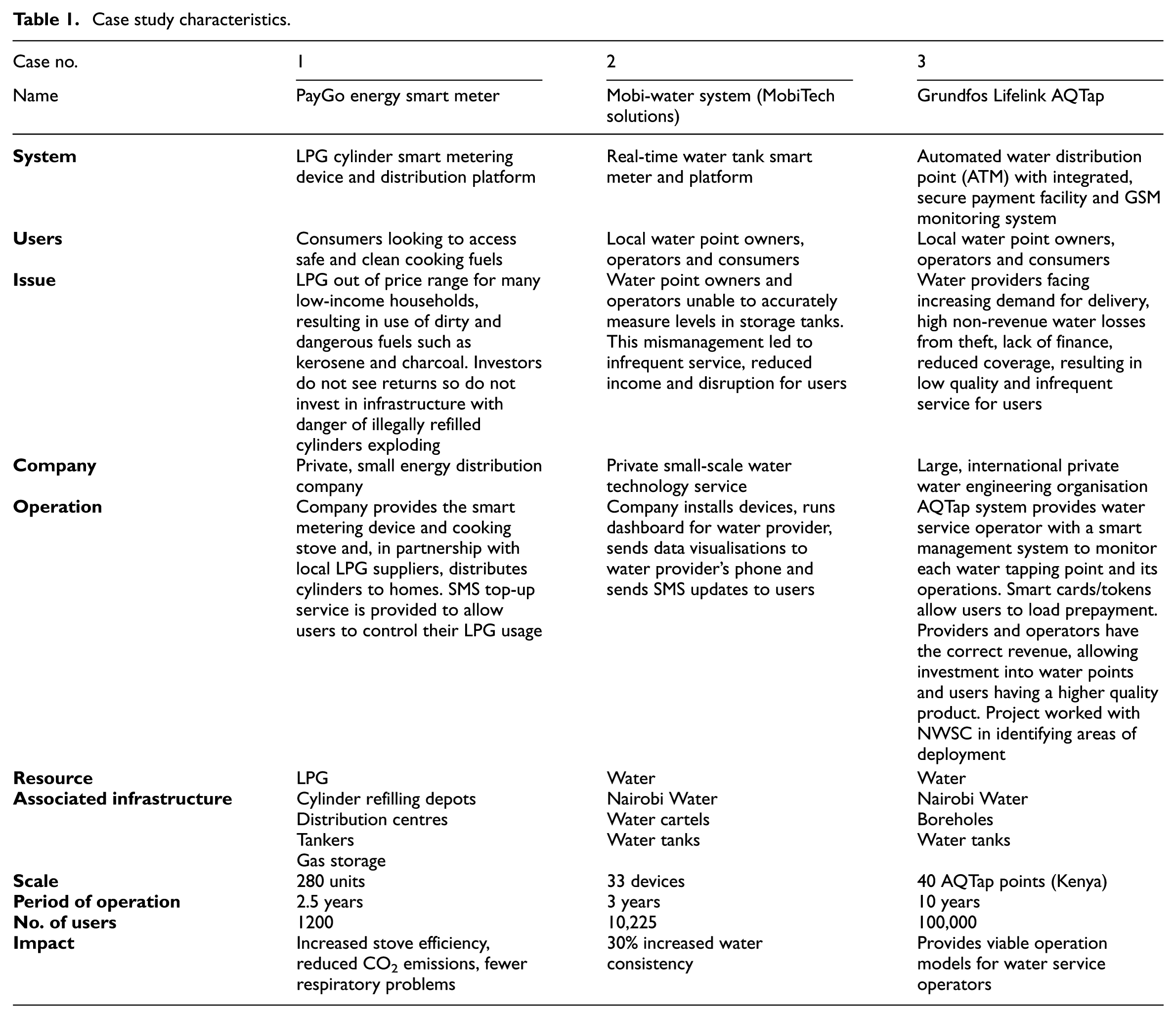
Three IoT technologies form the focus of the research. The first is an LPG smart metering device created by PayGo Energy, which enables users in informal areas to access LPG via pay-as-you-go technology and a smart meter. Through this device, users can move away from dangerous and inefficient fuels such as charcoal and kerosene and infrastructure providers have greater control around their supply network. This private company works closely with local LPG networks and, although separate from state projects, has gained government attention as a solution for LPG issues in informal settlements. Whilst operating in various informal settlements across Nairobi, the stakeholder engagement and site visits for this research primarily took place within Mukru Kwa Njenga.
The second IoT device, a sensor and monitoring device created by MobiTech Solutions, allows users, businesses and utilities to remotely monitor and manage water tanks. The device has been deployed in various informal settlements in Nairobi but during the research there was a predominant focus on working with community water points in Kibera. The devices were installed on tanks made from thick plastic and placed above buildings, replacing manual calculations that were difficult and prone to human error. This private company, started by a Kenyan engineer, attempted to solve the chronic water issues faced by informal settlements and water point operators around water supply, tracking and management.
The third IoT device, a water ATM, is a smart metering technology developed by Dutch engineering firm Grundfos that enables water providers to track water consumption and collect revenue. With issues relating to a lack of accountability, return on investment and corruption, many water points often operate with low returns. Through the water ATM, however, users are given a smart card that allows them to top up and know they are accessing a safe and reliable water source, with the correct revenues being digitally accounted for. The ATM is usually operated by one or two operatives and has been rolled out across various informal settlements in Nairobi, including Mathare and Athi River. The roll-out of the water ATM has been supported by NWSC within Nairobi, who have looked to incorporate it within municipal-controlled water points in informal settlements. Table 1 gives further detail about the three case studies.
Case study characteristics.
Data are drawn from 44 interviews with stakeholders and one user focus group, during October 2017–May 2018, and include service users (28), service providers and managers (8), developers (3), government officials (2), experts (2) and activists (1), with full anonymity offered. Interviews and focus groups have been labelled with codes that correspond to their relevant transcript (e.g. F4). Once the data were collected, transcripts and notes were coded according to the key dimensions highlighted from the review of urban IoT and informal infrastructure outlined in the previous sections (Strauss and Corbin, 1990).
Reconfiguring trust
A chronic problem in Kenyan informal settlements, as well as globally, is the lack of reliability users experience in the infrastructures on which they depend (Mireri, 2006). During the fieldwork, the notion of unreliability appeared regularly during discussions with stakeholders. When examining the consequences of the IoT technologies, however, the concept of trust emerged and, more specifically, how it was being reconfigured within the various infrastructures through the implementation and use of the IoT devices. This reconfiguration of trust took place through the establishment of associated themes of credibility, reliability and intimacy (Maister et al., 2000).
Many users indicated that, prior to IoT installation, the infrastructures they engaged with were possibly not being provided honestly, it was not a safe product, the price might have been artificially manipulated or they were being offered an inferior product. For example, water trucks supplying water points ‘would pump [smaller] amounts of water because I would not climb up there to confirm if it is full or not’ (FM4), or the gas tank ‘could explode, other times it could leak’ (F3). With cartels and other illegal activities often operating infrastructures, users suggested that a lack of care from these groups caused further infrastructural issues. With the installation of the IoT devices within these infrastructures users felt that they were being treated fairly by a credible piece of technology. For a majority of the users, this credibility was often denoted by knowing the device was honest in terms of its price, as seen by one LPG user who commented that ‘I trust it [the smart system] … I do not think that it will steal from me’ (F2). Because the service felt modern for many users, they associated this with a belief that they were dealing with professional organisations, although a couple of users noted the device had not met their expectations (F3).
The IoT devices provide credibility through assurances between users and providers in both directions. In interviews with infrastructure providers, their concerns often related to users not paying on time, damaging equipment or selling parts of infrastructure into informal circles. In this case, the user was positioned as being not entirely credible. Through the IoT device, infrastructure providers were afforded greater honesty from the users, enabling them to better plan for the future. As one IoT technology developer and infrastructure provider noted, ‘we would be getting done over with old and bad cylinders; the device means that we know they will [now] be returned’ (M7), thereby reducing their overheads for repairing cylinders or buying new ones. Credibility however, while often attributed to the IoT sensor itself, was not purely a digital effect. One community representative (J3) suggested that local technology developers working around IoT have attempted to better understand the complexities of local infrastructures and now work at a smaller scale and slower pace, attempting to form deeper connections with local communities. They further indicated that this ‘new group’ of technology developers were learning from mistakes of the past, such as previous organisations whose staff did ‘not speak the same language on issues pertaining to the services offered or issues raised’ (J3). In doing so, appropriate levels of engagement around IoT helped foster greater credibility between users and infrastructure providers.
The second component of this reconfiguration of trust was reliability, which appeared when discussing the consequences of installing IoT devices. For many users, the IoT device acted as something which could improve reliability in them being able to access the infrastructural service. Users noted that the IoT technology, as well as offering reliability through its design and capabilities, also gave a sense that any infrastructure provider employing such a device must be a company of greater reliability. As one user suggested (F1), through the IoT device they were able to remotely check their gas level, have faith that if ordering more they ‘know that it will be delivered for when I get home’ and that they knew that ‘there will be someone (from the company) there within the hour’. This sentiment about relying on the device, the infrastructure and the provider to carry out their respective roles was reflected by many other users. Some users also believed that the computer-based system meant that the company would not mislead them and they could check up if anything was an issue, with one user commenting that they ‘trust the digital system because the systems are computer based and you can always do a follow up in case of anything’ (J4). Inaccuracies appeared to be no one’s fault because the system was digital, every transaction would have been logged and could be rechecked. A major implication of this improved reliability was that the IoT devices were noted as helping alleviate infrastructural stresses and strains faced by users in informal settlements and eliminating ‘worry and anxiety’ (F4).
The final component of how IoT reconfigured trust that emerged during the research was that of intimacy. Within informal settlements, lack of governmental oversight and investment results in an increase in the frequency of human connections required to provide infrastructural services. For example, small-scale gas retailers and water providers operate closely within community groups and form a central cog within the daily operations of these infrastructures that supply informal settlements. Users of the IoT-enabled infrastructures identified how IoT technologies and their associated modern imaginaries helped forge new personal connections and forms of intimacy within the infrastructural system. As users noted, the staff of the infrastructure provider ‘do their work well and are respectful’ (F2) and the IoT company are ‘not impatient when teaching about technology … [and] they are polite and talk gently’ (F7). These, and many other users, regularly noted that through this new technology the users had grown close to an infrastructure provider.
During interviews with other non-user stakeholders, the idea of intimacy emerged as integral to the infrastructural stories of Nairobi and its citizens. One Kenyan academic in urban planning identified that many Kenyans both want and need the human element of infrastructure in addition to any digital component. He suggested that there was a particular Kenyan sensibility that saw both an acceptance of technology but a reluctance to rely on it entirely, noting that his father would not feel he had complained properly if it was done online, which required him to visit the infrastructure provider’s head office directly in order to air his grievance. The IoT developers interviewed understood the importance of human interaction and had specifically incorporated it within their technology design. An extreme but very important extension of this sensitivity to local context involved the imperative to design with cartels in mind. As one developer noted, cartels rarely care about the end users so, to overcome this, they needed to make systems that built in intimacy and trust to ensure the cartels could not render them obsolete (M20). For another IoT developer working within informal water infrastructure, they identified that developers ‘don’t just give and leave the part [technology] with them’ but they make sure that they train them how to operate it, collect funds and repair it (M36).
The infrastructures of informal settlements in Nairobi face multiple challenges, including a lack of regulation, fluctuating resource supply, cartels, infrequent service and low safety standards. These challenges result in infrastructural networks suffering disconnects between users, providers, the physical infrastructure and the resources, and a breakdown in trust. The findings here present how components of trust (reliability, credibility, intimacy) can be established or strengthened though IoT technologies, by reconfiguring connections between users, providers, infrastructure and resources. For users, the IoT technology meant that they were able to trust that providers were operating honestly, that the infrastructure would be operating when they needed it and that the resource would be safe and fairly priced. For infrastructure providers, the IoT technology gave them trust that the infrastructure would operate when required, users would pay on time, the infrastructure could not be stolen and the resource could not be extracted illegally. In this sense the digital components of IoT enhanced infrastructural trust (Mattila and Seppälä, 2016) by creating transparency in the material, economic and social exchanges.
The implications of IoT for everyday lives
When examining the implications of IoT for the everyday lives of users within informal settlements, it became apparent that these technologies smoothed out the fluctuations associated with accessing resources. For many users, the IoT technologies helped users to better plan daily activities by offering certainty in terms of accessing infrastructure, delivery of fuel/water and being aware of infrastructural disruptions, thus saving them valuable time. In terms of basic tasks, users noted that through the IoT device they knew the ‘preparation of my evening meal will be quicker … it saves me time’ (F4) and that the technology could fit into their everyday lives. One user noted: ‘this technology is very beneficial and aptly fits to my lifestyle in that it saves me a lot of time’ (F3). The different ways these devices were able to save users time was often related to the collection/delivery of LPG or water. As one user noted, ‘initially I had to go out, find the gas, get someone to carry it and this would cost me more money and time’ (J3). Prior to the IoT device installation, users of gas infrastructure required significant investments of their time and financial payments to coordinate the delivery of the gas. Major disruption when any part of this infrastructural chain broke down could also be mitigated by IoT, as one user of the LPG IoT device noted: ‘Sometimes you … come home late at night only to find all [shops selling fuel] closed and neither charcoal nor kerosene available. On that day you’ll sleep hungry … but not with [IoT device], you can cook anytime’ (J3).
Other users suggested that through the devices they were able to understand where other associated infrastructural issues were occurring in the local area: ‘It [smart water metering device] has also enabled me to know whenever there is a power blackout in the village because the device goes off … this helps in planning what time and how to get home’ (FM13).
While this alternative use of the IoT device was not identified by other users, IoT developers indicated that there was growth in interest around how these technologies could perform multiple infrastructural roles.
Ultimately, the IoT devices provided users certainty in otherwise highly uncertain lives. One user of the LPG IoT device suggested that ‘with the monitor it is possible to pay and plan accordingly’ (J3). Taking charge of the payment process for infrastructure allowed them to have clearer patterns in terms of their longer-term financial processes. For non-user stakeholders, the way in which IoT technologies could or should smooth out the everyday fluctuations within informal settlements also appeared frequently during discussions. As one IoT developer commented, in order for water point owners to be able to get their money back correctly, technology developers ‘needed to use IoT to make sure that every KES [Kenyan Shilling] is accountable’ (M3). For operators, the lack of certainty around revenue collection hampered their business operations. Delays could cause issues in the operation of smaller businesses that often existed on small financial margins. An IoT developer working with a large infrastructure provider suggested that whilst they could design an easier revenue collection process for operators, they would need to consider how the infrastructure would work on the ground; as ‘prior to the installation, water management was done by manual measurement in the area … [which] meant that bribes were often handed out’ (M29). One counterpoint raised by a handful of users and non-user stakeholders was the concern that the fluctuations solved by IoT technologies are inefficiencies that generate local employment. One user of an IoT fuel device noted they were worried what impact this technology may have on their local supplier (M7), suggesting that despite some of their delivery and quality issues, there had been personal connections built with local small-scale fuel sellers and that these new technologies might result in eliminating work for others.
When talking with residents, IoT users, local activists, community leaders and other stakeholders, it became apparent that small margins in personal economies significantly impacted the everyday lives of many within the informal settlements. In addition, delays in collecting water/fuel often resulted in reduced time for other home duties such as cooking. With the installation of the IoT technologies, however, whilst fluctuations in service and challenges from theft/corruption could not be eliminated entirely, the various devices gave users, operators and other stakeholders greater ability to use, operate and manage these infrastructures and plan their activities accordingly. For three-quarters of users who ran small businesses, the IoT devices enabled an extension of their working hours in their various enterprises, thereby increasing their incomes. For example, one user of the LPG IoT device commented that ‘I close my business between 9.30 and 10 pm. This has increased my income. [Before the device] I would get home at 8 pm’ (F6) and another user of the same device noted that ‘it has helped me extend my working hours as I do not worry about getting home early to cook. This has led to increased business’ (F10).
A large proportion of those interviewed were women running their own shop/stall or cooking operation either within the informal settlements or adjacent to popular transport corridors. For some, the IoT device was directly used in their business. In the case of the LPG smart metering device, one user suggested ‘I like it and my customers too count on its efficiency and speed in preparing food’ (F9). For others, IoT devices were directly reducing theft and potential losses from untrustworthy employees or suppliers, as one user of the water monitoring IoT technology noted, ‘This will boost accountability, minimise losses due to deceitful employees and enables the project to scale up’ (FR5). Similarly, another user of the water monitoring technology commented that ‘Now I do not have to get someone to climb up and check water levels … or deal with water suppliers who lie about the amount of water they have refilled in my tank’ (FM13).
Increased personal economies for IoT users have also come through the efficiencies enabled by the IoT device itself. For operators of a local water point the water ATM IoT device has ‘reduced water wastage especially during tank refills where water would overflow all night’ (FR5). The result of installing the water metering IoT technology was noted by one operator who commented that now ‘we make higher profits due to better monitoring and management of our water resources’ (FC13). More broadly, representatives of the water industry suggested that while IoT devices could solve problems in informal areas in the short term, there needed to be greater development of devices that could understand and manage the wider levels and reserves of natural resources. They further added that the real gap in data management concerns boreholes and water levels in Nairobi and that IoT technologies could help by creating more real-time and transparent data (M8). One government official recognised that IoT devices may play a role in alleviating poverty in informal areas but noted that while ‘informality is an easy political win [there are many politicians] who are completely blind to it’ (M37). There is clearly potential for data from IoT devices to support better resource management across urban areas.
Conclusions: Towards a research agenda for the ‘Informal IoT’
This paper has critically examined how IoT devices are being integrated within the infrastructures of informal settlements and their implications. In doing so it has addressed a major research gap around IoT and conditions of urban informality. The findings suggest that IoT technologies can reconfigure trust within the infrastructures of Nairobi’s informal settlements. By re-establishing trust, IoT smooths the everyday fluctuations that affect the infrastructures of these areas and increase their reliability, which, in turn, creates considerable benefits for both users and providers, such as increased personal economies. While the validity of these findings requires studies in other cities with different infrastructural legacies and contexts, and IoT deployments led by not-for-profit or government bodies, it seems appropriate to reflect on the implications of these findings for wider thinking around smart cities, infrastructure and urban informality by way of conclusion.
In recent years concerted efforts have been made towards understanding and theorising the complexities and variegated urbanisms that characterise cities of the Global South (McFarlane, 2010; Robinson, 2013). Inspired by postcolonial and post-structural critiques of knowledge and practice, this work has examined the flows of power within infrastructures shaping African Cities (Lawhon et al., 2014) and how dynamic and heterogeneous infrastructures mediate informal urban areas in distinct ways (Myers, 2011). Lawhon et al. (2018), drawing from broader work around informal infrastructures of the Global South (Gandy, 2006; McFarlane and Silver, 2017), employed the term Heterogeneous Infrastructural Configurations (HICs) to denote the ‘diversity of infrastructural configurations’ within informal settlements that blur distinctions between formal and informal operations.
The IoT technologies within Nairobi’s informal settlements discussed in this paper did not formalise the infrastructures in which they were embedded, with these configurations still relying on informal networks and associated connections to operate, but instead increased the fluidity between formal and informal infrastructures through the availability of real-time data. In this sense they resemble HICs, reconnecting socio-technical components and reconfiguring flows of power and resources both within informal settlements and across an increasingly digitally mediated Nairobi. The findings suggest that relational approaches to understanding infrastructure such as HICs could be fruitfully applied to understand IoT interventions, which reconfigure social, political and cultural dynamics. This is an important and new task, as the reconfiguration potential of IoT exceeds that of ICT technologies more broadly in important ways. Most importantly, IoT connects broader ranges of physical infrastructures and enables closer relations between users and resources through real-time information exchange and remotely control devices.
For cities around the globe enacting smart city plans, policies and programmes, a common critique is that these actions are underpinned by market-led, neoliberal logics, resulting in a further splintering of urban infrastructure (Datta, 2015). IoT, a central component of smart urbanism, is often envisaged as something which can be seamlessly plugged into existing networked infrastructures within these ever-smartening cities. As this paper identifies, however, the infrastructural realities of informal settlements diverge from this ‘modern infrastructural ideal’ of homogenous, networked infrastructures (Graham and Marvin, 2002). As scholars examining smart cities in the Global South such as Datta (2015, 2018), Odendaal (2016) and Guma (2019) have shown, however, processes of smart urbanism are increasingly present within low-income and informal urban settlements, often led by top-down attempts to simultaneously control and provide infrastructure and to open up new markets for capital. The findings here contribute to this literature by showing how alternative realities of smart urbanism are emerging within the infrastructures of informal settlements. As demonstrated in this case of three IoT technologies within Nairobi’s informal settlements, heterogeneity can work with, rather than against, the needs of residents. With a global trend towards decentralised, renewable infrastructures in smart city visions (Maier and Narodoslawsky, 2014), informal settlements, with their history of overlapping and dynamic infrastructures, appear an ideal site for South–North knowledge exchange concerning heterogeneity in future smart cities.
When deployed within the infrastructures of Nairobi’s informal settlements, the IoT technologies examined positively reconfigured social elements associated with infrastructure, generating trust. Although trust was not missing within informal settlements by any means, the technologies examined were able to repair some of the fractured relationships between infrastructure, its operators and users. Either directly, or via the imaginaries associated with them, the technologies mediated a two-way flow of credibility, reliability and aspects of intimacy between actors within these infrastructures of Nairobi’s informal settlements. Through this reconfiguration of relations, trust was established between users, infrastructure operators and infrastructure providers, as well as in the infrastructures themselves and the resources they supply.
The findings here provide insights around the social dimensions of trust and the ways in which IoT can help re-establish this within fractured networks. Given their role in supplying continuous streams of data that change the way cyber-physical systems engage with each other, more work is required to understand how IoT produces digital and non-digital forms of trust (Chen et al., 2016). For residents within informal urban settlements such as Mathare, Mukuru kwa Njenga and Kibera in Nairobi, infrastructural uncertainty is an ever-present element of daily life (Zeiderman et al., 2015). The IoT technologies examined here complemented existing strategies already used by communities to manage infrastructural uncertainties. Through access to real-time data, users assumed greater control over daily routines and were able to increase their own personal economies by extending working hours. Uncertainty is at ‘the heart of what urbanism is, as urbanism is always a work in progress rather than a destination’ (Simone, 2013: 245). The findings here would indicate that this theoretical work can be expanded by not considering uncertainty solely as something to either be eradicated by government or exploited by corporations, but as something that can be digitally mediated in productive ways by citizens.
Our findings suggest that ‘radically rethinking’ African Urban Theory (Myers, 2017) to incorporate those on the social and economic margins of cities may find space to engage with urban IoT. In the context of the much-heralded Fourth Industrial Revolution, of which IoT forms a part, these findings suggest that in the case of Nairobi’s informal settlements such technologies can reconfigure trust and reduce uncertainty within HICs. With research on smart cities and smart urbanism within the Global South growing, and a broader impetus to address urban challenges within framings of sustainable development, the time seems right to develop a fuller research agenda around IoT and urban informality. Furthermore, as cities in the Global North increasingly look towards decentralised visions of urban infrastructure they potentially have much to learn from informal settlements. In this context such a research agenda has genuinely global relevance.
Footnotes
Funding
The author(s) disclosed receipt of the following financial support for the research, authorship, and/or publication of this article: Engineering and Physical Sciences Research Council (EPSRC) Power Networks Centre for Doctoral Training at the University of Manchester (Grant number: EP/L016141/1).
