




Abstract
This research examines the role of food aid providers, including their spatial engagement, in seeking to alleviate urban food poverty. Current levels of urban poverty across the UK have resulted in an unprecedented demand for food aid. Yet, urban poverty responsibility increasingly shifts away from policymakers to the third sector. Building on Castilhos and Dolbec’s notion of segregating space and original qualitative research with food aid organisations, we show how social supermarkets emerge as offering a type of transitional space between the segregating spaces of foodbanks and the market spaces of mainstream food retailers. This research contributes to existing literature by establishing the concept of transitional space, an additional type of space that facilitates movement between types of spaces and particularly transitions from the segregating spaces of emergency food aid to more secure spaces of food access. In so doing, this research extends Castilhos and Dolbec’s typology of spaces, enabling a more nuanced depiction of the spatiality of urban food poverty.
Introduction
This research examines the role of food aid providers, including their spatial engagement, in alleviating urban food poverty. 1 Levels of urban poverty and social inequalities across the UK have increased steadily over the last decades, leaving cities and communities increasingly segregated between the haves and the have-nots (Gibbons, 2018; Hincks, 2017; Massey and Fischer, 2000; Nieuwenhuis et al., 2020; Panori et al., 2019; Zhang and Pryce, 2020). Simultaneously, austerity-based policy measures have exacerbated these socio-spatial dynamics (Moraes et al., 2024), resulting in precarious levels of urban poverty (Shaw, 2019). People who live in urban areas of high poverty concentration have their economic opportunities restricted (Andersson et al., 2023; Hegerty, 2023).
Urban studies’ debates about food provision typically approach the issue from the perspective of local policymaking and partnerships (Bedore, 2014), translocal alliances (Moragues-Faus and Sonnino, 2019), and food deserts (Hamidi, 2020; Whelan et al., 2002). However, rising levels of urban poverty across the UK have also given way to a ‘spatial shifting of responsibility’ (Strong, 2020: 211; Gibbons, 2018) for addressing food poverty, moving it from public institutions to third sector organisations (Le Feuvre et al., 2016). Consequently, a substantial number and variety of food aid providers 2 now exist across UK urban areas, which include foodbanks, social supermarkets, 3 churches, and surplus food redistributors, and which demand further research attention.
Although the wider urban poverty literature provides extensive debates on the spatial relationships between regional and neighbourhood segregation based on race and/or housing (Consolazio et al., 2023; Gibbons, 2018; Hincks, 2017; Massey and Fischer, 2000; Serrati, 2024), there remains a limited understanding of the spatial interplay between economic-driven urban poverty segregation in the UK and how low-income individuals can transition beyond poverty’s ‘vicious circle of segregation’ (Nieuwenhuis et al., 2020: 178; Hincks, 2017) into having a more secure means of food access. This paucity of understanding suggests more research is needed on how these organisations operate both spatially and relationally, and the extent to which they alleviate urban food poverty (Loopstra and Lambie-Mumford, 2023; Moraes et al., 2021; Morgan, 2015).
Our work responds to this knowledge scarcity by addressing the following research question: how do spaces of food aid provision address urban food poverty and facilitate transition from poverty-based, segregating spaces into more secure spaces of food access? We tackle this research question through the theoretical lens of segregating spaces, which are ‘spaces defined by one or multiple actors for the benefit of a cohesive group or community’ (Castilhos and Dolbec, 2018: 159). Segregating spaces are an exclusionary type of space within Castilhos and Dolbec’s (2018) broader typology of public, market, emancipating and segregating spaces. In this typology, such spaces are argued to be orchestrated by core oppositional dynamic forces, which shape and are shaped by the interplay among social actors and wider structures in society (Castilhos and Dolbec, 2018).
This theoretical lens is helpful in that it lends itself to conceptualising the spatiality (i.e. locations, patterns, and organisation of people) surrounding urban poverty (Shaw, 2019; Strong, 2020). Nevertheless, it requires further research attention within the context of food poverty, but also more broadly in terms of how individuals navigating segregating spaces and their dynamics might be able to move beyond them.
By tackling our research question through the lens of segregating spaces and original qualitative research, we contribute theoretically to the literature on urban poverty spatiality by extending Castilhos and Dolbec’s (2018) typology of spaces. We do so by offering greater understanding of how people might transition across spatial types, capturing more fully the spatial and relational activities that occur in and between transitions from one spatial type to another. We, thus, extend Castilhos and Dolbec’s (2018) spatial typology by establishing an additional type of space, that of transitional space. Specifically, we propose and define transitional space as a liminal spatial type that is fluidly situated between public, market, emancipating and segregating space types (see Figure 1). Further, in the case of food poverty alleviation, we establish that social supermarkets are a manifestation of transitional space, operating between the segregating space of emergency food provision and those of more secure spaces of food access.
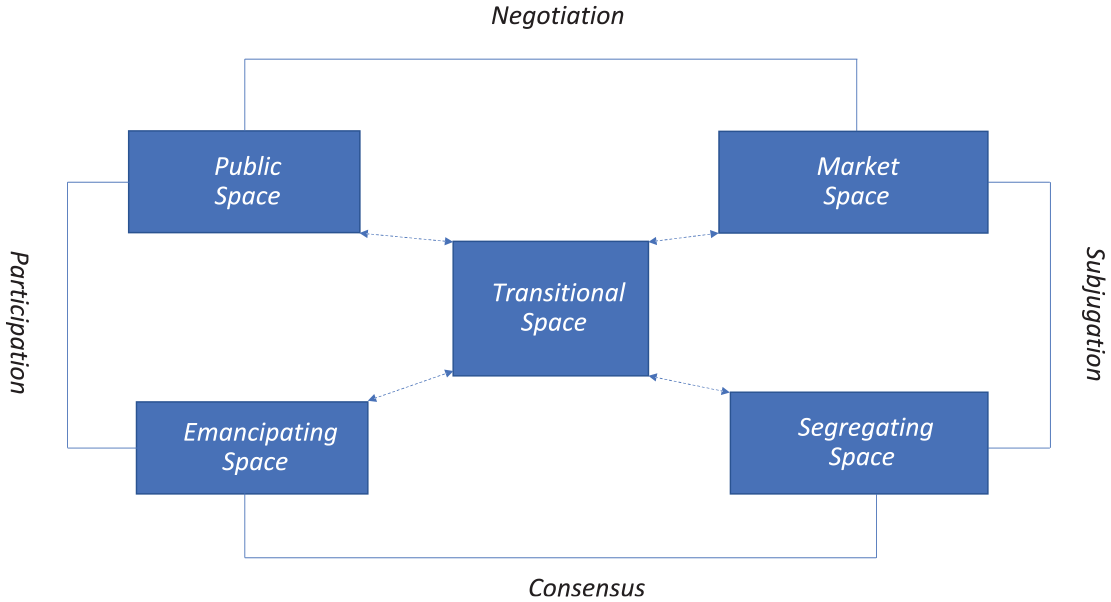
Types of space incorporating transitional space.
This extended conceptualisation allows for a more nuanced and theory-informed depiction of urban poverty, including how it is spatialised and experienced in the context of urban food aid. This contribution is significant in that it offers societally relevant evidence of the relationship between spatial segregation and social divisions, which, in our research, apply to areas of regional deprivation across British cities, but which can be extended to other contexts, too.
We begin by providing a review of relevant literature and theory on spatial types. This is followed by our qualitative methodology and the data and discussion supporting our conceptualisation of transitional space. We conclude the article by elaborating further on our research contributions and how the concept of transitional space can be used more widely in urban studies.
Spatial poverty and segregating spaces
The notion of space as a practised place (de Certeau, 1984; Lefebvre, 1991) is particularly helpful in that it permits the spatial, relational, and temporal dimensions of poverty to be examined alongside the broader moral, cultural, and political contexts experienced by those in urban poverty (Sen, 2006; Shaw, 2019; Strong, 2020), and by those seeking to alleviate it.
Much geography literature on spatial poverty relates to Massey and Denton’s (1988) spatial dimensions of segregation, which are important in helping to comprehend the spatial intensity of exclusion (Zhang and Pryce, 2020). However, their theoretical emphasis upon the interaction between residential segregation and race often neglects the effects of income distribution and the social relations of income classes (Gibbons, 2018; Massey and Fischer, 2000).
Barring recent exceptions (e.g. Nieuwenhuis et al., 2020), the combined role of income inequality and stagnating wages in furthering poverty-based segregation and concentrated poverty spaces has received less attention (Marmot et al., 2020; Massey, 1990; Massey and Massey, 2005; Quillian, 2012).
Castilhos and Dolbec’s (2018) typology of four spaces can help address this paucity of research and understanding, as it critically outlines the spatiality of the city. The typology provides ‘conceptual clarity and theoretical usefulness for the study of different kinds of space, how [people] experience these, and how these spaces shape society and can be shaped and marketed by an array of actors’ (Castilhos and Dolbec, 2018: 155). The typology recognises that spaces are conceptualised as facilitating production and consumption in capitalist societies (Lefebvre, 1991). This is because spaces are embedded as commodities within ‘circuits of capital reproduction and accumulation’ (Castilhos and Dolbec, 2018: 155).
Within this typology, the four spatial types include public (e.g. city parks, streets), market (e.g. cinemas, shops, high streets, shopping centres), emancipating (e.g. festivals) and segregating spaces (e.g. domestic spaces, private clubs, neighbourhoods, ghettos). Thus, the typology permits the identification of the main characteristics of each type of space. Nevertheless, it also enables an understanding of the dynamic forces or force ‘continuums’ through which these four spaces are shaped and orchestrated in society (Castilhos and Dolbec, 2018).
The oppositional dynamic forces orchestrating these spatial types concern the ways in which different spaces are animated; in other words, the different kinds of orienting logics underpinning spaces, in Castilhos and Dolbec’s (2018) terms. Castilhos and Dolbec (2018) do not define their understanding of ‘logic’. However, their conceptualisation of space as the ‘cumulative product of the ongoing forces of society’ (Castilhos and Dolbec, 2018: 155) and their reference to Lefebvre (1991) enable us to extrapolate its definition as characterising a force of both coherence and reductionism, pulling spaces towards social homogenisation (Lefebvre, 1991).
These orienting logics and their dynamics ‘structure the behaviour of [people] in these spaces and the role of these spaces in society’ (Castilhos and Dolbec, 2018: 155). 4 On the one hand, the participation versus subjugation dynamics continuum focuses on the extent to which spaces are characterised by a logic of inclusivity versus a logic that drives the creation of subjects who comply with, or favour, stakeholders in positions of power. On the other, the negotiation versus consensus dynamics continuum is marked by a logic of ongoing relational tensions and compromises among different social conventions, beliefs and powers versus a logic oriented towards cohesion and social reproduction. In this way, public spaces are typified by negotiation and participation logics, emancipating spaces by consensus and participation, market spaces by negotiation and subjugation and segregating spaces by consensus and subjugation (Castilhos and Dolbec, 2018).
Here, we focus on market and particularly segregating spatial types and their logics, as they offer the strongest illuminating potential in the context of urban food poverty. This is because there is an implied economistic, hierarchical, class-based interconnection between market and segregating spaces. That is, people are expected to participate in consumer culture and therefore access food through market spaces. Nevertheless, using the supermarket as an example, even the same market space can be experienced quite differently depending on how wealthy one is. This is because people on low incomes might avoid certain aisles if they know that what is on them is not going to include food they can afford to consume. When access to market spaces is only partially possible and/or no longer an option, people are pushed to the margins of the marketplace, relying instead on segregating spaces of food access.
Indeed, market spaces are the most dominant form of space in urban landscapes. Their logics create particular types of subjugated subjects (i.e. consumers), who are ideologically recruited into favouring markets. They create exclusions based on social affiliation, as they are open to those who can afford to interact with the market and/or who have the cultural capital to access them. In line with market rationality, market spaces are negotiated ‘against the discursive and material authority’ of dominant economic actors (Castilhos and Dolbec, 2018: 156). Thus, urban market spaces are accessible only to those who fit in, can conduct themselves according to dominant socio-cultural norms and have enough financial capital to participate in consumer culture.
In contrast, segregating spaces reveal homogenous areas of deprivation that have become segregated based on multiple socio-economic dimensions (Hincks, 2017; Milbourne, 2014; Powell et al., 2001). They are animated through both a logic of subjugation and a logic of consensus. In the context of urban food poverty, the logic of subjugation is illustrated within segregating spaces through external power structures of market actors such as businesses, who can exercise power by suppressing employment rights through the use of zero-hour contracts or low wages, for example. Additional external forces are austerity measures implemented by the state (e.g. welfare benefits cap, removal of the spare room subsidy, benefit sanctions, or the lengthy assessment period for first payment of Universal Credit), which also reflect the logic of subjugation.
Segregating spaces are recognised spaces for homogenous groups from similar cultural and social classes to convene, such as foodbanks. As their logic of subjugation strives to construct subjects according to whatever social consensus has been reached (Castilhos and Dolbec, 2018), they materialise through the intertwining of both logics of consensus and subjugation. For example, in addition to the external forces of austerity and poor employment conditions, the logic of subjugation of a particular segregating urban food aid provider will also be shaped by internal forces such as those of a community of volunteers and/or donors. This is because these stakeholders advocate how their food aid provision should be run and how those accessing it should behave. Akin to the often-contested meanings associated with place (Pred, 1984), the orienting logic of consensus then favours cohesion and seeks to mitigate diversity tensions inherent to the logic of subjugation by providing ‘spaces organised around shared and codified attributes’ (Castilhos and Dolbec, 2018: 159).
Thus, the notion of segregating space is particularly apt as an enabling lens for addressing our research question, as it helps to identify and analyse how food aid providers might alleviate segregation and urban food poverty. This is because, as spaces of exclusion, the segregating spaces of food aid providers are purposefully determined to benefit a cohesive group (Castilhos and Dolbec, 2018). The traditional model of the foodbank and alternative sources of surplus food distribution (e.g. school breakfast clubs) are examples of segregating spaces, as their users are separated from the general population by their low socio-economic group status and their limited or no access to market spaces such as supermarkets, corner shops and food markets (Moraes et al., 2021). Intersectional dimensions such as class, income and race inter alia can also influence and re-shape segregating spaces of food aid provision (Madhavan et al., 2021; Nieuwenhuis et al., 2020; Panori et al., 2019). This, thus, foregrounds the need for flexibility in systems of food distribution and consumption in such spaces.
It is important to highlight that we see these orienting logics as being both external and internal to the activities that organise spatial types, co-acting on space to co-shape its possibilities. The dynamics of these logics, therefore, reflect the interconnections and interplay between individual agency and societal structures, which co-shape space and society. Thus, the (re)production of space can be seen as the result of the interactions among different stakeholders and the dominant logics and power they exercise, where segregating spaces might be enacted by both the market and charitable foodbanks, as an example.
In summary, this spatial-typology lens, therefore, allows an enhanced understanding of the functions that diverse actors and forces perform in producing and reproducing diverse kinds of space in society (Castilhos and Dolbec, 2018). This is because it highlights the forms of place making power that shape how particular urban spaces are made available to, and by, people. This spatial (re)production manifests according to specific sets of logics, which, when exercised, co-produce different kinds of space. Although Castilhos and Dolbec (2018) acknowledge the potential for transitions between spatial types, limited explanations are offered as to how these transitions might materialise. Those that are provided focus only on the example of potential transition between public to market spaces. Thus, in addressing our research question – that is, how do spaces of food aid provision address urban food poverty and facilitate transition from poverty-based, segregating spaces into more secure spaces of food access?– we seek to extend Castilhos and Dolbec’s (2018) theorisation of spaces through qualitative research.
Methods
Our interpretivist approach affords deep understanding of participants’ subjectively construed meanings (Spiggle, 1994), generating insights that are generalisable within theoretical propositions, rather than to populations (Gioia et al., 2013). This approach enables nuanced understandings of the interplay between space and social practices, capturing ‘qualities that describe or explain a phenomenon of theoretical interest’ from a small sample (Gioia et al., 2013: 16). Thus, our approach helps further our theorisation of segregating spaces and of transitions between spatial types.
Qualitative in-depth interviews were carried out between 2018 and 2019 5 with directors and/or managers of food aid providers and networks. Upon receiving research ethics approval from our institutions, we focussed on interviewing these particular stakeholders because they are a sample of operational leaders in their organisations. Another reason was that they tend to be the organisational actors who develop the boundary-spanning networks that are necessary for food aid initiatives to emerge and function. Our purposive sample of 11 organisations is consistent with methodological approaches that seek fine-grained, in-depth examination of a particular phenomenon (Crouch and McKenzie, 2006).
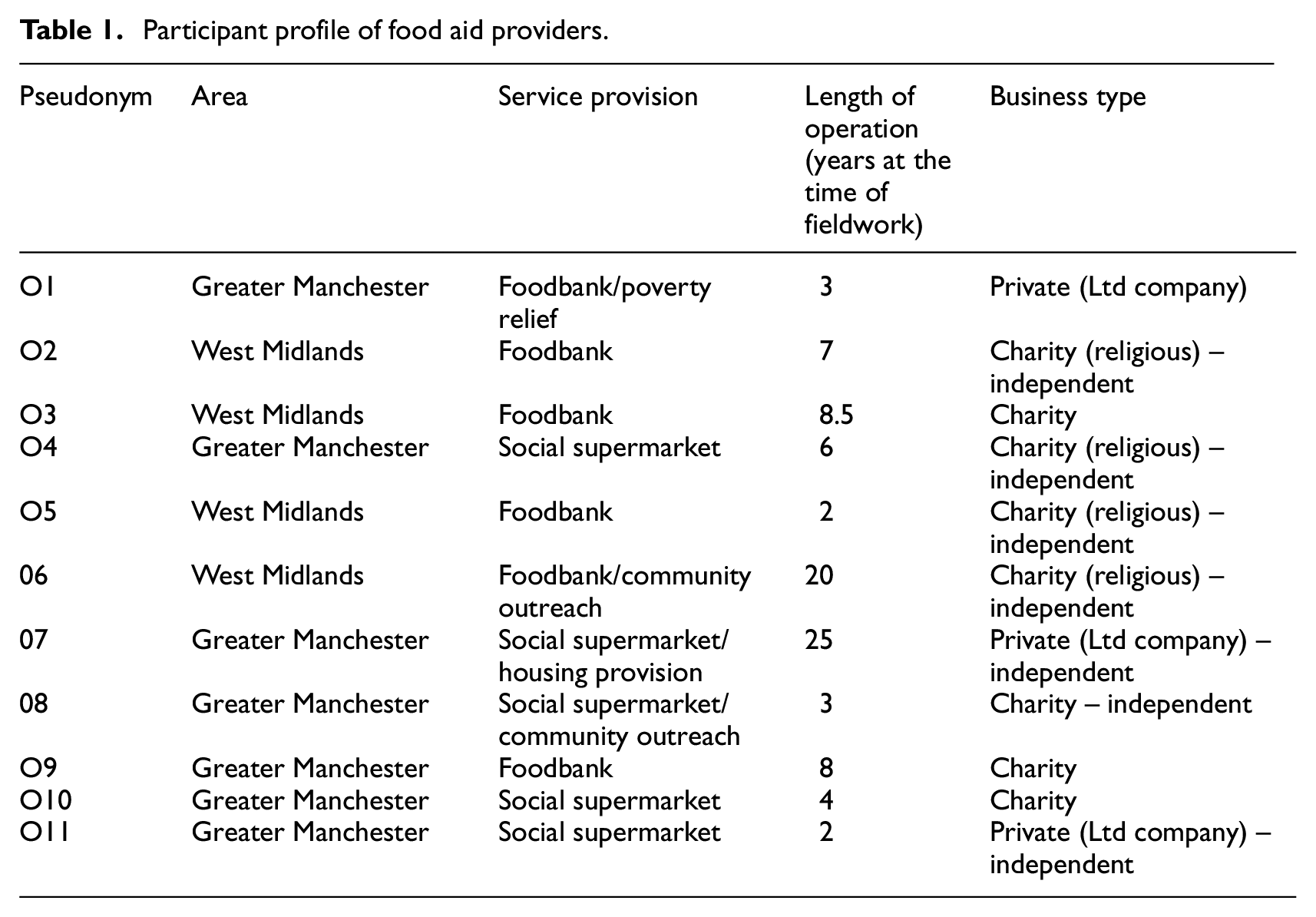
Organisational participants originated from a variety of food aid providers and were located in the Greater Manchester and West Midlands regions, two regions which regularly feature in the top 10% most deprived areas of the UK (IMD, 2019). These are areas with the highest and sixth highest number of emergency food parcels distribution in the UK, respectively (Tyler, 2020). Participants’ profiles (Table 1) reflect the diversity of the organisations involved in attempting to address urban food poverty and are coded to ensure their anonymity.
Participant profile of food aid providers.
We visited all 11 organisations that took part in the research and carried out one interview per food aid provider. Usually, these visits lasted between 1.5 and 2 hours. The interviews ranged from 30 to 90 minutes and the remaining time was spent on personal tours of the facilities while food aid was being provided during operational hours.
The semi-structured discussion guide included questions about how the organisations were providing food aid access, the nature of their food access operations, how long they had been operating for and the scale of their operations, whether they provided any additional services (e.g. budgeting or debt advice, job or cooking clubs, help claiming benefits, domestic violence support referrals, homelessness support referrals), and their social, spatial and transitional impact. Due to the flexible nature of the discussions, conversations expanded to include the political and social welfare landscape, as well as broader issues of regional deprivation.
After transcription of the audio-recorded interviews, we used a thematic approach to data analysis to address our main research question. The approach involved iterative reading of transcripts, inductive data coding to illuminate data patterns, identifying emerging themes, refining themes and then writing up (Braun and Clarke, 2006; King and Brooks, 2018). Our analytical process made use of NVivo. It ensured interpretive quality by providing emic evidence of interpretation (i.e. participants’ quotes) and emphasising the study’s contributions to existing theory (Pratt, 2009).
This analytical process revealed how food aid organisations perceive the segregating spaces of urban food poverty, their modus operandi, and how they attempt to facilitate transition from segregating spaces to spaces that can provide more secure types of food access to people. In line with our research question – which asked, how spaces of food aid provision address urban food poverty and facilitate transition from poverty-based, segregating spaces into more secure spaces of food access? – the findings begin by providing an overview of the new type of space that emerges through the data, namely transitional space. This type of space is then unpacked through the following subsequent themes: the role of subjugation and consensus within the segregating space of food aid how spatial and operational models of food aid providers impact food poverty-based segregation and offer potential for transition; and overcoming poverty-based segregation and manifesting transitional spaces of food access.
Findings and discussion: Facilitating transitions from poverty-based segregated spaces into more secure spaces of food access
Overview
In the sections that follow, we extend Castilhos and Dolbec’s (2018) typology of spaces by proposing and theorising an additional type of space, that of transitional space, based on our empirical research. Based on our qualitative data, we define transitional space as transient spaces that lie between spatial types. The themes that follow underpin this conceptualisation by unpacking the logics within the food aid-related segregating spaces, how their operating models impact the potential for more secure food access spaces, and how transitional spaces of food access then manifest.
Subjugation and consensus within the segregating spaces of food aid
This first theme addresses our research question by revealing the logic dynamics of the segregating spaces of food aid and the organisations attempting to facilitate transition to more secure spaces of food access. Despite all food aid organisations’ endeavours to reduce the negative poverty effects of segregating spaces, the broader cultural and political contexts of poverty (Sen, 2006) and their logic of subjugation are reflected clearly across the two regions researched. Income inequality, stagnating wages, and increased reliance upon the gig economy (Marmot et al., 2020) revealed concentrated levels of poverty (Massey, 1990; Quillian, 2012) and reflected such a logic. Specifically, we witnessed increasing wealth inequalities and austerity-led local government funding cuts, which hindered food aid providers’ capacity to reach those in needed: We have less government departments … so the Citizens Advice neighbourhood office closed … we’ve lost a lot of the agencies that used to refer to us. (O2, foodbank, West Midlands)
O2′s comment verifies the logic of subjugation enforced by austerity measures. Such measures have worsened the impacts of poverty-based segregation across urban areas through the enforced closure of services and premises that sought to benefit those without means (e.g. closure of public spaces, removal of public advice services). The results of this logic contribute to the creation and perpetuation of segregating spaces, hindering transitions out of poverty.
Unsurprisingly, food aid organisations across both regions expressed alarm at the rising demand for food aid. Such is the increasing scale of demand and perpetuation of the logic of subjugation that one organisation spoke about how they did not want to be included in a regional food aid mapping exercise because they were ‘oversubscribed everywhere’ (O11, social supermarket, Greater Manchester). This is because taking part in such an exercise would likely increase demand and therefore strain their services further.
Our findings also show that various demographic groups, such as those experiencing homelessness, unemployment, or in-work poverty (e.g. zero hour contracts, gig economy employees) are all extremely likely to encounter each other when frequenting urban food aid premises located near churches, community sports halls and housing blocks. These individuals come together within the spaces of foodbanks or social supermarkets because of state-enforced austerity (e.g. government-enforced benefits system reforms and delayed payments), social isolation (e.g. loss of employment, mental health issues) and/or low income. Indeed, despite common stereotypes of the type of foodbank user (e.g. the unemployed, homeless), many organisations discussed the growing numbers of people in-work having to access food aid services: It’s people who are employed, people who are unemployed … it’s people who are struggling to make ends meet … we plug a gap for people who possibly are waged or on benefits. (O8, social supermarket, Greater Manchester)
Interestingly, despite their diverse backgrounds, people are then organised around a logic of consensus. This is because all food aid users are excluded from the food marketplace and utilise the same charitable spaces, with the same mutually arranged attributes and configurations; spaces that gravitate towards cohesion.
In summary, a logic of subjugation as exercised by austerity politics and the welfare state impacts the need for food aid access through charitable food aid providers and contributes to the creation and perpetuation of segregating spaces of poverty in urban areas. The concept of segregating spaces resonates here, as food aid providers offer an exclusionary space for individuals who need access to food and other forms of urban poverty support. These individuals come together through the segregating spaces of food aid provision and are then organised around an orienting logic of consensus (Castilhos and Dolbec, 2018). While these individuals may not be described as a homogenous group, they share the common attribute of being excluded from the mainstream food marketplace through either no or low income.
How spatial and operational models of food aid providers impact food poverty-based segregation and the potential for transition
This theme responds to our research question by elaborating upon how food aid providers address food poverty. Particular emphasis is given to their spatial and operational organisation and how social supermarkets facilitate transition from segregating spaces to spaces offering more secure forms of food access.
Spatially, all food aid providers locate their premises in busy, urban spaces accessible to heavily populated residential areas and adopt a variety of operational approaches. There exists significant variation around foodbank provision, ranging anywhere between three-day and five-day food parcels being distributed over a period of six months to a year. Organisation O3 exemplifies this point, highlighting the need for flexibility regarding the number of vouchers and, correspondingly, the number of food parcels that people can receive during each crisis: No more than three vouchers per crisis – We’re dealing with vulnerable people and therefore, sometimes somebody will have a crisis, six months later they’ll have another crisis, and we don’t stand there saying ‘well you’ve had your lot for this year’. We treat it as a fresh crisis and start again. (O3, Foodbank, West Midlands)
Financial and ethical tensions are prevalent between traditional foodbank operation models versus independent or social supermarket models. For example, O6 (Foodbank, West Midlands) talks about their objections to paying a membership fee to ‘join Trussell Trust’ as they do not ‘agree with their principles … If I’m going to pay £1000 to join an organisation, I’d rather pay £1000 worth of food … the principle of it is wrong’.
However, many organisations are limited by inadequate funding or inappropriate premises and cannot provide the scale of help required on their own. Therefore, most food aid providers are involved in partnerships between local and national registered charities (e.g. housing associations, churches, advice agencies), private partnerships (e.g. supermarkets) or partnerships between regional government and the tri-sector (i.e. charity-business-government) to stretch their financial and human resources further.
Social supermarkets, in particular, help create such partnerships informally to meet demand but also to create safe, transitional spaces of food access for people. For example, O10 describes how they collaborate with partners: We’ve formed partnerships – and I use the term loosely, because there’s nothing written when we do this. I basically go, ‘look, here’s a deal – you provide the space and volunteers … we will bring the food, the staff, the supervision, the compliance and create a safe bubble for your community’. (O10, social supermarket, Greater Manchester)
Such initiatives between social supermarkets and other market actors illustrate the liminal spatial type of transitional spaces, as social supermarkets attempt to mitigate tensions between spaces and respond to their users’ needs. They do so by providing a temporal space more aligned with the logic of negotiation, as social supermarket managers negotiate food surplus donations and warehouse space, for example, to facilitate transition to more secure food access. Here, we see transitional space emerge as a kind of transient space that lies between spatial types. Traditionally, urban planners have acknowledged space as binary (i.e. indoors–outdoors, public–private) and/or as dichotomous oppositions (Pittaluga, 2020). Instead, we see transitional space as a non-binary alternative that allows for a more liminal space (i.e. a ‘safe bubble’, in O10’s words) to be co-created through responses to societal needs and uses (Lefebvre, 1991).
Many foodbanks acknowledge their food parcels as temporary ‘sticking plasters’ (O5, Foodbank, West Midlands) in terms of addressing urban food poverty. Nevertheless, this perceived temporal modus operandi is supported by a vocal desire among social supermarkets to avoid further institutionalisation of food aid provision. Further, O7 discusses the benefits and challenges of remaining independent and wanting or needing to circumvent franchising akin to the Trussell Trust foodbank model of emergency food provision: We do give out food parcels, but we’ve been unhappy about it for a long time because we don’t feel it’s a model that particularly fits with our core values around choice and dignity … [so]what we do now is our food club. (O7, social supermarket, Greater Manchester)
O7’s quote shows how respect for human dignity is a key value that helps them navigate the tensions that inscribe independent food aid provision in urban areas. More importantly, this quote alludes to the transitional role of social supermarkets (in this quote referred to as a food club) in helping people transition from segregating spaces of emergency food aid to more dignified forms of food access. Indeed, O7 offers an instantiation of how social supermarkets are positively addressing segregating practices by creating a temporal space more akin to, but nevertheless distinct from, food providers in market spaces, where people have food choice. Figure 1 depicts the intermediary qualities of transitional spaces with a dotted rather than solid line, representing liminal movements (i.e. forwards and backwards), fluidity of interactions (i.e. flexibility), influences among spatial types, and the potential for individual transformation.
The social supermarket model is considered more dignified and different to emergency food provision, as it does not discriminate participants based on conditionalities, that is, based on people having to prove that they deserve help because they are living precariously and in dire need. Additional tensions and logics are highlighted further in the comparisons made between providers who address food poverty through social supermarkets versus those providing short-term, emergency food aid: This is a slightly different approach which is, I’ll probably say a more dignified, and a more sustainable … approach. It’s a food club. People join, pay a [token] weekly fee, and in return, are able to then access good quality food on a weekly basis. (O4, social supermarket, Greater Manchester) As a social supermarket, the work of the chef and our cookery school, and confidence building finance classes, employment, mentoring, all that stuff will always be there as long as we are selling tins of beans. It won’t be taken away on the whim of the government or local government who decides that in a year’s time they are not going to fund that work anymore … we didn’t want to run a model that was reliant on somebody else (O11, social supermarket, Greater Manchester).
As O4 and O11 show, social supermarkets strive to operate independently by providing a more dignified food access model for low-income individuals and by reducing the effects of the logic of subjugation and of the homogenising forces of the logic of consensus. The main logics affecting transitional spaces remain the same as in the original model (see Figure 1). However, due to the liminal positioning of transitional spaces, the main orienting logics are dependent upon the direction of people’s transition. Additional logics are at play, too, although perhaps less dominantly, as this is a liminal space where existing logics might be flexed, tested and contested. For example, as the data shows thus far, as people are attempting to transition between segregating and market spaces, the main governing logic of subjugation might remain dominant. However, the segregating space’s orienting logic of consensus and the market space’s logic of negotiation are also a part of the transient logics of such transitional spaces.
A social supermarkets’ model can be sustained over time and include additional services where possible, helping people transition into more secure forms of food access. Through various funding sources (e.g. loans, donations, National Lottery) and partnerships, most social supermarkets provide additional services other than just food access. Services include job clubs, cooking clubs, benefits advice, debt management and café facilities, which create opportunities for people to transition out of emergency food need.
For example, O10 talked about regularly having ‘representatives come in from Shelter… and do one-to-one Universal Credit support as a drop-in service’ (social supermarket, Greater Manchester). This would suggest that social supermarkets offer an enriched spatial infrastructure that not only takes care of an individual’s food needs over the longer term, but also helps to alleviate transition out of food poverty by recognising other poverty-related barriers to reaching more secure forms of food access.
Although many urban food aid organisations express an interest in doing more, foodbanks in particular feel that responding to public demand for food was more critical than offering other areas of support. For example, O9 justifies this decision by explaining, It was getting busier and busier, and we just had to make a call – we just needed to stick with the core business … rather than diversifying. (O9, foodbank, Greater Manchester)
In summary, as foodbanks are less focussed on addressing wider issues of poverty, participants recognise the limitations of the foodbank model. Nevertheless, there is a clear desire to facilitate transition out of urban poverty among social supermarkets, who are counteracting the harsher effects of the logics of subjugation and of consensus while creating transitional spaces of food access.
Overcoming poverty-based segregation and manifesting transitional spaces of food access
This final theme addresses the second part of our research question concerning the extent to which food aid providers can and do facilitate transition from the segregating spaces of food poverty towards more sustainable forms of food access.
Like other types of spaces that mediate production and consumption, transitional spaces communicate visual (e.g. colours), physical (e.g. steps), and embodied (e.g. links between space, smell, and memory) qualities. Although unintentional, our data additionally point towards how, in some cases, the segregating spaces of food aid provision contribute to people’s lived experiences of poverty-based segregation. For example, people accessing food aid often had to form long queues publicly outside the premises or were made visible through glass-fronted premises, adding to the stigma that people experienced (Lambie-Mumford, 2017; Moraes et al., 2021, 2024). Additionally, food aid organisations who made use of old churches or church halls often viewed their premises as not being physically and/or psychologically appropriate to deliver the full range of services needed to facilitate transitions out of food poverty: They’re OK for a food club where people can come or could be given a meal maybe. What they’re not very good for is the educational environment or the support aspects … or they would probably fail on a more rigorous approach from a public health perspective. (O1, foodbank, Greater Manchester)
Other food aid organisations acknowledge similar visual and/or physical limitations and talk about their attempts to help ‘make the whole environment … as relaxed and informal as we can’ (O9, Foodbank, West Midlands). However, social isolation is also a segregating factor, as discussed by O5: People feel isolated. It’s not all about the poverty … it’s the isolation; it’s the way it makes them feel … You can tell that when they produce the voucher, they’re looking around. Even though everyone knows what they’re all there for. (O5, Foodbank, West Midlands)
Therefore, to help overcome segregation and stigma and facilitate transition, organisations aim to ensure that food aid provision is ‘about being really embedded in the community’ (O1, foodbank, Greater Manchester). O2 (foodbanks, West Midlands) explains how they are ‘part of a community forum’ and how this helps to promote their services to schools and the wider community.
For most food aid providers, achieving a successful transitional space is less about the challenges involved in alleviating food poverty and more about reconfiguring social-spatial relations through a logic of negotiation. For example, social supermarkets played a key role in bringing stakeholders together from inside and outside the immediate community to help achieve social reintegration: For some people it’s also the social aspect … if you’re living on the estate, you are living on your own, or you’re quite isolated, so a space where you can go and meet the same people every week [is helpful], actually, there’s other reasons than just the food. (O4, social supermarket, Greater Manchester)
As exclusionary segregating spaces (Castilhos and Dolbec, 2018), food aid organisations acknowledge poverty-based segregation from both inside the community and across the region for individuals who are excluded from the mainstream food marketplace. In their attempts to deflect poverty-based segregation and re-shape urban systems of food aid, social supermarkets appear to go above and beyond the role of food distributor, not just to ensure that access to food is available to all, but also to counteract the effects of segregation by re-shaping the socio-spatial dynamics of communities.
Numerous efforts to address and reconfigure segregating spaces in the researched areas are evident. Food aid organisations commonly discussed how they do not focus on alleviating food poverty per se, but rather aim to assist individuals to transform their personal circumstances and transition to other spaces of food provision. O10 discussed how their plan involves providing ‘support to each of the critical access points for people in food crisis’ and how this approach facilitates being ‘able to move [individuals accessing food aid] from being in crisis to support them in terms of being more food secure as well as secure improvement to public health’ (social supermarket, Greater Manchester). Similarly, O4 felt that for some people, the pantry is a route to potentially dramatic change … there’s a lot of other things around, which wouldn’t [be] if the food wasn’t there … there’s opportunities to contribute and feel useful and gain some skills … it’s interesting how much more once you unpack it [what] a pantry offers. (Social supermarket, Greater Manchester)
The desire to enable people to feel they can participate in ‘the normal portfolio shop, where you buy some products in some places and then some somewhere else’ (O10, social supermarket, Greater Manchester) is common among social supermarkets. Indeed, many organisations highlight the transitional qualities of their spaces as enabling transitions from emergency food segregation (i.e. foodbank) to the more dignified and inclusive spaces of social supermarkets.
Additionally, despite spatial deprivation differences between Greater Manchester and the West Midlands, and the desire not to entrench foodbanks, most food aid organisations felt that ‘foodbanks were not going to go away’ (O6, foodbank, West Midlands) and that food poverty would ‘continue to get worse until there’s a significant change in policy’ (O9, foodbank, Greater Manchester). Due to the tensions between the short-term focus of emergency food aid providers and organisations who favour longer term approaches like social supermarkets, many emergency food aid providers called for more collaborative partnerships that ‘look beyond Trussell Trust models’ (O6, foodbank, West Midlands) to facilitate transition and help alleviate poverty.
In sum, the social supermarket model highlighted above not only contributes to the potential transformation of socio-spatial relations, but also permits food aid organisations to hold a liminal space to widen stakeholder involvement (i.e. transitional space) and facilitate transitions from segregating spaces to more dignified food access spaces, whether market-based or alternative forms such as cooperative and local buying arrangements. The findings show that transitional spaces allow for a more nuanced spatial pathway for achieving transitions through spatial types. Transitional spaces offer a middle ground for people, food aid organisations and partners that can help if the ‘leap’ from one space to another is too great or complex to achieve, as is the case with a transition from accessing the aid of a foodbank (i.e. a segregating space) to shopping at a supermarket (i.e. a market space), for example.
Conclusions, limitations and avenues for future research
This research set out to identify how spaces of food aid provision address urban food poverty and whether they help to facilitate transition from poverty-based, segregating spaces into more secure spaces of food access. Using an interpretive, qualitative research approach to interviewing food aid providers, our findings demonstrate Castilhos and Dolbec’s (2018) notion of segregating spaces and their orienting logics of subjugation and consensus. The findings also illuminate the tensions and misalignments that occur among the diverse logics orchestrating different models of food aid provision, which then generate the impetus for transitional spaces, and which in this work manifest as social supermarkets. Here, we do not wish to convey that social supermarkets are the only way that transitional space is made available to such groups. Rather, we are aware that there are other forms of food aid access, which can also be seen as types of transitional spaces. Examples might include social eating projects and social enterprises that engage people in food growing. However, such forms of food access were outside the scope of our primary research.
Further, networked foodbanks unintentionally contribute to poverty-based segregation because of their operational models and how they are organised, responding to external logics of subjugation and exhibiting internal logics of consensus that prevent people transitioning to more secure modes of food access. In contrast, our work establishes that social supermarkets mitigate, at least in part, these space-making powers, because they do not restrict food access through a ‘dire needs-based’ eligibility system (e.g. referral tokens). The operational model that social supermarkets adopt also ensures wider support beyond the provision of emergency food and is therefore acknowledged both operationally and relationally as providing a more transformative approach to food poverty. Consequently, our research points to the need for in-between, fluid spaces, which address at least in part, the misalignments among external forces and the many competing logics that challenge food aid providers and that prevent those accessing food aid from transitioning to more secure spaces of food access, such as market spaces, for example.
For clarity, we do not wish to imply a hierarchy that presumes the preferred transition is one from a segregating space (i.e. the foodbank) to a space of the market (i.e. the supermarket). Indeed, in many instances the need might be to provide transitions from segregating to public spaces, as poverty and food insecurity are not just about a lack of calories or nutrition, but rather also about a lack social connections, for instance. In fact, many initiatives seeking to tackle food poverty attempt to help people transition towards more secure forms of food access through cooperative and/or local buying arrangements rather than a return to the mainstream supermarket. Indeed, an implied transition from segregating to market spaces is an economistic hierarchy that tends to align with, and be implied in, austerity policies, media and market logics rather than something that we wish to convey or perpetuate through this work. Instead, we hope that our conceptualisation of transitional space can illuminate the often taken-for-granted assumption that people should or would want to go back to the supermarket for food access, as existing evidence suggests the contrary (Moraes et al., 2021).
This work responds to calls for more research on how food aid organisations operate both spatially and relationally (Loopstra and Lambie-Mumford, 2023; Morgan, 2015), advancing existing knowledge of charitable efforts dedicated to addressing urban food poverty. It does so, firstly, by foregrounding how UK food aid providers perceive and respond to the social challenges of urban food poverty to create spaces of transition. This contribution is significant given the rising levels of poverty and deprivation being experienced in the UK.
Second, we contribute to furthering research on the spatial relations surrounding poverty (Hincks, 2017; Nieuwenhuis et al., 2020), which is important given the increasing economic segregation between the haves and the have-nots (Gibbons, 2018; Hincks, 2017; Massey and Fischer, 2000; Nieuwenhuis et al., 2020; Panori et al., 2019; Zhang and Pryce, 2020) across UK cities. In doing so, we augment the concept of space as a practiced place (de Certeau, 1984; Lefebvre, 1991), furthering understanding of segregating space.
Thirdly, we extend Castilhos and Dolbec’s (2018) typology of spaces by establishing transitional space as an additional type of space that facilitates movement between spaces. This extended conceptualisation is significant, as it allows for a more nuanced depiction of the spatiality of deprivation and concentrated poverty.
National statistics highlight Greater Manchester and West Midlands as regions with the highest and sixth highest number of emergency food parcel distribution, respectively (Tyler, 2020) and echo the exponential growth in the number of emergency food parcels distributed year on year across the UK (Trussell Trust, 2021). Similarly, our findings demonstrate that UK food aid organisations had witnessed significant increased demand from individuals experiencing urban food poverty at the time of the research.
The urban spaces of concentrated poverty segregation offer empirical evidence of segregating spaces coordinated by the logic of subjugation of the welfare state and an orienting logic of consensus among food aid providers (Castilhos and Dolbec, 2018), particularly foodbanks. However, our empirical context additionally suggests the presence of transitional spaces between spatial types. Through our original concept of transitional space, we highlight that an individual accessing food aid is unlikely to transition directly to a market space. This is not because of any mediated resistance to ‘the marketisation of space’ (Castilhos and Dolbec, 2018: 162), but rather because individuals experiencing food poverty are unable to access mainstream retail spaces due to a lack of income and sometimes other issues such as mental health problems, needing instead the transitional spaces that social supermarkets enable.
Our empirical context of urban poverty and food poverty specifically has revealed how our proposed addition of transitional space as a supplementary type of space facilitates movement between spaces. This conceptualisation also permits greater opportunities for understanding additional transitions that are likely to occur among the remaining three types of space. This theorisation can ‘travel’ and be extended to different contexts such as additional urban cities in the Global North, for example. This is because it offers a lens through which to examine a variety of urban contexts. It also reveals additional research opportunities for urban studies scholars interested in furthering existing understandings of the role of spatial types in shaping, and being shaped by, economic-driven urban poverty.
The wider relevance of this theorisation lies in its ability to illuminate the roles that different but interconnected kinds of space and their orienting logics can play in perpetuating or alleviating urban space and place issues. For example, further insights into people’s transitions between public and market space could be gained in the event of public parks or swimming pools becoming increasingly privatised. The concept of transitional space could then be used to illuminate the kinds of liminal spaces and negotiation logics that emerge to address the erosion of the commons as public authority budgets diminish and tensions increase over access to services that were previously freely available to all.
Finally, we acknowledge our single focus on transitions between segregating and transitional spaces as a limitation of this research. Nevertheless, this opens up the scope for additional studies on transitions between other spatial types. We also acknowledge that we examined only two areas of deprivation in the UK and only one manifestation of transitional space (i.e. social supermarkets). This presents opportunities for further investigation of additional transitional spaces, such as community growing initiatives.
Footnotes
Acknowledgements
We would like to thank our participants for their time and for sharing their knowledge with us. We would also like to thank our reviewers and participants at the British Sociological Association Annual Conference for their helpful comments and suggestions.
Declaration of conflicting interests
The author(s) declared no potential conflicts of interest with respect to the research, authorship, and/or publication of this article.
Funding
The author(s) disclosed receipt of the following financial support for the research, authorship, and/or publication of this article: We gratefully acknowledge funding from the British Academy/Leverhulme Small Research Grants 2017-18 Round Scheme, through which this research was funded.
