



Abstract
The idea of the modern city continues to inform urban policies and practices, shaping ideas of what infrastructure is and how it ought to work. While there has long been conflict over its meaning and relevance, particularly in southern cities, alternatives remain difficult to identify. In this paper, we ‘read for difference’ in the policies and practices of sanitation in Kampala, purposefully looking for evidence of an alternative imaginary. We find increasing acceptance of and support for heterogeneous technological artefacts and a shift to consider these as part of wider infrastructures. These sanitation configurations are, at times, no longer framed as temporary placeholders while ‘waiting for modernity’, but instead as pathways towards a not yet predetermined end. What this technological change means for policies, permissions and socio-economic relations is also as yet unclear: the roles and responsibilities of the modern infrastructure ideal have limited significance, but new patterns remain in the making. Further, while we find increased attention to limits and uncertainty, we also see efforts to weave modernist practices (creating legible populations, knowing and controlling nature) into emergent infrastructural configurations. In this context, we consider Kampala not as a complete instantiation of a ‘modest’ approach to infrastructure, but as a place where struggles over infrastructure are rooted in competing, dynamic imaginaries about how the world is and what this means for the cities we build. It is also a place from which we might begin articulating a ‘modest imaginary’ that enables rethinking what infrastructure is and ought to be.
Introduction
Flushing toilets might well be the epitome of modern technology. Used in private, with a glossy aesthetic, a simple flush makes our waste seem to disappear. The lack of this infrastructure is seen as indicative of global socio-economic division and a crucial public health and ecological concern. While it is oft-cited that roughly a quarter of people lack access to improved sanitation, only 30% of the global population has flushing toilets connected to a sewer (WHO, 2019).
How ought such inequalities be redressed? Should modern technology be extended to the nearly six billion people without such infrastructure? In the height of modernist development, the answer to this question was unequivocally ‘yes’. Colonial-era sewers, built primarily for white-only residential and commercial areas, would be spread to the peripheries, providing the gleaming artefact to modern citizens (Letema et al., 2014; Monstadt and Schramm, 2017; Nilsson, 2006). Many continue to believe such narratives, attributing shortcomings to colonialism and capitalism, doubling down on the promise of modernity to deliver modern infrastructure to all (Bond, 2019; Morales et al., 2014).
Yet the toilet (and infrastructure more broadly) is also indicative of the troubles of modernity, for despite valiant efforts, in practice modern toilets rarely fully embody their promise (Morgan, 2002). They are frequently dirty and do not always work, sewers leak and water scarcity problematises the ease of flushing. Further, infrastructure in southern cities in and beyond sanitation has long been diverse (Letema et al., 2014; McFarlane, 2008): they are heterogeneous configurations comprised of social, technical, political and economic difference (Lawhon et al., 2018; see also Jaglin, 2014). A plethora of scholarship on southern urban infrastructure has critiqued the inadequacies of modern infrastructure and shown that some non-modern sanitation configurations work well, while others clearly do not (Alba et al., 2020; Björkman, 2015; Furlong, 2011, 2014). For sanitation and beyond, debates about what is healthy, dignified, affordable and ‘appropriate’ are ongoing (McFarlane and Silver, 2017). What to do about the toilet (and infrastructure more broadly) has, thus, become a notable point of friction amongst environmentalists and well-intentioned advocates of development (Avellán, 2017; Clark, 2019; Ward, 2021).
Debates over toilets are, crucially, not just about sanitation. They are underpinned by, and provide a lens into, imaginaries of the world we have and the world we aspire to make (Jasanoff and Kim, 2015; Jensen and Morita, 2017). This paper builds on the idea that urban scholarship ought to attend not just to the limits of existing infrastructures, but to the role of infrastructure in ongoing uncertainties over the kind of worlds different people might want to make. Thus, while we engage with literature on southern infrastructure, we work to contextualise them within the wider literature on modernity. For there are often underemphasised connections between beliefs in the promise of modernity and beliefs in the possibility of modern sanitation for all. Similarly, those sceptical of the promise of modernity must look elsewhere for ideas of infrastructure, and have instigated renewed inquiries into what material lives are possible and for whom (Anand et al., 2018; Kaika and Swyngedouw, 2000; Wakefield, 2018). At present, however, such inquiries often leave us without a clear pathway towards an alternative.
What might it mean to stop aspiring to modern sanitation for all while still working towards safe and dignified sanitation for all? How might we distinguish between ‘good’ and ‘bad’ (or, better and worse) heterogeneous configurations of sanitation? More broadly, what kinds of socio-material worlds are possible if we reject the modernist assumption that we can know and control nature and each other, but still believe the world can be made better? Where might we look for ideas, ones that might not be fully formed but provide a starting point from which to imagine anew?
Inspired by the idea of reading for difference (Gibson-Graham, 2020; Ordoñez, 1982) as well as arguments for theorising from the south (Parnell et al., 2009; Robinson, 2006) and scholarship on southern urban infrastructure (Cirolia and Rode, 2019; Furlong, 2014), in this paper we begin formulating what such an alternative might entail. We examine sanitation policies and politics in Kampala and identify a growing scepticism (albeit not a full rejection) of the possibilities of modern sanitation. We also find an emergent explicit acceptance of a diversity of technological artefacts. This is accompanied by a shift towards the state as coordinator (rather than provider or rule-maker), and a growing acknowledgement that knowledge and power are distributed. Importantly, we suggest these changes are not simply about sanitation, but indicative of wider ongoing shifts and contestations over how the world is and ought to be. Specifically, we suggest these changes can be read as indicative of what we call a ‘modest imaginary’. This imaginary is rooted in an acceptance of the realities of heterogeneity, uncertainty and the inability to truly know and control our world and others. Importantly, it is not an anti-modern imaginary that rejects progress or the utility of knowledge, but an alternative imaginary outside the modern/anti-modern binary.
While our naming of it is new, we are clear that the imaginary itself is not. Instead, we position it as resonating with many long-standing non-modern ways of engaging with and understanding our world (see Lawhon et al., 2021). We also believe it accords with many ongoing infrastructural practices globally, even if much literature has not explicitly attended to these underlying beliefs. Here, we frame Kampala as a site of contestation over infrastructure and imaginaries as well as a place from which to begin theorising a modest imaginary. Our interests in what follows, then, are both to identify changing practices and ideas of sanitation as well as to tease out aspects of what we call a ‘modest’ imaginary.
The modern imaginary and modern infrastructure
What is the modern (city)? Should modernity be embraced, rejected or modified? Such questions have been asked in urban studies and beyond, producing a plurality of meanings, extensions and reworkings. Postmodern inquiries, often rooted in northern cases and concepts, challenged the veracity, idealism and empirics of modernity and sought to articulate an alternative analytic and description of the city (Dear and Flusty, 1998). Critiques of modernity often took a different shape in the Global South, emphasising its connection to colonialism (Mignolo, 2011). Postdevelopment, often drawing on postcolonial theory, rejects the teleological narrative of modernisation (Pieterse, 1998). Others writing of and from southern places argued for reworking the geographies of modernity, insisting on more cosmopolitan roots and visions (Robinson, 2006; see Monstadt and Schramm, 2017 on infrastructure).
We instead suggest that there is analytical and political utility in a narrow and specific use of the term ‘modernity’, for extensions and expansions can both hide ongoing inequalities and make it difficult to identify alternatives (see Ferguson, 2005; Lawhon, 2020). Rather than revising modernity, we work to distinguish ongoing and emergent politics and practices from established modern ones. Mindful that the world has long ‘been tired of grand solutions’ (Max-Neef, 1991: 110), we assert that there remains a need for analytical vocabulary to understand and imagine less grand alternatives. In this context, we propose a ‘modest’ imaginary.
We consider modernity as an imaginary, a set of ideas about what the world is and how it works. Imaginaries are rarely explicit, but become materialised in particular objects and relations, politics and processes. Imaginaries can be investigated through analysis of narratives, which are often provided by actors as they explain a story of what is and ought to be. A modern imaginary is premised on a world that is external, knowable through objective science and controllable through technology (Lorimer, 2020; Merchant, 1980). This world is comprised of categories, and these categories can be placed into hierarchies; modern statecraft means creating and controlling populations. Social improvements are to be achieved through clearly defined universal aims, including a specific type of scientific advancement, industrialisation and democracy (Ferguson, 2005; Lushaba, 2009). Yet, importantly, while modern imaginaries travel the globe, modernity (as we have identified it) is an inaccurate representation of the world, never quite achieved anywhere, always an imagined state even in places deemed at the top of the hierarchy (Latour, 1993). Modernity thus simultaneously shapes aspirations and practices while only existing in the realm of the imagined.
Infrastructure, as a site of critical theorisation as well as empirical dynamism and experimentation, provides important insights into the power and limits of the modern imaginary (Anand et al., 2018; Jensen and Morita, 2017; Wakefield, 2018). ‘Modern infrastructure’ is a shorthand for infrastructure that was built as if modernity accurately described our world; yet if modernity is an inaccurate representation of the world, then truly modern infrastructure cannot exist. Instead, infrastructures that are underpinned by a modern imaginary require continuous modification, recalibration and repair. What, precisely, modern infrastructure is remains difficult to precisely name, and varies over time and space (Gandy, 2014). Yet, as noted above, we believe it is important to tease out its meaning so as to more clearly distinguish modern from non-modern infrastructures.
The modern imaginary has, nonetheless, long shaped narratives of what good infrastructure is, resulting in what Graham and Marvin (2001) call ‘the modern infrastructure ideal’. Building infrastructure was and continues to be a key part of enacting modern visions: big dams exemplify the spectacle of the modern, providing a material function and performance of state power (Mitchell, 2002; Swyngedouw, 2015). Other forms of infrastructure, like sewers, are less visible but have been promoted as part of a story of modernity, ‘in the name of progress, development, growth and emancipation’ (Flaminio, 2021 p.205). Such infrastructure facilitates modern visions of urban metabolisms in which materials flow in and out of the city: waste generated in the city is to be moved outwards, to be deposited elsewhere. Infrastructures also transform social relations and expectations, including shifting what is understood to be public and private. As Gandy (2006) observes, ‘public activities such as washing were increasingly restricted to the private sphere whereas privately organised access to potable water or sanitation was gradually incorporated into a centralised, networked and municipally controlled metropolitan form’ (see also Kaika, 2005). The modern imaginary also identifies an appropriate role for the state as provider of services. Infrastructural economies are to be based on citizen payments paying for services, subsidised by states who would enable access for the urban poor and distribute the upfront costs of extending the network (Graham and Marvin, 2001).
In sum, even if the modern ideal was impossible to fully achieve, the modern imaginary shapes the creation of modern infrastructural systems, systems built as if modernity were possible. It shapes the artefacts that are built: for sanitation, this means ceramic flushing toilets connected to underground sewers. It shapes political economic relations: states are to subsidise sanitation, provide and regulate sewers, but not toilets in private dwellings. It shapes material flows, supporting infrastructures that move waste out of the city and concentrate its management. It also reworks roles, responsibilities and relations of various actors: moving flows of water indoors reworks social relations and expectations and modern engineers are needed to build and manage infrastructure.
What of the places where there has never been modern infrastructure? Seen through a modern imaginary, they are places in waiting, where modern infrastructure is yet to come. For example, Du et al. (2019) acknowledge the unlikelihood of achieving universal access to flushing toilets in southern cities anytime soon. They observe that in Kampala ‘the average construction and connection cost of a sewered facility is almost 200% of a household’s average monthly income’. Yet their vision for the future continues to rely on modern infrastructure. They advise, ‘For cities to provide well-regulated, affordable sanitation services, they need to plan for the long term and extend sewer networks to households and communal and public toilets.’ The authors attribute this infrastructural limbo to a lack of political commitment and capital investment in modern technologies, presuming that modern infrastructure is indeed possible for all southern cities. They are not opposed to onsite sanitation options, but explicitly identify these as temporary solutions (see also Bond, 2019; Morales et al., 2014).
Yet as many have shown, modern infrastructure is fraught with problems. The global majority continue to operate without it, in part because it is expensive to build and maintain (WHO, 2019). It is ecologically unsustainable, particularly in places with water shortages. There is an ongoing search for alternatives across the Global North and South, often underpinned by pragmatic attention to economic and ecological flows (Ward, 2021). This searching, we argue, is usefully read in conjunction with a growing scepticism towards the modern imaginary and a need to identify alternatives that accord with the kinds of cities and infrastructures we might seek to build.
Not modern infrastructure, not a modern imaginary
How might we come to understand a different underlying imaginary and its implications for infrastructure? In and beyond urban studies, there is a growing call to theorise from southern spaces, to start with what is there rather than to view cities through ideas established elsewhere (Lawhon, 2020; Pieterse, 2011; Robinson, 2006; Watson, 2009). Such calls have prompted attention to infrastructures that do not fit the modern infrastructure ideal, as well as increased acceptance of the logic of technological diversity across the north and south (see Jewitt et al., 2018; Ward, 2021, for sanitation; more generally Coutard and Rutherford, 2015; Furlong, 2011, 2014; Jaglin, 2014; Lawhon et al., 2018). Seen through the lens of modernity, these infrastructures are not modern, are temporary (while people are waiting for modernity) and are deficient or substandard (of a lesser quality than modern infrastructure and/or in ruins, see Wakefield, 2018).
Yet many scholars, activists, policies and states reject this framing that starts with a modern ideal, instead starting from the south and emphasising how non-modern infrastructures work, explaining their operations, relations and politics (e.g. Alba et al., 2020; Alda-Vidal et al., 2018; Furlong and Kooy, 2017; Jaglin, 2014, 2015; Rusca et al., 2017a). Such studies have done much to help us understand the significance of infrastructure and its role in shaping urban lives, economies, ecologies and politics and the possibilities for infrastructure beyond modernity. They raise important questions about the ethics of infrastructural heterogeneity, particularly in cases where service quality differs (Jaglin, 2008; Zérah, 2008; see also Rusca et al., 2017b).
How and to what extent such practices ‘break’ with modernity, however, is not always clear. Indeed, some writing about ‘alternative’ technologies have argued for ‘modernized mixtures’ that work across various scales of infrastructure (Letema et al., 2014). While the technologies examined through this lens might well hold promise for moving beyond modern infrastructure, analytically it is not clear what is (not) ‘modern’ about such mixtures, and this concern is true for many southern urban infrastructural studies.
More generally, there is ongoing uncertainty over the social, political and economic relations that might constitute a good version of non-modern infrastructure. Privatisation (and its role in splintering the urban, Graham and Marvin, 2001) has been routinely condemned, accompanied by reassertions of the role of the state as owner and the importance of modern infrastructure for all. Yet there are many ways for non-state actors to participate in sanitation configurations (McGranahan and Satterthwaite, 2006). Postdevelopment thinking, for example, recognises the ‘private sector’ as heterogeneous and emphasises the potential of locally based economies (Demaria and Kothari, 2017). Such political economies are distinct from the provision of infrastructure by multi-national capitalist profit-oriented entities; they are instead driven by and responsive to a host of factors including and beyond exchange value (Sandbrook, 2011; see Alba et al., 2020 on water).
In what ways do particular heterogeneous infrastructural configurations differ from the ideal of modern infrastructure? It is clear that heterogeneous configurations are comprised of different artefacts and relations, often incorporating and drawing on networked infrastructures. Yet the imaginaries (again, the set of ideas about how the world is and ought to be) that underlie various heterogeneous configurations have been insufficiently attended to. Scholarship examining the imaginaries underlying infrastructure typically emphasise the failings of modernity rather than investigating alternatives (Anand et al., 2018; Wakefield, 2018). Jaglin (2015), instead, frames the growing acceptance of non-modern infrastructures as a ‘pragmatic turn’, a point we tentatively agree with. Yet pragmatism is not an end explanation: even pragmatism is informed by underlying rationales about what is working and why something else might work better. Our reading of the literature and practice is that there is something deeper going on in the studies and practices of heterogeneous infrastructure configurations, something that might be hard to clearly and tightly name but is worth attending to.
In sum, we are not without some guidance in our search for non-modern imaginaries that might underpin new infrastructural configurations: work on southern urban infrastructure and heterogeneous infrastructure configurations has usefully expanded analyses of socio-material flows beyond conversations about modernity, its absence and its failings. Yet there remains a gap in understanding how infrastructure links to broader imaginaries of the world, including consideration of the imaginaries that lie behind non-modern infrastructures, their logic and the extent to which they accord with the world we have. As a tentative starting point, we name one imaginary ‘modest’ and begin to tease out what it might mean to develop a modest approach to infrastructure that is underpinned by a modest imaginary.
A brief overview of sanitation in Kampala
Sanitation in Kampala has many parallels with that in other postcolonial cities, where modern infrastructure was built for white residents in the urban core (Nilsson, 2006). Despite an historical commitment to modern infrastructure, Kampala’s sewerage network only serves the city centre and 10% of the urban population. Most residents use onsite options, often built with support from the state and international development organisations. Some toilets do not need to be emptied (e.g. eco-san toilets) and some residents with open land can remove faecal sludge and use it as compost. Most toilets, however, must be emptied and the associated faecal sludge must be transported elsewhere. Officially, this has primarily been done by sanitation tanker trucks (called cesspools in Kampala) who transport the sludge to sewerage treatment facilities. Kampala’s municipal government owns and operates six trucks which remove waste from municipal sanitation facilities (like schools and public toilets) (Nkurunziza et al., 2017). Additionally, there are privately owned trucks that provide services for urban residents. As is common throughout the Global South, emptying also occurs in other ways: open dumping of faecal sludge results in environmental contamination that impacts human health. For in Kampala, as is also true more widely, onsite sanitation has typically focused on providing toilets rather than creating infrastructure to guide flows of waste (Gambrill et al., 2020). Ongoing efforts to change the sanitation configuration is largely prompted by a desire to reduce such practices.
Decision-making about infrastructure is shaped by fraught multi-scalar politics. Uganda receives substantial support from international donors, and urban infrastructure and governance is no exception here. More broadly, Ugandan politics continues to be shaped by discourses of modernity, a point succinctly captured in the National Vision Statement adopted in 2007 and repeated in each subsequent national development plan: ‘A Transformed Ugandan Society from a Peasant to a Modern and Prosperous Country within 30 years’ (GoU National Planning Authority, 2021).
Uganda’s capital city is home to most of its economic activity and a key site of resistance to an increasingly authoritarian state (Muwanga et al., 2020). Allegations of municipal mismanagement led to the creation in 2011 of the Kampala Capitol City Authority (KCCA), which is divided into ‘technical’ and ‘political’ wings. On the whole this has increased the influence of Museveni’s National Resistance Movement party on Kampala’s governance (Muwanga et al., 2020). The National Water and Sewerage Corporation (NWSC) is in charge of the nation’s sewers, and continues to oversee Kampala’s grid. KCCA plays multiple roles in the sanitation sector, including planning developments, creating local regulations and enforcing national and local rules. It is also tasked with harmonising multiple scales of regulation and urban development planning (KCCA, 2018). Finally, KCCA provides sanitation services at municipal public spaces, including public schools, market places as well as hospitals and health centres.
Methods
The central questions that we seek to address in this paper emerged from several years of empirical work on sanitation in Kampala, informed in particular by work done in conjunction with the Urban Action Lab at Makerere University (see Lawhon et al., 2018; Nakyagaba et al., 2021; Sseviiri et al., 2020). In this paper, we draw on an analysis of documents about sanitation, and read these through our wider engagements with stakeholders in and beyond the sanitation sector. These documents provide an important window into how different actors suggest sanitation infrastructure ought to work, although they provide only one angle into this question. Given our interest in investigating imaginaries, we do not extensively attend to a comparison between the documents and ongoing practices; on occasion we do situate these documents within a wider context to reinforce our arguments.
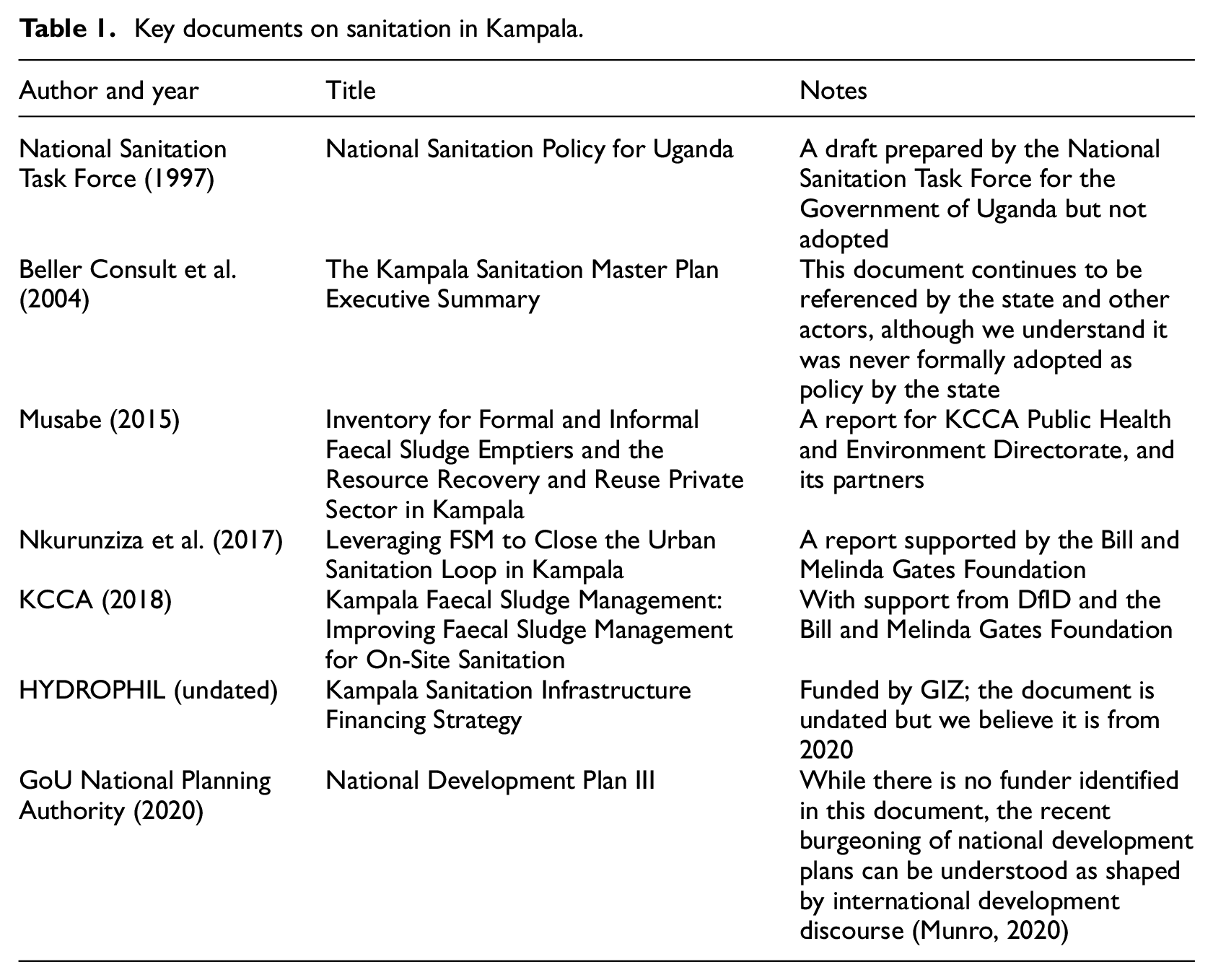
Documents were collected from online sources and directly from state and NGO representatives by Gloria Nakyagaba during her previous work on sanitation (see Nakyagaba et al., 2021). Our analysis is most informed by the documents in Table 1, and complemented by reference to national policy as well as an explanation of ‘City-wide Inclusive Sanitation’ (Gambrill et al., 2020). We focus on identifying state narratives, but the lines between the state, NGOs and the private sector are not always clear. For example, several texts we examined were written by consultants and funded by international donors, and some of them were published on the official municipal website; so their precise legal status was unclear. Others were similarly generated by consultants and donors for the state, although not adopted through an explicit legal process. Below, we emphasise growing attention to what we consider to be a modest approach to sanitation rather than a genealogy of its ownership and origins, mindful of its multiple influences.
Key documents on sanitation in Kampala.
In what follows, we focus on texts that emphasise the justifications for different types of infrastructure and explanations of how non-modern infrastructure works. We analyse different views on what technological artefacts should (not) be included (and why), who ought to do what to make the infrastructure work well (and why) and how the costs and benefits ought to be distributed across the configuration (and why). From these narratives about the workings and benefits of different infrastructural configurations, we tease out underlying imaginaries. In this context, the data that follow are not intended to be representative of urban dynamics but are purposefully chosen to draw attention to ongoing struggles between longstanding and emergent approaches to doing infrastructure.
Out of the cracks of modernity
In this section, we identify ongoing, dynamic narratives about sanitation in Kampala. We first point towards changing technological artefacts, and a growing acceptance of heterogeneous types of off-grid toilets. We then examine how this technological diversity has shaped permissions to access and manage sanitation. Finally, we assess how these shifts have contributed to new socio-economic relations. Notably, while we identify many points below that do not accord with the modern infrastructure ideal, none of the texts we reviewed take an anti-modern stance towards science, technology, the state or the notion of progress. Additionally, there is some evidence of efforts to weave modern ways of thinking into onsite sanitation configurations. There is also evidence of stories that are neither modern nor anti-modern, stories that place sanitation off the grid as a different but not inferior development pathway (and possibly, a better one), although its precise contours remain undefined. We conclude the paper with reflections on the implications of our work for how we think about infrastructure, modernity and a modest imaginary.
The nuts and bolts: Modern and modest sanitation artefacts
In Kampala, there are ongoing discussions about expanding and improving both the sewerage system and onsite sanitation. Explanations of where and how to do both can be found, for example, in the Kampala Sanitation Master Plan (Beller Consult et al., 2004). The more recent Kampala Sanitation Infrastructure Financing Strategy (KaSIFS) states a goal of ‘increasing the sewer connections in sewered areas from the current 15% in the CBD to 90% by 2040’ (HYDROPHIL, undated: 7). Notably, this goal is confined to the central city, where colonial era sewers have already been laid. For sewerage connections outside the CBD, there is a general aim of ‘extension’, but no targets are given. The strategy also notes an interest in piloting simplified sewerage (a technological adaptation of networked infrastructure developed in other southern cities) outside the CBD, suggesting possibilities for retaining modernist ambitions in lower-cost form. Yet what surprised us when we reviewed the documents is a focus on sanitation beyond the sewers.
This emphasis in the documents on sanitation beyond the sewers accords with changes in what the state is doing: as Lwasa and Owens (2018) observe, there has been a notable trend ‘away from expanded sewer connections and towards other kinds of improved sanitation options’ (p. 2). They trace the shift away from a modernist narrative of infrastructure, including sanitation, to the late 1990s, noting that actual expansions of the sewer network from 2003 to 2015 are ‘negligible’ (Lwasa and Owens, 2018: 5). For sanitation, a new approach is visible in the 1997 National Sanitation Policy draft, which rarely mentions sewers: they are named just once in reference to their limited extent and again in the appendix as one of several technological options (National Sanitation Task Force, 1997). Instead, the draft policy intends ‘To promote safe disposal of human excreta by any appropriate means’ (National Sanitation Task Force, 1997: 5). The word ‘appropriate’ is used twenty times in this 20 page document, and discussions of latrines are central to the text. More recently, the 2015 National Development Plan II (NDP II) includes the goal of extending sewerage, but this goal was removed from the national plan adopted in 2020 (GoU National Planning Authority, 2015, 2020). Sanitation is still considered, but the single mention of sewers is actually a proposed project for ‘Implementation of Faecal Sludge Service Chain Management in Un-Sewered Urban [Centres]’ (GoU National Planning Authority, 2020: 262).
We also find, in accordance with emergent discourses in the international development sector (Scott and Cotton, 2020), occasions where latrines are described not as single-point ‘onsite’ solutions, but as part of sanitation chains or loops (Nkurunziza et al., 2017). For example, the NDP III notes the dual objectives of ‘increasing coverage of improved toilet facilities’ and ‘effective management of the entire WASH value chain segments such as containment, emptying, transportation, treatment, safe reuse or disposal’ (GoU National Planning Authority, 2020: 175). Additional text provides details about the construction of toilets, but places substantial emphasis on the management, transportation and treatment of faecal sludge. In sum, onsite sanitation is increasingly viewed as part of urban infrastructure, and thus there is a need for consideration of connectivity and flows.
Viewing sanitation beyond the sewer as infrastructure, therefore, includes ensuring safe faecal sludge transportation. Sewers provide a network for the transportation of faecal sludge away from users that is invisible to most urban residents. What happens and should happen to waste that does not enter the sewers is less clear. In low-density areas, full pits may be abandoned and new pits created, but for most urban residents this is not a viable strategy; waste needs to be removed and transported. As described above, the dominant practice is that large trucks suction and transport faecal waste, but there are ongoing efforts to deploy smaller technologies such as the gulper (Note: The gulper is a small pump system developed to withdraw faecel sludge from latrines) (Nakyagaba et al., 2021). Open dumping and the unsafe removal and transportation of sludge continue to be real concerns, and in this context the state is seeking to better regulate where faecal sludge goes and how it gets there, as well as provide institutional support for various alternatives (Nkurunziza et al., 2017). As we detail elsewhere and reflect on further below, what these new rules ought to entail (including the rules of how this waste ought to be moved, who is permitted to do it and who ought to pay for it), remains the subject of considerable debate and experimentation (see also Nakyagaba et al., 2021).
Efforts by the state to embrace heterogeneous infrastructure are not solely about building alternative networks, but also about reworking the infrastructure that already exists to better accommodate heterogeneous flows. For example, the Bugolobi sewage treatment plant has been adapted to accept faecal sludge from trucks (i.e. not only to accept sludge from the sewer). The treatment plant was also recently reworked to enable gulper operators to deposit collected waste, although distances travelled by small operators can make this flow of waste very expensive (HYDROPHIL, undated). In an effort to reduce these costs (and thus support gulper operators), there are ongoing efforts to better accommodate heterogeneous flows. This includes plans for ‘constructing transfer stations in strategic locations [and] installing dumping points on sewer networks’ in order to reduce the distances travelled by small-scale operators to safely dispose of faecal sludge (HYDROPHIL, undated: 6). In sum, existing infrastructure can and ought to be reworked in order to accommodate a greater diversity of pit emptying options.
This shift towards embracing and working to facilitate heterogeneity accords with ongoing narratives of City Wide Inclusive Sanitation (CWIS), an approach supported by the World Bank. Kampala is the site of a CWIS project, although at present there is limited available documentation on the project. At its core, the CWIS approach does not frame non-sewered options as temporary, as a way to provide infrastructure at a lower standard, nor as something only appropriate for developing countries. Instead, the narrative is one of leapfrogging: the technologies adopted in the south through CWIS might well foreshadow those that will later be needed in the north. In other words, the non-sewered technological heterogeneity promoted by CWIS may well be where northern cities are headed, and southern cities can get ahead by developing with long term sustainability in mind (World Bank, undated; see also Gambrill et al., 2020).
In sum, we see evidence of a move both in the narratives and practices of sanitation in Kampala away from flushing toilets connected to sewers across the city. This is emphatically not a rejection of the ambition to ensure safe and dignified sanitation for all of Kampala’s residents. Nor is it rooted in an expectation of and reliance on individuals or communities to provide for themselves. Thus, it differs substantively both from the modern infrastructure ideal and the splintering and privatisation described above, as well as from postdevelopment approaches that largely reject state and non-local support. This narrative draws on international approaches and experiences that frame a new technological pathway for sanitation outside of the modern teleology and the modern/anti-modern binary. In this new pathway, latrines are not singular, isolated technologies but part of urban infrastructure that requires connectivity, multiple actors and some type of regulation. This pathway is not ‘behind’ or ‘lesser’ but holds the potential to be more affordable and sustainable than modern infrastructure.
Governance: Modern and modest regulation and permissions
Despite the increased support for heterogeneous technologies that we emphasised above, it would be inaccurate to read this policy shift as a whole-hearted rejection of modernity. Instead, there are ongoing tensions between statements and policies from different institutions and scales of the state, as well as disjunctures between regulations and their implementation. Here we point towards ongoing tensions in policy and the difficulties of regulating such heterogeneity.
The shift towards a greater embrace of heterogeneity has been a slow and iterative process. Importantly, the regulatory context experienced by residents and workers in the sanitation sector continues to be ambiguous as there are ongoing struggles over what the new rules might entail and how regulations provided by different parts of the state might be reconciled. For example, a national scale development policy requires that all permanent developments in urban areas must have water-borne toilet facilities drained to a septic tank and soak pit within the plot, connected to a sewage lagoon or connected to a central sewer line system, and that these facilities must be of types approved by the local authority (GoU Ministry of Lands, Housing and Urban Development, 2011). Latrines which do not require emptying (such as ecosan) or which are emptied by other means contradict this policy unless they are explicitly ‘temporary’. While this opens a space for non-sewered technologies to be legal, it reinforces the idea that such technologies are only appropriate while residents are ‘waiting for modernity’.
In this context, KCCA is experimenting with new arrangements for what it might mean to govern heterogeneous infrastructure configurations. One tactic has been to develop relationships across the public, private and international development sector and include stakeholders in governance processes through the Kampala Water and Sanitation Forum (KWSF) (KCCA, undated; Nakyagaba et al., 2021). Many activities continue to be undertaken directly by KCCA, informed at least in theory by a networked governance strategy. Rather than primarily focusing on creating and enforcing laws, the role of KCCA appears to be shifting to creating a regulatory context, facilitating communication across sectors, using its influence to generate linkages and providing infrastructure that supports and enables non-state actors. (The limits of document analysis are particularly clear here: the extent to which this is how the forum actually works is worth investigation but beyond the scope of this paper.) Yet not all actors across the sanitation configuration are included in this participatory forum: residents and their representatives are notably absent. The forum is part of KCCA’s ‘technical wing’ and thus even elected municipal councillors (housed in KCCA’s ‘political wing’) are excluded from KWSF. Instead, residents are framed as objects of regulation and subjects of educational campaigns (see HYDROPHIL, undated).
Other policies are being reworked to enable and stabilise heterogeneity. The regulatory context for faecal sludge transportation, for example, is undergoing notable shifts. Private sector cesspool sanitation trucks are the dominant technology for faecal sludge transportation, yet these enterprises look nothing like those that dominate scholarly privatisation debates. Instead, they range from owner-operated individuals to small businesses (Musabe, 2015). Cesspool sanitation trucks are recognised repeatedly across many state policies, yet operate in a legal grey space. Permits are required to transport faecal sludge, but although this requirement is largely unheeded in practice, sanitation truck operations typically do not face direct challenges from the state (Musabe, 2015). There is, thus, a tacit acceptance by the state of cesspool sanitation trucks as part of the existing sanitation configuration. Those working to remove and transport faecal sludge through other means, with different technologies that provide different costs and benefits to urban residents (such as the gulper), have in the past encountered more conflict with the state (Nakyagaba et al., 2021).
In response to this legal ambiguity and lack of enforcement, in the last decade there has been a renewed attention on providing a clearer regulatory context, including a push to formalise cesspool and other heterogeneous transportation operations. This includes increased codification and visibility of actors to the state by registering businesses and obtaining legal permission for waste transportation. The KaSIFS, for example, emphasises that the ‘pit emptying sector will be professionalised by developing standard operating procedures for emptying services, regularising and improving on the licencing regime’ (HYDROPHIL, undated: 6). We return to this issue below, working through the implications of increased legibility and regulation.
In sum, we see difficulties with the alignment of policies and an increase in efforts to create more visible and regulated sanitation infrastructure beyond the sewer. Difficulties with policy alignment are common globally, and are likely exacerbated by struggles at different scales and across political parties in Kampala. Yet we suggest it also demonstrates ongoing ambivalence over modernist infrastructure and deliberation over alternatives. The state is not uniform, but efforts at the municipal scale indicate an interest in a configuration that is neither the full extension of uniform infrastructure run by the state nor an anti-modern unregulated sphere: limiting our analysis to these two frames provides little analytical value. Instead, other rationales are at play that recognise the limits of the state and modern technology but do not relinquish the possibility of state oversight and improvements in material quality of life through technology.
Who owns and pays for what? Modern and modest socio-economic relations
Embracing technological diversity is not simply about the nuts and bolts of sanitation, nor writing new rules. It also includes reworking the imagined role of the state and associated social and economic relations (see Jaglin, 2014). What this means in practice is an unfolding, agonistic process underpinned by outstanding questions over roles and responsibilities, costs and benefits.
The draft National Sanitation Policy (National Sanitation Task Force, 1997), for example, emphasises multiple ownership strategies, tacitly acknowledging that the state alone cannot and/or should not be the sole provider of sanitation infrastructure. This point is further developed across many other documents (e.g. Beller Consult, 2004; GoU National Planning Authority, 2020). Included in this list of sanitation providers and owners are state facilities (the public toilets owned and operated by the state), community toilets (often run in conjunction with NGOs) and businesses (often owned and operated by local entrepreneurs, at times with support from NGOs). As Jaglin (2014) emphasises, embracing heterogeneous owners and technologies complicates governance: there is still a need for regulation and guidance, including creating standards, developing linkages between artefacts and assuring of ecological protections (Jaglin, 2014).
Yet not all actors are seen as equally likely to succeed in the new sanitation configuration. And, while this point is not explicit, reading between the lines suggests that this means not all actors will be equally supported by the state. While the draft National Sanitation Policy (National Sanitation Task Force, 1997) disambiguates multiple types of non-state actors and urges support for locally embedded entrepreneurs, this point is developed further in later documents that specify the types of entrepreneurs the state might be more inclined to support. For example, the KaSIFS notes that the sanitation construction business is better suited to ‘medium’ rather than small businesses (HYDROPHIL, undated). In practice, this could mean growing small businesses to be more viable or enticing medium sized businesses to expand into the sanitation sector. Either way, this likely means crowding out existing ‘non-professionalise-able’ businesses. Depending on how this term comes to be understood, these may well be non-profit and community-based enterprises.
What it means to regulate such heterogeneous actors across the infrastructural configuration remains the subject of ongoing contestations. For example, the KaSIFS suggests the importance of various entrepreneurs being ‘professionalised’ (HYDROPHIL, undated). Similarly, with support from international development organisations, there are ongoing efforts to track the movements of gulper operators by equipping them with GPS (Musabe, 2015), efforts that have been resisted by the operators (Nakyagaba et al., 2021). This example is emblematic of the ambiguities and uncertainties associated with making heterogeneous operations more regular and legible to the state. There are, thus, ongoing tensions between a modest embrace of heterogeneity and modern attempts to sort this diversity into new categories legible to the state which can then be disciplined.
Acceptance of onsite sanitation has also, in practice, meant reworking state financing in ways that differ from the modern infrastructure ideal. The state has long been involved in sharing the cost of sewerage, but NGOs and private sector actors have been the main sources of financial support for onsite options. Onsite sanitation can be quite expensive (Du et al., 2019) and its costs not only include construction and sludge removal: private sector actors pay to deposit waste at sewage treatment plants. While the draft National Sanitation Policy suggests ‘the use of public funds will aim at the attainment of basic levels of sanitation’, it has been unclear whether and how this might happen (National Sanitation Task Force, 1997: 6). KCCA does occasionally subsidise pit emptying services for households in low income areas as part of the ‘weyonje’/clean-up campaign (GoU Ministry of Water and Environment, 2019), but such actions have been fairly limited. There is, as noted above, growing support for building infrastructure to lower the cost of pit emptying, including by establishing faecal sludge transfer stations. This approach aligns with CWIS, which urges rethinking ‘the way sanitation infrastructure is funded’ including ‘subsidiz[ing] sewers but not onsite sanitation’ (World Bank, undated).
In sum, the narrative about the role of the state in relation to heterogeneous configurations of sanitation infrastructure is one of both limits and expansion: the state must draw on resources and knowledge beyond itself, although at present the narrative continues to emphasise the knowledge and resources of ‘experts’ rather than citizens. The state must continue to regulate and financially support sanitation infrastructure, but there are notable shifts away from penalising those with few options and supporting safe flows of faecal sludge. This support includes creating, enabling and financing not just toilets, but affordable and regulatable infrastructural configurations. What exactly all this means for the nuts and bolts, the rules and permissions and the socio-economic relations continues to be a difficult question with emergent and ongoing answers (Jaglin, 2014). Further, while the modern urge to create categories and fix rules sits awkwardly with this existing heterogeneity and uncertainty, we also find evidence of ongoing reluctance of the state and international development organisations to let go of the urge to govern, know and control. The tensions and synergies between the strategies of building trusting relationships with a range of stakeholders and creating and enforcing categories and rules remain ongoing, and much uncertainty remains over whether and how such tensions might be resolved.
Towards a modest imaginary?
Debates about what a city is and ought to be have long been informed – implicitly and explicitly – by a modern imaginary and critiques of it. For even if modernity only exists as an imagined future state, it has shaped the construction of objects and relations, politics and processes. As faith in the promise of modernity continues to wane, there remains a gap in our understanding of the multiple imaginaries informing ongoing and future practices. In this context, inspired by our previous work in and beyond Uganda, as well as calls to ‘read for difference’ and to theorise from the southern infrastructure, we have sought to name and tease out the beginnings of what we call a modest imaginary through an examination of sanitation in Kampala.
In Kampala, we find that it remains difficult to let go of modernist dreams. Long-standing beliefs and their instantiation in policy and practice are difficult to erase, rework and move beyond. Equally importantly, it is difficult to let go of the urge to create and control nature and populations. Efforts to ‘professionalise’, regulate and monitor those working in heterogeneous infrastructural configurations demonstrate the ongoing power of the modern imaginary. Some aspects of the modern imaginary are also retained in ongoing efforts to transport waste to existing facilities, for waste continues to flow outward, to be processed elsewhere. Further, the framing of citizens as objects of regulation and subjects of education (rather than knowledgeable participants in sanitation configurations) is founded on problematic modernist assumptions about knowledge and expertise.
Yet we also see evidence – as we purposefully attend to difference – of increasing mobilisation around an as yet illusive modest approach to sanitation. Modesty means rejecting the teleology and hierarchy of modernity: modern sanitation (a private flushing toilet connected to sewers and subsidised by the state) is not the only way of providing safe and dignified sanitation for everyone. Instead, modern sanitation is an impossible dream based on unsustainable resource consumption and an illusion of control. A modest approach to sanitation is not a temporary position on the way to modernity, nor is it an acceptance of a position behind or lower than elsewhere. A modest approach is also not the antithesis of modernity, for it does not reject the possibility of progress and the importance of technology. We propose, instead, a different approach underpinned by an imaginary that better accords with the world we have. Emphatically, this modest approach does not accept inadequate sanitation for some: it is founded on a vision of an interconnected city with shared interests.
Drawing on our investigations in Kampala, we begin to articulate a set of ideas that work beyond the modern imaginary and its inverse. In this approach, there is no way of knowing beforehand what the perfect toilet is, and further, no single toilet design that will work everywhere for everyone. While not all technological artefacts are good, technology still holds potential as a source of betterment and possibility. The state cannot be relied upon to provide technology for all, not (only) because of a lack of capital or political will, but because of the limits of its ability to know, control and justly provide. The inability to know and control also means technologies must work with, rather than control, their surroundings. A modest approach is deeply relational, recognising that ‘onsite’ sanitation is never really ‘onsite’: waste does not stay in place. Toilets, thus, must be combined with infrastructure that enables the safe care and disposal of faecal sludge. This sludge may continue to move elsewhere, but there are also possibilities for reducing transit and turning waste into value locally. Responsibilities in this new approach are the subject of ongoing change, but it is clear that there is a need for a wider range of actors and that neither the state nor the engineers can provide sanitation infrastructure alone. In this context, power and knowledge are recognised as distributed and created in many ways. Yet there is still a need for some kind of regulation, for vested interests are real and so too are the impacts of poor sanitation on people and the environment. Some kind of governance and oversight are needed to ensure alignments, connectivities and equity and there may often be a role for the contributions of experts working across international spaces.
In Kampala, the struggle between modest and modern has not been resolved, but it has clearly caught our attention and sparked our curiosity about what is and what might be. In calling attention to and working to name and develop a clearer understanding of this ‘modest’ alternative, we hope to be joined by others to better articulate a modest imaginary, and understand its potential here and elsewhere. Doing so goes beyond the comforts of more conventional studies that critique and analyse what is there (although both of these have value). Yet, emphatically, our intention here is not to suggest that we, or others ought to, take a normative position as ‘advocates of modest development’.
Our broader argument here is more tentative: it is a call for more scholarship that inhabits a space of inquiry that attends to emergent possibilities, that critically reflects on what we see and suspends judgements because what we see is as yet imperfect, and may not aspire to perfection. Attending to such possibilities is not, however, only an academic exercise: expanding on Gibson-Graham (2008), we suggest that such attention can contribute to making modest infrastructures ‘more real and more credible as objects of policy and activism’ (p. 613). Again, this is not to advocate modest infrastructures but instead to insert them more centrally into ongoing debates. Such scholarship can be risky and uncomfortable, and somewhat unconventional. But in the world we have, a world in which so many are searching for and acting on alternatives to the promise of modernity, we urge greater engagement with policies, practices and aspirations to create a world otherwise.
Footnotes
Funding
The author(s) disclosed receipt of the following financial support for the research, authorship and/or publication of this article: The authors would like to acknowledge funding support from The Riksbankens Jubileumsfond (RJ) for work conducted under the project “Examining nature-society relations through urban infrastructure” (project number: P19-0286:1).  .
.