




Abstract
This article develops ‘street-level bureaucracy’ theory to conceptualise how policy implementation within urban design governance is shared among actors whose role transcends sectoral responsibilities and motivations. It presents case study research with a Scottish local authority which has made a strategic investment in a placemaking policy agenda, including the creation of an influential design review panel of volunteer experts which exemplifies the wider embrace of private capacity within public governance. The paper identifies the distinctive role of design review panel members in street-level implementation, and shows how their discretion is shaped simultaneously by public and private interests. It concludes that understanding and utilising these micro-level processes provides opportunities for conceptualising policy implementation within a neoliberalising urban governance context, and for addressing the implementation gap between the aims of public urban design policy and the realities of delivery.
Introduction
Place-based policy approaches have increasingly been recognised for their potential to deliver wide-ranging outcomes including economic growth, environmental sustainability, improved health and social inclusion (e.g. Carmona, 2019a; Hambleton, 2014). In Scotland, a placemaking planning policy agenda advocates creating high-quality places that accord to design principles promoting fine-grained urban blocks, streets and public spaces, an appreciation for existing context, and an integrated mix of uses and housing types (White, 2019). Scotland’s recently adopted Fourth National Planning Framework, for instance, strongly advocates the concept of 20-minute neighbourhoods for building economic and environmental resilience through local living (Scottish Government, 2023). This extends earlier policy statements, including Creating Places (Scottish Government, 2013), and parallels urban design policy in the UK’s other national administrations, albeit with subtle differences in emphasis (e.g. Department for Infrastructure, 2015; Department of Levelling Up, Housing and Communities, 2023; Welsh Government, 2020).
Strong evidence exists for the social, economic and environmental benefits of well-designed places, including the ability of walkable neighbourhoods to reduce pollution and create more vibrant and sustainable communities (Carmona, 2019a). Yet, while urban design has established a major role in UK planning policy and practice (Punter, 2007), local implementation remains a stubborn challenge. Research in Scotland has found that the quality of new places being delivered, particularly within large-scale housing developments, too often follows standardised development practices and falls short of the design aims of planning policy (James and Tolson, 2020; White et al., 2020). A detailed 2020 housing design audit, across England, found that one in five of the 142 schemes audited should have been refused planning permission outright (Place Alliance, 2020). A similar UK-wide study (White et al., 2020) accordingly identified several key barriers to delivering ‘design value’ within new homes and neighbourhoods, including: other policy objectives taking precedence; a lack of design capacity within planning authorities; limited engagement with communities and private housebuilders’ focus on profitability at the expense of design. Research has also previously identified policymakers’ limited understanding of how the development industry is structured (Adams et al., 2012), and failed collaboration between the stakeholders responsible (Carmona, 2009), as important contributors to poor urban design outcomes.
A clear implementation gap between the aims of planning policy and the realities of its delivery persists. In this regard, planning systems in the UK have long been the object of reform, often driven by criticism that planning creates barriers to investment and economic growth (Clifford and Tewdwr-Jones, 2013; Slade et al., 2022). While prioritising pro-development planning is not without criticism (Savini and Raco, 2019), in Scotland, similar reforms since 2019 have responded to a wide-ranging review which advocated for a more ‘open for business’ planning system (Beveridge et al., 2016: 3), and for generating efficiencies through ‘joined up community engagement on a place-based agenda’ (p. 31). Place-based policy approaches must take account of the corresponding delivery mechanisms if planning and design solutions are to successfully address today’s urgent cross-cutting policy problems including housing and climate crises.
Scholarship on public policy implementation has long considered how policy aims are enacted, but has not yet been applied to the study of urban design. Existing work has contrasted top-down perspectives in which policy delivery can be viewed as a series of links in a chain following initial policy formation (e.g. Pressman and Wildavsky, 1973), with bottom-up interpretations (e.g. Lipsky, [1980]2010) which see policy continually remade by ‘street-level bureaucrats’ who possess high levels of discretion in implementing policy aims. While focusing on public policy implementation became somewhat ‘out-of-fashion’ by the early 21st century ‘age of governance’ (Hupe, 2014: 164), the consistent inability of the UK’s planning systems to deliver on national-level design objectives (Place Alliance, 2020; White et al., 2020) requires implementation processes to be repositioned as a key part of policy design.
This paper develops street-level theory in response to the implementation mechanisms of an increasingly fragmented and privatised UK planning context (e.g. Parker et al., 2018; Savini and Raco, 2019). A conceptual focus on ‘street-level bureaucracy’ is not wholly new within planning. Previous contributions have used street-level theory (e.g. Clifford, 2022; Clifford and Tewdwr-Jones, 2013; Inch, 2009) particularly to highlight how planners negotiate the conflicting demands of neoliberalisation. Neoliberal logic is an ‘ideological software’ which is reshaping public governance through the global extension of markets and competitiveness, alongside public austerity and state downsizing (Peck and Tickell, 2002: 380). Scotland’s devolved administration is typically viewed as comparatively supportive of state-led planning (
This paper’s focus is on the local implementation of urban design within this governance context, considering the growing recognition of place-based design solutions to key policy problems. These ‘design governance’ (Carmona, 2016) processes transcend public and private responsibilities in ways that reflect the wider evolution of the state under neoliberalisation, where the active blurring of public–private boundaries resulting from a growing dependence on private capacity following public austerity has occurred (e.g. Newman, 2014; Savini and Raco, 2019). This article presents the results of case study research with a Scottish local planning authority, West Dunbartonshire Council (WDC). Since 2017, WDC has prioritised urban design within an overarching policy agenda centred on the regeneration of its post-industrial towns (WDC, 2020). A series of interventions have supported this policy agenda, including a new design review panel of volunteer experts. WDC’s collaboration with external – often private sector – design review panel members illustrates the deeply embedded public-private interactions which define contemporary urban design governance. The article therefore extends ‘street-level theory’ to capture the growing role of private actors in design policy implementation under neoliberalising governance practices, deepening understanding of who the built environment is designed by, and how, amid the ‘rise of a new technocracy in urban governance’ (Savini and Raco, 2019: 3).
The next section outlines the value of ‘street-level theory’ for understanding the distinctive public policy context of urban design, and for developing the growing literature on private sector involvement in planning. The case study and research methods are then introduced, followed by the results of the research. The paper concludes with implications for street-level theory and urban design governance.
Exploring urban design through street-level theory
The complex cross-sector delivery mechanisms for urban design provide a distinctive institutional context for developing street-level theory. Lipsky ([1980]2010) conceptualises street-level bureaucrats as the workers within public agencies who interact with citizens, and who have wide discretion over the dispensation of benefits or the allocation of sanctions. These ideas are salient to much of the outward-facing work of public authority planners in the United Kingdom (e.g. Clifford and Tewdwr-Jones, 2013), which includes liaising with applicants over development proposals, granting or refusing planning permission (or making corresponding recommendations to elected politicians) and facilitating community consultation processes. According to Lipsky, despite a high level of discretion, the pressures and uncertainties of street-level bureaucrats’ work – including inadequate resources and contradictory expectations – force them to adopt coping devices which reshape public policy as it is enacted. Street-level bureaucrats therefore possess ‘relative autonomy from organisational authority’ (Lipsky, [1980]2010: 16), with their discretion structured by their relationship to the overarching bureaucracy, which is shaped by factors including management oversight, public pressure, duty to regulation and informal discourses (Proudfoot and McCann, 2008).
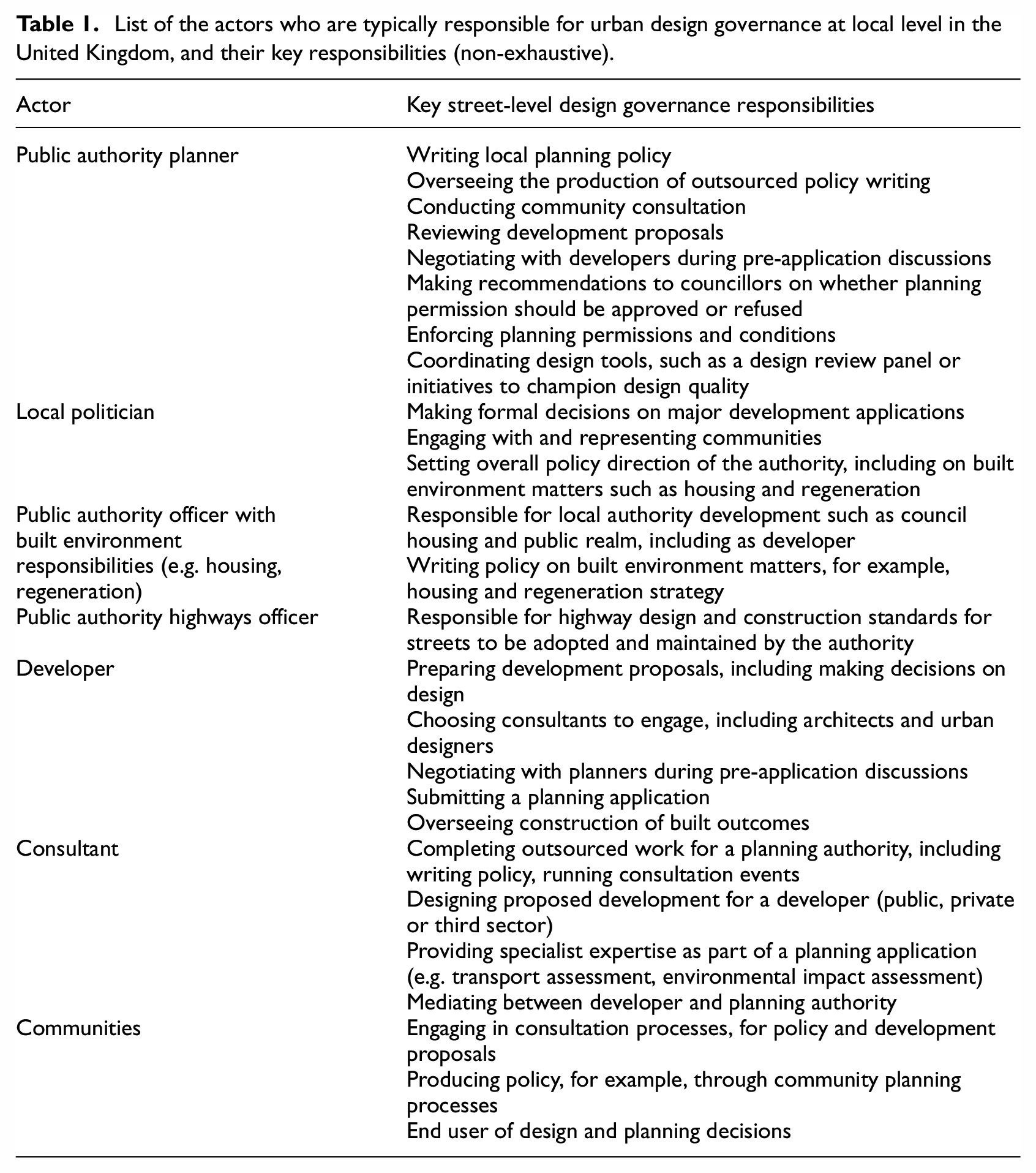
The flexibility inherent to the UK’s discretionary plan-led systems emphasises the role of public planning professionals and elected politicians, for whom design is one consideration among many (Punter, 2007). However, as the creation of the built environment is a collective and holistic endeavour (Carmona, 2009), to which the navigation of state-market relations is central (Adams and Tiesdell, 2010), urban design policy is implemented by a series of actors across sectors (Carmona, 2016). As well as public authority planners and politicians, this includes the developers – who may be public, private or third sector – and their consultants, who propose and design new development (Table 1).
List of the actors who are typically responsible for urban design governance at local level in the United Kingdom, and their key responsibilities (non-exhaustive).
Carmona (2016: 705) defines a corresponding sub-field of ‘design governance’ as ‘the process of state-sanctioned intervention in the means and processes of designing the built environment in order to shape both processes and outcomes in a defined public interest’. State intervention in urban design is usually a ‘second-order’ endeavour (George, 1997: 143), pursuing policy aims by shaping the decision-making environment of typically private sector designers. The responsibilities for implementing urban design are therefore shared, and transcend both public–private boundaries and the limitations of the state’s statutory responsibilities (Carmona, 2016). Bentley (1999) conceptualises this as a battlefield in which development outcomes result from how each actor negotiates in the pursuit of their own objectives, while under the constraint of resources and rules, which produce ‘opportunity space’ to act.
Changes to public governance in recent decades have reshaped this ‘battlefield’. In a thirtieth anniversary edition of his seminal book, Lipsky acknowledged that he earlier ‘took the existence of government and critical public services for granted’ (Lipsky, [1980]2010: 215). In the United Kingdom, fuelled by the austerity policies of the Coalition and Conservative-led governments since 2010, the public sector no longer dominates public service delivery, with local authorities required to increasingly deliver services through other state and non-state providers (Durose, 2011; Newman, 2014); or ‘street-level organisations’ (Brodkin, 2012: 944). Concurrent policy agendas, including localism and the ‘big society’, in England, have meanwhile discursively shifted responsibility away from the state (Newman, 2014).
In-house local authority urban design expertise has been particularly badly affected by austerity cuts (Carmona and Giordano, 2021; White et al., 2020), and in Scotland, survey evidence shows that 15 of 35 responding planning authorities named design as one of their top five areas of skills shortage (Birrell, 2018). Public design services, particularly policy writing, are therefore increasingly outsourced to private consultants (Linovski, 2019), leading to ever-more fluid boundaries between (typically private sector) design and development functions, and public (regulatory) planning practices (Cuthbert, 2017).
Private actors in planning
With ‘reluctant outsourcing’ (Slade et al., 2019: 15) increasingly common, the work of ‘traditional’ street-level bureaucrats within local planning authorities is now routinely undertaken by private actors. The growth of private sector planning (Parker et al., 2018; Sturzaker and Hickman, 2023) has required scholars to reconsider the very nature of the planning profession, particularly regarding the skills planners require, and their interpretation of the ‘public interest’ values which have historically legitimised state intervention in planning in the United Kingdom (Schoneboom et al., 2022). Within increasingly fragmented governance structures (Parker et al., 2018), planning is being commercialised and reimagined as ‘a model of (economic) delivery rather than a public service’ (Slade et al., 2022: 400). This poses a major challenge for how design outcomes can consistently reflect ‘public interest’ values, and the nuanced design ambitions of planning policy.
Planners at the frontline of the local state must make sense of such policy initiatives and put them into practice (Clifford, 2022), and planners’ discretion ‘at the coalface’ means they are both collaborators and resistors to neoliberal state reform (Clifford and Tewdwr-Jones, 2013: 35). Inch (2009: 84) similarly highlights the ‘political value of planners as street-level regulators’ in negotiating the contradictions of the planning system under neoliberalism. This paper builds on such micro-level perspectives which view the state as a peopled organisation (e.g. Inch, 2018), ‘actively constructed through the activities of its bureaucrats and their everyday work’ (Clifford, 2022: 100). In particular, it highlights how the increasingly embedded public–private interactions associated with neoliberal urban governance are perceived – and actively utilised – by planning authorities, in delivering an overarching design policy agenda.
The street-level implementation of urban design policy aims is characteristically fluid across public and private functions. For instance, planning applicants, who are often private developers, are both recipients of street-level policy decisions and partially responsible for their implementation. These power dynamics are also evolving, with planning applicants often viewed as customers of the planning system, and authorities increasingly reliant on income from application fees (Clifford and Tewdwr-Jones, 2013). Furthermore, the growing trend for private consultants to write outsourced public policy while subsequently working for private developers who are regulated by that policy introduces conflicting interests deriving from their need to secure future business (Linovski, 2021), which questions the relationship between urban design and democratic politics (Cuthbert, 2017). As well as cycling between public and private contracts, design professionals move between jobs across sectors, giving them ‘a clear-eyed view of public processes and private requisites’ (Hack, 2017: 43).
While existing literature has tended to treat public and private actors distinctly, this paper builds on recent planning research suggesting the everyday realities are more complex (Schoneboom et al., 2022; Sturzaker and Hickman, 2023). It contributes to understanding of how public and private interests interact at street level, recasting street-level theory to illuminate these ‘prosaic practices of neoliberal governance’ (Newman, 2014: 3301), through a focus on design review.
Design review: Collaborative policy implementation
Design review is an increasingly common intervention, and exemplifies the collaborative imperatives of design governance. Design review is a widely-used tool for the peer review of the design of built environment projects, usually conducted by a panel of external experts – typically experienced built environment professionals including architects and urban designers – on behalf of a governing authority (Carmona, 2019b; White and Chapple, 2019). The traditional street-level bureaucrat in this context, a public authority planner, has additional discretion to manage a network of reviewers, while parts of the authority’s street-level design function, in steering development proposals in line with policy aims, are executed informally by an external stakeholder group.
Design review panels vary in structure from those formally integrated with local regulatory planning functions, as has been typical in the United States, to those operating in an advisory capacity alongside the planning system, which is more usual in the United Kingdom (Punter, 2011). The Commission for Architecture and the Built Environment (CABE), the former national design champion in England, operated a high-profile design review panel which helped embed design review within planning processes across the United Kingdom (Black, 2019). CABE’s Scottish equivalent, Architecture and Design Scotland (A&DS), continues to run its own similar process (White and Chapple, 2019).
In 2017, research found that 12 design review panels existed in some form in Scotland (WDC, 2017), while in England, by 2021, 75% of local authorities were using a design review panel (Carmona and Giordano, 2021). In the absence of further evidence from Scotland, research suggests that design review panels in England are being used to fill local authorities’ design skills gaps, alongside practices including formal outsourcing to consultants (Carmona and Giordano, 2021). Design review panels in England are also being increasingly marketised as a chargeable service (Carmona, 2019b), and are now most commonly managed by third parties rather than local authorities (Carmona and Giordano, 2021). Design review can therefore be viewed as an iterative practice which is constitutive of evolving wider governance processes and cultures.
The existence of a design review panel can set clear pre-application expectations to developers (Punter, 2011), but the impact derives largely from the soft power of peer review which encourages developers to present their best work, similarly to the design crit model used by architecture schools (White and Chapple, 2019). The discretion exercised by design review panel members is therefore critical to the process, but has received limited academic attention. Black (2019) highlights the agency of reviewers in rendering design review a contested mechanism given differences in taste and approach, while Paterson (2011) finds that design review can compromise consistency in decision-making and obscure competing interests, contending that the ‘extent of third-party involvement is controversial in this context’ (p. 103, emphasis in original).
In conducting ostensibly public functions on behalf of a governing authority, design review demonstrates the blurring of public and private functions within urban design (e.g. Hack, 2017; Linovski, 2019), and an inherent ‘tension between “expert” advice and “local” democracy’ (Punter, 2011: 185). Design review panel members’ participation in a public process as external volunteers – with simultaneous public and private obligations – distinguishes them from the typical street-level bureaucrats conceptualised by Lipsky. Developing street-level theory to capture their role therefore helps conceptualise how private actors shape implementation processes.
Case study and methods
This article presents evidence from collaborative case study research with a Scottish local authority, West Dunbartonshire Council (WDC). As a small and financially-constrained authority which has made a strategic investment in its urban design capacity, WDC presents an atypical case, in Flyvbjerg’s (2001) terms, as authorities in deprived areas have typically been reluctant to push developers for better design for fear of driving them away (Punter, 2007). A single case study research design was selected to facilitate an in-depth focus on this informative context (Yin, 2018).
West Dunbartonshire is located between Glasgow and Loch Lomond, in the west of Scotland, and has a population of approximately 87,790 (National Records of Scotland, 2022). West Dunbartonshire is known for its industrial heritage, formerly home to several major shipyards, such as John Brown’s in Clydebank which built renowned liners including the RMS Queen Mary and the QE2 (WDC, 2019a). However, 20th-century deindustrialisation has left a challenging socio-economic legacy. West Dunbartonshire’s population has declined 5.9% since 2001, while both male and female life expectancy is over two years below the Scottish average (National Records of Scotland, 2022).
WDC has, since 2017, pursued a strategic policy agenda which positions urban design as key to long-term economic regeneration. This was driven by an elected councillor who believed that West Dunbartonshire had seen ‘too much identikit designed retail and housing development’, and that the council should view ‘design as a means of achieving economic benefit’ (The Improvement Service, 2017: 4). In March 2017, WDC committed an additional £75,000 per year, on a trial basis, to expand its urban design capacity. This included recruiting a full-time design officer and establishing a high-profile design review panel to review early-stage development proposals and draft policy (WDC, 2019a), supported by place-based design and planning policy including a Local Development Plan which ‘focuses on delivering our regeneration sites and creating places which strengthen our existing communities’ (WDC, 2020: 6), and advocates utilising masterplans and design guidance.
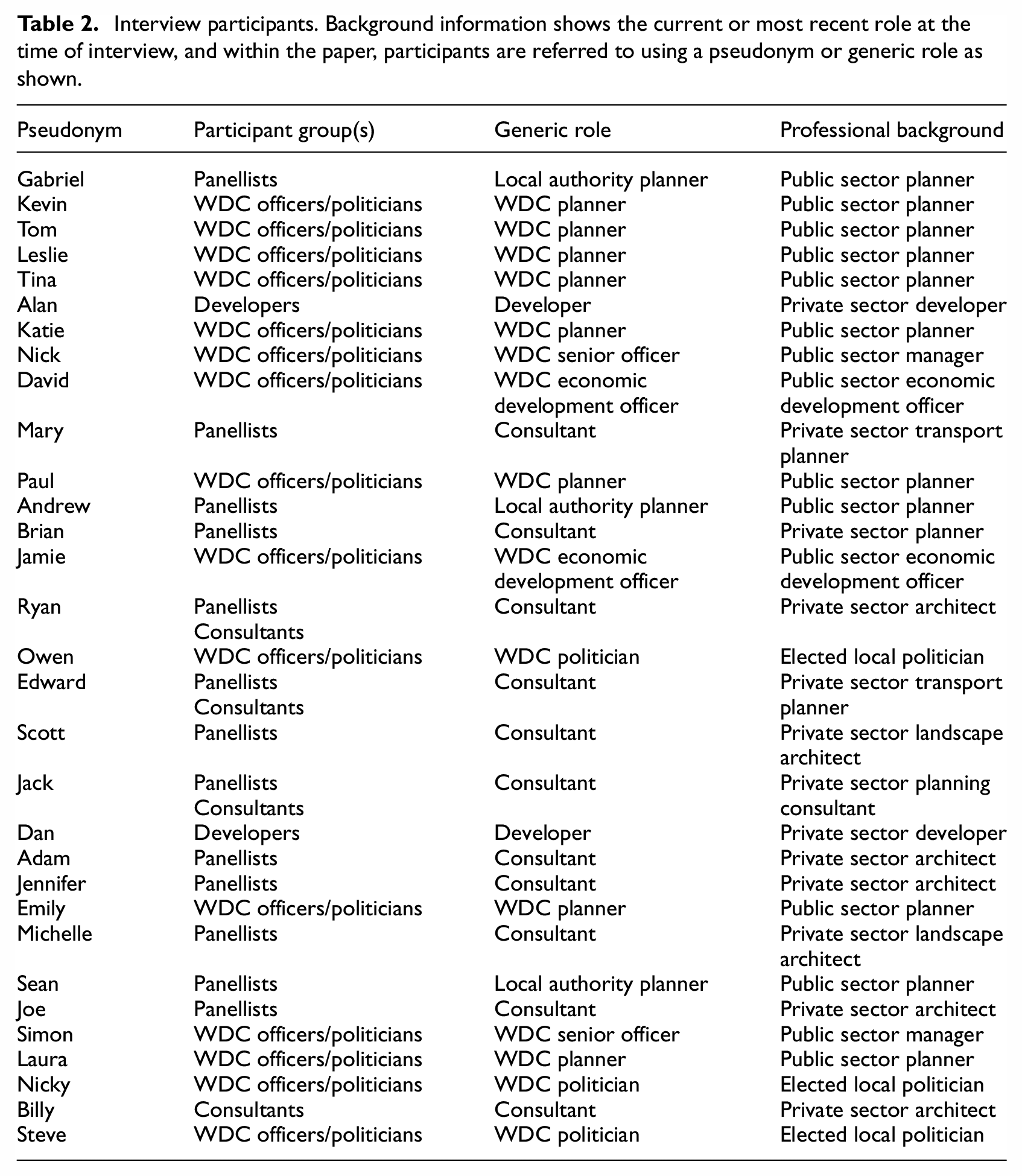
An interpretivist philosophical stance informed this research, reflecting the ‘peopled’ and constructed nature of governance practices (e.g. Clifford, 2022; Inch, 2018). Primary data was collected using two main methods. Firstly, semi-structured interviews with 31 key informants were conducted between October 2020 and May 2021. Participants were recruited according to their recent experience across four broad categories: WDC officers or politicians; WDC design review panellists; developers; and consultants (Table 2). Interviews were audio-recorded where participants consented, and fully transcribed. A thematic analysis was conducted using the software NVivo to construct codes according to a series of themes and sub-themes, each representing ‘a theoretical construct that explains similarities or variations across codes’ (Seal, 2016: 452). Secondly, archival research was conducted with documents including Scottish Government and WDC planning policy, records of local planning applications and details of WDC committee proceedings. All documents referenced here were publicly available online. Ethical approval was granted by the University of Glasgow’s College of Social Sciences Ethics Committee in April 2020, and amended in September 2020.
Interview participants. Background information shows the current or most recent role at the time of interview, and within the paper, participants are referred to using a pseudonym or generic role as shown.
Delivering a design policy agenda at street level
While in-house local authority urban design skills have declined elsewhere (Birrell, 2018; Carmona and Giordano, 2021), WDC’s strategic investment in design meant that, during the research, its in-house planning team included a qualified urban designer and an architect. This enabled policy including supplementary guidance to the Local Development Plan (LDP) to be written in-house, when otherwise, planners would ‘have punted the design guidance out to a consultant’ (Kevin, WDC Planner, Interview 2020). Yet, WDC’s planners still needed to engage with increasingly pervasive ‘reluctant outsourcing’ practices (Slade et al., 2019: 8). For example, a masterplan project for West Dunbartonshire’s third largest town of Alexandria was outsourced to private consultants despite its significance, because WDC’s planners otherwise ‘just wouldn’t have the resource’ (Leslie, WDC Planner, Interview 2021).
A design review panel – the Place and Design Panel – was the primary initiative funded by WDC’s annual £75,000 investment in design capacity. Beyond its design review function, it was intended to reshape perceptions about design across the council, as ‘a culture changer and an educator … to excite people about place’ (Owen, WDC Politician, Interview 2021). The Panel operates in an advisory capacity alongside WDC’s formal development management processes. Reports from sittings are shared with presenters, panellists and relevant council officers, while elected local politicians on the planning committee receive a summary when a corresponding application for planning permission is discussed. The Panel’s recommendations are therefore treated as a material consideration (WDC, 2019a) – a discretionary consideration which enables elected decision-makers to deviate from statutory development plan policy (Scottish Government, 2023). Between March 2018 and April 2022, 22 sittings took place, discussing 28 projects spanning development proposals and draft policy.
The volunteer design reviewers comprise a pool – numbering 70 at its peak (WDC, 2019b) – of built environment professionals from the public, private and third sectors, including architects, planners, urban designers and landscape architects, of which four to six are selected by the council’s planners to attend each sitting (WDC, 2019a). A WDC report towards the end of the trial funding period concluded that design review in this form presents a ‘cost-effective method of extending the council’s capacity regarding design’ (WDC, 2019b: 84). The perception of external actors as ‘council capacity’ is informative; given these professionals are typically employed privately, particularly following the recent broad decline of local authorities’ in-house design skills, private consultants occupy a prominent position within the Panel’s membership. WDC always intended for the Place and Design Panel to be a collaborative cross-sector vehicle, having undertaken thorough consultation with academic, third sector and private sector professionals, as well as developers, including through powerful housebuilding lobbyist Homes for Scotland (WDC, 2017, 2019a).
Subsequently, WDC’s planners sought to avoid what they perceived as the structured approach of some of Scotland’s established design review panels, including those in Glasgow and Edinburgh, which they felt could be unsuitable for West Dunbartonshire’s fragile development context (Leslie, Interview 2021; Emily, Interview 2021). The Place and Design Panel was deliberately positioned as an ‘enabler and not an obstacle’ (WDC, 2019a: 23), to appeal to private developers and the concerns of WDC’s own economic development function, that ‘if you were too choosy about design, that could impact on investment’ (Simon, Senior Officer, Interview 2021), demonstrating the perceived power of development capital compared to that of the authority. Unlike the emerging pattern in England (Carmona, 2019b), WDC does not charge applicants to use its design review panel.
The panellists take part in their own individual capacity (WDC, 2019a), in contrast to panels in Glasgow and Edinburgh, where panellists are selected via member organisations including the Royal Town Planning Institute and Historic Environment Scotland (Edinburgh City Council, n.d.; Glasgow Institute of Architects, 2021). Similarly, rather than replicating a formal committee, Place and Design Panel sittings typically begin with a site visit and presentation from the developer, consultant or council officer leading the project, before an ‘informal workshop’ discusses the design proposal (WDC, 2019a: 26).
This informal structure emphasises the discretion of both the external reviewers and the WDC planners who coordinate the process. Alongside an initial advertising campaign to recruit panel members, WDC’s planners invited their own contacts directly. For example, a consultant recalled how ‘through our work with the council, I was quite a well-known person in the council offices, within the planning department, so they asked me if I would be interested’ (Edward, Interview 2021), highlighting the embedded public–private interactions within professional planning networks (Parker et al., 2018; Schoneboom et al., 2022). This also reflects the active role of these networks in the Panel’s development, which was planned as an ‘iterative process that would always evolve’ (Emily, WDC Planner, Interview 2021), after its initial political proponent stood down in May 2017.
Fluid identities
Design review panellists represent a growing and informative stakeholder group within the street-level implementation of urban design. When asked during interviews why they volunteered, most Place and Design Panel members reported a commitment to improving design outcomes in West Dunbartonshire, such as ‘trying to achieve good design quality in … an area that’s not as wealthy’ (Jack, Consultant, Interview 2021). Yet, more transactional personal and private benefits of participating were as common. This included professional development, as ‘you can always reflect on your own [work] through seeing others’ work’ (Joe, Consultant, Interview 2021), and career development, ‘to gain experience … to make yourself more attractive to employers’ (Andrew, Local Authority Planner, Interview 2021).
Furthermore, some had wished to see first-hand how WDC functions. For example, having found authorities difficult to navigate as a consultant, Brian reflected, ‘I won’t say “if you can’t beat them join them”, but if you can’t beat them, at least get inside their head and find out what makes them work’ (Interview 2021). More directly, Edward explained that his consultancy firm was ‘working on a number of other projects in the area, that might find themselves going in front of such a Panel, so it would be important to understand how it was going to work, what they wanted to see’ (Interview 2021). Similarly, several participants valued the ‘opportunity to network and build relationships’, as a form of ‘business development’ (Mary, Consultant, Interview 2020), as the Panel provides an opportunity ‘to get involved in things outside the office that are good for the office’ (Joe, Consultant, Interview 2021).
Although all actors within street-level implementation processes are influenced by myriad personal and professional motivations, the Place and Design Panel’s informal structure, which includes a flexible pool of panellists selected by planning officers – including from their own professional networks – emphasises the discretion of its external members. This stakeholder group exemplifies increasingly technocratic urban governance (Savini and Raco, 2019), which necessitates further understanding of how the ‘business of planning’ (Linovski, 2019: 1671), including the requirement for private consultants to secure future work, interacts with public design processes. One consultant reflected directly on this relationship: we’re giving up our time for free, which is fine, so the question our employers – and we – ask ourselves, is ‘what do we get out of it? Do we get anything out of it or are we just doing a favour?’ Doing a favour’s fine, that’s part of business, and as I say, I was happy to do that. But if there’s an added value to make some professional connections, then that’s all to the good. (Edward, Interview 2021)
Mary agreed that ‘the council benefits from some of the technical input and that diversity of knowledge from the specialists in the field, but equally the specialists in the field that are coming along also have the opportunity to network and build relationships’ (Interview 2020). These reflections highlight a perceived relationship between panellists’ simultaneous public and private motivations, with fulfilling elements of business interest seen as fair recompense for the time volunteered. The way such transactional interests structure the discretion of design reviewers and the planners who coordinate these processes, which ostensibly operate in the ‘public interest’, is important to understand, particularly given the potential influence of competing interests (Linovski, 2021).
Although WDC’s planners reported that encountering such conflicts was rare, and the council operates a clear conflict of interest policy with respect to the Place and Design Panel (WDC, 2019a), on one occasion, a Panel member was contacted the day before a sitting by the developer who was due to present their proposal, who the panellist had also previously conducted work for. Adam described how, ‘I know him [the developer] quite well, and he’d phoned me up beforehand to say, “I see you’re on the Panel, remember what side your bread’s buttered on”’ (Consultant, Interview 2021).
The attempt by a developer to sway a member of a public authority’s design review panel illustrates one extreme outcome of blurring public–private boundaries. Adam could only report this event to WDC’s planners on the day of the sitting, when there was limited time to respond – meaning the developer had, to an extent, undermined the process. Adam recalled that he ‘just laughed it off … that company, I think we’d done one or two jobs for them over a twenty-odd year period. They’re not – and if they were – considered one of our bread-and-butter clients, I wouldn’t have done it [participated in the Panel sitting]’ (Interview 2021). Given the varied volume of work a consultant might undertake for a client over time, individuals will likely interpret what constitutes a ‘bread-and-butter client’ differently.
In another example, ahead of a sitting to discuss a development brief for a council-owned site, a panellist declared that they had worked as a consultant to a developer which had also bid to acquire the site, albeit unsuccessfully. As this was early in the development process, there was still a possibility that WDC’s preferred bidder would drop out, leaving the panellist’s client to revive their bid. WDC’s planners decided it was not necessary to ask the panellist to step back, feeling that ‘it’s about, do they have an economic advantage, or a commercial advantage?’ (Emily, Interview 2021). Yet, beyond questions of imminent commercial advantage, such circumstances are emblematic of a wider governance culture whereby commercial logic and privatisation increasingly drive UK planning practices (Slade et al., 2022), within which private actors commonly produce policy they are later subject to (Cuthbert, 2017; Linovski, 2021). How commercial interests interact or conflict with national and local design policy aims, and how local authority planners respond, are important considerations for design review and similar collaborative governance practices.
Same aspirations and values?
Design review panellists’ voluntary participation as individuals distinguishes them from consultants operating under sub-contracting conditions, and from typically-understood street-level bureaucrats employed by a public authority. Street-level theory can therefore be extended to capture how these actors respond to public and private functions simultaneously, with corresponding motivations which transcend organisational boundaries, in a way that planning literature has yet to fully conceptualise (e.g. Linovski, 2021; Parker et al., 2018; Sturzaker and Hickman, 2023).
Before WDC agreed to permanently fund the Place and Design Panel, in March 2020, one panellist wrote to the council’s chief executive, to ‘feed back through the various layers within the council that I thought that the initiative was extremely worthwhile’ (Joe, Consultant, Interview 2021). Joe’s sentiments exemplify the high esteem in which the panellists interviewed held the Place and Design Panel, and an elected councillor confirmed that their support for permanently funding it was influenced by ‘feedback from the volunteers’, which ‘suggests that people who know a little bit more about it are massively in favour’ (Steve, Interview 2021).
Some of the volunteers interact with WDC’s planners regularly, having taken part in several Panel sittings and repeatedly consulted for the council or developers operating locally. Describing one such consultancy practice, a WDC planner explained that, through building these relationships, ‘you’re able to determine they had the same aspirations and values as the council, and believed in quality development’ (Leslie, Interview 2021). The suggestion of shared ‘aspirations and values’ is likely true for some elements of design, but not regarding the divergent business interests of a private consultancy and a local authority’s regulatory obligations.
This perception of common values aligns with research showing that consultants tend to be viewed – perhaps uncritically – as an objective source of external expertise (Linovski, 2015; Parker et al., 2018). WDC expects its panellists to be ‘impartial and independent’ (WDC, 2019b: 24), reflecting established guidance on design review from the Design Council (2013, cited in WDC, 2019a: 29). Panellists themselves embraced this mindset, including Michelle who felt that ‘it just makes your solutions more robust … having an objective group who can come in with no partiality’ (Consultant, Interview 2021).
As consultants often work for private developers and public authorities simultaneously, this valorisation of external privately-held knowledge implicitly raises the profile of for-profit development interests within street-level implementation processes. Indeed, an elected councillor expressed a desire for WDC’s Place and Design Panel to access ‘more people from the likes of [construction and manufacturing company] CCG … or [housebuilder] Barratt’, because ‘it’s good to get people on the inside’ (Steve, Interview 2021). Steve’s reference to developers as ‘the inside’ hints at where power over the delivery of design and development outcomes is perceived to lie, reflecting the prevalence of neoliberal discourses surrounding commercialisation and viability (Clifford and Tewdwr-Jones, 2013; Slade et al., 2022). It also highlights WDC’s desire to proactively utilise this ‘insider’ knowledge within its own planning processes.
Navigating these public-private interactions is an increasingly important component of public authority planners’ professional discretion. These networks can, it should be emphasised, yield significant opportunities to positively shape places. The Place and Design Panel provides access to design skills and capacity to enable design review which may otherwise not be undertaken. Furthermore, the Panel allows WDC to harness professional networks to promote its design ambitions. For example, a consultant who had both presented to the Panel and volunteered as a panellist explained that, while working on behalf of a developer in West Dunbartonshire, he had persuaded the project architect to adapt their proposals in line with recommendations from a Panel sitting. Edward, previously described as a ‘well-known person in the council offices’, recalled that on this project, ‘the architect initially was [saying], “well that’s just another architect’s opinion, I’ve got my opinion”… I said, “but this is about getting our development through … why don’t we just go with what they’re suggesting?”’ (Interview 2021).
A WDC planner reported a similar modus operandi in relation to a consultancy firm, some of whose staff were Place and Design Panel members, which had been appointed to design a council housing site: ‘They know what we’re after, they’re not going to associate themselves with bad design. How would their reputation be if they’re a member of the Panel and they’re putting forward something that isn’t of great design?’ (Leslie, Interview 2021). This demonstrates how WDC’s planners, as Adams and Tiesdell (2010) argue is necessary more widely, have actively developed market-rich knowledge, market-relevant skills and market-rooted networks. In line with existing literature on design review (e.g. Punter, 2011; White and Chapple, 2019), consultants and developers who had presented to the Panel reported that the experience of peer review shaped their future expectations of WDC’s design aims; ‘you get to know what they’re (WDC) looking for’ (Dan, Developer, Interview 2021). WDC planners also felt that participating in the Panel process gave them additional ‘confidence and … skills to go out and push for better development’ (Leslie, Interview 2021), further demonstrating the perceived impact of external design review capacity.
The Place and Design Panel exemplifies the coordinated street-level engagement with market actors by local authority planners which is a crucial feature of contemporary urban design and planning practice. Design review panellists occupy a somewhat hybrid street-level function in responding to public and private motivations simultaneously. Panellists, in a quasi-public but independent role, exert significant discretion inside and outside of design review panel sittings, and their autonomy from organisational authority is structured by limited direct accountability to the council, but likely simultaneous obligations to another employer, and implicitly, to potential clients. Their operation at a greater distance from the bureaucracy than traditionally-defined street-level bureaucrats, as with the wider growing role of private actors within UK planning, also raises critical questions for how major policy agendas interact with complex and evolving implementation processes.
Conclusion
Street-level theory should therefore be developed to conceptualise how emerging planning (and wider governance) practices, whereby non-state actors increasingly deliver planning and urban design work on behalf of a governing authority (Linovski, 2021; Parker et al., 2018), are experienced and negotiated ‘on the ground’. Using case study evidence from West Dunbartonshire, Scotland, this article demonstrates the fluidity of public-private relationships within urban design governance, and how the role of a ‘typical’ street-level bureaucrat within implementation is shared among actors, transcending sectoral responsibilities and motivations. Beyond the ‘street-level organisations’ which Brodkin (2012: 944) identifies as being responsible for contemporary policy delivery, further focus on the micro-level of street-level professionals and networks is necessary for understanding how urban design implementation will evolve under neoliberalisation, with the structuring power of an overarching state bureaucracy appearing ever more diffuse.
Compared to the policy settings Lipsky ([1980]2010) describes, including welfare services and courts, communities typically receive public urban design services less directly, and at a greater distance from the street-level bureaucrat. Alongside public consultation methods, much emphasis has historically been on planners to act on behalf of citizens in determining how the public interest is met (Slade et al., 2019). The growing influence of non-state actors within implementation mechanisms, including informal design review, is likely to influence how these ‘public interest’ values are operationalised. As Linovski (2015) contends, the complex interests involved in delivering urban design render universal understandings of ‘good design’ impossible. The power dynamics within design governance processes are therefore crucial in determining whose interests design outcomes serve, and how they reflect policy responses to key challenges including climate and housing crises.
The private sector should not be equated with purely profit-seeking behaviour (Sturzaker and Hickman, 2023), but while many private planning and design consultants will be genuinely committed to creating well-designed places, they must also be influenced to a degree by the requirement to secure future business (Linovski, 2019). This necessitates appealing to the interests of private developers, who, particularly in the case of volume housebuilders, are often reluctant to invest in design features which provide public benefits but do not deliver a corresponding increase in property sale values (Adams et al., 2012; White et al., 2020). This reflects wider neoliberal ideological and cultural shifts within UK planning (Clifford and Tewdwr-Jones, 2013; Inch, 2018) through which discourses surrounding viability and delivery increasingly drive planning processes (Slade et al., 2022). The embrace of private expertise within the case study, to fill a gap in design capacity and in aiming to actively shape wider development practices, reveals how such rationalities influence street-level planning. As Proudfoot and McCann (2008) argue, further understanding is needed of how micro-level concerns regarding street-level implementation relate to such wider forces of political and economic change.
The fragmented and technocratic nature of contemporary planning practices (Parker et al., 2018; Savini and Raco, 2019) means that negotiating public–private relationships is a key responsibility of UK local authority planners (Schoneboom et al., 2022; Slade et al., 2019). The model of WDC’s Place and Design Panel is likely desirable and replicable for authorities seeking to expand their capacity cost-effectively, and indeed, similar collaborative mechanisms may have wider appeal. How these ‘emergent spaces’ of local governance (Durose, 2011: 978) – and the systemic tensions they may present – are managed will be key to addressing the urban design implementation gap, and to delivering socially just place-based policy solutions. The evidence here highlights how local planning authorities are not passive recipients of neoliberalisation (Newman, 2014), but that street-level planners must have the skills and knowledge to actively utilise and reshape emerging policy implementation processes.
Developing street-level theory for this distinctive urban design governance context helps understand the behaviour and motivations of the actors with ‘shared responsibilities for delivery’ (Carmona, 2016: 706). This, in turn, reinforces the importance of implementation processes – which are multi-actor, cross-sector, fluid and challenging to direct – as a key consideration within policymaking, and as a focus of planning and public policy research.
Footnotes
Acknowledgements
I am grateful to the interview participants, and to West Dunbartonshire Council for its support with this research. I would also like to express thanks to the three anonymous reviewers whose comments strengthened the paper, to James T White for reviewing the initial manuscript, and also to James, Sharon Wright and Rebecca Madgin, for supervising the doctoral research project on which the article is based.
Declaration of conflicting interests
The author declared no potential conflicts of interest with respect to the research, authorship, and/or publication of this article.
Funding
The author disclosed receipt of the following financial support for the research, authorship, and/or publication of this article: This work was funded by a supervisor-led Economic and Social Research Council Collaborative Doctoral Scholarship awarded by the Scottish Graduate School of Social Science (the ESRC’s Doctoral Training Partnership in Scotland, grant number ES/P000681/1). West Dunbartonshire Council was a collaborative partner in the scholarship and contributed 10% of the total funding.
