



Abstract
Until very recently, the question of how residents might be affected by the gradient of neighbourhood boundaries – whether these boundaries are abrupt or gradual – has remained largely absent from mainstream segregation research. Yet, theoretical and empirical findings emerging from recent studies suggest the impacts could be profound and far-reaching. This article seeks to provide a conceptual foundation for understanding such effects. We focus on the concept of ‘social frontiers’: spatial discontinuities in the geography of residential mix which occur when community boundaries are abrupt. Drawing on insights from cognate disciplines, we develop a theory of social frontier impacts that articulates their potential importance in limiting and shaping contact between neighbouring communities, exacerbating territorial conflict and ultimately affecting the psychological wellbeing and life course outcomes of those living at the frontier. We present our thesis as a series of propositions and corollaries, and reflect on the implications for empirical research.
Introduction
Imagine the geography of urban residential mix as a three dimensional landscape where the peaks and troughs represent geographical variations in the proportion of a particular ethnic or social group. For the most part, the terrain is characterised by shallow slopes, indicating relatively similar proportions of different groups between adjoining neighbourhoods. Overlaid onto this richly textured demographic surface are precisely drawn administrative borders. These are artificial borders that delineate a set of areal partitions, created for bureaucratic purposes. Their precision belies the messy social reality underneath where the boundaries are blurred, ambiguous, fragmented and dynamic. Amid the gentle slopes of this hypothetical social landscape, we also observe cliff edges. These are places where the gradient in social, ethnic, or religious composition rises or falls precipitously. Here the boundaries between neighbouring communities are clearly demarcated.
Variously labelled ‘spatial discontinuities’ (Harris, 2014), ‘neighbourhood boundaries’ (Legewie and Schaeffer, 2016) and ‘social frontiers’ (Dean et al., 2019; Křížková et al., 2021; Piekut et al., 2019; Staples et al., 2023), there is growing empirical evidence in the urban studies, human geography and sociology literatures that these ‘cliff edges’ not only exist not only exist between races, self-reported ethnicities and countries of birth (Dean et al., 2019; Legewie and Schaeffer, 2016) but also have potentially important impacts (e.g. on crime). However, the conceptualisation of social frontiers and their impacts remains undeveloped and fragmented. Hence, our goal in this article is to develop a more coherent theoretical foundation for thinking about social frontiers. In the following section, we start by reflecting on core features of social frontiers: their spatial, territorial and relational properties. Drawing on the social psychology, sociology and human geography literatures, in the third section we then set out specific propositions about the anticipated consequences for wellbeing, crime and social mobility. We conclude in the fourth section with a discussion of what these theoretical insights mean for empirical investigation.
Social frontiers: Essential features
The spatial dimension
Staples et al. (2023) argue that, while social frontiers draw on established notions of bordering and social boundaries, they are nevertheless a distinct concept. They occur at specific geographical locations: they are a spatial manifestation of the symbolic borders underpinning subjective categorisations of people. Moreover, whilst administrative boundaries such as postal zones and Census tracts are explicitly binary, we should think of the social frontier as a quantitative phenomenon lying along a continuum. A useful concept is ‘edge intensity’, coined by Legewie and Schaeffer (2016: 126) to describe the difference between neighbouring communities in the proportion of residents based on an attribute (e.g. race, social class). Social frontiers, then, can be thought of as clear-cut boundaries with relatively high edge intensity in a particular socio-demographic dimension.
These frontiers can have profound symbolic meaning, and yet they can also remain undetected by traditional measures of residential segregation. None of the dimensions of residential segregation (such as dissimilarity and concentration) considered by Massey and Denton (1988), for example, account for social frontiers. This is an important omission since these measures are widely used in urban studies and human geography, such as work on tenure mix (Graham et al., 2009), ethnic/racial/racial segregation (e.g. Lee et al., 2015) and geographical inequality (e.g. Zhang and Pryce, 2020). Some researchers have proposed indices that incorporate boundary properties (e.g. length of the common boundary; Wong, 1993), yet the extent of spatial (dis)continuities has only recently received serious attention, hence the concern that existing quantitative research ‘does not address what happens at places where groups border’ (Legewie and Schaeffer, 2016: 131). This omission is especially poignant given the potential impacts of social frontiers on human relations, social coherence and wellbeing, as we discuss below.
In principle, spatial discontinuities can arise between any dimension of group identity: race, ethnicity, social class, age, religion, country of birth etc., and they can also be intersectional, co-occurring across multiple socio-demographic domains. Combinations of similarity and difference may also be important. Consider, for example, a deep social frontier in race between neighbouring communities, both of which are similarly deprived. The shared economic privation could engender solidarity, but may equally heighten the sense of threat towards the outgroup due to perceived competition for resources.
The nature and extent of difference between communities may also be important. Social frontiers entail the proximity of extremes: the cheek-by-jowl juxtaposition of contrasting cultures, lifestyles, value systems and social hierarchies. The greater the socio-cultural distance, the more difficult it may be for social connections to form (McPherson et al., 2001). Spatial scale might also be important. Do, for example, spatial discontinuities at the ‘micro neighbourhood’ scale (Easton and Pryce, 2019) – between clusters of several houses, say – constitute social frontiers? It seems likely that, for a social frontier to take on potent symbolic meaning, it will have significant length as well as edge intensity and cultural distance.
In summary, the label ‘social frontier’ should ideally be reserved for patterns of segregation where there is a critical mass of two or more contrasting contiguous groups sufficient to facilitate the emergence of sizeable self-contained intra-group networks. Persistent abrupt spatial transitions between these networks have the potential to take on symbolic meaning and influence behaviour. Thus, we can think of the magnitude of social frontiers as comprising both edge intensity and edge length, and potentially also cultural distance and temporal persistence.
Territoriality
Territory, according to Gold (1982: 44), is derived from ‘the Latin noun terra (earth, land) and verb terrere (to warn or frighten off)’, and implies ‘defended as well as bounded space, with connotations of attachment and exclusivity’. Territoriality refers to ‘the processes and mechanisms by which people establish, maintain, and defend territories’ (Gold, 1982: 44). Some argue that humans are ‘biologically predisposed towards territoriality’ (Gold, 1982: 48), while others contend that human territoriality is a ‘culturally derived and transmitted answer to particular human problems, not the blind operation of instinct’; one that encompasses ‘higher’ needs such as ‘identity, status, recognition by others, and achievement of self-image’ (Gold, 1982: 48). As humans are predisposed towards binary classifications of ingroups and outgroups (Ramos et al., 2019), the physical bifurcation of groups implicit in social frontier segregation may draw-out these behavioural tendencies, leading to othering and defensive behaviour.
Thus, to ignore territoriality ‘is to leave unexamined many of the forces moulding human spatial organisation’ (Sack, 1983: 55). Since Sack’s landmark article, a large political geography literature on territoriality has emerged, though much of this work is theoretical or qualitative, and has tended to focus on political boundaries at the scale of entire regions or countries (Storey, 2020), rather than at the neighbourhood level (for a notable exception, see Sibley’s, 1995 discussion of the links between community spatial boundaries and the development of residents’ social identities). Hence, various authors (Kramer, 2017; Legewie and Schaeffer, 2016) have lamented the lack of quantitative research on how neighbourhoods border. Research on social frontier locations is limited to a handful of specific cities. Harris (2014) is, to our knowledge, the only quantitative segregation paper to consider spatial discontinuity for an entire country, and even then, the implications for territoriality are entirely overlooked.
Our interest is in the question of why, and under what circumstances, territorial behaviour emerges at the neighbourhood level as a result of social frontiers. Sack (1983) argued that territorial boundaries become prevalent because they provide an efficient form of communication and control. By way of illustration, he describes a parent seeking to prevent children from causing damage to important books in the family study. The parent could attempt a complex list of prohibitions describing the books that should not be touched. Or they could, instead, invoke a simple territorial boundary: barring the children from entering the study. While the former is likely to be cumbersome, confusing and ultimately unsuccessful, the latter is straightforward and more likely to be effective. Hence, ‘Territoriality can be easy to communicate because it requires only one kind of marker or sign – the boundary . . . Territorialities’ simplicity for communication may be why [they are] often used by animals’ (Sack, 1983: 58).
A corollary of Sack’s argument, we argue, is that unambiguous neighbourhood boundaries provide a necessary condition for territorial strategies to be an efficient means of communication and control. Conversely, blurred or fragmented social boundaries between neighbourhoods will frustrate the deployment of simple and instinctively understandable forms of communication. So, the more abrupt the spatial discontinuity in the residential distribution, the greater the potential for community boundaries to become an efficient means of control.
The relational implications of social frontiers
Social frontiers as mainstays of social stability
According to Gold (1982), territorial boundaries may emerge for the purpose of avoiding conflict rather than encouraging it. ‘Once territories are established, they are rarely seriously challenged… territoriality is the cornerstone of stable social organisation’ (Gold, 1982: 47). Moreover, territories are not just about keeping rival groups apart. Historically, territorial boundaries kept ‘individual members within communication distance of one another so that food and danger [could] be signalled’ (Gold, 1982: 44). It follows that, ‘the most important facet of territoriality is that it can create a stable and unobtrusive framework for the orderly conduct of everyday life’ (Gold, 1982: 54). In a similar vein, Legewie and Schaeffer (2016: 126) propose the concept of contested boundaries: the idea that social tensions arise, not where spatial discontinuities are most severe and clear-cut, but ‘at poorly defined boundaries’. However, while it makes sense to expect boundaries that are actively being contested to generate conflict, it does not follow that uncontested social frontiers will generate social harmony in the long run (Dean et al., 2019: 272).
Opportunity for positive contact
To understand why social frontiers may have negative long-term effects, we need to consider the role of edge intensity in reducing opportunities for outgroup contact, compared with more gradual blending of communities at the border (see propositions 1, 2 and below). Exposure to diversity helps to attenuate our natural aversion to heterogeneity. Ramos et al. (2019: 12244) find that ‘humans adapt to social diversity over time’, which is consistent with the main postulate of Contact Theory that, ‘increased diversity leads to increased intergroup contact, which improves intergroup trust to reduce threat and lower levels of prejudice’ (Li et al., 2021: 2). Thus, the contested boundaries proposition could be interpreted ‘not as an end point, but as part of the sorting process that generates social frontiers’ (Dean et al., 2019: 276–277) which in turn reduces intergroup contact in the long run.
Heterogeneity in attitudes to the outgroup
One of the most influential theories of residential segregation (Schelling, 1971) uses an early form of agent-based modelling to show how high levels of self-segregation can emerge, even if no resident wants it to. A much-overlooked aspect of the Schelling model, however, is that it also predicts abrupt neighbourhood boundaries. The question therefore is why are not all neighbourhood boundaries social frontiers? The answer is that his model assumed that every household is equally averse to being in the minority in their immediate neighbourhood. Other things being equal (i.e. abstracting from spatial variation in school quality, access to employment, housing quality etc.), blurred boundaries may reflect heterogeneous preferences with respect to living in proximity to outgroup residents. When there exists a variety of preferences towards the outgroup, those households with the greatest preference for residential diversity will be drawn to live near the boundary. This will be true on both sides of the frontier. As a result, spatial discontinuities may become frontiers of ‘conviviality’ (Gilroy, 2004), where identity difference is considered unremarkable, and where diversity-loving households from both communities are brought together, with unusual potential for positive intergroup connection.
However, when a social frontier evokes conviviality, it also sows the seeds of its own destruction. If there are large proportions on each side of the frontier that are heterophilous (diversity loving), conviviality will foster integration and neighbourhood borders will become places of residential mix rather than separation.
The implication of all this is that context and local social dynamics are potentially important in shaping the effects of social frontiers (see, corollary below).
Causal impacts of social frontiers
Having introduced the core attributes of social frontiers, we now attempt to tease out and organise the most salient effects of social frontiers through a series of propositions and corollaries.
Propositions
P1: Direct contact effect
Social frontiers reduce the opportunities for positive direct contact. In the long run, this will likely increase social tension and conflict between groups.
According to Intergroup Contact Theory, positive direct contact with members of an outgroup decreases prejudice and hostility towards that group (Allport, 1954) via three explanatory pathways: increased knowledge, increased empathy and decreased anxiety (Pettigrew and Tropp, 2008). We propose that the distinct boundaries set out by social frontiers are hypothesised to increase social tension and conflict between groups because there are fewer opportunities for positive intergroup contact that serve to foster harmonious intergroup relations and social cohesion (Lemmer and Wagner, 2015).
This effect has received limited attention in the mainstream social psychological theoretical and empirical work on intergroup contact (see Dixon, 2001). To date this work has either examined intergroup contact without consideration of physical neighbourhoods (Pettigrew, 2008) or has tended to examine the impact of neighbourhood segregation on intergroup contact without consideration of the nature of boundary making between neighbourhoods (Dixon et al., 2020).
P2: Indirect contact effect
The presence of social frontiers is likely to further increase the social network independence between groups by reducing opportunities for two types of indirect contact (
Vezzali et al., 2014
): (1) extended contact (whereby individuals know that fellow members of their group have friends who belong to the outgroup) and (2) vicarious contact (whereby individuals observe such intergroup friendships).
We know from existing social psychology research that indirect contact can have a positive impact on individuals’ orientation towards an outgroup, including feelings, perceptions, attitudes and behaviours (Lemmer and Wagner, 2015). However, this literature has not considered the impact of neighbourhood segregation or the nature of social boundaries between neighbourhoods.
The greater the edge intensity of a social frontier, the greater its effect in reducing the likelihood of indirect contact. This is because edge intensity: (1) reduces the proportion of the outgroup on either side of the frontier; and (2) increases the transition gradient – the rate at which the proportion of one residential group falls and another rises at the boundary between the two communities. Both possibilities reduce the number of ‘bridge-builders’– outgroup households living near the frontier (Dean et al., 2019) – and this reduces the opportunity for indirect contact, thus sowing the seeds for misunderstanding and prejudice.
P3: Asymmetrical territoriality effects
The greater the edge intensity between contrasting population groups the greater the propensity for territorial attitudes and defensive behaviour to emerge. These effects will likely be asymmetrical across the frontier.
Because social frontiers represent a distinct spatial location for the boundaries between groups, they clarify the demarcation of zones designated as defensible spaces, increasing the likelihood of territoriality and defensive behaviour. Further to reducing the opportunities for contact (P1), the territorial nature of social frontiers means that they may sour any contact that does take place. This is significant because ‘negative contact predicts increased prejudice more than positive contact predicts reduced prejudice’ (Barlow et al., 2012: 1629). Recent reviews have identified contextual factors that modulate this effect (see Schäfer et al., 2021).
Moreover, the territorial meaning and impact of a social frontier may be profoundly asymmetrical, diminishing the capacity for contact to be on equal terms. For example, community boundaries are often imposed by the majority group (Alba, 2005: 27) as a way of containing the residential spread and perceived threat of ethnic minorities. As such, one side may see the frontier as something they want to preserve to maintain social distance, whereas the other may view it as an unwelcome barrier to their progress and/or integration. The asymmetrical nature of territoriality may lead to a range of social frontier effects being profoundly unequal for the communities on either side of the boundary.
The demarcation of social frontiers may be heightened further by cultural symbols and physical markers such as sectarian murals, graffiti, flags, religious buildings and architectural styles which reinforce the perceived physical presence and social psychological impact of a social frontier (Leonard, 2006). Being able to see symbols of one’s own cultural identity may reinforce a sense of belonging and safety (Bruter, 2003; DeCook, 2018). They may also be a means of communicating status (Bourdieu, 1984) and reflect a desire to project control and dominance. In contrast, viewing cultural markers from a rival group may engender a sense of threat and uncertainty (Butz, 2009).
P4: Exposure to inequality effect
Social frontiers in affluence and status have the potential to heighten awareness of inequality and intensify the low-status group’s cognisance of their relative deprivation.
Individuals who live near frontiers in affluence are likely to be more aware of differences in economic status. Awareness of inequality is heightened for those at the border compared to those living near the centre of the community, as the differences are more visible and inescapable. Such proximity will perpetually invite intergroup social comparisons, which increase the low-status group’s awareness of their relative deprivation (Smith et al., 2012) and the deficit in one’s position compared to what one deserves (Dar and Resh, 2001; Smith and Huo, 2014). A sense of relative deprivation can have negative consequences for mental and physical health (Smith and Huo, 2014) and can produce a sense of injustice that motivates disruptive responses, such as aggression (Greitemeyer and Sagioglou, 2016) and collective action.
The existing literature has documented the impact of relative deprivation on important outcomes such as health and social mobility (Ellemers et al., 1993; Iyer et al., 2017; Tajfel and Turner, 1979; Zhang et al., 2013) but to our knowledge no work has investigated whether the magnitude of social frontiers (edge intensity, length, persistence) strengthens these effects.
P5: Challenged social hierarchy effects
Proximity to social frontiers will challenge sources of status or self-worth arising from hierarchies specific to one’s own group.
An individual might have a low-paid job but have high social standing in the community due to their leadership status in a group-specific social or religious organisation. Such high-status positions within a social group or community can mitigate the negative impact of that group having a lower social rank relative to others within the broader societal hierarchy.
We propose that the benefits of within-group status may, however, be diminished for those living close to social frontiers: their proximity to a sharp boundary makes the views of the outgroup especially salient, including the outgroup’s ongoing rejection of the ingroup’s internal status hierarchies. Such perpetual rejection can enhance individuals’ expectations of rejection and stigma consciousness, which have been shown to elicit lower levels of well-being (Chan and Mendoza-Denton, 2008) and less trust in the system (Mendoza-Denton et al., 2002, 2008). There are also concrete consequences for life outcomes, including worse academic performance (Mendoza-Denton et al., 2002) and disengagement from mainstream systems/structures (Pinel and Paulin, 2005).
Taken together, these potential effects suggest that the benefits of having within-group status may be diminished as one moves further away from the core of one’s community and the closer one is to the social frontier where such status is actively and perpetually challenged. To our knowledge, this proposition has not been investigated in the social psychological literature.
P6: Cultural preservation
Social frontiers may heighten the fear of cultural erosion, especially for minority and vulnerable groups, leading to greater focus on strategies and behaviours to preserve cultural identity and group distinctiveness.
As noted in P1 (Isolation-Conflict Effect), living near social frontiers is associated with lower levels of (direct or indirect) positive contact with members of the outgroup. Such conditions can heighten residents’ awareness of the potential dangers posed by the outgroup (Schmid et al., 2014). Perceived threats could be material (including physical harm or loss of concrete resources) or symbolic (including erosion of cultural traditions and values; Stephan et al., 2016).
Individuals typically seek to reduce the threats they encounter, to maintain a sense of safety and prosperity (in the case of material threat; Stephan et al., 2016) and positive identity (in the case of symbolic threat; Tajfel and Turner, 1979). However, strategies to reduce threat can be limited by reality constraints: it may not be possible to adjust one’s circumstances to reduce or remove the threat. For example, low-status groups are aware of their general material disadvantage (i.e. via intergroup comparison) and tend to acknowledge that social mobility and social change are limited in this context: it is difficult for individuals and groups to create opportunities for mobility and change to protect against material threat. Similarly, racial and ethnic minority groups who experience symbolic threat from mainstream society are aware that they cannot easily change the traditions that are celebrated by the majority group.
According to Social Identity Theory (Tajfel and Turner, 1979), groups in such cases of clear disadvantage are likely to bolster their positive identity by using social creativity strategies (Ellemers and Rijswijk, 1997) that focus on alternative relevant dimensions of comparison and protection over which they can exert autonomy and control. For instance, they could focus on protecting their cultural status and distinctiveness, thus maintaining a positive sense of social identity.
We hypothesise that efforts to preserve cultural status and distinctiveness should be especially strong when people live near social frontiers, due to the heightened awareness of threat in such contexts. Preoccupation with cultural preservation may be expressed in diverse ways and take various forms. However, it is important to recognise the role of human agency in how groups respond. For some groups, the desire to preserve cultural identity may cause them to react against prevailing societal norms, perhaps detracting attention and resources from the pursuit of educational achievement and career progression. For others, it may focus efforts to succeed in education and respected professions as a way of expressing pride in their community and raising the status of their cultural identity. As far as we are aware, these propositions have not yet been investigated in the contexts of segregation or the boundaries between segregated areas.
Corollaries
The six proposed impacts of social frontiers set out above are unlikely to operate in isolation, either from each other, or from wider contextual and behavioural factors. We propose tentative examples below of how interactions might occur, presented as a series of corollaries.
C1: Neighbourhood allegiance effect
Social frontiers may reduce geographical mobility of residents by eliciting an obligation or sense of allegiance to remain in the neighbourhood to defend the frontier and preserve ingroup cultural identity.
This is a corollary of P6 which suggests that proximity to social frontiers will elicit a personal inclination, reified through social pressure, to defend one’s cultural traditions and values. Combined with the tendency of social frontiers to engender territorialism (P3), threatened groups may develop a ‘siege mentality’ where defending the frontier becomes a moral obligation. This allegiance may represent a particularly potent form of what Friedman (2016: 129) describes as the ‘emotional pull of class loyalties’ that ‘entangle subjects in the affinities of the past’. Those who move away may be perceived as traitors to the group, rather than legitimate members, by those in the ‘old neighbourhood’ (Iyer et al., 2008). This incurs a perceived emotional and social cost of moving away (Ropert and Di Masso, 2021).
The effect will be to reduce geographical mobility, limiting educational and employment opportunities, educational achievement and labour market progression. Research indicates that a perceived gulf between ‘old’ and ‘new’ identities can hinder individuals’ attempts at social mobility. For example, among British first-year university students from low socio-economic backgrounds, perceived incompatibility of old and new identities is negatively related to identification as a university student (Jetten et al., 2008). We propose that neighbourhood allegiance effects should be especially strong when people live in segregated neighbourhoods near social frontiers. To our knowledge, the impact of social frontiers on geographical mobility has yet to be investigated.
C2: The political messaging effect
The cultural symbolism attributed to social frontiers makes them vulnerable to becoming a focal point for political activity and totemic violence. Such activities will heighten the territorial symbolism and stigma of the frontier and add potency to other frontier effects.
Central to the territoriality proposition (P3) is the idea that the tendency to attribute symbolic meaning to neighbourhood boundaries will increase with edge intensity. In terms of territoriality, the clearer their spatial demarcation, the more efficient social frontiers become as a means of communicating boundaries of influence and control. Moreover, as boundaries take on symbolic meaning, they can become a container for the spatial properties of events: ‘The territory becomes the object to which other attributes are assigned’ (Sack, 1983: 59). Thus, a corollary of P3 is that social frontiers provide the spatial structure to contain and mould political and administrative events, becoming the focal point for ideological messaging and protest. Speaking about borders more generally, Storey (2020: 14) notes that they ‘become discursive devices so that defending, sealing, and controlling them serve as rallying cries for political groups’. Moreover, ‘Territorially transgressive acts, whether protest marches or the painting of graffiti, can be employed to reclaim space and to assert basic rights and identities’ (Storey, 2020: 19). Social frontiers between Catholics and Protestants in Belfast, for example, have become the loci for political violence and demonstration. By provoking riots at known symbolic fault lines, paramilitary organisations can use frontiers as an efficient form of communication, ensuring that their actions are linked to the wider conflict, rather than being interpreted as isolated events.
This makes social frontiers vulnerable to exploitation by political strategists and radical elements seeking to influence an ideological agenda that may have little to do with the immediate needs of local residents. The effect may be to exacerbate the stigmatisation of frontier neighbourhoods, heightening the stresses and anxieties for residents. In some cases, the geo-political symbolism of social frontiers may eventually cause them to evolve into formal boundaries that mark political geographies, framing the allocation of resources and shaping the channels of power and communication.
C3: Physical barriers to frontier effects
Factors that reduce exposure to social frontiers, such as buffer zones and topological features, are likely to reduce the negative effects of territorial threat, relative deprivation, challenges to social hierarchy, and cultural preservation effects. However, they will also further reduce the opportunities for positive contact, both direct and indirect, and may help entrench the frontier as a semi-permanent feature of the social landscape.
A question for policy makers is whether the erection of physical barricades (such as the Peace Walls in Northern Ireland) will help to ameliorate or exacerbate the negative impacts of social frontiers. To answer this, we need to consider two types of effects (Dixon et al., 2020). The first is the impact on exposure to the various psychological impacts of social frontiers: the sense of threat arising from the territorial implications of social frontiers (P3), the awareness of relative inequality (P4), the perceived challenge to the validity of social status (P5), and the systemic cultural threat (P6). Peace Walls and other physical barriers should help ameliorate exposure to all these effects by reducing exposure to the outgroup, blocking visibility of cultural symbols erected the outgroup, and increasing security.
However, we need to be cognisant of a second type of effect: that such barriers will likely reduce opportunities for direct and indirect contact. According to the Contact Proposition, such barriers will prolong and potentially intensify perceptions of otherness. Indeed, Mesev et al.’s (2009) analysis of conflict in Belfast, Northern Ireland notes that ‘Neighbourhoods with high-intensity surfaces of deaths were those with the highest levels of segregation (>90% Catholic or Protestant) and deprivation, and they were located near physical barriers, the so-called “peace lines”, between predominantly Catholic and predominantly Protestant communities’ (p. 893). Barriers designed to reduce conflict may themselves become cultural symbols of that conflict.
This raises the wider point that other physical barriers, such as distance to the frontier, and natural features that create buffer zones between communities (rivers, ridges, roads, parks), will likely have similar countervailing effects: reducing exposure to the sense of threat, but also reducing opportunities for positive contact, and heightening the symbolic meaning and awareness of the frontier.
Incidentally, the contradictory nature of physical barriers is also likely to be a feature of other processes associated with social frontiers. Consider, for example, duration of exposure: the longer one lives at the frontier, the longer one is exposed to the psychological pressures implied by P3, P4, P5 and P6; but equally, the more opportunity one has to build positive relations with the outgroup and ‘adapt to diversity over time’ (Ramos et al., 2019). These countervailing effects suggest that the net outcome of social frontiers may be heavily dependent on local context and human agency – individual communities may consciously choose to interpret and respond to social frontiers in diverse ways.
C4: Frontier dynamics can moderate frontier effects
The impact of a given level of social frontier magnitude (edge intensity and length) and exposure (duration, proximity) may be affected by the lifecycle of the frontier.
A further example of the contradictory nature of social frontiers is that while they may invoke territorial responses (P3), they may also be peripheral places of common experience that bring together individuals who are from the margins of the respective communities. Frontiers may also attract households from each community who are heterophilous – those who have a preference for connecting with outgroup members over ingroup ones. However, we noted that this kind of residential sorting process is precisely the kind of mechanism that may cause social frontiers to decline because they blur intergroup residential boundaries and reduce edge intensity. So, the very processes that ameliorate the negative impacts of social frontiers will likely erode the existence of the frontier itself.
The existence of factors that might cause frontiers to decline, as well as factors that cause their emergence, lead us naturally to the idea of the frontier lifecycle. This in turn raises the question of how the impacts of social frontiers change over the various stages in that lifecycle. Dean et al. (2019: 275) note that, ‘It may be the process of frontier development, rather than their longstanding existence, that generates the most acute conflict’.
Figure 1 illustrates how these impacts might vary the over life cycle of a hypothetical social frontier. During the period up to t1, growing hostility between groups leads to declining residential mix at the boundary and the initial emergence of the frontier. The blurred nature of boundaries during this hostile phase exacerbates conflict over territorial demarcation – the ‘contested boundary’ phase (Legewie and Schaeffer, 2016: 125) where heightened social tension accelerates the growth in frontier length and edge intensity. In time, the social frontier stabilises, leading to a period of reduced conflict but with minimal opportunities for contact. This lack of contact leads to ongoing isolation and sporadic hostilities. Eventually, relations thaw (perhaps due to an exogenous shock, such as policy intervention) and households with heterophilous preferences are drawn to the frontier. This may lead to a ‘convivial’ phase where residential mixing increases at the border, nurturing adaptation to diversity for long standing residents, and finally the thawing of tensions.
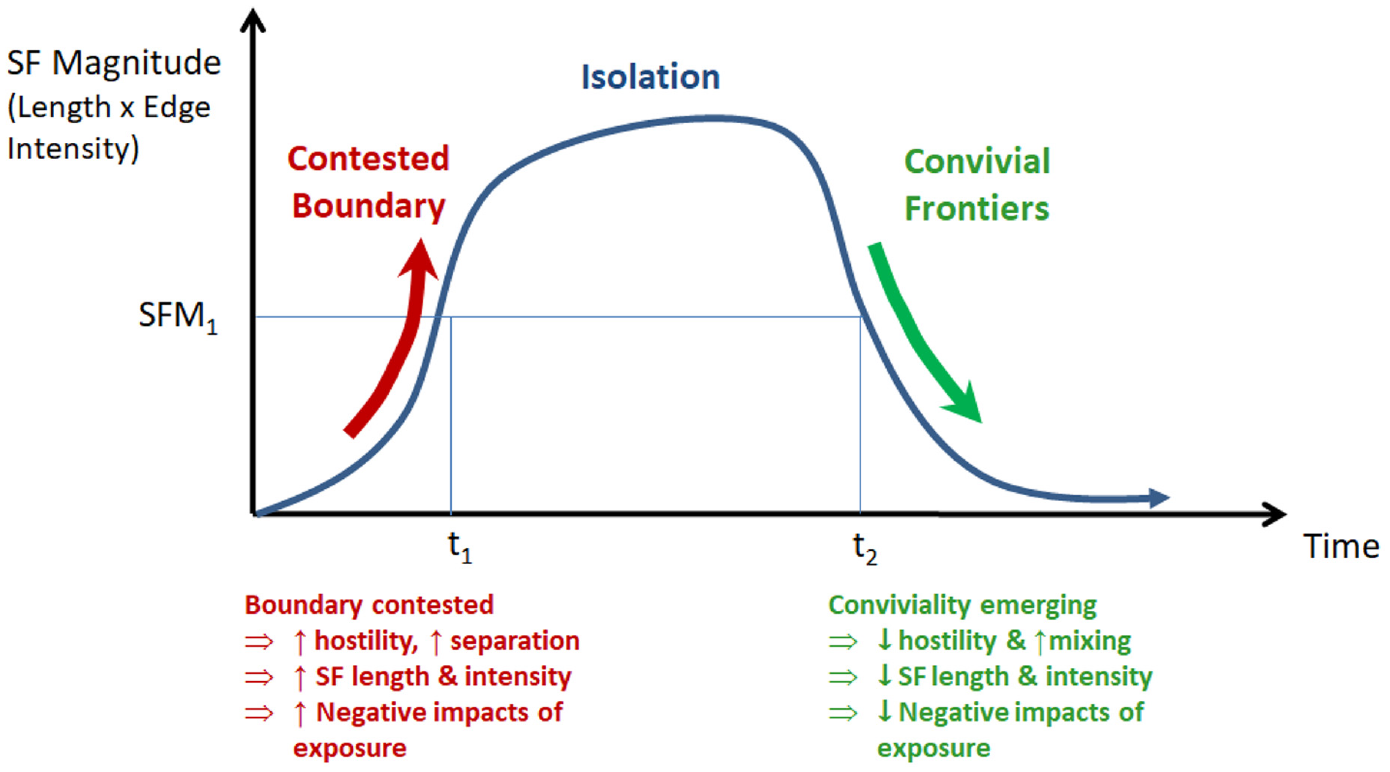
Impact of social frontier (SF) magnitude depends on the stage of the frontier.
The purpose of Figure 1 is not to offer a universal template for the life cycle of social frontiers – there may be a variety of frontier morphologies depending on socio-cultural context. Rather, it serves to highlight how impacts of frontier magnitude (SFM1 in Figure 1) could differ markedly depending on whether it occurs during the upswing (t1) or downswing (t2) phase of the frontier lifecycle, with important implications for how we interpret empirical estimates. To our knowledge, no existing estimates of social frontier impacts consider frontier dynamics.
C5: Wellbeing, educational and life-course effects
Increased conflict, crime, psychological threat, and awareness of relative deprivation, combined with reduced geographical mobility near social frontiers, will have negative impacts on mental health, wellbeing, and the life-course.
The community isolation (P1, P2) associated with social frontiers, territorial conflict effects (P3), exposure to relative deprivation (P4) and reduced geographical mobility (C1) all have implications for life-course trajectories. The increased levels of prejudice and intergroup tensions near social frontiers, for example, are likely to expose children in the area to greater levels of crime and conflict during their formative years. Growing up in conflict-ridden areas has been shown to have a detrimental effect on school performance and life outcomes (Bowen and Bowen, 1999), though the specific impact of neighbourhood boundaries on this relationship has yet to be investigated empirically, as far as we are aware. Increased awareness of relative deprivation (P4) is also likely to have a negative effect on self-image and self-efficacy (Smith et al., 2012). Such impacts are likely to have negative implications for educational achievement and employment outcomes. Layard et al. (2014: F720), for example, find that, ‘the most powerful childhood predictor of adult life-satisfaction is the child’s emotional health’. So, the theorised negative psychological impacts of social frontiers could have enduring effects over the life-course.
From Social Identity Theory (Tajfel and Turner, 1979) we learn that relative deprivation can also have negative consequences for social mobility when the system of inequality is perceived to be stable (i.e. unchangeable) and/or group boundaries are perceived to be impermeable (i.e. little or no possibility for individuals to move from the lower-status group to the higher-status group). Social frontiers may serve to reify these group boundaries. Under such conditions, adults are less likely to engage in individual mobility strategies to improve their personal positions (Ellemers et al., 1993) because the prospect of success is minimal. Similarly, children’s focus on the current relatively disadvantaged position of their group, in contrast to a better possible future, can have negative consequences for their self-esteem (Zhang et al., 2013 ); academic self-efficacy, or belief in their capabilities to organise and execute a course of action to produce results (Iyer et al., 2017); and performance on academic tasks (Iyer et al., 2017).
Conclusion
In this article we have attempted to lay the conceptual foundations for an emerging field of research on social frontiers. We set out a series of testable hypotheses regarding the potential impacts of social frontiers (wellbeing, social cohesion, crime, life-course trajectories). We reasoned that the scale of these impacts will be affected by the magnitude of the frontier and the degree of exposure. For example, frontiers of high edge intensity and significant length, that divide highly contrasting communities will be more likely evoke territorial and defensive behaviour, especially when no natural barrier or buffer zone exists, and where at least one of the communities faces significant vulnerabilities in terms of their social or economic status. The phase of the frontier life cycle will also be important. Whether the frontier is in ascendance or decline may qualify the nature and extent of its impacts.
In short, context and dynamics matter for the impacts of social frontiers. This might seem obvious, but none of the existing empirical papers on social frontier impacts (e.g. Dean et al., 2019; Křížková et al., 2021; Legewie and Schaeffer, 2016) consider frontier dynamics or the effects of different socio-cultural contexts, or many of the other aspects noted above. In fact, all existing studies are cross-sectional, focussing on a single town or city in a particular country at a specific moment in time. We believe there is an imperative therefore for this nascent literature to engage more thoroughly with social frontier dynamics, and the particularities of place. To help facilitate this, we offer some practical suggestions for how the quantitative literature could incorporate some of these insights.
First, empirical studies need to think more carefully about how they measure social frontiers and devote more attention to capturing their salient features, including:
Edge intensity: The severity of the fissure in the spatial distribution of a particular population group, taking into account random variation in the presence of spatial autocorrelation (Dean et al., 2019).
Accentuation: The existence of visual markers such as flags, graffiti, murals and monuments, which potentially reinforce the symbolic interpretation and cultural potency of the frontier.
Length: This has been overlooked in empirical work, but short frontiers may not evoke the same kind of symbolic meaning as those that persist over a sustained distance.
Duration: For their territorial and relational significance to emerge, and for residents to have prolonged exposure, social frontiers need to have persisted for a significant length of time.
Peripherality: Frontier effects may be partly offset by the extent to which households near the frontier feel peripheral to their own communities. Measuring the distance from the frontier to the core of the community, for example, will help control for such effects.
Contrast: How marked is the cultural and social distance between the groups divided by the frontier? A measure of contrast, such as cultural distance between the groups (Shenkar, 2001), could be a useful gauge.
Second, when estimating the impacts of social frontiers, our theory suggests that the following factors need to be considered:
Exposure: The closer the proximity of an individual to the frontier, and the longer duration of this proximity, the greater the exposure to frontier effects is. The traversability of the frontier will also affect exposure. For example, a river or canal may not add much to Euclidean distance or visual obstruction to the outgroup, but it may affect perceived distance, thereby reducing effective exposure.
Ambient Exposure: Proximity to multiple frontier locations, and to frontiers in multiple dimensions, needs to be taken into account as they contribute to overall social frontier exposure.
Dynamics: How and why the frontier has emerged could be important in determining the impacts.
History: Frontiers that arise by mutual consent may elicit quite different responses to those imposed unilaterally. Boundaries that are viewed as legitimate may enhance tendencies to maintain the status quo.
Power Asymmetries: Group size, both in the neighbourhood and in the city/country as a whole, along with their socio-economic and political status and contemporary public attitudes, will all affect the power imbalance across the frontier. This in turn will affect how vulnerable a particular community feels, and their perceived need to preserve ingroup culture, cultivate solidarity and provide support to members, and defend the frontier.
Threshold Effects: The impacts of social frontier magnitude may be non-linear with tipping-points potentially interacting across multiple dimensions.
Capturing these important dimensions and features will help researchers distinguish the impacts of social frontiers from other effects, such as the impact of residential segregation more generally.
It is also worth noting the implications for nomenclature. We mentioned in the introduction the different terminologies that have emerged in the literature. For example, some authors use ‘spatial discontinuities’ or ‘neighbourhood boundaries’ to describe cliff-edges in the social geography. In light of the theoretical considerations presented here, however, these more neutral terminologies seem rather detached; whereas the term ‘social frontiers’ is more attuned to the potent features that follow from the theory. For example, ‘frontier’ connotes asymmetry– how one side views/experiences the social frontier may be quite different from how the other side sees it. ‘Frontier’ also suggests something that is dynamic and contested. By contrast, ‘boundaries’ imply permanence, neutrality and acceptance. ‘Frontier’ also has behavioural connotations, especially the evocation of territoriality. ‘Boundaries’ and ‘discontinuities’, on the other hand, are rather anodyne terms with much weaker behavioural associations. Indeed, perhaps we can frame the field of social frontiers research as:
The quest to understand the circumstances under which spatial discontinuities/boundaries become a social/psychological/political phenomenon.
This behavioural emphasis is congruent with the idea that human agency may play an important role in moderating/mediating the impact of social frontiers (e.g. see our discussion of cultural preservation above). Quantitative analysis alone is unlikely to capture these subtleties. As Munafò and Smith (2018) have argued, the primary epistemological challenge in science is not one of reproducibility, but of a deeper, more fundamental kind: that of overcoming siloed empiricism. It is likely, therefore, that social frontiers will only be fully understood by drawing on multiple perspectives, including qualitative and participatory methods that can focus on individual experiences in complex social environments, and explore the different meanings of social frontiers for different groups in different locations. A more pluralistic approach will also help guard against the stigmatisation of communities living at the frontier, and deepen our understanding of the external processes (such as city planning and housing allocations) that contribute to frontier formation, over which individual residents and communities may have little influence. Indeed, the role of such factors in the development and perpetuation of social frontiers is itself an important avenue for future research.
Footnotes
Acknowledgements
We are very grateful for feedback on earlier versions of the manuscript from John Dixon, George Galster, Sako Musterd and the anonymous reviewers.
Declaration of conflicting interests
The author(s) declared no potential conflicts of interest with respect to the research, authorship, and/or publication of this article.
Funding
The author(s) disclosed receipt of the following financial support for the research, authorship, and/or publication of this article: This research was funded by the Economic and Social Research Council (ESRC) Understanding Inequalities project (Grant Reference: ES/P009301/1) and the ESRC/NordForsk Life at the Frontier (NordForsk Project Number: 95193) research projects.
