




Abstract
The causal impact of the built environment on travel behaviours is a subject of debate. This debate especially concerns the independent effect of the built environment on the observed travel patterns after taking into account residential self-selection arising from pre-existing travel-related attitude. This study argues that travel attitude varies over time, and thus, is also reshaped by residential built environment and interrelated with residents’ travel behaviours. Focusing on the event of residential relocation in the Netherlands, this study longitudinally investigated the interrelations between travel mode choices and preferences before, immediately after and a year after the relocation. Results from the random-intercept cross-lagged panel models substantiated the residential self-selection based on the pre-relocation preferences for motorised means of transport, including cars and public transport. Moreover, travel mode preferences varied to a greater extent than travel mode use pre–post relocation, and especially, frequent use of public transport or bicycles stimulated by the new place of residence had a one-year lagged effect on developing the mode preference. Therefore, the structural role of residential built environment manifests as (re)shaping travel mode choices as well as mode-specific preferences in the process of residential relocation.
Introduction
Urban studies have a long-standing interest in the outcomes of residential mobility, including educational outputs, socio-economic mobility, health outcomes and subjective wellbeing (e.g. Clark and Morrison, 2012; Tao et al., 2022; Troost et al., 2023; Wang and Wang, 2020). Less attention is paid to residential mobility as a long-term process intertwined with daily mobility – concerning travel distances and durations, travel mode choices, preferred ways of travelling, trip frequency and routes, and destinations to daily-life activities. The focus of this study is the dynamics in travel mode choices and preferences before and after residential relocation. It is theoretically sound that the relocation event acts as a window of opportunity for travel mode shift (Verplanken et al., 2008), because relocated residents would consciously reconsider their travel routines after exposure to a new residential built environment (BE) which stimulates the use of alternative travel modes.
However, there is limited research evidence on the causal structure underlying the relationships between BE, travel behaviours and travel-related attitude. Existing cross-sectional studies and the studies based on retrospective survey designs have discussed to what extent travel mode shift is the result of changes in residential BE following relocation, or a manifestation of residents’ socio-economic traits and pre-existing travel-related attitude (Cao and Ermagun, 2017; Cao et al., 2009; Van Herick and Mokhtarian, 2020). For example, residents who prefer cycling or using public transport tend to move to an urban neighbourhood with easy access to diverse activity destinations and transport services. This phenomenon is termed (travel-related) residential self-selection, indicating that people choose the place of residence according to their travel abilities, needs and preferences (Cao et al., 2009; Van Wee and Cao, 2022). Based on the residential self-selection, the importance of BE manifests as allowing residents to select desired housing locations and thus enables preferred travel alternatives (Næss, 2009). Besides the self-selection from pre-existing travel attitude, however, less longitudinally investigated is whether travel attitude changes over time, and to what extent the time-varying travel attitude is endogenous to the relationships between BE and travel behaviours.
As a critical dialogue with residential self-selection, this study reiterates the structural role of residential BE, over and above residents’ pre-existing travel mode preferences, in (re)shaping their travel mode choices. Changes in residential BE after relocation not only result in travel mode shift, but also induce changes in mode-specific preferences, which script future mode use (Tao et al., 2023a). More importantly, residents may not change their mode use and preferences immediately following the relocation given that daily travel routines have been established. Instead, travel-related adjustments to the new place of residence are a gradual process involving reciprocal relationships between travel mode use and mode-specific preferences over time. This entails a multi-wave analysis of travel mode use and preferences for a long period of time pre–post residential relocation.
This study aims to investigate changes in travel mode preferences and the interrelations with travel mode choices in the process of residential relocation. To achieve this aim, I applied the random-intercept cross-lagged panel models to a unique panel dataset that followed around a thousand relocated residents for three survey waves in the Netherlands. The main questions are: (1) How do travel mode choices and preferences interrelate with each other before, immediately after and a year after residential relocation? (2) What is the role of residential BE in the mode use-preference interrelations?
Literature review
The causal relationship between the built environment (BE) and travel behaviours is an important subject for urban and transport geography research. This BE–travel causality pertains to the role of spatial planning initiatives, such as compact urban forms, transit-oriented development, walkable neighbourhoods and the 15-minute city, in (re)shaping people’s travel patterns and promoting sustainable means of transport (e.g., public transport, bicycles and walking). However, existing research evidence using the cross-sectional design cannot lend this causal inference. The reason is that cross-sectional studies examine the coincidence between BE and travel characteristics among different individuals at a single time point, which cannot exclude any between-individual idiosyncratic factors (e.g., travel-related attitude) that commonly drive the choices of residential locations and travel behaviours (Tao et al., 2023a). For this reason, emerging longitudinal research retrospectively or prospectively investigates residents who have recently moved their houses, and analyses how within-individual changes in residential BE result in corresponding changes in travel behaviours pre–post relocation. The following literature review focuses on the longitudinal research evidence based on the relocation event. For a broader review of the relationship between BE, travel behaviours and travel-related attitude, see Cao et al. (2009), Ewing and Cervero (2010), Guan et al. (2020) and Van Wee and Cao (2022).
Despite great advances in longitudinal research designs, three arguments remain in establishing the causal BE–travel relationship, that is, residential determinism, residential self-selection and reverse causality. Residential determinism claims that the residential BE itself exerts an independent impact on residents’ travel mode choices (Lin et al., 2017). For example, moving to a more urban-like neighbourhood with greater accessibility to activity destinations and transport services results in less use of cars and more use of public transport and non-motorised means of transport, while relocation to a more suburban BE contributes to greater car ownership and car-dominant travel patterns (e.g. Cao et al., 2019; Scheiner and Holz-Rau, 2013; Van Acker and Witlox, 2010).
In contrast to residential determinism, residential self-selection argues that residents’ socio-economic traits and travel-related attitude predispose their daily mobility choices (Cao et al., 2009; Mokhtarian and Cao, 2008). For travel-related residential self-selection, the pre-existing travel attitude may drive residential location choice and following travel behaviours. As such, residential self-selection, as ‘an expression of expanded choice’, matters for people’s daily travels by realising their preferred way of travelling through long-term residential mobility (Levine, 1999; Næss, 2009). It is uncertain how overlooking travel-related self-selection will influence the estimation of the BE effect on travel behaviours. Cao and Chatman (2016) summarise that the true BE effect depends on the supply of alternative housing development, the preference structure among the population, and to what extent residents prioritise their travel preferences in relocation decision-making. Recent qualitative research evidence also suggests that travel preferences do not always translate into the relocation decision because other non-travel-related residential preferences (e.g., the desire for larger living space, lower housing costs and better school quality) dominate the housing selection process (Wolday et al., 2019; Zarabi et al., 2019).
The third argument involved in the BE–travel relationship – reverse causality – pertains to the time-varying nature of travel attitude. van Wee et al. (2019) have explained this reverse effect from changes in BE to changes in travel attitude through two theoretical pathways. The learning process indicates that individuals update their knowledge and adapt pre-existing travel attitude after experiencing a change in situational contexts (e.g., a new place of residence) or using alternative means of transport. The cognitive dissonance theory posits that the inconsistency between travel behaviours and attitude incurs psychological stress, which motivates people to adjust either their behaviours or their attitude. In case that residential BE does not allow a specific mode use, such as inaccessible public transport (PT) services in the neighbourhood, residents are more likely to adjust the mode preference to match their mode choice than vice versa (De Vos et al., 2018). Based on these theoretical pathways, the reverse causality assumes that a disregard for attitudinal changes would underestimate the impact of BE on travel mode choices. Changes in residential BE after relocation not only stimulate the use of certain travel modes, but also promote the preference for these modes and predispose their future use (Tao et al., 2023a).
However, changes in travel attitude are empirically understudied because of the retrospective survey design in previous relocation studies. Especially those studies examining the effects of residential self-selection, it is unreliable to collect information on travel attitude at post-relocation and use it to infer the relocation decision-making that occurs at an earlier time. The post-relocation travel attitude, as claimed by the reverse causality, is more of an adaptation to the new place of residence than the self-selection of it. Recent longitudinal studies have examined the bidirectional relationships between travel mode use and preferences (e.g. Kroesen et al., 2017; McCarthy et al., 2023; Olde Kalter et al., 2021). Their results support that travel mode preferences vary over time, and in some cases, travel mode use influences mode-specific preferences more than vice versa. Less known is how residents change their travel mode use and preferences in an unstable context, for example, after moving house. Following a quasi-longitudinal design, De Vos et al. (2018) ask residents in Ghent, Belgium to retrospect changes in the frequency and preferences of using different travel modes following relocation. The results suggest that after moving to more urbanised neighbourhoods, residents not only switch from cars to PT and active travel modes, but also improve their attitude towards these sustainable travel modes. Wang and Lin (2019), and Tao et al. (2023b) provide the only longitudinal evidence that prospectively investigates residents’ travel behaviours and attitude pre–post relocation, but their results are not consistent with each other. In Beijing, China, Wang and Lin (2019) find significant changes in travel mode preferences after relocation, but show little evidence of residential self-selection arising from pre-relocation mode preferences. In contrast, Tao et al.’s (2023b) two-wave analysis in the Netherlands indicates both residential self-selection and the reverse causality at play, and either of which mechanism works is specific to the commuting mode under study. Due to the limitation of a single survey wave at post-relocation, however, these three studies do not consider that behavioural or/and attitudinal adjustments to residential BE may take time to appear. It is thus unclear how travel mode use and preferences interrelate with each other over time after relocation.
Besides the above three arguments, residential relocation involves complicated decision-making beyond the travel-related concern. Along with the pursuit of better housing and living environments, relocation decisions are often triggered by family and job-related life events (Scheiner and Holz-Rau, 2013; Tao et al., 2023c). These life events often lead to an imbalance between housing-related needs and resources, which stimulates relocation decision-making (Coulter and van Ham, 2013; Wolday et al., 2019). For example, residents may demand a larger living space after childbirth, or seek to reduce commuting distances after job changes. As such, the subsequent changes in travel behaviours are the outcomes of these lifecycle changes and concurrent changes in residential BE. As suggested by Scheiner (2014), travel-related changes after residential relocation should be understood in a wider context of changes in life domains and choices where the relocation decision-making is embedded. To this end, a holistic perspective is required to investigate how residential relocation is intertwined with life events and how they jointly reshape daily travel demand and preferences.
Research framework
Residential relocation and travel mode shift are interrelated mobility decisions made in life. Existing relocation research has discussed the impact of changes in residential BE versus prepositioned travel-related attitude on changes in travel mode choices, that is, residential determinism versus residential self-selection. Considering solid theoretical support for the argument of reverse causality, less longitudinally investigated is how changes in residential BE lead to changes in travel mode preferences, and importantly, how changes in travel mode choices and preferences interrelate with each other over time.
To examine the three abovementioned arguments in an integrated framework, an appropriate approach is using a three-wave prospective survey which incorporates the measures of travel behaviours and travel-related attitude before, immediately after and a period of time after the relocation (Guan et al., 2020; Tao et al., 2023a). The multi-wave analysis pre–post residential relocation will contribute to better understanding of the causal relationships between BE and travel behaviours. The research framework of this study shows the three-wave cross-lagged panel analysis of travel mode choices and preferences pre–post relocation. Specifically, Figure 1 focuses on the within-individual interrelations between travel mode use and preferences after taking into account the stable between-individual correlations. Regarding the role of residential BE, pre-relocation BE may have a lasting impact on the choices and preferences for different travel modes pre–post relocation. In contrast, post-relocation BE not only induces changes in mode use and preferences after relocation, but also can be self-selected based on the mode preferences at pre-relocation. Besides the travel-related self-selection, baseline socio-economic characteristics and family or job-related life events may also influence the choices of residential BE at post-relocation, as well as the interrelations between travel mode use and preferences pre–post relocation.
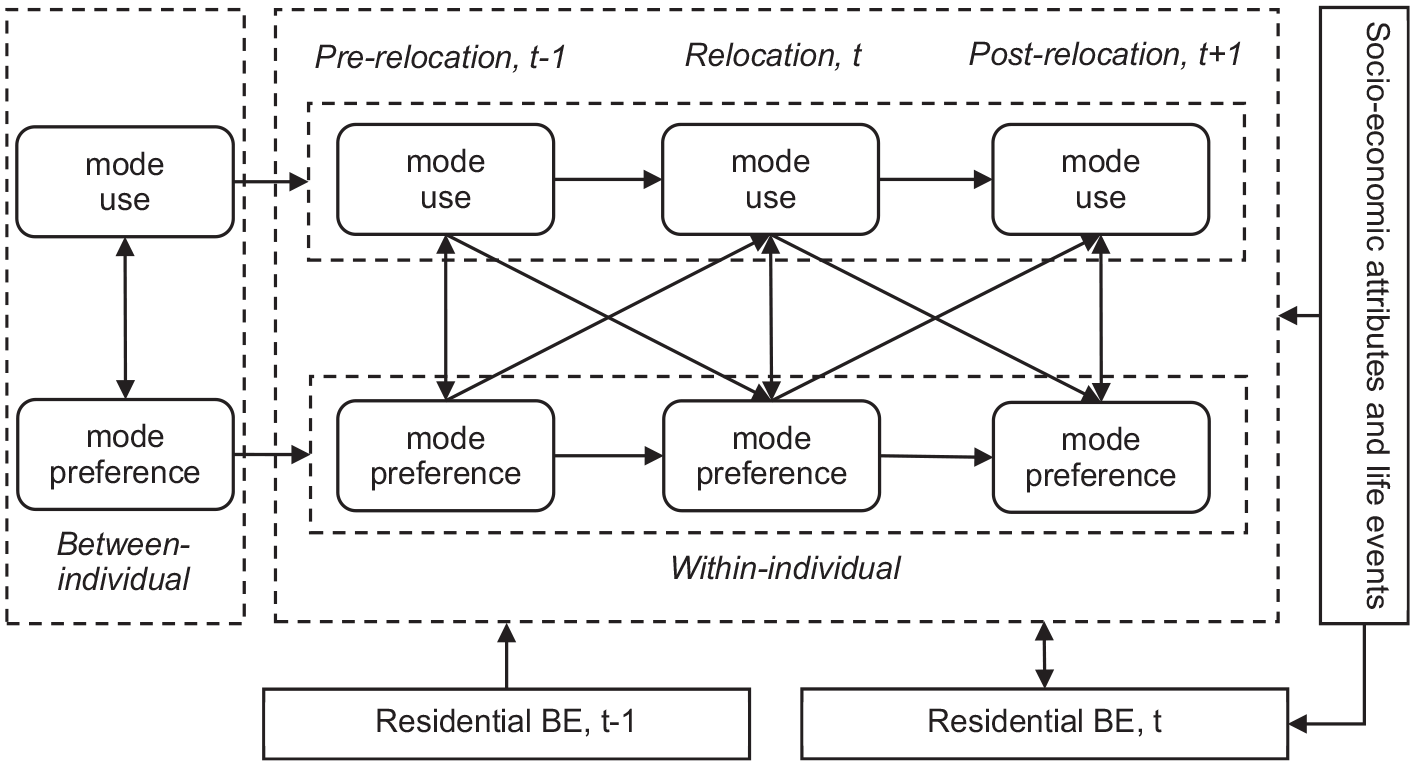
Research framework.
Data and methods
Data
The data were from the Netherlands Mobility Panel (MPN). MPN has conducted nationwide panel surveys for around 6000 respondents every year since 2013. These multi-wave surveys aim at monitoring the temporal trends in travel patterns of the Dutch population. Given the longitudinal nature of MPN, this study can investigate changes in travel mode choices, and especially, the interrelations with changes in mode-specific preferences over time. Besides, respondents were randomly recruited and investigated based on an online access panel, which provides a unique opportunity to follow relocated residents for multiple waves. For detailed sampling and survey procedures see Hoogendoorn-Lanser et al. (2015).
This study selected the MPN respondents who reported the event of residential relocation between 2013 and 2019. Among them, respondents aged below 18 were removed from the study because they are not allowed to independently drive a car in the Netherlands. The selection strategy results in 911 respondents longitudinally investigated in this study. Note that each studied respondent has a continuous three-year record, that is, the year before the relocation (termed the pre-relocation year, t −1), the relocation year t and the year after the relocation (termed the post-relocation year, t+1). To examine the non-random dropout of the respondents between survey waves, this study compares the socio-economic characteristics of the studied respondents (i.e. three-wave relocated respondents; N = 911), with those of all MPN respondents (N = 7113) and the respondents who quit the MPN before the year t+1 (i.e. two-wave relocated respondents; N = 1107). The results (not shown) indicate that the two-wave and three-wave respondents had little difference in socio-economic characteristics, suggesting no serious problem of non-random drop-outs for relocated residents. Even so, the studied three-wave respondents were younger, better educated and more likely to be singles from middle- or low-income households than all MPN respondents, indicating that relocated residents are not uniformly distributed among the general population regarding their socio-economics.
Measures
The main variables of interest are travel mode use and the mode-specific preference, both of which were investigated three times in the years t −1, t and t+1, respectively. Travel mode use was measured by asking respondents the frequency of using the car, public transport (PT) and bicycle for their daily trips. Their answers were coded on a 7-level scale, ranging from 1 (almost never) to 7 (four or more days a week). Regarding travel mode preferences, MPN respondents reported their preferred means of transport every year for eight different purposes (i.e., commuting, education, daily groceries, shopping, visiting other people, a day trip, sports activities, and other leisure activities). Following Olde Kalter et al. (2021), mode-specific preferences for the car, PT and bicycle were calculated by dividing the total number of the purposes applied to the respondents by the times of each travel mode mentioned as the preferred one. The resultant ratio ranged from 0 (the least preferred) to 1 (the most preferred) for each travel mode.
Residential built environment (BE) was registered twice before and after the relocation, respectively at t −1 and t (or t+1 due to the stable residential BE between t and t+1). Based on Ewing and Cervero (2010), Ettema and Nieuwenhuis (2017), and Wang and Lin (2019), three BE characteristics relevant to the use of different travel modes were included, that is, the distance to the regional centre, population density at the residence and the distance to the intercity train station. Specifically, the distance from the home location to the centre of the nearest urban region measured the residential BE at the regional scale. In the Netherlands, there are 22 functional urban regions where most of the population from surrounding areas commute to work (Organisation for Economic Co-operation and Development [OECD], 2022). Population density and the distance to the intercity train station represented the BE at the neighbourhood scale. The population density was quantified by the number of inhabitants per square kilometre in the four-digit postal code areas of the residence, while the distance to the nearest intercity train station was used as a proxy for the geographic accessibility to high-quality public transport at the residence.
The covariates are baseline socio-economic characteristics at pre-relocation and life events concurrent with the relocation event. Specifically, job-related life events include starting a first job, job/school changes, retiring from work and income changes, while family-related life events include giving birth to a child, cohabitating with a partner and separating from a partner. Notably, when respondents moved houses, around one-third of them went through either a job-related or a family-related life event in the same year, underlying the important role of concurrent life events in relocation decision-making. In addition, baseline socio-economic characteristics are composed of gender, age, educational attainment, employment status, the number of children (<12 years old) in the household, household income and household car ownership at pre-relocation.
Methods
The random-intercept cross-lagged panel model (RI-CLPM) was used to examine the interrelations between travel mode use and preferences pre–post residential relocation. RI-CLPM is a structural equation modelling (SEM) method for longitudinal data. Compared to traditional CLPM, it decomposes observed variables into stable between-individual differences and time-varying within-individual dynamics (Mulder and Hamaker, 2021). For example, changes in travel mode use are composed of variations in the frequency of mode use for different individuals with specific trait-like features and for the same individuals who change mode use over time. By doing so, a less biased estimation of the mode use–preference interrelations can be yielded at the within-individual level.
This study developed RI-CLPMs for the car, PT and bicycle separately. For each of these travel models, mode use and preferences were split into within-individual and between-individual variations, as expressed in Formulas 1 to 4. At the within-individual level, the autoregressive effects, cross-lagged effects and cross-sectional associations were estimated. The autoregressive effects (denoted by


with


where
Besides the three-wave interrelations between travel mode use and preferences, RI-CLPMs also accounted for the exogenous impact of baseline socio-economic characteristics, residential BE at pre-relocation, and family and job-related life events. Note that, as shown in the research framework (Figure 1), post-relocation BE was regarded endogenous considering the residential self-selection resulting from baseline socio-economics, pre-relocation mode preferences and life events. RI-CLPMs were fitted in the programme Mplus, and the estimators of maximum likelihood with robust standard errors (MLR) were used to address the non-normal distribution of the variables.
Results
Changes in travel mode use and preferences pre–post residential relocation
As shown in Table 1, not only travel mode use but also mode-specific preferences varied pre–post residential relocation. Regarding mode use, respondents gradually reduced bicycle use from the pre-relocation year (t −1) to the post-relocation year (t+1), while the frequency of travelling by PT significantly decreased at t+1 compared with that of PT use at t. The decline in the use of these sustainable travel modes was greater for respondents who relocated away from the centre of the urban region. In contrast, those who moved closer to the regional centre used the car less frequently and PT more frequently following the relocation at t. Regarding mode preferences, respondents were more likely to increase the level of car preferences and less likely to favour bicycle use from t −1 to t, which was particularly the case when they relocated away from the regional centre. Whilst moving closer to the regional centre weakened the preferences for using cars from t −1 to t, the long-term effect was uncertain given the insignificant difference in car preferences between t and t+1.
Changes in travel mode use and preferences pre–post residential relocation.
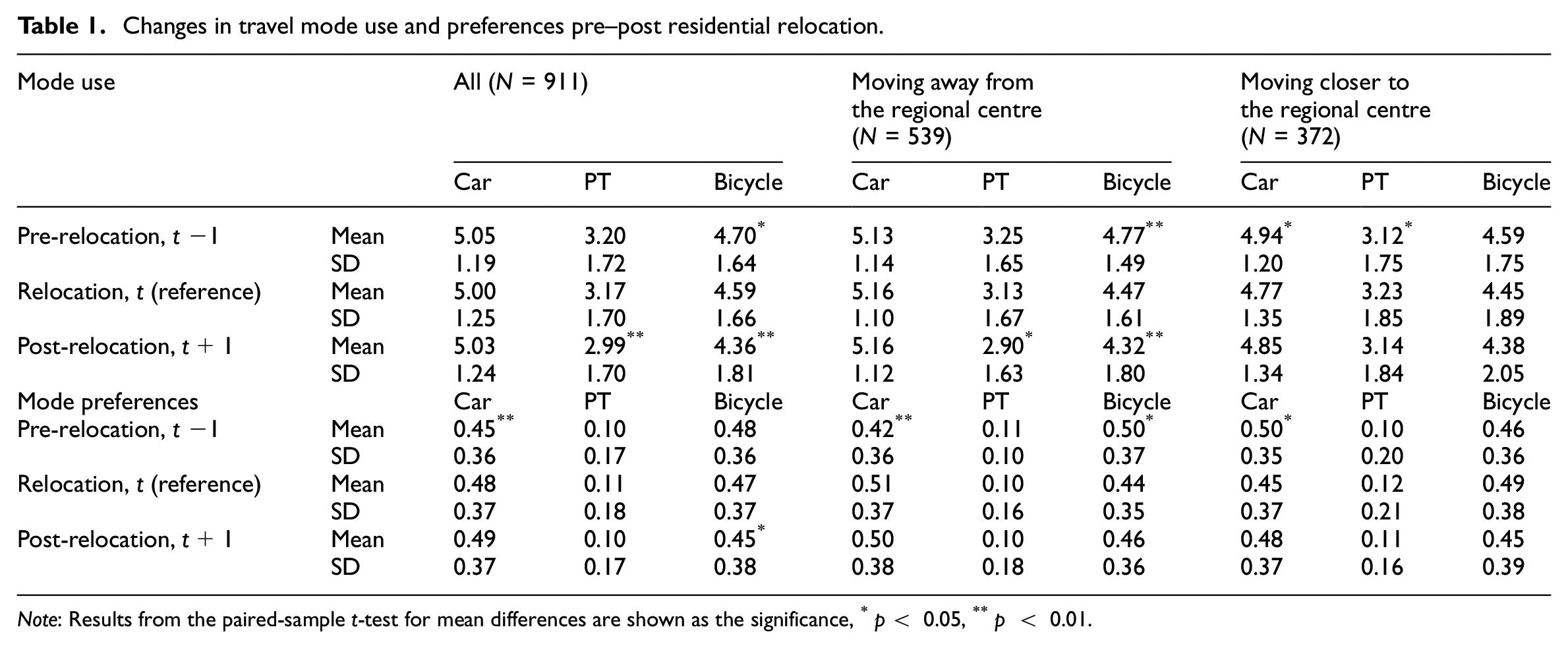
Note: Results from the paired-sample t-test for mean differences are shown as the significance, *p < 0.05, **p < 0.01.
Model adjustment and model fits
Three RI-CLPMs were constructed to analyse the interrelations between mode use and preferences respectively for the car, PT and bicycle pre–post relocation. In the raw RI-CLPMs that link all the paths between variables, the goodness-of-fit indices of the models just met the recommended values. For this, each model went through two additional adjustments: First, the non-significant paths (at p < 0.10) from baseline socio-demographics (i.e., gender, age, education, employment and the number of children) to mode use and preferences were dropped out. Second, residential BE factors were aggregated into two latent variables, respectively at pre-relocation and at post-relocation, given the high correlations between BE factors (Pearson correlations = 0.63–0.86). Results from confirmative factor analysis show that the latent variables were strongly associated with the three BE factors, negatively with the density indicator and positively with the two distance indicators. Hence, a larger value of the latent variables represented a more suburban residential BE, with lower population density and longer distances to the regional centre and the train station. The factorial invariance was also tested by comparing with the fixed factor loadings of the two latent variables pre–post relocation. After the model adjustment, all three RI-CLPMs fitted the data pretty well as indicated by the goodness-of-fit indices (chi-square/degrees of freedom = 0.82–1.07, comparative fit index, CFI = 0.96–0.98, Tucker–Lewis index, TLI = 1.00–1.07, root mean square error of approximation, RMSEA = 0.00–0.02, standardised root mean square residual, SRMR = 0.01–0.02).
The interrelations between travel mode use and preferences
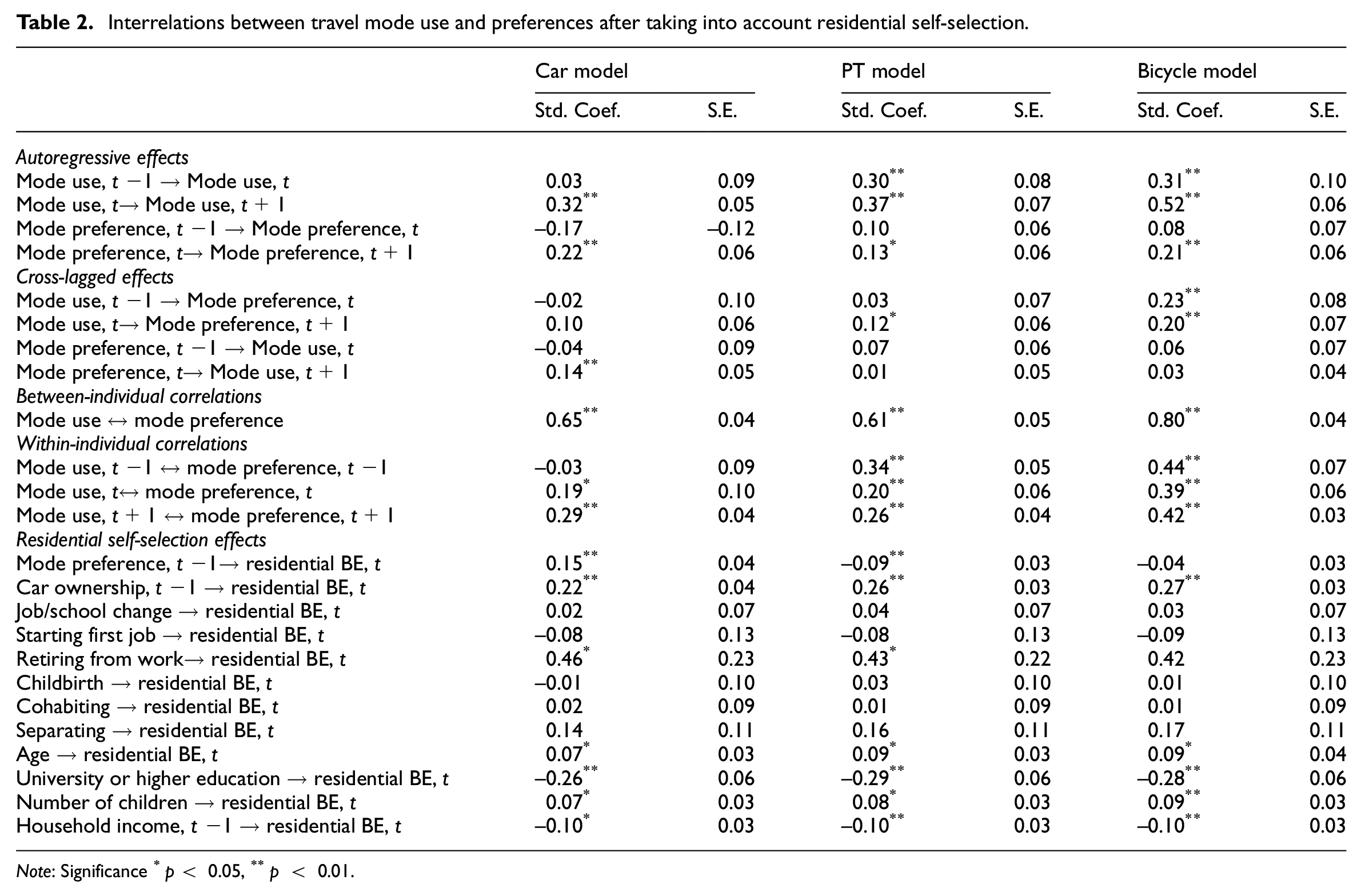
Table 2 presents the endogenous parts of RI-CLPMs, including the interrelations between travel mode use and preferences and the effects of residential self-selection. The autoregressive effects demonstrate that mode preferences varied to a greater extent than mode use following the relocation. Preferences for the car, PT and bicycle in the pre-relocation year (t −1) were not predictive of respective preferences in the relocation year (t), while pre-relocation PT and bicycle users tended to maintain their mode use from t −1 to t. After relocation, however, mode use and preferences exhibited state dependence, for all three means of transport alike. That is to say, if someone preferred a travel mode and used that mode more frequently than the expected level at t, he/she would also prefer and continue using that mode at t+1.
Interrelations between travel mode use and preferences after taking into account residential self-selection.
Note: Significance *p < 0.05, **p < 0.01.
The cross-lagged effects, or the within-individual spill-over effects, indicate that for PT and the bicycle, mode use had a greater impact on the preference for that mode than the other way around. Respondents who used PT frequently at t tended to prefer using PT at t+1, while frequent bicycle users at t −1 and t respectively increased the levels of cycling preferences at t and t+1. In contrast, car use did not exert a lagged effect on car preferences. The level of car preferences at t, however, was positively related to the frequency of car use at t+1; that is, a strong preference for the car would transform into frequent car use one year after the relocation.
The within-individual correlations show strong year-specific interrelations between mode use and preferences for PT and the bicycle. Individuals who had an above-average level of PT or bicycle use also had an above-average level of the preference for that mode in the same year. In contrast, the car use-preference correlation was only significant at t+1, implying the time required to achieve the consistency between car use and preferences in the process of residential relocation. Even so, there were strong between-individual correlations between mode use and preferences for all three travel modes. This means that some stable between-individual differences commonly drive people to become the frequent mode user and to develop a preference for that mode. For example, car users tend to prefer car use because they share similar values and predilections in life (e.g., weak environmental awareness and treasuring punctuality), or have been exposed to limited geographic opportunities pre–post relocation (e.g., living far away from the job centres and lacking daily-life activity destinations in the neighbourhood).
The effects of residential self-selection
There was clear evidence of travel-related residential self-selection for respondents who preferred travelling by car and PT at pre-relocation. Specifically, car lovers tended to move to more suburban BE with lower population density and transit accessibility. This explained the insignificant within-individual correlation between car use and preferences at pre-relocation. A pre-existing preference for the car would expand residents’ search area of potential housing alternatives, and furthermore, the car use-preference inconsistency might motivate them to relocate to a more suburban-like neighbourhood with additional benefits of lower housing price and better living environments. As suggested by Næss (2009, 2014), this self-selection effect is in itself a manifestation of the BE effect by allowing car lovers to satisfy their travel preferences. In contrast to the results for car-related residential self-selection, residents who preferred PT use at pre-relocation would relocate to more urban BE, while the self-selection effect was negligible for pre-relocation cycling enthusiasts. In addition to the travel-related self-selection, the elderly, lower-educated respondents, and respondents who owned more cars, had more children in the family and had lower household income at pre-relocation would choose a more suburban-like neighbourhood than their respective counterparts. Surprisingly, there was little residential self-selection arising from family and job-related life events, except that residents tended to move to more suburban BE after retiring.
The effects of residential built environment on travel mode use and preferences
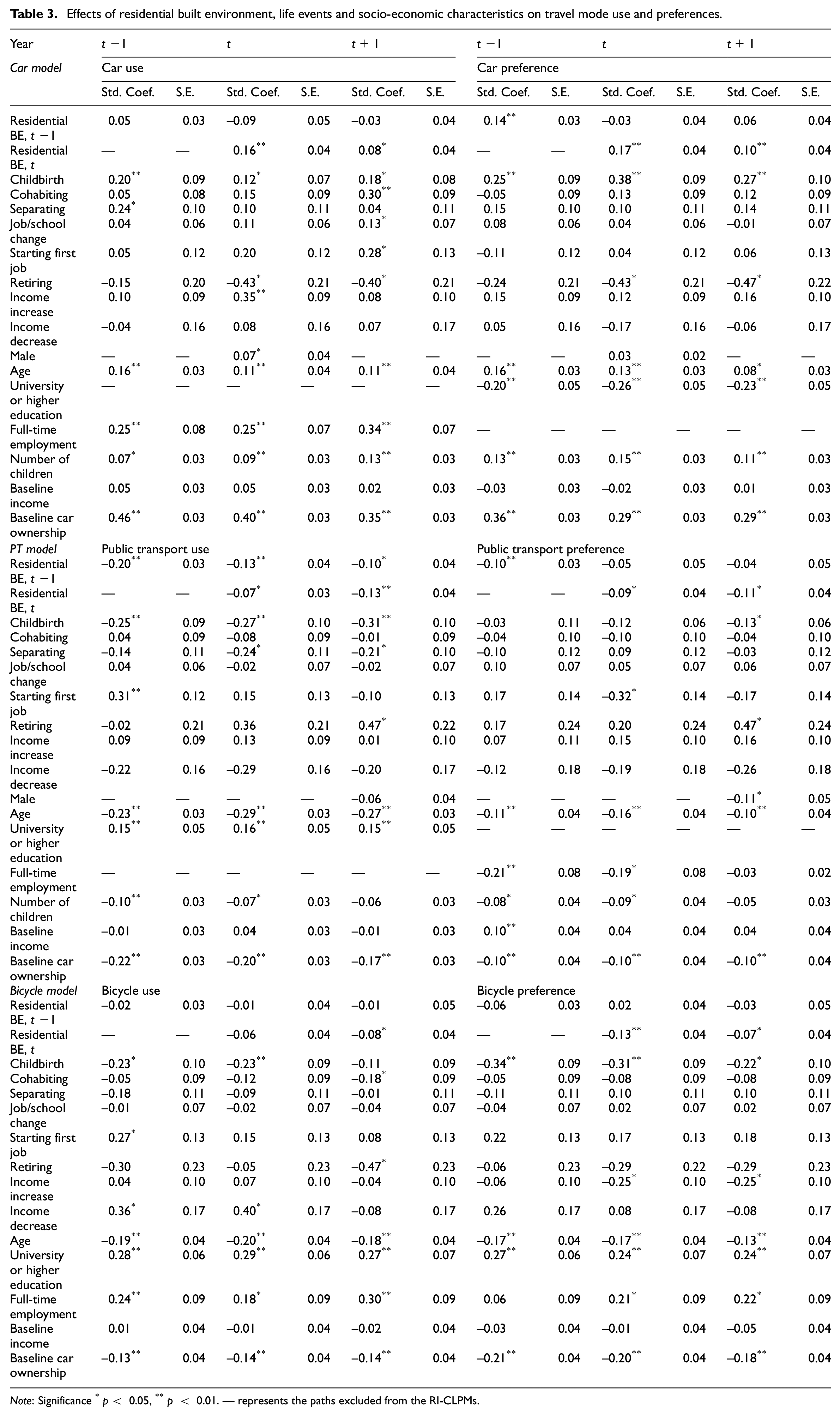
Table 3 presents the exogenous parts of RI-CLPMs, including the effects of residential BE, life events and socio-economic characteristics on travel mode use and preferences. First and foremost, residential BE exerted an effect on travel mode use, as well as mode-specific preferences, over time. Specifically, relocating to more suburban BE significantly increased car use and preferences at t, but both effects diminished a year later. In contrast, residential BE had a long-term effect on PT use. More suburban BE, whether at pre-relocation or at post-relocation, decreased the frequency of travelling by PT in all three studied years. Different from the results for PT, post-relocation BE exerted a stronger effect on the preference for the bicycle than its actual use. After moving to a more suburban-like neighbourhood, respondents weakened cycling preferences at t and t+1, and reduced bicycle use at t+1. Note that the one-year lagged effect of post-relocation BE on bicycle use was the net environmental impact rather than through the mediating pathway of cycling preferences, considering the insignificant cross-lagged effect of cycling preferences at t on cycling frequencies at t+1 (Table 2).
Effects of residential built environment, life events and socio-economic characteristics on travel mode use and preferences.
Note: Significance *p < 0.05, **p < 0.01. — represents the paths excluded from the RI-CLPMs.
The effects of life events and socio-economics on travel mode use and preferences
In addition to the role of residential BE, life events concurrent with the relocation also influenced travel mode use and preferences after the relocation. Regarding the effects of family-related life events, giving birth to a child resulted in greater use and preferences for the car and less for more sustainable alternatives. Moreover, parents would anticipate the occurrence of childbirth, adjust mode use and preferences beforehand, and maintain their mode choices and preferences for at least three years pre–post relocation. Besides a childbirth event, moving in with a partner had a lagged effect on more car use at t+1, while separating from a partner prompted more trips by car at t −1 and discouraged PT use afterwards at t and t+1. Regarding the effects of job-related life events, starting a first job and job/school changes had a one-year lagged effect on more frequent car use after the relocation, suggesting the time required to develop the car-use habit. Interestingly, those newcomers to the job market had travelled frequently by PT and bicycle one year before but decreased their PT preferences immediately after starting their first job. In contrast, retiring decreased the use and preference for the car. Considering the tendency for suburban relocation, retired residents relied more on PT and reduced cycling frequency one year after the relocation. Besides, more household income increased car use at t and reduced cycling preferences at t+1, while respondents would anticipate their income decrease and cycle more frequently at t −1.
Table 3 also revealed some between-individual differences in mode use and preferences based on baseline socio-economic characteristics. Men used cars more frequently at t and showed less interest in PT use at t+1 than women. Age was positively related to car use and preferences but negatively to the use and preferences for PT and the bicycle over time. Higher educated respondents were less likely to appreciate car use, and more likely to use PT or bicycle frequently and develop cycling preferences. In contrast, full-time employed respondents drove more often, disliked travelling by PT, but also conducted more frequent cycling trips and desired to do so. Notably, respondents who had more children and owned more cars at pre-relocation travelled by car more often and preferred car use in all three studied years, and accordingly, their use and preferences for PT were much lower pre–post relocation.
Discussion and conclusions
Drawing upon the three-wave cross-lagged panel analysis, this study longitudinally examines the interrelations between travel mode use and preferences pre–post residential relocation in the Netherlands. Compared with the cross-sectional research that focuses on between-individual differences and the retrospective research that investigates travel-related attitude only at post-relocation, the longitudinal analysis of this study represents a step forward in understanding the causal relationship between residential BE and travel behaviours. The study results substantiated the residential self-selection resulting from the pre-relocation preference for motorised travel modes on the one hand, and the reverse causality from residential BE to mode-specific preferences at post-relocation on the other. Interestingly, travel mode preferences were varying to a greater extent than travel mode choices following residential relocation. Therefore, the structural role of residential BE manifests as (re)shaping travel mode choices as well as mode-specific preferences in the process of residential relocation.
The impact of residential BE was firstly evidenced by allowing people to self-select the housing locations and realise their pre-existing travel preferences. Car lovers tended to relocate to a more suburban-like neighbourhood with lower population density and transit accessibility, while residents who preferred using PT at pre-relocation would move closer to the centre of the urban region to access more convenient transit services. Residential self-selection based on PT preferences has been evidenced by some recent studies in the Netherlands (Ettema and Nieuwenhuis, 2017; Tao et al., 2023b). However, the self-selection based on car preferences is inconsistent with recent quasi-longitudinal and qualitative research evidence in the Nordic contexts (Cao et al., 2019; Wolday et al., 2019). This warrants the analysis of non-travel-related residential preferences to examine whether the pre-existing preference for car use is a self-selection factor in itself or enables residents to prioritise other residential preferences (e.g. a desire for larger and less expensive houses in the suburbs; Næss, 2014).
After relocation, residents did adjust their travel mode preferences. Results from the autoregressive effects show that pre-relocation preferences for the car, PT and bicycle did not carry over to predict corresponding mode preferences following relocation. Moreover, frequent use of PT or bicycle had a one-year lagged effect on developing the mode preference after the relocation, indicating a stronger effect of travel mode choices on mode-specific preferences than vice versa. The opposite pathway, that is, the cross-lagged effect of greater mode preferences on more frequent mode use, only applied to the car. Taken together with the results for residential self-selection, this implies that pre-existing car preferences would not transform into frequent car use immediately following the relocation. It took time (one year in this study) for car lovers to address the inconsistency between mode choices and preferences by using the car more frequently. To postpone or even reverse this car-dominant travel pattern, the short period after the relocation is a window of opportunity to intervene in residents’ mode choices, and in the long term, more awareness campaigns are required to destabilise residents’ favourable attitude towards car use.
Given the temporal variations in travel-related attitude, another important role of residential BE is to influence travel mode preferences and interrelated mode choices over time. After relocating to a more suburban-like neighbourhood, residents would increase their car use and preferences. However, this environmental impact subsided with time possibly because residents reached the car use-preference consistency one year after the relocation. Besides, more urban residential BE stimulated more frequent PT trips, which further contributed to a positive stance towards PT considering the cross-lagged effect of PT use on PT preferences. This indicates that transit-oriented development has the merits of not only promoting transit ridership but also spreading transit-like attitude among the public. Also, residents increased their cycling preferences after moving to a more urban-like neighbourhood, and cycled more frequently one year later. Notably, the cycling preference alone does not work well in promoting bicycle use because of the insignificant cross-lagged effect. Based on this result, relaxing environmental constraints at the residence, such as by improving the cycle lanes and networks and providing diverse activity destinations within cycling distances, is a precondition for encouraging more widespread cycling behaviours.
Life events occurring in the same year of the relocation also reshape travel mode choices and preferences. In the household domain, relocated residents would anticipate changes in travel demands after childbirth by using the car more frequently and travelling less by PT and bicycle one year before. This car-oriented travel pattern was sustained for at least two years after the relocation when families with children had formed a preference for car use (similar household-level longitudinal evidence by Tao et al., 2023c). In the employment domain, starting a first job would decrease the use of sustainable travel alternatives, transform residents’ positive stance towards PT, and even spread the car-use behaviour and car-like attitude one year after concurrent job and housing changes. In contrast, retired residents tended to relocate to more suburban BE and show less interest in car use, which entailed their dependency on the provision of PT services in the residential neighbourhood. Based on the results for family and job-related life events, the preconception stage and the year before entering the job market are important timings for interventions to alleviate the dominant car use of relocated residents in the near future. Besides, easy-access and high-quality transit services in suburban areas contribute to developing and satisfying residents’ preferences for PT use.
This study has some limitations. First, for reaching parsimonious models, changes in car ownership were not considered in this study. This could be the reason for the one-year lagged response in car use for relocated residents who had a pre-existing car preference (i.e., the time required for car purchase behaviours). Besides, the impact of residential BE on travel mode choices and preferences should be interpreted as the total effects, irrespective of the mediating pathway through changes in car ownership. Second, this study took into account three possible sources of residential relocation, that is, socio-economics, life events and travel mode preferences. In these three sources, life events were included in the models only when they occurred in the same year as residential relocation, which leaves relocation in anticipation of, or adaptation to, these events out of consideration. As recommended by Næss (2015) and Van Wee and Cao (2022), an integration of longitudinal quantitative analysis and in-depth qualitative interviews will further interpret the causal mechanism underlying the motivation for residential relocation (e.g., non-travel-related residential preferences) and the impacts on daily travel behaviours. Third, this study focused on the interrelations between travel mode use and mode-specific preferences over time. The longitudinal analysis of other dimensions of travel behaviours is also a promising research direction. Particularly, it is interesting to investigate how changes in travel distances, travel time and mode choices are interrelated with each other over time. Does bringing the origin and destination of daily-life activities closer actually reduce people’s daily travel time or just expand their search area and increase their travel frequency? To what extent does the dominant car use reflect people’s habit/preference for driving or the necessity due to long distances to activity destinations?
Travel behaviours are not only a daily mobility choice but concern the long-term adaptation and adjustment in the process of residential relocation. This study makes an important step in this regard by examining the residential self-selection and reverse causality for the relationship between residential built environment and travel mode choices in an integrated framework. The three-wave cross-lagged analysis of this study also indicates the time required for residents to adjust travel mode choices and preferences after relocation. Qualitative research and longitudinal research with more survey waves are welcome to enrich the understanding of residential mobility as a process in life and to investigate the interrelations between travel behaviours and travel-related attitude over the life course.
