




Abstract
City leadership appears key in driving the transition towards a liveable future. Trying to bring specific visions of the future into present decisions and actions is what anticipatory governance is about. However, the literature has highlighted a lack of discussion of the use of anticipatory practices in urban climate governance. What anticipatory practices do cities employ to tackle climate change and work towards a desirable future? What limitations does it involve? The City of Montreal provides an effective case study as, recently, it has been the locus of large projects representative of the three dominant approaches of climate action–climate planning, carbon control and reporting and experimentation. Our results indicate that traditional tools such as reporting, urban planning regulations and bylaws are the strategies urban actors rely on to advance towards desirable futures. And yet, they seem to be missing opportunities to act in the present for these desirable futures, especially to increase equity in urban climate action. This research offers a concrete and empirical exploration of cities’ anticipatory practices regarding climate change, ultimately contributing to the literature on anticipatory urban climate governance.
Introduction
Cities face a diverse set of social, economic and environmental challenges, situating them as loci of progressive visions for sustainable future living (Angelo and Wachsmuth, 2020). For the past two decades, the urban climate change agenda has evolved (Bulkeley, 2021; Long and Rice, 2019). Cities of the Global North focussed initially on greenhouse gas reductions (Aylett, 2015), and, since the 2010s, have also been working on adaptation and resilience (Webber et al., 2021).
Many cities have ambitions for a carbon neutral and resilient future. In their attempts to govern climate change, cities have focussed on the development of climate plans, emission reductions, carbon management reporting and experimentation. These approaches help urban actors – that is, municipal actors and their partners from public, civic and private sectors – define climate targets and, hopefully, mobilise for actions that move society towards more sustainable futures. The modus operandi is that actions taken today should improve the future. But these actions can also close down different visions of the future. Kenis and Lievens (2017) also note that while focussing on the future, actors can miss opportunities and decisive moments of action today.
Trying to bring the future into present actions and decisions is what anticipatory governance is about: ‘governing (or steering) in the present to engage with, adapt to or shape uncertain futures’ (Muiderman et al., 2020: 2). Anticipatory practices can include scenario planning, foresight, back-casting, gaming, etc. (Muiderman et al., 2020). A form of governance that harnesses anticipatory practices requires clear and explicit processes: Who drives them, for what purpose and how are they used (Burch et al., 2019; Muiderman et al., 2020)?
In this article, we aim to identify the actions, tools and instruments urban actors use in climate governance approaches to progress towards desirable futures. Our research question has three components: What anticipatory practices do cities employ to tackle climate change and work towards a desirable future? How do the urban actors involved perceive them? What limits do these practices involve?
We begin by defining anticipatory governance and practices. We then review the three main approaches used by cities to govern climate change: climate planning, carbon control and climate action reporting, and experimentation. After an overview of methods, we study three specific projects launched by the City of Montreal and its partners between 2018 and 2021 to determine how anticipatory practices help guide present action in relation to desirable futures. We conclude that, while urban actors turn to carbon control, a search for performance and developing urban planning regulations to tackle climate change, as well as striving for a desirable future, they may be missing ‘now moments’ that could present opportunities to act in the present.
This study adds to the existing literature by connecting anticipatory governance with urban climate governance and highlighting its tangible impact in contemporary cities.
Anticipatory governance
Since the Paris Agreement, climate policy aims at shaping the transition to a future in which the temperature rises no more than 1.5°C (Hajer and Pelzer, 2018). To this end, mechanisms and processes are required to imagine, steer and govern cities towards diverse climate futures (Vervoort and Gupta, 2018).
Anticipatory governance, defined as ‘governing (or steering) in the present to engage with, adapt to or shape uncertain futures’, has been integral to ongoing discussions around governing for sustainability, offering a distinct emphasis on future-oriented perspectives (Muiderman et al., 2022: 2). Boyd et al. (2015: 157) argue that anticipation serves both as an active process of sense-making and as a means to foresee aspects of the future. This process is political; what is foreseen will vary with the actors involved and the power relations at play. Such activities can have significant implications for decision-making and the choices that influence collective action (or inaction).
To explore innovative and unconventional ways of envisioning the future, Bai et al. (2016) suggest considering sustainability from the perspective of desirable futures rather than focussing solely on plausible futures. Desirable futures can unlock individuals’ and collectives’ imaginaries and envision the likelihood of our societies overcoming current crises. In policymaking, desirable futures are often expressed as visions: ‘a social construct that can be used to guide contemporary developments towards a shared future’ (Dignum et al., 2018: 194). The process of shaping visions echoes the notion of performativity, wherein a constantly reiterated way of seeing the world participates in its effective implementation (Hajer and Pelzer, 2018).
For the sociology of expectations, discourses about the future are generative (Oomen et al., 2022). By acting on these futures, they become real, making expectations performative in nature. Individual and collective expectations are the result of social interactions (Konrad, 2006). Tutton (2017) adds that expectations are performative because they are ‘constitutive’ of alliances, attracting and rallying different actors around common interests, defining roles and constructing mutually binding obligations.
Anticipatory governance implies practices made of formal and informal processes that offer paths towards understanding uncertain futures (Muiderman et al., 2020). In the planning literature, anticipatory practices are addressed through scenario planning, a framework that allows for adaptive decision making, and efforts to continually adjust strategies as scenarios unfold. This approach stands in contrast to the traditional ‘predict and plan’ paradigm (Quay, 2010).
Futures literacy, or the capacity to know, envision, use and orient one’s actions towards a certain future, all constitute anticipatory practices (Mangnus et al., 2021; Muiderman et al., 2020). Different techniques and activities can be developed to improve this ability. The methods used to elucidate a plausible and desirable future are never neutral – they carry certain assumptions, expectations and attitudes about the future and the means to reach it (Mangnus et al., 2021).
Quay (2010) also includes, in key practices of anticipatory governance, the creation of flexible adaptation strategies or mitigation pathways (e.g. contingency plans, no regrets strategies), as well as monitoring and action (e.g. indicators). These techniques to follow, track and adjust actions in regard to desirable futures can also carry certain assumptions and biases, on what is modelised (e.g. if distributive justice is or is not considered, Rubiano Rivadeneira and Carton, 2022), relative to what is judged ‘monitorable’, as well as the timing and logic of action.
The concept of Techniques of Futuring (ToFs) contributes to the understanding of anticipatory governance in the context of urban climate action, that is, ‘practices bringing together actors around one or more imagined futures and through which actors come to share particular orientations for action’ (Hajer and Pelzer, 2018: 222). These practices are frequently structured around particular ‘techniques’, that is, tools or instruments such as cost–benefit analysis, climate modelling, visioning exercises or formalised methods of public participation (Oomen et al., 2022). For Oomen et al. (2022), ToFs always have certain orientations and biases as they are based on particular logics and assumptions that influence how actors engage with certain futures, promoting neoliberal or managerial ideology (Jonas et al., 2011; Long and Rice, 2019; Rosol and Béal, 2022).
While anticipatory governance practices and their techniques of futuring put emphasis on the long term, the connections with the logic of action in the present can often be unclear. Kenis and Lievens (2017: 1771) note that the time for climate action should be ‘now’: ‘each and every political event or moment can be seized to make steps towards another socio-ecological future’. The authors explain that projecting into a utopian future should not be incompatible with maintaining a strong sense that there are opportunities to seize in the present. For the authors, there is a risk of letting ‘now moments’ pass, and this occurs far too often when cities define climate targets that engage them in a more distant future.
In summary, anticipatory governance involves practices to improve futures literacy and agency in order to reflexively orient and adjust actions in the present towards plausible and desirable futures. Although anticipatory practices are becoming increasingly prominent, a deeper and more comprehensive understanding is still needed, particularly in the context of environmental transformations and the aggravation of climate injustice.
Governing climate change at the city level
For over two decades, cities’ involvement in climate issues has progressed in successive approaches, ranging from municipal voluntarism to explicit planning of cities as ‘enablers of change’, with a growing importance, over time, to logics of carbon control and climate experimentation (Bulkeley, 2021; Bulkeley and Betsill, 2005, 2013; Long and Rice, 2019). Indeed, from the early 2000s, many cities in the Global North began developing sustainable development plans that included the issue of climate change, followed by specific climate plans focussed on reducing GHG emissions and adapting to climate hazards. Climate action seemed part of a broader neoliberal process, where the promotion of growth and sustainability in cities were co-implicated (Jonas et al., 2011; Long and Rice, 2019; Rosol and Béal, 2022). The approach of carbon control emerged within this context, driving governments to measure, quantify, account and promote their attempts to reduce emissions, and, to a lesser extent, to monitor the securitisation of cities and the progress of single-hazard focussed adaptation (Hodson and Marvin, 2017). And yet, both the efforts of comprehensive planning and those of accounting led to disappointing results. Climate governance experiments and living labs – the last approach we discuss below – become ways for cities to unlock climate action by testing new ideas, exploring new forms of governance and fostering learning under uncertainty.
Climate planning
A large literature focuses on the content and processes of cities elaborating and implementing climate plans (Chu et al., 2018; Satorras et al., 2020). Here, we explore climate planning as an approach to urban anticipatory governance. Kauffman and Hill (2021) underscore that the process of formulating a plan involves articulating and steering a future-oriented vision. A declarative set of goals, along with milestones, phases and strategies for reaching them, can characterise this approach. Strategic plans are generally flexible, longer term and less specific than project plans. While there is greater uncertainty about ‘more distant’ futures, the planning process and decisions made regarding uncertain futures are anticipatory in their very nature.
According to the IPCC (2022: 6–114) many proposals have yet to be implemented. Despite established climate targets and plans, results in cities are slow to emerge (Bulkeley, 2021). The discrepancy between climate plan targets and their implementation undermines faith in their ability to shape a desirable future. Barriers to implementation include a lack of political will and management capacity, limited financial means and mechanisms and competing priorities. Cities face multifaceted barriers, including but not limited to resource constraints, limited state-granted authority, inertia in urban morphology and carbon-intensive development pathways and obduracy in infrastructure (Luque-Ayala et al., 2018; Rutherford and Coutard, 2014). Other issues include the multi-scalar nature of urban climate issues, the complexity of internal structures and challenges related to cross-sectoral work and expertise sharing (Bednar et al., 2019; Patterson and Huitema, 2018; van der Heijden, 2019).
The instruments used to implement climate plans may also bend the outcomes in an undesirable direction. For example, the dependence on private funding and the fact that North American municipalities rely on tax revenue from development can introduce a bias favouring urban strategies that offer ‘win–win’ climate protection policies that prioritise assets for development protection (Chu et al., 2018; Long and Rice, 2019). The IPCC (2022) notes that many cities’ climate plans focus strictly on reducing climate risks, missing the opportunity to put forward co-benefits for mitigation, sustainable development, reducing inequalities and improving quality of life. Because of the nature of these priorities and the investments and instruments used, climate planning may be inciting cities towards more inequitable futures or very selective ecological gains, rather than promoting visions of inclusive, climate-friendly futures (Anguelovski et al., 2016; Dobai and Riemer, 2024; Long and Rice, 2019).
Following the Paris Agreement, a new generation of climate plans, propelled by the C40, has urged cities to attain carbon neutrality by 2050, and even more selective ideas of what should constitute cities’ priorities are being advanced (Burch et al., 2019; Huovila et al., 2022). Setting carbon targets alone does not guarantee their achievement. Moreover, transnational city networks such as C40 are recognised as promoting particular forms of investment in their member cities, with neoliberal discourses of market and corporate climate governance (Leal and Paterson, 2024).
Carbon control and climate action reporting
In the 2000s, the approach to addressing climate change became more targeted and specific when compared to sustainability policies (Bulkeley, 2021; Long and Rice, 2019). The focus was on quantifying and reducing GHG emissions, conceptualised as ‘carbon control’ (While et al., 2010). The measurement of carbon reduction, and to a lesser extent, of the securitisation of essential infrastructure to climate extremes, was promoted as a condition and means to promote sustainable economic development (Jonas et al., 2011; Long and Rice, 2019).
The selective attention on GHG reduction went hand-in-hand with measurement and performance management indicators in municipalities, reporting methods that governments used to attempt to quantify the results of their actions in other domains (Jones, 2019). Cities and firms’ GHG reporting was meant to ensure progress, in an effort to bridge present decisions with a carbon neutral future. However, this type of approach has its limitations when applied to urban climate strategies. Typically, emissions reductions are evaluated in terms of production rather than consumption within each city (Ramaswami et al., 2021; Rice, 2014). These assessments also fail to identify which populations and neighbourhoods are the largest emitters. As GHG emissions are correlated with income, reduction measures should first target the wealthiest populations instead of being universal. Additionally, reporting often lacks transparency and is seldom used as an instrument to politicise urban choices. According to Edwards and Bulkeley (2018), these forms of calculative rationality often treat the future as predictable within specific parameters and aim to render this predictability visible, either to safeguard certain interests or to advance specific agendas. The difficulty of tracking progress is even higher in the field of climate adaptation, where targets are often vague at best (Jones, 2019). The tracking of climate adaptation progress, while less developed (Berrang-Ford et al., 2019), also seems to be associated with implicit and explicit choices (single hazards approaches, infrastructural and focus, etc.) that have consequences for equity (Anguelovski et al., 2016; Hamstead, 2024; Long and Rice, 2019).
In light of these findings, the following questions arise: do climate action reporting, carbon control and related objectives of carbon neutrality assist cities in clarifying the roadmap needed to reach certain goals, in various configurations, and to adapt it as necessary over time? Do these indicators promote public oversight and deliberation regarding an iterative future; or do they result in reduced transparency by simplifying specific interventions tied to GHG reductions, overshadowing alternative approaches and indirect impacts? For example, the decarbonisation of housing for GHG reduction requires major renovations. Cities need roadmaps to decarbonise the built environment and measures to protect tenants from induced rent increases and renovictions (Bouzarovski et al., 2018; Grossmann, 2019). While actions to decarbonise the built urban fabric may attract investments (as part of an urban sustainability fix, Jonas et al., 2011), growth-oriented urbanism can also contribute to increasing overall GHG emissions and inequalities (Long and Rice, 2019), depending on how the developments are orchestrated.
To better understand what carbon control and climate accounting means for urban futures, several elements need to be defined. Taking the case of carbon control, the very definition of carbon neutrality must be established: are all sectors (building, transportation, etc.) being considered holistically? Are current and historic inequities in climate change contribution considered? What is the role of emissions offsetting and what perimeter and calculation methods are used (Huovila et al., 2022)? More importantly, are solutions determined through a narrow understanding of GHG reduction being driven by selective indicators, or is there a deliberative process that accounts for the myriad ways the climate problem, its potential solutions and consequences intersect in society? Current assessments point to technocratic approaches oriented towards specific fixes, avoiding open debates and conflict, with consequences in terms of social justice and, in certain cases, the aggravation of the broader ecological crisis (Kenis and Lievens, 2017; Tozer and Klenk, 2018).
Experimentation
Experiments and living labs help cities learn by testing new ideas and forms of governance (Bulkeley, 2021; Huitema et al., 2018). They are ways of exploring and testing different futures by literally constructing them in the present (Edwards and Bulkeley, 2018; Karvonen and Bylund., 2023). This notion ties in with Anderson’s (2010) idea of bringing the future into the present through performance. Bulkeley and Castán Broto (2013: 373) see experiments as ‘critical sites through which visions of low carbon cities are created, networks built and learning enacted’.
Living labs are fertile grounds for city experiments, as they are ‘sites devised to design, test and learn from social and technical innovation in real time’ (Marvin et al., 2018: abstract). Living labs can allow participants to experiment with new relationships and modes of regulation in governing climate change (Bulkeley and Castán Broto, 2013; Marvin et al., 2018). They can be prefigurative for new types of relations, practices and instruments to institutionalise climate action.
As experimental models in governance, living labs carry inherent limitations. These limitations include a proclivity to portray experiments in a favourable light and to appeal to decision-makers, while overlooking critical and alternative perspectives (McFadgen and Huitema, 2017; Van Neste et al., 2025). Furthermore, academic research indicates that experiments encounter challenges in effecting substantial institutional change. Bulkeley (2021) and Karvonen (2018) observe the advent of the ‘city of permanent experiments’, where experiments evolve into a distinct mode of governance. This trend prompts inquiries into the enduring consequences of experiments, thereby necessitating a deeper exploration of their capacity to trigger long-term and structural changes in institutions and practices. Bulkeley (2023) suggests that the key challenge is not to abandon or move beyond experimentation but to critically examine the types of socio-material orders being created and excluded through these practices – by whom, for whom and with what consequences – as we navigate and engage with the climate crisis through continued experimentation.
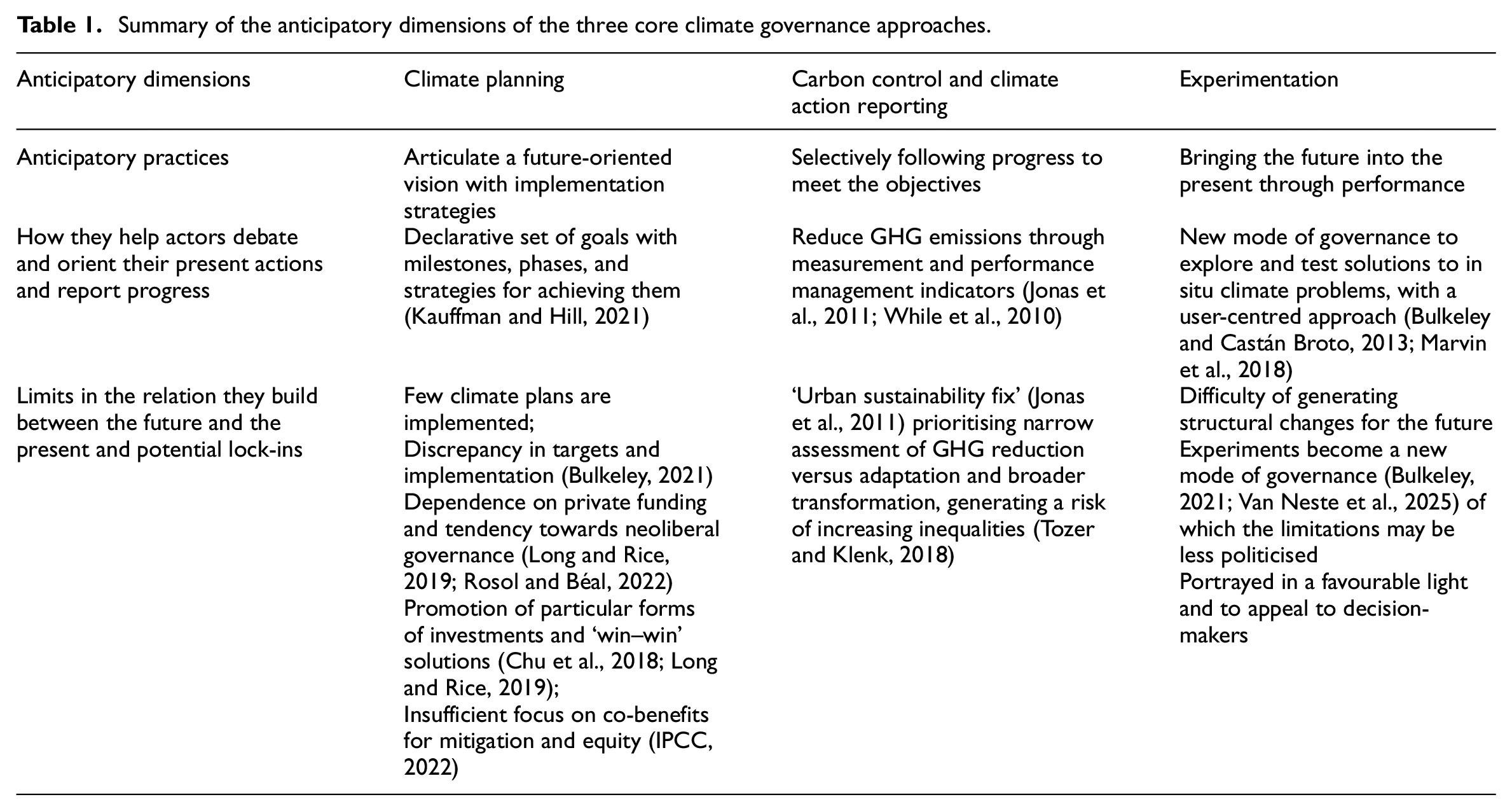
To summarise, the three main approaches for acting on climate change – climate plans, carbon control and climate action reporting and experimentation– all contain anticipatory elements but also present important limitations and several challenges (Table 1).
Summary of the anticipatory dimensions of the three core climate governance approaches.
Methods and case study
In this paper, we examine the three dominant climate governance approaches with respect to the anticipatory practices they include and promote, and their consequences. This is studied in the empirical settings of urban everyday governance of climate change in Montreal. To determine how anticipatory practices steer present action in relation to desirable futures, we studied three projects initiated between 2018 and 2021: on climate planning, the 2020–2030 Climate Plan and the 2050 Montreal Land Use and Mobility Plan; on carbon control and accounting, the climate test; and on climate experimentation, the Labo Climat Montreal, a living lab on climate change adaptation.
Three methodological strategies were used to examine the anticipatory practices in Montreal: document analysis, participant observation and interviews.
Data collection took place from May 2019 to November 2021. It consisted of document analysis of Montreal’s urban, sustainability and climate plans, as well as related documents (e.g. city council minutes, organisational charts, other plans and studies), participant observation of three two-hour prospective workshops conducted by the City of Montreal for its upcoming Land Use and Mobility Plan and data from a climate adaptation living lab we designed (Van Neste et al., 2025). For the first and second climate governance approach (climate planning, and carbon control and reporting) 17 semi-structured interviews were conducted to identify and assess the use and perception of anticipatory practices (10 with interviewees from the City, three from philanthropic foundations having participated to the climate planning process, two from businesses and two from institutions).
For the experimentation approach, 15 more interviews (10 with interviewees from the City, three from civil society, one with a developer and one with a research professional in adaptation) were conducted, of which only part of each was used for this paper. We were personally involved in the living lab designed to study the anticipatory practices of climate experimentation, with four living lab workshops organised by the authors and their partners. The results of one workshop with 12 participants is used in this article. Overall, the interview questions we discuss here focussed on the dimensions of anticipatory practices: activities to get a grasp on the future, orientation towards a desirable future, tools to monitor and adjust actions today for a desirable future, and the actors involved in these processes. The interviews and workshop were recorded, transcribed and coded in NVivo 12 software.
Results: Anticipatory practices in Montreal
In Canada, provincial governments mandate or grant cities the authority to act on environmental issues and provide them with part of the financial resources to do so. Some cities, like Montreal, have progressed quite a lot without much provincial leadership, but at different paces (Van Neste et al., 2019). Dale et al. (2018) argue, with the case of municipalities in British Columbia, that they achieve better results in reducing their GHG emissions than municipalities in provinces less committed to environmental issues, such as Alberta, Ontario or Nova Scotia (Dale et al., 2018).
Montreal/Tiohtià:ke is located in the province of Quebec, Canada, on the unceded land of the Kanien’kehá:ka Nation. Quebec is often represented as a climate leader, thanks to its cap-and-trade carbon policy and reliance on hydroelectricity, of which the negative environmental, social and health impacts, in particular for indigenous nations, have long been underestimated (Rosenberg et al., 1997). The province has no clear plan for energy sobriety and faces challenges in reducing GHG emissions from the transportation and building sectors. Nevertheless, since 2005, the City of Montreal has implemented three successive sustainable development plans, a GHGE reduction plan in 2013, an adaptation plan in 2015, and a resilience strategy in 2017. Montreal’s climate ambitions have particularly grown since 2017, when the Projet Montréal party won the municipal elections for the first time. Projet Montréal focuses on sustainable urbanism and quality of life and is committed to ‘offering a vision of the future’ (Projet Montréal, 2017).
Climate and urban planning: Developing a common vision
When Projet Montréal came to power the land use plan dated back to 2004 and the GHG reduction and adaptation plans were set to expire in 2020. The new administration currently works on planning processes including: Montreal 2030, a 10 years strategic plan, 2020–2030 Climate Plan and 2050 Land Use and Mobility Plan.
Montreal 2020–2030 climate plan
Shortly after the elections, the new mayor signed the One Planet Charter, declared a climate emergency and entered into an agreement with the C40 Cities Climate Leadership Group, the Trottier Family Foundation, and the David Suzuki Foundation to develop a new climate plan as part of C40s Deadline 2020 programme (Madénian and Van Neste, 2025).
Following this agreement, a 19-person advisory committee was created to provide the city with advice on the plan’s content. Members of the committee included four businesses, the Montreal public health department, the Chamber of Commerce, two electricity distributors, a public foundation, Ouranos (the public consortium expert on climate adaptation), three academics (in the fields of mobility, architecture, urbanism and energy) and four environmental NGOs.
From June 2019 to March 2020, workshops were held with advisory committee members, the city’s political and administrative representatives, city professionals and over 60 external experts (e.g. academics and environmental group representatives) to define actions in the sectors of transportation, buildings, adaptation/resilience, mobilisation and industry. There was no open participatory process on the Climate Plan (Madénian and Van Neste, 2025). The municipal ecological transition and resilience office was in charge of writing the Climate Plan on the basis of these advisory elements.
Adopted in 2020, the 2020–2030 Climate Plan aims to make Montreal ‘a carbon-neutral, resilient, and inclusive city’ by 2050, and proposes 46 actions under five themes (mobilisation of the Montreal community; mobility, urban planning and urban development; buildings; the city’s exemplarity; and governance). For city professionals and certain advisory committee members interviewed, the success of the Climate Plan appears to be conditioned by the Land Use and Mobility Plan to come.
Montreal 2050 land use and mobility planning
In 2019, Montreal launched the 2050 project, which included predictive and scenario-building activities that contributed to the new Land Use and Mobility Plan, set for 2024. The first outcome of this project is the City Vision, unveiled in June 2021. It is the product of scenario-building designed to chart a path towards the city’s 2050 goals. Framed as a tool for ‘envisioning Montreal in2050’, City Vision was presented for public consultation in fall of 2022, offering potential pathways and challenges for discussion.
City Vision presents possible futures for Montreal in seven categories: population, climate and environment, social inequalities, mobility, activities, urban forms and land uses and governance. For each of these dimensions, the document lists findings and trends for the future, questions to be resolved and topics requiring action. The document then proposes 14 transition pathways to enact ‘the major changes that we must make for our desired vision of the future to become reality’. These pathways address the renewal of urban form, soft mobility, the integration of nature in neighbourhoods, energy in buildings and the quality and affordability of housing. For each pathway, the current situation, key elements of the future vision, and associated challenges are outlined.
In formulating City Vision, a series of activities were conducted, including a foresight initiative with the Lab Ville Prospective from the Faculty of Planning at the Université de Montréal, as well as assessments of previous urban and transportation plans. The city also met with groups that are typically underrepresented in public consultations, seeking their input on urban planning and mobility. The city then adopted a ‘participatory forecasting process approach’‘to forecast the future by blending expected changes (climate change, infrastructure deterioration, decrease in available parcels of land, etc.) with surprise disruptions and innovative solutions (new forms of mobility, new uses, new ways of working, new modes of governance, etc.)’ (Ville de Montréal, 2021: 21). To deal with flooding for example, the City Vision’s solutions include water squares, green infrastructures and green roofs. The objective was to ‘find a meeting point between the needs of the future and the lifestyles we desire’ (Ville de Montréal, 2021). The proposed forecasting process encouraged participants to consider visions of the future and then define potential paths to get there.
During the City Vision workshops, organised by the City and a communication strategy firm, over 200 people from social, economic, community, cultural, environmental and institutional organisations discussed lessons of the past, current trends and visions for the future of Montreal. During the workshops, participants were asked by facilitators from the communication strategy firm to answer the following questions:
In 2050, what transformations will have improved the daily lives of Montrealers and their experience of the city?
What transformations will ensure the vitality of the Montreal community?
What transformations will allow Montreal to distinguish itself from other major metropolises?
Some examples of desired transformations for 2050 given by participants included complete and vibrant neighbourhoods, active transportation, urban agriculture projects and access to the banks of the St Lawrence River.
The goal of City Vision is not to implement immediate actions and systems to achieve this envisioned future. The final deliverable will be the Land Use and Mobility Plan, with its objective to ‘Set out Montreal’s vision for the city as well as the urban planning and mobility guidelines for the coming years’ (Ville de Montréal, 2021: 15). For many of the people involved in developing the Climate Plan, the Land Use and Mobility Plan is seen as the missing piece to a comprehensive climate policy. As one of the interviewees put it, the plan shows ‘a much greater potential for transition than the Climate Plan’, and will enable concrete actions to be implemented thanks to the development of appropriate urban planning regulations and bylaws.
Carbon control: The search for performance
During the 2020–2030 Climate Plan elaboration process, the first step initiated by the advisory committee was to mandate a specialised firm in strategic energy consulting to carry out ‘techno-economic modelling’ (Ville de Montréal, 2020). The modelling exercise set a target of 55% GHG reduction by 2030, and carbon neutrality by 2050.
The transport and building sectors, already identified as the largest emitters of GHGs in the previous plan from 2013, represent 40% and 28% (versus 39% and 33% previously) of Montreal’s community emissions, respectively (Ville de Montréal, 2013:4, 2020:37). The firm’s analysis presents aggregated emissions for the entire city, delineating emissions according to activity sector and energy source. However, although emissions models prioritise the transportation and building sectors, they fail to discern the divergent emission patterns among residents across the city’s neighbourhoods and social strata.
The Climate Plan acts as a roadmap to 2030, with many actions having yet to be defined. The progress of the actions is tracked and reported by the city in an annual report. There are eight indicators, four of which specifically address climate change mitigation in Montreal: a 55% reduction in GHG emissions, a reduction in the consumption of fossil fuels, but with no quantitative target in the Climate Plan, a 25% reduction in the share of single-occupancy vehicles and the registration of 47% of electric vehicles.
Subtitled ‘For an inclusive, resilient and carbon neutral city’, this plan does not include indicators for equity, and is more focussed on mitigation than adaptation. Participants involved in developing the Plan explained that this is due to a lack of time to develop real adaptation strategies, but also an overall lack of knowledge regarding ways to measure the adaptation and resilience of a population. Two of the four indicators monitoring adaptation are quantified as follows: 500,000 trees are to be planted, and 10% of the city is to be deemed protected green areas. The other indicators concern a decrease in vulnerability to climate change (no in-depth discussion on social vulnerability and inequities is provided), and the reduction of heat islands.
Interviews with city professionals and advisory committee members highlighted the importance of city-wide transparency and annual reporting on the Climate Plan’s progress. This transparent approach is desired not only to foster public trust but also to serve as a catalyst for stakeholder engagement in the plan’s initiatives. Moreover, consistent reporting serves as a guiding beacon, especially considering the next decade’s important role in combating climate change. Participants stressed the significance of meeting the 2030 targets as a crucial step towards attaining carbon neutrality by 2050.
In addition to progress tracking, the city plans to develop a climate test that will be applied to all municipal decisions. The development of this test is planned to take place over three years and involves the implementation of a climate impact assessment. Little information was available about this tool at the time of the study, except that it would be developed according to the approach promoted by the C40 network. According to a city professional, the test will include a grid of criteria applied to each project, from purchasing policies to major infrastructure projects, starting from special projects. The web page from the city indicates it aims at assessing the projects’ impact on climate goals, to prioritise and modify projects to optimise mitigation and adaptation results (Ville de Montréal, 2021). The climate test represented a first step for the city, which then developed a carbon budget pilot for the Montreal community in 2023. These ideas came to light during Montreal’s 2015 public consultation about reducing the city’s dependence on fossil fuels. Although the climate test was a welcomed solution among the population at large, some actors from groups working on climate and environmental issues questioned the city’s choice of indicators for this test during a webinar organised by Montreal Climate Coalition in March 2021, especially the absence of social aspects such as gender-differentiated analysis, equity considerations and risks of maladaptation.
Labo Climat Montreal: An experiment in urban climate governance
In 2018, the City of Montreal and Ouranos launched a call for projects to establish a living lab-inspired research project. This was an experiment on the governance of climate adaptation, in particular in a large urban redevelopment project, which involved city departments, the borough, local community, civil society actors and other public and private actors.
From May 2019 to January 2021, the Labo Climat Montreal team worked with these actors to understand, learn and transform the practices and issues associated with priorities for climate change adaptation.
The site on which we all focussed was Lachine-East, an area chosen as a future ecodistrict and former industrial sector whose history has been tied to the colonial development of Montreal and a narrative of hydrological engineering prowess, with the Lachine Canal (Van Neste et al., 2025). Its development presents numerous challenges for water management infrastructure, transportation, urban morphology and equity. As part of the project’s research activities, Labo Climat Montreal organised workshops with participants from several city departments (e.g. water, urban planning and mobility, parks, etc.), city organisations and both public and private sector organisations to collaborate, identify structural barriers in their organisational and professional practices, and move towards adaptation for the eco-district.
One of these workshops was a future-oriented activity that explicitly addressed how the future relates to current actions. It brought 12 city and borough professionals together to imagine two fictional scenarios depicting the everyday life of Lachine-East residents: it is 2035, and the neighbourhood is ill-adapted to extreme heat waves, drought, freeze–thaw cycles and freezing rain events. The scenarios showed residents facing heat islands, a lack of parks and neighbourhood services, icy sidewalks and winter power outages. After asking participants to identify problems faced by residents, the researchers challenged them to answer the following question: How did we get here? The objective was for participants to identify shortcomings in Montreal’s urban redevelopment process and its adaptation to climate change. Participants were then asked to consider possible solutions by mobilising their current resources: How can your expertise contribute to solutions? What levers do you currently have? After identifying barriers to climate change adaptation in urban project processes (e.g. silos between different municipal departments), participants identified several levers. For example, they mentioned how they could contribute to urban planning visions that could influence and rally actors around a common goal. They talked about their ability to raise awareness and garner stakeholder support. They entertained high expectations around participatory planning with the population and local organisations and in deliberative spaces for professionals that would break municipal silos. Overall, participants saw the dystopian vision as highly unlikely, and this was especially the case for planners who had a blind faith in existing urban planning instruments and tools, including zoning and bylaw regulations that should ensure a good distribution of green spaces and parks. Participants also mentioned their hope that regulations for stormwater management on private property, ecological standards and ecological design guides would have positive impacts on the neighbourhood’s future.
Our design of the workshop also featured discussions about the lack of equipment and social infrastructure providing social and community support to those most vulnerable to climate change. City planners did not feel they had much leverage over the development of social and community resilience and the reduction of social factors of vulnerability in the face of climate hazards like extreme heat. Their expectation was that, beyond their efforts to secure a municipal leisure services amenity, this would depend on the future residents of the eco-district and their community engagement.
The workshop, combined with interviews and analyses, underscored the value of addressing climate change with mobilised actors on the ground and identifying the strengths and pitfalls of their preferred tools, some which served to de-prioritise interventions for resilient social infrastructure. The living lab also allowed urban practitioners to identify areas of powerlessness due to static institutional structures and governance frameworks.
In our final research report, we presented some recommendations, opportunities and levers to co-construct the following ‘now moments’ with city planners: (1) taking climate hazards and social factors of vulnerability into account from the earliest phase of planning and identifying public resources that should be dedicated to this process; (2) holding deliberative workshops to examine development hypotheses in relation to climate change; (3) including concrete regulatory measures of private urban development for climate adaptation; and (4) target investments and perimeters of public action in function of current inequalities and vulnerabilities. These ‘now moments’ can be immediately implemented into city practices. Considering the perceived difficulty of planners when it comes to tackling the equity and social components of climate adaptation in the short term, the extent to which changes will be made to the city’s urban planning process when incorporating all or some of these proposals remains to be seen.
Discussion and conclusion
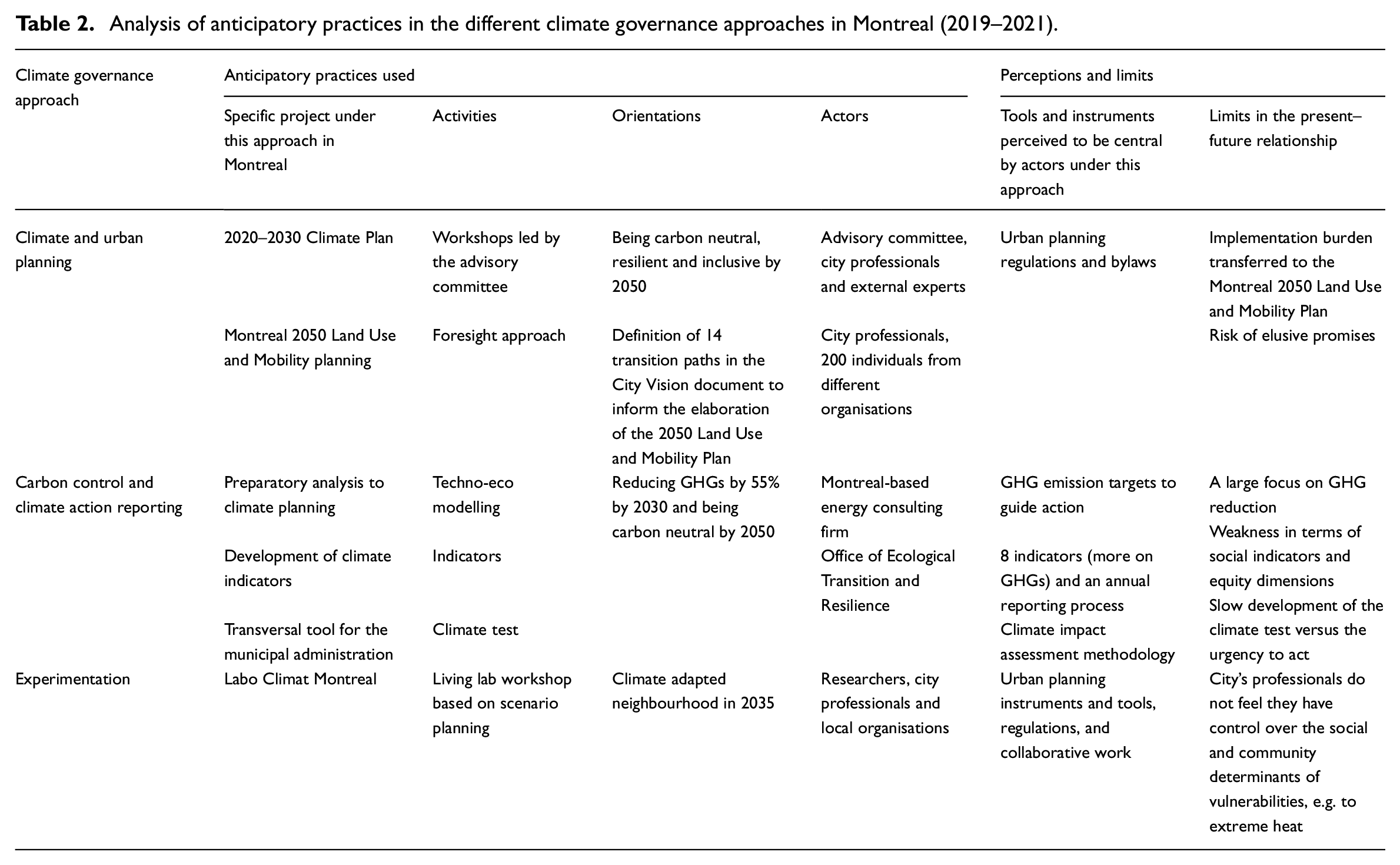
We studied three climate governance approaches – climate and urban planning, carbon control and climate action reporting and experimentation – used by the City of Montreal and its partners between 2019 and 2021 to understand how anticipatory practices unfold. Table 2 presents the three approaches according to their specific projects on practices, participating actors, future orientations, instruments perceived to be central by actors under this approach and limits in the present–future relationship. Our analysis reveals that participants in these climate governance approaches in Montreal have, overall, favourable expectations of the positive impacts that certain privileged anticipatory practices can have, to act towards a desirable future. They also have limits, which we discuss below.
Analysis of anticipatory practices in the different climate governance approaches in Montreal (2019–2021).
This article presents findings on how anticipatory practices unfold in climate governance approaches. More specifically, the results show that urban actors rely on two strategies to achieve climate goals and shed light on the limitations involved by anticipatory practices.
First, urban actors rely on instruments that include indicators, balance sheets, reporting, a climate test and eventually a carbon budget to reach targets and measure progress. Eight indicators have been developed. Four of which specifically address climate change mitigation with specific targets in terms of GHG emissions reduction or electric vehicles registration increase. Adaptation indicators are vague (except for the number of trees). This attention to GHG reduction and performance-based research (Jones, 2019) is part of the dominant trend of carbon control (Jonas et al., 2011; While et al., 2010).
Actors also have high hopes for the upcoming climate test and the future carbon budget to help meet GHG reduction targets. The climate test has rapidly become a persuasive idea and flagship action for the city. However, little information is currently available regarding its content and use. Social dimension seems to be missing in this tool, raising concerns about the risk of creating or reinforcing inequalities in future climate policies and maladaptation (Anguelovski et al., 2018; Schipper, 2020).
Many city professionals see the test as a way to ensure that no opportunity is missed in any decision. This echoes the idea of ‘now moments’ (Kenis and Lievens, 2017), that is, that each event or political moment must be seized to initiate changes towards a socio-ecological future. These ‘now moments’ are key when it comes to decisions about infrastructure because, as one interviewed civil servant stated, ‘municipal infrastructure is for 50 years, 100 years’. The climate test must help align infrastructure decisions with climate goals. The development of the climate test, which is planned to take at least three years, seems to be leading to a slowdown in concrete actions due to the desire to measure, count and test what already seems obvious in terms of GHG impact.
Also, will the climate test have the visibility and format to allow for conversations about trade-offs in climate action; as the experimental approach of the adaptation living lab proposed? Efforts to account for and control GHG emissions, are selective and non-transparent in the perimeter of carbon neutrality (or adaptation) considered. However, it is crucial that deliberate choices be made in shaping a decarbonised and resilient urban future. This involves addressing both infrastructure considerations and striving for equity among territories and populations.
Second, urban actors rely on urban planning interventions, regulations, specific urban programmes and the upcoming 2050 Land Use and Mobility Plan. Launched in late 2020, the Climate Plan sets the goal of transforming Montreal into a ‘carbon-neutral, resilient, and inclusive city’ by 2050. However, many professionals are relying on the 2050 Land Use and Mobility Plan, set to be published in 2024, to operationalise the Climate Plan.
The 2050 Land Use and Mobility Plan development process is based on a forward-looking approach. The first step is the City Vision document, which proposes a set of transitions without suggesting concrete actions to be taken in the present to achieve this desirable future. These latter actions are to be included in the Land Use and Mobility Plan, raising expectations among city professionals and partners. The plan is the common reference point for many actors both within the city and externally (Konrad, 2006). The key challenge will be to move from a city plan to tangible tools, strategies and bylaws that can make a difference on the ground.
Yet, as pointed out by Abram and Weszkalnys (2013), while planning is an inherently optimistic and forward-looking activity that offers the opportunity to envision the future, the vision promised in the plans always seems slightly out of reach. The ideal outcome always appears slightly elusive and the plan, retrospectively, seems flawed. There is also a danger that moving from one plan to another will create more ‘elusive promises’ without anything happening (Abram and Weszkalnys, 2013). Creating visions of an urban plan does not mean that those visions will take root on the ground (Van Neste et al., 2012). The risk of visioning exercises is in imagining a ‘concrete utopia’ in which the future dominates and decisions to be made in the present are paralysed (Kenis and Lievens, 2017).
While Montreal’s Labo Climat opts for an experimental approach to climate governance, results show that city professionals also rely on urban planning and zoning bylaws being more innovative than traditional zoning (Rochefort, 2024). The development of the Lachine-East area over a period of 20 years sparks concrete questions and the need to make decisions today to deal with the climate hazards of tomorrow, and the unequal vulnerabilities already present today. Labo Climat’s workshops helped city professionals identify some of their own influences and perceived limits on adaptation. They were then able to use this information to propose objectives for framing the project within specific urban planning programmes. Overall, while city professionals view urban planning, zoning bylaws and physical infrastructural investment for rainwater resilience as key strategies, they struggle to understand how to address the social and community determinants of climate vulnerability, especially when it comes to extreme heat.
Following the workshops, Labo Climat’s research team identified changes that could be made to the governance of urban projects: ‘now moments’ to be seized by modifying the project process to seriously insert the risks, impacts and resources necessary for fair adaptation to climate change in Montreal. The impact of these recommendations remains to be seen. There are also outstanding questions regarding the capacity of living labs to change rules and practices and to support the transfer and circulation of learning within institutions (McFadgen and Huitema, 2017). City professionals have highlighted the challenge of extracting and institutionalising the insights gained from completed projects to bring about changes in urban governance.
The two strategies – climate reporting and measuring, and the tools from climate and urban planning – show that actors oscillate between notions of ‘now’ and ‘not yet’, both of which give them hope to achieve results. In the ‘now’, actors expect to achieve results by focussing on carbon control and the search for performance. In the ‘not yet’, actors expect that the development of action mechanisms, including urban planning regulations, will allow them to operationalise the Climate Plan’s actions, particularly the fuzzier adaptation component. These expectations, both individual and collective, are mutually reinforcing and encourage actors to work together (Konrad, 2006; Tutton, 2017). However, these expectations may lead stakeholders to miss ‘now moments’ that would allow them to move towards more sustainable urban futures (Kenis and Lievens, 2017). In our opinion, by focussing expectations on future tools and regulations, there is a risk of continually producing ‘elusive promises’ instead of developing concrete actions (Abram and Weszkalnys, 2013). The tendency to rely on accounting and planning promises does not invite actors to act in the present nor to reflect on the context of their governance and the levers they can mobilise now.
These findings are particularly concerning in terms of equity considerations as vulnerable populations are already the most impacted by the climate crisis (Ranganathan and Bratman, 2021). Similarly, anticipatory practices fail at translating justice and equity considerations into practice (Dobai and Riemer, 2024). However, existing social vulnerabilities need to be considered in contemporary climate urban practices in order to avoid exacerbating them or creating new ones (Anguelovski et al., 2016; Chu et al., 2017).
This research contributes to the literature on urban climate governance and debates surrounding the role of cities as key actors in addressing climate change by providing a better understanding of their practices. Our case study sheds light on how particular anticipatory practices create high expectations around the performativity of climate targets and of typical urban action such as bylaws and reporting mechanisms. However, these tools mainly serve to comprehend and assess ongoing action and future planning, while mostly ignoring ‘now moments’. This study’s empirical data also offers a better understanding of how anticipatory practices unfold in the face of environmental transformations (Burch et al., 2019; Muiderman et al., 2022). These findings should help researchers and practitioners identify if they are missing ‘now moments’, especially in terms of equity considerations. How can they address equity in the present and move towards a fairer future? Additional research that looks into other case studies would enrich these initial findings and help advance urban climate action as a whole.
Footnotes
Acknowledgements
We warmly thank all participants to this research for their time and commitment, as well as members and partners of Labo Climat Montreal. We also wish to thank the anonymous reviewers for their helpful comments and feedback, which greatly strengthened the overall manuscript. This research has been reviewed by the INRS Committee of Ethics in research with humans, ID CER-20-589 and ID CER-19-510.
Declaration of conflicting interests
The author(s) declared no potential conflicts of interest with respect to the research, authorship, and/or publication of this article.
Funding
The author(s) disclosed receipt of the following financial support for the research, authorship, and/or publication of this article: This work was supported by Fonds de Recherche du Québec-Société et Culture [328382]; Social Sciences and Humanities Research Council [752-2021-1361]. Labo Climat Montreal project was funded by Ouranos (via the Quebec government’s Climate Change Action Plan 2013-2020), the City of Montreal and Mitacs Acceleration.
