




Abstract
This paper examines how common property is produced and delineated in contractual communities in China. Shanghai, one of the most developed Chinese cities with a burgeoning housing market, is used as a case study. The research analyses the power relations between land, construction and housing departments within Shanghai district governments and with developers, specifically, during the development phases of land leasing, construction permission and ownership registration. Drawing on the theoretical framework of new institutionalism, and its conception of path dependency in urban space, the article sheds light on what has led to the infringement on homeowners’ common property by developers. In a weak legal and regulatory system for property development, the departments within district governments shirk responsibility to each other, whereas developers hold considerable power. The article concludes that common property bears the imprint of power dynamics set in motion in the development phase and thus requires greater recognition.
Introduction
‘Common property’ in residential development includes the part of land and buildings that are not comprised of any individual properties but are collectively owned or merely used by two or more individual owners (Christudason, 2004). Common property benefits homeowners economically through the cost-sharing of facilities and services (Korngold, 2015). However, homeowners’ rights to use and manage common property can also be infringed by poor provision of essential common facilities, construction defects, controversial ownership and use of common property and loss of income from common property (Crommelin et al., 2021; Shin et al., 2021). Homeowners’ dissatisfaction can develop into disputes with developers about common property delineation, building design and functions, profit sharing and upkeep responsibility regarding common property (Easthope and Randolph, 2016; Yip et al., 2021).
While common property disputes occur after schemes have been passed into their management phase, decisions made throughout the development phase significantly impact on common property rights, which are not only hard to resolve but weaken the ability of homeowners to win their disputes later on (Johnston and Reid, 2013). Global neoliberalism has brought the market-oriented changes to residential development, especially in terms of increasing reliance on developers and weaker local governments’ intervention (Li et al., 2021b). In both developed and developing countries, laws and rules regulating the production of property are left open for developers to design, construct and delineate common property to their advantage (Blandy and Wang, 2013; Easthope et al., 2014). This challenge, however, is assumed to worsen in developing countries, given inadequate legal infrastructures for common ownership which are riddled with more flaws and biases that developers can use (Yip, 2010).
The complex interplay between local governments and developers warrants more in-depth investigation, particularly given that local governments have a potentially important role in preserving homeowners’ rights in the early stages of development (Blandy et al., 2010; Easthope et al., 2014). Local governments also play a vital role in mediating the owner-developer power asymmetry. They retain the capacity to regulate private activities at critical points of development, notably when granting or refusing planning permission (Easthope and Randolph, 2016).
This article investigates the power relations between developers and local governments in the delivery of common property through a Chinese case study, namely Shanghai. China represents an interesting illustration of a developing country where institutional development for protecting private and common property rights lags far behind private housing development (Wang, 2014). A national system of state land ownership enables Chinese local governments to have ultimate power at the points of land leasing and planning permission (Li et al., 2019). However, recent years have witnessed an escalation of common property disputes, particularly in highly developed Chinese cities such as Beijing, Shanghai and Guangzhou where real estate is the most developed and housing activism is the most intense (Sun and Huang, 2016; Yip, 2019). This contradiction stimulates the research of this article, with the aim of probing the power relations between local governments and developers. Our attention is on how the local government's land, planning and housing departments engage with developers in the decision-making around constructing and delineating common property.
The article frames the investigation, drawing upon new institutionalism as a theoretical framework and its use of concepts, namely path dependency, critical juncture and power. The research premise is built on Sorensen’s (2018a) conception of path dependency in urban space: both formal and informal rules regulating the development process bring enduring imprints on the forms and available rights of property produced. This theoretical framework directs our research to informal rules and practices among actors (Lowndes, 2009), especially when formal rules fail to guide or constrain actor behaviour. It also provides a means to unpack the processes in which power relations throughout the development phase cause the infringement on homeowners’ common property rights.
Before presenting the research, the next section reviews the design and delineation of common property as well as the allocation of relevant responsibility and profits. We introduce the definition and classification of ‘contractual communities’ (Moroni, 2014), as common property is functioned via the contract unanimously accepted by homebuyers (Blandy et al., 2010). The section also reviews the homeowner–developer power asymmetry and potential tools of local government intervention in general and in China.
Contractual communities and common property
Contractual communities are defined as ‘territorial organisational entities that are linked to a specific tract of land’ (Moroni, 2014: 39). This open definition encompasses varied physical designs of communities. Homebuyers join contractual communities based on an unanimously accepted contract, which establishes the rights and commitments of these homebuyers. Important among them is the availability of a package of shared facilities and services, namely common property (Brunetta and Moroni, 2012).
Contractual communities of various physical and architectural designs contain common property of different designs and functions. For example, in multi-family buildings, common property is often minimised as building structures (walls and roofs) and underlying land. In villa-style neighbourhoods, it includes communal roads, squares, parking lots and basic infrastructure and facilities (electricity, heating, gas, sewage). In addition to those needed for essential maintenance, developers can additionally provide high-quality leisure facilities such as golf courses, swimming pools and water features (Hendrikx and Wissink, 2017).
Contractual communities can be divided into three sub-types by differentiated ownership arrangements: leasehold contractual communities, freehold contractual communities and commonhold contractual communities (Moroni, 2014). Table 1 shows the differentiated ownership arrangements of common property among the three sub-types, the allocation of management responsibility and profit sharing regarding common property, and the likelihood of common property disputes (Korngold, 2015; Moroni, 2014). According to Table 1, the developer can take advantage of differentiated arrangements of common property regardless of different sub-types of contractual communities. The power asymmetry between developers and homeowners regarding common property has been highlighted by international studies (Blandy et al., 2006; Easthope and Randolph, 2016; Yip, 2010). The developers’ original ownership of communities enables them to dominate the design and delineation of common property, whereas homeowners are excluded from this process (Easthope and Randolph, 2016). Developers also specialise in employing legislation and drafting contracts in their interest, with homeowners generally lacking information and knowledge about common property (Yip, 2010).
Ownership arrangement of common property, allocation of management responsibility and profit sharing, and the likelihood of common property disputes in three sub-types of contractual communities.
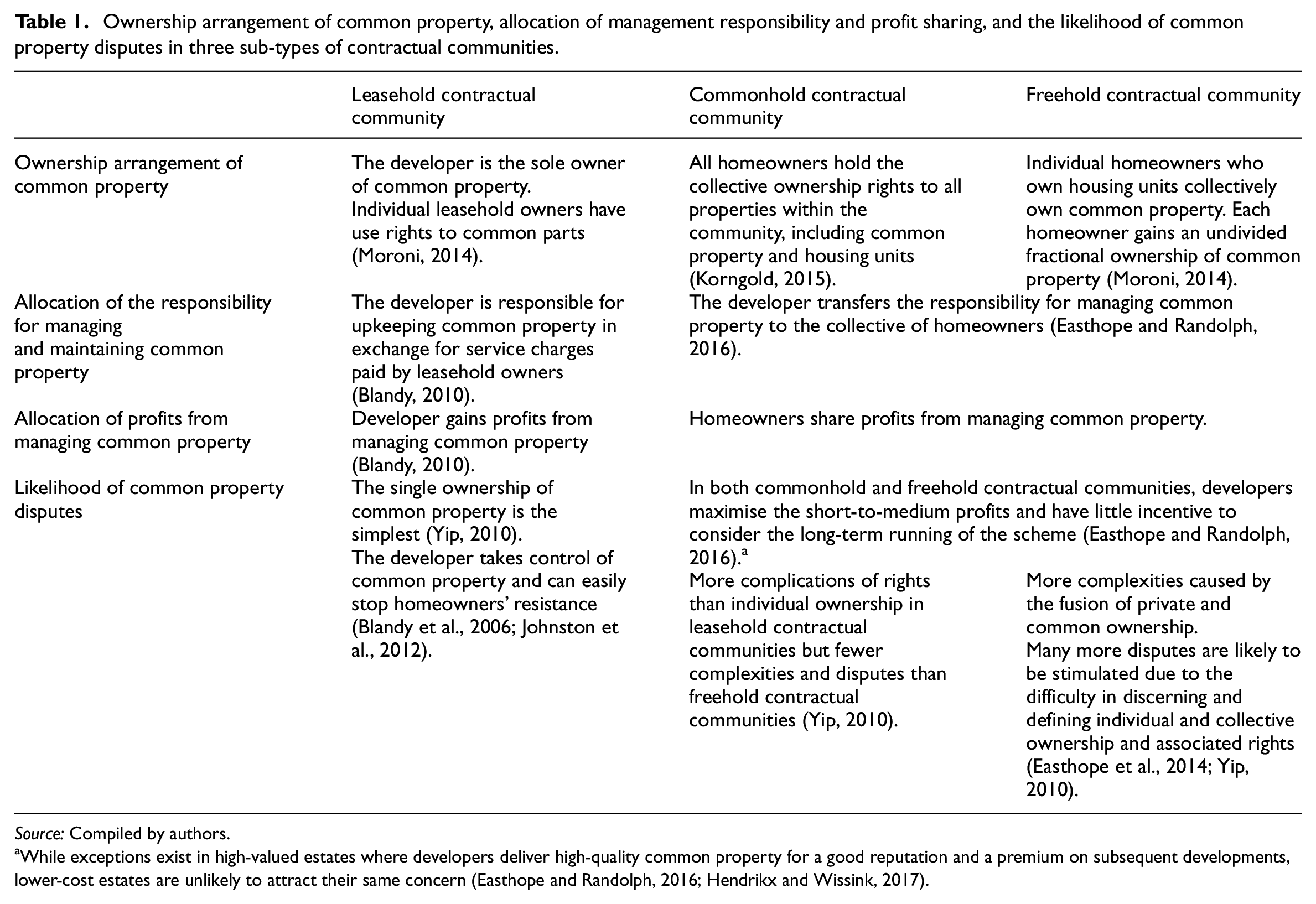
Source: Compiled by authors.
While exceptions exist in high-valued estates where developers deliver high-quality common property for a good reputation and a premium on subsequent developments, lower-cost estates are unlikely to attract their same concern (Easthope and Randolph, 2016; Hendrikx and Wissink, 2017).
Government intervention plays a vital role in mediating the power asymmetry between developers and homeowners, hence lessening the infringement on homeowners’ common property rights. As Easthope and Randolph (2016) argue, even the market approach emerges spontaneously alone with difficulty requires some form of government intervention. Local governments’ regulatory toolkits include introducing legislation, adding content to the detailed plan or zoning, inserting conditions into planning or construction permission, monitoring and checking and issuing punishment for non-compliance (Easthope and Randolph, 2016; Goodman et al., 2010). Granting (or refusing) planning or construction permission is deemed the primary regulatory instrument (Easthope et al., 2014), because once the development right is obtained, the developers’ original legal ownership of the whole site empowers them to keep self-built properties away from local government intervention (McKenzie, 2006).
It is commonly found that local governments relinquish regulation over the delivery of common property, going as far as to not even consider common property, because of a lack of both motivation and capacity. Local governments often treat the delivery of common property as a private issue, as the developer and ultimate homeowners cover the costs and responsibilities of delivering and maintaining common property. The bias of local governments towards economic development and hence towards developers often puts homeowners in a disadvantageous position (Yip, 2010). The lack of clear guidelines and enforceable regulations regarding common property constrains local government’s power to oversee the delivery of common property.
We equate China’s contractual communities with commodity housing 1 estates consisting of individually owned private units and jointly owned facilities, which can be regarded as freehold contractual communities. Contractual communities in China are not based on private but state-owned land. Chinese local governments are the de facto landlord of contractual communities, whereas developers acquire land-use rights. Chinese local governments’ toolkits for regulating property development include construction permission and land leasing (Lu et al., 2020). Before exploring whether the expansion of regulatory instruments changes the relationship between local governments and developers, it is essential to first clarify how laws and regulations define and delineate common property in Chinese contractual communities.
Common property in Chinese contractual communities
Chinese contractual communities have emerged since the 1980s when the market mechanism of housing development was first introduced. They are mostly fenced and often termed as gated communities or gated commodity housing estates in existing literature (He, 2013; Liao et al., 2019). Common property was first recognised in China’s 2007 Property Rights Law via the term ‘homeowners’ partitioned ownership of building areas’. Since then, homeowners have been entitled to collective ownership and management rights to their common property.
The scope of common property was set out by the Property Law and the supplementary national and local property-related regulations. As shown in Table 2, common property includes that for essential maintenance of neighbourhoods, including internal roads and green areas, the structure and communal areas within apartment buildings and shared facilities supporting homeowners’ self-management. However, the legislation does not clarify whether common facilities for additional leisure and education use are involved in common property, such as basements (including underground parking lots), kindergartens, day-care centres, cafés and gyms. These facilities are usually of greater economic value.
The scope of common property in Chinese residential areas from both national laws and local regulations in Shanghai.
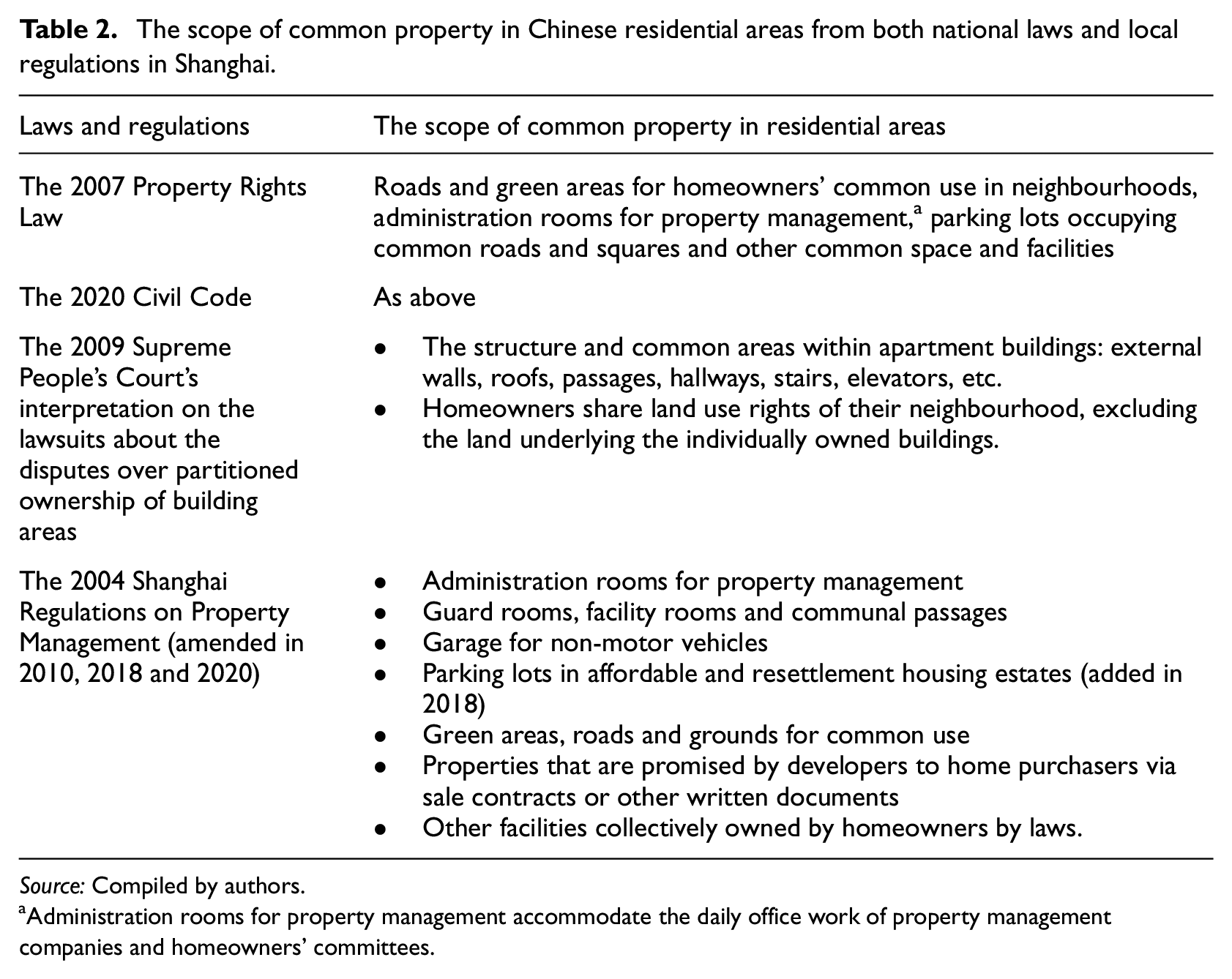
Source: Compiled by authors.
Administration rooms for property management accommodate the daily office work of property management companies and homeowners’ committees.
The ambiguous legal definition is directly associated with subsequent disputes centring on the ownership and profit sharing of common property. The absent specification of a considerable scope of common facilities in laws and regulations leaves opportunities for developers to claim ownership of these common assets, without informing homeowners who know little about new schemes. For example, leisure and education facilities within communities often generate considerable profits, incentivising developers to retain or occupy them (Wang, 2010). Thus, in contrast, homeowners end up owning only a limited scope of common property specified by legislation, ones mostly functioning for essential maintenance such as roads, green areas and administration rooms, which can also generate economic benefits, but are comparatively limited.
Few regulations exist regarding the design and construction of common property in residential developments. Common property is not displayed in the local development control plan that is the basis for land leasing and construction permission. 2 The minimum size of different neighbourhood facilities stipulated by the Planning and Design Standards for Residential Neighbourhoods is solely a technical guideline and has limited enforceability.
Therefore, common property design, construction and delineation guidelines in Chinese laws and regulations are far from clear, which, it has been argued, fails to protect homeowners but leaves opportunities for rent-seeking developers (Blandy and Wang, 2013; Wang, 2014). With the lack of formal guidelines on the production of common property, the informal practices and relations of local governments and developers throughout this process require further investigation.
New institutionalism
The institutionalism theory is centred on institutions. North (1990: 3) defines institutions as ‘the rules of the game in a society or, more formally, are the humanly devised constraints that shape human interaction’. In contrast with traditional institutionalism focusing on formal rules and institutional structures, new institutionalism expands its concern to informal, non-codified rules and practices (Manzi and Morrison, 2018; Thornton and Ocasio, 2008).
New institutionalism has a bearing on power 3 (Hall and Taylor, 1996: 940). Both formal and informal institutional rules are far from neutral but ‘embody power relations by privileging certain positions and courses of action over others’ (Lowndes, 2009: 95). Privileged actors benefit from ‘an uneven playing field’ tilted to their advantage (Lowndes and Roberts, 2013: 89). Formal rules give certain actors power to police others and punish those who do not comply by prescribing permitted and forbidden actions (Lowndes and Roberts, 2013). Informal rules enable no less compliance than formal rules (Ostrom, 2007) and distribute power through knowledge, force, ideology and legitimate processes (Matthews and Sydneysmith, 2010).
From a new institutionalist perspective, individuals and groups create more than economic success and establishing legitimacy through each other’s consent (Morrison, 2017), especially when clear formal rules are absent (Rosenschöld et al., 2014). Legitimacy can be defined as the perceived appropriateness displayed in certain situations in terms of rational effectiveness, legal mandates or collectively valued purposes (Deephouse et al., 2017; Meyer and Rowan, 1977).
New institutionalism provides insightful explanations for two interrelated concepts, ‘path dependency’ and ‘critical juncture’ (Morrison, 2017). The idea of path dependency is not just that some particular set of conditions is durable, but that they are self-reinforcing and become harder to change over time, reinforcing the significance of the critical junctures in which conditions were created (Pierson, 2000; Sorensen, 2018b). The concept of path dependence helps to explain why the critical juncture that establishes those conditions is important (Sorensen, 2017).
The choices made during critical junctures depend heavily on the circumstances, timing, power relations and combinations of actors involved, and minor differences may lead to very different developmental pathways (Sorensen, 2018b). Critical junctures create opportunities for all actors to play greater roles in developing new rules, establishing new legitimacy and changing power relations (Katznelson, 2003: 277). Disadvantaged actors are not merely rule-takers but are able to resist institutional constraints and seize opportunities to form a coalition, combat their opponents, exploit policy loopholes and shape policy direction (Lowndes and Roberts, 2013).
Sorensen (2017, 2018b) adapts ‘path dependency’ and ‘critical juncture’ to urban space. Path dependency in cities translates our focus to the rules and practices during the production of property, which he argues bring enduring imprints on the new urban properties, including the property rights created, their management and governance rules and their spatial configurations (Sorensen, 2018a, 2018b). Such path dependency derives ‘not from the sunk investment in and enduringness of buildings, but from the motivations and values of their owners and users’ (Sorensen, 2018a: 74). In this sense, urban property development is understood not merely as a construction process but as a ‘spatial critical juncture’ in which new properties and associated rights are produced (Sorensen, 2018b: 27).
Sorensen (2018a) also argues that collectively owned and managed housing development bears the characteristic of path dependency, as the property rights created, management rules established, and spatial configurations are difficult to alter. Changes to common parts and management rules often require majority votes of owners. As property within these developments ages, as more pieces of ‘common’ property are sold off and ownership grows complex, collective action problems are likely to become more challenging, reinforcing path dependency (Gao, 2015; Sorensen, 2018a). The above insights support the starting point of this article. The delivery of common property, as the spatial critical juncture, has profound and long-standing implications for homeowners’ common property rights and relevant disputes with developers. Yet to date, relatively limited research has been carried out on the process of producing common property.
When it comes to the power relations between local government and developers during the development phase, the government has significant power in making and enforcing formal rules, but non-government actors with opposing interests are able to exercise countervailing control and cultivate rent-seeking behaviour (Morrison, 2013, 2017). Lin and Ho (2005: 415) contend that the state is ‘a complex, conflictual, and internally heterogeneous institutional ensemble on which power relations are constantly mediated upward, downward, and sideways’. Institutional rules are contested, circumvented and manipulated by state agencies at various administrative levels and different departments on the same level (Lin and Ho, 2005: 412). In Chinese-based literature, the central–local relationship has been used to explain the ineffective enforcement of high-level policies in urban development (Liao et al., 2019; Lin et al., 2015), but the internal power relations among local-level departments have been relatively insufficiently examined. The studies by Wu et al. (2007) and Blandy and Wang (2013) are exceptions, focusing on the poor coordination between local land and planning or construction departments.
Research methods
Selecting Shanghai is information oriented (Flyvbjerg, 2006). While Shanghai is not a typical Chinese city, given its super-size and well-developed real estate, the common property disputes between developers and homeowners found here are comparable to those discovered in other Chinese cities (Wang, 2014; Yip, 2019). Moreover, Shanghai’s burgeoning commodity housing development and intense homeowners’ resistance to defend their infringed property rights provide a rich source of information required for this in-depth case study (Qiao, 2021; Yip, 2019).
To make the power distribution transparent among the local departments and the developer, we analysed their decision-making process regarding the delineation and construction of common property and how different actors influence the decision-making throughout the successive phases of commodity housing development. At the micro-scale, we also observed how formal rules of central and local governments were reinforced or subverted by informal rules among actors. Drawing upon Blandy and Wang’s (2013) research in Beijing, we identified three phases: land leasing, construction permission and ownership registration. These signify the points at which the developer applies for the land-use right of the site, the right to construct new properties, and the legal ownership of new properties from the land, construction 4 and housing departments in Shanghai district governments (Table 3).
The role of the developer and local government departments in successive phases of developing commodity housing estates.
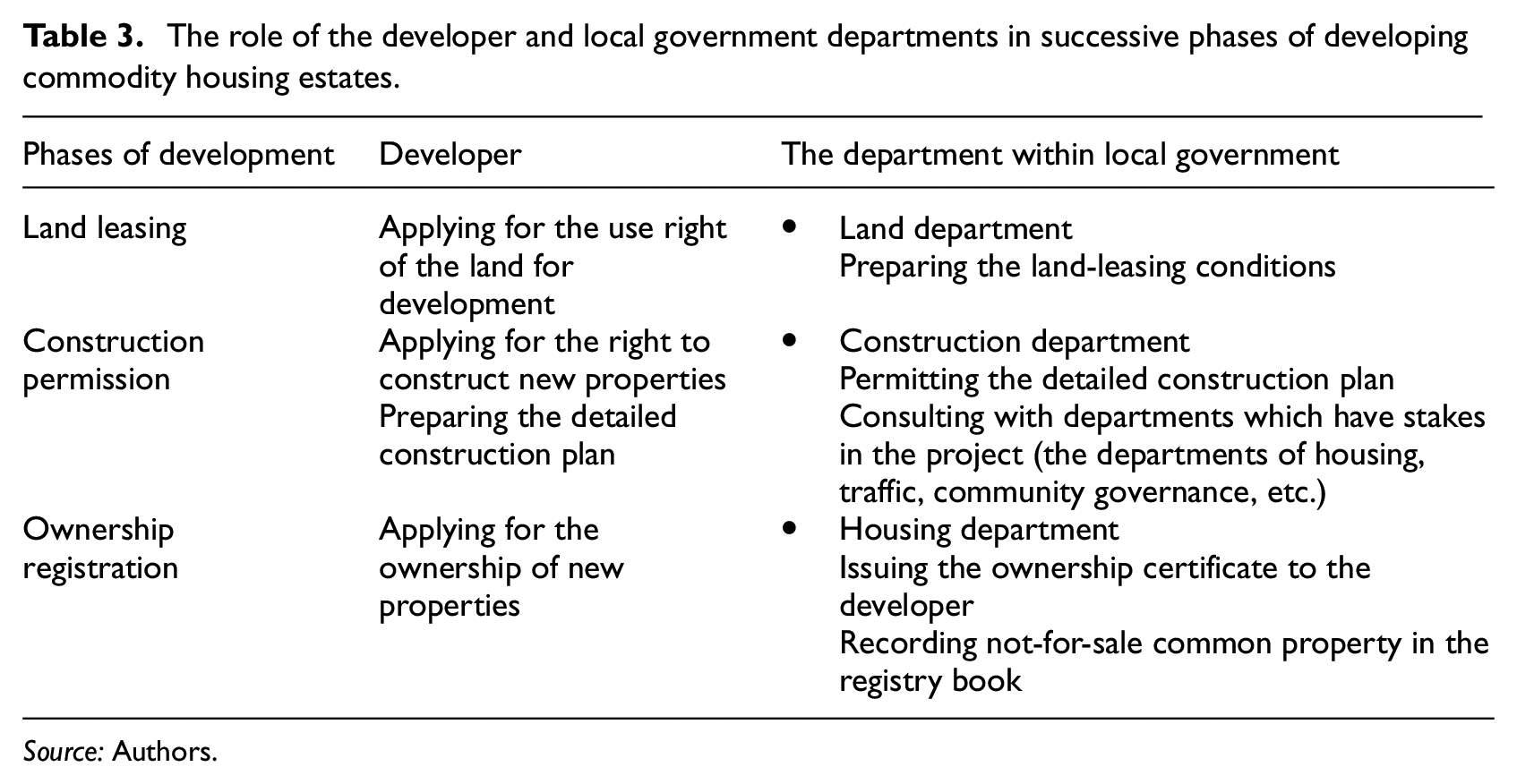
Source: Authors.
At the start of commodity housing development, the land administration department (hereafter abbreviated as the land department) and the developer bargain over the land-leasing contract. Once acquiring land use rights, the developer prepares a detailed construction plan that lays out all buildings, facilities, roads and grounds. The construction administration department (hereafter abbreviated as the construction department) judges the detailed construction plan mainly based on the local development control plan and the land-leasing contract while consulting with other district departments that have a stake in the new estate. When construction completes, the developer applies for the ownership certificate from the housing administration department (hereafter abbreviated as the housing department).
Data were drawn from semi-structured interviews, observations and written material. It was collected primarily from the first author’s fieldwork in Shanghai from March to September 2019 and subsequently analysed. These different data sources were cross-checked against each other to avoid deviated results and outliers. The research entailed in-depth interviews with senior district government officials from the land, construction, housing departments, real estate developers’ senior investment and design managers. A total of 16 respondents were purposively selected through a snowball approach, as the authors’ resources and time constrained the number of interviewees. Also, the respondents’ sensitivity to the discussion on ‘property rights disputes’ increased the difficulty of access. We chose cadres or senior executives in district governments and real estate enterprises to maximise the information from the limited-number respondents. These well-informed respondents enhanced the representativeness of their affiliated organisations, owing to the advantages of professional knowledge and practical experience and the considerable decision-making power within the departments. Based on Lowndes' (2009: 95) statement on how rules shape behaviour from the new institutionalist lens, our enquiry was formed as (i) the access to the construction and delineation of common property; (ii) the behaviour that is permitted or forbidden in respect to common property; (iii) the extent to which the ownership and use of common property can be affected; and (iv) the interpretations of self-interest and legitimacy.
In addition to the concerns about the development process, this article employed the site observation of 18 contractual communities in Shanghai and interviews with the critical actors involved in the management process, including 15 residents’ committees, 5 homeowners’ committees, and 11 property management companies. Although these demand-side actors were usually excluded from decision-making in delivering common property, we did not neglect the significance of the information flowing from them to the supply-side actors (Le Goix and Webster, 2008). The findings in existing estates demonstrated the disputes emerging from the use of common property, which were also included in the questions for the district government and developers.
The formal rules of central and local governments regulating the delivery of common property were gathered from the laws and regulations in the property and planning systems. They included the Property Rights Law 2007, the Planning and Design Codes of Urban Residential Neighbourhoods 1993 (lately amended in 2018), the Regulations on Property Management 2003 (lately amended in 2018), the Shanghai Regulations on Residential Property Management 2004 (lately amended in 2019) and Shanghai Real Estate Registration Regulations 2002 (lately amended in 2009).
Power relations in delivering common property
Land lease phase
The land departments and developers interviewed confirmed that common property was not specified in the land-leasing contract. The land departments indicated that issues surrounding common property were too detailed to be considered at such an early development phase. Common property was seen as a private investment rather than a public sector issue. On the contrary, attention was directed at public facilities that serve city residents beyond the homeowners of new schemes, such as urban roads, public green areas, primary and junior schools and office buildings for local governments. The provision of these public facilities, which should have been district governments’ responsibility, was shifted onto developers. In doing so, local expenditure was saved. It was acknowledged by the government officials that these public facilities, built and invested by developers, were then transferred back and ultimately owned and managed by various local government agencies.
At this stage, the land department dominated the preparation of leasing conditions of strong enforceability, leaving little room for developers to bargain. Leasing conditions were viewed as an effective instrument deployed by the district government to gain land revenue and shift the financial burden of public service delivery to developers. In most cases, the developer had to accept the leasing conditions or otherwise withdraw from the deal if the scheme was no longer financially viable. As the chief of the land department said: All requests are on the table. Anyhow, the government has no additional budget. In most circumstances, developers must accept the requests to deliver projects and survive. (August 2019)
Construction permission phase
The developer
Developers constantly calculate the costs and benefits of a scheme. There are no overt incentives for developers to deliver common property, such as the exclusion from the calculation of allowable gross floor area (La Grange, 2014). The developers interviewed displayed reluctance to sacrifice any of the schemes’ gross floor area for the common property that could not be sold but they were obliged to supply, such as garbage collection points and the administration rooms for the homeowners and the property management companies. In comparison, they paid more attention to providing common facilities that could be sold or attract homebuyers and hence enhance the scheme value, such as kindergartens, day-care centres, sports facilities and parking lots.
Developers were tactical in constructing common facilities. For example, they often delivered a community centre or community club, which could be used for a variety of functions, such as a gym, day-care centre and café. Such an approach allowed developers not to list specific tasks in the detailed construction plan, leaving room for future function change. A community centre was a significant selling point, especially for middle- and upper-end estates. As the design manager in a real estate company remarked: The community club is a symbol of the high-end estate. Homeowners can enjoy un-crowded services and secure their privacy. A well-operated community club manifests the prestige of an estate and its developer. (May 2019)
Developers used the lack of formal rules in the construction sequencing of commodity housing estates to evade the delivery of common property that they were unwilling to provide. They were able to do so more readily in the complex and multi-stage larger estates. Developers, for instance, tended to first build dwellings for sale for a quick return and postpone the delivery of low-return common property, such as green areas and the offices for the homeowners’ committee and the property management company. As a government official remarked, ‘developers eat meat up but leave bones’ (August 2019). To deal with the construction inspection, developers used the tactic of placing the estate’s common facilities in the last plot to be developed. This invariably left residents having unequal and inconvenient access to the facilities. Without the construction departments’ careful inspection and due diligence, there were many instances in which developers readily evaded investment, resulting in missing common facilities. In some circumstances, developers even left the last plot undeveloped when the calculated investment in facilities outweighed the profits created by the plot. Yet there appeared to be little action from district departments to hold developers to account.
The district construction department
The district construction department displayed little motivation and insufficient negotiating capacity to preserve homeowners’ common property rights from developers’ infringement. The land-leasing contract and the local development control plan were the two statutory requirements that the construction departments drew upon to permit the developer’s detailed construction plan. In contrast, other non-statutory and non-coercive rules were viewed as additional obligations. As a chief of the district construction department contended: We can make a site plan reach 60 points by enforcing the land-leasing contract and the development control plan, but we have to negotiate with developers for additional requirements to promote a plan to 85 points. (August 2019)
Translated, a so-called ‘60-point’ construction plan drafted by the developer is all that is required to gain permission. Yet, an 85-point plan would result in a much higher quality plan, better serving its residents. This comment highlights that while statutory requirements make sure the construction plan is not incorrect, they only go so far. Non-statutory requests on developers would make the plan and subsequent development much better, but could not be enforced. It also appeared that the district construction departments lacked motivation to push developers to go beyond minimum standards, as a deputy chief of the district housing department remarked: The construction administration department always manages to make common property reach the minimum standards. Otherwise, they would be blamed. The quantity meets the standard, but the layout is unreasonable. (August 2019)
Moreover, officials in the construction departments claimed that professionally, they must balance the interests of different parties and not favour one over the other. They neither prevented developers from pursuing profit nor merely acted on behalf of the homeowners. A chief of the district construction department maintained: We are finding a balance of various requests and interests, which is eventually in the form of a permitted construction plan. Maybe all parties are dissatisfied with the final plan, but they can accept this plan. (August 2019)
The bargaining between the construction departments and developers appeared to be full of uncertainty and discrepancies. Although the construction departments could make additional requests on developers to improve their schemes, based on non-statutory and non-coercive planning rules, such as technical standards, there were limited sanctions against developers who breached these rules. The significant leverage that the construction departments could utilise was the time it took to grant permission, which could range from several days to several months. For developers, the more time a project took, from inception to completion, the greater the financial risk. Their goal was to spend the least amount of time on gaining permission, as a senior design manager in a private real estate company stated (May 2019).
Nevertheless, the officials interviewed argued that the efficacy of this leverage was comparatively minimal and individuals’ negotiation capacity was more critical. They had no bargaining power if developers stuck to their minimum ‘60-points’ construction plan, beyond delaying the granting of permission. Bargaining outcomes were mainly dependent on whether developers agreed to absorb the costs of modifying construction plans, or not: Our success in bargaining has much to do with luck. If developers are willing to bear the cost, we can persuade them to improve their construction plans. Otherwise, they will refuse any change. (A chief of the district construction administration department, August 2019)
The negotiation capacity of individual planning officials also varied greatly. All the construction departments interviewed admitted that inexperienced officials might find it challenging to bargain with developers who knew they were not formally obliged to improve their schemes (July and August 2019).
Coordination between district construction and housing departments
When consulted about the detailed construction plan, the district housing departments focused on a limited scope of common property, including the offices for the homeowners’ committee and the property management, guard rooms and facility rooms for electricity, water, sewage and garbage collection. They gave priority to those facilities that supported the essential maintenance of new schemes and accommodated the work of critical actors managing the neighbourhoods.
The housing departments complained that their intervention was limited to the construction permission phase and so they were unable to ensure the sufficient delivery of these types of common property. The inability to intervene sooner raised an intractable problem for the housing departments at the subsequent ownership registration phase, as there ended up being a lack of common property to be delineated and registered.
When asked about this problem, the district construction and housing departments shirked the responsibility on to each other. Housing officials claimed that they could not force the construction departments to implement their suggestions. As a deputy chief of the housing department contended: The construction of common property needed for effective neighbourhood management depends on either enforceable regulations or planning officials’ conscientiousness and morality. (August 2019)
Despite holding the power to permit or refuse construction plans, the construction departments argued that they did not focus on the issue of ‘property’, especially when the housing departments did not express specific requests around the types of common property for the proper management of the new estate. From the interviews with both departments, a tacit understanding of regulation execution was conveyed, namely if one department agreed to a construction plan, the other would not exceed its power and meddle in the other’s decisions (July and August 2019). The poor coordination left room for developers to make construction plans without an adequate common property provision. As a government official revealed: What developers do is no more than bargain with different departments to lower the standards of the low-return common property back and forth. Developers want to construct housing units and sell them as soon as possible and avoid constructing what cannot be sold… I cannot say more. The outcome is that these departments pass the buck to each other. (August 2019)
Ownership registration phase
In Shanghai and other Chinese cities, it is the role of the local housing department to delineate and register common property within new commodity housing estates. This system is in contrast to that in Western countries where it is up to developers to delineate common property (McKenzie, 2006). Despite Shanghai district housing departments having control over the ownership registration phase, common property, up until 2009 (two years after the enactment of China’s Property Rights Law), was always included in the developer’s ownership certificate of the entire site. Individual homeowners’ ownership certificates only contained their private units and a fraction of the building area of jointly shared buildings and facilities (termed gongtan in Chinese). From 2009 onwards in Shanghai, common property has been removed from developers’ ownership certificates and officially recorded by the district housing departments in the real property registry books.
Despite this change in law, the housing departments suggested that homeowners collectively owned a very limited amount of common property, given poor specification in the existing formal legislation. The department officials only delineated what was specified in the Property Rights Law and the national and local regulations on property management, as shown in Table 2, Section: ‘Common Property in Chinese Contractual Communities’. Other facilities omitted by formal legislation, such as community centres, day-care centres, underground parking lots, kindergartens and gyms were automatically included in the developer’s ownership certificate. The housing departments claimed they lacked the legitimacy to intervene in the developer’s ownership arrangement of facilities if the formal legislation did not specify them. As a deputy chief of the housing department maintained: We register what is stipulated as common property by laws but cannot force developers to give homeowners what is not specified… Without legislation, what developers have built are owned by them and does not need to be approved. (August 2019)
This loophole in law has resulted in developers becoming the legal owner of a whole range of lucrative common facilities. The sales contract with home purchasers rarely displayed these facilities' ownership clauses and was seldom observed by home purchasers who paid more attention to individual dwelling contracts. Only when their rights were infringed, did homeowners become aware of the importance of owning those common facilities. A homeowners’ committee interviewed expressed their frustration when checking the ownership arrangements from the district housing department: We feel that we have many facilities, but in fact we own nothing. (September 2019)
To maximise short-to-medium profit and shrug off the responsibility of the ongoing maintenance, developers often sold common facilities owned by them to individuals or other companies at a considerable profit and then retreated from the project. For example, underground parking lots were sold to individual homeowners and the kindergarten, the community centre and the gym were sold to professional operators. When the homeowners reacted with dissatisfaction that the common facilities were not operated as advertised, there was little that could be done. As a chief of the homeowners’ committee said: When we checked the real estate registration book from the housing department it was too late, the developers had already changed the ownership of many facilities. (August 2019)
In a commodity housing estate visited by the first author, homeowners never enjoyed the advertised function of the community centre, which the developer had first occupied and then sold to an outside law firm. Not only were homeowners’ consumer rights infringed, their expectations of privacy and security were not met. Homeowners felt powerless when trying to resist the developer, due to the lack of legal ownership and the high costs of lawsuits. Formal legislation only grants homeowners the right to determine the use of what they collectively own, but does not protect their exclusive use rights over common facilities originally owned by the developer.
There are also examples across Shanghai where developers retained the ownership and management of common facilities, especially in high-end commodity housing estates, as self-operating common facilities were beneficial to building brand and maintaining a high reputation. Yet in these instances, common facilities were usually operated through a separate company with no contractual relationship with the existing homeowners, rather than the property management company employed by the homeowners. The homeowners thus had no say on how these facilities were managed in the future.
Discussion
The findings from the Shanghai case study provide fresh insight into the power relations between local governments and developers. For Lin and Ho (2005: 412), the Chinese local government is powerful in the sense that it has the control over land leasing. But it remains powerless in the face of ineffective enforcement of formal regulation. Local governments’ regulatory power is thwarted when developers understand, and act upon the loopholes in the current regulatory system. Weak specification of common property in formal rules, limited capacity of government departments and developers’ ability to handle decisions around constructing and delineating common property, result in homeowners’ interests in using and managing common property becoming fundamentally compromised. Supporting Sorensen’s (2018b) contention, this research demonstrates that the infringement on homeowners’ common property rights can be ascribed to the power relations between various local government departments and developers across the development process. Table 4 summarises these actors’ power relations manifested in the delivery of common property in Shanghai. In this section, those who operate beyond the micro-scale development process are excluded from discussion (see the Conclusion).
Power relations in the delivery of common property in Shanghai, concerning the tenets of new institutionalism.
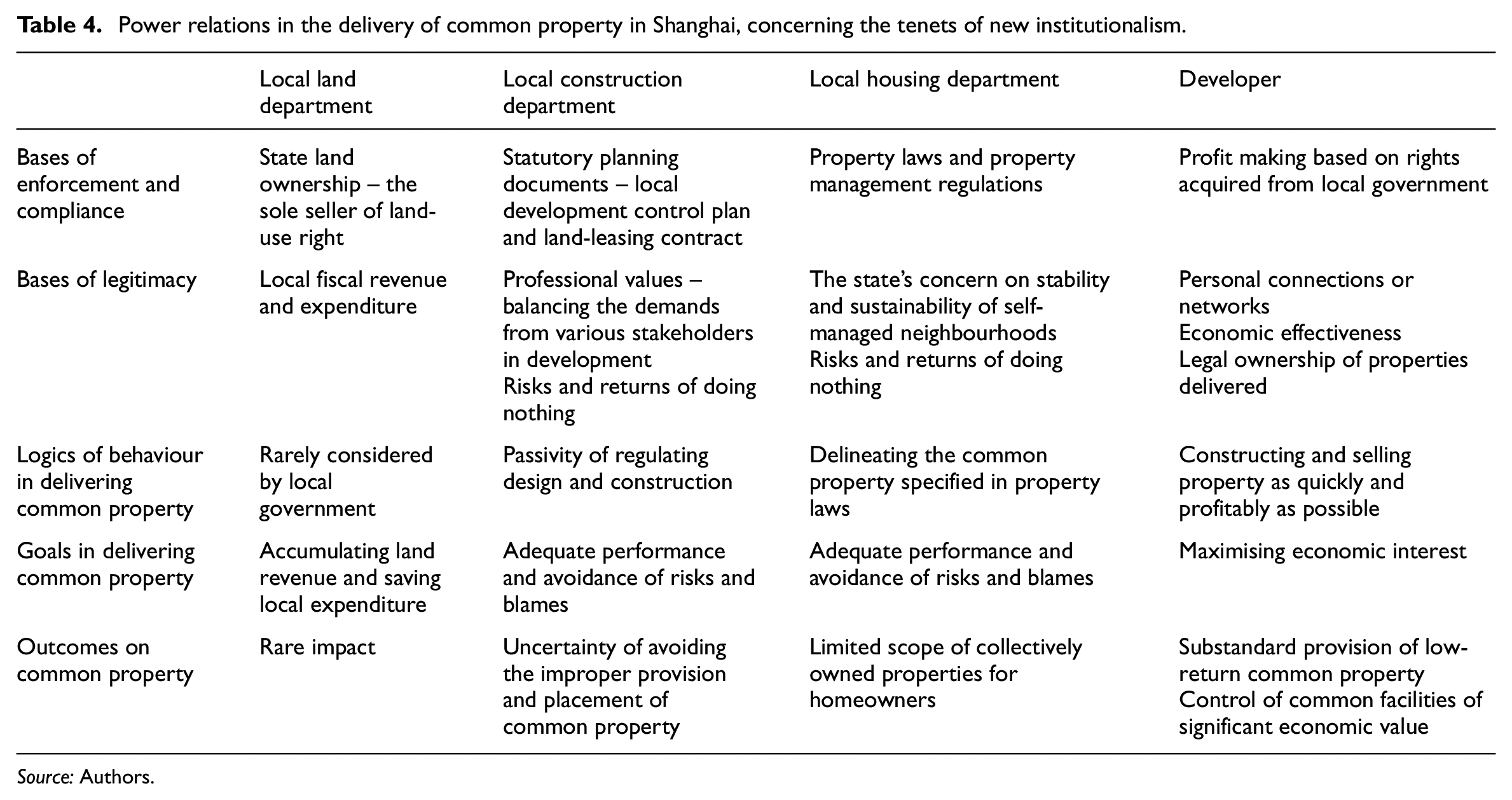
Source: Authors.
At the land-leasing phase, the local land departments hold the power and can readily discipline developers in the making of land-leasing contracts. Nevertheless, the issues of common property are neglected at this crucial phase, with government officials arguing they are private issues and have nothing to do with land revenues and public expenditure. This poses a missed opportunity for local government to exert effective regulation on common property.
At the construction permission phase, the local construction departments choose to be inactive, with the design and construction of common property not specified in statutory planning documents. Developers thus gain considerable power in capitalising on rent-seeking opportunities to evade the investment in low-return common property, and instead provide common facilities with significant profit potential. The lack of accountable and enforceable formal rules has been used by previous scholars to explain the result of the improper provision and placement of common property (Easthope et al., 2014). This research, however, emphasises the legitimate ‘modus operandi’ (Crook and Kemp, 2019: 669) of the local construction departments. This department’s professional values confer legitimacy to their passivity in protecting homeowners’ interests. This finding corroborates with Sorensen’s (2018b: 25) contention that ‘planning interventions are profoundly constrained by conceptions of legitimate governance interventions.’
Although the local housing departments have the potential to influence the construction of common property, the construction and housing departments shirk the regulatory responsibility onto each other. Out of the strategic calculation of the ‘risks and returns of doing nothing’ (Morrison, 2017), these departments do not meddle with each other’s decisions and thus avoid potential blames and risks. Developers often take advantage of this poor coordination to evade regulation.
Finally, at the ownership registration phase, the housing officials’ hands are tied and they can only delineate the common property specified in formal property legislation, which focuses solely on the basic maintenance and self-management of new estates, whereas other more lucrative common facilities are owned by developers. The legal ownership of these lucrative common facilities grants developers the ultimate power to arrange their subsequent ownership and use them in pure economic self-interest, placing the rights of individual homeowners in an unfavourable position. The legitimate goal of the local housing departments is confined to the self-contained management of communities, rather than protecting the long-term rights and interests of homeowners.
In summary, this research reaffirms Lowndes and Roberts (2013: 89) contention that within the urban playing field, the rules of the game allow ‘different possibilities (to) emerge in terms of actors’ capacities to resist constraint and seize opportunities for empowerment’. Local departments are not merely the rule implementers, and nor are developers simply rule followers. Both government and non-government actors conduct convert practices to evade responsibility and maintain their self-interest, while appearing to conform to formal rules (Morrison, 2014). These research findings confirm Streeck and Thelen’s (2005) argument that informal rules operate alongside or beneath formal rules and even displace formal rules in structuring behaviour. Given ambiguous and limited guidelines for the delivery of common property in the Chinese context, legitimacy becomes ever more important for actors’ strategic choices and long-term survival. The legal mandates protecting homeowners’ common property rights are often outweighed by the legitimacy managed within the Chinese administrative framework.
Conclusion
Drawing on the new institutionalism framework and the Shanghai case study, this article unpacks the power dynamics at the spatial critical juncture in which common property is produced. The article also reveals spatial specifications of common property, its property rights and power relations (between homeowners and developers) in operation. Despite the state land ownership and the laws enshrining individual property rights, the poor coordination of land, construction and housing departments within the local government in Shanghai weakens its power over developers. Avoiding blame is also an essential aspect of different local government departments’ practices (Li et al., 2021a Morrison and Xian, 2016; Li et al., 2021a), in addition to the conflicting interests, differentiated enforcement and negotiating power (Wu et al., 2007). That is, the local land, construction and housing departments shift unwanted duties to each other, attributing ineffective regulation to limitations in legislation and inadequate power and resources. This article suggests that there are substantial opportunities for developers to design common property and allocate associated rights and benefits to their advantage, which allows them to sustain advantage after schemes are put into use. In doing so, the cost and difficulty for homeowners to reclaim their rights increases.
The finding also supports Sorensen’s (2018a) claim that property created under different legal regimes at different times is likely to be specified differently, and that those differences are likely to be consequential. The Property Rights Law, together with subsequent national and local legislation, has established a legal system that protects the production of common property rights in Chinese cities. Property rights of contractual communities in China created before the enactment of these sets of legislation are differently specified than those after this turning point. In the Shanghai case, common property has been removed from developers’ ownership certificates and officially registered by local housing departments in new communities from 2009 onwards. In communities built before 2009, homeowners had no legal ownership over common parts and found it hard to claim their common property rights.
As one of the most developed Chinese cities, Shanghai is no exception for exhibiting ineffective regulation of common property to the subsequent detriment of homeowners’ common property. The legal and regulatory environment of property development (outlined in this paper) is readily applicable to other Chinese cities. The ambiguity in the central property legislation, the bias of the state towards economic development and the stability of grassroots communities (Cai and He, 2022; Morrison, 2014; Morrison and Xian, 2016) as well as fragmented and disjointed Chinese departmental bureaucracies (Lieberthal and Oksenberg, 1988) are common features of many Chinese cities.
The theoretical basis of this article, which draws on Sorensen’s (2018a) conception of path dependency and critical juncture in urban space, offers a new window for comparative study. What can be compared here is not countries or cities with similar sizes and populations, but of more significance is the comparison of legal and regulatory systems that structure the production of common property (as well as expanding to other property types) (Sorensen, 2018a). Therefore, the analysis of different stages of the development process can be readily applied to other Chinese cities and international contexts.
What can also be compared is the performance of differently specified properties within cities like Shanghai over time. For instance, it seems likely that in the medium term, property values in contractual communities that lost much of their promised ‘common property’, and have significant homeowner-developer disputes, will be lower than those where common property was more robustly institutionalised and governed as common property.
The local rules of the game at the micro-scale, however, do not occur in a vacuum. It is affected by outside actors and broader power relations (Morrison, 2017). Further research on the central and municipal government acting as the rule makers helps ascertain the bias and values embedded in high-level policies within any given jurisdiction. Juridical specialists who deal with the lawsuits of neighbourhood disputes can be interviewed to offer insights into the role of property laws in protecting homeowners’ common property rights (Blandy et al., 2006).
These critical insights in turn have a series of practical applications. Gaining a deeper understanding of how the allocation of property rights and interests are determined in the development process can assist in alleviating post-development problems and minimising the costs of dispute resolution.
First, the research would help to clarify why it is critical that the delineation of common property and associated rights in the property legislation are well-specified and legally ‘watertight’. Strong legislation would prevent developers from disposing of and using common facilities that do not respect homeowners’ property rights.
Secondly, again drawing on the Chinese illustration, the land-leasing contract and the local development control plan have become blunt tools, with little attention paid to the subsequent lived experience. However, if used more effectively, they could have considerable potential to unleash statutory enforcement powers, which would allow the delivery of high-quality urban developments across Chinese cities. This calls for stronger legislation within any given jurisdiction, which would both incentivise and prohibit certain developers’ activities developers' activities, and enhance and enhance local government’s regulatory legitimacy.
Finally, given the significance of informal rules (North, 1990: 36), we suggest greater transparency and accountability on the part of all actors throughout the development process. The goals of various government departments need to face greater scrutiny and at the inter-departmental fractional divisions require mending. Considering the power imbalance between homeowners and developers, greater transparency, for example through information campaigns, would allow well-performing developers to be rewarded and become more common practice. Those developers adopting poor practices, particularly around the delivery of common property, would ultimately become the exception, nationally and internationally.
Footnotes
Acknowledgements
The authors are very grateful to the editorial team and the four anonymous referees for their helpful comments and suggestions.
Funding
The author(s) disclosed receipt of the following financial support for the research, authorship, and/or publication of this article: Funding for this research came from the China Scholarship Council and the Humanities and Social Sciences Fieldwork Grant (University of Cambridge). Yiru Jia appreciates the support from Beijing High-Precision Discipline Project, Discipline of Ecological Environment of Urban and Rural Human Settlements.
