




Abstract
Pale is the Old English word for fence, and the phrase ‘to go beyond the pale’ means to stray beyond the limits of acceptable action. In this critical commentary I discuss whether the installation of temporary fencing in public parks to secure ticketed festivals is now beyond the pale. Fences restrict access but they also affect how park spaces are perceived, used and managed. I use photographs taken in three different London parks to illustrate the materiality of these temporary structures, but also their aesthetic impact, symbolic significance and lasting legacies. I argue that temporary fences have enduring effects on parks and public spaces by discouraging everyday use, by preparing the ground for future incursions, and by normalising and festivalising barriers that restrict access. My commentary highlights the often overlooked importance of fences and illustrates the splintered and sequestered nature of contemporary cities – where citizens are increasingly fenced off.
Introduction
Pale is the Old English word for fence, and the phrase ‘to go beyond the pale’ means to have crossed the line, to ‘have strayed over the limits of acceptable action’ (Hayes, 2020: 18). In this critical commentary I discuss whether the installation of temporary fencing in public parks to secure ticketed festivals is now beyond the pale. Driven by government austerity and entrepreneurial urbanism, this contested practice is an issue in various parts of the world, notably in Australia (Garrett and Iveson, 2018), the US (Greenfield, 2016) and the UK (Hunt, 2018). Disputes over festival fences epitomise and exacerbate wider concerns about restrictions on access to, and permitted behaviour within, urban public spaces. Fences not only limit access to public spaces, they affect how these spaces are perceived, used and managed. Further effects emanate from symbolic impacts as fences both represent and reproduce the contested, militarised and splintered nature of contemporary urbanism (Graham and Marvin, 2002). As Habeck and Belolyubskaya (2016: 119) note, ‘segregation, exclusion and partitioning of urban space have been central issues of sociology, geography, anthropology and urban planning’ and my analysis of park fences is situated within these literatures.
Almost 20 years ago, Jones and Wills (2005) suggested that municipal parks may become a victim of a broader war between public and private use, class and moneyed interests. Following the period of austerity imposed after the global financial crisis in 2008, this is now the reality for many urban parks. Cuts to local government budgets have significantly reduced the funds available for maintenance, and event hires allow park authorities to realise the exchange value of their assets without having to sell them. The most lucrative hire fees are earned by hiring parks to the festival arms of global entertainment corporations. Given the budget pressures they face, hosting major music festivals is seen by some municipal authorities as the least worst option, particularly as hosting ‘world class’ events can be aligned with place marketing and cultural policy agendas. I have already analysed contested events and the ways they restrict access to public spaces (Smith, 2018, 2019, 2021), so here I focus on one aspect of this trend: the installation and impact of temporary fences.
Fences are easily dismissed or overlooked, but they are significant installations that can help to shed light on wider issues. According to Habeck and Belolyubskaya (2016: 119) ‘few studies have addressed micro-practices of dividing space’ and ‘even fewer the materiality of those objects that actually restrict and regulate access’. To fill this gap in the literature, I analyse how the presence, assembly/disassembly and aesthetics of temporary fencing affect parks. Detailed observations in London before, during and after festivals 2018–2022; conversations with park users, and interviews with other stakeholders over the same period have allowed me to better understand how fences affect park use, and how they are regarded – and appropriated – by park users. In the analysis that follows, I address the materiality of these temporary structures, but also their symbolic significance, and their wider effects. This analysis is accompanied by photographs taken during fieldwork in London parks, which are included to illustrate the arguments. To highlight that the issues covered are not confined to London, my analysis also refers to examples from other global cities, particularly in Chicago, where there are ongoing concerns about fencing off parks for ‘mega fests’ (Perlman, 2022). The commentary begins with a discussion of fences in general and park fences in particular: this extended introduction contextualises the subsequent analysis and highlights key ideas which I return to in later sections.
On the fence
We live between fences. (Dreicer, 1996: 8)
Fences tend to be regarded as insubstantial structures, but their significance should not be underestimated. As Jakes et al. (2018) note, they are ubiquitous features of landscapes, but get far less attention than roads, walls and other linear features. Fences tell us ‘where we belong’ and ‘who we are’, and are fundamental to the ways land is colonised, used and managed (Dreicer, 1996). They are used to appropriate and enclose land – and therefore to privatise and monetise it – and so provide the physical means through which ‘accumulation by dispossession’ is realised (Harvey, 2010). Fences define and confine (Dreicer, 1996), protect and conceal (Boano and Talocci, 2014); roles reaffirmed by Hayes (2020: 95), who argues that fences ‘guard their territory, conceal it, and at the same time announce its presence, exposing its vulnerability’. Their visible presence mean it is tempting to regard fences as material phenomena, but they are better understood as socio-material and bio-political entities as they are supported by various technologies, regulations, media and behaviours. Jakes et al. (2018) advocate a greater focus on fence ecology, exploring interactions between fences, societal needs and ecosystems, and my commentary contributes to this embryonic field of study.
Fences are usually regarded as ugly, not just because of the way they look, but because of what they represent. For example, in Trouille’s (2014) work in Los Angeles, new fences surrounding a popular soccer field were deemed ‘unsightly, illogical and offensive’. Fences project power (Hayes, 2020) and symbolise conflict (Trouille, 2014) because they are used to exclude and divide, and due to their military associations. In an era of gated communities (Kostenwein, 2021) and neoliberal enclosures (Christophers, 2018), they are also metonyms for the contemporary city. According to Boano and Talocci (2014: 701), the fence is ‘a prominent signifier of the material condition of urbanism’. For this reason, fences have been the focus of notable public art works: including Ai Wei Wei’s temporary security fence structures that were installed across various New York spaces in 2017. In Cornford and Cross’ work Camelot (1996), the artists fenced off three grassed areas in Stoke-on-Trent to highlight the lack of public spaces.
Among understandably critical and negative interpretations of fences, we should also acknowledge some neutral, even positive, appraisals. Although his work is deliberately ambiguous and includes the counter perspective, Frost’s poem from 1914, Mending Wall, popularised the phrase ‘good fences make good neighbours’. Mending fences has since become a widely used phrase that refers to a process of reconciliation, reaffirming this positive interpretation. Even Harvey (2013) admits that not all forms of enclosure can be dismissed as bad, and the potentially positive outcomes of defining open space in cities have been highlighted by urbanists past and present. For example, Blake (1993) advocated more closed space, a view that seems more justified if we accept the idea that ‘fences make space into place’ (Dreicer, 1996), with freedom sacrificed for security (Tuan, 1977). This perspective has permeated urban design, with parks configured and managed as ‘precious enclosures’ separated from, rather than integrated with, the rest of the city (Hebbert, 2008). Separation is generally lamented by contemporary architects, perhaps most famously by Tschumi (Hardingham and Rattenbury, 2012), but some commentators remain convinced that enclosing parks can be a good thing. For example, Hajer and Reijndorp (2001) argue that ‘unless such spaces are fenced, defined and identifiable they cannot give structure to social encounters’. This view is reaffirmed by Kullmann (2014: 165) who regards ‘programmatic intensity without the benefits of a traditional perimeter fence’ as ‘akin to running air conditioning with the windows wide open’.
Park fences
In this commentary, I focus on the highly contested ways that parts of parks are fenced off to generate income from festival hires. But these fences can only be understood within a wider consideration of park settings, especially in the UK and other places where parks tend to be surrounded by perimeter fencing. Temporary fences in parks do not produce conventional enclosures as they are installed in sites which are already enclosed (Figure 1). There are contrasting perspectives on the merits of enclosing parks, with advocates suggesting that fences help make parks safer. For example, Harding (1999) suggested the decline of UK parks was partly explained by the removal of railings which made them less safe and more ‘vulnerable to incursions’. Fences allow parks to close at night which prevents vandalism and reduces the chances that these spaces are used as places for assailants to hide. This rationale is shared across various international settings, with Malek and Mariapan (2009) noting that fencing is deemed to be one way of making Malaysian parks feel safer. Other critics and designers worry about the way perimeter fencing contributes to exclusion. There are also concerns about the ways perimeter fencing might compromise the safety of those inside and outside: for this reason, Zavadskas et al. (2019: 374) suggest park fences should be designed to ‘maximise natural surveillance from the street and minimise opportunities for intruders to hide’.
The multiple layers of fencing in Finsbury Park during the Wireless music festival in July 2022. Basic wooden fencing round the park is reinforced with a further layer of 2 m high anti-climb mesh panelling and the festival perimeter within the park is secured by 4.12 m high aluminium Super Fortress fencing. Photo: Andrew Smith.
Fencing within parks tends to be used to screen off various service areas, or to enclose sports and play facilities. In the UK, children’s playgrounds tend to be surrounded – and defined – by barriers to keep young children in and dogs out. Containing children’s play within dedicated and protected areas is now seen as an old fashioned and unhelpful approach, but perimeter railings remain ‘an integral and enduring feature’ of playgrounds (Pitsikali and Parnell, 2020: 658). Like other types of fencing, these barriers can be appropriated and subverted by the very people they were designed to contain. As Pitsikali and Parnell (2020: 658) highlight, ‘boundaries can become a catalyst for creative or transgressive behaviour where people test the effectiveness of physical controls’.
Installing fencing around sports pitches is a growing trend which is justified by the need to regulate use and protect these amenities from damage (Trouille, 2014). However, there is also a financial incentive: fences ensure pitches must be formally booked and paid for rather than used incidentally (Smith, 2021). Trouille’s (2014) research in Los Angeles highlights the issues associated with these enclosures. Here, fences erected around a soccer pitch came to symbolise a wider conflict over the way the field attracted Latin American users to a white wealthy neighbourhood (Trouille, 2014). Opposition to fences grounded in worries about racism is also a prominent theme in Low’s (2013) research on Prospect Park, Brooklyn. Here, fences were erected to restrict access to a heritage feature that was being restored, but Black residents interpreted them as barriers to keep them out of the white part of the park. As these (temporary) fences restricted access for all groups, Low (2013) suggests that the consultation of some residents but not others, and therefore the lack of procedural justice, fuelled feelings of exclusion.
Temporary festival fences
Temporary fences are installed in parks for various reasons: for safety purposes, to restrict access during redevelopment, to protect park ecology or to screen off sites for filming. In the contemporary era, temporary fences are often used to secure organised events, particularly music festivals. These events have become more common as local councils and park authorities seek to offset reductions to their budgets during the latest period of austerity. For paid entry events, fences ensure entry is restricted to those with tickets, but fences are increasingly used to control access to free events too. Fences thus restrict the accessibility of park spaces by introducing physical, financial and symbolic barriers, and they also redefine what people are allowed to do there. Indeed, while parks are sometimes criticised for the prevalence and pettiness of rules, defining event zones through fencing creates areas which are subject to different regulations – including what can be consumed, worn or displayed (Osborn and Smith, 2015). There is a financial motive for installing fenced festivals, but these are also a product of wider processes, including the securitisation and juridification of public spaces (Smith et al., 2022; Talbot, 2011). Fences are justified as safety measures which are used control the numbers of people who can enter a space and what they can bring in. Local residents and regular park users tend to be the most vocal opponents, but some festival organisers also object. In Clissold Park, north London, the local council ordered that any event of 3000 people or more must be fenced in, which led one festival organiser to cancel their event: ‘we … cannot bring ourselves to organize a free community festival inside a great big steel box! It just doesn’t feel right’ (Talbot, 2011). This comment highlights that festival fences are not merely resisted by those locked out, but also by those penned in.
For the past few years (2018–2022), I have been observing fenced festivals in London’s parks, particularly in some of the city’s larger parks which tend to be more heavily programmed as venues. The analysis that follows is based on observation work undertaken in Brockwell Park (South London), in Gunnersbury Park (West London) and in Finsbury Park (North London). I draw on these observations to highlight the range of effects that temporary fencing has. I start with some of the more obvious impacts, before moving on to some of the more subtle and unintended effects. Each of these sections contains one photograph taken during fieldwork which helps to illustrate the issues highlighted. My analysis is inspired by fieldwork conducted in London, but the issues discussed are not confined to the UK capital. Fencing off parks for festivals is contested in many cities; and I have included recent examples from two Chicago parks to highlight this. However, the issue is most acute in London, and detailed analysis of this case serves as a warning as to what might happen in other cities pursuing ‘neoliberalisation by festivalisation’ (Smith, 2021).
Disrupted access
The most obvious effect of temporary fences is to exclude people from spaces which are normally available and free to use. People unwilling or unable to pay entry fees, or comply with entry conditions, are excluded from what is meant to be open, public space. Handing over parks to private event companies in this way is effectively a form of privatisation that allows organisers to decide who can get in and what they can do there. Advocates of event hires argue that restricting access to parts of parks is not unique to festivals, and a range of permanent incursions from tennis courts to art galleries help to justify exclusive use. It is true that there has never been universal access to public parks, and that there is a long tradition of commercial activity – usually in the form of cafes, car parking, visitor attractions or sports facilities. However, fencing off park space for festivals is more problematic for several reasons: each of which is linked to fencing.
First, festivals and events interfere with existing park facilities and features rendering some of them inaccessible. Figures 2 and 3 provide provocative examples of the way fences interfere with the everyday function of parks. Some authors have tried to conceptualise park festivals as social infrastructures, but they are responsible for introducing anti-social infrastructures in the form of fences. Second, the scale of some festivals means very large amounts of space are rendered off limits by fences several kilometres long. Residents living near London’s Brockwell Park call the festival fence that is regularly constructed there The Great Wall of Brockwell because of its length. A third consideration is the price and availability of tickets, and the related need to provide high levels of security. Music festivals tend to be very expensive, making them inaccessible to many people and rendering the barriers to entry higher than for other commercial activities. This level of exclusivity exacerbates some of the problems with fencing as, inevitably, expensive festivals require intimidating, multi-layered fences which are particularly disruptive and divisive.
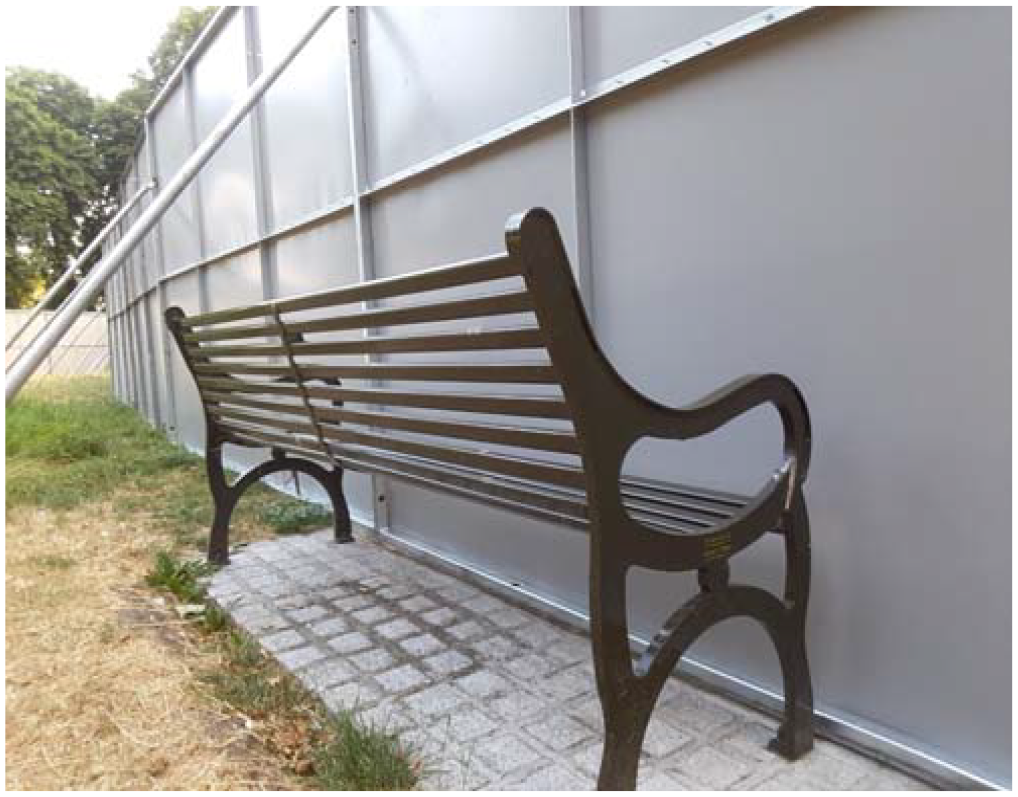
Fences in Brockwell Park in 2018 for the (free) Lambeth Country Show. Blocking off benches was controversial, not just because of the restricted access to park amenities, but because of the disregard for benches which commemorate the lives of deceased park users. The bench pictured here is dedicated to ‘Anthea Eugenie Toorchen, artist (1955–2015), who loved this park and walked her dog Rufus here everyday’. Photo: Andrew Smith.
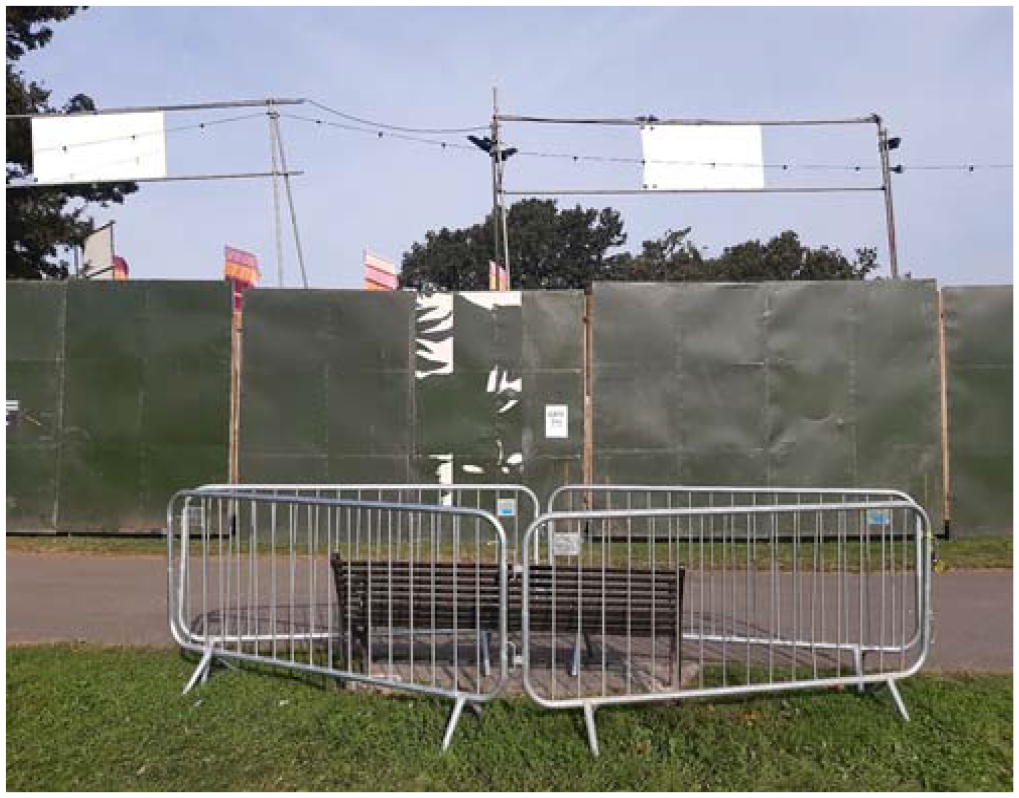
Steel Shield fencing for music festivals staged in Brockwell Park in 2021. Fences enclose open spaces, but they also disrupt access to various park amenities such as sports facilities, playgrounds and seating. Even when facilities remain outside the main festival fences, they can still be affected by barriers installed for security or safety reasons. Photo: Andrew Smith.
Not all park events are as commercially oriented as music festivals organised by global entertainment companies. Urban parks still stage free, community-oriented events and these have less significant effects on the accessibility of public spaces. However, the recent tendency to fence these events too – for security, safety and commercial reasons – means that many of the problematic effects of fencing still apply. Fencing off large scale, free festivals like the Mardi Gras Fair Day in Victoria Park, Sydney has caused friction as attendees object to the searches and the ban on bringing your own food and drink (City Hub, 2013). One fascinating difference between the issues here and those associated with expensive music festivals is that people object to being ‘fenced in’ rather than ‘fenced out’ (City Hub, 2013). Restriction, rather than exclusion, causes opposition. It is often assumed that we cannot have festivals without fences, but there are still some large music festivals that remain fence free (Smith and Ertem, forthcoming).
In searching for a positive angle on park fences, it is possible to draw comfort from Hayes’ argument that (2020: 95) while fences ‘guard their territory and conceal it’, by doing so, they ‘announce its presence, exposing its vulnerability’. Paradoxically, by visibly restricting access, festival fences highlight the presence of public parks, and emphasise how valuable free access to green spaces is to citizens. Building on the established notion that contesting park space is what makes it public, the publicness of parks is reproduced through its violation (Citroni and Karrholm, 2019). Temporary fences remind people that access to public parks is not guaranteed and, in instances where fierce public opposition is instigated, they reaffirm the publicness of these spaces.
Disrupted mobility
Festival fences do not merely prevent people from accessing park spaces, they are barriers that affect the ways the people move through them. As Dorreboom and Barry (2022: 48) point out in their paper on Brisbane, ‘habitual mobility patterns are drastically altered to accommodate festivals’. It makes sense to stage park events on hard surfaces, such as pathways or carriageways, to prevent unnecessary damage to grasslands. But these throughfares are also those which are most frequently used by people moving within, or through parks. Unsurprisingly, some of the most vocal opponents of temporary fencing are cyclists whose routes are closed off by temporary barriers. Limiting movement through parks is a particularly pertinent issue when considering the needs of those with mobility impairments: wheelchair users, elderly pedestrians and parents/carers pushing buggies (Figure 4). Forcing people to go off designated paths, and round festival sites, creates muddy and slippery paths which are difficult to navigate. Ultimately, festival fences make parks difficult to move through – deterring active travel and those less mobile. Festival fences also restrict the movement of (other) animals (Jakes et al., 2018), undermining the role of urban parks as havens for wildlife. For example, Rast et al. (2019) measured the effects of a Berlin music festival on the behaviour of hedgehogs, concluding that the event impacted the behaviour of all the cases studied.
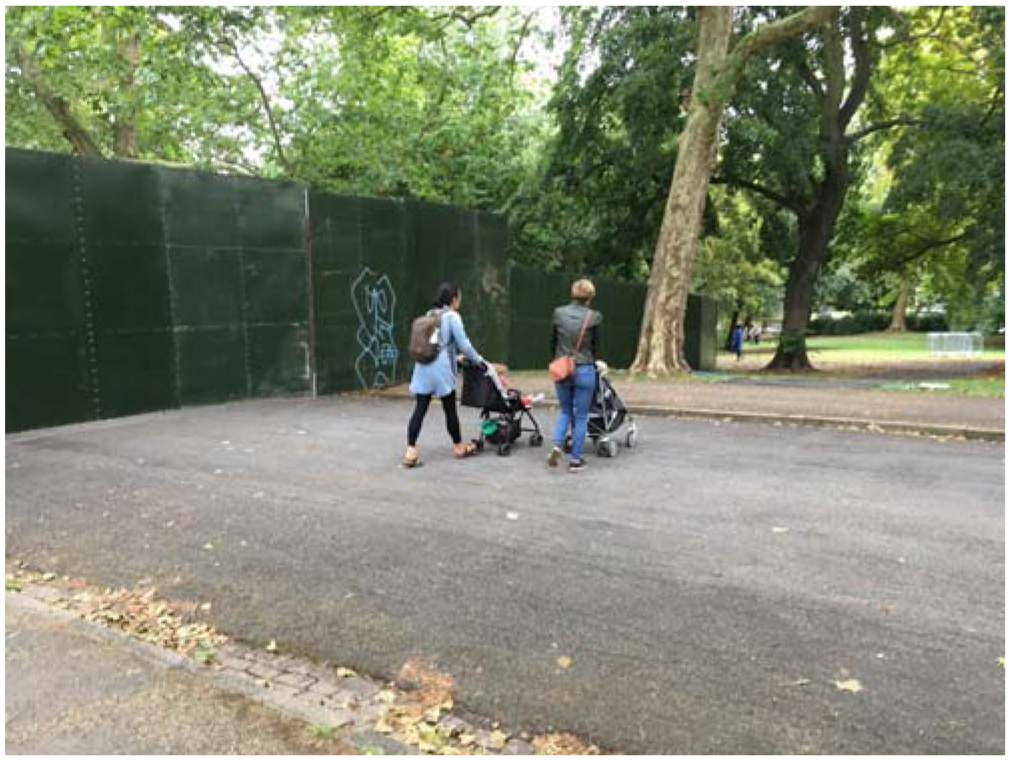
Parents/guardians with children in pushchairs attempt to navigate festival fences in Finsbury Park in 2019. Urban parks function not merely as destinations but as greener, healthier and safer ways of navigating through cities. Festival fences disrupt the movement of people through parks, especially when they prevent access to footpaths, cycleways and carriageways. Photo: Goran Vodicka.
Extended disruption: Assembly and disassembly
The disruption caused by fencing is not confined to the festive period. Fences are often left up after festivals, extending the time during which everyday activity is displaced. Fencing and venues for large festivals takes a long time to erect (up to two weeks) and dismantle (one week), interrupting access but also disrupting park use. This means access to parks that stage 4 or 5 festivals per year can be restricted for more than 100 days per year. In Chicago, communities surrounding Douglass Park complain that around 40% of the period June–September is now disrupted by ‘mega fests’ (Perlman, 2022). Opposition to festivals staged in another of the city’s parks – Grant Park – derives from the visual and physical impact of fences that stay up for several weeks while the park environment recovers (CBS Chicago, 2018). The presence of large vehicles required to service construction and derig are particularly disruptive (Figure 5). In cases where extensive use of temporary fences can be avoided – for example, free events and/or those staged in parks with permanent perimeter fencing – the effect on everyday park use tends to be significantly reduced (Smith and Ertem, forthcoming). Fewer vehicle movements and fewer temporary structures mean less disruption, but also less damage to grass surfaces that prolongs restricted access to park spaces. One other interesting aspect of the construction process is the unintended creation of strange landscapes littered with fence panels and half built structures. Festival organisers are obliged to maximise public access during the assembly/disassembly processes, allowing people to access and inhabit these spaces. Opportunities to dwell within these secluded sites are appreciated by individuals and groups seeking privacy, but contradict Zavadskas et al.’s (2019: 374) recommendation that park fences should be designed to ‘minimise opportunities for intruders to hide’.
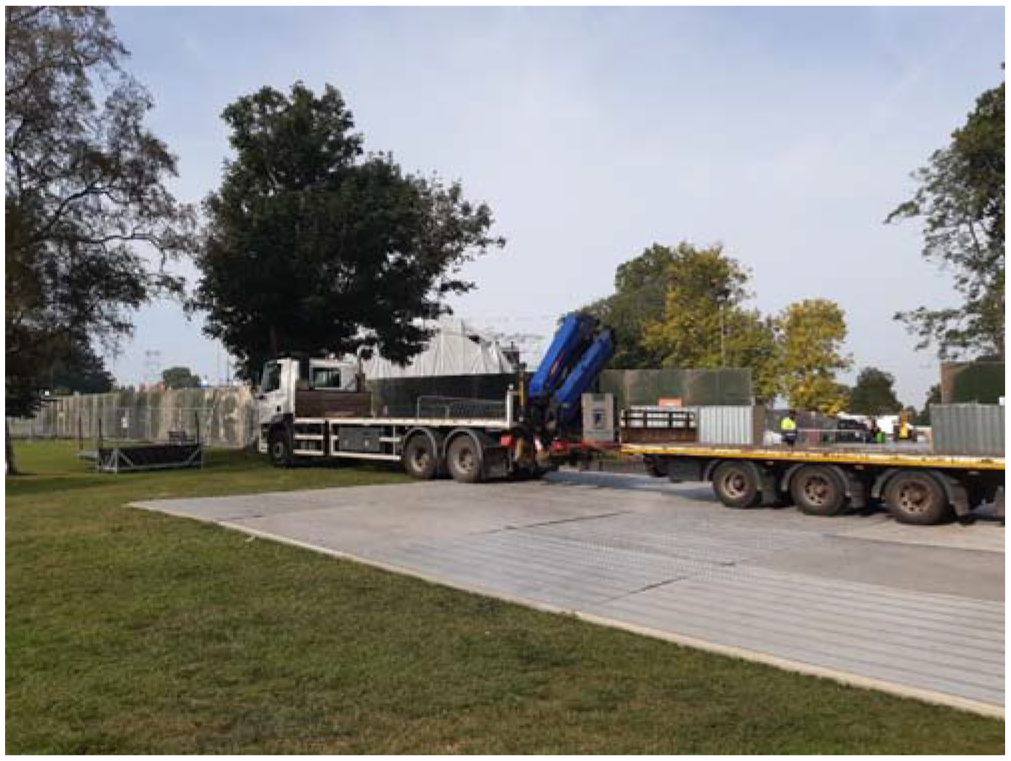
Deconstruction of festival fences and venues in Brockwell Park in 2021. Arguably, the assembly and disassembly of fences is more disruptive than their presence during festivals. London festivals that disrupt everyday park activity the least are those that do not require fencing such as Latino Life in the Park (Finsbury Park) and the Walthamstow Garden Party (Lloyd Park). Photo: Andrew Smith.
Aesthetics and symbolism
Talking to park users and various park stakeholders revealed that some of the most significant effects of the fences are their aesthetic impacts and symbolic effects. People told me that they ‘hated’ the fences, not simply because they restricted their use of space but because they affected the look and feel of their park. Various terms with military or negative connotations were used by park users to describe the fences, including ‘barricades’, with some noting that they felt as though they were entering a war zone or encountering a detention camp. This is a common response: a recent letter to a Chicago newspaper complained that festival fencing made Grant Park look like ‘a deserted prison camp’ (Chicago Sun-Times, 2022). These interpretations are prompted by security apparatus that accompanies fences: security guards, watchtowers, police vans and signs warning of guard dogs and CCTV cameras. In the UK, the most common type of fencing used for park festivals is Steel Shield – 3.45 m × 2.45 m panels which are ‘sympathetically coloured to compliment any park or green field site’ (Entertee Hire, n.d.). These fences are manufactured by a specialist company (SteelShield Ltd.) and can be erected in relatively confined spaces. However, as Figure 6 illustrates, some park festivals now deploy Super Fortress fencing, a more visible barrier with overhang extensions which extend the fence height to 4.12 m, making unauthorised entry ‘virtually impossible’ (Eve Trakway, n.d.). These fences are fabricated from extruded aluminium and when launched were described by an industry magazine as ‘aesthetically pleasing’ (Aluminium International Today, 2002: 7). A more realistic assessment is that Super Fortress fencing produces an aggressive, militarised aesthetic which contrast markedly with park settings (Figure 6).
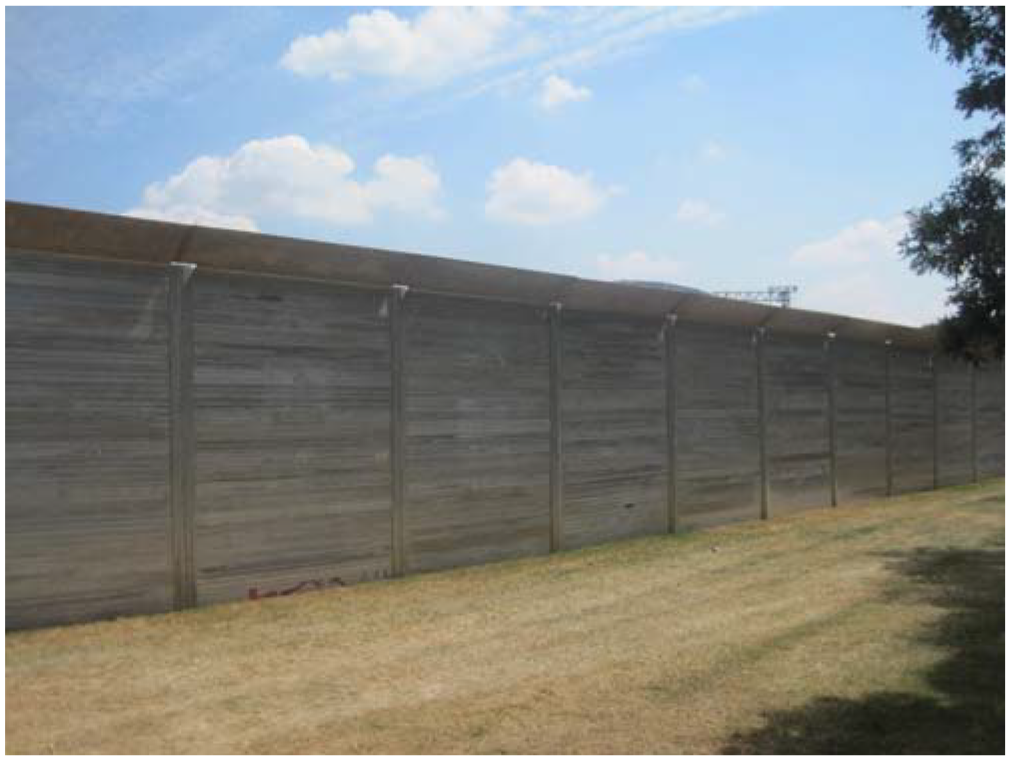
Super Fortress Fencing for the Lovebox festival in Gunnersbury Park in 2018. This is the most secure fencing available to festival organisers, and features tamper proof fitting and integrated gates. Super Fortress fences were developed by Eve Trakway, the industry’s leading supplier of temporary fencing, and were first used at the Glastonbury Festival in 2002 as a response to the high volume of people breaching fences at the 2000 edition. Photo: Andrew Smith.
Improvised and unintended functions
Festivals fences do not merely serve their primary function, they also play a variety of improvised or unintended roles and can be appropriated by park users. Given Pitsikali and Parnell’s (2020: 658) expectation that fences encourage ‘transgressive behaviour where people test the effectiveness of physical controls’, I was expecting to witness people trying to penetrate fences without permission. But, other than stumbling across objects strategically positioned to aid unsanctioned entry, I did not see much evidence of fence jumping. Fences and the various technologies and personnel deployed to reinforce them seem to be working as intended, as evidenced by the number of times I was asked by security staff why I was loitering around festival perimeters. Park users’ engagement with festival sites was generally limited to peering through holes and cracks in fences, highlighting the way fences draw attention to what is inside and the ways fences, unlike walls, can be looked through.
Some of the other improvised or unofficial roles of fencing are illustrated by Figure 7, which shows festival attendees using fencing for shade at the Lovebox festival in Gunnersbury Park. In this instance, the fence is also used as an advertising hoarding; promoting one of the performing artists (Childish Gambino), but also providing a convenient place to advertise future festivals. The capacity to display advertising is one of the reasons Steel Shield is such a popular fencing option for park events. Sanctioned and unsanctioned flyposting on these fences are common, which causes rather odd aesthetic effects when the same fences are relocated uncleaned to other sites. Fences are also used to communicate messages to park users, reminding users that facilities are ‘open as usual’. In this sense, festival fences are used to display efforts to excuse or justify them. In Hyde Park, London, fences were covered by winning entries to an art competition based around the question: What Does Hyde Park Mean to You? Conveniently, a lot of the winning entries seemed to imply what people liked best about this park were the (fenced off) music festivals staged every summer.
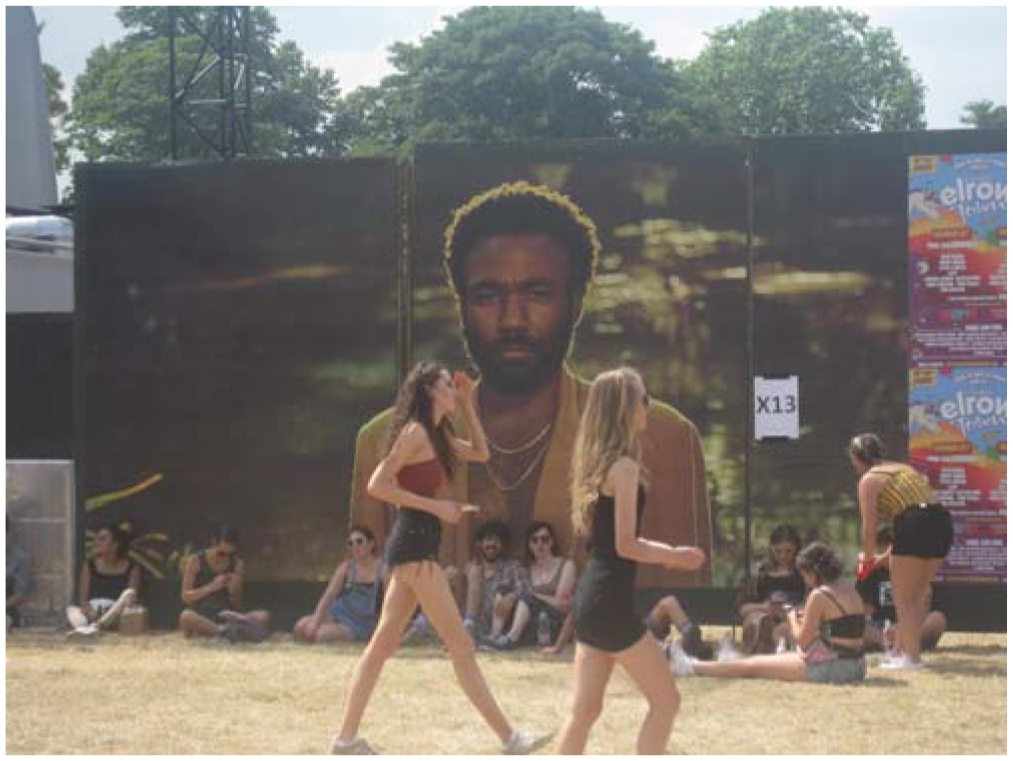
Inside the fences at the 2018 Lovebox festival in Gunnersbury Park. This image highlights the ways festival fences provide opportunities for shade and advertising. It also emphasises the differences between being inside and outside the fence. Inside festivals, fencing is often hidden or decorated to make its presence less visible. Outside, the fence is made as visible and intimidating as possible – to deter unsanctioned entry. Photo: Andrew Smith.
Fence panels also tend to be used for subversive messages and provide an obvious place to display resistance via artwork, graffiti, territorial ‘tagging’, and other basic communication. For example, when the Lambeth Country Show – a free event staged annually in Brockwell Park, London – introduced fencing for the first time, someone scribbled ‘Welcome to Lambeth Country Show Penitentiary’ and ‘No Fences. No Walls’ onto dusty fences (Field notes, 2018). Less critical appropriations I witnessed included using fences as backboards for various park activities, including games of football and cricket. These left me wondering whether the participants would need to ask festival organisers the question every fence owner dreads: can we please have our ball back?
Conclusions
Fences have always been fundamental features of our urban space but they are now at the forefront of debates about the right to the city, not just curtailing individual access but restricting the collective capacity to remake our cities (Harvey, 2010). In his recent book, Christophers (2018) analyses a second iteration of British enclosures, a new phase dating back to the late 1970s involving the transfer of land ownership from public authorities to private companies. My commentary identifies a different type of enclosure; one involving the temporary privatisation of public space to generate financial returns. In park settings, these are enclosures within enclosures, adding to other fencing and undermining the idea that these are ‘open spaces’. While temporary enclosures may seem less fundamental than land sales, fenced off festivals epitomise ‘accumulation by dispossession’ in which ‘common resources are enclosed and transformed into exclusive places’ (Islar, 2012: 386) and exemplify the ways urban parks are now oriented more towards political economy than public ecology. This issue is most acutely felt in London and Chicago, but is increasingly relevant to other cities too, particularly in contexts where neoliberal austerity is firmly established as the dominant political ideology.
As the preceding discussion and photographs have shown, fences erected to create and secure festival enclosures have significant physical, social, visual and symbolic impacts while they are in situ, and during their assembly/disassembly. These fences also have wider and longer term effects that are sometimes overlooked. Installing fences regularly can have enduring effects by changing the way public parks are imagined, used and managed. My observations in various London parks suggest that festival sites are not very well used even when they are not fenced off. People become accustomed to not being able to use them, so do not. Under-use is also a result of park authorities neglecting these areas and keeping them free of amenities or trees – so staging festivals can be more easily justified and realised. Park authorities often cite under-use as a reason to justify fencing off parks but my research suggests the reverse is true: people do not use these sites because they are used and managed as festival venues. Festival fences leave shadow legacies: they instal invisible ‘ghost fences’ in peoples’ minds which restrict use even after material structures have been taken away. This chimes with Garrett and Iveson’s (2018: 48) analysis of festival fences in Sydney: ‘we stop ourselves from going to public space or doing certain things in it, because we feel, subconsciously or otherwise, that on some level corporations have more of a right to the space than we do’.
There are also other ways that festival fences might leave longer term effects. Fencing off areas for festivals might be a precursor to making more permanent changes, literally ‘preparing the ground’ for more permanent enclosures. There are precedents for this – for example in London’s Battersea Park where access to areas used for Festival of Britain festivities was never fully reinstated (Smith, 2018). Another enduring effect of temporary fences is to normalise restricted access to public spaces, with the festive function softening opposition. Temporary fences or what Dorreboom and Barry (2022) call ‘soft fortifications’ are now becoming a more prevalent and more permanent feature of our cities. Fences are not merely used for festivals and events, they are used for a variety of purposes: crowd control, protection of property, conservation of natural resources and to prevent access to development sites. In this context, festival fences provide palatable precedents, helping to normalise the presence of other types of temporary and more permanent fencing.
Fences are part of the way public spaces are managed and less critical appraisals might argue that they facilitate the enjoyment, socialising and cultural expression generated by festivals. For those on the inside, fences deliver the separation from contemporary life that many festival goers are seeking. In some instances, such as events that celebrate marginalised identities, fences may even help to protect those inside from disruption or harm. But fencing off park spaces repeatedly during the summer months, as happens in London’s Finsbury Park and Chicago’s Douglass Park, restricts access to public spaces and sends out worrying messages. If fences tell us ‘where we belong’ and ‘who we are’ (Dreicer, 1996), then festival fences remind us that urban parks are becoming more exclusive sites which privilege those willing and able to consume. To tackle related procedural injustice (Low, 2013), it is important to scrutinise decision making to understand if and how communities can influence the location, specifications and lifespan of temporary fencing. Democratic accountability is usually provided via oversight by municipal authorities, but the rise of entrepreneurial park governance, lacklustre consultation and the location of large parks on Borough boundaries can distance local people from decision making (Smith, 2021).
During the height of the Covid-19 crisis our urban spaces featured a frenzy of fences: barriers were used to cordon off various amenities, and to prevent people from gathering. At various scales – from individual benches to entire parks – sites were fenced off. There is galling irony here: whereas fences had previously been installed to allow festivals to be staged, now fences were being installed to prevent festivities. Back in 1996, Driecer suggested fences were underestimated because we ‘hardly notice them’ but, following the coronavirus pandemic and the festivalisation of public spaces, they are now a more visible and more contested feature of our cities. Citizens are increasingly fenced off and the soft fortification of our urban public spaces is surely beyond the pale.
Footnotes
Acknowledgements
The author would like to thank Dr Goran Vodicka, a Research Fellow on the FESTSPACE project 2019–2020, who took one of the photographs and co-presented a related paper at the 2021 RGS-IBG Annual Conference.
Funding
The authors disclosed receipt of the following financial support for the research, authorship, and/or publication of this article: This paper was produced as part of the FESTSPACE project (2019–2022) which was funded by a grant (No. 769478) awarded through the Humanities in the European Research (HERA) Joint Research Programme dedicated to Public Spaces: Culture and Integration in Europe.
