




Abstract
Recent work has pointed to the importance for their social inclusion of convivial encounters between people with and without disabilities, but little is known about the spatial and social conditions of the places that encourage these encounters. This paper is concerned with public places that are conducive for convivial encounters between people with and without disabilities. Drawing on extensive participative observations of four community projects and 78 interviews with people visiting or working at these projects we investigated which elements in these places encourage ‘strangers’ to move from merely co-presence to conviviality. Three conditions seem to be conducive, namely: (1) a shared purpose, (2) built-in boundaries, (3) freedom to (dis)engage. These conditions were beneficial for convivial encounters, but do not lead to friendship or long-term support. People engage in such contact because they can be sure that these contacts do not raise expectations of long-term support or friendship.
Introduction
As a result of policies of ‘deinstitutionalisation’ and ‘normalisation’ in Western countries, people with disabilities increasingly live in conventional neighbourhoods (Lamb and Bachrach, 2001; Novella, 2008). There they are expected to interact with other people in society and become ‘socially included’. The ideal of social inclusion is embraced by policymakers and researchers, in line with the criticism of large institutions that arose in the 1960s. Despite ongoing discussion about the concept, most authors agree that social inclusion implies having social relationships with people without disabilities and active participation in mainstream society, for example, through shopping or sports club membership (Simplican et al., 2015).
Numerous studies have shown that people with disabilities living in conventional urban neighbourhoods have more social contacts than people living in institutions (Chow and Priebe, 2013; Kozma et al., 2009: 195; McConkey, 2007). However, research also shows that these contacts are usually limited to family members, other people with disabilities and support staff (Bigby, 2008; Forrester-Jones et al., 2006). Consequently, the question of how social inclusion of people with disabilities can be fostered still puzzles policymakers as well as researchers.
In the field of intellectual disability, policymakers and scholars tend to evoke a communitarianism view of the concept of social inclusion with people sharing the same values, and with people with disabilities also benefiting from community membership (Simplican and Leader, 2015: 718). This is, for example, visible in how scholars (e.g. Cobigo et al., 2012; Power, 2013) stress ‘that people with disabilities also need to sense “a feeling of belonging” and may benefit from being a member of the community’ (Simplican and Leader, 2015: 718). This communitarianism also comes to the fore in pleas for enlarging the social networks of people with disabilities with people in the community (e.g. Bates and Davis, 2004; Gomez, 2011). In line with these ideas, policymakers devise projects where neighbours with and without disabilities can meet and interact or help each other. They promote close, long-term relationships between people with and without disabilities (see also Bredewold et al., 2016; Simplican and Leader, 2015) in order to make people with disabilities feel more at home and accepted in society.
However, some scholars maintain that, in addition to close long-term relationships, we should also value and invest in ‘convivial encounters’: superficial, fleeting interactions in public places such as streets, squares and parks (Bigby and Wiesel, 2011, 2015; Bredewold et al. 2016; Fincher and Iveson, 2008; Wiesel and Bigby, 2014, 2016; Wiesel et al., 2013; Wise and Noble, 2016). They argue that these light and superficial contacts can breach indifference in ways that better fit with urban lifestyles. While long-term relationships are important for everyone, light interactions and encounters are particularly important for inclusion of people with disabilities in urban areas. Such an approach aligns with urban research that develops concepts such as ‘kindness’, ‘niceness’ or ‘light-touch relations’ (Brownlie and Anderson, 2017; Thrift, 2005) to articulate how urban indifference can be breached.
Building on these insights, we will argue that urban policies need to create situations and places that are conducive for ‘convivial encounters’, as they can be beneficial for people whose everyday lives are separated by differences in lifestyle, religion, ethnicity and being able or disabled (Brownlie and Anderson, 2017; Hall and Smith, 2015: 12, 15). As Thrift (2005: 144) and Bigby and Wiesel (2018: 2) argue, more knowledge is needed on how to create such situations and places. In this paper we will focus on spatial and social conditions to arrange these convivial encounters: encounters between people who are relative ‘strangers’ to each other.
Conditions for organising convivial encounters
The notion of ‘convivial encounters’ was introduced by urban geographers Fincher and Iveson (2008). It is based on the work of Georg Simmel (1950), urban sociologists of the Chicago school and urban geographers (e.g. Jacobs, 1961; Young, 1990). It builds on the idea that modern cities are characterised by social heterogeneity rather than homogeneity and that residents are likely to be strangers. Encounters with strangers are, therefore, a central feature of urban life and inherent to what it means to be socially included in the city. In urban areas, many different kinds of people are brought together. Therefore, urban encounters can be seen as a way to engage with difference and to encounter the richness of the urban experience (see also Bannister and Kearns, 2013; Jacobs, 1961; Richaud, 2018; Valentine and Sadgrove, 2013; Werbner, 2017).
Fincher and Iveson (2008: 154) maintain that it is important to work towards conviviality in urban life, where different individuals can work together on shared activities, projects and concerns that do not totally reduce them to fixed identity categories either as citizen or as group member. They take a convivial encounter to be ‘more than the free mingling of people in large public squares and spaces. It is more than the apparently aimless wandering of the flaneur, being pleasant to those strangers he may see. Rather, these encounters have a certain intent namely meeting people who are different, but without the idea to become a homogenous group’ (Fincher and Iveson, 2008: 154).
Fincher and Iveson add that such encounters may be marked by friendliness or hospitality and may lead to ‘moments of pleasure and excitement’ (Young, 1990, cited in: Fincher and Iveson, 2008: 154). Such encounters may also contribute to ‘reducing prejudice and social exchange between people who normally do not meet’ (Valentine and Sadgrove, 2013). They also shape possibilities ‘to step outside a fixed identity’ and ‘explore more transient shared identifications with those they meet’ (Fincher and Iveson, 2008: 159). This is contrasted with social life in villages, seen as more based on homogeneity and on repeated contacts with familiar people with fixed identities (Fincher and Iveson, 2008; Jacobs, 1961).
Wiesel and Bigby (Bigby and Wiesel, 2011; Wiesel and Bigby, 2014, 2016; Wiesel et al., 2013) further developed the concept of convivial encounters, especially related to the inclusion of people with disabilities. They argue that in modern urban life, convivial encounters can be significant moments of connection that can add up to participation in community and long-term relationships (Bigby and Wiesel, 2011: 264). Convivial encounters may help people from minority groups to become recognised and known in the community (Wiesel and Bigby, 2014). Through repeated encounters over time, people can recognise each other, get to know each other and find a shared identity (Bigby and Wiesel, 2011).
Of course, not all encounters are convivial. Simply being on the street does not automatically lead to encounters, and encounters are not automatically positive. People with disabilities are often ignored, laughed at and bullied, or met with impatience, fear, condescending remarks or actions that single them out as not fully belonging in the community (Bredewold et al., 2016; Wiesel and Bigby, 2016). Meeting places may also be non-inclusive, predominantly filled with people with disabilities and staff, and unwelcoming to others. People can also share a space or bump into each other without any interaction, not even a fleeting exchange or sign of recognition (Wiesel and Bigby, 2016). Hall (2004, 2005), Milner and Kelly (2009) and Ootes (2012) found that people with disabilities feel vulnerable when venturing to places beyond the familiar settings and people. They avoid places that require knowledge of the intimate social ordering of spaces (Milner and Kelly, 2009: 301) or where they are being hurried (Hall, 2004, 2005).
Only a few scholars use the lens of encounters to study the social inclusion of people with disabilities (Bigby and Wiesel, 2011, 2015; Bredewold et al., 2016; Simplican et al., 2015; Wiesel and Bigby, 2014, 2016; Wiesel et al., 2013). When putting together the work of these scholars, four conditions seem to be conducive for convivial encounters: (1) a welcoming environment, (2) a shared purpose, (3) non-competitive activities, and (4) built-in boundaries. We will elaborate on these four conditions below.
(1) It seems that people with disabilities tend to feel more at ease at places with a verbally and non-verbally welcoming non-discriminatory environment (Hall, 2004, 2005; Wiesel and Bigby, 2016). Venue staff (such as managers, shopkeepers, librarians, hosts at the community houses) take care to make them feel welcome and at ease. They show patience and accommodate to the slower pace of some people with disabilities (Wiesel and Bigby, 2016: 11).
(2) Some authors suggest a shared purpose or goal may be important, too. Based on the research of Ash Amin about intercultural interaction in Britain, Fincher and Iveson (2008: 157) suggest that ‘successful intercultural interaction among strangers is most likely to take shape through ‘micro-publics’ – that is, through sites of purposeful and organised group activities like workplaces, schools and community organisations where people might interact in pursuit of common projects and goals that are not defined with reference to ethnic identities and difference’. Wiesel and Bigby (2016) maintain that convivial encounters between people with and without disabilities are rare but do occur when there is a common purpose. Because of the shared purpose, group membership is developed over time through repeated encounters, for example in a dance club and during a clean-up event in a local park.
(3) Wiesel and Bigby (2016) point to non-competitive activities as an important condition for places of sustained convivial encounters. Places with very strict forms of behaviour or highly competitive activities tend to exclude people with intellectual disabilities. For example, in bowling clubs people with disabilities are excluded because it is supposed that they lack the capacity to play the game well (p. 9).
(4) Bredewold et al. (2016) found built-in boundaries to be important too. By built-in boundaries they mean clear rules and roles for social interactions that do not require reflexivity or negotiation. They state that it is helpful when roles are clear so that people know what others expect of them. For example: ‘I mind the animals and you visit the children’s farm.’
Wiesel and Bigby (2016; Bigby and Wiesel, 2018) argue that if we want to gain more knowledge of conditions that support convivial encounters between people with and without disabilities, more in-depth research is necessary. With this article we want to contribute to this knowledge. Additionally, we also aim to contribute to knowledge about how to organise light urban interactions between people who do not normally meet, as many urban scholars argue that thinking about the value of light superficial interactions in the city is underdeveloped (Brownlie and Anderson, 2017: 1224). We aim to deepen our understanding of the conditions for convivial urban encounters. We studied four different places, set up by urban policymakers to encourage people with and without disabilities to meet and enjoy convivial encounters, to establish which spatial and social conditions of such places contribute to convivial encounters between people with intellectual and psychiatric disabilities and people without disabilities.
Case study
In line with the ideal of social inclusion, Dutch policymakers attempt to promote the participation of people with disabilities by setting up neighbourhood projects where people with and without disabilities are encouraged to meet. A white paper from the City of Zwolle reads: We find it very important to enable vulnerable people to participate in society, which is why we focus in the activities of welfare organisations and the planning of projects on the participation of vulnerable people. (Gemeente Zwolle, 2015: 8–9)
From January 2016 to June 2018, we participated in four Dutch neighbourhood projects in urban neighbourhoods which all house a sizeable minority of people with intellectual and/or psychiatric disabilities. The projects aim to promote contact between them and other neighbourhood residents. We will briefly introduce all four projects.
First, The Encounter, a project for people with intellectual disabilities located in the centre of the municipality of Zwartewaterland (22,500 inhabitants). The Encounter arranges monthly coffee meetings and occasional activities, such as cooking together or playing games, where neighbours are invited. Some of the neighbours without disabilities volunteer on a regular basis for a fixed number of hours per week in activities such as wood carving, cooking and needlework. During our observations, approximately ten people with disabilities, one or two volunteers without disabilities and a few irregularly visiting neighbours were present at this project.
The second project is a Community Centre which organises a weekly shared meal open to all inhabitants of the neighbourhood. It is located in Dalfsen (28,000 inhabitants), in a neighbourhood with approximately 7500 inhabitants adjacent to assisted living apartments for people with severe psychiatric disabilities and an apartment block housing people with varying levels of intellectual disabilities. A group of three to four people with disabilities prepare the shared meals and approximately ten people with disabilities and ten people without disabilities dine together under the supervision of one community worker. Additionally, activities such as a movie night, creativity workshops and a weekly walk are organised. These activities are also open to other inhabitants but none attended during our fieldwork.
Third, the project Community Garden is dedicated to the production and sale of vegetables. It is located in a quiet area of the city of Steenwijk (19,000 inhabitants), adjacent to an indoor sheltered employment project for people with intellectual disabilities. At first, the Community Garden was run by two or three volunteers without disabilities. Under their supervision, two or three people with quite severe disabilities worked in the garden. From 2018 onwards, a social worker with gardening skills was hired for supervision and recruitment, and more volunteers and people with intellectual disabilities have been participating. Occasionally, neighbours come to buy vegetables.
Fourth, the Community Farm is located in the medium-sized city of Zwolle (125,000 inhabitants) with farm animals, gardening and woodwork activities. A local welfare organisation manages the farm, which mostly deploys around five volunteers (mostly people without disabilities) for gardening and feeding the animals. The farm also hosts a kindergarten. Two days a week, between five and seven people with psychiatric disabilities join the volunteers in gardening, woodworking and animal tending, supported by a social worker. The farm attracts many close neighbours, particularly when the weather is nice.
Methods
Participant observations
In 2016 and 2018, three researchers performed participant observations (Patton, 2002) in the four neighbourhood projects. From January to June 2016, each project was observed for 20 hours, spread over at least five visits, which lasted from two to six hours. In April and May 2018, each project was observed for six to eight hours, spread over two or three visits each lasting two to four hours. These researchers assisted with activities such as cooking and gardening. Their observations focused on whether social contact actually developed between neighbours with and without disabilities and what characterised such contact. They recorded their observations in three ways. First, compact field notes were taken: registration of all concrete observations directly or at least within five minutes. Second, they wrote a comprehensive observation report within a day of the observation. Third, they kept a research diary in which they noted their general impressions and reflections on the findings and the research process. The researchers regularly shared and discussed their findings. Prior to the participant observations, written ethical approval was obtained.
In-depth interviews
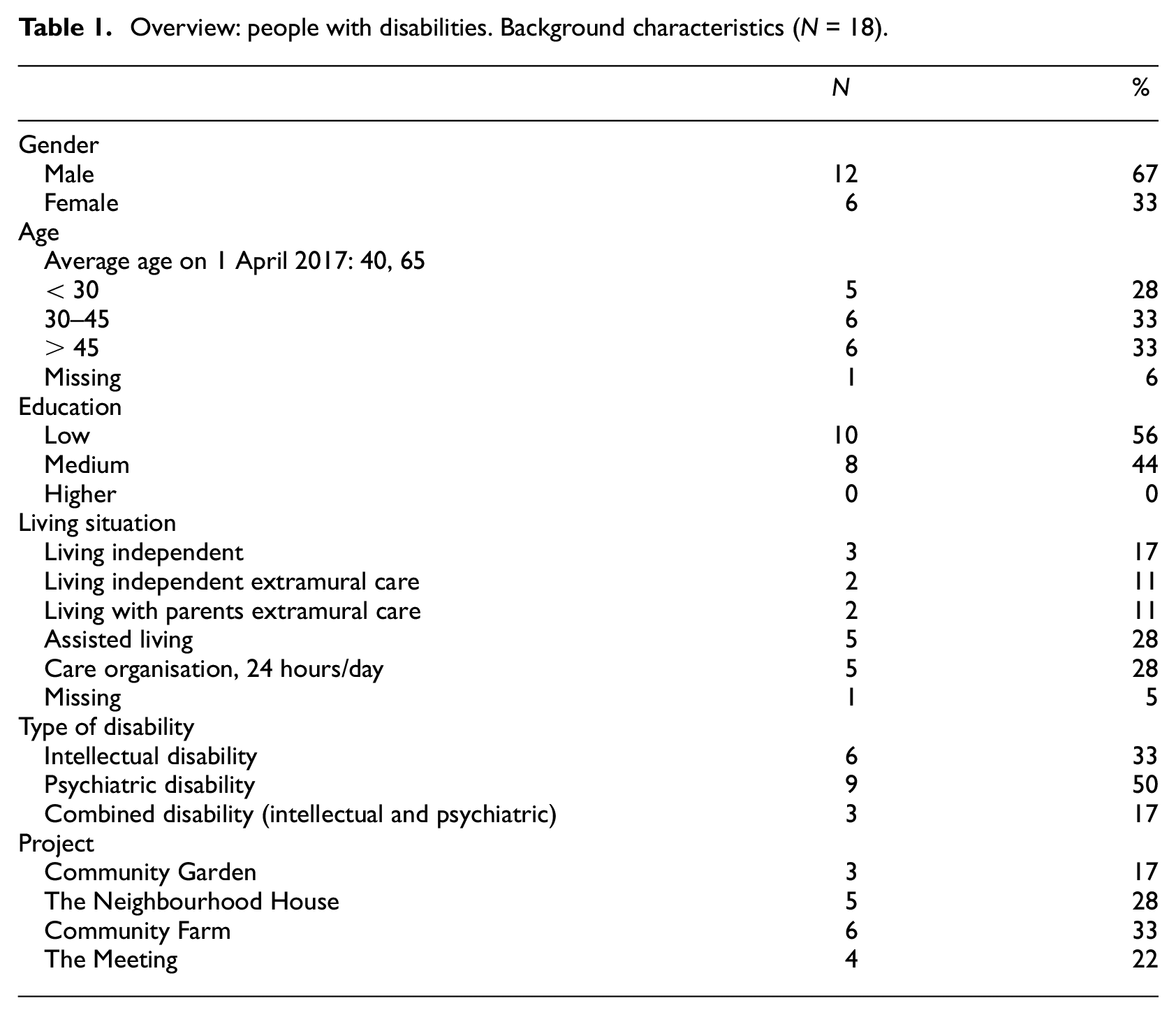
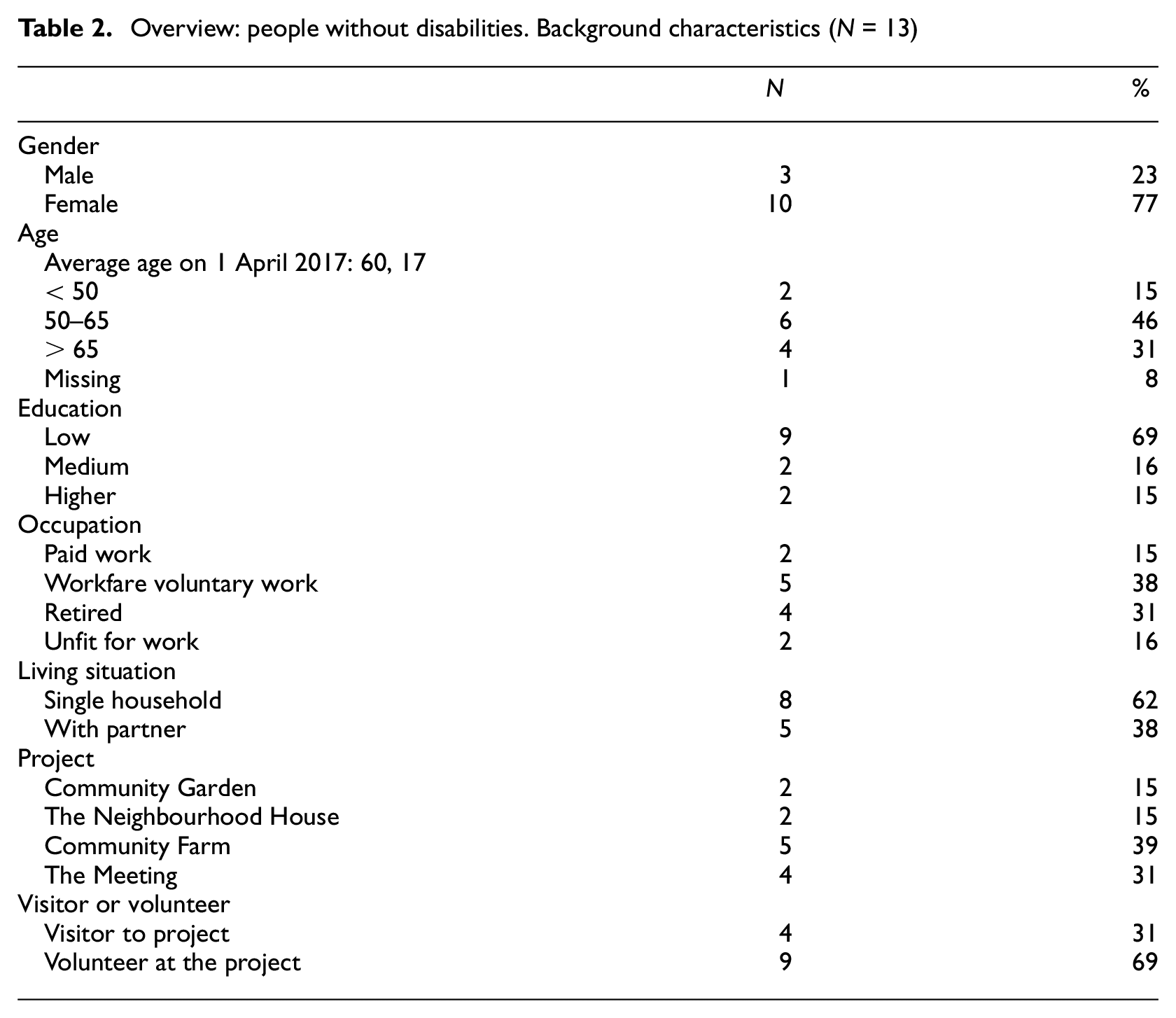
To find out how participants experienced encounters on the projects we also conducted interviews with people with and without disabilities and social workers at these projects. We discussed the meaning and facilitators of and barriers to the (observed) encounters. The interviews relied on a topic list rather than a standardised questionnaire, which was used flexibly to adapt the interview to differences in respondents’ communication skills. Such use of a topic list also allowed respondents to exercise control over the direction of the interview and depth of discussion (Jahoda and Markova, 2004). Three interview rounds took place in the spring of 2016, the spring of 2017 and the autumn of 2017. In total, we performed 78 interviews: 37 with people with disabilities, 26 with people without disabilities and 15 with social workers. At all four locations, recruitment of respondents was done during the first field visits. Some people signed up spontaneously; others were selected in consultation with the community workers at the projects, as we asked them for respondents who represented the various users and volunteers of the projects (with and without disabilities). The background characteristics of the respondents are summarised in Tables 1 and 2.
Overview: people with disabilities. Background characteristics (N = 18).
Overview: people without disabilities. Background characteristics (N = 13)
All interviews were audio recorded. Prior to an interview, all respondents signed a document declaring that they had been informed about the aims of the research, that they gave permission to take part and could withdraw this permission at any time in the future. Our communication style was adapted to the various audiences in order to ensure that all participants understood what they were asked to sign.
Data analysis
The interviews were transcribed ad verbatim, and the observations were reported in detailed logbooks. All authors analysed the transcripts of interviews as well as the logbooks of the observations using a coding scheme (code tree) based on a literature study (conditions for convivial encounters). This coding scheme was used deductively as well as inductively. For the analysis we used the qualitative data analysis (QDA) programme ATLAS.ti. All data were anonymised.
Findings
In this section we present our findings. We first describe the various forms of non-convivial as well as convivial encounters we found at the projects, and then present our analysis of conditions for convivial encounters.
Non-convivial encounters
Non-encounters
The projects we studied are located in residential areas and are accessible to local residents. Although we observed convivial encounters at these places (as will be discussed later) we also observed a lot of ‘non-encounters’ (Bigby and Wiesel, 2018). At the Community Farm, neighbours would often just pass by, cuddle some animals and leave the Community Farm again without even noticing the people with disabilities working at this project: A group of soldiers are entering the farmyard. They take a seat on and around the picnic benches. There is no contact between them and the people with disabilities who are working outside. Five minutes later, a mother with a small child enters the farm. They come to see the goats. They also look at the rabbits where Marc, who has a psychiatric disability, is busy collecting hay for the animals. There is no contact between them. They do not look at each other and do not greet each other. (PO, the Community Farm, 18 April 2018)
One week later, this researcher is visiting the Community Farm again. This day she writes: Today I only saw one visitor at the Community Farm. Only one mother with a child. They were cuddling the horses. I didn’t notice any contact between her and the people with disabilities working outside at the yard of the farm. (PO, the Community Farm, 26 April 2018)
At the other projects we also noticed a lot of non-encounters. Bigby and Wiesel (2018) state that non-encounters do not have to be a problem. They show that ‘the absence of any interaction, not even a fleeting exchange of recognition, is not necessarily problematic as there is no expectation in most communities that people should recognise and interact with every person that happens to pass by’ (Bigby and Wiesel, 2018: 5). Amanda Wise (2011) maintains that inter-cultural difference in certain places, such as food courts or shopping centres, goes unnoticed as co-presence becomes unremarkable. ‘Difference and diversity become inhabited and habituated’ (Wise, 2011: 88–89). However, this does not seem to be true for people with a disability. Various studies (Bredewold et al., 2016; Ootes, 2012) show that people with disabilities are regularly ignored on the basis of their disability, and experience this as social exclusion and confirmation of their stigma. Signs of being noticed such as a nod or a wave provide the recognition they have been longing for. They feel especially ignored when a project aims to boost contact with inhabitants and nobody comes: Anna – a person with a disability – tells me that she’s a bit disappointed and that she had expected more from the Community Centre, more contact between people with disabilities living in the assisted living apartments and the neighbours without disabilities. (PO, the Community Centre, 23 April 2018)
And one of the visitors of the Community Centre with a mental disability is also disappointed, because of the non-encounters. She states: Well, I think it was not such a good idea to locate the project in this neighbourhood. It is inhabited by many young couples with small children who work during daytimes. Their life is totally different from ours. They don’t need a nice project in which they can meet other people. (…) So, it is a bit disappointing. (KBMB8.3, person with disability, the Community Centre)
We discovered that for the people with disabilities involved, non-encounters are a painful confirmation of their stigma. When people do not visit projects which are especially set up to arrange encounters with them, this feels like exclusion. This shows that a politics of ‘social recognition’ is important for those people who have been excluded for a long time because of long-term politics of institutionalisation and malfunctioning politics of inclusion.
Exclusionary encounters
During the three years we have been studying the neighbourhood projects, we have also observed annoyance and dissatisfaction with others’ behaviour. A woman described how she did not feel at ease while working with a group of men, because they were making ‘anti-female’ jokes. But the most frequent negative encounters we found were ‘exclusionary encounters’ (Bigby and Wiesel, 2018) in which people without disabilities grouped together and excluded people with disabilities: Around 10.15, four elderly ladies arrive. They want to sit together, but there are not enough chairs grouped together for all of them. The social worker says there is also an empty chair over there (where people with disabilities are sitting) and says: ‘or do you want to sit together, that’s also all right?’ One of the elderly ladies says: ‘Well, that is not a necessity’, but meanwhile she takes the fourth chair, joins the other three neighbours and starts chatting with them. (PO, the Encounter, 24 February 2016)
People with disabilities also flocked together, leaving no room for people without disabilities to join them. At the Community Centre, for example, people with disabilities cooked together, brought food to the tables and then sat by themselves, not mixing with people without disabilities.
Convivial encounters
Moments of everyday recognition
In addition to ‘non-encounters’ and ‘exclusionary encounters’, we also found many convivial encounters. We observed ‘moments of everyday recognition’ (Bigby and Wiesel, 2018): fleeting exchanges such as nodding, waving or brief conversations between people with and without disabilities. An example from the Community Farm: As we are walking the horses back to the farm, Justin (a man with a psychiatric disability) is waving to some people who are passing by. He also waves at a father and a little girl who are at the farm. He tells us he knows a lot of neighbours because he frequently participates at the farm. A bit later, the father and the girl stride towards us and take a seat at the small bench, where Justin ties the horses on a tree so they can graze. They talk a bit about the weather and the horses; apparently picking up on earlier conversations. The child is playing. Justin seems to be very happy. He is smiling and making jokes. A neighbour walking his dogs is passing by and joins the conversation of Justin and the father. (PO, the Community Farm, 12 May 2016)
Becoming known
These moments of everyday recognition often resulted in ‘becoming known’ (Bigby and Wiesel, 2018). Through repeated encounters over time, people with and without disabilities came to know each other. A person with a disability tells us: It has been four years since I started out as a volunteer at the Community Farm. And at some point, people just started saying ‘hi’ when I walk around the neighbourhood or when I ride my bicycle. And I don’t even know who they are. They know I am from the Community Farm. Yes, I like that. (KBMB8-3, person with disability, the Community Farm)
We noticed that people transformed from strangers to acquaintances and sometimes even to (good) colleagues. People came to know each other’s names and talked together on a regular basis. Such light interactions in the public domain seem to improve the atmospheric quality in the city, as was also emphasised by Thrift (2005) and Brownlie and Anderson (2017: 1235), and are important for social recognition of people with disabilities. Our research indicates that these convivial encounters are valuable in themselves; they do not lead to long-lasting supporting relationships between neighbourhood residents with and without disabilities. People told us they have regular positive interactions but do not meet at home or elsewhere outside the projects. Contacts only took place in the context of the group at the location of the neighbourhood projects. Interviewer: ‘Do you also meet at other places except from the Community Centre?’ Respondent: ‘We only meet at the Community Centre. That is where we meet and that is okay.’ (NHMB 2.3, person with disability, the Community Centre)
So, we may conclude that, while we found non-encounters and some exclusionary encounters, a lot of contacts were positive and convivial. This in itself should not come as a surprise, since we did not study spontaneous contacts at the streets and in shops, as was researched by Wiesel et al. (2013), and Bredewold et al. (2016). Instead, we exclusively focused on projects that were especially set up to encourage contact between people with and without disabilities and were supported by social workers.
Conditions for convivial encounters
We now turn to the conditions we found were enablers of convivial encounters. We identified three such conditions: a shared purpose, built-in boundaries and freedom to (dis)engage.
Shared purpose
The conditions of shared purpose and built-in boundaries are not new. The condition of shared purpose has already been identified by Fincher and Iveson (2008) and Wiesel and Bigby (2016). Our research merely confirms these earlier findings. Especially at the Community Farm and the Community Garden, we found a strong common focus; animals and plants needed to be fed and watered to stay alive. This motivated people to collaborate and increased the possibility of convivial encounters.
Built in boundaries
Built-in boundaries, the second condition, was also found in the earlier research of Bredewold et al. (2016). They found that it is easier for people to engage in contact with people who are different, ‘when the rules of the situation are clear and when boundaries are set in terms of time and place so that they do not need to negotiate them’ (Bredewold et al., 2016: 3384). They describe that this is the case in shops, for example, where both parties have a fixed role, such as shopkeeper and customer. In these situations, it is clear that the encounter takes place at that very location, for the duration of the encounter itself. Our research confirms the importance of built-in boundaries. For example, at the Community Farm and Community Centre, while taking care of the animals people with and without disabilities talked about the job that needed to be done and related issues, but after the job was done, they both went home again.
Freedom to (dis)engage
The third condition for convivial encounters that we found is new. This third condition concerns the freedom to (dis)engage in contacts whenever people with and without disabilities choose to. When people with disabilities were present at these projects, no pressure was put on them to make contact or to develop more social bonds. They were free to engage or disengage with people and no pressure was put on them to interact or to achieve specific goals related to their relationship. One of the social workers confirmed these observations: At the Community Farm we don’t aim to achieve specific goals. You can participate without obligations. People like it when you are there, and that’s it. People can have some small talk related to the work at the farm like ‘how are the rabbits doing’ and another time they can ask ‘well how are you doing’. And the third time they talk about the horses, but nothing is obliged and expected. (ProfKB1.1, social worker, the Community Farm)
People with and without disabilities were not expected to develop convivial encounters into deep friendships. Encounters were valued not as a means to this end but as an end in themselves. Conviviality was mostly experienced in contacts with the group as a whole and not specifically in one to one contact. This was experienced as less demanding, because in a group it is easier to feel free to contribute as well as to withdraw. One of the visitors explained: Respondent: I know George [person with a disability] from this place. Interviewer: And how often do you meet? Respondent: We always meet with the group as a whole. I never meet George alone. No, it’s just with everyone. Not only George. (…) Interviewer: And do you, for example, call each other or meet outside the project? Respondent: No. No, and I don’t want that. I prefer to meet him at the project with the other guys. We only meet at the Community Centre and that’s it. (NHZB2.3, person without disability, the Community Centre)
For most people with a mild intellectual or a psychiatric disability, freedom to (dis)engage is attractive. When they feel pressured, they don’t even start to engage in contact: I really enjoy the non-binding and non-demanding character of interactions here. I mean, there is no pressure put on you. People do not expect anything from you. It feels free, it feels free to deal with people and it does not feel like people want anything from you. (…) I only come here for the food, for convivial conversation. (…) Expectations are different. Or even absent. (…) Yes, it doesn’t matter if you want to talk back or if you want to withdraw. Both are okay. (NHMB3-1, person with disability, the Community Centre)
However, it does not mean that they did not learn to interact with others: Interviewer: Do you learn something at the Community Centre? Respondent: Yes, I get better at dealing with people and that kind of things. Before, I was withdrawn and very silent. Nowadays, I am present in a more prominent way, talking more, also with strange people. (NHMB1-1, person with disability, the Community centre)
What fascinated us was the spatial side to this third condition. To ensure freedom to (dis)engage it proved to be especially helpful when activities took place in (half) open spaces where people could easily walk in and out. This spatial aspect is important to keep encounters convivial. A man with a mental disability explains: Here outside (at the garden), the contacts are more fleeting; we chat about work-related things. And contacts inside the farm (during coffee moments), are mostly a bit more in-depth. There, at the coffee table, they are talking about the news and politics and so on. I like it more to be outside. (MSB1-1, person with disability, the Community Garden)
People with disabilities especially sometimes mentioned that they did not like it when the place was crowded, because they felt forced to join other people. It seems to be helpful when there are various places to work or to relax so that people are not forced to accompany each other but can easily withdraw and opt-out: During coffeetime we are sitting outside. Bob is entering the yard of the community garden. He greets the other people sitting at the table. He tells the other visitors that he is wearing a hearing aid and that is why he likes to sit alone and is going to look for a quiet place. (PO the Community Farm, 18 April 2018)
Another respondent with a diagnosis explains how she tries to find a balance between quietness and sensory overflow in the Community Centre: That woman is so noisy. I cannot really deal with noisy people. For a while I like them. But then I opt out. I try to find some peace. (NHMB1-2, person with disability, the Community Centre)
Paula, a social worker at the Community Farm, recounts that people often feel uncomfortable when they join the neighbourhood project for the first time, after spending their days at the day-care centre for people with psychiatric disabilities: The Community Farm is much more open, with no walls and all sorts of strange people. It feels unsafe in comparison. They have to get used to this new situation. But in the end, it is also comfortable: having a little wiggle room, to be alone for a little while. Paula says that Bradley does not drink coffee and withdraws from the group. It is too much for him. They sometimes drink coffee separately, with one group in the stable or outside. When they get to know each other, drinking coffee together is less scary. (PO the Community Farm, 19 April 2018)
These efforts to control their physical environment and render places habitable for themselves is also described by Bister et al. (2016). They developed the notion of ‘niching’ to account for the way people with a psychiatric diagnosis in urban areas ‘develop a mode of dwelling in the city that is bearable for them’, when they navigate public areas (Bister et al., 2016: 5). Bister et al. (2016) describe how people with a psychiatric diagnosis find it difficult to just live out in the open. Such people need to contain open spaces and immunise themselves against the urban assemblages. People with disabilities seek various ways to control the situation; for example, they make use of tranquillising medicines, visit places together with peers or with a social worker when they feel overwhelmed and are afraid to visit the place alone. In these ways, they adapt to their physical environment and find out how they can navigate in the city. Bister et al. (2016) found that places where people with a diagnosis are welcome and which accommodate difference, can seriously support this niching. They argue that such places need to be fostered (Bister et al., 2016: 15).
The emphasis on the organisational side aligns with other research about light interactions (e.g. Brownlie and Anderson, 2017; Thrift, 2005) that we discussed in the introduction. Urban neighbourhoods need to be designed in such a way that encounters can take place, in a way that feels safe for both parties. Our empirical findings seem to reveal the need to strike a delicate balance between a politics of, and need for, social recognition, but also a politics of indifference. Such politics take into account preferences of people with and without disabilities who normally do not meet. We found that open spaces and the freedom to (dis)engage from the group activities contribute to these kinds of encounters. Light convivial encounters help to prevent experiences of discomfort that can come with more intimate contacts. Moreover, our research indicates that the freedom to (dis)engage can be organised by careful spatial planning.
Discussion and conclusion
There has been a growing tendency in urban studies to emphasise encounters in public life. Not as a steppingstone to turn urban neighbourhoods into (imagined) villages, where people know each other and, by meeting, form a cohesive community. Instead, urban encounters are increasingly understood as meaningful ends in themselves (see, for example, Bannister and Kearns, 2013; Richaud, 2018; Valentine and Sadgrove, 2013; Werbner, 2017). Urban scholars seek attention for such encounters with concepts such as ‘kindness’ or ‘light-touch interactions’, as these encounters have the potential to breach urban indifference (Brownlie and Anderson, 2017; Hall and Smith, 2015; Thrift, 2005) without the need to build intense affective relations. Such encounters must be seen as attempts to construct publics with certain conviviality without raising hopes too high (Thrift, 2005).
In this article, we investigated encounters in public urban spaces that are set up to encourage contact between people with and without disabilities. In line with other urban scholars, we also found that encounters in public places are valuable, as they can transform the world of strangers into places where they can experience familiarity and friendliness without tight commitments and, in this way, create ‘safe spaces’ (Hall, 2004) in the city. These encounters are about ‘knowing without really knowing others’ (Richaud, 2018: 576) by way of light mutual involvement. Such contacts can be captured by the concept of ‘convivial encounters’ (Fincher and Iveson, 2008): light interactions between strangers, which often require a form of organisation.
Convivial encounters are important for the social inclusion of people with disabilities, as was noted by other researchers (Bigby and Wiesel, 2011, 2015; Bredewold et al., 2016; Simplican et al., 2015; Wiesel and Bigby, 2014, 2016). Our study confirms this finding and points to three conditions that promote conviviality in projects that were designed to promote social inclusion. Two of these – a shared purpose and built-in boundaries – were also found in other research. The third condition we found was new. It concerns freedom to (dis)engage, supported by (half) open situations where people can easily walk in and out.
These conditions were conducive for convivial encounters but did not lead to long-lasting caring relationships or friendships. Instead, particularly the last two conditions – built-in boundaries and freedom to (dis)engage – are conducive to convivial encounters especially because they put up barriers to friendship and long-lasting support. People engage in convivial encounters because they can be quite sure that demands remain low.
More generally speaking, our findings indicate that, when discussing social inclusion, we cannot simply expect social inclusion to simultaneously lead to both deep friendships and conviviality. These two aims are often considered to be well aligned, but we have shown here they are not. When promoting social inclusion in urban neighbourhoods, the aim of deep friendship conflicts with the ideal of convivial encounters. We think social inclusion will be better served when policymakers and researchers are more conscious of such conflicts and make a choice. Convivial encounters are valuable in themselves. In urban neighbourhoods, they seem to be a more promising road to social inclusion than romanticised notions of deep and lasting contacts. While the social recognition of people with disabilities is necessary, our empirical findings also reveal a politics of indifference which can only be breached when policymakers and scholars take into account the wishes and needs of people with and without disabilities themselves for non-demanding situations and the freedom to (dis)engage.
Understanding social inclusion through the lens of convivial encounters opens up new opportunities for the inclusion of people with disabilities, as it is a more transformative way of thinking. It demands a two-way transformation (Fraser, 1995). Not only do people with disabilities need to adapt because they have to become socially included in mainstream society – which has been a major critique from disability researchers who adhere to the social model (e.g. Oliver, 1983; 1990), but it also demands some degree of opening up from people without disabilities. It is a two-way instead of a one-way movement. And because convivial encounters are not demanding, they are attractive for both parties. They fit with a non-communitarian way of thinking about community where there is ample room for loose contacts and affiliations (see also Wise, 2005; Wise and Noble, 2016). Consequently, the concept of convivial encounters helps us to understand and promote social inclusion while doing justice to the specific character of urban neighbourhoods. People can enjoy pleasurable contacts without being burdened with interpersonal obligations (see also Richaud, 2018).
Since people with disabilities have been institutionalised for a long time, social interactions between people with and without disabilities do not arise spontaneously. In the light of deinstitutionalisation, urban planning needs to be adapted to facilitate convivial encounters. Spatial characteristics of places where ‘strangers’ can meet can contribute to convivial encounters if they offer possibilities for ‘niching’ (Bister et al., 2016): especially, opportunities to opt out temporarily and to withdraw seem to be helpful. This should be possible in various semi-public places in the city such as libraries, community houses and city farms. A number of these encounters will still need support from social workers because, even though they are light and superficial, they may still be a first and difficult step for people with and without disabilities to meet and engage with each other.
There are obvious limitations to our study. Our study was based in an urban area in one small Western country. The situation may be different in non-Western countries or bigger cities. In addition, our qualitative study was too small to draw firm conclusions from the findings. However, our general findings are in line with previous urban sociological research on convivial encounters in other countries (Bigby and Wiesel, 2011; Wiesel and Bigby, 2014, 2016; Wiesel et al., 2013) and the importance of low demands agrees with the study of Richaud (2018: 581) which shows that the absence of interpersonal obligations may increase the enjoyable character of the contacts. This makes us optimistic regarding the validity of our findings.
Footnotes
Declaration of conflicting interests
The author(s) declared no potential conflicts of interest with respect to the research, authorship, and/or publication of this article.
Funding
The author(s) disclosed receipt of the following financial support for the research, authorship, and/or publication of this article: The research project and publication are supported by the Province of Overijssel in the Netherlands.
