




Abstract
Since the 1990s the UK’s city centre high streets have been losing market share to out-of-town shopping and e-retailing. The shocks of the Global Financial Crisis and COVID-19 have hastened this and precipitated widespread store closures. The experience economy is increasingly promoted as a means to avert the ‘death of the high street’, and this prompts our study of its evolution. An exploration of the literature reveals the experience economy to be an interconnected phenomenon focused on the creation of a memorable event that elicits a sensory response via multi-dimensional innovation and design. Using this to guide our empirical work, we undertake a comparative mixed method longitudinal case study of five UK city centres. We initially chart the changing manifestations of experience uses before analysing supporting interviews and observations that reveal three interconnected layers of the experience economy: in-store commercial experiences; leisure and entertainment-orientated adaptations to shopping centres and department stores; and the wider regeneration of the public realm. Implications for city centre management are discussed.
Introduction
UK city centres have undergone significant change since the 1990s as the retail sector has lost business to out-of-town shopping (Dolega and Lord, 2020) and ‘e-retailing’ (Jones and Livingstone, 2018). The 2007–2008 Global Financial Crisis (GFC) added to retailers’ woes and left many businesses struggling to meet costs (CBRE, 2018), while COVID-19 restrictions in 2020–2021 led to a surge in online shopping that reached 35% of all UK sales at the height of the 2020 ‘lockdowns’ before settling at an otherwise all-time-high of 27.8% in February 2022 (Office for National Statistics, 2022). Numerous high street brands and department stores succumbed to bankruptcy as a result (Centre for Retail Research, 2022). This has been described as ‘the death of the high street’ (Hughes and Jackson, 2015) and is mirrored in cities around the world (e.g. Delage et al., 2020; Kickert and Vom Hofe, 2018).
The future of UK city centres has garnered the attention of politicians and the retail industry, precipitating a focus on the ‘experience economy’ which Pine and Gilmore (1998) define as the distinction between a simple business transaction for a good or service and the creation of a multisensory, memorable event. Reflecting this distinction, the retail consultant and broadcaster Mary Portas (2011) argues that only a small number of retailers ‘start with the customer experience and design the product to fit into it’ (p. 43). The experience economy has since featured in reports and initiatives including the 2013 Grimsey Review (Grimsey et al., 2013) and the Institute of Place Management’s ‘High Street 2020’ project (Parker et al., 2014). In 2019, the parliamentary Housing, Communities and Local Government Committee (2019) also recommended that high street retailers enhance the customer experience through a dual focus on e-retailing and the innovative use of physical retail space.
While the definition put forward by Pine and Gilmore (1998) is appealing in its simplicity, the devil is in the detail. The creation of a ‘memorable event’ requires further scrutiny. This is our focus in the remainder of the paper where, starting with a literature review, we develop a definition of the experience economy and construct a conceptual framework for studying it in city centres. This leads into the main aim of the paper where we use the definition to scrutinise the manifestation of the experience economy on the high street and examine how it has evolved in UK city centres since 2000. In so doing, we contend that the city centre experience economy is a multi-dimensional and interdependent phenomenon. We therefore argue that experience economy uses should be more directly coordinated and managed by local authorities and other city centre stakeholders. This is important if town and city centres are going to secure a healthy and vital future.
The experience economy
Pine and Gilmore (1998) argue that an experience occurs ‘when a company intentionally uses services as the stage, and goods as props, to engage individual customers’ (p. 98). They contend that experiences have hitherto been ‘lumped …. into the service sector along with such uneventful activities as dry cleaning, auto repair, wholesale distribution, and telephone access’ (Pine and Gilmore, 1999: 3). The fundamental difference between an experience and these more mundane services, they argue, lies in the ‘sensory interaction’ (Pine and Gilmore, 2019: 22) that takes place between the consumer and the good or service. A successful experience economy business encourages ‘guest participation’ (Pine and Gilmore, 2019: 31) by serving customers in a unique and personal way, while also identifying ways to charge for ‘the time its customers spend with it’ (p. 31). Pine and Gilmore call this ‘mass customisation’.
Pine and Gilmore’s ‘experience economy’ is presented with an evangelistic zeal that urges the reader to see it as the ‘next’ economy after the service economy. Nevertheless, instructive lessons on customer experiences can be drawn from this earlier period. Of note is Boom and Bitner’s (1981) ‘servicescapes’ model which reveals how the design of a physical service environment – encompassing the facility’s exterior, interior and ambient conditions – influences consumer satisfaction and the rapport between customers and employees. Bitner (1992: 64) later argued that ‘positive cognitive and emotional responses to [a] firm’s exterior’ generate the initial attraction, while the decision to stay in a service environment is made if the customer has a ‘positive emotional and physiological response to the organisation’s interior space’. Rosenbaum and Massiah (2011: 477) have since found that consumers are often drawn to places with a ‘high social density’ where opportunities exist for ‘light-hearted associations’ with other people. ‘Servicescapes’ are thus conceptualised as places for societal as well as economic exchange (Aubert-Gamet and Cova, 1999).
Pine and Gilmore lean heavily on the experiences offered by businesses in the retail, leisure and entertainment sectors. Retail examples include brands like Apple and LEGO that create the conditions for customers to have a multi-sensory experience by touching, feeling, smelling, inspecting or trying on a product (Sachdeva and Goel, 2015; Spence, 2022). Applying a ‘servicescape’ framework to these environments reveals that a ‘multi-sensory atmosphere’ (Spence, 2022: 665) can lead customers to make a purchase because it stirs a positive cognitive and emotional response (Booms and Bitner, 1981). Pine and Gilmore’s examples tend to be multi-national comparison retailers, but many independent businesses, such as vintage shops and record stores, also focus on experience. Independents often seek to create a bespoke retail environment in a carefully curated space that relies on its authenticity to provoke positive cognitive and emotional responses (Hracs and Jansson, 2020; Leslie et al., 2015).
Turning to leisure and entertainment, Pine and Gilmore (2019) identify examples including the themed restaurant Hard Rock Café and the Starbucks coffee shop chain, both of which offer a ‘third place’ beyond the home or office (Oldenburg, 1989). Starbucks is a good example of how to achieve ‘mass customisation’: customers can visit one of their branches in almost every city in the world, enter a familiar ‘servicescape’ and order a personalised drink from a vast range of options. The alternative to Starbucks is, of course, the independent coffee shop. Like other independent retailers, independent coffee shops also seek to be ‘authentic’ (Hubbard, 2017), often deftly marketing their contribution to the local rather than global economy, perhaps by roasting beans on site or working with local bakery suppliers.
In their most recent writing, Pine and Gilmore (2019) seek to extend the reach of the ‘experience economy’, noting that experiences are now interwoven with the internet. They point to examples like Airbnb and co-working office space, both of which use web platforms to sell personalised, time-limited space in the city. Pine and Gilmore (2019) also highlight other experiences, such as escape rooms, indoor mini golf, unattended selfie booths and axe throwing venues that demonstrate how ‘the options for how to spend time in physical places have exploded’ (Pine and Gilmore, 2019: x).
The ‘experience economy’ is invariably place-bound and Pine and Gilmore are particularly interested in how businesses curate experiences which generate a multi-sensory response in commercial spaces like the examples above. However, experiences can also be shaped by relationships between businesses offering different experiences in one place and where the wider ‘atmosphere’ subsequently becomes a fundamental part of what the individual businesses offer (Lorentzen, 2009).
Purpose-built shopping centres, which appeared in suburban North America some 50 years before Pine and Gilmore coined the term ‘experience economy’, are a prime example because they seek to offer a ‘total experience’ through ‘a mix of retail, entertainment, event spaces, and restaurants’ (Carmona, 2022: 23). Motivated by the loss of retailing to suburban locations in the late 1990s, Warnaby and Davies (1997) explored how town and city centres might be marketed like a purpose-built shopping centre as ‘shopping destination products’ where retail is ‘only one aspect of the urban experience’ (p. 208) and ‘the interaction of retailing with other urban land uses’ shapes the ‘overall urban place product’ (p. 210). Using Langeard et al.’s ‘survuction model’, Warnaby and Davies argue that the ‘experiential aspects’ of purchasing a good or service are multi-layered and deliver a ‘bundle of benefits’ (p. 206) which can be extrapolated to the level of a town or city centre where the multi-layered characteristics of the ‘shopping centre product’ are revealed. A shopper will therefore derive visible benefits from the different shops and services they visit and their perception of a town or city centre’s overall ‘sense of place’, while also benefitting from the design and layout of the public realm and its attendant facilities, which are more invisible.
For Lorentzen (2009), these visible and invisible elements come together as the ‘city in the experience economy’ where ‘place-bound activities, events and services, attractive places and diverse social spaces’ work together to ‘make visitors and residents feel inspired, involved and connected to the place’ (p. 840). Urban designers furthermore identify town or city centre streets as places where multiple senses –‘sights, sounds, smells, tastes and touches’ (Adams et al., 2009: 80) – are jumbled together and create a place-bound ‘social experience’ (Jones et al., 2016: 498) or atmosphere, and thus a more successful retailing environment.
The creation of holistic ‘shopping centre products’ was keenly adopted by policymakers during the 1990s and 2000s as a ‘retail-led’ urban regeneration tool to slow the growth of out-of-town shopping and prioritise town and city centre investment (Coca-Stefaniak, 2014; Guy, 2002; Lowe, 2005). The development of large in-town shopping centres offering a ‘total experience’ (Carmona, 2022: 23) followed – Birmingham’s redeveloped Bullring (2003), Cabot Circus in Bristol and Liverpool ONE (2008), St. David’s 2 in Cardiff (2009) and Southampton’s West Quay (2000).
Analysing West Quay, Lowe (2005: 466) raised prescient questions about the sustainability and capacity of these centres to re-create the ‘qualities of urbanity “better than the city itself”’ (p. 466). Teale (2012), writing soon after the GFC, found that the concentration of large regional-scale shopping centres in a small number of city centres had created poorer shopping experiences both in those cities (away from the shopping centre itself) and in smaller neighbouring towns and cities hit by the competition.
E-retailing has, more recently, shifted the focus from retail-led urban regeneration schemes towards different strategies. These include improving the public realm and establishing stakeholder organisations like Business Improvement Districts (BIDs) which, understood through a ‘survuction’ lens, focus on managing experiences across the ‘totality of the system’ (Warnaby, 2009: 108). Yet, as Mumford et al. (2021) have recently argued, city centre planners still place too much emphasis on the retail sector at the expense of wider city centre planning and design concerns. This critique is reinforced by DeNisco and Warnaby’s (2014: 212) claim that a ‘well designed and pleasure-inducing urban shopping location may lead consumers to spend more time and to visit a large number of retail outlets’.
Our exploration of the experience economy has revealed the multi-dimensional nature of the ‘memorable events’ which sit at the core of Pine and Gilmore’s (1998) definition. The definition encompasses: experiences in the retail, leisure and entertainment sectors (Pine and Gilmore, 1998, 1999, 2013, 2019; Sachdeva and Goel, 2015; Spence, 2022); the design of physical retail ‘servicescapes’ and consumers’ cognitive and emotional response to them (Bitner, 1992; Booms and Bitner, 1981); and the conceptualisation of experience across a town or city centre using the ‘survuction’ model that incorporates visible and invisible links between uses and reinforces a sense of place and atmosphere (Adams et al., 2009; Jones et al., 2016; Lorentzen, 2009; Warnaby and Davies, 1997). Thus, a succinct definition can be put forward that describes the experience economy as an interconnected phenomenon focused on the creation of a memorable event that elicits a sensory response through multi-dimensional innovation and design. However, there remains a gap in understanding how the experience economy manifests in town and city centres and, in the remainder of this paper, we use our definition to examine it in UK city centres since 2000.
Research design and methods
We conducted a comparative mixed method longitudinal case study of five UK city centres. This approach is well-established as a means of interpreting interrelated phenomena and generating deep insights from data (Mason et al., 2020). We employed a two-phase ‘explanatory sequential design’ (Creswell and Creswell, 2018). First, we collected quantitative data (Phase 1) on occupiers and property use to reveal broad city centre trends. Second, we collected qualitative data (Phase 2) using semi-structured interviews and direct observations to provide deeper insights on the broad trends identified in Phase 1.
The study was conducted as a comparative case study so we could explore how the experience economy evolved in different settings. Therefore, we purposefully constructed a heterogeneous sample of five cities with the intention that the study produce applicable insights on the city centre experience economy writ large. The five city centres were Glasgow, Edinburgh, Hull, Nottingham and Liverpool.
Our decision to focus on cities (rather than towns) reflects the fact that most investment activity takes place in these larger urban areas. The selection of five regionally significant cities in the north of the UK, rather than cities in the north and south, was determined by the findings of Wrigley and Dolega’s (2011) study on retail resiliency and adaptation during the GFC, which found that the UK’s ‘north–south divide’ has significant social, economic and political effects that influence the resilience and operation of the real estate market. The five cities nevertheless have distinct characteristics. They have all experienced retail market fluctuations and there are similarities and differences across the sample with respect to catchments, relative affluence, expenditure, supply, competition and market fundamentals (e.g. Harper Dennis Hobbs, 2014, 2017, 2019; Hiller Parker, 1996; Schiller and Jarrett, 1985). Significant retail development occurred in Edinburgh, Liverpool and Hull during the study period, while Glasgow and Nottingham saw less change. Headline data on the five cities are provided in Table 1.
Size and retailing characteristics of the five case study cities.
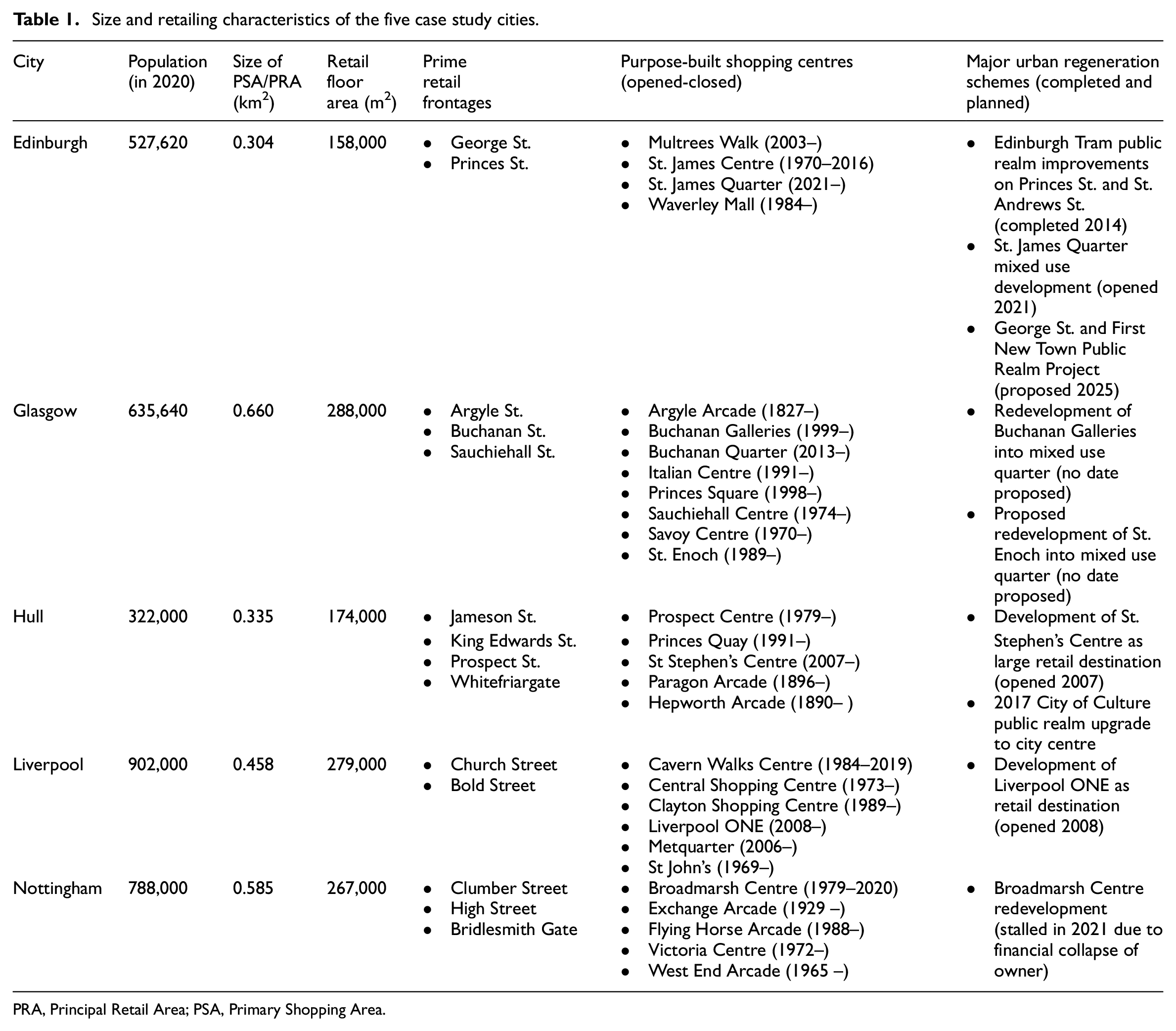
PRA, Principal Retail Area; PSA, Primary Shopping Area.
From a policy and regulatory perspective, England and Scotland have similar but distinct planning systems because planning is a ‘devolved’ responsibility in the UK. The most important difference is that the system of classifying land and property uses in England was overhauled in 2020 while in Scotland it remained unchanged. This means that under The Town and Country Planning (Use Classes) (Amendment) England Regulations 2020 many land and property use changes in the retail and commercial sectors no longer require planning permission (e.g. converting a bank into a coffee shop), whereas in Scotland they do.
To ensure consistent spatial delimitation across the sample of five cities, both the quantitative and qualitative phases of the research focused solely on the central ‘high street’ area of each city where retail clusters (see Figure 1). In England this is known as the ‘primary shopping area’ (PSA), while in Scotland it is the ‘principal retail area’ (PRA). These policy-defined areas include both traditional unplanned retail clusters as well as purpose-built shopping centres. In the three English cities and Edinburgh, BIDs also overlap with the PSA/PRA. 1 Glasgow is the only case study city without a city centre BID, although it does have a City Centre Retail Association with a broadly similar mandate.
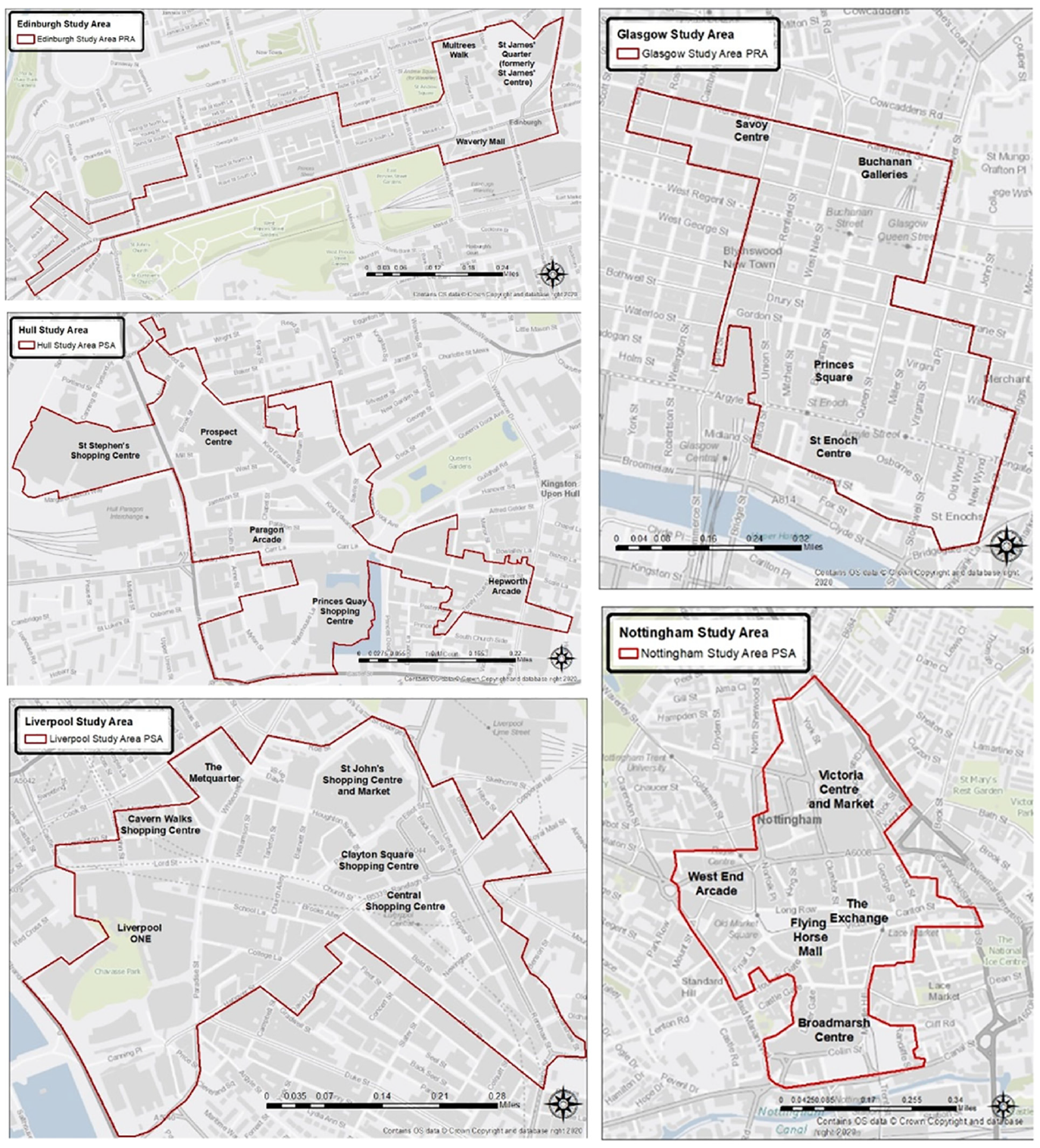
Central study areas of the five UK cities.
The quantitative phase (Phase 1) of the research involved the creation of a spatial stock database for each city to enable broad occupier and use trends to be identified over time. To build the databases we collected the Non-Domestic Rating Valuation List (England) and the Valuation Roll (Scotland) for each city centre. These provide an approximately 5-yearly snapshot of all commercial property units eligible for local taxation, allowing us to extract key data points between 2000 and 2017 in the Scottish cities and between 2010 and 2017 in the English cities. To address the gap in the English data, and to provide further information on ownership and vacancy for all the cities, the data were additionally linked to other administrative and commercial datasets. The data linking process is explained in the Online Supplemental Material accompanying this paper. Categorisation of different uses was needed, and our classification enables identification of the retail, leisure and entertainment sectors that form the focus of Pine and Gilmour’s analysis of the experience economy, with 11 broad non-domestic use categories. Furthermore, and reflecting finer distinctions between uses, 68 sub-categories were identified to enable deeper analysis of property types, uses and businesses that were identified as important in the literature (see Table SM1 in the Online Supplemental Material). The classification provides comprehensive spatio-temporal coverage and, as such, enables us to chart the evolution of the experience economy.
The qualitative phase (Phase 2) comprised a semi-structured interview study, supported by built environment observations, to explain and contextualise the trends identified in the quantitative phase and reveal deeper insights into experience economy uses. We conducted two series of interviews in the five cities. The first had a broad focus on city centre management, drawing on the ‘totality of the system’ (Warnaby, 2009: 108), while the second focused on two or three experience economy exemplars within each case study – what Yin (1989) calls ‘sub-units of analysis’.
The exemplars were initially identified from our Phase 1 database and their suitability was then cross-checked using an internet search of property and property news websites and by observations. The observations were recorded using fieldnotes and supporting photographs. To ensure that experience economy uses were understood ‘in-the-round’, purposive sampling was used to recruit participants that were variously involved at a senior level in design, ownership, operation and regulatory oversight. Contact details were identified from the websites of property companies, architectural practices, retailers, local authorities and chambers of commerce, and participants were recruited via email or telephone.
We conducted 70 semi-structured interviews with 75 participants. On average we conducted 1–2 interviews on broad city centre management and 3–4 per exemplar. Approximately half of the interviews were conducted in 2019 and early 2020 before the COVID-19 pandemic. After a year’s hiatus, the remaining interviews were completed to fill data gaps. A mixture of in-person, online face-to-face, and telephone interviews were conducted, and the interviews lasted approximately one hour. The semi-structured questions addressed both general trends and, for the exemplars, specifics about the design and operation of experience economy uses.
The interviews were professionally transcribed and each transcript was checked for accuracy. The data were anonymised, coded and interrogated using abductive thematic analysis that focused on the findings in Phase 1, namely experience economy trends and the nature of experience economy uses, as well as the wider relationship of commercial uses to the public realm and commonalities and difference across the cities. Independent coding was undertaken by two researchers who then compared their results to enhance the reliability of the data. When we refer to the interview transcripts, we follow the convention ‘Local Authority 1 Edinburgh, Pre-C19’, ‘Retailer 1 Glasgow Post-C19’, etc. This protects anonymity while also providing a sense of our participants’ expertise and, for the purpose of context, identifies the pre- or post-COVID-19 (‘C19’) status.
Results and findings
The results and findings address our aim of uncovering how the experience economy has evolved in UK city centres. We first outline the trends identified from our city databases, before using our interview and observation data to explore how these trends have manifested in the built environment.
Our quantitative results indicate that property use in the five city centres changed significantly between 2000 and 2017 (see Table 2). Notably, the number of vacant properties in all five centres increased. The steepest rise occurred in Hull, where the increase exceeded 850% (27–258). Glasgow had the smallest rise, although vacancies still went up by 125% (286–678). Analysis of the comparison shops sub-categories in our databases (see Table SM1 in the Online Supplemental Material) also showed that each city lost at least one major department store.
Change of use in the five city centres.
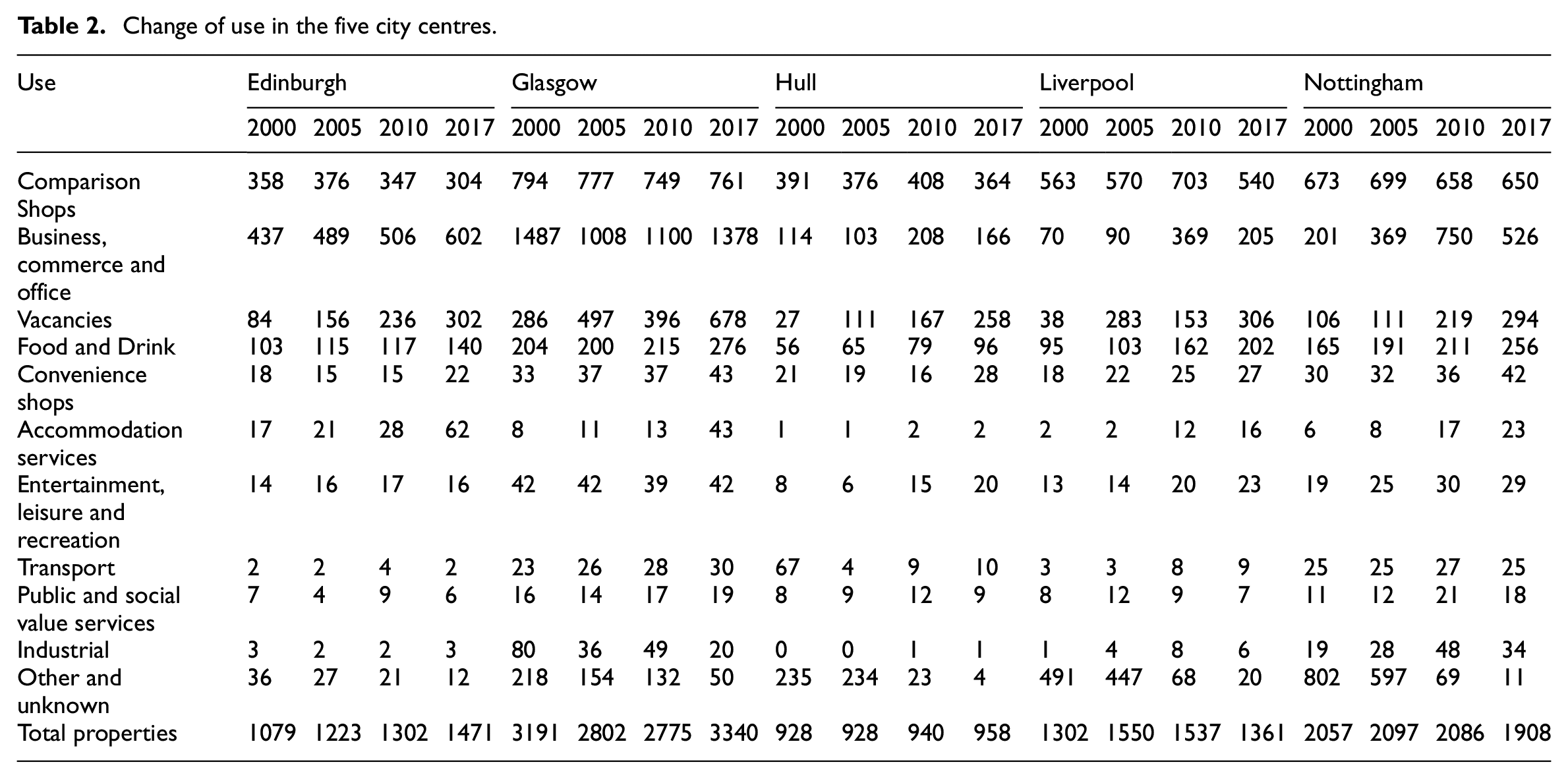
The data recorded an increase in some of the categories of uses associated with the experience economy. This was clearest in the food and drink category, where the number of outlets increased significantly between 2000 and 2017 in all five city centres. Detailed analysis of the property use sub-categories (see Table SM1 in the Online Supplemental Material) revealed that this growth was driven by national and international coffee shop brands, like Costa, Café Nero and Starbucks, which fit Pine and Gilmore’s (2019) definition of quintessential experience, economy outlets. The number of UK chain restaurants also increased. This included brands like Pizza Express and Zizzi that provide a sensory-rich Italian dining experience, and the hamburger joint Five Guys, which lands the consumer in an All-American fast food environment. Between 2000 and 2017, the food and drink sector increased by the largest amount in Liverpool where there was a 330% (10–43) increase in the number of cafes/coffee shops. Glasgow witnessed the smallest rise yet still saw an 83% (24–44) increase.
A rise in the number of entertainment, leisure and recreation uses was also recorded, but only in the three English cities. In Hull the number increased by 150% (8 –20), in Liverpool by 77% (13–23) and in Nottingham by 53% (19–29). Furthermore, in the comparison shop category, the number of health and beauty services rose from between 33% (21–28) in Edinburgh and 95% (20–39) in Hull, with the data showing that many are owned by independent businesses.
While some clear trends were identified, the databases cannot capture all the changes that have taken place. This includes the redesign of existing comparison retail stores, the opening of new experience-orientated shops that did not require a change of use (even harder to capture since the 2020 amendment to Use Classes in England), as well as wider experience-orientated changes to the design of purpose-built shopping centres and the public realm. The data also pre-date changes precipitated by the pandemic.
Our qualitative interview and direct observation data allowed us to address these gaps and offer additional evidence on: (1) the use and diversity of in-store experiences; (2) the adaptation of purpose-built shopping centres and vacant department stores – both akin to Booms and Bitner’s (1981)‘servicescapes’ concept; and (3) via the redesign and changing use of the public realm to support a better visitor experience – a process reflecting the tenets of Warnaby and Davies’‘survuction model’ (1997). We discuss these in turn below.
‘In store’ commercial experiences
Interview participants described how landlords increasingly encourage their retail tenants to focus on creating in-store experiences (Estate Director 1, Liverpool, Post-C19) that have a ‘strong resonance with their online offer’ (Property Agent 2, Glasgow, Post-C19). COVID-19 brought this approach into sharper focus because consumers became more confident about shopping online (Estate Director 1, Liverpool, Post-C19). This forced retailers to recognise a pre-pandemic trend: that a trip to the high street was evolving from being a ‘need’ to a ‘leisure pursuit’ (Property Professional 13, Nottingham, Post-C19) meaning consumers have become more discerning about what they expect from a retail store and now look for ‘something different’ (Asset Manager 5, Hull, Post-C19).
Pivoting towards customer experience means some retailers have reduced the number of staff that work solely at the point of sale. Following the precepts of the ‘servicescape’ model (Booms and Bitner, 1981), this has allowed them to deploy more sales agents on the shop floor where they can engage easily with customers on a one-to-one basis and, in some cases, complete sales transactions on portable chip and pin devices or smart phones and service online orders (Asset Manager 2, Glasgow, Pre-C19; Property Manager 2, Glasgow, Pre-C19).
One such example we observed was the UK brand Hotel Chocolat, which has locations in all but one of the five cities. Their shops offer multiple layers of sensory experience, including: tasting samples; in-store cafés in some branches; and opportunities to visit the store ‘after hours’ for hosted events. We also observed further examples such as the Belong Gaming Arena in Hull’s Prospect Centre; a barber shop in a Kiehl’s skin care store on Buchanan Street, Glasgow; and perfume making events in a Jo Malone health and beauty store on George Street, Edinburgh.
Technology underpins transformations of in-store experiences and some of the more innovative retailers have adopted a hybrid ‘omnichannel’ approach that seamlessly combines a physical store presence with a sophisticated online experience (Carmona, 2022). In our sample this ranged from robotic click-and-collect systems which we observed at the fashion retailer Zara at its Buchanan Street store in Glasgow (Property Professional, Glasgow, Pre-C19), to more immersive technology-oriented in-store experiences, such as those offered by American brands Peloton, which sells exercise equipment and online work out content, and Tesla, the electric car manufacturer. Both have opened city centre showrooms – in Glasgow and Edinburgh respectively – that allow potential purchasers to touch, feel and engage with their products.
While some of the biggest changes to ‘in store’ experiences have been driven by chain retailers, the growing number of vacant properties in city centres has led to a fall in rents and allowed independent retailers and service providers to lease city centre space they might otherwise have been unable to afford (Property Professional 11, Liverpool, Post-C19; Asset Manager 5, Hull, Post-C19). This occurred in the Paragon Arcade in Hull, operated by Allenby Commercial, and Flying Horse Walk in Nottingham, operated by Nottingham City Council. Both arcades contain small traditional units, marketed to local independent businesses, including a coffee house called 200 Degrees Coffee in Flying Horse Walk that also houses a Barista School. Despite the pandemic, the occupancy rate in both arcades has remained high.
Independent retailers often place a strong emphasis on ‘uniqueness’ and individuality, both in terms of their products and the spaces in which they are curated and displayed (Hracs and Jansson, 2020; Leslie et al., 2015). Interest from independents in city centre space has thus presented landlords with an opportunity to let ‘quirky’ properties (Asset Manager 2, Glasgow, Pre-C19) because they enhance the way independent brands are perceived and experienced. However, despite the success of many independents in recent years, some have struggled during the pandemic. An asset manager we interviewed in Liverpool noted this was particularly the case for cafes/coffee shops and hairdressers, which were very vulnerable to government ‘work from home’ mandates (Asset Manager 4, Liverpool, Post-C19).
Experience-orientated adaptation in shopping centres and department stores
The retraction of retail from city centres has proven especially difficult for shopping centre and department store operators, both of which have experienced rising vacancies. At the most extreme end of the scale in our sample the Princes Quay shopping centre in Hull saw vacancies increase from 4.1% to 45.6%.
Creating an experience and ensuring that a shopping centre is a ‘destination’ for shoppers has been the modus operandi of many shopping centres for decades (Carmona, 2022). However, the dramatic vacancy rates have led operators to look for new and innovative ways to fill empty retail units. Many have turned to familiar experience-orientated leisure and entertainment businesses, including bars, restaurants and cinemas, but others have also looked to some of the newer, participatory uses that Pine and Gilmore (2019) point to, such as indoor mini golf, darts and even axe-throwing – what one landlord in Glasgow termed ‘competitive socialising’ (Landlord 1, Glasgow, Pre-C19) – to fill the gap.
These broad trends are illustrated well in Liverpool ONE where, in 2017, 38% of all the occupied properties in the shopping centre were leased by non-retail ‘experience’ businesses, including a Peaky Blinders-themed Escape Room, crazy golf, virtual reality golf and a ballroom-themed bar (Estate Director 1, Liverpool, Post-C19). Innovative uses are also emerging in some former department stores. For example, we observed that the whisky brand Johnnie Walker opened a sumptuous shop, bar and private event space in a former House of Fraser department store building on Edinburgh’s Princes Street in 2021, and an independently-operated food hall called Hammond’s of Hull opened in a former House of Fraser on Hull’s Jameson Street in December 2021.
Glasgow’s St. Enoch shopping centre offers a particularly instructive case of how the plans and priorities for shopping centres and department stores have evolved. Its vacancy rate steadily increased from full occupancy in 2000 to 20% in 2005. Major shocks have included the closure of the British Home Stores department store in 2016, the downsizing of Hamley’s toy shop in 2020 and the closure of Debenhams, which adjoins the shopping centre, in 2021. In response, St. Enoch has undergone what an architect we interviewed called a ‘sequence of projects’ to make the ‘whole experience more attractive and comfortable’ (Architect 2, Glasgow, post-C19). While these projects initially focused on improving the quality of St. Enoch’s food-court and circulation areas, attention has since shifted to finding new uses for larger vacant retail units, toward the less successful eastern end, where British Home Stores had been the principal retail anchor (Consultant 1, Glasgow, post-C19). In 2021, a VUE multiplex cinema opened and other experience-orientated ventures are planned, including a ‘Boom: Battle Bar’, a licenced venue incorporating the aforementioned 9-hole crazy golf course and axe throwing experience. For one of the property agents we interviewed, St. Enoch is nevertheless an example of the significant and on-going challenges that shopping centre operators will face as the retail landscape continues to change: ‘[t]he likes of St Enoch and other centres are definitely trying to repurpose this retail space and find other uses for it but it was never designed for that so it’s very expensive to do that’ (Property Agent 2, Glasgow, Post-C19).
Designing the public realm to support a better visitor experience
All five local authorities in our sample have taken advantage of the lottery, ‘City Deal’, ‘Levelling Up’ and other government funding and invested in public realm improvements to improve the visitor experience. This approach, which aligns with Warnaby’s (2009: 108) notion of managing experiences across the ‘totality of the system’, also represents a marked departure from the large retail-led schemes of the 2000s where public and private investment flowed into the creation of purpose-built regional shopping centres in city centres.
By way of example, Glasgow City Council’s ‘Avenues’ project, which launched in 2014, seeks to create a ‘more “people-friendly”, more attractive, greener, more sustainable’ and ‘more economically competitive’ city centre (Glasgow City Council, 2021: 1), while in Liverpool, plans for a new public realm strategy were launched in late 2019 with similar ambitions (Liverpool BID Company, 2019). Much the same rationale underpins plans for Edinburgh’s George Street which intend to improve active travel connections for cyclists and other non-motorised modes of travel (City of Edinburgh Council, 2021) while also reinforcing the iconic street’s sense of place.
In Nottingham, the local authority has focused on improving the challenging connection between the railway station and the city centre caused, in large part, by the problematic design of the 1970s shopping centre, the Broadmarsh Centre. A key part of this effort was an improvement plan for Carrington Street which provides one of the main pedestrian links between the railway station and the Broadmarsh Centre. Since the plan, the vacancy rates on Carrington Street have significantly reduced with new offices and cafes moving into the regenerated buildings (Heritage Practitioner 1, Nottingham, Post-C19).
Plans for the redevelopment of the Broadmarsh Centre itself were approved in 2015 and demolition and redevelopment work began soon thereafter. However, the centre’s owner, Intu, went into administration in 2020, putting the project in jeopardy and creating a perilous situation for struggling retailers located nearby (Property Professional 8, Nottingham, Post-C19). Nottingham City Council has subsequently taken over the project and conducted a public consultation in 2020 which clearly indicated that local residents wanted the centre demolished rather than redeveloped and a ‘greener and more open space’ created in its place (Nottingham City Council, 2021: 4). The local authority has since embarked on a demolition programme and produced a major new masterplan guided by the architect Thomas Heatherwick. It incorporates elements of the Broadmarsh Centre in a partially demolished state set within a new multifunctional public space as part of wider proposals that prioritise leisure and entertainment over retail (Butler, 2021).
In our sample, the city with the most comprehensive public realm plan was Hull. Its successful 2017 UK City of Culture bid opened up access to public money for regeneration, including a Public Realm Strategy that was delivered in the years leading up to the City of Culture festival (Hull City Council, 2014). Major improvements were made to the public spaces in front of Hull Train Station, Queen Victoria Square, Trinity Square and the waterside Fruit Market, as well as the principal retail streets that connect these spaces.
The regeneration of the public realm has also created new space for temporary and ‘pop up’ uses, both of which have proven popular with local authorities and city centre stakeholder organisations (e.g. BIDs) looking to enhance the experience of visiting city centres (Martin et al., 2019; Smith, 2015). The Fruit Market in Hull, for example, stages ‘pop up events and exhibitions’ and ‘act as a magnet for people to sort of dwell on the street, maybe have a coffee, maybe go into the forum and have a look around the shops there, and buy things’ (Surveyor, Hull, Pre-C19). Notably, temporary Christmas Markets have become major seasonal events. A community stakeholder we interviewed in Edinburgh explained, however, that the Christmas Market undoubtedly draws visitors into the city centre, but not necessarily to other fixed retail stores or leisure and entertainment venues (Community Stakeholder 1, Edinburgh, Pre-C19). The sometimes-negative impact of temporary events in Edinburgh, including the famous Fringe Festival every August, mean that the aforementioned plans for George Street include programmable space for temporary events. This will allow fixed retail stores and temporary events to operate alongside one another.
Conclusion
Mumford et al. (2021: 1496) argue that ‘outdated interpretations of high streets’ mean that planning and design issues in town and city centres are overshadowed by concerns about how to rescue the retail sector. We have presented evidence on the ways this is changing. While comparison retailing is the dominant property use in the cities we examined, the use of land and property has diversified because retailers, operators and city centre managers have become more flexible about the use of retail space and the public realm.
This has enabled the experience economy to gain a foothold in UK city centres in various ways, starting with the conversion of vacant retail space into coffee shops, cafes and restaurants that encourage shoppers to dwell for longer in city centres, before widening to include the type of memorable and sensory-rich leisure and entertainment uses that most closely align with Pine and Gilmore’s original definition of the experience economy (1998). These uses have filled gaps left by department stores and other retailers and have helped to limit the negative visual impact of void units on the wider city centre sense of place. Independent retailers and service providers have also benefitted from the retreat of comparison retail in city centres, allowing them to rent space that might otherwise have been unaffordable. Independents fulfil Pine and Gilmore’s (2013) notion of ‘mass customisation’ where the individual consumer is served efficiently, but ‘authentically’ in a ‘servicescape’ (Booms and Bitner, 1981) that effectively supports the operator’s brand and enriches the sense of place. Within stores, retailers are making the in-store experience more interactive and exploiting technological advances that blur the boundaries between the physical and virtual realm, offering consumers the chance to immerse themselves in a multi-sensory environment. The rapid increase of e-retailing, especially in the wake of COVID-19, has also led local authorities to design and develop public realm schemes that create the conditions for social experiences that extend beyond shopping.
With some notable exceptions (e.g. Lorentzen, 2009), the existing literature has tended to focus on experience economy uses in isolation (Pine and Gilmore, 1999, 2019; Sachdeva and Goel, 2015). Conceptualising the experience economy as an interconnected phenomenon in city centres, as we have done in this paper, reveals its multi-dimensional character. First, individual businesses are becoming more experience-orientated in the way they market their products and services in-store and increasingly look for ways to create visual drama and generate a strong emotional response from consumers. Second, more diverse land and property uses work together to make the experience of visiting the city centre more appealing and interconnected. And third, drawing these elements together, is the ‘servuction’– the visible and invisible factors that influence the process (and quality) of delivering a positive cognitive and emotional experience that cannot be recreated online (Warnaby and Davies, 1997).
The multidimensional character of the city centre experience economy suggests a greater resilience than might be assumed from the predictions about the high street’s decline, but ensuring that the interconnections between the various layers of experience are maximised arguably demands a degree of management by local authorities and coordination with other stakeholder organisations, such as BIDs. At the same time, city centre managers need to be cognisant to the equal access challenges posed by temporary commercial events and the potential overt commercialisation of the public realm which this can encourage (Moore-Milroy, 2009).
As with any study, ours has limitations. First, our sample examined large UK cities that draw consumers from a regional base. As a result, it does not necessarily reflect what has happened in smaller towns and cities where the impacts of out-of-town shopping, e-retailing and the COVID-19 pandemic are likely to be different. Second, our study was conducted before and during the early stages of the COVID-19 pandemic and before inflation started to impact the global economy in the early 2020s. With this in mind, we cannot argue with much certainty that the experience economy uses we identified are necessarily here to stay, nor can we reasonably predict the extent to which e-retailing will continue to draw consumers a way from physical retailing in the future. What we can say, however, is that the composition of the city centre experience economy will inevitably evolve as tastes change and new innovations emerge. As Pine and Gilmore (2013: 39) argue, experiences are time-limited and age quickly, leading people to voice the familiar phrase ‘Been there, done that’.
It is nevertheless our contention that if city centres are to remain competitive, local authorities and commercial stakeholders alike must adopt a collaborative and coordinated approach to city centre management, reflective of the multi-dimensional and multi-sensory experience economy, and the crucial role that the public realm plays in ‘connecting the dots’. This remains an arena ripe for further research. Ultimately, the more connections that are made across the multi-dimensional experience economy landscape in city centres, the more emotionally invested visitors to city centres are likely to become. City centre managers must therefore ensure that land and property uses are balanced to ensure that the cognitive experience for all city centre visitors is maximised. In short, the more there is for people to do, the more likely it is that city centres can adapt to the new challenges they will undoubtedly face.
Supplemental Material
sj-docx-1-usj-10.1177_00420980221143043 – Supplemental material for The experience economy in UK city centres: A multidimensional and interconnected response to the ‘death of the high street’?
Supplemental material, sj-docx-1-usj-10.1177_00420980221143043 for The experience economy in UK city centres: A multidimensional and interconnected response to the ‘death of the high street’? by James T White, Allison Orr, Cath Jackson, James Hickie and Robert Richardson in Urban Studies
Footnotes
Authors’ note
This paper was written by James T White. James Hickie helped develop the theoretical framework, worked on the initial draft of the paper and collected and analysed the primary qualitative data. Allison Orr conducted primary analysis of the quantitative data and supported the writing process. Cath Jackson helped develop the theoretical framework and edited drafts of the paper. Robert Richardson collected and analysed the primary qualitative data.
Declaration of conflicting interests
The author(s) declared no potential conflicts of interest with respect to the research, authorship, and/or publication of this article.
Funding
The author(s) disclosed receipt of the following financial support for the research, authorship, and/or publication of this article: Economic and Social Research Council, Grant No. ES/R005117/1.

Supplemental material
Supplemental material for this article is available online.
Notes
References
Supplementary Material
Please find the following supplemental material available below.
For Open Access articles published under a Creative Commons License, all supplemental material carries the same license as the article it is associated with.
For non-Open Access articles published, all supplemental material carries a non-exclusive license, and permission requests for re-use of supplemental material or any part of supplemental material shall be sent directly to the copyright owner as specified in the copyright notice associated with the article.
