




Abstract
The article analyses heritage conservation and urban upgrading in Cuenca, Ecuador, in order to reflect on global inequality and rights to the city at the crossroads of transnational lifestyle mobilities and the globalisation of real estate markets. Processes of gentrification in Cuenca reproduce colonial social relations and marginalise the popular economic activities of informal vendors. Under the auspices of UNESCO World Heritage designation, the Inter-American Development Bank and successive municipal governments have sought to increase property values in the historic El Centro neighbourhood. Rather than relying on a local middle-class return to the city, heritage urban upgrading in Cuenca is dependent on higher-income global middle classes attracted to the city’s historic urbanism. The subsequent higher-income appropriation of urban improvements takes the form of dispossession of use and exchange values of lower-income groups, especially of informal vendors.
Cuenca, Ecuador, a UNESCO World Heritage Site since 1999, has drawn perhaps as many as 10,000 North American lifestyle migrants to the city since the 2008 economic crisis. While this number may fluctuate – especially given recent instability due to IMF-imposed austerity measures widely opposed by students, unions and indigenous groups – lifestyle migrants have helped change the city in important ways. These changes interpolate current conceptualisations of ‘planetary urbanism’ (Lees et al., 2016). Cuenca has become a destination due to the way international lifestyle marketers have been able to project its heritage urbanism to an aspirational class of American retirees, whose ageing process is marked by desires to live leisure-oriented urban lifestyles in nostalgic city environments (Hayes, 2018). One American migrant I spoke with, then in his late 60s, said, ‘[Cuenca] reminded me of the Brooklyn that I grew up in, of the 1950s, with the tiendas, the small neighbourhoods, the small churches in the neighbourhoods, and the friendliness of the people.’ North Americans often evoke this idyll of 1950s urbanism to describe Cuenca (Hayes, 2018: 72–76), and while it represents North American cultural ideals transported to a foreign space with a different history, its material impact is nonetheless significant.
This article looks at how heritage conservation and historic urban commodification in Cuenca, Ecuador, have sought to attract higher-income global middle classes, enabling a more intensive extraction of land rents in parts of the city. In the process, however, it has led to the displacement of lower-income uses of the centre, especially those of informal retail vendors. Informal vendors such as the ones at plaza San Francisco at the heart of the historic centre are being harassed and removed, as local real estate developers and transnational speculators make local housing stock available to higher-income demand, especially American and Canadian retirees looking for lower-cost places to live. The potential to increase rent gaps in the historic centre and exploit new possibilities for higher profits from foreign buyers is a relatively new development in most Latin American urban centres, but one with growing impact on the uses of public space and the meaning of historic urban areas. The globalisation of Cuenca’s real estate in recent years follows the trajectory of a ‘transnational gentrification’, that is, the connection of an increasingly mobile and aspirational global middle class with local projects of urban ‘revitalisation’ in order to intensify ground rent extraction (Kurzac-Souali, 2013; Sigler and Wachsmuth, 2016: 708).
The economic possibilities of relocating higher-income global demand to lower-cost cities are not lost on international institutions such as the Inter-American Development Bank and libertarian lifestyle marketers such as Forbes and International Living. Their global designs interact with local processes in Cuenca, providing a unique window into the effects of unequal globalisation in intermediate-sized cities. As other scholars have noted, smaller, even ‘ordinary’ cities of the Global South offer important standpoints for theorising urban processes and for rethinking conceptualisations of gentrification (Parnell and Robinson, 2012; Shin, 2018). Cuenca’s integration into global networks of leisure mobility and heritage urbanism conjures its history of colonial caste hierarchies, urban–rural divisions, and dispossession of informal labour – particularities that give local form to global processes of accumulation.
The work presented here is the product of 39 weeks of ethnographic study in Cuenca over a 7-year period. While my work began focusing on North American lifestyle migrants (most of whom were retirees), I started paying closer attention to the urban processes affecting lower-income retail spaces in 2015. Retail displacement is often marginal to critical urban studies (González, 2016; Lacarrieu, 2016). However, greater attention is warranted because of both the importance and the numerical prevalence of informal vending in Latin America (Bromley and Mackie, 2009; Janoschka and Sequera, 2016; Steel, 2012), where uses of public space are intertwined with informal, commercial activities that cannot be easily detached from residential dwelling (Kingman and Bedón, 2018). Moreover, the spaces of popular markets where informal vendors congregate have meanings that extend beyond commercial uses. As Blomley (2008: 318) suggests, retail spaces can be understood as a ‘commons’, to which marginalised groups lay claim. The argument of the article follows in three sections. The first explores the emergence of Cuenca as a lifestyle destination and situates the rehabilitation of its historic area within the relevant literature on Latin American heritage gentrification. The second explores how UNESCO’s World Heritage status promotes an elite-driven form of urban revitalisation. This section outlines how Cuenca’s heritage process reproduces the coloniality of historic urbanism and marginalises lower-income and informal uses of public space. 1 The third section explores the intensification of urban ground rent extraction which lifestyle migrants enable. Lifestyle migrants bring significant resources to bear in Cuenca and participate in gentrifying processes aligned with elite accumulation strategies.
Cuenca, Ecuador: An emerging Leisure City
Cuenca is a city of 330,000 people (according to the 2010 census; current estimates are about 400,000) located at 2500 m in the southern Ecuadorian sierra. Cuenca is Ecuador’s third largest city and, while it is significantly smaller than Quito and Guayaquil, it has seen substantial urban growth since the 1950s. In addition to being an important weaving town in the 18th century, supplying the Spanish colony of Peru with textiles, it became the centre of the panama hat trade in the second half of the 19th century, which enabled the accumulation of important commercial fortunes until the industry’s demise after the Second World War (Cordero et al., 1989). The fortunes of landed and commercial elites were, up to that point, primarily expressed in the urban centre, concentrated in a few blocks around Parque Calderón, the city’s main plaza. These fortunes were built on the exploitation of a rural and racialised labour force.
As tastes changed in the 1950s, elite social classes sought out new suburbs outside the historic centre (Hermida et al., 2015; Lowder, 1990). The agrarian reforms of 1964 and 1973 reduced the viability of small-scale agriculture, prompting rapid urbanisation, as rural workers moved to the city, occupied the historic centre and established their own outlying suburbs (Hermida et al., 2015; Kyle, 2000: 61–64; Lowder, 1990; Peek, 1980). As Mónica Mancero Acosta points out, the popular, rural appropriation of historic urban spaces provoked a reaction from Cuenca’s elite social classes, who began mobilising to prevent what they saw as the destruction of traditional architecture, much of it representative of the heyday of the panama hat industry (see also Klaufus, 2009: 61–66, 72–75; Mancero Acosta, 2012). Pauta Calle (2019) points out that they initially promoted commercial concentration in the historic centre, increasing rents, but this merely led to worse residential conditions. Faced with a rapidly increasing urban population and uncontrolled growth, the municipal government established a planning department in the mid-1970s, and an urban plan in 1981. One of its ordinances prohibited the demolition of historic properties in a rapidly declining urban centre, where low-income workers had clustered in cramped housing conditions (Pauta Calle, 2019: 121). While initially these regulations led to a decline in investment (and further deterioration of housing stock), local commercial and architectural elites led a ‘reconquest’ of the historic centre with an investment boom over the decade 1986–1995, which displaced lower-income residents. This renovation boom was the foundation of a successful application for inclusion on UNESCO’s World Heritage list in 1999, recognising Cuenca’s ‘remarkable example of a planned inland Spanish town’ in colonial America. 2 Though an intermediate-sized city, it has become southern Ecuador’s most important destination for tourism and lifestyle migration – the permanent residential resettlement of leisure-oriented migrants from high-income countries. 3 The arrival of several thousand North American migrants marks a new phase in Cuenca’s urban history, as the historic centre is repositioned for higher-income uses.
Cuenca’s urbanisation raises important questions about the commodification of historic urban areas, heritage-led gentrification and its impact on lower-income groups, whose uses of public spaces in Latin American cities are increasingly problematised by local authorities. These lower-income, popular uses of public space clash with elite nostalgia for old-style European urban tastes, which are increasingly marketed to prospective second-home owners, residential tourists and lifestyle migrants over the internet. Urban scholars have attended to conservation-led gentrification in Latin American centres (Borsdorf and Hidalgo, 2013; Carrión, 2005; Delgadillo, 2016; Hidalgo et al., 2013; Kingman and Bedón, 2018; Manrique Gómez, 2013). Other studies have emphasised how displacement of lower-income groups reproduces the coloniality of regimes of accumulation by dispossession (González, 2016; Janoschka and Sequera, 2016; Kingman, 2004; Lacarrieu, 2016; López-Morales, 2013). There is also wide acknowledgement of how conservation is accompanied by municipal policies that displace informal workers, especially street vendors, in ways that reproduce racist caste hierarchies (Bromley and Mackie, 2009; Steel, 2012; Swanson, 2007). As Hidalgo et al. (2013) point out, UNESCO World Heritage status may be an important stimulus to urban economies, but they are insufficient to provide livelihoods for all residents, and often compound existing spatial injustices (see also Kingman and Bedón, 2018). This is especially the case where lower-income groups are excluded from urban improvements brought about by public reclamation and conservation projects (cf. Delgadillo, 2016).
In Cuenca, conservation efforts reflect the urban nostalgia of landowning elites, who seek to leverage the apparent uniqueness of the city to promote local real estate to higher-income foreign investors and renters – groups often incidental to studies of heritage-led gentrification in Latin America. The internet and the proliferation of low-cost airfares have brought previously remote cities to the forefront of American tourist imaginaries. Cuenca’s elite social classes have sought to position the city within international tourism networks to support the reclamation of heritage properties from the informal working classes (Cabrera-Jara, 2019; Mancero Acosta, 2012). In a region often lacking middle-income groups capable of sustaining sufficiently high returns on investment in urban renovations (Betancur, 2014; Carrión, 2004; Janoschka and Sequera, 2016), cities such as Cuenca are rescaling their real estate, focusing less on local demand and catering instead to higher-income tastes from abroad (Sigler and Wachsmuth, 2016; van Noorloos and Steel, 2016). Given the city’s large informal workforce (perhaps one-third of workers are in the informal sector, see Inter-American Development Bank (IDB), 2014: 12), there is limited private domestic demand at price levels that would support renovations of historic properties for residential purposes.
Cuenca is at the forefront of a growing list of intermediate-sized cities whose landowning classes have prioritised developing competitive tourism industries as a means of increasing revenues generated from urban space. The city is part of the IDB’s Emerging and Sustainable Cities Initiative, which seeks to enhance urban planning capacity in intermediate-sized Latin American cities (IDB, 2016). The Initiative’s work in Cuenca pays special attention to conservation in the historic centre (IIDB, 2014). Since the 1990s, the IDB has backed attempts to conserve heritage urban areas in Latin America as a way to help promote urban density, while at the same time creating ‘sustainable’ bases for tourism industries (see Rojas, 1999). As van Noorloos and Steel (2016) point out, this commodification of heritage urbanism reflects neoliberal modes of urban governance, which seek to make the spaces of the city more competitive and attractive to transnational investment flows. The consequent urban conservation boom has opened new heritage processes in Latin American cities (Carrión, 2005; Durán, 2015), processes marked by struggles over the meaning of the past (Harvey, 2008; Smith, 2006).
Cuenca’s heritage conservation and the perceived value of its historic urbanism have also caught the attention of international lifestyle marketers, especially International Living, a libertarian publication promoting transnational relocation towards lower-cost locations for groups that want to reduce their involvement in paid labour markets (see Croucher, 2019). The publication’s focus on Cuenca has been especially popular with North American retirees, who often identify economic reasons as the main motivation for searching for destinations in Latin America (Hayes, 2018). A few identify themselves as ‘economic refugees’, a reference to the sense of financial precarity that pushed them to leave the USA. Given the growing insecurity of North American retirements and the culturally important trends towards active and successful ageing, the potential growth of this new type of economic migration to cities such as Cuenca may be considerable.
International place marketing has helped Cuenca’s municipal authorities project the city’s historic urbanism into more competitive international and higher-income tourism networks, a key goal of the city’s strategic tourism plan (Fundación Municipal Turismo para Cuenca, 2011). It has also helped promote local real estate abroad and opened new markets for local and international property investors. International Living’s writers frequently have real estate interests in the locations they write about and, thus, while the publication primarily focuses on introducing English-speaking middle-class audiences to the idea of high-end living in lower-cost countries, it also has close ties to local developers. It runs annual seminars informing potential lifestyle migrants (or ‘expats’) about how to buy and own real estate in destination countries. In Cuenca, many online community platforms – especially websites, newsletters and listserv posts – are run by former International Living authors or other investors who trade in Cuenca real estate, often in conjunction with local developers and landlords. They promote its historic centre as a low-cost cultural amenity to North American buyers, who are charmed by its ‘European-style’ urbanism (Hayes, 2018: 68–72). These online platforms promote the city as an urban cultural destination and champion ‘improvements’ to public space – a new light rail network and new urban parks, such as Parque Libertad (Liberty Park), a former juvenile detention site – as signs of the growing sophistication of Cuenca as a lifestyle destination.
The global demand for local real estate has further stimulated investment in urban improvements and site-specific conservation. The municipal government set up Fundación El Barranco in 2004 to provide technical assistance for the ‘creation and recovery of public space’ (Fundación El Barranco, 2017: 5). This arms-length public corporation now coordinates municipal interventions in plazas, squares, courtyards and streetscapes. It is one of the key proponents of traffic-calming in the historic centre, identified as an impediment to realising greater commercial and residential rents from historic properties. Cuenca’s growing planning capacity has helped the city expand its borrowing ability from national and international sources, including the IDB (IDB, 2016). For an intermediate city, these revitalisation projects amount to a major urban infrastructure project (see also Carrión, 2005), which includes major spending on light rail transit through the historic centre and renovation of several major plazas, buildings and streetscapes. 4
UNESCO and the struggle over heritage space
These urban projects often confront lower-income groups – especially informal vendors – with new regulation of public spaces. Reclaiming these spaces and removing or regulating marginalised workers and residents reflects historical inequalities that often follow a colonial pattern (Durán, 2015; Kingman and Goetschel, 2005; Salgado Gómez, 2008; Swanson, 2007). As scholars of Quito and Guayaquil have noted, heritage conservation in the Ecuadorian context has sought to ‘purify’ urban heritage from the supposedly sullying influences of lower-income groups, often of indigenous and rural origin (Bromley and Mackie, 2009; Burgos-Vigna, 2017; Kingman, 2004; Swanson, 2007). This section explores this historical exclusion of popular groups in Cuenca’s heritage process, notable for its continuity with historical modes of ‘accumulation by dispossession’ (Harvey, 2003). As ‘new assets’ (Rojas, 1999) in the heritage process, conservation of UNESCO’s ‘historic urban landscape’ risks supporting the class and caste project of urban elite landowners.
While UNESCO has sought to pay closer attention to the ‘layered meanings’ different groups have given to ‘historic urban landscapes’ (see Bandarin and Van Oers, 2012; Rey Pérez and Gónzalez, 2018; Rey Pérez et al., 2017; Taylor, 2016), thus far, these layerings are not articulated in terms of class struggle and colonial exploitation, integral to the creation of urban public space in the Americas. As a result, UNESCO has a limited ability to address many of the current political problems it purports to identify – including tourism gentrification, which valorises elite-owned real estate. Moreover, UNESCO heritage status is used by heritage elites in Cuenca to justify interventions that reproduce the coloniality of urban space – that is, the subordination of non-Spanish, non-white and non-elite uses of public space to a dominant, leisure-oriented focus of heritage spaces in the city.
As Latin American scholars have pointed out, the identification and designation of cultural heritage is an integral part of elite strategies of urban governance and redevelopment, often designed to ‘reclaim’ public spaces and distinguish between appropriate and inappropriate uses (Durán, 2015; Galvis, 2017; Hidalgo et al., 2013; Kingman, 2006). Conservation interventions in public plazas receive UNESCO approval for maintaining authentic characteristics of heritage assets, most often buildings and built areas. In Cuenca, as in other Latin American heritage cities, these assets evoke the wealth of elite groups, produced through the exploitation of rural and racialised workers (Palomeque, 1990). Indeed, the most characteristic properties in the historic centre are the product of fortunes accumulated through control of land and labour in the countryside. Cuenca’s landowners controlled large haciendas in Cañar, and in the nearby sugarcane valleys of Paute and Yungilla, where racialised workers were indentured on hacienda estates until well into the 1960s. Small landholders and tenants, for their part, were obliged to supplement subsistence agriculture as low-paid wage workers, especially in panama-hat weaving, which was very profitable for commercial elites in the late 19th and early 20th centuries (Kyle, 2000; Palomeque, 1990; Pribilsky, 2007: 51–53). The city’s French neo-classical façades are from this period and reflect the European-oriented tastes of landowning elites who spent time living in European capitals (Mancero Acosta, 2012).
Rural workers who migrated to Cuenca after the 1960s used historic properties for their own ends, often sharing them with other families to divide high rents (Pauta Calle, 2019). Their use of the city’s public space reflected their own traditions of coming into the city to supplement incomes through vending and to shop (Mancero Acosta, 2012; Weismantel, 2001). As Swanson (2007) pointed out, informal street vending is often an urban survival strategy of rural-to-urban migrants. As Ecuador has urbanised, many of these vendors succeeded in making their presence more permanent and less precarious. Vendors at plaza San Francisco built more permanent stalls and occupied much of the plaza, modernising their businesses to support urban lifestyles and ambitions of social mobility. Despite commercial traditions ensconced in the exploitative and unequal social relations of the Andes, these expressions of commercial endeavour and the uses informal vendors make of public space lack symbolic power within the heritage field.
The historic uses of plaza San Francisco illustrate how a top-down heritage process reproduces historic relations of caste and class in Cuenca. The plaza is located at the heart of the historic centre, just around the corner from the city’s main plaza, Parque Calderón. It is at the crossroads of several important pedestrian circulations, which go from Mercado 10 de Agosto, on Calle Larga, to the main square of Parque Calderón and the New Cathedral. Its southside is one of the busiest public transit routes into the city from outlying areas. It is, therefore, a busy space, filled with the noises, smells and sights of a bustling urban centre. For decades, it was the ‘mall of Cuenca’, the main commercial centre for low-cost, non-perishable goods, and remains today the site of informal vending stalls that cater to all Cuencanos but especially to lower-income groups and rural workers who come into the historic centre to shop. For 50 years, most of its central area was occupied by the improvised stalls, but its commercial tradition stretches back much further. In the 2010s, there were 134 informal vendors working there, selling affordable and practical mass-produced goods (Figure 1). In addition to its centrality in the commercial circuits of popular classes, plaza San Francisco brought together other informal activities, including women who sold herbs, healing salves, and who performed limpias or cleansing rituals. There were also the vendors of quail eggs who circulated nearby, and other traditional popular food items. It is the main location where informal day-labourers seek work, mulling around the plaza’s eastern edge, waiting for construction contractors or other employers to offer jobs. And there are also plenty of street vendors who are increasingly prohibited from accessing the busy pedestrian thoroughfare.
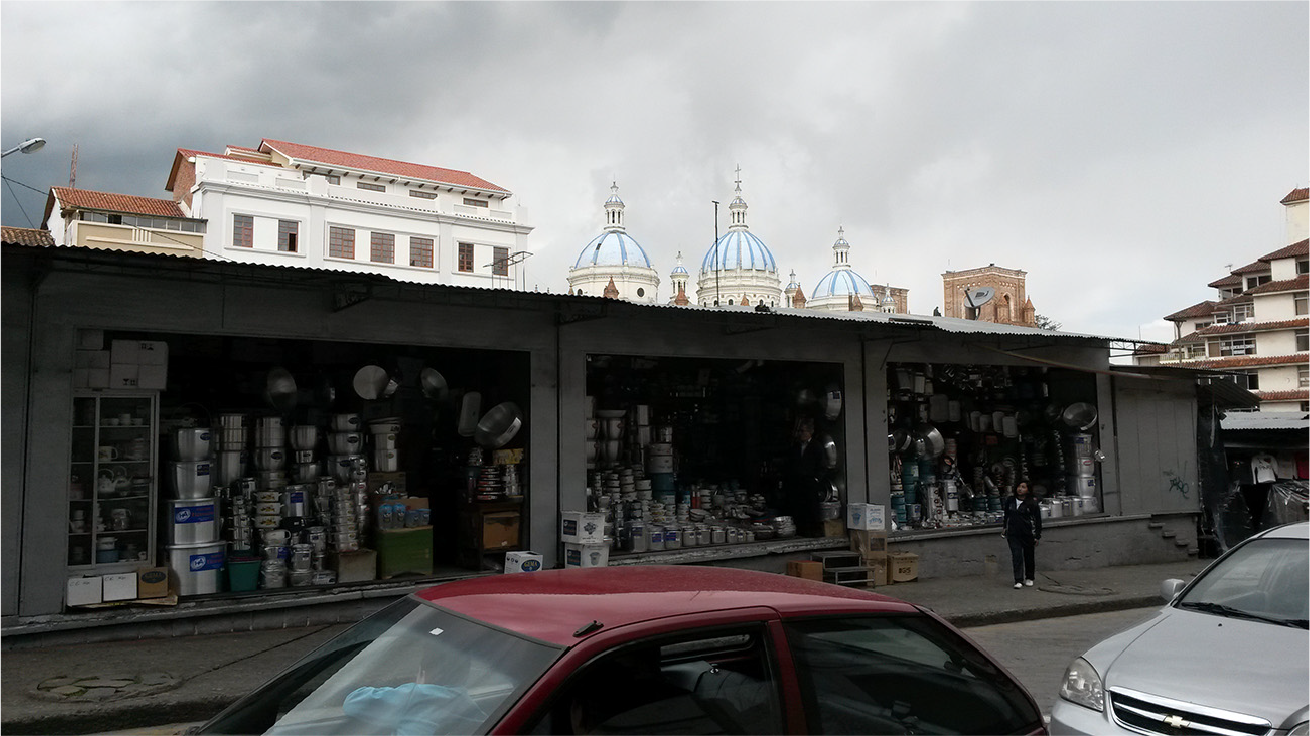
Plaza San Francisco, May 2015.
Owing to its centrality and the presence of building façades representative of the French neoclassical style, the plaza has been at the forefront of municipal conservation planning. The informally constructed settlement of vendors, however, was seen as an impediment to its ‘rehabilitation’. In 2006, planning began for the renovation of plaza San Francisco and another central market area, plaza Cívica, with funding from the IDB and the Banco de Desarrollo de Ecuador – the national development bank. One of the goals of these interventions was to improve the quality of life of lower-income residents around the two plazas (IDB, 2006: 7). However, as in other market-driven projects, improvements were to be accomplished by increasing ground rents in an area covering 680,000 m2 of the downtown, adding US$23.3 million to its value, an increase of 20–30%, which ‘provided strong justification’ for the project (IDB, 2006: 29). This intensified commodification of public space is in keeping with international financial institutions’ support for heritage-led tourism and urban revitalisation (Hawkins and Mann, 2007; Rojas, 1999). Of course, conservation interventions not only increase local rental incomes, but also get local urban spaces working more efficiently for international finance – a priority sure to be accentuated in light of the highly contested 2019 IMF loan package. The aims of increasing ground rents also conflict with the interests of lower-income vendors, whose businesses and incomes were not supported over the 18-month construction period, during which they were relocated off the square.
While renovations initially focused on removing the vendors altogether, they have managed to resist being completely removed, at least for now. Disagreements about the design project for plaza San Francisco within the architectural community under the mayoralty of Paul Granda (2009–2014) helped delay it for several years. So too did opposition from informal vendors who refused to leave the plaza without an agreement on their return, citing their constitutional right to work – a right secured for informal workers during the 2007 constitutional process led by progressive social movements. Their opposition and desire to remain compelled the city under mayor Marcelo Cabrera (2014–2019) to pursue a compromise that would improve the aesthetic of the square without permanently displacing the popular market. Yet, they also did not manage to fully secure their future in plaza San Francisco. A new municipal administration appears unbound to previous commitments and some municipal elites continue to see informal vendors as an eyesore, diminishing the square’s heritage value. The new square provides better sight lines to the New Cathedral’s domes (Figure 2), but it also leaves less space for only 96 of the original vendors, permanently displacing the other 38 who discovered their exclusion only in January 2019 as they were to move back to the plaza. In addition to reducing informal vendors’ imprint on the square, these changes potentially transform the meaning and use of the plaza, away from informal vending traditions and towards tourist and leisure uses. Spaces such as plaza San Francisco remain tied to rural–urban mobilities and are therefore important to marginalised groups as potential sites of urban incorporation or for short-term income generation as street vendors. Vendors are private commercial actors in public space, and municipal officials and other social classes challenged their commercial use of the plaza, presenting them as detrimental to the public as a whole (see, for instance, Páez Barrera, 2014: 107–120). Yet, they also foster a community of lower-income workers, whose informality and marginalisation in the city reflect the historic exploitation of workers (see also González, 2018). This is not to idealise the community of informal workers, merely to observe that their material conditions and informality are the product of social relations that continue to deprive them of access to the urban amenities their class helped produce.
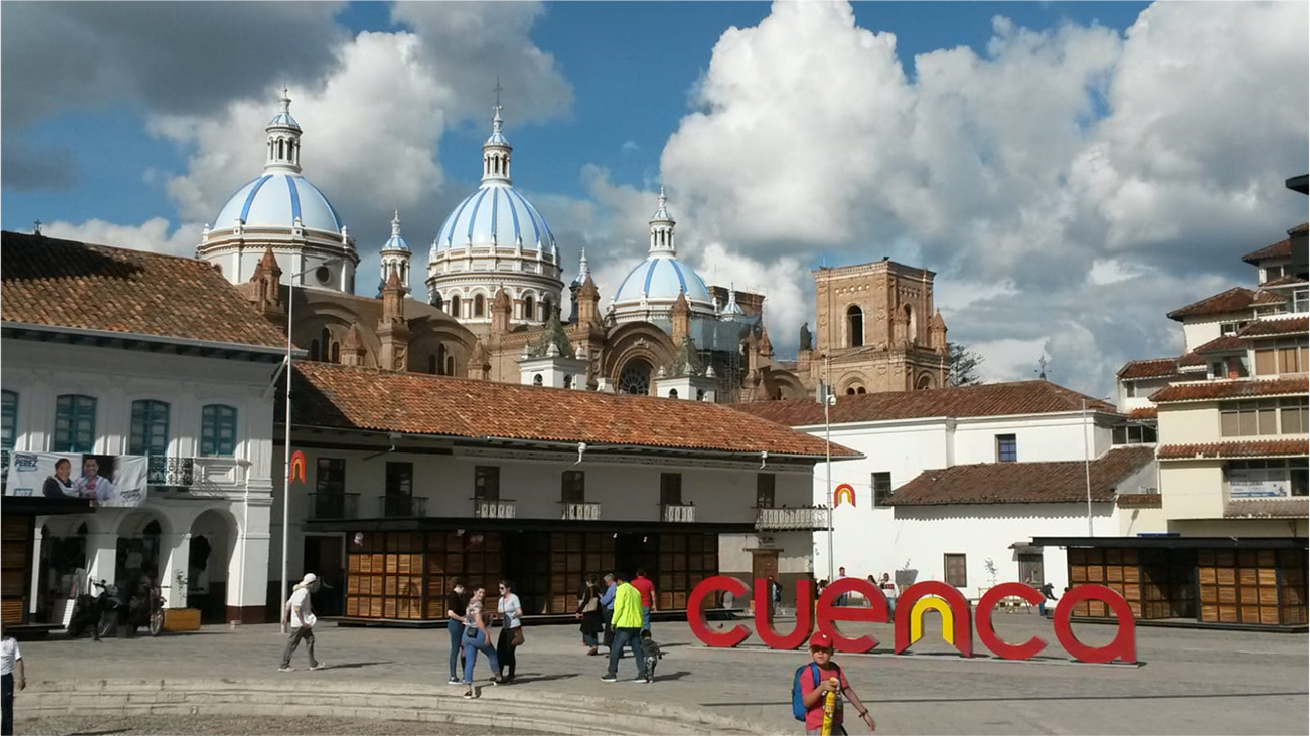
Plaza San Francisco, March 2019.
Though the work is now complete, several important items of disagreement remain between vendors and the municipal government, which may continue to affect the plaza’s role at the centre of popular circulation in the historic district. City officials want to use the square for new purposes, especially for cultural presentations that previously occurred in the street or in Parque Calderón nearby. In order to limit their space on a more open square, the remaining vendors have much less space to display. They also lack awnings to protect textile products from the elements, especially the mid-day sun, which bleaches their merchandise. The space now has regular police patrols and informal day-labourers are increasingly harassed as the city attempts to move them to a new location, outside the historic centre. Furthermore, the city wants to charge vendors US$160 per month for the new, modern stalls that were constructed in a bid to clean up the market’s image. Vendors said this was much more than they could afford. Most importantly, the city is limiting vendors’ ability to sell their stall spaces on to other vendors – often family members. This threatens the investments made there – associations of vendors previously oversaw the transfer of stalls, for which new entrants paid thousands of dollars. The new market creates conditions in which landowning elites dispossess informal lower-income groups of the use and exchange value of urban improvement, limiting their ability to reproduce spaces that ‘give life’, as one vendor told me, to the public spaces of the historic centre.
Lower-income uses of urban space are longstanding in Cuenca’s historic district, particularly at plaza San Francisco, which has been used as a market square for centuries (Páez Barrero, 2014: 64, 71–81). Unlike European colonial central plazas, which, as Neill (2015) points out, served to demonstrate the power of colonial authorities, the central plazas of Andean cities have other uses. The latter were traditionally produce markets dominated by rural, indigenous-mestizo women workers (Weismantel, 2001). They were productive squares, knitting together rural and urban forms of subsistence labour at the site of colonial administration (see also González, 2018). Certainly, as the retail industry changes and as lower-income dwellers are forced out of the historic centre by rising rents, popular vendors face new challenges. Yet, vendors mentioned wanting to remain in place and hoped to develop more competitive businesses in a historic centre that they still felt belonged to social classes who needed access to low-cost textiles, footwear and kitchen utensils. The heritage process in Cuenca neglects these popular commercial traditions and their modernisation in favour of European-style open plazas that favour contemplation of historic architecture – in the Andes, architecture representing the urban concentration of wealth produced through exploitation of rural workers.
As Kingman and Goetschel (2005) argue, Andean heritage conservation reproduces Eurocentric cultural and economic domination in urban centres and is therefore an important context that should be front and centre of the ‘layered meanings’ that UNESCO seeks to recognise in its new Historic Urban Landscapes approach – an approach largely fixated on the stylistic clashes between historic assets and modern construction in densifying central urban areas (see Bandarin and Van Oers, 2012). In Ecuador, Kingman and Goetschel (2005) point out how a nostalgic modernisation of urban areas through cultural heritage conservation reflects elite longing for an idealised urban past of racist exploitation. Cuenca’s attempt to stage its urban heritage for foreign lifestyle migrants who will rent elite-owned real estate reflects similar, lasting effects of exploitative Andean racial formations. As the city becomes increasingly global, the exclusion of vendors from public space erases the Andean-style plaza of informal vending.
Intensifying urban extraction
In Cuenca, informal retail activities were seen as detrimental to the heritage value of historic urban spaces, potentially limiting the ability to attract higher-income activities. The 2006 IDB funding agreement with the city characterised ‘informal activities’ as a limitation to the ‘use and valuation’ of the historic centre. Deterioration of central neighbourhoods was blamed on vendors, whose presence ‘generates tension with the rest of the city, particularly with those sectors with the greatest potential for development through the rational pursuit of advantages stemming from the existence of valuable cultural assets and heritage’ (IDB, 2006: 3). These ‘rational pursuits’ imply a more intensive, higher-income use of the commercial potential of the historic centre, one that corresponds to elite nostalgia not only for a historic centre that once was, but for a dream of the centre as the ‘nobles of Cuenca’ desired it to be – for example, more European, ‘cosmopolitan’ and formal. This section looks at the heritage ‘rationalisation’ of the centre of the city, one that leverages heritage urbanism to improve the city’s competitiveness within global circuits of leisure mobility.
This attention to the competitiveness of urban space reflects forms of neoliberal urban extractivism, as financial interests seek to extract ground rents from the built environment of the city (Gago and Mezzadra, 2017). From the vantage point of finance, the historic centre is an amenity that supports the globalisation of real estate, notably newbuild condos in middle-class neighbourhoods near the centre, where a large part of the North American migrant community is clustered (García et al., 2017). This is what makes heritage conservation profitable. Housing and condo construction has become one of Ecuador’s leading industrial sectors in recent years, owing in part to expanded state support for mortgage lending (Cabrera, 2017; Ordóñez, 2014). Despite stated intentions to improve housing affordability for local people, real estate development has historically focused on higher-income groups with access to credit, or on the interests of elite social classes, for whom land ownership functions as a store of value (Lowder, 1993). New condo apartment buildings in neighbourhoods surrounding the historic centre, especially the west end ‘Gringolandia’ along calle Ordóñez-Lasso and in the El Batán and El Ejido neighbourhoods, are owned by elite families who have successfully integrated architectural, construction and landowning functions into family enterprises, which now increasingly seek to attract higher-income investors and renters. As in other lower-income countries, the lack of adequate domestic demand for formal housing construction led developers to look to external markets (for an example from Morocco, see Kutz and Lenhardt, 2016). The ability to globalise demand for assets that have traditionally been valorised for local uses enabled local builders to experiment with new, denser and more intensive construction patterns (Cabrera-Jara, 2019), driving up ground rents in formerly middle-class parts of the city and creating yet more demand for new-build developments in others, especially San Joaquín in the city’s south-west and in Chaullabamba to the east, currently the edges of Cuenca’s speculative urbanism. Lower-income groups, meanwhile, are expelled even further from central areas of the city, often to informal settlements in the north and north-east (Pauta Calle, 2019).
For Cuenca’s elites, the economic crisis of 2008 turned out to be a boom. In partnership with media platforms capable of drawing North American attention to its historic urbanism, it managed to attract thousands of permanent migrants from high-income countries, as well as thousands more tourists who cycle through the city, trying it out to see if they might want to move there (Hayes, 2018). In Cuenca, it is North American lifestyle migrants who are one of the most important sources of demand for condo housing units. Whether as renters or as buyers of Cuencano real estate, North Americans help to stabilise the market from the vantage point of finance, consistently offering higher prices for new developments and renovations in neighbourhoods in and near the historic centre, independent of local and national economic fluctuations. Moreover, their presence resolves a systemic issue in Ecuadorian real estate development, where local demand has historically been insufficient to support denser private-sector housing development.
In 2019, the average Ecuadorian household (composed of four members) earned just over US$733 per month, usually with more than one household member working to earn the basic income of US$394 per month. 5 This basic amount required to meet essential costs, however, cannot be achieved by more than half of Ecuadorian workers, many of whom work in the informal sector. 6 The shortage of affordable housing is acute in Cuenca, where average housing costs outpace those of the capital, Quito, by US$30 per month (at US$227 per month). Newbuild condo construction and renovated properties in the historic centre start at rents well above this amount and are often directly advertised to lifestyle migrants and digital workers who report much higher earnings.
To qualify for residency visas, lifestyle migrants have to be able to show pension income of at least US$800 per month (for individuals, US$850 for couples), or an investment of US$25,000 in the Ecuadorian economy, an amount easily secured by investment in a property or condo unit. This then enables lifestyle migrants to access all the same rights Ecuadorian citizens have, including public health insurance. Most North Americans spend far more than the average Ecuadorian. International Living provides prospective migrants to Cuenca with a sample budget of US$1680 per month (US$500 for rent of an unfurnished apartment). 7 Research participants in my study often reported spending even more than this amount (a survey by García et al., 2017, showed 65% of lifestyle migrant households spent more than US$2000 per month). Nevertheless, this was far less than the average for retirees in the USA. According to the Bureau of Labor Statistics’ Consumer Expenditure Survey, in 2017, older households (above age 65) spent US$49,542 per year or US$4,128 per month. 8 For fixed-income older Americans and Canadians, relocation to Cuenca was often undertaken to stretch pension savings and to achieve a higher standard of living at lower cost – a form of arbitrage promoted by international lifestyle marketers and libertarian publications, such as Forbes (Hayes, 2014).
Relocating North American spending power to Cuenca has had a profound impact on local conservation projects, real estate development and especially on the rental market. These higher rents also form part of national policies of tourism development, even though they evidently lead to residential displacement of popular classes in the historic centre, especially residents of conventillos – heritage properties divided up for use by multiple families, dozens of which have been renovated for new tourism and short-term residential uses (Pacheco and Sarmiento, 2015; Pauta Calle, 2019). There are no accurate figures of how many North Americans live in Cuenca, but if there were only 5000 households spending on average the amount recommended by International Living, it would bring in US$100 million in revenue to the country every year, about 7% of Ecuador’s total tourism income in 2016 obtained from over 1.4 million visitors. 9 This income is not only an important source of investment for local developers but also part of a national strategy of improving Ecuador’s balance of payments – key to sustaining the country’s dollarised economy. Cuenca’s urban policy, therefore, has taken on national significance, evident from national investments in heritage conservation and the construction of a light rail tram system. These public infrastructure projects effectively subsidise private ground rent accumulation and (unintentionally or not) limit the right to the city of lower-income workers. As López-Morales (2013) points out, it leads to a process of gentrification in which higher-income groups dispossess informal workers of the use and exchange values of urban space.
By contrast to most Latin American transnational migrants moving North, who often lose citizenship rights in order to work in the USA or Canada (Goldring and Landolt, 2013; Hiemstra, 2019), citizens of high-income countries carry citizenship rights with them across borders by virtue of market power, and use higher purchasing power to appropriate resources and urban space from lower-income groups in the Global South – even in some cases where those moving south are doing so to escape poverty in old age. This market power indexes racist regimes of colonial accumulation, since it is the inheritance of an unequal, colonial integration of the global economy. Lifestyle migration is, therefore, a site where new geographies of neoliberal citizenship are configured, striating rights and privileges in a transnational social field (Glick Schiller, 2015; Levitt and Glick Schiller, 2004), marked by histories of colonial labour exploitation. The mobility rights of citizens of wealthy, metropolitan countries help the value of local property to appreciate but come at the expense of social classes whose access to high-amenity spaces and historic neighbourhoods – including neighbourhoods they have built and helped animate for generations – is made more limited. Rather than ‘development’, what are produced are neo-colonial patterns of displacement and ‘accumulation by dispossession’ (Harvey, 2003).
Conclusion
Ecuadorian scholars have noted that in many cases, heritage conservation fails to benefit most urban residents (Burgos-Vigna, 2017; Durán, 2015; Kingman and Bedón, 2018). Urban interventions attempt to make historic centres more liveable, but still do not address the root causes of urban inequality in Cuenca and other Latin American cities, which can be found in the colonial patterns of exploitation and narrow concentration of wealth that have historically marked the regulation of urban spaces and urban–rural divides (cf. Kingman, 2006). Moreover, as Pauta Calle (2019) points out, renovation projects in Cuenca’s historic centre do not address the housing needs of low-income residents. Nor do they address the business interests of informal and lower-income vendors. Lower-income groups, many of them land-poor rural workers, appropriated an urban centre increasingly abandoned by high-income social classes in the 1960s and 1970s. During these decades, the expansion of industry marked urbanisation, drawing to the city workers with hopes of integrating into formal employment. These hopes stagnated in a historic centre deprived of investment to address low-income housing needs. The shift towards accumulation strategies based on finance and real estate has reversed the historic urban incorporation of precarious workers, who are now expelled from central areas of the city.
Local elite classes benefit from this process but do not necessarily re-occupy the historic centre themselves. More than a return to the city, the pattern of urban transformation in Cuenca is influenced by transnational pathways of gentrification (Sigler and Wachsmuth, 2016), in which higher-income, foreign lifestyle migrants and tourists support new uses and upgrading of historic urban areas. Lifestyle migrants help globalise rent gaps, inflating them beyond what would be possible from local conditions alone. This enables a more ‘efficient’ use of urban land on a global scale, since it relocates incomes from higher-income countries to urban areas that were until now marginal within the global economy, where neighbourhood amenities may be under-valorised relative to global market forces – helping fulfil a neoliberal urban dream of efficient markets. This potentially adds a new dimension to ‘planetary gentrification’ (Lees et al., 2016): gentrification not merely as a ‘revanchist’ neoliberal urban strategy applied everywhere (Smith, 2002) but also as rescaling of local real estate, to take advantage of larger rent gaps and profits made possible by transnationally mobile, global market demand. The cultural ideals of North American lifestyle migrants – many of whom are looking to ‘downsize’ without sacrificing consumption – is a key condition of intensified neoliberal urbanism in Cuenca. And international place and lifestyle marketers help shape this market, stimulating desire for heritage urbanism and connecting networks of local real estate supply to global demand. This market remains in its infancy but has the potential to transform cities, especially with the help of new internet platforms and algorithms that help promote urbanism in lower-income countries to financially precarious workers in the higher-income countries of the Global North.
While informal workers and low-income residents of the historic district contest their displacement and have their own interpretations of Cuenca’s heritage process – interpretations that require more space than is available here – it is hard to ignore how higher-income appropriation of urban space reproduces and compounds injustices inherited from the colonial organisation of a global division of labour. Phenotypically lighter groups appropriate the benefits of place improvements, while darker ones are dispossessed. Quite aside from its effects on the built environment, the relocation of informal exchange activities aggravates urban poverty and strains valuable networks of mutual aid and solidarity, which attenuate the lack of formal support and wealth redistribution (see also Burgos-Vigna, 2017; González, 2018; Kingman and Bedón, 2018). This situation challenges international institutions, such as UNESCO, whose heritage policies currently lack attention to the coloniality of Latin American heritage processes. In Cuenca, transnational gentrification is a product of historical relations of exploitation, which enabled elite accumulation of land and the construction of a built environment evocative of European tastes and styles. As squares and courtyards are ‘restored’ in the centre, informal vendors reorganise their lives and their markets in peripheral parts of the city, removed from the main focal points of commercial activity. While not listed as UNESCO heritage, their markets are nonetheless contemporary artefacts of Cuenca’s unequal heritage process.
Footnotes
Acknowledgements
I am indebted to colleagues from the Universidad de Cuenca, FLACSO Ecuador, and the Instituto de Altos Estudios Nacionales (Quito), as well as from the Instituto Geografico de Ordenamento Territorial (IGOT) at the Universidade de Lisboa, who commented on this work.
Declaration of conflicting interests
The author(s) declared no potential conflicts of interest with respect to the research, authorship, and/or publication of this article.
Funding
The author(s) disclosed receipt of the following financial support for the research, authorship, and/or publication of this article: This research was made possible thanks to funding from the Canada Research Chair in Global and International Studies at St Thomas University.
