




Abstract
This article explores how citizens respond to ruptures and problems in the places they inhabit by enacting adaptive improvised and incremental urban infrastructure patching. This might relate to citizens deciding to undertake small scale interventions in their communities to develop solutions to problems that are being overlooked by local government; or it might involve a community response to an ongoing systemic place-based problem that formal agencies involved in managing change are not addressing. This paper develops the concept of urban infrastructure patching with reference to conceptual debates and informed by research undertaken in Birmingham, UK. Drawing upon observations, interviews, and collective art projects, citizen-led urban patching is identified as an important urban intervention process that emerges in response to tensions between professional urban policymakers’ ostensive views of a place and the lived experiences of inhabitants. Cities are in a continual process of becoming and this includes the impacts of citizen end-user adaptive and incremental patching to maintain and enhance urban social-material environments. Two distinct contributions are made. First, citizen-end-user urban patching is based on residents’ experiences of perceived or actual ruptures in local urban infrastructure. Secondly, patching in response to ruptures is an individual and collective response. As a collective response, the power of numbers can bring about transformational change in places, but such participatory action is often viewed as challenging existing hegemonic power structures associated with representative democracy, whereas citizen-led responses can serve as a useful and parallel activity to urban government if it is legitimised.
Introduction
In June 2017, Adi Astl, a retired mechanic, built a set of wooden steps that cost him CA$550 to provide access from a car park to Tom Riley Park, Toronto (Fox, 2017). Adi had petitioned the city council to build these steps, but the response was that they would cost between CA$65,000 and CA$150,000. No action was taken, but Adi decided to build the steps himself. The council then responded noting that Adi had violated a bylaw and his steps were illegitimate. Nevertheless, Adi had identified a health and safety issue over an access route park users had formed down a slippery grass slope. In July 2017, Adi’s homemade structure was removed and replaced by the council with legitimate concrete steps costing CA$10,000 (McLaughlin, 2017).
There are many ways of reading this account of Adi’s urban infrastructure patch. This could be considered as an illegitimate act by a citizen, or as an example of a citizen identifying a very specific local urban infrastructure problem and improvising a solution (Bryson et al., 2018; Kinder, 2016). It could even be considered as effective lobbying since his temporary illegitimate steps were replaced with a legitimate structure. Adi’s steps highlight tensions between urban residents, place, and their rights to engage directly in developing solutions to urban problems. Another reading is to see these steps as another type of urban ‘patch’ defined as ‘material fixes’ and ‘repair practices’ (De Coss-Corzo, 2021: 238). This is a very different type of urban patching to that explored in De Coss-Corzo’s (2021) analysis of employees patching Mexico City’s hydraulic infrastructure, as Adi was an urban resident with no rights to engage in any form of direct intervention to patch Toronto’s infrastructure, Z This paper is a call for a new urban studies research agenda that would explore and conceptualise different types of urban patching involving volunteers and/or employees improvising solutions to damage or rupture to a city’s material or social infrastructure. It also seeks to identify – through empirical research – what the relationship is between urban infrastructure patching and urban governance.
Urban patching could be conceptualised in a narrow sense as a relatively minor form of place-based infrastructure adaptation, but this process matters for those involved and living in that place. This type of patching may be planned or improvised but it reflects a form of citizen or community buffering to mediate the impacts of some localised problem. From a conceptual perspective, emergent urban patching discussions have developed in isolation from wider debates concerning local services and urban governance. The literature on patching to ‘keep dwellings liveable, infrastructure working’ (Corwin and Gidwani, 2021: 1) has focused on repairs characterised by capitalist social relations – paid labour (Graham and Thrift, 2007), and has ignored repairs that are produced by non-capitalist social relations (Bryson et al., 2018; Gibson-Graham, 2008). In addition, much of the literature on alternative-substitute place-making (Andres et al., 2021) and patching has focused on infrastructure and resource-constrained environments in the Global South (Björkman, 2018; De Coss-Corzo, 2021; Pierce, 2020), and yet urban patching occurs in many settings and takes different forms (Kinder, 2016; Noveck, 2015) and constitutes informality in everyday urbanism (Amankwaa and Gough, 2022).
Residents inhabiting a place have the potential to apply their own lived experience as part of a place-bounded patching process based on adaptive improvisation intended to produce better outcomes for people. In this paper, we identify the contextual factors, institutions, and interventions that are effective in supporting citizen end-user urban infrastructure patching, drawing upon research undertaken in Birmingham, West Midlands, UK. We explore to what extent citizens fill gaps in infrastructure provision, or shape alternative outcomes, by developing immediate solutions to citizen-defined and -led local infrastructure problems.
The paper goes on to identify the role citizen-led responses and interactions play in community provision, focusing on whether the local state–citizen relationship has changed recently. It then examines the role citizens play in reshaping the urban public realm, the form this might take, and conceptualises alternative interventions that are occurring. The paper illustrates these trends with reference to research on citizen-led patching interventions in Birmingham. These illustrations are drawn together to make broader theorisations regarding the nature of citizen urban infrastructure patching evident in the Global North before a concluding section addresses wider governance implications.
Public service provision and the rise of citizen delivery
Cities are continually changing, reflecting the ongoing assemblage of different types and degrees of planned and unplanned intervention. Urban planning and state interventions shape cities but, more recently, the literature on temporary urbanism and insurgent planning has highlighted the importance of understanding how informal citizen-led interventions act as alternative substitutes (Andres et al., 2021, 2022; Bryson et al., 2018; Madanipour, 2017). These approaches embed citizens and voluntary sector organisations in place to develop local solutions to soft and hard infrastructure problems.
The term infrastructure is usually associated with ‘hard’ capital investment in buildings and networked structures – roads, pipes and cables. Much of the recent geographical debate on infrastructure has focused on financialisation, and the state (Bryson et al., 2018; Santos, 2022). Nevertheless, it is important to distinguish between ‘hard’ or capital urban infrastructure, and ‘soft’ or revenue infrastructure. The former involves long-term capital investment that is fixed in urban environments, whilst the latter refers to monetarised and non-monetarised, or paid versus unpaid, investments in information, knowledge networks, and community and place-based interventions. This is an important distinction as the long-term success of hard infrastructure investments is dependent on investments in softer infrastructure based around citizen engagement with infrastructure in place. These infrastructure investment types have different temporalities; hard capital investment is fixed for long periods in the built environment, but soft infrastructure investments are more transitional, ephemeral, invisible and need to be continually renewed.
The delivery of infrastructure, and public services, within places represents a significant challenge for any government, often exacerbated by a number of interrelated issues: the siloed nature of government departments (Carey and Crammond, 2015); the fragmentation of agencies involved in policy and delivery (Beghelli et al., 2020); the inability of market instruments and models to address the peculiar challenges of public service delivery (Mazzucato, 2013); and the impacts of financial crises and austerity on public service provision (Gray and Barford, 2018; Heald and Steel, 2018; Mazzucato and Kattel, 2020).
Austerity, and decreasing state resources in developed market economies, has led to a reaction by citizens as ‘end-users’ that crosses-over between patching activities and urban governance, through: (i) transforming existing forms of public service delivery; (ii) substituting services that used to but no longer exist; and (iii) providing new services and place-based interventions that have previously not been provided locally (Bryson et al., 2018; Franke et al., 2016). Nevertheless, whether the activity occurs unilaterally or reactively, citizen involvement in developing solutions to local infrastructure problems is much more than a response to neo-liberal agendas per se; rather, it is a continuous process in which citizens engage in activities that walk a tightrope between the formal structures of place-based governance and the informal and improvised practices of do-it-yourself urban patching. The end-users are motivated by personal needs or frustrations with existing services or by achieving place-based outcomes, seeking to overcome some of the immediate challenges of everyday living.
Path-dependent urban government decision-making is common amongst incumbent producers or policymakers, who may be unwilling to endorse improvised citizen interventions at the expense of existing service programmes (Hansson and Holmgren, 2011). Public policy tends to happen incrementally and is risk-averse rather than through radical innovation jolts. By contrast, end-users have direct experience of the everyday problems that they are experiencing and may be impatient for the provision of publicly funded and maintained infrastructure and related services.
Urban citizens, already witnessing the impact of central state-imposed austerity on services (Gray and Barford, 2018; Hastings et al., 2017) and voluntary and community activities (Jones et al., 2016), are starting to step into the breach. This has shifted the balance between expert and non-expert involvement in soft urban infrastructure provision. Citizens have engaged in adaptive place-based improvisation to develop solutions to local place-based challenges. This is part of a much broader process involving ‘infrastructuring’ in which places are shaped via an ‘emergent, multi-relational activity, where continuous co-creation involving people, objects and processes occurs’ (Frangos et al., 2017: 3279). There has been a veer to participatory urbanism (Parés et al., 2017) or, in the context of the Global South, insurgent planning (Andres et al., 2021; Miraftab, 2009). Citizen involvement in infrastructuring may empower the marginalised and the oppressed and challenge or temper existing hegemonic forms of power. Infrastructuring highlights the importance of grounded and improvised initiatives constructed in response to local needs. These may be ‘intimately tiny’ (Massey, 2005: 9) interactions between people and place that may be too often overlooked. But it is necessary to recognise the emergence of a more participatory approach to community matters if only to understand novel iterative interrelationships between people and place. These small-scale interventions may be minor, for example Adi’s steps, or seen as a gesture in local state terms, but they may well be considered as critical by local citizens.
In a democracy, each citizen is involved in urban government public services in three ways: as a purchaser through direct (user fees) or indirect payment (taxation); as a consumer of public services; and as a participant in a democratic process. Gaps often emerge, however, between the services provided and the changing needs of citizens (Ogawa and Pongtanalert, 2013; Richardson et al., 2014). These might be localised gaps in which public service-led solutions have either not yet been formalised or are inappropriate. Alternatively, citizens challenge the local state and attempt to reshape outcomes, and these might be characterised as disruptive, populist or even ‘stealth’ in nature (Stoker and Hay, 2017). There are extreme examples of citizen delivery of public services in developed market economies. In Detroit the provision of basic public services was curtailed forcing citizens towards do-it-yourself provision (Kinder, 2016) as a buffer to the failure of public service delivery. This included sweeping streets, maintaining public parks, and planting community gardens. In other North American and European cities, examples of public sector failure are less extreme, but research reveals growing distrust of institutions as public services are considered to be ill-suited to addressing complex societal challenges (Calzada, 2018; Noveck, 2015).
Through a more proactive lens, it is possible to see citizens as an untapped and unexploited resource able to participate in co-producing solutions to local infrastructure problems. Examples of this type of citizen activity have been identified in the Netherlands and Belgium (Van Eijk and Steen, 2016), and UK (Bryson et al., 2018; Vallance et al., 2020). Nevertheless, the contribution citizen innovation makes to public services and the impacts remains unknown and could be geographically uneven. This is despite the ongoing debate highlighting community action and the value of citizen participation (Bovaird et al., 2015; Johnson, 1984; Natarajan et al., 2019; Ross et al., 2012; Seyfang and Haxeltine, 2012; Smith et al., 2016).
Citizens as end-users and the shaping of the urban environment
Current scholarship on alternative approaches to place includes the emphasis by Massey on place as ‘co-constitutive’ and always under construction (Massey, 2005: 9). This raises questions regarding who is involved in creating and managing urban spaces, the form this process takes, and to what extent citizens are included/excluded. The outcome of this process may result in capital-intensive infrastructural investments and less visible urban infrastructure interventions, including citizen-led urban patching. Existing research has highlighted the ability of urban spaces to adapt to rapid change by examining temporary or ‘meanwhile’ uses of land and buildings, and the ways in which people undertake autonomous initiatives as a form of mutual support and social resilience (Katz, 2004; Steer et al., 2021).
The alterity debate highlights the importance of different values driving alternative outcomes (Bryson and Lombardi, 2009; Fuller et al., 2010; Gibson-Graham, 2008; Jones, 2010). This includes citizen-led alternative infrastructure models in response to infrastructure exclusion (Bryson et al., 2018) in situations when there is no alternative apart from the status quo. Three types of alternative institution have been identified: alternative-oppositional institutions based on values and ideologies that reject the mainstream; alternative-additional institutions which provide an additional choice to other extant institutions whilst not necessarily developing values that reject the mainstream; and alternative-substitute institutions which act as a substitute for institutions that are no longer present or have never existed in a place (Fuller and Jones, 2003: 57). The latter represent coping mechanisms or survival strategies rather than attempts to be alternative. One institutional solution is the role that charities, voluntary organisations, or social enterprises play as a compensatory mechanism to ongoing restructuring of the welfare state under neoliberalism (Deverteuil, 2016).
End-user innovation has been identified as an approach to exploring the role end-users play in the development of new or modified products, processes, or other applications (Baldwin and von Hippel, 2011; Gault, 2012). The focus here has been on end-user innovation and business rather than on place and public services. Von Hippel (1976) explored 111 innovations and concluded that ‘80% of these innovations were invented, prototyped, and first field-tested by users’ (Bogers et al., 2010: 859), rather than by companies. End-users can create new products as solutions to meet their needs or they can repair or modify existing products (Von Hippel, 1988; Von Hippel et al., 2011). End-users are ‘prosumers’, as they ‘both consume and produce content’ (Rayna et al., 2015: 91). End-user innovation represents a form of user patching as existing products are modified to meet unmet user needs resulting in innovation that might be new. There is, however, a pertinent question: to what extent are urban residents prosumers rather than consumers of the urban environment when they engage in urban patching?
Despite the theoretical and empirical broadness of these different debates, there is an underlying appreciation that developing solutions to local soft and hard infrastructure problems is a complex heterogeneous process. Much of the emphasis until recently has been on institutional solutions rather than citizen-led solutions. Within a frame of urban government, citizens are consulted periodically but play a relatively passive role in planning and managing cities. End-user innovation highlights the role that citizens could play in place-based adaptive improvisation as a proactive or reactive alternative-substitute process. How citizens react is dependent on whether activities are initiated in response to perceived gaps or failure on the part of the state, or whether new solutions are created that have yet to be devised by formal institutions. There are both push and pull factors at play, as much for citizens as urban government, and there is also a local geography to this, as the responses can be a reaction to distinctively place-based problems.
Methodologies for researching urban patching
The research is based on data collected in Birmingham (UK) between 2017 and 2021. The focus of the analysis was on pre-pandemic Birmingham to highlight that citizen-led urban infrastructure patching is a continuous process, rather than reflecting pandemic-induced improvisations. The intention here was to uncover the range of different types of activities that citizens are involved with, and then focus in on uncovering urban patching initiatives.
Birmingham was selected as a case study, following an independent review of the governance and organisational capabilities of its City Council in 2014, which found it was not even ‘getting the basics right’ and ‘did not sufficiently understand what was happening in its communities’ (Kerslake, 2014: 7; 25). In response, the Birmingham Independent Improvement Panel was formed in 2015, tasked with overseeing alterations in the Council’s culture. Change has been slow and funding cuts have increased the Council’s financial difficulties. Birmingham City Council (BCC), like most local authorities in the UK under austerity, experienced a 37% reduction in government funding between 2010–11 and 2015–16 (National Audit Office, 2014). Attempts to cover this funding gap have led to reductions in the numbers of full-time employees and the outsourcing of roles. Localised problems, identified by residents, have motivated groups of citizens to develop and apply their own ideas and approaches to resolve local infrastructure problems.
To explore these trends, a qualitative research approach was adopted. This comprised 20 face-to-face, 60-minute interviews with individuals directly involved with public service provision in Birmingham. In addition, three practitioner- and citizen-informed workshops were held with 40–60 policymakers, professionals, residents, and academics (on 12 September and 29 November 2016, and 1 June 2017) to explore public service provision, citizen end-user place-based innovations, and group innovation. Each workshop explored public services in the context of private and public sector demands. The first workshop focused on identifying barriers to citizen involvement in developing solutions to local infrastructure problems; the second explored the opportunities and enablers supporting citizen involvement; and the final discussed examples. Each workshop was followed by targeted searches and triangulation.
Researching citizen involvement in local infrastructure is challenging, as much of this type of citizen place-based patching is largely invisible. The types of improvisations are not well-documented and are often not captured by social media; some of this activity is insurgent or even viewed as illegal. To address this, working with art facilitators, the researchers instigated a process of creative consultation with residents to uncover activity sequentially. These consultations were in some of the city’s more disadvantaged wards. Residents in four areas were invited to participate in developing a place-based art project led by a professional art facilitator. This involved a series of three-hour sessions with art facilitators. This method was intended to develop a dialogue about citizen involvement in shaping the urban environment. The art projects included residents walking around their local area with an art facilitator to identify and develop a place-based art project that would explore their roles in shaping their locality. This creative consultation process led to the formation of new local resident networks.
Citizen end-user urban infrastructure patching in Birmingham
We now explore the ways Birmingham residents initiated, or were permitted by urban government, to engage in shaping urban infrastructure outcomes. The research identified three forms of citizen initiative:
community projects funded by the UK National Lottery, as one approach for measuring the scale of community-initiated projects;
BCC’s approach to citizen consultation; and
citizen urban patching activities by individuals and groups.
Measuring the scale of community-initiated projects: The National Lottery
The UK National Lottery was established in 1994 to raise funds to be allocated to projects spanning the arts, sport, heritage, health, and environment. Between, 1995 and 2022, 11,397 projects in Birmingham were awarded National Lottery grants with a total value of £1,005,622,312. Of these, 6456 projects were undertaken by charities and community organisations which were awarded £313,132,413 (see Table 1).
Value of national lottery grants provided to charitable and community organisations for Birmingham-based projects.
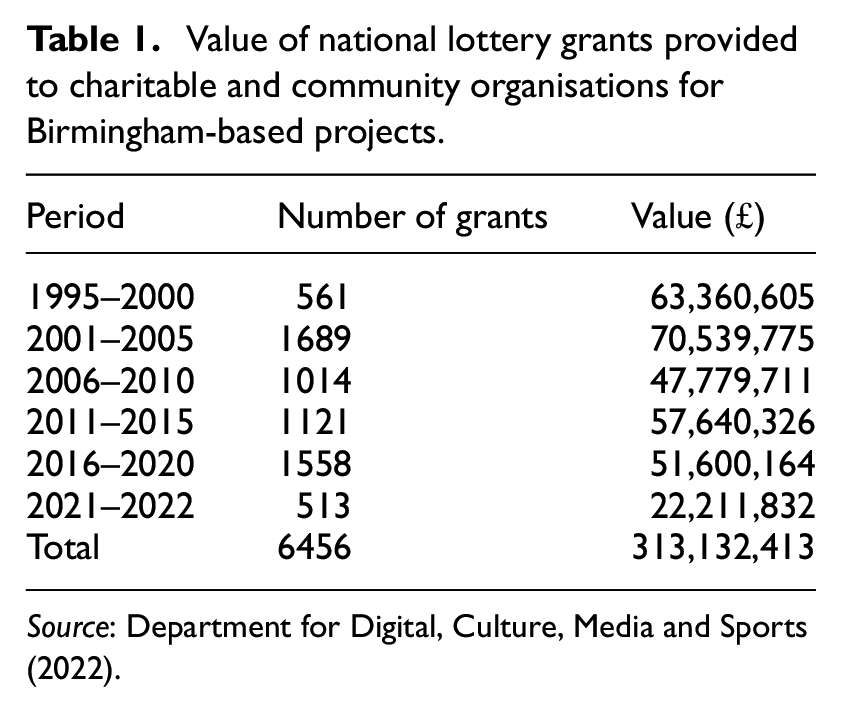
The National Lottery Community Fund (LCF) was established in 2004 to support health, education, and environment projects. The value of these awards ranged from £1000 to over £6m with applicants being charities, companies, community interest companies and community groups. Services and interventions that local and national government have a statutory responsibility to deliver are not funded. These projects reflect different forms of citizen- and community-led urban patching; 84% of grants awarded were under £10,000 with the average grant being £8100, and 60% were awarded to organisations with turnovers of less than £100,000 (Community Fund, 2022).
The ‘Together We Can!’ initiative is an example of a three-year intergenerational, community building project underway in the Firs and Bromford neighbourhood, East Birmingham. This is a partnership between local community groups with funding from the LCF to enhance connections between people and place including supporting people to ‘grow in the confidence, skills and connections needed to be able to participate in and contribute to the life of their neighbourhood’ (Barrett and Perry, 2018: 1). This is a form of place-building urban patching that involves creating a highly localised alternative-substitute institution based on formalised improvisation to enhance interactions between people and place.
Birmingham City Council and citizen consultation
Birmingham provides formal opportunities for citizens to express their views about matters of concern. ‘Be Heard’ is the BCC website that encourages citizens to report problems, raise queries, and learn about formal consultation opportunities initiated by BCC through its directorates. Very few citizens use this engagement opportunity, with responses to consultations ranging between 0 and around 500. These low rates may be the consequence of the council initiating very controlled consultation processes on subjects that are of interest, first and foremost, to the council itself.
The workshops highlighted that some citizens were aware of the council’s consultations but choose not to interact. People highlighted the inability of BCC to respond to feedback when it was given, due to – according to the council – a lack of staff capacity and funding. One citizen also suggested that BCC may have created a one-stop-shop engagement platform through ‘Be Heard’ but had not created any mechanism to respond to citizens’ online submissions and thereby permit a two-way exchange that would highlight that BCC was listening to residents’ concerns. Overall, this had caused citizens asking, rhetorically, ‘why bother in the first place?’ According to one interviewee, BCC did not necessarily have the ‘appetite or legal ability’ to involve citizens in innovative processes, since ‘politicians don’t like risk or failure and so the change they [citizens] want is unlikely to be delivered’ (Interview-transportservices1). In addition, many changes in public service provision desired by citizens are driven ‘through [national] law rather than local priorities’ (Interview-transportservices1).
Prescribed consultation processes, in contrast to active citizen participation in Lottery projects, represent a form of ‘citizenwashing’ of public service provision in which an impression is projected that public services are being co-created with citizens. The reality is one based on a false impression that consultation exercises shape public service delivery outcomes. The nature of these BCC-initiated consultation processes are examples of what-may-be-seen-as prescribed, passive, outside-in co-creation processes, where the knowledge and ideas of end-users are captured by service providers through unidirectional feedback mechanisms (Noveck, 2015; Rayna et al., 2015). The result is that the lived experiences of urban residents are discounted in infrastructure decision-making processes.
Citizen-led urban patching
In contrast to the Lottery projects and formal consultation processes, urban patching takes many forms, but represents a form of go-it-alone activism by citizens impatient with waiting for an urban government response. This includes informal litter picking and individuals developing smartphone apps intended to encourage a public service response. Apps include those designed to report street problems or identify the lack of bins or public toilet locations. This type of urban patching involves creating alternative-additional structures, where additional activities to those provided by the council are created, and alternative-substitute activities where services are created in response to delays by local government in developing and/or implementing solutions to local infrastructure problems.
One resident, for example, participating in one of the art projects described the long-term problems they had experienced in trying to persuade BCC to fix the pavement outside their home. They had contacted the council on numerous occasions, and they had been promised that it would be repaired, but nothing had happened. They mentioned this problem to a neighbour who volunteered to fix the problem after dark. This type of citizen-initiated pavement and road patching is in direct opposition to existing conventions regarding pavement and highway maintenance. Illegitimate urban patching is one form of alternative citizen involvement in urban infrastructure that goes undocumented; it is practical and actionable, rather than digital. But it remains illegal, as the council needs to be certain that any work undertaken meets current specifications.
In contrast to the Lottery-funded projects, the formal council-initiated consultation exercises, and the go-it-alone activism of individual citizens impatient with waiting for a council response, a further approach identified within the research was group activism in patching. Two of the art projects involved attempts by residents to define the area they inhabited before considering possible interventions in the urban realm. In one case, a diverse mix of 30 people, decided to ‘yarn bomb’ their area as a place-based collective endeavour. Yarn bombing is a guerrilla or ephemeral art form based on using knitted, crocheted, or other thread-based processes to highlight environmental features, often to personalise cold physical spaces. A second project involved 15 people of mixed ages and genders designing and making a map of their area using textiles and threads. This map defined their place to encourage place-focused conversations. Both projects represent citizen-led informal place-based consultation exercises that have the potential, if recognised by BCC, to act as alternative-additional institutions to enhance citizen participation in shaping the places in which they live.
The development of a group identity linked to a place was the first stage in residents’ involvement in trying to shape place outcomes, and this contrasts with council-initiated consultation processes that often dispense with collaboration and trust-building elements and launch directly into public service or policy matters. Participation in the art projects then led to residents deciding to clean up their areas by organising litter picking. This is a form of adaptive improvisation in which a place is patched by removing rather than adding something. The collective process of a neighbourhood clear-up enhanced, in turn, solidarity amongst residents, a patching that snowballed across different communities. As one BCC employee explained, across Birmingham there are now ‘over 40 active community groups doing cleanups in their neighbourhood – so I think there is a groundswell of support with citizens to be proud of their neighbourhood and city that they live in’ (Interview-wasteservices2).
One of the most active citizen-led groups in Birmingham emerged in the Balsall Heath area to directly challenge policymakers’ existing views of the area. A Balsall Heath community representative noted that: Pre-1994 we had big problems with drugs and prostitution, about 400 girls, at one time one of the biggest open-air brothels in Europe, for us as a community it was a difficult time and we didn’t have much of a voice, there wasn’t much unity, we didn’t know how to challenge the service providers or even that we could challenge service providers (Interview-BalsallHeathForum).
Balsall Heath had ruptured and required patching, but those with the legitimacy to develop and implement solutions were focused on containment. Those living in Balsall Heath were not expected to challenge the status quo as this might have shifted the problem to other locations across Birmingham. This case of urban patching and group activism is an excellent example of the formation by citizens of an alternative-oppositional institution that rejected the mainstream. Through protest and direct action, localised urban patching was improvised that disrupted established practices and led to a new solution for a long-term problem. This example reveals that the initial creation of an alternative-oppositional institution can be the pathway towards mainstream adoption of an oppositional approach. When this occurs, an alternative-oppositional institution transitions to an accepted alternative-additional institution.
In this case, there was no intention by residents to form an alternative-oppositional institution, but it was the outcome of a process of improvised urban patching. In 1994, two residents who – in the words of one interviewee –‘worked for British Rail said, “hold on, when we want our demands met, we picket, we protest, so why don’t we do that?”’. They ‘started off a back of the street watch campaign’ as one solution to the problems being experienced (Interview-Balsall Heath Forum). The railway workers drew upon their embodied expertise by applying conventional trade union protest methods to try to solve a place-based problem. The two residents stood on street corners and picketed; soon after, the two become four residents, the four turned into eight, and suddenly ‘every single corner had local residents standing there protesting’ (Interview-Balsall Heath Forum), disrupting the everyday routines of pimps, sex workers, clients, and drug dealers. Numbers matter and the power of the crowd captured the attention of media. This activism, and media attention, forced the police and BCC to reconsider their existing approach to this part of Birmingham and to acknowledge residents’ perspectives and place experiences. Six months after the street watch was introduced, crime levels dropped in the area.
The street watch campaign developed into the Balsall Heath Forum, a community action group run by residents, aimed at undertaking local area improvements. Those involved came to appreciate ‘that if you are united and have one voice as a community then you actually get listened to’ (Interview-Balsall Heath Forum). ‘Lobbying in the local community’ has been successful because of the number of residents involved, since if it had ‘been one or two individuals then it would have been easier to ignore’ (Interview-Planning Services). Since 1994, the Forum has been recognised by BCC as a legitimate provider of localised citizen-led adaptive improvisation. Examples of this group’s activities include running a community garden, local landscaping, clearing rubbish from local parks, and litter collection.
The Balsall Heath Forum provided a structure within which citizens could engage in continued adaptive improvisation to develop rapid urban patches. The value of this local patching process can be seen in the role the Forum played during the city’s 2017 refuse collector strike. In 2017, BCC’s long-term restructuring process led to an attempt to save £600,000 a year by replacing 113 waste collector roles with lower-paid positions. The outcome was a two-month city-wide bin strike. Mounds of waste accumulated attracting vermin and eventually led to an interim injunction being taken out against BCC in the High Court. The Balsall Heath Forum combined with Bearded Broz, another citizen-led group, to collect over 100 tonnes of rubbish (Marsh, 2017). During the crisis, these groups acquired a legitimate right to collect and remove rubbish as a localised improvised patchwork solution, framed within the context of an existing structure.
Collectives form in response to local needs, but they are time and space contingent, require local leadership, and may take the form of oppositional, additional or substitute institutions. They may initially be regarded as informal or illegitimate and unwelcome by officials and policymakers but, in order to transition towards acceptance and legitimacy, they have to be seen to be delivering for places. The place-based characteristic of citizen-enacted infrastructure patching means that it can often be unevenly distributed, even across a single city, reflecting citizen experience of some local problem that they consider requires action. A local crisis, perceptions of an inadequate or timely official response, a belief that urban government is failing to recognise, understand or listen to residents’ concerns, are all the types of pre-conditions that lead to citizens deciding to intervene directly by urban patching. In turn, once accepted, there is a possibility for urban patching activities to become part of an array of urban governance vehicles. Not all these adopted activities are formalised, but rather will operate in parallel to public service provision.
Conceptualising citizen-led solutions to urban ruptures: A research agenda
Citizens are never completely excluded from urban governance decision-making, but their roles and responsibilities are tightly prescribed. BCC encourages residents to play a passive supporting role in council decision-making. Residents are recipients of professionalised and politicised decision-making processes; they are rarely ‘hands-on’ with co-producing or testing new public sector services (Berthon et al., 2008; Bogers et al., 2010; Poetz and Schreier, 2012). The role of the citizen is as a non-expert participant in consultation exercises or is confined to writing to or petitioning their local councillor.
Despite the emergence of isolated examples of more citizen-led interactions with official agencies, the opportunities nevertheless remain firmly within a context of existing structures and power relations; representative democracy tends to outflank participatory democracy. Resident expert knowledge obtained through their lived experiences of directly engaging with a place is deemed by elected local government to be less important than expert knowledge. There may well be greater advantages to city government not by offering residents a blank page upon which to start their conversations about infrastructure needs or public services, but rather to set some pre-determined parameters for discussion. In the context of public service cuts, however, a lack of capacity on the part of councils to respond rapidly, or a community that may feel their needs are not being listened to, especially in an era of heightened social media activity, then local governance settlements may start to unravel further as residents take it upon themselves to perform urban patching. This also necessitates some degree of self-organising and self-managing emerging sets of relationships (cf. Vakkayil, 2022).
The Birmingham analysis reveals that there are times when urban residents take individual or collective action, legitimately or illegitimately, as they attempt to rewrite the narrative of a place that is currently being enacted by officials. Individuals can develop apps and undertake place-bounded urban patching, but individual action can go viral through social media resulting in copying. Individual urban patching then has the possibility of transforming into collective action. Residents may come together with a shared vision to work on developing a solution to a very specific local infrastructure problem with the outcome being urban patching that is oppositional, additional, or substitutional. Citizen-led urban patching is a place-based process highlighting that the local is ‘a key driver of civic participation and also as an important context for behaviour change’ (Richardson et al.’s, 2014: 1717).
Analysis from the research shows that there is a myriad of activities that have, or have the potential to involve, citizens in decision-making. Some are project focused, some are mandated consultation requirements, others are either proactive or reactive groundswell activist movements. In essence, they may be both democratically representative and participatory in form. Although the driver of change for some urban patching initiatives appears to be some failure on the part of the local state, most of the examples identified were about coalescing around an urban rupture rather than seeking to challenge existing power structures. Citizens have a different experience of their places compared to the views of those possessing formal responsibility for managing physical change, public services, and budgets. Citizen-led urban patching will always be an uneven and exclusive process, even if it has the potential to develop novel end-user solutions to long-term problems. But, equally, during a time of continued state upheaval and financial uncertainty, citizen-led urban patching may be seen to be a parallel world to formal urban governance.
Core research issues for the future will lie in examining the rapidly evolving form and style of urban patching within changing relationships and tensions between representative government and participatory governance. In developed market economies, urban patching was common and expected in earlier times when municipal government was more embryonic. As programmed forms of public service provision developed then patching became less visible. In more recent decades, the impacts of austerity have led to urban patching appearing to be on the rise again, although the picture is complicated and nationally variegated. In some nations, patching is still required for day-to-day survival and is considered normal practice. In advanced Global North states, patching may be viewed more as an illustration, and indeed symptom, of failing municipal government.
Future research needs to adopt a multi-scalar approach with the development of an urban patching theory that highlights patching as a form of place-based improvisation. Patching is a form of buffering and is a variegated process given differences in the links between people, need, place, and public service provision. This paper is the start of this process. From these perspectives, there are many questions that arise about what form of local government people want and expect, and what benefits and drawbacks may exist in a desire for more active forms of citizenry. The key task to perform in analysing these heterogeneous patterns is the need to unscramble the complex and interwoven set of governmental and participatory processes in any one place relating to rights, responsibilities, opportunities, and legitimacy.
Then, on a broader scale, we also need to ask some very germane questions: Whose places are we talking about, and where are they? Can ruptures be fixed as an enduring commitment over time? How resilient is a place’s infrastructure and service provision? In Global North nations over the next decade, we could well witness a swathe of post-privatised, austerity-riven, and institutionally fragmented places offering-up growing disparities, greater inequalities, and shrinking services. Academically, we have been here before (cf. Marcuse, 2012; Mayer, 2017; Pahl, 1975; Sassen, 1996; Zukin, 1995). The difference this time concerns not only who the citizenry might be and their rights to do-it-themselves, but whether the urban government model itself can survive in a meaningful form to address, financially and politically, some of the biggest challenges cities are likely to face.
Conclusions
This paper is a call for a new research agenda in urban studies that explores the contributions urban residents make to urban patching. We began with Adi Astl’s wooden steps in Toronto. This was one instance of a citizen challenging the boundaries between legitimate and illegitimate involvement in urban government. His action was a form of alternative-additional urban patching, with the city eventually taking on formal responsibility. Such direct citizen enacted urban patching must be distinguished from citizen participation in consultation processes initiated by officials. Policymakers’ priorities are set by local and national politicians with citizens, as subjects, becoming marginalised in the process. This is not to imply that citizens are unable to apply their embodied expertise to develop solutions to urban problems, but it does mean that sometimes they must engage in unofficial improvised and sometimes illicit urban patching, at least to make their voices heard beyond the ballot box.
Urban patching is one response urban residents can make when tensions emerge between the ostensive perceptions of a place held by politicians and policymakers, and their everyday lived experiences. Consequently, some urban residents become prosumers rather than consumers of the urban environment as they attempt to apply patches to the places they inhabit (Bryson et al., 2018; Kotler, 1986). There is much in common here with the end-user innovation process as the emphasis is on users taking ownership of a problem to develop solutions through incremental adaptive improvisation.
Urban patching may be illegitimate, hidden, and unobserved, or legitimate, visible and observed by those in official positions of power. Nevertheless, there is always the possibility that successful, but illicit, end-user urban patching will be legitimised locally by urban government. As we move forward, and if these trends continue, one issue to consider is whether the national or local state attempts to fill a vacuum created by service cutbacks or professional staff shortages, by not only legitimising but exploiting citizens’ new-found roles. Clearly, a line needs to be drawn between the citizen and the state to identify tipping points. The research did not find evidence of this in Birmingham, but it is easy to see how incremental change may lead to unintended consequences. For some, this could be the thin end of the wedge.
Citizen-led urban patching corrects, repairs, or enhances some identified aspect of an urban environment. The outcome is variegation in place-based outcomes for citizens with the expertise and inclination to engage in urban patching without disadvantaging those without the expertise or the hope required to undertake localised adaptive improvisation. All this demonstrates a more profound heterogeneous landscape of urban places, with looser roles for both urban government and residents, as traditional forms of governing places – through institutions, public services, revenue, democracy, and accountability – warp and oscillate. Urban studies will need to recognise, analyse, and respond to these changes, as new models, activities, relationships, rights, and responsibilities emerge. Existing studies have focused on residents and adaptations to crisis situations (Kinder, 2016). Further research is required on the formal and the informal, on individual and collective types of urban patching that would surely identify a multitude of patterns and behaviours across our cities, that go well beyond urban government and formal planning.
Footnotes
Acknowledgements
We acknowledge the feedback and support provided by members of the Urban Living Birmingham Project team, and feedback provided by researchers working on the other funded Urban Living Partnership projects, on earlier versions of this paper. We must also thank all those Birmingham residents and policymakers who participated in the data collection process. We received interesting comments on an earlier draft of this paper from Jeroen de Jong and Natalie Oswin and benefited from an e-mail exchange with Eric von Hippel. We would like to thank Professor Shenjing He for his constructive editorial guidance and the two reviewers for their insightful and constructive feedback.
Declaration of conflicting interests
The author(s) declared no potential conflicts of interest with respect to the research, authorship, and/or publication of this article.
Funding
The author(s) disclosed receipt of the following financial support for the research, authorship, and/or publication of this article: The research presented in this paper was supported by Research Councils UK (RCUK) and Innovate UK, led by the Engineering and Physical Sciences Research Council (EPSRC), as part of the Urban Living Partnership programme [grant number EP/P002021/1].
