




Abstract
Urban scholars commonly expect that residents show more neighbourhood belonging, the longer they live in an area. An imagery of fixed settlements thus remains dominant in a rapidly changing world. Recent research challenged classic assumptions but the alternative of elective belonging hardly differentiated between symbolic and practical neighbourhood use. As belonging is performatively maintained, this differentiation may be needed. What defines residents’ belonging in a neighbourhood in digital mobile times? Does length of residence alone result in place-based practices, familiarity with other people and ultimately in more belonging? Our analyses of survey-data from four Berlin neighbourhoods show that length of residence correlates with belonging, but not in a simple linear way. The use of infrastructure and especially public familiarity, which depends on the settlement as specific historical configuration, affect this relationship.
Introduction
Most of us ‘develop connections to place over time and draw from them important material, social and emotional support’ (Paulsen, 2019: 1, see also Lewicka, 2011). However, changing residency has become much more common than when scholars developed the first ideas about residence length and belonging. For more and more people globally, being home is a matter of routes rather than roots as they are permanently uprooted by necessity or en route by choice (Blokland, 2017; Watt and Smets, 2014).
While neighbourhood belonging has not disappeared with mobility, ‘this does not mean that increasing mobilities have no influence on the social formation of neighbourhoods as meaningful places’ (Watt and Smets, 2014: 10). This paper revisits the relationship between length of residence and neighbourhood belonging. If we think of people’s mobility as a continuum of rootedness (never moving) to routed (recently arrived and possibly moving again), could neighbourhoods vary in their relevance for belonging? We understand neighbourhoods here as types of settlements (following Gans, 2009): socio-historical configurations of people, places and institutions as well as a built environment that facilitate belonging.
Neighbourhood ties are not static and homogeneous and equally accessible for everyone (Kusenbach, 2006: 281). Neighbours are not a relationship type (Blokland, 2003a: 13 after Abrams in Bulmer, 1986; Laurier et al., 2002; Painter, 2012; Van Eijk, 2012). Their content depends on the orientation of the social actions of the agents, so that belonging is not solely constituted by how one sees one’s neighbours or even by ‘the normative practices that characterizes neighbourhoods as parochial territory’ (Kusenbach, 2006: 282). In ‘rapidly changing urban settings, new questions of belonging (…) emerge’ (Paulsen, 2019: 5; also Mee and Wright, 2009). Datta (2009: 353) showed, for example, how Eastern European construction workers in London developed ‘multitudes of cosmopolitanisms in everyday places’. Terruhn and Ye (2022: 623) demonstrated how residents in an Auckland neighbourhood develop ‘tacit codes’ of a pragmatic nature to co-exist in high diversity. Van Leeuwen (2010) pleaded for normative theories of ‘minimal standards’ of intercultural relations in urban settings. Wood and Waite (2011) argued for belonging defined as dynamic emotional attachment, inspired by theories of modernity and globalisation disrupting local belonging (Amin, 2002; Bauman, 2000). We may hence have to tease out the relationship between length of residence, interactions in public, expectations of neighbouring and neighbouring practices in mobile, trans-local times. Observing others repeatedly who are thus ‘familiar strangers’ (Milgram, 1992: 60) requires fixed rhythms – like commuters had in the 1970s when Milgram introduced this idea through a small study of interactions at suburban train stations. Milgram and other scholars focussed on familiar strangers whom we recognise but ignore. Could it be possible that a public familiarity can be situationally created as a zone or realm (Felder, 2021; Lofland, 1989) not because we see the same people at the subway station daily, as with highly differentiated lifestyles may have become less likely, but because, we do communicate in public space, with people unknown to us and with people who we run into and may know from some other place? Does length of residence result in more place-based practices, familiarity with the neighbourhood and its communications between strangers and ultimately stronger belonging, independent of historic specificities?
The use of a neighbourhood, as environmental ‘home area’ (Kearns and Parkinson, 2001: 2104) of walking 10–15 minutes from one’s residence, 1 takes two forms: practical neighbourhood use, or the proportion of daily routines that we do directly in our settlement, and symbolic neighbourhood use, or imaginations of neighbourhood relevant for identifications (Blokland, 2003a: 157–158; Blokland, 2017). While often connected, one does not automatically follow from the other. 2 Frost and Catney (2020), for example, show in their recent qualitative study in Liverpool that a broader ‘spatial horizon’ in doing things beyond the neighbourhood affects identification, which, their data suggest, is more likely among younger residents. We will use survey-data from four Berlin neighbourhoods to unpack the role of length of residence in the connection between such practical use and symbolic use for one’s belonging. This contributes to better understandings of how belonging matters ‘as people become more mobile and as technologies offer communications with distant individuals and communities’ (Paulsen, 2019: 5). While many other cities could have been the site for our study, Berlin provides a good case for this, as it has high mobility (Sturm and Meyer, 2008) – in everyday work and leisure, long-term travelling and more permanent moves. Watt and Smets (2014: 7) pointed out that such mobilities contribute to the remaking of neighbourhoods ‘via flows of people as they circulate in and out of, within and around residential locales’. While all neighbourhoods change, mobility may be less intense in cities with fewer ‘expats’, tourists and temporary workers.
The next section places our paper in wider academic discussions. After presenting our methods, we analyse whether length of residence affects belonging and the relevance of practical neighbourhood use for this relation. Next, we ask to what extent everyday encounters with others with whom one does not have much to do, indicators of public familiarity (PF) (Blokland, 2017; Blokland and Schultze, 2021), affect the relation between length of residence and belonging. We demonstrate that the effect of length of residence varied in different neighbourhoods, as specific historical configurations produced diverging patterns of neighbourhood belonging – driven by specificities of neighbourhood transformation rather than stable normative fixity imposed by the established, or by an unchanging ‘home’.
Belonging and length of residence: An overview
Scholars have extensively measured neighbourhood belonging in relation to heterogeneity, density and size, raising questions of belonging and cohesion, collective efficacy and community organisation. 3 While measurements became more refined, the conceptual development did not progress as much. As Gans (2009: 215) argued, for such progress we may need more ‘focus on what all settlements have in common as well as on how they differ, which in turn should encourage more attention to the entire range of concurrent activities and processes to be found inside every settlement’. In such a reading of settlements, interactions, routines, conflicts and cooperation of people ‘gain relevance against the preoccupation with size, density, or administrative boundaries’ (Gans, 2009: 215).
In UK sociology especially, Savage et al. (2004) advanced conceptual development with elective belonging as a personal project in line with one’s habitus rather than a product of local attachment indicators (like the number of neighbours one talks to or one’s participation in local organisations) and brought the belonging debate out of working-class community studies. Savage and colleagues demonstrated that newly arriving middle classes in Manchester neighbourhoods felt more at home than people who had resided much longer. The following debate (Benson, 2014; Paton, 2013; Stillerman, 2017; Watt, 2009, 2010) decisively challenged the long-hold assumption that locality, neighbourhood and length of tenure simply produced belonging, local status and even community.
The challenge was timely. Indeed, that long durée in a neighbourhood could produce disidentification and ‘uncommunity’ (Williams, 1986: 35), especially in neighbourhoods undergoing rapid transformations, had been noted in studies on local identities along lines of ethnicity (Blokland, 2003b; Burgers and Zuijderwijk, 2016). Pinkster’s (2014) case study in Den Haag, the Netherlands, evidenced that residents adopt strategies of neighbourhood disaffiliation. The impossibility of practising daily routines in ‘the way it was always done’ in Blokland’s (2003a) study in Rotterdam created a nostalgia productive for a sense of a collective (see also Adams and Larkham, 2016), and informed various routes of discriminatory repertoires. ‘Selective belonging’ (Watt, 2009), or ‘intermediate belonging’ (Smets and Hellinga, 2014) presented similar ideas. Watt argued, for instance, that Londoners’ references, as part of their symbolic repertoire of what their area is ‘about’, do not simply include all categories of things and people. These authors agree that locality may be a site for constructing belonging, but in a variety of ways: class (Preece et al., 2020; Robertson, 2013), race/ethnicity (May, 1996), gender (Fenster, 2005), family situation (Karsten, 2014) and age (May and Muir, 2015) intersect with residence length.
Other scholars are less concerned with residents’ characteristics and biographies and more with the role of geography. Yuval-Davis (2006) differentiates between analytical levels of belonging to locations, identifications and emotional attachments. Such levels emerge in everyday ‘geographies of encounter’ where the performative elements of belonging are stressed (Valentine, 2008; see also Butler, 2002; Jackson and Benson, 2014). For Terruhn and Ye (2022: 615), ‘different kinds of spaces determine (…) particular codes of conduct’. Neighbours ‘by nature of proximity’ typically ‘recur in familiarized locales’ (also Peterson, 2017).
Variations of belonging, connectivity and practical neighbourhood use may take place in the same space at the same time. Even the psycho-social benefits that nearness can bring (Kearns and Parkinson, 2001: 2104), thanks to an urban infrastructure, are uneven. Hence the answer to what a neighbourhood is in terms of networks, interactions and belonging is: it all depends. As Ye (2019) has shown with reference to Southeast Asian case studies, not length of residence but ‘transcient encounters’ or ‘short-lived encounters with strangers’ (p. 484) may make a diversity ‘breathable’ and practical neighbourhood use may remain by and large instrumental (p. 485; also Ye, 2016). Belonging has been discussed as politics (Crowley, 1999; Lovell, 1999; Yuval-Davis, 2006) and power relations rise from belonging, so neighbourhoods may become battlefields of meanings (Mannergren Selimovic and Strömbom, 2015). For example, Dirksmeier and Helbrecht (2015: 488) argued that encounters between strangers include ‘micro-mechanisms’ of negotiating status, so that encounters always include power. Belonging can then mean an entitlement to define the rules of the game called neighbourhoodin norms for appropriate behaviour (Burgers and Zuijderwijk, 2016; de Koning, 2015; Karsten, 2014), for which knowing about other people may suffice. In Felder’s (2020) study of residents of one building, inclusions and exclusions worked without personal networks between all residents (also Talen, 2010; Tonkiss, 2003). If norms develop over time, bricks and mortar carry memories of how things are usually done, 4 and neighbourhood narratives may be transgenerational (Frost and Catney, 2020), length of residence may increase a capacity to set those norms and take control over local resources – the activist organisation, the bingo hall, the local square – while others ‘just live there’ (Pinkster, 2014). Such approaches find their origins in older studies of politics of belonging as a figuration of established and outsiders (Elias and Scotson, 1965) or housing-class hierarchies intersecting with race (Rex and Moore, 1967).
More recent approaches to living together in hyper-diverse neighbourhoods (Vertovec, 2015) theorise the presence of strangers and processes of ‘familiarisation’ of people in co-presence but draw conclusions predominantly for diversity. The social–psychological understanding of experiencing familiar strangers, as originally discussed by Milgram (1992: 62) and developed by Ye (2019: 486) as an individual’s ‘special grammar of public spaces’ must, for our study, be less in focus. We do not start from observing public space interactions, but from a sample of people with residence in certain neighbourhoods. We thus cannot assume that our survey participants engage in any neighbourhood-based ‘practicing of place’ (Massey, 2005: 154) or ‘purposeful, organised interactions’ central to Valentine’s (2008) ‘geography of encounters’. Link et al. (2022) showed for Santiago, Chile, that rather than population diversity, urban vitality (the relationship between spatial conditions and inhabitants’ interactions) may matter more for belonging through the link of public familiarity, not as an individual’s perception but as a social zone (Guest and Wierzbicki, 1999 quoted in Link et al., 2022, see also Méndez and Otero, 2018). Such a zone comes about when ‘people will gradually acquire knowledge about others that will familiarize them with each other and (…) repeated observations of (..) others will yield knowledge comparable to what is obtained through direct personal contact’ (Blokland, 2003a: 90). Familiarity thus relies on loosely ‘thematized’ knowledge (Felder, 2021: 183) and emerges in a mix of anonymity, without any personal information revealed, and intimacy, where people exchange a lot of personal information. Other than the observations of familiar strangers, it may however include – but not be limited to – all sorts of forms of small talk and recognising gestures. When such repetitive encounters emerge in sites with accessibility to everyone who ‘conforms somewhat to the very generally expected patterns of action’ (Blokland, 2003a: 91) in such places, public familiarity emerges as a ‘patterned ground’ (Amin, 2008: 12).
Our study thus contributes to research on belonging and familiarity as we start from random people who happen to reside in a neighbourhood and then work our way towards the role neighbourhood may, or may not, have as a settlement.
Methods and data
We analyse data from the research project ‘The World Down My Street: Resources and Networks Used by City Dwellers’, part of Collaborative Research Centre 1265 ‘Re-Figuration of Spaces’. In 2019, we interviewed 572 adults in four neighbourhoods, technically called ‘LOR-Planungsräume’ of around 7500–10,000 residents. Given the small scale of the areas, we invented names to ensure anonymity and avoided popular images, personal impressions or stereotypes that might guide the reading of our paper. Following Gans, (2009) suggestion to study neighbourhoods as settlements, that is, study people’s practices in relation to socio-historical specificities of places (e.g. built environment, social composition, positioning within the city and local histories), we selected most-dissimilar neighbourhoods along four axes: high/low functional diversity, high/lower social-economic status, East/West Berlin and percentage of people classified as migrants. We drew a sample of the government registration office 5 and wrote letters to 5023 people announcing ourselves. Together with student-assistants, we conducted face-to-face surveys with tablets. We reached 2606 persons, and 37.3% agreed to participate. We collected demographic and household data, data on use of infrastructures, (trans)localness of networks and neighbourhood belonging. 6 Eight items operationalised neighbourhood belonging (Figure 1).
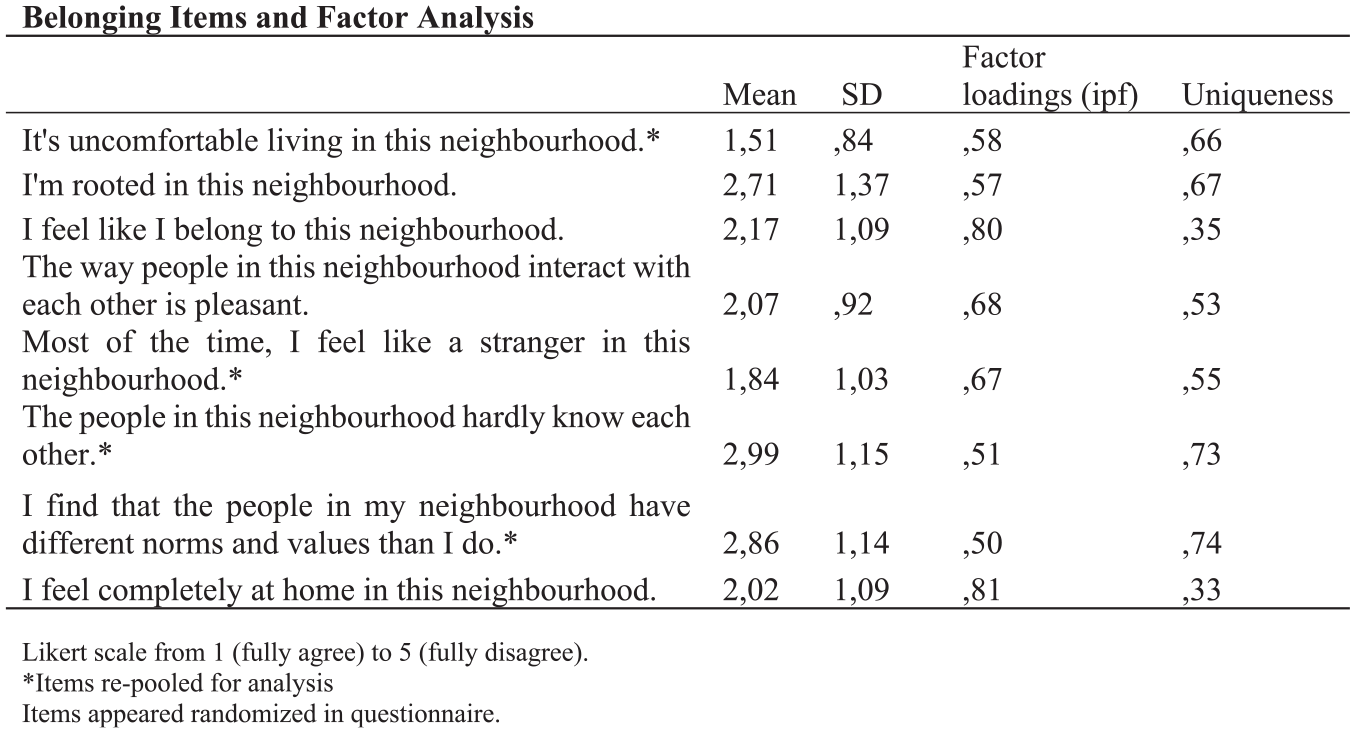
Belonging items and factor analysis.
Two other important concepts in our paper are practical neighbourhood use and public familiarity. Respondents filled out a long list of potential facilities and amenities (e.g. work, sport, leisure, counselling or others) and indicated whether they did these things, if at all, in the neighbourhood. We computed practical neighbourhood use as the proportion of things done locally of a respondent’s total activities within the last year. We used two measures as indicators of the theoretical idea of public familiarity: the frequency of talking with strangers in one’s neighbourhood and the frequency of running into people whom one knew from someplace else.
We chose a random sample and closed questionnaire as we believe that qualitative neighbourhood studies are prone to selection bias. As belonging is likely to correlate with neighbourhood use, finding research participants by ethnographic or participatory approaches risks over-representing people locally active and visible. To establish a correlation between variables, statistics are the best technique. To generalise towards a neighbourhood population and compare neighbourhoods, a random sample is best suited. Meanwhile, while statistics and larger surveys are necessary to establish correlations beyond anecdotical suggestions of these, correlations do not reveal causations. For the ‘why’ of the correlations we find, we draw on qualitative material and expert knowledge.
Research settings
Apolda Springs developed in the 1970s as part of a large GDR 7 estate built for the Communist workers before the Wende – the term used for the period when the Wall between East and West Berlin came down (1989) and FRG and GDR subsequently re-unified (1990). With federal home-ownership programmes for Eastern-based Germans and freedom of settlement after the Wende, Apolda Springs’ population declined. Factory closure induced high unemployment. State-owned shops, eateries and recreational activities disappeared. The attention on some of its residents’ radical right-wing voting and criminality negatively affected its reputation. With the Wall gone, people who moved in or to Berlin had little reason to move into the relative monotonous high-rise apartments, as the hinterland with its greenery and villages had opened with often extremely low prices for land and buildings. The sudden possibilities for West Berlin inhabitants to move from apartments in the crowded Western enclave to owner-occupied dwellings in towns and villages surrounding Berlin relaxed the housing market in the early 1990s. Newcomers, especially the creative class coming to Berlin by choice, preferred inner-city diversity. Apolda Springs’ vacancies were so high that the housing authority demolished entire apartment blocks. Subsequently, however, Apolda Springs’ popularity increased again, as its prices rose more slowly than those in other areas, reflecting the pressure on the housing market elsewhere.
Coswig Gardens is near Berlin’s centre in the former East, directly beside the former Wall, so a central location after reunification. While poor but bohemian before the Wende, rents increased after 1990, when renovations of the housing stock enhanced its desirability. It lies in the district that showcases Berlin’s gentrification (Schultze, 2017). Cafés and restaurants, design shops and bookstores, or commercial gentrification (Bantman-Masum, 2020; Zukin et al., 2009) now surround the upgraded apartments. With Berlin’s increasing popularity in the 2000s, the district became a destination of ‘transnational consumption’ (Hayes and Zaban, 2020) for wealthy residents.
Dorsten Heights, in the former US American sector in the West, has a more suburban nature, and a very stable infrastructure where shops advertise their long family traditions. Once a village between meadows, a builder in the mid-19th century bought the area from bankrupt nobility in order to develop it into a Villenkolonie for white-collar workers. After the destruction of World War II, more modest development made the area more diverse, but it still maintained its middle-class, white dominance over time. In the years following the Wende, housing prices here went up more than elsewhere in Berlin when the federal government moved from Bonn to the capital, reinforcing its middle-class socio-demographic structure. With the German reunification, the US American army left the city, leaving land previously used by the army vacant. Developers built single-family dwellings and apartments sold to middle-class people with young children.
Borkum Rock is a low-income neighbourhood with high ethnic/racial diversity located in a district right at the former Wall in the West. The district was a town incorporated into Berlin in the 1920s and, initially, developed as working-class area when Berlin boomed as an industrial city. It was known as overcrowded, with low-quality housing, often without central heating or private sanitary facilities. German, Turkish and Arab working-class families rubbed shoulders. Students ‘discovered’ the neighbourhood when other areas outpriced them in the early 2000s. Borkum Rock lies in the district where contestation over housing rights now is strongest. With its increase of artistic, alternative and political spaces, rental prices started rising rapidly and commercial gentrification commenced: hipster bars, vegan restaurants and bike-shops mushroomed. Residents with a mobility of ‘long-term travelling’ (Watt and Smets, 2014: 7), or ‘expats’ (Beckers and Boschman, 2019), drove up prices (Holm, 2013). Meanwhile, the wider area developed its Turkish, and especially Arab, infrastructure of mosques, chicken restaurants, kebab houses and shisha bars.
Analyses
We computed OLS linear regression models with corrected standard errors on the neighbourhood level, with the factor score on neighbourhood belonging as dependent variable. Such models are used to see how well a change in an independent variable (example: length of residence) are associated with changes in a dependent variable (here: the factor score composed from answers on the questions that measure belonging) controlled for other influences. We had the following hypotheses for the most important concepts on how they affect neighbourhood belonging. In addition, however, we assume that the residential neighbourhood setting can significantly shape, if not invert, these basic trends – which we discuss in the following analysis.
H1: Overall, years of residence are positively associated with the factor score on neighbourhood belonging (FSoB).
H2: Practical neighbourhood use is positively associated with FSoB.
H3: Public familiarity indicators ‘talking to strangers’ and ‘meeting known people’ are positively associated with FSoB, while controlling for practical neighbourhood use.
H4: The residential neighbourhood setting of survey-participants importantly affects the relationships formulated in H1–3.
Length of residence and belonging
Figure 2 models the relationship between length of residence (horizontal axis) and the advance in belonging (vertical axis), controlling for age, migration status, gender, employment status, education, the existence of local friends and family and the ratio of local support contacts. 8 Belonging strengthens over time in all areas. But people who have arrived recently show greater differentials in belonging between the neighbourhoods than long-time residents, with the effect strongest in Apolda Springs and marginal in Coswig Gardens. While residents who just moved to the neighbourhood have an almost 1.4 factor score lower prediction in belonging in Apolda Springs than in Dorsten Heights, these differentials converge for long-term residents to about 0.3 when residing for 40 years.
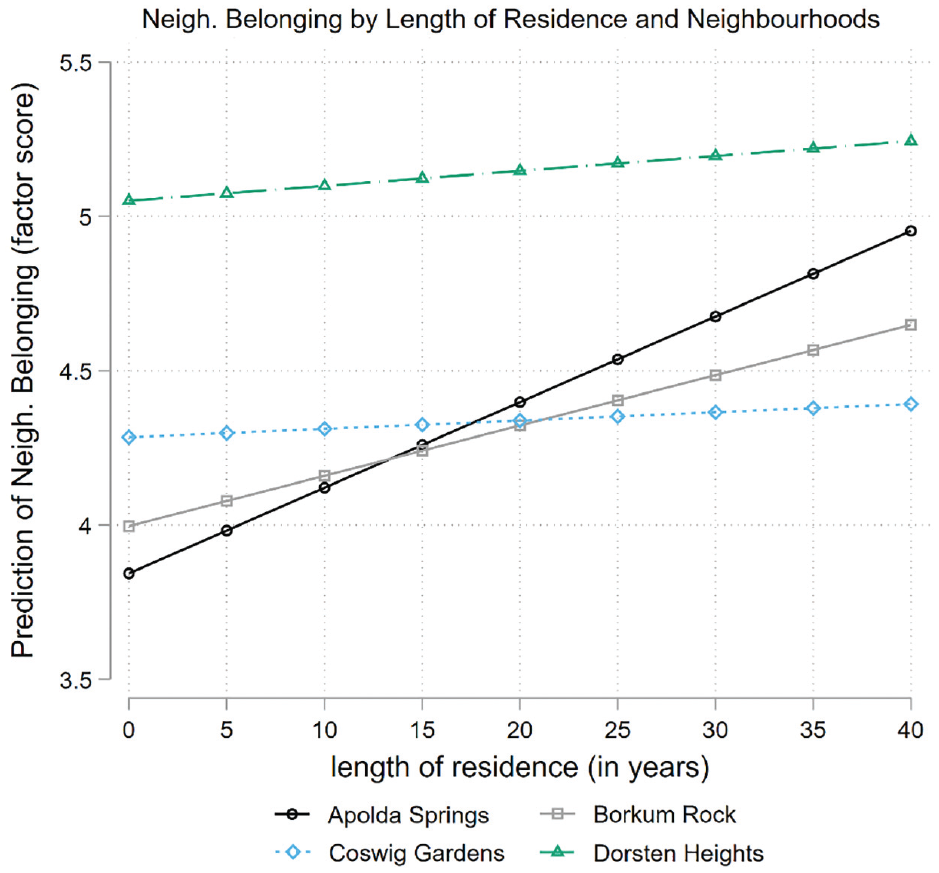
Neighbourhood belonging by length of residence and neighbourhoods.
The relationship between length of residence and belonging is significantly but moderately positive in Dorsten Heights and Coswig Gardens, independent of individual class positions, for which we controlled. This seems to confirm the common idea that in residentially stable neighbourhoods, residence length associates positively with collective attachment (Sampson, 1988: 778). We could hence simply refer to their overall middle-class character. But the description of the settings showed that their infrastructures, built environment and histories enable different lifestyle enclaves (on enclaves defined by lifestyle see also Cocola-Gant and Lopez-Gay, 2020; Hayes and Zaban, 2020). Both now appear stable middle class; only Dorsten Heights ‘always’ was.
Gentrification is symbolic when caused by ‘indirect displacement’: when residents do not feel at home any longer in a changing neighbourhood (Marcuse, 1986 in Elliott-Cooper et al., 2020: 495; Sequera and Nofre, 2020). Coswig Gardens’ infrastructure fits the habitus of residents. The global signs of gentrification which people with routes have learnt to read are readily available, as discussed in recent scholarship on ‘lifestyle migration’ (overview: Hayes and Zaban, 2020). Arrivals may feel at home immediately.
Yet belonging is not so pronounced as in traditionally middle-class Dorsten Heights, where it is highest. This may be an effect of the stable settlement structure, where long-term facilities, social class and race/ethnicity changed little overall. Dorsten Heights may allow people to quickly experience ‘roots’ as homogeneity is high (if they fit, see Baumgartner, 2010). In Coswig Gardens, a ‘re-invented city’ (Karsten, 2014) has been constructed for residents who overall may define themselves more along routes (Blokland, 2017), and whose practices may be seen as incremental acts of cultural displacement (de Oliver, 2016) without the role of ethnicity.
As we discussed, Apolda Springs with its high-rises has its strengths and charms but was and is not a tenant’s first preference. Presumably, not all arrivals came to Apolda Springs as a lifestyle choice. We suspect that the design of the settlement does not to evoke an immediate identification. It may need time.
In Borkum Rock, residence duration increases belonging scores more than in Coswig Gardens and Dorsten Heights, but less than Apolda Springs. This may be for two reasons. First, Borkum Rock is similarly low-income but much more ethnic/racially diverse than Apolda Springs. Borkum Rock, therefore, may have produced sites of identification for a broader spectrum of residents than the other neighbourhoods, but more as intercultural conviviality (Noble, 2013; Radice, 2011; Wessendorf, 2013) with, beyond one’s inner circle or ‘rooms without walls’ (Ye and Wafer, 2015: 201), a sense of ‘ethics of indifference’ (Tonkiss, 2003). Length of residence may thus produce less change in belonging than in Apolda Springs, where all there is, crudely put, is a place-based story because you lived through it: the place itself hardly ‘speaks’. As Ruch (2020) showed in a small-scale study of street signs, Apolda Springs gives away few identifiers of ethnicity or migration histories or global signs of class. Graffiti tags and stickers require inside knowledge to make sense. In contrast, Borkum Rock is rich in such signifiers.
Length of residence and belonging are thus not independent but positively associated (H1). However, the relationship is not of the same strength in all areas and not simply linear (H4): it is mediated by settlement’s characteristics and the support these provide for symbolic neighbourhood use, in support of (one homogeneous or a diverse set of) habitus.
Belonging, length of residence and practical neighbourhood use
Many researchers test the relevance of practical neighbourhood use solely based on the factual use of local amenities (overview: Kearns and Parkinson, 2001) especially when they have a relative stability (Vagni and Cornwell, 2018). What happens to the strength of belonging when we also include length of residence? If I go to a bakery for 20 years, may my belonging differ from that of people who moved in a year ago and stand in line with me for rolls, but have far less connection with the baker? Or does it not matter, because the waiter in the local restaurant knows me after three visits, so I do not need years to become locally embedded? Our next model tests this. We add the interaction between practical use, length of residence, its square term (a technique to model possible non-linear relationships) and visualise ‘low’ and ‘high’ use (Figure 3).
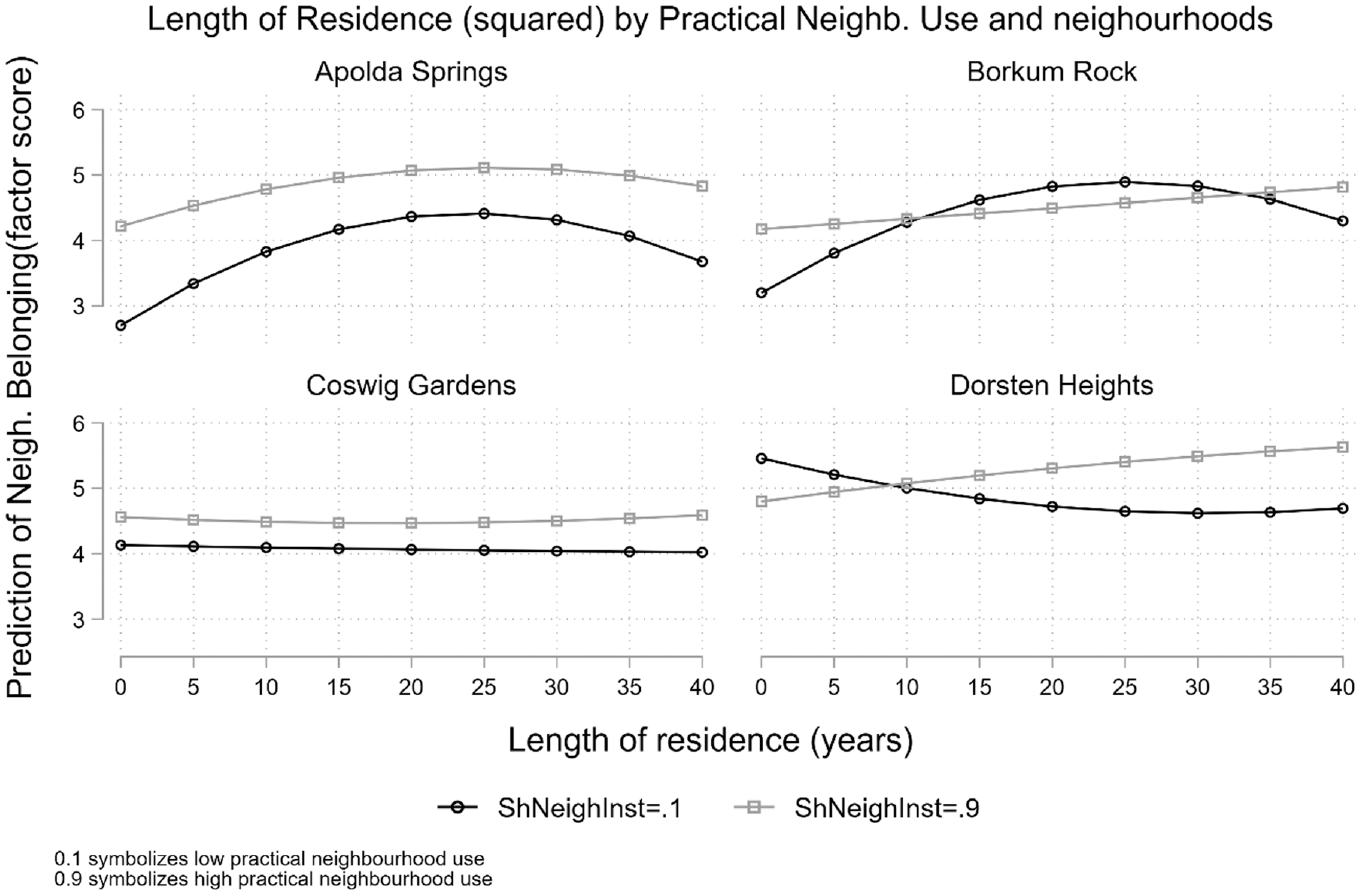
Neighbourhood belonging by length of residence (squared), practical neighbourhood use and neighbourhoods.
While practical neighbourhood use mediates the relationship between residence length and belonging, it is not having the same effect in each area. This suggests again that the type of settlement, including the nature of what a restaurant or bar may look like, how a park is organised or what sort of shops are located there and at what distance (Elldér et al., 2022), as well as its historical embeddedness, produces different effects, in line with research results on neighbourhood consumption and lifestyles (Hayes and Zaban, 2020). It is not the residents’ characteristics or the neighbourhood as a site of a specific population, but the ways in which people turn potential environments, which are already incongruent, into effective environments (Gans, 1991). How places are ‘nested’ in practical uses and routines alone cannot be unproblematically linked to belonging (cf. Bosch and Ouwehand, 2019; Kusenbach, 2008).
In middle-class suburban Dorsten Heights, for people who use the infrastructure little but have lived there for a long time, belonging is negatively impacted by length of residence. When living in the area longer comes together with higher use, belonging increases. Practical and symbolic neighbourhood use feed each other, and this becomes more important for people the longer they live there. The standard literature on neighbourhood, neighbourhood facilities and local attachment usually finds this. But in Coswig Gardens, amenities usage does not influence the correlation between length of residence and belonging. Apparently, practical neighbourhood use does not always matter.
In working-class, hyper-diverse Borkum Rock, length of residence is most positively related to belonging when neighbourhood use is low. High use reduces the effect of length of residence. Through practical neighbourhood use, Borkum Rock residents may be said to ‘compensate’ for lack of years spent there. But having no local spots to go to regularly reduces belonging especially for people who lived there for a (very) long time.
In high-rise area Apolda Springs, length of residence matters both for those who use the neighbourhood and those who do not, with users having a slightly higher belonging. However, then the line drops again at over 20 years, especially for those with lower use. So, time of living in this area does not follow a simple principle of ‘the longer, the more established and at home’: it becomes a negative relation for residents who already lived in Apolda Springs before the Wall fell. Between 20 and 30 years ago, residents saw their neighbourhood change and their social networks transform when others left. When they do use local facilities the decrease in belonging is less severe.
Practical neighbourhood use, therefore, sometimes matters (H2 and H4). First, the standard idea of practical neighbourhood use affecting belonging fits the relatively stable middle-class neighbourhood but does not apply in the same way to a working-class area with hyper-diversity, a gentrified neighbourhood, or a high-rise outskirt estate: settlement matters. Second, we identified a sharp moment of transition in Apolda Springs. It separated those who lived there for a long time and lost connectivity as they also limited their practical use and those who lived through changes but kept a practical neighbourhood use.
Belonging, length of residence, neighbourhood use and public familiarity
As belonging, residence duration and practical use do not directly correlate, simply not all facilities matter. Apparently, simply counting years since we used them also does not explain much. Neighbourhood use measured by what people do locally is a wonderful survey tool, but, as part of the literature (Kusenbach, 2008: 231–239, 2006; Laurier et al., 2002; Valentine, 2008) already suggests, does not necessarily cover neighbourhood public life. Could it be that it is not the frequency of use as such, but the actual usage that affects a neighbourhood’s familiarity matters most? Perhaps it is not the bakery, but my connection to the baker, and not the restaurant, but the waiter affects my belonging?
Then, encountering others at the same place repeatedly without getting to know them personally may be important, as well as brief conversations between strangers and communication between people that we encounter in public and that are already familiar faces: in short, it may matter to what extent a neighbourhood constitutes a zone of public familiarity.
To test this, we use two PF indicators: whether people ever speak to people that they do not know in neighbourhood streets and squares and whether people in their neighbourhood repeatedly run into others that they know. We assign 1 to all who reported this at least weekly and 0 to those who did less frequently, or never. The figures visualise predicted margins and predictions of the effect of length of residence on belonging, depending on the neighbourhood and PF items, controlling for practical neighbourhood use (H3 and H4).
Figure 4 visualises ‘talking to strangers’. In Dorsten Heights, people who speak to strangers belong a little stronger, but it does not affect the relationship between length of residence and belonging. Living in highly diverse Borkum Rock matters for belonging for about 15 years. After that, people who speak to strangers show a weaker connection between belonging and length of residence. So, people’s belonging seems less affected by the neighbourhood’s transformations when these old-timers do not use local facilities much and do not speak to strangers. This supports the thesis that who are the established and who are outsiders is not a matter of who came first. Our data suggest that long-term residents who remained outside of local dynamics, because they do not get around much and do not talk to strangers belong, indeed as Watt (2009) suggested, selectively. ‘Anxieties about neighbourhood change’ (Pinkster, 2016: 888) or feelings of being ‘out of place’ (Davidson, 2009) appear smaller for those who avoid stranger talks.
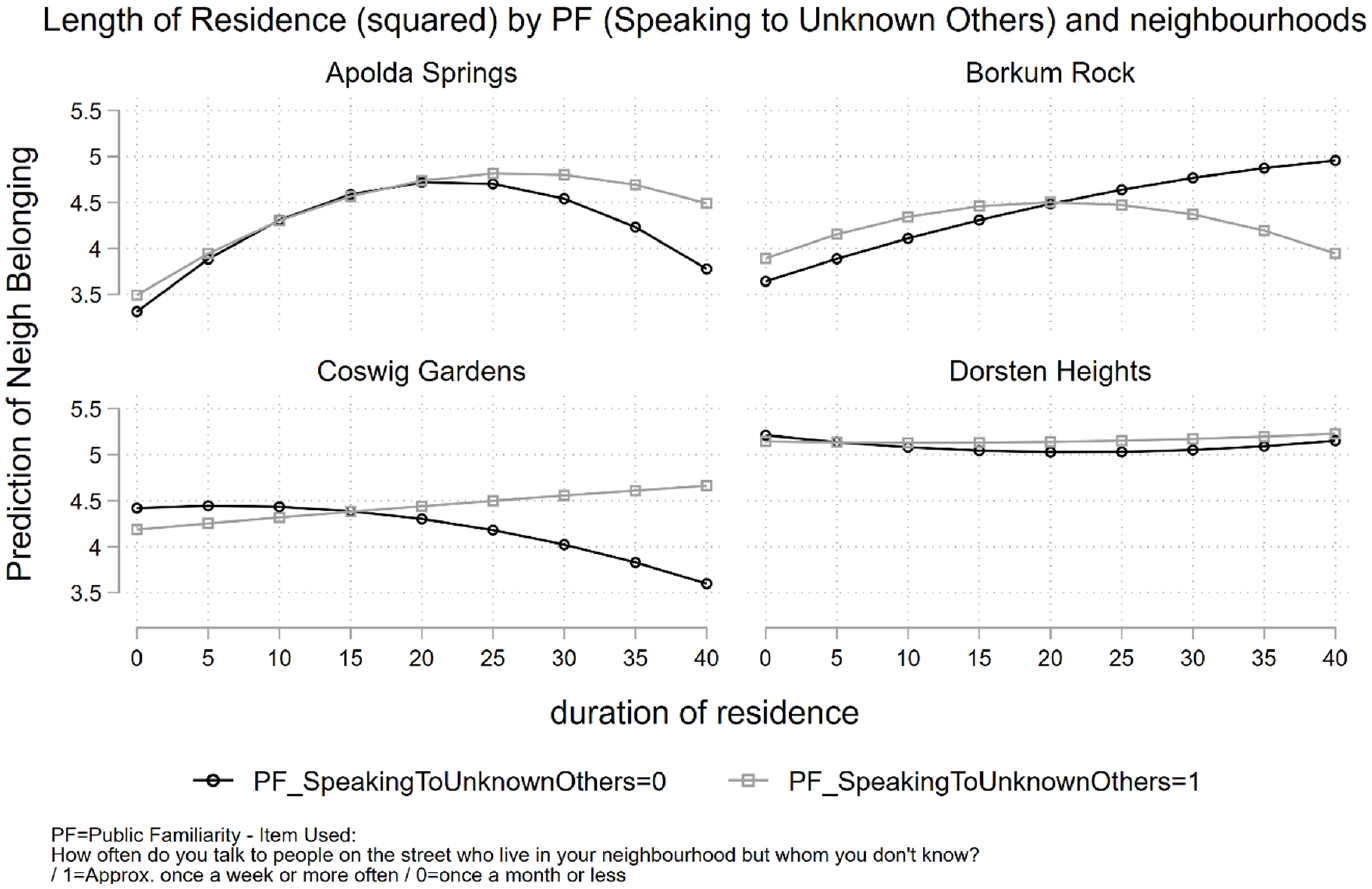
Neighbourhood belonging by length of residence (squared), public familiarity (speaking to unknown others) and neighbourhoods.
In Coswig Gardens, the downtown middle-class neighbourhood where practical use did not matter, people who speak to others that they do not know have different experiences than people in Dorsten Heights. The data confirm that public familiarity facilitates symbolic neighbourhood use: if someone never speaks to anyone, the longer she lives in the area, the less she feels like she belongs. If residents communicate with unknown others, living there for all those years enhances belonging, strengthened by the chit-chat in streets and squares. This is especially the case for people who remained in the area after the Wende: after 20 years of residence, the relation changes. In our first model (Figure 2), we just computed the interaction between length of residence and neighbourhoods. In gentrified Coswig Gardens, belonging was least affected by length of residence. Figure 4 clarifies that how long somebody lives in Coswig Gardens does play a very important role – but this is moderated through daily interactions. While Coswig Gardens upgraded, Borkum Rock became significantly more diverse in publicly visible lifestyles and political positions over time. Long-term residents seem to gain something from talking to strangers in Coswig Gardens while in Borkum Rock, they do not.
In Apolda Springs, talking to strangers does not make much difference for belonging in the first years of living there. This changes when the Wende starts to matter – with more than 20 years, length of residence brings belonging scores slightly down, while people who speak to strangers maintain a higher belonging than people who do not. In contrast to hyper-diverse Borkum Rock, where talking to strangers if you live there for a long time reduces your belonging, in Apolda Springs and Coswig Gardens, public familiarity softens the effect of having lived through transformations which negatively affected belonging.
Figure 5 models the effect of whether people run into others they know, our second indicator of PF (H3 and H4). In Borkum Rock and Dorsten Heights, the areas where we also found a relation between practical neighbourhood use and belonging, residents who run into known others have a slightly stronger belonging than residents who do not. Such encounters apparently compensate for being new, and they do not matter more as time proceeds. In Borkum Rock, encountering known faces in one’s own bubble or, as suggested by Ye and Wafer (2015: 201), in ‘rooms without walls’, works positively.
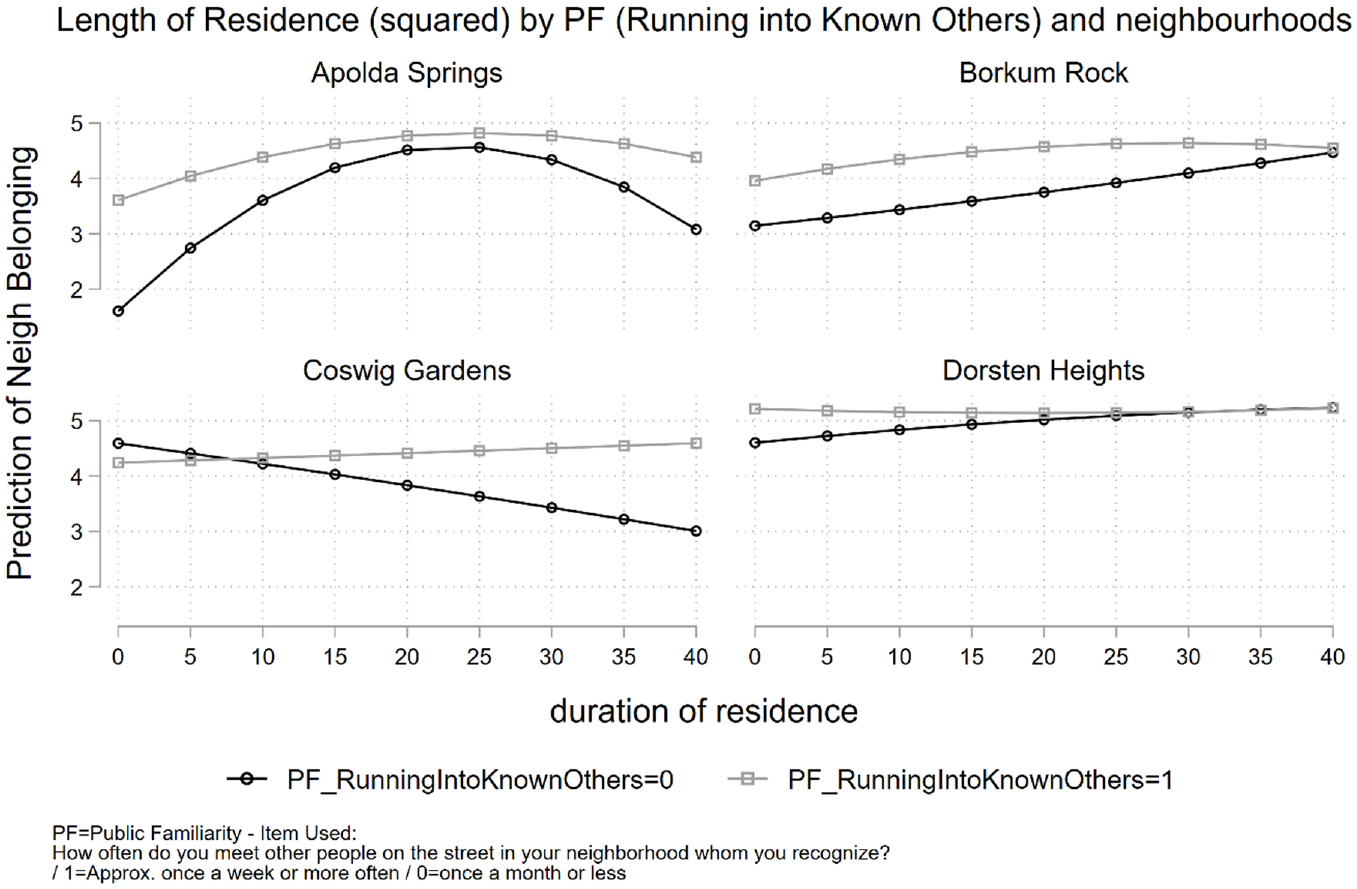
Neighbourhood belonging by length of residence (squared), public familiarity (running into known others) and neighbourhoods.
Coswig Gardens’ residents who report such recognition score higher on belonging items and belonging goes up, the longer they live there. When people do not run into known others, their belonging is lower, and becomes even lower over time. As stated previously just use of facilities was without effect in this area. Thus, the social fabric of settlements matters for belonging: people who do not meet people they know, no matter how frequently they use facilities, feel less at home, the longer they live in Coswig Gardens.
In Apolda Springs, belonging starts on a low level and picks up with years of residence: residents get used to being there. Recognising others helps belonging greatly in Apolda Springs for people who just moved there. But the effect of seeing known faces wears off again after 20 years. Belonging is almost equal now, with public familiarity or not. For the old-timers of Apolda Springs, the absence of PF makes neighbourhood belonging harder. This indicates that people with roots in the neighbourhood may experience that it is no longer ‘theirs’, not as an abstract, collective discursive reaction to neighbourhood transformation or nostalgia. Their sense of less belonging in a neighbourhood of transformation is clearly mediated by public familiarity.
Conclusion
In times of gentrification and globalisation, neighbourhoods are highly differentiated settlements (Gans, 2009). Against fixity of urban settlements, neighbourhood transformation must be more strongly accounted for in studies of neighbourhood belonging.
Our analysis makes three contributions to doing so. First, we confirmed that length of residence affects belonging, supported by infrastructure use – but it does so differently, depending on each settlement as historical configuration. Two neighbourhoods with high transformation since the Wende but little ethnic diversity and homogeneously gentrified commercial infrastructure (Coswig Gardens) or functionally segregated infrastructure (Apolda Springs) saw no effect of practical neighbourhood use. In Borkum Rock with all its immigrant presence in commerce, long-time residents (<25 years) belonged more strongly when they used the area less. Neighbourhood infrastructures alone, therefore, do not support belonging. Just the number of shops, cafés and other facilities does not matter. Such infrastructures matter selectively, and transformation of the commercial infrastructures and functional differentiation must be considered.
Second, and most importantly, interactions in streets and squares on the way to amenities as well as interactions there, not simply the ‘use’ of local amenities, affect the connection between practical and symbolic neighbourhood use in the form of ‘belonging’. We explored statistically whether public familiarity, measured by talking to strangers regularly and running into known others, affected whether length of residence correlates with belonging. We showed that stronger ruptures in a neighbourhood increased the relevance of public familiarity as a mediator of the relationship between length of residence and belonging. Whereas the effect of talking to strangers in neighbourhoods was positive in areas that saw transformation without strong increase in lifestyle diversity, it was negative in Borkum Rock which became highly diverse in all regards. In short, then, neighbourhood matters for belonging both for those with roots and routes, and length of residence is most certainly not the key variable anymore.
Third, politics of belonging, of simple established/outsiders-figurations may have lost its explanatory potential as we moved from the fixity of 50 years ago to figurations that require new conceptual thinking. The social fabric of settlements matters for belonging and impacts how place attachment develops, which is less straightforward than we may have thought. From the insight that belonging is a practice, it may be necessary to differentiate the idea that the more meaningful interactions with a place, the greater the attachment (Milligan, 1993 in Paulsen, 2019: 2). This can be a next step in critically re-assessing the ideas that time spent in a particular neighbourhood alone produces local belonging as a positive person–place relationship per se, and that local power relations are generally outcomes of length of residence.
Supplemental Material
sj-docx-1-usj-10.1177_00420980221136960 – Supplemental material for Roots and routes in neighbourhoods. Length of residence, belonging and public familiarity in Berlin, Germany
Supplemental material, sj-docx-1-usj-10.1177_00420980221136960 for Roots and routes in neighbourhoods. Length of residence, belonging and public familiarity in Berlin, Germany by Talja Blokland, Robert Vief, Daniela Krüger and Henrik Schultze in Urban Studies
Supplemental Material
sj-docx-2-usj-10.1177_00420980221136960 – Supplemental material for Roots and routes in neighbourhoods. Length of residence, belonging and public familiarity in Berlin, Germany
Supplemental material, sj-docx-2-usj-10.1177_00420980221136960 for Roots and routes in neighbourhoods. Length of residence, belonging and public familiarity in Berlin, Germany by Talja Blokland, Robert Vief, Daniela Krüger and Henrik Schultze in Urban Studies
Footnotes
Acknowledgements
The authors thank the following people for contributing to the paper: Jule Benz (data processing, interview coordination), Ceren Kulkul, Matthias Jacob (corrections and layout), Marieke Prey, Kaspar Metzkow, Maria Stachira (interview coordination), Aaron Kurz, Anastasiia Tcypina, Ann Katzinski, Anna Kravets, Antonia Welch Guerra, Ecem Karadeniz, Esther Feiertag, Fabian Schridde, Felix Schott, Imke Götting, Jeremy Lacher, Katharina Gebhard, Leon Krüger, Lara Gromm, Marlen Mai, Richard Mattmüller, Sarah Hegasy, Selen Ericok, Skarlett Schubert, Teresa Becher, Tomke Roolfs and Zeliha Kabakci (interviews). All contributors were paid. We also thank the anonymous reviewers for their feedback.
Declaration of conflicting interests
The author(s) declared no potential conflicts of interest with respect to the research, authorship, and/or publication of this article.
Funding
The author(s) disclosed receipt of the following financial support for the research, authorship, and/or publication of this article: This project was funded as Partial Project C04 in the Collaborative Research Centre 1265 ‘Re-Figuration of Spaces’ by the German Research Foundation (DFG).

Supplemental material
Supplemental material for this article is available online.
Notes
References
Supplementary Material
Please find the following supplemental material available below.
For Open Access articles published under a Creative Commons License, all supplemental material carries the same license as the article it is associated with.
For non-Open Access articles published, all supplemental material carries a non-exclusive license, and permission requests for re-use of supplemental material or any part of supplemental material shall be sent directly to the copyright owner as specified in the copyright notice associated with the article.
