




Abstract
Temporary populations – tourists, temporary stayers, non-resident students – constitute a substantial share of many cities’ inhabitants. Their implications are normally the object of separate research, about over tourism, studentification, transnational gentrification. When viewed from the perspective of the sociospatial relations those populations have in and with the city, many similarities emerge in their urban practices, socio economic characteristics, locational and housing preferences. The paper aims to contribute to recent attempts to avoid traditional categorisations and investigate jointly how the inflow of temporary inhabitants produces effects at the urban and sub-urban scales. The COVID-19 pandemic will then be used as a natural experiment to estimate how they distribute in the city of Rome, Italy, which is crucial to a better understanding of their impact. Temporary populations, we argue, are a very visible source of both hard and soft urban changes, and a major driver of not only neighbourhood change but sociospatial polarisation at the whole city scale. The pandemic also offers an occasion to see how dependent cities are on temporary inhabitants and to reflect upon the ambivalence in how they see those populations as either a gain or a burden, something they struggle to attract or as a source of tensions and opposition.
Introduction
Large urban areas have always attracted a variety of temporary populations, defined in this paper as people moving voluntarily to a city for a more or less short period but with no intention to settle there permanently. This is particularly evident in the age of hyper-mobility. The negative implications have been the object of research dealing with, for example, over tourism (Celata and Romano, 2022), studentification (Nakazawa, 2017) or transnational gentrification (Sigler and Wachsmuth, 2020). Each temporary population is usually addressed separately because in terms of conventional categories – such as motivations, push and pull factors, duration of stay – and according to common sense, tourists, students and temporary stayers have little in common. However, when viewed from the perspective of the sociospatial relations those populations have in and with the city, many similarities emerge in their urban practices and in how they contribute to urban change.
The paper aims to contribute to recent attempts to investigate how the inflow of different categories of temporary inhabitants produces effects at the urban and sub-urban scale. Several studies addressed this topic from the perspective of specific sub-groups, or of the neighbourhoods where they (co-)locate. Our first aim is to put these studies into conversation. To this end, we will provide a review of research that, from a variety of perspectives – mobility, tourism, migration or gentrification studies – stresses the need to avoid traditional categorisations and provides insights into what those populations have in common and their implications. We will then focus on the locational patterns of temporary inhabitants in the city, as they are indicative of their urban practices and crucial to understanding their effects. The option is to investigate how and where temporary populations contribute to urban density, that is to show how topographical density is constituted by multiple space-times (McFarlane, 2016) and the layering of different populations, distinguished based on the length of their permanence. The case study is that of Rome, Italy, due to its attractiveness towards various typologies of temporary inhabitants.
The paper brings conceptual and empirical insights. In the second section we outline a definition of temporary populations and link different branches of research that deal with specific and relevant sub-groups. Based on this review, in the third section we reflect upon what those populations share in terms of sociodemographic characteristics and practices of the city.
In the fourth section we attempt a quantification of temporary inhabitants in Rome, a frequently discussed challenge within research on the topic (Bell and Ward, 2000). Conventional sources provide some evidence but are limited in many respects. Unconventional sources exist that are either direct (e.g. mobile phone data) or indirect (e.g. electricity consumption) but those sources are difficult to access and to use for distinguishing between permanent and temporary inhabitants. More importantly, data at the urban and sub-urban scales are very rarely available. The idea in this paper is to use the COVID-19 pandemic as some sort of natural experiment. One of the most visible effects of lockdowns has been the disappearance of those who visit the city for a few hours (commuters), a few days (tourists) or for longer stays (non-resident students and other temporary populations). On this basis, in the fifth section we provide a spatial analysis and mapping of the distribution of temporary inhabitants in Rome.
In the sixth section and the conclusions we will put our empirical findings in conversation with previous research on the topic to highlight how temporary populations impact increasingly gentrified and unequal cities. The pandemic is also an occasion to see how dependent certain cities or parts of the city are on temporary inhabitants, and to reflect on the ambivalences in how cities see those populations as either desirable or undesirable, a gain or a burden, something they struggle to attract or as a source of tensions and opposition.
Defining temporary populations
The difficulty in defining temporary populations is a common trait of research on the topic. The easiest way is to include anyone who is not a permanent resident, but this is not necessarily resolutive. Besides some groups that are inevitably temporary – e.g. tourists – a rigid distinction between permanent and temporary inhabitants is problematic as both may be more or less mobile and the boundaries are blurred. Residency, moreover, is a legal attribute and does not necessarily correspond to where people predominantly live, although the two should correspond. Being temporary, moreover, might be a choice as it is for tourists, or a legal constraint as it is for migrants denied a permanent permit to stay. It is also an issue of perceptions and perspectives, especially if we define temporary inhabitants as people with no clear intention to settle permanently, and not simply an issue of duration (Robertson, 2014). Formally, the boundary between tourism and migration is, for example, based on the length of stay, but the threshold varies between countries and is merely conventional: it may be three, six or twelve months; the same applies to the distinction between temporary and permanent migrants.
In line with the definition given above, the forms of mobility this research is interested in are in between the two extremes of, on the one hand, day-time visits, and on the other hand more ‘conventional’ forms of migration that may be more or less permanent, mobile, and consequently temporary but still imply a longer-term project when compared to the temporalities we refer to in this paper. In other words, the experience of many contemporary migrants is better captured by the idea of ‘permanent temporariness’ (Collins, 2012) rather than temporariness alone.
We are aware that such scope is broad and includes very different forms of mobility: our goal is to explore what those have in common without denying their specificities. Instead of searching for an overall definition, an alternative is to proceed ‘from below’ by reviewing how researchers addressed specific groups of temporary inhabitants that cannot be easily classified within more traditional categories.
One of the first was Wilbur Zelinsky who introduced the concept of ‘circular migration’ in 1971. Despite the term being predominantly used to describe the impermanent character of contemporary migration, the examples provided by the author were broader and included short-term movements such as: ‘weekend or seasonal movements by students; vacation and weekend travel; shopping trips; […] travel to professional and business conventions; trips by government and business executives; […] social visits […]. The volume, intensity, and nature of circulation’, the author stressed, ‘is such that there is no realistic alternative to treating all territorial mobility as a single continuum, extending from the shortest, most routine of iterated motions to the most adventurous intercontinental journey’ (Zelinsky, 1971: 226).
Within such a continuum between short-term and permanent stays, one end of the spectrum is occupied by urban tourists whose temporariness increases along with their decreasing length of stay (Gössling et al., 2018). On the other hand, in their motivations, the threshold between visiting a city and ‘living’ there ‘like a local’ has blurred. This is one of the reasons behind the success of short-term rentals in residential apartments, which make tourists less distinguishable from residents (Celata and Romano, 2022).
The need to overcome traditional boundaries is particularly evident when observing certain categories of ‘quasi-tourists’ that have inspired several definitions, such as residential tourism (Janoschka and Haas, 2014), transnational flaneurism, post-tourism, ‘as “if” tourism’ or place consumption (Novy, 2018). World cities are among the preferred destinations for quasi-tourists, together with coastal resorts (Benson and O’Reilly, 2009): southern, coastal cities are therefore incredibly attractive. Separating tourism from other forms of mobility is especially difficult in world cities because the demand they activate is similar (Novy, 2018).
At the other end of the continuum between short and long stays – that of ‘conventional’ migration – the emphasis on circulation has been recently complemented by inquiries on novel forms of mobility that can be classified as neither tourism nor migration. It is the case of ‘leisure’ or ‘lifestyle’ migration, whose diffusion is due to many causes such as hyper-mobility, labour flexibility and increased wealth (Benson and O’Reilly, 2016). Those temporary movements are mimetic of tourism practices and also ‘tourism-informed’ (Williams and Hall, 2000): many lifestyle migrants (sometimes even temporary labour migrants) visit their destination before deciding to move there for longer periods (Jover and Díaz-Parra, 2022). Not to mention that the availability of ‘amenities’ is a significant predictor of the decision to undertake even more permanent forms of migration, as well as the choice of the destination (Rodríguez-Pose and Ketterer, 2012), especially concerning internal migration flows – although ‘amenity migration’ is usually associated to non-urban destinations. What makes cities attractive for those categories of migrants is similar to what makes them attractive to tourists – urbanity, liveliness, material and immaterial heritage (Jover and Díaz-Parra, 2022). Those drivers may even supersede traditional pull factors such as economic opportunities, even for (temporary) migrants whose primary motivation is work (Brown, 2015). Research on ‘creatives’ has for example shown that ‘lifestyle’ or quality of life can be an important concomitant motive for the more qualified and wealthy migrants which, more importantly, represent a substantial and increasing share of flows towards so-called ‘super-star cities’, simply because the benefits of living there exceed the costs of migrating only for the most skilled (Storper, 2018).
Another option is to locate the various drivers of mobility within a continuum between production (work) and consumption (leisure) (Bell and Ward, 2000; Smith, 1989). About the latter, of particular relevance is the concept of ‘city users’ introduced by Guido Martinotti in the early 1990s to indicate the variety of populations ‘consuming’ a city without living or working there. The category includes tourists, second-homers, non-resident students and nomadic professionals (Martinotti, 2005). What the above-mentioned inquiries show, however, is that motivations are often mixed. The same applies to second homers and so-called ‘pied-a-terre urbanism’ (DeVerteuil and Manley, 2017) whose aim is both to ‘consume’ the city for short periods and to invest in its housing market.
Mixed motives are also typical of an important and growing form of temporary migration, that of non-resident students (Frändberg, 2014). Education is a form of consumption but aimed to acquire working skills. Many non-resident students also tend to work, more frequently than their local ‘schoolmates’ (Staniscia, 2012). Their primary motive is to obtain more prestigious degrees, but also to improve their employment opportunities, occasions for sociability or quality of life (Ward and Masgoret, 2004).
Lifestyle migration has both non-economic and economic motives: it is therefore more an analytical tool than a specific category of migrants (Benson and O’Reilly, 2016). However important lifestyle or flaneurism may be, career prospects are still the predominant driver of most temporary (as well as longer-term) movements, both internally and internationally (Frändberg, 2014). Lifestyle migrants are themselves often working. In this regard, increased mobility and the salience of temporary inhabitants is also, if not predominantly, a consequence of a working condition that is itself increasingly short-termed, precarious and mobile (McIlwaine and Bunge, 2019).
Another relevant definition is that of the ‘floating population’, predominantly associated with Chinese massive internal migration flows and the attempts to discourage their permanent settlement (Du et al., 2018). However peculiar the case of China is, this definition will be used in this paper because it expresses the floating character of temporary populations, as well as their ‘state of flux and, consequently, lack of local embeddedness and a certain passivity vis-à-vis the city contexts and atmospheres they “consume”’ (Carvalho et al., 2019: 570).
A peculiar expression of this ‘state of flux’ is that of transregional or transnational commuters, who sometimes stay overnight (Ralph, 2014): they account for 1% of the total workforce in the EU (Eurostat, 2020). Another relevant category is that of ‘digital nomads’– young professionals working solely in an online environment (Reichenberger, 2018) – a group which has grown considerably thanks to the pandemic, and is by definition very mobile, being particularly flexible in the choice of their place(s) of residence.
The invitation to avoid rigid categorisations is also one of the main founding acts of the new mobilities paradigm which, besides other things, emphasised the importance of tourism while questioning its specificity compared to other forms of mobility (Novy, 2018). Notwithstanding the emphasis on movement and flows, temporariness as well as permanence, emplacement and stillness, are crucial terms in the vocabulary of mobility studies (Cresswell, 2012). From the very beginning this research has underlined the intimate link between mobility and immobility (Meier and Frank, 2016) and emphasised the crucial role of ‘moorings’ that anchor mobility to specific infrastructures, sites and cities (Hannam et al., 2006). Still, a more explicit engagement with temporariness can help in finding a middle ground between the obsession for sedentarity that dominates the social sciences, and the emphasis on movement that followed the mobility turn (Meier and Frank, 2016). More importantly, those studies emphasised how mobility, immobility and motility intersect issues of identity, gender, class and sociospatial relations. It is to some of those intersections that we now turn.
Qualifying temporary populations
Despite the difficulties in outlining exclusive boundaries between each of the temporary populations described above, they are indeed very different. However stereotypical the imaginary of the ‘tourist’ or the ‘migrant’ may be, those stereotypes still have some explanatory power. At the same time, temporary populations share many common traits that are crucial for understanding their practices and implications.
In terms of demographics, they are relatively younger than the average resident. This is obviously the case for students. Frequently, lifestyle migration is also some sort of rite of passage to adulthood (Frändberg, 2014). Temporary movements for labour purposes tend to take place at the beginning of the working age (Crisci and Di Tanna, 2016). However, in comparison to permanent migration, temporary migrants show a second peak during retirement age (Bell and Ward, 2000). This is also due to a form of mobility that is similar in motivation to lifestyle migration, and growing: retirement migration (Benson and O’Reilly, 2009). Tourists are more evenly distributed but Eurostat data shows that approximately 40% of them are between 25 and 40 years old. Almost all ‘transnational gentrifiers’ are within this same age group (López-Gay et al., 2021). The inflow of those populations may therefore contribute to cities’‘youthification’ (Moos et al., 2019) and counter-balance the ageing of the permanent inhabitants.
Many temporary inhabitants also have higher incomes and/or budgets compared to the average resident. Lifestyle migration is almost exclusively associated with affluent individuals (Benson and O’Reilly, 2009). Temporary stays for labour purposes are obviously more mixed in terms of socio-economic background, although – as already mentioned – flows towards the most attractive and wealthy cities are today, to a larger extent, composed of highly skilled individuals; this is true also for temporary migrants in general (Crisci and Di Tanna, 2016). Tourism is no longer an exclusive privilege for the wealthiest, as tourists today are also middle- and even low-income. Yet, being a tourist is still seen as an occasion to experience how the rich live. Students obviously have lower budgets but those who can afford post-secondary education outside of their place of origin are from at least middle-income families (Lupi and Ordine, 2009). Most forms of voluntary temporary mobility are correlated with income and/or associated with a specific class habitus (Meier and Frank, 2016).
In terms of daily practices, temporary inhabitants tend to ‘use’ the city, its services, infrastructure, public space, and amenities, intensively. They are all very visible, in contrast with their invisibility in formal records and official statistics, which poses considerable challenges to urban policies (Martinotti, 2005). An additional reason for avoiding rigid distinctions is that their consumption practices and needs are similar, in terms of for example retail. The same applies to their infrastructural needs, particularly for moving in and out of the city: the crucial variable is ‘connectivity’ (Conventz et al., 2016). Consequently, the transformations these temporary inhabitants produce in the built environment and the urban economy are similar (Emard and Nelson, 2021) and their growth is a very visible source of both hard and soft urban changes (see the sixth section).
Many similarities emerge also concerning their housing preferences and forms of dwelling. For mobile populations dwelling is first ‘a multi-sited issue’ (Meier and Frank, 2016: 366). As their intention is not to settle permanently in the city, they often have their ‘home’ elsewhere. Their needs in terms of dwelling space are consequently limited compared to the standard family. Both students and temporary stayers are also frequently co-living, and something similar may be said about many forms of tourism accommodation. The tendency for co-living, together with the more limited needs in terms of space, has some relevant consequences. First, it is one of the reasons why renting to temporary inhabitants is very attractive for homeowners, who can make the most out of their properties, as well as avoid the higher risks of renting to permanent residents. Second, it reinforces the above-mentioned tendency of non-residents to spend most of their free time outside their crowded and/or small lodgings. Third, their (relatively speaking) lower cost of housing increases the locational flexibility of temporary inhabitants, who can more easily afford to live in parts of the city where low- and even middle-income families are excluded due to rising housing costs.
As we will discuss further below, all of the above circumstances converge in producing a peculiar geographic distribution of temporary inhabitants whose key elements are spatial concentration and centrality.
Another crucial characteristic is seasonality and fluctuation. A common trait that distinguishes temporary populations from both daytime visitors (Smith, 1989: 430) and permanent migration (Bell and Ward, 2000: 98) is that their permanence is often limited to certain periods of the year or even of the week. This is obviously the case for tourists, despite their seasonality being higher in non-urban destinations, where tourism has stricter climatic boundaries. But this is also the case for other categories of temporary inhabitants, having their main residence as well as ties and affects in other places where, consequently, they tend to periodically return, or as soon as they can. Many movements for labour purposes are also seasonal, as seasonal peaks in, for example, tourism, are a strong motivation for recruiting non-locals. A consequence of those fluctuations is their vulnerability to external shocks, as the pandemic showed.
Finally, temporary populations are often ‘accused’ of belonging somewhere else, of having weak sociocultural relations with the city, and a low sense of community and attachment. Temporality is associated with volatility and superficiality. ‘Greater mobility means shallower local attachment’ (Zelinsky, 1971: 225). Permanence is spaced en rule in the end spaced en rule what distinguishes a ‘home’ or someone’s ‘place’, from a simple ‘dwelling’ (Meier and Frank, 2016). Most of the existing research assumes an association between permanence and territorial belonging. Empirical explorations across different forms of mobility and geographical scales return a more complicated picture (Blunt et al., 2021), but confirm the basic association; in particular, the negative correlation between mobility and ‘local’ belonging (Gustafson, 2009), which is most relevant at the city scale. Those studies also indicate that territorial belonging is positively associated with involvement in community life, social solidarity and political responsibility. Whether simply perceived or real, those associations between temporariness and belonging are crucial for understanding the ambivalent relationship between ‘locals’ and temporary inhabitants, as we will discuss further in the next sections.
Quantifying temporary populations
Quantifying temporary populations is particularly challenging, as mentioned in the introduction. Attempts to account for non-residents in official statistics are rare, at least in Italy. Since 2001, the Census quantifies those who are temporarily present at the date of the Census: in Rome, the difference compared with the resident population was approximately 78,000 in 2001 and 135,000 in 2011 – the number is therefore growing. This is not, however, a proper quantification of temporary inhabitants as it only partially covers longer stays and does not account for those registered as residents in Rome but temporarily living elsewhere.
The National Institute of Statistics (Istat) recently published an ‘experimental statistic’ on the ‘day-time population’ (Istat, 2020), combining administrative data sources. Due to the method used, the results – approximately 950,000 temporary stayers, one-third of the resident population – are probably over-estimated. Of those, 118,000 are students, while other Istat official statistics quantify 71,000 non-resident students. In any case, this data does not distinguish between night-time stayers and commuters.
A more reasonable estimation is the one provided in the preparation of the city’s last Masterplan from 2003, to quantify the ‘temporary demand’ for housing: non-resident students and temporary workers were estimated to be 180,000–190,000, 1 7%–7.5% of the resident population, not considering those who temporarily live in Rome without either working or studying.
None of those sources includes all the categories that we consider in this study and particularly short-term stays and tourists. Tourists are obviously much more – approximately 19.5 million arrivals were registered in Rome in 2019 – but their permanence is short: 2.4 days on average, that is, 130,000 presences per day. If we therefore hypothetically assume, based on the above figures, that the non-tourist temporary population accounts for approximately 200,000 persons, and that its average permanence is 235 days per year, the number of their overnight stays would equate to that of tourists. Their yearly permanence may be lower than 235 days – probably close to 180 – but still the two quantities would be comparable, notwithstanding Rome is one of the main tourism destination in Europe and certainly not among the most attractive for workers and students.
Although often limited to work-related mobility, sample surveys provide interesting evidence. Istat’s ‘Labour Force Survey’ includes data on those residing in a region that is different from that of work. This data is inadequate for a comprehensive quantification but useful to confirm some of the issues discussed in the previous section. Compared to locals, extra-regional workers in Rome are younger (42 vs 44 years old), more qualified (the portion of ‘managers’ is almost double), and have higher earnings (+13.5%, despite most of them coming from lower-income regions).
A wealth of information exists about sub-groups of temporary inhabitants but a simple aggregation of this data is problematic. Statistics about tourists and (international) migrants are largely available but they both struggle to account for un-/mis-registered entries. Many migrants, for example, are registered as tourists when crossing national borders while many tourists are not registered as such during their stay. The inadequacy of data on migration is well known – notwithstanding some attempts to estimate irregular migrants 2 – and particularly in the case of temporary migration, whose definition is itself elusive. Statistics about tourism are also increasingly incomplete due to the growth of unregistered stays. 3
Similar problems apply to the registry archives: many temporary stayers may not register themselves or wait months or years to do so. Attempts are being made to improve the accuracy of this data, by also integrating various sources (Istat, 2020).
Official, validated statistics, in sum, are scarce, partial and incomplete, and it often takes years before data get published. More importantly, this data is often unusable when it comes to mapping, because micro, georeferenced or granular data is nonexistent, inaccessible or unreliable, or samples are not large enough to allow for a small area estimation. In the next section an attempt will be presented to estimate temporary inhabitants through unconventional sources.
Mapping temporary populations and the short-term city
The intra-urban distribution of temporary populations is highly peculiar compared to permanent inhabitants, and crucial to understanding their drivers, practices and effects. To explore the issue empirically, our option is to assess how temporary populations contribute to urban density or, in other words, who contributes to density and where, based on the length of permanence in the city.
To estimate where temporary inhabitants locate in the city, one option is to use smartphone apps data that have been already used to capture forms of (temporary) migration which are not reported in conventional statistics (Fiorio et al., 2017; Spyratos et al., 2019; Zagheni and Weber, 2015). Social media are the most used due to their coverage and the possibility for geolocation. Also due to the pandemic, a few big techs made some of their datasets available to allow an almost real-time mapping of people’s mobility. We opted for Facebook DataForGood‘disaster maps’ which include an estimation of the present population at 8 am, 4 pm and midnight, each day from the beginning of the pandemic, compared to the same count during a baseline pre-pandemic period – the winter of 2019/2020 (Maas et al., 2019). Data is estimated based on the number of Facebook users with the location services enabled, and for many cities it is available at a resolution of approximately 455 per 455 meters.
During the lockdown many temporary inhabitants returned to their main place of residence, or did not arrive due to mobility restrictions. We can therefore assume that the spatial distribution of the overnight population observed during the lockdown approximates that of the permanent population, and that its difference with the pre-pandemic baseline approximates the spatial distribution of the ‘floating population’. We are aware that these are rather strong assumptions and that the results are just an approximation. However, the analysis is not aimed at extracting exact overall numbers: the sources described in the previous section are more accurate in this regard. Our goal is to obtain a rough estimate of the spatial distribution of the floating population in the city. Indeed, it cannot be assumed that all temporary inhabitants returned to their place of residence: their number, therefore, is probably underestimated. And it is not possible to account for: the inflow of Roman residents that were temporarily living elsewhere and returned to the city; or the outflow of permanent inhabitants that may have moved elsewhere thanks to the lockdown. These latter flows are probably smaller and we may assume that their net balance is close to zero or that the spatial distribution of unobserved values is homogenous.
In Italy, the consequences of the lockdown were the most visible in April 2020 when – according to Google COVID-19 Community Mobility Report (Google LCC, 2020) – movements around transit stations in Rome had decreased by 82% (in Italy 78%) and those to workplaces by 68% (in Italy 64%), due to the city’s specialisation in industries that were severely affected (e.g. tourism), shut down (e.g. non-essential services, construction) or relying on remote work (e.g. public administration, knowledge work).
We used Facebook data for the average present population at midnight each Monday of April 2020. We opted for Monday night given that, including during the pre-pandemic period, most restaurants and public spaces were closed and, therefore, the present population corresponds more closely to the overnight population.
Data from social media do not represent all social groups equally. Researchers therefore usually apply corrections to avoid sample biases (Spyratos et al., 2019). The result of our estimations has been corrected based on the distribution of Facebook users in Italy per age group (Statista, 2022), versus the same distribution for the resident population. Facebook users, moreover, are fewer than the total population: in order to scale our estimates accordingly, we assumed that the overnight population observed during the lockdown corresponds to the permanent population. This is also to intersect our estimations with so-called ‘ground-truth’ data, that is validated, official statistics (Zagheni and Weber, 2015).
The results are reported (Figure 1) in terms of the density of the floating population per distance from the city centre. For the sake of comparison, we added the density of residents and that of incoming commuters (for both work and study) extracted from the last census (2011).
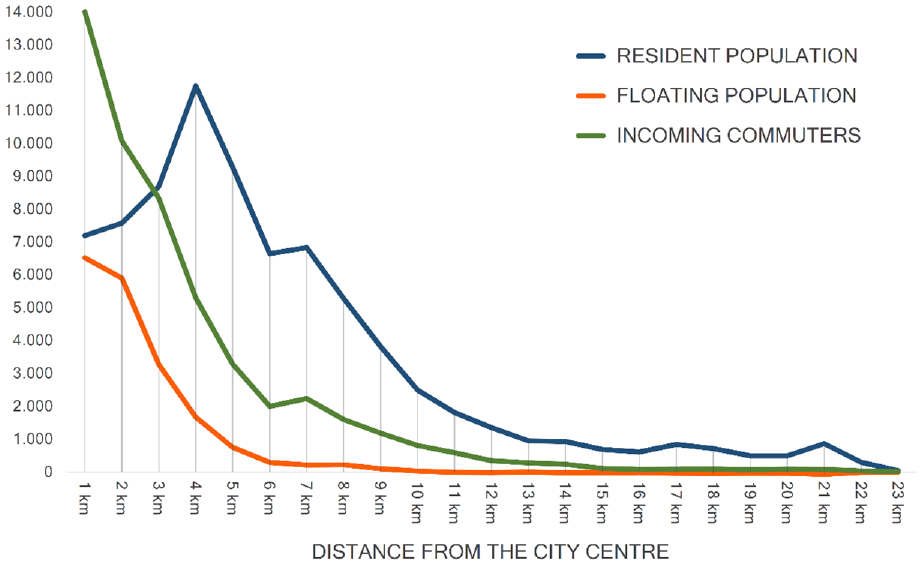
Density of the floating population, of residents and of incoming commuters in Rome, per distance from the city centre. Based on Facebook DataForGood and Istat.
Our results confirm that concentration and centrality are crucial and interlinked dimensions in the locational patterns of temporary populations in the city. This is also true for the even more temporary population of incoming commuters – particularly due to the monocentric structure of the urban economy – but the degree of concentration for the floating population is higher: 65% are located within 3 km from the centre. The density of residents, on the other hand, is much less concentrated and has its peak outside of the urban core, that is where the urban fabric is the densest, and because the urban core is depopulating, also due to the inflow of temporary inhabitants (Celata and Romano, 2022).
To appreciate better where non-residents in the city locate and to compare this with the distribution of residents, we identified the area where the density of temporary inhabitants plus that of incoming commuters is considerably above that of residents (Figure 2). We named this area the ‘Short-Term City’. The map confirms the attractiveness of central locations, well beyond the old/tourist city. Towards the East, temporary inhabitants concentrate (not surprisingly) around the main railway station and the biggest of Roman universities (Sapienza; Roma Tre is much smaller, and its facilities are more distributed; Tor Vergata and Luiss are even smaller). Towards the North, they concentrate between Prati and Salario, that is in the wealthiest and more central residential neighbourhoods. The Short-Term City includes also a few more peripheral hot spots where the source of attraction may be businesses (e.g. the EUR neighbourhood), hotels (e.g. along the outer ring freeway), universities (e.g. Tor Vergata), or a combination of those. The drivers and implications of this spatial pattern will be discussed in the next sections.
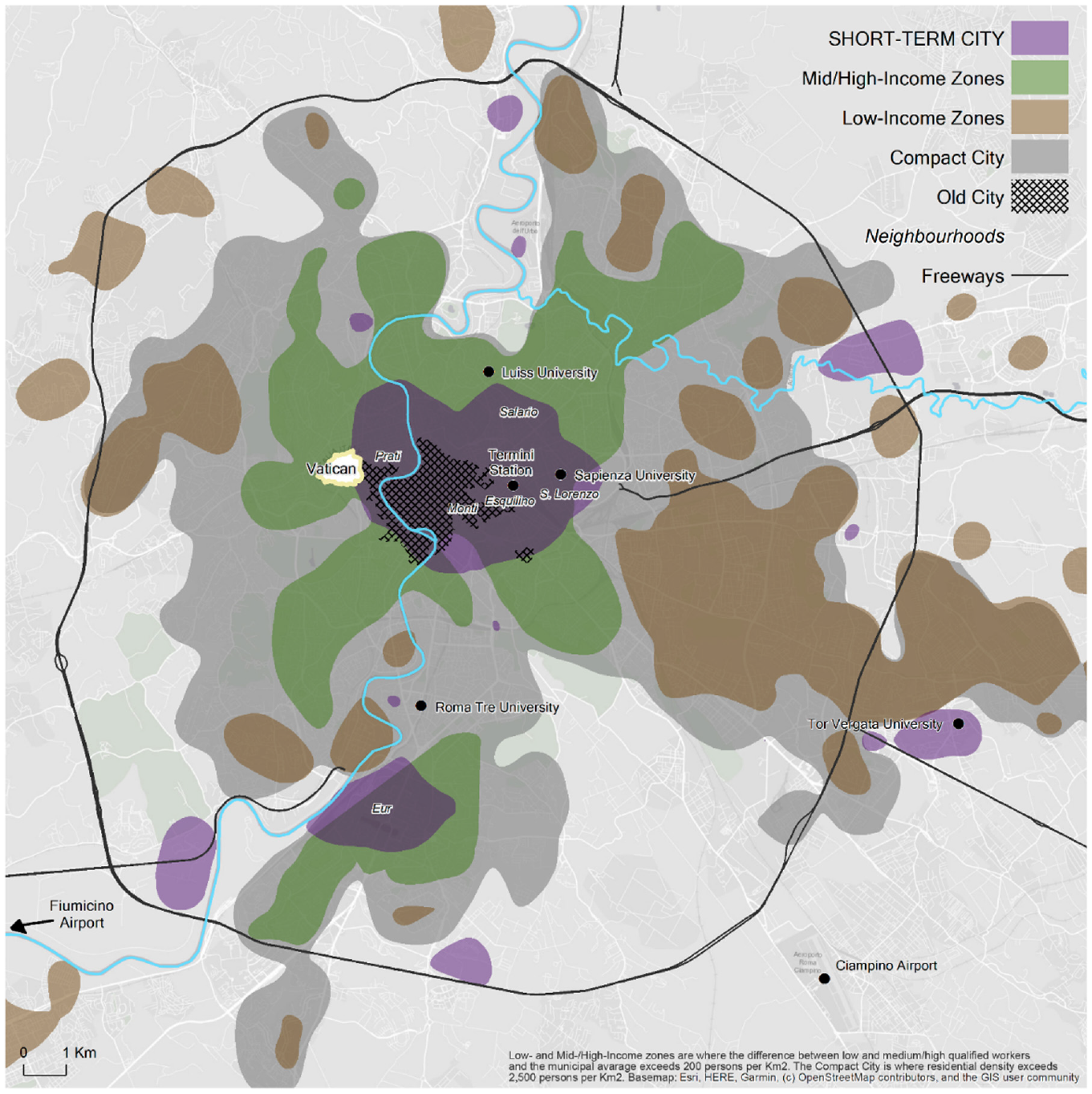
The short-term city: areas in Rome where the density of temporary inhabitants and incoming commuters exceeds that of residents of more than 1000 persons per km2 (kernel density, radius: 1 km), and the city’s socio spatial morphology. Based on Facebook DataForGood and Istat.
Temporary populations in unequal cities
The analysis described in the previous section confirms, in the case of Rome, the strong spatial concentration of temporary inhabitants, which may have many different causes. As mentioned in the third section, their housing, service and infrastructural needs are similar and predominantly available in certain neighbourhoods. Concentration may be due to their tendency to co-locate, also due to some sort of mutual attraction, as they tend to have, for example, more social ties among them than with permanent residents. Each sub-group obviously has its specific needs and displays its own pattern. Previous research, however, showed not only that different categories of temporary inhabitants are attracted by members of the same group but also that their locational patterns tend sometimes to overlap with, or follow, that of other groups (Maitland and Newman, 2008; Malet-Calvo, 2018; Novy, 2018). Touristification, as well as studentification, are often a source of attraction for lifestyle migrants or nomadic knowledge workers (López-Gay et al., 2021), and vice versa; touristification may also contribute to the expulsion of students or temporary stayers who may themselves be a source of transnational gentrification (Russo and Sans, 2009; Sigler and Wachsmuth, 2020) showing that they compete for the same places. More research is needed to properly assess these convergences and divergences.
In terms of spatial outcomes, a recurrent tendency of mobile populations is to form enclaves in the places of destination. However, although concentration is still a predominant character of their settlement patterns, some authors have criticised the use of the metaphor of the enclave (Collins, 2012). Enclaving is still a recurrent outcome of temporary (lifestyle) migrations in the Global South (Emard and Nelson, 2021) as well as of tourism, but less so in the Global North. The concentration of temporary inhabitants, in other words, does not necessarily lead to rigid segregation. Students are today more dispersed than in the past, also due to difficulties in finding affordable housing, but still tend to prefer specific districts (Malet-Calvo, 2018). Concerning tourists, the increasing overlapping of the ‘tourist city’ with the ‘city of residents’ is one of the most problematic consequences of the diffusion of short-term rentals (Celata and Romano, 2022). Temporary migrants are even less distinguishable from residents in their practices and needs, although they also display peculiar locational patterns.
The places where these populations concentrate tend to be predominantly central. This is also not surprising and probably not only typical of Rome: a monocentric city where the availability and quality of services, public transport, work and recreational opportunities decrease substantially the further we move away from the urban core. Also in more polycentric or sprawled metropolis temporary inhabitants are crucial agents of re-urbanisation, central neighbourhoods’ revitalisation and gentrification (Florida, 2017; Sigler and Wachsmuth, 2020). Urban centres are the places where most amenities concentrate, as well as the privileged stage of the urbanity, sociality and liveability temporary inhabitants seek. Centrality is a synonym of accessibility, which is crucial for mobile populations aiming to make the best use of their short stays. Compared to residents, moreover, their location is less influenced by the places where they are born or where their relatives reside.
Such a heavy concentration of temporary inhabitants in the urban core, together with their considerable and growing number, as well as pervasiveness, has important effects. These effects are, on the one hand, positive: they bring money, skills, investments, and diversity. On the other hand, there are many potential detrimental effects that previous research associated with both conventional and novel forms of gentrification.
Despite the impacts of different sub-groups being different, the neighbourhood effects temporary inhabitants produce are to some extent similar, overlapping and reinforce each other (López-Gay et al., 2021). Touristification has been frequently interpreted not only as a source of ‘tourism-led gentrification’, but also as a complement to other drivers of neighbourhood change (Cocola-Gant, 2018; Gravari-Barbas and Guinand, 2017; Novy, 2018). Studentification is also often considered as a specific case (Smith, 2005) or as a consequence of gentrification, and vice versa (Moos et al., 2019) despite the two processes showing several differences (Nakazawa, 2017). Concerning lifestyle migrants, whereas debates have initially focused on their motivations, identities and experiences, the emphasis has recently moved towards impacts (Emard and Nelson, 2021). The term ‘transnational gentrification’ is frequently used to describe the urban changes driven by the inflow of affluent international migrants (Sigler and Wachsmuth, 2020) and gentrification is one of the most debated downsides of cities’ struggles to attract ‘creatives’.
Those effects are even stronger and quicker compared to other forms of gentrification: here replacement takes place with a population that is temporary, fluctuating, loosely attached but strongly impacting (Celata and Romano, 2022; Collins, 2012; Jover and Díaz-Parra, 2022). Their inflow creates a strong incentive to radically alter the retail base in order to serve their very specific needs and tastes. Urban functions and services dedicated to them easily displace those dedicated to residents. The result may be interpreted as the formation of ‘quasi-tourism bubbles’ that extend well beyond specific sites or enclaves, and pervade a substantial portion of the city, often causing irritation and alienation for permanent residents, as well as conflicts (Allinson, 2006; Jover and Díaz-Parra, 2022). ‘Foreigners’ are often one of the predominant targets of anti-gentrification protests. Urban protests against the effects of over-tourism have multiplied worldwide (Colomb and Novy, 2017). Students as well are often accused of misusing the public space, and of causing the degradation of streetscapes and residential environments over the long run (Hubbard, 2008; Nakazawa, 2017).
What is more significant is that the inflow of temporary inhabitants dramatically affects the housing market by increasing real estate values and the rent-gap (Sigler and Wachsmuth, 2020). These effects are particularly difficult to contrast because temporary inhabitants nourish a specific segment of the market that is dedicated exclusively to them, and is particularly rich, secure and attractive for homeowners and the real estate industry. The conversion of a substantial share of the housing stock into short- or medium-term rentals causes the expulsion of even middle- or high-income residents, including earlier gentrifiers. The different categories of temporary inhabitants may overlay and co-locate in the city but also compete and exclude each other, as already mentioned. Permanent inhabitants, in any case, tend to be excluded altogether from the segment of the housing market where such competition occurs and, consequently, are marginalised from where it takes place.
An illustration is what happened during the COVID-19 pandemic when thousands of apartments normally rented to tourists remained empty and were made available for mid-term rentals. Such a strategy was not only adopted by private and corporate hosts, and by Airbnb, but also by municipal authorities in, for example, Milan, Venice and Florence. Florence and Venice even created ad-hoc online platforms: Venice’s one (venywhere.it) is exclusively in English and appeals to ‘remote workers, digital nomads, freelancers’; Florence’s one, despite the name (Be.Long), ‘is a project from Florence for its temporary citizens: international students, startuppers and co-workers’ (belong.destinationflorence.com). What this shows is that different typologies of temporary inhabitants are to a good extent interchangeable, while returning this housing stock to the long-term rentals market is considered too difficult and/or undesirable. The pandemic has simply shown how heavily dependent cities are on the inflow of temporary inhabitants. And while the aim of the above-mentioned cities was also to counteract over tourism, the risk is in substituting one source of gentrification with another.
Another illustration is the multiplication of so-called ‘student hotels’ that are intended for affluent students (the cost of a room often exceeds that of renting an apartment) but are very attractive and indeed host many young professionals. When ‘unused’, rooms can even be rented to tourists. Being organised like hotels or, if you wish, co-housing, they allow for a very efficient and lucrative use of space. It is not surprising that such developments are attractive to private investors. What is more surprising is that student hotels are often incentivised by governments: the EU Plan for (post-pandemic) Recovery in Italy allocates several million Euros to them and aims to reduce the current limits in terms of space per occupant. 4
Raising concerns about these processes is challenging because those oppositions have to confront a discourse of the city that considers the attraction of temporary inhabitants crucial for, and as a sign of, urban vitality, wealth and competitiveness.
Conclusions
Besides many obvious differences, the various categories of temporary inhabitants show similarities in terms of demographic, economic, sociocultural characteristics, locational and housing preferences and, consequently, in how they practice the city and contribute to urban change.
The first and most debated effect is gentrification. The area of Rome we labelled the ‘Short-Term City’ (Figure 2) includes some of the most heavily gentrified Roman neighbourhoods. It goes beyond the scope of the paper to discuss the case of each of those neighbourhoods, many of which have been gentrifying for decades. The more recent tensions arising from the inflow of temporary populations are frequently a contraposition between them and earlier gentrifiers, like in the Monti neighbourhood (Herzfeld, 2009). In other places gentrification is more recent and more strictly connected to the inflow of temporary inhabitants. The Esquilino neighbourhood, for example, was until recently the area with the highest concentration of low-income foreigners, a population that is being replaced by both tourists and affluent temporary inhabitants (Di Sandro and Carbone, 2020). San Lorenzo, between the Termini station and the University La Sapienza, once a working-class neighbourhood, is probably where the overlapping effects of gentrification, studentification and touristification are the most visible and disruptive (de Biase et al., 2016).
The number and locational preferences of those inhabitants cannot but constitute a major driver not only of neighbourhood change, but of sociospatial polarisation at the whole city scale, by contributing to lifting and sharpening the bid-rent curve in favour of the most accessible and attractive locations. The expulsion of low- and even middle-incomes from cities’ cores, and sociospatial polarisation, are increasing in many European cities (Musterd et al., 2017), as well as in 95 of the 112 main Italian cities (Antoniucci and Marella, 2018). Although in many cities the issue is often only discussed with respect to tourists, the research we reviewed as well as our results suggest that these effects cannot be exclusively attributed to over tourism (Novy, 2018). The reach of those processes goes beyond a few enclaves or ‘quasi-tourism bubbles’ and affects the morphology of the whole city (Martinotti, 2005).
Our research has several limits. The quantification and mapping of temporary inhabitants are only based on indirect and rough estimations. Investigating other cities may provide additional and comparative evidence. The effects of temporary inhabitants in terms of sociospatial polarisation and the dynamic of urban rent are, for the most, deduced. More research and empirical verification are needed to confirm our findings and understand their implications better. Our invitation is to go beyond conventional categorisations, as well as beyond those parts of the city where specific sub-groups of temporary inhabitants concentrate, to address wider and self-reinforcing effects at the metropolitan scale. Adopting the lens of temporariness, we believe, is helpful in this regard, but is not intended to deny the specificities of each sub-group, also in terms of locational patterns.
This discussion is particularly useful in light of a substantial ambivalence in how cities ‘see’ these populations, which is itself the result of their ambivalent implications. On the one hand the attraction of the ‘right’ temporary inhabitants – expats, qualified workers, ‘creatives’, foreign entrepreneurs, international students, tourists, etc. – is a crucial component of contemporary urban policies. Attractiveness is, in this sense, a natural complement to competitiveness. Cities often struggle to attract them by any means – which also means that the above-mentioned gentrification is also state-led. Lifestyle migrants, for example, are welcomed even by proponents of anti-immigration policies because they are not supposed to compete with locals in the job market (Benson and O’Reilly, 2009). On the other hand, as long as the effects of those strategies in terms of displacement and gentrification have become clear, the idea that being attractive is necessarily beneficial has come increasingly under scrutiny by both urban social movements and urban scholars (Emard and Nelson, 2021).
We think that this ambivalence is also inherent to populations that may be interpreted, alternatively, as a ‘gain’ or as a ‘burden’. Temporary inhabitants permit the inflow of material and immaterial resources while implying very few socio-political responsibilities. However, these inhabitants may be accused of over-using cities’ fixed capital and public services without having contributed to them through, in particular, taxes. Conflicts on the issue can easily incur problematic questions like who has right to the city, or for whom the city should be planned. Scale is also relevant, insofar as the positive effects are the most visible for the whole city, while the negative ones are in specific neighbourhoods. Both views are of course legitimate. What is needed, although challenging, is to find a proper balance, which implies a careful consideration of who benefits and who pays the cost.
Footnotes
Declaration of conflicting interests
The author(s) declared no potential conflicts of interest with respect to the research, authorship, and/or publication of this article.
Funding
The author(s) disclosed receipt of the following financial support for the research, authorship, and/or publication of this article: The research received support from the Italian National Ministry of Universities and Research, Research Projects or Relevant National Interest, PRIN 2017, n. 2017EWXN2F, Title: The Short-Term City: Digital Platforms and Spatial (In)Justice [STCity].
