




Abstract
In a context of global-scale inequalities and increased middle-class transnational mobility, this paper explores how the arrival of Western European and North American migrants in Barcelona drives a process of gentrification that coexists and overlaps with the development of tourism in the city. Research has focused increasingly on the role of visitors and Airbnb in driving gentrification. However, our aim is to add another layer to the complexity of neighbourhood change in tourist cities by considering the role of migrants from advanced economies as gentrifiers in these neighbourhoods. We combined socio-demographic analysis with in-depth interviews and, from this, we found that: (1) lifestyle opportunities, rather than work, explain why transnational migrants are attracted to Barcelona, resulting in privileged consumers of housing that then displace long-term residents; (2) migrants have become spatially concentrated in tourist enclaves and interact predominantly with other transnational mobile populations; (3) the result is that centrally located neighbourhoods are appropriated by foreigners – both visitors and migrants – who are better positioned in the unequal division of labour, causing locals to feel increasingly excluded from the place. We illustrate that tourism and transnational gentrification spatially coexist and, accordingly, we provide an analysis that integrates both processes to understand how neighbourhood change occurs in areas impacted by tourism. By doing so, the paper offers a fresh reading of how gentrification takes place in a Southern European destination and, furthermore, it provides new insights into the conceptualisation of tourism and lifestyle migration as drivers of gentrification.
Introduction
It is well known that Barcelona is one of the most appealing cities in Europe for visitors and that the growth in the number of tourists has been exponential since the celebration of the Olympic Games in 1992. Barcelona is home to 1.6 million inhabitants; however, in 2018 more than 9 million people stayed in hotels in the city and it is estimated that the total number of visitors exceeded 30 million in the same year (Barcelona City Council, 2019). The excessive growth of tourism and the proliferation of short-term rentals have caused tensions in several neighbourhoods and both the international media and academic publications have focused on this issue (Blanco-Romero et al., 2018; Brandajs and Russo, 2019; Cocola-Gant, 2016; Mansilla and Milano, 2019; Nofre et al., 2018). Residents complain that tourism threatens their right to stay put and triggers a process of social change in which permanent populations are displaced by transient visitors. This is, furthermore, the view of a variety of authors who suggest that tourism boosts gentrification (Cocola-Gant, 2018; Gotham, 2005; Gravari-Barbas and Guinand, 2017). However, the leisure-led restructuring of Barcelona and its effective international representation as a city to have fun in have not only triggered the arrival of visitors but have also been successful in attracting young transnational migrants, in particular from Western Europe and North America, who moved to Barcelona because of lifestyle choices. We provide evidence that the arrival of these highly educated young migrants drives a process of transnational gentrification that coexists with tourism and, in fact, results from the development of tourism in the city. While research has increasingly focused on the role of visitors and Airbnb in driving gentrification (Cocola-Gant and Gago, 2019; Wachsmuth and Weisler, 2018; Yrigoy, 2019), in this paper our aim is to add another layer to the complexity of neighbourhood change in tourist cities by also considering the role of migrants from advanced economies as gentrifiers in these neighbourhoods. By doing so, the paper offers a fresh reading of how gentrification occurs in a Southern European destination and, furthermore, provides new insights into the conceptualisation of tourism and lifestyle migration as drivers of gentrification.
Within the framework of global-scale inequalities that has been a key theoretical point in accounts of transnational gentrification (Hayes, 2018, 2020; Sigler and Wachsmuth, 2016), we incorporate the central role that tourism plays in the process, particularly in Southern Europe. The development of tourism in the region occurs in the context of the spatial division of labour in Europe in which the peripheral South has historically targeted consumers from core accumulation areas as a way to stimulate the economy, particularly the real estate sector (Lefebvre, 1991). Against this background, we draw on the lifestyle migration literature to suggest that tourist destinations are at the same time destinations for transnational migrants in search of exciting lifestyle opportunities (Benson and O’Reilly, 2009; Huete and Mantecón, 2011b). This idea is also at the heart of the overtourism debate. Drawing on authors such as Urry and Larsen (2011), Milano et al. (2019) remind us that tourism is made and shaped by different forms of mobilities and, accordingly, overtourism implies the influx of different populations that are inherently mobile such as international students (Malet-Calvo, 2018) and digital nomads (McElroy, 2020). Furthermore, authors such as O’Reilly (2003, 2017) and Huete and Mantecón (2011a, 2013) show that, in destinations, migrants settle in tourism enclaves and share spaces and lifestyles with visitors rather than mixing with the host community. The paper demonstrates how, in Barcelona, transnational migrants are attracted to areas of intense tourism activity, which, therefore, leads to the formation of ‘foreign only’ enclaves. This means that centrally located neighbourhoods are appropriated by foreigners – both visitors and migrants – who are better positioned in the unequal division of labour, leading locals to feel increasingly excluded from the place.
In the next section we highlight why the links between tourism and lifestyle migration are critical to understanding transnational gentrification. Despite gentrification driven by tourism lifestyles being noted in core centres of accumulation – cities such as Paris for instance (Gravari-Barbas, 2017) – in this paper we refer to the context of Southern Europe. Following this, we present our case study and methodology. The research focuses on the Gòtic neighbourhood of Barcelona, which is a central area and one of the main tourism enclaves in the city. Residents’ concerns regarding excessive tourism growth in this area were noted in the early 2000s (Degen, 2004), several years before the expansion of Airbnb. At the same time, the 2001 census shows that gentrifiers in this neighbourhood tended to be young professionals from Western Europe (Arbaci and Tapada-Berteli, 2012). Our aim was to explore (1) how gentrification in a tourist enclave has been related to migration flows; (2) why transnational migrants were attracted to this area; and (3) the socio-spatial consequences of the process, particularly how long-term Spanish residents have been affected by the overlap of transnational gentrification and tourism. To do so, we adopted a mixed method approach and used demographic analysis, participant observation and in-depth interviews with both migrants and long-term Spanish residents. The results are presented in two sections. We first show that gentrifiers are young professionals from Western Europe and North America and then we reveal how transnational gentrification and tourism coexist, suggesting that to understand neighbourhood change in a tourist enclave we should assess how the impact of both processes relate to each other, rather than analysing them as separate phenomena. In the last section, we put our findings into conversation with the literatures on tourism and transnational gentrification and suggest ideas for further research.
Transnational gentrification and tourism. A view from Southern Europe
It is useful to remember that ‘gentrification’ refers to the process of neighbourhood change in which capital investment in the housing market results in the displacement of existing populations and the arrival of newcomers with higher socio-economic status (Lees et al., 2008; Reese et al., 2010). Despite the different forms, geographies and temporalities of the process, gentrification is by definition a process of socio-spatial change that started when physically degraded working-class central areas were rehabilitated for the middle classes. Sigler and Wachsmuth (2016) and Hayes (2018, 2020) refer to transnational gentrification as a process of neighbourhood change in which the newcomers with higher socio-economic status are migrants from the industrialised West who relocate to cities of less-developed regions. It is no coincidence that transnational gentrification has been noted in peripheral economies, particularly in Latin American cities (Hayes, 2018, 2020; Janoschka et al., 2014; Navarrete Escobedo, 2020; Sigler and Wachsmuth, 2016) where the middle classes are far smaller than in the Global North and where there exists high levels of informality in the labour market (Betancur, 2014). These cases refer to areas that suffered long-term disinvestment and are inhabited by low-income residents, meaning that there is a rent gap between actual and potential returns which creates incentives for real estate capital to direct new housing investment flows and rehabilitate housing for wealthier inhabitants. However, rent gaps have been closed when the state and the real estate sector marketed places for consumers from more advanced economies. The attraction of an extra-local demand is seen by developers to be necessary to stimulate local property markets and extract profits from urban space. Therefore, in the explanation of transnational gentrification, unequal division of labour and transnational migration become central issues to understanding the process.
Within this framework, we want to emphasise the role that tourism plays in transnational gentrification, in terms of both the explanation and the consequences of the process. We argue that tourism is central to understanding transnational gentrification particularly because it is in the context of tourism marketing and development that migrants from the industrialised West relocate to less developed areas. We want to recall the links between lifestyle migration and tourism. For both Sigler and Wachsmuth (2016) and Hayes (2018, 2020) transnational gentrifiers are lifestyle migrants, particularly retirees. Benson and O’Reilly (2009) suggested the term ‘lifestyle migration’ to refer to the relocation of people within the developed world searching for a better way of life through transnational migration. Lifestyle migration has been defined as a privileged form of mobility where lifestyle and consumption opportunities, rather than work, appear to be the main motivations for migrating (Janoschka and Haas, 2014). Much of the focus of lifestyle migration research has been on international retirement migration from Northern Europe and North America to coastal and rural sites in places such as the Mediterranean or Latin America (Benson, 2011; Hayes, 2015; Huete and Mantecón, 2011b; Huete et al., 2013; Janoschka, 2009; O’Reilly, 2017). We, however, agree with King (2018) that the lifestyle migration framework should also be applied to young people moving to cities. There is a growing number of works that highlight how lifestyle migrants include people of all ages and, furthermore, show that the share of working-age people is growing (Benson and O’Reilly, 2018). Moreover, there is an expanding literature that demonstrates how these young mobile populations are relocating to cities rather than to coastal and rural sites (Griffiths and Maile, 2014; Zaban, 2017, 2020). Nevertheless, the important point for us is that lifestyle migration has been conceptualised as a form of tourism-informed mobility. The relationship between lifestyle migration and tourism has been highlighted by several authors who note how lifestyle migrants usually relocate to tourist destinations (Benson and O’Reilly, 2009; Huete and Mantecón, 2011b; O’Reilly, 2003; Williams and Hall, 2000). There is a significant relationship between tourism images and where lifestyle migrants wish to locate. Therefore, the marketing of places for tourism attracts transnational mobile populations and not only visitors, which, as a result, means that it makes sense to assume that the growth of urban tourism will be followed by an increased number of young transnational migrants in urban centres.
Authors such as O’Reilly (2003, 2017) and Huete and Mantecón (2011a, 2013) note that lifestyle migrants settle in holiday areas, share spaces with visitors and, ultimately, turn tourism into a way of life. These authors show that the spaces consumed by lifestyle migrants and short-term visitors overlap while interaction with local populations is minimal. In cities, urban tourism scholars have stressed the spatial connection between visitors and a mobile cosmopolitan consuming class (Fainstein et al., 2003; Novy, 2018) that recognises a middle-class sense of place and feels comfortable in similar landscapes of consumption across the globe (Rofe, 2003). In other words, transnational gentrification and tourism will spatially coexist and so an analysis that integrates both processes is needed to understand how neighbourhood change occurs in such places. There is a need to explore deeper how long-term residents experience neighbourhood change when transnational migrants from advanced economies establish themselves in areas that are already subject to intense urban tourism activities.
The mobility of young transnational migrants into urban tourism destinations and their role in gentrification processes is particularly relevant in the context of Southern European cities.
Core–periphery hierarchies and differences in income level occur within Europe as well (Arbaci, 2019; Boatcă, 2016) and, in this context, the state-led attracting of consumers from Northern Europe as a way of boosting the real estate sector started as an organised industry in the 1950s, particularly in Spain (Lefebvre, 1991; Murray-Mas, 2015). According to Lefebvre (1991: 353), in Europe there were two kinds of regions: ‘regions exploited for the purpose of and by means of production (of consumer goods), and regions exploited for the purpose of and by means of the consumption of space’. This meant that Southern Europe was becoming a ‘vacationland festival’ (Lefebvre, 1991: 58) for the Northern European middle classes. It is in the context of this spatial division of labour that the lifestyle migration literature noted that the marketing of destinations focused not only on attracting tourists but also new residents and second-home buyers. Although this process started in coastal destinations, since the 1980s, tourism has been for many Mediterranean cities a central strategy in their restructuring towards a post-industrial economy. Furthermore, such a strategy has been strengthened in recent years, as the neoliberal answer to the 2008 financial crisis has been further tourism development (Mendes, 2018). In a period of increased young middle-class mobility across Europe, the process is causing some Southern European destinations to become melting pots of transnational mobile populations such as Erasmus students (Malet-Calvo, 2018), digital nomads and professionals from more advanced economies who usually settle in centrally located tourist areas. In Portugal, for instance, together with tourist promotion, the state has targeted transnational migrants by providing them with fiscal benefits, and authors show how tourism development overlaps with processes of migrant-led investment in real estate (Montezuma and McGarrigle, 2019) and transnational gentrification (Carvalho et al., 2019). Carvalho et al. (2019) illustrate how Porto, where gentrification had not taken place, can suddenly be gentrified by a wave of visitors, transnational migrants and international students, in a process in which real estate capital invests significantly in the services that these consumers use. In conclusion, we suggest that in the context of Southern European cites, tourism development also drives the arrival of transnational migrants from more advanced economies that are able to gentrify vibrant urban areas, particularly spaces that are consumed by visitors. There is need, however, for a critical examination of the implications of how the blending of tourism and migrants affects the places and communities in which they settle.
Case study and methodology
Barcelona is at present the most visited city in Spain and the fourth most-visited city in Europe in terms of international visitors (Barcelona City Council, 2019). The contemporary branding of Barcelona started in the 1980s and was part of a strategy of city restructuring in the transition to a post-industrial economy (Balibrea, 2001; Russo and Scarnato, 2018; Smith, 2005). Smith (2005) notes that while in the 1980s tourism was identified as one among several objectives for Barcelona’s urban regeneration, after the economic crisis of the 1990s local authorities saw tourism as the ‘easiest’ and a more direct way of attracting inward investment and consumers. Authors such as Smith (2005), Degen (2004) and Balibrea (2001) stress that the search for tourism growth was implemented by a neoliberal process of deregulation and urban entrepreneurialism, alongside place promotion, flagship buildings and mega-events. The number of visitors started to grow from the mid-1990s and increased further after the year 2000. During the early 2000s, authors already noted that such a process resulted in the needs and satisfaction of tourists being prioritised over those of local residents, thus creating the first signs of discontent (Balibrea, 2001; Degen, 2004). Furthermore, as a response to the 2008 economic crisis local authorities have promoted further tourism growth, this time in the age of low-cost travel and Airbnb, resulting in mass demonstrations organised by residents that have been reported on by media from across the globe (Colomb and Novy, 2016).
This picture of tourism growth, proliferation of short-term rentals and community opposition has been depicted in Barcelona several times (Blanco-Romero et al., 2018; Brandajs and Russo, 2019; Cocola-Gant, 2016; Mansilla and Milano, 2019; Nofre et al., 2018). It is less known, however, how gentrification occurs in the most touristic neighbourhoods of Barcelona: is there a process of socio-spatial change that can be defined as gentrification in these areas? The main tourist enclave in the city is the historic centre, the district of Ciutat Vella. It is an important heritage cluster, with large pedestrian and commercial areas, which is located on the seafront. Before the 1990s, the district of Ciutat Vella was one of the poorest areas of Barcelona. It has been the residential area of the working-class and low-income immigrant populations since the mid-19th century and experienced a long-term process of capital disinvestment in its built environment. During the 1970s, the crisis of deindustrialisation led to an increase in poverty, unemployment, drug abuse and marginal activities in this area. In such a context, in 1986 the whole district was declared an ‘Area of Integral Rehabilitation’. In addition, in 1985 the government changed the regulations that permitted lifetime tenancies and in 1994 it was decided that tenancy agreements could last for a maximum of five years. Nonetheless, in 2000 half of tenancy agreements in Ciutat Vella had been established before 1985 and so had guaranteed lifetime tenancies (Fiori, 2010). Consequently, the area presented the typical pre-conditions for gentrification to happen: a central location within the city; a working-class and elderly population; long-term disinvestment and thus potential financial returns if housing was rehabilitated for wealthier inhabitants; expected real estate investment because of state-led regeneration projects and also because of the liberalisation of the rental market. In this context, authors noted that some areas of Ciutat Vella started to experience gentrification at the end of the 1980s and particularly during the 1990s (Alabart and López, 1996; Arbaci and Tapada-Berteli, 2012). Importantly, Arbaci and Tapada-Berteli (2012) linked gentrification with transnational migration and noted how since the late 1990s gentrifiers were migrants from Western Europe. However, an exploration of this issue in detail has not been undertaken before.
Our research focuses on the Gòtic neighbourhood, one of the four boroughs of Ciutat Vella (Figure 1). Roughly 16,000 residents inhabit the area. It is the oldest part of the city and home to several iconic buildings including the cathedral and Royal Palace (Cocola-Gant, 2014). Since the end of the 1990s, the growth of tourism experienced in Barcelona has significantly impacted this neighbourhood. Figure 1 shows that the Gòtic neighbourhood is the most touristified area of Barcelona. Taking into consideration the 64 hotels, 50 hostels and 1194 Airbnb listings that existed in the neighbourhood in 2018, the consequence is that there are 71 beds offered to tourists per 100 inhabitants, meaning that the intensity of tourism in the area is substantially higher when compared with the rest of the city. 1
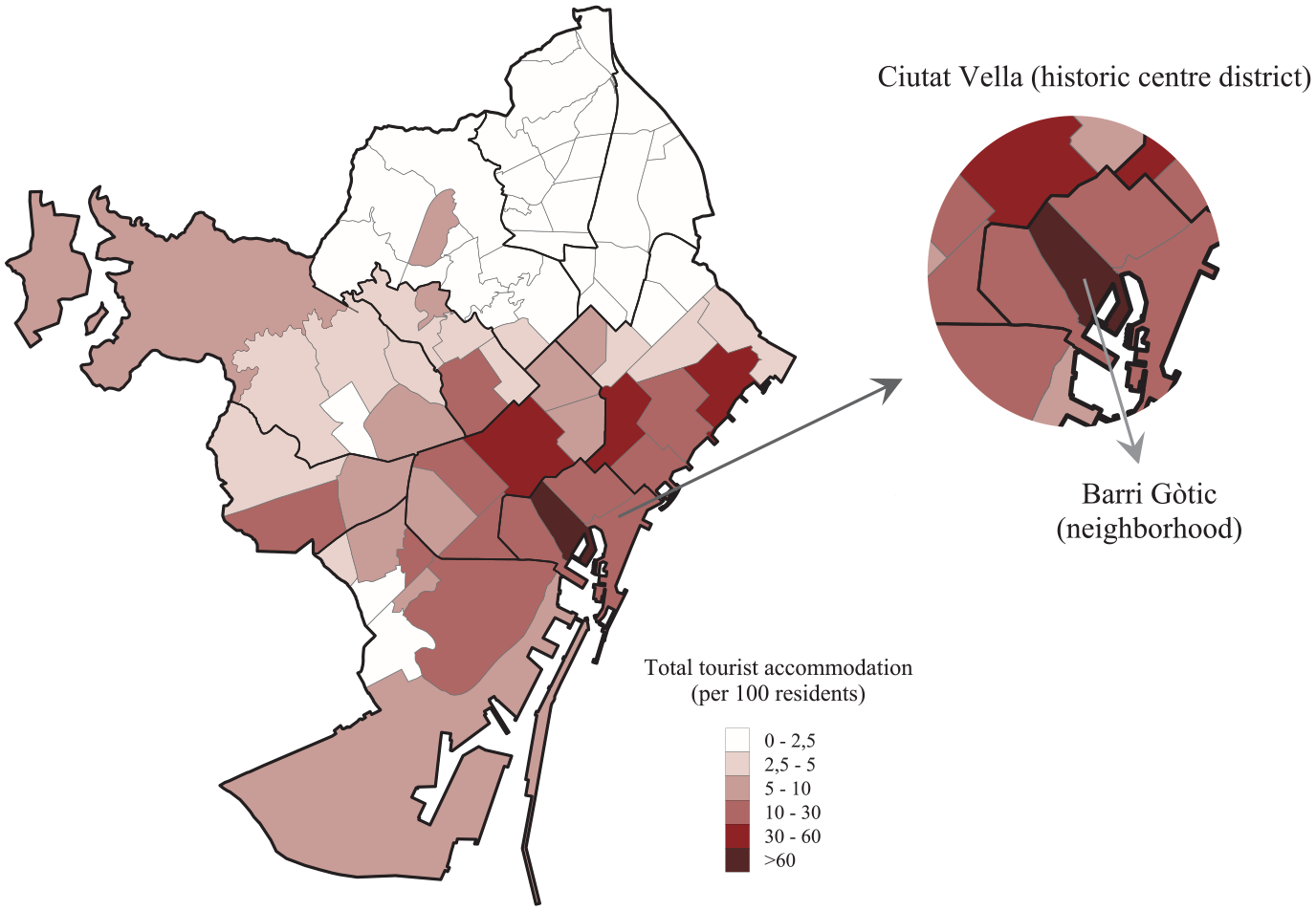
Number of tourist beds per 100 inhabitants in the 73 neighbourhoods of Barcelona, 2018.
Our research adopted a mixed-methods approach. First, we examined socio-demographic shifts and migration flows between 1991 and 2016. We used the Spanish Population Census (1991, 2001 and 2011) and the Population Register, which offers data annually from 1998. Second, we conducted participant observation for a year to get involved in the community and to develop relationships with residents – both Spanish and migrants. As tourism and gentrification represent a central point of community stress and tension, residents and different grassroot associations usually organise talks, meetings and workshops about these issues. Participant observation in such activities was a key source of information as they were places in which people had the chance to express their concerns about the changes taking place in the neighbourhood. Finally, we conducted 42 in-depth interviews with residents living in the area and 14 interviews with key informants such as officials, shopkeepers and real estate consultants. Participant observation was an important tool for recruiting informants. From this starting point, respondents were asked to recruit another contact, thus triggering a snowballing effect. We recruited a cross-section of respondents to give voice to different types of individuals living in the area for at least five years. The variables used included gender, age, nationality (place of birth), status of residence (homeowners or tenants) and the number of years living in the area. Among the residents, 16 were Western Europeans and Americans whose ages ranged from 35 to 50 years old. The other 26 residents were Spanish individuals who were between 30 and 81 years of age. The snowball effect provided us the possibility to contact residents who had lived in the area for more than 25 years. Their experiences were important to understand the evolution of the neighbourhood, together with the way in which they have adapted over time to such changes. Furthermore, we asked migrants about their motivations behind settling in Barcelona and in the Gòtic neighbourhood in particular. The migrants that we interviewed lived in Barcelona on a permanent basis and had arrived in the city between the late-1990s and 2010.
Transnational gentrifiers
Because in its classic form gentrification is understood as the displacement of low-skilled individuals – particularly the elderly – and of those typically employed in manual functions by new young residents with higher educational levels who are employed in the professional and managerial service sectors, our first step was to explore whether this process took place in the Gòtic neighbourhood. We analysed the censuses of 1991, 2001 and 2011 and found that the area has changed from being inhabited by an older and less well-educated population into a place dominated by young adults with university degrees and professional occupations. For instance, in 1991, 25% of young adults (20–34 years) had a university degree while in 2011 the proportion was 65%. These changes in educational level can only be understood by the arrival of newcomers. We found that population restructuring in this case has been notably linked to the arrival of young transnational migrants since the end of the 1990s, particularly Western Europeans and North Americans. In 2011, European and North American residents of all age groups had the highest rates of university education compared with other nationalities.
We have analysed the Population Register in order to examine in more detail how transnational migration has had a central effect on the population restructuring of the area. We did this because the Population Register offers information with regards to annual population changes since 1998. Using this source, we constructed the population pyramid of the area between 1998 and 2016 (Figure 2). A significant characteristic to be noted is the change from being a neighbourhood predominantly inhabited by elderly residents into a place in which the majority of residents are young adults. The population over 65 years has fallen by 50% while the 25 to 39 age group now forms the main portion of the population pyramid. Importantly, the increase in the population aged 25–39 is primarily due to the arrival of foreign-born individuals who represent 65% of this age group. The proportion of Western Europeans is particularly high. This origin, together with North Americans, represents 60% of the foreign-born population in this age group. Among Western European residents, French, British, German, Italian and Swedish are the most common nationalities. The presence of Europeans and North Americans is very low among elderly residents, which suggests that the arrival of individuals from those places is not related to retirement migration.
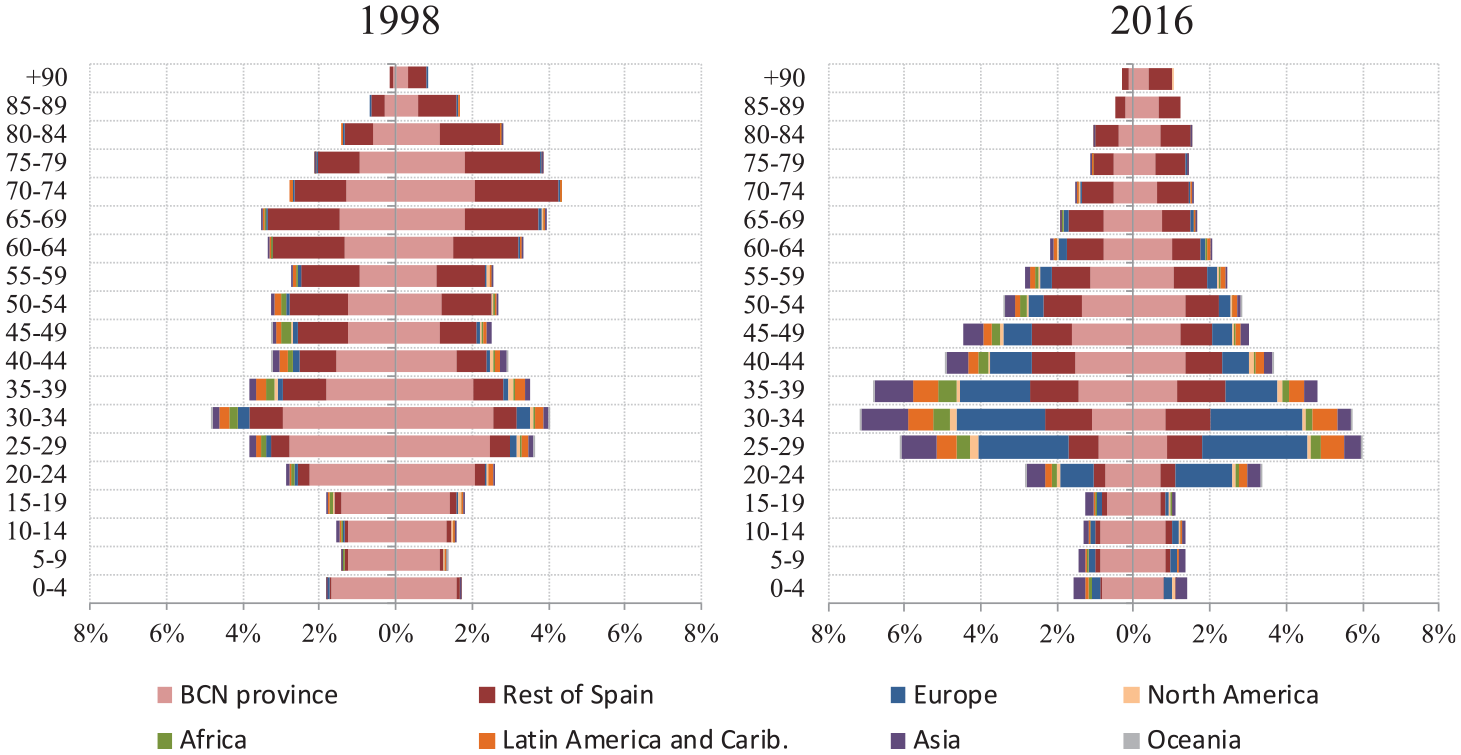
Population structure of the Gòtic neighbourhood by place of birth, 1998–2016.
In contrast, the proportion of young adults from the local population is extremely low. By local population, we mean residents born within the province of Barcelona. These people only represent 17% of the population in the 25–39 age group. This is an unusual feature of the city considering that for the rest of the municipality this figure is 48%. It seems that the area is attractive for transnational migrants but not for locals or residents from the rest of Spain. A central finding is that, when assessing all age groups, the Gòtic neighbourhood has lost 4000 Spanish residents since 1998 and has gained 5000 foreign nationals. Furthermore, migration flows for the period 2011–2016 show that 75% of individuals arriving in the Gòtic neighbourhood are foreign citizens. The area is therefore attractive to transnational residents, while in contrast Spanish individuals have been progressively moving out. Crucially, in Figure 3 we show that the Gòtic neighbourhood is the area of Barcelona with the highest proportion of European and North American residents. When this is compared with Figure 1, it indicates that transnational migrants from advanced economies locate themselves in areas of intense tourism activity.
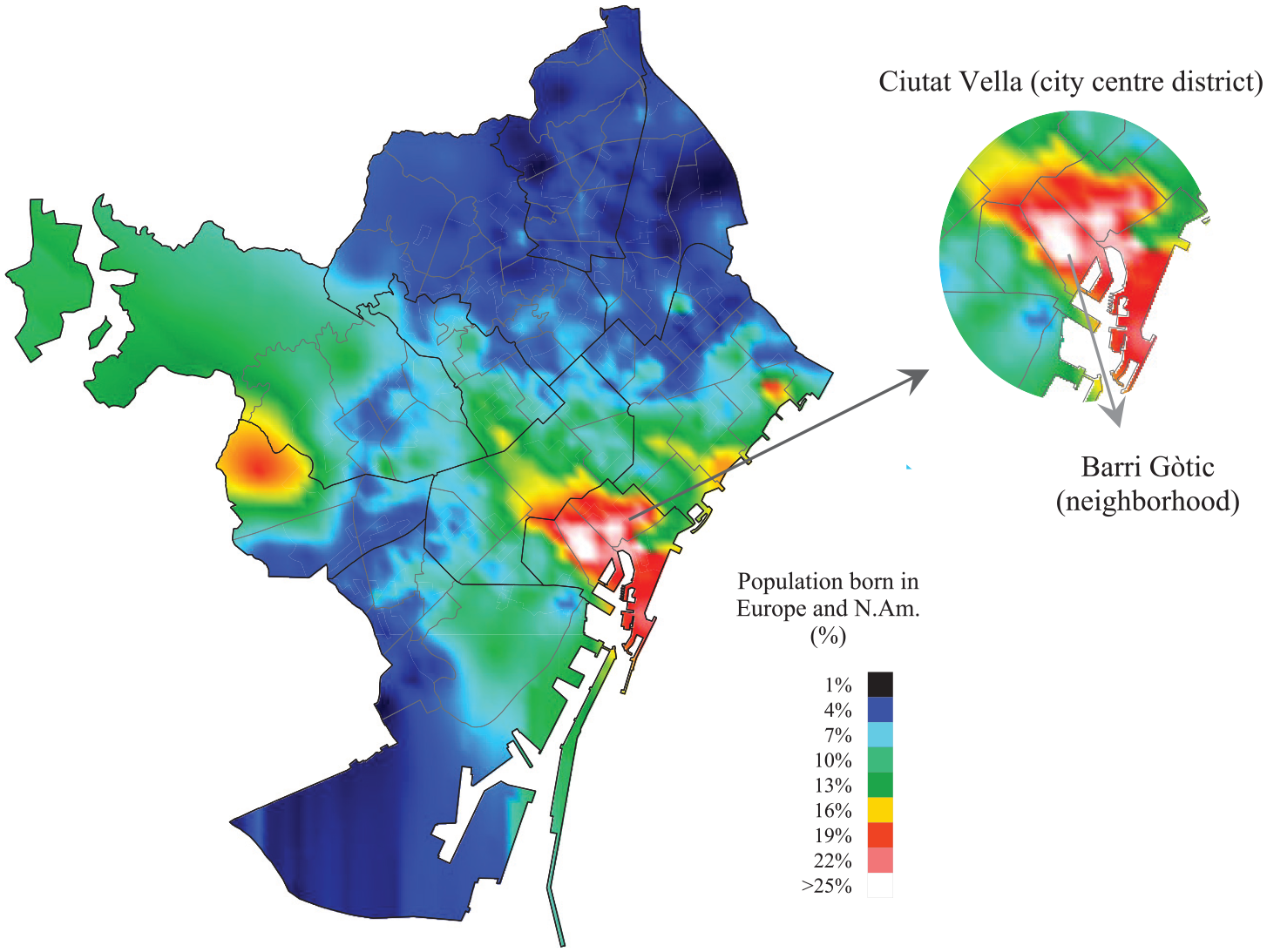
Proportion of population born in Europe and North America by census tract (1068 units).
The question of displacement was a central issue mentioned by both migrants and Spanish residents. Participants agreed that the arrival of young transnational migrants since the late 1990s has been linked to a process of housing rehabilitation that displaced the indigenous residents, particularly elderly tenants, and that is still ongoing in the South part of the neighbourhood. According to the Barcelona Sociodemographic Survey (Barcelona City Council, 2017), the proportion of homeowners in the Gòtic area is only 27.4%, while the average in Barcelona is 58.9%. Furthermore, social housing in the area is almost non-existent. This means that most residents are tenants and that people access housing via the private rental market. Residents describe how elderly tenants were forced to move through means of harassment and intimidation. Especially important was the process of deliberate degradation as unsafe living conditions were the only ‘legal’ means of evicting lifetime tenants. A French resident said: ‘I saw how the elderly tenants were evicted to prepare flats for people like me.’ Similarly, another resident describes the history of his apartment building as follows: In 1990 all my neighbours were lifetime tenants and I have seen how each time one of them moved out, the landlord refurbished the flat for professionals, of which 60% are Europeans at present.
Therefore, neighbourhood change in this case mirrors examples of classical gentrification, that is, housing rehabilitation for middle-class professionals that involved the displacement of low-educated elderly residents (Lees et al., 2008). However, the fact that gentrifiers are transnational migrants that settle in an area of intense tourism activity raises several questions that should be clarified: who are these migrants? How does neighbourhood change occur when transnational gentrification and tourism coexist? In what follows, we present the results of our interviews and reveal why gentrification, in this case, needs to be linked to regional inequality and the role of tourism in attracting mobile populations.
Tourism, lifestyle migration and the formation of ‘foreign only’ enclaves
Our findings show that the locational decisions of transnational migrants should be seen as a form of tourism-informed mobility. We have found two key factors to explain why migrants have moved to Barcelona: place promotion and opportunities for leisure activities and consumption. First, interviews with European and North American residents show that the representation of Barcelona, socially organised by the tourism industry, marketed ideals about the place that influenced their decision to migrate. All participants stated that prior to their move they had an understanding of Barcelona as an exciting place. For instance, a Swiss lawyer explains that she had professional opportunities in various cities but she chose Barcelona because ‘everybody knows that this is a fantastic place’. Second, participants suggest that the provision of leisure facilities, nightlife, culture, architecture, as well as the weather and the cost of living are key pull factors. The leisure-led regeneration of Barcelona and the creation of a ‘fun’ city that has been linked to the growth of tourism (Russo and Scarnato, 2018) have also been successful in attracting transnational migrants. An important conclusion of this is that the consolidation of transnational gentrification in the Gòtic area is a consequence of the construction of Barcelona as a tourist destination. The expansion of tourism and transnational gentrification went hand-in-hand. This is because the symbolic power of images – that are so important in aiding tourism – also facilitated the arrival of transnational gentrifiers.
All our transnational participants were within the working-age range and employed in professional occupations. However, they all stated that they were attracted to Barcelona because of lifestyle choices. In recent years, the technological and creative sectors have significantly grown in Barcelona and it has been suggested that the arrival of high-skilled transnational migrants is linked to the growth of such sectors (Coll-Martínez et al., 2019; Lopez-Gay, 2018). Notwithstanding, our participants settled in Barcelona in the past two decades and among them we did not find a single case in which they moved to Barcelona because of the attractiveness of job opportunities. Most of them do not rely on the local labour market and had a job, or capital, before settling in the city. We found three main professional categories among migrants: (1) freelancers whose clients are in their country of origin; (2) small entrepreneurs who accumulated capital before moving to the city and who have invested in real estate and tourism services, mainly holiday rentals; and (3) professionals such as architects and designers who settled in Barcelona to open their own businesses. We found two cases of professionals working in transnational corporations who stated that they had professional opportunities in different cities but chose to be transferred to Barcelona because of lifestyle opportunities.
The gap between the purchasing power of migrants and that of the local population is a central issue in terms of explaining gentrification in this case. The issue of unequal income structures was evident during the interviews and, regarding housing markets, we found a clear difference in the perspective of migrants and Spanish residents. On the one hand, migrants found Barcelona a cheap place to live in and indeed, for many, Barcelona was a good place to invest in terms of real estate. In fact, a number of migrants stated that an important reason behind moving to Barcelona was the opportunity to buy a house in the historic centre: ‘I will not be here all my life, but the price of my house will always increase’, as one French woman stated. On the other hand, Spanish participants felt increasingly excluded. As one resident stated, ‘if you want to buy a house to live in you actually have to compete against people that for us are super-rich’. Additionally, the difference in purchasing capacity is reinforced because of the transient nature of some migrants and other mobile transnational populations, such as international students and digital nomads, who are willing to pay high rents. According to the Population Register, more than half (51.3%) of all residents in the Gòtic area moved to the city in the past five years. In-migration and out-migration rates are, respectively, 1.8 and 2.0 times higher in the Gòtic neighbourhood than the city’s average. This indicates that the attractiveness of the area for new residents is high but, at the same time, residents are increasingly mobile and so form a transient population. An Italian resident who settled in Barcelona in 2008 stated: When I arrived, it was easy for me to find a place to live in the Gòtic area. I think it was because here there is an informal letting market for transient foreigners. When you arrive, you do not have a payslip to show to the landlord nor references nor any kind of document. So, it is very difficult to do a formal tenancy agreement. But landlords are willing to rent to transient people because in these conditions you do not mind paying high rents.
The coexistence of transnational gentrification and tourism means that migrants are privileged consumers of housing in an area in which apartment buildings have been increasingly converted into accommodation for visitors. As a result, housing mainly caters to the needs of foreigners, leaving Spanish residents feeling excluded. As demonstrated in Figure 1, the supply of both hotels and holiday rentals is highly concentrated in the Gòtic area. Therefore, a large proportion of the housing stock is used by visitors as short-term accommodation while transnational migrants are frequently the people that have better options in accessing the remaining housing stock in the market for long-term occupation. From the perspective of long-term residents, housing in the neighbourhood has been appropriated by tourism and by consumers from wealthier economies. One interviewee stated that, ‘This neighbourhood will be a place for wealthy migrants from the North.’ The feeling is that only visitors and foreign consumers from countries better positioned in the global division of labour will be able to access housing. The expression, ‘foreigners have taken our homes’, has been used by several participants. This indicates a sense of frustration because long-term residents are unable to confront structural global inequalities.
We have followed economic explanations of gentrification-induced displacement that derive from the purchasing gap between both groups – Spanish residents and migrants. However, tourism and lifestyle choices are central to understanding the impacts of transnational gentrification beyond housing market dynamics. The touristic atmosphere existing in the area is a key element in explaining why the presence of transnational migrants in the Gòtic neighbourhood is particularly high while the proportion of young Spanish adults living in the area has been significantly reduced. Our findings reveal that transnational migrants tend to settle in the Gòtic area because they feel more comfortable living alongside tourism and sharing spaces with visitors and other transnational migrants. An American businessman who invested in the short-term rental market explains: I moved to Barcelona in the 1990s and lived in Sant Gervasi [a middle-class suburb]. But there I felt that I was a tourist. I was the only American. I didn’t like it, so I moved to the Gòtic area. Here there are more people like me, and I feel more integrated.
It has been argued that rather than mixing with local communities, lifestyle migrants need to be with people from similar backgrounds (Zaban, 2015). Focusing on the Spanish Mediterranean coast, Huete and Mantecón (2011a, 2013) explored how the arrival of Northern European retirees resulted in socio-spatial segregation and the formation of dual social structures. They found that socio-cultural practices inextricably hinder the interaction between Spanish and Northern European residents. The lack of integration is partially explained by language abilities but, additionally, because of a lifestyle in which the need to establish social relationships is achieved in leisure spaces with other Northern European retirees, with minimal interaction with Spanish individuals. Moreover, the authors note that because retirees form a non-permanent population, social interaction with Spanish residents is more difficult. Similarly, O’Reilly (2003, 2017) stressed that migrants do not identify themselves as tourists, despite living in a holiday space and having touristic lifestyles.
Our findings reveal that a similar process occurs in the centre of Barcelona, thus leading to the formation of dual social structures within the same neighbourhood. While language ability does contribute to segregation, we also found two other central points. First, the sense of migrant integration in a tourist area is explained by the sort of leisure facilities that they find in the neighbourhood. In particular, the provision of cafes and restaurants catering to transnational consumers rather than to local residents is an important point. In such places, English is the main language and they serve food and drinks that have more to do with standards marked by transnational lifestyles than with Spanish culture. The truth is that transnational migrants coexist with visitors and other transient users, such as international students, in similar places. Importantly, the spaces frequented by visitors and transnational migrants are the places that long-term Spanish residents usually avoid. As a participant explains, bars are not a reference point for us anymore because the people you meet there are precisely the people that you want to escape from. They sell ‘brunch’ and things that are not for us.
Second, the lack of interaction is related to the fact that migrants are predominantly mobile as previously mentioned. As a long-term resident explains, ‘those who move in disappear before you even try to get to know them. It is very difficult to interact with transient people.’ In fact, for long-term residents it is increasingly problematic to distinguish whether transnational migrants are tourists or not. Migrants are seen as ‘permanent tourists’ rather than as part of the community. A resident explains that there are no holiday apartments in his building but that, instead, we have ‘semi-holiday apartments’. They are from France, Germany, UK, etc., and apparently they live here but we do not have any contact with them. They speak their language and have a different social life. They live here but they are not my neighbours.
The fact that transnational migrants feel more integrated in a tourist area leads to the formation of ‘foreign only’ enclaves that are not attractive to Spanish residents. We referred to how housing mainly caters to the needs of visitors and transnational migrants; however, leisure and meeting spaces in the area have been appropriated by foreigners from wealthier economies too; with little interaction between them and Spanish individuals. Our findings suggest that the impact of transnational gentrification, in this case, is driven by both the divergence in the purchasing power of migrants as well as the difference in lifestyle choices between them and Spanish residents. The coexistence of transnational migration and tourism means that long-term residents have been increasingly prevented from accessing housing and excluded from an area that they see as being appropriated by privileged foreigners – both visitors and migrants. This combination of economic and cultural factors explains why the area has lost 4000 Spanish residents and gained 5000 transnational individuals in the last 15 years.
Concluding remarks
This paper has shown how tourism and the resulting leisure-led migration are key elements in understanding how transnational gentrification has taken place in the Gòtic neighbourhood of Barcelona. Our findings suggest that these three processes are linked to each other and, accordingly, we should bring them into conversation to make sense of how tourism drives neighbourhood change, particularly in the context of Southern European cities. We have exemplified a case of gentrification which, to a certain extent, can be considered a classic manifestation of the process; that is, in the context of a neighbourhood that experienced long-term disinvestment, housing has been rehabilitated for highly educated middle-class newcomers who displaced working-class residents, particularly the elderly. However, the main group of gentrifiers are transnational migrants, rather than local middle classes. In fact, Spanish residents have been moving away and the area is now appropriated by transnational migrants and visitors. In relation to this, we found that transnational migration in this case is a form of tourism-informed mobility and, in fact, not only are migrants attracted to a tourist destination but they also gravitate towards particular areas to maintain tourist lifestyles and to feel more comfortable by sharing spaces with visitors. The spatial practices of lifestyle migrants and tourists coexist and we have shown that this has had a significant impact on the population restructuring of a neighbourhood impacted by tourism. It is crucial for us to emphasise, on the one hand, how the marketing of cities for tourism is a key driver of transnational gentrification; and on the other hand, that recent research concerned with the impacts of tourism in urban areas has mainly focused on the proliferation of short-term rentals and the effects of visitors as consumers of places – but such a perspective does not provide a full picture of the process. The role of migrants as gentrifiers in tourist areas should also be taken into consideration in order to have a better understanding of tourism as an agent of neighbourhood change.
Therefore, the development of transnational gentrification and tourism, as well as their impacts, cannot be separated from each other and a view that integrates them is needed. Papers in this Special Issue (Jover and Díaz-Parra, 2020; Sequera and Nofre, 2020) argue that the socio-spatial impacts of tourism essentially produce a different process than gentrification, suggesting that ‘touristification’ is a more accurate concept to use. The argument of these papers is that tourism produces displacement of residents but not gentrification in the sense that an excessive growth of tourism is somehow incompatible with residential uses and so middle-class residents will not move into these areas. Our findings contradict these arguments and we have shown how the most touristified area of Barcelona is, at the same time, attractive to new residents. In the Gòtic neighbourhood, the in-migration rate is 1.8 times higher than the city’s average and new residents are young professionals with purchasing power superior to that of the residents they displace. Then, the area has experienced a process of gentrification.
As a result, we suggest that bringing tourism, transnational migration and gentrification into conversation is crucial, rather than analysing them as separate phenomena. In understanding tourism as an agent of urban change, the important point for us is to consider that tourism destinations are destinations for an array of transnational mobile populations including visitors, but also young professionals, international students, digital nomads and other young transient people who want to have an exciting experience during their transition into adulthood. As a result of unequal income structures and the fact that transient users are willing to pay high rents for short stays, this international demand allows developers to extract profits from urban space ‘in markets where such possibilities would not have otherwise existed on the basis of local demand alone’ (Sigler and Wachsmuth, 2016: 706). The result is capital investment in hotels, holiday rentals, housing for transnational mobile populations, accommodation for international students, and second homes. What we suggest is to further explore how all these elements taking place at the same time result in a process in which often centrally located historic areas are gentrified by tourism, meaning that space is produced for transient visitors and transnational populations while long-term local residents are displaced. Furthermore, this kind of urban change is likely to occur in peripheries of pleasure and it is not a coincidence that the papers of this Special Issue that in one way or another link transnational gentrification with tourism refer to cases from Latin America and Southern Europe (Hayes, 2020; Jover and Díaz-Parra, 2020; Navarrete Escobedo, 2020; Sequera and Nofre, 2020). Both regions are subject to similar core–periphery relationships that lead to a spatial division of labour in which they provide leisure services for consumers from wealthier economies.
We have shown how transnational mobile populations, visitors and migrants alike, coexist and consume similar environments, leading to the formation of ‘foreign-only enclaves’ that exclude the local community in terms of housing affordability issues and cultural practices. By exploring the perspectives of long-term residents, the paper has offered a critical understanding of the socio-spatial impacts of the process and highlights why these two issues are mechanisms of exclusion. First, in a context in which housing has turned into hotels and holiday rentals, the remaining stock available for long-term occupation tends to be rented by transnational mobile populations. Second, the effects of the process go beyond the inability of residents to access housing, by creating an exclusion process marked by the differences in lifestyles between long-term residents and transnational mobile populations. In Barcelona, while transnational populations feel comfortable alongside tourism, Spanish residents see the transformation of the area as something that does not cater for them and, indeed, that should be avoided. Further research will need to examine this process; in particular, how residents experience the transnational appropriation of space, and in their encounters with transient foreigners who are better positioned in the unequal division of labour.
Footnotes
Acknowledgements
We would like to thank the guest editors, Hila Zaban and Matthew Hayes, for their invitation to contribute to the Special Issue and their support throughout the process. We are extremely grateful to the three anonymous reviewers for their constructive feedback. During the early stages of the research we received feedback and supervision from Geoff DeVerteuil and Peter Mackie.
Funding
The author(s) disclosed receipt of the following financial support for the research, authorship, and/or publication of this article: This research received financial support from Fundação para a Ciência e a Tecnologia (FCT) within the scope of the SMARTOUR project (Ref: PTDC/GES-URB/30551/2017); from Ministerio de Economía y Competitividad, MOVIPOL project (CSO2014-60967-JIN); from Programa Talent (Universitat Autònoma de Barcelona) and Programa CERCA (Generalitat de Catalunya).
