




Abstract
Drawing on the example of the metro in Brussels, we examine public transport as a public space. We uncover how the conception of the metro and its fare system reflects an idealisation of public transport that conflicts with the daily experiences and structural inequalities among its users, manifested, in part, in fare evasion. We explore this practice through qualitative interviews, observational studies and analysis of online evader platforms. In contrast with existing research, we recognise fare evasion as a complex practice that challenges and shapes the publicness of public transport through knowledge exchange, solidarity building, social encounters and a redefinition of social norms.
Introduction
‘Tickets, please!’ For most passengers travelling by public transport in Brussels, ticket controls are nothing to fear. Officially, only 5% of users engage in fare evasion, a practice interpreted by STIB – the city’s main public transport company – as a rational and opportunistic act of avoiding payment. In this article, we question this view by revealing that fare evasion is enacted by diverse social groups and inspired by various motives. We argue that evasion constitutes a complex practice that reflects social inequalities and enables urban inhabitants to access and navigate urban space. In effect, it challenges and redefines public transport as a public space.
Urban scholars interested in public spaces have typically observed the intensity of interactions between passengers as a catalyst for social diversity and intercultural dialogue (Wilson, 2011). As the incessant motion generates ‘constant flows of diverse and anonymous strangers who must coexist together’ (Ocejo and Tonnelat, 2014: 496) in enclosed spaces, public transport can be perceived as a myriad of ‘mobile agoras’ (Jensen, 2008) that open up for short and irregular periods and are continually transformed and negotiated. It has been conceptualised as a service enabling city dwellers to access public space and acting as a tool of social inclusion that addresses social inequalities determined by class, sex and race (Lucas, 2006). Finally, public transport arguably has the capacity to resist neoliberal agendas, as it is often publicly owned or financed, and constitutes a public concern that matters to a large share of urban inhabitants (Paget-Seekins and Tironi, 2016).
However, as Enright (2016) poignantly notes, these observations might be contributing to a ‘myth’ of public transport as a public good that obfuscates how key actors involved in the production of public transport – from transport companies to regulatory agencies and political bodies – reduce its passengers to ‘an abstract universal subject (coded white, male, able-bodied and propertied) [that] is taken to represent the diversity of […] urban dwellers’ (Enright, 2016: 141). Passengers are thus approached as clients interested in service ‘quality’ and accessibility, and devoid of political agency. We argue that such a narrow framing of the users of public transport is at odds with the actual experiences of its diverse public and explore this tension through the lens of public transport fares. Fares, often considered a financial transaction enabling the operational efficiency and financial sustainability of transport networks, are in fact contested and evaded, as pricing structures and ticket controls pose significant financial, infrastructural and social barriers (Correa et al., 2017).
Our study is situated in the Brussels-Capital Region (BCR), a city-region that is particularly relevant for exploring the public nature of transport, as its publics are manifold and reflect a super-diverse population and high socio-spatial segregation (Kesteloot and Loopmans, 2009). After several decades of decline, the use of public transport in the BCR has rapidly increased, strengthening its position in the local political agenda, and prompting continuous development of its network. We focus on the metro as a central component of Brussels’ extensive public transport system. Since its inception, the Brussels metro has played a strategic and symbolic role in urban development agendas, idealised as efficient and modern, yet largely depoliticised in the public debate. Moreover, the metro involves sophisticated security and surveillance infrastructure, making fare evasion more visible and complex than in buses and trams.
We open our analysis by turning to the debates on public space in urban studies and discussing their engagement with public transport, before reviewing the literature on fare evasion. Against this background, we empirically explore how the idealisation of public space is present in the governance of the metro and fare systems in Brussels, and how the motives and forms of fare evasion in the metro contest underlying fare inequalities. We conclude by examining how fare evasion challenges an idealised notion of public transport as public space and enables users to create alternative publics appropriating digital and physical transport spaces.
Throughout our analysis, we employ several qualitative methods. To explore the governance of public transport, we build on existing academic and white paper literature, newspaper articles and legal texts, supplemented with insights from three interviews with representatives of STIB. Based on participant observation, we investigate the diversity of fare evasion practices. For this purpose, we observed passenger activities, movements and encounters at the gates of 16 out of 59 metro stations, selected according to passenger volume and location, at three hourly slots each (morning peak, evening peak and off peak or weekend). In parallel, we conducted semi-structured interviews with respondents recruited via the Facebook group ‘Controle de la STIB’ (CdlS; engl. ‘Control by STIB’). Created in 2012, CdlS gathers over 56,000 members 1 and constitutes the largest online platform for sharing real-time information on fare inspection – alongside a designated mobile application, website, Twitter account 2 and other Facebook groups. Between July and December 2020 we retrieved posts and comments from CdlS, which we subsequently analysed and coded thematically together with the field notes and interview transcripts. We conducted 27 interviews with fare evaders in Dutch, French or English, lasting an average of 34 minutes, either remotely or in person. The guiding questionnaire involved five themes: patterns of public transport use before and since the outbreak of COVID-19; regularity, modalities and attitudes towards fare evasion practices; experiences of ticket inspections; general assessment of public transport provision, safety and accessibility; use of transport-related digital platforms and social media. Following the interview, participants were invited to complete an online survey on their socio-economic data and offered a gift voucher of €10.
The majority of our respondents were between 18 and 29 years old, and a third of them were between 30 and 39 years old. While this bias might relate to our use of social media for recruitment, the literature confirms that fare evaders were predominantly young (Bucciol et al., 2013; Delbosc and Currie, 2016). One third of our interviewees were students, while others worked as interns, part-time workers or were self-employed. About two-thirds of the respondents identified themselves as male and a similar proportion reported a medium or low household income. With approval from Tallinn University Ethics Committee, the study guaranteed anonymity, secure data storage and ethical conduct of research in all respects. The focus on digital platforms is partly due to fieldwork constraints triggered by the COVID-19 outbreak, which certainly affected the urban environment and the mobility of our respondents.
Is public transport a public space?
We begin our journey into fare evasion in Brussels by inspecting how urban scholars have explored public space. Following Iveson’s (1998) and Neal’s (2010) classification of liberal, communal, ceremonial, legal and economic perspectives on public space, we observe how each of them can be employed to study public transport.
A liberal understanding of public space refers to the ideal of the Greek agora, conceptualising it as open and accessible to all, regardless of social, political and economic differences. In this approach, scholars have explored in/formal regulations that condition access to public space, foregrounding related social inequalities (Iveson, 1998; Neal, 2010). Using this lens, transport scholars often idealise public transport as a service geared towards improving the mobility of all urban inhabitants, identifying spatial, infrastructural and economic barriers – notably in the form of fares – that limit the publicness of public transport and contribute to social exclusion and transport poverty (Lucas, 2006).
A communal approach conceptualises public space as embracing difference, articulated through planned and random social interactions that require constant negotiation. Building on Jacobs’ (1961) work on inter-cultural dialogue and conflict in the streets of New York, in recent decades this perspective has taken a post-humanist turn, looking into public space as an assemblage and situated multiplicity of matter, bodies, practices and relationships (Amin, 2008). Hence, mobility scholars have studied public transport as a space that mediates behaviour due to the physical proximity of its users, arguing that mobility is governed both by legal regulations of urban order and by tacit and informal codes and norms (Jensen, 2008). According to Goffman (1963), what distinguishes the public from the private is thus the social order predicated in the physical and communicative function of individuals in the presence of others. Exploring diverse in/formal rules enacted and subverted in public transport (Lobo, 2014; Ocejo and Tonnelat, 2014), some scholars have argued that the intimacy of public transport might make passengers more aware of others, facilitating inter-cultural dialogue centred upon social differences (Wilson, 2011) and enabling everyday multiculturalism, while others have observed segregation, tension and aggression (Mattioli, 2014).
From the ceremonial perspective, public space has been explored as a sign of the triumph of the public over the market (Iveson, 1998) and a framework for civic engagement, empowerment, political participation and democracy. The roots of this approach lie in Arendt’s (1998) conceptualisation of discursive public space that allows individual subjects to engage in political action. It further builds on Habermas’s (1989) work on the public sphere as an abstract and conceptual space that enables deliberation of ideas and views. Although less present in research on transport and mobility, this outlook has inspired Paget-Seekins and Tironi (2016: 179) to recognise the ‘political publicness’ of public transport as ‘a matter open to citizen debate in the public sphere’, deliberated through the framework of representative democracy.
Finally, from a legal perspective, scholars have analysed public space as a public good, exploring who has the power over its conception, planning, ownership and usage. Exhibiting this approach, Enright (2016: 141) criticises the idealisation of public transport as a ‘common good’ among scholars advancing an economic perspective, as it obfuscates political-economic dynamics and interests behind transport agendas. Although public transport is often praised as an inherently public service that caters to socially diverse publics, the costs and benefits it generates are unevenly distributed across society and space. Therefore, while transport infrastructure is discussed as an outcome of rational planning, how it is embraced and encountered by individual passengers is conditioned by socio-economic factors, not least related to gender, class, race and age (Lucas, 2006).
Although diverse, the ongoing debates on public space have left several research gaps that are particularly relevant to the argument we develop below. First, when focusing on questions related to public transport, scholars rarely provide an explicit analysis of how ideology and power shape public transport, Enright’s (2016) work constituting a formidable exception in this regard. Consequently, much remains to be explored in urban and transport studies to capture how public transport projects that allegedly incorporate the public dimension act as expressions of political and economic interests of more privileged passengers. Second, few studies have moved beyond approaching publicness as a quality per se, identified and studied in a given space, towards understanding publicness as a process characterised by various biographies and a multiplicity of publics (Qian, 2020).
Public transport and fare evasion
Fare evasion ties in with a particular form of contestation against the alleged publicness of public transport. Defined as a ‘non-violent act of traveling on public transport in disregard of the law or regulation or contract, having deliberately not purchased, not validated or not correctly adopted the required travel ticket’ (Barabino et al., 2020: 34), fare evasion constitutes ‘an old and crucial problem for almost all [transport companies] worldwide’ (Barabino et al., 2020: 30). The phenomenon proliferated in formal transport networks in Europe in the 1960s, when on-board conductors in buses and tramways were made redundant in favour of ‘honour ticketing systems’ in which passengers are trusted to purchase and validate an appropriate ticket (Bijleveld, 2007; Nahuis, 2005). Consequently, transport companies in the global North began shifting to a ‘proof-of-payment’ model, applying ticket control infrastructure (e.g. turnstiles and gates) while simultaneously re-introducing ‘pay-on-entry’ practices that require passengers to purchase a ticket from the driver when boarding a vehicle or to present a pre-purchased ticket (Schwerdtfeger, 2018).
Fare evasion is perceived by most of the literature as a highly problematic phenomenon. First, it is studied as an operational challenge and economic problem that incurs a loss of ticket revenue to companies (Cantillo et al., 2022). In response, relying on insights from computer sciences, econometrics and game theory, scholars have attempted to model evaders’ behaviour and calculate optimal levels of fines, fares and inspections (e.g. Correa et al., 2017; Troncoso and de Grange, 2017). This work builds on the assumption that fare evasion could be limited through technological and operational innovation, as well as through improvement of control systems (e.g. Dauby and Kovacs, 2007). Second, from the perspective of criminology, fare evasion constitutes a legal issue. Approached as a form of unethical and dysfunctional behaviour (Bucciol et al., 2013), it supposedly favours anti-social and criminal acts, as ‘fare evaders can trigger other crimes or generate security issues’ (Barabino et al., 2020: 36). This aligns with the argument that fare evasion erodes the perception of trust towards the transport system and diminishes its value for paying passengers. Consequently, scholars have explored strategies working towards deterrence, enforcement and security through both infrastructural and legal innovation (Bijleveld, 2007; Clarke et al., 2010; Killias et al., 2009).
Although this literature draws from a variety of disciplines, it reveals a number of research gaps, scrutinising fare evasion through an essentially neoclassical lens (Kębłowski and Bassens, 2018). First, it perceives fares as an economic instrument for maintaining the financial sustainability and operational efficiency of public transport, and develops predominantly techno-managerial tools for preventing evasion (Cantillo et al., 2022). Second, while it is common to model efficient fare control, few studies have calculated the impact of total abolition of fares or controls (Cats et al., 2017). Third, the literature discusses fare controls as supposedly neutral and objective instruments geared towards reducing violence and vandalism, without attending to their potentially discriminatory, stressful or even illegal character (Bijleveld, 2007). Thus, it de-politicises evasion as a chiefly juridical issue, delegating the decision-making authority over fare policing to apolitical and un-democratic bodies (Nahuis, 2005). Fourth, the literature perceives fare evaders as economic actors that rationally calculate whether to pay for tickets or not, and shames them as ‘vandals’, ‘malicious passengers’ and ‘criminals’, as opposed to ‘honest’ paying customers (Barabino et al., 2020). Finally, previous studies have identified higher evasion rates in low-income neighbourhoods (Cantillo et al., 2022) and on short trips (Buneder and Galilea, 2017), observed different styles of circumventing control barriers (Delbosc and Currie, 2016; Reddy et al., 2011) and confronting staffed controls (Suquet, 2010) diverse motives among fare evaders (Schwerdtfeger, 2018). However, this body of work has rarely considered evasion as a social practice. While the act of evading may be spurred by individual agency and action (Delbosc and Currie, 2019; Schwerdtfeger, 2018), we argue that its nature and motives are complex and diverse, involving networks and communities of evaders, social interaction, organisation and mutual aid. Below we begin to address this research gap by examining how fare evasion affects public transport as a public space.
Public transport in Brussels: An idealised and contested public space
In Brussels, the authorities responsible for governing public transport conceptualise it as an inherently public service available to all urban inhabitants (Smet, 2019). Although this vision frames public transport as a collective good, we argue that it hinges on an implicit idealisation of the metro system as a symbol of modernity and efficiency, and of the metro passenger as a middle-class consumer. This bias has strong repercussions for the political economy and governance of fares, which in turn generates and justifies fare evasion practices.
Idealising the publicness of Brussels’ metro and its passengers
The origins of the metro can be traced back to the 1950s and 1960s, when Brussels experienced rapid motorisation. To facilitate circulation of traffic flows and prevent congestion, road infrastructure was significantly expanded (Hubert, 2008). Public transport entered into a veritable crisis: as its speed and efficiency both decreased, so did its popularity, leading to increased ticket prices (Tellier, 2010). The metro emerged as a solution that guaranteed high speed, punctuality and overall efficiency. It did not have to negotiate urban space with any other transport modes, marrying the development of public transport and automobility, and leaving the latter unchecked and unquestioned. This techno-political compromise meant that ‘[t]he surface of Brussels would be used by cars, whereas public transport would make use of an underground network’ (Zitouni and Tellier, 2013). Such logic underpinned the immense expansion of the metro network: in the 1970s and 1980s, 69 underground stations and 55.7 km of tunnels were built. This development was spurred not just by technical arguments and considerations, but also by what Lannoy and Tellier (2011) identify as the ‘metro elites’, who included construction companies, engineering offices, elected officials and their cabinets—all jointly responsible for justifying, planning, executing and maintaining Brussels’ underground infrastructure.
The ‘metro elites’ aimed at controlling the city’s development by organising and subsidising transport for workforce commuting to the urban core (Kesteloot, 2000) and idealised the passengers of the new mega-infrastructure as middle-class male workers. Thus, shifting public transport to the underground disproportionately benefitted the motorised middle class and geared public transport towards the efficiency and speed of the home-to-work commute. Focusing on such mobility, as criticised by feminist geographers and planners (e.g. Law, 1999; Lindkvist-Scholten and Joelsson, 2019), reinforces a gendered spatial division of labour by valorising paid work over care work. It further obscures the fact that women make a greater proportion of care-related journeys than men, and privileges the physical movement of commuters at peak times by preventing access with prams or buggies through revolving doors or turnstiles.
Although formulated in the 1970s, this idealisation of the metro and its passengers continues to underpin transport policy in Brussels. The 2000s brought a return of the ‘great ambitions’ (Hubert et al., 2009), with a new line dubbed Métro Nord (Metro North) scheduled for completion in 2031. STIB, the city’s main public transport company, continues marketing the metro as a particularly efficient, punctual and reliable transport mode. Despite the evidence that the new line will reduce car traffic in the BCR by less than 1% (Van Gyzegem, 2019), regional transport authorities emphasise these qualities as crucial for allowing the metro to compete against private cars (Smet, 2019), and apply these criteria to evaluate STIB’s performance. The Métro Nord constitutes a particularly high financial risk for the BCR, with construction costs rising from an initial estimate of €750 million to €2.3 billion, exceeding the total annual expenditure on transport and mobility in 2018, and contributing to the region’s debt. Decidedly, this mobility agenda, focused on a single mega-project (Deglum, 2022; Dobruszkes et al., 2021), is not part of a broad public debate in which the increasingly super-diverse yet socio-spatially segregated publics (Kesteloot and Loopmans, 2009) can participate. Rather, Métro Nord contributes to the rampant gentrification of neighbourhoods such as Stalingrad, where the ongoing construction has largely disfigured public space, affecting the livelihood of working-class residents and local businesses. In this case, although idealised as an efficient and modern transport service for all inhabitants, the metro privileges future opportunities for potential middle-class residents and investors (Fanon, 2021).
The role of fares in idealising public transport: Motivations and inequalities
This idealisation is further reproduced by the fare system. Reflecting academic debates, local actors rarely question the existence of fares and approach them as a supposedly neutral element of the transport system that ensures STIB’s financial sustainability. In contrast to this logic, we argue that the local fare system is highly politicised and reproduces social inequality within the city-region, as it reflects who the local authorities acknowledge as actual users – the veritable public – of public transport.
Most importantly, we argue that the fare system does not reflect the socio-economic diversity of the population and divides passengers into uneven groups. First, one-fifth of passengers holding an annual pass, who in total account for half of ticket revenue and one-third of all registered journeys (see Figure 1), are subsidised through a third-party payer system. Under this policy, employers pay 80% and the State the remaining 20% of the cost of employees’ annual passes. Second, in line with social welfare policies, passengers over 65 years old, students and low-income inhabitants holding an official ‘social integration revenue’ status have access to discounted or free fares. These account for as many as 49% of registered trips while constituting only 13% of the STIB’s ticket revenue. While this policy might seem socially redistributive, it ‘show[s] signs of serious inequalities [as transport] free of charge or at a highly reduced rate is offered to some categories based on age […] or status […] regardless of the person’s income’ (Hubert et al., 2009: 3). This emerges as an essential inequality underpinning the fare system, as it excludes a heterogeneous group of passengers: under-privileged inhabitants who have neither ‘social integration revenue’ status, nor a stable employment that could include them in the third-party payer system, nor the means to buy the annual pass themselves. We posit that such passengers can be found among precarious workers operating in the so-called ‘gig economy’, working on zero-hour contracts or self-employed, receiving below- or near-minimum salary or staying in between jobs without official unemployment status. The mobility choices of precarious passengers are thus severely limited: unless they engage in fare evasion, they purchase expensive single tickets (€2.40), day passes (€7.80) or 10-journey tickets (€15.60), which together account for 12% of trips on the STIB network and generate 37% of the company’s ticket revenue. 3
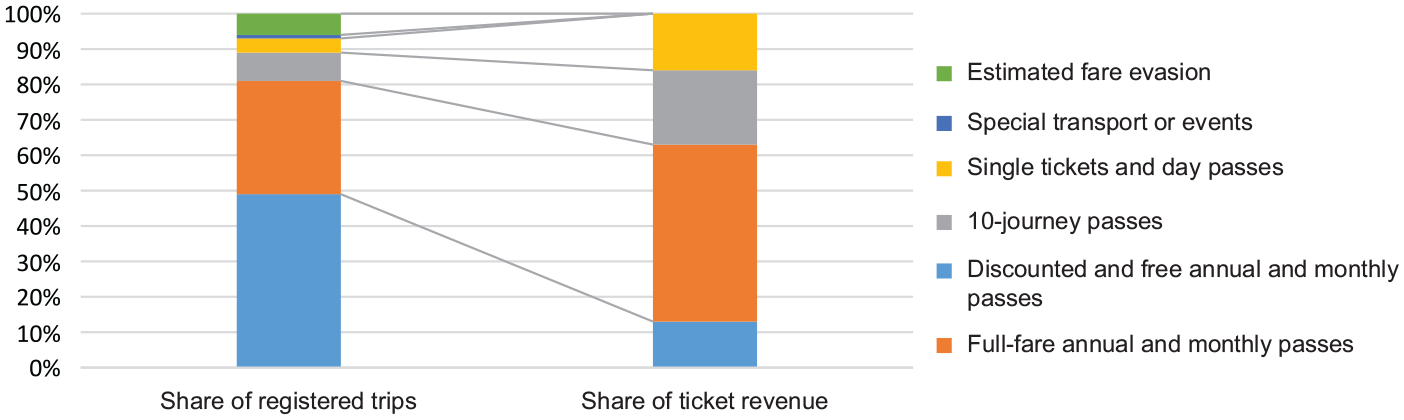
STIB breakdown of trip share and revenue by type of ticket (2018).
Moreover, the fare system supposedly secures public transport from ‘unwanted’ users. For Alain Flausch, former CEO at STIB (2000–2011), removing fares would devalue public transport and question its public character, failing to discipline passengers:
I compare free public transport to a piece of land that is abandoned. When you have a piece of land that is not fenced, where nothing is happening, and nobody is taking care of that piece of land, […] people are dumping their waste on the free place, […] it’s a free place that is not respected. (Flausch, 2017).
Through the fare system, STIB perceives passengers as paying customers. Kris Lauwers, an interim CEO of STIB in 2012, publicly declared that, alongside public subsidies, ‘the second money machine is, of course, the customer. […] We will undoubtedly have to milk them out more [and] move to a situation where public transport is paid at its true price’ (Colleyn, 2012). Consequently, through fares, passengers supposedly ensure and protect the quality of public transport – as a comfortable, reliant and aesthetically pleasing service – for its ‘desired’ public. As explained by Flausch (2017):
When I decided to buy what I consider [to be] a beautiful tramway […] in Brussels […] I decided [to] bring glass, […] stainless steel and seats in leather […] They are still there, no destruction, nothing, because [when] people […] get nice things, […] they really feel like they are in their public transport, they respect it. And that’s much more important than the few pennies that they pay [for] a yearly subscription.
As a result of this rationale and despite the fact that direct fare revenue represents merely 39.6% of the company’s operating budget in 2019 (STIB/MIVB, 2022a), between 1989 and 2019 the price of the annual pass for all public transport services in the BCR went up from €232 to €583. This means a+151.5% increase, which is nearly twice as high as the change of price index observed in the same time period (+82,3%). 4
Fare evasion as a complex and diverse practice
The inequalities embedded in Brussels’ fare system are a key factor behind fare evasion. According to STIB’s annual reports, 5 between 2008 and 2017 the share of passengers caught without a valid ticket increased from 2.4% to a record 5.8%, while the number of passengers checked annually has decreased by more than half. According to these estimates as well as our own observations, the actual rate is well over 10%. In response, STIB has increased the fines, held a prize draw for paying passengers and launched a media campaign, arguing that evasion is ‘a question of solidarity and equity’ (STIB/MIVB, 2022b). Above all, the increasing evasion rate justified the reinforcement of control mechanisms. Most notably, barriers known as portiques were installed at metro entrances and exits. Consisting of almost two-metre-high doors made of reinforced glass that slide aside upon ticket validation, the portiques serve a triple purpose of ticket control, data collection and passenger flow regulation.
Diversity of evasion practices
Through our observations, we have detected various practices that allow passengers to circumvent these barriers. The highest rates of evasion occur in busy stations at peak hours, when one in 10 passengers exercises ‘bumping’ (Reddy et al., 2011), that is sneaking through the opening doors behind a paying passenger and, if necessary, pushing the closing doors aside with the upper body or arms. In less-frequented stations and at off-peak times, passengers sporadically jump or climb over the portiques, despite a high level of exposure:
A woman approaches the barriers […,] turns towards the side counter […]. Supporting herself with both arms, she pushes herself up, pulling her legs sideways, and stands up on the counter. She places her right foot on the protruding display for card validation. Balancing on tiptoe, she swings her left leg over the doors and with a foothold on the other side, pulls her right leg along […] then jumps down on the inside of the station.
6
As this action is physically demanding, evaders may instead resort to using emergency buttons that open the barriers. As one interviewee explains,
If there’s no one at the station and you have to go through, […] we jump the gate, but it’s a bit wild so I prefer not to, even if it means missing my transport to wait for someone to go through. Otherwise, I press the ‘emergency evacuation’ button.
7
This practice is captured by our observation in one of Brussels’ busiest stations:
About 50 passengers, arriving up the escalators from the station below, move towards the barriers, where one after another validates a ticket […]. A man pushes past the throng towards the emergency board placed on the right side of the gates. With a quick, inconspicuous hand movement, he presses the emergency button. Thereupon a loud, continuous beep sounds and all doors pop up. For a minute, the barriers remain open, while passengers flow out into the entrance hall, some validating their tickets on the way, others passing through quickly.
8
Factors influencing fare evasion strategies
Our research further reveals three main reasons why passengers evade fares. Firstly, they are motivated by inequalities embedded in the fare system, as identified in the previous section, which impede many passengers’ daily mobility around the city-region. For instance, workers receiving a minimum wage that, depending on their socio-economic situation amounted to approximately €1300 per month in 2020, find it difficult to afford an unsubsidised annual STIB pass, as it costs almost half of their monthly salary. 9 One interviewee explains, ‘as a laid-off employee […] I can no longer pay a season ticket. It used to be [the] expense of my employer. With €1175 per month I earn too much [sic] to get […] a reduced travel card’. 10 Even for ‘young workers, young entrepreneurs […] who have a small job [… €499] is actually enormous’. 11 Indeed, most evaders cite financial reasons: ‘For a whole period […] when I didn’t have an internship, […] I didn’t earn enough to […] invest in a season ticket, and so I tried to evade as often as possible’. 12 Thus, in most cases, evasion is a temporary practice exercised in times of financial hardship and labour precarity, responding to fare-related inequalities in the welfare system. Otherwise, an evader declares, ‘if the employer pays me or I could afford to pay, I would no more be part of the [evaders]’. 13 Moreover, a few respondents explicitly articulate an ideological motivation, arguing that increased surveillance in public transport means ‘being confronted by a machine or even a human be[ing], who controls us, [which] can create a hierarchical relationship’. 14
Secondly, our research partly concurs with the academic literature as well as local public transport companies that the evaders’ behaviour may be rational or opportunistic. Indeed, some evaders compare the risk of being fined with the cost of an annual pass: ‘I’d rather pay €100 [for a fine] once a year than [€499] for a service that doesn’t work very well’. 15 However, the evaders’ reasoning is often much more complex. For instance, our respondents frequently justify evasion as a response to a perceived poor quality of STIB’s services and control mechanisms. Beyond financial calculations, regular evaders admit making daily mobility decisions based on their physical abilities, knowledge of the transport network and the length and geography of potential trips. While evading presents an unnecessary risk on very short journeys, when riding public transport can be substituted by walking, many respondents also avoid it when making particularly long trips, in which case they buy a single ticket. One evader explains: ‘For short journeys, I tried not to take too much transport so as not to overdo it. I said to myself, come on, I can do this journey on foot’. 16 Additionally, the decision to evade in the metro depends on the (un)availability of buses and trams, in which the honour-ticketing system facilitates evasion and the risk of running into ticket inspectors is lower. This factor strongly determines the travel behaviour of our interviewees: ‘I would generally take [a bus or tram] to avoid paying for the metro, […] I’d rather travel half an hour more [by] tram or a bus than to pay for the journey there and back’. 17
Deliberate fare evasion in the metro requires passengers to pay strong attention to infrastructural conditions. They acquire and adapt their knowledge about the location of the portiques, the surveillance at metro stations and the real-time geography of controllers – an awareness keenly indicated by nearly all our respondents. For instance,
with the introduction of the portiques […] it is much more complicated to travel without a ticket […], you have to think twice as much about the journey […]. Will there be people or not, will there be a ticket inspector, or will this metro station offer an easy way out?
18
Thirdly, fare evasion may be unintentional, caused by malfunctioning or absent vending machines and control barriers, forcing passengers to evade payment. This experience can be very stressful, as we observed:
One of the portiques is blocked. While the remaining doors swing open as usual, two passengers are stuck outside, the display reporting their pass as already validated. They spontaneously decide to squeeze into the station unnoticed behind other passengers. […] At 5.40 pm, the barriers are blocked again. A woman, whose children and husband have already passed through, is stuck. She looks around desperately, repeatedly pressing her card against the reader. […] Her husband […] approaches the doors from the inside and as soon as they swing open, he presses them to the side with both arms at head height to let his wife slip through the gate.
19
The control infrastructure, supposed to regulate the flow of passengers and improve the network efficiency, may thus become an obstacle for passengers. Its design further overlooks the diversity of metro passengers. While negotiating the portiques appears easy for able-bodied passengers with little luggage, this idealisation does not include persons travelling with small children, shopping trolleys, bicycles or pushchairs, who frequently get stuck between or outside the gates. In effect, the portiques represent a ‘dystopian vision [that] from an ethical and moral point of view [raises] the question of how we fight evasion, as it concerns a public form of transport’. 20 Although Brussels’ transport authorities claim that public transport is universally open to all users, the everyday experiences of its passengers reveal that fare-related economic and infrastructural barriers limit access to public transport for diverse groups of urban inhabitants.
What is public about fare evasion?
As a multi-layered and complex practice, fare evasion affects the publicness of public transport in at least four distinct ways. First, it involves mobilising, creating and sharing knowledge. This occurs in the physical spaces of public transport, as we observed in the metro stations. An interviewee explains that when ‘people on the other side [of the portiques…] don’t know how to get out, […] I would go back […] and press [or] tell them to press the green [emergency] button to open all the doors’. 21 The knowledge exchange further takes place in virtual spaces mediated by social networks. In the CdlS Facebook group, an average of 17 posts are published daily, transmitting real-time information about ticket and police controls, as well as about the locations of ‘free’ access due to portiques failure: ‘The gates of paradise [at Midi station] are open, come quickly, the passage is free!!!’ 22 Such channels of information have become daily companions and reference points for fare evaders, enabling them to share knowledge and adapt their practices to changing circumstances over time: ‘The first reflex I have is […] to check on Facebook [whether] in my direction there have been some announcements […]’. 23
Second, these social networks contribute to a sense of solidarity and community. Besides exchanging information about controls, many CdlS members exercise mutual aid, advising one another about procedures related to fines, lost and found items, and general functioning of public transport. Although most members do not contribute with posts or comments, they feel ‘solidarity to help one another, and to avoid that one of our members ends up with a fine’.
24
Hence, many interviewees as well as a flurry of CdlS posts refer to other group members as like-minded evaders, ‘fellow fare dodgers’ or ‘friends’, sharing their identity and collectively challenging norms in public transport: ‘We’re not all sheep: […] there are people who think that certain rules are actually there […] to break people […], and it’s nice to see that there are other people who think like us’.
25
Across CdlS, shared humourous vocabulary refers to the police as ‘chickens’ or ‘the blues’ and identifies controllers as ‘pigeons’ and ‘the greys’: ‘The blues are hanging around in montgom [station]  no control but be careful friends’.
26
The sense of community and ‘symbolic solidarity’ (Amin, 2008) thus arises from situated multiplicity in public transport. It supports evaders in validating their idiosyncratic and non-conformist practices, which are otherwise marginalised by transport officials. This translates from virtual spaces into practice. In metro stations, we observed many instances of fare-evading passengers approaching strangers to request or offer assistance: a man lending a travel card to a woman with a pram to let her through the lock gate,
27
a young woman politely asking one of the authors whether she could sneak together through the portiques.
28
no control but be careful friends’.
26
The sense of community and ‘symbolic solidarity’ (Amin, 2008) thus arises from situated multiplicity in public transport. It supports evaders in validating their idiosyncratic and non-conformist practices, which are otherwise marginalised by transport officials. This translates from virtual spaces into practice. In metro stations, we observed many instances of fare-evading passengers approaching strangers to request or offer assistance: a man lending a travel card to a woman with a pram to let her through the lock gate,
27
a young woman politely asking one of the authors whether she could sneak together through the portiques.
28
Third, such observations indicate that encounters and interactions constitute an important public dimension of fare evasion. Particularly during the peak hours, we recorded passengers moving in close proximity to each other and the built environment, crowding together as they approached the portiques and adjusted their movements. In this way, the mobile bodies draw closer through the practice of ‘bumping’, negotiating the shared spaces and reinforcing the experiential dimension of the journey (Bissell, 2013). This proximity, as one interviewee explains, affects the choice of evasion techniques:
[If it is] someone with whom the relationship can easily be established […] I ask ‘can I come with you?’ […] In general, during peak hours, people pass by and we go for it, we cling together a little bit and that’s it.
29
Following the communal approach to public space, practising evasion thus reinforces both physical and social proximity, and stimulating interaction between passenger-strangers in the enclosed space of public transport (Wilson, 2011). Nonetheless, similar to other types of social interactions in public spaces (Amin, 2008; Mattioli, 2014), encounters that occur through evasion are not necessarily convivial, but can involve friction and conflict. For some evaders, proximity occasionally causes stress and discomfort: ‘[sometimes I pay just] so I don’t have to cling to people, that sort of thing makes me quite uncomfortable’. 30
Therefore, evasion-induced encounters articulate tensions regarding the social norms in public space. Our research indicates that while transport companies and some passengers consider fare evasion to be disrespectful behaviour that entails breaking the law and social rules, evaders establish parallel rules of civility: ‘When you want to go with someone, ask nicely […,] don’t stick aggressively, it just makes the person uncomfortable If you’re going to evade, you have to do it in a more diplomatic way and not push people lightly or aggressively. [When] someone asks nicely, […] there’s no problem. I understand very well that some people don’t have the means and they have to go somewhere, to go to an appointment.
32
 ’.
31
Such alternative interpretations of socially appropriate behaviour are justified by the motives of the evaders:
’.
31
Such alternative interpretations of socially appropriate behaviour are justified by the motives of the evaders:
Similarly, other interviewees consider it ‘weird to talk about evasion and respect at the same time, because I think evasion is not respectful. But following someone without their consent is not respectful either’. 33 Thus emerges the fourth public aspect of fare evasion, as its practices articulate new rules of behaviour and civil (in)attention (Goffman, 1963) in public transport, since ‘we find ourselves in a space where there are many strangers and […] there are unusual interactions that would not happen in private space’. 34 Hence, the emphasis on the publicness of public transport leads our respondents to reflect on the (in)appropriateness of certain behaviour with regard to other passengers: ‘it’s a shared space so, obviously, I’m not going to behave in a bus or tram as I would in my car’. 35
Practising fare evasion for a more public transport?
In this article, we have explored the practice of fare evasion. Public transport authorities and scholars commonly condemn it as a rational and opportunistic act of avoiding payment, emphasising its financial, behavioural and criminal consequences. To challenge this simplistic view, we have explored fare evasion as an idiosyncratic practice that involves complexity and ambiguity, as it is underpinned by social inequality, driven by various motivations, and enacted in diverse ways. Thus, we have questioned a number of idealisations regarding the publicness of public transport, notably the framing of passengers as mere clients, and of the fare as a neutral instrument for facilitating a purely economic transaction. We have situated our study in the BCR, a city-region whose public transport policy is strongly guided by an idealisation of the metro as a symbol of modernity and efficiency, and of its passengers as middle-class consumers. We have shown how this bias is reflected in the fare system, as it is meant to secure public transport from ‘unwanted’ users, and hinges on strong social inequalities and injustices. In effect, it fails to recognise existent socio-economic diversity by omitting a series of under-privileged passenger groups while offering fare-free passes to middle-class salaried workers.
Having explored diverse practices and techniques of evasion, we argue that although it may hinge on calculated and opportunistic action, evasion is driven primarily by fare-related inequalities, alongside ideological views, dissatisfaction with transport services and malfunctioning control infrastructure. Evaders largely concur with observations made in academic debates about the publicness of public transport, emphasising its ownership structure, opposition to privatisation agendas and importance for the public. Put simply, ‘when you’re waiting for the metro at the Central Station, it’s a public space, it’s not private, there’s no owner’. 36 However, they expand the definition of publicness further, perceiving public transport as ‘a space where anything can happen, anyone can enter, evaders like me’. 37 They value that public transport is ‘a space that is easily accessible’, 38 and further emphasise that it is ‘a space that is shared with several people, there is something collective about it’. 39 Evaders are engaged in exchanging knowledge and building virtual communities of like-minded passengers. Consequently, as a transforming practice, fare evasion reflects how the publicness of a space may not be defined by inherent and stable features, but through processes shaped by multiple publics, agencies and individual biographies (Qian, 2020). Seen from this perspective, evasion contributes to a variety of social phenomena that characterise public transport as a public space: the creation and sharing of knowledge across its users; a sense of solidarity and community amongst evaders; encounters and interactions resulting from physical proximity causing conviviality or disruption; an opportunity to re-negotiate social norms.
Finally, for many evaders riding without a ticket is an implicit protest against the governance of Brussels’ public transport. It enables them to expose the injustices of the fare system, challenging the official narrative that claims public transport to be open and accessible to all. Lacking sufficient economic resources to purchase a ticket, they transcend the paradigm according to which passengers are paying customers, engaged in a purely economic and apolitical transaction, buying a mobility service at a price. Instead, they become re-politicised as evaders. They gain agency to articulate their political claims about public transport, and claim a ‘right to the city, a right to be able to move around’. 40 Thus, while evasion involves a breach of social norms and laws, it may well question, enhance or even condition the publicness of public transport.
Footnotes
Acknowledgements
No article could be written in a vacuum, without conversations with colleagues and friends, their sympathetic critiques and words of encouragement. We express our gratitude to Jason Finch, Wladimir Sgibnev and Tauri Tuvikene, who together with Wojciech acted as guest editors of the special issue on “Public Transport as Public Space”. We appreciate the efforts of three anonymous reviewers, whose comments challenged and motivated us to improve the article. Special thanks go to Céline Drieskens and Frédéric Dobruszkes for their support throughout our research. Finally, we are grateful to all the interviewees for sharing their experiences and stories. Needless to say, none of the above holds any responsibility for the arguments advanced in the paper, which remains ours.
Declaration of conflicting interests
The author(s) declared no potential conflicts of interest with respect to the research, authorship, and/or publication of this article.
Funding
The author(s) disclosed receipt of the following financial support for the research, authorship, and/or publication of this article: This research is carried out within the project ‘Public transport as public space in European cities: Narrating, experiencing, contesting (PUTSPACE)’. The PUTSPACE project is financially supported by the HERA Joint Research Programme ( ) which is co-funded by AKA, BMBF via DLRPT, ETAg and the European Commission through Horizon 2020.