




Abstract
Strategy has become an important concern and practical tool in urban management and governance, with the literature highlighting implementation as a hallmark of effective strategy. Whilst such a strategy–action link (which we label here as ‘implementation nexus’) has been well established, other long-term effects have been documented in less detail. Our study of Sustainable Sydney 2030 finds that strategy was effective to the extent to which it changed the institutional a priori of what a collective of actors engaged in city-making knows, what it can articulate and how its members relate to each other. We capture this effect as ‘institution nexus’ and theorise our findings with Ludwik Fleck’s concept of ‘thought style’ of a focal ‘thought collective’– notions that also centrally influenced Mary Douglas’ work on ‘how institutions think’. We contribute to extant research by adding the institution nexus as a long-term effect of urban strategy as well as by advancing strategy theory in urban studies to foreground its ability to shape institutions.
Introduction
As ‘watchword of our times’ (Carter, 2013), strategy has profoundly shaped discourse and practice of public administration including urban management and governance. Research has responded to this rise of strategy and significantly advanced our understanding of the evolution of urban strategy (Andres et al., 2020; Brandtner et al., 2017; Kornberger, 2012) and public-sector strategy more generally (Brown, 2010; Bryson and George, 2020; Johanson, 2009; Stewart, 2004). Studies analysed the nature of public-sector strategy (Mulgan, 2009), its tools (Bryson, 2018), its ability to engender strategic change (Pettigrew et al., 1992) and its promise to enhance performance (George et al., 2019) at all government levels (for an overview see Ferlie and Ongaro, 2015). More recently, work investigating the nature of urban strategies has elaborated on issues of power (Jalonen et al., 2018) and suggests that strategy is not a neutral planning tool but part and parcel of a performative and disciplinary apparatus that shapes the city and its constituents (Alexander et al., 2012; Brorström, 2019; Kornberger and Clegg, 2011; Vaara et al., 2010) as well as the ‘geometries of power’ (Certomà et al., 2020; Vanolo, 2014).
However, existing literature has put less emphasis on investigating strategy’s long-term effect. 1 We address this lacuna through an empirical inquiry into the effect of the Sustainable Sydney 2030 strategy over a 10-year period. Our case poses a considerable puzzle in this respect. Notably, not just the city administration but also critical voices regard Sydney 2030 as a ‘success story’ despite the fact that most of the projects proposed in the strategy were not implemented. Thus, we ask: why did stakeholders attribute ‘success’ to the strategy? Or, put in a more scholarly way, what were its effects? Our findings suggest that Sydney 2030’s effect was to create shared sensibilities, a repertoire of categories, vocabularies and frames, as well as ways of relating those engaged in city making to each other. In order to theorise and discuss these findings, we draw on concepts initially developed by Fleck (1935) and later elaborated by Douglas (1986) and argue that Sydney 2030 changed the distinct ‘thought style’ of the ‘thought collective’ of actors engaged in city-making. The effect of urban strategy resides, so our central concept claims, in its power to shape the shared understandings on which a collective of actors draws when directing their attention, asking questions and exploring alternative courses of action. Our study suggests that one challenge of strategy practitioners is to institute a shared socio-cognitive infrastructure for collective reasoning and action.
Our work offers two conceptual take-aways from Sydney 2030. First, our article extends current scholarship by recasting the question of the effect of urban strategy. We argue that strategy is effective to the extent to which it shapes the thought style of a thought collective and, in our case, through that, the city as an institution. Building on work that suggests performative aspects of strategy (see e.g. Brandtner et al., 2017; Brorström, 2019; Van den Ende and Van Marrewijk, 2018), and in contrast to the idea that strategy’s raison d’être lies in its implementation (which we describe as ‘implementation nexus’), we refer to this as the ‘institution nexus’. Our second contribution aims to deepen the conversation about strategy in urban studies. We develop a critical vocabulary to analyse strategy as pivotal urban practice and response to a ‘new localism’ (Katz and Nowak, 2017). Extending ongoing conversations that discuss strategy, tactics and power of urban actors (Andres et al., 2020; Vanolo, 2014), our study highlights the long-term (infra-)structuring effects of strategy.
Theoretical orientation
From the 1970s onwards, mounting critique questioned strategic planning as an inadequate tool (Kaufman and Jacobs, 1987; Wildavsky, 1973) and bureaucracy as an inadequate organisational form for efficient public service delivery (Du Gay, 2000). A host of new demands towards the public sector and a series of reforms designed in response (such as New Public Management; Hood, 1991) further opened up public administration research and practice towards strategy (Andrews et al., 2012; Bryson, 2018; Kornberger, 2012; Moore, 1995; Stewart, 2004). Paraphrasing Osborne and Gaebler (1992): if government is not about rowing but steering, then strategy – that is, the setting of direction – becomes quite logically its quintessential task. Thus, strategy has been defined as ‘the development and execution of a plan of action to guide behavior in pursuit of organizational goals’ (Brown, 2010: 212). ‘Being strategic’, then, is thought to make the difference between success and failure in government: ‘Good strategy pays off’, as Mulgan put it (2009: 2), because strategy protects against the ‘tyranny of the immediate’ that (often politically induced) sacrifices the future for the present (Mulgan, 2009: 3). In contrast, strategy is about ‘purpose, direction and goals’ (Johanson, 2009), requiring ‘detailed work of analysis and planning and keeping track of implementation’ (Mulgan, 2009: 3). Further research (e.g. George, 2020) has investigated the conditions for successful strategy implementation, which remains the rationale for strategy work. Indeed, whilst a ‘pluralist and even fragmented’ (Ferlie and Ongaro, 2015: 2) body of literature on public strategy has emerged, the focus on implementation as the hallmark of strategy’s effectiveness is widely shared across strategy schools. For instance, Vining (2011) suggests a Porter-esque framework, while Moore’s (2000) value triangle provides a less literal translation of business strategy tools to the public sector. Others deploy a resource-based view to analyse competences and capabilities in public-sector organisations (Bryson et al., 2007). What these approaches share is the idea that strategy’s effectiveness is a matter of putting to use appropriate models or frameworks (e.g. Five Forces, VRIN) that lead the way to effective implementation.
More critical literature emphasises the messy realities of strategy-making in which planned, emergent and realised strategies intermingle, with the result that strategy ‘formulation and implementation become indistinguishable’ (Ferlie and Ongaro, 2015: 32). With this focus on adaptive strategy-making, the implementation work has become an important locus of strategy studies. For instance, Brown (2010: 213) elaborates on ‘distributing strategizing activities throughout the organization’ which should be ‘coupled with increased managerial autonomy to allow decision makers to reevaluate strategies and execute midcourse corrections as conditions change and new information becomes available’. Andres and colleagues (2020) highlight the polyvocality of strategy where a variety of powerful actors (including politicians, developers, citizen groups, etc.) develop conflicting strategies resulting in emergent negotiated and always only temporary order. Similarly, processual accounts of strategy (Pettigrew et al., 1992) argue for an understanding of strategy as an ongoing and inherently political change process. This process can be driven bottom-up and creates ‘fluid governance structures’ that – at least partly and temporarily – change existing power dynamics (Certomà et al., 2020). As strategy formulation and execution are difficult to disentangle, the focus is rather on processes of learning and change that unfold in often unforeseen directions with unintended consequences. Following this emergent account, strategy-making is not beholden to a rigid top-down planning cycle but a flexible, adaptive process.
A branch of this critical literature has focused on strategy practices in the context of cities (Brorström, 2019; Jalonen et al., 2018; Kornberger, 2012). For instance, Vaara and his colleagues (2010) highlighted the power effects of strategy texts and genres. Similarly, Kornberger and Clegg (2011) analysed the performative effects of strategy making, arguing that urban strategy may be analysed as an aesthetic phenomenon that aims to mobilise people, marshal political will and legitimise decisions. Brandtner and colleagues (2017) study strategy documents as a discursive device through which local governments enact aspired governance configurations. Whilst these studies zoom in on strategy and its making in city administrations, they remain silent about the long-term effects of strategy: they highlight how strategy is being done but do not investigate what strategy does. Indeed, a key point of critique of practice-based studies of strategy is that they focus too much on minute details and hence lose sight of the effects of strategy.
In sum, we argue that the growing literature that has reflected strategy’s rise in cities and public administrations highlights that the hallmark of an effective strategy lies in its implementation, and that it is in turn through implementation that strategy adapts to changing environments. Whilst this ‘implementation nexus’ is well established, it is less well documented which other long-term effects of strategy may occur. Intrigued by the assessment of Sydney 2030 as a ‘success’, and simultaneously puzzled by the lack of its implementation, the following question motivates our investigation: What is the long-term effect of strategy?
Our findings show that strategy effected the city as institution, that is, strategy was effective as it shaped common understanding and social networks of those engaged in city-making. We label this effect the ‘institution nexus’ and, in our discussion, theorise it by building on Ludwik Fleck’s concept of ‘thought style’ and ‘thought collective’ of actors engaged in city-making.
Empirical context, data and method
Empirical setting: Sustainable Sydney 2030
Our empirical focus is the Sustainable Sydney 2030 strategy crafted by the City of Sydney under the leadership of Lord Mayor Clover Moore.
2
Running as an independent candidate, she emerged as the unlikely winner of the 2004 election. Soon after assuming office, the Lord Mayor embarked on a 2-year strategy process – the first for Sydney since the 1970s. This process resulted in the final strategy document published in March 2008. For the Lord Mayor, the comprehensive strategy was a legacy-building tool beyond a (at that time unlikely) second term. A close observer reflected: She [Lord Mayor] also knew that she didn’t necessarily have anything more than one term. It was an unlikely win anyway. So one of her big commitments was to get the kind of strategic plan in place that would both guide the city but would also need to be able to inspire people, so that if she was not there in four years’ time there would still be something that was carefully engaged, carefully consulted, had a lot of buy in, and would actually inspire people for it to keep going no matter who was in government here at the city or at the state level, or at the federal level. (D, 2016)
What Sydney 2030 signalled to the electorate was that the Lord Mayor had indeed a plan for the future – which they rewarded with re-electing her ever since, making her, now in her fourth term, the longest serving mayor since the establishment of the City of Sydney in 1842.
In terms of content, Sydney 2030 proposed sustainability as key to the future; it identified three key values (‘green’, ‘global’ and ‘connected’), defined ten strategic directions, and elaborated them through ten concrete projects that were designed to bring the strategy to life (such as reconnecting the harbour with the city, or integrating the western edge of Sydney). 3 In the detailed document, the strategic intent was backed up by almost 200 action points that were meant to guide implementation (see Kornberger and Clegg, 2011). Moreover, whilst Sydney 2030 was conceived of as one strategy, it is important to note that over the years it was accompanied by the myriad of documents, standards and plans in its support. In terms of process, Sydney 2030 was the most extensive consultation in Sydney’s history, engaging 12,000 people through workshops, roundtables, public events and exhibitions; hundreds of thousands more were reached through extensive media coverage and the city’s online channels.
Data collection
Our main data sources are interviews with key actors, stretching over a decade. 4 The first series of interviews in 2007/2008 focused on motivation and ambition of the strategy project as well as the strategy-making process itself. In 2016, we revisited our research site twice: early in 2016, interviews with city executives probed the effects of Sydney 2030. In these conversations it transpired that Sydney 2030 was perceived as a success – despite the fact that only one out of ten proposed projects was implemented. This sparked our curiosity and we returned for more fieldwork in September 2016. This third round of interviews included strategists within the city administration; in addition, to ensure diversity in our sample, we also interviewed actors with critical distance from Sydney 2030. Interestingly, their assessment did not differ substantially from that of city administrators.
The selection of interview partners focused on persons involved in the strategy process as well as experts outside the city administration. We had access to the city’s top management team, including the city’s CEO, the heads of urban strategy, planning, city design, city life, sustainability as well as senior members of the Lord Mayor’s office. Where useful we interviewed middle managers. External experts were included to avoid selection bias: we interviewed an urban affairs editor of an influential newspaper who wrote about Sydney 2030; senior members of the State Government because of their rather adversarial position towards the city, their views balancing perhaps overly optimistic accounts of the city administration; and experts and observers of Sydney’s evolution (such as a well-regarded former president of an architectural association, a senior member of the Greater Sydney Planning Commission, or the chief executive of the Committee for Sydney, a body comprising 400 corporates devoted to the development of Sydney). In total, we analysed 40 interviews (20 from 2007/2008 and 20 from 2016) with 32 different individuals. The interviews were semi-structured and covered questions on both the effects of strategy and the conditions for its success. They lasted on average an hour, the shortest being just shy of 30 minutes, the longest lasting over 90 minutes. All interviews were taped and transcribed verbatim. As a result of regular contact over several years, many of our interviewees became trusted conversation partners, read draughts of our findings and kindly commented upon them. This feedback loop proved invaluable to ensure accuracy of our analysis and authenticity of the resulting narrative.
To further contextualise our data, we also studied a number of documents such as white papers, strategies that developed specific ideas in various policy fields, and more operational documents into which the strategy had spilled over. Moreover, we analysed reports, studies, newspaper reporting on the city strategy and updates on the city’s website. These data were important to gauge the overall effect of Sydney 2030. Being our main data source, insights from the three rounds of interviews spanning a decade were cross-checked and validated using this wide range of supplementary material.
Data analysis
In order to translate our data into a narrative, we followed methodology proposed by Gioia and colleagues (2013). In a first step, we paraphrased the statements from the transcripts. We coded the salient articulations that our interviewees provided regarding our research question. During this phase, we stayed as close as possible to their original formulations, making ‘extraordinary efforts to give voice to the informants’, as Gioia and colleagues (2013: 17) suggested. Concepts were developed inductively. In so doing, we drew up a table of statements that summarised different domains in which interviewees described the multiple effects of strategy. In a second step, we compared these concepts and derived underlying themes. During this step, we applied a more theoretical lens and condensed our initial concepts in order to gain a more abstract understanding of the effect of strategy. Finally, in a third step, we further aggregated the themes into abstract dimensions that provide the building blocks for our theorisation and the model that we will present in the discussion. We discussed the interpretations of data with each other; in case of disagreement, we went back to the original transcripts and discussed the statements again in context. Figure 1 provides an overview of the analytical work leading from interview data to conceptualisation and theorisation.
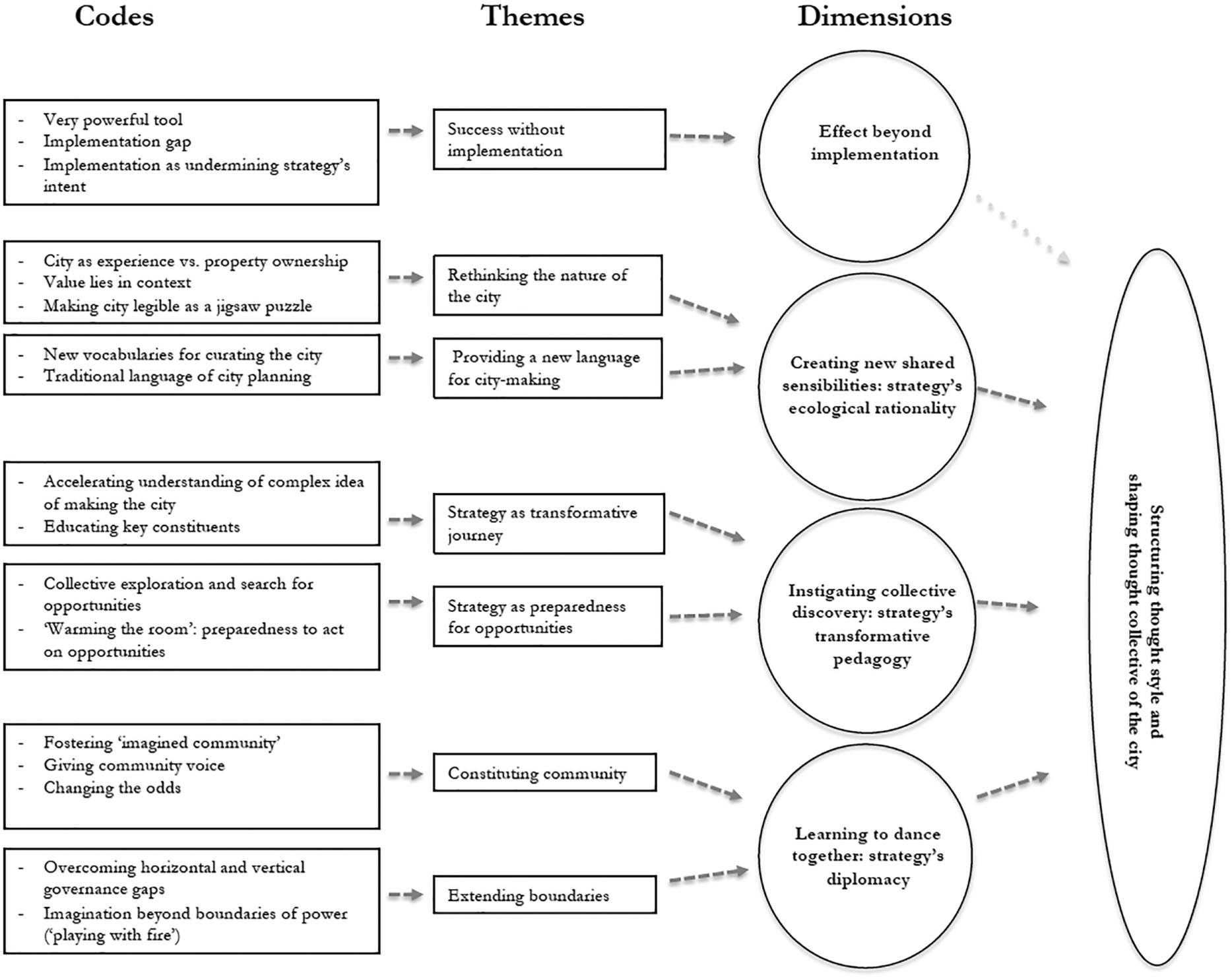
Analytical framework and findings.
Findings: The effect of Sydney 2030 beyond implementation
Our analysis yields four dimensions (see Figure 1) that we will describe below, building on the underlying themes and codes. Prior to this, however, we wish to return to 2007/2008 and revisit the aspirations as to how strategy was meant to shape the future.
Strategy by the (text)book: Imagining Sydney 2030’s effects in 2008
When Sydney 2030 was originally crafted, expectations were fairly conventional: Sydney 2030 was supposed to provide ‘the blueprint for the future’ (E, 2008), as an exercise that helps the city adapt to the environment, find out where they want to go and how to get there (W, 2008), whose positive effect would be in the implementation of its proposed ideas. This textbook approach to strategy was complemented by the concern for implementation: I don’t think a lot of people really appreciate what strategy is. […] to me strategy is the whole package; it is sort of like the vision and the goals but it is also you know the action plans that sort of get you to that end goal, because very often people sort of articulate what they want, but they don’t put any sense, anything behind it that actually says how we are actually going to get there. (X, 2008)
Of course, they anticipated that ‘realities will always impinge’ (V, 2008) and putting ideas into action was by no means easy: I think doing the vision is not easy but it’s not necessarily the hardest part of the process. I think the vision bit, once you’ve got that, then the next level down to actually implement – that is hard. It’s really hard. (H, 2008)
In sum, the strategists’ expectations in 2007 and 2008 of what their strategy would do was to guide implementation of the plans made, reflecting an understanding of strategy and its effects much in line with what we described above as the implementation nexus.
Effect beyond implementation
Fast-forward to 2016: Sydney 2030 is widely regarded as a success story. As a strategic narrative, it has guided the city for a decade and provided the springboard for the re-election of the Lord Mayor: Because it’s [2030] been successful, it’s been a very powerful tool, you could say, for a re-election of a Mayor. A very powerful tool. […] I think a lot of people would say, I’m going to vote for Clover Moore, I’m actually voting for 2030. (C, 2016)
In this sense, Clover Moore’s victory at the voting booths is also a popular vote on Sydney 2030. However, critical voices from the media
5
and senior officials from the state government (T, P, 2016) also describe Sydney 2030 as highly effective. The success, however, cannot be attributed to implementation; Sydney 2030 turned out not to be the ‘blueprint for the future’. It had proposed ten flagship projects through which it would deliver. Looking at what has actually been achieved provides a rather sobering picture. As one person very close to the strategy process noted: I suspect the majority of those actions [in 2030] weren’t implemented. […]. But in some ways, to me, that’s not so much the concern or the issue […]. (O, 2016)
A decade on, out of the ten projects only one has been implemented – the light rail along the eastern suburbs and the related re-design of George Street – the central street in the CBD – into a more pedestrian-friendly street. Perhaps ironically, this project does not reference Sydney 2030: the light rail project owner is the NSW Ministry of Transport who, in their project communication neither acknowledge the city nor Sydney 2030. Other multi-billion investments such as the prestigious Baranagaroo project or the redevelopment of Darling Harbour are by no means implementations of ideas developed in the strategy.
Perhaps even more counterintuitive, our data suggest that implementation might sabotage the strategy’s intent. Our interviewees stressed the ‘multidimensionality’ of doing strategy (O, 2016). The light rail project was no exception, the question being whether it is ‘a transport project or is it a pedestrianising green city project? Is it a sustainability project? Or is it a means of doing a – a public domain? Or is it a land use facilitation project?’. Our interviewee suggested that it is all of the above, and alluded to paradoxical consequences that result from actually implementing the strategic plan: […] so the danger in not having thought through these multiple dimensions is that when the people come to deliver the light rail, all they care about is delivering the light rail. (O, 2016)
Focus on delivery of the project, this interviewee highlights, results in strategy drift and goes against the spirit of the strategy as a whole: the trams stop at Circular Quay and, being 60 m long, the tram stop cuts the city off from the waterfront even more – although a key priority of Sydney 2030 was to create better access to the harbour (O, 2016). Or: for capacity reasons the trains have to be quite long – which will aggravate the problem it was initiated to solve: ‘So we go back to the problem that caused the light rail which was end to end buses’ (N, 2016).
What this shows it that implementation was clearly not the reason why Sydney 2030 is regarded a success story. Why is it that, in our case, implementation – commonsensically the hallmark of an effective strategy – is ‘immaterial’, as one of our interlocutors put it? What else could account for its attributed positive effects?
Creating new shared sensibilities: Sydney 2030’s ecological rationality
First of all, as the most significant change, Sydney 2030 created ‘new shared sensibilities’– mainly manifested in novel ways of thinking about the nature of the city as well as in providing an innovative language to talk about it. For instance, one interviewee explained that it ushered into being a ‘very strong sensibility’ in relation to the urban –‘a sensibility, but not necessarily a plan’ (B, 2016).
Rethinking the nature of the city
Sydney 2030 provided a different lens through which to understand what ‘city’ and ‘urban space’ mean: the lens of experience, not of property rights and ownership. Our interviewees stressed that, as a former colony, the latter had been the driving force for decisions that shaped the city for a long time. In contrast, Sydney 2030‘put the people experience above the ownership experience. […] it kind of looked through a different lens’ (B, 2016). It brought a new sensibility that shifted the conversation of what made the city move towards thinking relationally. The value of, for instance, a building does not reside in bricks and mortar, but in the relation between the building and its environment. As one senior executive stated: It’s not enough to talk about your building, you’ve got to think about your building in a context. The value for your building comes from its context and our job, as a city, is to look after the context […]. What I’m saying is that the mentality of the citizens and the building owners and everything, it has been shifting, to go, I get it. They’re not coming in so much to talk about their building, they’re coming in to talk about their precinct. (E, 2016).
Context represents a ‘collective good’ (P, 2016), and the city administration acts as the ‘custodian of context’ (E, 2016). The emphasis on context and the activities unfolding between buildings can be referenced with Jacobs (1961) who promoted the idea of the urban commons as positive externality. Following her thinking, Sydney 2030 introduced a new sensibility that re-evaluated what made the city work; it was, as one senior strategist noted not uncritically, an exercise in the ‘marketing of the commons’ (A, 2016). Of course, critical urban scholarship has highlighted the importance of contextual factors and the commons for a long time (see Harvey, 2012); what was of interest in Sydney 2030 was that strategy effectively translated this ethos into the tool kit of city-makers including politicians, developers and citizen groups.
Sydney 2030 was seen as success because it proposed to read the nature of the city differently; it made the city legible in a novel way. Instead of proposing a model, it embodied the search for relations and linkages, looking for threads constituting the urban fabric. This new integrative, contextual thinking was highlighted and explicitly referred to as the essence of ‘strategic thinking’ (H, 2016). Having a bigger picture implied an understanding of what makes the urban (or: what is the city-ness of a city)? The search for reading city-ness differently was articulated through the metaphor of the ‘jigsaw puzzle’. As one senior urban designer (C, 2016) suggested ‘we have some pieces, the state government others’. It was not crucial who owned which piece of the puzzle, but how to clip the pieces together and to think holistically about their interactions. To be strategic meant to keep one’s eyes on the big picture, not the individual puzzle piece. Losing sight of the big picture leads to delivering a project – but to failing on the overall vision.
Providing a new language for city-making
The new sensibility also brought to life a ‘very new language’ of ‘curating the city, co-creating the city’ (E, 2016). Practical examples include concepts such as the ‘night-time economy’ or ‘fine-grain development’ which allowed capturing hitherto unexplored qualities of the city: It is at the level of perception I think, it’s actually once you have the language, once you have the terminology, once you have not just the vocabulary but the way the ethos is then expressed and that becomes part of the broader culture […] [and the] repertoire and the expectation and the way people think of the city. (R, 2016)
As our interviewee recalled with a smile, ‘fine-grain’ had only been known as flower mixture for ‘baking bread’ until Sydney 2030 made it part of the vocabulary of describing urban experience, and thus part of the toolkit of urban designers working on improving urban experience.
Sydney 2030’s language invited diverse stakeholders to debate the city in ways that departed from the traditional language of city planning an expert would use that was precise but, at the same time, rather exclusive and restrictive: The problem with planning is that it’s a kind of – it’s almost an arm of the legal profession because planning, in order to be defensible, has to use precise, overworked, jargonistic language and make precise references so that others can’t drive a truck through it. People learn at that defensive mode of language to resist erosion of the concept or the idea […]. I think the city did the best job in 2008 in breaking that mold with this document […]. It’s more propositional and by that the virtue of the propositional is it doesn’t have to be precise. (B, 2016).
Instigating collective discovery: Strategy as transformative pedagogy
The second key dimension points to the following effect: Sydney 2030 represented an ongoing process that was transformative and led to an openness for evolving preferences, new opportunities and alternative paths of action.
Strategy as transformative journey
Our interlocutors stressed the transformational quality of strategy. For them, Sydney 2030 took those involved on ‘a journey’ which ‘was a massively educational exercise’ (O, 2016). A senior urban designer (N, 2016) reflected that Sydney 2030 was ‘accelerating the understanding’ of the ‘complex idea of making the city’. Strategy’s effect does not lie in proposing a solution to a complex problem; rather, it lies in instigating a process of developing a joint understanding of the city as such. Doing strategy embodied a pedagogy that was educational for key constituents. This was particularly important with regard to political decision-makers and council members: I think in some respects one of its [Sydney 2030’s] greatest influences was actually on the elected members of the councils themselves. […] the document couldn’t be comprehensive about everything, but on a large number of fronts it had some basic policy thinking in place so that when it became time for the council to make a comment about something at least they knew – at least they had something to start with instead of nothing. […] [Sydney 2030] had a very big role in educating the councilors about how the city actually works. (A, 2016).
Our interviewee expressed an important point, arguing that the political decision-makers came into power through mobilising local constituencies around local issues, but only a few of them would actually understand the ‘complex idea of making the city’ (N, 2016). Hence Sydney 2030 was a learning journey for the councillors helping them to understand the bigger picture.
Sydney 2030 was also educational for the wider public who were invited to question and re-imagine the city. One interviewee elaborated that the process ‘lifted the debate’ (L, 2016) and ‘got the population thinking about urban matters’ (A, 2016).
Sydney 2030 as preparedness for opportunities
Instead of providing a precise plan to be implemented, Sydney 2030 triggered exploration and search for opportunities: It comes back to this whole notion of a strategy as something that is aspirational, […] that a whole lot of things happen around and come up to as opposed to necessarily it all working out exactly how it might have been planned […]. It never really worked actually, but the consequence of that though was just about having – continuing to have that as in the ether as a conversation based on the Sydney 2030 thing, when I think created that opportunity around what’s happened now with Central Park, with the Frasers […]. The Gehry building […]. You can never work out cause and effect in those things. (I, 2016).
Other interviewees stressed that the merit of strategy lies in being propositional and explorative rather than precise (B, 2016), offering a narrative of possible futures that galvanises support in the present. A senior strategist summarised this characteristic of strategy as ‘direction without commitment’ (A, 2016): As a narrative form (i.e. genre), strategy allowed to imagine a joint future without asking immediately for commitment. In this sense, strategy differs from other genres such as planning or political discourse in which ‘direction without commitment’ is rather difficult to sustain.
Strategy was successful precisely because it outgrew the original intent and led to new opportunities that were hitherto unimagined. Strategy’s effect was not only understanding possibilities for change but also readying people to act once an opportunity would arise. This awareness was especially important in the context of Sydney that has been labelled the ‘accidental city’ (N, 2016, referencing a book by Ashton (1993)). A senior political advisor reflected on opportunity structure and strategy: It’s hard to nail down what was 2030 and what was something else […]. It was also I think a matter of waiting for the right time. Because there was a plan in place, when the opportunity presented itself, there was an intelligent strategy to put forward. [Facilitator: It’s a bit like luck favors the prepared mind?] Yeah, and I think one of the strengths that all of that work has done, I think probably if I looked through there are a large number of things that are still sitting there waiting for their time, but it does mean when the opportunity presents itself we have a well thought through approach that we can start to put on the table. (D, 2016)
If luck favours the prepared mind, our data suggest that opportunity favours the strategic mind. As the interviewee argued, the role of strategy is not to entrap the future and force things to unfold according to a plan. Strategy works more indirectly, as ‘warming the room’: What you have to do is be prepared […]. So as much of it as anything is just being ready for when the time is right. Because the time can be right really very quickly and you need to be ready to go with it […]. Then it’s what Rachel Healy [Australian art director] used to call ‘warming the room’. It’s a great comment. You know you warm the room so that the room, when the idea comes up, it falls into a ready mindset. (K, 2016).
Learning to dance together: Strategy’s diplomacy
The third effect is captured best by one of our interlocutor’s reflection that strategy is about ‘learning to dance together’ (A, 2016). With that phrase, s/he alluded to the social efficacy of strategy, something we conceptualise as capacity to constitute a sense of a collective urban identity.
Constituting community
Sydney 2030 was described as engendering a sense of ‘we-ness’ amongst citizens, developers, owners, the business community and other Sydneysiders. Interviewees suggested that it had created a ‘constituency’ (O, 2016), built a ‘consciousness’ (B, 2016) or, as another expert described it quoting Anderson’s felicitous phrase, Sydney 2030 created an ‘imagined community’ (S, 2016). The effect of strategy was to network people around shared issues and concerns. One executive (H, 2016) reflected that Sydney 2030 gave the city ‘a ticket at the table’ of sustainability thought-leaders; it granted access to a community-of-practice. More locally focused, Sydney 2030 created its own community, a collective around Sydney and its future. It provided not only a distinct vocabulary to use but ensured that not only ‘the loud voices in the city’ (B, 2016) were heard. Hence, Sydney 2030 provided the canvas for the ‘imagined community’ to form itself around the city as place, engendering a sense of collective urban identity and a feeling of ‘we’-ness.
Strategy was about building consensus amongst its constituency. It ‘de-risked’, as one interviewee (K, 2016) put it, certain ideas, increasing their odds to happen through forging the scarce resource that is necessary for any major projects in the city: public support.
Extending boundaries, bridging governance gaps
Strategy did not only connect constituents within the city but also allowed the city to extend its boundaries into areas outside its jurisdiction. Our interviewees highlighted governance gaps as a specific challenge that strategy had to cope with. Our findings reveal two kinds of governance gaps (see Pierre, 1999) – horizontal gaps (within civil society) and vertical gaps (within government).
First, with regard to horizontal distribution of decision-making, already at the outset of the strategy project it was argued that ‘the city is the result of billions of decisions about minor things’, hence any form of central planning is at odds with individual decision-making as ‘everyone is an author in the making of the city’ (R, 2008). Given this distributed decision-making, Sydney 2030’s challenge was to identify ways and means to influence the multiple ‘authors of the city’ so that their decisions and actions were aligned (E, 2016). Strategy, to stay with the metaphor, had to provide the leitmotif and rhythm for the dancers to dance together.
Second, in the Australian context, fragmentation between hierarchical levels of government (municipal versus state and federal levels of government) are the norm, resulting in vertical governance gaps which formally leave the City of Sydney little leeway for manoeuvre. One of our interviewees with a wealth of international experience in local government noted: I’ve never met such disempowered city government as I’ve met in Australia because it doesn’t exist […]. So we are in the presence of a democratic deficit and a governance deficit that is leading to random projects – essentially. I think it’s catastrophic […] What she [Clover Moore] has done very well by the way is that she’s used it [Sydney 2030] to manage upwards […]. (S, 2016).
We found a strong recognition that one of strategy’s most significant effects was allowing to cope with these problematic governance configurations. One interviewee contemplated this by holding that ‘strategy doesn’t know governance boundaries […]. It doesn’t know any boundaries, which makes it really exciting. It’s like playing with fire’ (C, 2016). Such ‘playing with fire’ allowed for collectively imagining ‘a future for things that we didn’t control’ (K, 2016). This capacity of strategy to spark inspiration in areas that lie outside the city’s realm of power and control was a prominent theme in our interviews.
Discussion
Strategy’s effect as ‘institution nexus’
Johanson (2009: 873) diagnoses that much of the public-sector strategy literature ‘has been more oriented to introducing the tools of strategy implementation than elaborating on the nature of strategy itself’. Our case responds to this criticism: based on our analysis, we observed that the implementation of the only realised project proposed in Sydney 2030 undermined the actual strategic intent of Sydney 2030 rather than bringing it to life. In contrast, our study suggests three alternative effects of strategy.
First, strategy ushered into being shared new sensibilities, inviting city-makers to rethink the city as commons and the urban as a ‘mindset’: the city is not just bricks and mortar – rather it is the context, the people and relations between buildings that make the city. Sydney 2030 provided a new language to articulate and accelerate this shift. We found that Sydney 2030 encompassed an ecological (relational) rationality that was focused on context, and the role of the city as the custodian of such context.
Second, strategy was a transformative process inviting constituents on a journey that accelerated their understanding of the complex nature of ‘how the city actually works’. It instigated an openness for opportunities and encouraged a process of exploration. Moreover, through ‘warming the room’ it introduced a propensity to act when opportunities presented themselves. Quite contrary to predetermining the execution of a plan, strategy produced the fertile ground on which new ideas could fall; it sparked curiosity, not closure.
Third, strategy entailed a form of diplomacy helping people to ‘learn to dance together’ tactfully, to a shared rhythm and leitmotif. Strategy constituted an ‘imagined community’: this sense of ‘we-ness’ was articulated through galvanising the public’s voice around shared concerns and a shared sense of identity. It inspired commitment through increasing the odds of desired things to happen. In so doing, it overcame a number of governance gaps by engaging people to collaboratively sketch possible futures and think beyond the boundaries of power and control.
How can we theorise these findings? The new, shared sensibility, the transformative process (pedagogy) and its diplomacy (learning to dance together) shaped what we call with Fleck (1935) the city’s ‘thought style’, and structured its community as ‘thought collective’. For Fleck, a Polish bacteriologist and co-founder of philosophy of science, these were two inextricably related concepts that share one point of departure: that thinking is not an individual process, nor can knowing be captured in the relation between a knowing subject and a known object. Thought style, Fleck (1935: 187) elaborates, is characterised by its ‘propensity for directed perception and accordingly directed processing’. 6 Fleck’s own analyses are especially enlightening for interpreting our findings: He demonstrated how a novel thought style and thought collective emerged and became institutionalised, and subsequently led to new ways of perceiving and acting (in his case, the meaning, categorisation and treatment of syphilis). A thought style, once stabilised, trains perception of the collective. As Fleck suggested, ‘the matters of the intellectual mood are the first conditions of a discovery.’ (Fleck, 1935: 75). With the notion of the ‘mood of thought’ (Denkstimmung) he described the socio-cultural conditions for new ideas to emerge and evolve. 7 Once in place, Fleck spoke of ‘cognitive tracks’ (1935: 53) laid down by a specific thought style along which cognition develops. It produces a shared vocabulary and understanding that opens the possibility for collective action. Thought style and thought collective capture the social precondition and structural basis of meaningful thought and action. Hence, thought style is the epistemic condition for cognition, meaning and truth. Thought collective is the social condition for cognition to be intelligible, legitimate and resonate. In other words, they provide the socio-cognitive infrastructure for collective reasoning to occur.
Thus, with Fleck, we contend that Sydney 2030 was effective because it brought into existence a new thought style and structured a thought collective around it. Following Mary Douglas’ (1986) reading of thought style and thought collective as ‘institution’, we can elaborate our findings: the effect of strategy as observed in Sydney 2030 is to shape the city as institution. Building on what she calls the Durkheim-Fleck programme, Douglas (1986: 128) suggests that ‘each kind of community is a thought world, expressed in its own thought style, penetrating the minds of its members, defining their experience, and setting the poles of their moral understanding’. Hence, for Douglas, ‘institutions think’ through providing thought styles defined as set of shared assumptions, categories, vocabularies and frames (1986: 112). This theorisation allows us to fully articulate our core contribution: strategy is effective to the extent to which it shapes the institutional a priori of what a collective knows, what it can articulate and how its members relate to each other. In short, strategy’s long-term effect is to shape how ‘institutions think’. Figure 2 summarises our findings, highlighting the ‘institution nexus’ that complements the ‘implementation nexus’ already described in previous studies (see Ferlie and Ongaro, 2015; Mulgan, 2009).
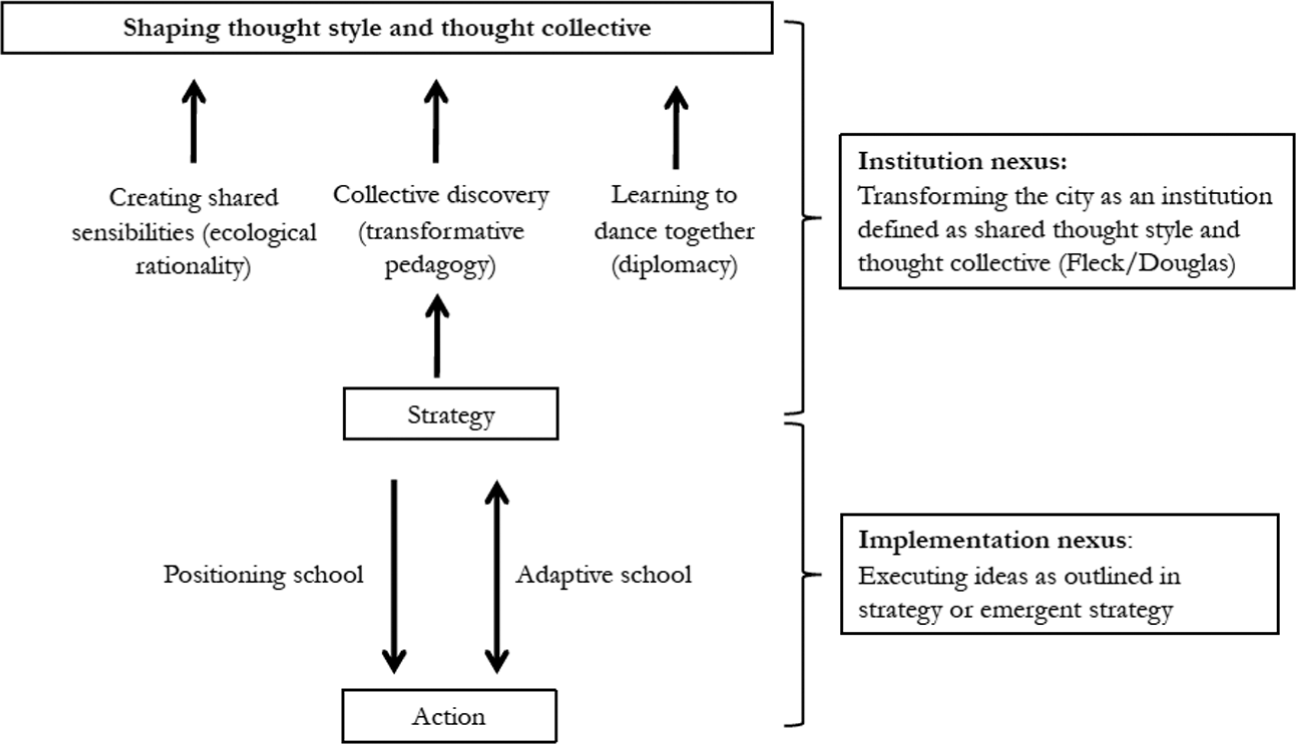
Effects of the Sustainable Sydney 2030 strategy and the institution nexus (summary figure).
Extending the conversation in urban strategy research
We contribute to the growing body of research on strategy in public administration and urban studies through an empirical inquiry into the long-term effect of strategy. We argue that this effect should not only be understood as coming from the ‘implementation’ of ideas into reality (as in the planning school) or mutual adaptation between plans and reality (as emergent theories, learning or muddling through would argue). Nor is strategy as we analysed it a more effective form of planning (Kaufman and Jacobs, 1987). Rather, our study demonstrates that strategy’s power lies in its capacity to shape the institutional make-up of the city.
This finding extends the current conversation in urban and public strategy research. Work in the emergent, process and practice tradition (see Ferlie and Ongaro, 2015) stresses that over time plans inform actions and actions, in turn, shape plans; strategy is conceived of as both: intentions and plans that shape future behaviour and post-hoc sensemaking of behaviour that has already occurred (Mintzberg, 1987). Here adaptive behaviours form patterns in streams of decisions and actions that are read as strategy a posteriori. In consequence, the effect of strategy is difficult if not impossible to trace as ‘unowned processes’, unintended consequences, and a posteriori crafted narratives collide in decision arenas (MacKay and Chia, 2013).
In our analysis, we provide a different proposition about the long-term effect of strategy: through engendering a new, shared sensibility, through transformational pedagogy, and through learning how ‘to dance together’, Sydney 2030 shaped the thought style and constituted a thought collective. Conceptually, we captured this as institution nexus. The distinction between implementation nexus and institution nexus is crucial. Implementation focuses on the strategy–action link, either (as in mainstream research) prescribing the cause of events from planning to action; or (more process or practice inspired) through describing the course of events as emergent interplay between strategising and doing. The institution nexus is about changing the shared socio-cognitive infrastructure of a collective, its concepts, its logic of argumentation and its vocabularies-of-motive. Implementation remains focused on what can be delivered: the ribbons that can be cut. The institution nexus is about context and creating relationships: the ribbons that tie together the collective, its imagination and its ‘mood of thought’.
Our findings have implications for the debate about whether strategic management tools lead to better performance in the public sector. For instance, George and colleagues (2019) argue that performance is a multidimensional concept, including effectiveness, client responsiveness, financial performance, outcomes and efficiency. In their meta-analysis, the authors found that ‘effectiveness might be the most important performance driver to target through SP [strategic planning]’ (2019: 7). Our article sheds a different light on the strategy–performance link, revealing what kind of effectiveness strategy may bring about: in our view, it is not narrowly defined performance but the formation of thought collective and thought style – in short: the shaping of the city as institution – that provides the necessary socio-cognitive infrastructure for collective action. Thus, our findings extend the discussion on the strategy–performance link by alluding to the important institutional foundation for public administration – and how strategy shapes it. In so doing our findings resonate with recent research on urban strategies that stresses how strategy ‘inevitably involves a new geometry of power relations requiring the production and circulation of knowledge, rationalities, subjectivities and moralities’ (Certomà et al., 2020; Vanolo, 2014: 894), and work that highlights the central role of curating imaginaries and shared narratives of place (Potter, 2020) and the performative effects of strategy (Brandtner et al., 2017; Brorström, 2019; Kornberger and Clegg, 2011; Van den Ende and Van Marrewijk, 2018). By providing an empirical example, we also speak to calls for more research on how ‘frameworks’ and ‘urban codes’ rather than detailed plans may master urban complexity (Alexander et al., 2012; Moroni, 2015).
Finally, our claim responds to Stewart’s (2004: 21) call ‘to create a strategic “space”’. What we add to this idea is that strategy is not only about providing this space but also about structuring it, that is, the way a collective of actors relates to each other and thinks with each other. This shifts the debate about ‘fit’ between organisation and its institutional environment. We turn the concern with how the institutional environment (via legitimacy, resource flow, regulation) influences a public organisation (e.g. Andrews et al., 2012) around and argue that it is the organisation (the city administration) that co-shapes its institutional environment via strategy. This has implications for the ‘new localism’ agenda in urban studies (Katz and Nowak, 2017). This agenda suggests cities to assume increasingly powerful roles in not only local but also global affairs (Acuto, 2013). According to Katz and Nowak (2017), the new localism is ‘multidisciplinary in focus’ and ‘collaborative in practice’ (2017: 35) occurring in a ‘broader framework of collective urban action’ (2017: 38) and carried out by ‘networks of institutions and ecosystems of actors that coproduce the economy and cosolve problems.’ (2017: 223). However, in contradistinction to Katz and Nowak we put less emphasis on heroic leadership to deliver this agenda; rather we conclude that strategy plays a crucial role in this process: not because it delivers projects built from bricks and mortar, but because it creates the shared socio-cognitive infrastructure for people to reason and act collectively.
Concluding remarks
What practical conclusions does our article invite? Strategy’s long-term effect beyond implementation is its ability to shape how we think of complex social entities (such as the city), the vocabulary we can draw upon to make them intelligible, and how we collectively engage in designing them. We claim that strategy’s effect lies in its capacity to shape a thought style and form a thought collective. Extending the insights gained from our study to other areas, the role of strategy in the context of non-command-and-control settings includes a focus on contextual, relational rationality, commons and positive externalities; the design of transformational processes that disclose preferences rather than scramble for means that pursue (if not dead then often diffuse) ends; and the delicate task of inviting actors to ‘learn to dance together’– in short, to provide a shared socio-cognitive infrastructure to ask questions and search for answers and, with this, for collective action to occur. Strategy, we may conclude, is like the North Star in the night sky: one needs it for orientation and yet nothing could be further from reality.
Footnotes
Declaration of conflicting interests
The author(s) declared no potential conflicts of interest with respect to the research, authorship, and/or publication of this article.
Funding
The author(s) received no financial support for the research, authorship, and/or publication of this article.
