Abstract
This article elucidates the discursive, spatial and procedural mechanisms by which residential segregation and ghettoisation based on religion in Ahmedabad is reproduced and reinforced. It studies the application of the Disturbed Areas Act of Gujarat, a 1986 law ostensibly intended to curb spatial segregation based on religion by preventing the distress sale of property in ‘disturbed areas’ affected by sectarian violence. However, this law is being used for precisely opposite ends and as a tool of ‘ethnocratic urban planning’ to advance the Hindu right’s goal of separate and hierarchical nations based on religion and to actively ‘Hinduise’ urban space. Current practices of the law enable the state to police boundaries between Muslim areas and adjoining Hindu localities, sealing their porosity and preventing the formation of mixed areas by restricting property transfers. The article uses semi-structured interviews, mapping techniques, participant observation and official data as sources of evidence. It maps ‘disturbed areas’ in Ahmedabad for the first time and presents previously unpublished data on applications for property transfers between persons of different religions under the Act. The article argues that ethnocratic planning combines with a range of other vectors, such as targeted anti-Muslim violence, the hindrance of justice and reconciliation thereafter and the persistent vilification of minorities, to produce saffron geographies of exclusion in Ahmedabad. These saffron geographies of exclusion are grids of Hinduised spaces cleansed of Muslim presence that embody the ascendancy of the ideology of Hindutva over the city and simultaneously create Muslim ghettos.
‘Kaaydo haat ma layeene Kashmir na Mussalmano Bharat nee lashkare darawta hoye, to apdee bahumati chhe tya kaaydo haat ma layeene darawanee takat howee joyye’ [If Muslims in Kashmir are using the law to terrorise the army, we should have the strength to terrorise [Muslims] with the law where we have a majority].
(Pravin Togadia, former President, Vishwa Hindu Parishad, 19 April 2014, Bhavnagar, Gujarat) 1
Introduction
In urban studies, the call for ‘new geographies of theory’ (Roy, 2009: 819–820) based on cities in the global South has been answered with a burgeoning literature in recent decades. Urbanism has itself been conceived as a set of inter-related processes in which global circuits of capital accumulation have primacy in producing urban space (Roy, 2011: 8). The post-colonial literature on urbanism in the global South also reflects these concerns for the most part. 2 However, if we want to understand how space is implicated in the production and perpetuation of hegemony in the global South, following Lefebvre (1991 [1974]), a consideration of the role of competing or complementary spatial logics such as those based on ethnicity, race, religion, language and caste is critical. This issue has become even more pressing as authoritarian populist regimes in the global South reimagine the nation based on narrow and exclusionary ethnocentric collectivities and set new urban models and practices into motion. There is already growing evidence of widespread spatial segregation based on religion and caste in urban areas in India. 3 This study contributes to the literature by going beyond the issue of prevalence and analysing some of the mechanisms by which segregation is reproduced.
We focus on a state-level law in Gujarat called the Disturbed Areas Act (DAA) and examine its workings as a tool of urban planning, understood as ‘the public production of urban habitat’ (Yiftachel and Yacobi, 2003: 675). 4 Introduced in 1986 by the Congress government in Gujarat – a state with a high incidence of sectarian violence – the law was ostensibly intended to curb spatial segregation based on religion by preventing the distress sale of property in violence-prone or ‘disturbed’ areas of a city. We show how this very law is being deployed towards opposite ends – to perpetuate spatial segregation and ghettoisation based on religion – by studying its implementation in Ahmedabad. Urban planning in this case has exacerbated rather than ameliorated the city’s already stark patterns of spatial segregation and ghettoisation based on religion.
The DAA translates as the Ashant Dhara in Gujarati and is known as the H-M (or Hindu-Muslim) Act colloquially in Vadodara. It prohibits all property transactions in areas of a city that are designated ‘disturbed’ unless they are approved by the District Collector (DC), who must ensure through a formal inquiry process that the sale is occurring through the free will of the seller and at a fair price (GoG, 1986). Any property transfer contravening this condition is considered null and void. The law also protects tenants who are in danger of being evicted by requiring landlords to repair property that was damaged during riots and guaranteeing tenants’ rights to occupy the new or repaired building. It was first applied to the city of Ahmedabad but has been expanded to cover Vadodara, Surat, Bharuch, Godhra, Himmatnagar, Kapadvanj and Viramgam since 1991 (Ahmedabad Mirror, 2019; Times of India, 2019a).
Although recent controversies related to the Act have been reported in the press, 5 there has been no systematic study of its functioning in Gujarat. We focus on Ahmedabad because it has experienced some of the worst sectarian violence in the state and because the DAA was first applied here in 1986. It has been in continuous operation since. Our methods include semi-structured interviews and participant observation conducted between 2014 and 2019 as well as mapping techniques and data analysis. We present maps of disturbed areas in Ahmedabad (2013 and 2018) for the first time and provide previously unpublished data on applications made for property transfers under the DAA from 2011 to 2019 obtained from the City Deputy Collector’s (CDC) offices.
In order to articulate the exclusionary and ethnicised dimensions of urban planning in Ahmedabad, we build on Yiftachel’s (2006a) concept of ‘ethnocratic urban planning’. Yiftachel deploys the term to encapsulate the Judaisation of urban space in Israel, which he argues is linked to the construction of an exclusionary Israeli-Jewish identity and hierarchical citizenship based on ethnicity. According to Yiftachel (2006b: 217), ‘ethnocratic planning’ is a form of urban planning that advances the goals of the dominant ethnonational group and bolsters its dominance using a rhetoric of majoritarian democratic governance. 6 Far from functioning as a neutral instrument, urban planning here exhibits a deep ethnocentric logic that actively excludes the ethnonational other (Yiftachel, 2006b: 217). Clearly, the interests and goals of the dominant ethnonational group are themselves divergent and fragmented. However, planning is shaped by powerful classes within the dominant group who frame their practices as being in the public interest (Yiftachel and Yacobi, 2003).
The Hindu right-wing Bharatiya Janata Party (BJP) has governed Gujarat continuously since 1995. It is the political wing of a family of organisations known as the Sangh Parivar whose aim is to build a Hindu majoritarian state in India where religious minorities such as Muslims and Christians have secondary status. 7 Cities lie at the heart of this project of nation building as they command vital symbolic, cultural and economic resources through which national identities can be reworked (Yiftachel and Yacobi, 2003). Urban planning in this context plays a vital role in building an ethnicised nation by spatialising hegemony and materialising otherness (Yiftachel and Yacobi, 2003). As Rajagopal (2010: 249) notes, Gujarat has ‘normalized an exceptional social order predicated on accelerated practices of social segregation, which in turn enabled anti-Muslim violence (and its rhetorical justification)’. Gujarat then provides us with a valuable canvas to understand the spatial goals and strategies of the Hindu right wing and its effects over a longer horizon. Theoretically, we frame the DAA as a form of ‘ethnocratic planning’ that advances the Hindu right’s goal of separate and hierarchical nations based on religion and actively Hinduises urban space.
In this article, we elucidate the various mechanisms by which ethnocratic planning through the DAA has reinforced spatial segregation by religion. These are: (i) Discursive reconstruction: official and local narratives have transmuted the meaning of ‘disturbance’– defined in the law as riots or mob violence – to the nuisance created by the presence of Muslims. This allows the law to be reframed as a tool to protect Hindus from Muslims. (ii) Conservation and expansion: despite the DAA’s origin as a temporary and emergency measure related to sectarian violence, the state government has converted it into standard policy and expanded its territorial coverage over the years. (iii) Deterrence: applications for the approval of property transfers between persons of different religious backgrounds (particularly Hindu and Muslim) are onerous and cumbersome, with high rates of rejection (in the Eastern zone) and delay, which discourages such requests and forces some of them underground.
We argue that ethnocratic urban planning has contributed to the production of saffron geographies of exclusion in Ahmedabad: a grid of Hinduised urban spaces cleansed of Muslim presence that embody the ascendancy of the ideology of Hindutva 8 over the city and simultaneously create Muslim ghettos. Alongside ethnocratic planning, different vectors have combined to produce and maintain saffron geographies in Ahmedabad, a subject we revisit in the conclusion. These vectors include anti-Muslim violence often fomented by the Hindu right wing; the hindrance of justice and lack of reconciliation between communities thereafter; and the persistent vilification and stigmatisation of religious minorities. In the next section, we discuss the enactment of the DAA in relation to Ahmedabad’s evolving spatial segregation and history of sectarian violence. Following this, we present the mechanisms through which the Act is reinforcing ghettoisation in Ahmedabad.
Sectarian violence, urban segregation and the Disturbed Areas Act in historical perspective
Ahmedabad is Gujarat’s largest city, and its municipal boundaries include 5,577,940 residents, of whom 82% are Hindu and 14% Muslim (Government of India, 2011). It is a city that is segmented along the lines of class, caste, religion and economic activity, with the Sabarmati River as the divide. By the early 1960s, three distinct urban morphologies had begun to emerge in Ahmedabad: the densely packed walled city on the eastern side of the Sabarmati River; the industrial belt located further east from the walled city; and the more affluent neighbourhoods on the western side of the river (Mahadevia et al., 2014; Yagnik and Sheth, 2005). These can be seen in Figure 1.
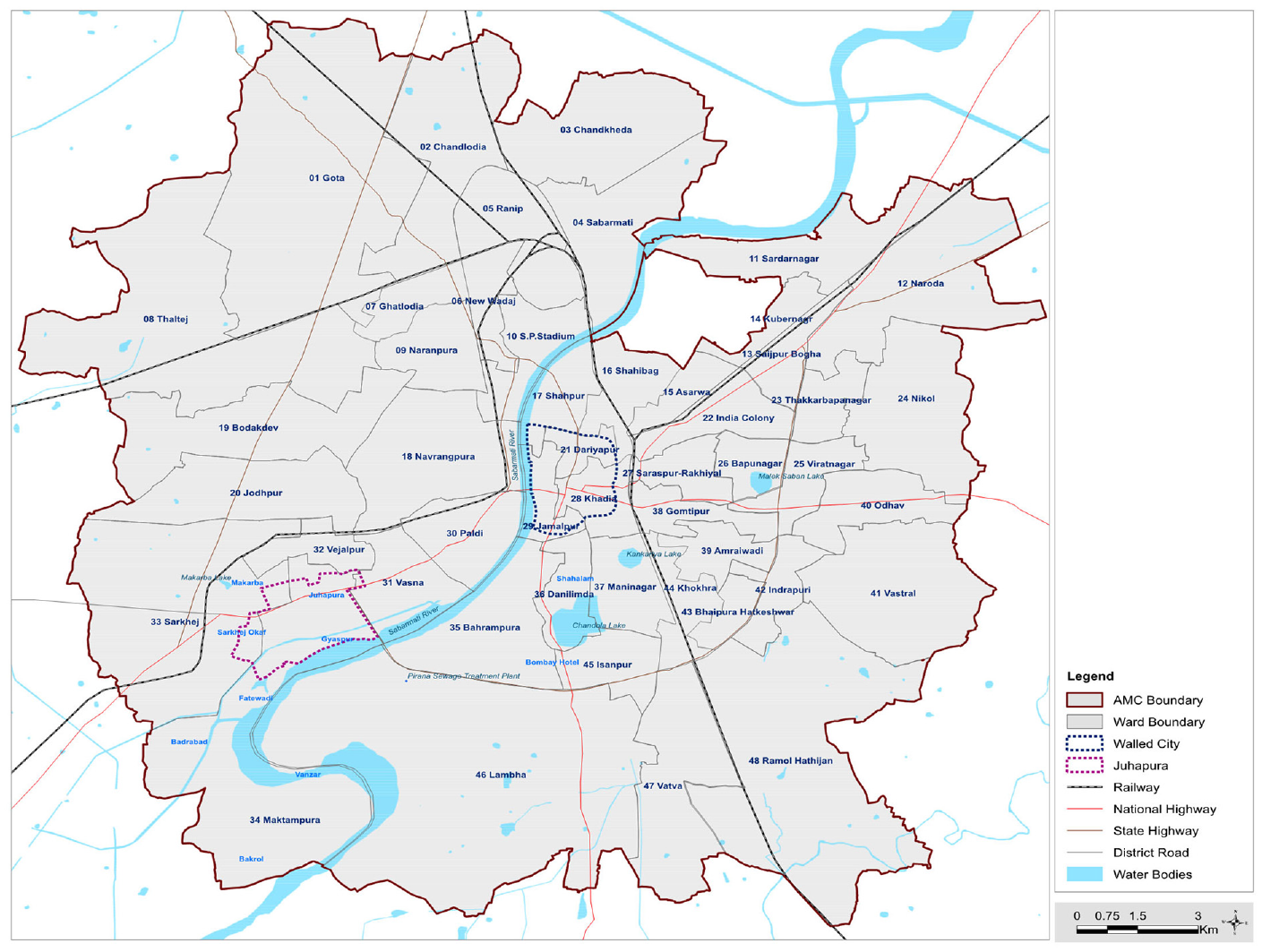
City map of Ahmedabad.
The walled city is Ahmedabad’s mediaeval urban centre, with a residential pattern comprising pols, or dense clusters of houses organised around a main street with a gate for security (Jaffrelot and Thomas, 2012). These pols have tended to be relatively homogenous in terms of occupation, religion and caste but they are now generally populated by low-income and lower-caste residents, with the population of Muslims increasing over time (Ray, 2008). The industrial belt further east of the walled city, with areas such as Gomtipur and Saraspur, became home to Ahmedabad’s booming textile industry in the early to mid-20th century (Shani, 2007: 31). Dalit and Muslim migrant workers lived here in close proximity in industrial townships organised around chawls, or low-income tenement housing (Jaffrelot and Thomas, 2012). Areas on the eastern periphery became hubs of informal small-scale production as the textile industry declined in the 1970s, attracting large populations of migrant labourers who lived in growing slums (Mahadevia et al., 2014). The western expansion of the city began in the early to mid-20th century as dominant caste groups such as Brahmins, Baniyas and Patidars, engaged in business or the services industry, began to establish cooperative housing societies across the river, often in a caste-segregated fashion (Shani, 2007: 34). The western section of the city enjoys a much higher level of basic services and is the hub of elite educational institutions, new gated communities, bungalow schemes, malls and multiplexes (Mahadevia, 2007; Mahadevia et al., 2014).
Creating a segregated city
Sectarian violence targeting Muslims in Ahmedabad in 1969, 1985, 1991 and 2002 has intensified patterns of segregation based on religion and created a new spatial order over time. The violence of 1969 began the process of segregation; it gathered momentum in 1985, intensified in the 1990s and became cemented after the pogrom of 2002 (Desai, 2010).
After the sectarian violence of the 1980s, lower-caste Hindus living in Muslim-dominated areas started moving into the walled city, while better-off Hindus moved out and into western suburbs (Shani, 2007: 121–122). The population of the walled city declined, while mixed areas in eastern Ahmedabad such as Bapunagar began to be partitioned into Hindu and Muslim sections (Shani, 2007: 32, 127). As Desai (2010: 111) notes, ‘after 1986 the reconfigurations of the urban landscape started to create a patchwork of Hindu and Muslim localities, with the meeting points between these referred to as “borders”’. Muslims moving out of the walled city were mostly confined to areas on the western periphery such as Sankalitnagar, which eventually became the sprawling Muslim ghetto Juhapura, visible in Figure 1.
In 1991, Muslim shops and homes in elite areas in the west were also attacked (Yagnik and Sheth, 2011: 278–279). Juhapura and Vejalpur on the western periphery became entirely segregated based on religion in the 1990s, as lower-caste Hindus in Juhapura and Muslims in Vejalpur were forced out (Breman, 1999, cited in Desai, 2010). Between a third and half of Ahmedabad’s Muslims now reside in Juhapura, which grew spectacularly from 1985 onwards as Muslims from different classes flocked there for safety (Jaffrelot and Thomas, 2012: 68–69). Juhapura remains severely neglected by the authorities and lacking in even basic facilities such as roads, street lights, drainage systems, clean drinking water, schools and hospitals; it has been characterised as a zone in which ‘the state is missing’ (Jaffrelot and Thomas, 2012: 71). Ahmedabad became the epicentre of the pogrom in 2002, seeing some of the most gruesome and sadistic scenes of violence in the state (Berenschot, 2011). It became virtually impossible for Muslims to reside in the western section of the city – except in Juhapura and some circumscribed pockets – and spatial divisions in the walled city and industrial areas became pronounced (Desai, 2010).
Enactment of the Disturbed Areas Act
It was in the context of this process of exodus and partitioning that the DAA was temporarily 9 enacted at the state level by the Congress government and first applied to the city of Ahmedabad (GoG, 1986). An area could be declared ‘disturbed’ if it had experienced riots or mob violence between March 1985 and October 1986, and parts of the old city where the violence was concentrated were designated as such. In 1991, a new DAA was enacted under a Congress-led coalition government headed by Chimanbhai Patel, while the 1986 law was repealed. The year-specific stipulation of 1986 was dropped and now any vicinity experiencing riots or mob violence for a ‘substantial period’ could be designated disturbed. The 1986 and 1991 Acts remain almost identical in substance otherwise. The 1991 Act was applied to parts of the walled city, and areas further east, in Ahmedabad and to Vadodara (Jindal, 2006). The Modi government brought significant amendments to the Act in 2009: making offences under the Act cognisable, dramatically increasing the DC’s power to reverse unsanctioned transactions and introducing a criminal penalty of six months imprisonment or a fine of Rs. 10,000, or both, for non-compliance (GoG, 2010; Pathan, 2009).
The Disturbed Areas Act in practice
Spatial segregation by religion in Ahmedabad is almost complete. In this context, the DAA works as an ethnocratic planning tool by which the state polices boundaries between Hindu and Muslim areas, and limits the spread of Muslims into adjoining Hindu localities. It is also used to maintain existing patterns of segregation within ‘mixed’ but internally segregated areas such as the walled city where Hindus and Muslims live in close proximity to each other. We now discuss the three main mechanisms – discursive reconstruction; conservation and expansion; and deterrence – by which the current practice of the law produces these effects.
Discursive reconstruction: Circulating narratives of ‘disturbance’
The expansion of ‘disturbed’ areas in Ahmedabad and Gujarat creates a particular kind of problem for the BJP government, which has been accused of sponsoring or being complicit in the anti-Muslim pogrom of 2002. In the run-up to the 2014 national elections, the Government of Gujarat proclaimed that Modi’s tenure as chief minister (from 2001 to 2014) had resulted in ‘13 years of peace, prosperity and progress’ (Government of Gujarat (GoG) (n.d.)). This claim erases the pogrom of 2002 entirely, though at other times the claim is that no major sectarian conflagration has taken place in Gujarat since then. How are these claims reconciled with the expansion of ‘disturbed’ areas in the state? Official narratives handle these questions by reframing the law as a tool that maintains peace in Gujarat through the segregation of Hindus and Muslims. That is, spatial segregation is presented as a strategy of urban planning, which is normalised and rationalised as a necessary feature of a desirable society.
A senior official in the district administration of Ahmedabad,
10
who preferred to remain anonymous, recounted that the motive of the law is ‘to create social harmony, to protect buyers and sellers and tenants … and promote social peace and tranquillity’. But, as he explained, the road to harmony was a specific one: Gujarat has a long history of these kind of disturbances – communities here are living apart, they have their own cultures, habits and different conflicting interests. There is social harmony if different communities are living apart and living separately … To take an example, if a Muslim comes into a Hindu area and takes a house on rent or buys it at a high price, he might create some disturbance there like eating non-veg[etarian food] or forcefully evacuating others. This is why we need this Act. It is to protect people, it is preventive, to prevent any such disturbances and conflicts.
While the DAA specifies the disturbance of public order as riots or mob violence, the word disturbance in the remarks above is reconstructed to convey the personal and social nuisance value of Muslims. Through this critical semantic shift, ‘disturbance’ emanates from the mere presence of Muslims, an eventuality from which Hindus must be protected. By peddling the theory that Muslims infiltrate and then expel Hindus from their neighbourhoods, the official explanation draws directly from the Vishwa Hindu Parishad’s accusation that Muslims are conducting land jihad. 11
I found that the majority of my Hindu interlocutors had this understanding of ‘disturbance’ and the protective role of the DAA. Anshul co-owns a construction business in Ahmedabad along with four other partners, including a Muslim. Their projects are residential and located on the western side of the city. Anshul explained that the DAA was introduced during Congress rule in 1986 when the city experienced a lot of sectarian violence. 12 At that time, rich Muslims would purchase properties in ‘thickly populated Hindu areas’ and slowly ‘eat away the entire community’s premises’. For instance, they would first buy one bungalow in a Hindu society, ‘create nuisance’ and then try to acquire the whole society. Therefore, the Ashant Dhara was applied to ‘borderline areas’ between Hindu and Muslim localities to stop this practice and avoid conflict between the communities.
It is true that Muslims desire to purchase property in Hindu areas but it is driven by completely different dynamics than those that Anshul describes. It is a product of the significant pent-up demand for better housing among Muslims who face widespread discrimination and exclusion in the housing market. For instance, within pockets of Paldi and Navrangpura, where some upper- and middle-class Muslims still reside, there are significant differences in prices between ‘Hindu’ and ‘Muslim’ buildings. Nadeem, a broker who has worked in these areas since 2005, pointed out that a three-bedroom apartment measuring 242 square yards in Navrangpura Muslim Society sells at a premium of about 67–90% as compared to the adjoining Hindu Law Garden area. 13 Though these apartments cost more, they come without the amenities that new developments in Hindu areas offer, such as gymnasiums, playgrounds, car parks, swimming pools or modular kitchens. A resident of Navrangpura Muslim Society also confirmed that the asking rate in his building was 50–80% higher than the most elite schemes in Ahmedabad, though it lacks the aforementioned amenities. 14 The premium that Muslims are paying is simply for the luxury of living outside the ghetto, though even in these areas segregation persists, with individual buildings or streets marked as Hindu or Muslim. Access to such housing is also entirely out of reach for lower-income Muslims who are consigned to the ghetto, walled city or segregated industrial areas.
Vegetarianism as an exclusionary shorthand
In my conversations with Hindu interlocutors, dietary practices were almost always invoked to explain the city’s stark segregation based on religion: Muslims’ non-vegetarian diet went against the beliefs, traditions and habits of the Jain and Brahmin communities in Gujarat. When I have countered that many Hindus also eat meat, the ‘purity’ of Gujarati Hindus is often emphasised: non-vegetarian Hindus come mostly from other states. In this telling, it is not only the consumption of meat and eggs but the attendant sights and smells of cooking them that are ‘disturbing’. In fact, Jain and Brahmin housing societies in Ahmedabad commonly enforce vegetarian-only codes for residents that prohibit the cooking and eating of meat and eggs. According to Anshul, this is not discrimination based on religion but is about choice, and many buildings in Mumbai also have such restrictions. 15 Indeed, these codes do not discriminate only on the basis of religion but conveniently exclude multifarious others from diverse (and often lower) castes and backgrounds, whether they hail from Gujarat or elsewhere. Dalits in particular face significant housing discrimination in the city, which is also justified using the discourse of meat-eating (Banerjee and Mehta, 2017), although the factors underlying caste-based segregation are clearly more complex.
Housing societies that do not enforce vegetarian codes are referred to as ‘cosmopolitan’, and upper-class Hindus often reside here even if they do not live in systematically segregated communities. But even ‘cosmopolitan’ housing is not open to Muslims. As Ghassem-Fachandi (2010) notes, meat production, cooking and eating are exclusively identified with Muslims in Gujarat. When I asked a couple living in South Bopal, a relatively new and ‘cosmopolitan’ suburb in the western reaches of Ahmedabad, whether they knew of any Muslims living in the area, one of them responded: ‘No, none in this society … People don’t like to live around Muslims, also because of non-veg[etarian food]. They will come here and cut their goats, they say, then people will move out’. Although the couple and their children also eat meat, as do others in the society, only Muslims are identified with the act of killing that precedes consumption, which then serves as the basis for exclusion. 16 In fact, the use of the pejorative kasai (butcher) for Muslims is common in Gujarat and plays on the community’s trade as butchers and their practice of animal sacrifice. These tropes work in tandem with many others, such as Muslim men’s unrestrained libido – evident in their polygamy, excessive children and easy divorces – and their religious fanaticism, intolerance, bloodthirstiness and aggression, which are used by the Hindu right to paint them as a threat to the Hindu nation (Blom Hansen, 1996). Undoubtedly, local discourses are amplified by transnational tropes of the Muslim as a terrorist and a global threat.
In short, the discourse of meat-eating has become a convenient shorthand that communicates a range of prejudices and myths about Muslims and is used to justify and reproduce residential segregation. Whether practised or not, vegetarianism works as an important identity marker in Gujarat that distinguishes the ‘Hindu character’– non-violent, peaceful and tolerant – from its Muslim counterpart. It has become an effective way of regulating meat consumption and exerting social control by projecting the values of mostly upper-caste Hindus as superior and universal and undercutting the practices of Muslims and lower-caste Hindus as morally unsustainable. As a result of the association with dietary practices, there is greater emphasis in Ahmedabad on residential than commercial segregation based on religion, as we will see in the next section.
Conservation and expansion: Spatial dimensions of disturbed areas
In this section, we show how disturbed areas in Ahmedabad have been being conserved, renewed and expanded using a logic that did not conform to the law. By expanding the coverage of disturbed areas on the pretext of pre-empting future violence, the DAA is being used as a form of ethnocratic city planning to prevent the formation of mixed localities and reproduce a segregated pattern of housing.
The Ahmedabad Police Commissionerate periodically reviews and recommends areas for inclusion under the DAA to the Revenue Department of the Government of Gujarat, which then publishes them as a list via a government notification. Former district collector of Ahmedabad Vikrant Pandey explained the rationale behind the addition of new areas in the 2018 notification as follows: ‘The new areas were recommended to us by the respective area police stations[,] which had analysed past violent instances of communal or mob violence’ (Times of India, 2018). However, the analysis on the basis of which new disturbed areas are recommended remains opaque and inaccessible to the public. Incidents of sectarian or mob violence at the local level, which can motivate extension of the Act, the addition of new areas or removal of old ones, are not systematically reported. 17 The process thus remains arbitrary, with plenty of room for discretion and abuse. In practice, Hindu vigilante groups often mobilise, stage protests and petition the government to take action when they identify Muslim ‘intrusions’ into Hindu areas. They are often given a hearing at the highest levels of the city government as the authorities scramble to respond to their demands in some way. 18 The DAA has also become a way for BJP politicians to build political capital by projecting themselves as guardians of Hindu interests vis-a-vis Muslims. Two BJP members of the Gujarat legislative assembly from Surat district made imposing the DAA a campaign issue to ‘protect’ Hindu-majority areas in 2017; both MLAs were re-elected and the Act was imposed in parts of Surat shortly after (Nileena, 2019). In Ahmedabad, disturbed areas that were limited to a few localities in the walled city in 1986 have expanded considerably through successive notifications since then. In the 1994–1997 notification, for instance, new areas in Meghaninagar, Navrangpura, Ellisbridge and Vejalpur were added, while in the 1997–2007 period, disturbed areas in Vatva were included (Jindal, 2006).
Disturbed areas in Ahmedabad
In Ahmedabad, it is primarily Muslim-majority areas, their bordering Hindu localities and mixed neighbourhoods like the walled city that are designated as disturbed. This pattern is displayed visually in Figure 2, where we map disturbed areas for the first time using successive notifications issued by the government in 2013 and 2018. Final plot (FP) and survey numbers of disturbed areas were included in the notifications for the first time starting in 2013, which has enabled us to present these maps. Please refer to the Technical Appendix for the methodology used. We discuss each year in turn.
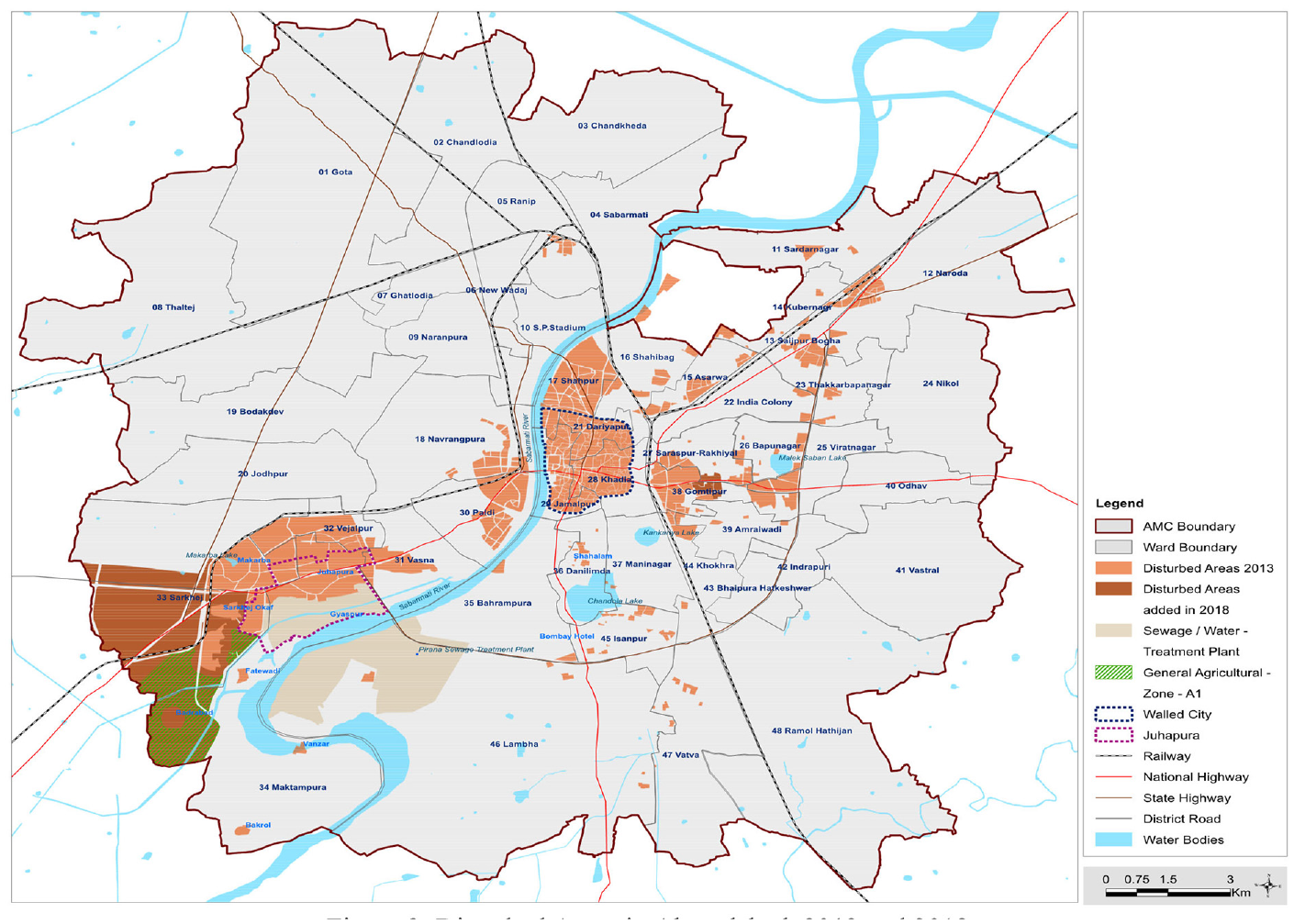
Disturbed areas in Ahmedabad, 2013 and 2018.
In 2013 (light orange), east of the river, the entire walled city and the sections north and east of it are designated as disturbed. This includes the mill localities of Gomtipur and Rakhiyal, which are ‘mixed’ but internally segregated by religion, and largely Hindu Saraspur. The disturbed areas further north-east such as Naroda, Meghaninagar and Asarwa are hubs of informal enterprise and ‘mixed’ but also internally segregated. In the south-east, disturbed areas encompass sections of the predominantly Hindu Isanpur, ‘mixed’ wards of Behrampura (including the Muslim ghetto Bombay Hotel), Vatwa and the largely Muslim Danilimbda. 19 On the west of the river, the largest cluster of disturbed areas is the Muslim ghetto Juhapura in the south-west and adjoining areas in Vejalpur, Vasna and Makarba that are predominantly Hindu. On the map, sections of the dashed line between Juhapura and Vejalpur/Vasna have become a de facto border where Muslim and Hindu vicinities face each other across roads, fences and high boundary walls. Further north, the relatively affluent and ‘disturbed’ neighbourhoods of Navrangpura and Paldi are inhabited largely by Banias and Jains but have small pockets of Muslims. Ranip in the north-west, where many Dalits from Danilimbda migrated to after the 1989 violence, is also declared disturbed.
There is some rough correspondence between the geography of sectarian violence and the delineation of disturbed areas in Ahmedabad but the logic is partial. It is true that pols in Jamalpur, Dariyapur and Kalupur in the walled city, neighbourhoods in the mill areas such as Gomtipur and Rakhiyal, as well as the small-scale industrial belt areas such as Chamanpura and Naroda experienced sectarian violence repeatedly in 1969, 1986, 1992 and 2002. 20 However, Paldi, Navrangpura and Vasna in the east did not witness any significant violence during these times. What distinguishes these places from other Hindu-dominated areas in the west is that they incorporate pockets of Muslim residence or border Muslim localities. This seems to be sufficient to mark them as disturbed.
Conservation of disturbed areas
The law clearly states that disturbed areas are to be designated on the basis of past riots or mob violence and only for a limited period of time (GoG, 1991: 3). The government usually notifies areas as disturbed for a period of five to 10 years. After that period, an area can be designated disturbed only if it continues to experience riots or mob violence. Yet the government continues to renew disturbed areas en masse, regardless of whether they experienced mob violence or riots after that period. Clause 3.2 of the Act provides for the rescinding of disturbed status once order is restored, but no area has ‘ceased to be disturbed’ since the law was first enacted (GoG, 1991: 3).
In practice, the law is being used to prevent the formation of mixed neighbourhoods even when there is no present disturbance of public order, on the pretext of pre-empting future violence. A property transfer application from a Hindu to a Muslim in Raikhad, submitted to the DC in 2016 and made available to us, makes this amply clear. The application was rejected and the police inspector denied permission with the following justification: … abhipraay magawta, janawel che ke sadar jagya upar koi vasti nu santulan jokhmaay tem hoy, jena karane komi ramkhan jevi paristhiti na sarjaay te saaru. Sadar milkat tabdili baabate nakaratmak abhipraay aapwa ma aavel hoy toh te oo na abhipraay sathe aamo sehmat hoi aa baabate milkat tabdil thawa amaro abhipraay thato nathi [… we have learned that there is risk of an imbalance in the population of a particular community in the said area, due to which there is a possibility of communal riots, and it would be better if such a condition does not arise. For the above property transfer, the opinion received is negative and we agree and therefore in this matter we do not recommend it and give an opinion to not transfer the property].
Although the letter of the law does not allow its use in a preventive way, it has been the general practice. This practice has now been legalised in an amendment to the Act passed by the Gujarat Assembly in October 2020, during the writing of this article. It allows the DC to check that ‘improper clustering’, ‘polarisation’ and ‘disturbance in the demographic equilibrium of persons belonging to different communities’ are not occurring through a sale (Dabhi, 2020). As we have seen, this is a way of preventing any significant Muslim pockets from appearing in Hindu-majority areas. For obvious reasons, there is no demand by Hindu populations to live in Muslim-majority areas.
Expansion of disturbed areas
In the 2018 notification, not only were all previously disturbed areas renewed but new areas were added in the east (Gomtipur, 0.24 km2 and Saraspur-Rakhiyal, 0.09 km2) and the west (Sarkhej, 9.63 km2 and Maktampura, 3.19 km2). This takes the total area covered under the Act from 25.87 km2 in 2013 to 39.01 km2 in 2018, an increase of 51%, and disturbed areas now cover 8.4% of the city. Most of this increase came in the western wards of Sarkhej and Maktampura near Juhapura, where disturbed areas more than doubled from 11.65 to 24.46 km2. Entire villages of Sarkhej, Okaf, Narimanpura, Bakrol, Badrabad, Makarba, Fatehwadi and the fields surrounding them have been categorised as disturbed without any clear justification. Around 4.63 km2 of this area is still zoned as general agricultural land where commercial and residential development is restricted. There is a flurry of construction and development activity taking place in Sarkhej and Maktampura as a result of new town planning schemes announced in 2010, which is expected to accelerate when the land is rezoned as non-agricultural (DNA, 2012). A number of prominent builders such as the Bakeri Group and Deep Builders have already floated rowhouse, tenement and high-rise residential schemes in the area (Sharon, 2013). A senior official in the CDC (West Zone) office confirmed that although there had been no sectarian violence in these areas, the police were of the opinion that the areas could be affected in the future from a law and order perspective due to a ‘change in demographics’. The official is referring here to the growth of Hindu residential schemes close to the Muslim ghetto. 21 By expanding disturbed areas on city outskirts that are still under development, ethnocratic planning is being used to realise an ideally segregated city that is cleansed of Muslim presence in the future.
Deterrence: Administrative procedures for approval under the DAA
A powerful social consensus excludes Muslims from Hindu neighbourhoods throughout Ahmedabad, but there is potential for creeping desegregation at the borders as well as some possibility for upwardly mobile Muslims in a free property market to push the perimeter of ghettos outwards. This is what urban planning through the DAA is being used to treat; it is not needed in areas that have already been cleansed of Muslim presence further west, where any intrusion can be immediately identified and policed. The administration has devised different procedures to obtain approval for property transactions depending on whether the buyer and seller belong to the same or different religions, even though the law and its rules do not make such a distinction. We argue that the lengthy and protracted procedures devised for inter-sectarian transfers serve to deter and discourage applicants from entering into transactions with persons belonging to different religions. They also encourage informal transfers of property with unofficial documents that result in insecure property rights and criminalise buyers.
All sellers of property in a disturbed area must apply for permission from the DC who delegates his/her powers to the CDCs of the East and West Zones 22 in Ahmedabad. The seller has to submit an application form and affidavit to the DC declaring their intention to sell the property to the buyer through ‘free consent’ and ‘for a fair value’, along with a deed of conveyance, a description of the property and related identity documents. 23 Although this is not standard practice elsewhere, in Gujarat the deed of conveyance mentions the religion of each transacting party. If the sale is intra-sectarian, the Collector’s office scrutinises the documents and, if they are in order, generally grants permission within 10–15 days. 24 The ease and speed of permissions granted for transactions between persons of the same religion was confirmed in conversations with three different civil lawyers. A government official in the East Zone office also confirmed that nearly all applications in this category are approved unless there is a problem with the title of the property, in which case approval is delayed until the title is cleared. 25
However, if the transaction is between parties from different religions, two additional enquiries – by the police and by the revenue department – must be conducted before permission can be granted. For the police enquiry, the CDC’s office requests the Police Commissioner (PC) of the city to investigate the prospective transfer and give his/her opinion on the matter. The PC delegates the matter to a Joint Police Commissioner who forwards the request to the Deputy Commissioner of Police (DCP) of the city sector, who in turn sends it to the Assistant Commissioner of Police of the concerned zone. Finally, the police inspector of the local police station conducts an investigation by calling both parties and two witnesses, who must be neighbours, to ascertain if there are any objections to the sale or if any undue coercion has been used. Thereafter, the inspector prepares a report and sends it to the Joint Police Commissioner who then forwards it to the City Deputy Collector.
The second inquiry is conducted in parallel by the Mamlatdar of the Revenue Department who delegates his/her powers to the Circle Officer, who deputes the Talati to the matter. 26 The inquiry is similar in nature to the police investigation and attempts to establish that there is no coercion in the sale. The Talati also verifies that land records related to the property in question are clear. Once reports have been received from the police and revenue departments, the CDC issues notices to the seller and buyer to appear for a hearing and passes an order about the sale based on the reports received. Generally, this process takes much longer than transfers between members of the same community, with many opportunities for extortion and corruption along the way.
According to Ammar, a civil lawyer who has handled many applications under the Act over the years, most inter-sectarian applications take at least a year to be processed and often drag on for three or four years. Lawyers and brokers working with the Act state that it is nearly impossible to obtain permission for residential property transfers from Hindus to Muslims in notified areas, though it can be easier for commercial property. Still, informal transactions continue in the walled city, where houses are bought and sold by making a sale deed on stamp paper but without registering the documents with local authorities. Another way that property is exchanged is by awarding the buyer power of attorney to live in the property and transact with it in the future. In effect, the Act is forcing property transfers underground, creating insecure property rights and criminalising transactions between persons belonging to different religions.
Applications and approvals under the DAA
Below we present figures for the total number of applications, approvals and rejections under the Act from 2012 to 2019 for Ahmedabad, obtained from the City Deputy Collector’s offices, East and West Zones. A Right to Information petition was also filed in December 2018 to obtain the data in an official format. There was no reply to the request from the CDC East office, while the CDC West office reiterated that the data may be obtained in person. This information is not published or made public by the government and is presented here for the first time. It demonstrates the long delays and high number of rejections for property transfers between persons belonging to different religions in the Eastern zone of the city. Table 1 reports data for the East and West Zones, including the number of applications for inter-communal transfers, and the number that were approved, rejected, provisionally rejected and kept pending. Applications that are provisionally rejected can be reopened, although the entire process, including police and revenue department investigations, must be conducted again. On the other hand, if an application is rejected outright, the matter can only go into appeal and cannot be reopened. In case of a rejection, an appeal can be made to the Principal Revenue Secretary of Gujarat, to whom all DCs of the state report, though again this process is lengthy and cumbersome. The district administration does not record whether the prospective sale is of commercial or residential property so these could not be presented, though the distinction is important for reasons mentioned earlier.
Applications and approvals under the DAA, East and West Zones.
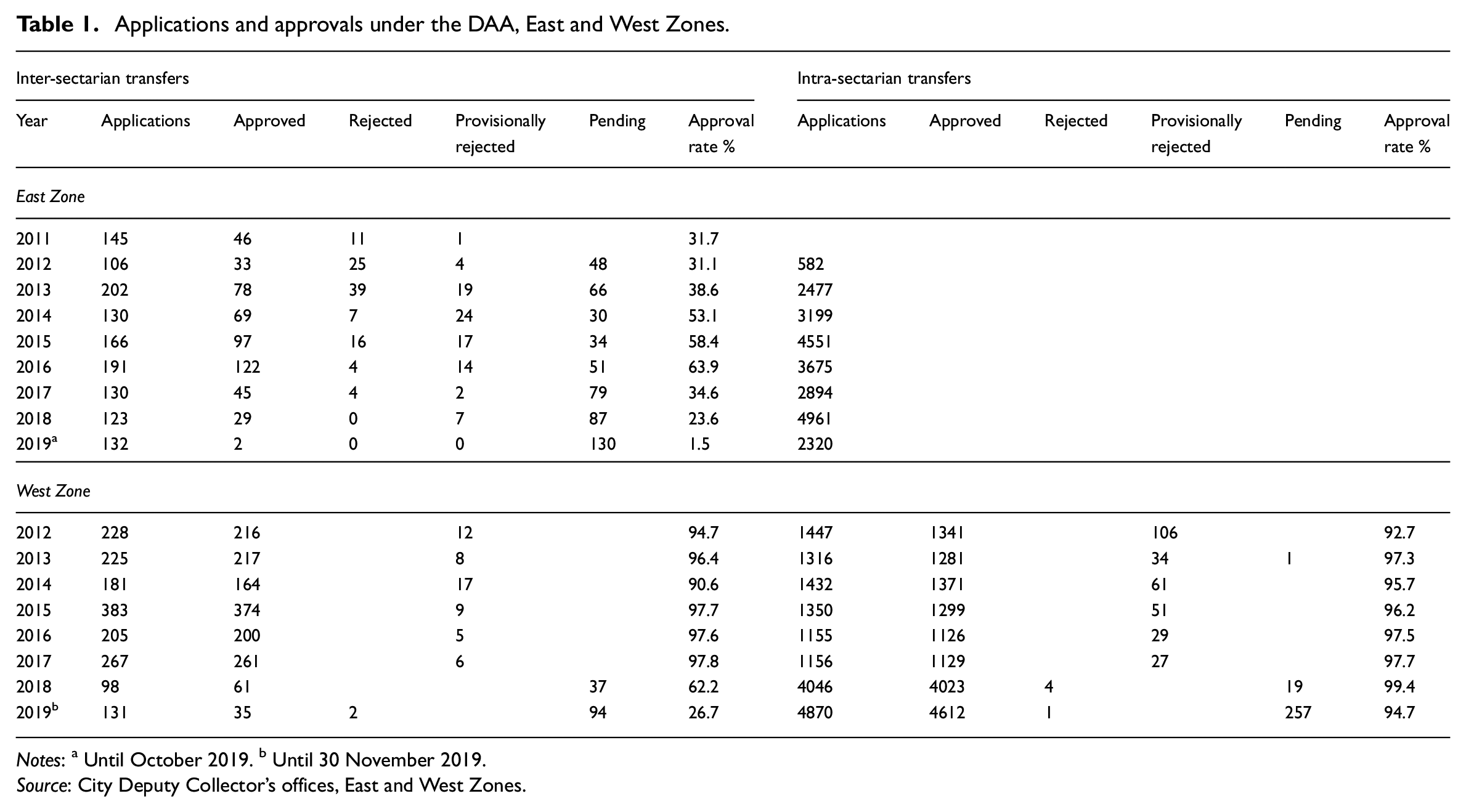
Notes: a Until October 2019. b Until 30 November 2019.
Source: City Deputy Collector’s offices, East and West Zones.
First, it is striking that the number of applications for inter-communal transfers of property are so few in number when the population of the walled city was 368,000 in 2011 according to the census. 27 This suggests that people have been deterred from engaging in such transactions altogether or that they are informally transferring property, which comes with its own risks. There are many more transactions between members of the same community in the last column, on the other hand. The breakdown of approvals and rejections for intra-sectarian transfers in the East Zone was not provided, though I was informed that almost all intra-sectarian applications are approved. On the other hand, for inter-communal transfers – mostly from Hindus to Muslims, I was informed – the approval rate is low, at around 30% for most years. The higher approvals in 2014, 2015 and 2016 are due to new commercial developments in the walled city where builders obtained en masse approval for the sale of offices and shops. After accounting for these developments, the approval rate remains around 30%. It is also noteworthy that applications kept pending are much higher than outright rejections, which keeps the approval rate low. The number of pending applications from 2017 onwards is particularly high, which illustrates how slow the bureaucratic process of obtaining permission is. In fact, for 2019, although the data were collected near the end of the year, almost all applications were still pending and the approval rate was 1.5%.
For the West Zone, figures were provided for both inter-sectarian and intra-sectarian transfers and are presented in Table 1. The high approval rate of over 90% for inter-communal transfers looks quite different from the East and applications are pending only for the last two years. Although individual records were not available for further analysis, the concerned official at the CDC West office as well as civil lawyer Ammar suggested several explanations. One, it is likely that a bulk of the applications are for inter-sectarian land deals in Sarkhej and Makarba, where many new projects are under construction, as discussed earlier. For instance, Bakrol village in the area is Christian dominated while Shela has a sizable Muslim population, and these residents are likely selling land to Hindu developers. Two, some of the transactions might represent commercial properties, for which permissions are generally granted. Three, some of the applications are for property transfers from Hindu developers to Christian or Parsee buyers in large new townships in the West Zone, such as Bakeri City in Vejalpur and Saket in Makarba, which have thousands of residential units. Generally, these buyers are from outside Gujarat and purchase apartments in these townships because they are relatively affordable as compared to elite areas in the western suburbs. It is also noteworthy that the approval rate for the West Zone dropped significantly to 62% and 27% for the years 2018 and 2019 respectively. This could signal a return to ‘business as usual’ now that most of the land has been sold to developers. In other words, we are suggesting that inter-sectarian property transfers were allowed in the process of city expansion while new land was being bought and developed. However, once the distribution and division of land has taken place, further inter-sectarian transactions are being restricted.
The higher rate of permissions in the West Zone cannot be interpreted as evidence that Muslims are able to purchase residential property in Hindu areas. Housing societies refuse to provide a no-objection certificate if a flat is being sold to a Muslim and the sale cannot proceed without it.
According to the broker Nadeem:
28
Hindu society mein [Muslim ko] jagah milna bilkul na mumkin hai. Aisa rule hi hai. Abhi main 10 broker ko phone karoonga aur sab aisa hi bolenge. Muslim hai to nahin milega, kabhi nahin milega [It is absolutely impossible [for a Muslim] to get place in a Hindu society. It is like a rule. If I call 10 brokers now and ask them, they will say the same thing. If you are a Muslim, you will never get it, ever].
Nadeem reported that he doesn’t take on Muslim clients who want to purchase flats in Hindu buildings because it is a waste of time, a stance shared by lawyer Ammar. Nadeem explained that it was sometimes possible for Muslims to rent a flat in Hindu areas but only in townships on the outskirts of the city where there is a large non-Gujarati and expatriate population. Often residents there work for large corporations, eat meat and have a ‘different attitude’ because they have not seen riots, he said. Sometimes Muslims will make the lease on the company’s name and, according to Nadeem, ‘as long as they don’t look Muslim, the wife doesn’t wear a burkha and they don’t show their identity, there is no problem’. 29 If a Muslim man and Hindu woman are married, they make the lease in her name but again they can only rent, not buy.
Saffron geographies of exclusion
This article has shown how ethnocratic planning through the discursive, spatial and procedural mechanisms of the DAA works to reinforce spatial segregation based on religion in Ahmedabad. Although ostensibly intended to curb such segregation, the DAA has been operationalised as a tool of ethnocratic planning by discursively reconstructing the meaning of disturbance; conserving and expanding disturbed areas; and deterring inter-sectarian property transfers through exacting administrative procedures. We contend that ethnocratic planning through the DAA has contributed to the production of saffron geographies of exclusion in Ahmedabad: Hinduised urban spaces that embody the ascendancy of the ideology of Hindutva over the city and simultaneously create Muslim ghettos. The emerging geographies are the physical equivalent of a Hindu majoritarian state in which the Muslim is cleansed and purged from the body of the nation and reassembled in designated and peripheral spaces of relegation. 30 In the process, ethnocratic planning also attempts to interpellate proper Hindutva subjects through the normalisation of stigma and acceptance of exclusion.
Within segregated landscapes, borders are the liminal spaces that are prone to intrusions and rupture – and the critical fault lines upon which the DAA is intended to act. These borders, and the localities adjoining them, are designated as ‘disturbed areas’. They are predominantly Muslim neighbourhoods, in keeping with the discourse that associates ‘disturbance’ with Muslims and marks them out as intruders. As a form of ethnocratic planning, the DAA uses legal and institutional means to not only reinforce segregation but to realise a vision of an ideally segregated and ethnically purified city of the future. It is being used by the state to police borders between Hindu and Muslim localities in Ahmedabad and reshape market-driven urban development that might otherwise lead to some creeping desegregation. By showing how the DAA modulates the property market in order to further refine its ethnocratic logic, our study highlights the role of ethnocentrism in structuring urban space and contributes to the literature on urban theory from the global South.
As the case of Ahmedabad clearly shows, urban planning with an ethnocratic logic produces new forms of illegality and informality. By creating an artificial shortage of space through legal obstructions to Muslims’ obtaining housing, the DAA drives them into unplanned ghettos that are severely neglected by the state and into unauthorised constructions within these. At the same time, the criminalisation of legitimate inter-sectarian market transactions pushes them underground and fuels an informalised property market that creates insecure property rights. The state has responded by attempting to plug perceived loopholes in the ethnocratic planning apparatus that allows such practices to continue. Contravention of the DAA has been made a cognisable offence, authorities have been empowered to take suo moto notice of violations and criminal penalties have been added.
Not only do formal institutions of ethnocratic planning produce informality and illegality, they also rely on informal and illegitimate processes for their efficacy. For example, the DAA could not be effective without the informal social consensus that works so powerfully to exile Muslims beyond existing fault lines, and away from elite western sections of the city, where the law does not apply. As Mehta (2010) notes, this social consensus is a product of the domination of Hindutva politics in Gujarat. The existing practice of using the DAA to pre-emptively ‘prevent’ sectarian violence does not conform to the law, and recent amendments have tried belatedly to regularise it. Similarly, the written rules associated with the DAA do not specify separate and multiple procedures for inter- and intra-sectarian property transfers, but they have become standard practice.
Theoretically speaking, our analysis reveals how ethnocratic planning works through the subversion and creative re-interpretation of laws in a country like India, where all citizens are guaranteed equal rights, unlike de jure ethnic democracies such as Malaysia and Israel that are the focus of Yiftachel’s (2006a) work. Although India may be turning into a de facto ethnic democracy, as Jaffrelot (2021) has argued, legal and planning frameworks must at least in letter conform to principles enshrined in the constitution. Thus in India, as the case of the DAA shows, discrimination on the basis of religion has often worked through the interstices of the law, and via its rules, practice, procedures and application, rather than its letter. 31 Such a practice often perverts language in a way that inverts reality and produces misrecognition. For instance, although the amended DAA prohibits ‘improper clustering’ and ‘polarisation’ between communities, these terms are discursively and practically redeployed to communicate Muslim infiltration into purified Hindu space.
In conclusion, it is useful to recall some of the vectors that combine to produce saffron geographies of exclusion in Ahmedabad, in addition to ethnocratic planning. These vectors are intimately tied to the strategies used by the Hindu right to cement its dominance in Gujarat, and to the political and ideological entrenchment of Hindu nationalism there. First, as discussed earlier, repeated episodes of targeted anti-Muslim violence from 1969 to the more recent 2002 pogrom have produced and consolidated patterns of spatial segregation by religion. Second, justice has been impeded and denied (most recently after the 2002 pogrom) through the state’s interference in and handling of the supposedly independent functions of investigation, prosecution and adjudication of crimes committed during episodes of sectarian violence (Jaffrelot, 2012). 32 The lack of public acknowledgement and remorse about the repeated targeting of Muslims has prevented their rehabilitation materially and symbolically, as well as forestalled any reconciliation between communities (Mander, 2007). As a result, many more Muslims have been driven into ghettos for reasons of safety, fear of reprisals and re-traumatisation and the inability to return to their original homes, which were either destroyed or occupied during the violence, or to obtain housing elsewhere (IIJ, 2003). This has entrenched the new spatial order. Third, the extreme stigmatisation and vilification of religious minorities through discourses promoted by the Hindu right wing at different scales (Ghassem-Fachandi, 2012) works to exclude Muslims even in areas where the DAA does not apply, as noted earlier.
In this context, ethnocratic planning through the DAA has played a crucial role in conserving, reproducing and expanding saffron geographies of exclusion over time. Although not the focus of this article, Ahmedabad displays many features of an urban ethnocracy, as outlined by Yiftachel and Yacobi (2003) in their study of Lod (Israel), and this could be fruitfully explored in future studies.
Footnotes
Technical appendix
The Ahmedabad Development Plan 2021 issued by the Ahmedabad Urban Development Authority (AUDA, 2019) was used as a base map, digitised and added to GIS software. Satellite imagery, including the base layer of roads, rivers and ward boundaries, was added from the digital map of Ahmedabad available through the TPVD website of the Urban Development and Urban Housing Department (GoG, 2019). Finally, plots that were listed as disturbed in the notifications were identified using town planning (TP) numbers and final plot (FP) numbers displayed on the TPVD online map. For the walled city, plots were identified by using city survey numbers and names of areas. Through the entire process, building names, area names and landmarks were cross-checked and verified through Google Maps.
The city boundary used in the map is the Ahmedabad Municipal Corporation (AMC) limit and all 48 wards of the AMC are displayed on the map. In the notifications, disturbed areas are grouped by police station rather than wards; 28 such police stations were listed in the 2013 notification and 30 in the 2018 one. The difference arises because Paldi was earlier subsumed under the Ellisbridge police station; the same is true of Vasna, which was first listed under Vejalpur.
Acknowledgements
The author wishes to thank Riddhi Ratnottar and Surhud Tatu for their valuable assistance in producing maps of Ahmedabad. I am greatly indebted to Filip Pospisil whose helpful comments and multiple readings of the article helped to shape and improve it. Thanks to Renu Desai for helpful discussions on mapping and her comments on a previous draft. Michael A Cohen’s careful reading of the article is gratefully acknowledged. Finally, many thanks to three anonymous referees whose comments helped to frame and sharpen the arguments made. Errors and omissions remain mine alone.
Declaration of conflicting interests
The author declared no potential conflicts of interest with respect to the research, authorship, and/or publication of this article.
Funding
The author disclosed receipt of the following financial support for the research, authorship, and/or publication of this article: A grant from the Julien J. Studley Graduate Program of International Affairs, The New School, New York, which partly funded this research, is gratefully acknowledged.