




Abstract
Residential segregation, especially of rural migrants, is of growing concern in China. A key question is whether this spatial separation is entirely due to income – rural migrants priced out of affluent areas – or whether other factors, such as institutional discrimination or social prejudice or homophily, are also at work. We employ state-of-the-art methods to yield a more detailed and nuanced picture of segregation in Shijiazhuang, a second-tier Chinese city. We use a multilevel modelling approach that allows us not only to quantify the extent of segregation at different spatial scales, but also to disentangle the intersectional nature of segregation: the extent to which segregation is due to migrant status or low income alone. We find that migrant status is actually more important than occupation in determining segregation. These findings emphasise the imperative to decompose intersectional segregation into its constituent parts, a task recently made possible by developments in multilevel modelling.
Introduction
Since the 1980s, market reforms in China and economic restructuring have led to rapid urbanisation and widespread changes to the urban environment (Feng et al., 2008). These changes have also led to rising socio-economic inequality and increased residential mobility (Wu, 2004). A consequence of this has been the emergence of greater residential segregation, an issue previously not of great concern in China (He et al., 2015).
In Chinese cities the pressing issues have been around the segregation and socio-economic stratification of migrants, rather than ethnicity. Rural migrants in particular are more likely to have lower levels of education than urban residents and are often further disadvantaged because they lack local hukou, a form of household registration status that permits access to a range of public services and employment rights (Chan, 2010). Without local hukou status, migrants can face restrictions on access to subsidised housing and employment. Consequently, many migrants are separated from the native urban population, living in areas where cheap housing is available (Hao et al., 2013).
Understanding the residential segregation of migrants in Chinese cities is important if rapid urbanisation and growth are to be inclusive (Liu et al., 2020). Extensive research across the globe has shown that place of residence matters for people’s life outcomes through spatial opportunity structures (Galster and Sharkey, 2017). While there is evidence that in some cases segregation can be beneficial to migrants in China by encouraging social networks that provide employment opportunities (Liu et al., 2019), there are also many potential disadvantages. For example, segregation can hinder the integration of migrants within a city and constrain opportunities for social mobility (Zou et al., 2020), as well as preventing social trust formation between migrants and the local population (Wang et al., 2017). Segregation can also create concentrations of poverty with migrants living in areas with deprived housing and living environments (Liu and Wu, 2006).
An important question is whether the residential segregation of rural migrants is due entirely to their low-income status, or whether there are other factors, social and cultural, at work. If their segregation is entirely due to low income, then the policy solution is relatively specific: a matter of reducing income inequalities. However, if other factors are at work in driving the segregation of rural migrants, such as institutional discrimination or social prejudice or homophily (McPherson et al., 2001) then the policy response would have to consider a wider set of issues.
The aim of this paper is to disentangle these aspects and present a more coherent and nuanced approach to measuring segregation in the Chinese context, specifically in Shijiazhuang, the capital of Hebei province (see Figure 1). Previous studies on segregation in China have primarily focused on megacities such as Shanghai and Beijing, while far less attention has been paid to smaller-sized inland cities such as Shijiazhuang. This type of inland city makes up a substantial proportion of the total Chinese urban population. Similar to megacities, Shijiazhuang has experienced tremendous urban development and attracted many migrants over the past 40 years. Yet, it differs from megacities in that its land market is less competitive and housing is more affordable. Moreover, migration controls are much more relaxed, which means institutional barriers against migrants might be less severe. It is unclear the extent to which its patterns of social and spatial differentiation are likely to differ from those in megacities.
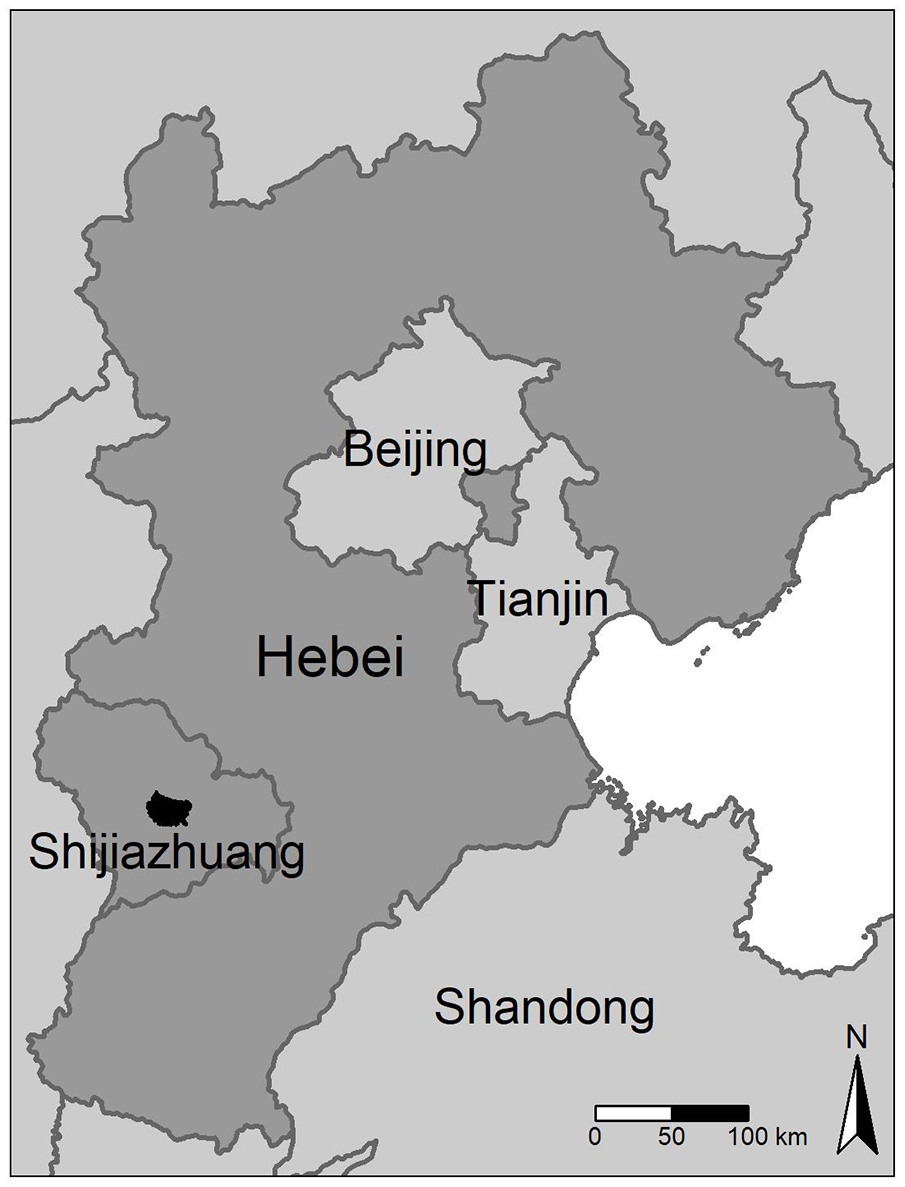
Study area of Shijiazhuang urban area (shaded black) within Shijiazhuang prefecture within Hebei province.
The second limitation of existing research on segregation in urban China concerns the lack of analytical rigour. Segregation is a complex, multifaceted phenomenon, which cannot be expressed by a single number such as the dissimilarity index which has tended to dominate previous studies. This paper uses state-of-the-art methods to better understand the nature of segregation in a Chinese city. While our focus is to evaluate segregation of migrants in Shijiazhuang, we highlight three specific areas in which the measurement of segregation in all Chinese cities can be improved.
Firstly, analyses of segregation in Chinese cities have focused upon a single scale: either the residential committee (juweihui) scale – the smallest level at which census data are available, or the larger sub-district (jiedao) scale. However, there has been increasing recognition that both the causes and the consequences of segregation do not exist on a single scale (Fowler, 2018). For example, small scale segregation of migrants living in neighbourhoods with other migrants may be beneficial in promoting strong social networks that help migrants secure jobs. However, if migrants are consigned to larger enclaves, perhaps on the periphery of the city, there may be less opportunity for integration and larger compounding of disadvantage (Zou et al., 2020). To capture these multiscale effects we deploy recently developed multilevel methods (Jones et al., 2015) to measure segregation at the residential committee (RC) and sub-district scales independently and simultaneously.
Secondly, most empirical studies in Chinese cities treat segregation between migrants and non-migrants separately from other types of socio-economic segregation. Most data show that the majority of rural migrants work in low-income occupations (Zhang and Wu, 2017), but there is little evidence to show whether they are more or less segregated than equivalent local residents in these types of occupations. Shen and Xiao (2020) argue that most migrants are disadvantaged in the housing market because they lag behind local hukou holders in educational attainment, earnings and wealth and not specifically because of their hukou status. They suggest that in most cases migrants with a higher level of education can access better housing and neighbourhoods. However, existing approaches have not permitted researchers to robustly decompose intersectional segregation, which leaves the question of whether the segregation of migrants is partly due to stigma associated with their migrant status unanswered. Our approach allows us to address this question, separating-out segregation by occupational status from segregation by migrant status.
Thirdly, most segregation studies consider segregation as the uneven distribution of groups across areas. Evenness is, however, only one of the five dimensions of segregation identified by Massey and Denton (1988). Centralisation – whether groups are located close to or away from the city centre – is an additional important dimension because it affects people’s access to amenities, services and employment opportunities (Zhang and Pryce, 2020). Existing studies suggest that migrants often reside in peripheral areas of Chinese cities (Liu et al., 2019; Wu, 2014). Most studies, however, lack a robust metric to quantify decentralisation, which means that we do not know whether this is a consistent, systematic pattern or random variation. We adopt an approach that assesses whether the observed level of centralisation is systematic or random.
Our results challenge the claims of Shen and Xiao (2020), providing evidence that migrants are segregated because they are migrants and not just because they are in low-income occupations. In fact, low-income migrants are more likely to be found away from low-income locals. Additionally, we show that unlike in Chinese megacities, migrants are not more likely to be found on the periphery of Shijiazhuang. Finally, our results reveal the multiscale structure of segregation in the city.
Previous studies on segregation in Chinese cities
Segregation was minimal during the centrally planned period (1949–1978) when most urban residents lived in work-unit compounds close to their workplace (Li and Wu, 2008). Housing was allocated as a form of social welfare according to workers’ seniority, rank and family needs rather than income, leading to mixed neighbourhoods without clear patterns of segregation (Bray, 2005). Rural-to-urban migration was strictly restricted by the government through the hukou system.
Economic restructuring and labour market reforms after 1978 resulted in widening income gaps among urban residents (Wu, 2004). Whilst the new rich and the middle class have been on the rise, those laid off from state-owned enterprises and the unemployed have become a significant proportion of the urban poor. Housing reforms privatised existing work-unit housing and promoted a booming real estate market. This was especially the case after 1998 when the welfare housing allocation ended and people had to purchase housing via the market for homeownership (Wang and Murie, 1999). Those who can afford to, live in high-quality commercial properties with good access to services. Meanwhile, numerous urban renewal projects gentrified the city centre and relocated poor residents to resettlement housing in suburban areas (He et al., 2015). In response to rising housing prices, a range of affordable housing schemes have been promoted to support low- or median- income residents, such as Economic and Comfortable Housing (ECH), Capped Price Housing (CPH) (after 2007) and Public Rental Housing (PRH) (after 2010) (see Huang, 2012, for a review). In 2008, the government announced a programme of 7.5 million units of affordable housing. Another 36 million affordable housing units were designed for the 12th Five Year Plan between 2011 and 2015 (Shi et al., 2016). However, much subsidised housing was constructed in peri-urban areas with poor access to amenities and services.
With the booming urban economy, migrants, most of whom originated from the countryside, have flooded into cities for job opportunities and higher income. The hukou system has been reformed to adjust to the vast migration, including the temporary residence permit system in the 1980s, the blue-stamped hukou in the 1990s, and the points-based system in the new millennium (Chan, 2010). Despite strict population controls in megacities such as Beijing and Shanghai, hukou restrictions in smaller cities have been gradually relaxed. For example, it is easier to get local urban hukou status in smaller cities; and migrants can access certain benefits and services, including children’s schooling in state schools and subsidised public rental housing. Despite these hukou reforms, migrants continue to face institutional constraints. Many migrants conduct low-paid jobs and are accommodated in poor urban neighbourhoods, including dilapidated pre-work-unit housing, old neighbourhoods awaiting regeneration, company dormitories and urban villages (Liu et al., 2019).
The quantitative literature has found evidence consistent with these observations showing substantial segregation in a range of Chinese cities by migrant status, education, income and housing tenure. For example, using census data in Beijing in 1990, 2000 and 2005, Zhao (2013) calculates indexes of social segregation and concludes that residential segregation increased significantly over these years. Wu et al. (2014) use 2000 census data at RC level in Nanjing and reveal clear patterns of residential segregation between the affluent and the poor. More recently, Shen and Xiao (2020), using census data at RC level in Shanghai, find increased divisions in terms of socio-economic status between 2000 and 2010, and significant segregation in educational attainment and hukou status. Further investigation of the census data by Liu et al. (2019) revealed that rural migrants in Shanghai tend to be spatially clustered in peri-urban areas away from local residents. Significant residential segregation between migrants and local residents has also been reported in Guangzhou (Li et al., 2015), Wuhan (Huang and Yi, 2009) and Shenzhen (Hao, 2015). However, it is not clear from the existing literature whether the residential segregation of migrants is entirely due to their low-income occupations or whether there is an additional migrant effect, perhaps due to institutional discrimination, social prejudice or homophily (McPherson et al., 2001). This gap in the evidence base arises from the fact that existing approaches do not permit researchers to decompose intersectional segregation into its constituent parts.
In terms of overall levels of segregation, studies typically find that segregation is small in comparison with Western cities. There are, however, some notable exceptions, particularly in more recent studies. Monkkonen et al. (2017) claimed that many large Chinese cities are more economically segregated than even the most segregated American cities, while Shen and Xiao (2020) found that the extent of segregation in Shanghai in 2010 was similar to that in large American and European cities, though it is questionable whether the measures are comparable given the differences in scale and data. For a broader and more detailed overview of the parallels and differences between segregation in China and the West, see Chen and Chen (2021) and Pryce (2021). For recent reviews of the segregation literature more generally, see Piekut et al. (2019) and Musterd (2020).
As noted above, most studies on segregation in China focus on large coastal cities and use traditional index-based measures of evenness, such as the dissimilarity index, which consider different types of segregation (e.g. migrant vs non-migrant; rich vs poor) in isolation. In this paper we apply multilevel modelling and decentralisation methods to the Chinese context for the first time to better examine the complex nature of segregation in Shijiazhuang. We aim to open up a new era of robust and nuanced segregation research that will be applied in a comparable way to cities across China.
Study area and data
This paper focuses on Shijiazhuang, a major industrial city in the Beijing-Tianjin-Hebei (Jing-Jin-Ji) Region, which is the largest urban cluster in North China. Shijiazhuang is a second-tier inland city, located in the south-west of Hebei Province, about 283 km away from Beijing. Historically the city thrived as it was situated along the major train line linking Beijing and Guangzhou, two major cities in the north and the south, respectively. Since the initiation of the economic reforms the city has experienced rapid urban expansion and renewal as a result of public housing privatisation, land sprawl and inner-city renewal projects. As the capital of Hebei Province, and an important gateway to Beijing and Tianjin, Shijiazhuang has attracted many migrants from across China.
Our study area comprises five districts (Chang’an, Qiaoxi, Qiaodong, 1 Yinhua and Zuhua) which make up the urban area of Shijiazhuang. Local knowledge deemed this to be the most appropriate area. The formal definition of Shijiazhuang city-region includes substantial rural areas with very few migrants, whose inclusion would give misleading estimates of segregation. We consider the government buildings to be the city centre. There is a new commercial centre situated a few kilometres to the east, though the choice of city centre has little impact on estimates of centrality. The city sprawls out in all directions but particularly to the east where there are large industrial, low-income areas on the edge of the city.
We use data from the 2010 Chinese census, which consists of counts of individuals within RCs, unless otherwise stated. In 2010 the study area had a population of 2.7 million situated within 450 RCs. These are nested hierarchically within 59 sub-districts. The average RC contained around 6000 individuals (a similar order of magnitude to the population of US census tracts) and the average sub-district contained approximately 45,000.
To assess the segregation of migrants in the city we use hukou status. According to the definition adopted by the National Bureau of Statistics of China, migrants are people who had been away from their original township or sub-district level administrative units of hukou registration for over six months without changing their hukou status at the time of the 2010 census (Zhu et al., 2015). This measure includes a small number of people from Shijiazhuang but whose hukou registration is in a different sub-district from where they currently reside. Unfortunately, this is the only data available to us about migrants at the RC level. At the sub-district level, however, we can additionally identify migrants with rural hukou status, which are the group of migrants most disadvantaged in Chinese cities.
We therefore use the first definition to measure multiscale segregation of migrants at both the RC and sub-district level, with the caveat that the group of migrants that are included in this measure are heterogeneous. We additionally measure the segregation of rural migrants specifically, but only at the sub-district level.
We use education and occupation to measure socio-economic status (SES) independently from migrant status. Levels of education are divided into low, medium and high education, with low denoting primary school or below, medium denoting secondary school education, and high denoting a college/university degree. The categories of occupation are managerial roles, professional occupations, administrative staff, low skilled service sector staff and industrial production workers. This classification is used elsewhere as a proxy for income, with low skilled service sector staff and industrial workers considered as low-income groups (Yuan and Wu, 2014).
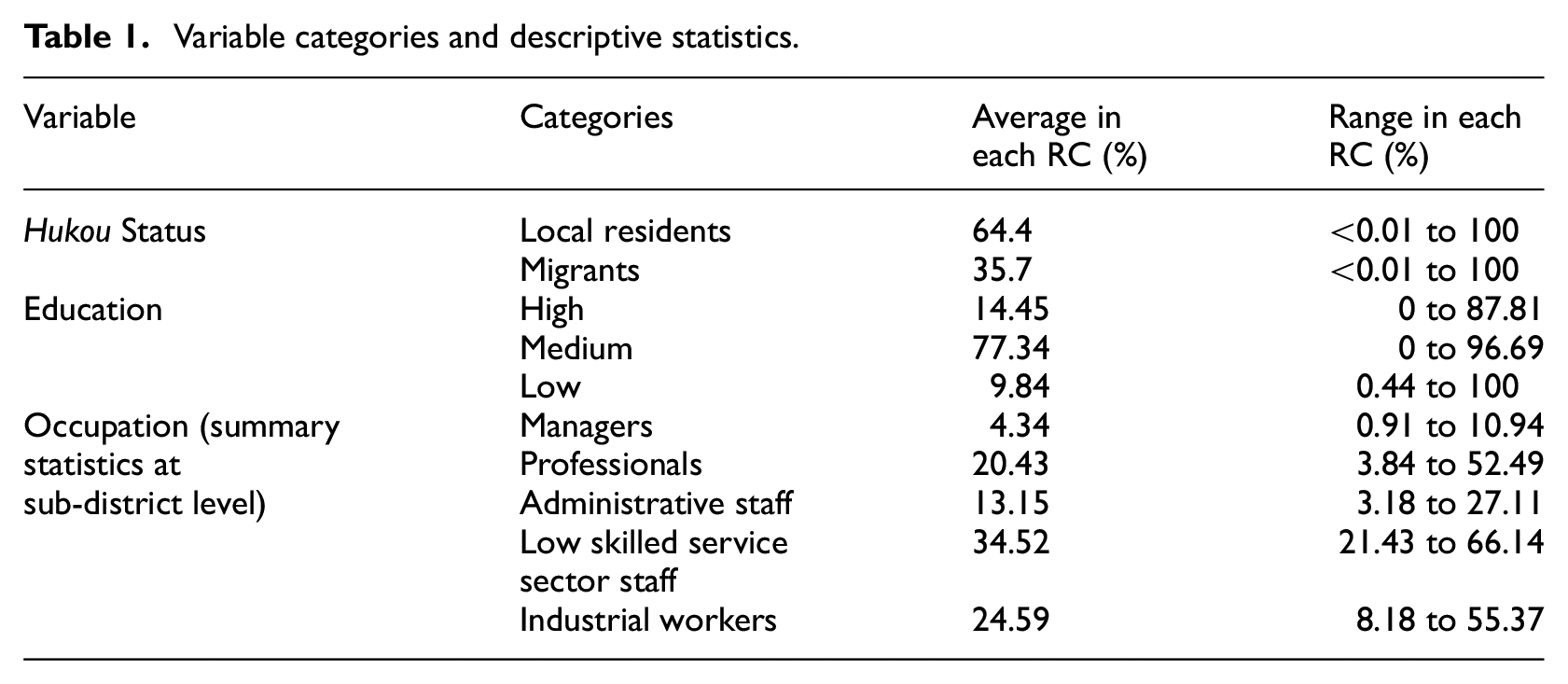
Unfortunately, occupational data was only available to us at the sub-district level so it cannot be used for multiscale analysis. We can, however, use it for intersectional analysis at the sub-district level where we have data on occupation by hukou status. We focus on five occupations and two types of hukou status (local residents and rural migrants), yielding a total of 10 sub-groups. Table 1 shows descriptive statistics for all variables and categories in the study.
Variable categories and descriptive statistics.
Methods
In order to explore the multidimensional and multiscale nature of segregation in Shijiazhuang we use the recently developed multilevel modelling approach of Jones et al. (2015). The method works by first calculating what the expected rate for each group in each area would be if there were no segregation. It then conceptualises segregation as variance around this expected rate. The higher the variance, the greater the unevenness in the distribution of the group across areas, therefore the greater the segregation.
Rather than simply calculating the variance of the observed counts around the expected rate, the method adopts a modelling framework with the observed counts treated as coming from a Poisson distribution. This accounts for stochastic variation associated with small counts, meaning that we can be confident that the variation which remains is systematic segregation, as opposed to random differences. This helps overcome a criticism of traditional segregation measures, such as the dissimilarity index, that they can be biased upwards when counts are small, exaggerating the levels of segregation (Allen et al., 2015).
The multilevel approach has several additional substantive advantages over traditional segregation indices, which make it particularly useful for meeting the aims of this study. Firstly, the method allows for the level of segregation for different groups to be estimated in one model without the need for a reference category. Instead the comparison is made with the expected rate for each group. Furthermore, because of the modelling framework we can calculate confidence intervals (Bayesian credible intervals) for all the segregation estimates. This allows statistical comparisons to be made between the magnitudes of segregation for different groups and at different spatial scales. Finally, we can estimate covariances between each pair of groups in the model, which can be standardised into correlations. A positive correlation between two groups means that the two groups tend to be overrepresented in the same areas while a negative correlation means they tend to locate in different areas of the city. From this we can develop a richer understanding of how different groups and sub-groups are segregated throughout the city. Technical details of the model are provided in the Supplemental Material.
Following Jones et al. (2015) we use a transformation of the variance called Median Rate Ratio (MRR, see Supplemental Material) which can be interpreted as the median ratio between the rates of two areas picked at random. The higher the MRR, the greater the segregation.
We estimate a multilevel model for segregation by hukou status and education, as well as an equivalent single level model for occupation as there is only data at the sub-district level for this variable.
Intersectional segregation
We use the same modelling technique to answer our main research question: whether migrants are segregated entirely because of their low-income occupations which limit their location choice, or whether there is an additional migrant status effect. As the cross-tabulation of the two variables is only available at the sub-district level, we only estimate variances and therefore MRRs at this scale. We first run a null model, followed by a model with occupation alone and then a model with migrant status alone. Subsequently we run two models with both variables included in the same model, the first in an additive manner and the second with an interaction between the two. We use the Deviance Information Criterion (DIC) to evaluate each model against other models. See Supplemental Material for further details.
Relative Centralisation Index
In order to answer the research question relating to where different groups are located in relation to the centre of the city, we calculate the Relative Centralisation Index (RCI) (Duncan and Duncan, 1955), which is a measure of how centralised in a city one group is compared with another group (see Supplemental Material). For hukou status, we calculate the centralisation of migrants relative to local residents. For the other variables, there are multiple categories and we therefore calculate the relative centralisation of each category in relation to all others. For each variable we simulate a 95% confidence interval for what the RCI might be expected to be if the groups were randomly distributed with respect to the centre. If the estimate for the RCI falls outside this interval it suggests that any centralisation is a systematic rather than simply stochastic variation.
Results
Segregation by migrant status
Table 2 reports the MRR and Relative Centralisation Index results with 95% credible intervals in parentheses. Using the data that combine all types of migrants into one group, we can see that migrants are segregated at both scales with an MRR of 1.70 at the sub-district scale and a (statistically significantly) larger MRR of 2.03 at the RC scale. This means that taking two RCs at random (in the same sub-district), on average you would expect the RC with the larger population of migrants, to have a rate of migrants roughly twice that of the RC with the smaller population of migrants. The rate of migrants being the observed count of migrants in the RC divided by the expected count if all migrants were evenly distributed across the city. The effect sizes can be thought of as comparable to odds ratios.
Median rate ratios and relative centralisation indices for all variables.
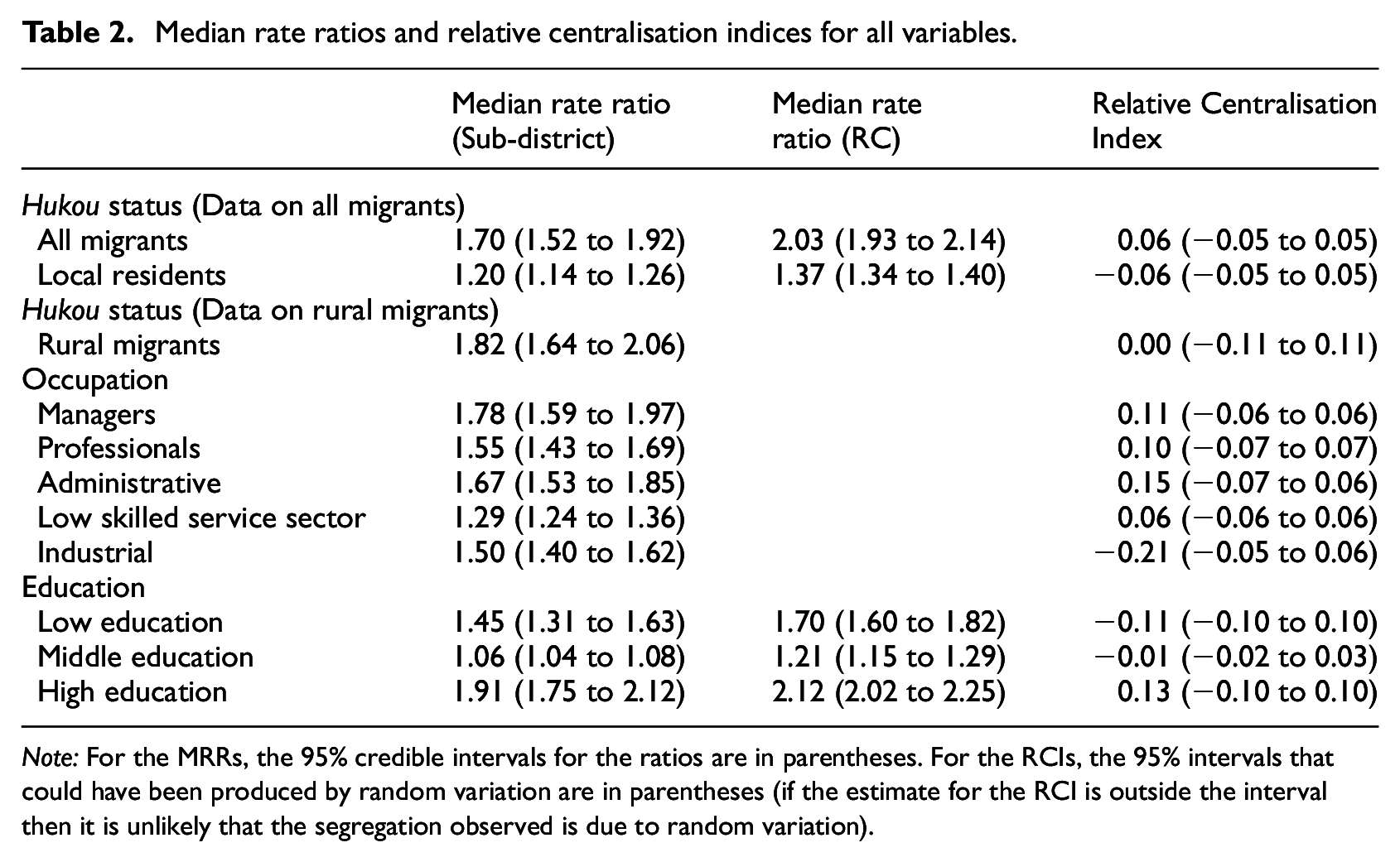
Note: For the MRRs, the 95% credible intervals for the ratios are in parentheses. For the RCIs, the 95% intervals that could have been produced by random variation are in parentheses (if the estimate for the RCI is outside the interval then it is unlikely that the segregation observed is due to random variation).
When we look just at rural migrants, for whom data are only available at the sub-district level, we can see that segregation is slightly higher than if we take all migrants as one homogenous group; however, the difference is small.
Segregation by education and occupation
The MRRs show substantial segregation by education level, with those with the highest education being the most segregated at both scales. Similar to migrant status, segregation is greatest at the RC level for each of the categories. The MRRs are also of similar magnitude to the migrant status variable.
The MRRs for occupational groups at the sub-district level show that each group is segregated; however, there is some variation between them. As with education it is the higher SES groups which are the most segregated, starting with managers, followed by administrative staff and professionals. Industrial workers are the next most segregated although the differences between this group and the three higher-income groups is small. Low skilled service sector staff are the least segregated – segregation of this group is significantly smaller than all the others.
Intersectional segregation
With respect to our primary research question, we find that there is a large reduction in the DIC for both the models of migrant status alone (DIC as a % of the null model = 68%) and occupation alone (DIC = 67%) compared with the null model. It is clear, therefore, that both these variables contribute substantially to segregation. The further large reduction in deviance when occupation and migrant status are included together in the additive model (DIC = 43%) makes it clear that their contributions are separate. In other words, this shows that the segregation observed for migrant status cannot be explained by occupational differences between migrants and locals. The best fitting model of all is the multiplicative model with the full 10 parameters (DIC = 38%; see Supplemental Material), which implies that migrant segregation patterns across the occupational groups differ from those of locals.
Figure 2 compares the multiplicative model MRR results for the ten separate groups. By far the most segregated are managers with rural hukou status. There should be some caution when interpreting this result, however, as these are a very small and unusual group which make up just 0.02% of the total population. The graph also clearly shows that rural migrants of all occupations are more segregated than local residents, with the differences more pronounced for the low-income occupations (low skilled service sector workers and industrial workers). Local residents in low-income occupations are no more – and in the case of low skilled service sector workers, significantly less – segregated than local residents in high- and middle-income occupations (managers, professionals and administrative staff). For rural migrants on the other hand, those in low-income occupations are significantly more segregated than those in higher-income occupations (with the exception of the above-mentioned managers).
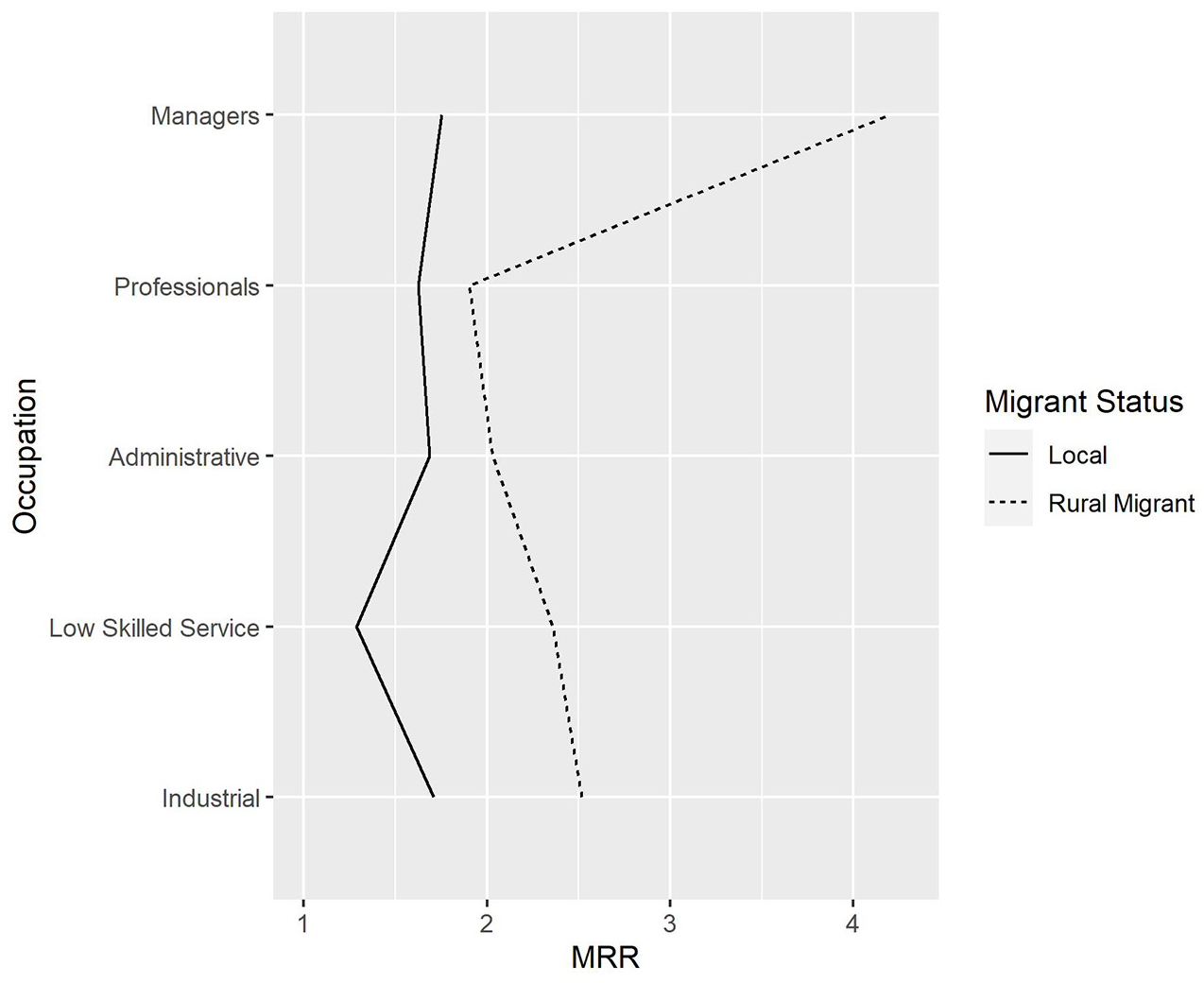
Median rate ratios for intersectional segregation.
The correlations in Table 3 show which sub-groups tend to locate in the same sub-districts, a positive correlation signifying that the two groups are more likely to be found in the same sub-districts and a negative correlation indicating the two groups are more likely to be found apart from each other. While their strengths vary, for rural migrants there are positive correlations between all the occupational groups. This indicates that rural migrants are likely to be found in the same sub-districts regardless of occupation.
Correlations between occupation and migrant status sub-groups.
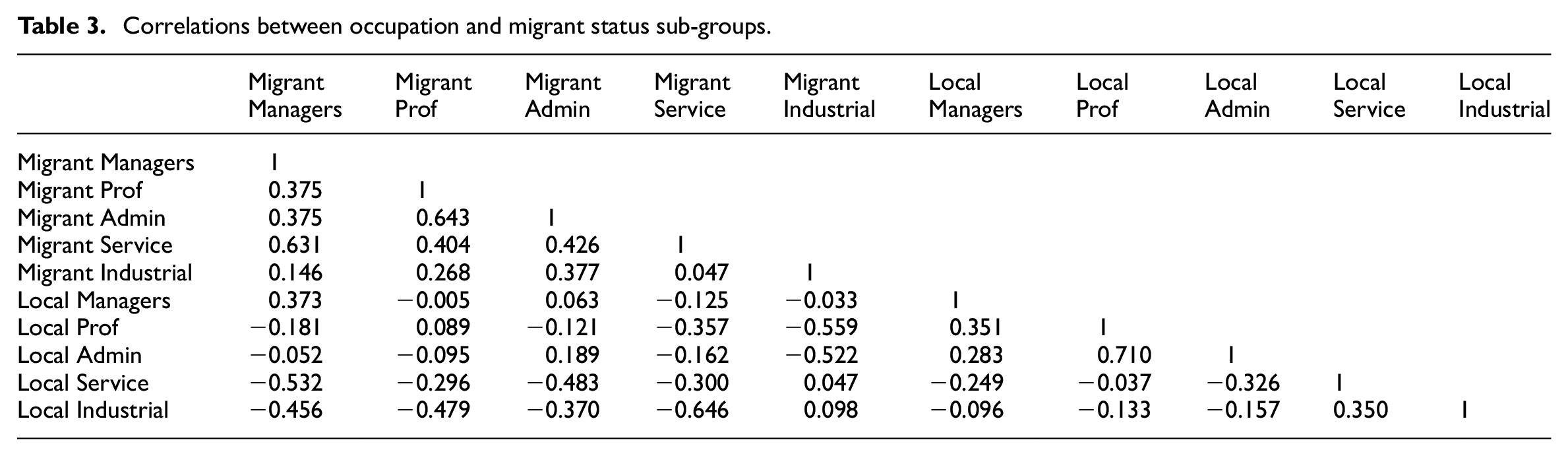
For local residents on the other hand the correlations are positive between the different higher- and middle-income occupations, positive between the different lower-income occupations but negative between the lower- and higher-income occupations. The correlations between rural migrants and local residents of the same occupation are also positive for four out of the five groups. However, these correlations tend to be weaker than those between rural migrants of different occupational groups, suggesting that migrant status may be more important than occupation in determining the location within the city of rural migrants.
Of particular note is the negative correlation between local low skilled service sector workers and their rural migrant equivalents, the largest group for both rural migrants and locals. Alongside this, the majority of the correlations between rural migrants and local groups of different occupations are negative. The strongest negative correlations are, perhaps surprisingly, between rural migrants of all kinds and local workers in low-income occupations, in particular industrial workers.
Centralisation
At 0.06, the Relative Centralisation Index (RCI) for migrants is marginally greater than zero, indicating that migrants are actually more centralised than local residents, although only 6% of them would need to change their area of residence in order to be equally centralised as locals. At the sub-district level, where we can isolate rural migrants, the RCI for rural migrants falls to 0.00, indicating no relationship at all between the residential location of rural migrants and the city centre.
The socio-economic variables show stronger patterns with respect to the centre of the city. Managers, professionals, administrative staff and, to a lesser extent, low skilled service sector staff tend to live closer to the centre, whereas industrial workers tend to live further from the centre. Those with high education also tend to live closer to the centre, whereas those with low education tend to live towards the periphery.
Discussion
This paper is the first to apply state-of-the-art multilevel modelling methods to explore the multidimensional, multiscale and intersectional nature of segregation in a Chinese context, and the first to decompose intersectional segregation by occupation and migrant status.
Our results highlight the strongly intersectional nature of segregation. While, in general, low SES groups are less segregated, among rural migrants the evidence suggests the converse may be true. Furthermore, rural migrants in low-income occupations are more highly segregated than any of the occupation groups among locals. The significant segregation between migrants and local residents is consistent with findings in existing studies (Huang and Yi, 2009; Li et al., 2015). Although migration restrictions are more relaxed in smaller cities compared with first-tier megacities, migrants are still confronted with institutional constraints including limited access to public housing and other life opportunities due to a lack of local hukou status. However, our findings challenge the claims by Shen and Xiao (2020), who suggest that rural migrants are largely segregated because they are of low socio-economic status rather than because they are migrants. We find the opposite to be true: migrant status is more important than occupation in determining segregation in Shijiazhuang. Our findings therefore highlight how multilevel modelling can be used to shed light on the intersectional nature of segregation and inequality in China.
Overall, we find substantial segregation between different socio-economic groups and between migrants and non-migrants. Interestingly, among local residents it is the higher socio-economic groups who are generally more segregated. Managers are the most segregated occupation and people with university degrees are the most segregated education category. This reflects the findings of Shen and Xiao (2020) in Shanghai, who also found that those with high education were the most segregated. Our results are consistent with the claim that increasing socio-economic inequality and commodification of housing have given more affluent groups greater choice over residential location and therefore more possibilities to segregate themselves from other socio-economic groups. That these patterns are observed in a smaller more affordable city such as Shijiazhuang is a new finding and suggests that the type of inequality observed in Chinese megacities may be evolving elsewhere.
Segregation of rural migrants in low-income occupations is much more pronounced than other types of segregation. This raises concerns about its potential to compound the disadvantage and marginalisation that these migrants may already face by restricting their integration into the city as a whole. This is of particular concern, as other research in Shijiazhuang suggests evidence that these migrant areas are more likely to be deprived in terms of housing conditions and economic opportunities (Owen et al., 2021). Policies aimed at improving migrants’ access to social services and benefits would be particularly important.
A somewhat surprising finding is that there is no strong relationship between where migrants live and proximity to the city centre. This challenges the received wisdom that migrants tend to live at the periphery because they have limited access to housing near the centre for a combination of economic or institutional reasons. We did, however, find evidence that certain low status groups – such as industrial workers and individuals with lower education – do tend to locate near the periphery. These different centralisation results for low-income groups versus rural migrants may also provide some insight into another finding of the paper: that local residents in low-income occupational groups tended to be found in different districts of the city from rural migrants of any kind.
One plausible explanation for this finding is that there are lower barriers to housing in central areas in smaller cities such as Shijiazhuang compared with the centre of megacities such as Beijing and Shanghai due to less intense inner-city competition for land and lower housing prices. This would enable rural migrants to live closer to the centre where economic and employment opportunities are concentrated. Rural migrants come to the city specifically to search out these opportunities, and while still probably somewhat constrained economically, will likely value proximity to them when choosing a residential location.
Another explanation could be that there are not as many urban villages in Shijiazhuang as in megacities such as Shenzhen and Guangzhou. The speed of urban expansion in Shijiazhuang tends to be slower than that in Shenzhen and Guangzhou where a large number of urban villages formed in peri-urban areas. Urban villages are popular migrant destinations due to low house prices and proximity to job opportunities. For local residents, the set of factors determining residential decisions is different, as these groups may be tied to a certain area of the city through family, institutional benefits or secure employment. Further qualitative or survey research would be required to understand the reasons driving these locational differences.
The multiscale aspect of our modelling approach revealed substantially higher segregation at the smaller scale. This may be because socio-economic groups cluster together at small scales, but the clusters themselves are not evenly distributed throughout the city.
Directly comparing segregation in Shijiazhuang with that in other cities in China studied previously is difficult due to differences in: how segregation is measured, the types of study areas, and the geographical units of analysis. While it loses some of the complexity that our analysis contains, we can use the dissimilarity index (D) to provide reasonable comparisons if the segregation has been calculated at the RC level. The most suitable comparison that we found for this is research by Shen and Xiao (2020), who calculate segregation using D by hukou status and education at the RC level in Shanghai in 2000 and 2010. They calculate D to be 0.39 between migrants and local hukou holders in 2010. In contrast, we estimate D to be somewhat lower at 0.30. For education they calculate D between those with high education and low education as 0.58 in Shanghai, while in Shijiazhuang it is 0.54 (see Supplemental Materials for the full set of comparisons). These results fit in with previous research in China that suggests segregation is smaller in smaller cities (Monkkonen et al., 2017). However, it is also clear that the differences between Shijiazhuang and Shanghai are generally not large. The assumption that inequality in smaller cities will always be less extreme might not necessarily hold.
Using the results from this paper to compare segregation with that in cities in other countries is even more difficult. RCs are likely to be considerably different in size and nature from units of analysis in other countries. While the multiscale segregation method employed in this analysis does not solve this problem, we believe it can be helpful when considering cross-national comparisons. Firstly, thinking about segregation in this multiscale way allows us to think critically about any comparisons with segregation in other countries by explicitly bringing attention to the impact of scale on estimates. Secondly, the method can help us build up a more detailed multiscale profile of segregation in a city which can at least be qualitatively compared with profiles in cities in other countries. For example, segregation studies using this method in the UK and Australia have shown large segregation at micro and macro scales with much smaller levels of segregation at meso scales in between (Jones et al., 2015, 2018). The smaller and larger scales in our study are closest to the meso and the macro scales in those studies respectively, which suggests a different profile of segregation in Shijiazhuang. This is of interest because different multiscale profiles could suggest different consequences of segregation – and therefore the need for different policy responses – even if traditional measures of segregation suggested similar overall levels. Whether similar multiscale profiles are seen in other Chinese cities will be an important area for future exploration, alongside work looking at the advantages and disadvantages of segregation at different scales.
In conclusion, we have employed an empirical framework using state-of-the-art methods to better understand the nature of segregation in a Chinese city, by revealing some of the nuances that traditional index-based approaches overlook. We found evidence that the segregation of migrants is due not only to their low-income occupations but also their migrant status. Moreover, we found that the residential population in Shijiazhuang is highly segregated across multiple dimensions and spatial scales. Our results highlight the challenges that China is facing as a result of marketisation, but also that migrant status itself may be a source of segregation, perhaps a symptom of stigmatisation or homophily. Further research is needed to unpack this.
We hope that the approach presented here will be applied to other Chinese cities and initiate a new era of rigorous and nuanced inter-city comparisons that provide more detailed insights for policy makers seeking to mitigate social fragmentation and inequality.
Supplemental Material
sj-docx-1-usj-10.1177_00420980221076802 – Supplemental material for Residential segregation of migrants: Disentangling the intersectional and multiscale segregation of migrants in Shijiazhuang, China
Supplemental material, sj-docx-1-usj-10.1177_00420980221076802 for Residential segregation of migrants: Disentangling the intersectional and multiscale segregation of migrants in Shijiazhuang, China by Gwilym Owen, Yu Chen, Timothy Birabi, Gwilym Pryce, Hui Song and Bifeng Wang in Urban Studies
Footnotes
Acknowledgements
The authors are grateful for the comments from three anonymous reviewers and the editors of this journal. The authors would also like to thank Pengxin Duan for help with translation between English and Chinese, David Manley for advice on the methodology, and Meng Le Zhang and Dan Olner for general comments on the analysis.
Declaration of conflicting interests
The author(s) declared no potential conflicts of interest with respect to the research, authorship, and/or publication of this article.
Funding
The author(s) disclosed receipt of the following financial support for the research, authorship, and/or publication of this article: The research was supported by funding from the Economic and Social Research Council, grant numbers ES/P003567/1 and ES/P009301/1.

Supplemental material
Supplemental material for this article is available online.
Notes
References
Supplementary Material
Please find the following supplemental material available below.
For Open Access articles published under a Creative Commons License, all supplemental material carries the same license as the article it is associated with.
For non-Open Access articles published, all supplemental material carries a non-exclusive license, and permission requests for re-use of supplemental material or any part of supplemental material shall be sent directly to the copyright owner as specified in the copyright notice associated with the article.
