




Abstract
In the context of increasing appeals to informal care in Western welfare state policies, questions concerning urban sociality acquire new significance. This paper aims to contribute to the emergent thinking on ‘urban care’ by situating it in policy debates concerning care responsibilities between citizens. We used small-scale focus groups among urban residents in The Hague (the Netherlands) to inquire into the accounts urbanites give of engaging or not engaging with perceived care needs of a stranger. Informed by Goffman’s ‘civil inattention’, we found that accounts of non-engagement highlight urbanites’ orientation towards maintaining friendly social interactions in the face of strange or worrisome situations. Urbanites feel that they should respect people’s choices even if these might hurt them. They fear that interference might be humiliating and they attribute to themselves the task of sticking to normality, while family members, friends or professionals might take on the task to intervene. This careful non-engagement, contrasted with long-standing accounts of urban indifference, enhances our understanding of urban care.
Introduction
In Rotterdam, the second-largest city of the Netherlands, the body of an older woman was discovered in 2013. Nobody noticed her death during the ten years that she had been lying in her house. In the public debate, this tragedy turned into a symbol for the loss of community ties. It was lamented how people in cities failed to care for one another and were not even aware of each other. These concerns became especially harrowing against the backdrop of increasing appeals to informal care as an alternative to state-provided care in Western welfare states (Bredewold et al., 2019; Ilcan and Basok, 2004; Newman and Tonkens, 2011). In the Netherlands it is not just family-members, friends and acquaintances who are admonished to look after each other but also unacquainted persons who meet each other in the public domain. Neighbourhood residents should keep an eye on each other and intervene whenever they suspect a fellow citizen is in a precarious situation, to preclude situations as described above.
The Dutch case shows how political questions concerning care relationships between citizens (Tronto, 2013) intersect with long-standing debates on the nature of urban sociality (see Amin, 2006, 2012; Bannister and Kearns, 2013; Bannister et al., 2006; Fyfe et al., 2006; Thrift, 2005). Policies aiming to shift shared understandings of responsibilities between citizens are underpinned by images of a lost rural community, filled with loving, interpersonal ties (see Thrift, 2005: 140). Urban theorists have critiqued this portrayal of urban sociality as the antipode of community (Robinson, 2006) and called our attention to how urbanites perform acts of urban kindness (Brownlie and Anderson, 2017; Hall and Smith, 2015) and urban care (Amin, 2010; Kullman, 2014; Till, 2012). This paper aims to contribute to this emergent thinking on urban care and to juxtapose it to the growing appeals for informal care in Western cities. Theorising so far has been marked by what geographer Barnett (2012) describes as a focus on spatial, material and ontological dimensions of social interactions (cf Kullman, 2014; Till, 2012). We follow his call to pay more attention to the role of people’s first-person perspectives when faced with an ethical situation and how they consider to act one way or another. We do so by inquiring into urbanites’ accounts of their responses to a stranger’s perceived care needs. We believe that such accounts enhance our understanding of urban care.
Contributions to urban theory should distinguish clearly between issues found in cities and issues of cities (Scott and Storper, 2015: 9), as issues can take place and concentrate in cities without being intrinsically urban. Reflections on care responsibilities are shaped by wider socio-cultural developments, such as neoliberalisation and welfare state reforms.
Therefore, this paper is structured to develop an account of the specific urban dimension of responding to strangers’ care needs. First, it reviews thinking on urban sociality, focusing specifically on non-engagement between urbanites and situating scholarship on urban care herein. Next, to connect non-engagement and urban care, Goffman’s concept of ‘civil inattention’ is discussed and reviewed. This is followed by the discussion of our focus group study into Dutch urban residents’ accounts of their responses towards strangers who are possibly in need of care. Their accounts show how people seek to maintain friendly social interactions between strangers in worrisome or strange situations and how, following this, careful non-engagement can be interpreted as a form of urban care. In our discussion, we show how this enhances our understanding of urban care and reflect on how the intersection between urban care and social policy and practice can be further developed.
Non-engagement in urban sociality
To think through urban responses to strangers’ care needs, we build upon a core theme running through thinking on urban sociality: people’s physical proximity and behaviour aimed at keeping social interaction to a minimum. We refer to this theme as non-engagement. This theme has been brought forth by classic Western urban sociologists. Tönnies, Simmel and Wirth portrayed urban life as a new and distinct form of sociality that reflected modernisation processes such as individualisation and industrialisation. As a result of new social structures (Tönnies, 1957 [1887]), the excess of sensory input (Simmel, 1971 [1903]) and the density of fellow residents (Wirth, 1938), people would shut off emotionally in public and try to get involved as little as possible with those around them. As a consequence, citizens do not interfere with one another in public and expect others to do the same. This line of thought was long presented as a general account of urbanism but has been critiqued for not sufficiently acknowledging its basis in particular Western geographical and historical contexts (Robinson, 2006: 41–64).
Later generations of scholars have expanded upon the difference between in-group and intergroup social interactions in urban life. Whereas the classical sociologists, with the exception of Simmel, focused on the presumed generalised condition of not knowing one another in person (‘biographical strangership’, Lofland, 1998: 7–8), their successors focused on the role of social divisions in cities, such as ethnicity and class (Allport, 1954; Valentine, 2008; Wang et al., 2020; Wessendorf, 2014). In this view, non-engagement is indicative of ‘cultural strangership’ (Lofland, 1998: 7–8), as urbanites would engage more with people perceived as familiar and less with people perceived as ‘strangers’ belonging to a different cultural group.
A counter-perspective is brought forth by a range of different theorists who stress the merits of non-engagement in public. According to them, non-engagement does not reflect a blasé attitude (Simmel, 1971) or societal divisions. Instead, non-engagement constitutes the fleeting social interactions that make up the urban social sphere, which provides pleasurable social experiences (Jacobs, 1961; Lofland, 1998), recognition of differences (Lofland, 1998; Young, 1990) and a basis for democratic culture (Amin, 2012).
The thinking on urban care can be situated in this last stream of literature. Conradson (2011: 465) articulates the intersection of care ethics and social geography as the question of how to relate to ‘unfamiliar others – in the sense of those who are not part of our immediate families – less as strangers and more as neighbors’. Some studies develop ‘care’ as a lens to highlight how people in cities, far from being unacquainted atoms, engage in subtle acts of care, working towards collective wellbeing and the common good (Kullman, 2014; Till, 2012). Others have argued how an urban ethics of care can help to further our understanding of living with difference (Amin, 2006, 2010). Simultaneously, care ethicists increasingly engage with matters of care in the relationships between unacquainted persons (Barnes, 2012: 105–107), including public space interactions (pp. 113–116). But how to understand the relationship between non-engagement and urban care? In this respect, Goffman’s concept of civil inattention offers promising insights.
Civil inattention
This section aims to further theorise urban care by extending Goffman’s concept of civil inattention. It is one of the most well-known conceptions of non-engagement (Karp et al., 2015: 103) in urban theory. It is often mistakenly taken for granted as one of the well-known facts of urbanity, but Goffman did not aim to provide a universal account of behaviour in public places and acknowledged that his account reflected merely certain middle-class contexts in the USA. Goffman’s own remark is confirmed by comparative urban studies that highlight the different forms of social life in Asian and African cities (for a discussion, see Robinson, 2006: 41–64). Despite this built-in limitation we feel that the concept of civil inattention can still be used to analyse acts of non-engagement as possible acts of urban care.
Goffman (1963, 1971) develops his account of ‘civil inattention’ to highlight how non-engagement does not imply the absence of social interaction per se. In civil inattention, non-engagement is the performance of a subtle form of communication in which ‘inattention’ is signalled as a form of respect. Strangers perform civil inattention when they are physically proximate. This performance is described vividly in Behaviour in Public Places (Goffman, 1963: 84): ‘one gives to another enough visual notice to demonstrate that one appreciates that the other is present (and that one admits openly to having seen him), while at the next moment withdrawing one’s attention from him so as to express that he does not constitute a target of special curiosity or design’. For instance, when we step into a bus, we perform civil inattention when we sit down next to a stranger.
This subtle performance of inattention is a courtesy insofar as it consists of a middle ground between two negative extremes: fully ignoring a person on the one hand and paying too much attention on the other hand. Goffman does not discuss explicitly why this balance should be considered a courtesy but a close reading of his accounts of civil inattention points towards two different rationales that provide more insight into non-engagement as an act of urban care.
The first rationale is that doing civil inattention is a way of respecting the autonomy of the other person. According to Goffman, when we are proximate to other people we might share personal information without intending to do so. For instance, we could overhear a personal conversation when someone else is sitting next to us. By civil inattention we act as if we do not overhear this conversation, by turning our attention away and letting other people know we are doing so. This makes it more pleasant to be out in public, not having to worry constantly about our impressions on others.
However, it does not follow that we should shut off completely. The second rationale is that being proximate to another person calls for an acknowledgement of the other person as a person. We should be friendly in one way or another rather than ignore the other person’s presence altogether. Therefore, civil inattention is more than turning our attention away. It is respecting a person’s autonomy while at the same time acknowledging the person by being friendly.
We think this is a specifically urban care act, as city life is full of light-touch encounters between strangers (Valentine, 2008; Wessendorf, 2014) in which, it can be argued, such acts of care are performed or withheld, especially in cases of intergroup social interactions. This reading is supported by empirical research into the experiences of people to whom civil inattention is not accorded. Too much attention (lack of non-engagement) or too much non-engagement are both experienced as disrespect – as if one were less of a person than others. A study by Cahill and Eggleston (1994), based on first-hand experiences of wheelchair users in public spaces in the USA, shows how wheelchair users often experience both a lack of attention as well as unsolicited attention. For instance, when they enter a shop together with a non-wheelchair user, they are ignored. Yet in other situations, strangers compliment them on how well they manage to move around. Both deviations from the civil inattention norm are painful to wheelchair users because they seem to emphasise that wheelchair users differ from other persons in public space. Similar findings were reported by Gardner (1980, 1989). Her research into the experiences of women in North American public spaces shows that women often receive unwanted attention from men. The fact that this was not commonly regarded (back then) as a breach from civil inattention was experienced as an indication that their status was lower than men’s.
The studies above do not explicitly address the perspective of the people that aim to accord civil inattention. They focus on the subjects that (do not) receive it. However, the situations that are being discussed indicate how breaches of civil inattention cannot be solely attributed to malicious intent but can also be the outcome when people uphold non-engagement too firmly or seek to acknowledge a person too explicitly. This account of civil inattention is suggested by the culture-critical account of staring by Garland-Thomson (2009). She argues how staring in public space interrupts the delicate balance between avoiding attention and achieving recognition. People with physical disabilities can feel stigmatised when people relinquish the norm of civil inattention when they stare at their divergent appearance. In other instances, they notice how people become too self-aware in their attempt to adequately perform civil inattention. On closer scrutiny, civil inattention is thus more adequately understood as a balancing act between different intentions and pitfalls in the relations between strangers. Especially in intergroup social interactions, one can do too much of the one in one’s attempt to avoid the pitfalls of the other, as is mapped in Table 1.
According ‘civil inattention’.
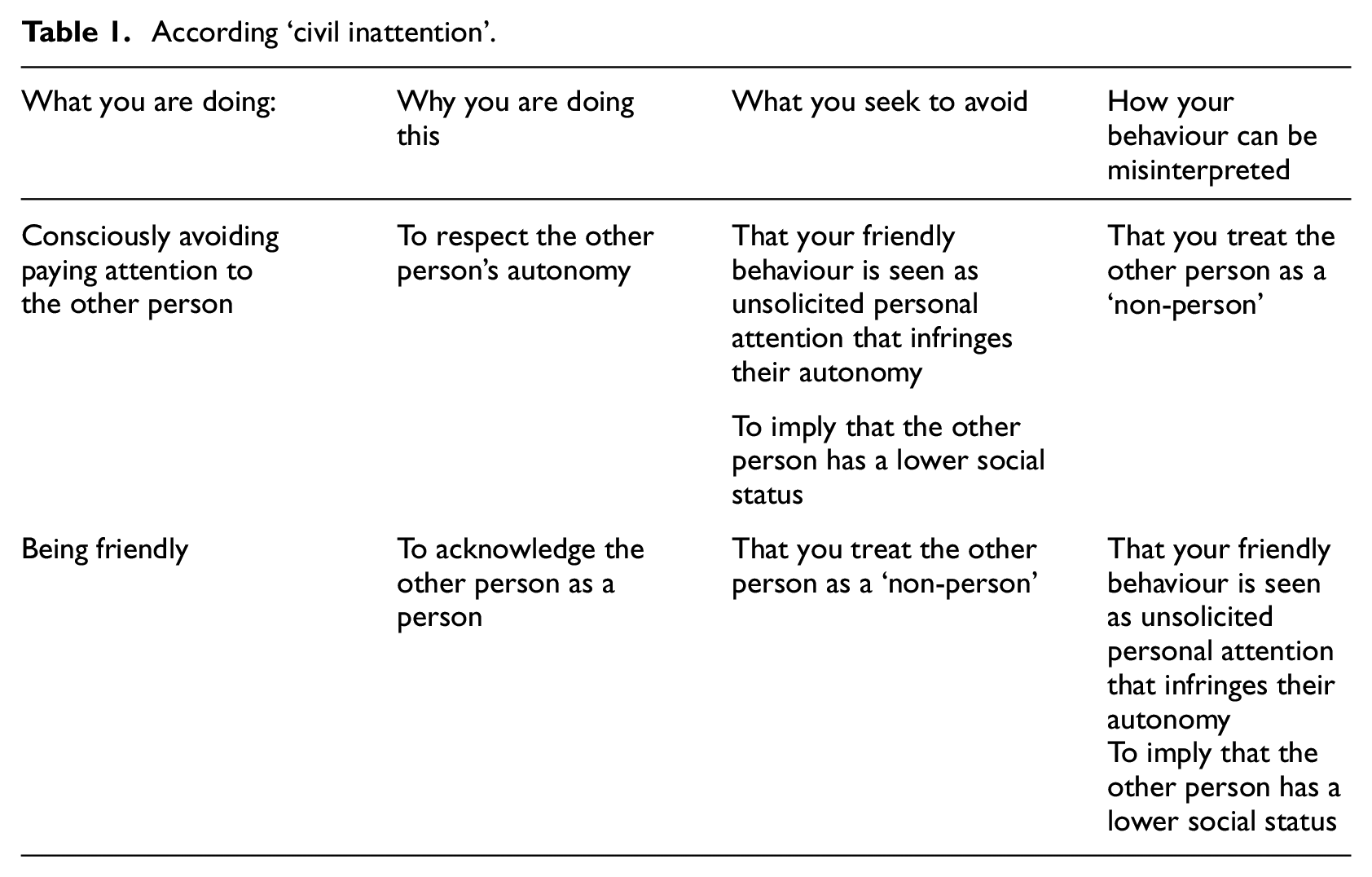
In our study we use civil inattention and its pitfalls as indicated in Table 1 to sensitise us to the understandings involved in accounts of non-engagement in response to a stranger’s perceived care needs.
Method
We conducted focus group research to study urban residents’ norms and understandings with regard to responding to possible care needs noticed in the public domain. Our study is situated against the background of recent policy changes in the Netherlands. The shift of care responsibilities due to the restructuring of the Dutch welfare state has sparked a debate about the scope and nature of support and care responsibilities that citizens have towards one another (Fenger and Broekema, 2019; Grootegoed, 2013; Knijn, 2019; Trappenburg, 2015). Many people who were eligible for residential care, such as older persons and persons with a psychiatric condition, are now living assisted at home. Many other people have faced cut-backs in state-provided care services during recent years (Fenger and Broekema, 2019; Grootegoed and Tonkens, 2017). Non-professional citizens are supposed to step in. This includes family members, friends and neighbours but also neighbourhood residents in urban areas, who have to learn to interpret odd behaviour as might be displayed by people with dementia or a psychiatric condition and subsequently provide help if necessary.
We chose to conduct focus groups as they are well-suited to assess widely shared opinions on a topic (Morgan, 2011). The social interaction in a focus group provides a context in which people interpret and account for their experiences by referring to widely shared understandings within their group or community. In addition, focus groups can be conducted in such a way that the consensus or disagreement concerning such understandings in a group can be explored (Kitzinger, 1994).
Seven focus groups were organised with inhabitants of the third largest city in the Netherlands, The Hague (approx. 500,000 inhabitants), during June and July 2017, with a total number of 23 participants. The focus groups were organised with a smaller number of participants (2–5) than commonly found in focus group research (6–8) (Kitzinger, 1994) in order to have enough time to look in depth into specific cases that participants would raise. In addition, two social workers working in the field of mental health were interviewed after the focus groups in a 1.5-hour dual interview to comment on the themes of the focus groups to gain a deeper understanding of differences between a layman perspective on worrisome situations and an expert perspective.
Participants were selected as a convenience sample (Patton, 2015). An open call was spread by social media, the distribution of flyers, posters in local shops and through an advertisement in the local newspaper. In addition, the first author recruited participants by asking her network to point out the research to friends and acquaintances; this was also how the two social workers were recruited. All participants were informed about the nature of the research and were asked to sign an informed consent form. They were assured anonymity. The names used in this paper are all pseudonyms. The focus group participants’ average age was 52 years and ranged from 22 to 82 years. Twelve of the participants self-identified as female and nine as male. Most participants had lived and worked most of their lives in The Hague or the wider region. A high number of participants (11) was working, or had retired from work, in healthcare, nursing or social work, others were (or had been) self-employed, or worked in administrative or technical positions. None of the participants had (held) a higher-level professional or managerial position. Participants were mostly of middle-class background and two participants had an ethnic minority background.
The focus groups were held in a community centre in The Hague and lasted for 1.5 hours. The first author had prior experience with conducting focus groups and moderated all groups. The focus groups started with an individual instruction for each participant to remember a situation in which they were concerned about the wellbeing of another person (with the exception of urgent medical emergencies such as a heart attack or a stroke) with whom they were not personally acquainted. Participants had to fill in a form that asked questions concerning the situation itself and their reflections on their position: what was happening in this situation? What was your relationship to this person? What did you consider doing? What did you do in the end? When participants finished writing, they were invited to share their experiences and reflect upon different aspects of their own and each other’s experiences. The first author used a funnel model (Morgan, 2011) to lead the interview from a broad, exploratory phase to a more in-depth phase in which the themes from the exploratory phase were deepened through questions concerning norms and expectations about non-engagement. The focus groups were audiotaped and transcribed verbatim.
The first author conducted the main part of the analysis, the second and third authors were involved in the interpretation and refinement of the findings. Analysis was done through a combination of deductive and inductive coding in the qualitative analysis software Atlas.Ti. Deductive codes were derived from theory on non-engagement and civil inattention discussed above; inductive codes were added to code the different ways in which people gave accounts of what they did or did not do in the situations. The analysis concentrated on the ways people account for non-engagement in a way that refers to ideas about what is appropriate and what is of value in the way unacquainted people treat one another.
Findings
Taking care of each other
In the focus groups we discussed cases that the current policy agenda would categorise as warranting action by urban neighbourhood residents. Some participants agreed with the policy agenda, at least up to a point. In some situations, they considered non-engagement to be a form of neglect, or even to contribute to social isolation. Some cases were discussed in which building social contact would be a way to help people handle a difficult situation, according to the participants. Sophie describes how she decided to ignore the apparent wish of a hermit to avoid contact with his neighbours and how this eventually led to his involvement in a small neighbourhood association.
Somebody said to me: ‘I have a neighbour and he is a hermit, I think something’s wrong.’‘How to get him to one of our neighbourhood gatherings?’ That proved to be very difficult. Eventually it turned out his whole house was a museum, it smelled bad, it was very bad. But the man turned out to be keen on Klaverjasser [a Dutch four-player card game]. We set up a trick: we said we were missing one player and asked him to replace him. Then he came, very cautiously, and he left again. But during the match he remarked that he knew a lot about computers. So then I played the helpless old lady that needed help with computers and asked him if he could solve my computer issue. That is how we slowly got in touch with him. (…) At first, he definitely did not want to. It was only afterwards, when he was out of his situation, that he wanted to get in touch with his neighbours.
More often, social contact was discussed as being an indication of a person’s social status. Participants Emma and Erik stress that some people have problems that go unnoticed and describe how this is an isolating experience. They believe it would be good to show these people some form of acknowledgement:
I don’t have an answer to all problems, but it’s important that people see you, let you know that they’re there (…) that you can be who you are. Perhaps even cry.
Show them that they are valued for who they are. For some people, this just doesn’t happen, for instance, a woman with dementia.
The example of a women with dementia suggests that Erik thinks that positive social interaction is not an intervention but should counter the negative effects of a lower social status because of a stigmatised condition.
Robert also stresses the value of social interaction in contrast to non-engagement, it does not even have to be friendly. He reflects on his past as a drug user in two different apartment blocks. He concludes that he prefers meddlesome interference from his neighbours to being ignored and treated as a non-person.
I remember how my neighbours used to call the police right away whenever they noticed something about me. Whenever there was a boy delivering his stuff, they told me to do it somewhere further away because of the children living here. I was very lucky. Before that, I used to live in a flat where no one ever said anything, not even about noise disturbance due to loud music. That was very impersonal.
Maybe they didn’t hear you?
You could hear each other all right, it was just that nobody ever mentioned anything.
Robert’s reference to the indifferent atmosphere of his former flat aligns with remarks made during several conversations about differences between places. Some respondents compared their experiences as residents of different neighbourhoods, or between living in The Hague and in a small town or village. Both cities and villages could be caring or uncaring, depending on the amount of social interaction between neighbours; places were perceived as uncaring if there was little or none. It was discussed in some groups that cities generally had higher barriers for social interaction because it was less common to say hello on the street and because of cultural differences between residents.
In these accounts, non-engagement is contrasted negatively with friendly social interaction between neighbours. However, careful non-engagement in the form of limited, friendly social interaction was also contrasted with ‘helping’. In a way similar to Goffman’s civil inattention, limited friendly interaction was employed to avoid further engagement, while at the same time expressing a positive attitude towards the fellow citizen. Participants stressed the intrinsic value of careful non-engagement as they explained why they would refrain from ‘helping’ a fellow citizen in need.
Respecting autonomy
Many accounts referred to autonomy. For the participants, autonomy entails that people decide for themselves what they consider to be a negative situation and which personal information to share, when, how and with whom.
I think that’s the point: just imagine I am living happily with my television and whiskey and suddenly a neighbour asks me: why do you always keep the curtains closed? It is very important that a person would be able to reply: ‘that is none of your business, I am happy the way I live’. Some people just don’t want company. They may seem lonely to their neighbours, but they are happy to live the way they do.
If I see something, I can’t just go up to a person to ask what’s going on. Of course not! One should be very careful, just have a chat and try to figure out whether they would like to talk with you about it. If they don’t want to, I’m out!
Not only do participants themselves think it is important, they also experience that others expect them to behave accordingly. Some people had negative experiences when they approached a person without such permission, as Sem describes.
She [my neighbour] is alone. Nobody can help her, though she does receive some sort of day care. But at night (…) you could hear her moan with pain. That was not nice. At one point, I started calling to ask her if she needed help. Then you get a response like it’s none of your business.
Yes, is that what she said to you?
Well, not literally, but indirectly, that was the feeling I got.
In the comparative interview, the social workers confirmed that residents value autonomy highly, even in quite distressing situations. One of the social workers voiced her critique on this shared understanding by referring to a situation in which she intervened when an older, confused woman in the middle of a crowd had a bleeding wound and said she wanted to be left alone. Bystanders got angry at the social worker for not respecting her request, while she thought it to be evident that the woman needed help and not respect.
References to autonomy in the focus groups only generated discussion in an extreme case. During the conduct of the focus groups, the Dutch news reported how one person in a spiritual community of breatharians had died as a result of malnutrition, which was related to the breatharians’ belief that food should be rejected and one should learn to literally live on air. The focus group in which this case was brought up disagreed about whether others, for instance neighbours, should have intervened.
Yet, according to the law, they should have done something as bystanders, neighbours.
But this is what she wanted herself! Should you meddle with that? This is what she wanted.
But of course, you can be sure: if this goes on for another three weeks, she’ll be dead.
Avoiding humiliation
In addition to the autonomy argument, participants also felt that unsolicited concern could be experienced as humiliating. Whereas non-engagement as the absence of social interaction is understood as a ‘non-person’s treatment’, expressions of unsolicited concern resonated with the pitfalls of offering too much attention, in the accounts of the participants.
Harry and Charlotte, for instance, talk about a local initiative of supermarkets to have their staff talk to older customers to see if they can manage. Both feel that those inquiries could be humiliating:
Someone aged 50, 60, with some physical problems comes to the counter and a girl aged 15, 16 asks him: ‘hey, something’s wrong with you?’‘Well, that’s none of your business!’ Maybe it would be different with an elderly lady behind the counter, but still, it doesn’t work with all these young girls.
That’s just what I think when I buy a box of painkillers at the grocery store and the brat asks me ‘Do you know how to use them?’ I reply: ‘I don’t look like a sixteen-year-old, do I?’ But just imagine, if you start to limp a bit and a girl says: ‘are you all right, madam?’!
Other participants added that one could add insult to injury with unsolicited concern. Difficult situations can make people feel insecure or less in control of their lives and participants explained how they would only want to share their concerns with people whom they trust. When other participants were discussing in general terms the importance of increasing social control in urban neighbourhoods, Linda, an older participant, brought forth her own experience against it from the time she started doubting her cognitive abilities:
You become very insecure when you doubt if you suffer from dementia! A few months ago, when I was very busy, I just couldn’t remember how to use the coffee maker. I was just staring at it: ‘how do I turn it on?’ Then I went to the supermarket, and I paid with a 20-euro banknote at the counter and the cashier said: ‘you gave me only 10 euros’. I was absolutely certain I had paid 20, but then I remembered the incident with the coffee machine. I went to the doctor and luckily, it wasn’t dementia. But you feel very insecure, standing in front of the cashier. (…) It was so frightening, the last thing you need is another person rubbing it in your face!
Avoiding humiliation and not adding insult to injury were also much referred to when situations were discussed in which participants encountered a person perceived as belonging to a different cultural group. The participants felt one should not approach people who do not speak your language or who are expected to hold different norms and values because of their ethnic background because it is not possible to know how to hit the right note in such situations.
Division of care responsibilities
The last reason why respondents felt that they should not offer unsolicited concern to strangers in need was a belief in a proper division of care tasks. Emma, for example, describes how she had chosen not to inquire further during her encounters with a shopkeeper who eventually quit her business because of mental health issues. She referred to the role of friends:
I saw a change in the appearance of a shopkeeper, around the corner where I live, a shop I always liked to visit. I tend to wait and see, I asked her if things were all right, and well, that’s not really a genuine question anyway. When I noticed it became a little more permanent, I thought: everybody has their own friends and not everybody is willing to tell others about their situation.
Participants contrasted the role of unacquainted citizens to the role of personal contacts (and in some cases, professionals in social work or healthcare), implicitly referring to a societal division of care responsibilities. Family and friends are the ones who should attend to people when they face difficulties, because they are entitled to discuss the situation.
This is illustrated by an incident described by Linda. Two people on the street found a man (a neighbour of Linda’s) who had fallen and suffered from unknown but clearly visible medical injuries. However, the man had asked them not to call an ambulance, so they did not. Later that day, his own wife convinced him that he should go to the hospital. The ambulance came and he was admitted to the hospital and spent three days there. It seemed common sense to all participants that the two people on the street had respected the man’s wishes whereas his own wife was the one to go against him. This is also illustrated by Jennifer’s account of the reasons for not inquiring further into the situation of a colleague. All of a sudden, the colleague started to make a lot of mistakes and was having bad moods. Jennifer felt sorry for the way others responded to her and wondered if her colleague’s mistakes life due to something going on in her private life. However, she thought it was not her responsibility to do anything for her colleague.
I asked her if everything was alright. She replied: Yes, it’s okay. I said: Sure, just let me know if there’s anything I can do. But I don’t think I am the person to inquire into her situation, so I just left things this way. I was positive she would go to see a professional if she were in need of any help.
Contrary to pessimistic accounts of the lack of responsibility that strangers feel towards one another, participants suggested that unacquainted persons have a different, less clearly articulated responsibility towards one another. This responsibility entails respecting the person by not treating him or her differently in the case of extraordinary, strange or difficult situations. Not treating a person differently consists of finding an appropriate form of light-touch interaction that should be tactfully employed in order to avoid further engagement with the extraordinary dimension of the situation. For instance, in the case of an older woman with dementia on the bus, the focus group discussed how the bus driver (one of the participants) should disattend to her confused story through such tactful interaction:
Once there was an older woman, she entered the bus, a bit confused. Something about her wallet, her ticket, her daughter … it was obviously dementia in its initial phase. But of course, I couldn’t say to this woman ‘Well, madam, no problem!’ I did not know, I just showed her my interest. ‘Of course, you can come along.’ I didn’t make a fuss about the ticket. I just hoped that there would be some sort of … safety net for her. Because, well, what am I supposed to do as a bus driver?
The only thing you can do is let her on the bus, that is what you did, it was very kind of you.
And listen to her story.
Definitely.
That’s very important, to listen. To be someone to talk to. That is the most important.
Well, it’s about showing genuine interest in someone. That’s important. Someone should feel respected and be heard.
The bus driver hoped that other people would provide a safety net for his older passenger. In his understanding, his responsibility was to keep up a semblance of normality. Other cases were also discussed in which strange or unusual behaviour was consciously unattended to, through careful non-engagement. Referring to an older woman crossing the street in the wrong direction, one participant describes his appreciation of the fact that all the traffic adjusted itself to the situation as if nothing was going on. Another participant gave an account of a male neighbour who started to get more and more confused, supposedly because of dementia. She described how she kept on chatting with him as usual. The other participants responded how such light forms of social interaction are valuable social skills that should be taught and promoted through social policies.
The findings suggest that careful non-engagement in cases of a worrisome situation of a stranger is a balancing act very much in line with ‘civil inattention’. Friendly social interaction between fellow residents is perceived as intrinsically valuable. In these interactions, autonomy should be respected, possibly humiliating situations should be avoided and strange or worrisome behaviour should be consciously unattended to (Table 2).
Careful non-engagement.
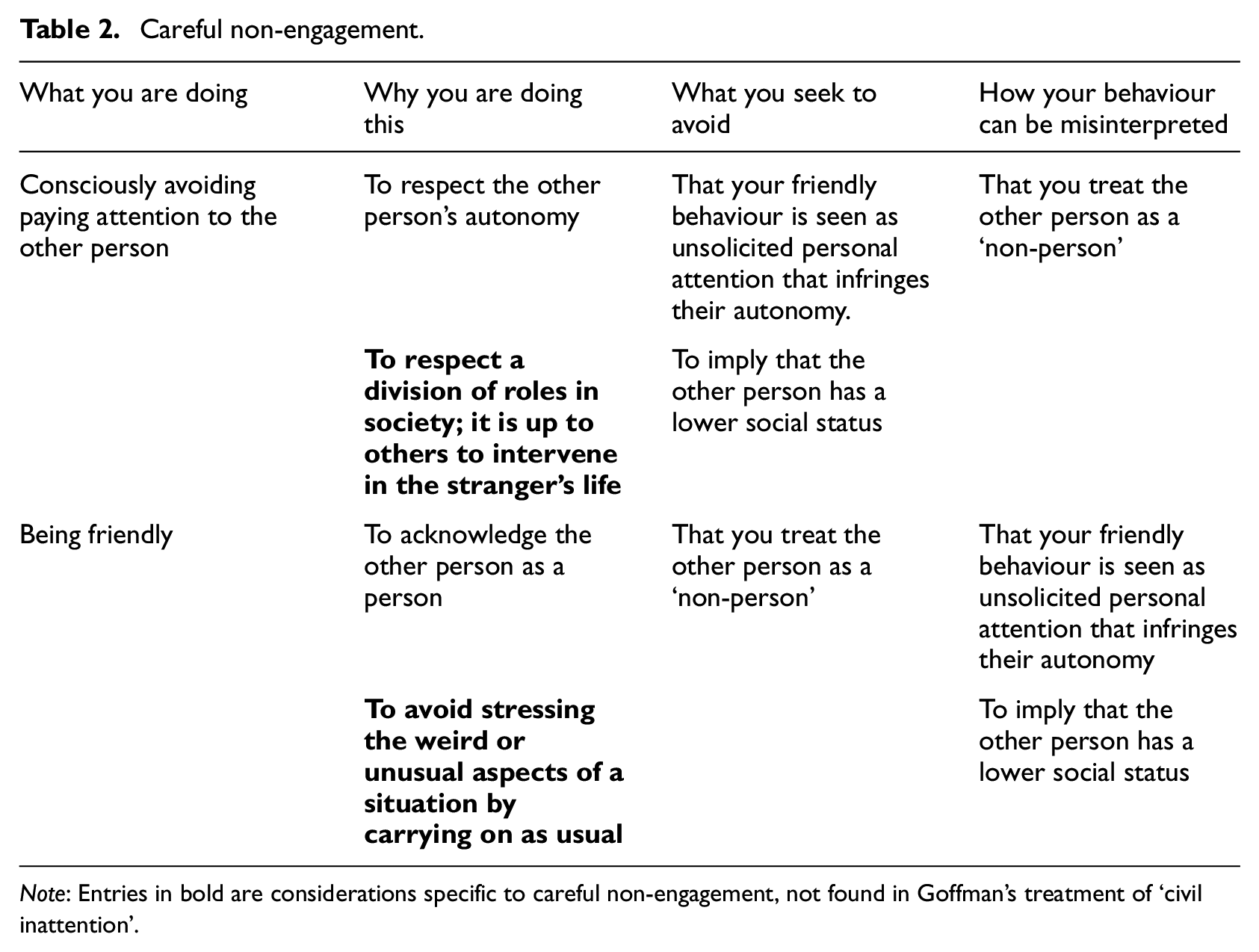
Note: Entries in bold are considerations specific to careful non-engagement, not found in Goffman’s treatment of ‘civil inattention’.
Conclusion and discussion
With this study, we aim to deepen the understanding of the intersection between urban care and care responsibilities between citizens as discussed in current Western policies. We are aware of its limitations. The theoretical model is based on observations in Western cities and the self-selected sampling method used for this study resulted in a homogeneous sample in terms of cultural and professional background. Other research has convincingly shown that understandings of giving and receiving care vary from culture to culture (Cohen et al., 2019; Verbakel, 2018) and highlighted clear differences concerning informal care norms between people with a non-Western migrant background in the Netherlands and people with a Western background (Van den Berg, 2014; Van Wezel et al., 2016). In addition, our sample was homogeneous in terms of professional background as a high number of participants (formerly) held positions in social professions working in healthcare or in social work. Research indicates that citizens working in social professions are more likely to look after and support vulnerable neighbours (see, e.g., Bredewold et al., 2016a; Veldboer et al., 2008). Therefore, we assume that the self-selected sampling has led to a group of participants who endorse the policy concerns about informal care in cities and who see themselves as socially involved in their neighbourhood. The act of participating in a focus group without compensation is in itself a kind gesture towards a stranger. Thus, the participants’ considerations about how they treat or help other persons are probably not shared by all Dutch urban residents. However, it seems a significant outcome that even these people who are probably a little more socially inclined than average, value and defend non-engagement in situations where they worry about others, instead of choosing to intervene.
The participants’ accounts of non-engagement add a new perspective to ‘urban care’, namely as a specifically urban concern to constitute and maintain minimal friendly social interactions between fellow urban residents in response to strange or worrisome behaviour. This echoes Lofland’s (1998)‘civility towards diversity’ (pp. 464–465) as a social norm in the public sphere: treating people the same, regardless of differences in appearance or demeanour, as well as the ‘comfort of strangers’ (Barnes, 2012: 116–119) that can be experienced through pleasant social interactions in public. Our research confirms the critiques voiced by urban theorists that urban sociality should not be viewed as the antipode of a caring community and that we should pay attention to specific urban acts of care instead (Amin, 2010; Brownlie and Anderson, 2017; Hall and Smith, 2015; Kullman, 2014; Till, 2012). Non-engagement does not constitute indifference or neglect but can also be understood as a contribution to the common good by upholding respectful, pleasant relations between strangers in a division of care responsibilities. In the context of growing appeals to informal care between strangers in cities, our research shows that such appeals go against the balancing acts of careful non-engagement.
Paying attention to people’s perspective as ethical agents considering whether to act one way or another, as suggested by Barnett (2012), adds a new perspective to existing macro-level perspectives on non-engagement in urban theory. This approach can contribute to articulating alternative conceptions of care for informal care policies, more tailored to urbanites’ concerns and sensitivities than conceptions of care grounded in the image of a rural community lost. Further work on the intersections between people’s considerations and macro-level perspectives on non-engagement seems to us an important next step to further develop the emergent thinking on urban care.
Non-engagement entails a thin line between working towards and upholding respectful friendly social interactions and neoliberal understandings of freedom from care obligations and autonomy. Disattending to care needs resembles the masculine, higher-class ideal of freedom as being unhindered by complicated and obliging care responsibilities (Tronto, 2013: 88). While we support careful non-engagement as a form of urban care, we do not want to suggest that non-engagement is an overarching ideal for social interaction between urbanites, as this would enforce a situation in which the care burden falls on one part of the citizenry and can be ignored by others. In addition, the high value placed on autonomy in the focus groups echoes the ‘autonomy myth’ (Fineman, 2004) that citizens can and should be autonomous instead of acknowledging the need for help and assistance as part of human life and social relationships. Therefore, urban care acts, such as the careful non-engagement conceptualised in this article, should be situated in a wider framework of relationships between urbanites. What is the nature of such relationships, how do they encompass different care acts and how do they relate to dimensions of gender, cultural background and class? This suggests a different route for social policy. It should not aim to address a presumed, generalised condition of indifference but instead focus on the ways care needs are attended to, by whom, and how, as a result, care responsibilities and burdens are distributed.
The accounts of non-engagement in this study also suggest that people distinguish between situations of in-group and intergroup social interactions. The values of non-engagement are also referred to in accounts that discuss barriers or hesitations to engage in social interaction with people who are perceived as different. This touches upon the other dimension of urban care, namely as a transformative ethic that accommodates living together with difference (Amin, 2006, 2010). The renewed interest in the ‘contact hypothesis’ (Allport, 1954) and debates concerning encounters across difference (Blonk, 2020; Bredewold et al., 2016b; Nowicka and Vertovec, 2014; Valentine, 2008; Wise and Noble, 2016) can be cross-fertilised with urban care through further inquiry into non-engagement between urbanites.
Footnotes
Declaration of conflicting interests
The author(s) declared no potential conflicts of interest with respect to the research, authorship and/or publication of this article.
Funding
The author(s) received no financial support for the research, authorship and/or publication of this article.
