




Abstract
This paper shows how residential high-rise developments in London deteriorate the living conditions for existing residents and set a legal precedent for distributing harm unevenly across the population. The paper unpacks the contentious decision-making process in one of several local planning applications in the London Borough of Tower Hamlets that ended in a spur of high-profile public planning inquiries between 2017 and 2019. The Enterprise House inquiry shows how, among other things, a loss of daylight, sunlight and outlook, and an increased sense of enclosure, affect already marginalised residents in neighbouring buildings disproportionately, elevating light to a legal category for assessing harm and addressing social injustice in the vertical city. The paper adopts a forensic approach to interrogate four instances during the public inquiry, in which numerical evidence of material harm resulting from a loss in daylight, sunlight and outlook was made to appear and disappear. The translation of scientific evidence into legal evidence is performed through the act of claiming ‘truthful’ representations of ‘real life experiences’ of light in digital visualisations. By revealing how material harm resulting from vertical development is normalised and thus naturalised in the planning inquiry, the paper demonstrates how ‘light’ violence is exercised in vertical development.
Prologue
‘We’re talking about two different things here – of what the law says and of what I have found out in person. You shouldn’t confuse the two’ (Kafka, 2012: 177)
Mr. P arrived at the public inquiry ready to deliver his personal statement before the planning inspector. Like the four other witnesses who came that day, he had three minutes. He wanted to convince the inspector above all how it impacted him, like nothing you could read off some chart, a table or a computer-generated image. Living in a three-bedroom apartment on the sixth floor of Goldpence Apartments – the lower seven storeys of the 23-storey residential tower, Altitude Point, comprising a block of ‘affordable’ housing which includes both intermediate homes 1 and social rent – Mr. P explained how the proposed tower block – a 13-storey Apartment hotel, standing a mere 9 m east of their west facing windows –‘will virtually block out all sunlight’. To his wife, who works from home and who is ‘very sensitive to changes in daylight, especially at this time of year’, this would be absolutely catastrophic. Having already submitted written objections to the planning application, Mr. P was puzzled that the inquiry didn’t give weight to the material harm resulting from their loss in sunlight, but instead set out to determine whether that harm would be perceptible or not, and consequently acceptable or not. So far, he was right. The inquiry didn’t deal with harm as an ontic question (whether it happened or not, that was already settled as harm was documented in detail to breach guidelines for 201 windows across 166 rooms in 58 individual flats), but rather as an ontological question (how can harm be understood?) followed by the ethico-juridical question (to what degree is harm acceptable or unacceptable?). Mr. P was puzzled by this shift in attention and in his concluding remarks exclaimed that while ‘it is difficult to quantify the harm, negative effects are real, and I argue that the perception of enclosure is best understood by residents’.
Living below the Ps, Mr. R spoke, not only on behalf of himself and his partner but also of 33 residents in Goldpence Apartments who opposed the scheme, but who unlike Mr. P and Mr. R, didn’t feel comfortable and confident, speaking at the inquiry. Mr. R explained how to maximise the amount of light they get when working from home, he and his wife had placed a desk up against their windows. Similarly, they had placed groups of plants against the windows to grow in the sunlight that on clear days reaches through their windows and travels across the flat, reminding them that their lives are entangled in the natural passage of the day into night. They stood to lose this sense of connection while their outlook would be replaced with a ‘claustrophobic’‘sense of enclosure’. He furthermore objected to the appellant’s justification of harm by arguing that ‘the conditions are already bad in the area’, reminding the inspector that ‘the people who stand to be impacted the most, are those that already suffer the most’ as the ‘majority of flats are social rented tenure, they don’t have a choice on where they and their families live’. Among the residents, he continued, some of the most ‘vulnerable are domestic abuse victims’, children and students, of which one resident ‘on the first floor … is studying for his A levels [and] cannot see properly … his eyesight is deteriorating due to lack of light’. By foregrounding the disproportionate experience of harm among the residential population, Mr. R sought to shift attention away from the material considerations of land use as a matter of planning policy, to consider the forms of social injustice that directly or indirectly result from matters of planning policy.
While the inquiry is not a vehicle for settling cases of social injustice, the personal statements of the local residents elevated light to a legal category and a medium for measuring physical and psychological harm resulting from vertical development in dense urban environments. Their embodied accounts of experienced harm, not only breathed life into the numerical figures and dry bureaucracy of building codes that had been scrutinised in the preceding days at the inquiry, but attempted to convince the planning inspector that ‘what the law says’ was not what they ‘found out in person’ (cf. Kafka, 2012), thereby challenging the epistemic regimes that underpin legal judgement. As argued elsewhere, the inquiry ‘permits the expression of embodied points of view … mediated through the protocol of the inquiry itself and the institutions that stand in for individuals in the civil arena’ (Hyde, 2019: 164) but gives ‘no formal standing of privilege’ to such embodied views (Hyde, 2019: 165). By hearing diverging parties in the courtroom setting, the inquiry can provide ‘a crucial tool for individuals and community activists to re-examine … reconstruct… and draw media attention to the shortfalls of the proposed new developments’ (Lees and Ferreri, 2016: 21) in ways that suggest the convergence of planning law with social justice and human rights issues (Hubbard and Lees, 2018: 15). So conceived, the public planning inquiry opens up a semi-legal space for challenging authoritarian claims to truth or what Weizman terms ‘ground truth’ (Weizman, 2017: 289). Yet, others remain more sceptical of the liberatory or egalitarian potentials of the public inquiry. With reference to the inquiry into the Grenfell Fire, Tuitt (2019) argues that a ‘dissonance between law and justice is emphasised whenever the question of justice is raised in the face of racism and other forms of exclusion’ (p. 119), pointing towards a systematic disregard for already marginalised people in the planning system.
This paper extends these discussions by tracing how evidence of harm resulting from loss of sunlight, daylight, outlook and from overlooking as a consequence of commercially driven vertical development in London, is determined in the public inquiry. By exploring how evidence of harm is represented through digital approximations of ‘real life experiences’ and subsequently made to disappear, the paper demonstrates how ‘light’ violence is exercised in vertical development.
Introduction
A few months after the last word was muttered at the inquiry, the planning inspector granted the proposed development permission to go ahead with demolition and subsequent construction. Heard, but not heard. The inquiry follows an alarming trend: since late 2017 Tower Hamlets’ Strategic Planning Committee have refused planning permission for seven major high-rise developments, quoting a range of legal grounds 2 to which the developers subsequently objected through appeal, resulting in public inquiries for each case. On the Isle of Dogs, Westferry Printworks (1500 homes across four towers reaching up to 44 storeys), Mill Harbour (319 homes across two 30- and 26-storey towers) and 225 Marsh Wall (332 homes in a 46-storey tower) were all refused planning permission by the Council, but after sitting through public inquiries, the developers were granted permission either by the planning inspector or by senior ministers who served as Secretary of State for Housing, Communities and Local Government. In Whitechapel, three landmark cases drew particular attention to the impacts of the developments on light to existing homes: Whitechapel Sainsbury (559 homes across buildings reaching up to 33 storeys), Whitechapel Estate (529 homes across buildings reaching up to 24 storeys) and Enterprise House (103 apartments in a 13-storey tower). While the developer for Whitechapel Sainsbury addressed the Council’s concerns by reducing the scale of the development, the Secretary of State at the time, James Brokenshire, denied it planning permission, quoting the unacceptable impact on light levels for residents. Yet, the ‘win’ for local residents and the hope it instilled in local planners for setting a precedent, were quashed in the Whitechapel Estate and Enterprise House inquiries. In both cases the planning inspector argued that residents would expect and be prepared for drastic changes causing substantial material harm.
This paper draws on observations made at the Enterprise House inquiry 3 to expose how light violence is exercised in the vertical city. While violence is commonly defined as the intent to cause harm or damage to someone or something, recent environmental justice scholars suggest that violence is often exercised through insidious and subtle forms of harm. To Nixon (2011), slow violence characterises the ‘forms of harm and damage that are not punctual and acute but rather occur “gradually and out of sight”’ (Anderson et al., 2020: 631) through exposure of marginalised populations to hazardous materials and toxic environments. While slow violence ‘keeps marginalized groups in situations and spaces of wounded subjugation’ (Davies quoted in Anderson et al., 2020: 627), the impact of this form of violence is not clearly identifiable, and instead appears as part of everyday life, as ‘a form of ordinary trauma’ (Anderson et al., 2020: 631). This paper considers the kind of harm that is exercised through a deterioration of living conditions due to changes in light as a form of slow violence.
The notion of light violence extends work that has documented how the introduction of lighting technologies historically has shaped geographies of exclusion and marginalisation in cities (Koslofsky, 2011) and its continued role today in shaping a ‘nocturnal field of the visible [which] solicits a sense of shared economic and cultural privilege’ at the expense of marginalised populations (Ebbensgaard and Edensor, 2021: 385). Light violence does not, however, refer to any change in a person’s light conditions, but instead, to the wider deterioration of living conditions of those already marginalised residents who have little choice in where to live. Light violence is therefore not reducible to the individual’s experience of harm – as expressed by Mr. P or Mr. R in their witness statements – but rather is characterised by its structural or systematic exercise that is considered ‘inherent to the “normal” state of things’ (Žižek, 2009: 2). Elsewhere, the planning inquiry has been shown to normalise often ‘harmful’ vertical developments in London by failing to resolve planning disputes (see Appert and Montes, 2015; Kaika, 2011) and thus performing the function of the différend– that is, a decision that defers rather than resolves dispute (Hyde, 2019). This paper demonstrates how the inquiry performs the function of différend as residents’ experiences of harm resulting from poor light conditions are diminished and naturalised, making ‘participation’ a performative veneer that eases the systematic exercise of light violence in the name of advancing vertical development.
Vertical law
While little work has explored the legal geographies of vertical urbanism and high-rise development, a rich body of work in urban studies and associated spatial disciplines has explored how the loosening and in some instances withdrawal of planning regulations and obligations on high-rise developments have diminished the regulatory capacity of local authorities (Appert and Montes, 2015; Graham, 2015; Nethercote, 2019; Smith and Woodcraft, 2020; Woodcraft, 2020). In the United Kingdom, critics suggest that local councils are ‘progressively undermined by central government’s desire to be friendly to developers’ (Moore, 2014: 11) and that their role in harnessing the onslaught of vertical development is increasingly minimised. In London, more than 200 towers above 20 storeys have been built since 2000, and they precede another wave of 525 towers which currently are under construction or in planning, mainly funded by private investors (NLA, 2014, 2015, 2017, 2018, 2019, 2020). It is evidently problematic that this intense verticalisation of London’s housing infrastructure is ‘taking place without oversight or vision’ (Moore, 2014, para. 3), as local authorities and ‘the public’ are side-lined in the decision-making process (Kaika, 2011).
While the decision-making capacity is conferred on elected officials in local authorities, they remain mostly reactive by curtailing developments in the planning process. Appert and Montes suggest that until the 2000s, the city-wide management of towers was guided by ‘legislative vagueness, resulting in an accidental skyline’ (Appert and Montes, 2015). When local authorities refuse permission for high-rise developments, applicants have the opportunity to appeal the decision to the Secretary of State, who will appoint a planning inspector to convene a public inquiry, which invites ‘interested parties to submit their views or opinions … [and to sit through a] hearing of material arguments for and against the proposed development’ (Hyde, 2019: 163). The public inquiry is a product of post-war planning efforts in the United Kingdom to rationalise the decision-making process and ensure ‘a transparent protocol’ (Hyde, 2019: 163) for assessing environmental impacts, design quality and policy compliance of all new developments. Yet, with reference to a number of controversial inquiries in London, Hyde (2019) argues that the Modernist ideals of transparent process seldom inhere because the terms of debate are susceptible to a range of contingent forces. Similarly, Kaika quotes the range of inquiries that have been convened in relation to iconic high-rise buildings in central London, arguing that the material evidence presented at the inquiries helped ‘developers and planning authorities “sell” the building to the general public’, and rather than questioning their policy compliance and overall viability, succeeded in ‘project[ing] buildings into the city’s skyline as if they were already fully embedded onto the urban landscape’ (Kaika, 2011: 985). Kaika (2011) is referring to the production of ‘photorealistic media images’, also known as computer-generated images, or CGIs, that can provide ‘specialist advice’ to decision makers beyond mere visualisation (p. 985), as they not only represent but actively participate in producing ‘place atmospheres’ (Degen et al., 2017). To Rose et al. (2016), CGIs are digital visualisations that ‘like movie special effects and computer games … seem almost magical in their ability to show, in an [sic] quasi-realistic visual language, something that does not exist’ (p. 111). Yet, the visual language of CGIs, they continue, is firmly framed by a Western-centric perception of space, drawing on a sensory palette that universalises Western visions of urban development and space. It is not, therefore, surprising that digitally produced imagery has made an impactful entrance in legal arenas where the notion of ‘data witnessing’‘represent[s] a shift from [relying on] the singular experiences of individuals which are surfaced through textual practices, towards witnessing as the configuration of relations between events, producers, consumers, content and technologies’ (Gray, 2019: 973). Digital witnesses can be powerful evidentiary tools in legal arenas – such as the planning inquiry, where it has proven powerful in ‘rekindling the debate on the relevance of towers in London’ (Appert and Montes, 2015, para. 24).
While not limited to visual media and digital witnessing, work examining community objections to Compulsory Purchase Orders (CPOs) and the wider impacts of state funded ‘regeneration’ has shown that communities who might otherwise be marginalised through the conventional planning process, are offered an adversarial opportunity to influence the decision. As Lees and Ferreri (2016) demonstrate, objection to the CPO issued to residents on the Heygate Estate in Southwark, south London, prior to the demolition of the estate challenged ‘the presumed “public interest” of the new developments’ (p. 21). At the inquiry, the objectors revealed ‘a range of evidence proving that the new developments did not respond to the housing needs of the area nor of the borough, and moreover would be detrimental to existing low income communities’ (Lees and Ferreri, 2016: 21). While their efforts ultimately proved unsuccessful, the inquiry ‘provided a useful test bed for those who subsequently objected to the adjacent Aylesbury Estate CPOs’ (Hubbard and Lees, 2018: 15–16). During the Aylesbury Estate inquiry, the inspector decided not to confirm the CPO, citing the grave nature of negative impacts it would cause on residents and the disproportionate effect on black and ethnic minority communities. According to Hubbard and Lees (2018), the CPO inquiry therefore demonstrates how human rights and the respect for private and family life were given consideration as a matter of planning law, setting a ‘precedent … for other resident groups … to similarly invoke their “right to community”’ (p. 20). Yet, as Davis and Thornley (2010) show in relation to similar CPO inquiries made ahead of the Olympic Games in Stratford, the ‘opportunity’ for marginal and ‘the most deprived groups’ in a community ‘to be formally “heard”’ (p. 94) through the inquiry, entirely depends on the wider pressures on developers and decision makers to deliver projects within given timelines. What this suggests is that even when the assumed ‘public interest’ of large-scale regeneration and development projects is challenged at the inquiry through the production of ‘a range of evidence’ documenting harm, development is often favoured.
In cases of tower block collapse or failure, procedural inquiries have been commissioned to examine the circumstances leading up to a fatal event. Jacobs (2006) shows how the Ronan Point inquiry staged different stories that competed to narrate the events leading to the collapse and found that it resulted from an ‘unusual and unhappy combination of events … for which no blame attaches’ (Jacobs, 2006: 20). While the inspector’s report noted that the explosion and subsequent structural collapse resulted from a ‘weakness’ in the building design, he refused to blame the designers or manufacturers: the ‘stakeholders’‘fell victims … to the [naïve] belief that if a building complied with the existing Building regulations and Codes of Practices it must be deemed to be safe’ (planning inspector quoted in Jacobs, 2006: 20). Parallels can be drawn to the recent and, in time of writing, ongoing inquiry into the tragic fire at Grenfell, which has exposed the lax attitudes of key stakeholders that oversee quality assurance, testing and marketisation of deadly building materials (Bulley et al., 2019). The systematic character of neglect reaches from the ‘deliberate and calculated deceit’ (Booth, 2020) exhibited by manufacturers who knowingly sold flammable insulation (Kingspan) and cladding (Arconic) to constructors who have installed these on more than 240 tower blocks, through to the politicians who sought to bring spending on public housing maintenance and renewal down while in the same stroke lowering income tax for the richest in the borough (Hatherley and Sarkar, 2020). As responsibility is concealed in a confusing haze of serpentine relations and circular responsibilities that defer responsibility from one person or company to a systematic, structural or organisational web of relations, the inquiry comes to create and maintain the ‘systematic character’ of violence in which everyone and therefore no-one is to blame (Žižek, 2009). It not only allows, but sustains, forms of slow violence to occur seemingly ‘out of sight’ (Anderson et al., 2020: 631) as a kind of ‘ordinary trauma’ (Anderson et al., 2020: 631) which normalises the further marginalisation of residents in situations of ‘wounded subjugation’ (Davies quoted in Anderson et al., 2020: 627).
In addition to the evidence of material harm caused by new, proposed residential developments or the forms of social marginalisation that are propagated through estate regeneration projects, the evidence of deadly harm caused by building failures is no guarantee of achieving justice in the planning inquiry (see Tuitt, 2019). Despite the post-war ambitions of ensuring transparent protocol in the planning processes, the inquiry remains unstable and unpredictable as a forum for determining the degree of expected and accepted harm in urban development. We might therefore agree with Hyde as he argues that while the inquiry is an instrument for settling planning disputes, the inquiry itself is a source of dispute. Hyde (2019) suggests that the inquiry is more helpfully understood along what Jean-François Lyotard termed the différend, which designates ‘a dispute that cannot be resolved determinately and equitably because the means of judgement is itself under dispute’ (p. 177). His point is not to argue that the inquiry is doomed to fail or that the decision necessarily will be corrupted, but rather, that it ‘performs the function of deferral, of decision without resolution’ (Hyde, 2019: 178). From Heygate Estate to the Olympic Park, the objections to the proposed developments were heard, but eventually, with time, side-lined to make way for large redevelopment projects deemed more worthy of public interest than the livelihoods of existing residents. In other words, the law is not resistant to change but rather a process of continuous interpretation and translation not just of the evidence that is presented in the inquiry, but of the various contingencies that surround legal judgement. In the Ronan Point and Grenfell inquiries, the contingencies are argued to normalise forms of harm that result from building protocols which lead to premature death, thus propagating forms of slow (or even imminent) violence that maintain marginalised groups in positions of subjugation (Jacobs, 2006; Tuitt, 2019).
Counter forensics
When the legal instruments for assessing harm function as a différend– insofar as resolution is deferred, responsibility curtailed and the evidence interpreted in still more narrow ways – critical urban and legal scholars have sought to expose the injustices of legal processes by turning to the concept of forensics in architecture (Schuppli, 2014; Weizman, 2014, 2017) and geography (Jeffrey, 2020; Sharp, 2021). Forensic app-roaches hold out a promise of revealing how the harm caused by urban development propagates social injustice, while also seeking to challenge authoritarian violence by producing evidence that documents perpetrated harm.
Forensics generally refers to the application of scientific methods in investigations of crimes and follows a tradition using evidence produced not by humans but non-human agents. In conjunction with the move towards introducing ‘data witnessing’ (Gray, 2019), forensic approaches introduce a ‘material witness’, in order to challenge the ‘episteme of mechanical objectivity’ in courts (Schuppli, 2014: 57) and therefore shift the legal sensibility from witness statements to ‘an object-oriented juridical culture immersed in matter and materialities, in code and form, and in the presentation of scientific investigations by experts’ (Weizman quoted in Sharp, 2021: 996). Expert knowledge often requires a process of translation from the scientific into the legal realm, relying on the opposing parties’ ability to interpret and ‘to curate evidence that will be persuasive within a legal setting’ (Jeffrey, 2020: 909). It is in this ‘light’ that Weizman’s (2017)‘counter forensic’ method is interesting, as it introduces the built environment as witness in cases where evidence of authoritarian or state crime is absent or refuted. By triangulating information retrieved through satellite imagery, news video clips, sound recordings, official police reports and military documents, alongside witness statements, Weizman seeks to establish ‘ground truth’– that is, produce evidence that can translate or ‘calibrate the … relation between aerial photographs – indeed between any photographs – and the reality they capture’ (Weizman, 2017: 289). Imported from the scientific idea of ‘ground-truthing’ (Carp, 2008), the aim is not to arrive at an objective or singular truth, but rather to recalibrate the relation between evidence and its physical reality.
The visual import of the architectural method provides Weizman’s work with powerful tools for making evidence documenting harm visible as it slips above and below what he terms the ‘threshold of detectability’. This evidentiary boundary is defined by the grain of the media that is used to record material evidence, and when the grain size approaches the size of the object recorded in the real world, the evidence can slip below the threshold of detectability. Using the example of pixel-sized grid in a digital image, it filters reality like a sieve or fishing net. Objects larger than the grid are captured and retained. Smaller ones pass through and disappear. Objects close to the size of the pixel are in a special threshold condition: whether they are captured or not depends on the relative skill, or luck, of the fisherman and the fish. (Weizman, 2017: 27)
At the threshold of detectability, things that are evidence of crimes therefore ‘hover between being identifiable and not’ and while they leave digital or chemical trace, they ‘cannot be verified’ (Weizman, 2017: 20), and the forensic approach holds out a promise of challenging this process of making evidence invisible. When applied to geographical thought, the forensic approach, Sharp purports, can help advance the understanding of ‘the ways in which bodies and other materialities are caught up in geopolitics’ because ‘it recognises the performative instances, the particular institutional locales and perhaps most important, the creation of political publics through which these networks of materialities are made to matter’ (Sharp, 2021: 999). This is particularly relevant in relation to the public inquiry, where the forensic approach could introduce a range of human and non-human witnesses to document the occurrence of harm and thereby challenge the grounds on which developers’ claims to the ‘public’ interest of developments are made. Establishing ground truth is not only concerned with exposing the disappearance of evidence of harm, but with the creation of an opening for making alternative claims to ‘truth’ by configuring new ‘political publics’.
The following sections adopt a counter forensic approach to exposing the process through which evidence of material harm caused by high-rise development floats along the threshold of detectability, as expert witnesses curate their evidence in competing compelling claims to what counts as a ‘truthful’ experience of harm.
‘Real life experience’ at the threshold of detectability
The inquiry sat for six days in November 2019 and focused on the Council’s three objections to the proposed development: its impact on the living conditions of the occupiers of neighbouring residential properties, on the local townscape character and on designated heritage assets. The impacts on living conditions pertained to daylight and sunlight measures, loss of outlook and an undue sense of enclosure, which were calculated by following the Building Research Establishment’s Guide (2011). Dr. L, who authored the BRE Guide, performed as the Council’s expert witness and Mr. G performed as the appellants’ expert witness in daylight and sunlight calculation. Both experts agreed on the 201 windows across 166 rooms in 58 individual flats that breached the BRE guidelines, but they disagreed whether this harm was acceptable or not.
For the 201 windows in breach of the guidelines, Mr. G developed an additional test including 16 parameters 4 that sought to account for ‘real life’ or ‘real world experiences’ of changes in lighting and thereby challenge the scientific validity of the BRE guideline. Already, Mr. G was ground truthing all over the BRE guidelines, and with reference to the local planning policies that identify the appeal site within an area that enthusiastically encourages intense development, the appellant argued that the harm resulting from the proposed building would be expected. Dr. L disagreed, insisting that the objective of applying the BRE guide was to protect residents from harm. As the burden of the proposed scheme would fall unevenly on the shoulders of the already marginalised local population, he reiterated the importance of following the BRE Guide. Yet, on numerous occasions, Mr. G argued that ‘the light we leave in the flat is no different [from the previous levels] in real experience’. A numerical drop in light levels, he suggested, does not translate into an embodied, ‘real world experience’ of having less light. To substantiate this claim, he presented a range of different examples, of which I will home in on four that all, he argued, show where and how the guidelines fail to account for ‘lived experience’.
When in Venice…
One of the three measures for calculating light levels in the BRE (2011) is the Vertical Sky Component (VSC), which denotes the light falling on a vertical surface, like a window, on an overcast day as the percentage of the light that would fall on the window from an unobstructed view of the same sky. 5 VSC values below 27% or which are reduced by more than 20% will, according to the BRE, be perceptible and therefore in breach. However, VSC values remain the same for windows regardless of window size, the number of windows, room use or room size. Without considering the difference of a 1 m2 window compared with a 10 m2 window to the experience of light in a room, Mr. G argued that the experience of change would be purely theoretical because the reduction on a larger window will seem less dramatic. Experientially speaking the numerical loss might be imperceptible and therefore ‘not be true at all’ as it falls below the threshold of detectability. The threshold is not a quantitative tipping point but a contextual judgement that shifts attention away from what the figure says – above or below a numerical limit – to how it looks to ‘the naked eye’.
To assist him in making this shift away from the indisputable ‘fact’ to a judgement of its perceptibility in ‘real life’, he produced a range of three-dimensional renditions of the distribution of daylight measures and translated these into ‘real world scenarios’. As seen in Figure 1, Mr. G produced gradient, false coloured maps to illustrate how the Average Daylight Factor (ADF) is distributed across a room with seven individual windows, in an existing and proposed scenario. The ADF is a measure that includes the VSC, but also considers the glazing, transmittance and reflectance of materials and the room size and use. ADF is given as a percentage and must not fall below 2%, which is illustrated by the colour change from red to blue in the two top images in Figure 1. Yet, ADF does not account for reflections of light in adjoining buildings and therefore will not represent a ‘real world experience’ of light in the room, and as a consequence, Mr. G supplemented the gradient maps with Human Visual Response (HVR) renditions (the two bottom images in Figure 1) using ‘the most accurate software to simulate daylight conditions’. The HVR study enabled Mr. G ‘to understand what a real experience of light might be … what it will feel like’ and by comparing the illustrations at the bottom of Figure 1, Mr. G argued that the changes in light levels are almost imperceptible: ‘experientially, I don’t think you would experience it’.
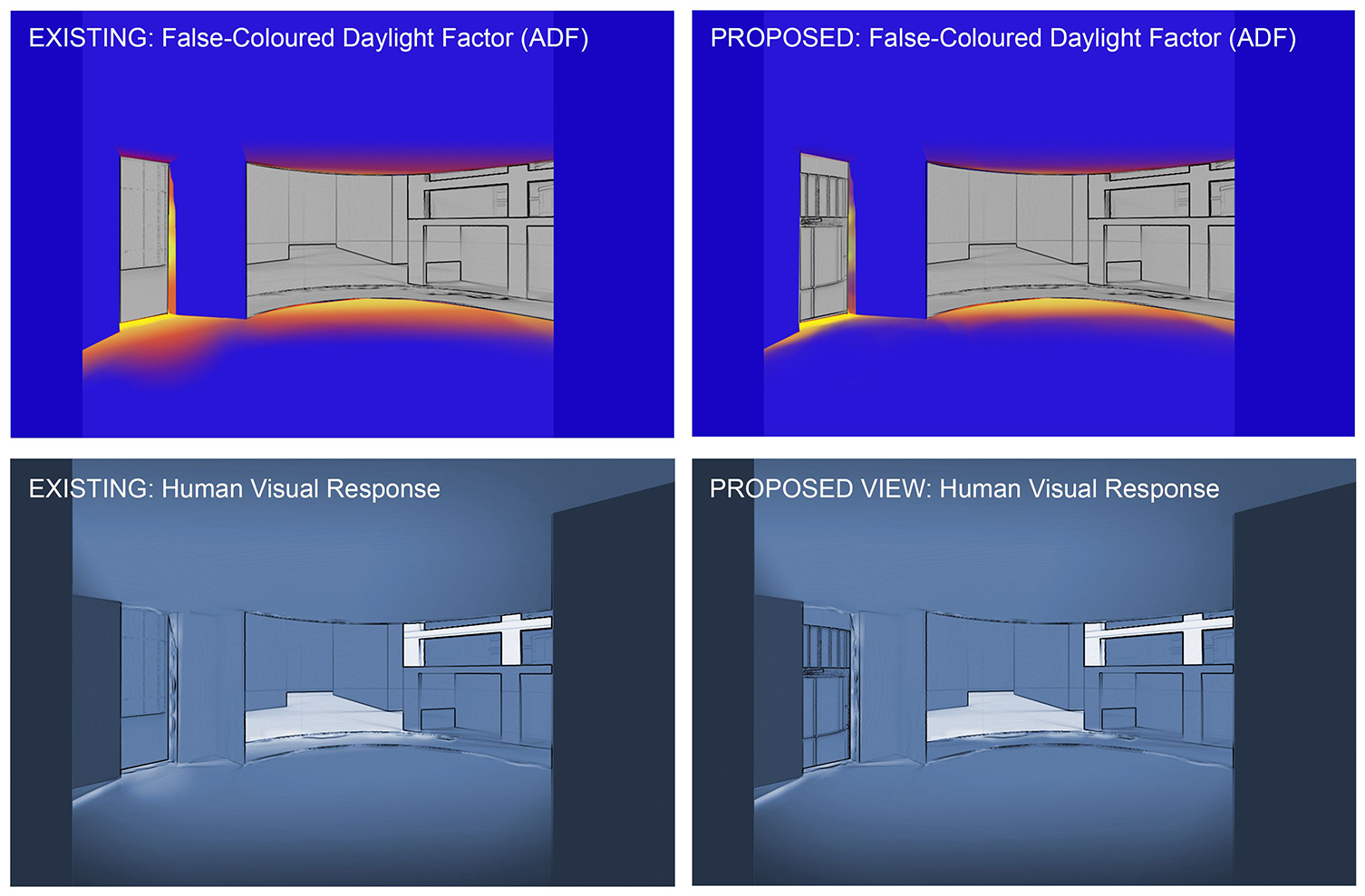
Artist impression of Proof of Evidence detailing Daylight study of Apartment 107 (least affected) in Goldpence Apartments, comparing ADF and HVR scenarios for the living room (see online for figures in colour) (for original figures, see Daylight and Sunlight Proof of Evidence Part 1, pp. 100–101. Planning portal reference: PA/16/03522, planning inquiry reference: APP/E5900/W/17/3191757).
The comparison of HVR renditions furthermore allowed Mr. G to make a contextual point about the threshold figures for a given window, when considered in relation to other windows in the same room. Of the seven windows in the room in Figure 1, the two windows to the left fall below the threshold while the remaining windows all pass the test. Despite these five windows passing both VSC and ADF tests, the overall judgement is guided by the windows in breach. The overall judgement, he suggested, should instead balance those windows in breach against those that pass to give a more ‘truthful’ judgement of how light changes will impact on ‘real experience’.
During his examination, Dr. L objected to Mr. G’s ground-truthing claims, and challenged his idea that if harm approaches the threshold of detectability, it evidently becomes acceptable:
In trying to ascertain the most ‘sensible and reasonable’ way of judging the importance of an uneven distribution of daylight and sunlight in a room and its subsequent change, it is noticeable that both Mr. K and Dr. L rely on assumptions of what residents ‘would’ or might ‘want to’ do. They shy away from the scientific evidence that sustains the BRE because that ‘isn’t how light works’ experientially. Dr. L himself refers to a personal anecdote that he recounted earlier in the cross-examination: Recently, I was on holiday in Italy, in Venice [where most buildings are very dark, and you need artificial lighting. The narrow windows and the heavy blinds they use, very characteristic of Southern Europe, means that only very little daylight comes through]. We had to use electric light all the time, but I still went over to our window and opened the curtains every day to look out and see what sort of light was out there. Standing by the window I could see a bit of the sky and get a sense of what the weather was like. We have the exact same situation in Goldpence. They have limited light … but just because it’s a small amount doesn’t mean they don’t benefit from it.
The anecdote is compelling, not due to the content or the substance of his argument, but in how it is used to challenge the appellant’s case. As a form of quasi-evidence, Dr. L’s anecdote causes friction in the smooth burial of evidence of harm below the threshold of detectability and, therefore, shares with the residents’ statements, quoted in the prologue, a desire to decentre the threshold and renegotiate its boundary. The procedural deliberation and examination of evidence at the public inquiry can, as argued by Jacobs (2006) and Hubbard and Lees (2018), open up a space for redefining the terms of address as competing parties can narrate events and thereby create the conditions for including and considering matters of justice. However, as Tuitt (2019) reminds us, the very notion of ‘justiciability’ at the inquiry – the judgement of matters and questions that can give rise to legal claims and be settled in court – is often defined in narrow and restrictive terms by an exclusive, authoritarian elite. At the Enterprise House inquiry the anecdotal evidence presented by Dr. L and the objecting residents sought to challenge the appellant’s claim that HVR allowed to better ‘understand’ what light change feels like, arguing instead that such ‘understanding’ is best placed with those who experience it in ‘real life’– whether that is in Aldgate or a dark street in Venice. For the residents of Goldpence Apartments, life at the threshold of detectability is a battle against representation through aspatial and atemporal renditions, attempting instead to foreground their messy and complex daily lives on and off the ground.
Theoretically, the view is already changed
In relation to ADF values, Mr. G not only compared the value for an individual window with that of its neighbours in the same room. As any yardstick for estimating the expected light level for any given window, Mr. G suggested that light levels should be commensurate with those of windows on similar floors in the same or neighbouring buildings. In practice, this means that any sequence of windows, regardless of them breaching national planning guidance or not, could be used as a benchmark for future developments if they are considered as a local norm. The objecting party did not refrain from pointing out that this principle would grant developers powers that would further undermine and hollow out the planning system as failures of the past could become the benchmarks of quality measures in the future – what they also on several occasions referred to as a ‘race to the bottom’:
The appellant’s plea to consider harm caused to residents living behind each of the 201 windows in breach by comparing their conditions to the conditions of existing neighbours with equally poor light conditions is yet another attempt to shift the threshold of detectability; a rhetorical grip that normalises the conditions of pre-existing harm and which facilitates the smooth erasure of future harm. Furthermore, the appellant suggested that people who chose to live in dense urban locations did so while knowingly accepting worsened living conditions. Cosmopolitan life comes with a cost, and whether it be worsened air quality, reduced light levels or increased noise pollution, residents in Aldgate are assumed (and expected) to endure more ‘harm’ than compared with residents in, say, rural Norfolk. Again, the examination ensued:
In local planning, light is never considered as an amenity in isolation but instead balanced against other amenities, providing some support for Mr. K’s insistence on expanding the assessment exercise to include ‘contextual’ factors alongside light. Yet, as with the previous examples, the appellant is not balancing the planning assessment but instead shifting attention away from the experience of harm to the expectancy of harm. At the threshold of detectability, the valuation of light as a life-giving and mental health-improving resource is obscured from sight, just as the traces of harm that result from its removal are erased from the site.
The contextual point was developed further with reference to the sense of enclosure and overlooking, for which no method of assessment exists or is advised by the local authority. Mr. G therefore drew on calculations of a third daylight measure, the No Sky Limit (NSL) – which designates the area within a room from which the sky can be seen at 0.85 m height – and visualisations of existing and proposed views from selected flats. The appellant reiterated that in a neighbourhood ‘with towers going up everywhere’, the proposed development would not result in an undue sense of enclosure. About 60 m west of the appeal site, on Leman Street, another development including a 21-storey tower was going through planning, and while it was not yet given consent, it would impact the view from Goldpence Apartments if given the go ahead. As Mr. G argued: ‘in the true existing situation there will be a change in the view out of the windows’ (emphasis added; Ingram, 2018: 267) regardless of the appeal scheme going ahead and presented Figure 2 with the ‘future baseline’ provided by the neighbouring block:
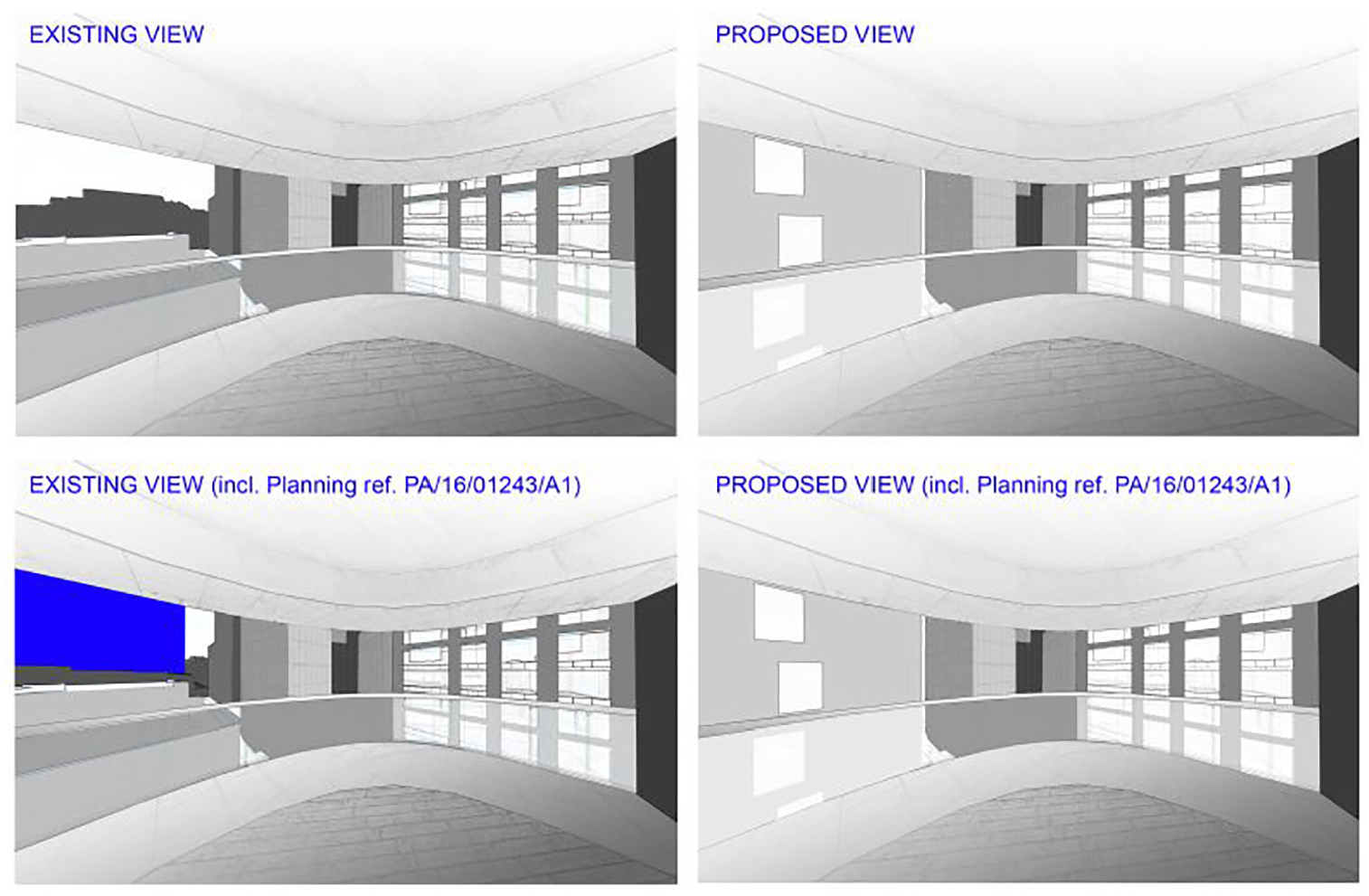
Artist impression of Proof of Evidence detailing Sense of Enclosure and Outlook for Apartment 609 in Goldpence Apartments, comparing existing and proposed views from the living room including the potential future base line (in red) (see online for figures in colour) (for original figures, see Daylight and Sunlight Proof of Evidence, Appendix 6, Part 3, pp. 293–294. Planning portal reference PA/16/03522, planning inquiry reference APP/E5900/W/17/3191757).
a dense SoE and Outlook is appropriate … the view is already theoretically changed as a result of a current application. The massing which is highlighted [in blue] will clearly be visible and in my opinion further illustrates that in this dense urban environment a changing landscape is expected. (Ingram, 2018: 267)
While the idea of commensurability seeks to establish a threshold of acceptability by defining a norm based on the levels in neighbouring flats, the idea of a future baseline sets a threshold, by importing the potential future buildings that might come to set a standard – from a race to the bottom, to a race to the (castles in the) sky.
‘Perfectly acceptable’ concluding remarks
In the end, the inspector heard the appeal, concluding that the material deterioration of living conditions would not exceed expectations and would be outweighed by the benefits of the scheme. Accepting that ‘the calculated impact figures may indicate a drastic change’, he sided with Mr. G in arguing that ‘in practice … many would experience … a virtually imperceptible change’ (Ball, 2018: 6). Furthermore, he found ‘that apartments with a restricted outlook have become the norm’ in Aldgate, making ‘such living conditions …perfectly acceptable’ (emphasis added; Ball, 2018: 6). While he recognised that ‘[s]ome residents understandably find these prospective changes objectionable’, the harm would be outweighed by ‘the advantages of living in an accessible and thriving community’, and as a consequence the material harm ‘is considered acceptable’ (Ball, 2018: 6).
This paper demonstrates how commercial high-rise developments in London operate through the exercise of ‘light’ violence; a ‘soft’ form of violence that is ‘invisible’ insofar as it is ‘inherent to the “normal” state of things’ (Žižek, 2009: 2), and which operates through the ephemeral and indeterminate medium of light. Along with other visual media – CGIs, models and promotional materials – that are mobilised to legitimise the continued erection of towers (Kaika, 2011), light smooths the vertical insemination of the urban landscape – it allows for the alluvial circulation of global capital to sediment and take architectural form. As a doctrine in common law, light is a private concern that can be mobilised as a vertical lubricant exactly because it shifts issues of public interest (the living conditions, mental health and well-being of the population) onto the individual (you are expected to make ‘reasonable’ adjustments to change). The forensic analytic exposes the mechanisms through which light violence is exercised, normalised and naturalised in UK planning law, and as applied in this paper, creates an opening for making alternative claims to ‘truth’ by elevating subjective experiences of harm into a public concern.
According to Jasanoff, for examining lawyers to successfully translate scientific evidence into legal evidence in the courtroom, ‘the expert needs to render technical evidence in a way that may be visualised by judge and jury’ (Jeffrey, 2020: 910) and that requires the skill to ‘instruct, cajole, and rhetorically restrain the fact-finder’s eyesight … to “see”’ the evidence (Jasanoff quoted in Jeffrey, 2020: 910). As the inspector’s report reveals, the appellant’s representation of ‘real life experiences’ in HVR simulations infused the scientific evidence with the ‘seductive certainty’ (Jeffrey, 2020: 910) that made the inspector see what light changes look like, and in doing so, made him unsee light violence. By removing the residents’ stories about the mental health and well-being qualities of light in everyday life from sight, evidence of light violence that results from vertical development is erased from the site. A reversal would require not just to make the inspector see light violence (as the anecdotal evidence strived to do) but to unsee or unthink the ‘inherent or normal state of things’, that is, the growth paradigms that underpin the fantasy of vertical development in London. This paper has demonstrated how a forensic analytic can challenge the conditions that surround legal judgement of harm, rendering light violence visible and thus challenging the assumed inevitability of light violence in the vertical city.
In conjunction with the forensic approach, work that engages with lighting and night-time design is helpful in foregrounding light design’s ‘radical potential for challenging and destabilising the appearance of normality’ (Ebbensgaard, 2020: 1972) through various forms of experiments in producing ‘alternative visions for urban places at night’ (Dunn, 2020: 24). By promoting the ethos of ‘Dark Design’, Nick Dunn encourages light designers and urbanists to take on a more adversarial role in local planning, by visualising how cities could be ‘designed differently to promote positive, non-consumer-orientated experiences and encounters’ (Dunn, 2020: 25). Beyond simply ‘raising public awareness’ about the detrimental effects of over illumination – or, as this paper’s focus, about light violence in the vertical city –‘dark design’ is a subversive practice that finds inspiration in resistive acts that overturn the limitations of lighting standards and regulations (Ebbensgaard, 2020) and by ‘[s]taging social negotiation over meanings of space can challenge contemporary understandings of particular materialities, potentially appropriating space’ (Ebbensgaard, 2015: 120).
To ensure convergence of lighting design advocacy with issues of social spatial justice, this article argues for the need to mobilise a forensic analytic throughout the legal processes of vertical development. If, as Tuitt (2019) argues, planning law is to achieve a more equitable process, ‘change must come at the level of the chair’ (p. 126), which often is occupied by a senior judiciary within years of retirement and who will therefore ‘inevitably carry with them into the inquiry forum fairly entrenched notions as to the futility of looking for a justice that exists beyond the strict rule of law’ (Tuitt, 2019: 126). In the Enterprise House inquiry, the planning inspector clearly did not find justice beyond the celebration of urban renewal that heralds the arrival of new hotel rooms, a café and shared office space at the expense of the living conditions for the already most marginalised residents. This paper foregrounds how a forensic analytic can expose the mechanisms through which light violence is exercised, normalised and naturalised and thus contribute to bringing change to the role and function of the planning inquiry in seeking to achieve more socially and environmentally just urban development.
Footnotes
Acknowledgements
I would like to thank Cllr Rachel Blake for taking me along to the 225 Marsh Wall inquiry, and to the planning lawyers and witnesses who took their time to discuss the material and ideas with me. Earlier drafts of the paper were presented at the ‘Radical Verticality’-panel at the RGS-IBG Annual Conference (2019), co-chaired with Michal Murawski, at the 3S Seminar Series at the University of East Anglia (2020) and at the Geography Seminar Series at King’s College London (2021) – all these gatherings provided incredibly supportive and encouraging environments that helped refine and advance the paper’s contributions tremendously. Thanks also to the three anonymous reviewers and Phil for editorial guidance. A special thanks goes to the wonderful Kerry Holden, for sparring and discussion of the material in Write Club! Any errors remain my own.
Funding
The author disclosed receipt of the following financial support for the research, authorship, and/or publication of this article: Leverhulme Early Career Fellowship, ECF-2017-389.
