



Abstract
Urban research assigns immigrant enclaves an ambiguous role. While such areas are seen as rich in beneficial ethno-religious infrastructures and networks, they also tend to be located in deprived and stigmatised inner-city neighbourhoods. Research on neighbourhood attainment provides evidence for both, a desire to attain mainstream middle-class neighbourhoods, which grows the more immigrants and their descendants establish themselves in society, but also a continuing attraction of residing close to co-ethnics. To tease apart this ambiguity, we study how the life satisfaction of immigrants and their descendants depends on the characteristics of the neighbourhood they live in, and pay special attention to heterogeneity along generation, country of origin orientation and income. We use classic measures of neighbourhood quality vis-à-vis newly collected data on the spatial density of ethno-religious minority associations, places of worship and grocers. We link these data to the geocoded German Socio-Economic Panel to predict life satisfaction among immigrants and their descendants. To strengthen a causal interpretation of our results, we employ specifications that address self-selection into neighbourhoods and unobserved confounding. Contra the assumptions of standard assimilation models, we document that ethno-religious infrastructures contribute to increased life satisfaction primarily among the second generation, and there especially among sending-country oriented individuals. This suggests a continuing importance of origin-culture infrastructures for some groups. Furthermore, we find little evidence that overall neighbourhood quality, or the mere share of co-ethnics in a neighbourhood, increases life satisfaction either among immigrants or their descendants.
Introduction
Theories of immigrant integration assign the neighbourhood a prominent role (Alba and Nee, 2009; Park and Burgess, 1921). Urban areas with a large share of co-ethnics, so-called ethno-religious enclaves, are central sites of ethno-religious business networks that provide marginalised immigrant groups with employment that may not be available in mainstream society (Andersson, 2021; Shaw, 1988; Zhou and Logan, 1989). They harbour people fluent in immigrants’ mother tongues and what may be called ethno-religious infrastructure: ethno-religious associations, grocers and minority places of worship.
On the other hand, ethno-religious enclaves tend to be located in economically disadvantaged inner-city areas, which are often blighted by underinvestment, served by substandard schools and stigmatised by mainstream society. In the long run, residence in a predominantly immigrant neighbourhood may therefore impede upward social mobility and integration (Danzer and Yaman, 2013). Accordingly, the so-called model of spatial assimilation suggests that the eventual move from a ‘bad’ enclave into a ‘good’ mainstream neighbourhood is associated with successful integration into the mainstream (Massey and Denton, 1985; Tran, 2020). However, this perspective has been criticised for relying on oversimplified conceptions of immigrant integration and neighbourhood quality. Under the term ‘ethnic community model’, scholars have pointed out that the economic and linguistic integration of immigrants and their descendants does not necessarily obliterate their desire to draw on ethno-religious socio-cultural resources, live close to relatives and kin or access religious sites (Hanhoerster, 2015). According to this perspective, ethno-religious neighbourhoods remain attractive even for economically successful immigrants and their descendants (Schaake et al., 2014; Zhou, 2009).
To test these competing theories statistically, scholars traditionally investigate residential choices of immigrants and their descendants, that is, the determinants of their relocations and the characteristics of the neighbourhoods they choose to resettle to (Lersch, 2013; Tran, 2020). Such studies have firmly established a tendency among immigrants and their descendants to aim for mainstream middle-class neighbourhoods the better integrated they are, but also that many remain to live in ethno-religious enclaves.
Surprisingly little attention, however, has been paid to the question that we raise in this article: in what ways does residency in ethno-religious enclaves vis-à-vis mainstream neighbourhoods affect the life satisfaction of immigrants and their descendants? We argue that considering the life satisfaction of immigrants and their descendants is an important extension of the neighbourhood attainment debate. After all, it is the concern for the quality of life of immigrants and their descendants that defines one of the ultimate reasons that social scientists study integration. However, there are also analytical benefits to assigning life satisfaction a more central role. Analyses of satisfaction may be more reflective of the neighbourhood qualities that immigrants and their descendants actually value (Schachter et al., 2020) – compared with actual residential choices, which are subject with constraints (e.g. housing market discrimination).
Beyond adding a focus on life satisfaction to the debate on ethnic segregation, we move beyond the default in statistical migration research of using the share of co-ethnics as the sole indicator of ethno-religious infrastructures and networks, and instead directly measure ethno-religious infrastructures. Drawing on geocoded survey data from Germany – a receiving country with a diverse immigrant-origin population in terms of faith, origin and migration motive – we use novel ecologic data on the local density of ethno-religious associations, businesses and places of worship in addition to traditional indicators of neighbourhood quality, to assess which neighbourhood characteristics predict life satisfaction among immigrants and their descendants.
Theoretical background
Life satisfaction is an important pillar of a person’s overall quality of life and well-being, because it reflects objective living conditions as well as one’s evaluation of these conditions against personally-held aspirations and the perceived living conditions of significant others (Diener et al., 2003). Scholarship of neighbourhood impact on life satisfaction is therefore concerned with the importance of neighbourhood deprivation but also with potential negative consequences of relative comparisons with more affluent neighbours (Firebaugh and Schroeder, 2009; Knies, 2012; Knies et al., 2021). Analyses of life satisfaction are generally complicated by the fact that life satisfaction is a complex product of both objective conditions and personal evaluations. It is, for instance, difficult to empirically tease apart whether a group of people are happier because they live in an objectively better neighbourhood, or whether they merely hold subjectively lower expectations of what makes a good neighbourhood (Firebaugh and Schroeder, 2009). However, scholars interested in life satisfaction emphasise that exactly this complexity defines life satisfaction as the arguably most immediate and comprehensive measure of individuals’ personally experienced welfare.
For this reason, we regard life satisfaction as particularly well-suited to investigating a prominent trade-off implied in the scholarly debate on immigrant integration and residential choices: do immigrants and their descendants prefer the generally higher quality of mainstream middle-class neighbourhoods or rather the benefits of the alternative infrastructures that ethno-religious enclaves offer? This question is our motivation – rather than to investigate whether the general theory of neighbourhood effects on life satisfaction also holds among the sub-population of immigrants and their descendants (Knies et al., 2016). In the following, we review the debate on immigrants’ integration and their residential preferences as well as the implied trade-off.
From deprived enclaves to middle-class suburbs: Spatial assimilation
The model of spatial assimilation is the orthodox account of neighbourhood choice among immigrants and their descendants. It posits that as their integration progresses, immigrants and their descendants look for the same qualities in a neighbourhood as do members of the mainstream middle-class: (suburban) high-quality housing, high-quality schools, public safety, low pollution, middle-class neighbours and a good neighbourhood reputation (Massey and Denton, 1985; Tran, 2020). Cross-sectional statistical studies indeed show that as their socio-economic status and their language skills improve, immigrants and their descendants are less likely to live in deprived inner-city neighbourhoods with large shares of co-ethnics and are instead more likely to reside in suburban neighbourhoods dominated by middle-class residents with native-born parents (Iceland and Scopilliti, 2008; Sager, 2012). Explicitly longitudinal investigations that track persons of immigrant origins’ neighbourhood relocations demonstrate the same pattern (Lersch, 2013; Schaake et al., 2014; Tran, 2020).
Following the tradition of the Chicago School of Urban Sociology, the model of spatial assimilation acknowledges that newly arriving immigrants may initially benefit from living in ethno-religious enclaves, because these offer employment, and cater for religious and cultural consumption needs. Yet, it regards these benefits as turning increasingly obsolete as immigrants learn to speak the local language fluently and attain middle-class occupations. In fact, there is even evidence that in terms of employment and income, enclave residency switches from initially beneficial (Martén et al., 2019; Stips and Kis-Katos, 2020) to increasingly disadvantageous (Andersson, 2021; Edin et al., 2003). Established immigrants and their descendants also consider whether mainstream middle-class neighbourhoods are better suited for the upbringing of their children and recognise that purchasing real estate in such neighbourhoods is the sounder investment strategy (Barwick, 2016). Well-established persons of immigrant origin might furthermore hold a desire ‘to spatially display social advancement and the fact of having “truly arrived” in society’ (Hanhoerster, 2015: 3115). That is, they seek congruence between their attained socio-economic status and that of the neighbourhood they live in. Regarding life satisfaction, all of this implies the hypothesis that general neighbourhood quality increases the life satisfaction among immigrants and their descendants (H1).
Continuing attraction: The ethnic community model
Researchers have also documented that immigrants and their descendants tend to stay in socio-economically disadvantaged (inner-city) enclaves at higher rates than would be expected based on their socio-economic standing alone (Coulter and Clark, 2019; Schaake et al., 2014). One possible explanation for this pattern is offered by place stratification theory, which posits that constraints in the access to loans, and information, but also in terms of housing-market discrimination, limit the extent to which immigrants and their descendants can realise their desire to live in a mainstream middle-class neighbourhood (Alba and Logan, 1992).
More recently, however, both the model of spatial assimilation and place stratification theory have come under critique for assuming a single dimension along which neighbourhoods can be ranked as better or worse and a universal desire among well-integrated immigrants and their descendants to attain ‘better’ mainstream middle-class neighbourhoods (Hanhoerster, 2015; Murdie and Ghosh, 2010). Ethno-religious enclaves cater for needs that continue to matter even for well-integrated immigrants and their descendants, because they value their cultural heritage, family ties and religion. Therefore, even well-established immigrants and their descendants may desire the social embeddedness in a local community and the ethno-religious infrastructures that such a community provides (Özüekren and Ergoz-Karahan, 2010; Phillips, 2006). These ethno-religious community infrastructures may be summarised as being composed of three types: ethno-religious associations, businesses and places of worship. Ethno-religious associations contribute to an environment of mutual understanding, co-ethnic socialising and shelter from stereotyping (Phillips, 2006), where community monitoring furthers the upbringing and educational attainment of children (Zhou, 2009). The enclave economy not only offers employment opportunities outside the mainstream labour market, but also caters for cultural consumption needs that are not provided for by mainstream grocers, hairdressers or non-halal/kosher butchers (Chiodelli, 2015). Finally, the local density of places of worship and their religious communities may similarly continue to matter for immigrants and their descendants, since integration does not imply secularisation (Voas and Fleischmann, 2012). This is particularly apparent for the case of non-Christian immigrants and their descendants in Europe and the US, whose religious needs are not served by mainstream Christian churches (Gale, 2013). In fact, religiosity and conservatism are key drivers of neighbourhood choice among persons of Turkish origin in Germany (Özüekren and Ergoz-Karahan, 2010), implying in turn that the density of places of worship may contribute to life satisfaction less for those who are not very religious. In summary, we expect that the local density of ethno-religious infrastructures (as indicated by ethno-religious associations, grocers and places of worship) increases the life satisfaction among immigrants and their descendants (H2). Spatial assimilation theorists would argue that these benefits mainly accrue to less-well integrated persons of immigrant origin, particularly of the first generation (H2a), while the ethnic community model would expect that they remain important along the course of integration, that is, among those who speak German fluently, belong to the second generation, but are also origin-oriented and religious (H2b).
Spatial implications
Our final attempt to advance the debate is to consider recent arguments, according to which immigrants and their descendants do not necessarily seek ethno-religious infrastructures in their immediate neighbourhood. Our argument runs somewhat parallel to a recent debate on the effect of neighbourhood deprivation on life satisfaction at different geographical scales (Knies et al., 2021). However, we are specifically interested in ethno-religious infrastructures and the spatial scale-related arguments urban ethnographers have proposed. Søholt and Lynnebakke (2015) argue that persons of immigrant origin seek embeddedness in co-ethnic networks, but are happy to do so on a city-wide level rather than in their immediate neighbourhood. Zhou (2009) and Hanhoerster (2015) make the same observation with respect to ethno-religious infrastructures (i.e. businesses, places of worship and associations). Yet, Hanhoerster’s observations go even further. Dense ethno-religious networks and proximity to relatives and kin may also be experienced as excessive social control that limits liberties. These insights imply a trade-off between the relative personal liberty of mainstream neighbourhoods and the benefits of ethno-religious enclaves. Importantly, this trade-off has a spatial dimension. Potentially excessive social community control is particularly acute in a person’s immediate neighbourhood. Therefore, if ethno-religious infrastructures can be readily accessed by non-residents and if there is excessive social control in the immediate enclave, then there is a positive association of ethno-religious infrastructures with life satisfaction in a person’s wider environment that turns negative in the immediate neighbourhood(H3).
Data and methods
We base our analyses on microdata from the 2018 German Socio-Economic Panel (GSOEP) 1 – a nationally representative panel study of German households with oversampling of people of immigrant origin (Britzke and Schupp, 2019). The analysis sample is restricted to people who are over 18 years of age and were either born abroad or have at least one parent who was born abroad. We thus focus exclusively on immigrants and descendants of immigrants, yielding a total of 9193 respondents, most of whom are (descendants of) guest worker immigrants, people who came to Germany as refugees during the 1990s, more recent newcomers from eastern and southern EU member states, and finally refugees who migrated after 2013. All analyses use provided post-stratification weights to ensure that our findings represent the immigrant-origin population of Germany.
Individual level variables
Our measure of life satisfaction is the well-established survey question ‘How satisfied are you currently with your life in general?’, which may range between 0 (‘completely dissatisfied’) and 10 (‘completely satisfied’). We z-standardise life satisfaction to ease interpretation.
The GSOEP is a rich source of individual and household level controls. Details on the coding of these variables, as well as descriptive statistics, can be found in Online Supplement A. All analyses control for location in East or West Germany, gender, age in five-year brackets, education according to the CASMIN classification (Brauns et al. 2003)), family status, number of persons in the household, generational immigrant status and ethnic background (defined in the following order by country of birth, non-German nationality and parents’ country of birth/nationality). To disentangle effects of dwelling-quality from true neighbourhood effects, we further control for homeowner status, size of respondent’s housing unit, whether it has a garden, and whether it has a balcony. In additional specifications, we furthermore control for respondents’ employment status, their Erikson-Goldthorpe-Portocarero (EGP) class (11-class ISCO 2008), and the household’s equivalent income – important drivers of life satisfaction, which are, however, potentially endogenous (see below). To thoroughly test for heterogeneity of infrastructure-effects, we additionally draw on standard items from the GSOEP questionnaire to distinguish between religious (those who say that religion is important or very important to them) and non-religious respondents, and between those who feel connected at least in some respects to their or their parents’ country of origin versus those who do not.
Context level variables
All our predictor variables of interest are contextual (see Online Supplement A). GSOEP respondents are embedded in PLZ-8 units, which split official postcode units into smaller areas consisting of around 500 households each (microm, 2019). Our contextual variables are either measured on the PLZ-8 level or have an exact geo-location. The exact geo-location allows us to aggregate variables on the postcode level, which is the smallest contextual unit that we can freely work with (the average population size of Germany’s roughly 8200 postcodes is 10,142).
One goal of our study is to explore the effects of our contextual variables at different spatial scales. For data with exact geo-location, we therefore use a bespoke neighbourhood approach: we define circles with radii of 1, 2, 5 and 10 km around the centroids of postcodes and assign GSOEP respondents to these circles depending on the postcode they live in. We then aggregate the geo-located data (e.g. the number of ethnic grocers) for those circles. Online Supplement A contains descriptive statistics of our contextual variables. Because geographical distances may have a different meaning in rural and urban contexts, we report the results of sensitivity tests that split the sample between urban and rural residents in Supplemental Figure B-3.
Established measures of neighbourhood quality and ethno-religious enclaves
Urban research typically defines neighbourhood quality as the economic status of its inhabitants. We therefore follow Knies (2012) and test Hypothesis 1 about the importance of overall neighbourhood quality, by using an indicator of the average post-tax, post-transfer household incomes in a PLZ-8 area (RWI and microm GmbH, 2016). To demonstrate robustness, Supplemental Figure B-4 uses the share of tertiary educated or unemployed residents as alternative indicators.
Prior statistical analyses have tested Hypotheses 2 about the importance of ethno-religious community embeddedness using the shares of co-ethnics and/or vice versa the share of native-born mainstream members. We operationalise these on the PLZ-8 level, again by using data provided by microm, which provides figures for the shares of German, Turkish, Balkan, Eastern European, Greek, Italian, Sub-Saharan African, Asian, Spanish/Portuguese-speaking and non-European Muslim residents, based on onomastic procedures (RWI and microm GmbH, 2016). We assign respondents the shares of co-ethnics by linking their ethnic background to one of these groups.
Novel ecologic measures of ethno-religious infrastructures
We compile novel (geocoded) data on ethno-religious associations, places of worship and grocers from various sources. By relying on ecological measures that are not aggregated from the survey data itself, we reduce the ‘reflection problem’ (Manski, 1993). Data on both associations and places of worship come from four sources: the official German trade register, online directories of ethno-religious umbrella organisations (e.g. Turkish-Islamic Union for Religious Affairs, DİTİB), Open Street Maps and requests to all German Catholic dioceses about foreign language services in their parishes. We identify ‘ethno-religious’ associations and grocers via nationality or continent of origin and gather data for all (non-German) national (or continent) groups represented in the 2018 GSOEP. We identify places of worship by religious minority denomination as recorded in the GSOEP: Islam, Catholicism, Christian Orthodoxy and non-mainstream Christian Protestantism (e.g. Baptism or Evangelical free churches). Given a lack of detail in the survey data it is not possible to distinguish more detailed persuasions (e.g. Sunni, Shia or Ahmadiya denominations). Forty-nine per cent of the places of worship in our sample are members of nationally focused umbrella organisations (e.g. mosques belonging to the Turkish Millî Görüş movement) or provide information about the language used in religious activities. We can thus also link them to national groups. Based on this logic, we filter all sources for all entries containing (a) the respective nationality, both in German and significant local languages, as well as for significant cities and groups (e.g. ‘liban*’, ‘Beirut’, ‘Tripoli’, ‘leban*’), or (b) a religious denomination (e.g. ‘orthodox’, ‘patriarch’, ‘Konstantinopel’). We assign associations catering to supra-national communities (e.g. ‘Verein Afrikanischer Studierender in Koblenz’) to all relevant national groups. Similarly, we collect data on grocers from Google Maps service by searching for the query ‘groceries’ in combination with each nationality by county (e.g. ‘Syrian groceries in Detmold’). All results are checked by human raters to ensure that they in fact cater to the presumed group and that their activities are focused on immigrants and their descendants in Germany. Following this procedure, we identify 6941 ethno-religious associations, 5082 minority places of worship and 4799 grocers in Germany and geo-locate them via their street address. Online Supplement A-2 describes the spatial imputation method we use to locate associations for which we do not have a precise location.
We aggregate the number of associations and grocers by all national groups they plausibly cater to on the postcode level and employ the bespoke neighbourhood approach described above. Similarly, we aggregate places of worship without clear national affiliation by religious denomination and those that cater to a specific national group by nationality and denomination on the postcode level. This represents the idea that minority-religion residents are potentially served by the origin-specific sites in their neighbourhood, but also by those that are denomination-based. If an address is identified as a place of worship and as an ethno-religious association (e.g. DİTİB mosques with associated community centres), we count it into both the number of places of worship and the number of associations. We z-standardise all three indicators across the respective contextual units (i.e. postcode-group combinations). Finally, we join the z-standardised number of ethno-religious infrastructures by respondent’s postcode and national background (and for places of worship also religious denomination). In analyses of the effects of places of worship, we drop respondents without a stated religious affiliation or a denomination other than Islam, Catholicism, Christian orthodoxy or non-mainstream Protestantism. We emphasise that all infrastructure densities and the share of co-ethnics are thus group-specific, to take into account the fact that they should not be lumped together (cf. Knies et al., 2016).
Contextual level controls
On the contextual level, we control for the postcode population density and microm’s PLZ-8 classification, which distinguishes eight neighbourhood types, from ‘dense inner-city area’ via ‘commercial zone’ to ‘rural area’.
Missing values
Less than 8% of our observations have a missing value on any of the variables. We use multiple imputation by chained equations to accommodate missing values and create ten complete datasets after a burn-in period of 20 iterations. All analyses were carried out on these ten datasets and their results combined using Rubin’s rule (Van Buuren, 2012).
Analytical strategy
We establish the associations of ethno-religious infrastructures and other spatial features with life satisfaction using ordinary least squares (OLS) regressions with (cross-classified) cluster-robust errors to account for the multilevel structure of our data (Heisig et al., 2017). In particular, we follow the advice in Abadie et al. (2017) and simultaneously cluster errors at the ethnic group (n = 54) and county level (n = 379) to account for all within-county correlation.
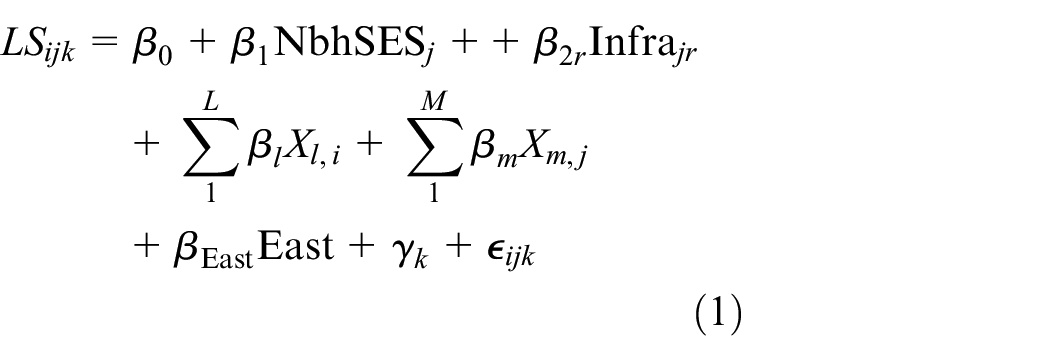
Equation 1 gives our preferred specification: a linear regression of life satisfaction of individual i, belonging to group k and residing in context j, on a measure of neighbourhood quality (
Results
How do our indicators of ethno-religious infrastructures map onto the stylised ideal types of inner-city ethno-religious enclaves vis-à-vis suburban middle-class mainstream neighbourhoods discussed in the debate on immigrants’ and their descendants’ neighbourhood preferences? This debate relies on the assumption that ethno-religious enclaves are mainly located in deprived areas, which can be contrasted to middle-class mainstream neighbourhoods without ethno-religious infrastructures. Figure 1 displays a density plot that largely confirms this assumption. We see a clear negative correlation between a comprehensive scale capturing the enclave characteristics of the neighbourhoods immigrants and their descendants live in and another scale expressing their neighbourhoods’ socio-economic composition. Figure 1 is split into four quadrants along the average values of enclave characteristics and socio-economic composition, respectively. In line with common assumptions, most of our respondents fall into quadrants II (42.9%) and IV (29.6%) of our density plot – those corresponding to the ideal types of the better-off mainstream neighbourhood and the economically disadvantaged ethno-religious enclave, respectively. Quadrant I, representing affluent enclaves or ‘ethnoburbs’, is virtually empty (only 7.7% of our sample). Finally, a fifth of our sample live in rather deprived mainstream neighbourhoods. Supplemental Table A-4 further breaks down the locations of respondents by urbanity and location in East/West Germany and demonstrates that our sample is dominated by West German respondents, and that half of our sample lives in urban environments. In conclusion, the ideal typical distinction in our theoretical discussion between middle-class mainstream neighbourhoods and poorer ethno-religious enclaves may be somewhat stylised but provides an overall plausible heuristic that is well-captured by our indicators.
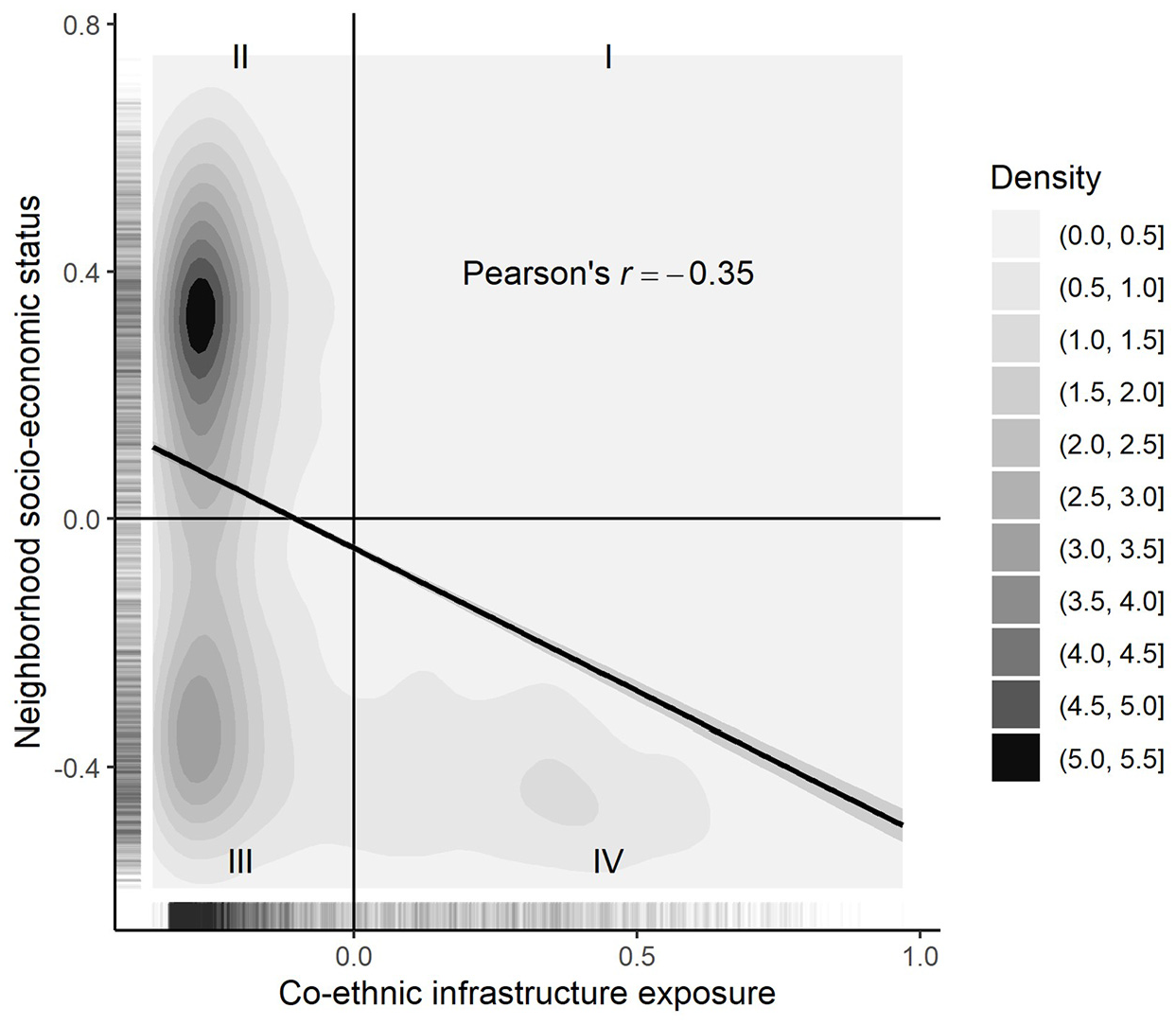
Association between neighbourhood socio-economic status and co-ethnic infrastructure among sample respondents.
Full sample results
Studies of residential choices provide strong evidence that immigrants and their descendants increasingly attain mainstream middle-class neighbourhoods as integration progresses, but also that there remains a strong tendency to reside among co-ethnics. Supplemental Figure A-1 shows descriptively that, in line with previous research, levels of satisfaction among native-born descendants of immigrants are lower than those of immigrants particularly in East Germany (Knies et al., 2016). Refugees and asylum seekers are less satisfied with their lives. But how do neighbourhood characteristics that are indicative of the two ideal types of neighbourhood affect life satisfaction? Figure 2 displays the results of our analyses of the combined sample. It casts doubt on the premise that co-ethnic presence and general neighbourhood status feed substantially into the quality of life among immigrants and their descendants. Starting with the left panel of Figure 2, we cannot detect any positive association between life satisfaction and measures of general neighbourhood quality. Taking individual and household characteristics appropriately into account, general neighbourhood conditions seem to be less important to immigrants and their children than previously assumed, especially by the model of spatial assimilation. We similarly find no evidence that larger shares of co-ethnic neighbours at the PLZ-8 level are associated with higher life satisfaction, reflecting recent evidence from the UK (Shen and Kogan, 2020; but cf. Knies et al., 2016).
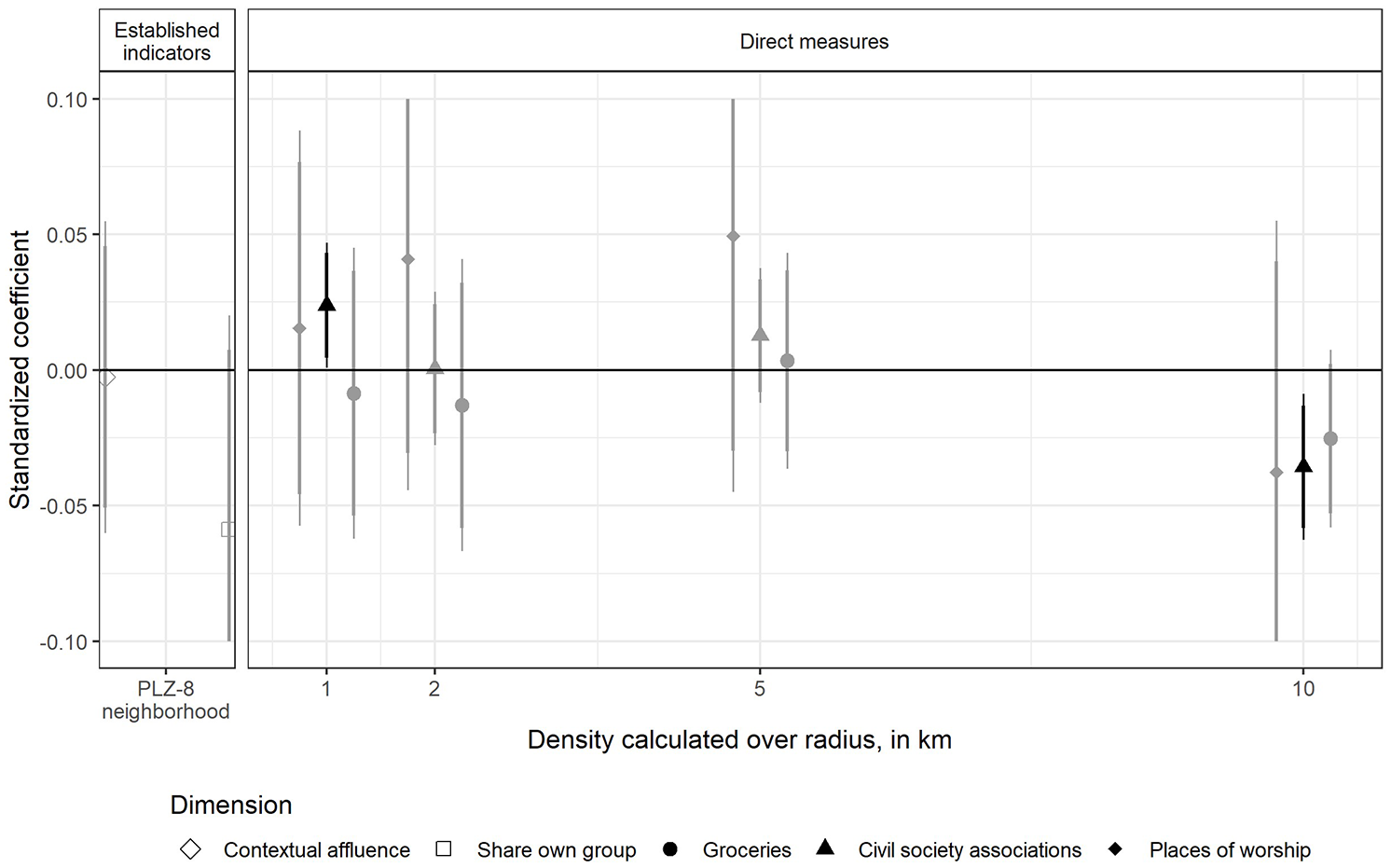
The association between neighbourhood and regional characteristics and life satisfaction (dependent variable) over different spatial scales, overall sample.
So far, our analyses do not provide evidence for a trade-off between the advantaged socio-economic composition of mainstream neighbourhoods and the benefits of ethno-religious enclaves in immigrants’ residential choices. For the overall sample of Germany’s diverse immigrant origin population, this also changes only little if we take our new measure of ethno-religious infrastructures into account. The right panel of Figure 2 documents that a higher density of ethno-religious associations, which urban scholars regard as furthering social capital and community building, is associated with a somewhat higher life satisfaction among persons of immigrant origin (significant estimates are displayed as the black bars in Figure 2). This association is only present in the immediate environment of a respondent’s address. Ethno-religious associations farther away than approximately 1 km from the centroid of someone’s postal code cease to exert an influence on life satisfaction. Our indicators of religious sites and an ethno-religious economy do not seem to matter much for life satisfaction in our combined sample. In sum, looking at Germany’s immigrant-origin population combined, we only find weak evidence in favour of a beneficial role of access to ethno-religious associations in one’s immediate neighbourhood and no indication that any of the other neighbourhood characteristics systematically matter for the life satisfaction of immigrants and their descendants.
Sub-group analyses
The results for our combined sample are largely negative. However, both the ethnic community model and the model of spatial assimilation argue that ethno-religious infrastructures carry special importance among some sub-groups. We therefore continue by investigating effect-heterogeneity across various sub-groups defined by generational status, language skills, home-country orientation, religiosity and earnings. These analyses focus on ethno-religious infrastructures in the immediate 1 km neighbourhood because it was only here that we found indication of an importance of ethno-religious associations.
Figure 3 displays effect heterogeneities across these sub-groups. 2 In line with the ethnic community model’s idea of a continuing attraction of the ethno-religious enclave, we find that it is especially the second generation for whom high densities of ethno-religious associations and places of worship matter. We find no unequivocal differences by German language proficiency (although places of worship matter more for those with low proficiency). The positive relation between life satisfaction and the presence of ethno-religious associations is stronger among those with a strong identification with the country of origin. Yet, we find no differences in the associations of places of worship with life satisfaction by religiosity. The model of spatial assimilation finds support only insofar as the financially worst-off quarter of respondents seem to receive the highest life satisfaction gains from ethno-religious associations. Against the theory’s core prediction, not even the best-off respondents seem to profit from a more advantaged neighbourhood composition in terms of socio-economic status (SES).
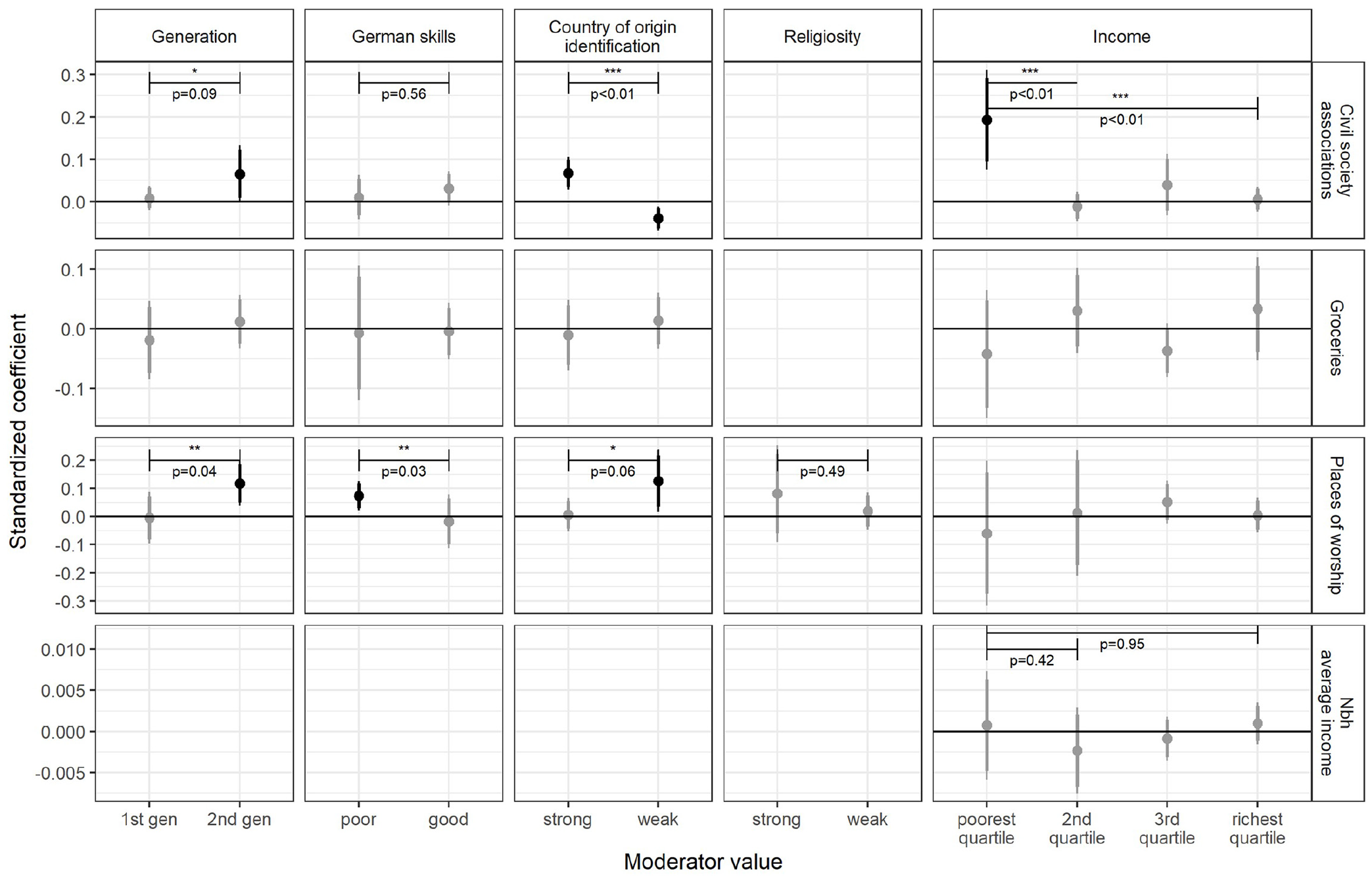
Moderation of neighbourhood effects at the 1 km aggregation (Nbh average income: PLZ-8), (dependent variable life satisfaction).
Figure 4 brings these insights together, by reproducing Figure 2 for native-born descendants of immigrants who identify strongly with their parents’ country of origin – the group for whom the ethnic community model would predict the strongest associations. Roughly half of the second generation meet these criteria, which shows that this definition represents a substantial demographic group. Among this sub-group, we see large and substantively significant associations between the presence of infrastructures and life satisfaction: a standard deviation more of both religious sites and associations within 2 km of the place of residence is associated with more than a 0.1 standard deviation higher life satisfaction – which corresponds to 50% of the life satisfaction gap between non-humanitarian immigrants as compared with refugees and asylum seekers (see Supplemental Figure A-1). Figure 4 thus supports the ethnic community perspective on the importance of ethno-religious infrastructures: rather than benefiting new arrivals, ethno-religious enclaves hold special importance for the descendants of immigrants who seek to uphold a cultural and identificatory connection to their parents’ country of origin. These results are in line with H2b, derived from the ethnic community model, and contradict H2a, implied by the model of spatial assimilation, which assumes that benefits mainly accrue to less-well integrated persons of immigrant origin, particularly of the first generation. Moreover, we find these patterns for ethno-religious infrastructures in the immediate neighbourhood, speaking against the idea of ethnoburbs or other forms of regional commuting between places of residence and infrastructure hubs among the second generation with a strong ethno-religious identity. For this group, this is evidence against the spatial hypothesis H3 stating that there is a positive effect of ethno-religious infrastructures in a person’s wider environment that turns negative in the immediate neighbourhood.
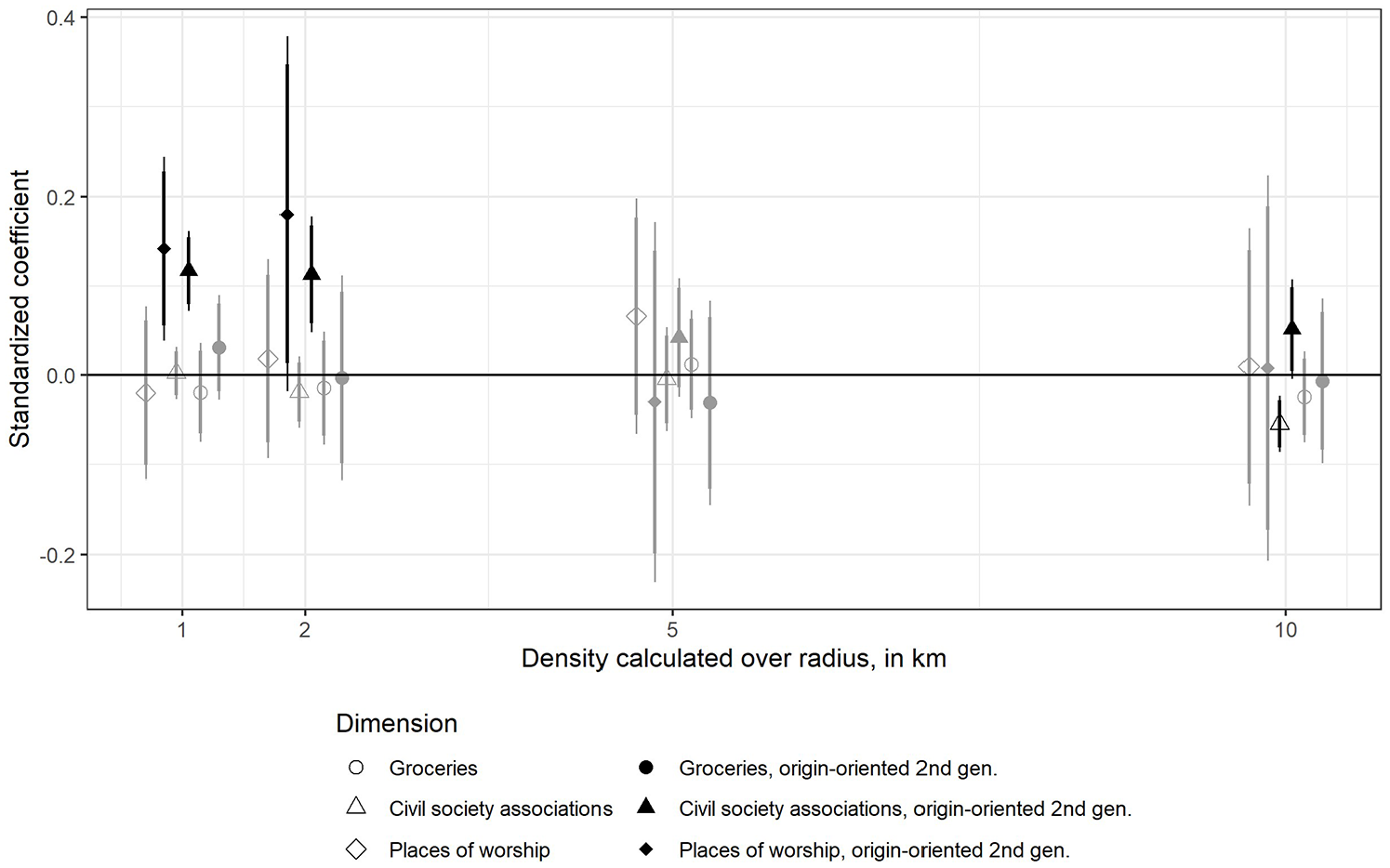
The association between neighbourhood and regional characteristics and life satisfaction (dependent variable) over different spatial scales, origin-country-oriented second generation versus others.
Addressing unobserved neighbourhood confounders and self-selection
The results thus far reported are based on the most representative sample of persons of immigrant origin. However, there may be concerns that selection into neighbourhoods is endogenous or driven by unobserved influences (Knies et al., 2021). Therefore, we follow Aksoy et al. (2020) and test whether our substantive conclusions hold up when we consider a more explicit identification strategy: restricting the sample to 891 refugees who are exogenously allocated across German regions. These refugees mainly come from Middle Eastern and African countries, are subject to binding residence requirements (Wohnsitzauflage or Residenzpflicht), and randomly assigned a place of residence. We exploit their exogenous distribution across German counties and thereby address the problem of self-selection in research on neighbourhood effects (see Supplemental Table A-5 for further information and results of balancing tests suggesting exogeneity of residence assignment). In this conservative specification, we also use county fixed effects. This allows us to compare the life satisfaction of different groups, relative to the county average, as a function of the relative density of respective infrastructures in that county – thereby controlling for all unobserved county level confounders.
Supplemental Figure C-1 shows the results and echoes our above findings – although we note that this analysis focuses on a group of vulnerable new arrivals rather than established descendants of immigrants. Neither the population share of co-ethnics nor the local density of ethno-religious grocers or places of worship show systematically positive effects on refugees’ life satisfaction. By contrast, ethno-religious associations improve life satisfaction at most radii. Overall, the results of using an explicit identification strategy confirm our previous conclusions: social capital fostering ethno-religious associations also improves the life satisfaction of exogenously allocated immigrants.
Sensitivity tests
Online Supplement B reports results that replicate the OLS analyses above using alternative specifications and different sample definitions. These additional tests show that our findings are robust to the inclusion or omission of further control variables either at the group or individual level. Alternative sample definitions show, however, that our results are largely driven by the West German sample – which may be for substantive reasons but is likely a result of the small sample size in the East (compare also Supplemental Table A-4). Stratifying the sample by urbanity (Supplemental Figure B-3) yields interesting results that, due to the reduced sample size, are, however, relatively imprecise. We find that our overall results are like those estimated for the urban sub-sample. No systematic effects are present in the rural sub-sample, possibly reflecting the small number of cases there. However, in the suburban sub-sample, we find the spatial patterns expected under our H3: Suburban immigrant-origin residents report higher life satisfaction when there are ethnic associations within a 10–15 km radius from their location, but not when these sites are closer to where they reside. Taken at face value, this suggests suburban immigrant-origin residents value the possibility to commute to infrastructure-rich areas but prefer not to live in co-ethnic concentrations. Finally, and in the spirit of Knies et al. (2016), Supplemental Figure B-5 also reports differences across ethnic groups.
Conclusion
This study started with the goal to help overcome the ambiguous role assigned to immigrant neighbourhoods in urban sociological research. Their typical location in deprived and stigmatised inner-city neighbourhoods notwithstanding, sociological research describes these neighbourhoods as enclaves offering beneficial infrastructures. Prior research has found evidence in favour of the spatial assimilation theory that immigrants and their descendants tend to move out of the enclave with increasing integration, but also that many remain close to co-ethnics in disadvantaged (inner-city) enclaves, suggesting a continuing attraction of the enclave as theorised by the ethnic community model. Compared with previous research, we have pushed this debate ahead with three contributions. First, we studied life satisfaction instead of neighbourhood choice. We argue that life satisfaction directly reflects neighbourhood qualities that benefit or impair individuals. Second, we move beyond using the share of co-ethnics as an all-encompassing indicator of ethnic community embeddedness and instead use novel ecological data capturing those characteristics of immigrant neighbourhoods that ethnographic research has identified as important over the past decades: ethno-religious associations, places of worship and businesses. Finally, we study the importance of these neighbourhood characteristics at different geographical scales.
Based on our various results, we draw the main conclusion that ethno-religious enclave infrastructures rarely show straightforward relationships to life satisfaction across the entirety of the immigrant-origin population. Nevertheless, they matter in more nuanced ways. Given the heterogeneity of the population we studied, we found that differentiating between theoretically suggested sub-groups is imperative. Taken together, our analyses yield three original insights. First, we conclude that future research on how neighbourhoods matter for the multidimensional integration of immigrants and their descendants should move beyond using the share of co-ethnics and indicators of general neighbourhood quality. Instead, the local presence of ethno-religious minority organisations should be measured directly. Our results cast doubt on the assumption of prior research that demography alone (i.e. share of co-ethnics) indicates beneficial ethno-religious communities. Irrespective of the sample, identification strategy, and model specification, we find no evidence that larger shares of co-ethnics are a driver of life satisfaction among immigrants and their descendants. Instead, our results suggest that higher densities of minority organisations which foster community creation and the development of social capital (i.e. ethno-religious associations) tend to increase life satisfaction among persons of immigrant origin. Our findings, thus, agree with labour market integration research where an enclave’s network-quality but not its sheer demographic size has often been found to be the crucial aspect (Edin et al., 2003; Stips and Kis-Katos, 2020). The local presence of ethnic businesses, which have received considerable attention in prior research, does, however, not seem to matter much for life satisfaction. According to our interpretation, this is because they may cater for substitutable consumption needs but contribute less to the generation of social capital. We also do not find consistent positive associations of religious infrastructures with life satisfaction. Our results further question another assumption of prior research informed by spatial assimilation thinking. It may well be that the attainment of residence in mainstream middle-class neighbourhoods is a typical aspect of the process of integration; however, we find no evidence that general neighbourhood quality lifts the perceived quality of life of immigrants and their descendants – not even among immigrant-origin top-earners. While unexpected from the standpoint of integration theory, this finding reflects the evidence on neighbourhood quality for life satisfaction among the general population. Neighbourhood scholars argue that besides an absolute positive effect of more affluent neighbourhoods and their resources on life satisfaction, there is a comparison or relative deprivation effect, such that residents who are less affluent relative to their neighbours, experience lower life satisfaction (Dittmann and Goebel, 2010; Firebaugh and Schroeder, 2009; Knies, 2012). We hypothesise that among immigrants and their descendants the relative deprivation effect trumps absolute effects of living in a better-off neighbourhood.
Second, our overall results suggest that in general neighbourhoods matter more than the wider region. According to our findings based on the general sample, it is only in the immediate neighbourhood that the density of minority organisations matters. Nevertheless, we agree tentatively with recent ethnographic work suggesting that ethno-religious community embeddedness may be a double-edged sword (Hanhoerster, 2015; Søholt and Lynnebakke, 2015). Our sub-group analyses document that nearby ethno-religious associations only benefit those with high ethnic-origin identification – and may compromise the wellbeing of others. Finally, we find that suburban residents benefit from associations in the wider region, but that their life satisfaction is decreased at closer distances to ethno-religious associations. These findings support the ethnic community model idea that ethno-religious infrastructure is part of a wider urban ecology, where inner-city enclaves also contribute to the life satisfaction of commuting immigrant-origin suburbanites.
Third and finally, our research provides novel quantitative evidence for the ethnic community model, which has thus far largely relied on qualitative evidence. We show that not only do associations matter also for the second generation, but that overall effects are driven by the descendants of immigrants – who often strongly identify with their non-German ethno-religious identity. The infrastructure sites we measured improve first and foremost the life satisfaction of those who grew up in the context of German institutions and peers. Contra the spatial assimilation expectation, ethno-religious infrastructures in Germany therefore appear less as temporary bridgeheads for little adapted newcomers than as community hubs for established ethno-religious minority communities in an increasingly multicultural Germany.
Supplemental Material
sj-pdf-1-usj-10.1177_00420980211066412 – Supplemental material for Ethno-religious neighbourhood infrastructures and the life satisfaction of immigrants and their descendants in Germany
Supplemental material, sj-pdf-1-usj-10.1177_00420980211066412 for Ethno-religious neighbourhood infrastructures and the life satisfaction of immigrants and their descendants in Germany by Jonas Wiedner, Merlin Schaeffer and Sarah Carol in Urban Studies
Footnotes
Acknowledgements
Earlier versions of this paper were presented in seminars at WZB Berlin Social Science Center. We thank participants for their helpful feedback, and particularly the members of the MAD department for their comments. We are indebted to Susanne Böller for outstanding research assistance.
Funding
The author(s) disclosed receipt of the following financial support for the research, authorship, and/or publication of this article: We gratefully acknowledge the financial support for the WELLMOB project from the German Research Foundation (DFG) (project number 422620400).

Supplemental material
Supplemental material for this article is available online.
Notes
References
Supplementary Material
Please find the following supplemental material available below.
For Open Access articles published under a Creative Commons License, all supplemental material carries the same license as the article it is associated with.
For non-Open Access articles published, all supplemental material carries a non-exclusive license, and permission requests for re-use of supplemental material or any part of supplemental material shall be sent directly to the copyright owner as specified in the copyright notice associated with the article.
