



Abstract
Property maintenance affects health and safety, market values and neighbourhood dynamics. Previous studies have indicated that owner-occupiers maintain their properties better than do absentee (non-resident) landlords. Some evidence suggests that maintenance by resident landlords falls in between but no study has compared all three tenures. This study of the City of Rochester, New York, utilises tax data for every residential property in the city in 2017, these being linked to records of building inspections, mostly pro-active. It indicates that code violations were highest for absentee-owned properties, lowest for the owner-occupied and intermediate for the properties of resident landlords. Comparison of the two- and three-unit properties of resident landlords indicates the impact of pro-active inspections. Maintenance by Limited Liability Companies was about average for absentee-owned properties, but those handled by management companies were worse. Longitudinal analysis of independent changes in the ownership and tenure of dwelling units, 2011–2017, indicates that observed differences in maintenance in 2017 were attributable to the incentives characteristic of each tenure, not to differences in personal preference among property owners. Results underline the importance of pro-active inspections and the need for qualitative research to clarify the motivations of different types of landlords.
Introduction
It stands to reason that owner-occupiers would maintain their properties better than absentee landlords, that is, non-resident property owners. After all, they not only stand to gain financially but also get to enjoy the result while forestalling the disapproval of neighbours (Dietz and Haurin, 2003; Rohe and Stewart, 1996). It also makes sense that, in terms of their motives as well as their level of investment, resident landlords, who live on site, should fall somewhere in between (Porell, 1985). This is a systematic pattern of difference that many observers have assumed to exist between these three private-sector tenures. But no-one has convincingly demonstrated its existence. That is what this paper sets out to do.
Landlords are often stereotyped, and always negatively: they only care about money, they exploit their tenants, or at least spend no more than they have to on their properties, and even then only reluctantly (Lehrer, 1991; McCrone and Elliott, 1989; Stegman, 1972). But landlords are diverse (Garboden and Newman, 2012; Mallach, 2007). Differences in the maintenance behaviour of resident and absentee landlords point to one major crack in the popular stereotype but there are others, according to type of property and form of property management, as well as location, size and type of landlord. Of particular interest is the behaviour of Limited Liability Companies (LLCs), a form of absentee ownership that has grown in the United States over the past two decades, notably following the subprime crisis of 2007/8. While focusing on broad differences across the three main types of property owners, this study also explores some contrasts within the absentee group.
This is possible because of excellent data for the City of Rochester, New York. The quality of these data encouraged us to study this city but its experience usefully parallels that of other industrial cities in the eastern and Midwestern states. The general pattern of results reported here, if not the specifics, probably hold across many other urban centres. The relevant evidence for Rochester comprises property tax records which, crucially, are linked to building inspection reports. The latter are unusually good, in some respects a ‘gold standard’ (National League of Cities, 2018: 17). In most cities, inspectors have responded only, or mainly, to complaints, leading to substantial underreporting of violations (ChangeLab Solutions, 2014: 4; c.f. Bartram, 2019a). However, Rochester pro-actively inspects properties with 3+ units every three years, and all other rental properties every six years, making inspection results a reliable indicator of property maintenance among those properties. More conventionally, the assessments contain information as to the identity and address of residents and, where different, owners, from which information on tenure can be inferred, as well as the number of each landlord’s holdings, whether measured by the number of properties or units owned. But there are challenges, as discussed in the methods section below.
Figuring out tenure differences in property maintenance is not a mere statistical exercise. Poor conditions affect health and safety (Korfmacher, 2018) and communicate a discouraging message to tenants and neighbours (Ioannides, 2002). The market value of the property will be affected and, especially where neglect is visible from the street, that of adjacent properties, too. Poor maintenance can trigger a spiral of neglect on the block, and beyond (Galster, 1987; Grigsby et al., 1987). That is one reason why many observers, and governments, assume that neighbourhoods of home owners are more stable than those of tenants, with consequences for community life and tax revenues (Rohe and Stewart, 1996). It is also why the developers of private Common Interest Developments include regulations that specify standards. In sum, the stakes of property maintenance are high.
With these considerations in mind, we turn first to review what others have said about dwelling conditions and tenure before considering the Rochester evidence. We focus on buildings of up to six units, because these account for most of the rental stock and are where resident and absentee landlords can be compared (beyond six units, resident landlords are rare, accounting for only eleven properties even in the seven-unit category). Our evidence indicates systematic differences in maintenance not only between owner-occupiers, resident and absentee landlords, but also within the latter category. Moreover, longitudinal analysis indicates that much is attributable to tenure per se, and not to differences in property value or to changes in ownership. But, because owner-occupied buildings are not pro-actively inspected, while one- and two-unit buildings are inspected only every six years, Rochester’s evidence also underlines the importance of pro-active inspections. For property maintenance, tenure matters, but so does active governance.
Tenure, property maintenance and neighbourhood change
Most observers assume that owner-occupiers maintain their properties better than landlords do. Two decades ago, Dietz and Haurin (2003: 404) spoke of a ‘general consensus’. No wonder. Tenants must live with a deficiency but have no financial incentive to fix it. Conversely, the landlord might be concerned about property value, and an income stream, but s/he does not experience the problem every day. The owner-occupant is doubly motivated to act, and is more likely to do so (c.f. Rohe and Stewart, 1996: 47–49; Sweeney, 1974).
This logic is borne out by the available evidence. Several American studies have compared the maintenance behaviour of owner-occupiers with those of tenants and landlords. Using the American Time Use survey, Morris (2018) found that owners do more work on their homes than renters. The contrast with landlords has also been documented or inferred. Grigsby (1963: 256) reported that owner-occupiers spent over twice as much as absentee owners on the upkeep of single-unit dwellings; Ioannides (2002) found that, in this regard, owner-occupiers were influenced by neighbours. Gatzlaff et al. (1998) inferred maintenance from value appreciation, concluding that the impact of tenure was limited, but their evidence was indirect. The best evidence was presented by Galster (1983). From a survey of households in Wooster, Ohio, combined with interviews, he found that home owners occupied better-maintained dwellings and spent more on maintenance. He suggested that the properties of absentee landlords had four times more problems than those of owner-occupiers (Galster, 1983: 112, 1987: 296).
Following the subprime crisis, the significance of owner-occupation has been indicated by studies of repossessions. Ihlanfeldt and Mayock (2016) found that such properties purchased by owner-occupiers had no negative effect on the value of neighbours’, but those purchased by absentee investors did. They attribute the discrepancy partly to maintenance differences (Ihlanfeldt and Mayock, 2016: 292). More direct evidence is presented by Hwang (2019). In Boston’s hardest-hit neighbourhoods she found the incidence of maintenance problems at time of purchase was lower for owner-occupiers than for absentee investors, a difference that remained after two years.
These studies helpfully point in a consistent direction but have various limitations. Several are dated. Those that examine property values rely on inferences; those focused on foreclosed properties may not be relevant across the whole housing market. Even Galster’s evidence is debatable, being based on tenants’ estimates of the value of work undertaken by landlords. And a general limitation is that these studies do not distinguish resident from absentee landlords.
This socially-meaningful distinction has legal aspects that amount to a difference in tenure. In many jurisdictions, resident landlords are more easily able to evict tenants. In New York state, for example, they can take over units for themselves or ‘as a primary residence’ for their ‘immediate family’ (New York State, 2019). Absentee landlords do not have that option. In addition, as discussed below, the properties of resident landlords are subject to a different inspection regime from the City of Rochester. In combination, these differences affect the security and potentially the living conditions of the tenants of resident landlords.
There are also reasons to believe that this tenure distinction affects property maintenance. Between the 1960s and the 1980s, several studies compared these two groups. Sternlieb examined the 566 rental properties in Newark, New Jersey, with three or more dwelling units. He concluded that ‘regardless of area, resident ownership is the keystone of good maintenance’ (Sternlieb, 1966: 176). A follow-up study confirmed this (Sternlieb and Burchell, 1973: 79–82). Then, from a large sample in Berkeley, California, Mayer (1981) found that resident landlords were more likely to rehabilitate their properties. Perhaps the most convincing evidence was national in scope. Using the American Housing Survey, and examining structures with 2–4 units, Porell (1985: 114) found that residency improved maintenance. He noted that the amount of improvement depended on whether it was the landlord (+46%) or property manager (+30%) who lived on site. As Porell noted, residents are better able to monitor tenant behaviour and, like owner-occupiers, are more aware of problems, more likely to feel pride in ownership, and more susceptible to pressure from neighbours.
Leaving aside the issue of residency, landlords have diverse motives. Financial considerations are prominent. Across ten cities, Peterson et al. (1973: 106, 113–114) found that, compared with home owners, absentee owners were more likely to appeal their property taxes and more responsive to tax abatements. They were less affected by the opinions of neighbours, less concerned by a negative social and physical ambience, and more willing to acquire deteriorated properties in run-down areas (Hilber, 2005; Ioannides, 2002). Financial considerations have two aspects, capital appreciation and rental income. Eisfeldt and Demers (2018) reckon that, overall, these are of equal weight, with the balance varying by investor (Mallach, 2007: 28; Rohe and Stewart, 1996: 44–45).
Small landlords, owning few properties, are most interested in current income (Stegman, 1972: 41). This matters because they play a major role in the rental market. In 2007, Mallach observed that ‘the ownership of one to four-unit rental properties is generally considered to be one of the few remaining economic sectors of any significance in the United States that has resisted rationalisation into larger, corporate entities’ (2007: 19). Many acquisitions were ‘inadvertent’, owners retaining properties they once occupied (Mallach, 2007: 27). As McCrone and Elliott (1989: 107) observe about British counterparts, rental income supplements paid employment and so they are landlords ‘only in a legal rather than a sociological sense’. Management methods may be financially irrational. A study of small rental properties across the United States estimated that only 5% were economically sound, while 65% were at risk and 30% were not salvageable (Garboden and Newman, 2012). Although slum landlords sometimes ‘milk’– extracting extortionate rents while skimping maintenance – commonly they cannot afford to make all necessary repairs (Grigsby et al., 1987: 51). A Boston study found that many are ‘just one step or two above their tenants on the income scale, do their own management and repairs and often delay costly capital improvements as long as they can’ (Schloming and Schloming, 1999: 26). Mallach (2007: 36) found the same in New Jersey. Hence, the properties of small landlords have sometimes been among the worst-maintained (Stegman, 1972: 40, 42), although not always (Sternlieb, 1966: 175).
The picture has changed recently, especially since 2008. Many absentee owners have adopted a new form of property ownership, the Limited Liability Company (LLC). This legal structure was created by states to encourage investment in rental real estate. Its appeal is that, in the event of default, it is the company not the owner that goes bankrupt. According to one guidebook for investors quoted by Adam Travis (2019: 147), LLCs create ‘a firewall between you and catastrophe’. Desmond cites a Milwaukee landlord who had learned the lesson. He reports that she created a different LLC for each of her properties so that, when a property became unprofitable, she could walk away without penalty (Desmond, 2016: 354, n. 16). Travis (2019: 154) reports that in Milwaukee the number of LLC-owned properties has been growing since 1995, and by 2015 accounted for 27% of all rental structures. Nationally, the proportion owned by individuals or families had fallen from 92% in 1991 to 74% by 2015, the financial crisis adding momentum (Glantz, 2019a, 2019b; Immergluck and Law, 2014; Mari, 2020).
Some writers have suggested that, because the LLC structure minimises risk, it is associated with housing code violations (e.g. Desmond, 2016: 354). It is unclear, however, whether this is because of adverse selection – investors who prefer LLCs buy poorer properties – or whether they skimp on maintenance once the property is acquired (Travis, 2019: 163). Both influences are probably in play. Regardless, LLCs now play a significant role in the rental market, challenging efforts to identify concentrations of property ownership (Glantz, 2019a; Mari, 2020).
In sum, in terms of property maintenance, it is meaningful to distinguish three subtypes of absentee private landlords: individuals who manage their own properties, those who hire managers and, cutting across this distinction, those who shelter behind LLCs. If we can expect absentee owners to maintain their properties worse than resident landlords or, especially, owner-occupiers, available evidence suggests that manager-run and LLC-held properties would be the worst offenders. This is the pattern of expectations that the Rochester study aims to explore.
The case study methodology
For present purposes, the main limitation and strength of the case study approach have the same source: the local character of urban housing markets. Their uniqueness means that there is always a question about the generalisability of results. At the same time, they exemplify the operation of a complex dynamic that national surveys, which average diverse situations, can obscure. Its other advantage is that some valuable data are available only in a few places. That is the case with Rochester.
Rochester is, of course, unique, but key features of its housing market are shared by many other declining industrial centres in the eastern and Midwestern states. With job losses in manufacturing, the population and vitality of the inner city has declined for several decades. In the 1980s, the city’s main employer, Kodak, employed over 60,000 people. By 2012, the number had fallen to 7000, and by 2017 to 1600. Comparable losses have affected two other major employers, Xerox and Bausch & Lamb, so that by 2012 the big three’s share of the metropolitan labour force had fallen from 60% to 6%. The city’s population shrank, from 332,000 in 1950 to 210,000 in 2018, in a metro area of just over a million. Like other declining cities, Rochester was hit by the subprime financial crisis of 2007/8, leading to repossessions and vacancies. The metro area’s homeownership rate fell, although less than in most other urban markets, from 67.4% in 2010 to 66.2% in 2016. By then, conditions had stabilised. The high vacancy rate had fallen somewhat from 7.9% to 7.3%, while a H.U.D report characterised the regional housing market as no worse than ‘somewhat soft’ (H.U.D. [U.S. Department of Housing and Urban Development], 2016: 13; Shinn, 2016: 3). The city’s market, however, was the weakest in the metro area.
But if Rochester can stand in for a wider experience, we chose it for the availability of excellent data. The city makes available a database that combines property assessment records and building inspectors’ reports. Unusually, for 20 years it has licensed and undertaken pro-active inspection of all rental properties, including those in duplexes with a resident landlord. Such properties, small absentee-owned properties, are inspected every six years; properties with three or more units, every three years (National League of Cities, 2018: 17). Inspectors receive ‘extensive training to ensure consistent enforcement’ and each building is checked at least every six years (Korfmacher, 2018: 444, 445). This has substantially reduced the usual bias in the records of code violations, which commonly rely on complaints (Bartram, 2019a; ChangeLab Solutions, 2014: 4). In Milwaukee, Desmond (2016: 75–76) found that, at the bottom of the rental market, tenants are afraid to complain, fearing that an LLC landlord would rather walk away from the property than fix it up, leading to repossession and eviction. In many cities, then, code violations for rental units may be understated, especially in the cheapest properties. Fortunately, this bias is minimised by Rochester’s pro-active inspection routine. 1
Two other biases remain. Owner-occupied properties receive fewer citations than they should because, although neighbours might register complaints, the owners themselves have every reason not to. In contrast, tenants will complain if they believe that, when compelled, recalcitrant landlords can and will fix problems. Significantly, a recent Chicago study found that two-thirds of complaints were registered by tenants, and speculated that tenants were responsible for many of the 25% of tips that were anonymous (Bartram, 2019a: 934). Because of complaint bias, code violations among owner-occupied properties will be understated, and based largely on exterior appearance. To a lesser degree, the same is true of the units occupied by resident landlords. In principle, the properties of resident landlords are subject to the same inspection regimes as those of absentee landlords: six-yearly for duplexes and three-yearly for all others. In practice, however, this applies only to all exteriors. Upon application, resident landlords may be exempted from interior inspections of the units that they themselves occupy; an unknown but probably high proportion do so. In those instances, reported code violations would pertain to the exterior of the whole property and the interior of rental units. As a result, official data somewhat underestimate the code violation rate for the properties of resident landlords.
Complicating the picture, it appears that in some cities inspectors occasionally treat property owners unequally, favouring low-income home owners at the expense of professional landlords (Bartram, 2019b). Korfmacher’s (2018) analysis across Rochester’s neighbourhoods indicates that that city’s inspection data are an unusually good, if still imperfect source, while her personal experience confirms that inspectors are ‘well-trained, professional and committed to fairness’. 2
Our database for 2017 was extracted from https://rochester-ny.tolemi.com and supplied as a polygon shapefile. The data for 2011 was supplied by the city of Rochester in Excel format. 3 It was converted into a shapefile by joining the property addresses to those for 2017, where over 99% matched. The result contained the following for both years: street address, address of owner (or manager), assessed value, number of units, number of housing code violations. We constructed additional variables denoting tenure (owner-occupied, resident landlord, absentee landlord) and absentee type (private individual, LLC, manager-run).
A second bias arises from the fact that, unlike larger rental properties, duplexes occupied by resident landlords are only pro-actively inspected every six years. Tenants may file complaints, but undoubtedly many infractions go unreported. This inconsistency raises questions about the accuracy of a comparison of code violation rates between owner-occupiers (not pro-actively inspected), resident landlords in duplexes and absentee owners of one and two-unit dwellings (pro-actively inspected every six years), and larger rental properties (every three years). However, a comparison of code violations for two- and three-unit properties makes it possible to estimate the significance of frequent pro-active inspection among resident landlords.
To classify property owners by type and size, two challenges had to be met. The most basic was to distinguish owner-occupiers from absentee and resident landlords. In principle this was straightforward; in practice, less so. In unambiguous cases the owner’s address lay outside the city or was identical to that of the property in question. Absentee ownership was indicated whenever the two addresses were truly different, but sometimes this was difficult to establish. Commonly, addresses in the assessment records contained misspellings or variant abbreviations. Some buildings on corner lots had two addresses, one on each street. The following procedure led us to reclassify as resident-owned 2% of the properties that had appeared to be absentee-owned. The distance between landlord and rental property was calculated, and those registered as being within 50 metres of each other were examined. Distances were calculated by comparing the centroid location of city-supplied shapefile polygons and the geocoded locations of landlord properties using the New York State Geocoding Web Service. As these two sources use different methods to determine location, properties that appeared to be adjacent could in fact be the same. We paid special attention to those located within 12 metres, most of which were found not to be absentee-owned. Between 12 and 50 metres most were found to be neighbours, and therefore treated as absentee (in practice there were very few such cases). In a few instances, notably those with hyphenated addresses (e.g. 12–14 Smith St.), these too were found to be resident-owned. Those beyond 50 metres were assumed to indicate absentee ownership.
A distinction was also made between rental properties owned privately as opposed to corporately, most being LLCs. A complication was that the property manager was sometimes identified in place of the owner. Usually, their status was apparent and here, as in ambivalent situations, this was confirmed by a web search: property management companies invariably have a web site. Nonetheless, some manager-run properties were probably misclassified as private landlords. We are confident, however, that the manager-run category is clean.
All non-absentee properties were then identified as being held by resident landlords or by owner-occupiers. This was done using the number of dwelling units. The potential error is that an unknown, and possibly large number of owner-occupied dwellings contain informal secondary suites. In many cities, these account for at least a fifth of all rental units, more at the lower end of the market (Harris and Kinsella, 2018). The fact that resident-owned duplexes do not require a licence makes it easier for owner-occupiers to create such suites, but the City of Rochester has not estimated their number. 4 Hence, the number of properties with sole owner-occupancy was overestimated while that of the resident landlords was correspondingly understated, and to a possibly significant extent.
There were, then, several unavoidable errors of classification. What effects might these have on our results? Assuming that the incidence of code violations would be lowest among owner-occupied properties and highest among the absentee-owned, we anticipate two biases. Because some resident-owned rental properties will have been misclassified as absentee-owned while others with secondary suites will have been counted as owner-occupied, our results will underestimate contrasts in maintenance by major tenure types. Counteracting this, because owner-occupied dwellings are not pro-actively inspected, their maintenance advantage will be overstated. To an unknown extent, then, the predictable sources of error cancel each other out.
The second methodological challenge was to identify the scale of each landlord’s operations. This meant identifying and aggregating the properties that each person or company owned. In principle, this could have been undertaken by comparing names. In practice, because some owners used multiple LLCs, addresses proved more useful. Again, misspellings and variant abbreviations had to be resolved by hand. Of course, to the extent that owners used more than one P.O. Box or LLC, with different addresses, our results understate the number and size of the larger landlords. However, cross-checking indicates that this was unusual, and our size estimates accurate. We grouped absentee owners by size, defined in terms of the number of residential units owned across multiple properties. We anticipated that the incidence of code violations would vary by size, but found few differences: the code violation rate was identical (25.4%) for those ‘small’ landlords who owned 1, 2–5 or 6–10 properties. Rates for medium (11–40 properties) and large (40+ properties) were also virtually identical, and so we merged them to simplify comparison of small and large.
For some purposes it was meaningful to control for value. Some writers have questioned the reliability of assessment data (Harris and Lehman, 2001). What matters here is not the assessment ratio (of assessed to market value) but its consistency across dwellings and neighbourhoods. Early studies found that properties in ‘downward transitional’ neighbourhoods were overvalued while those in economically reviving areas were undervalued (e.g. Peterson et al., 1973: 6). These errors presumably reflect lags in reassessment. In declining inner cities like Rochester or Hamilton, Ontario, this ‘amounts to an enormous drain on the resources that are available to property owners in central neighbourhoods’ (Harris and Lehman, 2001: 898). Such lags might affect the calculated incidence of code violations across value categories and, where tenure is correlated with value, across tenure types as well. However, recent research has indicated that modern assessment methods have reduced this lag effect (Gilderbloom et al., 2012). We assume that it is not a major concern in the present analysis.
The situation in 2017
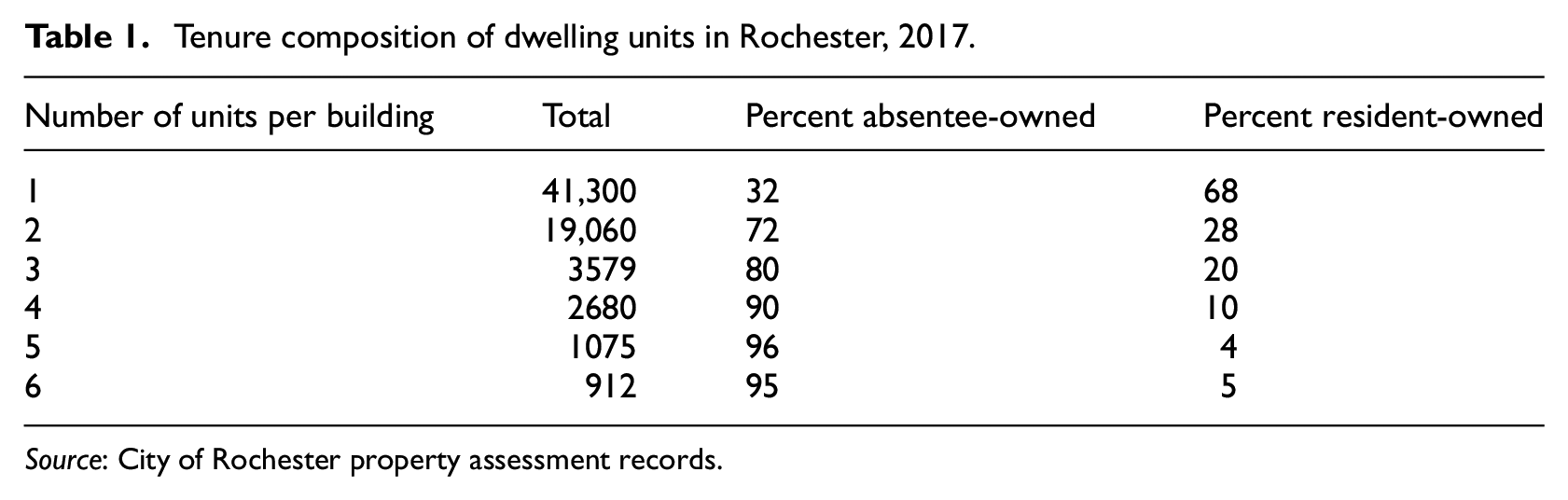
Rochester turns out to be an appropriate setting to explore tenure differences in property maintenance. Assessment evidence for 2017 confirms that the six-unit cut-off makes sense for the present analysis because, beyond that, resident landlords were exceedingly rare (Table 1). Among rental properties, resident landlords controlled almost three in ten dwelling units in the two-unit buildings, but thereafter their share declined to 5% in the six-unit buildings. Beyond that, their role was too small to justify meaningful comparison: only 2% of seven-unit dwellings – that is, twelve properties – were owned by resident landlords. Among single-unit dwellings, owner-occupiers were numerically dominant, but almost a third (32%) were held by absentee landlords. Some of the latter may have fallen into the hands of investors after the subprime crisis.
Tenure composition of dwelling units in Rochester, 2017.
Source: City of Rochester property assessment records.
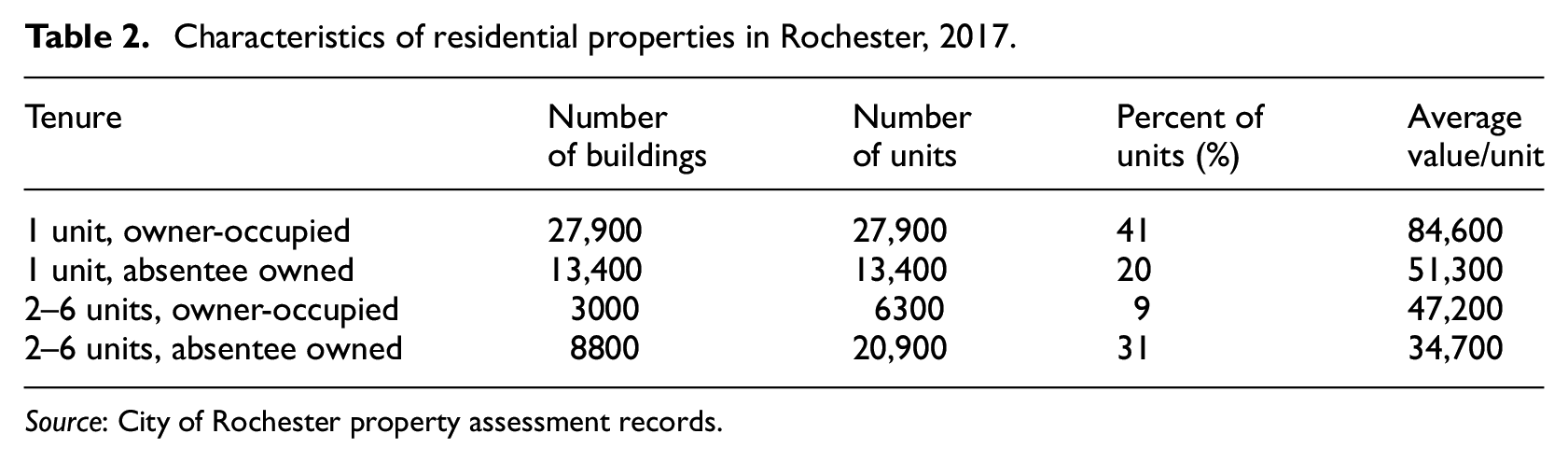
The city’s housing stock is dominated by single-unit dwellings, accounting for almost four-fifths of all structures, but only 61% of dwelling units (Table 2). The majority of rental units, whether in single- or multi-unit structures, are held by absentee landlords. Indeed, these amount to a growing, and by 2017 a marginal majority (51%) of all dwelling units in the city. Even so, resident landlords play a non-trivial role, controlling at least 9% of all units. If official records included illegal secondary suites this proportion would be higher.
Characteristics of residential properties in Rochester, 2017.
Source: City of Rochester property assessment records.
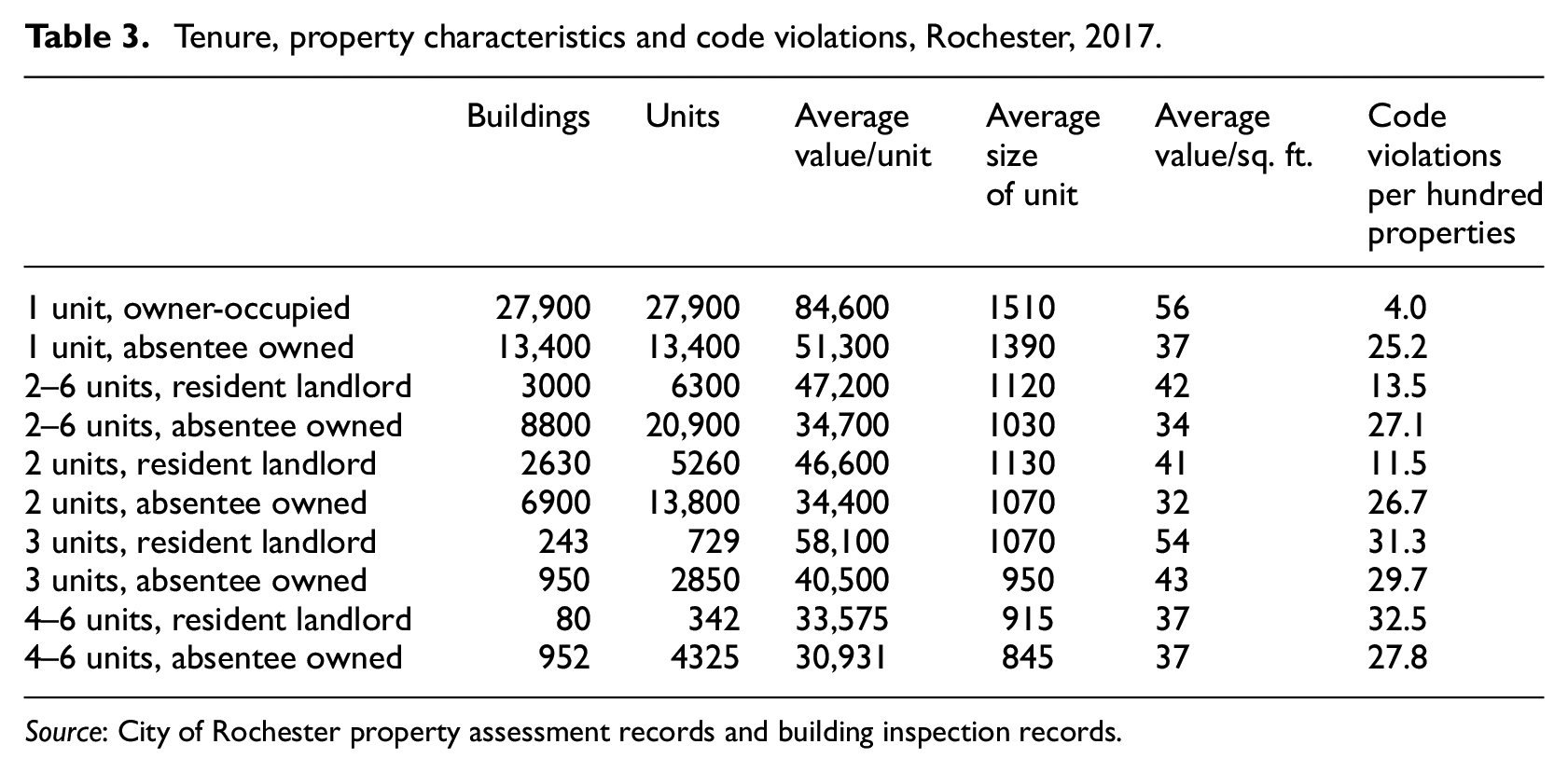
Not surprisingly, owner-occupied homes are the most valuable (Table 3). On average, they receive a 65% higher assessment ($84,600) than the single homes held by absentee landlords ($51,300) (Table 2). At 1510 square feet, they are on average 8.6% larger, but controlling for square footage they still earn a 51% premium (Table 3). Clearly, owner-occupied homes were of higher quality and/or in more prosperous neighbourhoods. Similarly, although to a lesser degree, the 2–6-unit properties held by resident landlords were superior to those of absentees: at $47,200, they are rated as 36% more valuable. Again, this difference was partly because those units are 8.7% larger – 1120 as opposed to 1030 square feet (Table 3). Among most multi-unit properties, square foot values were higher in those that were resident-owned. Only among the few, large properties did the average values converge.
Tenure, property characteristics and code violations, Rochester, 2017.
Source: City of Rochester property assessment records and building inspection records.
Property maintenance
To a considerable extent, these differences in assessed – and presumably market – values are associated with contrasts in the level of property maintenance. Rochester’s inspection records indicate that owner-occupied properties were by far the best-maintained, with only 4.0% registering one or more unresolved code violations (Table 3). This understates their true incidence because, as noted earlier, these properties are not pro-actively inspected. Even allowing for this, the contrast with rental properties is striking. The equivalent figure for single-unit homes owned by absentee landlords (25.2%) was over six times higher, and the incidence in their multi-unit buildings (27.1%) was slightly higher still.
Interestingly, the reported rate of code violations among resident-owned properties (13.5%) was mid-way between those for owner-occupied and for absentee-owned properties (Table 3). The difference with the latter was attributable entirely to the duplexes (two-unit properties), which account for almost nine-tenths of the dwellings owned by resident landlords. In this category, the incidence of code violations was only 43% of those owned by absentee landlords. Unfortunately, this comparison is imperfect. As noted earlier, because of the possible exemption from interior inspection of the units occupied by resident landlords, the reported code violation rate for those properties is an underestimate. The actual level of maintenance of resident-owned rental properties would therefore be somewhat closer to those that are absentee-owned than to the solely owner-occupied units. Significantly, however, in the rarer three-unit properties that are subject to pro-active three-yearly inspections, the resident advantage disappeared and among 4–6-unit buildings the pattern was reversed. There are two possible reasons. The first is that the duplexes are subject to less frequent inspections, flagging the effectiveness of such activity. The second is that in the smaller, two-unit properties resident landlords have closer relations with their tenants. Duplexes are likely to be converted single-unit dwellings where sound barriers are poorer and some facilities (e.g. a backyard) may be shared. Landlords may be more selective, and more responsive to tenant concerns. Meanwhile, tenants might feel reluctant to make a concern official. In larger rental properties, landlord–tenant relations might be more distant while tenants might find common cause in reporting complaints. Such dynamics have been documented (Krohn et al., 1977), but not in Rochester. Both explanations are surely valid, but the first is probably the more important.
In light of recent commentaries about LLCs, we had anticipated that absentee owners using this corporate form would be the least responsible. This turned out not to be the case. Small or large, they differed little from other absentee investors: their code violation rates, 25.0% and 26.1%, respectively, were only slightly above those for all absentee owners (24.7%). The properties that stood out were those run by professional management companies. Their code violation rate (38.2%) was about one-and-a-half times as high as that of all of those absentee landlords who managed their own properties. Significantly, preliminary analysis indicates that this difference was largely confined to Black neighbourhoods. 5 A possible explanation is that management companies in such areas were more likely to be used by out-of-state owners who might have had a relatively exploitive attitude towards their real estate holdings.
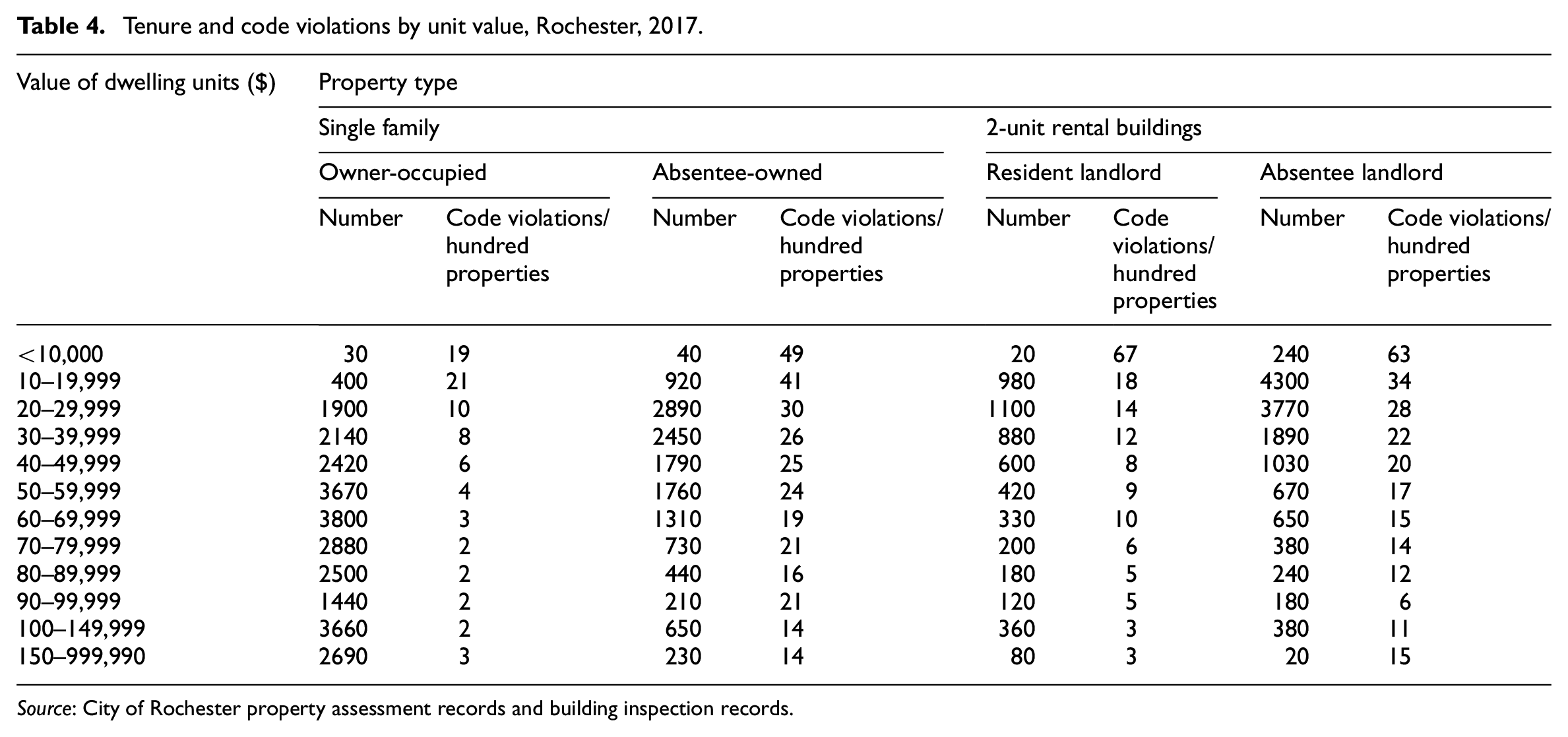
But simple comparison of code violations across the three tenures is insufficient. The proportion of properties with code violations varies with value, regardless of ownership. For example, across twelve value categories, the rate of violations in the cheapest owner-occupied properties is around 20%, 10 times higher than among the most valuable, while the range for absentee-owned single-unit properties extends from 49% among the cheapest to 14% for the most expensive (Table 4). Such variation is important because owner-occupied homes are larger and more valuable than those that are absentee-owned. Controlling for value, the tenure differences are reduced (Table 4). In single dwellings, as noted, code violations among the absentee-owned are more than six times higher than among the owner-occupied. Controlling for value reduces the difference by over a half. For example, in those rated $30,000–40,000, the modal category for absentee-owned homes, the respective figures are 30.0% and 10.0%. Among properties rated above $60,000, however, the far superior maintenance of owner-occupied properties is restored.
Tenure and code violations by unit value, Rochester, 2017.
Source: City of Rochester property assessment records and building inspection records.
Likewise, a controlled comparison of resident- and absentee-owned rental units shows that value accounts for some of the difference in maintenance. The resident-landlord advantage is confined to duplexes, by far the most numerous type of small rental property (Table 3). For these, it is especially meaningful to control for number of units as well as unit value (Table 4). Overall, as noted, in duplexes the reported rate of code violations for resident-owned units is only 43% of that for the absentee-owned. When value is controlled, the advantage is consistently reduced to 50% or higher. For example, among units rated $10,000–20,000, the modal category for absentee-owned duplexes, the respective rates are 34 and 18, an advantage of 53%. Even accounting for the omission of some of the resident landlords’ own units from inspection, that contrast is still far from negligible.
The question, of course, concerns cause and effect. Have absentee landlords bought cheaper properties that require more maintenance? Or has their business plan involved minimal investment, leading to more rapid deterioration? Cross-sectional data cannot tell us, but changes in tenure can throw light on the issue.
Intimations of causality, 2011–2017
The housing market is always in flux and the 2010s were problematic. Fortunately and exceptionally, as noted earlier, a city staff-person made assessment data available for Rochester back to 2011, enabling us to track changes in tenure and ownership over a six-year period. The number of owner-occupied properties fell by 6%, from 29,530 to 27,900. Most became absentee-owned. Absentees also loomed larger among multi-family properties. The absolute number of absentee-owned 2–6-unit rental units fell from 21,730 to 20,900 but, proportionately, those that were resident-owned fell further. In six years, then, Rochester had lost population and housing, while what remained had increasingly fallen into the hands of absentee investors.
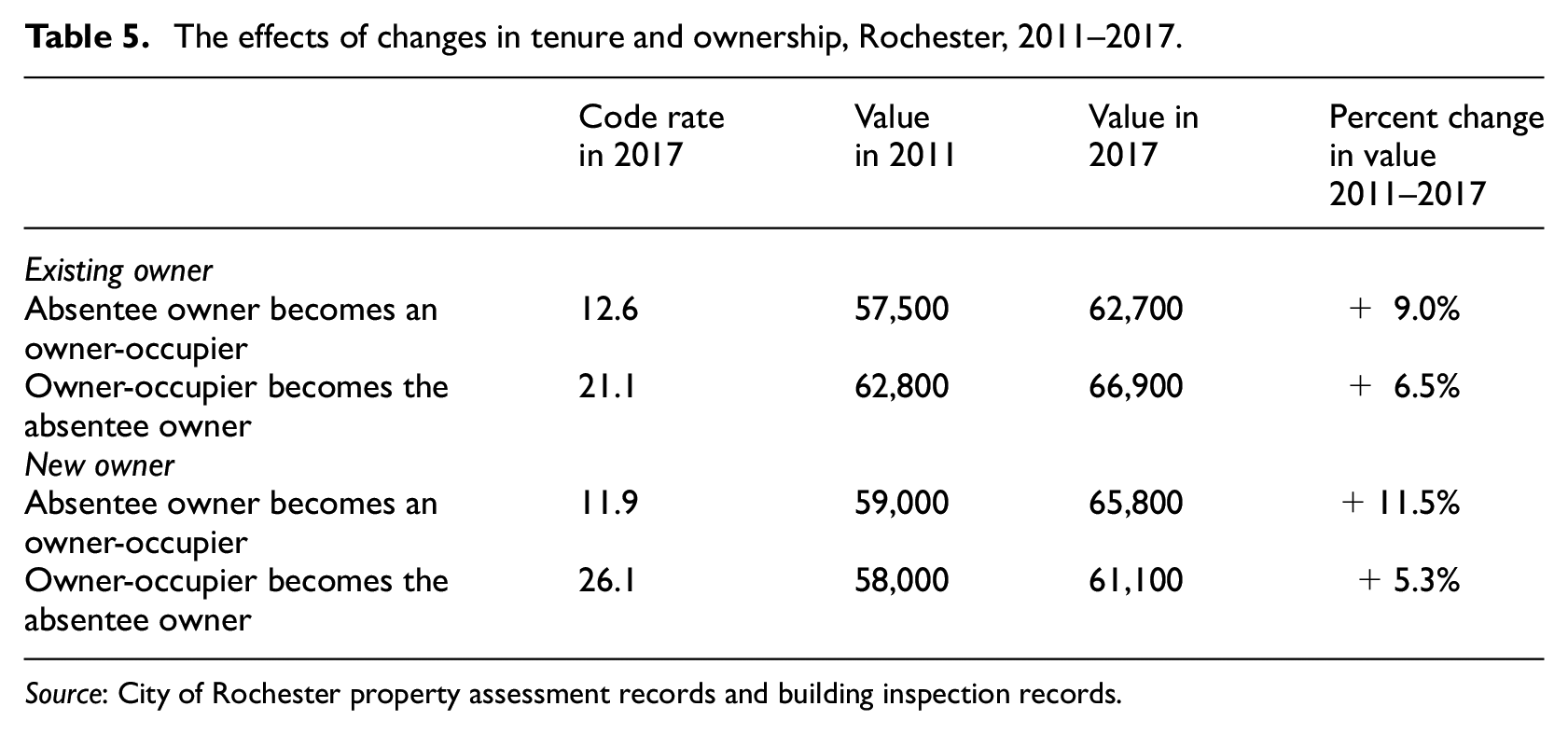
Usefully, it is possible to determine which properties changed tenure while remaining in the same hands (Table 5). In that way, we determined the effect of tenure independently of ownership. The results are telling. Between 2011 and 2017, 381 absentee owners of single-unit dwellings made those houses their homes. Their code violation rate in 2017 was 12.6%, mid-way between the rates for long-standing owner-occupied properties (4.0%) and for single dwellings that were still absentee-owned (25.2%). We do not know the maintenance profile of those properties in 2011 but, assuming that it was the same as other absentee-owned properties, the act of becoming a resident had changed these owners’ view of property maintenance. There is a mirror effect. Between 2011 and 2017, 1161 owner-occupiers moved out but retained ownership. By the latter year, the code violation rate on their properties was 21.1%, approaching the level for all absentee-owned properties. It may be that pro-active inspection now showed that these owners had always been derelict in terms of maintenance, but it is also likely that, after moving out, erstwhile owner-occupiers became less conscientious about upkeep.
The effects of changes in tenure and ownership, Rochester, 2011–2017.
Source: City of Rochester property assessment records and building inspection records.
But perhaps the homes that absentee owners decided to make their homes between 2011 and 2017 were unusually desirable and hence well-maintained, in anticipation of a move. Similarly, perhaps those that owners vacated had already been allowed to deteriorate. To check this, we compared changes in property value (Table 5). Before-and-after values for the homes that became owner-occupied were $57,500 (2011) and $62,700 (2017); interestingly, the values of properties that owners vacated were slightly higher, $62,800 and $66,900. In other words, if anything the net movement of owners was into cheaper, not superior, homes. But the telling difference concerns the rate of appreciation. Homes that became owner-occupied increased in value by 9% while those vacated by their owners only increased by 6.5%. Allowing for some lag in reassessment, the actual difference in experience was probably greater. Consistent with the evidence on code violations, this indicates that tenure alone changes the way owners behave.
The shuffling of tenure by existing owners was numerically overshadowed by the changes that occurred as properties changed hands: the respective numbers over the six-year period were 2035 and 5309 buildings, accounting for 2622 and 6579 dwelling units. The usefulness of examining tenure change in this larger group is that it suggests the extent to which tenure differences in maintenance in 2017 are attributable to new owners who differ in conscientiousness. The results are broadly consistent with, but interestingly different from, those for owners who retained their properties. The code violation rate in 2017 for single, owner-occupied homes acquired by new owners (11.9%) is similar to, but slightly better than, that for homes where the existing owner moved in (12.6) (Table 5). Moreover, if anything their values increase by rather more: +11.5% versus +9%, suggesting that the new owner-occupiers had a stronger commitment to what were also their new properties. That is not surprising: in a burst of pride and enthusiasm, new home owners often make alterations and improvements. Conversely, however, the owner-occupied homes that were sold and became absentee-owned are a sorry category. Their code violation rate in 2017 (26.1%) was markedly higher than for those that changed tenure but stayed in the same hands (21.1%), while their rated values had increased more slowly (+5.3% versus +6.6%). Those investors who were buying up single homes in Rochester in the 2010s were not thinking of their properties as viable, long-term investments. Overall, then, changes in ownership of single dwellings, by far the most common type, heightened the existing tenure contrasts in property maintenance.
Concluding discussion
Rochester’s evidence points to tenure differences in property maintenance and also underlines the importance of building inspections. It supported systematic comparison of the maintenance behaviour of the three major types of private property owners: owner-occupiers, absentee and resident landlords. It suggested that code violations are about three times more common in the property of resident landlords than that of owner-occupiers, but not much more than half as common as in the buildings of absentee landlords. However because, depending on ownership and number of dwelling units, properties are treated unequally by building inspectors, actual differences in maintenance across these groups are less than this. Differences are further reduced when the relative values of the properties in question are controlled, but contrasts persist. The evidence for resident landlords, often an overlooked group, is especially significant because there has been much discussion in recent years about the desirability of encouraging home owners to create secondary suites, for example in basements. Our findings indicate that such apartments are likely to be relatively well-maintained, although not as well as single-occupancy homes.
Of particular interest is our finding that, at least in a contemporary American city, longitudinal evidence indicates that these tenure differences stem primarily from the character of the tenure and not the individuals who choose to invest in rental property. Owner-occupiers who move out and then rent become more neglectful of what was once their home; those who move into a home that they had once rented out become more solicitous. That said, new owners do behave better than old. They are especially keen to fix problems and make improvements. Conversely, judging from the experience of Rochester in the 2010s, those who invest in single-unit dwellings care little about the quality of the dwelling, or by extension that of the neighbourhood.
Most surprising is the finding that investors who use LLCs are no more or less responsible than other types of landlords, coupled with the fact that, at least in Rochester, the properties handled by property managers are the worst culprits at meeting standards. As other researchers have noted, LLCs offer investors a way to hide their identity and limit their legal liability should they decide to walk away. The evidence for Rochester does not contradict this view, but neither does it provide support. Conversely, we might expect that professional managers would do a good job but, perhaps if employed by out-of-state investors, and especially in Black neighbourhoods, the reverse is true in Rochester.
A second type of conclusion concerns pro-active building inspection. The telling comparison is between the duplexes and three-unit properties of resident landlords. The latter are associated with a much higher rate of code violation. This difference may reflect varying landlord–tenant dynamics, but pro-active inspection is surely very important. Our evidence, then, confirms the importance of such inspections for the health of residents, a finding important for policy.
The obvious question is whether these findings can be generalised. Because the main ones are consistent with what others have suggested, or supposed, it is reasonable to conclude that they are broadly valid elsewhere, at least in the United States. The exceptions may be findings that pertain to LLCs and management companies, for which no comparable studies are available, and which are in some respects counter-intuitive. Here, especially, it would be helpful to have evidence for other cities. There is a particular need for qualitative studies that explore the varied motivations of landlords, and landlord–tenant dynamics in properties with varying numbers of rental units.
Generalising beyond the United States, and perhaps Canada and Australia, is problematic. The maintenance behaviour of property owners depends in part on the regulatory context and on cultural expectations. Where private tenancy is not as socially marginalised, where landlords are not routinely vilified, and where rent controls or other elements of the regulatory environment are more comprehensive, we might expect that the contrasts with resident-owned properties would be less. After all, far from being immutable, tenure is always a socially-constructed package of rights and incentives.
Footnotes
Acknowledgements
We would like to thank Katrina Korfmacher, Adam Travis, and three anonymous reviewers for comments on earlier drafts, as well as Pamela Delaney and Henry Fitts, City of Rochester, for information pertaining to the city’s procedure regarding building inspections.
Funding
The author(s) received no financial support for the research, authorship, and/or publication of this article.
