




Abstract
Whilst involving diverse local groups in urban policies is a key concern for planners, mechanisms to enable participation are often based on the problematic process of identifying minority groups. This paper concentrates on the concept of recognition when investigating the marginalisation of immigrant groups in local policymaking. It demonstrates that urban policies are sometimes built upon categorisations that reproduce a hierarchical relationship between ethnic groups, and thus inadvertently act as a possible barrier towards ethnic minorities. The findings draw upon qualitative research in Garibong-dong, Seoul, South Korea, a neighbourhood with a significant Korean Chinese population. I argue that participatory processes need to understand more carefully how the processes of group identification, as practised by planners and state officials, are integral to the transformation of group relations. In turn, this requires loosening ideas about how desirable qualities are identified in potential community participation and rethinking presumptions about ethnic minorities. Only then can engagement proceed in more equitable ways within planning systems.
Introduction
Many scholars have pointed out that current participatory planning practices often fail to engage diverse members of local communities, especially so-called ‘hard-to-reach’ groups such as ethnic minorities (Beebeejaun, 2012; Coaffee and Healey, 2003). In order to mediate an issue of unbalanced representation in the planning processes, the selective involvement of local ethnic groups to increase diverse representation has been increasingly observed in urban planning processes in recent years (Fincher et al., 2014; Greater London Authority, 2018; Schmiz and Kitzmann, 2017; Seoul Metropolitan Government, 2014a). However, these identification processes necessitate a simplification of diversity as they often draw upon an ‘essentialised ethnic singularity’, whereby group membership is uncritically equated with census categories or other forms of quantifying distinct ethnic groups. A space then arises for problematic presumptions about immigrant groups which operate in wider society to become embedded in categorising and representation processes. Such processes have been insufficiently explored in planning literature to date (Fincher and Iveson, 2008; also see Uitermark et al., 2005).
This research aims to investigate mechanisms that have been used to involve immigrant groups in urban planning through the concept of recognition. I use the concept of recognition, drawing on the work of the political philosopher Nancy Fraser (2003, 2007, 2009) and focusing on the relational dimension of group identities. The politics of recognition in this sense is an issue of how social understanding, associated with a certain group, is interpreted as less desirable in relation to others in policy-making processes. It is not limited to the matters of whether an ‘authentic’ or self-generated collective identity is well displayed or whether their existence is noted in policies, but rather how their group identity influences the roles such groups can play as partners within decision-making processes embedding the existing institutional patterns.
This paper deals first with how group categorisations emerge in Seoul urban policies and, second, the social meaning of groups which is reflected in them. These analyses will show how the current view of considering ethnic groups in participatory planning systems plays out in reproducing the existing societal structure surrounding immigrant groups in local plans. Third, the paper turns to an examination of how immigrant groups navigate the position themselves within this formation of groups in order to understand the influence of group divisions in the participatory processes. The lens of recognition will help us to see how the embedded ethnic categorisations deliver the assumptions of cultural attributions regarding a certain group of people by marginalising them.
The empirical focus of my paper is Garibong-dong, located in the south-western part of Seoul. This neighbourhood, with a longstanding Korean Chinese immigrant population, was previously subject to a proposed government-led full-scale development, Garibong-dong Newtown project, after demolition. After the plan was cancelled, Garibong-dong Urban Regeneration Promotion Plan, a community-led regeneration project, was introduced in 2015.
‘Korean Chinese’, 1 who are also called Joseonjok, are categorised as the Korean population in China who began to return to Korea since the 1980s. As a result of expanding policies, the number of Korean Chinese in South Korea reached 590,856 people in 2015, accounting for 33% of the overall foreign-born population (Korean Immigrant Service, 2015). The Korean Chinese in South Korea have been located in a particular in-between position which is difficult to understand without using a relational lens to perceive their group identities. Although Korean Chinese have the same ancestors as long-established Koreans, they have been differentiated from other groups in Korean society. They are frequently shown as possessing damaged group identities and suffer derogatory stereotyping, including stigmatising claims that they are a ‘dangerous’, ‘lazy’ and ‘inferior’ group of people (see Shin and Ma, 2017). Whilst they are the largest group amongst immigrants in South Korea, and many of them are fluent Korean speakers and their informal social activities became notable, their formal participation including participation in planning processes is rarely observed. I focus on the understanding of Korean Chinese in public policies as the barrier for them to be engaged.
This research is based upon a qualitative case study including in-depth interviews, non-participant observation in Garibong-dong, and documentary analysis of urban policies that were implemented in the area between the mid-2000s, when the first urban policy focusing on the foreign-born populations in Seoul was carried out, and 2016. The data were collected during three months of fieldwork, from March to June 2016. The total number of interview participants was 41: 19 local Korean Chinese residents, 12 Garibong-dong Regeneration local committee members, five public officials, three members of the Garibong-dong Regeneration team and two researchers. Korean participants were mainly recruited through attending committee meetings, and Korean Chinese groups in the neighbourhood were recruited by contacting local Korean Chinese organisations.
The concept of recognition: Unequal social status impeding participatory parity
Communicative planning theorists have been central in developing understandings of participation in contemporary planning studies by drawing upon the theory of communicative action developed by Jurgen Habermas. Whilst writers in communicative planning theory did not deny the operation of power, their arguments are based on the belief that it is possible to reach a consensus through the process of communication, or ‘communicative rationality’ in Habermas’s term (Forester, 1999; Healey, 2006; Innes and Booher, 2010). Basic to their position is that differences between actors can be challenged at the level of dialogue and through reflective discourse (Healey, 1999). In this context, ‘just results’ in participatory planning are often considered to be realised through procedural fairness (Campbell and Marshall, 2002). However, concern remains as to how possible equal and free participation can emerge through consultation processes (see Outhwaite, 2009). Although Habermas’s conception of dialogic reason presumes that generalising interests is possible, when individual participants in deliberative processes express their needs, no one speaks from an impartial point of view (Young, 1990). Their opinions are sometimes undermined as cultural meanings about the traits of the groups of people with which they are associated (Fraser, 2000).
The concept of recognition has provided a useful insight into understanding how power dynamics impede equal participation in the decision-making of socially marginalised groups (Fraser, 1995; Honneth, 1996; Taylor, 1994). The concept of recognition in political theories overlaps but can be contrasted with the use of recognition in the context of the rise of multiculturalism. Multicultural politics has placed emphasis on identity politics, focusing on the distinctive value of group identity and the group-specific right to protect their uniqueness (Calhoun, 2002). On the other hand, Fraser (2003) uses the concept of recognition to understand the social status of groups to provide a normative condition for social justice. Both approaches focus on a damaged and distorted identity which harms the dignity of some groups but whilst multiculturalism, such as the work of Taylor (1994), focuses on revaluing identities, Fraser (1995) sheds light on the importance of a transformative remedy which softens group divisions. Revaluing identities might be part of the strategies to reach the transformation of group relations but is not the end goal of the politics of recognition (see Young, 1997).
Nancy Fraser (1995; also see 2003) argues that the issue of recognition is an issue of social justice by linking it with impeded social status. She focuses on ‘participatory parity’ to examine social inequality by stating that ‘justice requires social arrangements that permit all to participate as peers in social life’ (Fraser, 2000: 74). In her arguments, the social idea about who are categorised as normative social actors leads to marginalising others as deficient or inferior. In this sense, identity politics in multiculturalism politics is not sufficient to adjust the social status of marginalised groups because it sometimes results in reifying group categorisations by celebrating group specificity and not reaching further mediations to political or economic adjustments. In the concept of recognition according to Fraser, the issue of the recognition of groups is not solely related to the depreciation of group identity but rather the matter of cultural patterns in an institutional design which reflect the relations between social domination and subordination, impeding minorities’ equal participation in the relations with other social members.
The emphasis on recognition has been based on dimensions of inequality requiring different approaches – economic distribution and cultural recognition – for them to be redressed. Economic and cultural discriminations have frequently intertwined since, for instance, the economic status of immigrant groups can build up certain perceptions about these groups. However, whilst these different aspects of social divisions – possibly more than those two dimensions – interact, cultural discrimination should not be reduced to a matter of economic social divisions (Crenshaw, 1991; Yuval-Davis, 2011). In other words, the socially rooted meaning of a certain group is sometimes not simply mediated by acquiring economic status, and the unequal power in the decision-making procedure and the division of labour and culture cannot be fully alleviated by distribution (Young, 1990). Whilst some argued in favour of the distribution of opportunity or power, the marginalisation in decision-making processes occurred in the relations between the groups in the processes and embedded in practices. Having an opportunity to be involved in decision-making is an important condition for fairer processes, but not a solution for being powerless in decision-making. Therefore, Fraser (2000) argues that ‘misrecognition’, which refers to institutionalised patterns constituting some actors as inferior, excluded, or simply invisible, needs to be considered as social subordination not only ‘free-standing cultural harm’, and it requires reforms of those patterns at an institutional level (p. 113).
The concept of recognition in planning
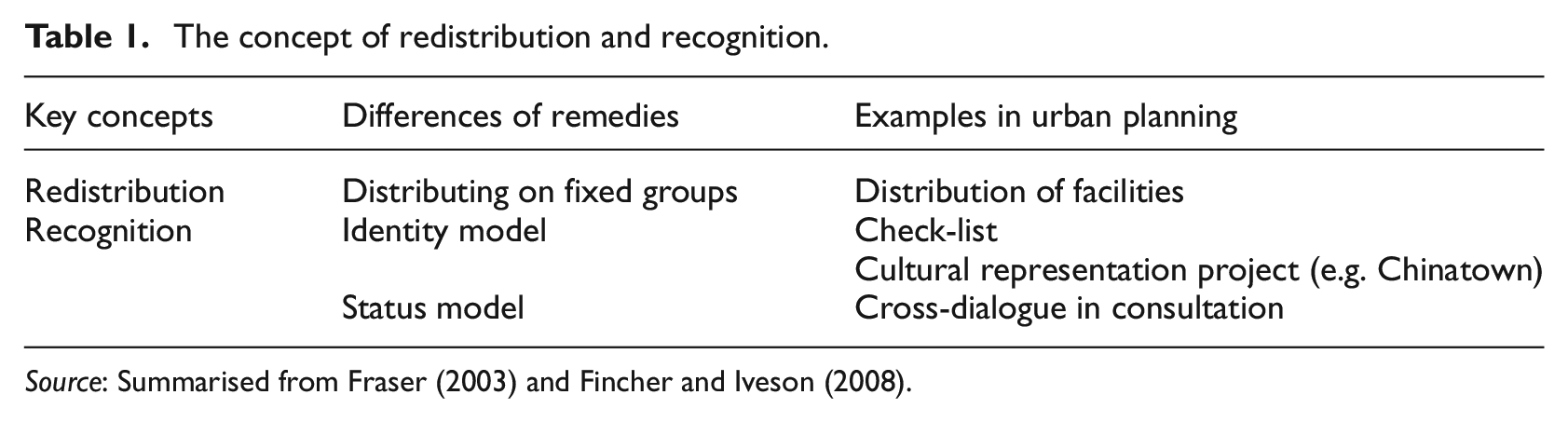
Although there is an impetus to reconsider institutional design in order to build fairer participatory processes, there are limited planning studies which directly engage with a politics of recognition. However, Fincher and Iveson’s (2008) work points towards the importance of a ‘relational model of recognition’ based on Fraser’s status model to soften the group divisions from the normative viewpoints in planning systems. Table 1 shows each approach and examples in urban planning by Fincher and Iveson (2008).
The concept of redistribution and recognition.
Source: Summarised from Fraser (2003) and Fincher and Iveson (2008).
Looking into the participatory processes through the concept of recognition identifies several important dimensions which were overlooked. First, even though the members acquire the right to participate in the procedure, the cultural contexts embodied through their social positions are constantly influential in the deliberative processes. Second, even in the cases of planning involving immigrant groups, recognition of identity in planning has tended to focus on celebrating ethnocultural specificities of identity (Chang, 2000; Lees, 2003; Schmiz and Kitzmann, 2017). For example, Fincher and Iveson (2008) took the example of including immigrant groups based on their group identities, with a ‘checklist’ approach or cultural representative projects such as Chinatowns. However, as mentioned, the affirmative approach towards immigrant groups can reinforce the problematic representation of group identities. Third, even when consultative processes were provided, the processes were frequently limited to consulting group-specific issues with each group, rather than including diverse groups together in more important decision-making such as prioritising the budgets, setting up the rules of representative groups or deciding overarching goals (Beebeejaun, 2012).
In this sense, equal participation for ethnic minorities needs to be more critically examined from the viewpoint of transformative remedies. The group interactions need to consider these conditions: (a) providing cross-group dialogues without separating groups according to their pre-assumed attributes, (b) providing an institutional setting involving social groups with equal social esteem, and (c) being aware of the different social locations of groups and respecting group differences without dissolving them into a united group or individualising members (Fraser, 2003; also see Young, 1990). Based on the normative framework of recognition, this paper will examine the Seoul Metropolitan policies regarding how policies enhance or impede equal participation of immigrant groups.
Korean Chinese groups in Garibong-dong
Korean Chinese people, who mostly work in low-skilled industries, began to relocate to Garibong-dong. 2 From the 1990s, the low-priced houses in the area became the predominant reason for the influx of Korean Chinese low-income workers into Garibong-dong. The neighbourhood was formed as a residential area for the surrounding industry complexes, called Guro Industry Complexes, in the 1970s (see Figure 1). The shabby houses known as bealjips, where factory workers lived, were built, and the houses remained after the workers left as the Guro Industry Complexes were rebuilt as Guro Digital Complexes. The Korean Chinese population in Garibong-dong, which was 0.5% (92 people) in 2000, rose to 18.2% (4134) in 2006 and reached more than 30% (6111) in 2010.
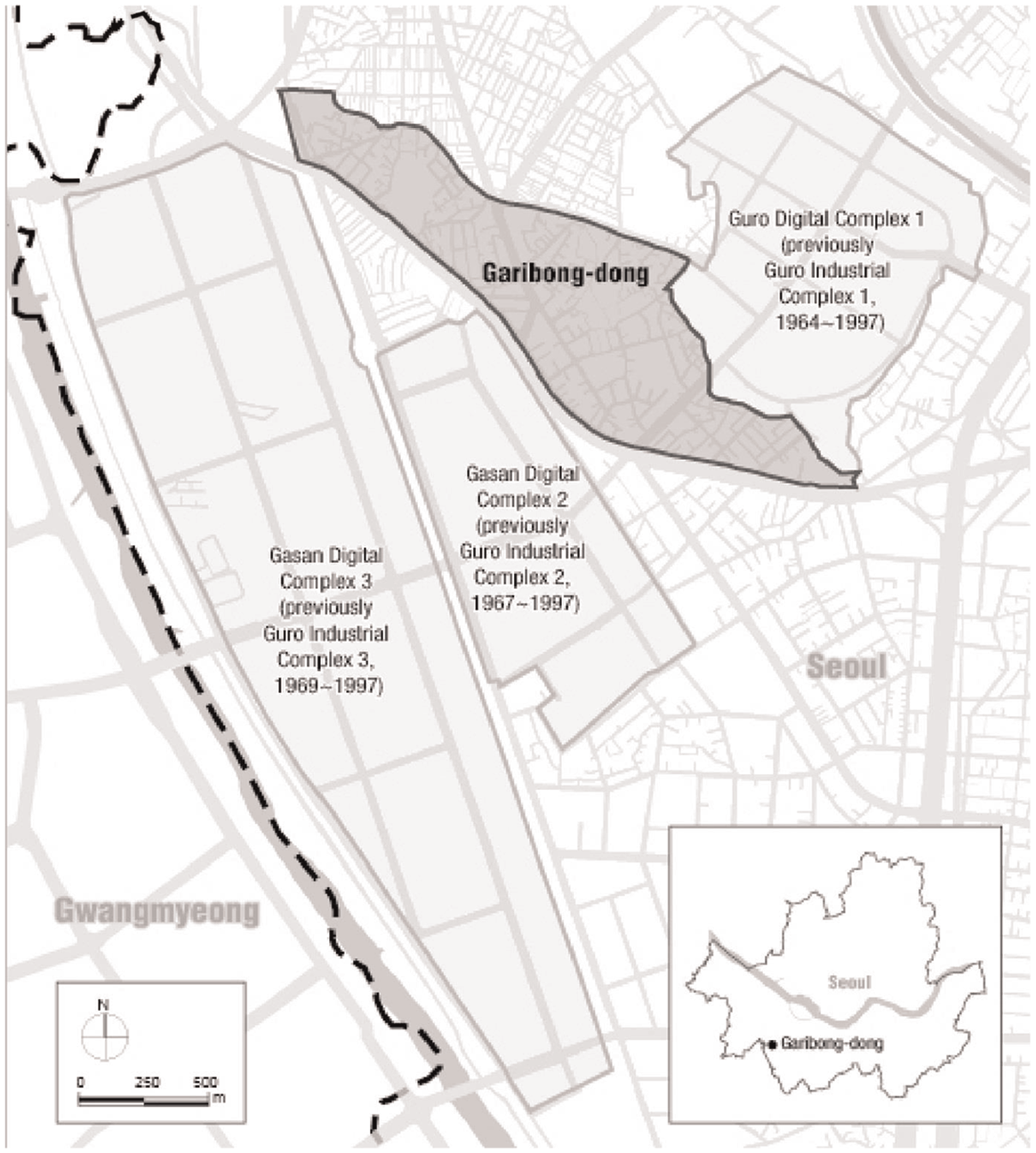
Garibong-dong, Seoul, South Korea.
Garibong-dong is understood as a ‘portal’ to South Korea, where Korean Chinese who aimed to move to Korea first visited (‘Lee’, Korean Chinese community organisation, interview, March 2016). Garibong-dong had built social networks amongst Korean Chinese through civic organisations and travel companies helping visa administration processes for around 20 years of history as a Korean Chinese enclave. As a result, many of the Korean Chinese groups chose Garibong-dong as the first place in which to settle whilst they sought help through their ethnic communities. Although Garibong-dong is understood to be home to a higher number of low-income workers compared with other Korean Chinese enclaves such as Daerim-dong, a nearby neighbourhood, the numbers of longer-term Korean Chinese residents in Garibong-dong became larger as the overall number of Korean Chinese who acquired overseas Korean visas grew.
The negative sentiment towards the groups has been formed amongst long-established Koreans since the 1990s when the population of Korean Chinese significantly grew (Seo, 2014). Some studies explained this tendency as an antagonism which occurred in the process of a transition from the Korean view of a nation based on a single ethnic nationality 3 to a multicultural society (Kim Y, 2014; Yoon and Song, 2011). Along with Korean ethnic nationalism, the history of the relations between Korea and China also had been discussed as a context of exclusion of the Chinese groups in Korea. Kwon (2020) states that the Sino-centric world view of Korea had been denied through the influence of Japan in the late nineteenth century. Chen (2010) argues that the power relations in the Asian region after the cold war constructed the anti-communism-pro-Americanism structure along with weakening the previous Sino-centric structure.
Despite those existing barriers, Korean Chinese groups have become one of the significant groups in South Korea based on their Korean language skills and networks (Lee, 2014; Shin and Park, 2017). Their collective activities, such as local activities to improve social attitudes towards them or their establishment of quasi-political organisations, are notable. Yet, it is not sufficiently understood how the presence of structural limitations and social networks has been influential within formal planning processes.
Seoul metropolitan policies
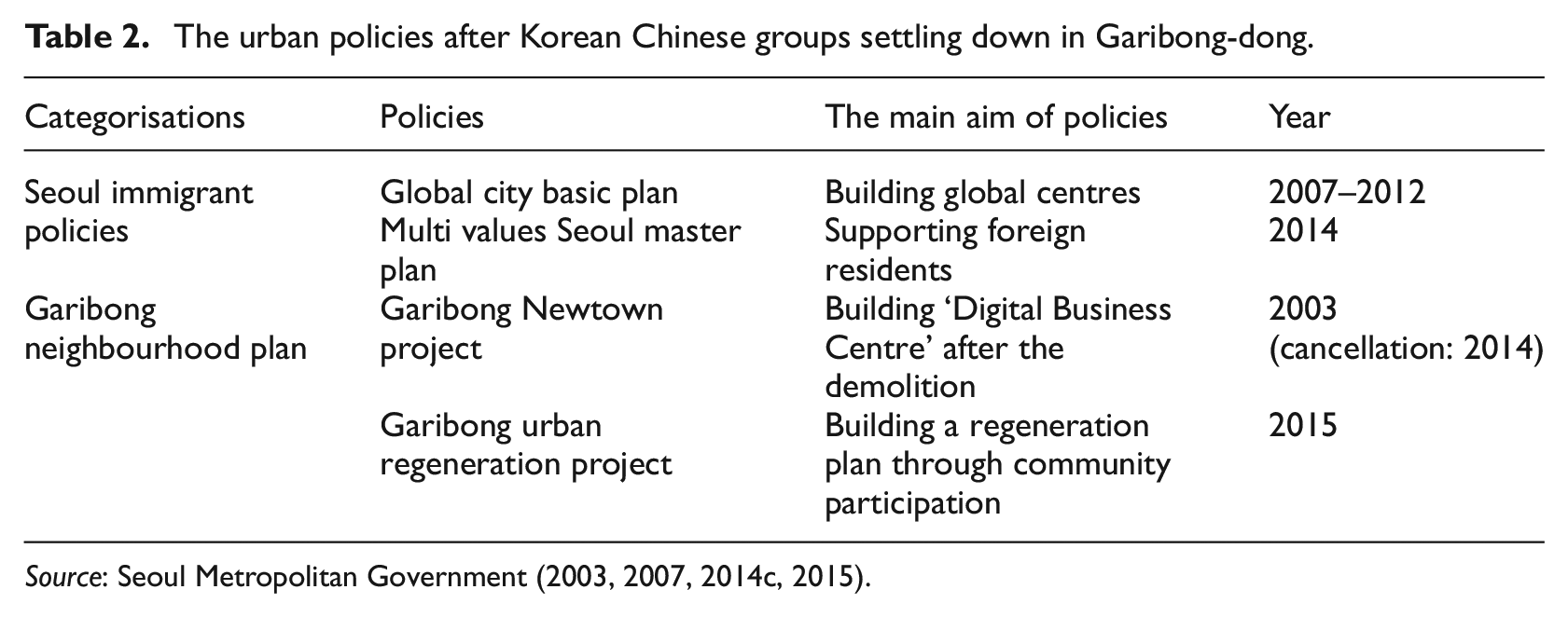
From 2000 to 2016, mechanisms to involve immigrant groups in planning have differed depending on two different Seoul Metropolitan Mayors, Oh Se-hoon (2006–2011) and Park Won-soon (2011–2020). The foreigner policies have shifted from only considering foreigners as foreign investors or travellers mainly from Western developed countries to a focus on foreigners as part of local neighbourhoods by also including low-income foreign workers, overseas students and marriage migrants (Table 2).
The urban policies after Korean Chinese groups settling down in Garibong-dong.
Source: Seoul Metropolitan Government (2003, 2007, 2014c, 2015).
The first plan by the Seoul Metropolitan government involving foreigners 4 was announced in 2007 with the title of ‘Seoul Global City Basic Plan [Seoul geullobeol dosihwagibongyehoek]’. The Seoul Global City Basic Plan seemed to be largely influenced by the discourse of a ‘creative city’ by Landry (2008), Florida (2005), Glaeser (2011) and Choi (2014). Based on the assumption that encounters with differences can enhance creativity and ultimately the economic growth of the city, this policy argued the importance of nurturing a foreign-born population. However, high-skilled workers, so-called ‘talented workers’, were mainly described as important actors in the policy, not low-income immigrants such as a Korean Chinese group.
The first Seoul Foreigner Basic Plan was replaced by the second Seoul Foreigner Basic Plan in 2015. This second plan, ‘Multi Values Seoul Master Plan [Dagachi Seoul maseuteopeullaen]’, included larger immigrant groups by aiming at improving the quality of lives of immigrants and defining ‘foreigner residents’ as the foreign-born population who stayed more than 30 days in South Korea (Seoul Metropolitan Government, 2014c). The second immigrant policy emphasised social cohesion by stating that ‘foreign residents are not strangers, but our neighbours’ (Seoul Metropolitan Government, 2014c: 5). The Korean Chinese group, which formed the largest group of immigrants, was therefore included as an important part of the policy.
Apart from the Seoul Foreigner policies, the Garibong-dong Urban Regeneration Promotion Plan 5 [Garibong dosijaesaeng hwalseonghwa gyehoek] in 2015 also demonstrated a change of direction in Seoul urban policies. Mayor Park Won-soon, who was elected in 2011, strongly criticised the New town planning model in which occurred large-scale displacement of residents through the complete demolition of neighbourhoods. The cancellation of the Newtown projects began to be discussed from the 2010s, and the community-led regeneration emerged as an alternative means. At the national level, the Special Action Promotion and Support of Urban Regeneration [Dosijaesaeng hwalseonghwa min jiwone gwanhan teukbyeolbeop] was introduced in April 2015. In Seoul, 301 Newtown districts amongst 638 were cancelled by the end of 2015, and 27 areas including Garibong-dong were designated as regeneration projects from March 2015 (Kim, 2016).
The main difference of this Urban Regeneration plan was its emphasis on the direct involvement of residents from the early phase of planning and the preservation of cultural and social aspects in the designated areas. The Seoul Regeneration Strategy Plan, which was a higher level policy of the Garibong-dong Urban Regeneration Promotion Plan, specified that the participants in Urban Regeneration plans should include tenants, local businesses and commuters (Seoul Metropolitan Government, 2015). According to the aim of preserving local culture and involving existing residents, the Garibong-dong Urban Regeneration Promotion Plan [Garibong dosijaesaeng hwalseonghwa gyehoek] was announced with the title of ‘the regeneration of the village living with multiculture’ in contrast to the Garibong-dong Newtown plan which neglected Korean Chinese communities (Seoul Metropolitan Government, 2014b).
The Urban Regeneration team prepared the Garibong-dong Urban Regeneration Promotion Plan with a local committee between 2015 and 2017, and the plan was announced in May 2017. The sub-projects focusing on the Korean Chinese groups in the Urban Regeneration plan have taken three directions: the first was revitalising the Korean Chinese commercial street, Uma Street (see Figure 2), the second was social cohesion projects such as education programmes and street cleaning campaigns which largely overlapped with the projects in the Multi Value Seoul plan. In addition, Urban Regeneration formed a committee with mixed groups.
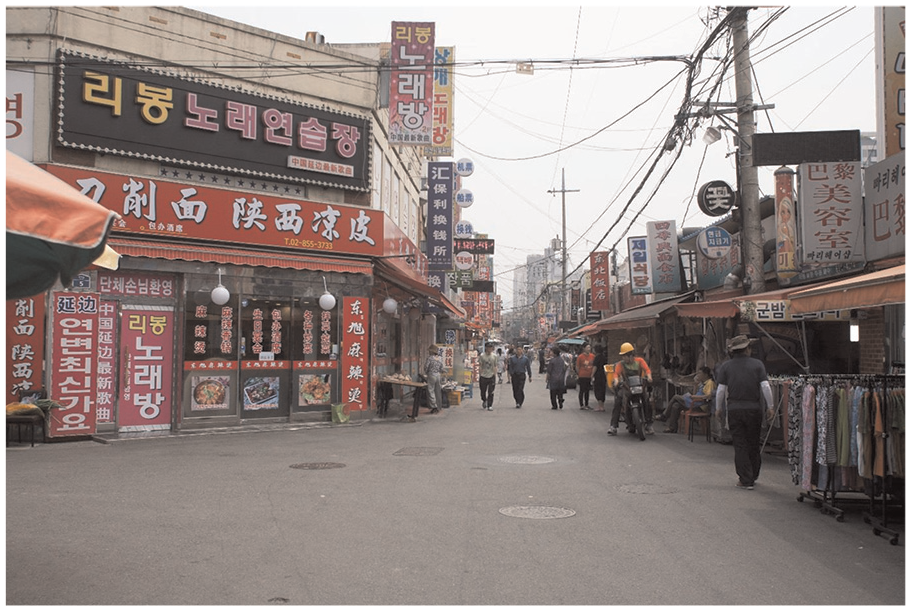
Garibong-dong, Uma Street.
The mechanisms to involve immigrant groups appeared in three different ways in Seoul urban policies: (1) policies celebrating differences as local cultural amenities; (2) building social cohesion; and (3) encouraging participation in community-led regeneration committees. Since 2014, as the direct involvement of local residents and enhancement of quality of lives had been emphasised in various policies of the Seoul Metropolitan government, the policies more frequently mentioned Korean Chinese groups.
Embedded social meaning of ‘Korean Chinese’ in urban policies
Korean Chinese in the discourse of ‘diversity’
Promoting foreign cultures, which aims at revitalising local economies, was one of the most common means to involve ethnic enclaves in South Korea (Lee, 2014). These attempts to ‘celebrate’ diversity in Seoul policies tended to specify the culture of immigrant groups, as frequently being based on the essentialist view of seeing ethnicity. This tendency which considers the culture of ethnic groups as consumable resources to enhance the local economy had been seen in the earlier policy more frequently but is still observed in recent policies.
First, before the second Foreigner Basic Plan replaced the first plan in 2014, Garibong-dong was rarely mentioned in public policies. In this discourse of diversity, the exclusion of the Korean Chinese seems to be strongly related to the cultural representation of the group’s identity. As mentioned, the first Foreigner Basic Plan focused on investors, high-skilled workers and visitors from other countries. The global centres built under the Seoul Global City Basic Plan have mainly been located in the central areas where foreign companies are concentrated such as Jongno and Gangnam, although the largest foreign population in Seoul, the Korean Chinese, have lived in the south-western part of Seoul, including Garibong-dong (Seoul Research Data Service, 2007).
During this period between 2007 and 2014, the Newtown project which planned the large-scale demolition of the entire neighbourhood contributed to overlooking Korean Chinese in Garibong-dong overall policies, and beyond the demolition plan, there seemed to be an understanding that Korean Chinese enclaves do not have sufficient value to be preserved. Even though the methods of development to be used after demolition were common when the Garibong-dong Newtown project was designated, there were still concerns about the preservation of old neighbourhoods. In the arguments for the preservation of Garibong-dong, one of the main contentious issues was the cultural value of the Korean Chinese enclaves to be preserved.
It is true that the perception towards Korean Chinese people is not very favourable. This is because they worked mainly in simple labour. […] Cultural differences also amplified this antipathy. Some argued that they are not worthy of being a multicultural resource [emphasis in original] because they are not differing from Korean culture because they use the Korean language. […] It worked as a ground for the argument to build a new apartment complex after demolishing the area. (K-M Kim, 2014)
In the judgement of immigrant groups, as the ‘multicultural resource’, their cultures are simplified and their language and foods represented as differences, intriguing creativity in existing members of the society. It was not deemed necessary to preserve neighbourhoods where immigrant groups without a favourable image lived. In the 2000s urban policies, including the Newtown project and the Seoul Global City Basic Plan, overlooked the Korean Chinese in Garibong-dong.
Second, even after the demolition works were cancelled and community-led regeneration was introduced in 2015, attempts at articulating the cultures of foreign-born groups as touristic resources were persistent. Social attitudes towards Korean Chinese groups was influential in their involvement, despite the increasing acknowledgement of the necessity for their engagement. For example, the Urban Regeneration project included the Uma Street project to improve the Korean Chinese commercial street, and it was regarded as an opportunity to revalue their contested identity. However, this attempt to articulate and represent the group identity instead revealed ‘a vehicle for misrecognition’ (Fraser, 2000: 112). Without an attempt to rethink the ideas which objectify immigrant groups by perceiving foreign cultures as consumable resources, the Korean Chinese groups’ cultural identities were examined according to the socially rooted ideas about the groups. A conversation with another researcher at the regeneration meeting showed the understanding of Korean Chinese enclaves as ‘diversity’.
[…] the researcher said, ‘But then if it is about diversity, it is more appropriate for the Haebangchon or Itaewon [the area with foreigners from the US].’ The researcher said, ‘Itaewon is completely different from Garibong. In a similar way that you consider Seorae Village [the area with foreigners from France] as a posh place, the foreigners have different social status. If those areas formed foreign commercials, Garibong-dong is a foreign worker’s village and a dilapidated area. Garibong-dong is, in other words, an extremely special case of a specific disease.’ (Field note in Master Planning meeting, 21 April 2016, emphasis added)
The enclave of Korean Chinese was understood as a ‘special case’ which is difficult to deal with within the cases of diversity. The common means to include immigrants in urban policies is to build commercial streets and promote the experience of ‘authentic ethnic culture’, and the Korean Chinese enclave was not considered commercialisable. The difficulties in involving Korean Chinese in urban policies were observed since cultural images of the group did not quite fit the imaginings of cultural diversity which the policies pursued.
Moreover, the complicated identity of Korean Chinese as the ‘in-between’ became problematic in the idea of cultural representation itself. The Korean Chinese group had been developed through their history between the two different societies, but the complicated dimensions of their identity were often overlooked in such processes (Choi and Kim, 2016). Attempts to represent the group have sometimes interpreted them as ‘Chinese culture’. The planner mentioned that ‘I don’t think it [Uma Street] has competitiveness compared to other Chinatowns like Incheon’ (‘Injoo’, planner, interview, April 2016). The Korean Chinese group identities, which could not be interpreted by the pre-fixed frames that represent cultural diversity, became a challenge in the Garibong-dong Urban Regeneration Project. The government announced the plan for Uma Street in 2017, focusing on the enhancement of the street by maintenance work of pavement signboards, without particular emphasis on Korean Chinese groups.
Involving immigrant groups in Korean urban planning has been ossified into the idea of different cultures as touristic resources, and the perceptions of Korean Chinese groups were revealed and shaped through the processes rather than being challenged. This limited understanding of the immigrant group functioned as a means to simplify the complex reality of Korean Chinese groups.
Korean Chinese in neighbourhood cohesion
Apart from the attempt to revalue Korean Chinese groups as multicultural resources, social cohesion has begun to be included as an important task since 2015 although the existing social understanding of Korean Chinese still seems to emerge in policies in a problematic way. The social cohesion projects in policies tend to focus on helping Korean Chinese groups adjust to existing social norms rather than mutually building social understanding. The Multi Values Seoul Master Plan included the expansion of foreign self-policing teams with Korean Chinese groups, and the sub-projects in the Urban Regeneration project appeared as ‘making the neighbourhood crime-free’ and ‘making the neighbourhood garbage-free’. In these projects, Korean Chinese groups seemed to be shown as sources of social disorder, such as crime and uncleanliness.
The neighbourhood environment of Garibong-dong was considered underdeveloped and filthy compared with surrounding areas which had been redeveloped in the 2000s. Owing to the planned demolition, individual development or refurbishment had barely happened in Garibong-dong by 2015. Whilst the physical environment of the neighbourhood deteriorated in the postponed Newtown project, the filthy neighbourhood environment was somehow associated with Korean Chinese groups.
They [long-established Koreans] said the dirtiness and garbage on the streets are our fault. I mean, society is like that. If someone has moved into the neighbourhood. And someone next door lost something. Then whom would you suspect first? (‘Kyung’, resident, interview, March 2016)
The Korean Chinese organised local groups to clean up the street and monitor possible crime incidents in order to change social perception voluntarily, and those activities had been included as a part of policies. Whilst the Korean Chinese residents considered that those activities and educational programmes to improve the social perception of the groups are necessary, they expressed an uncomfortable feeling about how they were being viewed in social programmes.
Although the policies emphasise building social cohesion and living together, the means to involve the Korean Chinese groups tended to emerge as a way to focus group specificities of the Korean Chinese. They deal with Korean Chinese residents as a group lacking in cultural knowledge and recommend that they follow Korean social norms. The Korean Chinese groups considered that the understanding of the groups in governmental programmes reinforced unfair judgements towards their ethnic group.
The emergence of cultural hierarchy in participatory processes
As another means of involving Korean Chinese groups, the committee of Garibong-dong Urban Regeneration was one of the first planning cases which involved Korean Chinese and South Koreans within a mixed group. However, the reality was that Korean Chinese members rarely participated in committee processes although the Urban Regeneration project emphasised the ‘village with multi-culture’. In the Urban Regeneration committee, which involved voluntary participants, only one Korean Chinese person was involved out of a total of 31 members (based on data in May 2016).
The understanding regarding the barriers to participation of Korean Chinese groups significantly differed between the groups. Korean residents and the planning team tended to point out the lack of capability or motivation of Korean Chinese residents, whilst Korean Chinese groups mainly argued that the antagonism amongst them had been built through governmental programmes. One of the Korean Chinese residents who participated in the Regeneration Project described his experience.
When I first came to the meeting, I felt that they had appointed me [as a foreigner advisor] as a mere formality. If they do it in a superficial way, I just will do it in the same way. People have a hunch. People’s attitude changes depending on the others. (‘Ryu’, Korean Chinese advisory member, interview, March 2016)
Along with the description of feeling unwelcome in the Regeneration project, he added other experiences of exclusion in other governmental programmes. This antagonism towards governmental projects, because of the experience of feeling mobilised for the benefit of others, was also observed in the response from other interviewees and, interestingly, it tended to more frequently appear amongst Korean Chinese members who had been actively involved in local social activities. This seems to show that the common assumption regarding the correlation between frequent participation and building positive perception between different groups is not always achievable, especially when the groups are not equally respected. The Korean Chinese organisations were occasionally invited to the committee meetings, but participation was limited to smaller parts such as giving opinions about the sub-projects.
As they assumed, the attitude of other parties was seen as a lukewarm endorsement rather than an active attempt to rethink the groups. The notable factor in the participatory processes in the Garibong-dong Urban Regeneration project was that the cultural understanding towards participants was delivered through the idea of ‘active citizens’ or ‘genuine residents’. Communities in the community-led regeneration policies tended to emerge as capable citizens who can rebuild social values such as the sense of attachment and the quality of life (Seoul Metropolitan Government, 2014b). An inclusive consultation lay on the emphasis of ‘spontaneous participation’ of residents, and the voluntary participation in the projects was somewhat understood as an indicator to show motivation as ‘genuine’ participants.
In the Garibong-dong Regeneration project, the participants tended to be drawn from the network amongst Korean groups who had been involved in the previous Newtown project, which did not include the Korean Chinese groups. The experience of the collective works to cancel the state-led demolition of the area led them to engage in more direct participation, frequently claiming their sense of community and ownership during the process of the Regeneration project.
That [the cancellation of the Newtown project] made us feel responsible. Anyway, from the viewpoint of ‘one who has tied a knot must untie it’, I think that we need to watch the later procedure, the regeneration project or whatever, so I began to participate. That is the reason why the proportion of the Korean groups who participated in the Newtown committee became bigger in the regeneration committee. (‘Ilwon’, member of the committee, May 2016)
However, instead of encouraging the participation of Korean Chinese the ideas of active participants contributed to their exclusion. Whilst there were sceptical attitudes observed amongst Korean Chinese groups, emanating from their concern about being mobilised for the interests of the dominant groups, their lack of participants was simply interpreted as lack of motivation. In this assumption, the idea of ‘active citizens’ tended to work in order to strengthen the positions of South Korean groups as the authentic community by distinguishing them from Korean Chinese groups. There were certain assumptions emerging from the reasoning, which frequently seem to be based on the stereotypes about Korean Chinese regarding the invisibility of Korean Chinese groups. For example, the planners tended to mention their lack of experience in civic society and democracy (‘Woong’, planner, interview, March 2016), and Korean participants frequently made negative comments regarding the presumed level of education of Korean Chinese groups.
In around the 1980s, those who came here amongst Korean Chinese were intellectuals. But from 1993 onwards, the people who came here were the lowest class in Chinese society. (‘Song’, member of the committee, interview, May 2016)
The notable point was that this social understanding from South Koreans emerged significantly in the interviews with Korean Chinese as one of the reasons to explain why they did not actively participate in the planning processes. The Korean Chinese communities were aware of the social understanding of their group. They used to say that Korean people do not consider them to be ‘genuine residents’.
Other residents used to think that we [Korean Chinese] will leave whenever we want and consider us as half-residents. So, if I, a rolling stone from elsewhere, make a strong opinion, Korean people would react against that. (‘Ryu’, Korean Chinese advisory member, interview, March 2016)
In a growing awareness, one of the interviewees made a clear division between social activities. He mentioned that he said to other Korean Chinese ‘don’t get involved in claiming the right, even if you have citizenships because it is the most convenient way to avoid conflicts’ (‘Yong-gun’, Korean Chinese organisation, interview, April 2016).
In short, the barriers for Korean Chinese groups to being involved in the committee were revealed to be highly complex. First, in decision-making processes, tensions occurred because of the inter-group relations with long-established Korean groups. As Young (1990) and Fraser (2003) argued, the power relation between groups in decision-making processes is not possible to be solved by distributing opportunities but is embedded in practices and deeply rooted cultural patterns. However, second, the framework of the Urban Regeneration policy did not provide any further means to mediate those existing group relations and, rather, the implicit and explicit identification of ethnicity seems to have an impact on participatory processes. For example, the sub-projects such as the Uma project were suggested by the planning team without involving Korean Chinese groups sufficiently, and those projects tended to deal with the local issues of Korean Chinese groups as a separated set of projects.
From the viewpoint of Korean Chinese groups, the encouragement of participation was considered largely as an empty gesture to mobilise them for legitimacy. The assumptions about the Korean Chinese groups, such as being aloof, less knowledgeable or less culturally competent, tended to drive other actors to consider the opinions of Korean Chinese groups as less significant or unusual. Within this structure, this ethnic identification influenced the immigrants’ ways of navigating themselves and negotiating with others. The participatory planning failed to draw their participation and, instead, seemed to build their antagonism towards formal planning procedure.
Conclusions
In this paper we find that the current means of involving immigrant groups in the Korean planning system tends to persistently deliver an existing social understanding of ethnic minorities, and it was one of the main barriers marginalising them in planning processes. Indeed, it is not uncommon to observe the lack of migrants’ participation, and it is not solely influenced by the cultural identity of the group. The lack of time and resources owing to the precarious economic situation and resulting lack of participation are also seen in other cases of low-income or disabled people (Edwards, 2008). However, by involving Korean Chinese who are economically successful, who own properties in the areas and who have already acquired Korean nationality, as members of the interview participants, the interview data showed that an ethnic categorisation is a predominant division which the groups face. The mechanism of involving immigrant groups relied on a simplified view of understanding the groups, undermining their voices and discouraging their participation. These implicit barriers embedded in planning processes were rarely understood or criticised.
The formation of a presumed ethnic identity in urban policies has taken various discourses. The opportunity for participation seemingly widened compared with the previous Newtown project for both Korean long-established groups and Korean Chinese groups as the policies emphasise the direct involvement of local residents. Their group categorisation became even more deeply embedded in the process and also mobilised the community, but obstacles still remained against the participation of immigrant groups. On the one hand, as Fincher and Iveson (2008) argued, group-specific approaches such as building cultural districts and commercialising ethnic cultures show the limitation more starkly through providing a clearer articulation of how such policies are underpinned by fixed understandings of certain ethnic groups. On the other hand, the power relations within participation in decision-making processes were more sophisticated, but those cultural patterns still seem to be embedded. Although the policy did not explicitly specify the group differences, the assumption towards immigrant groups tended to be shaped within the group interactions.
Including immigrant groups without mediating embedded cultural hierarchy consequently located them in subordinated positions in decision-making processes. Moreover, this aroused antagonism towards the governmental programmes amongst ethnic minorities through unbalanced group interactions. This requires further examination, such as whether the current institutional design of participatory planning provides the means for immigrant groups to be involved with equal social esteem in decision-making processes and how the current idea of ‘desirable’ participants hinders this involvement. Although many argued the importance of the transformation of group relations and the finding of this study supported these arguments, the urban policies highlighted these existing relations through group identification rather than challenging them.
When it comes to the impact of group identity on inclusion/exclusion in the planning procedure, the intertwined dimensions of economic and social status, and cultural identity, tended to make the issues of involving immigrant groups complicated. On the one hand, their marginalisation sometimes had been strongly related to their economic status. For example, the labour divisions appear to build a social image of Korean Chinese groups as less-educated ‘simple’ labourers. The history of Korean planning, which had only focused on landlords throughout Newtown projects, marginalised Korean Chinese groups. However, on the other hand, the ethnic categorisation of ‘Korean Chinese’ seems to have an effect as a strong identification by embodying these undesirable sets of features as the ‘natural attributes’ of groups. Furthermore, by being in a powerless position in decision-making processes, Korean Chinese groups tended to be excluded from decisions related to distributions such as prioritising budgets, and it seemed to possibly worsen the existing economic inequalities.
Investigating the limitations of the current mechanism of participatory planning in involving diverse social members should be an important part of planning studies attentive to how presumed group differences may undermine the intention to create a fairer procedure. Nevertheless, the studies regarding cultural hierarchy between ethnic groups in urban policies were still limited. I argue that assumptions about groups which are based on the essentialist view contribute to further barriers to obscure the existing cultural hierarchy, which limits their motivation. Participatory planning processes need to give fuller consideration to existing inequitable cultural patterns of group relations and work further to create processes that challenge negative stereotypes of ethnic minorities based upon simplified group identities.
Footnotes
Declaration of conflicting interests
The author declared no potential conflicts of interest with respect to the research, authorship and/or publication of this article.
Funding
The author received no financial support for the research, authorship and/or publication of this article.
