




Abstract
The segregation or integration of minority groups is a core issue in contemporary urban fabrics. The literature tends to highlight the difference between ethnic groups while diversity within them receives less attention. This study addresses such differences by looking at Arab residents of ethnically mixed Israeli cities. Specifically, it highlights religious affiliation and community standing (in terms of being an old/new city) by comparing three Arab subgroups: Muslims and Christians from Haifa and Christians from Nof HaGalil. Uncovering these variations, we use Schnell’s multidimensional model of segregation/integration relating to 12 dimensions of economic, social, cultural and emotional capitals. The study employed 222 questionnaires and GPS loggers to track the respondents’ daily movements. The results reflected different patterns of integration/segregation between the three communities, with Haifa Christians exhibiting wider and deeper integration compared with Nof HaGalil’s Christian residents and Haifa Muslims. Additionally, the high diversity within each group demonstrates the complexities of integration/segregation processes combining structural issues and personal choices.
Introduction
The socio-spatial integration/segregation of minorities is an increasingly debated concern. Current studies address different ethnic groups, as many are based on census data (Brown and Su-Yeul, 2006; Clark et al., 2015; Holloway et al., 2012). The diverse responses to the use of spaces in the era of globalisation within these groups, however, have received little scholarly attention. The current study addresses the diversity within a minority group – Arabs in Israel 1 living in ethnically mixed cities – by looking at three different subgroups: Christians and Muslims from the established mixed city of Haifa and Christians living in the newly mixed city of Nof HaGalil.
Comparing these three groups allows for the uncovering of two substantial factors. First is religious affiliation as a core identity that evidently plays an important role in the integration processes of minorities (Gale, 2013; Hemming, 2011), where Christians presumably lean towards more Western values yet are a minority group within the Arab minority. Second is the standing of an Arab community within the locality, and the difference for this between a city inhabited by Arabs for generations and a new mixed city formed a few decades ago as part of the Judaification of Israel. This difference is substantial because the presence of Arabs in an established mixed city may be legitimised by the Jews living there, whereas Arab residence in a new city designated for Jews can mean negative attitudes from the Jewish majority. This issue, moreover, could shed light on current debates regarding newcomer immigrants and host communities (Borevi and Bengtsson, 2015; Shokeid, 2015).
Traditionally, studies focused on residential segregation (Brown and Su-Yeul, 2006; Clark et al., 2015; Johnston et al., 2007). The turn of the 21st century saw a shift, as this focus proved insufficient to uncover contemporary diverse lifestyles marked by increased spatial movement in globalised space, and diverse social and telecommunication-based interactions (Kwan, 2013; Ruiz-Tagle, 2013; Wong and Shaw, 2011). These factors required an approach able to capture this multidimensionality.
The current study employs Schnell and his associates’ multidimensional approach for the study of segregation/integration (Goldhaber and Schnell, 2007; Schnell and Benjamini, 2001, 2005; Schnell and Haj-Yahiya, 2014; Schnell et al., 2015). It measures socio-spatial integration and segregation along one continuum on several dimensions: residential spaces; activity spaces; and economic, social, cultural and emotional forms of capital accumulation based on inter- versus intra-ethnic sources. Specifically, the study aims to identify the rates of segregated and integrated individuals among the three groups studied, to uncover the depth of integration or segregation within each subgroup and finally to identify indicators associated with each subgroup’s segregation/integration.
Beyond presenting a new perspective on Jewish–Arab relations in Israel, particularly in the ethnically mixed cities, the study contributes by addressing the diversity of integration/segregation within minority subgroups. Furthermore, socio-spatial integration is rarely discussed in geography and it is frequently oversimplified into mixing in residential space (Ruiz-Tagle, 2013). Additionally, the study lends further support to Schnell and his associates’ multidimensional approach regarding specific social indicators: religious affiliation and the standing of a minority community in a locality.
Integration versus segregation in urban contexts
Integration is defined by concepts such as inclusion, incorporation, combining, mixing, fusing and uniting (Farlex, 2010; Hainmueller et al., 2017). Others emphasise the salience of a sense of belonging in defining social integration (Berkman et al., 2000; Hurtado et al., 2002). Hainmueller et al. (2017) suggest a more comprehensive definition, in terms of the removal of all barriers to full participation in society.
The question remains as to the conditions that allow the full participation of individuals and social groups in social life. Some scholars emphasise the role of embeddedness in social networks as a means for integration (Brissette et al., 2000; Putnam, 2007), whereas others focus on emotional aspects such as attachment (Berkman et al., 2000; Burholt, 2006) or cultural aspects like language fluency (Barns et al., 2006). Several scholars show interdependence between the structures of social networks, involvement in communities and a sense of belonging (Schorr et al., 2017). Toepoel (2011) and Ruiz-Tagle (2013) suggest viewing integration in a multidimensional model, with the dimensions complementing each other in evoking a sense of involvement and belonging among members of society. Bohnke and Kohler (2008) stress the importance of equal rights and opportunities, shared values, trust, a sense of belonging and social networks as aspects of integration. Finally, Koramaz (2014) reminds us of the distinction between the structural and interpersonal social aspects, arguing that social networks are the key aspect for interpersonal integration.
These categorisations lack a systematic conceptualisation. Schnell et al.’s (2015) model further operationalises this suggested approach by relying on Putnam’s (2007) forms-of-capital theory, distinguishing between capital from intra- and intergroup sources. They define indices for social, cultural, economic and emotional forms of capital and measure the levels of mixing of the studied population in residential and daily activity spaces. Forms of capital from interethnic sources are considered to contribute to integration. Schnell et al.’s model is rather similar to that of Ruiz-Tagle (2013), which relates to spatial (proximity), functional, relational (network structures) and symbolic (emotional and identity) dimensions of integration. The variance between the aforementioned aspects of integration/segregation has been empirically verified in Israeli studies (Goldhaber and Schnell, 2007; Shdema et al., 2018).
Another aspect of the definition of integration relates to structure, meaning the sociopolitical context in which interactions take place. On the one hand, assimilationist worldviews have tended to define integration in terms of unification of populations within the nation-state, in which all members are expected to adopt one culture, one sense of belonging and shared systems of social networks. On the other hand, multicultural worldviews reject strivings for unification, focusing on producing the conditions for self-actualisation within social diversity (Farlex, 2010).
We argue that segregation, as the opposing pole of integration, should be defined in the same terms of lack of access to integrative forms of capital accumulation. This is opposed to traditional definitions that focus on the uneven distribution of populations (Liberson, 1981; Massey and Denton, 1988; Morrill, 1991; Reardon and O’Sullivan, 2004; Wong, 2005). These models have been criticised for drawing oversimplified deductions from forms of residential space, to social structures (Harvey, 1989). Relatedly, Ellis et al. (2004) criticised the exaggerated focus on segregation in residential space.
The multidimensional approach
Wong and Show (2011) and Kwan (2013) developed models that consider segregation in both residential and daily activity spaces. However, their models assume that proximity in the latter increases not only the chances for intergroup encounters but also actual encounters. In contrast, our lifestyle approach assumes that people who are active close to members of other groups do not necessarily integrate with them. Other scholars studied the complexity of the relations between the spatial and social, showing how interethnic encounters may either decrease or increase racism depending on the socially structured context in which these encounters occur (Leitner, 2012; Schnell and Haj-Yahya, 2014; Valentine, 2008; Valentine and Sadgrove, 2012).
In this study, we adopt Schnell et al.’s (2015) model, comparing three different Arab communities in mixed cities in Israel. The model is based on the following propositions. First, following Pratt (1998) and Kwan and Schanen (2018), it assumes that especially in the globalisation era, integration/segregation should be contextualised to subjects’ everyday life spaces and be subject to spatio-temporal uncertainties. Second, social reference groups may be fragmented, and people may develop highly individualistic identities in response to highly diverse and dispersed reference groups (Giddens, 1991). Therefore, any analysis must start from the individual before aggregating results. Third, since spatial movement is becoming more fluid over time, residential space does not necessarily determine activity spaces and agents may enjoy relatively high levels of choice in movement patterns. Fourth, telecommunication penetrates territorial boundaries more flexibly than ever, enabling meaningful global interactions. However, the fluidity of space is not evenly distributed, leaving room for different socio-spatial lifestyles, from highly global to highly local. Fifth, any analysis has to transcend the dichotomy between human agency and social structure, and we suggest the concept of socio-spatial lifestyle as a starting point, referring to the ways individuals use everyday life spaces to perform selected social projects (Giddens, 1991; Schnell, 1996). Finally, integration and segregation are measured by the salience of either intra- or interethnic sources of capital in all its forms and articulations in residential and activity spaces (Schnell et al., 2015).
We follow Putnam (2007) in defining economic, social and cultural forms of capital accumulation, and follow Lee and Kwan (2011) in adding emotional forms. Similar to Granovetter (1973), we distinguish between bridging social networks that increase intergroup integration and bonding networks that increase segregation. Emotional attachment and identification with a shared identity were shown to intensify integration in the labour market and society, helping to distinguish between interethnic encounters that increase integration and those that increase prejudice and antagonism and therefore segregation (Battu and Zenou, 2010).
Arabs in Israel and the mixed cities
Arabs in Israel count approximately 1.6 million, or 21 per cent of the population. They are the residuals of a larger community that fled the country in 1948. About 80 per cent of Arabs are Muslims, with the rest dividing nearly equally between Christians and Druze (Israel Central Bureau of Statistics [ICBS], 2019). The Arabs are marginalised and discriminated against in light of Israel’s self-designation as a Jewish State, the Israeli-Palestinian national conflict, substantial cultural and religious differences and discriminating policies (Ghanem, 2013; Smooha, 2002, 2005; Yiftachel, 2006). We adopt Smooha’s (2002, 2005) configuration of ‘ethnic democracy’ that structurally prefers a particular ethnic group over others.
About 90 per cent of Arabs in Israel live in exclusively Arab localities. Most of the rest live in mixed Jewish-Arab cities (ICBS, 2019). Since 1948, there have been five mixed cities (Acre, Haifa, Jaffa, Lod and Ramla) which were previously inhabited by an Arab majority, most of whose members became refugees in the 1948 war (Tzfadia, 2011; Yacobi, 2002, 2009). Over the years, new mixed cities have developed, including Nof HaGalil, Karmiel and Beersheba, due to the increasing flow of migration from Arab towns. The migration wave was triggered by the geopolitical struggle between social groups in neoliberal cities (Rokem and Boano, 2017; Yacobi, 2009). The geopolitical conflicts in the production of space take place from above by public institutions and from below based on a combination of class and ethno-national struggles (Braier and Yacobi, 2017; Raanan and Avni, 2020; Rokem, 2017). Accordingly, Arab migration to Jewish cities accelerated for a combination of reasons. There was a severe shortage of houses and land available for construction in Arab towns, which forced many Arabs out of their hometowns (Al-Haj, 2012). Also, the transition of Israel to a neoliberal system opened the doors for Arab mobility into the upper middle class (Shtern and Yacobi, 2019). The Arabs wished to improve their standard of living (Arar and Haj-Yehia, 2016) and to escape the traditional controlled lifestyles of their hometowns (Herzog, 2007). At the same time, the nationalist populist regime initiated by Prime Minister Netanyahu increased ethno-national tensions (Avni, 2020). Some of the newly immigrated cities were established or settled with Jews in Arab majority areas to ensure territorial control (Blatman-Thomas, 2017; Rabinowitz, 1997; Yacobi, 2002, 2009; Yiftachel, 2006), thus increasing the opposition to the penetration of Arab immigrants to these cities. This means that the struggle over integration in the mixed cities is rooted both in class and ethno-national struggles. Muslims are expected to confront stronger opposition from Jews compared with Christians and Druze.
In all mixed cities, Jews represent 70–90 per cent of the total population. Arabs’ residential segregation is between 40 and 60 according to the Liberson (1981) Scale. Most Arabs live in marginalised ethnic enclaves (Blatman-Thomas, 2017; Rabinowitz, 1997; Yacobi, 2002, 2009).
These gaps raise the question as to the essence of the mixed cities functionally, whether these are truly mixed cities where interethnic encounters and interactions take place, including some based on choice, or merely two communities living separately together in the same municipality. Due to the relatively scarce social interactions in practice, some refer to the cities as ‘mixed’, suggesting that they are not really mixed (Leibovitz, 2007; Yacobi, 2002), or even term them polarised cities (Abu-Rayya et al., 2020). However, scholars agree that Jerusalem, which is also inhabited by both Jews and Arabs, forms a different case as it is a divided city given the political dispute over it and the fact that Jewish and Arab residents do not share the same legal status (Leibovitz, 2007; Rokem et al., 2018).
Haifa is the main metropolis of northern Israel (ICBS, 2019), inhabited by nearly 300,000 residents, about 11 per cent of whom are Arabs. Founded centuries ago, it has been an administrative and economic hub since the British Mandate that built the modern port and oil refineries. During the Mandate period (1920–1948), Haifa was ethnically mixed, with an Arab majority that gradually declined as Jewish immigrants arrived (Goren, 1996). Interethnic relations were relatively good and cooperative, and both communities ran the municipality jointly.
The 1948 war transformed Jewish–Arab relations, as over 90 per cent of Arab residents became refugees or internally displaced persons; only about 3500 Arabs remained in Haifa (Goren, 1996). The influx of Jewish immigrants to the city in the years following the war further reduced the relative Arab presence.
Despite the troubled geopolitical circumstances, since then a stable interethnic framework has developed in the city, marked by tensions and inequality as well as mutual respect and substantial cooperation. Haifa is recognised by scholars as the mixed city in which Jewish–Arab relations are the best in the country (Falah et al., 2000). As a city with a long tradition of tolerant relations, Arab presence is perceived as ‘natural’. Politically, it is a traditional leftwing stronghold (‘Red Haifa’), characterised by less prejudiced attitudes towards Arabs. Additionally, as an economic hub, the relative prosperity it offers eases tensions. Currently there are about 30,000 Arab residents in Haifa, nearly equally divided between Muslims and Christians.
Nof HaGalil presents a substantially different case. It was established as Upper Nazareth in 1957 as a Jewish stronghold in an area dominated demographically by Arabs, located right above Nazareth, which became the largest Arab city in Israel after 1948. To a large extent, it was founded on lands confiscated from Arabs, some of whom still reside in nearby localities. Some of its residents as well as municipal officials have argued over the years that it suffers from a negative stereotype due to its name’s resemblance to the Arab Nazareth, and in 2019 it was changed to Nof HaGalil (View of Galilee).
Until the 1970s, only Jews lived in the town, but since then Arabs, primarily of the upper middle class, started migrating to it due to a shortage of housing in nearby Arab localities, to improve their standard of living and because of the tight social supervision within their traditionalist localities of origin (Kipnis and Schnell, 1978). Currently, the town consists of nearly 40,000 residents, about 25 per cent of whom are Arabs (65 per cent Christians and 35 per cent Muslims) (ICBS, 2019). Interethnic relations in Nof HaGalil are less tolerant compared with those in Haifa (Falah, 2000). The town was designated for Jewish settlers to begin with, the political leaning of the Jewish residents is clearly to the right and as a peripheral town it suffers from economic constraints that tend to increase interethnic competition over limited resources.
Arab Muslims and Christians differ in religion but share substantial characteristics and identities such as Arab culture, Palestinian nationality and marginalised status within the state (McGahern, 2011). While Muslims are the majority among Arabs in Israel, the percentages of Christians in mixed cities are much higher.
The religious difference is relevant in the context of segregation/integration processes. Muslims constitute the majority and are perceived as tightly affiliated with the Arab-Islamic world, hence they are more alienated in Israel’s social space and are perceived as closer to Israel’s enemies. Arab Christians compared with them are characterised by Western values due to their religion and are often seen as ‘less Arab’ by both Jews and Muslims, hence they might face fewer barriers to integration. In this regard, Mjally-Knani et al. (2017) found, somewhat against the general view, that Muslims had greater willingness to integrate in Jewish-Israeli society compared with Christians, who struggle to maintain their double minority status.
Additionally, Arab Christians are characterised by a significantly higher socioeconomic status compared with Muslims. They are better educated, participate to a greater extent in the paid labour market and have a lower fertility rate. All these result in lower poverty rates. Actually, on many socioeconomic characteristics, Arab Christians are closer to Jews than to their Muslim counterparts (ICBS, 2019). These gaps are largely attributed to a tradition of high-quality, privately owned church schools, some of which date to the 19th century.
Looking at the three groups studied means addressing the substantial differences within the minority groups – religious affiliations, plus whether they are a longstanding Arab community or are immigrants whose presence might be more challenging.
Methods
Sample
Aimed at comparing three groups, the sampling was designed to represent the diversity within each subgroup, rather than the distribution of ethnoreligious groups within each city studied. The sample included 222 participants, of whom 60 were Muslim residents of Haifa, 82 were Christians of Haifa and 80 were Christian residents of Nof HaGalil. The participants were representative in terms of sex and socioeconomic status. Their ages ranged from 20 to 40 – representing younger adults, who presumably play an important role in Arab–Jewish relations in contemporary mixed cities in Israel.
Variables
Data were collected using questionnaires with items addressing 12 integration/segregation factors related to four forms of capital (economic, social, cultural and emotional) as well as activity spaces (Table 1). In addition, the participants were asked about their sociodemographic characteristics.
Integration/segregation factors.
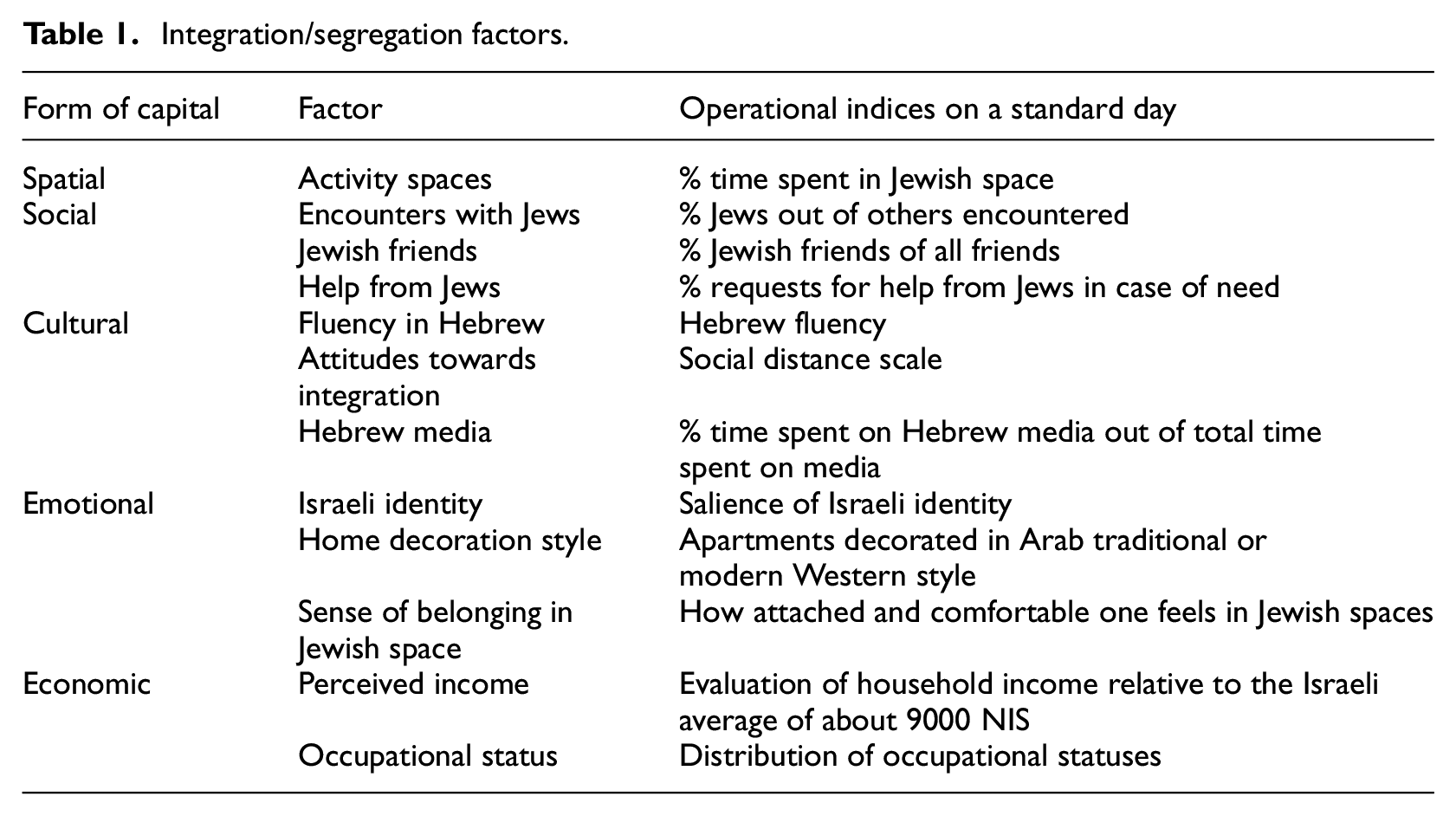
Spatially, we distinguished between activities performed in predominantly Arab or Jewish spaces on a standard day. Our definition of Jewish/Arab space related to both public (i.e. neighbourhoods, commercial centres) and private or segregated spaces (i.e. home, school), referring to the population most represented in them. A standard day was defined in terms of the time spent in each type of space on an average day of the week examined, and with additional reference to activities less commonly performed, such as shopping or leisure.
Socially, we used three measures sorted according to level of commitment: occasional encounters with Jews in the week under study, number of Jewish friends, and tendency to request help from Jews as a marker of a more committed interaction based on choice.
Culturally, our analysis ranged from superficial issues to deeper indicators, and included fluency in Hebrew, attitudes towards integration, and the consumption of mass media in Hebrew (preference over Arabic channels also available to the population under study). All were self-assessed by the respondents and measured on a 1–5 Likert scale) (Albaum, 1997).
Emotionally, our measures started from the least ‘committed’ aspect – the way people choose to decorate their houses. This was assessed by the first author during the interviews based on the subjects of photos, the style of furniture and carpeting, etc. Additionally, we asked respondents about their sense of belonging in Jewish space and the salience of Israeli identity to them as reflecting their emotional bonding to specific settings and to the state as a whole. All these measures were rated on a 1–5 Likert scale.
Socioeconomic status was reported by the participants in terms of occupational status expressed in job prestige (ranked 1–5, from low blue collar to high white collar, according to International Labour Office standards; ILO, 1990) and perceived income (1–5 in relation to the mean income in Israel). Note that these relate to two different measures of labour that in many cases do not overlap.
Procedure
The fieldwork was conducted from October 2012 to August 2014 by the first author, an Arab resident of northern Israel. Members of the three communities were randomly selected from names identifying their religious affiliations, in water bill lists of both municipalities. Corrections were made to limit the interviewees by age and sex. The refusal rate was 17 per cent (without significant differences between the groups studied), mainly because participation required relatively considerable time (as explained below). In these cases, we contacted the next person on the list.
We met each respondent twice. First, they completed the questionnaire. At the end of this meeting, we provided them with a GPS logger to track their movements for a week. After a week, we met each interviewee for a second time to create a map based on the GPS data and asked the respondents about specific activities over the week.
Figure 1 presents examples of maps of an integrated and segregated lifestyle, respectively. Clearly, the first respondent is marked by a daily commuting pattern while the second only rarely visits the regional metropolis. We present maps of participants from Nof HaGalil because for them movement in space and particularly commuting is more evident, as Haifa is their employment and service hub away from home.
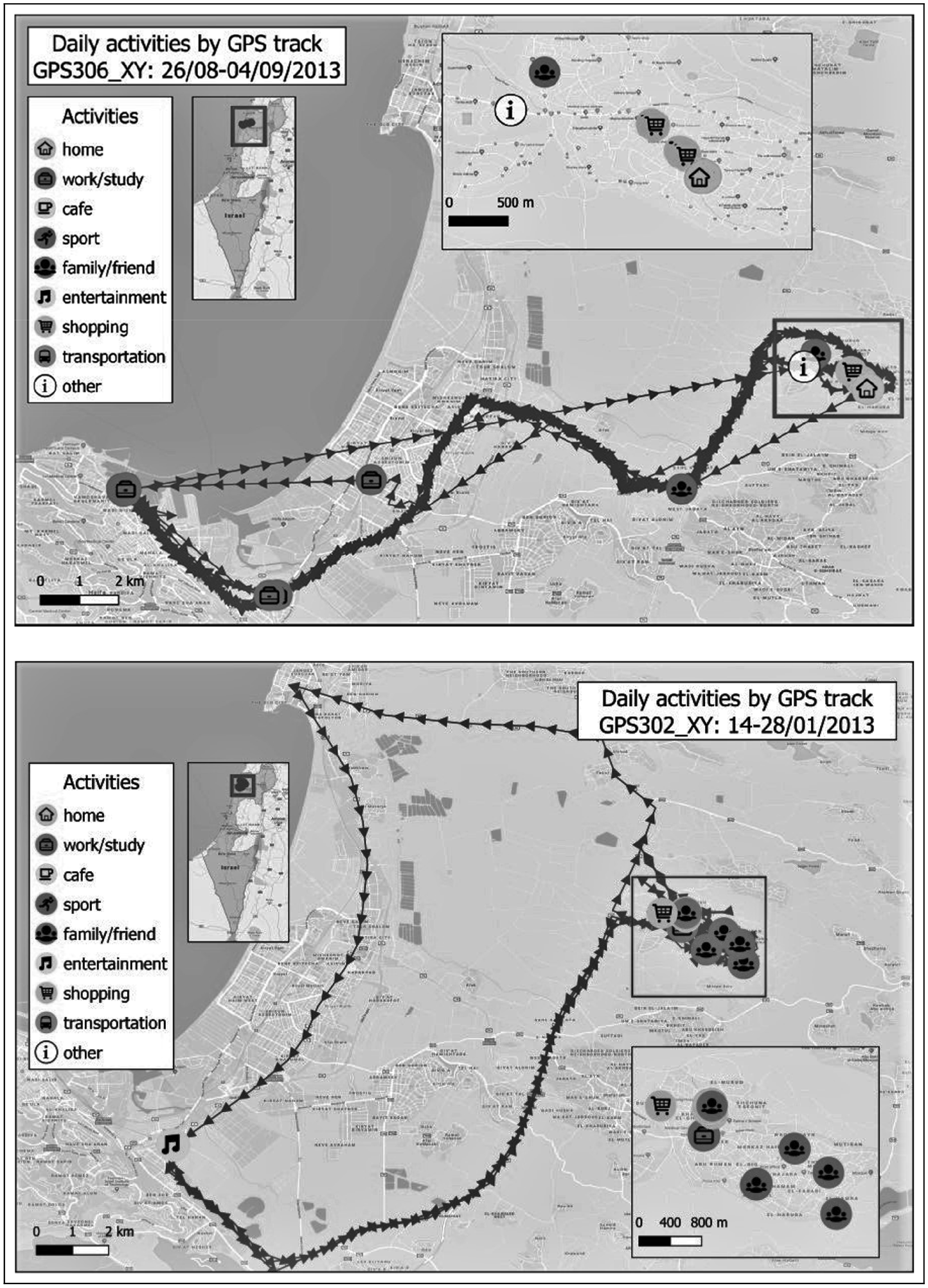
Example of the weekly movements of an integrated (top) and a segregated (bottom) respondent.
Data analysis
First, all indices were converted to a 1–5 Likert scale, with scores of 2 and below considered ‘segregated’, 4 and above ‘integrated’ and 2.1–3.9 ‘mixed’. Next, we examined the depth of segregation/integration for each group studied. For this, we standardised segregation/integration values and aggregated each subject and their partial levels regarding each factor studied. The results are three aspects of integration/segregation, the percentage of segregated and integrated persons in each index and the average of all factors. Depth of integration was measured by calculating the mean values of the segregated and integrated respondents relating to each factor, and comparing the overall index between each pair of groups studied (Muslims and Christians from Haifa and Christians from Haifa and NofHagalil) using a Mann-Whitney test. Finally, we performed a principal component analysis to identify the main factors associated with segregation or integration within each group and explain the variance in integration/segregation. All relevant analyses were calculated at 95 per cent confidence level.
Results
Distribution of segregated and integrated participants
The findings indicate that the Christians from Nof HaGalil are the most segregated group among the three, with almost two-thirds of them being segregated, and are the least integrated group, with only 11 per cent integrated. Christians in Haifa are the most integrated, with about a third being integrated, and they are the least segregated, with only 14 per cent segregated. While the differences between Muslims and Christians are non-significant, the differences between residents of both towns are highly significant, as reflected in the Chi-square test results (Table 2).
The distribution of the overall integration/segregation by community.
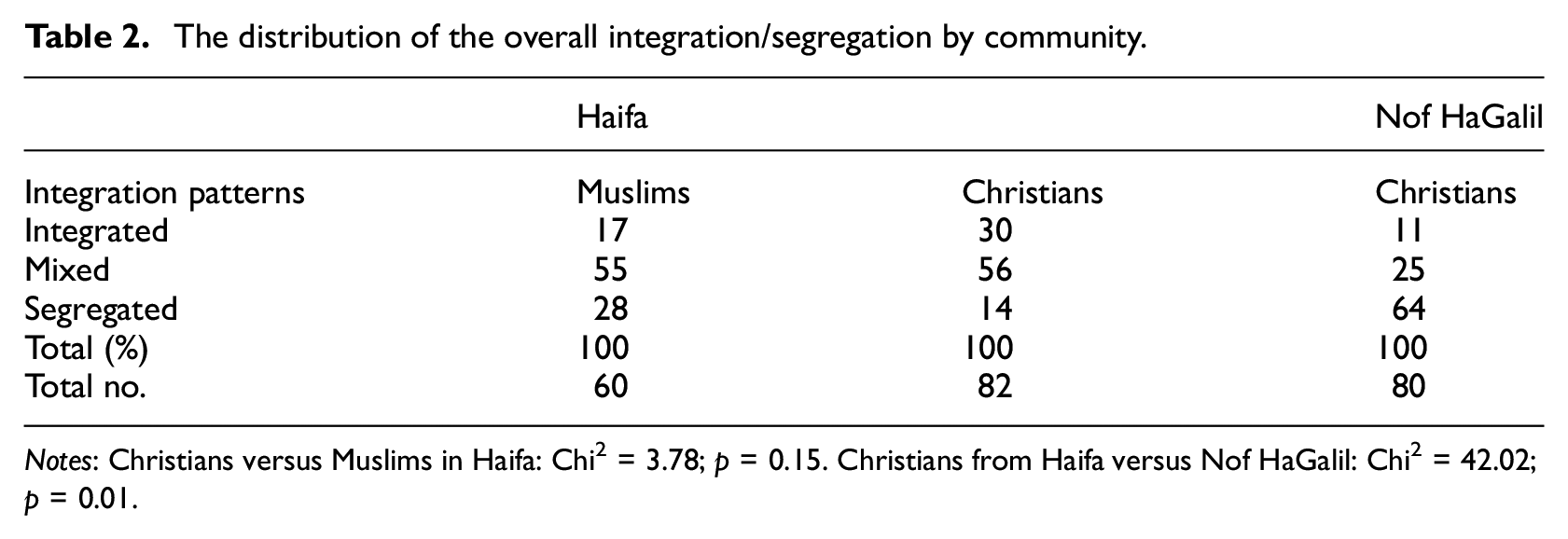
Notes: Christians versus Muslims in Haifa: Chi2 = 3.78; p = 0.15. Christians from Haifa versus Nof HaGalil: Chi2 = 42.02; p = 0.01.
Depth of segregation/integration
Tables 3 and 4 present the results for the depth of integration/segregation of each group based on normalised mean values of the segregated and integrated individuals within each group. In addition, we calculate the median value for the segregated and integrated individuals and the differences between the groups in each factor analysed. As mentioned above, there is a significant difference between Muslims and Christians in Haifa. Segregated Christians are characterised mainly by exclusion from high-status occupations, relatively low incomes relative to Muslims, a lack of exposure to mass media in Hebrew and negative attitudes towards integration. In contrast, they are more integrated in social networks, they have a substantial number of Jewish friends, they tend to ask for help from Jews, they are fluent in Hebrew and have a fairly high sense of belonging in Jewish spaces. It seems that despite their relative success in developing integrative social capital, they do not enjoy occupational mobility and hold negative attitudes towards integration.
Depth of integration/segregation and Mann-Whitney analysis of differences between Christians and Muslims in Haifa.
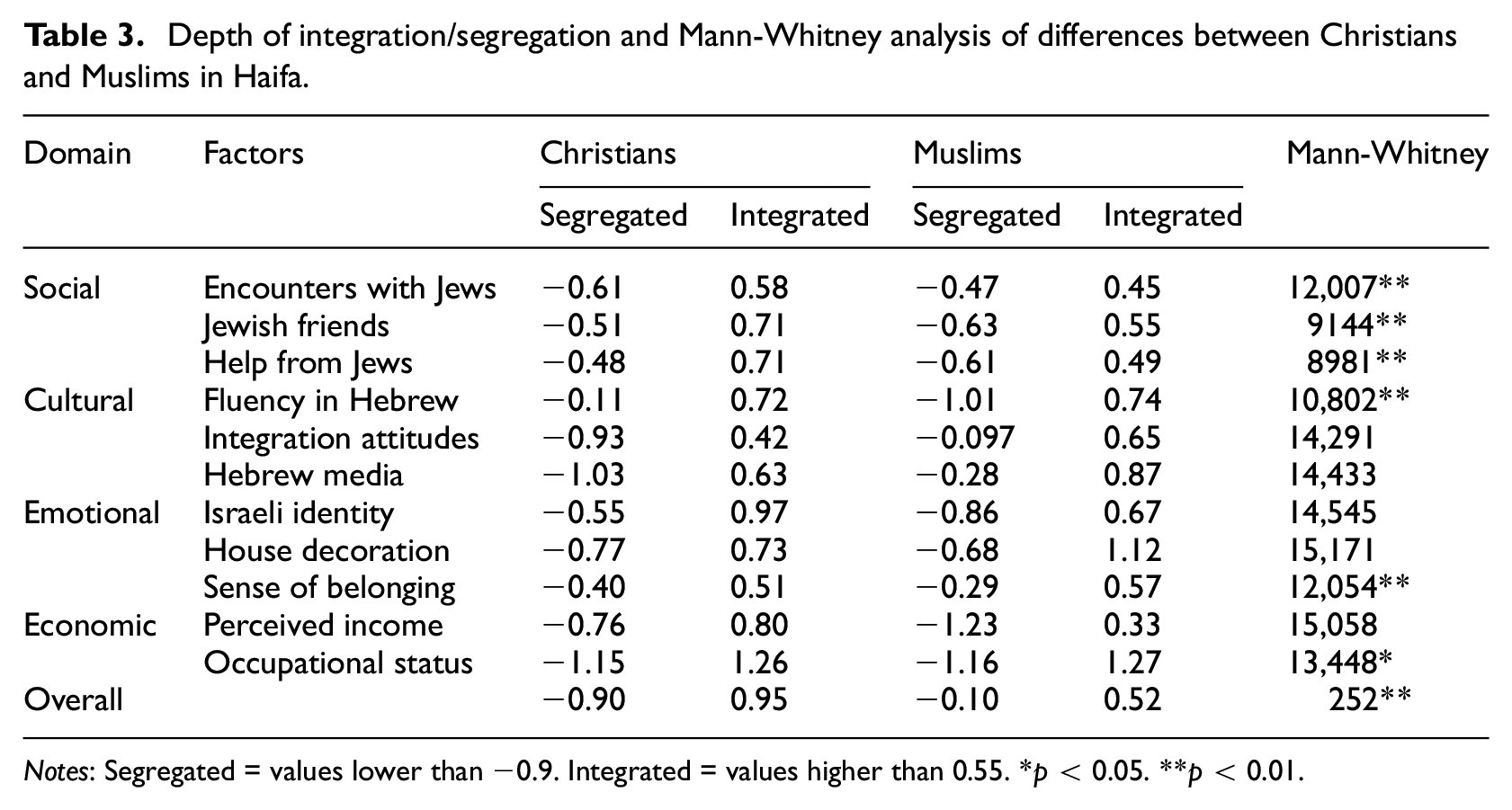
Notes: Segregated = values lower than −0.9. Integrated = values higher than 0.55. *p < 0.05. **p < 0.01.
Depth of integration/segregation and Mann-Whitney analysis of differences between Christians in Haifa and Nof HaGalil.
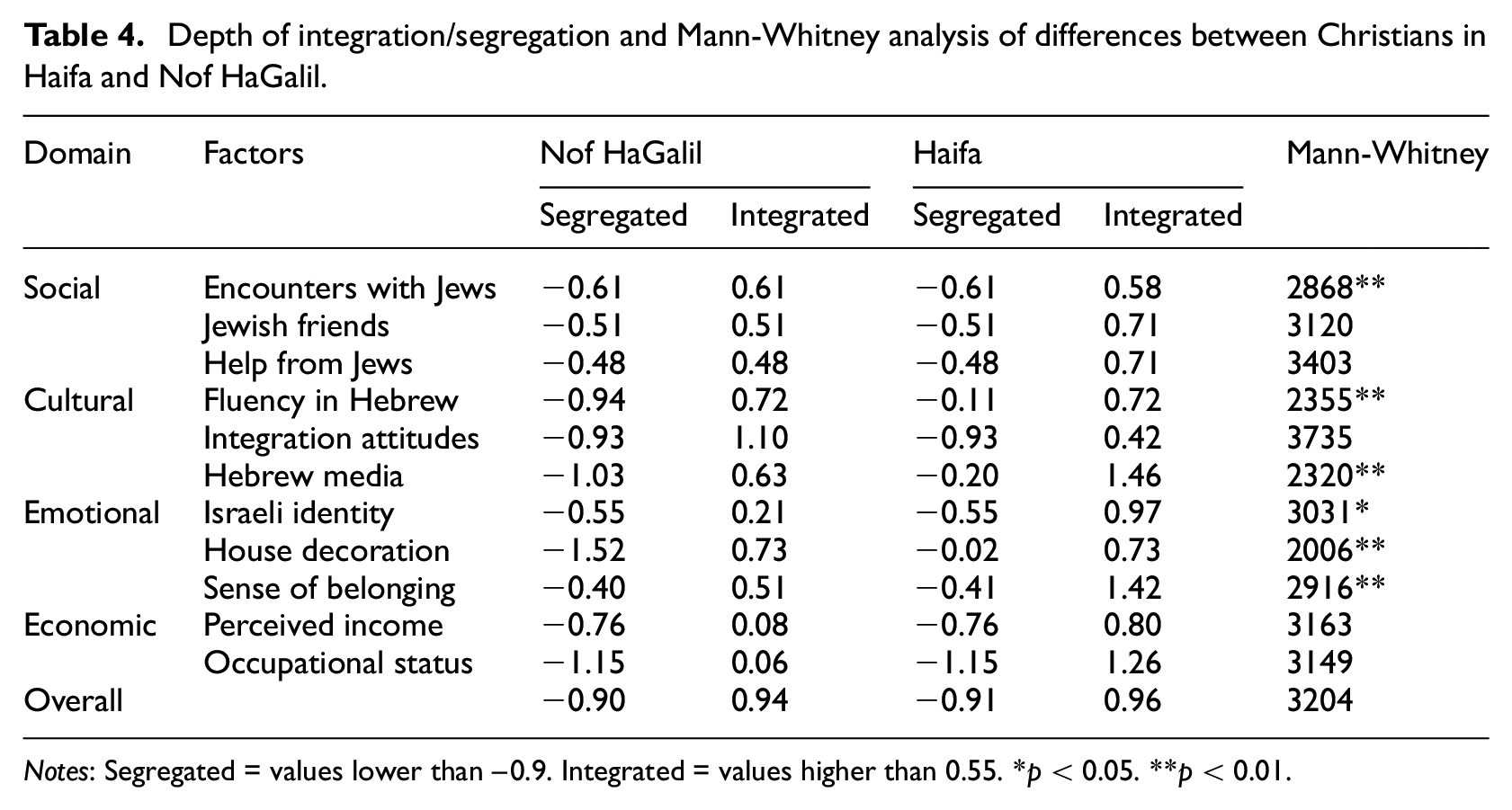
Notes: Segregated = values lower than −0.9. Integrated = values higher than 0.55. *p < 0.05. **p < 0.01.
Segregated Muslims from Haifa also have low occupational status and income and negative attitudes towards integration. In addition, they are less fluent in Hebrew. However, they encounter more Jews, have a relatively high sense of belonging in Jewish spaces and are more exposed to mass media in Hebrew. Integrated Muslims from Haifa have higher occupational status but are characterised by relatively low income. They adopt Western modes of decorating their apartments but do not develop integrative social capital.
Table 4 compares the depth of segregation/integration between Christians in Haifa and in Nof HaGalil. Despite the large differences in the percentages of segregated and integrated individuals, their depth of segregation/integration is about the same. Segregated Christians from Nof HaGalil are largely excluded from higher-status jobs, less fluent in Hebrew and less exposed to mass media in Hebrew, and they tend to adopt more negative attitudes towards integration. They are characterised by a low Israeli identity, less of a sense of belonging in Jewish spaces and not tending to seek help from Jews. Despite their low levels of integration, the more integrated respondents among them enjoy relatively high occupational status and positive attitudes towards integration.
It seems that the integrated individuals from Haifa are members of a new Arab upper middle class who seek integration but are reluctant in other forms of integration. A comparison of Christians from Haifa and Nof HaGalil reveals that while attempts are made to integrate into the Galilee town’s social space, they are significantly limited in almost all indices. Conversely, integration into the Jewish community in Haifa is welcome, as Christian Arabs enjoy a high occupational status, have a higher Israeli identity and consume more mass media in Hebrew.
The main segregative/integrative components
The third aspect of our exploration relates to the contribution of the variables to integration/segregation. Table 5 presents the main integration/segregation components of Christians in Nazareth. The first, which explains 27 per cent of the variance in integration/segregation, includes those with higher income and occupational status. Their success is followed by positive integration attitudes and a higher sense of belonging in Jewish spaces. The second component, explaining 19 per cent of the variance, addressed mainly the emotional aspects, including assigning high salience to Israeli identity and having a strong sense of belonging in Jewish spaces. This is also associated with positive attitudes towards integration, exposure to Hebrew media and seeking help from Jews. Note that seeking help from Jews is associated more with emotional and cultural integration capital than with social capital (Jewish friends and encounters with Jews). The third component, explaining 13 per cent of the variance, is social capital. Together, the three components explain 59 per cent of the variance.
The integration component matrix among the subgroups studied.
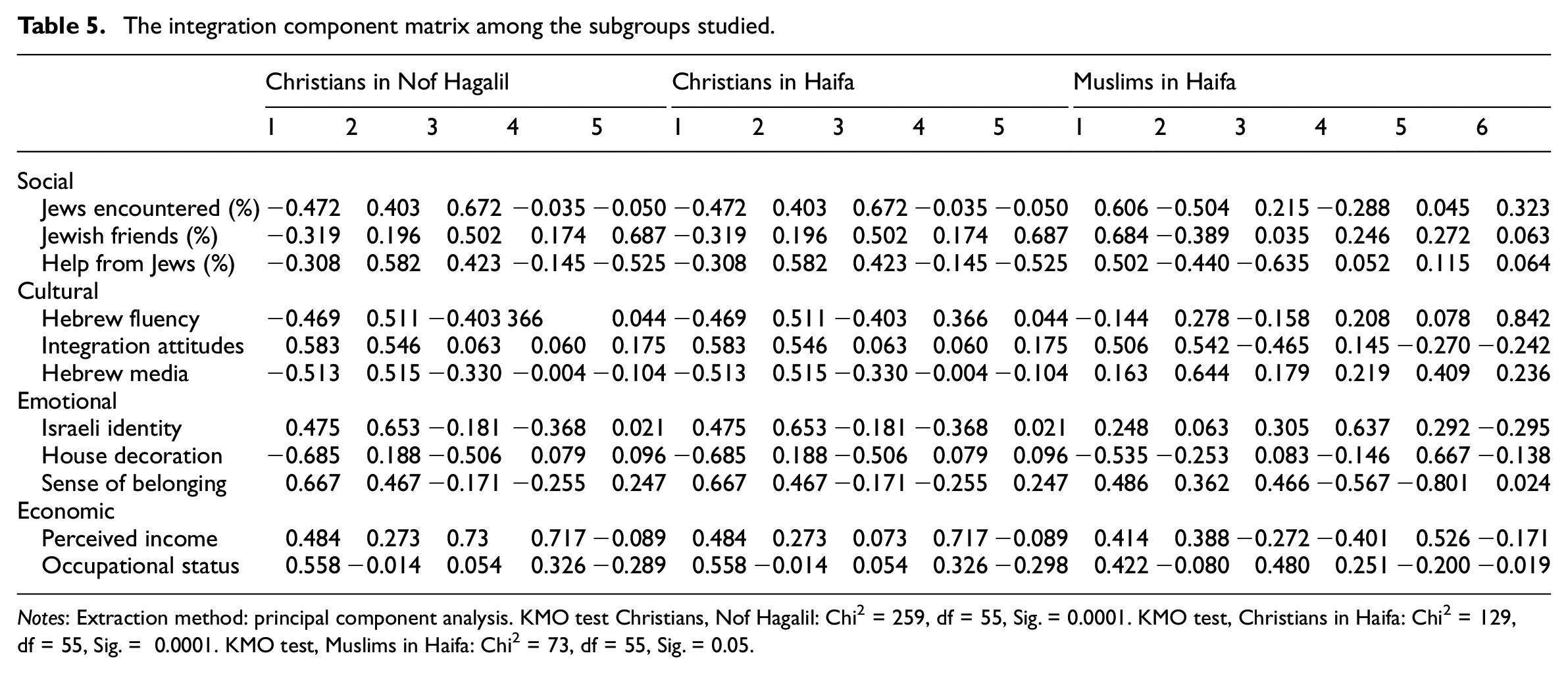
Notes: Extraction method: principal component analysis. KMO test Christians, Nof Hagalil: Chi2 = 259, df = 55, Sig. = 0.0001. KMO test, Christians in Haifa: Chi2 = 129, df = 55, Sig. = 0.0001. KMO test, Muslims in Haifa: Chi2 = 73, df = 55, Sig. = 0.05.
By comparison, Christians in Haifa integrate into the predominantly Jewish society mainly via social integration capital (Table 5). Jewish friends and seeking help from Jews are the leading factors, only partially associated with encounters with Jews. This factor explains 20 per cent of the variance in integration. Positive attitudes towards integration and exposure to Hebrew media as cultural forms of capital explain another 12 per cent, and encounters with Jews add 12 per cent. Finally, high occupational status explains 11 per cent of the variance. Combined, these factors explain 55 per cent of the variance in integration.
Table 5 presents the integration components for Muslims in Haifa. The prominent component is social capital, explaining 21 per cent of the variance. The second includes integration attitudes and exposure to Hebrew media – the cultural form of integration capital – adding 16 per cent. The third consists of a sense of belonging in Jewish spaces and occupational status, adding 12 per cent. The fourth is salience of Israeli identity: 11 per cent. Combined, the four components explain 60 per cent of the variance in integration.
Discussion
The current study applies Schnell and his associates’ multidimensional approach (Schnell and Benjamini, 2001, 2005; Schnell and Haj-Yahiya, 2014; Schnell et al., 2015) to studying the diverse segregation/integration patterns of minority subgroups into the majority social spere. It does so by looking at three groups within Arab society in Israel (Muslims and Christians from Haifa and Christians from Nof HaGalil) to uncover the role of religious affiliation and the standing of a minority community (an established community versus a community of immigrants) in minority integration processes.
The core findings uncover that Christians in Haifa are the most integrated subgroup, followed by Muslims in Haifa and Christians in Nof HaGalil. This suggests that, in this case, place has a greater influence on segregation/integration processes than religious affiliation. Looking at the fringes of these subgroups by focusing on segregated and integrated participants as opposed to those occupying the middle range reveals a different picture, however. Integrated and segregated Christians in both localities have similar integration and segregation patterns. The situation is substantially different among Muslim and Christian residents of Haifa, where significant differences are evident between these groups: Christians are both the most segregated and the most integrated individuals. Thus, among the fringes of these subgroups, religion prevails in determining integration/segregation patterns. This may be because Christian Arabs constitute a minority within a minority and as such choose diverse avenues to integration (Shdema, 2011). Additionally, many of the Muslim residents of Haifa are first- and second-generation immigrants who went there after 1948 for the sake of work, hence reflecting less diverse integration patterns.
The study also uncovers different paths for integration among the three subpopulations. For Christian residents of Nof HaGalil, both labour market indicators and emotional factors (positive attitudes towards integration and a sense of belonging in Jewish spaces) are associated with integration. The integration of their counterparts from Haifa is marked mainly by social capital indicators, and the integration of Muslim residents of Haifa is associated with a mixture of social, emotional and cultural forms of capital.
The current study represents a step forward in studying the context of Arab–Jewish relations in mixed cities in Israel by highlighting the associations between religious affiliation and the characteristics of the locality (a well-established Arab community vs. an immigrant community) and segregation/integration patterns. Falah et al. (2000) demonstrated the diversity in social interactions between these cities but did not address subgroups within them in the context of Arab marginalisation in these cities (Blatman-Thomas, 2017; Tzfadia, 2011; Yacobi, 2002, 2009). Shdema et al. (2018) specified several lifestyle patterns as related to segregation/integration among Arab residents of these cities but did not address specific factors affecting them.
The overall conclusion from the comparison of the two cities is that the city’s socio-historical background makes a difference. In Haifa, marked by an Arab community of relatively long standing in addition to relative tolerance and cooperation, the integration is based on social and emotional bonds, while in Nof HaGalil it is associated mainly with economic factors, as most Arab residents immigrated there for the sake of improving their standard of living. Regarding religion, it seems that not only religious affiliation matters, but within each community religious identity is associated with integration processes due to different affinities of Muslims and Christians to the State and the Jewish society and due to the socioeconomic characteristics of individuals.
More broadly, the study contributes to the urban studies and geographical literature by addressing diversity within minority groups, while many studies (being based on official statistics) have highlighted the differences between those groups (Clark et al., 2015; Johnston et al., 2007). Specifically, it demonstrates the role of religious affiliation and the characteristics of a locality in shaping the interethnic relations in cities. Moreover, the study demonstrates the diversity within subgroups, suggesting that segregation/integration is a result also of personal circumstances and preferences. This is in line with the arguments of Koramaz (2014), Valentine (2008) and Leitner (2012) concerning the interplay between the interpersonal and structural levels of analysis.
Finally, the current study reinforces the multidimensional approach in studying interethnic relations and specifically grasping and presenting the complexities of this framework. This is mainly important in the era of globalisation when individuals may be highly exposed to wide ranges. In this reality, integration is not subject to the identity of neighbours but to people’s exposure to main forms of capital. Some preliminary aspects of this approach have already been used to describe the integration of different ethnic groups in Israel (Schnell and Benjamini, 2001), based on the examination of commuting patterns (Schnell and Haj-Yahiya, 2004), to portray the diverse lifestyles of Arab residents in mixed cities in Israel (Goldhaber and Schnell, 2007; Shdema et al., 2018) and the labour market integration of Arabs in Israel (Shdema et al., 2019). Here, it is utilised to examine the role of religious affiliation and type of locality within this context.
For future directions, we suggest applying this approach to other places which are diverse in terms of immigrants’ time of arrival, to study when they are accepted as a ‘legitimate’ part of the city. Another avenue for further research would be to explore religious identity as well as socioeconomic characteristics as intervening factors in studying the role of religion in segregation/integration processes.
Footnotes
Acknowledgements
Ahmed Baker Diab, Ilan Shdema and Izhak Schnell contributed equally to the development of this article.
Declaration of conflicting interests
The author(s) declared no potential conflicts of interest with respect to the research, authorship, and/or publication of this article.
Funding
The author(s) received no financial support for the research, authorship, and/or publication of this article.
